Thursday, March 08, 2012

On Medtronic's Most Recent Medical Device "Correction"

Yesterday, Medtronic, Inc, the world's largest medical device manufacturer, notified me in clinic about another problem with one of their lines of defibrillators via a Dear Doctor letter (1 Mbyte) headed by the line "URGENT: MEDICAL DEVICE CORRECTION."

It seems this term is now commonly seen on other Medtronic device advisories as well.

I wondered how the marketing and legal folks at Medtronic could use that term on the top of such a letter.  After all, there is no "correction" that I can see in their "Dear Doctor" letter given to me.

By way of background, the letter explained there is a problem with a very small subset of Medtronic's Entrust (US market) and Escudo (overseas market) line of defibrillators which began to be used in 2005.  After 30 months of implant, a drop from 3.0V to 2.61V (ERI) can occur in 1 week to six months in rare cases. It is estimated that there are approximately 39,000 patients with these devices still implanted worldwide with 21,600 of the remaining devices in U.S. patients.  The root cause of the defect described in the letter is thought to be a battery short that develops as the battery in consumed.   Consequently, the battery may not last the expected three months after the device reaches its initial elective replacement indicator and doctors are advised to replace the generator immediately once the device reaches this indicator.  Importantly, no deaths have occurred as a result of this defect but there is a theoretic potential that a device might not reach an effective discharge voltage after the battery depletion occurs.  For doctors and patients, this alert ranks pretty low on the concern scale, provided patients are monitored closely and have their battery-reaching-ERI alerts programmed "ON." (Please see the above linked letter for full details)

This issue of what to call these device alerts is not a small issue. In early 2005 when a rash of serious ICD problems began to surface, they were uniformly called "device recalls." But the Heart Rhythm Society recognized the problems with this nomenclature:

Terminology should be commensurate with risk. HRS has previously recommended that the term “recall” not be used in reference to devices that do not require removal or explant, as it may foster miscommunication and lead to unnecessary and potentially harmful interventions.  Research supports the concept that the specific wording chosen to warn patients has critical implications and that some words (urgent, danger, FDA) and some phrases (FDA Public Safety Warning, Product Danger Alert, Public Safety Warning) are perceived as being just as important as phrases that include the word “recall.” The term “recall” has regulatory and legal implications that extend beyond cardiac rhythm management devices and substantial hurdles must be overcome to change the terminology. Nevertheless, the FDA is encouraged to explore the legal and regulatory alternatives to facilitate the establishment of a simple and intuitive nomenclature to publicly communicate important information out implanted medical device performance.

As a result, the terms "advisory alert" or "safety alert" were proposed to describe less serious communications with doctors and patients regarding important device communications.

So why now "important device corrections?" In cases like this, I feel it would be best that device manufacturers stick with terms that industry and physician groups have agreed so that the appropriate level of concern is conveyed to doctors and patients alike without sugar-coating the defects. That way when these letters are issued, we're all on the same page.

-Wes

Tuesday, March 06, 2012

Developing a Hybrid Pacemaker

Much like a hybrid car recaptures energy lost with braking, so too are technologies being developed to recapture the heart's motion to power a pacemaker using piezoelectric crystals and magnets:

The researchers haven’t built a prototype yet, but they’ve made detailed blueprints and run simulations demonstrating that the concept would work. As reported in the journal Applied Physics Letters, a hundredth-of-an-inch thin slice of a special “piezoelectric” ceramic material would essentially catch heartbeat vibrations and briefly expand in response. Piezoelectric materials’ claim to fame is that they can convert mechanical stress (which causes them to expand) into an electric voltage.


Karami and his colleague Daniel Inman, chair of aerospace engineering at U-M, have precisely engineered the ceramic layer to a shape that can harvest vibrations across a broad range of frequencies. They also incorporated magnets, whose additional force field can drastically boost the electric signal that results from the vibrations.

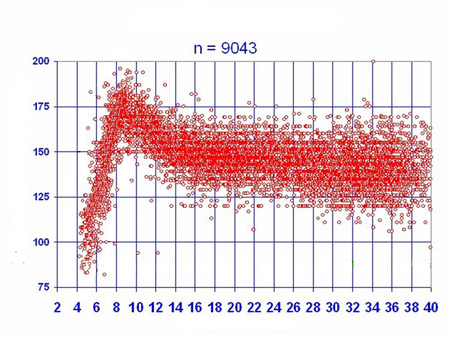
The new device could generate 10 microwatts of power, which is about eight times the amount a pacemaker needs to operate, Karami says. It always generates more energy than the pacemaker requires, and it performs at heart rates from 7 to 700 beats per minute. That’s well below and above the normal range.
-Wes

Monday, March 05, 2012

Sexism in Government Heart Health Programs

I saw this ad campaign sprinkled around O'hare airport last evening:


Click image to enlarge
Ask yourself: are the symptoms depicted in this ad any different for men? Why aren't men targetted similarly? Since men are affected by heart disease more frequently than women, why are men being neglected? Are men's tax dollars paying for these ads?  Do men also have a separate division similar to WomensHealth.gov called to MenHealth.gov? (No, it seems men's health issues have been relegated to a subdirectory of WomensHealth.gov)

While understand the importance of increasing awareness of heart disease in women, let's not forget the issue of heart disease is just as important (if not more so) for men.

-Wes

Wednesday, February 29, 2012

A Million Thoughts

Hope I picked the right side.  She's so thin.  I've gotten away with this before, but you never know, do you?  I wonder if there'll be enough tissue...  Such a nice lady... Antibiotics?  What about the irrigation fluid, antibiotics there, too?  Figures: the vein looks tiny.  Micropuncture'll probably be easier.  We'll numb her up well - can never have enough anesthetic.  We'll work lateral.  Grab some more.  Then medial,  A bit more.  Then one a bit deeper to numb the pre-pec fascia.  Good.  Blade.  Why can't they use the 15 blade?  Damb 10-blade's so big.  Gotta remind 'em to change that.  Okay,  Bovie.  Nice.  Not much tissue here.  Damn mastectomies; bilateral, no less.  We should be fine.  There's a little more tissue here and if we extend the pocket this way.  Yeah, should be fine.  Now, ultrasound.  Hope we get it on the first pass.  Come on...   Okay, there's the blood.  Seems to be flowing freely.  Wire.  Good.   Hmmm, resistance.  Flouro.  The first part looks okay.  Why won't the wire pass?  You don't get many tries if you miss... Pull back.  There.  Now advance.  Come on, come ON!  There.  Feels good.  Fluoro.  Oh, thank God!  Normal course.  Angle to the SVC looks pretty acute.  Dilate, Preform the sheath - hope it doesn't kink.  Good.  Wire passes fine. I wonder if I should doble wire this.  Yeah, safer, especially this time of night.   Good choice.  One lead at a time.  Counter-clock.  Septal.  Stylette back.  Nice.  Let's try here.  Alright, maybe a bit more apical.  Better.  Those are decent R waves.  10 turns.  Nice injury current.  Threshold?  Perfect.  It'll be 0.5 mV in the morning.  Keep moving.  Pre-pec fascia first.  Make sure there's enough lead.  Perfect.  Three ties to the muscle then tie the lead.  Be sure I'm over the sewing sleeve.  Good and tight.  Yeah, it looks pinched.  Leave a 1/4" of suture.  Cut.  Now the A lead.  Big atrium.  Blue stylette.  Nice movement.  Good.  Try here.  Excellent.  10 turns, screw's out.  I like the movement.  Nice injury current.  Same thing.  2-0 Ethibond, good and tight.  Again.  Good.  Leads lie smoothly on the floor of the pocket.  Seems to be a bit of tissue there.  Bovie.  Good.  Check for bleeders.  Bovie.  Let's irrigate.  Look again.  A bit more.  Okay.  Should be fine.  New gloves.  Device?  Atrium first - don't drop it.  Never forget when I did that once.  Set screw looks good.  A little tug.  Nice.  Ventricular lead.  I see the distal lead tip in the header - perfect. I like lots of clicks.   Leads have to lie flat.  No protruding.  Good.  2-0 now to secure the header.  I think there'll be enough tissue.  Gotta be careful about this closure.  Bury the knots.  Coming together  pretty well.  Should be enough tissue.  3-0.  Good.  Too much dimpling.  Try that one again.  Better.  4-0 layer.  Nice.  No pressure on the skin.  Run it carefully.  Bury the knot.   Good.  Benzoin?  Steri-strips.  Make sure they lie flat.  Good.  Gauze dressing.  Tegaderm.  I think we'll be okay.  No swelling, dressing dry. 

"All done, Mrs Smith.  You did great!  No problem at all.  Just gotta watch for arm swelling, as we discussed, okay?"

-Wes

Sunday, February 26, 2012

Friday, February 24, 2012

Teaching Old Dogs

I guess I've now become an "old dog" in medicine.  The residents look younger, the fellows, sharp and trim, and some of my contemporary physicians, like well-worn time-pieces, are beginning to complain of sore knees, backs, and declining vision.  And then there's the nocturia...  

Ugh.

But for those of us who've been around the block a bit, there remains the constant desire to remain up-to-date, novel, even original.  So we try new new things.  Sometimes they work for us, sometimes they don't.  One thing's for certain, however, it's much harder for salespeople to sway us old dogs, because by now, many of our habits are based on past experiences, not press releases.

Take for instance, three-dimensional mapping in the EP lab.  It's cool stuff: electrodes or magnets are arranged around the patient to create an X, Y, Z coordinate system of sorts, and a catheter is moved about inside the coordinate system to locate structures, map arrhythmias, and to facilitate movements of catheters without x-ray guidance.   The pictures are multicolor and stunning.  They are also typically studded with little circular dots placed in locations chosen by a technician to look stunning.  Sometimes, this technology makes a critical difference in the outcome of a case.  Other times, it's probably a waste of money, since some arrhythmias are defined by very well-defined anatomic locales whose need for precisely localized ablation lesions are simply not necessary.

So I was surprised to hear one industry rep remark that "every" new fellow uses 3-D mapping systems these days to ablate anything.  Maybe he was selling his system, maybe not.  But I wondered:  Really?  Even for something as straightforward as a typical atrial flutter ablation?  "Yeah," he said.  "They don't know how to map the old fashion way like you (older) guys do." 

Maybe that's a good thing. Maybe not.  There's much more to successful ablation than locating a catheter in three-dimensional space or placing a dot on an artificially-created geometric surface.  Yet these days, I rarely hear people speak about catheter stability, injury current, unipolar electrograms, or polarity reversal any more.  Instead, when using these 3-D mapping systems, catheter ablation it sounds more like a game of connect-the-dots: "You've got a gap over there."

So too, with our ablation technology. 

This week I finally broke down and tried irrigated ablation catheters for ablation and my experience?  Underwhelming.  There was extra tubing, a stiff catheter, fluid burdens I never had to think about before, and an inability to have any surrogate for catheter contact (such as tip temperature).  In return, I received only a promise of larger lesions, simpler ablation before the case started yet found myself struggling to complete a relatively simple procedure.  Certainly there was plenty that was new and unfamiliar: new catheters, new technology, new anecdotes to remember.  But at the end of both cases I performed, I found myself moving back to a conventional non-irrigated ablation catheter to achieve success.    Needless to say, this ol' dog wasn't impressed.

Now I know there are irrigated ablation catheter proponents out there.  They sing its praises and wouldn't perform catheter ablation with anything but this technology.  But I wonder how many of them ever looked at the physiology of what they're doing.  Years ago, I performed sinus node ablation in dogs with 50 watts of power using an 8mm tip conventional radiofrequency ablation catheter equipped with temperature feedback.  I saw what that much energy did to the dog's heart... and surrounding lungs.  I will never forget that finding.   My practice in man was forever changed as a result of that opportunity.  I find it hard to believe we need more energy than that if there is good catheter contact.

And yet, I now see FDA-approved 100-watt RF generators now and irrigated-tip ablation catheters capable of creating steam pops deep in tissue while having nice cool endocardial tip temperatures displayed that provide an artificial level of reassurance to our younger operators.  I know there's a reason these technologies were developed: influential doctors in our EP community demanded they be developed and industry responded.  Skill levels of operators are different. It was new and innovative.  It promised better outcomes while being acceptably safe, yet without so much as a lick of real-life multi-center case-based post-market proof.

So when I see the relatively high complication risks of atrial fibrillation reported recently, I wonder if some of those complications were from this push to higher power, irrigated-tip ablation catheters capable of making ridiculously larger, deeper ablation lesions in our rush to expedite the procedure couched on the unproven hope that with larger lesions, the need for repeat ablation would be reduced.  Is it?  Are we creating more problems than those we are hoping to solve?  Truth is: we don't know.

Which is exactly why we need an atrial fibrillation registry.  It's also why we need studies like the prospective, randomized atrial fibrillation ablation trial like the CABANA (Catheter Ablation versus Antiarrhythmic Drug Therapy for Atrial Fibrillation) trial to begin to answer such complicated questions.  Whether there will be enough data for subgroup analysis of irrigated tip ablation catheter from non-irrigated ablation technologies in CABANA remains to be seen.   But at least the CABANA investigators didn't require a particular form of energy delivery for the ablation arm of the study.  Will there be value in such a subgroup analysis?  It will depend on the numbers.

At least this old dog remains happy he can contribute to this arm of the ablation trial and hopefully remain innovative and creative in the years ahead while still practicing on the basis of my experience.

And who knows, maybe one day, we'll make catheter ablation safer for our patients as a result - you know: the old fashioned way.

-Wes

Wednesday, February 22, 2012

Truth and Consequences: The St. Jude Riata ICD Lead Recall and It's Possible Implications for Durata

Today, a remarkable tour de force essay on the St. Jude Medical Riata defibrillator lead recall controvery written by Edward J Schloss, MD, director of cardiac electrophysiology at Christ Hosptial in Cincinnati, OH, appears at Cardiobrief.   It is a must-read for all of us interested in the management of patients with the current class of St. Jude defibrillator leads.
In the essay, he reviews two opposing views on the industry handling of this recall, one published as a perspective piece in the New England Journal of Medicine by Robert Hauser, MD, and the other, a rebuttal piece published by St. Jude Medical's Chief Medical Officer and Senior Vice President of Clinical Affairs, Mark D. Carlson, MD. The article reviews the engineering changes made to the Riata line of leads in its evolution to the Durata defibrillator leads and expresses clear concerns about disclosure of all available information regarding lead characteristics to implanting physicians.

This piece is a must-read for electrophysiologists and industry personnel involved in the care of these complicated patients. Schloss concludes:
Anyone who has been in the business of cardiac rhythm management has struggled with the problems of device failures. Because most of these only occur years after FDA approval, having a system for early detection of excess or unique failures is critical.

Industry response to these failures is also critical. Clear, honest acknowledgement of the problem is essential. We also need quick action to define the scope of the problem and create an action plan. These measures go a long way to maintaining the confidence of everyone involved, including, but not limited to, physicians, hospitals, patients, and the investment community.

Every time we, the implanting physicians, implant a medical device, we are taking a measured risk that must be outweighed by its benefits. Understanding this true risk, especially in newer devices, is extremely difficult. By becoming a student of the engineering process of these devices, we can become better equipped to make good decisions for our patients.

We are only now learning the scope of the problem with Riata and Riata ST. The lead mechanical failures and externalizations of this lead may only first occur four to five years after implant. Since Durata leads are only now approaching that interval, it is not surprising that we have not seen many troubling signals with this lead. It remains to be seen what the future holds. Until we have longer experience and collect more data, it us up to individual doctors to educate themselves with available clinical and engineering data so they are equipped to make good decisions.
Go now. Read it all. You will learn something.

-Wes

PS: John Mandrola, MD, a co-editor of Dr. Schloss's piece, also offers an excellent overview of concerns that confront electrophysiologists regarding the Riata/Riata ST lead recall over at theHeart.org.

Friday, February 17, 2012

Just a Rash

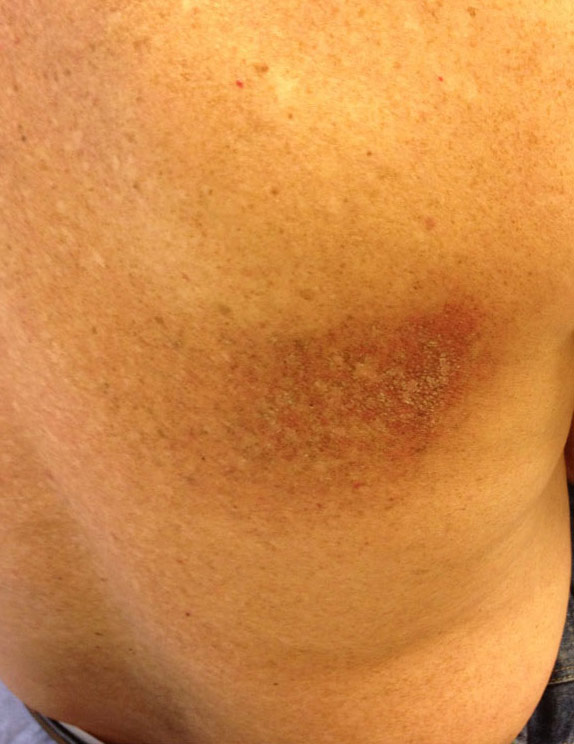
He was referred for consideration of a biventricular ICD implant after a failed attempt at an outside institution. When listening to his lungs posteriorly, a 'little' rash was noted:

Click image to enlarge
What is this?

-Wes

Kicking Cans

The government is remarkably good at kicking cans down the road.

This is the single reason is why government-run health care costs so much.

For instance, we continue to kick the can down the road for the doctor pay fix. Time and time again, we see the Sustained Growth Rate formula fail to be overturned, and instead, Congress vote a few-month reprieve to pay cuts for doctors until they can find another way to either pay those who do the work, or cloak these paycuts in another, less visible and acutely painful way. Look, we all know it's coming: paying a few paultry percent more for primary care while slashing specialists payments 40% was lost on noone.

And now their kicking the ridiculously complex and overly obsessive medical coding scheme called ICD-10 down the road. This morning we hear the purveyors of this money making scheme, the AMA along with their co-dependents at the Health and Human Services claim they will:
“announce a new compliance date moving forward,” the agency says.

“We have heard from many in the provider community who have concerns about the administrative burdens they face in the years ahead,” HHS says.
As if they really care. Better yet, it's as if doctors were on really okay with this coding scheme, but just a little "administratively burdened."

Baloney.

Let me clear: doctors are NOT okay with ICD-10. We never have been. Nor will we ever be. It provides NO value to the patient experience. And let me be even clearer: the REAL reason this can is being kicked down the road is because there are not enough programmers in the world capable of debugging and writing the mounds of computer code accross the scores of information systems out there in the time allotted, nor personnel capable of training all the medical coders and the various permutations of "medical providers" out there on how to use this system.

The delay in implementation of ICD-10 and the inherent costs associated with its implementation and delay of implementation has NOTHING to do with doctors.

Yet this coding scheme and bureaucratic delays of things like the doctor pay fix and the implementation of ICD-10 has EVERYTHING to do with how expensive our health care system has become and how expensive government health care is in general. But you will never see the huge costs of all these delays and hand-wringing accounted for in a non-partisan budget office.

Yep, the reality of these inefficiencies within government-run processes are the poster children for why our entire US health care system is so expensive.

-Wes

Tuesday, February 14, 2012

The Riata ICD Lead Recall: Two Perspectives

Robert Hauser, MD published a perspective piece in the New England Journal of Medicine today entitled "Here We Go Again — Another Failure of Postmarketing Device Surveillance." In the piece, he offers these suggestions on how to detect these failures earlier:
Opportunities have emerged for automated tools to prospectively monitor multicenter device databases for early, low-frequency adverse events and to compare suspect devices with established products that have been shown to be reliable.(4) The goal is a postmarketing surveillance system that not only detects device problems early but also accumulates the data needed to guide patient care. Until such a system exists, St. Jude Medical should initiate a study with these attributes for recalled Riata and Riata ST leads and for the currently marketed Durata leads. Indeed, all manufacturers should conduct postmarketing studies of this type for marketed class III devices that sustain or support life.

It has been 3 years since the FDA launched the Sentinel Initiative, as Congress, in 2007, directed it to do.(5) The intent of this new system is to supplement the current passive adverse-event reporting with an active, real-time network capable of identifying any safety or efficacy issues soon after a new drug or device is marketed and then communicating the information in a timely manner to health care providers and the public. Creating such a system is an ambitious undertaking, and the initiative aims to gather electronic health data from 100 million people by the end of 2012. Formidable challenges lie ahead, such as setting priorities, developing analytic tools, and deciding when and how to alert the public if a safety signal is detected. Thus, we are years away from a fully operational Sentinel Network.
Jay Schloss, MD offers another thoughtful perspective on this issue in his guest post over on Cardiobrief:
It is worth noting that all high impact device failures in the cardiac rhythm device industry have occurred well after device approval. In most cases, failures have been rare events occurring many years after these devices became clinically available. The industry is littered with high profile device failures, some of which serve now as footnotes or memories from the more gray haired members of the EP community: Medtronic polyurethane pacing leads, Ventitex Cadence ICDs, and Telectronics Accufix pacing leads were all devices that failed well after they had been introduced to the market. It was through case reports from concerned doctors – not the FDA — that these problems were brought to light.

Trying to absolutely prevent the failure of medical devices through the FDA approval process would be challenging to say the least. This would require an anticipation of the potential failure mechanism before the fact to design a study that would detect said defect. Moreover, the number of patients and length of study for these trials would be daunting, impractical and quite likely prohibitively expensive.

Hauser’s call to enforce a robust active postmarket surveillance system would allow ongoing innovation and appropriately timed approval of new technology. With the ability to carefully monitor a large population of approved devices “in the field,” sentinel failures could be detected and acted upon as they occur. With public reporting of these events, doctors could draw their own conclusion of whether to keep implanting these devices and prospective studies could then be designed promptly to determine the scope of the problem. That would be a system that protects patients while still allowing innovation.
Neither author mentions how their approaches might be funded. Nor is there a clear consensus on how to determine a threshold for sounding a recall (or "advisory"). Should it be announced before a root cause of the problem is known or suspected, or after? Pulling a recall trigger too early before a root cause of the defect is identified leaves doctors and patients completely in the dark about how to manage these complicated situations. These issues are still debated today.

What is clear, though, is that the efforts to prevent such widespread recalls continue and doctors (as shown by these two perspectives) remain eager to participate in the process.

-Wes

Our New Electrophysiology Annex?

This was spotted by one of our nurse practitioners vacationing in Belize:

Click image to enlarge
Heh.

-Wes

Happy Valentine's Day Edition of Grand Rounds Is Up!

For all the mended hearts, broken hearts, lonely hearts, sweet hearts, crazy hearts, bitter hearts, joyful and happy hearts out there, John Mandrola, MD hosts this week's edition of the medical blog-o-sphere's Grand Rounds at his blog, Dr. John M.

Happy Valentine's Day!

-Wes

Saturday, February 11, 2012

Tremors

I am seeing the world of medicine change before my eyes, and I wonder where we’re going.

Never before has there been more information at our disposal, yet more confusion. Like molecules being heated, the Brownian motion happening in medicine seems completely ineffectual for those of us on the front lines of care, geared more toward expensive facades than substance.

For the most part, doctors keep their heads down. Most of us are busy caring for patients, pushing to get home at least once each week before dinner. Most are humble servants to their patients, working tirelessly for their benefit. Sure, there are a few doctors participating in policy or medical associations, but it's clear to the rank and file that their leadership has already cashed out from patient care and are no longer participants in what medicine has become today. Worse: they’re too few in number and too underfunded and occassionally displayed as hood ornaments to validate a central policy decision.

Then there's call. No one likes call, but it must be covered. Doctors understand that medicine is 24/7/365 affair. But there's more people now, more places, and yes, more call. The burden falls on the doctors, so the tremors resonate louder. No large ones, mind you. But they're happening. Doctors are pleasantly, professionally, reaching critical mass.

I suppose there have always been rumblings in medicine, but somehow, the rumblings seem louder than usual. The promises of more with less is taking it’s toll. There are fewer perks these days for the work and risks involved for doctors. No one seems concerned, really, about liability reform. No one cares about doctor pay, except that it’s too much. Even the physician cheerleaders for the current reform efforts look tired. It’s hard to alter the course of a ship guided by business interests steeped in tradition, I guess.

This week doctors saw residents recalled to fill staffing shortages in a large, new teaching facility across town. Doctors there, it seems, were an afterthought. Residency work-hour restrictions prevent the remaining residents from filling the void left by their colleagues. So the extra workload necessarily falls on those who are ultimately responsible and already at risk for untoward outcomes: the already-busy attending physicians. Residents see it in their exhausted attending's eyes. Nothing is said, but the undercurrent is palpable. You see starry-eyed hospital administrators hell-bent on growth don’t fill those voids, doctors do.

Add to this, doctors read how another insurer has decided to change how they will pay doctors. At least that's how the headline read. But insurers don't pay doctors anymore, they pay their employers. How doctors are paid no longer relies on fee for service - that was gone long ago. But the public is told that the fee-for-service is what is broken. But doctors know what's broken are the incentives to maintain the middlemen that course through every layer of health care delivery that exists today in medicine. And God forbid there be more than a cursory mention of defensive medicine's toll. So the cash cow continues: policy-makers have decided that checking boxes on a computer screen or magically limiting readmissions is how "doctors" are to be paid. As if doctors can look in a crystal ball or should be expected plan for every contingency or every personal decision a patient might make or forget to make. Clearly these policy wonks ever heard of the People of Walmart. You see, for them, it's all about what they perceive is quality, remember, and quality involves a computer these days, not to mention maintaining shareholder value. So while insurers continue to cut payments to doctors and you can't get an appointment, remember: that's "quality" working for you.

Oh, and did I mention there’s a hiring freeze right now?

More tremors.

Can you feel them?

-Wes

Thursday, February 09, 2012

You Know You Love Your Work When

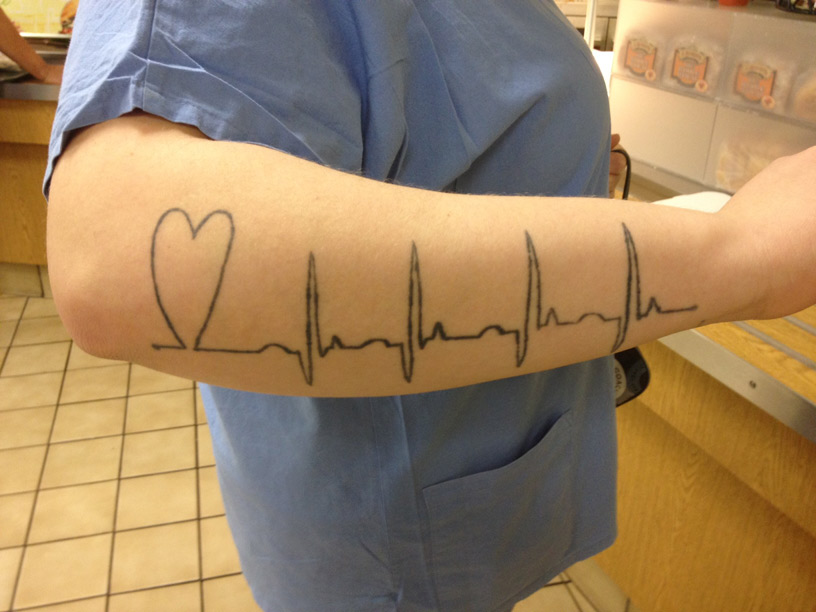
... you work in pathology and sport this cool tattoo (as seen in the lunch line today):

Click to enlarge

Nice!

-Wes

Other tattoos mentioned here:
Anatomical heart tattoos
Another Cool ICD Tattoo
Heart Curves
Taking Matters Into Your Own Hands

Wednesday, February 08, 2012

Our Conflicted Conflicts

This week's Journal of the American Medical Association (JAMA) published a lengthy conflict of interest correction by Eugene Braunwald, editor of one of our iconic textbooks of cardiology and author of over 1000 peer-reviewed cardiovascular publications:
To the Editor: It has been brought to my attention that there were differences in my financial disclosures in a number of articles recently published in JAMA, and this warrants explanation.
Dr. Braunwald explains the varous relationships inherent to discussing virtually any drug in our cardiovascular armamentatium. I encourage you to read the full text.

In reply to the correction, JAMA itself realizes it, too, has erred:
We appreciate Dr Braunwald providing his professional and transparent explanation to clarify the differences in the reported financial disclosures among several of his recent publications in JAMA. We fully recognize that determining relevant financial relationships involves judgment and that reporting of financial disclosure information certainly is not an exact science. In fact, in one of the Commentaries(1) that Dr Braunwald mentions, his co-author, Dr Gheorghiade, had reported to JAMA that he had received consulting fees from Bayer, Novartis, Sigma Tau, Johnson & Johnson, Takeda, Otsuka, and Medtronic. However, these disclosures inadvertently were omitted from the published article. The editors apologize for this oversight and regret this error.
With the depth and breadth of pharmaceutical and medical device company funding of academe, journals, and doctors is so pervasive and the disclosures so inclusive, what are readers to think?

In my view, these doctor-pharma relationships are part of the reason there have been the many advances we have enjoyed in medicine. Without these dollars to academics and their programs, there would be no research programs and little to no innovation. There simply is not enough dollars to support the costs of doing the work from independent sources, especially in today's highly regulated research environment. Companies vested in bringing a new drug to market MUST do clinical trials to prove their safety and efficacy before their drugs are sold in the US. So companies bring their trials to well-respected doctors who see the proper patients. In turn, these doctors present the protocols to their Institutional Review Boards, process the reams of paperwork, ultimately decide which patient(s) might be appropriate candidates for the new medication, prescribe the drug, watch (and record) it's side effects and benefits, treat complications (if they occur), collect and analyze the data (often with research technicians and nurses who help with blood tests and data collection), and publish the papers with the results. And yes, they collect a paycheck each month.

It's what MUST happen to approve ANY drug.

So why all the fuss about a prominant academic cardiologist updating his conflicts in this "gotcha" moment of revelation?

I think in part it's because our drugs (and health care in general) has gotten so expensive. Seriously, if innovative chemotherapeutic drug regimens weren't going into the tens of thousands of dollars (in some cases), we (as the consumers of these drugs) probably woundn't care. But when we see the costs of these new drugs impact to our health insurance premiums and wallets directly, we look for people to blame.

And doctors, the intermediaries between the pharmaceutical companies and patients, are the easy target, especially when so many research doctors later morph into highly-paid marketing spokespersons once the research drug is approved for sale.

Doctors are starting to understand this. But like "The Boy Who Cried Wolf," we now see doctors disclosing everything to everybody so often that few are listening anymore. Disclosure slides are lucky to last a tenth of a second before a talk and most doctors don't mind.

That's because doctors know these "conflicts" inherent to our research process have not changed, because any research takes money - TONS of money. But now, instead of money being given to the doctor and his research program, it goes to "independent" research "institutes" or "foundations" designed to mix their donations with funds from private philanthropic support so the same dollar support is harder to track and gains favor with government regulators. All perfectly legal. All much more expensive. Yet most of it the same.

That's because, believe it or not, when it works, sometimes the collaboration between doctor-researcher and industry can actually become a net positive for all of us.

-Wes

h/t Retraction Watch

Tuesday, February 07, 2012

Monday, February 06, 2012

The Politics of Measuring Outcomes

It's February, and with February comes Valentine's Day, and with Valentine's Day, comes Heart Month, and with Heart Month, comes the department of Health and Human Services press release promising a million lives saved if we just eat right, stop smoking, and have our free blood pressure and cholesterol checks. We are told this bold new initiative will be working to save a million lives. After all, "$1 of every $6 in health care" is spent on heart disease.

But how, exactly, are we going to measure our outcomes with any of these initiatives? Will our feel-good press releases make it so? Do we really have a good system of determining the cause of death now versus several years from now to measure the impact of these programs? Are we really measuring how much it costs to screen all these people versus how much money we save?

Of course not. That would be a scientific approach.

Today we are seeing medicine increasingly managed through politics and empty promises. As doctors interested in saving lives, we would LOVE to see the impact of these simple measures first hand, but we rarely do. Only after ten or twenty years can we see the sudden lengthening of mortality curves from smoking cessation, for instance. Yet smoking, even with it's well-publicized detrimental health effects, is still widely practiced by our teenagers and young adults. More importantly from a cost standpoint (our real problem, right?), even if these prevention programs are effective, longer lives mean more costs spent per person on health care over people's lifetime, not less.

So while I appreciate the government's call for preventative measures in heart disease as a way to save a million lives and save money, we should ask ourselves as money is stripped from government health care in the future, on whom will the health care axe be falling? Sadly, it's likely to be the very people who need the most health care services in the first place: the elderly.

Hospitals and doctors are working hard to cut the fat from our health care spending. Never before has there been such scrutiny on the health care system to save money. Large systems of care provision are being developed to economize and streamline care delivery in an effort to do more with less. But the inevitable cuts to spending on health care promised by the government in the next several years is lost on none of us tasked with the day-to-day responsibility of caring for people in such a setting. As staff are continually pruned and work-hours extended, rest assured there be a flipside to the rosy prevention promises made by our government as cuts to health care funding take effect.

Yet somehow, no one seems interested in measuring the impact these long-term changes will have on our older, sicker patients or on those who care for them.

You see, that wouldn't be good for politics.

-Wes

Thursday, February 02, 2012

Tomorrow is National Wear Red Day!

It's all about heart disease for the month of February and to commemorate the occassion the American Heart Association has designated tomorrow as "National Wear Red Day!"

As most of you know, I LOVE "Go Red" day and all its' marketing glitz that targets women (never mind that more men die of heart disease than women). It's not easy to find a politically-correct cause to piggy-back upon to sell more soups, Seiko watches and candles.

But I'm still behind the effort. Really I am. And so, once again in support of this important event, I'll be wearing red...

Rock on!

-Wes

Wednesday, February 01, 2012

EKG Du Jour #25 - The Exercise Enthusiast - Explained

Sorry about the delay, but unlike most of the EKG Du Jour series of EKG's, I elected to make a separate post to explain the interesting tracings that first appeared here.

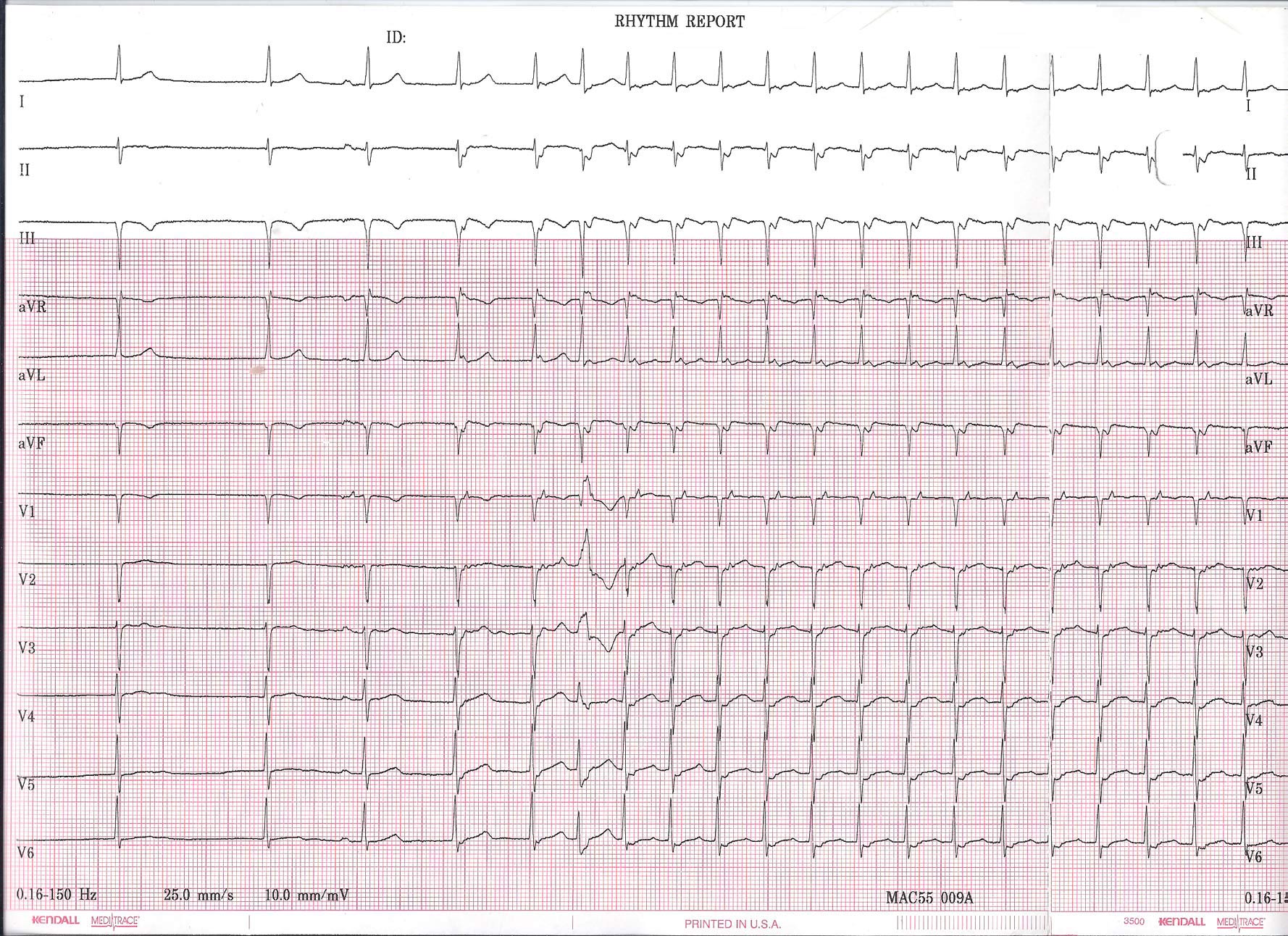
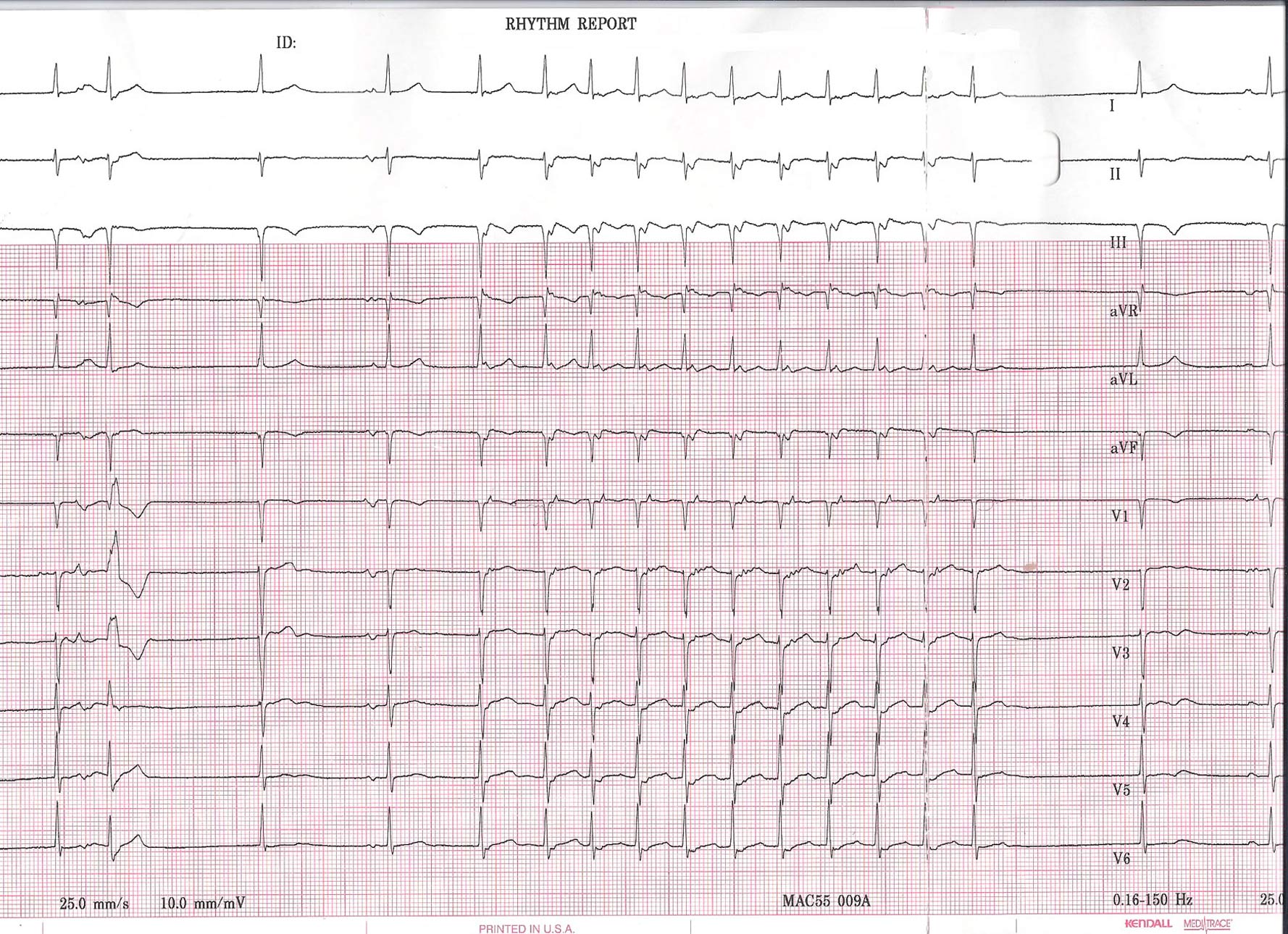
As a refresher, the original 12-lead rhythm strip obtained on this healthy, asymptomatic individual looked like this when he presented for evaluation of two near syncopal spells:

Click image to enlarge
The first two beats do not appear to be preceded by a P wave but have a relatively narrow QRS complex associated with them, suggesting an AV junctional origin to the patient's rhythm. It is possible this man suffers from sick sinus syndrome or has a sinus rate that is slower than his junctional rate while at rest.

The third beat is where things get interesting. Here, a P wave is clearly seen that conducts to the ventricle with a normal PR interval. What is unsual, however, is the finding that the fourth beat (that appears to be junctional) occurs earlier than one would expect than a junctional escape beat to occur (based on the earlier two junctional beats). In effect, this fourth beat appears "pulled in" earlier to the preceding beat, but also has a clearly visible retrogradely-conducted P wave (best seen in V1) that occurs immediately after the QRS complex. At this point, the patient is in a supraventricular tachycardia that accelerates slightly with the fifth beat occurring earlier - probably because of hemodynamic alterations that occur due to the unusual cardiac activation sequence (slightly decreased BP and increased catecholamine level).

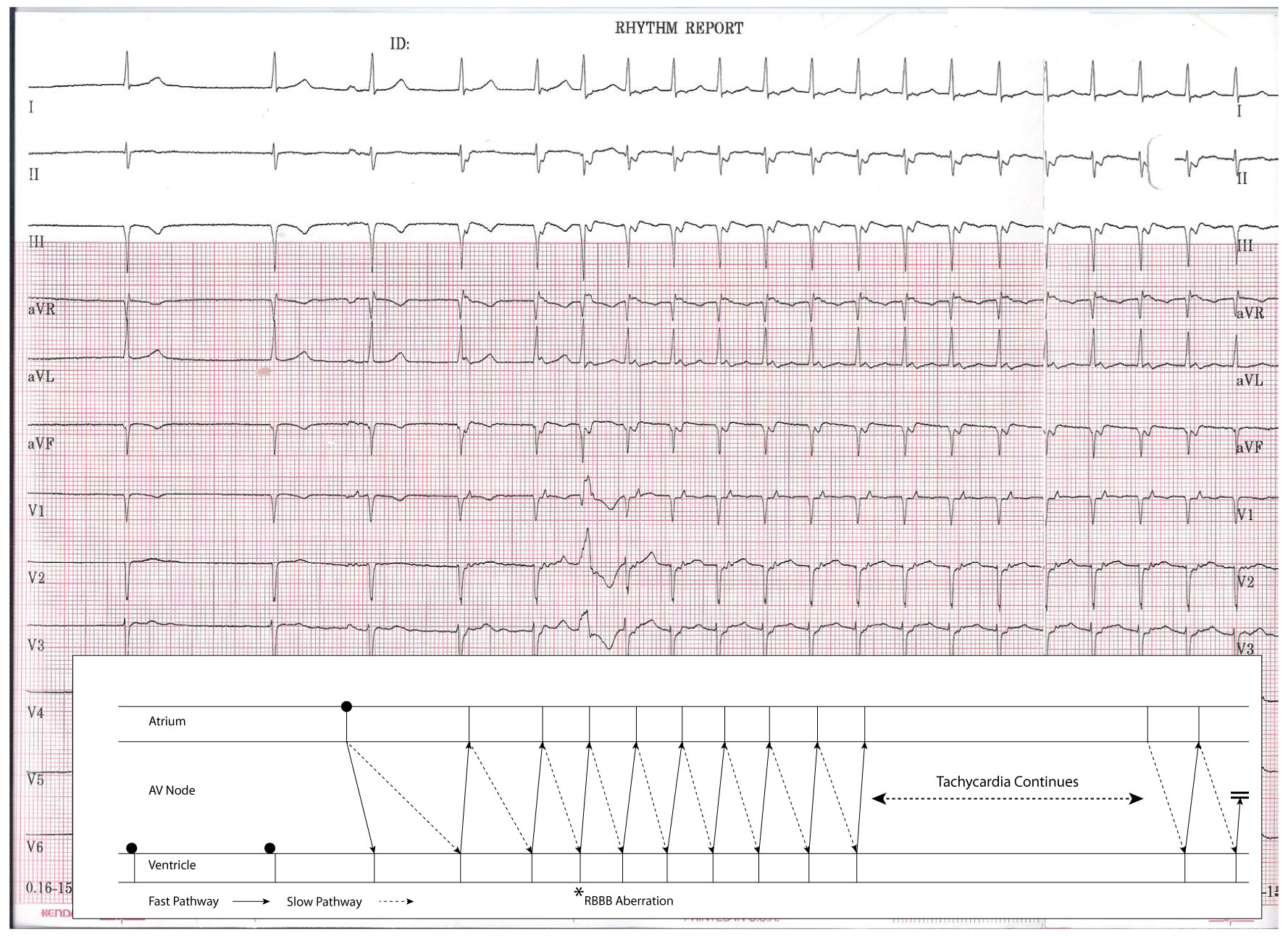
The sixth beat is a widened QRS complex of RBBB morphology. This beat is either a PVC (less likely) or (more likely) an aberrantly-conducted supraventricular beat. This beat aberrates because of the long-short nature of the initiation of the tachycardia that finds the right bundle branch refractory while the left bundle branch conducts to the ventricle. With continued tachycardia, the right bundle branch recovers and the tachycardia continues with a narrow QRS morphology.

The very last beat of the tracing defines the end of the run of supraventricular tachycardia.

So how did the tachycardia initiate?

This is an example of a normal P wave initiating SVT due to AV nodal "double-fire." That is, a single atrial beat conducts down BOTH the fast and slow pathway of the AV node. In this case, typical AV nodal reentrant tachycardia was initiated by a single sinus beat in this gentleman.

Here is the above tracing explained using a favorite of EP's -- a ladder diagram:

Click image to enlarge
To fix this problem, an EP study with slow pathway ablation should be performed with evaluation of the patient's residual sinus node function after the slow pathway is ablated. If his sinus node recover time remains sluggish after the ablation, then (and likely only then) should a permanent pacemaker be implanted.

-Wes

Tuesday, January 31, 2012

Taking Prevention to the Streets

... with a "Heart Cart" that has a remarkable positive screening rate:
Since implementation in 2008, Francis said more than 1,500 individuals have been screened through the Heart Cart. And of those screened, 50 percent of individuals had abnormal findings.

Francis urged all men and women 21 and older to get screened and learn the risk factors.

"The Heart Cart is available to anyone. You don't need a doctor's order to get screened," she said. "The earlier the risks are found, the earlier somebody could take action and prevent a cardiac event from occurring."

Jamie Howell, who helps schedule Heart Cart screenings, said the process is empowering.
But the article fails to note there are downsides to screening, too, like additional non-invasive and invasive testing that might be required once "positive" screening test are identified. Clearly, doing screenings on "all men and women 21 and older," especially those who are asymptomatic and have no family history of heart disease, probably isn't wise for most.

But then again, it's your money... just be sure you know what will happen (and what it will cost) if a test is reported as positive. After all, it seems there's a good chance this van's testing will be, even if you're perfectly healthy.

-Wes

Shining the Light

Doctors are under the Sunshine Act to disclose the dollars we receive from industry:
The Physician Payments Sunshine Act requires companies to begin recording any physician payments that are worth more than $10 in 2012 and to report them on March 31, 2013. That includes stock options, research grants, knickknacks, consulting fees and travel to medical conferences at chi-chi hotels. The details will be posted in a searchable database starting Sept. 30, 2013.
Yes, dear doctor, please disclose anything worth over $10 you receive from drug or device companies.

But how much can a medical device industry employee be incented per year by his own company?

How does $2.5 million dollars per year (page 31) grab you?

You know, the great thing about being a doctor is that you learn something new every day.

-Wes

Monday, January 30, 2012

Medical Information - Differentiating Old vs New

It is better to fail in originality than to succeed in imitation.
- Herman Melville
Medical information overload risks harming our patients.

At no time in medicine has information flowed so freely to our doctors. Imagine: CT scans in the palm of your hand, realtime EKGs telemetered to Emergency Rooms from the field, instantaneous text messages between collegues, literature references easily recalled...

... and 17-page progress notes containing volumes of rehashed information of no clinical value that must be scrolled through, tweets that are re-tweeted, blog posts that are shared from blogs to mainstream media and back again -- all because we can.

We are seeing an exponential growth, not of new, original information, but of rehashed, re-processed, re-published information. We promote this. We see this in our electronic progress notes that MUST contain the same old "same-old" time and time again because, quite frankly, we won't get paid if it's not there. It's as if we say, "the more the merrier!"

But the more there is, the greater the potential for doctors to miss the new stuff: those critical (and sometimes subtle) game-changers.

Finding what's new in the pile of old is becoming one of today's doctors' biggest clinical problems. Increasingly I find I consume chart notes like a bad sandwich, read the first paragraph and the last while ignoring everything in between: there's just too much worthless "filling" in between.

The problem goes well beyond mere EMR note bloat: from twitter feeds, to republished blog posts. Sure we want to get the word out, but the republishing and re-tweeting beast is eating us alive. Why do I need to see a link to a post from three months ago again?

Original thought takes time and careful consideration. Yet we insist that plagiarism has value in our medical records and electronic communications.

Strange.

We need an urgent push to simplify information flow to doctors, otherwise we'll compromise their ability to separate signal from noise. Maybe color code it, hyperlink the redundancies - whatever - but please, dear legislators and information technology professionals, appreciate the beast that is eating us alive.

-Wes

Thursday, January 26, 2012

EKG Du Jour #25 - The Exercise Enthusiast

He was a 65 year-old previously healthy avid exercise enthusiast on no medications who was referred for evaluation of two near-syncopal episodes. The first episode occurred approximately 10 minutes after he stopped exercising on a treadmill. He felt he had to grab the wall to prevent himself from falling.

The second occurred after riding his bike home from the gym. Just after riding his bike home, he became very lightheaded and felt he had to sit on his front porch and nearly lost consciousness. His symptoms passed after resting for about 20 minutes.

While having his blood pressure checked, the nurse noted an irregular pulse. He felt fine and was unaware of his heart rhythm. A 12-lead rhythm strip was obtained and two representative 12-lead rhythm strips from the recording are shown below:

Click image to enlarge


Click image to enlarge


Any ideas? What therapy (therapies?) would you recommend?

-Wes

Strips used with patient permission.

Doctors Helping Doctors (and Their Patients) Via Social Media

It was supposed to be a closed meeting attended by doctors who had a large amount of experience dealing with patients with St. Jude Riata leads, a defibrillator lead that recently garnered an FDA Class I advisory (recall) status due to it's high failure rate. Only 55 doctors and a few industry personnel were brought together to try to determine what to recommend to the rest of us who must deal with this problem in the outside (real) world.

It was 20 January 2012. I was doing an EP case at the time. When I emerged from the room to begin typing my orders, a tech said to me: "Hey, did you see this?"

It was a live Twitter feed from the meeting of one of the attendees - an electrophysiologist from Christ Hosptial in Cincinnati, Edward J Schloss, MD. In those tweets were a play-by-play of important discussions and the results of opinion polls fielded during the meeting. Here's what I saw:
20 Jan Edward J Schloss MD @EJSMD
At Riata ICD Lead Summit in Minneapolis.

20 Jan Edward J Schloss MD @EJSMD
35% of #StJude #Riata Summit attendees think this is a worse problem than MDT Fidelis.

20 Jan Edward J Schloss MD @EJSMD
41% of #StJude #Riata Summit attendees are concerned about Durata and are not implanting it.

20 Jan Edward J Schloss MD @EJSMD
#StJude #Riata US Multicenter Retrospective Trial Riata/ST. Overall failure rate intermediate between Quattro and Fidelis.

20 Jan Edward J Schloss MD @EJSMD
#StJude #Riata bench testing model shows good performance of externalized conductors with or without ETFE insulation breach.

20 Jan Edward J Schloss MD @EJSMD
#StJude #Riata Panel discussants repeatedly emphasize lack of data on natural history of lead. Difficult to reach expert consensus.

20 Jan Edward J Schloss MD @EJSMD
#StJude #Riata Lunchtime conversation: Concern that we're on the leading edge of failures with these leads. Problem apt to get worse.

20 Jan Edward J Schloss MD @EJSMD
#StJude #RIata Ellis-Vanderbilt series of Riata: 26% of leads had externalitzation flouro abnormalities.

20 Jan Edward J Schloss MD @EJSMD
#StJude @Riata 5 of 10 members of one expert panel use flouro screening routinely (in spite of HRS recommendation against this).

20 Jan Edward J Schloss MD @EJSMD
#StJude #Riata Epstein lecture on extraction points out the unique difficulties associated with this lead. Harder than Fidelis.

20 Jan Edward J Schloss MD @EJSMD
@DeltaAssist I'm booked on flight 3104 MSP to CVG tonight and Delta APP indicates delay with no alternative. Help?

20 Jan Edward J Schloss MD @EJSMD
#StJude #Riata Summit poll at completion: Concern went up - now 58% say Riata problem is worse than Fidelis (up from 35%).

20 Jan Edward J Schloss MD @EJSMD
#StJude #Riata Summit poll at completion: Concern went up - now 44% would not implant Durata (up from 41%)

20 Jan Edward J Schloss MD @EJSMD
#StJude #Riata Summit poll at completion: Concern went up - now 55% favor routine flouroscopy (up from 42%)

20 Jan Edward J Schloss MD @EJSMD
#StJude #Riata Summit poll at completion: More conservative philosophy with externalized conductors 76% would not replace (up from 69%)

In reply to Paul Verrastro 20 Jan Edward J Schloss MD @EJSMD
#StJude #Riata Hauser wrap up: We need to look at Durata very closely "put it under the microscope." Calls on SJM to create trials

Edward J Schloss MD @EJSMD
@pjv2217 heading to airport.
(Dr. Schloss's full account of the meeting, with a link to the meeting's slides and St. Jude's response to the report, was published recently at the Cardiobrief blog.)

But what was remarkable to me about this whole affair is that a doctor took it upon himself to help report this important information to his colleagues. By doing so, he likely helped many more patients about to receive a new defibrillator system. After all, it is the doctors in concert with their patient, who ultimately must choose which ICD lead gets implanted when a defibrillator is installed.

My hat's off to Dr. Schoss.

-Wes

Wednesday, January 25, 2012

Medcity News: Ten Cardiologists to Follow on Twitter

Thanks to MedCity News for their recognition today. Good folks, all.

-Wes

Some Downsides of Social Media for Doctors

With the preponderance of optimistic takes on physicians participating (some even suggesting we have an obligation to participate) in various forms of social media through blogging, Twitter-ing, and Facebook-ing, perhaps one of us should take a moment to acknowledge that there are some downsides to this practice for doctors and nurses. Increasingly, I have been thinking a lot about this topic and how to explain it without sounding like "Debbie Downer."

As my perspective has matured in the blog-o-sphere, I have had several insights that have tempered by unabashed enthusiasm for social media. Perhaps it would be helpful to share those to keep the discussion real for doctors considering a dive into this space.


Blogging, unlike diamonds, really is forever

Even if you try to delete a single published post or an entire blog, it's tough to delete all the references to the work that have been reprinted, reformatted or placed in an archived cache online. Further, the anatomy of a single tweet exposes us to the reality of the internet: much more is contained in any post or tweet besides its content - like time, computer type, location. Just as important: you are writing in pen (make that a an indelible marker!), not pencil, when your publish a thought on a social media platform. While this might be a good thing for many, the potential to take prose out of context (sarcastic or not) could have significant legal ramifications for those involved in the care of patients. In my six+ years of writing, I often think about this and wonder if the benefits I have garnered by sharing my insights could be rendered mute by a single legal reference to this blog.

You never hear the bullet that hits you

Way back in October, 2007, Allen Roberts, MD (an ER doctor of Gruntdoc fame) sent me an application that he had received for obtaining "board certification" in Cardiology from an unknown entity calling itself the "American Academy of Cardiology." All he had to do was complete the form, send in $300, and send the money to receive a "board certificate" in cardiology. Allen asked me in his e-mail: "Want to do anything with this?"

Well of course I did! I was the citizen journalist who could end this practice, right?

I researched the organization, the name of the individual, googled the website and its possible sponsor, and quickly realized this was a money-making scam.

So I wrote a post - a very satirical post - but still couldn't conclusively identify the individual responsible for the scam. Remarkably, the first anonymous commenter on my blog post identified this individual by name. Other comments followed with links to other not-so-great untoward activities by this individual. In the interest of full disclosure, I permitted those comments to be published. I felt I did my job and laid the topic to rest.

In June, 2008, while seeing patients in clinic, my front desk clerk handed me a large envelope containing a subpoena and cover letter insisting I appear the following day for questioning at a local lawyer's office. Further, the cover letter insisted I remove the blog post I published on this board certification matter as well as the picture of the fraternity paddle I had emblazoned with the words "American Board of Cardiology." Without going into all of the details, as you can see, the post and picture still stands. But not before my lawyer made three trips to court and I accrued almost $14,000 in legal fees.

Did I win?

I suppose for patients and gullible doctors who might be scammed into purchasing these fake board certifications, I did. But when I consider the costs of the legal haggling coupled with the months of worry for myself and my family, I'm really not so sure. I still wonder why I continued blogging. Perhaps it was to show my "strength." Perhaps because I didn't like to "lose" the right to stand up for what I believed. Whatever it was, I quickly grew up as a physician blogger. I pause every time I'm about to post. From that lesson it became abundantly clear to me: blogging, no matter how careful I tried to be, was clearly not a legally risk-free endeavor.

I also grew to appreciate the power of social media for my patients and colleagues. On occassion when discussing sensitive subjects, the truth can hurt those exposed. But people who decide to attack bloggers who tell the truth risk being even more exposed themselves (this phenomenon has been dubbed "The Streisand Effect.") That's because most bloggers to their homework and are careful to obtain background documents or refer clinical references to support their commentary. Most of all, good bloggers consider their words carefully and know when NOT to publish as well. So if you're going to do this social media thing seriously, realize it does have risks that you might not suspect associated with it. In this regard, it is good to review information offered by the Electronic Frontier Foundation. They have many helpful legal resources for bloggers there, new or old.

Gag Orders

Increasingly, doctors find that they no longer serve just their patients, but because more and more of them are becoming employees, they must serve their employers, too. Because of this new role, there exists a potential for conflicts for doctors between the needs of their patient and the needs of their employer. Although rare, an unhappy doctor could upset the careful balance between care delivery and business policies. Therefore, administrators are careful to protect their corporate policies and procedures. The make sure to place the onus of responsibility for participating in social media squarely on the participant's shoulders. Health care institutions commonly place doctors under restrictive social media policies that ban them from talking about business practices, contracts in place with vendors, and the like.

Can doctors still participate in social media in that setting? Of course! But commentary will be necessarily geared toward the sanitized and polite (some call this "professionalism"). And while I still meet doctors hungry for honest discussions about thorny issues that affect them directly, I have to be very careful what I include on this blog. Each of us must respect the fact that being too forthright could cost us our jobs. In some ways for patients, this is too bad, since honest discussions are potentially "filtered."

While doctors are partially muzzled online by these policies, patients are becoming increasingly vocal. As such, it will be the patients, perhaps in subliminal collaboration with their doctors, that will drive our health care system to improve. Social media is becoming a very effective way for patients to voice their concerns to others, and health care systems of tomorrow are launching their own social media campaigns to counter the potential for those patient concerns to be amplified many times over by others. And for this reason, maybe some of these downsides of social media for doctors will be outweighed by social media's benefits to our patients. Better yet: social media-savvy doctors might become the best voice of reason to address new patient concerns that arise.

Time

This is the Granddaddy downside for doctors of them all. Culling news stories or scientific articles, reflecting on your own personal experiences, placing pen (or fingertips) to paper (or computer), spell-checking (it happens sometimes) and processing feedback are prerequisites for a good physician or nurse blog. Even doctors NOT participating actively on social media are increasingly interrupted by the push of information to their smart phones, be it in the mall or in hospital hall. Surely, I'm not sure the last time I didn't run into someone checking their cellphone. Trendy journalists, ever eager to slam our profession, coin new terms for this phenomenon: distracted doctoring. (Never mind that the journalist has Tweetdeck open on his own computer as he writes his prose and receives his newsfeeds while driving). * sigh *

But we should acknowledge the seductive nature of social media. It is rewarding to post something on line that people can positively acknowledge. There is also an element of mystery and intrigue: who's reading and commenting? Where do they come from? Do they like what I have to say or are they critical? Sadly, bloggers can find out fairly easily. They just set up a little Sitemeter account and they gain the ability to see where and when readers come from. So the statistics are checked again and again - link backs explored - and time is frittered away. Bloggers wanting to grow their readership rationalize this "checking" as necessary. After all, it's all about generating "traffic," "stickiness," and "re-visits." Get enough of these and you can make a dollar from Google Adsense each day or promote your blog to advertisers through it's pageviews.

Sometimes, these time constraints can catch up to doctor bloggers. You simply can't write about everything that interests you on short order. Even if doctors understand this potential pitfall and limit their participation in social media to time only at home, the time required to participate can still intrude on one's personal or family life. After all, each of us are limited to only twenty-four hours in a day. To counter this, doctors should plan blog-breaks, sabbaticals, or even shutting things down temporarily or permanently. These breaks should not be seen as a sign of weakness (despite what happens to your Klout score or Technorati ranking) on the physician blogger's part, but rather, healthy insight into blogging's toll on life's other important priorities. For the reader of doctor blogs used to seeing instantaneous feedback from other non-medical social media sites, if a doctor doesn't respond to every comment within minutes, publish a post every day or even every week, then at least they'll understand where doctors are coming from.

This is not to say that doctors don't get things from participating in social media ourselves - we do. We learn from our patients. We learn from our colleagues. We develop a network where we bounce ideas off each other. We gain useful information quickly that we can apply to real-world problems. Beyond this, writing a blog can be therapy, a sounding board, or an information font. We can use social media in creative ways: for reference organization, to make considerable income, or maybe do it just because we like to write.

The Take-Home

So after all of this, what do I really think about social media for doctors now?

I feel social media's benefits for doctors are probably net neutral: not awesome, not horrible.

It is what it is.

In our increasingly connected medical world, social media will be an asset for some, a liability for others. Where it settles out will be a personal choice. Social media doesn't make us a better doctor, it just makes us a better public doctor that likes to write and type. It is not more than that. Doctors who have no typing skills can still have exceptional doctoring skills, but they'll probably never participate in social media and that's okay.

But there is one thing I know after all of this: whatever our new electronic medical world will become in the years ahead, social media use by our doctors of tomorrow sure isn't likely to go away.

-Wes

Tuesday, January 24, 2012

Medical Grand Rounds at USAToday This Week

Be sure to check out this week's Grand Rounds hosted by Val Jones, MD over at USAToday's Healthy Perspective blog.

Because of the number of submissions included (55!), Grand Rounds will be divided in to four posts - one at 10am (Health Tips), 1pm (True Stories), 5pm (Myth-Busters & Controversies), and 8pm (Healthcare Costs) today. So check back often to healthypov.usatoday.com to digest some of the best of the medical blog-o-sphere this week.

-Wes

Monday, January 23, 2012

Congressman Mark Kirk Suffers Stroke

From the Chicago Tribune today:
A Kirk spokesperson says the 52-year-old senator checked himself into Lake Forest Hospital. He was transferred to Northwestern, where tests showed he'd suffered a stroke.

A statement from Kirk's office says the surgery was successful and that doctors are "very confident" in his recovery based on his age and health.
My guess: if the surgeons are "very confident" in his recovery, more likely than not the stroke was not hemorrhagic, but embolic. If so, clinically asymptomatic atrial fibrillation is probably the most likely etiology for his stroke.

Our thoughts and prayers are with him and his family.

-Wes

Addendum: Non-dominant hemisphere?

Addendum #2: 12:55 CST: Ischemic etiology reported.

Addendum #3: More detail - Spontaneous R carotid dissection?

Background on this.

Honesty Is the Best Policy

It goes without saying: if procedures have complications, be truthful with the public and with patients. Otherwise, some might publically question your outcomes. If that happens, noone is likely to benefit.

-Wes

Wednesday, January 18, 2012

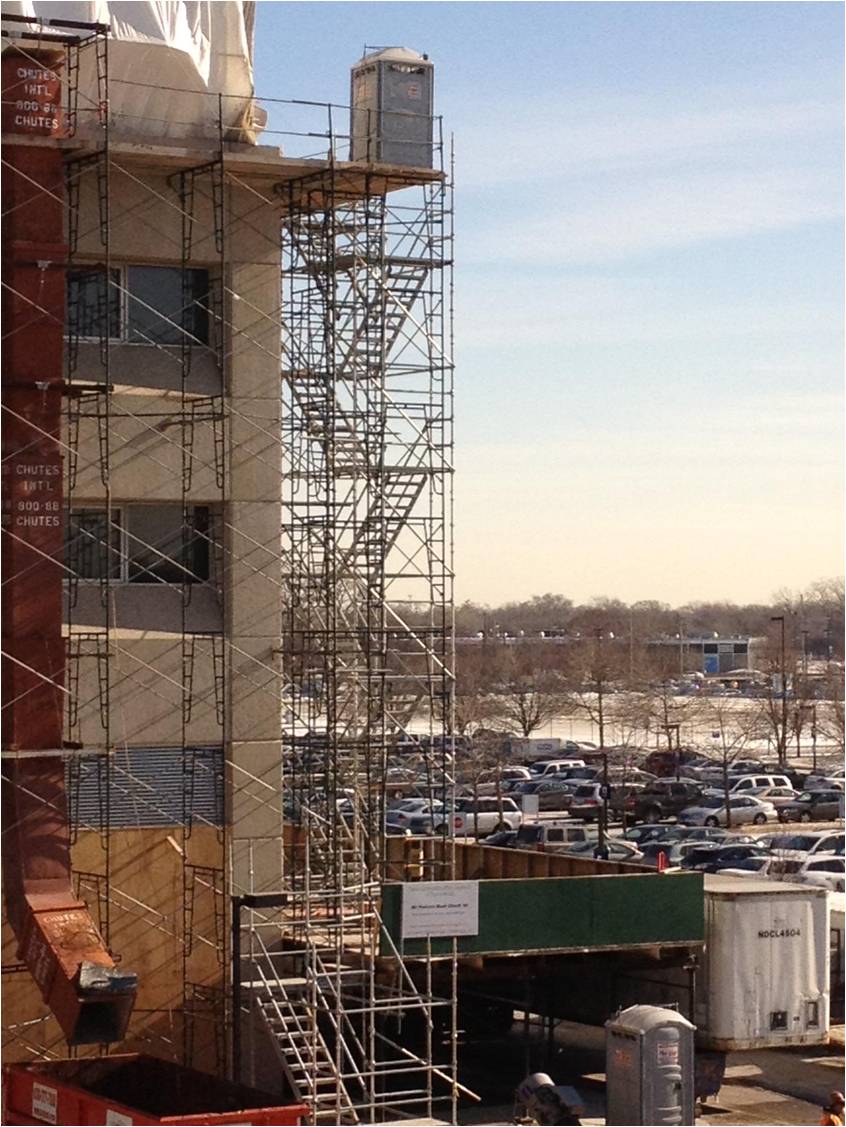
Caption Contest: Taking It to New Heights

Click image to enlarge

Yes, it's a porta-potty and yes, this is the view outside our clinic lunch-room.

Now, you pick the picture's caption.

The winner will be chosen by our office staff later this week. What's the prize? Sorry, our new Physician Payment Sunshine Act limits the prize to bragging rights only.

Good luck!

-Wes

Tuesday, January 17, 2012

Chowing Down On Microchips

Imagine a "smart pill" containing a microchip that tells a computer when you've taken your medication.

Reality? You bet:
UK-based retail pharmacy chain Lloydspharmacy has inked an exclusive deal with Proteus Biomedical to launch Proteus’ first commercial product, Helius, an offering that includes sensor-enabled pills, a peel-and-stick sensor patch worn on the body, and a mobile health app. The patch records when a pill is ingested, tracks sleep patterns, and records physical activity levels.
Will it affect medication complicance?

I'm not so sure.

But the idea of a smart phone reminding folks they've skipped their medication might be pretty useful for some, provided they don't eventually suffer from a second potentially more severe malady: alarm fatigue.

-Wes

Grand Rounds Is Up

... over at Codeblog - tales of a nurse:
Whereas in the past the host would post nearly every link they received, it appears that we are now moving towards more curated content. I said in my previous post that I wasn’t going to institute a theme, but I was definitely more drawn to the personal-story type posts.
Enjoy.

-Wes

Sunday, January 15, 2012

Oops: Transplant Heart Dropped On the Way to the Recipient

... and it was caught on video:


Talk about the "10-second" rule!

Heh.

-Wes

Large EMR's: The Back Story

I was surprised to see the backstory of EPIC Systems of Verona, WI, appear in the New York Times this morning. EPIC is one of the "biggie" electronic medical record systems that boasts 260 customers covering some 127 million patients' medical records by 2013. The article covers how the company was started and makes sure to mention the fact by Judith Faulkner, EPIC's CEO, that “to the best of our knowledge, in the 32 years we’ve been in business, there has never been a breach of Epic’s data by a hacker.” (Seems like a glove was just thrown down to this reader.)

Still, Ms. Faulkner adds:
“I’m worried if we put up too many barriers in order to make things private, and if that makes the flow of information slow and hard to share, in effect more people will be harmed,” she says. So far the committee has maintained that balance well, she says.
Balance? Hmmm.

So far, there appears to be huge skewing of information provided to health care administrators rather than doctors these days. For instance, when a doctor wants to know how many procedures their group has performed according to data they themselves entered into the Electronic Medical Record, they meet resistance. (This is not a small issue for doctors increasingly held accountable to MGMA benchmark productivity standards for their income.) Trust is a critical issue in medicine and doctors must feel they trust the data being given to them. The Electronic Medical Record systems of tomorrow should foster this kind of data transparency for doctors, not provide statistics from inaccessible data warehouses.

Doctors are eager to use their data for their patient's benefit. And yet they see these proprietary systems that carefully-control access to information as impediments to care rather than as facilitators of decision making. To date, this end-user still has yet to see any electronic data flow from one institution's EPIC data pool to another. Perhaps this capability will be realized some day, but for now, we still must request paper records from fellow EPIC institutions manually. While this limitation may be part of the "balance" to which Ms. Faulkner alludes, to doctors on the front line of care provision, this "balance" currently feels quite skewed away from patients and doctors.

Doctors are the largest and most influential contributors to the electronic medical record data and the cost of medicine. We see how these systems affect our patients first-hand. Unless change comes quickly to permit doctors to be involved in decisions based on the data they themselves provide the system, restricting their access to aggregated data assessment might become the greatest electronic medical error in the foreseeable future.

After all, how else will we ever be able to credibly challenge the potential for a critical programming or statistical error that could ultimately affect 127 million lives?

-Wes

Friday, January 13, 2012

My Health Care System Starts a Blog

This post represents post number 3000 to this blog. (Not all have been published - some sit as kernels of brilliance to bestow upon my readership at a later date when the time is right or after I rework them a bit). As striking as that may seem to some, I must say that this effort was finally acknowledged by my institution in an indirect fashion: they launched their own blog today. Very cool. It looks nice, but like most blogs just getting started, I suspect it will take them a while to find their "voice." Still, it's nice to see them entering the fray.

Social media with it's quick, informative blasts of information is particularly suited to today's more mobilely-connected patients. Gone are the days of cloaked, back-room, one-on-one information exchanges held solely in the privacy of a doctor's office. Instead, the ability of people to receive information quickly and interact with trusted sources of that information adds benefit to the health care experience for both the patient and the their care providers. With their blog's launch today, my hospital system has officially complemented their other Trifecta of social media engagement already underway: (1) Facebook, (2) Twitter, and (3) Youtube.

So while it's just a start, here's welcoming NorthShore University Health System's PR department to the blog-o-sphere. Head on over and offer them a bit of link-love. That way, they'll have to keep me around just a little bit longer.

(Heh).

-Wes

Fisher House Reaches LeapFrog Status

PRWeb (Chicago, IL) – Following an unprecedented first winter snowfall, the Fisher household achieved LeapFrog status attaining complete snow removal by no later than one hour before family members were scheduled to egress the premises. “This represents a landmark achievement by any house in the neighborhood,” says Mortimer T. Schnerd member of the 12-member LeapFrog assessment team. For the second year in a row, not only will the Fisher residence reach the 100-Most Wired Houses milestone, but also reach the US News and World Reports 100-Best Small Houses ranking on the North Shore of Chicago. “I would have also picked up the dog poop in the yard, but that was not in my wheelhouse,” said Westby Fisher, MD, owner of the esteemed home, “It was only through the tireless efforts of the whole family team, that we were able to reach this important benchmark.”

Media inquiries should be directed to the Ms. Sally Smith, Director, RealEstateByDesign PR, LLC, 2 East Park Ave, New York, NY 00221
(800) 555-1234
On Twitter: @WeBeBad

* * *

Wednesday, January 11, 2012

Duly Notified

Warning: You are entering the chart of a deceased person

What?

What happened? They called me about him. Said he was sick. He stared again at the message.

Warning: You are entering the chart of a deceased person

Should I open the chart? (Screw it - I need to find out what happened!)

But what if I do? (I'm not trying the alter the chart. Really. It's not my fault no one called me to tell me he died, is it?)

Warning: You are entering the chart of a deceased person

Why didn't they call me? I'd been caring for him for nearly ten years! I knew his story, his family, his wonderful personality. The ER said he looked sick and they were going to admit him.... Then someone called ... Didn't think he needed to be in the ICU... Who was that again?

Warning: You are entering the chart of a deceased person

Can't I just get his number to offer her my condolences?

Warning: You are entering the chart of a deceased person

-Wes

Tuesday, January 10, 2012

Eliminating Waste in Health Care

It's the new rage: eliminating waste in health care:
Nine medical specialty societies are joining with the American Board of Internal Medicine Foundation and Consumer Reports to curtail waste in health care and improve patient outcomes.

As much as 30% of U.S. health care is squandered on unnecessary tests, procedures, hospital stays and other services, according to the Congressional Budget Office. Such services don't benefit patients, and in some cases may harm them.
Specialty societies are joining forces to stamp out medical waste in all its forms, even resorting to petitioning their members to come up with ideas to save money.

Honestly, this should have been done long ago and should remain an ongoing priority.

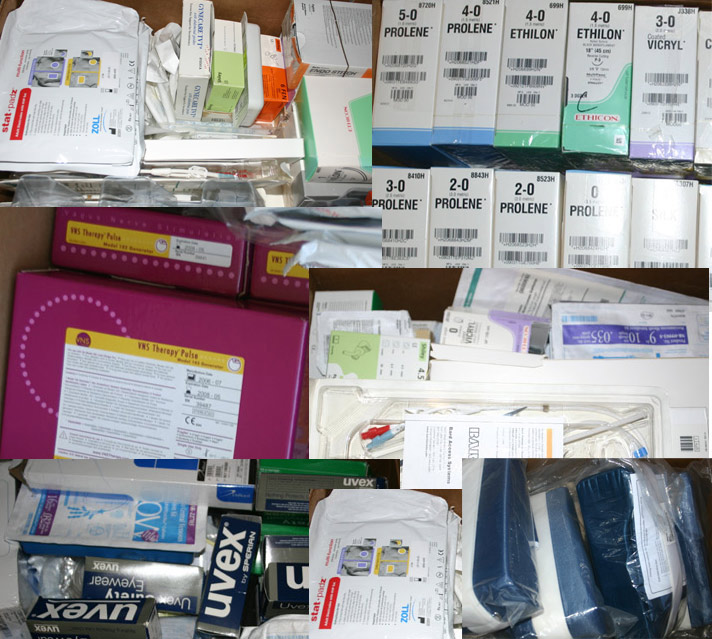
But I'm going to stick my neck out and mention an area that no one ever discusses. It's an area of waste so vast that it would dwarf all of the recommendations that are likely to come any or all of these surveys. It's an area of waste that plagues every hospital, long-term care facility, rehab facility, or nursing home in our country, yet benefits every device manufacturer and supplier to our health care system.

What is it?

Medical supply planned obsolescence.

What do I mean by this? I mean the waste generated every day in our health care system by expired medical goods.

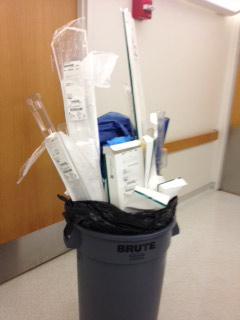
A Sampling of Expired Medical Supplies (click to enlarge)
Every day, week and month in our health care system, thousands of pieces of perfectly good medical equipment "expire." That is, their expiration date - similar to the expiration date noted on foods you eat in the grocery store - comes past due. At that instant, they can no longer be used by patients and become worthless items that must be removed from shelves, discarded, or donated. Companies will not take them back or exchange them. Re-use in America is banned. Thanks to the World Health Organization, even donations of expired goods to developing countries are banned because of their core principles regarding guidelines of medical supplies that states "there should be no double standard in quality: if the quality of an item is unacceptable in the donor country, it is also unacceptable as a donation." Such donations are even frowned upon by many veterinary clinics.

Never mind if they are non-sterilized plastic jars. If they have an expiration date that is past due, they are discarded. If they are expired shiny, new metal or plastic medical instruments that could easily be re-sterilized (think laparoscopic staplers, attachments and the like), they are discarded. Double-wrapped IV fluids? Sutures? Drape kits? Gloves? These too are discarded. You see, you can never be too safe.

In fact, expired medical equipment fills many landfills (a must-see video) both here and overseas.

Certainly there are concerns about sterility and the decomposition of medications and materials that occurs with time. No one wants to accept the liability that expired medical goods could have been the cause of illness or infection. This is certainly appropriate.

But how many thousands of pounds of medical goods are discarded each quarter from our nation's hospitals that could be re-purposed, re-sterilized, re-packaged to give us HUGE cost savings to our health care system? Could expiration dates be extended safely without compromising quality?

No. One. Knows.

Why?

Because there's no incentive to do so and it's not in the economic interest of the suppliers to find out.

But given the millions (and probably billions) of dollars wasted on expired medical equipment each year, isn't it about time we do? Even if we can only extend the purposeful shelf life of supplies from five years to six, we likely could save hundreds of millions of dollars (or more) for our health care system.

And who knows, maybe we'll do something good for our planet along the way.

-Wes

Saturday, January 07, 2012

It's Time to Look Critically at Board Certification

From Edwin Leap, MD:
Unfortunately, the rank and file is very unhappy. There is remarkable discontent, and considerable anger, among the lesser physicians. That is, the test takers, the physicians in practice subject to the new rules, the ones who have to add one more rule, one more activity, one more form, one more check to their already busy lives.

That discontent, that anger, that frustration on the part of practicing physicians is, in my opinion, very rational. It’s a tough time in medicine. Our regulatory burden grows by leaps and bounds every year. We are watched and harassed, by CMS, by JCAHO, by our state medical boards, by our insurers, by our hospital staff offices and now, most painfully, by our own specialties.

Of course, all of it comes in the context of falling reimbursements, a federal government licking its lips for any spurious allegation of fraud and a system in which EMTALA forces physicians of all specialties to see patients for free, even as government insurance programs pay less than the over-head to see their patients (and fulfill the regulatory guidelines required for the privilege of doing so).

In light of all of this, I have to ask ABEM and every other board certifying body, a simple question:

“What are you people thinking?”

Here’s the reality. Our certifying bodies should be our greatest, most passionate advocates. When the Institute of Medicine issued a report some years ago that said physicians were killing people on a scale consistent with the holocaust, ABEM should have looked at the data and refuted it. ABEM, and ABIM and all the others should have taken our fees, run out and found the best PR firm they could afford. “We stand by our physicians and we have serious questions with these research results and the way they are being interpreted.” That would have been a good use of my dues. That would have merited high salaries for everyone in every board that stepped up for its members.

Instead, at every step, ABEM seems to argue that “the public” wants us to be watched more closely and tested more frequently. Except, I’m not confident that’s true. The public never cares where you went to medical school. The public thinks most emergency physicians are interns hoping for a “real practice” someday. The public wants affordable, quality care. The public, in practical terms, doesn’t know the difference between a physician, a PA and a nurse practitioner, and often calls all of them “doctor.” The public, furthermore, tends to believe that mid-level providers are more attentive to their needs. (Despite their lack of board certification; shocking indeed!)
There's plenty more.

Go now. Read the whole thing.

-Wes

From my archives on the same subject:

1) Posers
2) Alphabet Soup
3) BoxTop Board Certification
4) Board Certification - Pay to Play?
5) The Cost of Our Medical Licensure Complex

Better Health Says Goodbye

Sad to see it go:
2012 will mark Better Health’s 4th year anniversary of group medical blogging. I began Better Health with the hope of organizing “voices of reason” in the health blogosphere so that our ideas would enjoy greater circulation and be more influential. We were the early adopters of social media – some of the first physicians, nurses, patient advocates, and scientists to join together to provide trustworthy content to our readers via blogs. We grew to represent over 130 bloggers and, over the years, were joined by such prestigious organizations as the American College of Physicians, Harvard Health Publications, Diario Médico, and the Centers For Disease Control And Prevention. I am proud of our excellent writing, and I know that we touched many lives through our blogging.

Many of our contributors have enjoyed such success in blogging that they are regular features of several publishing platforms. Others have gone on to careers in social media education and are now sought-after speakers across the U.S. and beyond. Today’s blog audiences often receive their health information via personalized “filters” on Facebook and Twitter, rather than specific websites. And so for these reasons, Better Health has achieved its purpose to promote medical bloggers. I will discontinue future publication of blog posts at the getbetterhealth.com website as of today. Better Health, LLC will continue on as my personal consulting company.
Here's wishing Val Jones, MD, the guiding light behind Better Health, all the best in her future endeavors.

-Wes

Friday, January 06, 2012

Fun In the Coed Cath Lab Locker Room

I have to admit, when I saw our curtained changing area, it made me hesitate momentarily:


Fortunately, it was just the work of some creative techs:


... having some Friday fun in the coed cath lab locker room.

-Wes

Thursday, January 05, 2012

How to Stop Incenting EMR Note Bloat

It happened again today: an elderly lady with critical aortic stenosis with all it's cool findings: late peaking harsh, palpable murmur, Gallavardin phenomenon, LV heave - the works! And what did the electronic medical record from the intern picking up the patient say?
"CV - Irreg rate and rhythm, no murmurs, clicks or rubs."

No doubt this was a documentation macro that was not edited or else the intern failed to examine the patient (or maybe both).

No excuse! It's time to end the crap being spewed forth into electronic medical records!

I say that every time such a note is discovered like this by our new medical trainess, they fail their rotation. Yep: make the penalty severe and make it stick! That way, they'll think HARD about what they contribute to the medical record and be held accountable!

Of course there's a few sticky problems with such a heavy-handed approach:
  1. Attendings do not critically review what is actually written in the chart by interns because it is buried in pages of electronic morass and rarely found, and...
  2. No one has a clue what to do to attendings who do the same thing. After all, when it comes to getting paid for your work, it's not about what doctors write in a chart, it's about how many things doctors write about so they can bill the government for their professional services.
-Wes

Tuesday, January 03, 2012

Tough Guy Does CPR Hard and Fast

While it might not be quite as funny as the Portugese Cardiology Foundation's Big Belly People video which takes a stab at the obesity epidemic, the British Heart Foundation does a pretty good job getting the "hard and fast" message out for "hands-only CPR" using British tough-guy Vinnie Jones in its new TV ad:


Heh.

-Wes

Monday, January 02, 2012

Giving Thanks to a Rule-Breaker

The call never should have been made.

It broke every proscribed rule.

After all, I was not on call. Thanks to the wonders of computer technology, it was very clear that I was being covered by my colleague. And yet, despite this, it came.

“Dr. Fisher, I’m so sorry for calling you at home, but I received a call from Ms. X, the wife of your patient Mr. Y. who said she really needed to speak to you about her husband... she seemed quite concerned and insisted I call you…. I told her I’d see if I could reach you at home… I’m so sorry, but it sounded urgent… I have her number, could I connect you?”

“That would be great, thank you…”

I wish I got the name of the operator that evening. I have no idea what intuition, what verbal cue she received that prompted her to break all the rules. She was, after all, just a hospital operator who should have followed the playbook but decided to take a huge personal risk to rely on her judgment instead. There was no playbook, no algorithm involved – in fact, it was just the opposite.

But one thing’s for certain: this operator should to know that the patient, his family, and I will be forever grateful.

Thank you.

-Wes