Showing posts with label medicine. Show all posts

Sunday, March 15, 2015

Live Video Feeds at Medical Conferences

I woke this morning in a cold sweat as I found myself wrestling with a thought.

Am I Big Brother?

The explosion of social media in our society, and at medical meetings in particular, is changing how our society, and medical professionals in particular, work and interact.  There is potential for tremendous good: social media to market, to promote, to communicate rapidly, to effect change.

But the social media story is not always one of roses.

My talk at the 2015 American College of Cardiology Scientific Sessions referenced a factoid that I am not smart enough to completely verify, but I suspect isn't too far off the mark: that in January of 2014 there were 7,095,476,818 people in the world and 6,572,950,124 (93%) of them had mobile phones.

Think about that.

Everyone has a camera with them.  Everyone at meetings (especially scientific sessions far away from the office) is shooting pictures of abstracts, friends, selfies, drug company displays … whatever - despite a policy to the contrary.

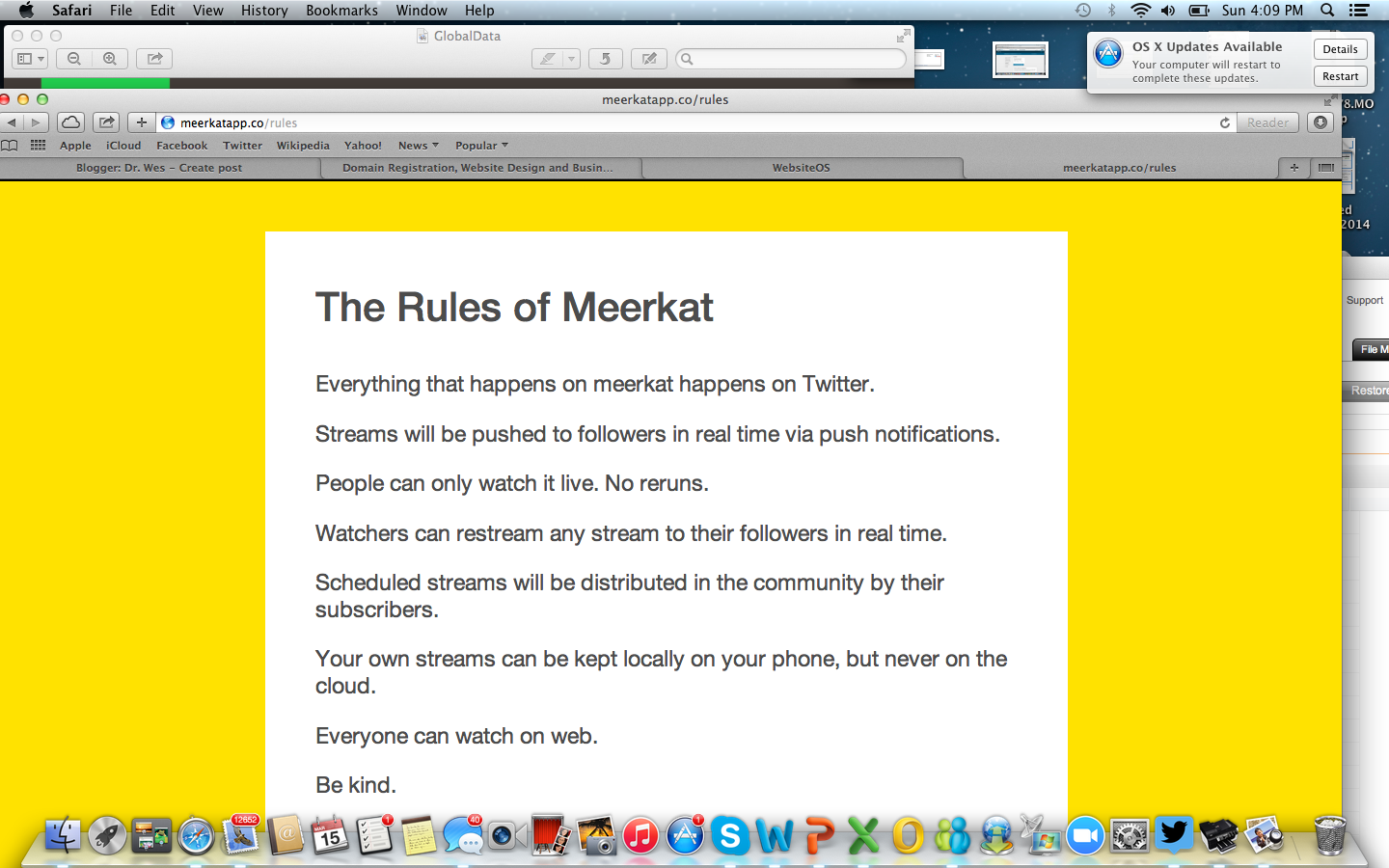
And now, there's even live streaming video on Twitter.  I experimented with one of these yesterday called Meerkat.  (Twitter recently announced a partnership with competing live video feed service called Periscope, so this feature is here to stay).  For $1.99 I downloaded the Meerkat app to my cell phone, linked my Twitter account, and my ability to transform any experience into a live video feed transmitted instantly to the world was complete.  There are some "rules" associated with Meerkat.  Yet even with these rules, I found it disquieting that I held Big Brother's camera in my hand, if only for a few minutes.  Those videos might not be on the "cloud" by policy, but how do I know where else they're stored, or used.

There is a remarkable power, subversiveness, and wonder in the simplicity of this new technology to send live video feeds from a mobile phone.  It is both novel and "cool."  But I still deleted the video that I sent from the ACC meeting yesterday from my iPhone this morning after I thought about things. Perhaps I'm being overly cautious because videos can still be taken at meetings and uploaded to YouTube for the world to share.  But somehow this live feed was different - so instantaneous, so uncontrollable.

And as a doctor, I don't want to become an agent for Big Brother.

-Wes


Tuesday, March 10, 2015

Where Will Social Media Be in Five Years?

Where will social media be in five years? Will it be dead? Will it be thriving? What will it look like?

This was just one question posed to me as a speaker in this topic for the 2015 American College of Cardiology Scientific Sessions in San Diego this upcoming weekend.  Here are some of my thoughts and I'd love to hear what others think (I need CONTENT people!) since I'm really not an expert:
  • The word "social" in "social media" will disappear.
  • The term "rectangle deficiency" (aka, misplaced cellphone) will achieve DSM-V status.
  • True privacy will be the "new black" for medicine (as will actually looking at the patient).
  • Text messaging will overwhelmingly replace paging for day-to-day patient care.
  • Research will increasingly recruit patients via this channel.
  • Credible content on social media will be recognized and even encouraged by academic institutions.
  • US physician attendance at Scientific sessions will further dwindle due to costs while subsidized overseas physician attendance will grow.

  • The Apple iWatch will be so, well, yesterday...

Am I smoking something or making sense?

Your thoughts?

-Wes

Monday, January 19, 2015

The Cancer of Our Profession

  229. Unity and friendship in the medical society is important.

The first, and in some respects the most important, function is that mentioned by the wise founders of your parent society - to lay a foundation for that unity and friendship which is essential to the dignity and usefulness of the profession. Unity and friendship! How we all long for them, but how difficult to attain! Strife seems to be the very life of the practitioner, whose warfare is incessant against disease and against ignorance and prejudice, and, sad to have to admit, he too often lets his angry passions rise against his professional brother. The quarrels of doctors make a pretty chapter in the history of medicine.

Sir William Osler
On the Educational Value of the Medical Society, In Aequanimitas, 335-6.
Never has the divide between the practicing work-a-day physician and the non-practicing ivory tower elite physician been greater. It is the cancer of our profession: quick to spread, difficult to contain.

But this should not surprise us. It is a recurrent theme in history, just as Osler was quick to remind us. But the ideal that Osler advocated for has disintegrated under political, financial and partisan agendas that covertly operate without transparency.

If nothing else, social media is helping expose this divide and its corrosive effects on our profession.

-Wes

Thursday, September 25, 2014

The Last Reprogramming

He had called the other day to update me up on his condition.  He did not sound upset, but resolute.  "They offered me peritoneal dialysis," he said, "but I decided against it and figured I'd just let nature take its course.  The hospice people are so wonderful - I've got things all set here at home, but I have two questions.  What should I do about my warfarin?  You know, I just don't want to have a stroke.   And what I do about my defibrillator?"

We were colleagues once and grew to be friends later when life's circumstances brought us together. He, a revered senior neurologist and me, a relatively new doctor in town. I could remember overhearing his heated discussions about administrative snafus with colleagues in the hall, or watching a horde of residents and medical students following him into a patient's room to teach at the bedside.

"Of course he didn't want a stroke," I thought.

So we decided to keep the coumadin and let him continue his daily INR checks at home and to turn off just the tachyarrhythmia detections on his biventricular defibrillator.

"I'll come over tomorrow and we'll turn it off," I said.

There was a brief silence, perhaps because of momentary disbelief that I'd do such a thing.  Then he proceeded to give me detailed directions and landmarks to watch for on my way over.  "I'm sure I can find it," I said thanking him.

So the next afternoon after most of the day's events had finished, I grabbed the programmer and drove to his home.  It was an unusually beautiful day - mid 70's, sunny - as if Someone had wanted it that way. There in the yard, was his wife, wearing a large-brimmed hat and holding a hose while pretending to water the shrubs.  She came over to greet me: "Thanks so much for coming over," she said, "I know this means so much to him." Then she realized she was still holding the hose. "Oh, I'm so sorry, it's just that someone has to try to keep the place up," she said, voice cracking.

The "place," of course, was beautiful.  A majestic grande dame of a house - one I would later learn they had occupied for the past 44 years and bought when they were "just kids on the block."  It was meticulousy kept, stately.  I entered with his wife and noticed a shadowy figure two rooms away sitting at the edge of a mechanized hospital bed.  The bed was placed in what must have been his study with a large bay window with a couch next to it.  A reading lamp was over the head of the bed and the walls held books from the floor to ceiling with icons and statues, likely from other, more active time.

"Thanks for coming, Wes," he said, looking up.

"How are you feeling?" I asked, somewhat stupidly.

"Pretty good, considering everything.  See?  My legs aren't quite so swollen and my abrasions all have eschars on them," he noted as only a doctor could.

"Is there a plug nearby?" and he proceeded to point me the way so I could plug in the programmer to do my job while he explained the device to his wife.  The process was quick and I interrogated his defibrillator, then turned off the tachyarrhythmia detections, therapies and now needless alarms. "There, that didn't take long.  All done," I said.

There was a moment of silence as I sat with this man whom I known for so long.  Like a wise sage and hospitable host, it was clear he wanted to talk for a bit, so I slowed my exit.

"You know, I've always appreciated your frankness about my condition," he said. "You're a lot like me in many ways, I think.  You never overstepped, let me have control, to manage things like I wanted to, and I've always appreciated that," he said.

Embarassed by his frankness, I wondered what to say.  At a loss for words, I told him how much I enjoyed meeting his family, wife, daughters, and grand-daughters recently in the hospital.  He looked puzzled, forgetting. "You know, that day I brought my daughter in your room with them?"  His eyes brightened and his smile widened as he remembered. 

"Oh, yes! That was wonderful!  How fast times flies, doesn't it?" he said.

"You know, I wrote about that day in my blog," I mentioned, ".. and included some pictures of my daughter from 10 years ago - about what she thought about medicine - can I show you?"

"Of course!"

So I showed him the picture and we shared our thoughts about family.  Then, to make reading from my iPhone easier, I read him the post I'd written about that day.  We talked about family and what they meant to each of us.  And then he shared with me another nugget, that he grew to become a writer, too.

"You know, I spent some time and wrote an autobiography for my kids not too long ago - over a hundred pages - about everything I could remember - from my earliest years as a child, about my immigrant father and  American mother.  My father made it as a successful lawyer - came over from eastern Europe - I even know the ship - I remember the picture of him standing there with his hat..., and I wrote about my family, influential teachers in grade school, fellow professors, and people that I knew throughout the years - everything.  You should do that, too, you know.  I'm so glad I did.  I gave them to my kids and even made some some extra copies - maybe for the grandkids, in case they want it someday..."  He looked away to see his wife leave the room, trying not to be noticed as tears filled her eyes once more.   She didn't want to him to see her this way.

He stared down at the floor beneath his swollen feet, then continued.

"You know, it was therapeutic for me to write that autobiography.  After all, what we do is terribly isolating for the most part.  No one understands that.  Like you do your procedural stuff and I do my diagnosing.  We do most of it all alone, with no one else there.  Just the patient and the doctor.  Wonderful, to be sure, but isolating.  So many memories.  I guess it helped me to put some of those feelings and the thoughts I had about those I loved into words.  It's hard to capture it all..."

He looked up from the floor and stared in my eyes.  "Thank you," he said extending his hand.

I sat motionless for a bit digesting the gravity of his words, lost in them before I saw his hand.  Once I noticed, I lept up to shake it and gave him a long hug to his increasingly skeletal frame.  It was a brief moment to share together once more and one I now realized I had done too infrequently with other patients in a similar circumstance.  Here he was, an incredible man who'd given so much to his family, fellow colleagues and patients, now teaching me once more so much about life as a doctor, about grace, and about real love.  Just the two of us, isolated again, but as friends. 

With great reluctance I packed things up and found his wife on my way out.  "Thank you," she whispered with swollen eyes, "I just don't want him to be in pain." 

"He's going to be fine," I told her, "... perfectly fine, especially now. He's such a wonderful guy." She smiled and opened the door.

As I drove away I realized we probably won't see each other again - his remaining time here will be saved for others now. There were so many thoughts, so much to remember, so much still to learn. Perhaps because I'd been through something like this before I was more prepared - it's never easy - but I still felt okay about it all - not sad - confident that we did the right thing... 

... together.

-Wes



Sunday, August 10, 2014

From the Mouths of Babes

"Dad, you have the nicest patients!"

She was right, of course. Daughters that you bring to work with you to shadow for a day can bring you back to what's important in medicine.  In fact, seeing medicine through fresh eyes is helpful, especially when we forget to look up from our work-a-day lives.

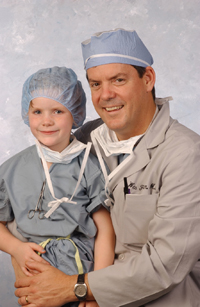
It had been over ten years since I had my first "Bring Your Daugher to Work" experience.  Her first time she wore scrubs they were bigger than she was.  She always remembered that day.

There probably won't be too many more times we'll share such an experience together.  Like most young college kids she's growing her own life now, trying to decide what to do.

"Why not shadow me and my nurse practitioner for a day to see what think?  I have a light day, you could really see what we do first-hand!"

Much to my surprise, she agreed.  And so we spent the entire day together once more.

She saw everything I did but this time with a more critical eye.  She saw everything my nurse practitioner did, too.  Just in case.  She witnessed the miracle of anesthesia, a strangeness of the "time-out,"  then the jolt of a cardioversion.  She saw the smile of the patient after it was all over.  She saw the real discourse that occurs between colleagues that are used to working with each other.  She saw the computer.  She saw the EKG.  She saw the family discussion afterward.  Everything.

Perhaps most touching was the moment we walked into a long-time patient's room - a fellow doctor - and there he was, lying in bed with his ankles too swollen with his wife, daughter, and granddaughters by his side.  His eyes, while a bit sunken, were beaming when he saw me.

"I'd like to introduce you you my family!" he exclaimed.  And one by one he introduced me to his lovely wife, daughter, and granddaughters who had all come to spend some time with him. Of course, I couldn't resist, and similarly gushed, "I'd like to introduce you to a member of my family, too!" I proudly introducing my daughter to him and the rest of his extended family.  His grandaughters were slightly younger than my daughter - just starting to think about college.  My daughter, now a veteran of the college experience, offered some words of encouragement to them.  They graciously nodded.    I couldn't help but marvel how therapeutic that interaction was for both of us - doctor and patient - a way to bring our lives a bit closer, our understanding, more meaningful.   Medicine is like that sometimes: one minute you're there to help the patient then you realize how much, in their grace, they help you.

I pretended not to think about this as I checked his defibrillator.  "Working fine," I told him.  He glanced at me and said "thank you" in a way I'll never forget: non-verbally with his eyes, as if to say, "I know how you're feeling."
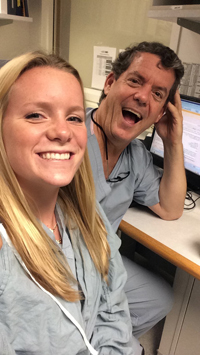
Our "selfie" that day

We left the room and returned to the nurse's station - or maybe it should be called the "Computer Terminal Station," since doctors, pharmacists, physical therapists were all playing a game of musical chairs waiting for a terminal to open.  More typing and staring at screens, more phone messages, documentation, lab checks, more typing, all clicked as fast as possible.  Finally, after seeing more patients and typing more notes, we had a debriefing.  Relaxed and looking forward to heading home, I asked her: "So what did you think?"

"You know, Dad, it was wonderful.  Your patients are all so nice.  But..."

There was a moment of hesitation in her voice, a concern, as she wrestled with how to break the news to me slowly; I could tell she didn't want to disappoint  me.

"What is it?" I asked.

"... there's just so much typing!"

-Wes


Saturday, February 15, 2014

What the Collapse of Big Law Can Teach Big Medicine

An important read from The Atlantic:

With each passing year, Big Med is following Big Law. Physicians, medical schools, and hospitals all proudly trumpet their standing in national rankings. Efforts to preserve and augment revenue streams produce a less patient-centered and more business-oriented approach to organizing the practice of medicine. Physicians are more and more commonly referred to as healthcare providers. And billboards hawking the services of injury attorneys are being crowded out by hospital ads touting high-margin service lines.

Many clients, patients, and legal and medical professionals regard the erosion of the professions as the equivalent a tidal wave—deeply regrettable but utterly unstoppable. But this is not so. It is possible to reverse the tide and restore a sense of what it really means to be a professional—to be devoted to the service of others and the ideals of a noble profession. Collaboration can supplant competition, and the best interests of clients and patients can regain their rightful primacy.

Who would gain from such a restoration of professional integrity? First, the professionals themselves, who could still go to work in the morning and lay their heads down at night knowing that they are serving something beyond their own narrow self-interest. Another group of beneficiaries would be clients and patients, who would be able to trust that the professionals serving them are truly following their hearts and doing what they believe to be right.

And third and most importantly, society itself would benefit from such an example. In the short-term, to strive to be anything other than number one is foolish. But in the long term, life need not be a zero-sum game. There are many opportunities for each of us to serve others and enjoy long and richly rewarding careers without always maximizing our incomes at other’s expense. As the story of Big Law indicates, competition can be good, but only when it truly brings out the best in us.
Read the whole thing.

-Wes

Wednesday, January 15, 2014

Fixing the Wholesale Destruction of the "MD" Designator

Thanks to the unrelenting march of regulatory affairs in medicine, the MD designator (Latin: Medicinae Doctor) has been completely devalued for patients.  No longer does "MD" mean you care for patients.  Instead, "MD" could mean many things: like you work for an insurance company.  Or it might mean you sit in a fancy building lined with marble floors in Washington DC writing legal briefs and laws to torment other doctors.  Or it might mean you kill rats for a living. 

What patients need, and want, is a way to determine who is a "real doctor" that cares for and makes the majority of his income from actually seeing, touching, and treating real live patients.

For this, what is needed, like the Good Housekeeping Seal of Approval, is a "Real Medicine" seal of approval.  It could be appended to every clinical MD's signature.

The seal would mean an MD (or DO) spends over half his or her time, and earns the most of his or her income, directly caring for patients.  It also means that the doctor who uses this designator attached to his MD also is willing to work outside the normal 8am - 5pm business day and even takes call for clinical patient care (available 24-hours/day) on a regular basis annually.

So I have made a "Real Medicine Seal of Approval" for real doctors (as defined above) to use, free of charge:


So patients, the next time you need a "Real Doctor,"  look for the Real Medicine Seal of Approval:*

-Wes

* Non-clinical doctors who use this logo will be summarily humiliated publically by any means real doctors worldwide choose.  Doctors are advised to use this logo with the utmost caution and respect for the real profession of clinical medicine.

Saturday, November 16, 2013

When Medical Content Providers Go Political

It is an interesting time in medicine.

If we step back a few thousand feet and look down on America's medical world, we see a mess.  We see rules and regulations run amok.  We see doctors under unprecedented pressure to click rather than to care. We see government websites built with the promise of access to health care, collapsing under its own weight.  We see politicians promising one thing, then delivering another.  Then we see them give exceptions to some or outright lying to others.  Then we see them get cozy with the insurance lobby after they're caught red-handed  in hopes of making a "fix."

We, the lowly patients and doctors in this political power game, turn our heads in disgust as we struggle to help people live (literally) another day.

US medicine is now all about power and money.  As such, medicine is now more about a political vision rather than reality.   Politics, after all, is all about sales: selling a vision to stay elected and to stay in charge.

So where better to turn to promote your political sales job than WebMD (and their subsidiaries like Medscape and theheart.org), that "trusted" purveyor of all things medical?  It seems WebMD and its MedScape affiliates like theheart.org have quietly accepted a $4.8 million grant  to promote the Affordable Care Act and have refused to disclose this little factoid to doctors and their readers.

There does not need to be a  Sunshine law for politicians and medical content providers these days, only doctors.

But it doesn't stop there.  Ironically, shortly after this disclosure by the Washington Times, an article entitled "Conflicts of Interest: Concepts, Conundrums, and Course of Action" appeared on theheart.org/Medscape Cardiology's website.  (Update: this morning there's an article on the Physician Payment Sunshine Act, too!)  As I tried to read this article I laughed as I clicked through a Brilinta ad and was subject to Bystolic and Belviq ads in Medscape's sidebar.

Here's a real "course of action" I'd suggest to doctors bothered by the double-standard of disclosure imposed on us from our political class: dump the Medscape app on your cellphone, give a little shout-out to theheart.org, er, Medscape Cardiology, and ask why they haven't said anything.

Then cancel anything related to WebMD.

Then, at least, we'd be sure we're getting past the political propaganda and back to medicine.

-Wes

h/t: A faithful reader.

Addendum 16 Nov 2013 @ 12:20 PM CST: It seems WebMD felt compelled to release this press release regarding their editorial integrity, but it did not reference the above conflict disclosed here specifically.

Tuesday, October 01, 2013

Ten Crackers

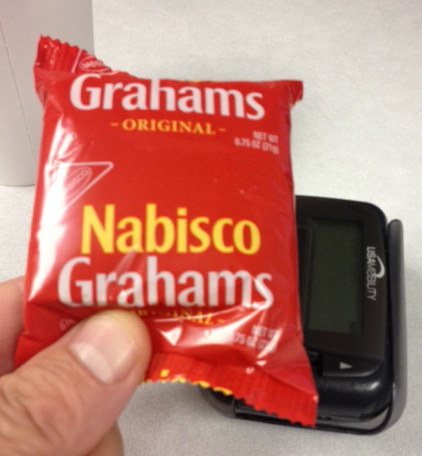
Graham crackers.

For years they have been an on-call snack staple for young doctors in training throughout the United States.  These little morsels have probably saved more lives than defibrillators after hours, especially if they are topped with a hefty dollop of peanut butter.

Admittedly, these flat brown crispy tastees don't contain much nutritional value.  They are probably a dentist's nightmare.  But after many late hours on call well after the dining hall closes, you'd be surprised how good these little devils taste, especially when they can be enjoyed in a quiet reflective moment alone or with a colleague in the nutrition room.  Graham crackers have a way of bringing you back to earth after you've dealt with a code, had to pronounce someone dead, or worked through a difficult family interaction in the wee hours of the morning.

But times are tough for hospitals now: censuses are down (as are revenues) as the uncertain effects of health care reform descend. Consequently, it makes sense for hospitals to trim budgets where they can.  After all, if its between graham crackers or nurses, I'm sure we'd all agree that graham crackers should be trimmed before nursing staff.

But I wonder if supplying an entire ward of fifty patients with only 10 of these little packets a day makes sense for physician and nursing morale.  Doctors and nurses, already dealing with reduced incomes and threatened with even more to come, are finding it harder and harder to find the tiny perks that make the late nights and long weekends tolerable.  Finding none of these hidden snack treasures on a ward after working 15 hours straight certainly isn't the end of the world, but when people are tired and hungry, it's noticed more than any highly-paid administrative decision-maker who's tucked neatly in bed could ever imagine.

Good leaders listen.

Good leaders know the value of small gestures.

But it's only the best of leaders that appreciate the importance of an ample supply of graham crackers.

-Wes

Friday, September 20, 2013

For Medicine: Go Slow

Three years ago, in the midst of all that was happening with health care reform, I thought about if I'd ever recommend medicine to my daughter.  I thought and thought about that issue and looked deep inside myself for reasons one might still choose this profession, then penned "The Top Ten Reasons to Be a Doctor."  It is, by far, the most popular post on this blog, having been read by more people than any other I've written.

But little did I think my youngest might heed this advice.  Unknown to me, she left for college as an environmental studies/economics major, to abruptly decide one week later after some soul-searching of her own to consider a pre-med curriculum.  I couldn't help but feel a rush of pride, but also a huge amount of concern, for no one can tell anyone else what this path is like until it's been traveled.  One thing I know: it she wants it, she's very capable of doing it.

And as part of her growing enthusiasm for this field and (I suspect) recent rewarding experiences she had as a lifeguard at our public beach this past summer, she's even thinking about training to become an EMT while studying at college.

My first thought, of course, was "Heck ya!  Dive in! You'll love that!  What a great skill to have!"  But after a night of rest and reconsideration, I have another piece of advice for her.

Go slow.

You see there's a little secret every doctor lives with throughout their career and never talk about: their closet.  We've all got one and we use it sparingly, and you don't want to fill it up too soon because it has to last your entire medical career.

You see, your closet is where you store life's experiences that are so horrible, so painful, so shocking, that you can never tell anyone (except, perhaps, another doctor) about them.  It is the place where you put the images you see that you'd really rather never talk about.  Ever.  Really: the gross stuff: the gross images, the gross sounds, and the gross smells.  Things so bad I can't even write them here.  That stuff.   And I know EMTs, like doctors, have a closet of their own.

You'll be surprised how dark that closet is and how fast it can fill.

But you also need to know that the closet exists, it is real, and how to clean that closet when considering the path toward becoming a doctor.  This is probably one of the most important skills outside of medicine that a doctor can muster.  So, I'll ask that my daughter to reconsider the EMT class for now and do something entirely, crazily, stupidly different and fun. (Whether she'll do this or not remains to be seen.)  For this is how we have to learn to clean a bit of our closet, or at the very least, make it a little bigger.  Use this precious time before all of the isolation of studying and commitment that medicine requires to expand yourself.  Learn to play badminton, to paint, to play a guitar, to debate, to sing, to ballroom dance, to fly or just to love and appreciate what's out there.  What ever.  The point is this: learn to do other things besides medicine that will engage your brain, hold you firm, and make you happy.  Because medicine's a long haul: a lifelong haul that never keeps adding to that secret closet.

As a student of medicine, your job, throughout all that lies ahead, is it to make sure you always have the renewable resources to get outside medicine so life stays rich and medicine remains, net sum, rewarding. Because as as rewarding as medicine can be at first, it can wear you down unless you always know how to properly size (and maybe even start to empty) a bit of that secret closet that doctors all share.

-Wes

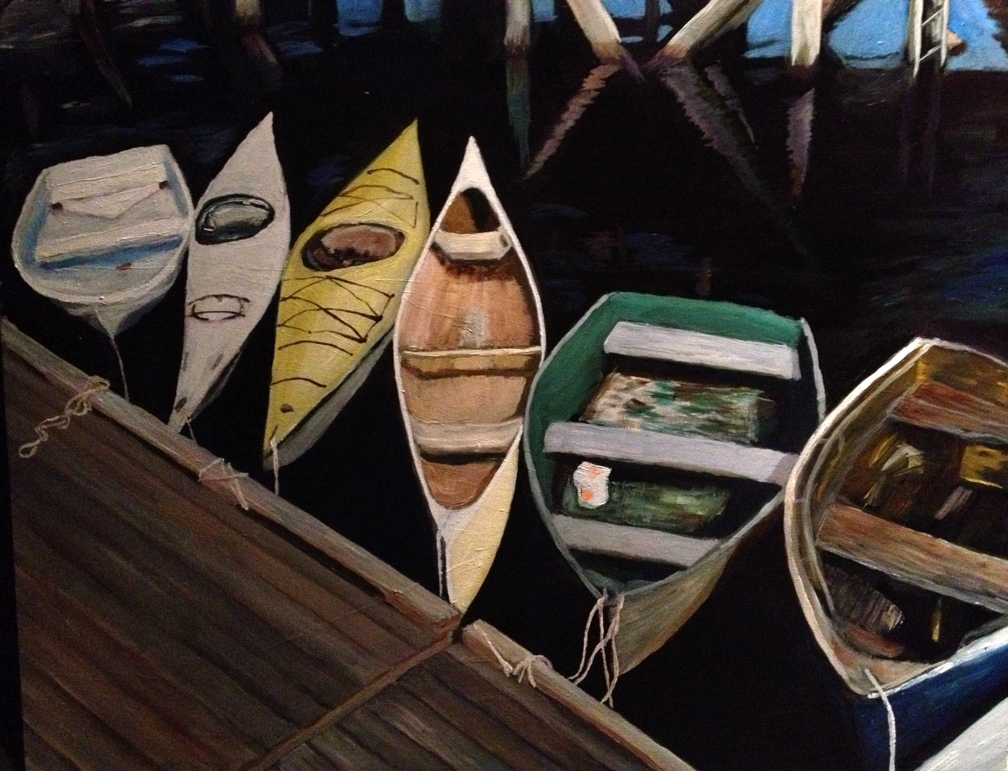
"Emptying the Closet"
Oil on Canvass, 36" x 24"


Saturday, July 13, 2013

The Clash of Cultures

"It looks like you've done very well, Mr. Smith..."

"Thank you, doctor."

He left the patient's room and ambled back to the nurses station, legs tired and ankles somewhat swollen.  It had been a long case and now he just had to type his note, send an email message, and review his schedule for the following day.  He sat down at the computer and logged in.  That's when he looked up briefly and saw them.

They looked so young.  Their newly-pressed white coats accentuated the faint glow of the computer screens on their perfect skin.  They looked like thoroughbreds, while he the old horse put to pasture, if they had noticed.  But they were each staring intently at the electronic screen arranged along the desk countertops, one with his back to the other two.  Occasionally the one would turn to ask the other two a question, then return with a blank stare to the screen before him.  The new residents had arrived.

"So different," he thought.  There they are, seated before a computer looking more like telephone operators rather than doctors.  "What were they thinking?" he wondered silently, then pondered how things had changed.

For now he realized that they didn't have to know where the blood or microbiology laboratories were.  They didn't have to search for an x-ray.  Instead, they had to find which button to click.  This day, this moment, was probably their dream come true.  For it was the day they had waited and worked so hard for, the day they became a working doctor.  Underneath the electronic facade, they were probably excited, eager, wanting to do a good job: excitement and anxiety, all rolled up into one.

But somehow, it was different.  The new doctors rarely looked at each other as they stared vacantly into their computer screens.  It was as though they were transfixed by medical porn.  It looked as though they were being bred into an interchangeable electronic medical documentation team, not a cohesive, personal one equipped with interpersonal skills.  After all, they really didn't have to see or listen to each other any more. They could send each other an e-mail, text messages, or chose to stay isolated, listening to the rapid-fire clicking taking place next to them.  Emotionally and physically, they could be miles apart or seated together, it really didn't matter any more.    It was so efficient, so neat, that their organized orientation to electronic dehumanization required very little movement, very little patient contact.

But young doctors, he realized, were meeting their patients like they've always met new friends on Facebook: electronically first.  Was this better?  He wasn't sure.  Would the initial impressions garnered from the chart skew their ability to look independently and objectively at their patient?  Will they be capable of accurate empathy?  Will a patient's undocumented concerns be missed?  Will new doctors forget to use the subtle signs and symptoms brought forth by the physical exam to head off disaster or just wait for the test results to return before reacting instead?  Will they see enough, smell enough, do enough, sweat enough, to learn enough?

He wondered.

But they were young.  They could learn.  They would learn.  They'd adapt.

And they could type faster.

Perhaps.  Maybe.  We'll see.  "I can only hope," he thought, realizing he wasn't getting any younger.

He turned his gaze back to his own screen and clicked the icons slowly, the way he had done hundred of times before, filling his note with voluminous immaterial drivel the government required, then added a single line: "Doing well.  Home today."  So meaningful, he silently quipped, meaningful indeed.

He rose to say goodbye to the unit clerk, who smiled as she peeled her eyes from her iPhone, "Goodnight, doctor."

"Take care of the new guys, okay?" as he pointed to the people behind her with the new white coats.

"You bet," she said, not turning to see them.  Her eyes reset to to her iPhone screen instead.

-Wes


Wednesday, March 20, 2013

Our New Inquisitors

A phone conference had been arranged.  They wanted to talk to me about a denial for payment on a portion of a patient's pre-authorized procedure after the fact.   It's participants: the regional medical director of a large insurance company, his female assistant administrator, and me.

He cordially introduced himself as a pediatrician by trade from a large well-known (and highly respected) academic institution with impeccable credentials responsible for our region of the United States.  It was clear we must remain professional.  I listened.  I was told there are proper ways to discuss claim denials - proper steps to follow - websites to consult.  We all must follow protocol.

Yet I had just learned by separate letter that my second request for the claim approval had already been denied.  I mentioned this.  It was unfortunate, but I was assured the the claim was re-reviewed by a specialist in my field.  Remaining professional, I wondered silently if that specialist still practiced. Then I pleaded my case once again on the phone to no avail.  I would have to submit my patient's claim a third time to an "independent" centralized reviewer, quietly please.

So I hung up and another letter was drafted.  This time a highlighted copy of our guidelines was included for  review.  "Standard of care," I thought, as if that would matter.  Guidelines for care mean little for payment when they are trumped by corporate policy directives.

We'll see.

* * *

For unclear reasons, a few members of our own traditionally underpaid or politically well-connected physician tribe are elevated  to work for insurance companies. Who can blame them?  Decisions must be made and who better than one of our own?  Whether a medical director of an insurance company or a member of an Independent Payment Advisory Board, these individuals must be carefully chosen. They must believe with all of their heart in the process.  They must believe the siren song that helping people achieve their "best possible personal health and wellness" rightfully sidelines the real-life costs of care that patients endure through no fault of their own.  Most of all, they must never, ever, speak of the money.

Then they are crowned the guild-masters, the rest of us, mere journeymen.  To them, it's about clipboards, corporate policy directives, and cost savings.  To the rest of us, clinical reality.  Increasingly, we we will be finding ourselves facing these modern-day Inquisitors - where principles for the "common good" supersede the needs of the commoner.

Medical decisions made by email, phone or fax.

No faces, please.

Quiet.

-Wes

Sunday, January 27, 2013

By the Numbers

Diagnosis codes: numbers.
Procedure codes: numbers.
Speadsheets of one's "productivity:" numbers.
Spreadsheets of RVU's: numbers.
Spreadsheets of total office visits: numbers.
Speadsheets of new office visits: numbers.
Spreadsheets of complications: numbers.
Spreadsheets of new codes on top of old codes: nothing more than more numbers.

Then numbers converted to numbers.

Speadsheets of revenue: numbers.
Spreadsheets of accounts receivables: numbers.
Spreadsheets of patient satisfaction scores: numbers.
Number of Patient calls: numbers.
Number of Staff messages: numbers.
Miles traveled: numbers.
Continuing Medical Education credits: numbers.
National Practitioner Identifier: numbers.

Letters typed, converted to bytes, then bits, then zeros and ones.

Fingers numb, eyes searching.  Unable to find a number...he stopped and looked up.

He wondered.

Where are the codes for color, for smell, for sound, for touch, for tears, for fear, for terror, for pain, for exhaustion, for laughter, for teaching, for listening, for learning, for love, for patience, for tenderness, or for grace?

"They paved paradise and put up a parking lot," he thought as he marveled at the revery of medicine's latest myopic trend:

cold, raw, unemotional, unassailable, yet remarkably error-prone,

numbers.

-Wes

Monday, December 03, 2012

On Folding

Every surgeon has been there at some time in their career.

It's a horrible, exhausting feeling.

Yet one we all must come to grips with: knowing when to stop.

There you are, six hours into a case, legs rubbery, mind racing, and barely conscious of the world outside the narrow view of the operative field. A life, literally in your hands, asleep now, but hoping (with you) for the best of outcomes on this last try.

"Maybe if I just..." you think, and a new idea is tried to no avail.

"Now, let's look at that again," you ask your techs. "Which electrogram's earlier? That one is CLEARLY earlier...right?" as you try to convince yourself that another choice is better. "What about here?" You go back and recheck once more, just to be sure...

So you do.

And it's still a dangerous spot to burn.

"Maybe it's on the left side?" So you cross to the left side and repeat the process. Everything maps back to the spot your dreaded before.

"Maybe if I give just a little energy here...." You hold your breath.

No effect.

"But if I burn here, I risk giving the patient a pacemaker. We never talked about a pacemaker," you think.

Yet the tachycardia persists, as if laughing at you and your inability to locate its origin.

* Bruuuuhaaaahhaaaahhaaaa... *

"Bastard!" you think. "I can get this!"

So you map above, below, left and right, forward and back...

* Bruuuuhaaaahhaaaahhaaaa... *

Like stubborn mule, you fail to give in. Again.

And again...

Until finally...

... you quit. A white flag raised. It beat you. Yes, you lost.

The supporting team with you, ever helpful, feels the patient's loss with you. They are relieved, though, for a pacemaker will not be in the offing. Like you, they know there will be another day, another arrhythmia: another victory to quell the sting of this defeat.

And while the Defeated hangs his head low to talk to the family, you then realize the the family is just as exhausted and concerned as you.  They thank you for trying.  They understand.

That's when you know you did the right thing.

-Wes

Monday, January 23, 2012

Honesty Is the Best Policy

It goes without saying: if procedures have complications, be truthful with the public and with patients. Otherwise, some might publically question your outcomes. If that happens, noone is likely to benefit.

-Wes

Wednesday, January 11, 2012

Duly Notified

Warning: You are entering the chart of a deceased person

What?

What happened? They called me about him. Said he was sick. He stared again at the message.

Warning: You are entering the chart of a deceased person

Should I open the chart? (Screw it - I need to find out what happened!)

But what if I do? (I'm not trying the alter the chart. Really. It's not my fault no one called me to tell me he died, is it?)

Warning: You are entering the chart of a deceased person

Why didn't they call me? I'd been caring for him for nearly ten years! I knew his story, his family, his wonderful personality. The ER said he looked sick and they were going to admit him.... Then someone called ... Didn't think he needed to be in the ICU... Who was that again?

Warning: You are entering the chart of a deceased person

Can't I just get his number to offer her my condolences?

Warning: You are entering the chart of a deceased person

-Wes

Monday, January 02, 2012

Giving Thanks to a Rule-Breaker

The call never should have been made.

It broke every proscribed rule.

After all, I was not on call. Thanks to the wonders of computer technology, it was very clear that I was being covered by my colleague. And yet, despite this, it came.

“Dr. Fisher, I’m so sorry for calling you at home, but I received a call from Ms. X, the wife of your patient Mr. Y. who said she really needed to speak to you about her husband... she seemed quite concerned and insisted I call you…. I told her I’d see if I could reach you at home… I’m so sorry, but it sounded urgent… I have her number, could I connect you?”

“That would be great, thank you…”

I wish I got the name of the operator that evening. I have no idea what intuition, what verbal cue she received that prompted her to break all the rules. She was, after all, just a hospital operator who should have followed the playbook but decided to take a huge personal risk to rely on her judgment instead. There was no playbook, no algorithm involved – in fact, it was just the opposite.

But one thing’s for certain: this operator should to know that the patient, his family, and I will be forever grateful.

Thank you.

-Wes

Monday, December 05, 2011

A Little Medical Crystal Ball

I heard this over the weekend:
"The students of today are training for a field that doesn't currently exist."
Seems hard to believe, right?

And yet, when I started medical school, there were no iPhones. In fact, there weren't even cell phones. My first cellphone was acquired while I was in fellowship training and came with a shoulder bag to hold the battery pack. (Man, was I cool to have one!) When I started as an intern, if I wanted to see a patient's chest x-ray I headed down to the file room to check out the patient's xray folder containing all of the films performed on the patient at that hospital and physically removed the particular film of interest from the folder and placed on a lightbox to review. Gosh, we even still had had and used manual blood pressure cuffs.

Things sure have changed. The pace of innovation in medicine has been staggering. Who would have thought you'd need to have typing proficiency to become a doctor? Electrophysiologists, once the boring antiarrhythmic testers of ischemic ventricular tachycardia, don't just test arrhtyhmias, but now routinely ablate them permanently. Stents, unheard of just 20 years ago, are now commonplace. And percutaneous aortic valve replacements and mitral valve repairs? You've got to be kidding me! Congestive heart failure too, once a pre-morbid condition, is now become chronic disease Public Enemy #1 (never mind the dirty truth that it's the innovative drugs and devices that keep people alive and have cost our health care system so dearly). As a result, "readmissions" for heart failure, the inevitable end run of all heart disease, have become a cardinal sin for hospitals thanks to our new health care reform law, punishable by non-payment.

Think practice patterns will change and senior "rehab centers" will benefit as a result? (Does a bear poop in the woods?)

Which leads me to contemplate where things will end up ten or twenty years from now under continued governmental belt-tightening. Will our medical students be better served to learn more medicine, or will should they be shifting their focus to business in an effort to forward themselves? Who will doctors find themselves serving more, their patients or their employers? Will the greatest challenge in health care be promoting life or will it be to promote a death with dignity and without expensive end-of-life care? How will doctors be paid: by salary? By specialty? Or maybe by an obscure, non-transparent concocted "work unit" that an outside hospital consultant group creates?

Even the the grand plan of hospitals called "build it and they will come" is crumbling. Like independent doctors' offices, many smaller hospitals, previously flush with cash and good credit lines, are suddenly finding it harder to stay afloat independently thanks to cuts to Medicare payments. Consolidation continues in health care where only the strongest richest and most politically-connected will survive. Young doctors need to understand these things, lest they work in an environment that might not have their best patient-care interests at heart and their workplace is sold to other larger hospital group intent on cost-saving and 'efficiencies.'

Like it or not, the medical world is rapidly morphing into a business-oriented world. Everything will have a cost and a benefit. It's the "to whom" that will be where doctors' influence will come in: the financial benefit to a hospital system will not always be in the patient's best personal interest. Strattling this divide will be doctors' greatest challenge for all doctors going forward.

But new medical students should not lament: there will still be tons of opportunities for them. Rather, they should accept that right now, this minute, they can have no idea where their current priorities and technical, clinical, and social skills will take them. But they should know this: they'll really need to stay flexible.

Because the only thing unchanging in medicine right now is change itself.

-Wes

Tuesday, November 01, 2011

Can I Watch?

It's one of the more common questions I hear from family members before I take their loved one into a procedure: "Can I watch?"

For me, the answer is simple: no.

Fortunately, when I explain my rationale, most people come to understand why this isn't such a good idea:
  • First, the doctor performing the procedure has enough to think about without having to be a tour guide to a family member. Even something as simple as a pacemaker battery change can go very wrong if an operator is distracted long enough to accidentally reverse the atrial and ventricular leads when they are reattached to the new pacemaker pulse generator.
  • Second, if something should occur that is unexpected during a procedure, a doctor needs to focus on the problem at hand without having to deal with the physical and psychological well-being of a family member also.
  • Third, the operating room has all kinds of unusual sights, sounds, and (often unexpectedly) smells to which many people are not accustomed. If a family member becomes lightheaded, nauseous, or hits the deck as a result of these powerful stimuli, it can make for a very long (and embarassing) day indeed.
-Wes

Friday, October 21, 2011

Changing Perspectives

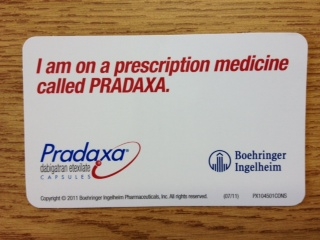
Earlier in my medical career, I would have thought this idea was a good one: a little med-alert card a patient could carry in their wallet that would tell people they're on an anticoagulant:


But in the old days, I didn't give much of a thought as to what was printed on the other side of the card:


Now I have to think about if I'm giving away branded marketing material of "value." How much are these cards worth? Will this be considered a "gift" from the drug industry? Will my patients be unnecessarily influenced by industry or might their lives be saved by having such a card?

Worse, I have to wonder if the use of the use of such a card would expose myself to additional liability risks if I did not offer similar cards to my patients on other anticoagulants like warfarin, aspirin, or clopidogrel.

Seems strange, really, because when I first started medicine I never used to think about these things - I just wanted to help my patients.

Now, everything's changed.

-Wes