Showing posts with label rant. Show all posts

Sunday, November 22, 2015

Labels


Two days ago after a typical day performing procedures in the EP lab, doing inpatient consults, fielding patient messages, attending administrative and research meetings, reading EKGs, Holter monitor recordings, and co-signing device clinic charts, I opened my email and saw this:
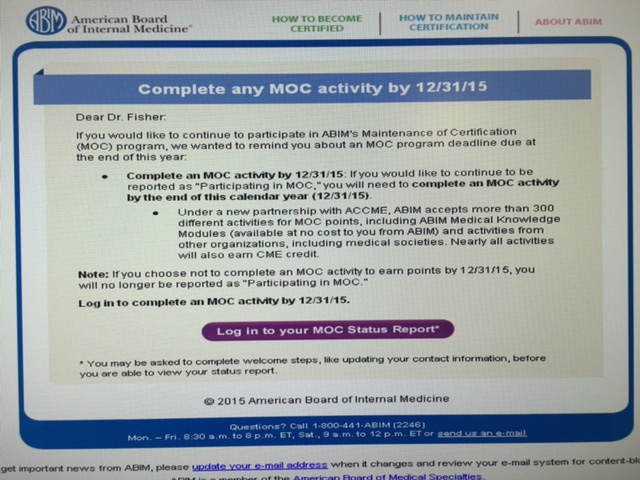
ABIM Email to Diplomats 11/20/2015

I was appalled. MOC is not longer about "keeping up" for physicians. It is a major distraction. This program is of unproven benefit to my patients and me. Thanks to haphazard and self-serving rule changes by the ABIM and their member boards over the past 25 years, the US Specialty Board system has become increasingly coercive. In fact, MOC program now threatens my ability to practice the work that I love because I could lose my facility privileges and ability to receive payments from insurers on December 31, 2015. That is my reality. This is the reality of every physician subspecialist who participates in the ABMS MOC program in US medicine today.

Remarkably, I just re-certified in Cardiovascular Diseases and Cardiac Electrophysiology in 2013 for the third time.  I have never failed. I have over thirty years of experience treating patients and standing in the cross hairs of what it means to be truly accountable to those I treat. I have had over thirty years of nights when I lie awake at night worrying about by patients, about if I did enough, about why a patient had to die. My family, too, has endured years of being woken in the middle of the night or seeing their father have to leave a school play, holiday concert, or friend's dinner party to place an emergency pacemaker.

I am not unique. I am a practicing physician everyman. I stand in unison with hundreds of thousands of others here in the United States just like me who get up every day, kiss their loved ones, and head off to do their favorite job in the world - a vocation so completely immersive and rewarding that we gladly give up a part of ourselves to earn the trust and faith of our patients and fellow physicians.

And because I've been practicing medicine so long, I know I do not need a private, unaccountable, and irresponsible organization to tell me how to behave. I am better than that. After experiencing the busywork of the evolving MOC program and its lack of value for the time spent, I looked into the corporations who promote this exercise. I had the help of accountants and fellow physicians who were similarly upset and uncovered a vast array of hidden financial activities of the ABIM and their collaborators. There is so much financial corruption it is mind-boggling. The conflicts of interest that are never acknowledged and corrected make my stomach churn. The practice of medicine is better than this. Practicing physicians are better than this. We do not need some dystopic corporate Big Brother watching over us to assure we log into a computer every so often to enter data that can be used against us. We do not need webcams, video monitors, body inspections, keyboard tracking, and palm scans to prove we are honest and ethical and won't cheat on examinations. But this is what the ABIM has become: some new form of quasi-police state for monitoring physicians.

Working in fear is not what I want for medicine. It certainly is not how I want my youngest colleagues to grow up learning and practicing medicine. But the ABIM and their parent organization, the American Board of Medical Specialties (ABMS), seem to love fear, humiliation, and intimidation to get doctors to participate in their lucrative MOC program. It is sickening. It is also the height of hypocrisy for these organizations to claim to run an organization that attempts to "Choose Wisely" when that same organization funnels tens of millions of dollars for itself from hard working physicians so they can choose an investment portfolio with multi-million dollar condos, meet at swank meeting venues, pay for spousal travel fees and first class airfares as they preen themselves in front of media lights. The ABIM Foundation "created to define medical professionalism" for the public? Give it a break.

Rest assured I am not naive. I know how important this MOC program is to certain investors. As I peel back layer after layer of the interconnected workings of these ABMS member boards and the ACGME, I know how high this MOC program goes and how dark this MOC program and its tactics have become. I completely understand that these specialty board organizations have managed to wedge themselves into our new health care law that calls itself "Affordable," wedged there by undisclosed lobbying efforts funded by the very doctors whose blinded trust was violated beyond comprehension. Just because these corporations want to make a buck.

So let me take the stick a moment.  Let me be perfectly clear and I don't say this lightly. I'm sure I say this on behalf of tens of thousands of other hard-working, honest, and ethical physicians. We have had enough of the ABIM and the ABMS MOC program. It is time to end it - completely.  No more "modifications" to make this broken program "easier." No more "listening" to our concerns but continuing this failed experiment. No more "MOCA Minutes" that we have to turn our gaze from our patients toward the computer screen or iPhone even longer. Continuing the ABMS MOC that has proven itself to be morally and financially corrupt, and exceedingly expensive to physicians, patients, and our health care system is ill-advised for our profession. The conflicts of interests alone are worth hundreds of millions of dollars to the corporations that stand to make millions from physician assessment, yet we never hear a word about this from them ABMS or the ABIM on this reality.

I am better than how the ABIM and ABMS threaten to label me. I served this great country for twenty-six years as a physician with the United States Naval Reserves and I continue to work every day to make sure I do the best I can for my patients in this increasingly difficult health care delivery environment. I worked then and work now beside hard-working corpsman, nurses, administrators and technicians who don't want to rock the boat and just want to do what's needed to finish our job every day. These people and the patients I care for are why I go to work every day.

So I ask the leadership of the ABIM: "Why does the ABIM insist on placing a "scarlet A" on my reputation by labeling me a "Not Participating in MOC?"  Such labels are offensive. I participate in ACGME-accredited CME as required by my license to practice medicine in the State of Illinois. I am not a slacker. I teach residents and fellows, for goodness sakes. I am certainly not one who doesn't mind working hard. I am a proud practicing physician with more years of clinical experience and direct patient care than any of you.

Please don't be libelous and cast aspersions my way with your on-line labels. I've got much more important things to deal with. Stop pretending that you speak for "the public" and know what's best for them in health care when you don't even crack the door of an examination room or know what I do. Proceeding to take away my hard-earned reputation and ability to practice medicine because of your little label is both threatening and hugely upsetting.

Think about these words. Think about them carefully.

I beg of you and your affiliated private organizations to stop the labels.

The profession of medicine is better than this.

Your everyman,

Wes

Friday, October 18, 2013

Saying Goodbye to Drug Samples

Soon, doctors won't be handing patients drug samples from time to time, pharmacists will.  

Doctors were told that makes a difference.  It will soon be a national trend, they were told.  Instead of handing a patient a sample, just type in an order for a sample to the EMR and the pharmacist will make sure they get it.

Doctors were told that the Joint Commission has certain standards that must be met by health care organizations and hospitals when drug samples are given to patients.  After all, doctors were told by at least one of their own that drug company representatives bias the way doctors think and prescribe.  Doctors must also disclose gifts they receive from drug companies that exceed $10, according to the recently activated Physician Payment Sunshine Act.  Doctors were told drug samples might qualify as gifts.  It just looks bad, they were told.

Doctors were not told that their hospital system runs the pharmacy now.

Think about that.  Think about the unintended consequence when yet another small, kind, visible gesture that a doctor can make to his patient is yanked from his control.  Think about the fact that decreasing pharmaceutical sales representatives might decrease pharmaceutical sales of more expensive medications, but might also have the unintended consequence of decreasing access to new and important information to physicians and as one study pointed out, result in doctors who didn't see drug representatives prescribing less effective and potentially more dangerous drugs to their patients longer than those who do.

But at least the sample order will be there in the electronic medical record to track.  Hospitals will be in regulatory compliance and pass their Joint Commission inspections with flying colors.  And no doubt the pharmacist will do a better job of teaching patients at the drug counter when people are lined up in public four-deep to get their prescriptions. Surely the hospital's pharmacist will be completely aware of the patient's entire medical history and offer the correct number of tracked sample medications without any conflict of interest involved.   

And doctors will sleep better at night knowing their physician payment database record remains unblemished.

Yeah, no worries.  None all all.  It's all for the better good.

Really.

-Wes

Wednesday, September 25, 2013

When Doctors' Names are Bought and Sold

Recently, an envelope arrived for me containing an advertisement from Mercedes-Benz:

Mercedes Benz Offer (Click to enlarge)
The advertisement was co-branding with the American Medical Association, leading me to suspect the obvious: my name was sold.

Why does this bother me so?  After all, the AMA advocates for physicians, don't they?  Surely they need the money to do all their important policy papers and lobbying activities on Capital Hill, right?

But read the advertisement.  It says: "Mercedes-Benz and the AMA have entered into an agreement to provide members in good standing an incentive of up to $4000 on the purchase or lease of select new 2013 or 2014 Mercedes-Benz Models."

So, is there a kickback for the AMA as well?  That is, for every referral that the AMA gets credit for, they make even more money?  How much?  And what about the Physician Payment Sunshine Act now in play?  Will doctors that claim the credit be on the hook for public disclosure?  Why am I, an AMA non-member, receiving this notice?  Are they counting me in their statistics of supporters when AMA policies are developed?

Perhaps.


I understand the simplistic logic behind the AMA's move to sell my name. But policy makers should be aware of this practice and how the AMA may be using doctors' names in their database to reinforce their positions.  The AMA also sells my name to drug companies who track my every prescription, and the results of this practice since the new novel oral anticoagulants have been released has been even more dramatic.

You see I am an early adopter and an influential thought-leader to drug companies who scour the internet for physician feedback.  Well, it's time to give some to make a point.

The next time a drug rep for Xarelto (rivaroxaban) follows me to the parking garage arguing why their drug is better than Eliquis (apixaban), consider the consequences.  But why did this unfortunate episode happen?  It happened because my personal information could be tapped by pharmaceutical companies courtesy of the AMA's Physician Masterfile, so my prescription practices are carefully followed.  When I use a competitor's drug instead of someone else's, the drug lunches suddenly appear and the persuasions begin.  You can almost hear the pharma managers in the back room: "Get over there, show the guy how rivaroxaban's better!  We had sicker patients!  We're a better company!  He's easily swayed! Buy 'em a better meal but be sure to have him sign in for his lunch!  Go!  Go!" 

What a mess.  All because my name is for sale to anyone who wants to cough up a pretty penny to the AMA. 

-Wes

Friday, April 05, 2013

The Physician Payment Reform I'd Like to See

In case you missed it, the "National Commission on Physician Payment Reform" issued their glossy, industry-produced white paper on 4 March 2013 containing twelve recommendations to provide a five-year "blueprint" for transitioning physician payment methods to a "blended payment system that will yield better results for both public and private payers, as well as patients."

Rules Are Only for the Little People

I was alerted to the presence of this report after an "Online First" article entitled "Phasing Out Fee-for-Service Payment" by Steven A. Schroeder, M.D., and William Frist, M.D. for the so-called National Commission on Physician Payment Reform was published March 27, 2013 in the New England Journal of Medicine.  (So much for Journal's Ingelfinger Rule that prevents the publication of works previously published elsewhere.  It is interesting that Dr. Schroeder, the lead author of this New England Journal of Medicine article, failed to disclose that he currently serves as an editor for the New England Journal of Medicine.  No doubt he "exempted" his own piece from the Ingelfinger Rule because this 5-year, 12-step program [pun intended] was felt to be "public-health information that needs to be brought to the public's or profession's attention without delay.")

But the concerns about this article and its authors' backgrounds go much further.  We should realize that this 14-member "National Commission on Physician Payment Reform" was supposedly created out of thin air by an obscure general internal medicine group called the Society of General Internal Medicine (SGIM) comprised of approximately 3000 academic internists. We are led to believe the SGIM doctors chose their 14-member National Commission with physician payment reform solely as their guiding light.  And why not?  What physician wouldn't want to enjoy not being paid for the work they do?

Whose Interests Are Served By Physician Payment Reform?

So let's look at a few of the members of their "National Commission."

First and foremost is the "honorary" commissioner and former US Senator, William H. Frist, MD.  Doctors should ignore Dr. Frist's deep, deep ties to Hospital Corporation of America (HCA), the largest operator of health care facilities in the world.  After all, he only held a few blind trusts that his 2005 financial disclosure form valued between $15 million and $45 million.  And we should ignore the fact that he sold his interests in those trusts just one month before HCA stock price precipitously fell in 2005 and was subject to a SEC investigation.  To be fair, no wrongdoing was ever found.  But that hasn't stopped our "own" Dr. Frist from serving as partner and Chairman of the Board for Cressey and Company, LP, a private investment firm based in Chicago and Nashville "focused on the health care industry."

I'm seeing this effort for physician payment reform as being all about patients, aren't you?

But there's more.

Another member of the 14-member commission is none other than Dr. Troyen A. Brennan.  Dr. Brennan is Executive Vice President and Chief Medical Officer of CVS Caremark, the nation’s largest pharmacy health care company.  In this role, he oversees the company’s MinuteClinic, Accordant Health Care, clinical and medical affairs, and health care strategy.  CVS was so happy about his appointment to this National Commission that it even sent out a press release!  While I have no idea about Dr. Brennan's salary with CVS, I'd bet my medical degree that his salary is higher than that of most US physicians.  One only has to look at the relative salary and benefits that CVS Caremark's Chief Executive Officer earns and you see why I am confident about Dr. Brennan's relative salary.  I mean, who wouldn't want that private jet?  No doubt America's doctors will feel nothing but goodwill and fuzzy feelings about helping to fund the nice retirement package CVS routinely gives to its chairmen as a result of Dr. Brennan's efforts on the Commission.

Another member of the Commission is none other than Dr. Lisa Latts.  Dr. Latts also serves as the Vice President of Public Health Policy for WellPoint, Inc, the largest managed health care, for-profit company in the Blue Cross and Blue Shield Association.  They insure nearly 11% of the US population.  But one could argue, cheap doctors should mean cheaper insurance, right?   I don't think so.  After all, it's not easy to keep paying for retirement packages for your retiring CEO's that cost $20.6 million.  But no worries.  Wellpoint's new CEO's compensation will include just an annual base salary of only $1.25 million with eligibility clauses for an incentive bonus of up to 300% of that amount, not to mention that he is also getting equity-incentive grants for 2013 with an $8 million target value, restricted shares with a grant date fair value of $1.5 million as "an inducement to joining" the company and a "make whole" payment currently estimated at almost $3.6 million for compensation he'll forfeit in switching jobs.   Poor guy. 

So physician payment problems really ARE a major cause of those high health care prices today, doctors, don't you see? 

So let's hear it for the Society of General Internal Medicine and the New England Journal of Medicine for providing their white paper to America on how to implement physician payment reform!  I'm so glad to see that all of the members of the National Commision of Physician Payment Reform were willing to do their part to sacrifice part of their hard-earned salary on behalf of our national health care cost crisis, too, aren't you?

Oh, wait...

A Solution?

Look, here's my idea: stop redirecting the truth about what's really eating up the cost of health care.  It's time we address the excessive costs of all of these excessive middle management healthcare leeches.  If you want physician payment reform, stop creating ridiculous fronts called "National Commissions" of doctors that act has our modern-day Physician Inquisitors.

Instead, pay us what we're each worth (trust me, it's not that hard to find out and it sure as heck doesn't take a year of meetings held at expensive hotels that results in just one white paper with 14 co-authors that carry innumerable conflicts of interest into the discussion.)  Pay us by the hour at our fair rate. And pay us for everything we do for our patients: every minute we type at the computer, answer a health-related e-mail, sit on a phone, sit at their bedside, remove an brain tumor, teach a medical student, look up labs, grow our practice, explain a procedure, or care for your mother after hours, too.  Then pay us double for every minute we take call after hours. 

Dissolve the RUC.  Flush the SGR formula that is never followed anyway and wastes too much time and money each year.  Rid us of stupid proprietary CPT procedure codes that must be linked (properly, mind you) to a ridiculous list of ICD-10 procedure codes so we can be paid.

Keep it simple, stupid. It's not that hard to do.

It's only hard to make changes to our current physician payment system when everyone that wants "physician payment reform" also wants to make sure they get their part of our already dwindling pay.

-Wes

Wednesday, December 19, 2012

No Longer Living in Denials

I received this notice, dated 1 March 2012, from our billing department after a denial for reimbursement following a successful right ventricular outflow tract ablation I performed:
"Paul Rossi DO, a Cigna Medical Director, reviewed Use of an intracardiac electrophysiological 3-dimensional mapping system in the diagnosis, treatment, or management of ventricular arrhythmias or any other condition because there is insufficient scientific evidence to support use and determined the service(s) is not a covered benefit as indicated below:

Service referenced: Electrophysiological 3-Dimensional Mapping and Catheter, electrophysiology, diagnostic/ablation, 3D or vector mapping

The use of an intracardiac electrophysiological 3- dimensional mapping system is considered medically necessary when used to guide supraventricular arrhthmias.  Based upon current available information, coverage cannot be approved to support the use of intracardiac electrophysiological 3-dimensional mapping in the diagnosis, treatment, or management of ventricular arrhythmias or any other condition because there is insufficient evidence to support its use.  At the present time, it is considered non-standard testing and falls under the category of experimental/investigational/unproven."
These denials are part of life for doctors - it's all part of the game.  But the era of social media is upon us, and with it, revenge.

We should first ask ourselves if Paul Rossi, DO, whose google search reveals he was an emergency room doctor working in "preventative medicine,"  should have ability to determine what constitutes standards of care in the field of cardiac electrophysiology when he, himself, is not credentialed in this subspecialty. 

But that's not all.

Even Cigna's own recently published "guidelines" for approval state:
The CARTO® EP Navigation System (Biosense Webster, Inc., Diamond Bar, CA) received 510(k) premarket approval in December 1999 by the U.S. Food and Drug Administration (FDA) as a Class II device for catheter-based cardiac mapping (FDA, 1999). The FDA indications for use state the intended use of the CARTO EP Navigation System is catheter-based cardiac mapping. The CARTO EP Navigation System and accessories have had numerous enhancements with the latest device, the CARTO 3 Version 1.05 EP Navigation System and accessories, receiving 510(k) premarket approval in 2009 (FDA, 2009; FDA, 2006; FDA, 2000).
Hardly experimental.

Furthermore, those same recommendations detail at least 8 different studies where 3-dimensional mapping was used for VT ablation and include this statement from the Joint Heart Rhythm Society/American College of Cardiology guidelines for ablation (2006):
"Electroanatomic magnetic mapping capabilities are being applied to aid in the diagnosis and nonpharmacological treatment of arrhythmias. The authors state, 'although not yet established as requisite or "core" equipment for the EP laboratory, these and other emerging technologies have had, and will continue to have, a major impact on the practice of cardiac arrhythmia management.'"
I'm sorry, but I do not see the words "experimental" in Cigna's own documentation nor does their document suggest that appropriate standard of care for 3D mapping be reserved exclusively for "supraventricular" arrhythmias.

Welcome to the world of social media, Cigna.  I can only hope that every employee out there with an option to choose insurers strongly consider picking another insurance carrier since they will be much better (and more safely) served when they need their ventricular tachycardia successfully ablated.  Rest assured, my response to Dr. Rossi's coverage denial decision is forthcoming.

Thanks so much for wasting my time.

-Wes

Thursday, June 21, 2012

AMA: People of Walmart Should Get a New Tax

It's hard to believe - well, maybe not - that the Chicago-based American Medical Association (AMA) would be so out of touch with America's obesity epidemic that they are now proposing a soda tax to "fight obesity."  We should ask ourselves, especially in light of the growing cigarette use in teens these days, how that approach has worked for cigarettes.

To think, even for a second, that a "penny-per-ounce" levy would "pare consumption of sugary drings 5% and therefore cut health costs by $17 billion" is nothing more than spin.  I am aware of no study that has proven that taxes cause people to lose weight and keep it off.   Nor have I seen any study that has proven that taxes save health care costs.  (Please, if you know of even one, please send it to me.)

Even worse: I know it's the Chicago Way, but since when have doctors become a taxing authority? 

Increasingly doctors, especially the paternalistically elite doctors, demonstrate they have no comprehension of the impact their taxes will have on America's poor.  After all, who are the ones drinking the 44-ounce Super Big Gulp while they buy their groceries at 10 pm? Are they not the same people who are picking their kids up from daycare at 7 pm working service-oriented, hourly wage, poor-benefit jobs - or two even jobs - and are drinking those Big Gulps just to stay awake because the quality of life for the low-income American worker has deteriorated so significiantly?  Has anyone ever considered that many of the people drinking these sugary drinks have very limited dollars and are drinking their lunches?  How much does an organic lactose-free sugar free Kambucha Tea from Whole Foods cost?

If you care about what's happening to the People of Walmart, go in their neighborhoods, gas stations, and day care centers and get a real sense of how difficult life has become for this demographic.  Get out of the John F. Kennedy School of Government and walk the streets and talk to the people.  As yourself if changing human behavior really so simple as imposing a sales tax on goods.

But then again, what else should we expect from an medical organization based in the state with the highest sales tax in the US?

-Wes

Update 26 Jun 2012:

The Official AMA policy that was ultimately adopted states the following:

"Our American Medical Association (AMA) recognizes the complexity of factors contributing to the obesity epidemic and the need for a multifaceted approach to reduce the prevalence of obesity and improve public health. A key component of such a multifaceted approach is improved consumer education on the adverse health effects of excessive consumption of beverages containing added sweeteners. Taxes on beverages with added sweeteners are one means by which consumer education campaigns and other obesity-related programs could be financed in a stepwise approach to addressing the obesity epidemic. (New HOD Policy)


2. Where taxes on beverages with added sweeteners are implemented, the revenue should be used primarily for programs to prevent and/or treat obesity and related conditions, such as educational ad campaigns and improved access to potable drinking water, particularly in schools and communities disproportionately effected by obesity and related conditions, as well as on research into population health outcomes that may be affected by such taxes. (New HOD Policy)


3. That our AMA advocate for continued research into the potentially adverse effects of long-term consumption of non-caloric sweeteners in beverages, particularly in children and adolescents. (Directive to Take Action)"

As ultimately passed, the policy and directive falls short of suggesting that taxes be imposed on soft drinks as I suggested.  I regret the confusion that I may have caused.  Still, I remain puzzled why taxes on soft drinks are even part of a "stepwise approach to addressing the obesity epidemic" when no data exist that demonstrate taxes on anything facilitate weight loss of any kind. 

Monday, June 18, 2012

Third Party Central

Third Party Central: that's what health care has become in the US.  Third party here, third party there, third party absolutely everywhere! 

In the business of medicine, I am constantly amazed at the number of third parties that have sprung up to assist patients and doctors through the maze of insurance coverages, co-pays, benefits, non-benefits, and pharmaceutical programs - just to name one example.  It's gotten so confusing that pharmaceutical comapnies are now getting into the act. 

What people don't realize is how this adds to the costs of goods in medicine.

The latest example of this fiasco are the new anticoagulant agents.   Since they're new, they're expensive.  Since they're expensive, insurers don't want to pay for them.  Yet because they innovated, researched, and developed a novel drug through a incredibly expensive regulatory process, pharmaceutical companies want to make as much money as possible to reward their stockholders, board members, and employees.  The end result?  Patients can't afford the price.  Not even close.  But no matter: a GROUP of people can pay for it for you - this is called i.n.s.u.r.a.n.c.e.  (Hence the collusion inherent to the new health care law, but I digress)  But there's a myriad of policies out there for i.n.s.u.r.a.n.c.e. with a myriad of co-pays and deductibles.  This makes it virtually impossible for a doctor (or even the pharmaceutical company itself) to know how much a patient should expect to pay for their drug each month.  Added to all of this, doctors really don't want to have to spend all day dealing with the multitude of "barriers to entry" constructed by the  insurers.   But if doctors don't deal with the insurers and their pharmacy customers, the patients won't get the drug.
So what's a drug company to do? 

Why, the drug company turns to another third party!

I learned that this is excactly what Janssen Pharmaceuticals has done for its drug Xarelto (rivaroxaban).

Janssen promotes this "value added feature under the name "Care Path" that is managed (according to their "Benefit Investigation Form" by TheraCom, LLC.

What's TheraCom's entire job?

To sit on the phone and find the best price based on the patient's particular insurance coverage for patients so doctors don't have to.

Now there's innovation!

But they've forgotten something.

They've forgotten that doctors no longer receive pens from the pharmaceutical industry.   As a result, filling out Benefit Investigation Forms becomes a hassle as doctors have to leave their examination rooms to ask: "Does anyone have a pen?"

Yep, it's just another important addition to health care of tomorrow, courtesy of Janssen Pharamceuticals, TheraCom, LLC and your $8.22-a-day rivaroxaban pill.

-Wes

Tuesday, January 31, 2012

Shining the Light

Doctors are under the Sunshine Act to disclose the dollars we receive from industry:
The Physician Payments Sunshine Act requires companies to begin recording any physician payments that are worth more than $10 in 2012 and to report them on March 31, 2013. That includes stock options, research grants, knickknacks, consulting fees and travel to medical conferences at chi-chi hotels. The details will be posted in a searchable database starting Sept. 30, 2013.
Yes, dear doctor, please disclose anything worth over $10 you receive from drug or device companies.

But how much can a medical device industry employee be incented per year by his own company?

How does $2.5 million dollars per year (page 31) grab you?

You know, the great thing about being a doctor is that you learn something new every day.

-Wes

Thursday, January 05, 2012

How to Stop Incenting EMR Note Bloat

It happened again today: an elderly lady with critical aortic stenosis with all it's cool findings: late peaking harsh, palpable murmur, Gallavardin phenomenon, LV heave - the works! And what did the electronic medical record from the intern picking up the patient say?
"CV - Irreg rate and rhythm, no murmurs, clicks or rubs."

No doubt this was a documentation macro that was not edited or else the intern failed to examine the patient (or maybe both).

No excuse! It's time to end the crap being spewed forth into electronic medical records!

I say that every time such a note is discovered like this by our new medical trainess, they fail their rotation. Yep: make the penalty severe and make it stick! That way, they'll think HARD about what they contribute to the medical record and be held accountable!

Of course there's a few sticky problems with such a heavy-handed approach:
  1. Attendings do not critically review what is actually written in the chart by interns because it is buried in pages of electronic morass and rarely found, and...
  2. No one has a clue what to do to attendings who do the same thing. After all, when it comes to getting paid for your work, it's not about what doctors write in a chart, it's about how many things doctors write about so they can bill the government for their professional services.
-Wes

Friday, November 11, 2011

Miss Manners Goes to the ACCF

Dear Ms. Manners:

I am a fellow of the American College of Cardiology and I just learned that the American College of Cardiology Foundation (ACCF), the same foundation that publishes most of our patient care and treatment guidelines, is providing training to medical device and pharmaceutical personnel so our interactions with them become “effective and efficient.”

How nice.

Is this how Multaq (er, dronedarone) got such an early mention in our latest atrial fibrillation treatment guidelines? I've always wondered, especially after we later learned that there might be a few unsavory issues with this drug.

Still, I have no doubt the need is there. Glad to see that my annual membership fees are being put to such good use. After all, up until now, it really HAS been hard interacting with industry reps when they brought lunch. Don’t get me wrong, it wasn’t their professional demeanor or their knowledge of their device or drug. No, that wasn’t it. It was just so hard to explain to them why I had to dine and dash.

Now, thanks to you, I won't have to. I'll just spend more of my limited time getting down with industry personnel so we can share. Imagine: having smart people we can talk to about our latest, coolest case so they can record how much money they spend on our get-togethers. That's efficiency exemplified.

I'm especially impressed that the ACCF training of industry personnel will occur every two years. I was worried about quality of our industry reps' knowledge base, so I'm glad you've made this effort a full-time job. (By the way, I had NO IDEA the ACCF now has a vivarium for all this training - when did you guys spring for that?) Impressive. Rest assured that I'll be SURE to check for your ACCF Training Logo on their business cards before I help myself to a gyro.

But do me a favor, will you? Would you mind passing on some of those fees you receive for that industry training to those of us helping ourselves to lunch? After all, those membership fees we're paying to the ACC are getting a bit stiff. (*wink wink*)

Just kidding.

I'm sure you're really collecting those fees to help lower the cost of my patients' medical devices and drugs in an effort to support their "positive health outcomes." After all, it's this cost thing that's reaking havoc on our health care system, right? (I wish I had thought of such a clever way to address this problem).

Ms. Manners?

Ms. Manners?

Right?

-Wes

h/t: Larry Husten over at Cardiobrief.

Thursday, September 15, 2011

We've Hit the Jackpot With A Million Hearts

I don't know what I was thinking with my last post about the Health and Human Services' Million Hearts initiative. I thought the whole point of this program was to save money. At the time, I was less than optimistic that the government could acurately reach their goal given the problems with many of the principles behind their program. For instance, maybe it was just me, but how typing on an electronic medical record system would save those lives was lost on me.

But at the time, I had no idea this whole campaign was based on fear.

Watch this introductory video I found on the brand new Million Hearts website, all paid for (of course) with your tax payer dollars:


Listen to all that horrible stuff that can happen to you! And they look like such nice, ordinary people. Man, if that doesn't scare you into seeing your doctor, I don't know what will!

I have now seen the light: this is going to be awesome! (* Cha-ching! *)

You know: terrified, low risk people clamoring for an appointment insisting on all kinds of blood draws, testing, EKGs, and sophisticated imaging tests! And for all those tests with false positives, maybe an angio, too! We're about to make a fortune on this program all in the name of "cost savings!" Baby, there's NOTHING like screening low risk people when it comes to making money: Yeeeeeee haaaaaa!

Boys and girls, step right up! Help our heath care system save money, will you? (* Yuck yuck yuck *) After all (wink wink) it's about saving a million lives! You did see that video above, didn't you? No? Make sure you do: this is really BAD stuff!

Boy, no WONDER the American Medical Association, the American Heart Association, the American College of Cardiology, Walgreens, United Healthcare and a whole host of other "private interests" want to support this program: it's not just about the hearts, it's about the Benjamins!

Even better: they're on Facebook and Twitter! (Hope their video goes viral! Pssst: here's the link: http://www.youtube.com/embed/poc1eTuJJfc)

Absolutely, positively, brilliant. (I hope our health care system's marketing team is watching.)

After all, nothing sells like fear.

-Wes

Tuesday, September 13, 2011

Education: Our New Direct-to-Doctor Advertising Initiative

Dear doctors:

I just want to make sure that your are "aware" of atrial fibrillation and its options for management at our new site that offers 1 AMA PRA Category 1 Credits™ credits through a local institution of higher learning.

With love,

Sanofi-Aventis

Wednesday, August 31, 2011

Query This

Why is it, with all the billions of dollars poured into health care information technology, that doctors can't query the information they hammer in to the computers themselves directly? Is it because our hospital administrators are scared of what we might find?

I am constantly amazed that I can't even query my work volume statistics. Despite the thousands of diagnosis and procedural codes that I have to enter on a computer to get paid, I'm not allowed to find out how many pacemakers I've performed for sick sinus syndrome versus complete heart block. I can't determine how many atrial fibrillation ablations I did last month without asking an administrator to "pull the data" for me.

Medicare gets the data.

The billers get the data.

Why can't I?

Should patient care information be valued less than billing data?

Don't get me wrong, there are plenty of good things that highly integrated electronic records can do for patient care, but seeing that doctors are the ones providing the care, shouldn't we be able to query, without restriction, any and all fields available pertaining to patient care? If I can program an Excel spreadsheet on my laptop to perform a nearly infinite number of queries, whay can't our billion-dollar electronic medical record companies make it just as easy for those providing the care to do the same?

Who knows, maybe we'll be able to find some improvements as a result.

Or might the potential that we find that all those information technology jobs are inefficient just too threatening to those in charge?

-Wes

Tuesday, July 05, 2011

European EP Societies Reach Détente

After two years of lengthy discussions, it looks like the Heart Rhythm Society (based in the U.S.) will have a consolidated European competitor counterpart by 2014:
European Heart Rhythm Society-Europace and Cardiostim, Europe's leading congresses in "electrophysiology" and the treatment of heart rhythm disorders (such as atrial fibrillation) have formed a strategic alliance to ensure the development from year to year of a homogeneous congress programme devised under the direction of a common scientific committee.
Historically, the two congresses have alternated the hosting responsibilities for their annual EP meetings: Europace on the odd years and Cardiostim on the even years.

Doctors are glad these colleges will now "provide a scientific continuum from one event to the next."

That's how science works, right? No major breakthroughs to report and doctors (and the public) appropriately shielded from reports of major device complications.

Nice.

I'm glad that the European EP congresses will finally provide a fine-tuned marketing scientific continuum.

-Wes

Monday, June 20, 2011

Heart Failure Therapy Inappropriately Bashed

People who stretch the limits of science need to be called out.

Especially when their intent appears to be to change therapy recommendations based on conclusions from a retrospective meta-analyses. Meta-analyses are nothing more than selectively-pooled studies aggregated by statistical pseudoscientific hand-waving and data manipulation fraught with so many examples of bias that we have to wonder if the intent of the lead author's comments about such a study to the media were not focused on whether their hypothesis was an appropriate topic for future study, but rather if some just had another axe to grind.

Repeatedly this week we have seen the lead author of the meta-analysis that attempts to determine if QRS width can predict future responders to cardiac resynchronization therapy (CRT) promulgate opinion in the name of science. In fact, the study's lead author, Ilke Sipahi, MD leaps to such amazing conclusions about the study's findings that the mind just boggles. From the Wall Street Journal, to Consumer Reports and now, that bastion of scientific reporting, the New York Times, his comments resulted in a main stream media feeding frenzy on the technology. His conclusion?
"In this in-depth analysis, we found that pacemaker patients with less severe electrical disturbance in their hearts did not receive any benefit whatsoever from these expensive and potentially risky implants. Given the abundance of data showing lack of efficacy in this patient population, current treatment guidelines should be changed."
Wow. I'm speachless. Cause and effect to change medical practice from a meta-analysis! Since when?

Since never.

And how did the mainstream media interpret the study?

Here's a sample comical passage from a Consumer Reports article entitled "Many Heart Failure Patients Don't Benefit from Pacemakers:"
Current American Heart Association guidelines say that patients with a QRS (the measurement of the activity of the heart's left and right ventricles) of greater than 120 milliseconds should be treated with CRT (Cardiac Resynchrtonization Therapy). But the study found that patients with a QRS between 120 ms and 150 ms—38 percent of the participants—received little to no benefit from CRT. In contrast, the 60 percent of people who had a QRS of 150 or higher did benefit.
Said another way, 38% (about 40%) of patients with QRS widths between 120-150 had no benefit to CRT pacing, and 40% of patients with QRS widths greater than 150 also had no benefit to CRT pacing. (Yet a remarkably large 60% of these very sick patients with or without wide QRS complexes - most NYHA Functional Class III - benefitted from the therapy.)

Yep. That's the real data: pre-procedure QRS width does not predict who will respond to biventricular pacing therapy clinically. Some will. Some will not. Truth is, we can't predict a priori which patients will respond to this form of pacing therapy for heart failure. To suggest (suddenly and miraculously) that QRS width can predict response from these poor data aggregations when numerous other studies have failed to show such an effect is an irresponsible leap.

Now, please guys, can we stop bashing the best form of heart failure therapy for patients with wide QRS complexes above and beyond our maximal medical therapy and move on to more important issues like bathing salt bans extolled by our AMA leadership today?

Now there's science!

-Wes

P.S.: (For a much calmer evaluation of the trial and the media's response, see Dr. John Mandrola's blog.)

Reference: Sipahi I, Carrigan TP, Rowland DY, Stambler B, Fang JC.
Impact of QRS Duration on Clinical Event Reduction With Cardiac Resynchronization Therapy - Meta-analysis of Randomized Controlled Trials
Archives of Internal Medicine Published online June 13, 2011.

Disclaimer: Dr. Fisher is on the speaker's bureau for the medical device companies Medtronic and Boston Scientific and earned $2000 from each company in the past year for that teaching. Also, he often cares for real patients with heart failure and, yes, earns a portion of his living implanting CRT devices as a board-certified cardiac electrophysiologist.

Wednesday, May 25, 2011

The Offer They Won't Refuse

"Hello, Doctor Johnson, this is Madam Secretary."

"Nice to hear from you Kathy. What can I do for you?"

"I enjoyed our last get-together, Dr. Johnson. May I call you William?"

"Please do."

"Thank you. You know, William, we've appreciated your contributions to our various health care initiatives over the many years and we've reviewed your public policy statements on the cost of Medicare and the waste inherent to the system. Brilliant work, really. Seeing that you're a tenured professor at the University of Greatness with such national prominence we thought we could turn to someone with such an impressive set of credentials and publications. Add to that, your contributions to the President's campaign haven't gone unnoticed."

"Thank you, Madam Secretary."

"William, let me cut to the chase: we're in need of like-minded individuals like you that see the value in preserving Medicare as we know it. Thanks to your efforts in the past, the President and I thought you'd be a perfect candidate to sit on our Independent Payment Advisory Board for the next nine years to help guide us to better health care with lower costs."

"Seriously? Me? Oh. My. Goodness!"

"Yes, William, that's right. And this position, as you and I both know, will make your tenured position at the University of Greatness look like relative chump change. Press releases, life-long consultancies, the works! And your salary? How does a million bucks a year with annual cost-of-living adjustments, coverage of your travel and moving expenses, and guaranteed unrestricted health care for you and your family for the rest of your lives grab you?"

"Seriously, Kathy? I had no idea that the conversation that last cocktail party would come to this! I'm looking forward to shifting our emphasis from providing so many options to people that are so expensive to standardizing care. Like all those drug-eluting stents in cardiology when bare metal ones can do the same job..."

"It'll be your chance to shine, William. And best of all? No. One. Can. Touch. You. No independent or judicial reviews. You won't have to take any more crap from anyone! And Congress? If they fail to act on any of your recommendations, bang-oh, they're enacted. (Snickering now) When was the last time you saw Congress agree on anything? (Laughing together) That, sir, is power personified! We're making this offer to only fifteen people, William, and with all of your impressive credentials, you are one of 'em!"

"But Madam Secretary, to be fair, I don't know anything about most of the other specialty fields out there. I'm just a pediatrician - and one that hasn't been practicing clinical medicine for the past 10 years... What will my colleagues say when I take a position on stents? I mean, I respect doctor Frigamafratz's position on the need for less stent thrombosis..."

"William, don't worry, you can still make them part of a special 'Presidential Advisory Panel.' You know the drill: put 'em on a panel and let him feel all important - like he's part of the solution! But it will still be you making the call! Get it? And as far as the other regular cardiologists out there are concerned, how are they going to compete with your presence next to a podium with an American flag and the symbol of Asclepius emblazoned behind you on TV?"

"Heh. Yeah. I love the way you think, Kath! What was I thinking? Very efficient, really. A fantastic board with national impact almost instantly! Amazing. When can I start?"

-Wes

Monday, May 16, 2011

What Quality Means Now: Checkboxes

With the news that Wellpoint, one of the largest insurance companies in America, will cut off annual 8% payment increases to about 1,500 hospitals if they fail to "test" high enough on 51 quality measures, they have officially defined "quality" health care as checkboxes.

Yep, checkboxes.

You see how do insurers know if we offer each of our patient's nutritional guidance or exercise counseling?

Well, they check to see of doctors have clicked on a yellow warning box advising we do this. If we have, then not only is that doctor a fine, "quality" doctor, but the hospitals (and it's computer system and scores of administrative staff that compile and submit this data) are real, fine, "quality" hospitals.

That's all there is to it.

Never mind if we don't have time to actually perform the counseling.

* click * * check * * click *

Simple as pie. Efficient, too.

Beautiful bureaucratic quality.

Good luck with that.

-Wes

Saturday, September 11, 2010

First the Residents, Then the Attendings

Residents have such long work hours! I fully support residents only having to work 56 hours a week:
Last week several groups, including Public Citizen and the American Medical Student Association, along with leading medical researchers, petitioned the Occupational Safety and Health Administration to step in and limit the number of hours that physicians-in-training can work. They contend that shorter hours will protect patients as well as the doctors' own health and safety.

Resident physicians should have work limits to reduce mistakes caused by fatigue, just as the federal government restricts the time spent working for employees in aviation, railroad, maritime and highway transportation jobs, according to the advocates.

The groups want OSHA to require that hospitals record and retain the work schedules of residents and fellows and that the agency conduct surprise inspections, establish confidential whistle-blower procedures and levy fines for violations.

Responsibility for regulating and enforcing work hours for resident physicians now falls to the Chicago-based Accreditation Council for Graduate Medical Education.
I say, go for it!

Then make sure attendings get the same treatment.

After all, we know medical issues only happen during the day. As you can plainly see, as we extrapolate these same workplace restrictions to attending physicians, nurses will risk being in violation of OSHA regulations if they call us after hours!

Perfect!

No, more late night interruptions of my sleep cycles. No more weekend call! Patient's won't suffer a bit! Even they'll get more sleep! See how good this will be for everyone? Especially when we add tens of millions of more people to the health care ranks in 2014 - everyone's going to LOVE the hours!

Really. I'm likin' this!

-Wes

Sunday, August 15, 2010

Health Care's Dangerous Politics

"An election is coming. Universal peace is declared, and the foxes have a sincere interest in prolonging the lives of the poultry."

~George Eliot, Felix Holt, Chapter 5
* * *
This morning, the chickens learned from two former independent public trustees for Medicare and Social Security what the foxes in our political hierarchy were up to with their recent budget forecasts for Medicare :
... the program's long-term deficit may be roughly three times what the trustees projected.

. . .

In addition, for the third consecutive year there were no independent Medicare trustees to issue a separate statement. Without them, the Obama administration was able to put forward an unjustifiably positive outlook for the Medicare program and the impact of the health care legislation. If public trustees had been in place, they could have helped ensure that a more realistic view was presented in the report, possibly including a reasonable best estimate along the lines set out in the chief actuary’s alternative.
Politician's fudging the numbers?

Say it ain't so!

But don't worry. It's only America's health care we're taking about. The new entitlement programs will be better. Much better.

Really.

. . .

What's that?

Why don't you trust me?

-Wes

Saturday, January 30, 2010

Which Drug Reps Do Cardiologists Prefer?

It seems Pfizer has won the marketing prize:
Rating pharma reps for the market researcher SDI (press release here), cardiologists named Pfizer's sales reps No. 1, with Merck's as No. 2. Rounding out the top five were Merck's Schering-Plough, AstraZeneca, and Novartis.

So just why did these 300 heart doctors rank the reps as they did? Most graded Pfizer first for several different attributes, including their product know-how, which they considered the most important quality of a good sales rep. Pfizer's sales folks also were No. 1 for the sensitivity to doctors' busy schedules, for their professional conduct, and for their drug-sample offerings. In fact, the only category in which Pfizer didn't rank first was in giving unbiased comparisons with competing products. Schering-Plough's cardiovascular sales force won that prize.
Wow. Amazing that "product know-how" was the most important quality of a good sales rep. Glad to know.

But I also agree with the other important qualities mentioned that were important to cardiologists: "sensitivity to doctors' busy schedules" (knowing when lunch is served), professional conduct (apropriate gender with low BMI's and stunning dress codes), and drug-sample offerings (not just giving out those skimpy rebate cards, but real drugs).

Now, if we could just get some pens...

-Wes