Showing posts with label hypertension. Show all posts

Friday, November 19, 2010

Ablating Hypertension

Refractory hypertension might be approached with radiofrequency catheter ablation techniques in the future, provided it's found the cure is not worse than the disease.

This week, the first non-blinded, prospective, randomized industry-sponsored Symplicity HTN-2 Trial of drug-refractory hypertension using endovascular low-power radiofrequency ablation within the renal arteries in 52 patients was reported. It is thought that this form of catheter ablation denervates the perivascular sympathetic innervation of the kidneys decreasing renin production and, therefore, blood pressure. (The guys over at Medgadget have some cool industry-sponsored pictures and videos about this technology). The ablation therapy in this trial appeared to carry promise at better blood pressure lowering compared to conventional medical therapy:
106 (56%) of 190 patients screened for eligibility were randomly allocated to renal denervation (n=52) or control (n=54) groups between June 9, 2009, and Jan 15, 2010. 49 (94%) of 52 patients who underwent renal denervation and 51 (94%) of 54 controls were assessed for the primary endpoint at 6 months. Office-based blood pressure measurements in the renal denervation group reduced by 32/12 mm Hg (SD 23/11, baseline of 178/96 mm Hg, p < 0.0001), whereas they did not differ from baseline in the control group (change of 1/0 mm Hg [21/10], baseline of 178/97 mm Hg, p=0·77 systolic and p=0·83 diastolic). Between-group differences in blood pressure at 6 months were 33/11 mm Hg (p < 0.0001). At 6 months, 41 (84%) of 49 patients who underwent renal denervation had a reduction in systolic blood pressure of 10 mm Hg or more, compared with 18 (35%) of 51 controls (p < 0.0001). We noted no serious procedure-related or device-related complications and occurrence of adverse events did not differ between groups; one patient who had renal denervation had possible progression of an underlying atherosclerotic lesion, but required no treatment.
This is an interesting study, but the long-term effects of this therapy to the renal arteries remains to be seen. The effects of low energy (6-8 watts of energy)applied over 2 min for each lesion will likely have variable effects at the tissue level.

Electrophysiologists have had a long history of experience with radiofrequency energy to ablate things. We have learned over the years that catheter tip temperature bears little resemblance to the tissue temperatures achieved. We know that low, long power applications make for larger lesions, provided tip catheter contact is stable. The low power applications used in this technology may have significant effects on surrounding tissues.

But we've also learned about the challenges with this technology inside vascular structures. We have learned (the hard way) about the development on intimal hyperplasia and later stenosis of vessels with radiofrequency ablation (in our case - pulmonary vein stenosis). If bilateral renal artery stenosis were to occur, how might the patient's blood pressure behave? Similarly, we have learned that stents placed in arteries cause inflamation and restenosis as well. Are we to think, naively, that inflamation inside renal arteries that have burn lesions applied inside them are more resistant to inflamation and later stenosis?

Hard to know.

Some protective effect against burns probably exists within the lumen of arteries thanks to the cooling effect of the brisk blood flow there. This convective cooling effect of the blood flow might be why these patients fared as well as they did while sufficient effects of heating occured in the outer adventitial layers of the renal arteries.

But there's also the question: what if it works too well? There are very effective treatments for patients with orthostatic hypotension (blood pressure that falls excessively with standing). It is interesting that one such patient was described in the USA Today article that covered this trial, but no mention of this complication occured in the peer-reviewed journal article published in Lancet which said:
Minor periprocedural events requiring treatment and possibly related to the procedure consisted of one femoral artery pseudoaneurysm that was treated with manual compression, one post-procedural drop in blood pressure resulting in a reduction in antihypertensive drugs, one urinary tract infection, one extended hospital admission for assessment of paraesthesias, and one case of back pain that was treated with analgesics and resolved after 1 month. Seven (13%) of 52 patients who underwent renal denervation had transient intraprocedural bradycardia requiring atropine; none had any sequelae.
No doubt a much larger trial will be forthcoming to evaluate these concerns. Still, this innovation might offer an interesting option for drug-refractory hypertension in the future but the jury's still out on it's long-term safety profile.

-Wes

Friday, November 24, 2006

Device-based Hypertension Therapy?

All of us have had our blood pressure taken when we visit the doctor's office. Many of us have been told by a doctor that our blood pressure is too high and that we should "watch" it. Few of us, however, leave the doctor's office understanding how serious a health problem high blood pressure is or that it can lead to heart disease, stroke and kidney failure.

It is not that high blood pressure is especially difficult to control. Today's doctors can prescribe a wide range of good, affordable drugs that will lower your blood pressure and help you live a longer, healthier life. The problem is many of them simply don't. Some estimates have suggested that only 30-47% of patients with hypertension receive adequate therapy.

But occasionally, even with lots of medications and careful follow-up, there are a few patients in whom controlling blood pressure can be particularly difficult. For these patients there might be another option soon.

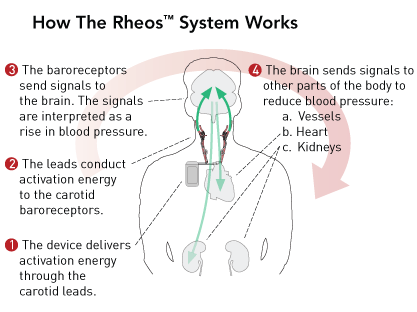
A new pacemaker-like device recently debuted at the American Heart Association meeting in Chicago this year to treat severe, drug–refractory hypertension. Made by CVRx, this device functions by stimulating the carotid bulb at the bifurcation (branch point) of the internal and external carotid arteries to activate the baroreceptor reflex.

The baroreceptor reflex is a normal reflex that the body uses to quickly provide more or less blood pressure to the brain with changes in posture. Elevation in blood pressures causes mechanical stretch of receptors (“baroreceptors”) in the carotid sinus. When stretched, these cells fire electrical impulses faster to stimulate centers in the brain that are responsible for deactivating sympathetic stimuli while activating the parasympathetic (or heart rate slowing and vasodilating portion of the body’s blood-pressure-regulating system to lower blood pressure. By stimulating these baroreceptors, researchers hope to use the body’s own baroreceptor reflex to drive blood pressure lower. The report of piloted patients appeared promising enough for the Food and Drug Administration to grant an Investigational Device Exemption (IDE) to expand the evaluation of the device to a larger cohort of patients.


Figure from the CVRx website


Early European results were reported for 12 patients at the European Society of Hypertension meeting in June 2006. In this study, after three months of active therapy, systolic blood pressure was reduced by an average of 24 mmHg (189 mmHg vs. 165 mmHg). In the preliminary US trial presented at the AHA meeting, three months of active therapy reduced systolic blood pressure by an average of 22 mmHg (180 mmHg vs. 158 mmHg) and diastolic blood pressure by an average of 18 mmHg (105 mmHg vs. 87 mmHg), using office cuff measurements. While data are preliminary at present, this device might become promising.

But there are some significant hurdles for the company to clear before the device can become reality.

First, because hypertension is painless and causes no symptoms until end-organ damage occurs, treating patients with an implantable device will be a hard sell for physicians. Furthermore, many patients with hypertension are simply left untreated by their physicians, or receive inadequate medical therapy. Confounding social and psychological problems, like alcoholism and medication non-compliance, further complicate therapy of hypertension. To think that such cases of hypertension warrant therapy with an implantable device is misguided.

Vanity, as well, will be difficult to overcome. From my experience with pacemakers, patients do not like their scar and associated discomfort occasionally experienced from pacemaker implantation beneath the collar bone (clavicle). Fortunately a shirt can usually cover the scar. But will patients want scars on both side of their neck with this device?

Safety issues also need to be addressed more completely. If the device is too effective in an individual patient and drop their blood pressure precipitously, how will it be inhibited? No sensor exists in the device to sense its effects on a persons’ blood pressure – certainly this is not a minor issue. Further, the baroreflex can cause profound slowing of the heart rate, or even asystole (no heart rate). No mechanism for pacing the heart (or a means of sensing the patient’s heart rate) exists in the device’s current design should a slow heart rhythm occur.

Finally, I hope that patients with renovascular hypertension are sufficiently screened before enrolling in a study using this device. Blocked arteries leading to the kidneys can result in profound medically-refractory blood pressure elevations and should be excluded before implanting this device.

In summary, the concept is interesting, but significant refinements are required before this device reaches the broader public. For now, treating hypertension early and often with conventional medical therapy and careful counselling is much more likely to be cost-effective at stemming hypertension’s end-organ complications.

-Wes