On 9 February 2017, I received a note from the editor of
Philadelphia Medicine magazine requesting that I respond to a
letter they received from Sidney Baumgarten, Esq, a friend and counsel for Ariel Benjamin Mannes, the American Board of Internal Medicine (ABIM)'s Director of Investigations, whom I had mentioned in their
publication dedicated to the ABIM that was released in December, 2016. Yesterday,
Mr. Baumgarten's letter and my rebuttal appeared in the
Spring 2017 issue (5 Mbytes) of
Philadelphia Medicine magazine.
I have reproduced the contents of Mr. Baumgarten's
original letter regarding Mr. Mannes and my rebuttal to his letter below:
December 27, 2016
Philadelphia Medicine Magazine
c/o Philadelphia County Medical Society
Alan J. Miceli, Editor
2100 Spring Garden St.
Philadelphia PA 19130
Dear Mr. Miceli,
I am writing this letter hoping that you will give it serious consideration and make it available to the members of the Society as well as those who read your publication.
I have been a friend and counsel to Ariel Benjamin Mannes, the Director of Investigations (formerly Test Security) at the American Board of Internal Medicine (ABIM), for many years. I must say, candidly, that with over 50 years of law practice I have never before seen the likes of the repeated attempts by Dr. Westby G. Fisher to malign a person based upon an 11-year old “blip” in his long and successful career of public trust. It is, to be sure, unconscionable, to be using invective to shame the ABIM and, along the way, destroying the career and good name of a very honest, competent person, I know that if a member physician were similarly treated you would be mounting the ramparts to obviate its harm to his/her career.
First, Mr. Mannes was a member of the DC Police Department with a very fine record of service. He had been on a leave of absence and was awaiting reinstatement to duty while working part time at a DC restaurant when the incident in question occurred. That night, Mr. Mannes intervened in an altercation and himself called the police for assistance and was in possession of a legally licensed handgun from Virginia where he lived, but not technically permitted then in DC. His arrest and conviction was solely for illegal possession of the weapon; one felony, not two as Dr. Fisher alleges.
Interestingly, Ben’s employment appeal was won and he was reinstated to the DC Police, and was ordered prior to the incident and was successfully reinstated, our legal view was that he was a de facto police officer at the time of the incident. It should also be noted that the very law Mr. Mannes plead guilty to was later declared unconstitutional by the Supreme Court.
Second, Ben had served with the US Department of Homeland Security on a TSA-led rail inspection team with a security clearance, even on the night of the incident. He had also held roles before moving to DC with the US Federal Protective Service in New York following the first World Trade Center bombing trials and the CAT Eyes program where he trained police instructors on anti-terrorism in multiple jurisdictions. Even after the aforementioned incident he worked as a contractor on homeland security technology initiatives in Los Angeles, Ohio and the Philadelphia region. In multiple instances, Mr. Mannes was able to assist me in my role as Chief of Staff of the Army Division of the New York Guard after 9/11. In fact, his intelligence gathering enabled us in New York to be forewarned of serious threats.
Third, because Ben was a resident of New York for many years, he was able to obtain a Certificate of Relief from Disabilities issued by the State of New York several years ago, which relieved him of any impediments to employment, etc. as a result of his plea and conviction.
Finally, our laws here in New York (where Mr. Mannes’ certificate was issued) prohibit discrimination against a person who has one criminal conviction. It is codified in our Human Rights Law and our Correction Law. Both are designed to prevent the stigma of one arrest from interfering with future employment.
As you can see, the one incident revealed nothing that would even suggest any form of dishonesty of other reason for the ABIM to reject his services. Mr. Mannes’ position was designed with a myriad of checks and balances and his casework, to include the one cited in your publication, have been upheld in courts of law on numerous occasions. Mr. Mannes is a consummate professional, active in the federal and local security community, who has made the appropriate disclosures in both his pre-employment background check at ABIM and the vetting process for appointments he has held since, to include his elected Governorship at Infragard, a public private partnership coordinated by the FBI.
To put it bluntly. Mr. Mannes is being unfairly pilloried to serve Dr. Fisher’s own differences with the ABIM. It is especially unseemly for the member of a highly respected profession to undertake the willful destruction of another human being for his own motives. Mr. Mannes has worked extremely hard over the last 11 years to undo the unfortunate incidents of one night and surely does not deserve to have his family, friends, and colleagues read disparaging, inaccurate things about him in the pages of your publication. I am sure Hippocrates would blush.
Sincerely,
Sidney Baumgarten, Esq.
Former Deputy Mayor, City of New York
Brigadier General, NYG, Retired
Cc: Hoffman Publishing Group
* * *
Mr. Baumgarten's understanding of Mr. Mannes' background conflicts with publicly available information regarding Mr. Mannes' past. To the best of my knowledge and belief, Mr. Mannes' prior background, responsibilities, "intelligence gathering" tactics, access to ABIM diplomate personal information, law-enforcement connections, and salary at ABIM have never been disclosed to ABIM diplomates despite Mr. Mannes' important public role in the organization. Here is the response I sent to
Phildelphia Medicine magazine regarding some of the verifiable facts I have found regarding his history (They requested I limit my response to 500 words):
"Contrary to what Sidney Baumgarten, Esq. claims, Ariel Benjamin Mannes does not have a 'fine record of service with the DC police department.' In 2003, Mannes admitted using his access as an officer to obtain Washington reporter Jason Cherkis's personal records and posting the information on a law enforcement website advocating reprisals. The disciplinary board decided unanimously to fire Mannes for conduct unbecoming, but took more than 55 days to notify him.
While on involuntary leave from D.C. Police pending investigation, Mannes began working for the TSA Railroad Division and moonlighted as a bouncer at the “Diva nightclub.” Mannes assaulted a Diva nightclub patron while carrying a loaded unregistered pistol and claiming he was a police officer. Mannes was charged with aggravated assault, impersonating a police officer, and carrying an unregistered firearm.
Per D.C. Court records (felony #006438), Mannes pleaded guilty on December 2005 to two charges from the nightclub incident: (a) impersonating a police officer and (b) carrying an unregistered firearm, and was sentenced to pay fines for each conviction and to probation. He lost his weapon and TSA employment because of this incident.
Police Chief Cathy Lanier was forced to rehire Mannes in November 2008 due solely to the notification issue, but then suspended him. The Department moved again to fire him because of his weapons charge.
Mannes lost his appeal of his two convictions on 10/21/2008, the same year he began working as Director of Test Security for the ABIM.
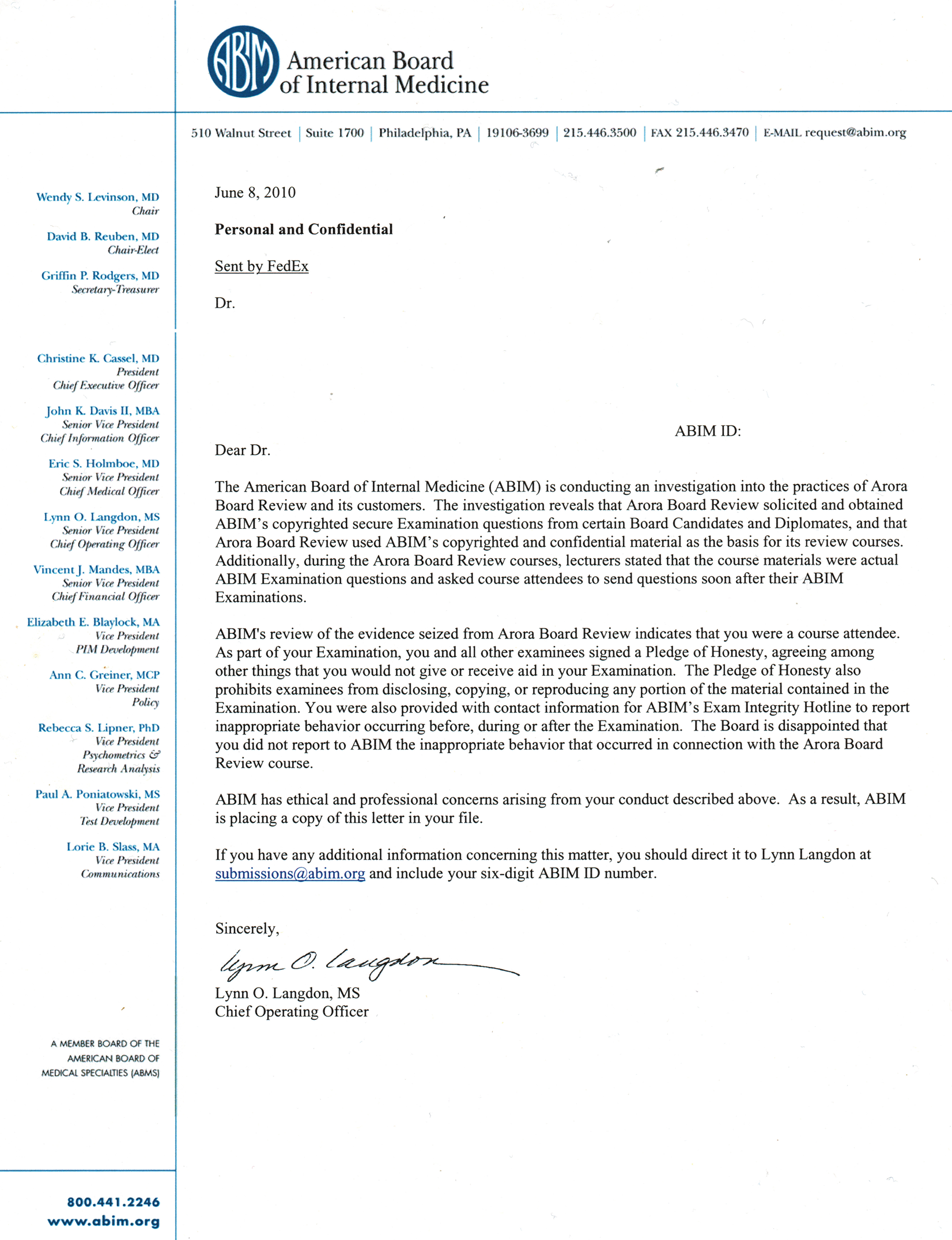
While at the ABIM, Mannes’ declaration before a federal judge was instrumental for the ABIM to obtain a temporary retraining and seizure order in ABIM’s investigation of the Arora Board Review (ABR) course on December 2, 2009. Mannes, ABIM lawyers, and U.S. Marshals seized materials from Dr. Arora’s home days later. Using emails from Arora’s computers, ABIM retaliated against 139 physicians and sued others and then issued a press release June 9, 2010 accusing physicians of unethical "brain dumping" before due process could occur.
In summary, Mannes was disciplined by the D.C. Police for abusing his position of authority to access confidential information to retaliate against an innocent citizen. Such conduct was not acceptable to the DC Police, and yet it appears to be acceptable to ABIM while it falsely accuses physicians of acting unethically. ABIM's double standard should be exposed as long as it continues to harm physicians.
These kinds of threats and attempts to discredit me are a dark example of organized medicine's ethics today. It is also a stark example of the tactics members of the American Board of Internal Medicine (ABIM) will deploy to control the narrative about them.
I take no joy in disclosing the misdeeds of a fellow human being. While the writer of the letter to
Philadelphia Medicine magazine seems to be concerned about his "friend and client" and describes his friend's past employment history as a mere "blip," he misses the point that 139 vulnerable physicians (and thousands more who received
"letters of concern") had their entire careers threatened by the ABIM's strongman tactics using his "friend and client's" investigation techniques and connections. Those actions resulted in untold personal and professional anxiety, legal fees, and
public humiliation before proper due process could occur. In many cases, physicians were
forced to undergo ethics training and
pay hefty fines to reinstate their board certification on the basis of the ABIM's felonious employee's carefully organized "investigation" so the leadership of the ABIM could maintain their monopoly, power, and lavish executive lifestyles. To then intimidate a person who tries to disclose the truth via a letter to a medical publication is a last-ditch tactic when there is no ground left to stand on.
Disclosing facts cannot be defined as "pillorying." In addition to the facts I outlined in my response to Mr. Baumgarten, it appears to me that Mr. Mannes used his experience with the Arora Board Review investigation to
promote his test security techniques to the board members of the American Board of Medical Specialties (ABMS) in a course called "Building a Bulletproof Exam Integrity Case: Tools of the Trade" in 2012. Should physicians blindly permit the wanton breach of their
civil liberties by individuals with Mr. Mannes' background and connections so other medical certifying boards can also profit using similar techniques?
Mr. Mannes had other conflicts of interest while an employee at ABIM: he worked for the test security firm,
Caveon,
teaching techniques of "responding to and investigating test-security incidents" to others. Mr. Mannes even
created his own corporation, Exam Integrity Services, LLC, in Florida in 2015. How much more profit did Mr. Mannes hope to gain at the expense of ABIM's physician reprisals while working as their employee?
Recently, we have come to learn that the ABIM sued one physician more than two years after the statute of limitations had expired on the 2009 Arora Board Review copyright infringement case that Mr. Mannes investigated under the direction of ABIM officers. The court recently
dismissed the claim after the physician (
Dr. Salas Rushford) was forced to endure years of stress and expense inflicted by the ABIM. For reasons that are unclear, Mr. Mannes' deposition in that case (for which I serve as an expert witness on behalf of Dr. Salas Rushford) has been kept under seal to the public, yet the deposition of Dr. Salas Rushford has not. Why? It seems the ABIM is an entity that has grown disproportionate authority over physicians without any meaningful accountability or transparency, and which we now see can abuse its power to inflict untold harm against physicians who are trying to serve patients.
How, where, when, and why unaccountable physician certifying bodies can retaliate against or sue physicians by intruding upon their personal property and
civil liberties on the basis of an
unproven promise of assuring "patient safety and physician quality" is one of society's most delicate and grave decisions. Certainly ABIM knows this but seeks to reduce working physicians' many concerns about their conflicted financial and investigational activities to a name-calling problem. While I admire the cleverness of this strategy, the genie is out of the bottle. Their attempt to make their reality a personal issue against me is deceptive.
Tens of thousands of US physicians have my same concerns and want answers from the ABIM and the American Board of Medical Specialties. In addition, an entire state medical society has
issued a vote of no confidence against the ABIM at the House of Delegates meeting in Chicago in June 2016, and the entire House of Delegates voted to end Maintenance of Certification (MOC) on the basis of lack of evidence of the need for MOC and the ABIM's financial and strongman actions. Despite this, the leadership of the American Medical Association has still not ended the ABMS Maintenance of Certification (MOC) program. Consequently, practicing physicians are mobilizing nationwide to
enact state-level legislation to end the corrupt MOC program that is tied to hospital credentialing and the ability of physicians to receive insurance payments in many states and, therefore, to practice their trade.
French philosopher
Foucault's work on power helps us understand why the physician certification industry, and Maintenance of Certification in particular, is so important to the US medical education system and for policy makers today:
Discipline, according to Foucault’s historical and philosophical analyses, is a form of power that tells people how to act by coaxing them to adjust themselves to what is ‘normal’. It is power in the form of correct training. Discipline does not strike down the subject at whom it is directed, in the way that sovereignty does. Discipline works more subtly, with an exquisite care even, in order to produce obedient people. Foucault famously called the obedient and normal products of discipline ‘docile subjects’.
Mr. Baumgarten's letter and the ABIM's strongman actions demonstate how the overreach of our US physician credentialing system can adversely affect the very people they pretend to protect: physicians and their patients. To limit a physicians' ability to think critically and care autonomously for their patients creates dangerous consequences for both caregivers and their patients. Health care administrators and policy makers would be wise to assure physicians continue to be able to speak independently and on behalf of their patients lest they fall prey to the same forces when they become patients themselves.
It is unacceptable to continue the half-truths and false representations of physician certification (and recertification's) value to our health care system. The ABIM and ABMS must take full accountability for their actions and reform the methods they are willing to employ to assure their revenues at the expense of the personal liberties of practicing physicians and stop using individuals like Mr. Mannes as their strongman and fall guy.
-Wes