(Note: my poor typical skills are evident in the repetitive pounding on the "Delete" key...)
-Wes
P.S.: Here's the data from a carefully-conducted "study" on age vs. typing skills I conducted some time ago.
“Politics is the art of looking for trouble, finding it everywhere, diagnosing it incorrectly, and applying all the wrong remedies.” -Groucho MarxAs I and others see the problems with "wellness initiatives" promoted by politicians and the insurance industry as cornerstones of our efforts to cut costs in our medical system, we should consider if institutional financial incentives will thwart any effort to achieve cost savings as physician productivity quotas are increasingly turned to as the driving force de rigueur for hospital profitability. Unfortunately, physicians are losing their ability to be stretched much further, especially as they struggle to keep up with the mushrooming number of inefficient certification and data-entry requirements, flooded e-mail in-boxes, and coding requirements necessary to continue practicing medicine in our new "reform" era. Then add the increasingly frequent hassles doctors are experiencing with their patients' insurance claim denials that go on for months. Medical care suffers as a result. Even our frontline force for quality medical care, nurses, are being stretched thin as many of their ranks are either let go or recruited as cleaning crews on top of their other patient care responsibilities.
The politics of selling the Affordable Care Act (ACA) focuses on promising health and wellness. Somehow, having “coverage” is supposed to get you to a primary care doctor, who will keep you healthy. And if he doesn’t, he will be held accountable by not being paid.
The fact is that “healthcare reform” is not going to cure America’s health problems.
Physicians, think tanks, and politicians are pointing out a myriad of problems with ACA. But most of them miss the main point, which starts with calling it “healthcare reform.” The term, and the conversation about it, conflates health care and medical care. But they are not the same thing. Individuals are in charge of their own health care. Physicians provide medical care to those who become sick.
(Read the rest, especially the comments)
Q: Many physicians are not seeing the expected financial return on investment after EHR implementation. Why is that?If you can stomach more, go on over and read the whole thing. (And consider leaving them a comment about how you really feel about this spin).
A: How you implement the technology has a lot to do with the results you achieve. (ed: Now, note how he dodges the question) But the bigger issue is how the compensation system is designed. If physicians are operating in a fee-for-service environment, then many of the gains of EHRs -- for instance, in quality, safety and patient engagement -- aren't reflected in revenue. Physicians are doing more work and delivering better care and service, but the added value is not reflected in the reimbursement. (ed: Okay, that's what we said: we're seeing lower pay, not higher, despite doing more and more meaningless data entry work with EHRs. We are often not finding return on our investment with the additional work. Why are you now addressing nebulous issues with physician payment reform? Could you stick with the question, please?)
We've been an advocate for making sure that when value is added, it's reflected in increased physician reimbursement whether it's through the patient-centered medical home (PCMH) setting (ed: Alas: no. It is impossible for the Coordinator to stick to the question. Now we're on to Value-Based Purchasing. WTF? Doctors aren't PURCHASING value, dammit, we're providing CARE!), value-based purchasing or part of an accountable care structure. That's where the ability to manage information -- not just for individual patients but for populations (ed: Remember dear doctor, it's not about you and your patient, EHRs are about the population manipulation! Huh?)-- becomes an absolute necessity, because in those models, it's not a question of whether there's a return on investment with electronic health records. (ed: Yes, dear Coordinator, in case you forgot, this WAS the original question) A physician can't function in those models without an EHR. (ed: Really? Since when?)
“An experiment is ethical or not at its inception, it does not become ethical post hoc – ends do not justify means. There is no ethical distinction between ends and means.”
"When everything is digitalized, all your records - your privacy is protected, but all your records on a digital form - that reduces medical errors. It means that nurses don't have to read the scrawl of doctors when they are trying to figure out what treatments to apply. That saves lives; that saves money; and it will still ensure privacy."
"I should like to affirm that American medicine is sound, and most progress in it soundly attained. There is, however, a reason for concern in certain areas, and I believe the type of activities to be mentioned will do great harm to medicine unless soon corrected. It will certainly be charged that a mention of these matters does a disservice to medicine, but not one so great, I believe, as a continuation of the practices cited.While Beecher’s paper was addressing ethical research errors in general, his words are oddly prescient for EMR development. Ethical errors, as he pointed out, “are increasing not only in numbers but in variety.” He points to one of the biggest drivers of ethical conflict: money.
Experimentation in man takes place is several areas: in self-experimentation; in patient volunteers and normal subjects; in therapy; and in the different areas of experimentation on a patient not for his benefit but for that, at least in theory, of patients in general."
“Of transcendent importance is the enormous and continuing increasing in available dollars for research, as shown below:
Money Available for Research Each Year Year Massachusetts General Hospital National Institutes of Health 1945 $500,000 $701,800 1955 2,222,816 36,063,200 1965 8,384,342 436,600,000
These data, rough as they are, illustrate vast opportunities and concomitantly expanded responsibilities.
Taking into account the sound and increasing emphasis of recent years that experimentation in man must precede general application of new procedures in therapy, plus the great sums of money available, there is reason to fear that these requirements and resources may be greater than the supply of responsible investigators.”
“The ethical approach to experimentation in man has several components; two are more important than others, the first being informed consent. The difficulty of obtaining this is discussed in detail. But it is absolutely essential to strive for it for moral, sociologic, and legal reasons. The statement that consent has been obtained has little meaning unless the subject or his guardian is capable of understanding what is to be undertaken and unless all hazards are clear. If these are not known this, too, shall be stated. In such a situation the subject at least knows that he is to be a participant in an experiment. Secondly, there is the more reliable safeguard provided by the presence of an intelligent, informed, conscientious, compassionate, responsible investigator.”Because EMR deployments are cloaked in intellectual property, non-disclosure and restrictive hospital employment agreements, doctors are often prohibited from voicing specific concerns about an EMR system publicly. In addition, by adopting EMR systems as cornerstones of the American health care system, Congress, the President and the ARRA side-stepped patients’ informed consent regarding the short-comings of these systems, advertising only their desired benefits instead. Furthermore, rather than Congress turning to “conscientious, compassionate, responsible investigators,” they turned to lobbyists when deciding to fund the deployment of unproven EMR systems. As a result, doctors were relegated to becoming nothing more than stewards of data entry subject to new, ever-evolving documentation requirements as these systems evolve for cost-saving benefits and care "efficiencies."
For Stage 1, physicians have to meet a total of 15 core (required) measures, select five measures of their choice from a menu set of ten, and also meet six clinical quality measures. For Stage 2, physicians are required to meet more measures: 17 core measures, an additional three measures of their choice from a menu set of six measures, and starting in 2014, meet nine clinical quality measures. The Health IT Policy Committee’s proposal for Stage 3 would nearly double the number of measures physicians would have to meet for each patient in order to avoid meaningful use financial penalties. Failing to meet just one measure by one percent would make a physician ineligible for incentives and face the same financial penalties during the penalty phase as those physicians who make no effort to adopt EHRs.You read that correctly. If you do all the clicky computer things the government wants with each patient visit, you will not have time to care for your patients. So never mind if you don't have a clue what all these "stages" of computer use actually mean because I can help you:
"A team of RAND Corporation researchers projected in 2005 that rapid adoption of health information technology (IT) could save the United States more than $81 billion annually. Seven years later the empirical data on the technology’s impact on health care efficiency and safety are mixed, and annual health care expenditures in the United States have grown by $800 billion."Who would have thought that such a prestigious organization like the RAND Corportation could have made such a teeny, tiny multi-billion dollar mistake? After all, their 2005 study was funded entirely by several of the major EMR manufacturers who have reaped billions in revenue on EMR sales since. Is there any wonder that now the same RAND Corporation felt that the EMRs the lack of cost savings is really the end-users' fault?
"In our view, the disappointing performance of health IT to date can be largely attributed to several factors: sluggish adoption of health IT systems, coupled with the choice of systems that are neither interoperable nor easy to use; and the failure of health care providers and institutions to reengineer care processes to reap the full benefits of health IT."
"A sleeper provision of the Affordable Care Act (ACA) encourages greater use of shared decision making in health care. For many health situations in which there's not one clearly superior course of treatment, shared decision making can ensure that medical care better aligns with patients' preferences and values. One way to implement this approach is by using patient decision aids — written materials, videos, or interactive electronic presentations designed to inform patients and their families about care options; each option's outcomes, including benefits and possible side effects; the health care team's skills; and costs. Shared decision making has the potential to provide numerous benefits for patients, clinicians, and the health care system, including increased patient knowledge, less anxiety over the care process, improved health outcomes, reductions in unwarranted variation in care and costs, and greater alignment of care with patients' values.What a nice, lovely, fuzzy bunny. Who couldn't want such "shared" decisions in complex medical care? Especially nice simple teaching aids for Medicare's top 20 procedures printed at the "8th grade level" that are "brief?"
However, more than 2 years after enactment of the ACA, little has been done to promote shared decision making. We believe that the Centers for Medicare and Medicaid Services (CMS) should begin certifying and implementing patient decision aids, aiming to achieve three important goals: promote an ideal approach to clinician–patient decision making, improve the quality of medical decisions, and reduce costs."
"Providers who did not document the shared-decision-making process could face a 10% reduction in Medicare payment for claims related to the procedure in year 1, with reductions gradually increasing to 20% over 10 years. This payment scheme is similar to that currently tied to hospital-readmissions metrics."Ms. Lee and Dr. Emanuel, in their zeal to impose their Progressive mindset upon America's physicians have forgotten several important tenets of health care delivery:
Medtronic says federal rules prohibit giving Ms. Hubbard's data to anyone but her doctor and hospital. "Our customers are physicians and hospitals," said Elizabeth Hoff, general manager of Medtronic's data business. Medtronic would need regulatory approval to give patients the data, she said. It hasn't sought approval because "we don't have this massive demand."
. . .
Some legal experts say the 1996 U.S. law governing patient access to their health files—HIPAA, or the Health Insurance Portability and Accountability Act—hasn't kept up with technology. The law gives patients the right to access information held by doctors and hospitals. However, the raw data gathered by an implant isn't held by a doctor or a hospital: Typically it goes directly to the device maker, which provides a summary report to the doctor. Because of this, the raw data falls outside the scope of HIPAA's patient-access requirements. In addition, Medtronic said, business agreements with doctors and hospitals restrict it to relaying information only to them.
"Is the device itself a depository for medical records?" said Paul C. Zei, a cardiologist at Stanford University Medical Center with a patient, Hugo Campos, who wants the same access to his cardiac-device data as the doctor gets. "Or is it part of the patient, and an extension of vital signs that we download into a medical chart?"Gee. Someone saw this coming years ago.
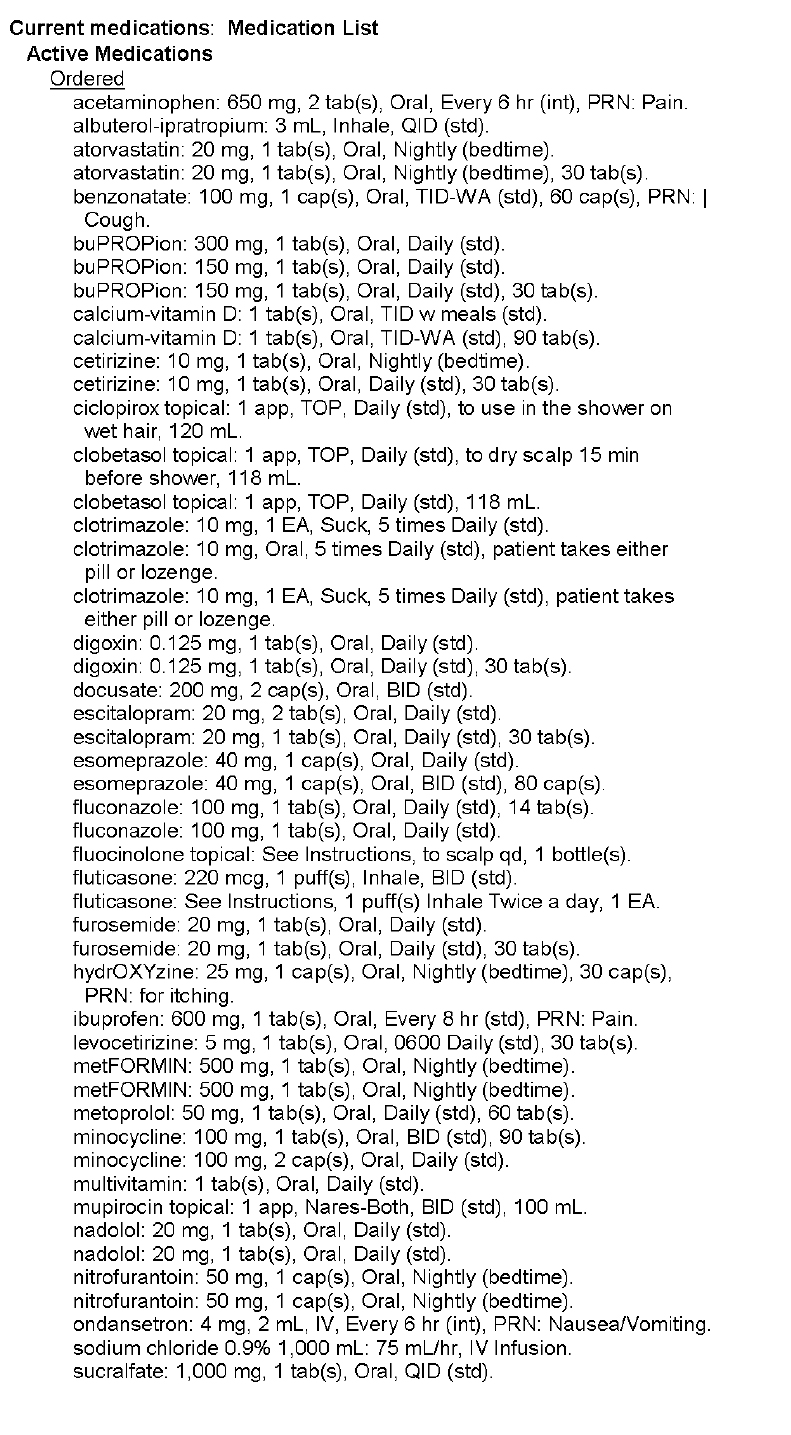 |
| Med List (Page 1) - Click to enlarge |
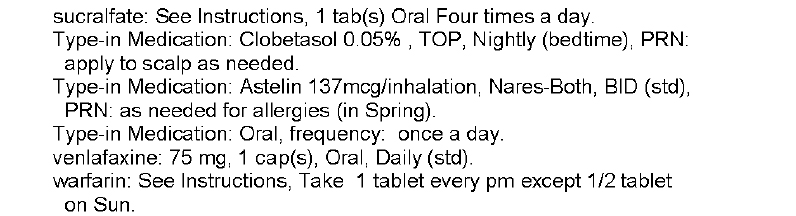 |
| Med List (Page 2) - Click to enlarge |

