As part of the Physician Payment Sunshine Act ("Sunshine Act"), some medical device companies started posting physician payments online.
Here are the current links to the "big three" US medical device companies' reports I could find online at this time:
Boston Scientific Corporation
Medtronic, Inc.
St. Jude Medical - to report payments beginning March 2014.
-Wes
Showing posts with label medical devices. Show all posts
Showing posts with label medical devices. Show all posts
Monday, January 06, 2014


Thursday, March 28, 2013
Doctors as Purchasing Agents
Thanks to NPR, I was directed to an op-ed that appeared in the New York Times in October 2012 entitled "In Cancer Care, Cost Matters." The article describes what may be one of the earliest accounts where doctors at Sloan-Kettering decided not to use a new cancer drug because of its extra cost when they were already using equally-effective drugs for their cancer treatments. The article piqued my interest. These days for any doctor who uses expensive technologies, it is easy to see where this evaluation will lead us in our new era of cost concerns in medicine. Medical device companies should take notice.
Few use more expensive technology in medicine than cardiologists and cardiac electrophysiologists. Not only is our technology expensive, it is also used frequently. Cardiovascular disease remains one of the largest cost drivers in medicine.
In the past, doctors (myself included) were complicit with device companies in our use of new technologies, implanting the latest model of defibrillator, for instance, not because it saved lives any better, but more so we could boast that our patients were receiving a "Cadillac" defibrillator rather than a "Ford" device (no disrespect intended to car companies, but you get my drift). After all, our patients deserved the best and most innovative technology available at the time. We did not want to be caught in the embarrassing position of being behind innovation power curve either.
I should acknowledge that there have been some very important recent developments with defibrillators since the 2005-2006 device recalls that plagued our specialty. The ability to monitor device reliability wirelessly facilitated the ability to detect device battery depletions or lead failures and has improved our understanding of tolerable device and lead failure rates, for instance. But it is not uncommon for a newly-named pacemaker or defibrillator to add several thousand dollars to the health care system over last year's device yet they may add only minor advances over the prior year's model.
Pacemakers, too, are being manufactured that are FDA-labelled "MRI-tolerant." But examples of safe application of MRI's to conventional pacemakers are prevalent in the medical literature, so is the extra cost of an MRI-safe pacemaker worth it? (In actuality, if you ask the informed pacemaker implanters out there, the main reason MRI pacemakers are routinely implanted is not because of safety concerns, but because of the CMS coverage decision for MRI payment in patients with pacemakers.(pdf)) How do we weigh the cost of these extra advances in technology versus their ability to improve our patients' actual morbidity and mortality?
Increasingly, doctors will soon be involved with purchasing decisions for advanced technologies. Pacemakers, defibrillators, implantable monitors, stents, catheters, and even small sheaths will be scrutinized for their utility, ease of use, and cost. (The liability of NOT using a technology will also be considered, but this issue is hard to measure and less familiar to frontline doctors.)
The real question, of course, is will the patient see these cost savings if older technologies are used? This is hard to say since there are so many layers to our health care system between the patient and the dollar. Also, how will patients react when they find out online that their model of medical device is last year's model rather than this year's? Will they seek another hospital system with shinier walls and bigger names? It's impossible to tell.
But if hospitals are smart, they'll make it clear to the patient on their bill what they saved themselves by using an earlier-year device. Medical device companies, too, might shift their marketing tactics to costs and benefits from things like size or shape of their device.
But one thing's for certain in the days ahead: device companies will have to carry not just this year's model of device, but last year's, too. Innovations in technologies will be harder to sell unless they show real patient morbidity or mortality benefit. Companies will have to adapt their marketing campaigns since cost savings, done correctly, will benefit everyone.
After all, it's now about real costs and benefits in health care, rather than just sexy bells and whistles.
-Wes
Addendum: The CMS National Coverage Decision for MRIs in patients with pacemakers is now functional.
Few use more expensive technology in medicine than cardiologists and cardiac electrophysiologists. Not only is our technology expensive, it is also used frequently. Cardiovascular disease remains one of the largest cost drivers in medicine.
In the past, doctors (myself included) were complicit with device companies in our use of new technologies, implanting the latest model of defibrillator, for instance, not because it saved lives any better, but more so we could boast that our patients were receiving a "Cadillac" defibrillator rather than a "Ford" device (no disrespect intended to car companies, but you get my drift). After all, our patients deserved the best and most innovative technology available at the time. We did not want to be caught in the embarrassing position of being behind innovation power curve either.
I should acknowledge that there have been some very important recent developments with defibrillators since the 2005-2006 device recalls that plagued our specialty. The ability to monitor device reliability wirelessly facilitated the ability to detect device battery depletions or lead failures and has improved our understanding of tolerable device and lead failure rates, for instance. But it is not uncommon for a newly-named pacemaker or defibrillator to add several thousand dollars to the health care system over last year's device yet they may add only minor advances over the prior year's model.
Pacemakers, too, are being manufactured that are FDA-labelled "MRI-tolerant." But examples of safe application of MRI's to conventional pacemakers are prevalent in the medical literature, so is the extra cost of an MRI-safe pacemaker worth it? (In actuality, if you ask the informed pacemaker implanters out there, the main reason MRI pacemakers are routinely implanted is not because of safety concerns, but because of the CMS coverage decision for MRI payment in patients with pacemakers.(pdf)) How do we weigh the cost of these extra advances in technology versus their ability to improve our patients' actual morbidity and mortality?
Increasingly, doctors will soon be involved with purchasing decisions for advanced technologies. Pacemakers, defibrillators, implantable monitors, stents, catheters, and even small sheaths will be scrutinized for their utility, ease of use, and cost. (The liability of NOT using a technology will also be considered, but this issue is hard to measure and less familiar to frontline doctors.)
The real question, of course, is will the patient see these cost savings if older technologies are used? This is hard to say since there are so many layers to our health care system between the patient and the dollar. Also, how will patients react when they find out online that their model of medical device is last year's model rather than this year's? Will they seek another hospital system with shinier walls and bigger names? It's impossible to tell.
But if hospitals are smart, they'll make it clear to the patient on their bill what they saved themselves by using an earlier-year device. Medical device companies, too, might shift their marketing tactics to costs and benefits from things like size or shape of their device.
But one thing's for certain in the days ahead: device companies will have to carry not just this year's model of device, but last year's, too. Innovations in technologies will be harder to sell unless they show real patient morbidity or mortality benefit. Companies will have to adapt their marketing campaigns since cost savings, done correctly, will benefit everyone.
After all, it's now about real costs and benefits in health care, rather than just sexy bells and whistles.
-Wes
Addendum: The CMS National Coverage Decision for MRIs in patients with pacemakers is now functional.
Thursday, November 29, 2012
The Currency of the Future
From this morning's Wall Street Journal:
But as patients pay for more and more of their health care, companies better remember who's really their customer. Furthermore. patients should have access rights to all of their medical information, irrespective of where it resides.
-Wes
Medtronic says federal rules prohibit giving Ms. Hubbard's data to anyone but her doctor and hospital. "Our customers are physicians and hospitals," said Elizabeth Hoff, general manager of Medtronic's data business. Medtronic would need regulatory approval to give patients the data, she said. It hasn't sought approval because "we don't have this massive demand."
. . .
Some legal experts say the 1996 U.S. law governing patient access to their health files—HIPAA, or the Health Insurance Portability and Accountability Act—hasn't kept up with technology. The law gives patients the right to access information held by doctors and hospitals. However, the raw data gathered by an implant isn't held by a doctor or a hospital: Typically it goes directly to the device maker, which provides a summary report to the doctor. Because of this, the raw data falls outside the scope of HIPAA's patient-access requirements. In addition, Medtronic said, business agreements with doctors and hospitals restrict it to relaying information only to them.
"Is the device itself a depository for medical records?" said Paul C. Zei, a cardiologist at Stanford University Medical Center with a patient, Hugo Campos, who wants the same access to his cardiac-device data as the doctor gets. "Or is it part of the patient, and an extension of vital signs that we download into a medical chart?"Gee. Someone saw this coming years ago.
But as patients pay for more and more of their health care, companies better remember who's really their customer. Furthermore. patients should have access rights to all of their medical information, irrespective of where it resides.
-Wes
Thursday, July 26, 2012
How the iPhone Might Disrupt The Medical Device Industry
Doctors wanting to determine a patient's atrial fibrillation burden have a myriad of technologies at their disposal: 24-hour Holter monitors, 30-day event monitors that are triggered by an abnormal heart rhythm or by the patient themselves, a 7-14 day patch monitor that records every heart beat and is later processed offlineto quanitate the arrhythmia, or perhaps an surgically-implanted event recorder that automatically stores extremes of heart rate or the surface ECG when symptoms are felt by the patient. The cost of these devices ranges from the hundreds to thousands of dollars to use.
Today in my clinic, a patient brought me her atrial fibrillation burden history on her iPhone and it cost her less than a $10 co-pay. For $1.99 US, she downloaded the iPhone app Cardiograph to her iPhone.

Every time she feels a symptom, she places her index finder over the camera on the phone, waits a bit, and records a make-believe rhythm strip representing each heart rhythm. With it, comes the date and time. When the rhythm is in sinus, she learned that her heart rhythm was typically in the 60's at rest:

When the rhythm was in afib, it was considerably higher and sometimes displayed an irregular rhythm:

or sometimes it displayed an error message:

I got a relative picture of how often she was having afib and she got the opportunity to help me with her care.
Was this a medical device? No, it was an iPhone app.
Was it perfect? No it wasn't. I certainly couldn't differentiate frequent PAC's or PVC's from atrial fibrillation reliably. It was NOT an EKG after all. But we were past that point in her evaluation. I just needed to know how often she was having her known paroxysmal atrial fibrillation and she wanted to keep a convenient record of her episodes.
Was it helpful in this case? Absolutely.
More importantly, she just saved herself and the health care system a ton of money.
Welcome, my friends, to the era of patient-empowered, individualized medicine and a whole new era of patient care. Now, if we can just keep the FDA from screwing things up.
-Wes
PS: I have no commercial interest in the Cardiograph app and do not endorse it as a standard of care, but merely use this case to demonstrate how innovation can facilitate cheaper, equally-effective health care in some cases. I'd also like to thank my patient for allowing me to use her screen shots.
Today in my clinic, a patient brought me her atrial fibrillation burden history on her iPhone and it cost her less than a $10 co-pay. For $1.99 US, she downloaded the iPhone app Cardiograph to her iPhone.
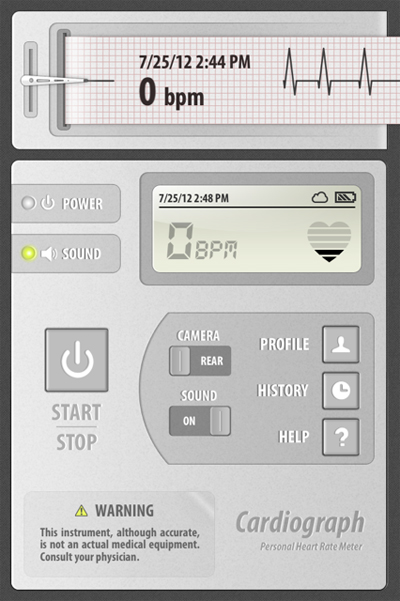
Every time she feels a symptom, she places her index finder over the camera on the phone, waits a bit, and records a make-believe rhythm strip representing each heart rhythm. With it, comes the date and time. When the rhythm is in sinus, she learned that her heart rhythm was typically in the 60's at rest:

When the rhythm was in afib, it was considerably higher and sometimes displayed an irregular rhythm:
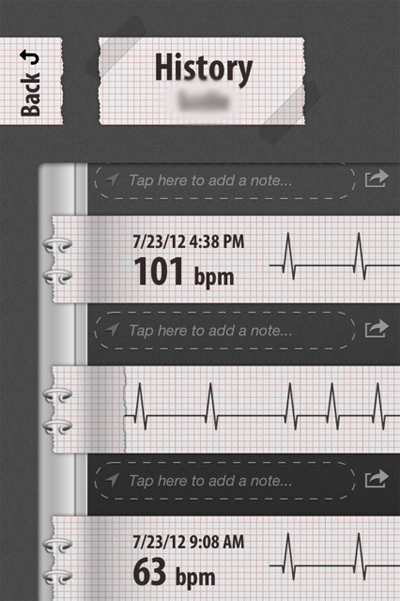
or sometimes it displayed an error message:
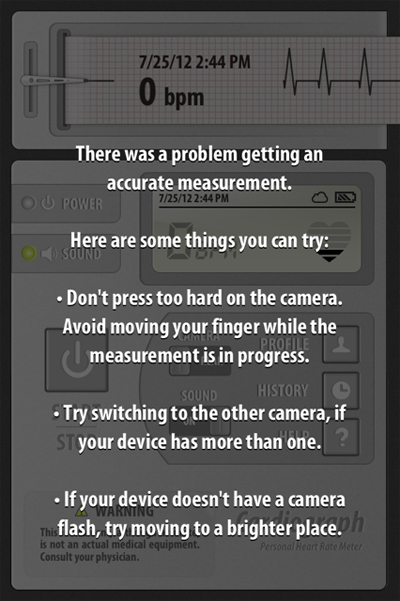
I got a relative picture of how often she was having afib and she got the opportunity to help me with her care.
Was this a medical device? No, it was an iPhone app.
Was it perfect? No it wasn't. I certainly couldn't differentiate frequent PAC's or PVC's from atrial fibrillation reliably. It was NOT an EKG after all. But we were past that point in her evaluation. I just needed to know how often she was having her known paroxysmal atrial fibrillation and she wanted to keep a convenient record of her episodes.
Was it helpful in this case? Absolutely.
More importantly, she just saved herself and the health care system a ton of money.
Welcome, my friends, to the era of patient-empowered, individualized medicine and a whole new era of patient care. Now, if we can just keep the FDA from screwing things up.
-Wes
PS: I have no commercial interest in the Cardiograph app and do not endorse it as a standard of care, but merely use this case to demonstrate how innovation can facilitate cheaper, equally-effective health care in some cases. I'd also like to thank my patient for allowing me to use her screen shots.
Tuesday, January 10, 2012
Eliminating Waste in Health Care
Nine medical specialty societies are joining with the American Board of Internal Medicine Foundation and Consumer Reports to curtail waste in health care and improve patient outcomes.Specialty societies are joining forces to stamp out medical waste in all its forms, even resorting to petitioning their members to come up with ideas to save money.
As much as 30% of U.S. health care is squandered on unnecessary tests, procedures, hospital stays and other services, according to the Congressional Budget Office. Such services don't benefit patients, and in some cases may harm them.
Honestly, this should have been done long ago and should remain an ongoing priority.
But I'm going to stick my neck out and mention an area that no one ever discusses. It's an area of waste so vast that it would dwarf all of the recommendations that are likely to come any or all of these surveys. It's an area of waste that plagues every hospital, long-term care facility, rehab facility, or nursing home in our country, yet benefits every device manufacturer and supplier to our health care system.
What is it?
Medical supply planned obsolescence.
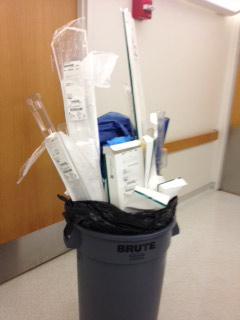
What do I mean by this? I mean the waste generated every day in our health care system by expired medical goods.
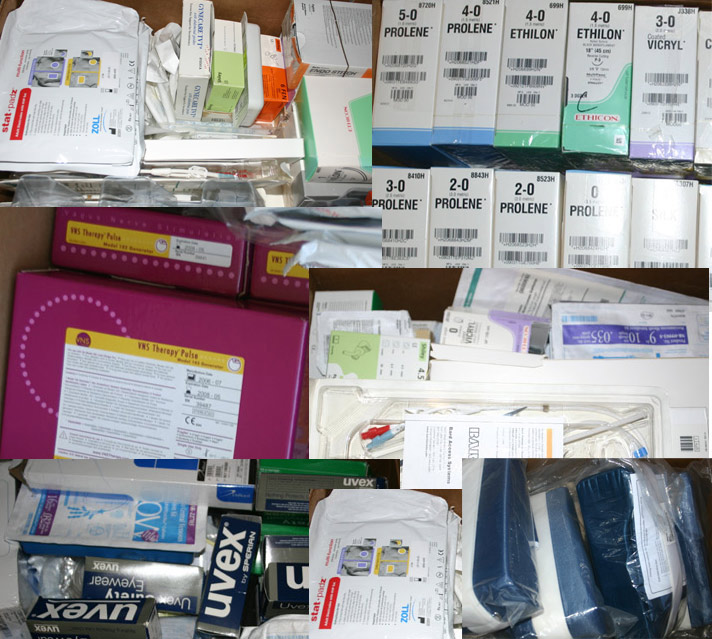
A Sampling of Expired Medical Supplies (click to enlarge)
Never mind if they are non-sterilized plastic jars. If they have an expiration date that is past due, they are discarded. If they are expired shiny, new metal or plastic medical instruments that could easily be re-sterilized (think laparoscopic staplers, attachments and the like), they are discarded. Double-wrapped IV fluids? Sutures? Drape kits? Gloves? These too are discarded. You see, you can never be too safe.
In fact, expired medical equipment fills many landfills (a must-see video) both here and overseas.
Certainly there are concerns about sterility and the decomposition of medications and materials that occurs with time. No one wants to accept the liability that expired medical goods could have been the cause of illness or infection. This is certainly appropriate.
But how many thousands of pounds of medical goods are discarded each quarter from our nation's hospitals that could be re-purposed, re-sterilized, re-packaged to give us HUGE cost savings to our health care system? Could expiration dates be extended safely without compromising quality?
No. One. Knows.
Why?
Because there's no incentive to do so and it's not in the economic interest of the suppliers to find out.
But given the millions (and probably billions) of dollars wasted on expired medical equipment each year, isn't it about time we do? Even if we can only extend the purposeful shelf life of supplies from five years to six, we likely could save hundreds of millions of dollars (or more) for our health care system.
And who knows, maybe we'll do something good for our planet along the way.
-Wes
Friday, November 11, 2011
Miss Manners Goes to the ACCF
Dear Ms. Manners:
I am a fellow of the American College of Cardiology and I just learned that the American College of Cardiology Foundation (ACCF), the same foundation that publishes most of our patient care and treatment guidelines, is providing training to medical device and pharmaceutical personnel so our interactions with them become “effective and efficient.”
How nice.
Is this how Multaq (er, dronedarone) got such an early mention in our latest atrial fibrillation treatment guidelines? I've always wondered, especially after we later learned that there might be a few unsavory issues with this drug.
Still, I have no doubt the need is there. Glad to see that my annual membership fees are being put to such good use. After all, up until now, it really HAS been hard interacting with industry reps when they brought lunch. Don’t get me wrong, it wasn’t their professional demeanor or their knowledge of their device or drug. No, that wasn’t it. It was just so hard to explain to them why I had to dine and dash.
Now, thanks to you, I won't have to. I'll just spend more of my limited time getting down with industry personnel so we can share. Imagine: having smart people we can talk to about our latest, coolest case so they can record how much money they spend on our get-togethers. That's efficiency exemplified.
I'm especially impressed that the ACCF training of industry personnel will occur every two years. I was worried about quality of our industry reps' knowledge base, so I'm glad you've made this effort a full-time job. (By the way, I had NO IDEA the ACCF now has a vivarium for all this training - when did you guys spring for that?) Impressive. Rest assured that I'll be SURE to check for your ACCF Training Logo on their business cards before I help myself to a gyro.
But do me a favor, will you? Would you mind passing on some of those fees you receive for that industry training to those of us helping ourselves to lunch? After all, those membership fees we're paying to the ACC are getting a bit stiff. (*wink wink*)
Just kidding.
I'm sure you're really collecting those fees to help lower the cost of my patients' medical devices and drugs in an effort to support their "positive health outcomes." After all, it's this cost thing that's reaking havoc on our health care system, right? (I wish I had thought of such a clever way to address this problem).
Ms. Manners?
Ms. Manners?
Right?
-Wes
h/t: Larry Husten over at Cardiobrief.
I am a fellow of the American College of Cardiology and I just learned that the American College of Cardiology Foundation (ACCF), the same foundation that publishes most of our patient care and treatment guidelines, is providing training to medical device and pharmaceutical personnel so our interactions with them become “effective and efficient.”
How nice.
Is this how Multaq (er, dronedarone) got such an early mention in our latest atrial fibrillation treatment guidelines? I've always wondered, especially after we later learned that there might be a few unsavory issues with this drug.
Still, I have no doubt the need is there. Glad to see that my annual membership fees are being put to such good use. After all, up until now, it really HAS been hard interacting with industry reps when they brought lunch. Don’t get me wrong, it wasn’t their professional demeanor or their knowledge of their device or drug. No, that wasn’t it. It was just so hard to explain to them why I had to dine and dash.
Now, thanks to you, I won't have to. I'll just spend more of my limited time getting down with industry personnel so we can share. Imagine: having smart people we can talk to about our latest, coolest case so they can record how much money they spend on our get-togethers. That's efficiency exemplified.
I'm especially impressed that the ACCF training of industry personnel will occur every two years. I was worried about quality of our industry reps' knowledge base, so I'm glad you've made this effort a full-time job. (By the way, I had NO IDEA the ACCF now has a vivarium for all this training - when did you guys spring for that?) Impressive. Rest assured that I'll be SURE to check for your ACCF Training Logo on their business cards before I help myself to a gyro.
But do me a favor, will you? Would you mind passing on some of those fees you receive for that industry training to those of us helping ourselves to lunch? After all, those membership fees we're paying to the ACC are getting a bit stiff. (*wink wink*)
Just kidding.
I'm sure you're really collecting those fees to help lower the cost of my patients' medical devices and drugs in an effort to support their "positive health outcomes." After all, it's this cost thing that's reaking havoc on our health care system, right? (I wish I had thought of such a clever way to address this problem).
Ms. Manners?
Ms. Manners?
Right?
-Wes
h/t: Larry Husten over at Cardiobrief.
Friday, August 12, 2011
The Challenges of Medical Device Follow-up
With the explosion of medical devices to treat various medical ailments in medicine, we have seen significant improvements in quality and quantity of life. An underappreciated consequence of all of these electronic device therapies, however, has been the manpower and expertise required to manage these implanted electronic medical devices long-term.
Problems with electromagnetic interference (EMI) with medical devices are real. Innovations in medicine have come from various portions of the electromagnetic spectrum including analog and digital wireless technology, diagnostic and therapeutic radiation therapy and magnetic resonance imaging. The effects of these technologies on implanted electronic medical devices can vary and specialty physicians, ancillary health care providers, and medical device manufacturers expend significant man-hours managing these potential interference sources and their affects on devices without a single prospective randomized trial to guide us. The sheer number of devices and the many ways that EMI can interfere with these complex devices makes constructing an all-inclusive trial with sufficient number of "events" to compare difficult or nearly impossible. As a result, most of our management recommendations and hospital policies in this regard have been based from literature case reports or personal experience and expertise.
To date, recommendations for minimizing EMI with cardiac implantable electronic devices has been sorely lacking, so the new recommendations published (1.3 Meg pdf) recently by the Heart Rhythm Society (HRS) in conjunction with American Society of Anesthesiologists (ASA) should serve as a helpful guide for physicians involved in the management of these devices. It would be well beyond the scope of this blog to include all of the pre-procedural, intra-procedural and post-procedural recommendations made by this document. But there are some other limitations to these recommendations that warrant mention.
First, there are a multitude of makes and models of pacemaker and implantable cardiac defibrillator devices which are covered by this document. The document is fairly inclusive regarding today's technology. New models forthcoming, however, are not specifically covered by this document (how can they be?) so the challenges keeping these recommendations current will remain a challenge.
Secondly, these recommendations do not cover the management of devices during magnetic resonance imaging, an evolving innovation in these devices, but no less important for patient management in these procedures.
Third, this document covers only implantable electronic cardiac devices. Nerve stimulators, brain stimulators, insulin pumps and a whole host of other implanted electronic devices still remain outside the purview of these recommendations, yet pose similar challenges to patient management, both from a technical expertise AND manpower-need standpoint. The challenges of not only electromagnetic interference, but also device-device interference remain and still need to be considered clinically.
Finally, the recommendations were made in conjunction with the expertise of industry and physician experts. While these recommendations appear to have been made for patients benefit, the real need for the medical device industry to limit their manpower needs for peri-procedural device checks should not go unnoticed. Much of the newer innovations of home monitoring has been forwarded in part to address these simultaneous patient and industry needs. Still, it goes without saying that doctors should remember that any local hospital recommendations developed on the basis of these guidelines should always put the needs of the patient before those of the medical device industry or hospital administration.
-Wes
Reference: The Heart Rhythm Society (HRS)/American Society of Anesthesiologists (ASA) Expert Consensus Statement on the Perioperative Management of Patients with Implantable Defibrillators, Pacemakers and Arrhythmia Monitors: Facilities and Patient Management.
Problems with electromagnetic interference (EMI) with medical devices are real. Innovations in medicine have come from various portions of the electromagnetic spectrum including analog and digital wireless technology, diagnostic and therapeutic radiation therapy and magnetic resonance imaging. The effects of these technologies on implanted electronic medical devices can vary and specialty physicians, ancillary health care providers, and medical device manufacturers expend significant man-hours managing these potential interference sources and their affects on devices without a single prospective randomized trial to guide us. The sheer number of devices and the many ways that EMI can interfere with these complex devices makes constructing an all-inclusive trial with sufficient number of "events" to compare difficult or nearly impossible. As a result, most of our management recommendations and hospital policies in this regard have been based from literature case reports or personal experience and expertise.
To date, recommendations for minimizing EMI with cardiac implantable electronic devices has been sorely lacking, so the new recommendations published (1.3 Meg pdf) recently by the Heart Rhythm Society (HRS) in conjunction with American Society of Anesthesiologists (ASA) should serve as a helpful guide for physicians involved in the management of these devices. It would be well beyond the scope of this blog to include all of the pre-procedural, intra-procedural and post-procedural recommendations made by this document. But there are some other limitations to these recommendations that warrant mention.
First, there are a multitude of makes and models of pacemaker and implantable cardiac defibrillator devices which are covered by this document. The document is fairly inclusive regarding today's technology. New models forthcoming, however, are not specifically covered by this document (how can they be?) so the challenges keeping these recommendations current will remain a challenge.
Secondly, these recommendations do not cover the management of devices during magnetic resonance imaging, an evolving innovation in these devices, but no less important for patient management in these procedures.
Third, this document covers only implantable electronic cardiac devices. Nerve stimulators, brain stimulators, insulin pumps and a whole host of other implanted electronic devices still remain outside the purview of these recommendations, yet pose similar challenges to patient management, both from a technical expertise AND manpower-need standpoint. The challenges of not only electromagnetic interference, but also device-device interference remain and still need to be considered clinically.
Finally, the recommendations were made in conjunction with the expertise of industry and physician experts. While these recommendations appear to have been made for patients benefit, the real need for the medical device industry to limit their manpower needs for peri-procedural device checks should not go unnoticed. Much of the newer innovations of home monitoring has been forwarded in part to address these simultaneous patient and industry needs. Still, it goes without saying that doctors should remember that any local hospital recommendations developed on the basis of these guidelines should always put the needs of the patient before those of the medical device industry or hospital administration.
-Wes
Reference: The Heart Rhythm Society (HRS)/American Society of Anesthesiologists (ASA) Expert Consensus Statement on the Perioperative Management of Patients with Implantable Defibrillators, Pacemakers and Arrhythmia Monitors: Facilities and Patient Management.
Thursday, May 05, 2011
Heart Rhythm Society Responds to Scrutiny Over Industry Ties
Tomorrow professional medical societies will be looking long and hard at how they disclose industry ties in response to an article published this evening by ProPublica (and co-published in USA Today) entitled: "Financial Ties Bind Medical Societies To Drug and Device Makers." The investigative reporting by Charles Ornstein and Tracy Weber examines the medical conference trade and the associated funding sources, focusing on the Heart Rhythm Society 2011 meeting underway in San Francisco. The report includes an interactive graphic, and slideshow of "promotional opportunities" available for purchase from the Heart Rhythm Society. The authors also organized the responses of 33 other prominent medical societies to an inquiry of Senator Charles Grassley's regarding funds they receive from the pharmaceutical and medical device industries. There is much for the public to learn here.
But what should not go un-noticed, however, is the Heart Rhythm Society's willingness to "bear all" about their practices. In fact, they answered, head-on, questions posed to them by the ProPublica reporters. In this respect, they should be commended for pulling back the curtain on the sources of funding for these scientific sessions and their operations.
It will be interesting to see if other medical societies are as forthcoming as the Heart Rhythm Society has been. What is clear is that as dollars get tighter and tighter for health care, the scrutiny of these practices and their potential to influence doctors will only continue to intensify.
-Wes
But what should not go un-noticed, however, is the Heart Rhythm Society's willingness to "bear all" about their practices. In fact, they answered, head-on, questions posed to them by the ProPublica reporters. In this respect, they should be commended for pulling back the curtain on the sources of funding for these scientific sessions and their operations.
It will be interesting to see if other medical societies are as forthcoming as the Heart Rhythm Society has been. What is clear is that as dollars get tighter and tighter for health care, the scrutiny of these practices and their potential to influence doctors will only continue to intensify.
-Wes
Sunday, December 12, 2010
"This Is The Way It's Done"
Tuesday, May 18, 2010
How We've Killed Clinical Research
- Blanche DuBois in Tennessee William's play,
A Streetcar Named Desire
Years ago when I began my medical training, I recall enrolling patients for clinical research. In cardiology, there were a myriad of questions that needed to be answered, especially in the area of defining which medications were best to limit the damage caused by a heart attack. Patients routinely participated in large, multi-center prospective randomized trials to answer these questions. It was routine for them not to charged for participating in the trial: the drug(s) and additional testing would be funded by the company whose drug was being studied. Patients enrolled willingly, eager to help advance science and perhaps, in some small way, their fellow man.
It never dawned on me in those early days why hospitals and research centers were so eager to promote research.
Like many things in our profession, research centers realized that these studies could make money. There are always additional expenses required to perform these studies and research centers wanted to make sure they were not left holding the "cost bag" for these trials, so they would pad their budgets for both the "direct costs" of performing the trial and a bit more for "indirect costs" that funded their offices and utilities and perhaps to offset the losses carried by other slow-to-enroll trials.
This strategy worked. Research centers, working earnestly, helped recruit patients by marketing their cutting edge researchers to the populous. Patients came in droves since there was no additional cost on their part to participate. Research centers got additional "indirect" funds from the drug companies to grow. More research was conducted, more patients recruited, and everyone benefited.
Until the costs of health care grew.
About 2001, research was getting expensive for companies. Back then, I noticed a subtle shift occur in the funding of clinical research by the medical device industry. I was involved in Medtronic's Insync trial that tested the first biventricular pacemaker for the treatment of heart failure. As a young electrophysiology researcher, I was stoked: this was exciting new and unproven territory for pacing therapy to venture.
But I remember how the Insync trial budget was formulated because it was quite different than I had remembered with other clinical trials. In this trial, part of the study was completely funded not by the company, but rather a portion of the trial was paid for by the patient's insurer. This was perfectly legal, we were told, since the large companies had to gain approval from our government via the FDA to allow such a payment strategy. Also, insurers were required to pay for clinically-indicated pacemakers. So, since dual chamber pacemakers were already approved for reimbursement by insurers and the "only" new portion of the implant procedure was the placement of a new left ventricular lead, the patient would not be charged for any of the new equipment, and their insurer would "only" be charged for a "regular" dual-chamber pacemaker (mind you, for a pacing therapy that was unproven at the time). Technically, patients still did not have to bear any additional cost of their involvement in the trial and everybody was happy. With this new trial budget strategy now firmly in place, we had, in effect, "relied on the kindness of strangers" (the patient's insurer) to help fund the company's research. No one seemed to notice this shift, and certainly no one minded, since everybody won: the patient got the device, the research center got paid, and the company, too, could even make a little money to offset their expenses in the process.
Naturally, there was a desire for research centers to recruit more and more trials to grow their prestige in the community. Small companies would use research protocols to gain marketshare in competetive hospital accounts using, in part, this patient-subsidized budget strategy. Worse, they would create new add-on trials only marginally relevant for the same growth strategy even after devices were FDA-approved.
Fast forward ten years to our current era.
With the growing cost of health care being offloaded by insurers on the backs of patients, patients have seen their insurance deductibles rise. Employers are finding they can no longer provide "Cadillac plans" to their employees due to costs, and instead move to insurance programs that are less encompassing in an effort to control costs to their employees. As a result, some patients even have "lifetime caps" limits on their insurance. Consequently, patients have become keenly aware of the costs of providing their health care.
I have noticed that patients are increasingly reluctant to participate in clinical research. Perhaps this is because they understand the relationship between ANY health care and THEIR expenses. They know that their insurers might not cover the experimental parts of research trials and are concerned that they'll be left holding the bag. After all, defining where the lines are drawn between what is paid for and what is not in clinical trials is nearly impossible with our current cloudy hospital billing schemes.
Peter Orsag, the White House budget director, has promised comparative effectiveness research will lead us to the promised land of health care cost containment. But given what I see, because patients are footing an increased portion of their health care tab already, do we really think enrolling patients in these trials will be easy going forward?
Reality always trumps the spin in Washington. Unless we see better transparency of costs from all of parties making money in clinical research, we'll never have the patients enrolled to bring any of these trials, comparative or not, to fruition.
-Wes
Wednesday, February 17, 2010
Using the iPhone for Cardiology
It's being done:
-Wes
An EKG is one tool used to diagnose various cardiovascular conditions, including a heart attack or heart failure.Despite it's obvious advantages, some centers have been slow to adapt this approach because of the iPhone's security concerns. Still, doctors can't get such practical uses for mobile devices fast enough. One only has to look at the advantages of being able to snap a picture of a rhythm strip or pathological lesion and paste it into a medical record or send the image to a specialist to see the power of applying this technology to improve patient care.
Within two minutes the EKG technologist will have loaded the test results onto a secure Web site at the hospital, the Picture Archiving Communication System.
The cardiologist is able to log in to the system from anywhere there is Internet access, including mobile connections such as iPhone. In the past, if the cardiologist was not at the hospital the alternative was to await a fax showing the graph of the electrical waves.
Quintana said he predicts more physicians will begin using the iPhone to aid in diagnoses, but cautioned against abandoning traditional technologies; he recommended a combination of all available tools.
“The interpretation of an EKG is based on patterns,“ he said.
“The field of view on an iPhone is smaller, so there’s a limitation there. It’s good for a quick diagnosis, but it’s not the final answer.”
The use of mobile technology such as the iPhone in medicine is not limited to cardiology.
Hospital officials said obstetricians and gynecologists can purchase an application to view wave forms; radiologists may read X-ray images or magnetic-resonance images; and the iPhone can even be used at bedside to help patients identify which medications they take.
-Wes
Wednesday, December 02, 2009
The Problem With Making Medical Devices Look Hip
With the advent of trendy-looking insulin pumps and event recorders that look like hip MP-3 players or cell phones, there might be a downside, like theft:
School officials say it's inconclusive whether the pump was "misplaced or taken." Police say they're still investigating.-Wes
But Raube and her parents believe someone stole it: Maybe they mistook the tiny shiny pink pump with cords wrapped around for an iPod. Maybe they knew what they were stealing.
Saturday, October 24, 2009
The Pacemaker Tax
... or is it really just an "assessment?"
But rest assured, for those accustomed to doing business the "Chicago Way," they'll continue to see the government gravy train flowing their way.
-Wes
The legislation does not work like a sales or excise tax. Rather, it follows the model of the punitive tobacco settlement imposed on cigarette companies in the '90s. It assesses an industry-wide payment that firms must make in proportion to their market share. It bars the them from passing along the cost of the assessment by charging more for certain basic products, but allows them to raise the price of others to raise the funds for the fee.Part of the reason the device industry did not capitulate on the price consessions was that hospitals are already pressuring device companies to lower their prices. Despite their best efforts, medical device companies will continue to feel the pinch from increasingly capitated payments to "Accountable Care Organizations" (aka, big lumbering hospital systems serving as HMO's), we'll see the gradual erosion of medical innovation in favor of business survival, especially for those who don't "play nice" with reform efforts underway.
The result will be that virtually every piece of advanced surgical equipment will be subject to a price increase to meet the levy from Washington. No matter that these devices often make the difference between life and death and that, in effect, taxing them raises the cost of vital treatments. The vengeful White House will have its pound of flesh from the medical device industry for daring to be independent and to refuse to knuckle down to administration pressure.
But rest assured, for those accustomed to doing business the "Chicago Way," they'll continue to see the government gravy train flowing their way.
-Wes
Friday, October 16, 2009
In Case You Were Wondering
... Kim has a nice run-down on what I've been up to over at Emergiblog. Yesterday's conference on medical blogging and the impact that social media will play in the future direction of health care was fascinating and well worth the trip. Issues discussed were far-reaching, including the legal issues facing physician and nurse bloggers, what new media means to hospital and the medical device/pharmaceutical industries, and the impact/influence medical bloggers can have upon mainstream media and patient communication.
Everyone had a great time and I would encourage anyone out there with an interest in this venue to join us next year!
-Wes
Everyone had a great time and I would encourage anyone out there with an interest in this venue to join us next year!
-Wes
Sunday, September 13, 2009
Circular Reasoning
Here's a dumb thought: If you want to save costs on medical devices to the federal government, require a tax fee concessions of $4 billion dollars from the medical device companies to fund a health care overhaul.
Now either that $4 billion will get added to the cost of devices (and the patient/insurer's tab) or the device companies will decide that they must pay the fee to maintain their current pricing.
Government pressures hospitals and doctors by paying less, so hospitals keep the heat on medical device makers to lower costs so they can make their margins.
It all sounds good, right?
But according to one analyst, it seems device makers would rather pay the fee than make their prices transparent:
Why do the patients always seem to lose with these government-mandated scenarios?
-Wes
Now either that $4 billion will get added to the cost of devices (and the patient/insurer's tab) or the device companies will decide that they must pay the fee to maintain their current pricing.
Government pressures hospitals and doctors by paying less, so hospitals keep the heat on medical device makers to lower costs so they can make their margins.
It all sounds good, right?
But according to one analyst, it seems device makers would rather pay the fee than make their prices transparent:
But the mechanism for how devices companies might pay matters more than what they pay, according to Morgan Stanley analyst David Lewis. "A 'flat tax' is preferable, in our view, to targeted industry fees as our larger concern is the creation of more infrastructure intended to catalyze pricing transparency," he said.And so, with the fee, the government pays itself while the medical device prices continue to remain inflated.
Why do the patients always seem to lose with these government-mandated scenarios?
-Wes
Wednesday, April 08, 2009
The Challenge of Medical Device Advisories
It was a routine pacemaker implant yesterday. No big deal, really.
But there's always one point of a surgical procedure that grabs the doctor's gonads, and for device implants, it's usually gaining access to the blood vessel where the leads for a pacemaker or defibrillator are to be implanted. You see, poke too deeply, you might hit the patient's lung. Poke a half a centimeter higher toward the patient's head, you might hit the high-pressure artery rather than the low pressure vein and bleeding will compress the target vein, making it very difficult to cannulate. Don't poke deeply enough, you never get in the vessel. That's the way these procedures go. (I've already mentioned that I cheat and use a vascular ultrasound device to find the vessel. I mean, why stress, right?)
But yesterday, I encountered a "new" challenge: not being able to advance a guidewire into the vessel after I had entered it with a needle.
"What the....?" This was certainly not something I had encountered before. And that's when the rep who was in the lab said: "I wonder if that's one of those recalled SafeSheaths."
"What recalled SafeSheaths?"
"I'm not sure, but I think there was a problem that sometimes the needle hub was not aligned properly and people couldn't pass a guidewire into the vein."
"Seriously? Well that sucks," I said.
So I had to pull out the carefully placed needle and try a new one. Fortunately, the rest of the procedure went fine. But I stopped briefly later to see what existed on the Internet about this problem, and sure enough, I found this little pdf document about the problem posted way back in September, 2008. I was unaware of this problem.
I wonder, how many other advisories am I unaware of? What responsibility to distributors of medical products have to their customers? What responsibility to the manufacturers have? What did I miss?
Because all of the FDA warnings and advisories and recalls don't mean a thing if the information is not received by the end users. Unfortunately, I suspect this will always be a challenge, irrespective of the amount of money we pour into oversight bodies. Maybe, just maybe, placing information like this in the blog-o-sphere will help out another device implanter caught unaware.
-Wes
But there's always one point of a surgical procedure that grabs the doctor's gonads, and for device implants, it's usually gaining access to the blood vessel where the leads for a pacemaker or defibrillator are to be implanted. You see, poke too deeply, you might hit the patient's lung. Poke a half a centimeter higher toward the patient's head, you might hit the high-pressure artery rather than the low pressure vein and bleeding will compress the target vein, making it very difficult to cannulate. Don't poke deeply enough, you never get in the vessel. That's the way these procedures go. (I've already mentioned that I cheat and use a vascular ultrasound device to find the vessel. I mean, why stress, right?)
But yesterday, I encountered a "new" challenge: not being able to advance a guidewire into the vessel after I had entered it with a needle.
"What the....?" This was certainly not something I had encountered before. And that's when the rep who was in the lab said: "I wonder if that's one of those recalled SafeSheaths."
"What recalled SafeSheaths?"
"I'm not sure, but I think there was a problem that sometimes the needle hub was not aligned properly and people couldn't pass a guidewire into the vein."
"Seriously? Well that sucks," I said.
So I had to pull out the carefully placed needle and try a new one. Fortunately, the rest of the procedure went fine. But I stopped briefly later to see what existed on the Internet about this problem, and sure enough, I found this little pdf document about the problem posted way back in September, 2008. I was unaware of this problem.
I wonder, how many other advisories am I unaware of? What responsibility to distributors of medical products have to their customers? What responsibility to the manufacturers have? What did I miss?
Because all of the FDA warnings and advisories and recalls don't mean a thing if the information is not received by the end users. Unfortunately, I suspect this will always be a challenge, irrespective of the amount of money we pour into oversight bodies. Maybe, just maybe, placing information like this in the blog-o-sphere will help out another device implanter caught unaware.
-Wes
Monday, January 12, 2009
When the Lights Go Out
... so too, might the medical devices:
-Wes
Roughly 2 million people use home oxygen machines, mostly "concentrators" that make oxygen on the spot as long as electricity flows. Just a few years ago, oxygen-gas tanks that don't require home electricity were the norm.And the situation can be made worse by HIPAA health care privacy rules:
At least another 10,000 people breathe with home ventilators, and thousands more have implanted heart pumps called VADs, or ventricular assist devices.
...
Millions more use other at-home equipment: dialysis machines, nebulizers, IV and nutrition pumps, CPAP breathing masks. But power failures bring the most immediate risk for users of ventilators, heart pumps and oxygen.
Ventilators and heart pumps have internal batteries that last 45 minutes to a few hours, time to put on longer-lasting batteries or get to help. Some portable oxygen concentrators can run on batteries for three or four hours or be plugged into a car adapter, but patients typically depend on oxygen suppliers to deliver old-fashioned tanks of the gas for emergency use.
Federal patient-privacy rules limit sharing, cautioned Bill Desmarais, a co-owner of Home Care Specialists Inc. in Haverhill, Mass., which had about 800 oxygen-dependent customers using backup tanks when last month's Northeast ice storm cut power.Patients with such devices would be well-advised to communicate with their local emergency medical services and the power companies to review actions to be taken in the event of power outages.
-Wes
Wednesday, April 02, 2008
Looking in the Mirror
The left-leaning National Physicians Alliance blog has decided to take on the American College of Cardiology.
Now as a Fellow in the American College of Cardiology, I don't agree with these guys on many things, but I think regarding the above post, they are right on the money as they describe the complicated interplay between the pharmaceutical and medical device industries and those of physicians' need for continuing education.
It was interesting to note that the ACC heavily promoted their "Quality First" initiative at this year's meeting and solicited input from physicians to garner "our feedback" in a survey distributed to the doctor-attendees. I found the survey hidden amongst the multitude of pharmaceutical swag and program outlines residing inside my handy-dandy co-branded Lipitor-ACC.08 shoulder bag. (I regret that I did not get the 1 GB USB drive they promised to the first 500 survey participants as I never saw this survey until I arrived home).
But their list of "key features" embodying the ACC's Quality First Campaign were presented unilaterally, without physician discussion. On the surface, they seem so necessary. What right-minded doctor would not want these things?
Here's what we were asked to rank (from "not important" to "very important") and my initial thoughts as I read these features in italics:
Finally, is our "quality" in cardiology so bad? Haven't we seen a dramatic decline in the incidence of cardiovascular morbidity and mortality over recent years?
Increasingly, large meetings struggle to balance marketing, policy, and educational missions in the backdrop of the medical industry's Big Money. But given the covert and conflicted issues at play, disclosure of these conflicts might no longer be enough: disentanglement of interests might be the better norm.
Maybe first re-evaluating our real priorites regarding the objectives of these meetings should be the "key feature" of the ACC's next Quality First Initiative.
After all, others already have taken the lead and I like the other guys' meeting space better.
-Wes
Now as a Fellow in the American College of Cardiology, I don't agree with these guys on many things, but I think regarding the above post, they are right on the money as they describe the complicated interplay between the pharmaceutical and medical device industries and those of physicians' need for continuing education.
It was interesting to note that the ACC heavily promoted their "Quality First" initiative at this year's meeting and solicited input from physicians to garner "our feedback" in a survey distributed to the doctor-attendees. I found the survey hidden amongst the multitude of pharmaceutical swag and program outlines residing inside my handy-dandy co-branded Lipitor-ACC.08 shoulder bag. (I regret that I did not get the 1 GB USB drive they promised to the first 500 survey participants as I never saw this survey until I arrived home).
But their list of "key features" embodying the ACC's Quality First Campaign were presented unilaterally, without physician discussion. On the surface, they seem so necessary. What right-minded doctor would not want these things?
Here's what we were asked to rank (from "not important" to "very important") and my initial thoughts as I read these features in italics:
- "Provide universal access through an expansion of public/private financing" (What? Does this mean "support universal health care?" - a buzz-word of the Dems? Does expanding public/private financing mean promote Health Savings Accounts - a buzz-word of the Repubicans? Hellllloooo, people! What the hay are we talkin' 'bout here?)
- "Increase patient value through the delivery of evidence-based, high quality care" (Excuse me, isn't that what we're already doing? Are you asking for another 74 "quality measurements" to keep track of (like shorter door-to-balloon times) with even more bureaucracy and documentation so we can pat ourselves on the back and be on the "100-best hospital list" one more time?
- Manage care by disease state and across sources and sites of care (Huh? I never liked "managed care." Is this what you mean? Or are we promoting the EMR here?)
- Implement a payment system that rewards quality, value, and coordinated care management (Oh, my God! Pay for Performance! eeeeeeekkkkk! Please, lets call this covert rationing scheme what it is: "Less Pay for Performance," okay?)
- Involve patients as partners in their own care Uh, excuse me, who has more of a vested interest in their care than the patient with the health problem? What the heck is this supposed to mean?
Finally, is our "quality" in cardiology so bad? Haven't we seen a dramatic decline in the incidence of cardiovascular morbidity and mortality over recent years?
Increasingly, large meetings struggle to balance marketing, policy, and educational missions in the backdrop of the medical industry's Big Money. But given the covert and conflicted issues at play, disclosure of these conflicts might no longer be enough: disentanglement of interests might be the better norm.
Maybe first re-evaluating our real priorites regarding the objectives of these meetings should be the "key feature" of the ACC's next Quality First Initiative.
After all, others already have taken the lead and I like the other guys' meeting space better.
-Wes
Thursday, March 06, 2008
PFO Closure and Migraines
There has been a remarkable amount of excitement about closing patent foramen ovales (PFO's) or larger atrial septal defects (ASDs) to cure intractable migrane headaches based on observational studies, and many, many companies have rushed to develop devices for this indication.
This week's Circulation (on-line version) released the much anticipated MIST trial (Migraine Intervention With STARFlex Technology) results which randomized 147 patients with a moderate to large PFOs between implantation of a STARFlex PFO closure device and a sham (or placebo) procedure.
The study's primary efficacy end point was migraine headache cessation during the analysis phase. It was derived from diary data.
Secondary efficacy comparisons were incidence of migraine during the healing phase; change in the severity of migraine attacks based on MIDAS (over a 3-month retrospective period) and headache impact test (HIT-6) (over a 1-month retrospective period) scores; change in the frequency of migraine attacks other than elimination of attacks; change in the characteristics of migraine (with or without aura and change thereof); change in the severity, frequency, and character of migraine relative to effective closure rate or presence of residual leak; and change in quality of life based on the SF-36v2 questionnaire (over a 1-month retrospective period).
The bottom line? The authors concluded that "no significant effect was found for primary or secondary end points."
Ouch.
To be fair, this was a tough group to fix: all had lots and lots of migraine headaches that were refractory to multiple medical therapies. The authors also note that the study was "underpowered" to show such a difference (do I sense backpedaling??) and the there was a trend toward fewer hours of headache experienced in the treatment group. The investigators want us to wait for the longer-term MIST-III trial results.
But the scuttlebutt doesn't stop there with this trial. Oh, no.
It is interesting that the study's prior "co-principle investigator's" name does not appear on the author list for this manuscript. Wow.
Last year at TCT 2007, Peter Wilmshurst,MD claimed there was data mismanagement over this trial and that perhaps the reason the study was negative was because of the poor performance of the device:
Clearly, the definitive jury about migraines and PFO closure is still out, but there are still many other trials (including MIST-III, PREMIUM and ESCAPE) pending with other companies devices, so hopefully more data will be forthcoming soon.
One thing's for sure, though, the MIST-I results will be a headache for gaining FDA approval of future devices without a clear headache improvement and more comprehensive residual interatrial shunt data to back up the observations.
-Wes
Image reference.
12 Mar 08 Addendum: More analysis on the MIST trial is available from theHeart.org (registration required).
This week's Circulation (on-line version) released the much anticipated MIST trial (Migraine Intervention With STARFlex Technology) results which randomized 147 patients with a moderate to large PFOs between implantation of a STARFlex PFO closure device and a sham (or placebo) procedure.

The study's primary efficacy end point was migraine headache cessation during the analysis phase. It was derived from diary data.
Secondary efficacy comparisons were incidence of migraine during the healing phase; change in the severity of migraine attacks based on MIDAS (over a 3-month retrospective period) and headache impact test (HIT-6) (over a 1-month retrospective period) scores; change in the frequency of migraine attacks other than elimination of attacks; change in the characteristics of migraine (with or without aura and change thereof); change in the severity, frequency, and character of migraine relative to effective closure rate or presence of residual leak; and change in quality of life based on the SF-36v2 questionnaire (over a 1-month retrospective period).

The bottom line? The authors concluded that "no significant effect was found for primary or secondary end points."
Ouch.
To be fair, this was a tough group to fix: all had lots and lots of migraine headaches that were refractory to multiple medical therapies. The authors also note that the study was "underpowered" to show such a difference (do I sense backpedaling??) and the there was a trend toward fewer hours of headache experienced in the treatment group. The investigators want us to wait for the longer-term MIST-III trial results.
But the scuttlebutt doesn't stop there with this trial. Oh, no.
It is interesting that the study's prior "co-principle investigator's" name does not appear on the author list for this manuscript. Wow.
Last year at TCT 2007, Peter Wilmshurst,MD claimed there was data mismanagement over this trial and that perhaps the reason the study was negative was because of the poor performance of the device:
At the TCT 2007 meeting last week, Dowson reported that the closure success rate was 94%, according to the implanting physician--in other words, a residual shunt rate of just 6% for the trial. Wilmshurst's review of the echocardiograms, however, suggested that the residual shunt rate was far higher--approximately one-third of the echocardiograms--a number he says was rejected by NMT, which then had the echocardiograms reviewed again, by the data monitor, Dr Luke Missault (St Jan Hospital, Brugges, Belgium). That second review, says Wilmshurst, who also sits on the steering committee for MIST, was statistically consistent with his own review. Wilmshurst states that all communications with NMT ground to a halt after he told the company the results of his review of the residual shunts. Ironically, while a higher rate of residual shunts would help explain the negative outcome in MIST, it has much larger implications for a device already marketed in Europe for the treatment of cryptogenic stroke.The author's and manufacturer's decision not to report the effectiveness of residual interatrial shunt data following ASD closure is troubling, given the controversy.
Clearly, the definitive jury about migraines and PFO closure is still out, but there are still many other trials (including MIST-III, PREMIUM and ESCAPE) pending with other companies devices, so hopefully more data will be forthcoming soon.
One thing's for sure, though, the MIST-I results will be a headache for gaining FDA approval of future devices without a clear headache improvement and more comprehensive residual interatrial shunt data to back up the observations.
-Wes
Image reference.
12 Mar 08 Addendum: More analysis on the MIST trial is available from theHeart.org (registration required).
Tuesday, January 29, 2008
What'dya Expect?
Mandates don't work if you can't enforce them:
Probably because knee-jerk scare tactics work best at generating revenues for bureaucracy on Capitol Hill.
-Wes
The Food and Drug Administration can't keep up with requirements to inspect domestic makers of medical devices to assure manufacturing quality, and the agency rarely examines foreign facilities, according to congressional investigators.Pacemakers have historically been far safer than their more complicated cousins, defibrillators. Yet it is important to remember that nearly every recall or device advisory in recent times has been generated by either doctors evaluating the outcomes of their patients or by the development of concerning trends in device manufacturers' product performance, not FDA intervention. So why do we insist that the FDA inspect manufacturers biannually?
In testimony scheduled to be delivered today before a House Energy and Commerce subcommittee, the Government Accountability Office will tell lawmakers that it found "weaknesses" in the agency's oversight of an industry that makes products ranging from contact lenses to defibrillators. According to FDA officials' own estimates, overseas makers of the riskiest products, such as pacemakers, were examined only every six years, and moderate-risk device manufacturers on average went an estimated 27 years between FDA inspections.
Probably because knee-jerk scare tactics work best at generating revenues for bureaucracy on Capitol Hill.
-Wes
Subscribe to:
Posts (Atom)