Showing posts with label social media. Show all posts

Saturday, July 30, 2016

When Patients Tweet Their Own Heart Attack

I was called at 04:30AM for a patient with tachycardia in the hospital and as I logged into my EMR from home, I saw this on Twitter:


In under two hours, there were 15 retweets, 44 "likes," and 19 comments that appeared on Twitter (so far), most wishing the patient the best, looking forward to pictures of the angiogram, etc.

This is the lovely world of social media, but it also demonstrates his very real limitations of the medium when potential life-and-death health care issues arise.

Not a single person on Twitter with its myriad of participants rushed to Dr. Rogers' aid, called an ambulance (tho' I suppose this depends on who's "following" Dr. Rogers on Twitter), started an IV, placed him on oxygen, gave him an aspirin, grabbed that EKG, prepped the cath lab, opened Dr. Rogers' coronary artery, spoke to his family, or held his hand. Social media reassurance, prayers, and good wishes can only go so far.

This is not too say there is not value in those prayers and good wishes. But we should remember that medicine and medical issues are real life, not digital.

And we should never forget the limitations of all of the digital technology in the world when it comes to delivering hands-on medical care to our fellow man, woman, or child. That requires those much-less-interesting real people, real workers, and real professionals (all on call 24/7/365) to help Mr. Rogers through his ordeal.

God speed, Dr. Rogers. I'm sure you're in the best of hands.

-Wes

Sunday, March 15, 2015

Live Video Feeds at Medical Conferences

I woke this morning in a cold sweat as I found myself wrestling with a thought.

Am I Big Brother?

The explosion of social media in our society, and at medical meetings in particular, is changing how our society, and medical professionals in particular, work and interact.  There is potential for tremendous good: social media to market, to promote, to communicate rapidly, to effect change.

But the social media story is not always one of roses.

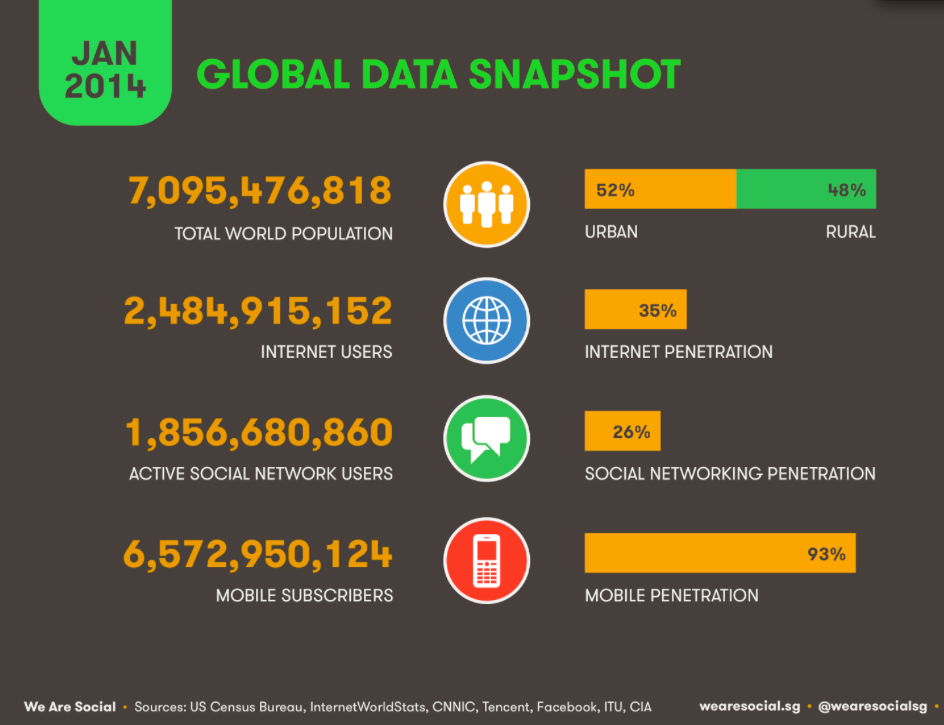
My talk at the 2015 American College of Cardiology Scientific Sessions referenced a factoid that I am not smart enough to completely verify, but I suspect isn't too far off the mark: that in January of 2014 there were 7,095,476,818 people in the world and 6,572,950,124 (93%) of them had mobile phones.

Think about that.

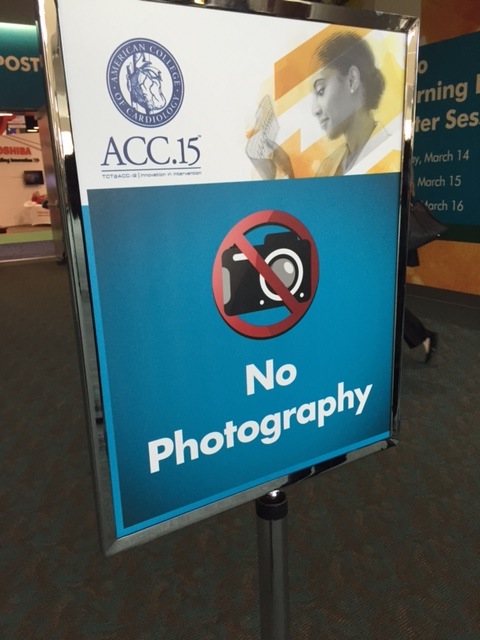
Everyone has a camera with them.  Everyone at meetings (especially scientific sessions far away from the office) is shooting pictures of abstracts, friends, selfies, drug company displays … whatever - despite a policy to the contrary.

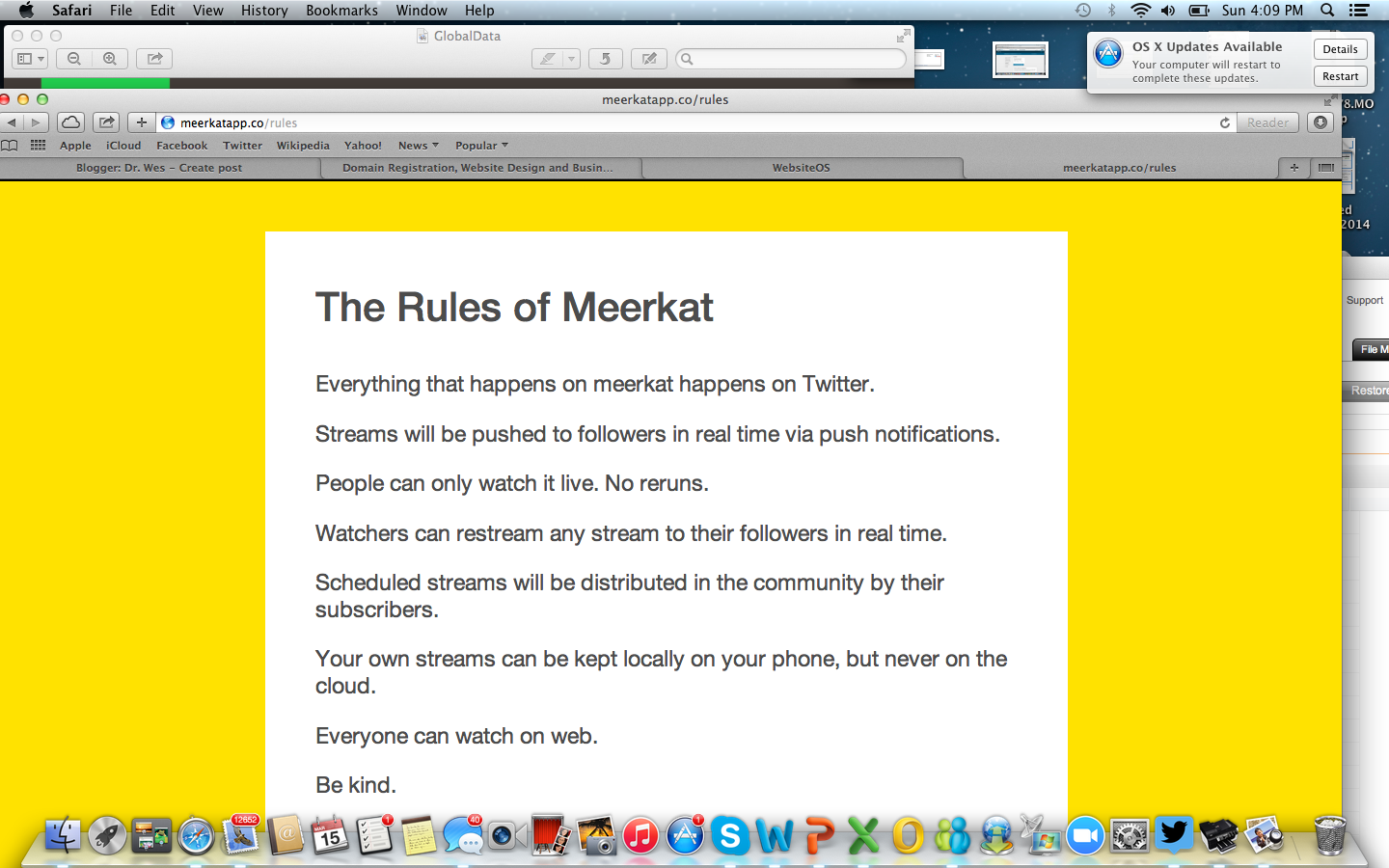
And now, there's even live streaming video on Twitter.  I experimented with one of these yesterday called Meerkat.  (Twitter recently announced a partnership with competing live video feed service called Periscope, so this feature is here to stay).  For $1.99 I downloaded the Meerkat app to my cell phone, linked my Twitter account, and my ability to transform any experience into a live video feed transmitted instantly to the world was complete.  There are some "rules" associated with Meerkat.  Yet even with these rules, I found it disquieting that I held Big Brother's camera in my hand, if only for a few minutes.  Those videos might not be on the "cloud" by policy, but how do I know where else they're stored, or used.

There is a remarkable power, subversiveness, and wonder in the simplicity of this new technology to send live video feeds from a mobile phone.  It is both novel and "cool."  But I still deleted the video that I sent from the ACC meeting yesterday from my iPhone this morning after I thought about things. Perhaps I'm being overly cautious because videos can still be taken at meetings and uploaded to YouTube for the world to share.  But somehow this live feed was different - so instantaneous, so uncontrollable.

And as a doctor, I don't want to become an agent for Big Brother.

-Wes


Tuesday, March 10, 2015

Where Will Social Media Be in Five Years?

Where will social media be in five years? Will it be dead? Will it be thriving? What will it look like?

This was just one question posed to me as a speaker in this topic for the 2015 American College of Cardiology Scientific Sessions in San Diego this upcoming weekend.  Here are some of my thoughts and I'd love to hear what others think (I need CONTENT people!) since I'm really not an expert:
  • The word "social" in "social media" will disappear.
  • The term "rectangle deficiency" (aka, misplaced cellphone) will achieve DSM-V status.
  • True privacy will be the "new black" for medicine (as will actually looking at the patient).
  • Text messaging will overwhelmingly replace paging for day-to-day patient care.
  • Research will increasingly recruit patients via this channel.
  • Credible content on social media will be recognized and even encouraged by academic institutions.
  • US physician attendance at Scientific sessions will further dwindle due to costs while subsidized overseas physician attendance will grow.

  • The Apple iWatch will be so, well, yesterday...

Am I smoking something or making sense?

Your thoughts?

-Wes

Monday, January 19, 2015

The Cancer of Our Profession

  229. Unity and friendship in the medical society is important.

The first, and in some respects the most important, function is that mentioned by the wise founders of your parent society - to lay a foundation for that unity and friendship which is essential to the dignity and usefulness of the profession. Unity and friendship! How we all long for them, but how difficult to attain! Strife seems to be the very life of the practitioner, whose warfare is incessant against disease and against ignorance and prejudice, and, sad to have to admit, he too often lets his angry passions rise against his professional brother. The quarrels of doctors make a pretty chapter in the history of medicine.

Sir William Osler
On the Educational Value of the Medical Society, In Aequanimitas, 335-6.
Never has the divide between the practicing work-a-day physician and the non-practicing ivory tower elite physician been greater. It is the cancer of our profession: quick to spread, difficult to contain.

But this should not surprise us. It is a recurrent theme in history, just as Osler was quick to remind us. But the ideal that Osler advocated for has disintegrated under political, financial and partisan agendas that covertly operate without transparency.

If nothing else, social media is helping expose this divide and its corrosive effects on our profession.

-Wes

Friday, March 28, 2014

Social Media at Scientific Sessions

More and more physicians are entering the social media space - so much so that even our more classic academic physician colleagues are joining in.  But there can be challenges that arise at scientific sessions when the old way of professional discourse meets the new way of social media.

Robert A Harrington, MD (Chair, Dept of Medicine, Stanford University, CA) and Clyde W. Yancy, MD, MSc (Northwestern Medical Center, IL) discuss these challenges nicely at theheart.org and offer some interesting insights and tips for doctors, both young and old, as they consider entering the social media space.

-Wes

P.S.: Then again, if you're still unsure how Twitter even works, consider this Twitter primer.

Sunday, December 22, 2013

This Christmas, Look Up

I sit before the computer screen this morning, wondering "What should I write?"  Yet as I thought about this, I realized I should really write about why I'm thinking about this.

My journey in this space of social media has been a bumpy one, full of ups and downs, ins and outs, obsession and indifference, all rolled up into one.   Yeah, this sums up health care social media now, at least for me.

I began writing here in November 2005, not really knowing what I was doing.  I thought of this space as a marketing space, then an information-to-patient space, then a social space ("gee, so many interesting people here!) and even an "inside view of medicine" space.  In reflection, I really didn't know what the hell this space should be.

But then came 2006 and 2007, my father became gravely ill, and social media was a wonderful outlet for me to reflect on all of the emotions, memories, and experiences that such an event invokes.  I found I loved writing.  To this day, I use this space as a diary of that time in my life, and even found my eyes blurring a bit this morning as I re-read my earlier Christmas reflection of the events that occurred that year.  Blogs, I've found, are really a good space for remembering certain events, certain times.

Later, I'm not sure where I went with social media.  I signed up for Twitter during the Twitter-craze and learned about "tweets" and "hashtags" and all that stuff.  I was amazed at how "up-to-date" I could be with the latest rage, outrage, sound bite and scandal in medicine.  Heck, it my cell phone would come alive!  Medicine is so, *ping* , i-n-t-e-r-e-s-t-i-n-g again!  *ping* *ping*

As if the latest cell phone vibration, chirp, and flash was really what mattered and dull ol' medical care was just, well, glacially stimulating by comparison.  What's not to like, right?  You could be a teacher, provocateur, and health care social media detective!  You, dear doctor, could make a difference!

But in reflection, reality's been very different than that.

I realize now that I am just one voice, one small individual in a the overcrowded mess that is the internet.  Everyone is trying so hard to be heard.  Entire social media companies are developed just to make sure you pay attention to your cell phone - just look at SnapChat, where if you don't immediately attend to your cell phone, the image, message or 10-second video is gone, never to be seen again.  Pay ATTENTION, people!

This is not to say people's voices aren't important.  In fact, many in this space say incredibly powerful things here.  But I am seeing something very interesting on social media now, especially as it pertains to doctors' participation in this space: propaganda.

There are very savvy, well-organized forces on social media now.  Everyone knows this is where the battleground of public opinion rests.  So forces are marshaled, teams assembled to make sure the party line is towed.

I ask you, dear doctor, who much time do you have?  So it is with social media in health care.

But recently in my evolution in this space, I realize I have matured.  I don't come into health care social media starry-eyed any longer.  It has a purpose.  You can meet some remarkably thoughtful and insightful individuals here.  You can make some pretty amazing friends.  And you can get lost.

But I realize there's a purpose, too.  People can tell a single, quiet, story  here - a small, transcendent one, too.

Nowhere was this more visible than in the recent quiet, painful reflections of a young boy suffering with leukemia and the wonderful stories he and his parents shared in their blogs.  These are not people providing propaganda, these were people with a purpose.  These were people who realized what mattered.  These were people who were an inspiration to us all.

As I reflect on all of this at Christmas time, I find it's more important to spend these short, dwindling, yet cherished moments with real life, not one manufactured by the media companies.

Time is precious.  Family is paramount.  And social media is, well, social media.

This holiday season I hope all of us will take time to pull our heads from our cell phones and computer screens.  There some amazing things going on around us, some amazing stories of hope and courage, and things we really need to appreciate.  Most of those things aren't represented by bits and bytes on an iridescent screen, but rather what we take for granted every day, if we dare to look up.

Merry Christmas.

-Wes


Monday, October 14, 2013

Sid Says Goodbye

Sid Schwab, MD, a surgeon with a remarkable skill as a writer and long-time author of Surgeonsblog (a favorite of mine in my early years as a blogger) says goodbye to the blog-o-sphere in true Sid-style.

-Wes

Wednesday, June 26, 2013

A Simple Idea for Collaborative Academic Research

With the rapid dissemination of medical information, global reach of the internet, and realization that more print journals doesn't mean better print journals, today's researchers use a variety of techniques to connect but most, sadly, have not kept pace with the times.

Yesterday, watching the nightly news, I saw something that caught my eye.  It came during a story about yet another shooting in Chicago.  The usual folks were interviewed by the media: distraught family members, friends, and eye witnesses to the crime.  One of the witnesses seemed intelligent, articulate, and surprisingly insightful and there, below his name on screen, was his Twitter handle.

Imagine how researchers could connect if Twitter accounts were added to their author lines in journal articles or next to their e-mail address in the article's contact information section.  Like-minded researchers could instantly connect, follow colleagues with similar interests, or message them questions.  Private conversations could continue via direct messaging or e-mail in follow-up.  Such a system would easily connect like-minded scholars as well as promote an individual's work.  Just as TV stations, news organizations, professional scientific organizations and the entertainment world have embraced the trend, so too should our stodgy academic world.

And why not?

After all, everyone's looking for research funding these days.

Who knows?  Good scientific work might just have a chance of receiving funds from the most unlikely of sources thanks to social media.

-Wes

Monday, June 24, 2013

For Physicians: The Challenges of Promoting Social Media

It is hard to teach an old dog new tricks.

No where is this more apparent than working to get physicians to understand the potential of social media for their practice.  The adoption of social media by doctors - even something as relatively simple as Twitter, is tough.

Face it:  Thinking that a re-tweeting how much we want - really - more doctors on Twitter by next year is just preaching to the social media choir.  After all, those on social media are already supporters.  How do we get physicians who are NOT on social media to understand its potential value to them?

This is not a simple undertaking.  Doctors are being forced to spend more computer screen time than they ever wanted to thanks to the mandatory documentation requirements of electronic medical records.  What physician also wants to spend even more time glued to a computer screen - or cell phone - texting little tidbits to Twitter, posting pictures to Facebook, or browsing Pintrest photos? 

Please.

For doctors to accept social media, they have to understand its value to them.  There's only one way I know to do that: demonstrate it to them. 

Those of us who are believers have to show them a well-organized RSS feed reader containing journal articles and news reports they're want to say up up to date with and likely read.  We have to show them how to use social media to collaborate (in near real-time) with colleagues to write an article or crowd-source a talk.  We need to show them the contacts - many who they'd recognize - you've made around the globe.  Show them how they can lurk and get the information they need without having to expose themselves to any potential legal issues.  We should show new graduating residents and fellows how they can stay in touch with their professors so they can continue to tap their network for answers to difficult clinical questions and get a rapid response.  And if all else fails: we must show them how they can stay in touch with their kids once they leave their homes.

Then, slowly, one-by-one, a grass-root physician social media movement can begin.  Otherwise, we'll just be preaching to our same old same-old physician social media circle.

-Wes


Sunday, May 05, 2013

Physician Blogger Insights On Social Media

A recent e-mail exchange between myself (WGF) and fellow-physician bloggers John M. Mandrola MD (JMM), Edward J Schloss MD (EJS)  and Ves Dimov MD (VDMD) resulted in some interesting insights about how physicians are using social media tools today.  The following is a lightly edited version of the thread (used with permission). It began with an e-mail from Dr. Mandrola:

JMM: "In prep for our Social Media session at HRS2103. I was just wondering…

Do you guys keep a list of favorites on Twitter? I have lists--but they aren't very effective logistically. I was wondering if I designed a list--say the Mandrola-twenty--of folks I did not want to miss, I might be able to use a column on TweetDeck. Right now, I follow 350 people--and it's unwieldy. But yet I have trouble parsing because I'll look at an acct and say to myself, "this one's pretty good; I don't want to unfollow." Also, I find TweetDeck sometimes intrusive. I use the reg Twitter app and often post with Hootsuite--because it allows me to link to 4 social networks at once--LinkedIn, FB, Twitter etc.

What Twitter app do you all use on Computer? On smartphone?

Do you have thoughts on Facebook (FB)? I see from the WSJ they are making a comeback so to speak. For a while there, I thought they might be dead.

Do you agree that Twitter seems more amendable to professional needs--the sort we all use it for: things like links, communication with colleagues, filtering of important medical news. I tend to use FB, the little that I do, for real life things like family, in-real-life friends and cycling stuff, for instance. I wonder whether this is a correct distinction, as most of the major journals and medical society have a FB presence. And likewise, Twitter has plenty of willy-nilly stuff like Hollywood, Athletes etc. The young people I know use Twitter more like I use FB."
* * *

EJS: "I also use Twitter almost strictly for professional stuff, especially my posts. I follow a few non-professional accounts, but am really choosy in general about followers. For my own posts, I try to picture someone looking down my timeline and trying to decide whether I'm worth their time to follow. If I put a bunch of cr*p up, I figure they'd move on. Twitter is also the predominant source of my online persona, and I'm really careful about maintaining this.

Right now I follow 239 accounts and not all are terribly active. That keeps the stream manageable. I actually get a popup on the laptop for every thing that posts to my timeline. Because I use my laptop for all hospital charting, this means I see A LOT of tweets. That setup is clearly not for everyone, but I've gotten good at just glancing up to see who is posting before I commit to reading. The tweets fill the dead and mindless spaces we get during EHR data entry (which are a lot). At any given time I'll also have 5 or 6 searches running that also generate popups. Right now these include meaningfuluse, St Jude Riata, Barry Meier, EHR, @burbdoc, #HRS2013 among others. All of these also generate popups.

If you want to filter down you list to highlight your most important accounts, you can set up a list in Tweetdeck (and I'm sure in the other clients, as well). That will become a column, and you could turn on alerts for just this stuff if you're not at ADD as me. I have a friends/family list that shows up on my front page so I can quickly see if I missed anything good without having to obsessively scroll back through everything.

On the laptop, I use Tweetdeck. The old version before Twitter bought it is the best, but will stop working in a few days. I've put up the new version, but don't like it as much. The biggest drawback is not having the profile photo on the popups. With the old Tweetdeck, it was easier to see who was posting with just peripheral vision.

On the iPhone and iPad I use Tweetbot. It's really good and worth the few bucks it costs.
I'd tell any cardiologist starting on twitter to follow a bunch of health care journalists, along with you guys. The interactions you get with the journalists are really rewarding, and truly are a two way street.

I really don't see much professional purpose for Facebook for an EP doc. If you were a plastic surgeon or ortho, maybe there would be a role. I'm actually trying not to market directly to patients, given the nature of my practice. Maybe you could pick up some AF that way, but I suspect a lot of nervous people with sinus tach or PACs would clog up your office if you did that.
* * *

VDMD: Hi John and colleagues,

Here are my answers:
re: "Do you guys keep a list of favorites on Twitter?" -- yes, I have 2 lists - 1. list of favorite tweets that I use as bookmark, 2. list of "allergists on Twitter".

re: "Mandrola-twenty--of folks I did not want to miss" - yes, KevinMD has that - top 20 Twitters he doesn't want to miss. I follow few people - less than 100, I think, and only 50 of them tweet regularly.

re: "What Twitter app do you all use on Computer? On smartphone?" - I use TweetDeck on my home PC, HootSuite at work (TweetDeck is blocked), and mobile Twitter on my Android phone. I "favorite"/bookmark the links I want to check later.

re: "Do you have thoughts on Facebook?" - Facebook (FB) is here to stay - until a new network replaces it. You have to use it to stay relevant if you have a blog. In addition, people look at the number of your likes to see how large a following you have as a blogger. FB has limitations and can be annoying but Google Plus is not a replacement yet. FB will evolve for sure, they are a young, aggressive company, and will keep searching for ways to combat "user fatigue".

These are some quick thoughts. Please let me know if you would like me to expand on any of these.
* * *
WGF: "Twitter is for the person with ADHD while blogs are for the obessive compulsive.

Twitter, by its very nature, has a low barrier for entry and can serve as an information "gatherer" initially. I'd encourage people to LURK first. It's easy to use and feeds lots of information of interest quickly to docs. As a "MUST HAVE" for doctors, they should follow the journals they subscribe to: Heart Rhythm, NEJM, Circulation, JACC, etc, as well as major news orgs: WSJ, CNN breaking news, local newsorgs or radios, etc. I also follow Steve Colbert for a laugh once in a while.

Twitter is also VERY useful for collaboration (as we have seen) and for "hunters" of information by using your network. I especially encourage follows of docs of the same subspeciality.

Facebook is for family/personal friends for me. No patients there. I find it's the best way to stay connected with my kids after they're out of the house.

As far as lists are concerned: I think they're a waste of time. I tried it, but since you cant send a targeted message or "tweet" to a list, it's only a way to group accounts.

I use Echofon on my iPhone (like it better than Hootsuite) - easy user interface and free. I use Tweetdeck on my PC and MAC.

I follow 446 people - probably too many - but it's a broad group that includes right and left-wing health care thinkers, IT nerds, politicians, bloggers, and you guys, and Steve Colbert. :)

Perhaps the most amazing use for Twitter (recently) was the immediacy of info provided there during the Boston bombings. It was unbelieveable how quickly updates happened and totally smoked the main news organizations. Imagine if doctors had a similar network at times of crisis! That's why I think it would be VERY cool to push that concept with our audience. Consider, for example, the need to get an EKG interpretation immediately (check my recent Twitter stream to see an example of just that) - lots of folks weighed in with ideas - some good - some bad - but in the end it was vetted pretty well.

Looking forward to this..."
* * *
VDMD: re: Journals on Twitter - I'm not a big fan of these. It's mostly the administrative staff pushing some articles they have picked. RSS feeds for the journals are much better, in my opinion. They save time and include most (all) articles of each issue.

So there you have it.  A sneek peak behiund the social media physician curtain on their take of current software, apps, and uses they find for social media in health care today.

For those attending the 2013 Heart Rhythm Society Scientific Sessions in Denver, CO next week, Drs. Schloss, Mandrola and myself (as well as Robert Coffield, Esq. of the Health Care Law Blog fame) will be speaking at the Rhythm Theatre at 3:15pm on 10 May 2013 on Physicians in Social Media.

Hope to see you there!

-Wes

PS: For doctors considering the leap to social media, here's a basic Twitter Primer.

Thursday, April 25, 2013

Technorati's Social Media Update 2013

In preparation for my upcoming talk at the Heart Rhythm Society's 2013 Scientific Sessions in May, I came across this information from TechnoratiMedia's 2013 Digital Influence Report.  While these data are primarily directed to general online consumer influence, doctors interested in social media might find this information interesting (my comments are italicized):
  • When it comes to community size, 54% of consumers agree that the smaller the community size, the greater the influence. (Healthcare is a niche market, subspecialties even more so)

  • Online services most trusted: (1) News Sites (51%), (2) Facebook (32%), Retail Sites (31%), YouTube (29%). Blogs (29%), Google + (26%), Twitter (16%), LinkedIn (5%) (Heh, glad to see blogs ranked neck-and-neck with kitty videos)

  • Online services shared the most: (1) Facebook (57%), (2) YouTube (40%), Blogs (26%), News Sites (26%), Google + (25%), Twitter (18%), LinkedIn (5%)  (Blogs are shared more than Twitter? Surprised by this - perhaps this is because of the relatively static nature of blog posts.)

  • Concerning creating influence: 86% of "Influencers" blog - one third of which have been blogging for more than five years.  (Rock on!)

  • Most bloggers operate 2-5 blogs (52%) while 43% operate just one.  (OMG, I can barely handle one).
-Wes

Monday, January 14, 2013

Cost Savings from EMRs: A Path to Salvation

The Electronic Medical Record (EMR)'s promised contribution to health care cost savings got a second look recently, and the results were poor at best.  But what I found interesting was the "second look" was from the same organization that did the first look: the corporately-funded, non-profit think-tank called the RAND Corporation.  From their second and more recent report:
"A team of RAND Corporation researchers projected in 2005 that rapid adoption of health information technology (IT) could save the United States more than $81 billion annually. Seven years later the empirical data on the technology’s impact on health care efficiency and safety are mixed, and annual health care expenditures in the United States have grown by $800 billion."
Who would have thought that such a prestigious organization like the RAND Corportation could have made such a teeny, tiny multi-billion dollar mistake? After all, their 2005 study was funded entirely by several of the major EMR manufacturers who have reaped billions in revenue on EMR sales since.  Is there any wonder that now the same RAND Corporation felt that the EMRs the lack of cost savings is really the end-users' fault?

"In our view, the disappointing performance of health IT to date can be largely attributed to several factors: sluggish adoption of health IT systems, coupled with the choice of systems that are neither interoperable nor easy to use; and the failure of health care providers and institutions to reengineer care processes to reap the full benefits of health IT."

What a shallow assessment.  There is no mention of the cost of these systems, their maintenance, lack of interoperability, poor user-interfaces, and in many cases, lack of graphics support.  Even more ironic, there was no consideration that someone might actually figure out a way to efficienctly skirt the government's arcaine documenttion requirements for reimbursement that would permit MORE health care spending.  No, those assessments would have been too obvious.  Instead, the Rand Corporation tells us that there were no cost savings with the EMRs is because doctor- and hosptial-customers didn't re-engineered their care processes or "adopt" substandard first-generation systems.

Give me a break.  At least the Congressional Budget Office saw through the Rand Corporation's ruse in their scathing report (pdf) from 2008.

Even so, at this point it doesn't matter.  Doctors and patients alike understand that there was too much corporate money involved and too many politicians' campaigns happily funded as the Stimulus Bill that implemented the EMR nationwide was crafted.  As a consequence, little will be done about either of the Rand Corporation's erroneous and over-zealous EMR cost-saving predictions now.  Whether we love it or hate it, the Electronic Medical Record is here to stay.   Government incentives have made it so and are still slated to grow.  More to the point, our lack-of-cost-savings epiphany came so late that most of our newly-graduated doctors have never used a paper chart and likely never will.

So now that the whole EMR implementation and cost charade has been exposed (and a blind eye permanently cast), what should doctors do now?

First, doctors must demand value for the money wasted spent on the multitude of EMR systems out there.   No where would that value be more evident than if interoperability standards were required within two years, especially when different health care systems use the same EMR system.  This is especially so with EPIC Systems, the largest EMR nationwide that is thought to contain patient records, at last estimate, some 40% of the nation's hospitalized patients.  Right now, this minute, most of the major medical centers in Chicago use EPIC.  There is simply no excuse any longer that doctors from one major medical institution shouldn't be able to view clinical records at another institution, especially when they use the same software.  Silo-ed patient data is not a value-driven proposition for the patient but rather a profit-driven proposition for hospitals.  As such, transferability of patient data between hospitals and health care systems should become one of the highest "quality standards" for hospitals to achieve and (perhaps) stiff payment penalties applied if this goal is not met. Patients (and the doctors trying to care for them) deserve nothing less.

Second, open avenues of communicating concerns about EMR functionality and safety should be mandated  and not restricted to conversations moderated behind secured web-based firewalls hosted by twenty-something computer nerds with no clinical experience.  Social media involvement by companies, be it by way of blogs, Twitter, LinkedIn, or Facebook, should be the norm.  Such open discussions encourages constructive, transparent and understandable transmission of tips, tricks, and (most importantly) needed improvements as EMRs mature.  After all, there's nothing better than a screenshot or picture(s) (devoid of patient information, of course) published for all to see to make a point and affect change. A grass-roots critique of EMR systems by doctors is long overdue.

Third, EMRs should not try to be all-encompassing.  They should stick with what they know.  Do not try to be a graphical user interface when you write in MUMPS, for instance. It's embarrassing.  If you can't do graphics, pictures or difficult multi-layercalendars, then dove-tail with someone who can.   To do otherwise creates unfamiliar non-standardized interfaces that invite treatment errors and inefficiencies rather then correcting them.

Today the sad reality is this: EMR interactions consume more of the physician's time than direct patient care.   EMR companies should realize that as long as doctors are challenged by data entry and the ever-increasing documentation and verification requirements to maintain their livelihood, they will speak out on the new challenges posed by the the EMR publically.  Companies that embrace and respond effectively to constructive criticism openly and honestly are much more likely to be viewed favorably by the health care marketplace and (who knows?) might even help to save a buck some day.

-Wes


Tuesday, June 26, 2012

Heart Health Information on YouTube

From the Journal of Clinical Cardiology:
We observed that many videos were produced by professional societies, news reports, and didactic lectures from reputable universities. However, these were not the ones with the most views. The videos that were viewed most often were those posted by media not related to any professional society or part of a news report. Similarly, videos that described personal experiences were “liked” as well as “disliked” most often and had the majority of comments. This indicates that people are more interested in and show active participation in their peers' experiences about a disease rather than in professional conferences or didactic lectures, irrespective of authenticity or the source of such material. This observation is in accordance with the social learning theory, which asserts the significance of peer education in eliciting behavioral change in individuals. In our study, the distinction between videos targeting the layperson vs healthcare providers was unclear. This might be the reason for underutilization of available video resources by people in general. Further, we found that a large number of videos were irrelevant, which indicates that good videos are often mixed in with a plethora of irrelevant content. A layperson often has to sift through this vast information and runs the risk of being misinformed.

Hence, why doctors need to be on social media.

Another take-home message from this study: professional societies need to make their videos shorter and use patient experiences to bring their message home.

-Wes

Monday, June 04, 2012

My Three Minutes of Fame

Dr. Seth Bilazarian of Haverhill, MA (a cool, rare-breed, private practice cardiologist) and I were interviewed by veteran health care reporter Shelley Wood from TheHeart.org on the use of social media for cardiologists.  (To their credit, Seth and Shelley are much better looking.)

Hopefully this will inspire other physicians to consider social media, irrespective of their specialty.

-Wes


Thursday, January 26, 2012

Doctors Helping Doctors (and Their Patients) Via Social Media

It was supposed to be a closed meeting attended by doctors who had a large amount of experience dealing with patients with St. Jude Riata leads, a defibrillator lead that recently garnered an FDA Class I advisory (recall) status due to it's high failure rate. Only 55 doctors and a few industry personnel were brought together to try to determine what to recommend to the rest of us who must deal with this problem in the outside (real) world.

It was 20 January 2012. I was doing an EP case at the time. When I emerged from the room to begin typing my orders, a tech said to me: "Hey, did you see this?"

It was a live Twitter feed from the meeting of one of the attendees - an electrophysiologist from Christ Hosptial in Cincinnati, Edward J Schloss, MD. In those tweets were a play-by-play of important discussions and the results of opinion polls fielded during the meeting. Here's what I saw:
20 Jan Edward J Schloss MD @EJSMD
At Riata ICD Lead Summit in Minneapolis.

20 Jan Edward J Schloss MD @EJSMD
35% of #StJude #Riata Summit attendees think this is a worse problem than MDT Fidelis.

20 Jan Edward J Schloss MD @EJSMD
41% of #StJude #Riata Summit attendees are concerned about Durata and are not implanting it.

20 Jan Edward J Schloss MD @EJSMD
#StJude #Riata US Multicenter Retrospective Trial Riata/ST. Overall failure rate intermediate between Quattro and Fidelis.

20 Jan Edward J Schloss MD @EJSMD
#StJude #Riata bench testing model shows good performance of externalized conductors with or without ETFE insulation breach.

20 Jan Edward J Schloss MD @EJSMD
#StJude #Riata Panel discussants repeatedly emphasize lack of data on natural history of lead. Difficult to reach expert consensus.

20 Jan Edward J Schloss MD @EJSMD
#StJude #Riata Lunchtime conversation: Concern that we're on the leading edge of failures with these leads. Problem apt to get worse.

20 Jan Edward J Schloss MD @EJSMD
#StJude #RIata Ellis-Vanderbilt series of Riata: 26% of leads had externalitzation flouro abnormalities.

20 Jan Edward J Schloss MD @EJSMD
#StJude @Riata 5 of 10 members of one expert panel use flouro screening routinely (in spite of HRS recommendation against this).

20 Jan Edward J Schloss MD @EJSMD
#StJude #Riata Epstein lecture on extraction points out the unique difficulties associated with this lead. Harder than Fidelis.

20 Jan Edward J Schloss MD @EJSMD
@DeltaAssist I'm booked on flight 3104 MSP to CVG tonight and Delta APP indicates delay with no alternative. Help?

20 Jan Edward J Schloss MD @EJSMD
#StJude #Riata Summit poll at completion: Concern went up - now 58% say Riata problem is worse than Fidelis (up from 35%).

20 Jan Edward J Schloss MD @EJSMD
#StJude #Riata Summit poll at completion: Concern went up - now 44% would not implant Durata (up from 41%)

20 Jan Edward J Schloss MD @EJSMD
#StJude #Riata Summit poll at completion: Concern went up - now 55% favor routine flouroscopy (up from 42%)

20 Jan Edward J Schloss MD @EJSMD
#StJude #Riata Summit poll at completion: More conservative philosophy with externalized conductors 76% would not replace (up from 69%)

In reply to Paul Verrastro 20 Jan Edward J Schloss MD @EJSMD
#StJude #Riata Hauser wrap up: We need to look at Durata very closely "put it under the microscope." Calls on SJM to create trials

Edward J Schloss MD @EJSMD
@pjv2217 heading to airport.
(Dr. Schloss's full account of the meeting, with a link to the meeting's slides and St. Jude's response to the report, was published recently at the Cardiobrief blog.)

But what was remarkable to me about this whole affair is that a doctor took it upon himself to help report this important information to his colleagues. By doing so, he likely helped many more patients about to receive a new defibrillator system. After all, it is the doctors in concert with their patient, who ultimately must choose which ICD lead gets implanted when a defibrillator is installed.

My hat's off to Dr. Schoss.

-Wes

Friday, January 13, 2012

My Health Care System Starts a Blog

This post represents post number 3000 to this blog. (Not all have been published - some sit as kernels of brilliance to bestow upon my readership at a later date when the time is right or after I rework them a bit). As striking as that may seem to some, I must say that this effort was finally acknowledged by my institution in an indirect fashion: they launched their own blog today. Very cool. It looks nice, but like most blogs just getting started, I suspect it will take them a while to find their "voice." Still, it's nice to see them entering the fray.

Social media with it's quick, informative blasts of information is particularly suited to today's more mobilely-connected patients. Gone are the days of cloaked, back-room, one-on-one information exchanges held solely in the privacy of a doctor's office. Instead, the ability of people to receive information quickly and interact with trusted sources of that information adds benefit to the health care experience for both the patient and the their care providers. With their blog's launch today, my hospital system has officially complemented their other Trifecta of social media engagement already underway: (1) Facebook, (2) Twitter, and (3) Youtube.

So while it's just a start, here's welcoming NorthShore University Health System's PR department to the blog-o-sphere. Head on over and offer them a bit of link-love. That way, they'll have to keep me around just a little bit longer.

(Heh).

-Wes

Tuesday, December 13, 2011

Be Wary of Press Releases

Why we need to be wary of press releases, especially when they contain so-called "scientific" content that "pushes the envelope," courtesy of Conan O'Brien:


-Wes

h/t: my brother-in-law on Facebook.

Monday, November 07, 2011

AMA Medical News: Social Media's Public Health Implications and Limitations

From a mention in today's AMA Medical News:
Many health professionals do not see social media-based research replacing more traditional study methods, because not everyone uses the Internet or social networking. But they expect data gathered from social media to play an increasingly larger role in addressing public health issues.

"Social media has huge potential for public health," Dr. Fisher said. "I don't think that people have even begun to realize that potential yet."
-Wes

Monday, September 26, 2011

EKG Du Jour #24: Reversals

In the spirit of connecting via social media, this EKG Du Jour hails from the great Aussie blog, Life in the Fast Lane.

(There's lots to learn on many levels.)

-Wes