Showing posts with label cardiology. Show all posts

Tuesday, June 03, 2014

On the ACC's Response to ABIM’s MOC Requirements

The American College of Cardiology (ACC) recently issued a response to the American Board of Medical Specialties (ABMS) and American Board of Internal Medicine's (ABIM) recent change to their Maintenance of Certification (MOC) requirements. The ACC's response was based in part on the results of a completed member survey that was distributed through their state chapters in the spring of 2014. The survey was completed within four weeks by over 4,400 members (12 percent of the total solicited). Nearly 90 percent of respondents opposed the changes to the American Board of Medical Specialty (ABMS)/American Board of Internal Medicine (ABIM)'s new Maintenance of Certification (MOC) requirements, citing, among multiple concerns, higher than expected costs. Nearly a third of respondents indicated that the changes will affect their future career plans and will likely accelerate career decisions such as early retirement, part-time work, or transition to non-clinical work. Approximately one-quarter of physicians in practice for 15 years or more specified that early retirement was a probable outcome.

If true, the implication of this change to MOC has significant implications for patients everywhere.

This must have prompted the leadership of the ACC to throw their considerable weight into the discussion with the ABIM. In their statement, the ACC promised to:

  • Have "ongoing discussions" with ABIM leadership, in partnership with other cardiovascular professional organizations whose members are similarly affected, to review these issues and to explore changes in MOC requirements that will result in more meaningful outcomes and less onerous burdens for ACC members (Editor's note: To date, MOC has never been shown to alter outcomes, so we are left to wonder what this statement really means.)
  • Request for ACC representation at ABIM to participate in discussions involving MOC, including its educational and financial aspects (Editor's note: What financial aspects might they mean? Does the ACC want in on this cash cow, too? Or might they want to strike a deal offset some of the fees since they want to keep their educational MOC-preparation income stream coming?
  • Review of the evidence base underlying current recommendations (Editor's note: Let me help: there are none. Any positive articles are likely authored by those standing to profit from the endeavor or research paid for by the ABMS. Negative articles are also suppressed from publications sympathetic to the regulatory world. And we should recognize that we have never developed a definition of the "quality" physician. Quality to whom? Is "quality" following rubrics and care pathways? Or might "quality" be something very different, like empathy, listening skills, interpretative skills, or surgical skill? The reality is, if you can't agree on what defines quality, you can't define how to measure it.)
  • Investigation of impact of MOC changes on non-ABIM certified members (Editor's note: I strongly agree with this - it is unethical to impose MOC mandates of any kind without first understanding how they negatively affect doctors, especially if a doctor should not pass and is unable to practice their vocation on the basis of a 180-question timed test)
  • In the interim, ACC will support its membership by:
    • Free provision of web-based MOC modules and navigation tools to ACC members
    • Expansion of Part IV MOC modules through ACC programs such as the NCDR’s inpatient registries and the PINNACLE Registry
    • Creation of mechanisms for ACC members by which patient safety and patient survey requirements can be efficiently fulfilled
    • Bidirectional communication with and engagement of membership through Chapters, Sections and Councils.
    (Editor's note: It's okay to make MORE MOC modules available to us? Is that what doctors want? How many more hours must we spend on this drill and for how much time in lost revenue? "Free" is in the eye of the ACC, not those who have to endure these processes.)

The good news (if there is any with the ACC's announcement), is that front-line doctors are starting to be heard. While the ACC's actions might be a step in the right direction (one can hope), it is disappointing that their statement still sides with the ABIM's requirements for the unproven MOC process in the first place, the busy-work requirement for "Practice Improvement Modules" (especially when quality measures are already required by hospitals), and for permitting a private organization to monopolize the ability of physicians to practice their trade. Furthermore, the ACC's statement does nothing to insist upon changes to the ABIM's non-transparent and self-serving Conflict of Interest policies that keeps conflicts confidential except to certain chosen individuals within the ABIM.

Unless the ACC can convince the ABMS and ABIM to come clean on these important issues, significant physician resistance to this process will remain. Furthermore, the lack of involvement by other subspecialty boards in resisting the ABMS/ABIM's MOC process is concerning. Hopefully, other subspecialty boards will be encouraged by the ACC's example.

After all, cardiologists aren't the only ones frustrated by this change in MOC policy.

-Wes

Saturday, March 22, 2014

ACC's 2014: What's Out There That's New?

I will be attending the ACC 2014 Scientific Sessions this year in Washington, DC.  Theheart.org has a nice post covering some of the early highlights of the conference (sorry, registration required).

But I'm going to try something a bit different this year.  Call it self-indulgence.  I'm going to try all my might to pull my head out of the corporate weeds for a while and look to my colleagues and start-up  friends to see where the innovation in health care is going, not where we've been.  After all, MADIT CRT, TAVR (Corevalve included), renal denervation (SYMPLICITY-3), colchicine in pericarditis (CORP 2 Trial), and 3-year results of bariatric surgery are, well, not exactly cutting edge.

I need to get back to my roots more.  While I'm a doctor, I'm also a biomedical engineer, a social media nerd, and a guy who loves innovation and creativity in medicine.  I want to discover new ideas, new people.  I want to discover those who want to attack the colossal challenges patients will have in health care delivery in the years ahead with new and innovative strategies for cardiovascular disease or cardiac arrhythmia management.  I want to connect with those who want to upend the status quo.   I want to wander around in the swamp of creativity instead of being led lock-step toward more marketing spin.

Am I crazy? Does such a venue exist at this years' ACC Scientific Sessions?

We'll see.

-Wes

(If you'd like to connect or have something that's really cool that might be interesting to discuss over breakfast or lunch one day, shoot me an e-mail at wes - at - medtees dot com or message me via Twitter at @doctorwes .  Please, no marketing pitches.)

Monday, November 18, 2013

Appropriate Use Criteria's Next Steps

Dr. Kussmaul, you are my hero for publishing this letter to the editor:
"With detailed evidence-based regulation of our professional lives already in full swing, it seems inevitable that the same process will eventually extend to our personal lives. The SCAI (ed's note: Society for Cardiovascular Angiography and Interventions) has always striven to stay ahead of regulatory developments, so as to exert a leadership role.

In that spirit, I offer the following as a beginning of the conversation. Should an interdisciplinary committee be convened on this matter, I hereby volunteer to serve."

William G. Kussmaul III, MD
FSCAI Hahnemann University Hospital
Philadelphia, Pennsylvania
-Wes

PS: Heh. Reminds me of another post I wrote a while back along the same line.

Reference: Kussmaul WG. Letter to the Editor: "Appropriate Use Criteria: What's Next?" Catheterization and Cardiovascular Interventions 82:848 (1 Nov 2013), pg 848.

Thursday, September 05, 2013

When Media Doctors Play Doctor

After George W. Bush's recent controvertial stent placement, news organizations were hot to jump on the media buzz created by a former President's health issues. Perhaps the funniest moment of all came from Fox News' proported medical "A-team" member, Marc Siegel, MD.

Dr. Siegel is an internist by trade, and when internists are handed a cardiac stent to open on TV, the ensuing moments were something to behold:


The special moments begin a 2 minutes into the video where Dr. Siegel attempts to open the stent packaging (even resorting to using his teeth 22 seconds later). After failing, he hands the package back to the anchorwoman who hands the challenging packaging to her TV crew to open.

Once the package contents are returned to Dr. Siegel, he remains baffled and displays the stents flush port to the TV audience as the stent.

Sorry, but it rarely gets better than this on TV...

-Wes

Friday, March 15, 2013

Psychocardiology: An New Cardiovascular Subspecialty?

I kid you not (sorry, Medscape registration required):
At the recently held World Psychiatric Association Thematic Conference on Intersectional Collaboration and 4th European Congress of the International Neuropsychiatric Association in Athens, Greece, Angelos Halaris, MD, PhD, made the case for this new subspecialty, which he believes would forge closer working relationships between psychiatrists and cardiologists, provide the training and expertise needed to detect cardiovascular disease (CVD) risk in psychiatric patients (and vice versa), provide continuing education regarding the safe use of medications for patients with these comorbid disorders, and raise public awareness.

"The formation of a formal subspecialty is a bit of a pipe dream at this point," Dr. Halaris, professor in the Department of Psychiatry and Behavioral Neurosciences at Loyola University Stritch School of Medicine in Maywood, Illinois, told Medscape Medical News.

"But I wanted to put it out there because our colleagues in cardiology as well as in psychiatry need to realize there is a very clear association between emotional/psychiatric/psychological conditions and cardiovascular health."

He noted that 40% to 60% of patients with CVD also have clinical depression. And 30% to 50% who have a diagnosis of depression are at risk of developing CVD.

"Multidisciplinary teams need to forge an alliance because of these comorbidities. This will allow an earlier diagnosis of our patients, vigorous treatment, and the prevention of worse conditions that would happen otherwise," said Dr. Halaris.
Wow.  More subspecialty regulation and titles?  This is the best we can do?

Psycho, indeed.

-Wes


Thursday, February 07, 2013

A Cardiologist Tests an Activity Tracker


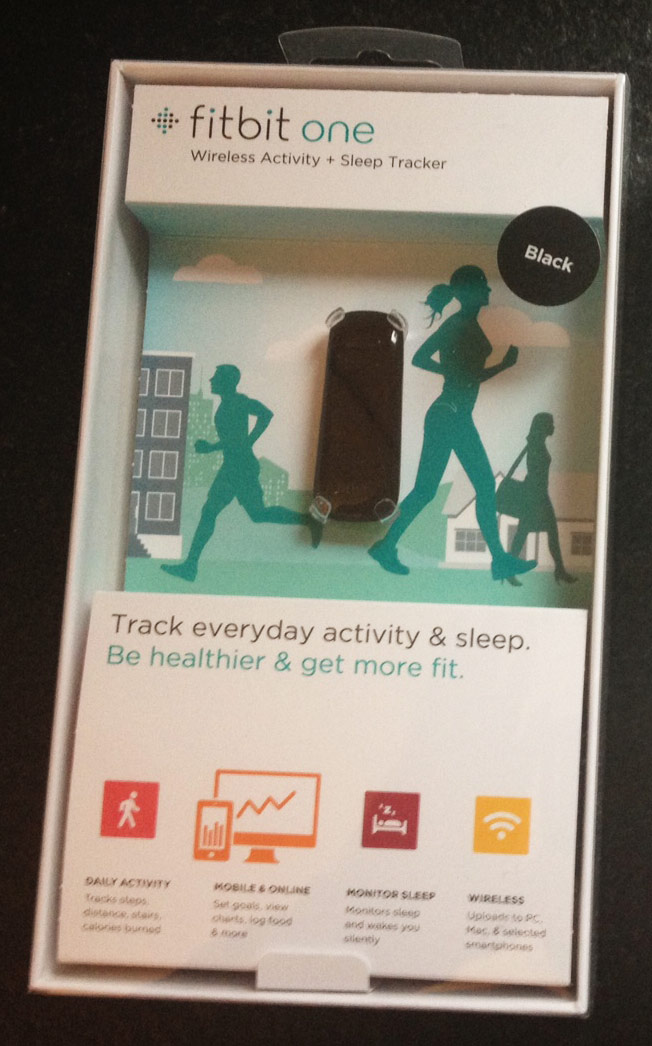
The Fitbit One Acitivity Tracker
(click to enlarge)
 I have been testing the Fitbit One activity tracker (Fitbit.com) over the past several weeks to see how it might help me lose a few pounds.  I'd heard a lot about these things and have friends who use this or other competing devices, so I felt it was time to test one myself.

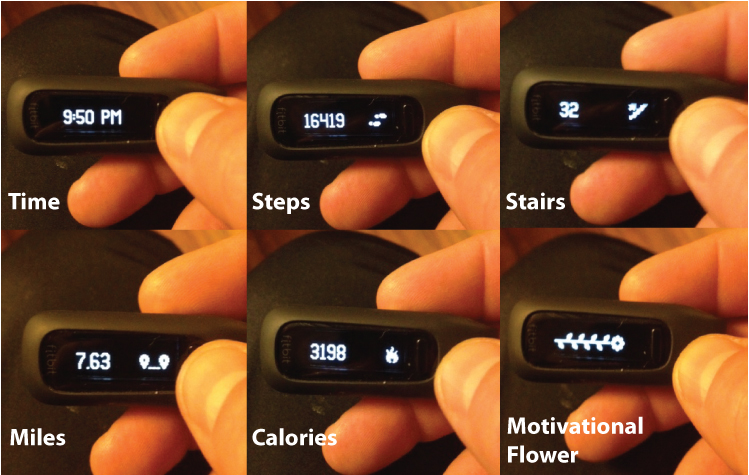
Simple in design, the Fitbit One looks similar to a small USB memory stick and has a single button on one side of the device and two small gold-colored electrodes on the back of the device that connect to a small USB-based charger that plugs into your computer.  It uses an accelerometer and altimeter to monitor movement counting "steps" and "stairs" climbed or descended.  Using your weight and age provided to the Fitbit website as your starting point, it calculates calories burned, estimated miles walked, and provides a motivational flower icon with a growing "stalk" for the level of activity achieved at different times of the day based on pre-set goals you select for yourself:


Toggling the button on the device shows the various information available
 The device is either placed in a small rubber clip that holds it on a wasteband or bra or it can be placed in a wriststrap that can be worn at night (more on this later).  It should be noted the device is NOT waterproof so it cannot be worn swimming.

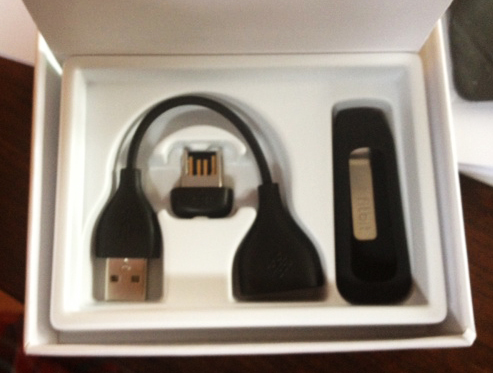
The device comes with a number of tiny attachments that are critical to its function, so keeping these in a safe place is a good idea.  They include the charging cable (one charge worked for 4-5 days for me and it quickly charges in about 60-90 minutes), a USB Bluetooth communicator, the rubber clip-on cover and the wrist strap.

The device communicates effortlessly via Bluetooth to an iPhone 4s or iPhone 5 automatically once a 4-digit unique handshake code is shared by the device and your cellphone.  Information stored on the phone also syncs with a (non-HIPAA compliant) website online where your daily, weekly, and lifetime activity levels, food consumption, and weights are stored.  Viewing data over time is a simple process.

The Fitbit iPhone app is downloaded on to your iPhone and permits you to enter your weight as you progress, food consumed, or to log your activities.  You can also connect with others via the app (something HIPAA rules discourage, but most people using these don't care).  Still, if you want to see how your compare each day to other like-minded souls throughout the day, you can using their iPhone app.  Real gluttons for punishment can even share their achievements using the device on Facebook.  (Sorry, not me.)  While the website can send you "badges" for activity milestones via email or text message on your phone, I preferred to turn off this functionality because I really didn't need to look at my cell phone any more than I already do.  Also, I don't need any more spam.

Interestingly, the Fitbit One can also track your time sleeping.  This is accomplished by pressing and holding down its single button for over 2 seconds until a timer starts.  Pressing the timer for two seconds upon awakening will then record the time slept.  As you sleep, the device reportedly records periods of being "awakened" because it senses motion as you sleep.  (I'll let you use your imagination for other purposes at night as well because, yes, there are interesting stories about this elsewhere).  It also has the ability to set (via your iPhone) a silent alarm that vibrates the device to wake you without waking others near you.

Impressions

I found there was value in using this device for me.  Fitbit's charm was its way of making even simple exercise like walking and climbing stairs matter.  While I enjoy racquet sports and they provide plenty of steps to achieve my self-imposed daily goal, I found walking the halls of our large hospitals worked pretty well, too.  Also, I found that I didn't have to obsessively track my food intake for too long since it became very obvious that every little thing I consumed quickly added to my daily allotment of calories.  Just understanding what you are eating, paired with your calories burned, was eye opening.  I learned first-hand how much activity it takes to burn off those calories consumed.  Most important, a pacemaker battery change burned about 105 calories.

I tried showing this device to a few of my more stubborn overweight patients in clinic, and they appeared interested, but whether I can convince them to make the plunge will have to come after I test my own ability to stick with the use of the device for a bit longer.  (If I lose weight, will it help me keep it off?)  Also, I found patients hesitated when I disclosed the price for the Fitbit One ($99 US), though a cheaper version called the "Zip" is available for $60 US that tracks fewer items.   Still, given what we pay for monthly cell phone service, this price seemed fairly reasonable over the lifetime that the device is likely to be used.

I worried that I might lose the tiny device and quickly turned to clipping it to a belt loop rather than my belt since it held better there.  And although I haven't had my device go through a wash cycle yet, I'm sure that scenario commonly occurs with this device and would likely destroy it.

Overall, it seems to be helping make weight loss fairly fun so far, though weight loss still requires discipline.  Still, geeks like me have found it's helped so far, aving lost 7 lbs in two weeks using the device.  But I have also come to appreciate what others have noticed using these devices: there is a thin line between healthy and unhealthy obsession with gadgets when using them for weight loss.

-Wes

Disclaimer: I have no commercial interest in the Fitbit products.

Thursday, December 08, 2011

Why Hospitals Should Permit Physician Blogs

Hospitals that permit physicians to participate responsibly on social media can reap significant benefits:

Click to enlarge
Just sayin'...

-Wes

Thursday, November 10, 2011

Planning

Years of college, medical school, residency, cardiology fellowship, and interventional fellowship training all comes down to this:

Click image to enlarge
Heh.

-Wes

Saturday, September 24, 2011

National Consolidation of Heart Programs: A New Paradigm?

With the announcement of Cleveland Clinic offering cardiothoracic surgery services to Charlotte, North Carolina after their collaboration with Central Dupage Hospital in Illinois, a new cardiovascular surgery paradigm is taking shape:
The Novant-Cleveland Clinic affiliation is not the first such collaboration for a Charlotte-area hospital. In 2010, CaroMont Health, which operates Gaston Memorial Hospital, announced a partnership with Columbia HeartSource, part of New York Presbyterian Hospital/Columbia University Medical Center. CaroMont doctors visit the N.Y. hospital, and N.Y. doctors have scrubbed in on surgeries at Gaston Memorial. Doctors confer about patient cases weekly, and CaroMont offers procedures that weren't available before.

"This is really a new paradigm in medicine," said Dr. Paul Kurlansky, a cardiac surgeon with Columbia HeartSource. It's a way for top-tier academic medical programs to share what they know with community hospitals and begin to reduce disparities in medical care across the U.S., Kurlansky said. "You will start seeing this increasingly throughout the country."
This is all about the race to tertiary care access which is increasingly being restricted. The hospital system that offers continued access to advanced therapies will hold a competetive (not to mention) financial advantage.

-Wes

Monday, August 29, 2011

Cardiology Hospitalist Programs Becoming a Reality

From St. Louis Today:
The first cardiology hospitalist program in the St. Louis area recently began at St. John’s Mercy Heart and Vascular Hospital allowing more focused care for hospitalized heart patients by board-certified cardiologists available throughout the day.

Patricia Cole, MD, an interventional cardiologist, is the director of inpatient cardiology services at St. John’s Mercy leading the new group. Mary Carolyn Gamache, MD, FACC, recently joined Mercy as the second cardiology hospitalist. She has been practicing with Metro Heart Group of St. Louis since 1995. Along with the cardiologists, three nurse practioners will also be a constant presence for patients and families.
On-site interventional "cardiology hospitalists" may improve door-to-balloon times during acute heart attacks, but will also place additional pressure on community-based interventional cardiologists to join forces with hospitals since their ability to expand their practices with new acute patients will be severely limited as a result.

The path to "cardiology proceduralist" continues.

-Wes


Monday, May 02, 2011

In Pakistan: Cardiologists Threaten Suicide

As America awakened to news of Osama Bin Laden's death in Pakistan, conditions for cardiolists in Pakistan sound dire:
Dr Zaheeruddin, while talking to The Express Tribune said, “After waiting for so long, for our salaries and to get our services regularised, we have been left with no other option but to protest and commit suicide along with our families.”
The reach of social media was exemplified by the inadvertant live-tweeting of the attack on Bin Laden. I wonder if these cardiologists have considered using social media to amplify their message before resorting to suicide.

-Wes

Thursday, March 24, 2011

How to Spin a Doctor Shortage

In rural Oshkosh, Wisconsin, they just call it "collaboration" between health care giants:
But that doesn't mean there's no place for collaboration among competing entities. ThedaCare and the other two healthcare biggies in Oshkosh – Affinity and Aurora – have found several ways to join forces to strengthen everybody's bottom line.

Whether it's Aurora and Affinity combining their cardiology departments to ensure top level care for patients of both hospitals, or ThedaCare, Affinity, Aurora and others working together at the Living Healthy Community Clinic at 510 Doctors Court in Oshkosh to provide medical care for the poor, these collaborations make sense.

'We just realized both our organizations expect to take good care of people. We'd identified gaps in services. That's how the cardiology cooperation came about between Mercy and Aurora," said Bill Calhoun, president of Mercy Medical Center.

"We questioned why do we compete when cardiologists are hard to find? We decided to do this on behalf of patients. At the end of the day it makes sense," Calhoun said.
It will be interesting to see how long these cardiologists continue to "collaborate" before either limiting their practice or burning out and moving to new pastures.

Despite what the corporate spin might be, "gaps in service" still need people to provide quality service. Spread 'em too thin and you'll still have "gaps in service."

-Wes

Monday, February 14, 2011

When A Cardiologist Has a Heart Attack

... the revelations for both the cardiologist and his patients are profound:
The doctor-turned-patient admits he’s faced some challenges in following the advice that he has given cardiac patients all these years.

“I try to go to the gym several times a week. It’s very difficult to fit that into my schedule,” he said. “I had adjusted my diet years ago, avoiding salt and eating less red meat. Now I’m eating oatmeal for breakfast five days a week.”

Lewin joined the cardiac rehabilitation program at the Ortenzio Heart Center at Holy Spirit, where he often ran into his own patients, who were surprised to see their doctor walking the treadmill.

“Some of them thought I was just coming to exercise,” Lewin said with a laugh. “People would tell me, ‘Gee, I have an appointment to come see you next week.’”

Lewin said his personal experience with cardiac rehab helps him relate better to his patients. “I can identify more now with what they’re going through and the concerns they face,” he said — and the challenge it can be to follow doctor’s orders.
-Wes

Friday, February 11, 2011

How Hospitals View Cardiology Groups

It is no surprise that hospitals are acquiring cardiology and primary care groups groups in droves lately. It seems there is a signficant financial incentive to do so for now, but doctors (and especially cardiologists) should read the tea leaves ahead:
While hospitals are limited to paying fair market value for practices, they can gain an edge over competing hospitals by offering longer employment contract terms or better electronic medical record systems and management services. If hospitals move forward with a transaction, Ms. Kaplan suggests they limit employment contracts to no more than two years if possible and rebase compensation annually based on productivity.

"In healthcare you shouldn't assume anything is permanent," says Ms. Kaplan. She cautions that the revenue increases that are currently available to hospitals through expanding outpatient cardiology services may not last forever, which is why she urges hospitals to limit employment contracts and other agreements to only a few years. Doing so will afford an "out" for the hospital if the service line goes from a money-maker to a money pit.
-Wes

Tuesday, February 08, 2011

Cardiologists as "Heart Whisperers"

... a creative moniker if there ever was one, but it should probably be reserved for primary care specialists, instead.

-Wes

Friday, February 04, 2011

February: Heart Month or Marketing Month?

Heart disease and February. What relationship could be more cozy?

From the scary risks of shoveling snow (yep, you could DIE, so be sure to lift a little at a time!), Mercedes-sponsored red dress parades and government-sponsored National Wear Red Day®, to tips for identifying heart attacks in women (men, you need a different month I guess), February has all the important stories to improve your "awareness."

Such a polite term, "awareness."

But I wonder, now that the internet is upon us and people are seeing their insurance rates and co-pays skyrocket if maybe we're shooting ourselves in the foot with all this heart month marketing hype. People are sick and tired of testing "just to be sure." It's starting to directly cost them a fortune, and people are pissed at having to pay a fortune for health care, let alone heart care.

I know, I know, I should be at the forefront of working with patients to stomp out heart disease. And goodness, people DO need to be attuned to diet, exercise, and weight loss. But the reality is, if we're giving you the ten latest tips on how to detect a heart attack, we're probably a bit too late.

That's the problem with all these press releases: while there's a need to raise "awareness" of heart health, there's also a very real need for people to take us, heart disease professionals, seriously to help cut costs in health care here. The last thing our health care system needs is more frivolous testing. Yet this is exactly what all this marketing does for our health care system: and it helps those with the largest PR budgets most of all.

Of course, there are researchers who depend on a portion of the funds raised to continue their work. After all, research is ridiculously expensive. There really is a need to raise funds for these scientists if we're going to continue our tradition of creative innovations in cardiovascular health care.

Maybe that should be the story line.

Maybe it would be nice to highlight these researchers' work and what that work hopes to bring to people rather than splashing a big feel-good red dress parade all over the media. Maybe we could focus on real life stories and less on the hyperbole. Maybe we could focus on the challenges, rather than the accolades and perfection.

Maybe then we'd have people take us seriously.

-Wes

Friday, December 03, 2010

Specialists' New Game: Musical Chairs

The consolidation of physician specialty practices in to larger corporate health care systems in urban areas is creating a new challenge for today's doctors when the music stops: there might not be a chair available.

There are simply many fewer hospital systems in large urban areas than there are specialy practices, so the number of specialist positions a large health care system is willing to absorb might be limited. As doctors and hospital systems coalesce into as-yet-to-be-clearly-defined "Accountable Care Organizations," the cost of too many specialists in an organization is being carefully weighed.

This is playing out in our area as more and more cardiology groups join forces with hospital systems. The concern in some circles is what will happen to laggard practices in similar geographic locales. Will they be able to go it alone and refuse government payments for services? Will they have to align themselves with an alternate hospital system that might not be there first choice? Or might they just simply fade away as the specialists in these practices retire?

It's hard to know where this might sift out, but the construct developing suggests that certain specialty services might be even harder for patients to obtain in the years ahead.

But then again, that's probably been the plan of our new health care reformers all along.

-Wes

Saturday, October 09, 2010

Oncologists - We're Coming to Get You

... as cardioncologists.

Be afraid. Be very afraid.

This is what happens when they take our imaging payments away...

... we metastasize to other specialties and create our own international societies.

-Wes

Friday, October 01, 2010

Health Care's Seismic Tremors

Today marked the official announcement that the 12-man cardiology group, North Shore Cardiology, will officially join NorthShore University HealthSystem on 1 January 2011.

In other words, they'll be employees of our large hospital system like me.

For long-term readers of this blog, most will recognize this as an expected result of our most recent health care climate change. These days with reduced payments for services and tests, paired with the threat of bundled payments for episodes of care around the corner, such a consolidation is a logical consequence for cardiology practices in large urban environments. Private cardiology groups have felt a particularly heavy blow to revenues after the government slashed payments for some diagnostic tests nearly 40% since the first of the year (hospital systems were not affected to this extent).

For patients, they shouldn't note much difference, but referrals to hospital facilities will now be along hospital affiliation lines, rather than patient geographical preference. Subspecialist referrals also might be a bit different, since subspecialist utilization will be along the lines of hospital affiliation as well. It will not be to the employee-cardiologist advantage to refer cases outside your own system since that would be like biting the hand that was feeding you.

There used to be some advantages to cardiologists to remain independent. For instance, they could advocate for greater roles on leadership in the hospital administrative levels or insist on better staffing for their patients by threatening to refer their patients to a competing health care system. But this method also used patient referrals as pawns in these political games.

No longer will that occur.

But doctors will increasingly find greater conflicts between the needs of their patients and the needs of their business-minded hospital employers. Their loss of independence will require they been seen as "productive" lest their salaries or jobs be cut. They are now dispensable workers rather than critical caregivers and entrepreneurs.

There is also the challenge of joining cardiology groups and maintaining a fair compensation arrangement. Hospital systems need skilled specialists and deals are always cut to consummate these unions. No doubt there was a long process of bargaining on both sides of the deal. For those already in large systems, they understand that they also are at risk as hospital systems look to thin their payroll overhead. Fortunately, the expected bolus of patients to the system in 2014 paired with the stiff competitive environment locally is likely to help deter physician layoffs in the near future.

But there are competitive advantages - a strength in numbers if you will - to having a solid group of cardiologists at your health center, especially ones based close to the hospitals themselves. It forms a formidable competitive environment for others who want to stake a claim to the geography inhabited by these doctors for they are the locals - well known by the community - and supplanting them will come with significant costs in terms of marketing and facilities to those who might desire to enter the area.

The seismic shifts in health care delivery are well underway - from ongoing practice consolidations like ours with larger and larger competing urban health systems, to McDonald's threatening to drop their "mini-med" insurance plans and Principle Financial Group exiting health insurance altogether.

It's going to be an interesting time, but one thing's for certain...

... resistance (at least for the forseeable future) is futile.

-Wes

Tuesday, August 17, 2010

Nay Fellow Way?

It was to be a routine pacemaker.

The parties assembled. The room prepped. IV started. Chest scrubbed. Antibiotics given. His nervous eyes raised when he saw me before the procedure, relieved at the sight of at least one familiar face.

"Are you ready?" I asked.

"Yes," he replied, "I think so."

"Any last minute questions?"

"I don't think so," he said.

"Great! Then let's get this over with..." I turned to the lab staff and signaled them to proceed.

"Oh, doc! I forgot. Can I speak with you a second? Ya know, privately?"

"Sure," I said returning gurney-side. I drew the curtain.

He leaned forward and whispered: "Doc, no fellow, right?"

I stopped and contemplated the question, then acquiesced. "Would you mind if I use one as my scrub tech, but I'll be the primary operator?" I asked.

"Yeah, that would be okay - as long as you're the primary operator."

* * *

This little exchange got me thinking: what would I want? Honestly, I'd probably want an attending physician working on me, too. After all, it makes sense, right? Get the most experienced hands and all.

But there are good reasons to have a fellow involved with your surgery, if the opportunity presents itself:
  • We need to keep training. None of us will be doctors forever, and now more than ever with tons of people entering the health care marketplace there is a need to have well-trained doctors in place to meet the need ahead. You can read all you want about how to do a procedure, but until you've done one yourself on a living, breathing individual, you have no concept of the complexities involved. Starting slow in a closely supervised, supportive setting, makes for some very technically-savvy doctors of tomorrow.

  • They improve your surgical technique. The better I can teach someone to do what I do, it seems the easier it is for me to do it, too. Throughout our careers as doctors, we work hard to solidify our competency "brand" amongst our patients and peers. Particularly for specialists: screw up a case or two and your "brand" is quickly tarnished. This is especially important as we train fellows - none of us wants to tarnish our "brand" when trainees work with us either. Therefore, you better bet that bottom dollar we'll be supervising those fellows closely.

  • Fellows keep you sharp. Oh sure, they often ask mundane questions but occasionally they ask remarkably astute questions, too. When this happens, they make us think and as a result, we all get smarter.

  • They're another set of eyes and hands.It never hurts to have another set of eyes contribute their interpretation to a tough case nor an extra set of hands for that extra retractor. Ever.

  • They slow you down. There is no question that teaching someone else takes more time than doing a procedure yourself. This definitely has its downside. But time spent now might pay large dividends in the future when that same doctor has to work on you someday. Also, spending a bit more time can have it's upsides - especially if you really don't want to have dinner with your mother-in-law.

  • More often than not, fellows are extra-careful. By their very inexperience and their desire to excel in training, I have found most fellows I work with especially conscientious when they dealing with patient and their procedures.
So the next time you have surgery and are introduced to a training fellow in medicine, consider letting a fellow help out on your procedure.

It might just be the best thing you ever did.

-Wes