Showing posts with label medical education. Show all posts

Monday, June 16, 2014

Medicine's Great Disruption

"Disruptive innovation is competitive strategy for an age seized by terror."
- Jill Lepore, author of
"The Disruption Machine: What the Theory of Innovation Gets Wrong"

"What do you want me to do with all the stuff in this box?" my wife asked this weekend.

I looked inside and saw my former self: one of BNC and pin connectors, wires, a notebook with sin, cos, theta, and a host of other equations - a project I worked on but never grew - it came from a time of creativity and endless possibilities for me in medicine.  Engineering and computers were how I entered this field - the hope of solving problems, doing things a little better, safer, and maybe faster.  A chance to innovate and collaborate.  A chance to make a difference.

But the world of medicine has changed from one that promotes discovery and creativity to one that promotes productivity and the lock-step over the past several years.  See more.  Do more.  Don't sway.  Follow the guidelines.  Stay between the lines.  Want to try something new?  The message to doctors is loud and clear now: don't you dare!

Every month another set of guidelines and rubrics, as if the guidelines are how we want doctors to think, or rather, recite.  Medicine is rapidly becoming a staid world of group-think, as we are forced to use the latest "disruptive technology" to change our medical world.  Bit by endless meaningless bit.  The "value-added" ideas never end.  There is little ownership now.  Little personal investment.  Punch the clock.  Get 'er done.  Do what those grey suits say.

It's the era of the creative destruction of creativity. 

What kind of doctor we are breeding in medicine now?  The American Medical Association (AMA) and Accreditation Council of Graduate Medical Education (ACGME) want to shorten studies and push medical students through school based on competencies and "not based merely on a traditional time-based system."  Time with patients can no longer be trusted it seems.  In the place of time: competencies gained from simulators. Plastics superseding flesh. As though doctors should become technocrats that make a cameo appearance at the patient's bedside with their smart phone in hand.

Is the hurry-up push toward technology and Big Data really needed or what we're being sold?   Enter your note, doctor, click another box, you're being scored now.  Do as you're told.  What's that? A little software glitch?  Don't rock the boat.  Just work around it.  The fix will be here in September. We must do more with less.  Oh, and forget the staff, they're expensive. Hurry up.  Perfect data, remember?  Your pay depends on it.

Oh, and that idea you wanted to work on?  Sorry, no time or money.  Really doctor, we're on a time line. Could you move it along?  My kids have a play date.

The Disruption Machine is moving, alright.

But will we be better for it?

-Wes


Friday, June 06, 2014

On Mentoring

Recently, I had one of those "proud Daddy" moments: watching my son play in the Chicago Civic Orchestra's last concert of their 95th season.  (For those unfamiliar, the Civic Orchestra is the training orchestra of the Chicago Symphony Orchestra.) They played Prokofiev's Symphony No. 5 under the direction of Jaap van Zweden - one of the most amazing conductors I have ever seen (and I later learned, one of my son's favorites).   Afterward, we were invited to a reception and I had a chance to meet YoYo Ma who served as an inspiration, role model, and mentor for my son for the past year in his role as creative consultant with the orchestra.  What a wonderful guy.  He was fun, energetic, complimentary and thoughtful.

Later that night, my encounter with these artists got me thinking about my role as a mentor to young physicians.  I teach residents.  I teach EP fellows.  What are they thinking?  Am I doing all I can for them?

So it came as a surprise that I had just been offered to speak at a fellows conference later this year.  The conference was sponsored by a major medical device manufacturer in a lovely US city.  100 fellows would be there along with 40 industry personnel.  I would be paid well for my travel and speaking time.  I'd connect with other contemporaries of mine whom I admire that would also serve as speakers.  My topic involved an aspect of social media for physicians.

How could I resist?

And yet, here I am talking about the Health Care Industrial Complex and the Iron Triangle of comprised of Congress, special interests, bureaucracy and how doctors are swept up in their wake.  I thought about being a mentor, a teacher, a doctor.  I wondered how it might ever change.  I wondered if doctors would ever have the courage to push back against the seductive powers of ego and money.  Then I realized: probably not.  It's how we're groomed for this from the beginning.  We're human.  So  I have no doubt another doctor will be more than happy to serve as my replacement.

And so it goes.

But perhaps I could do what I love again, I could teach for the joy of watching young doctors get excited again, not because I needed to make a buck.  Perhaps I could teach those same doctors that we do what we do because it's not about the corporate boondoggle, but about the patient.  I could mentor.

So I declined the offer.

After all, I've got other priorities now.

-Wes


Wednesday, January 29, 2014

For Medical Students, It Seems Nothing's Changed

It was a very brief 15 minutes but I had arrived early.  There they were, sitting in our conference room, waiting to be interviewed for a residency position at our institution.  They had come from far and wide: California, New York, Michigan, for instance - all dressed in their nicest suits or business attire - a 50-50 split of bright women and men.  I was to give a lecture as part of my monthly series on EKG interpretation that fell at this time of year.  So these applicants could see how faculty interact with residents firsthand, I was asked to give my lecture to a crowded room of residents and the applicants together as part of their visit.

Since I had a few minutes, I introduced myself to the applicants and asked them how things were going.  They were very complimentary (of course) and seemed eager to want to talk about something besides why they wanted to come to our institution for residency training.  So being a bit subversive (of course) I asked what seemed like a little question: "How much does medical school cost these days?"

Heaven to Betsy, every one responded and shook their head.  "It's cost me $75,000 in loans so far this year!" one female residency applicant exclaimed in an embarrassed tone.  Most agreed that many of them were astonished at the costs, quoting some with debts of $300,000 to $400,000 for some of their classmates."  "How did you do it?" they asked.  And I mentioned by 26 years in the Navy and how I couldn't believe my roommate in medical school left with $65,000 debt at the time.  They all laughed that I thought that was a lot of money, realizing how much more most of them owed in the present day.  "I guess none of you are going into primary care, right?" I said.  They laughed nervously, yet didn't really answer.

Medical school costs and the costs of educating America's physicians is in its bubble stage, about to pop.  Our finest medical students are accruing huge debts and no one cares.  After all, these young doctors were the lucky ones, right?  Smart, social, good interpersonal skills, hard-working, driven, and most of all, disciplined.  Look how lucky they are!

But when these young doctors look at their first salaries, reality will hit hard.  They will realize the next mountain they will have to climb (as if medical school wasn't enough).  Tough choices will have to be made.  Needless to say, the picture for lower-paid specialties in medicine is particularly grim, yet the reality of fewer residency slots also exists.  Depression, already a problem, is likely to increase.

In the past five years, the world of medicine has forever changed for everyone, except medical schools it seems.  Their costs and expectations for revenue continues to exceed inflation by a large margin.  When will it stop?  For our newest trained doctors increasingly saddled with nearly insurmountable debt, the lure of medicine is waning. For those already in the pipeline,  the reality of what's coming when the loan bills come due is inevitably going to be turning our best new hope for medicine's future away unless the cost problem is fixed soon.

I am not proposing we make medical school free - that would make things worse in my view.  Different, more disruptive ideas that reign in costs will be needed - removing tenured professorial positions and limiting medical school building projects would be a good first step, but admittedly difficult with our entrenched old-school teaching model.  Unless we really work to change the cost of educating our next generation physicians I fear that medicine's best hope for the future will quickly dwindle away.

-Wes

Thursday, December 19, 2013

The Matrix

"As a third year medical student, I would also argue that this is creating a generation of dumb doctors. My school (average US MD school in the Midwest) has almost abandoned teaching physiology and understanding. We have the virtues of guidelines shoved down our throats instead. Recognize a pattern, apply the appropriate guideline. That's medical school these days...."
-Anonymous commenter
Dr. Wes blog

Dear current medical students,

Welcome to The Matrix.

-Wes

Monday, September 23, 2013

Reviewing the 2013 EP Board Review Course

This past week I sat for my third board review course in anticipation of my upcoming third EP board recertification. It was a well attended event of about 150-160 electrophysiologists, some from as far away as Alaska. That, I suppose, is one of the attractions of having this course in a city like Chicago: it's a major central airport hub and has plenty to see and do for those hearty and financially solvent enough to spend the evenings out at a nice restaurant or club. For me, a native of the Chicago area, I was lucky enough to stay in my own home and just had to brave the traffic and $35-a-day parking fees. Others from out of town bore a much larger expense in terms of lost days from work, hotel and transportation fees. The meeting was held at the Marriott Renaissance Hotel on 1 Wacker Drive in Chicago, just a few blocks from Michigan Avenue's shopping district downtown - not the cheapest hotel in Chicago, nor the most expensive. Perhaps it was held there for the comfort of the rooms, the size of the lecture hall, or a need to provide a central Chicago location, but given the amount of time we spent in the lecture room and the social life of most serious electrophysiologists I know, I wondered why it wasn't held somewhere less expensive. After all, cost remains a huge concern (if not overriding one) for doctors attending these courses.

The course began Thursday afternoon at 1pm and went until 8:30 pm Thursday, 7:45am-5:30 pm Friday and Saturday, and concluded Sunday with a rushed morning review of pacing principles from 07:45 am to 12:30pm. (Completing the course on time was critical for those who had to catch planes home on Sunday)

I paid the extra money for attending a maintenance of certification test session before the main session began to earn a few points. This clearly was not worth the extra money in my view, as it was just an extra Workshop that included a bunch of typical board-style questions with the answers in the back of the book. My recommendation would be to save your money and take the online versions that come with one's recertification fee. It just seemed to be another cash cow for the ABIM and HRS.

The course materials were printed, and the majority of doctors polled (75%) preferred their materials this way, despite the Heart Rhythm Society (HRS) clearly leaning to providing the material electronically on a thumb drive. They also offered (with a $1300 discount if you attended the session) the full lectures (with audio and slides) to members who wanted to cough up even more money so they could review the materials at another time. (I passed).

The main course was taught by established names in EP and the Heart Rhythm Society: Ken Ellenbogen, N.A. Mark Estes, David Haines, Fred Morady, William Stevenson, among others. These are guys that taught me, they've been doing it a while, and they're good at what they do. As such, the lectures were paired down to the essential principles and generally well-organized with good audiovisuals and sound, but were peppered the same pimp items that you'll still have to memorize despite our new era of Google. I suppose having these things pass your cortex once so the recognition of these syndromes might be realized in one's practice, but in this era of Google whether memorization is really necessary is another matter.

But did I learn anything? Okay, I have to admit I did. New things I learned included a few pearls about Early Repolarization Syndrome (and is probably fair game for boards), the genetics of plenty of obscure diseases, and about how many ways a doctor can get pimped on a cleverly written examination. Given these realizations, I hope my chances for passing my board certification were improved as a result of attending this course. We'll see.

It was kind of sad (yet psychologically affirming) to see Sonny Jackman, an icon of accessory pathway ablation and EP, in the audience with me. It was particularly entertaining when he had to hop up and explain a tracing to the audience on behalf of the lecturer (truly a highlight). But I also wondered why Dr. Jackman was there. Sadly, I knew the answer: he's no different than the rest of us now and understands that it won't be long before the bureaucratic machine called medicine will require passing an irrelavent test to practice medicine.

It was this last issue that was most relevant and prescient. Mark Estes (someone who has sat on the test-writing committee in the past) tried to explain how the ABIM decides how many recertifying doctors ultimately pass their examination. "This is a sensitive and unpopular issue for EPs in practice," he said quietly. You could see people agreeing. But as he explained how the ABIM determines how many recertifying EPs pass the recertification exam he admitted, "I really have no idea how they decide." He continued, "But when we look at the trend line for the percent passing from prior years, you can see that last year's percentage was down a bit." He then showed the trend line.

Think about that. No one has an idea what consitutes the criteria for a "passing" grade for recertification, yet here we are spending too much money on a process that has little to no proven patient care benefit in terms of quality care. This non-transparent scoring criteria adds to the problems with recertification in my view, since it would not be difficult to think that granting of a passing grade for re-certification could be used against certain subspecialites for any number of obscure reasons (eg., the desire to downsize the specialty, political differences, etc.) One only has to consider how the IRS was used against non-profit political organizations to get my paranoid drift in the era of medical cost conservation here. Perhaps this is a bit overdramatic, but it makes you wonder, doesn't it?

So I'm back in the salt mine of everyday practice now. Hopefully the course helped and will prove itself valuable for me in the future. Honestly, every effort was made to make the sessions tolerable and informative, I just wish I understood why the re-certifiers needed to be there. But I'm trying to cope with the reality of the times and I just hope the ABIM won't decide not to pass me for what I've said here.

-Wes

Saturday, September 21, 2013

Shadow Puppet: An App That Lets iPhone Pictures Tell a Story

They say a picture is worth that thousand words, but nowhere is this more true than with a new, free, iPhone app called Shadow Puppet that lets you turn selected photographs on your iPhone into a narrated video storyline.

I saw this app reviewed over at Techcrunch and immediately saw its potential as a teaching aid.  The app allows you to pick a series of iPhone photos from your camera roll, order them, and then record a narrative about your pictures.  What is unique is that you can zoom or move between photos as you tell your story, annotating them by touching areas on the photo that you are discussing as it records the video.  (Very cool).

Here's my very first video I made with the app describing the new Zio XT patch monitor that records 14-days of a patient's heart rhythm that we've been using in our clinic.  Simply made, these video clips are easily shared via email, Facebook or Twitter.  For this particular video, I still had to edit portions of the patient's report on Photoshop, then sent the images to my iPhone but, still, that was easily done.

Want to teach a fellow how to implant a pacemaker?  Take some photos and show them!  Have an EKG that has a finding that you're not sure about?  Snap a picture (without patient identifying information, of course) , annotate it with your question and send it to your EP!  Simple, elegant, and who knows, maybe even life-saving.

-Wes

Friday, September 20, 2013

For Medicine: Go Slow

Three years ago, in the midst of all that was happening with health care reform, I thought about if I'd ever recommend medicine to my daughter.  I thought and thought about that issue and looked deep inside myself for reasons one might still choose this profession, then penned "The Top Ten Reasons to Be a Doctor."  It is, by far, the most popular post on this blog, having been read by more people than any other I've written.

But little did I think my youngest might heed this advice.  Unknown to me, she left for college as an environmental studies/economics major, to abruptly decide one week later after some soul-searching of her own to consider a pre-med curriculum.  I couldn't help but feel a rush of pride, but also a huge amount of concern, for no one can tell anyone else what this path is like until it's been traveled.  One thing I know: it she wants it, she's very capable of doing it.

And as part of her growing enthusiasm for this field and (I suspect) recent rewarding experiences she had as a lifeguard at our public beach this past summer, she's even thinking about training to become an EMT while studying at college.

My first thought, of course, was "Heck ya!  Dive in! You'll love that!  What a great skill to have!"  But after a night of rest and reconsideration, I have another piece of advice for her.

Go slow.

You see there's a little secret every doctor lives with throughout their career and never talk about: their closet.  We've all got one and we use it sparingly, and you don't want to fill it up too soon because it has to last your entire medical career.

You see, your closet is where you store life's experiences that are so horrible, so painful, so shocking, that you can never tell anyone (except, perhaps, another doctor) about them.  It is the place where you put the images you see that you'd really rather never talk about.  Ever.  Really: the gross stuff: the gross images, the gross sounds, and the gross smells.  Things so bad I can't even write them here.  That stuff.   And I know EMTs, like doctors, have a closet of their own.

You'll be surprised how dark that closet is and how fast it can fill.

But you also need to know that the closet exists, it is real, and how to clean that closet when considering the path toward becoming a doctor.  This is probably one of the most important skills outside of medicine that a doctor can muster.  So, I'll ask that my daughter to reconsider the EMT class for now and do something entirely, crazily, stupidly different and fun. (Whether she'll do this or not remains to be seen.)  For this is how we have to learn to clean a bit of our closet, or at the very least, make it a little bigger.  Use this precious time before all of the isolation of studying and commitment that medicine requires to expand yourself.  Learn to play badminton, to paint, to play a guitar, to debate, to sing, to ballroom dance, to fly or just to love and appreciate what's out there.  What ever.  The point is this: learn to do other things besides medicine that will engage your brain, hold you firm, and make you happy.  Because medicine's a long haul: a lifelong haul that never keeps adding to that secret closet.

As a student of medicine, your job, throughout all that lies ahead, is it to make sure you always have the renewable resources to get outside medicine so life stays rich and medicine remains, net sum, rewarding. Because as as rewarding as medicine can be at first, it can wear you down unless you always know how to properly size (and maybe even start to empty) a bit of that secret closet that doctors all share.

-Wes

"Emptying the Closet"
Oil on Canvass, 36" x 24"


Sunday, July 07, 2013

Physician Pay Redistribution: A False Sophie's Choice

Sophie's Choice is a novel by American author William Styron, whose plot ultimately centers around a tragic decision Sophie was forced to make upon entering the Nazi concentration camp: on the night that she arrived at Auschwitz, a sadistic doctor made her choose which of her two children would die immediately by gassing and which would continue to live, albeit in the camp.

While not of the same gravity,  I have seen the discussion by policy wonks about physician payment reform evolving into a smackdown between primary care physicians and specialty physicians for the remaining coins tossed on the health care floor.

James Hamblin MD, The Atlantic magazine's health editor, recently published an article entitled "When the Best Hospitals are the Worst," that assumes prestigious hospitals are the "worst" because they fail to train an adequate number of primary care physicians relative to the federal subsidy they receive for training residents:

But many hospitals aren't using that money to do what the taxpayers most need. 158 of them produce zero graduates that go into primary care. The worst offenders, in terms of the number of primary-care physicians produced, are the hospitals we hold in highest regard. 

To bolster his point, he references another article from the July-Aug 2013 issue of the wonkish Washington Monthly by demographer Phillip Longman entitled "First Teach No Harm."  Both Hamblin and Longman claim the following:
The nation’s residency programs are producing too many of the wrong kinds of doctors in the wrong places, while not producing enough of the kinds of doctors we most need to sustain the U.S. health care system.

Specifically, the programs turn out too many specialists who go on to practice in places where such doctors are already in oversupply, and where, according to numerous studies, they often inflate health care spending by engaging in massive amounts of unnecessary surgery and other forms of over-treatment. 

While both Hamblin and Longman make excellent points about the work conditions of today's primary care physician's, they veer into dangerous territory when they pile on the assumption that the problem with our nation's health care delivery and cost problem is the distribution of dollars between different types of physician training programs.  American's need doctors - all kinds of them - thanks to the ever-growing and aging population.  What they don't need is the mushrooming and very costly administrative overhead that plagues physicians today.

Here's a radical thought: all physicians should be paid a respectable and competitive salary commensurate with their years of educational investment and competitive training and receive the quality training they need to do their work.

But rather than acknowledging this fact, Hamblin and Longman want us to make a false Sophie's choice: picking which types of physician training programs should receive federal funds based on the types of physicians they train, rather than working to improve the lot of all physician training programs to assure excellent doctors in the years ahead for our health care system.

Perhaps rather than wondering how to redistribute $13 billion dollars of educational funding for medical residencies that flows to all residency programs, Hamblin and Longman should ask how we should cut the mushrooming and incredibly costly administrative overhead of our system that already  stood at $320 billion (and counting) way back in 2003?  How much is that overhead expanded thanks to the introduction of over 110 government agencies created by our new health care law?  Which bean counter should be fighting with the other bean counters for their share of administrative dollars?  Which new data miner, quality coordinator, hospital administrator, database operator, or government agencies that share similar functions (like the PCORI and AHRQ agencies) yet provide no care should be fighting to save themselves?

Maybe rather than peeling the dollars from any doctor's training pocket as he charges down the hallway to see the next patient in his 14-hour day, we should determine how to peel the even larger amount of dollars held in the pockets of the five administrators trailing him.

This is our real health care system cost Sophie's choice.

And doctors of all specialties would be wise to remind Congress and their respective medical associations of this fact.

-Wes


Tuesday, June 04, 2013

What I'd Tell the Graduating Medical School Class of 2013

Next week I'll be attending our medical school graduation and I wondered what I would tell them if I were chosen to give them a commencement address.  This would not be an easy speech to write right now, given all of the uncertainties in health care that lie ahead, but I thought it would be interesting to try.  Readers are invited to add their words as well in the comments section.

Dear Graduating Class of 2013 -

I appreciate the opportunity to address such an impressive pool of medical school attendees.  From the first day of medical school when you were introduced to your cadaver, you have endured countless lectures and lab hours, physical examination and sensitivity training sessions, and ward rotations under the watchful eye of senior residents and attendings.   Today, you will hold something that few people are privileged to sign behind their name: the letters "M.D."

This time in medicine is both a particularly exciting and particularly challenging one for doctors.  How you deal with these challenges will determine your staying power in the profession.

During your training and long hours, you carefully cultivated your taste for fine coffee. At first, time allowed for a daily Venti-sized Starbucks mocha latte, but later as you learned the contributions of carbohydrates to your waist line, you switched to "only" black Ethiopian Harrar. Good for you. No doubt your upcoming days of residency will allow you some time to enjoy these delights a bit longer, but rest assured that by the time you call yourself an attending physician, you will be satisfied to drink a late night splash of automated coffee machine chemicals called "Coffee, Black" as you clean up the remaining work load left by residents who have exceeded the work hour restrictions you once enjoyed yourself.  With this graduation, your sheltered medical workshop days are quickly coming to a close.

While most of you think this day is about you, realize there are some very important team players that have helped you get to where you are today.  First and foremost are members of your family.  They have encouraged you, guided you, and likely funded much of your way to this point.  And the funding for medical school has been significant.  The average medical school costs today, when one includes living expenses, exceeds $200,000.  For those of you who did not have family members supporting you, realize that $200,000 of debt obligations translates to $843.21 per month if you plan to pay that loan off over 30 years at a low 3% interest rate.  If your interest rate is higher, I feel for you.  Yes, Virginia, medical school has become much too expensive. 

But there is some good news.  For the first time ever, instead of paying in to the health care education system, the health care system will start "giving back" and paying you.  Admittedly at a very low rate.  But at least it's your first tiny step in the right financial direction.  Hopefully by the end of your residency training, the additional clinical experience you gain will finally allow you to make a bit higher salary than the nurse practitioners you work beside.

Fortunately, each of you began life as a medical student-doctor in the Gilded Age of Information Technology.  Anything, you were taught, is possible with enough Big Data.  But more data is not always better data.  More data can confuse and obfuscate.  More data might not be important data.  And all that data comes at a cost to you: repetetive motion injuries.  You see, Big Data is created from the information you will be asked to enter on your keyboard, iPAD, or via mouseclick or Google Glass.  And since Big Data must now include a myriad of new procedure and diagnosis codes that you must learn, residency is not only a time to master disease states, but also a time to master your typing and coding skills.  What ever you do, don't let Big Data detract from what matters most: your patient.

Your greatest challenge as a newly minted doctor in this Information Age will be to put your cellphone down.  Looking up from its glowing screen will let you see your patient's downward stare as they tell you their deepest, personal secrets.  If recognized, a trusting doctor-patient relationship will blossom.  If missed, a feeling that you don't care may result.  Remember that despite what the information technology zealots have been telling you, patients are not digital widgets, but analog, non-linear, feeling creatures who demand respect and intelligence.  If you remember this, you will go far.

Many of you will be switching to new cities and new institutions to begin your residency training at a highly-esteemed medical school now that you've "matched."  As you work to learn the clinical side of medicine, stay flexible. Fellowship positions are getting harder to come by as cuts to income for specialists continue.   So hang on to those cardboard moving boxes - they might be needed sooner than you think.  Honing hospitalist skills will probably be a wise choice, too.

And be prepared to have your heart broken.  People will die despite your very best efforts.  Complications occur, even to the most skilled and most cautious.  Administrators will tell you to do things a certain way when you know that way's inefficient, but it pays your salary.  People will deny payments for things that you know they shouldn't.  A single malpractice lawsuit, even if ultimately found to be unwarranted, will forever change you - not for the better - but for the worse.  And your wife and kids will still be affected when you arrive home late after missing your daughter's dance recital even though she says, "That's okay, Dad."

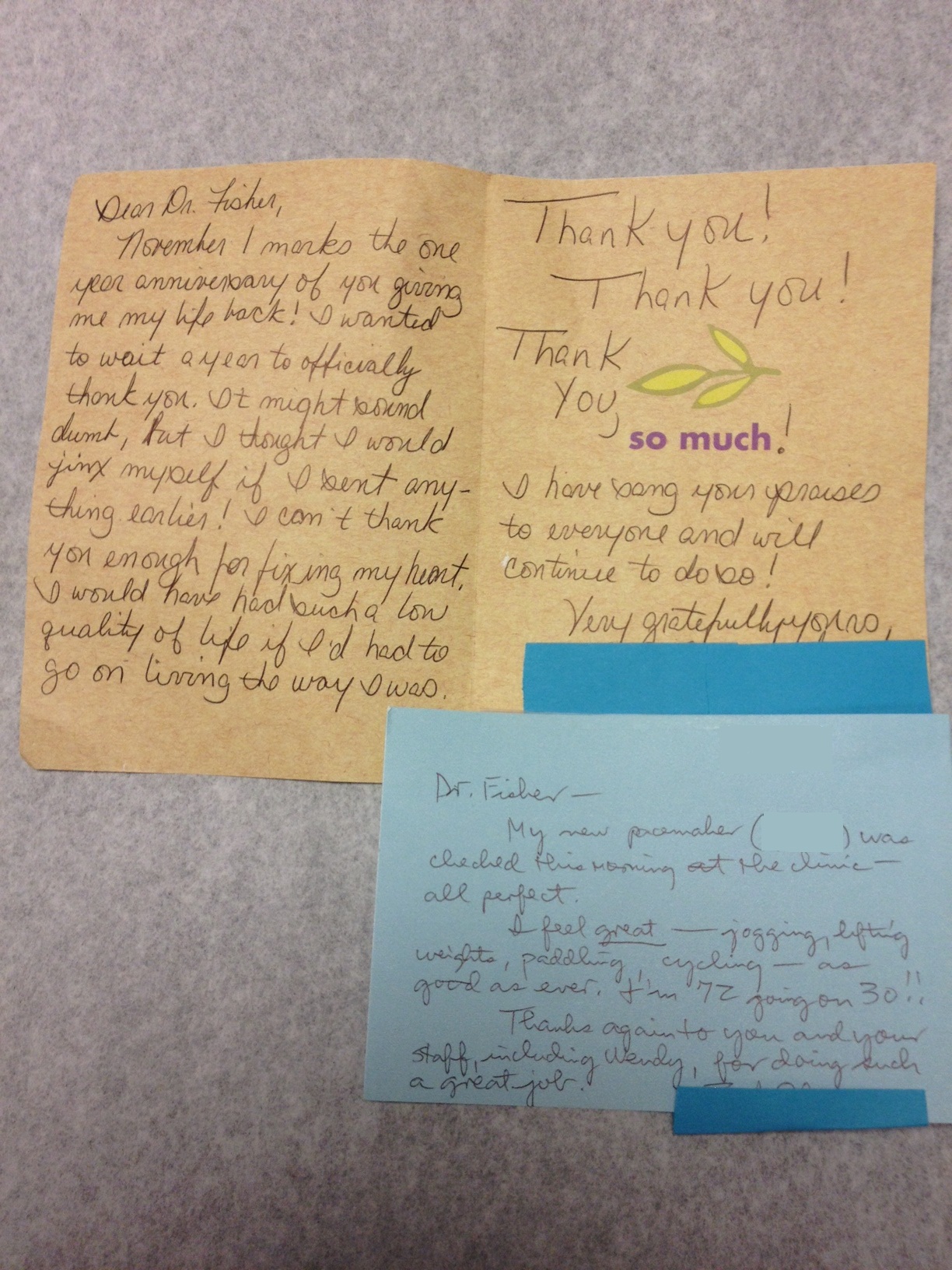
An example of a few much-appreciated
thank-you notes you'll receive
(Click to enlarge)
But despite all of these realities, there remain some wonderful aspects of medicine. People still will look up to you.  People will still respect what you do and say.  People will trust you, confide in you, and appreciate your efforts.  You can do amazing things for people if you don't let the system get you down.  Get involved in the process.  Work to set the needs of your patients before that of the system and you'll usually be rewarded.

Because in the end, this is what really matters.

So go forward, not with an artificial glow about all that you have achieved, but with the stark reality of what lies ahead.  These are challenging times for doctors as we increasingly encounter efforts to devalue all we've learned and experienced.  Work to make the system better.  Stay strong, work hard, and appreciate all you've got.

After all, there's plenty of people who would give anything to be in your shoes.

Good luck and God bless each and every one of you.

-Wes


Sunday, May 05, 2013

Physician Blogger Insights On Social Media

A recent e-mail exchange between myself (WGF) and fellow-physician bloggers John M. Mandrola MD (JMM), Edward J Schloss MD (EJS)  and Ves Dimov MD (VDMD) resulted in some interesting insights about how physicians are using social media tools today.  The following is a lightly edited version of the thread (used with permission). It began with an e-mail from Dr. Mandrola:

JMM: "In prep for our Social Media session at HRS2103. I was just wondering…

Do you guys keep a list of favorites on Twitter? I have lists--but they aren't very effective logistically. I was wondering if I designed a list--say the Mandrola-twenty--of folks I did not want to miss, I might be able to use a column on TweetDeck. Right now, I follow 350 people--and it's unwieldy. But yet I have trouble parsing because I'll look at an acct and say to myself, "this one's pretty good; I don't want to unfollow." Also, I find TweetDeck sometimes intrusive. I use the reg Twitter app and often post with Hootsuite--because it allows me to link to 4 social networks at once--LinkedIn, FB, Twitter etc.

What Twitter app do you all use on Computer? On smartphone?

Do you have thoughts on Facebook (FB)? I see from the WSJ they are making a comeback so to speak. For a while there, I thought they might be dead.

Do you agree that Twitter seems more amendable to professional needs--the sort we all use it for: things like links, communication with colleagues, filtering of important medical news. I tend to use FB, the little that I do, for real life things like family, in-real-life friends and cycling stuff, for instance. I wonder whether this is a correct distinction, as most of the major journals and medical society have a FB presence. And likewise, Twitter has plenty of willy-nilly stuff like Hollywood, Athletes etc. The young people I know use Twitter more like I use FB."
* * *

EJS: "I also use Twitter almost strictly for professional stuff, especially my posts. I follow a few non-professional accounts, but am really choosy in general about followers. For my own posts, I try to picture someone looking down my timeline and trying to decide whether I'm worth their time to follow. If I put a bunch of cr*p up, I figure they'd move on. Twitter is also the predominant source of my online persona, and I'm really careful about maintaining this.

Right now I follow 239 accounts and not all are terribly active. That keeps the stream manageable. I actually get a popup on the laptop for every thing that posts to my timeline. Because I use my laptop for all hospital charting, this means I see A LOT of tweets. That setup is clearly not for everyone, but I've gotten good at just glancing up to see who is posting before I commit to reading. The tweets fill the dead and mindless spaces we get during EHR data entry (which are a lot). At any given time I'll also have 5 or 6 searches running that also generate popups. Right now these include meaningfuluse, St Jude Riata, Barry Meier, EHR, @burbdoc, #HRS2013 among others. All of these also generate popups.

If you want to filter down you list to highlight your most important accounts, you can set up a list in Tweetdeck (and I'm sure in the other clients, as well). That will become a column, and you could turn on alerts for just this stuff if you're not at ADD as me. I have a friends/family list that shows up on my front page so I can quickly see if I missed anything good without having to obsessively scroll back through everything.

On the laptop, I use Tweetdeck. The old version before Twitter bought it is the best, but will stop working in a few days. I've put up the new version, but don't like it as much. The biggest drawback is not having the profile photo on the popups. With the old Tweetdeck, it was easier to see who was posting with just peripheral vision.

On the iPhone and iPad I use Tweetbot. It's really good and worth the few bucks it costs.
I'd tell any cardiologist starting on twitter to follow a bunch of health care journalists, along with you guys. The interactions you get with the journalists are really rewarding, and truly are a two way street.

I really don't see much professional purpose for Facebook for an EP doc. If you were a plastic surgeon or ortho, maybe there would be a role. I'm actually trying not to market directly to patients, given the nature of my practice. Maybe you could pick up some AF that way, but I suspect a lot of nervous people with sinus tach or PACs would clog up your office if you did that.
* * *

VDMD: Hi John and colleagues,

Here are my answers:
re: "Do you guys keep a list of favorites on Twitter?" -- yes, I have 2 lists - 1. list of favorite tweets that I use as bookmark, 2. list of "allergists on Twitter".

re: "Mandrola-twenty--of folks I did not want to miss" - yes, KevinMD has that - top 20 Twitters he doesn't want to miss. I follow few people - less than 100, I think, and only 50 of them tweet regularly.

re: "What Twitter app do you all use on Computer? On smartphone?" - I use TweetDeck on my home PC, HootSuite at work (TweetDeck is blocked), and mobile Twitter on my Android phone. I "favorite"/bookmark the links I want to check later.

re: "Do you have thoughts on Facebook?" - Facebook (FB) is here to stay - until a new network replaces it. You have to use it to stay relevant if you have a blog. In addition, people look at the number of your likes to see how large a following you have as a blogger. FB has limitations and can be annoying but Google Plus is not a replacement yet. FB will evolve for sure, they are a young, aggressive company, and will keep searching for ways to combat "user fatigue".

These are some quick thoughts. Please let me know if you would like me to expand on any of these.
* * *
WGF: "Twitter is for the person with ADHD while blogs are for the obessive compulsive.

Twitter, by its very nature, has a low barrier for entry and can serve as an information "gatherer" initially. I'd encourage people to LURK first. It's easy to use and feeds lots of information of interest quickly to docs. As a "MUST HAVE" for doctors, they should follow the journals they subscribe to: Heart Rhythm, NEJM, Circulation, JACC, etc, as well as major news orgs: WSJ, CNN breaking news, local newsorgs or radios, etc. I also follow Steve Colbert for a laugh once in a while.

Twitter is also VERY useful for collaboration (as we have seen) and for "hunters" of information by using your network. I especially encourage follows of docs of the same subspeciality.

Facebook is for family/personal friends for me. No patients there. I find it's the best way to stay connected with my kids after they're out of the house.

As far as lists are concerned: I think they're a waste of time. I tried it, but since you cant send a targeted message or "tweet" to a list, it's only a way to group accounts.

I use Echofon on my iPhone (like it better than Hootsuite) - easy user interface and free. I use Tweetdeck on my PC and MAC.

I follow 446 people - probably too many - but it's a broad group that includes right and left-wing health care thinkers, IT nerds, politicians, bloggers, and you guys, and Steve Colbert. :)

Perhaps the most amazing use for Twitter (recently) was the immediacy of info provided there during the Boston bombings. It was unbelieveable how quickly updates happened and totally smoked the main news organizations. Imagine if doctors had a similar network at times of crisis! That's why I think it would be VERY cool to push that concept with our audience. Consider, for example, the need to get an EKG interpretation immediately (check my recent Twitter stream to see an example of just that) - lots of folks weighed in with ideas - some good - some bad - but in the end it was vetted pretty well.

Looking forward to this..."
* * *
VDMD: re: Journals on Twitter - I'm not a big fan of these. It's mostly the administrative staff pushing some articles they have picked. RSS feeds for the journals are much better, in my opinion. They save time and include most (all) articles of each issue.

So there you have it.  A sneek peak behiund the social media physician curtain on their take of current software, apps, and uses they find for social media in health care today.

For those attending the 2013 Heart Rhythm Society Scientific Sessions in Denver, CO next week, Drs. Schloss, Mandrola and myself (as well as Robert Coffield, Esq. of the Health Care Law Blog fame) will be speaking at the Rhythm Theatre at 3:15pm on 10 May 2013 on Physicians in Social Media.

Hope to see you there!

-Wes

PS: For doctors considering the leap to social media, here's a basic Twitter Primer.

Friday, April 19, 2013

Our Fascination with TEDMED

I've been following the Twitter stream regarding TEDMED 2013 with interest this year, mainly because I recognized and "know" (virtually, mind you) one of the participants this year, @Zdoggmd.  Seems he knocked his talk on empathy out of the park and received a large, booming standing ovation after his talk.  Too bad I wasn't there to witness it.  I could only see a snippet so far and it looked great, but ...

... I had to work.

I love innovation in medicine.  I'm a technology junkie, I like to think of myself as an early adopter, and even though I am a "seasoned veteran" in medicine, I still think I keep reasonably up to date.  So it comes as no surprise that I find myself, admittedly, jeolous that I can't be there to hear the inspirational talks and leave feeling better about myself and the state of medicine.   After all, there is still so much to like about our profession, despite what we hear and what I sometimes write on this blog.

But I also love and respect the science of medicine, and this is the part that bothers me about TEDMED.

TEDMED isn't science.  TEDMED is show: really, really beautiful, articulate, polished, high-definition-brought-from-a thousand-angles-of-view, show.  We are wowed.  We wish we could speak like that.  We cherish the graphics that are shown.  We are taken places where we haven't gone before.  We see the 62,253,416 impressions, 21,023 tweets via 4,420 tweeps and weep.  We see cool things and hear cool stories while doing other things on our computer.  "God, it's beautiful man!"

And we are shown, convincingly, "The Way," through marketing. 

Do not ask.  Do not dare question.  Listen.  Accept. 

Then, while you're there, hob nob with the intellectual hoi polloi.  They are the "influencers."  You are, for that moment and for many thousands of dollars, in the inner circle: an intellectual elite.

It's addicting.  It's so easy:  an aphrodisiac for the tired medical soul.  Seriously, what's not to like?

But real scientific inquiry and discovery takes cynics, doubting Thomases, and critics, not just ideas and stage shows.  Medicine isn't practiced in corporate suites or in front of a computer (despite what others think), it's practiced at the bedside.  It is practiced face-to-face.  So while bringing great ideas together to brainstorm for "breakthroughs" is fine and dandy (even, as they say, "magical"), it is a very corporate way to think. 

But real, lasting ideas that work in medicine require more than just show and entry fees; they require inquiry, critique, testing, critical appraisal, buy-in, and most of all, action. 

Buy-in is tough if ideas are top down.  Buy-in is tough if only certain ideas are amplified by unknown "idea curators" while others are tossed aside too quickly.  Buy-in is impossible if ideas aren't responsibly vetted for they might be incorrect or dangerous.  Buy-in won't happen if leaders don't lead and are different from their followers.  And followers won't implement ideas if they think they are contrived.

So we should watch TEDMED for what it is - entertainment - and for what it's not.  THEN we can keep an appropriate perspective to what we need as we get back to the real work at medicine.

After all, our patients in this troubled medical system still need us firmly based in science and reality.

-Wes

Monday, March 04, 2013

Need an Expert? There's an App for That!

"Sally, we need an EP consult on Mr. Smith here. He has some trouble walking now due to pain from his multiple myeloma, but he also has a history of a heart attack, left bundle branch block, some non-sustained VT on his telemetry monitor, and is still a pretty young guy..."


"No problem!" said Sally, reaching for her iPhone. "I think there's a app for that!"

She scoured the apps on her iPhone 5. She clicked on her Heart Rhythm Society Sudden Cardiac Death Primary Prevention Protocol app walked through the algorithms there.

"Hmmm. Looks like I need to order an echo," she thought. * Click click * “Echo ordered! Damn I’m good,” thought Sally.

She continued with her Heart Rhythm Society app. "Says something here NYHA Class? I wonder how I figure that out....Wait! I have a MedCalc app for that, too!" A few taps later, "Looks like NYHA Class II!"

"Let's see, back to the Heart Rhythm Society app..."

A few more clicks and...

"Yipee! Looks like he qualifies for one! But wait, will the government pay for it? Let's check the CMS ICD app!"

A few more clicks and then...

"If we wait ninety days... he might get it paid for... but will I be investigated by the DOJ because I ordered it inappropriately? Hmmm. Oh, wait! There's an app for that, too! I can just use the American College of Cardiology Foundation's Appropriateness Use Criteria (AUC) app© ..." she thought to herself, “After all, it covers 369 clinical scenarios… Wait, looks like there’s an update to the app. This is only Version 1.1… I think I'm going to need Version 1.2…”

She left the "AUC app©" and went to the App Store icon on here phone. She waited a few seconds while the screen refreshed and then:

“There it is: the latest update!. Seems those guys update these scenarios every week. Wouldn’t want to be out of date on this.” She clicked the “Update” button. “I sure like how those clever app developers have all he right data I need right here at my fingertips,” she thought.

After it updated, she went back to the American College of Cardiology Foundation’s "AUC app©" on her iPhone and began entering the patient's scenario...

"Wow," she thought. "This is making it so easy for me! There's nothing to this! Hmm, can't seem to find anything in here about multiple myeloma ... Oh, heck, I'll just click on the 'no' button ... There we go, I got a green box! Looks like we'll still be okay to implant his ICD and stay out of jail." She turned to the resident, beaming.

"Well, did you get that EP consult I asked you to get on Mr. Smith?" the resident asked.

"I didn't need to, it looks like he's good to go!" Sally announced.

"Great!" said the resident, impressed with Sally's performance. "So when does the device go in?"

"I'm not sure.  As soon as the next iOS version becomes available I'll check the new software updates." said Sally.

"Awesome.  You think his low grade fever will be a problem?"

"Let me check," said Sally, reaching for her iPhone again...

-Wes

Wednesday, September 12, 2012

The Irony of Why EKG Class Was Cancelled

I look forward to teaching our housestaff the basics of EKGs each year. Moments where I can leap from worker-bee clinician to the quiet confines of a lecture hall is rejuvenating. Seeing eyes widen as they grasp basic insights to the wealth of information contained in biologic signals even more so. So I carve some time at the beginning of each year with the chief residents to commit to this endeavor far in advance.

This year, I arrived a little early for my lecture with a stack of EKG’s, ready to bring down the screen, load the Powerpoint presentation, and collect my thoughts. Unlike most lecture days, the lecture hall door was closed when I arrived. I quietly cracked the door and peered in: there, in their new, carefully pressed white coats, was a sea of residents. I was elated, expecting that attendance at this lecture would be especially high since I already had a captive audience.

So I closed the door quietly and paced in the halls waiting for the lecture before mine to conclude.

The nearby secretaries noticed me and politely said hello and I, in turn, smiled and acknowledged their greeting. I grabbed a quick cup of coffee from the coffee pot and sipped the nectar in my quiet moment of reverie before class.

But something was askew. The secretaries seemed a bit uncomfortable.

“Doctor Fisher? Oh, I’m so sorry, the lecture hall is being used today for our annual Transitional Residency program review. Let me see if I can find another lecture hall for you.”

She logged on her computer and scanned the available spaces. She clicked and clicked and clicked.

“Well, there is a room on the fifth floor…. Um, maybe not. I see there’s only 15 chairs in there… Let me keep trying.”

“Thanks so much,” I said.

About this time, the doors from my previously-arranged lecture hall opened and a sea of smiling residents poured out from the room. Some headed to the washroom, others checking their beepers. Others appeared to be heading back to the wards. I was puzzled.

I glanced in the lecture hall to see several well-dressed women sitting before a pile of 3-ring binders full of papers, one of which was opened. They chatted with each other, occasionally giggling, but very professionally so. There behind them was a tray of uneaten donuts and other treats and a coffee dispenser neatly arranged on a tray behind them.  Boy, those looked tasty!  I smiled as I thought to myself: “No wonder their attendance was so good.”

A few moments later, one of the Chief Residents came to me with his tail between his legs and apologized profusely. “I’m SO sorry, Dr. Fisher, we forgot to call you about this change of schedule!”

The poor guy. Sent with full flak jacket in place to take the hit. But I knew exactly how he felt as he tried to keep all the various clinical and administrative scheduling balls in the air.

“No problem,” I said. “We’ll do this another time.”

But as I walked back to my office, I couldn’t help but wonder what we’re creating as housestaff are corralled before bureaucrats who ask them how their residency is going while their own residency's EKG training was silently sabotaged. 

It’s kind of like those uneaten donuts behind those well-dressed ladies: food for thought.

-Wes

Tuesday, June 26, 2012

Heart Health Information on YouTube

From the Journal of Clinical Cardiology:
We observed that many videos were produced by professional societies, news reports, and didactic lectures from reputable universities. However, these were not the ones with the most views. The videos that were viewed most often were those posted by media not related to any professional society or part of a news report. Similarly, videos that described personal experiences were “liked” as well as “disliked” most often and had the majority of comments. This indicates that people are more interested in and show active participation in their peers' experiences about a disease rather than in professional conferences or didactic lectures, irrespective of authenticity or the source of such material. This observation is in accordance with the social learning theory, which asserts the significance of peer education in eliciting behavioral change in individuals. In our study, the distinction between videos targeting the layperson vs healthcare providers was unclear. This might be the reason for underutilization of available video resources by people in general. Further, we found that a large number of videos were irrelevant, which indicates that good videos are often mixed in with a plethora of irrelevant content. A layperson often has to sift through this vast information and runs the risk of being misinformed.

Hence, why doctors need to be on social media.

Another take-home message from this study: professional societies need to make their videos shorter and use patient experiences to bring their message home.

-Wes

Monday, June 25, 2012

Day 1

There they were: four nervously-smiling faces in flourescent-white starched lab coats, entering the elevator.

"Which floor?" I asked.

"Two please," one of them answered.

As I stood with them quietly, I thought about my first day of residency: the excitement, the uncertainty, the nervous energy.  What a cool time in your career as a doctor.  The thought of jumping right in and beginning clinical work was so welcomed after all those months of study, preceptorship, and hand-holding.  Finally, a chance to make a difference.

But then I wondered:

"Where are you guys heading?"

"An orientation meeting," they answered.

* sigh *  

I hope they see a patient today.

-Wes


Friday, June 15, 2012

Medical Education on the Brink: 62 years of Front-Line Observations and Opinions

From an harshly worded editorial published in the Texas Heart Institute Journal by Herbert L Fred, MD, MACP this month entitled "Medical Education on the Brink: 62 Years of Front-line Observations and Opinions*:"
"Over the sixty-two years that this report covers, medical education has moved its focus from the patient to the laboratory and now the doctor.  As a result, we currently have a training system that is doctor-centered, technology-driven. computer-dependent, algorithm-loving, and Internet-based.  And thanks in large part to the ACGME, we are exchanging sleep-deprived, competent healers for a growing number of "wide-awake technicians."  Many of these limited-work-hour trained individuals cannot take an adequate history, perform a reliable physical examination, create a sound management plan, or communicate effectively.  Therefore, they don't deserve the image of competence that their training certificates convey.

So it all boils down to this: The kind of health care that American medicine is capable of providing and the kind the American people actually receive are worlds apart.  Consequently, those of us in medical education have a major obligation and responsibility to close that gap."
Dr. Fred offers the following solutions:
"First, we must abolish the ACGME mandate on work hour limits.  When discussing the mandate with program directors in medicine and surgery around the country, I hear nothin but dissappointment, dissatisfaction, and disgust - my sentiments exactly.  Therefore, given its previously listed drawbacks, coupled with its unproven benefits to patient outcomes despite 9 years of intense evaluation, the time has come for program directors to unite and overthrow the mandate.  Getting rid of it, however, will be difficult and will require strong professional leadership and solid support from the public, which at present favors the limited hours.

In place of the existing mandate, we could (and should) revert to the unlimited work-hour system that has served all disciplines well for 100 years.  Or we could select program directors from each specialty to devise a work-hour system best suited for and limited to their particular discipline.  Either move would be a great step in the right direction, because the existing mandate is our biggest obstacle to producing competent physicians."
I think Dr. Fred has hit the nail on the head, but while he beautifully articulates what more senior physicians have observed over the past ten to twenty years, I think that unless there are rewards to physicians for their long hours from family, there will be very little going back to the days of old.  Doctors of tomorrow have accepted lower wages in exchage for a more balanced life-style.  Since payments to physicians are not likely to increase in the years ahead thanks to health care reform, I see no incentive for younger doctors to accept longer residency work hours any longer, even if program directors demand them.

It IS sad to see the deterioration the skills Dr. Fred mentions in our younger doctors.  But I find the younger doctors who have completed training are still eager to learn.  Educators of today should stop expecting doctors of tomorrow to learn everything in their three or four years of residency training with "unlimited hours."  The availability of information online is incredible and I would suggest that medical educators would better serve doctors of tomorrow by teaching (and showing) them how to continuously think critically about their patients and published studies.  Even more important they should learn an even more important skill: to learn how NOT to say "I don't know" but rather "I don't know but I'll look it up."   Sure we should turn from computers and lean more on our patients as educators- after all they still are, and will continue to be - our very best teachers.  But if we use computers as a useful tool rather than a crutch, our patients and students will be better for it in the long run.

-Wes

Reference:

Fred, Herbert L. "Medical Education on the Brink: 62 years of Front-Line Observations and Opinions." Texas Heart Institute Journal Vol 39, No. 3, June 2012, pp 322-329. (Contents here).

*I regret that the publication is not yet online and because of copyright restrictions, I hesitate to publish the entire work here.

Thursday, January 05, 2012

How to Stop Incenting EMR Note Bloat

It happened again today: an elderly lady with critical aortic stenosis with all it's cool findings: late peaking harsh, palpable murmur, Gallavardin phenomenon, LV heave - the works! And what did the electronic medical record from the intern picking up the patient say?
"CV - Irreg rate and rhythm, no murmurs, clicks or rubs."

No doubt this was a documentation macro that was not edited or else the intern failed to examine the patient (or maybe both).

No excuse! It's time to end the crap being spewed forth into electronic medical records!

I say that every time such a note is discovered like this by our new medical trainess, they fail their rotation. Yep: make the penalty severe and make it stick! That way, they'll think HARD about what they contribute to the medical record and be held accountable!

Of course there's a few sticky problems with such a heavy-handed approach:
  1. Attendings do not critically review what is actually written in the chart by interns because it is buried in pages of electronic morass and rarely found, and...
  2. No one has a clue what to do to attendings who do the same thing. After all, when it comes to getting paid for your work, it's not about what doctors write in a chart, it's about how many things doctors write about so they can bill the government for their professional services.
-Wes

Tuesday, December 27, 2011

Where Medicine and Aviation Meet

From Cory Franklin, MD in today's Chicago Tribune:
The tragic tale of Flight 447 should not only be a case study in aviation but also in medicine. Medicine is becoming less of a hands-on science and more dependent on sophisticated tests and high-tech scans. As in aviation, there is an overall benefit; diagnosis and treatment are better than ever. But the same problem bedevils medicine, perhaps more commonly — in difficult situations, inexperienced doctors are often uncertain of how to interpret sophisticated information presented to them, resulting in incorrect diagnoses or inappropriate treatment.
Read the whole thing.

-Wes

Friday, October 07, 2011

The Question

There they were, little maroon flags outside three patient exam room doors. You could almost hear the game show host ask the question:
Will it be Door #1, Door #2, or Door #3?"
So I asked the medical assistant, "Who's next?" and she pointed me to Door #2.

It was a new patient with a familiar problem, one I've seen probably a thousand times before. Another day, another case. Bada bing, bada boom. Nothing to it. You would think that all cases, and all people are the same in some ways. Certainly, those managing our health care system of the future would like us to believe it's so simple: just another case of heart failure (what can go wrong?) or supraventricular tachycardia (love that one, there's NOTHING hard about that!) or maybe a few PVC's (Check). Another day, another dollar.

I suppose it would be easy to classify patients that way, after all, I'm now just a "proceduralist for the heart electrical system" in the eyes of many these days. But there is something that I always find myself looking for with each new patient I see: The Question.

The Question is the query that irreversibly connects you with the patient. It's not the details of the history of present illness or the past medical or surgical history, rather, it's The Question that makes the patient look at you in a slightly different way. It's The Question that makes them realize you're human. It's The Question that let's them know you're interested. It's The Question that is outside the rubric of medical history taking. It's The Question that keeps you coming back for more, day in and day out.

The cool thing about The Question is it's usually different for every patient. In fact, it is invariably unique to a given patient. The challenge for every doctor is finding it. And the weird thing is, you might not know you found it at first. But when someone asks you about the patient, it's invariably The Question and its answer that you recall along side their health issue. It might be a simple, "What kind of work do (did) you do?" or "What's your son doing now?" or even "Nice shirt. Where did you get that?" Nothing complicated, mind you. You hear about the job, the kids, the passions: people being people, not just an algorithm.

And the best part?

There's always (and I mean always) something new to learn.

-Wes

Tuesday, September 13, 2011

Education: Our New Direct-to-Doctor Advertising Initiative

Dear doctors:

I just want to make sure that your are "aware" of atrial fibrillation and its options for management at our new site that offers 1 AMA PRA Category 1 Credits™ credits through a local institution of higher learning.

With love,

Sanofi-Aventis