For the first time, the history of the ABMS/ABIM board re-certification corruption scandal has reached a peer reviewed medical journal, the Journal of Interventional Cardiac Electrophysiology. I hope practicing physicians here (and others worldwide) take time to read the history and evolution of board certification in the US reviewed in the article and to review the associated references.
I would like to thank my co-author, Edward J. Schloss, MD (Twitter: @EJSMD) for his contributions to this work and the many helpful editorial suggestions made by the JICE reviewers.
It is time we reconsider the ABMS "Maintenance of Certification" (MOC) program. It is also time to have an independent audit of the financials from 1989 to 2016 from the American Board of Internal Medicine and its Foundation, including full disclosure of the many financial conflicts of interest within the American Board of Internal Medicine (ABIM), the ABIM Foundation, and each of the 24-member boards that comprise the American Board of Medical Specialties. Finally, a full investigation of misleading tax filings and lobbying disclosures of the ABIM as a public tax-exempt 501(c)(3) corporation by the IRS and Department of Justice is long overdue in light of these revelations.
-Wes
Reference:
Fisher WG and Schloss EJ. Medical Specialty Certification in the United States - A False Idol? J Interventional Cardiac Electrophysiology doi: 10.1007/s10840-016-0119-4 Mar 8, 2016.
Showing posts with label ethics. Show all posts
Showing posts with label ethics. Show all posts
Tuesday, March 08, 2016


Friday, May 01, 2015
Friday Read: The Not-So-Simple Pacemaker Check
Her breathing had never taken a second thought, except for the past several months. Slowly, gradually, her breathing became work so she came to our emergency room.
Her life had been an full one: married, kids, grandkids - all of whom brought her incredible joy. But since the loss of her husband and all of the changes that occurred in her life as a result, she felt more alone than ever. Perhaps this was the reason the pacemaker she had received some 14 years before just didn't seem so important any more. Her kids and grandkids were what remained now, and for them she was grateful for they had noted she'd become too short of breath with even the slightest effort, so they brought her in.
The chest-xray taken when she came to the Emergency Room showed her pacemaker and prompted the ER staff to ask about it. "She hasn't had a pacer check in a while, " the family mentioned. So we were consulted to check the pacemaker's function.
Before we'd done so, we looked at her EKG and weren't surprised at what it showed. After all, we'd seen this scenario before.
So with some confidence I entered her room. There sitting beside her was one of her sons and a granddaughter. She was propped up in bed wearing a green oxygen face mask that covered her mouth and nose but couldn't suppress her kind smile as I entered. After a brief introduction, I explained what her EKG showed and how I thought a good portion of her shortness of breath might be stemming from her pacemaker's low battery.
In our conversation she mentioned that she had been told her pacemaker battery would need to be changed soon. That was before her husband died. After his funeral, the need for a recheck of her pacemaker was quickly forgotten. So she had not anticipated that the pacemaker might be a cause of her symptoms.
We discussed her options. She could leave things well enough alone if she preferred while we arranged to keep her comfortable for her remaining days, or we could change her pacemaker battery. At the time, she didn't want excessive resuscitation measures and had declared herself a "DNR - Do Not Resuscitate" in the event of cardiac arrest. She thought hard about the choices but wasn't sure...
"Mom, it seems like such a small thing and it might be able to help you feel better! Don't you want to see your grandkids a little longer?" the son pleaded. She listened to him, then looked at me. It was clear she understood the choices and their implications. I suggested she think about it and left the room to give them time to discuss things. Some time later, she asked me to return.
She asked again, "So you think it might help me feel a bit better to have the battery changed?"
I replied, "Honestly, I do, but it's always hard to gauge how much."
So after a few more questions were answered and worried looks shared with her son, she agreed to have her battery replaced. I left the room to document my visit. (After all, nothing happens in medicine any longer unless typing occurs.) Seated next to me was my nurse practitioner, herself transfixed to the computer screen as she returned patient phone calls and made arrangements for procedures to be performed the next day. Next to her was the pacemaker programmer which she wisely brought with her to help check the patient's device. She finished her call and then offered to check the device while I finished my note. I thanked her and continued typing.
It was still relatively early in the afternoon and the eight computer terminals around me were completely occupied by nurses, physical therapists, and residents hammering away and looking stone-faced, somewhat akin to what the New York Times newsroom must look and sound like just before deadline.
Until that sound was shattered by "Call a Code! Code Blue! Get Dr. Fisher!"
Somewhat startled, I looked up to see a sudden shift of the masses. Was that the voice of my nurse practitioner? It couldn't be, could it?
It was.
Poor thing. It seems she placed the wand of the pacemaker programmer over the patient's device, only to see a strange screen on the programmer appear that read something like: "Pacemaker reached ERI 8/13/2013…" followed by a bunch of other text that said something about "Power-on Reset mode" among other things. As she struggled to read the long message and donned a pair of glasses, she noted some twitching in the corner of her eye coming from the patient's direction. She looked up to see a peaceful blank stare on the patient who now laid motionless and unresponsive - a quick glance at the monitor showed it had flat-lined with only a rare agonal ventricular escape rhythm. Realizing what had happened, she was briefly at a loss how to react. This was not supposed to happen. Fleeting thoughts raced through her head like "Seriously?" and "Oh, God, I'm too old for this!" That's when she called out for help.
The poor son and granddaughter sitting in the corner were stunned, not knowing what had just happened. A horde of medical personnel swept in to the room and ushered them out, terrified. I entered the fray and saw my pleasant patient lying there motionless, small puffs of condensation appearing on her face mask and her pupils somewhat dilated. The monitor, too, was devoid of motion, except for an occasional blip seen one the screen. I reached for a pulse. It correlated to the monitor. Not much at all.
"Can we get some atropine and epi?" A asked the code team nervously assembled, not knowing what to do in this "no code" situation. Fortunately, I removed the programmer head from her chest and watched her breathing carefully. Seconds seemed like hours as my poor nurse practitioner stood beside me with her mind scrambling. "Come on guys, we need those meds… What's taking so long?… " she snipped. "Get the pacing patches!" They still were rifling through the drawers of the crash cart when she offered like a pro: "Guys, the purple box!" And within a second, the purple box appeared. The first medication was administered as time seemed to stand still. An occasional blip, then more people in the room. "What can we do?" the anesthesiologist asked.
I looked at the monitor dreading the thought of starting CPR given her wishes, or the what I might say to the stunned family at her bedside if we didn't.
But then, just as unexpectedly as it had begun, a paced rhythm resumed on the monitor! "Hold it!" I said, "I think we have a pulse!" And like a wilted daisy that just received its water, she immediately regained consciousness and wondered what all the fuss was about.
"What happened? Where did all these people come from? Why are they here?"
"It seems your pacemaker battery is a lot lower than anyone expected, Ms. Jones (not her real name). When we checked it, we must have used some of the last energy that pacemaker had. It looks like we need to take you our laboratory and replace that battery right away!"
She smiled and looked up at me with her precious eyes gleaming. Here we were, total strangers just minutes before, now bound together by some unimagineable force. She looked so comfortable lying there, then out of nowhere she reached up to me and grabbed my head, pulling it toward her oxygen mask in an attempt to give me a kiss right through it.
"Thank you," she whispered and smiled, "Thank you."
After reassuring her family and explaining what had happened, we hurried off to the EP lab, our eyes transfixed on her monitor and me still reeling from that beautiful and totally unexpected kiss...
... plastic face mask and all.
-Wes
Her life had been an full one: married, kids, grandkids - all of whom brought her incredible joy. But since the loss of her husband and all of the changes that occurred in her life as a result, she felt more alone than ever. Perhaps this was the reason the pacemaker she had received some 14 years before just didn't seem so important any more. Her kids and grandkids were what remained now, and for them she was grateful for they had noted she'd become too short of breath with even the slightest effort, so they brought her in.
The chest-xray taken when she came to the Emergency Room showed her pacemaker and prompted the ER staff to ask about it. "She hasn't had a pacer check in a while, " the family mentioned. So we were consulted to check the pacemaker's function.
Before we'd done so, we looked at her EKG and weren't surprised at what it showed. After all, we'd seen this scenario before.
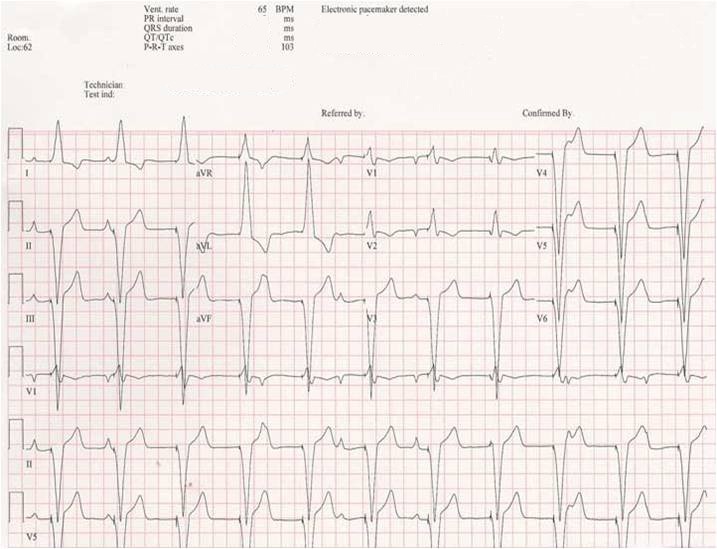
So with some confidence I entered her room. There sitting beside her was one of her sons and a granddaughter. She was propped up in bed wearing a green oxygen face mask that covered her mouth and nose but couldn't suppress her kind smile as I entered. After a brief introduction, I explained what her EKG showed and how I thought a good portion of her shortness of breath might be stemming from her pacemaker's low battery.
In our conversation she mentioned that she had been told her pacemaker battery would need to be changed soon. That was before her husband died. After his funeral, the need for a recheck of her pacemaker was quickly forgotten. So she had not anticipated that the pacemaker might be a cause of her symptoms.
We discussed her options. She could leave things well enough alone if she preferred while we arranged to keep her comfortable for her remaining days, or we could change her pacemaker battery. At the time, she didn't want excessive resuscitation measures and had declared herself a "DNR - Do Not Resuscitate" in the event of cardiac arrest. She thought hard about the choices but wasn't sure...
"Mom, it seems like such a small thing and it might be able to help you feel better! Don't you want to see your grandkids a little longer?" the son pleaded. She listened to him, then looked at me. It was clear she understood the choices and their implications. I suggested she think about it and left the room to give them time to discuss things. Some time later, she asked me to return.
She asked again, "So you think it might help me feel a bit better to have the battery changed?"
I replied, "Honestly, I do, but it's always hard to gauge how much."
So after a few more questions were answered and worried looks shared with her son, she agreed to have her battery replaced. I left the room to document my visit. (After all, nothing happens in medicine any longer unless typing occurs.) Seated next to me was my nurse practitioner, herself transfixed to the computer screen as she returned patient phone calls and made arrangements for procedures to be performed the next day. Next to her was the pacemaker programmer which she wisely brought with her to help check the patient's device. She finished her call and then offered to check the device while I finished my note. I thanked her and continued typing.
It was still relatively early in the afternoon and the eight computer terminals around me were completely occupied by nurses, physical therapists, and residents hammering away and looking stone-faced, somewhat akin to what the New York Times newsroom must look and sound like just before deadline.
Until that sound was shattered by "Call a Code! Code Blue! Get Dr. Fisher!"
Somewhat startled, I looked up to see a sudden shift of the masses. Was that the voice of my nurse practitioner? It couldn't be, could it?
It was.
Poor thing. It seems she placed the wand of the pacemaker programmer over the patient's device, only to see a strange screen on the programmer appear that read something like: "Pacemaker reached ERI 8/13/2013…" followed by a bunch of other text that said something about "Power-on Reset mode" among other things. As she struggled to read the long message and donned a pair of glasses, she noted some twitching in the corner of her eye coming from the patient's direction. She looked up to see a peaceful blank stare on the patient who now laid motionless and unresponsive - a quick glance at the monitor showed it had flat-lined with only a rare agonal ventricular escape rhythm. Realizing what had happened, she was briefly at a loss how to react. This was not supposed to happen. Fleeting thoughts raced through her head like "Seriously?" and "Oh, God, I'm too old for this!" That's when she called out for help.
The poor son and granddaughter sitting in the corner were stunned, not knowing what had just happened. A horde of medical personnel swept in to the room and ushered them out, terrified. I entered the fray and saw my pleasant patient lying there motionless, small puffs of condensation appearing on her face mask and her pupils somewhat dilated. The monitor, too, was devoid of motion, except for an occasional blip seen one the screen. I reached for a pulse. It correlated to the monitor. Not much at all.
"Can we get some atropine and epi?" A asked the code team nervously assembled, not knowing what to do in this "no code" situation. Fortunately, I removed the programmer head from her chest and watched her breathing carefully. Seconds seemed like hours as my poor nurse practitioner stood beside me with her mind scrambling. "Come on guys, we need those meds… What's taking so long?… " she snipped. "Get the pacing patches!" They still were rifling through the drawers of the crash cart when she offered like a pro: "Guys, the purple box!" And within a second, the purple box appeared. The first medication was administered as time seemed to stand still. An occasional blip, then more people in the room. "What can we do?" the anesthesiologist asked.
I looked at the monitor dreading the thought of starting CPR given her wishes, or the what I might say to the stunned family at her bedside if we didn't.
But then, just as unexpectedly as it had begun, a paced rhythm resumed on the monitor! "Hold it!" I said, "I think we have a pulse!" And like a wilted daisy that just received its water, she immediately regained consciousness and wondered what all the fuss was about.
"What happened? Where did all these people come from? Why are they here?"
"It seems your pacemaker battery is a lot lower than anyone expected, Ms. Jones (not her real name). When we checked it, we must have used some of the last energy that pacemaker had. It looks like we need to take you our laboratory and replace that battery right away!"
She smiled and looked up at me with her precious eyes gleaming. Here we were, total strangers just minutes before, now bound together by some unimagineable force. She looked so comfortable lying there, then out of nowhere she reached up to me and grabbed my head, pulling it toward her oxygen mask in an attempt to give me a kiss right through it.
"Thank you," she whispered and smiled, "Thank you."
After reassuring her family and explaining what had happened, we hurried off to the EP lab, our eyes transfixed on her monitor and me still reeling from that beautiful and totally unexpected kiss...
... plastic face mask and all.
-Wes
Sunday, March 15, 2015
Live Video Feeds at Medical Conferences

Am I Big Brother?
The explosion of social media in our society, and at medical meetings in particular, is changing how our society, and medical professionals in particular, work and interact. There is potential for tremendous good: social media to market, to promote, to communicate rapidly, to effect change.
But the social media story is not always one of roses.
My talk at the 2015 American College of Cardiology Scientific Sessions referenced a factoid that I am not smart enough to completely verify, but I suspect isn't too far off the mark: that in January of 2014 there were 7,095,476,818 people in the world and 6,572,950,124 (93%) of them had mobile phones.

Think about that.
Everyone has a camera with them. Everyone at meetings (especially scientific sessions far away from the office) is shooting pictures of abstracts, friends, selfies, drug company displays … whatever - despite a policy to the contrary.
And now, there's even live streaming video on Twitter. I experimented with one of these yesterday called Meerkat. (Twitter recently announced a partnership with competing live video feed service called Periscope, so this feature is here to stay). For $1.99 I downloaded the Meerkat app to my cell phone, linked my Twitter account, and my ability to transform any experience into a live video feed transmitted instantly to the world was complete. There are some "rules" associated with Meerkat. Yet even with these rules, I found it disquieting that I held Big Brother's camera in my hand, if only for a few minutes. Those videos might not be on the "cloud" by policy, but how do I know where else they're stored, or used.

There is a remarkable power, subversiveness, and wonder in the simplicity of this new technology to send live video feeds from a mobile phone. It is both novel and "cool." But I still deleted the video that I sent from the ACC meeting yesterday from my iPhone this morning after I thought about things. Perhaps I'm being overly cautious because videos can still be taken at meetings and uploaded to YouTube for the world to share. But somehow this live feed was different - so instantaneous, so uncontrollable.
And as a doctor, I don't want to become an agent for Big Brother.
-Wes
Tuesday, December 16, 2014
The ABIM Foundation, Choosing Wisely®, and the $2.3 Million Condominium
Is it "medically professional" for a non-profit organization to use
physician testing fees to "choose wisely" a $2.3 million luxury
condominium complete with a chauffeur-driven BMW 7-series town car? In my view, obviously not. To most people such an action would conjure up images of hypocrisy, waste, and
corruption.
Yet, after a review of public and tax records, it appears to me this is exactly what has happened.
Background
In 1999 for reasons that are unclear, the American Board of Internal Medicine (ABIM), itself a tax-exempt 501 (c) (3) independent non-profit physician evaluation organization domiciled in Iowa, created (Editor's note 10/20/2015: referenced web page has since been edited by the ABIM Foundation; the original referenced web page can be viewed here) a second non-profit tax-exempt 501 (c) (3) organization, the ABIM Foundation (Foundation), to first define and later promote the term "medical professionalism." Both the ABIM and the Foundation share a common address in Pennsylvania and common officers:
Ten years later after accumulating some $76 million in assets, the Foundation began their hard-to-disagree-with "Choosing Wisely®" campaign to encourage physicians and providers to question the value of medical testing in an effort to eliminate unnecessary tests and procedures. The campaign has grown to include 70 societies and some non-physician organizations, including Consumer Reports, AARP, SEIU, and Univision among others. As part of the campaign, monetary grants from the Robert Wood Johnson Foundation are awarded to institutions willing to "educate practicing physicians about the recommendations from specialty societies, and building physician communication skills to facilitate conversations with their patients about the care they need."
The Money Trail
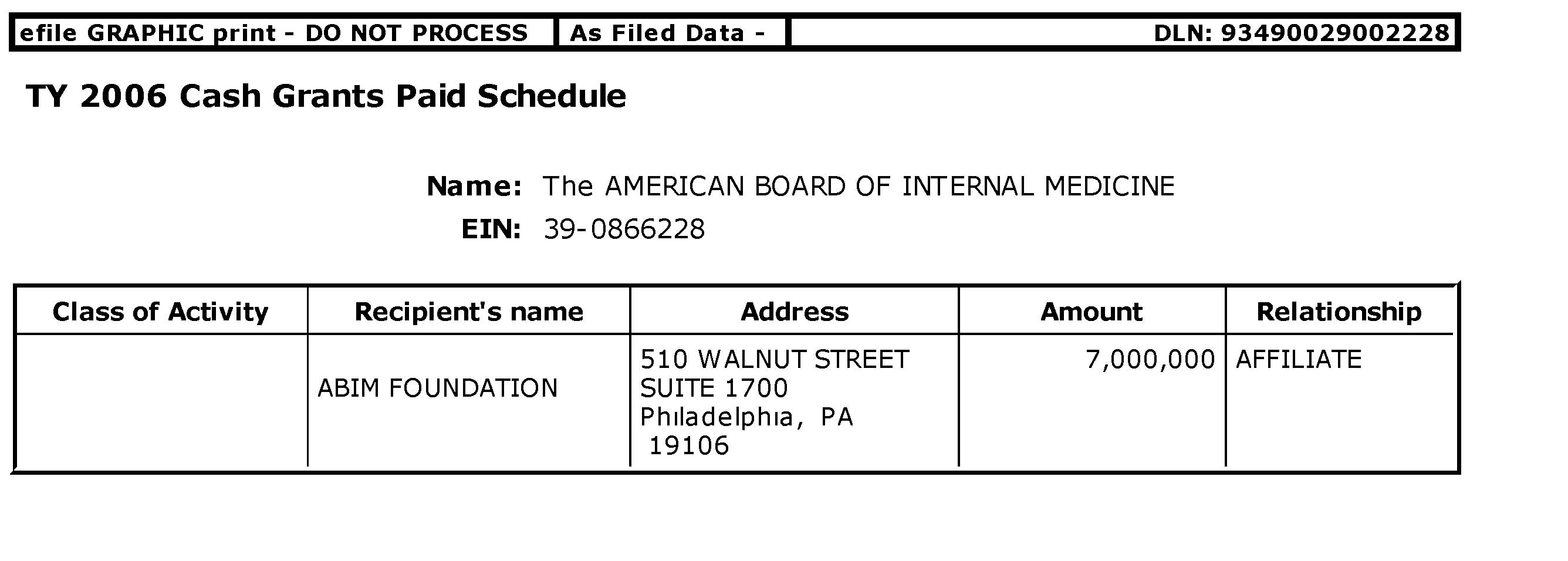
So how did the ABIM Foundation accumulate all that money? Reviewing public tax records of the ABIM and its Foundation reveals a significant portion of the Foundation's revenues came directly from the ABIM. Recall that ABIM receives 97% of its annual revenues from physician certification (62%) and re-certification fees (35%), with only 14% of these fees going toward physician examination development. In 2007 and 2008 alone, cash grants from the ABIM to its Foundation of $7 million and $6 million respectively were issued. The public records disclosed that $17,360,000 from the ABIM were made to its Foundation in the 7 years ending 6/30/2008. As a three-time participant in the ABIM certification process (candidate #127308), I can attest that to the best of my knowledge physicians were never made aware of this use of the testing fees they paid the ABIM.
The Luxury Condominium
So why did the ABIM Foundation need all this cash from physicians? We can't be certain, but the Foundation disclosed in their 2008 Form 990 that a portion of the
money they received from the ABIM via physicians fees was used to purchase a 2,579 square foot 3-bedroom luxury
condominium (Unit #11NW, in the "Ayer" Building, 210 W. Washington Square, Philadelphia) in December 2007 for $2.3 million. The luxury property borders Washington Square Park of the most historic areas of Philadelphia, across the street from the Tomb of the Unknown Revolutionary War Soldier and the Eternal Flame. The condominium building previously advertised a chauffeur driven Mercedes Benz S-series town car (more pictures here).
Since then, the Foundation has reported "condominium expenses" totaling $850,340 from December 2007 through June 30, 2013 (FY 2008: $42,522, FY 2009: $164,460, FY 2010: 161,957, FY 2011: $165,982, FY 2012: $161,980, FY 2013: $153,439 (most of these reported as "program service expenses")). In my view, these expenses were accrued while the ABIM appears to have been on an inherently unsustainable financial course from 2001 to 2012 with its net asset or fund balances on 6/30/2002 beginning with a negative balance of $10,762,954 and growing to a negative balance of $43,150,390 ending 6/30/2013. Meanwhile, over the same period its shadow organization, the ABIM Foundation, fund balance was $73,841,719 on 6/30/2013.
It should be noted that in the year of the condominium purchase the President and CEO of the ABIM, Christine Cassel, MD, earned $484,883 from the ABIM and $161,627 from the Foundation. Dr. Cassel continues to serve as President and CEO of the National Quality Forum despite a history of other seemingly conflicted financial dealings. Other executives of ABIM that year included F. Daniel Duffy, MD who served as Executive Vice President of the ABIM earning $379,915 from the ABIM, and Cary Sennett, MD, PhD who served as Senior Vice President earning $185,122 from the ABIM and $185,122 from the Foundation and now serves as a Vice President of Anthem, Inc., formerly Wellpoint. That year Dr. Richard Baron, the current President and CEO of the ABIM and Foundation, served as the secretary/treasurer of the ABIM Board earning $59,729 until 7/1/2008 when he became an unpaid Director of the Board. By comparison, according to one reliable source, the median general internal medicine physician salary in the U.S. was $205,441 in 2009.
More Questions
Reviewing the public record on when and where the ABIM Foundation was actually created discloses another discrepancy. We observe that the Foundation has recorded on their tax returns as being founded in 1999 with its "legal domicile" in Iowa, like the ABIM. However, a search for the organization in Iowa comes up empty, while a search in Pennsylvania Department of State (screen shot here) shows the Foundation was actually created in Pennsylvania in 1989. Which is correct?
We should note that non-profits are not required to file financial statements with the state of Iowa, while Pennsylvania requires them. This raises uncomfortable questions. Is the Foundation's Iowa domicile sheltering the sources and uses of its funds? Why does a non-profit promoting "medical professionalism" need to accumulate this much revenue? Is this how the Foundation demonstrates their "medical professionalism" to the public? To whom is the ABIM and Foundation "accountable?" Anyone?
My Call to the ABIM
On 4 December 2014 I contacted the ABIM and requested an explanation regarding the condominium, the ongoing condominium expenses, and the discrepancy of the ABIM Foundation domicile and founding date. Richard Baron, MD, the current President and CEO of the ABIM returned my call and explained the following:
Larger Implications
Sadly, the medical profession has become a house divided. On one side are many non-clinical physicians who have become far removed from patient care and are firmly embedded in the non-profit, academic, and public policy circles making handsome salaries while seeing little problem with coercing their colleagues to pay fees to support their various economic, policy, or personal agendas. In the words of my colleague Jordan Grumet, MD: "they talk about 'accountability' as if they are the ones in the ICU having the family meetings. They pray at the altar of 'quality' yet fail to define the specifics of such a term. They resent 'over treatment' but never have suffered the consequences of not doing enough."
On the other side are the physicians buried in the work-a-day world of patient care, busy doing the best they can for their patients in our increasingly complicated health care system, working as "excellent sheep" as they do their difficult job and try not to rock the boat. While such a dichotomy is not unique to medicine (look to education, the public service sector, and politics, for instance), is ignoring this new reality useful to our profession? Might the unintended consequences of these unaccountable non-profit organizations and revolving-door employment practices with government and business interests be causing unimaginable harm to the integrity and credibility of our profession while simultaneously wasting valuable resources?
It is a shame that most physicians, particularly younger doctors saddled with exorbitant training debt and concerns of job acquisition and job security, are not in a position to protest the actions of the ABIM and its sycophants, particularly since their ability to practice medicine is increasingly tied to these ABIM board certification and their new perpetual maintenance of certification payments. But this is the point, isn't it? Regulatory capture. As these younger doctors gain experience and awaken to the realities of their new health care arena that is increasingly dominated by unaccountable organizations led by non-clinical members of our own profession, we risk creating cynicism in our ranks and physicians who must be more concerned with passing a test than providing direct patient care. Even worse, we risk promoting ourselves, career or cause over the complicated needs of our patients as the divide grows ever deeper. As a result, the brittle credibility and hard-earned trust with our patients is squandered beyond repair. In my opinion, this is what we risk when we have corruption within.
Is this what our profession and the public wants?
I can only hope that practicing US physicians and the public will demand a full accounting of the ABIM and their Foundation's entire financial dealings and non-transparent co-mingling of funds. I hope that Congress decides to investigate the ABIM's role in including their MOC program as a physician quality reporting measure in the Affordable Care Act (see pages 247 and 844-845) to determine its legitimacy in light of these findings. Furthermore, an investigation into possible violations of federal policy on the protection of human subjects (in this case practicing physicians involved in direct patient care) regarding the American Board of Medical Specialties' requirement for practice and patient survey collection for Part IV of their trademarked Maintenance of Certification® program that the ABIM helps conduct should occur, especially in light of lack of informed consent afforded to physicians regarding how the fees and data they collect are used.
It is time we hold the non-clinical members of our own profession that lead these organizations accountable to all physicians and the public at large. Until this occurs, physician-members of every ABIM subspecialty organization that profits from educational content provided to the ABIM should divest themselves and work to create their own, more credible, simplified and transparent life-long learning pathways. The American Association of Clinical Endocrinologists has already set a good example. While I understand that refusing to buck the coercion created by the multimillion dollar ABIM and its Foundation will be difficult, our credibility as stewards of our patients' best interests and the preservation of the integrity of our profession demands nothing less.
-Wes
Acknowledgement
I am indebted to Charles P. Kroll, CPA for his invaluable assistance collecting tax records of the ABIM and ABIM Foundation before 2007 and assisting in the understanding of the nuances of not-for-profit accounting methods. Mr. Kroll provided forensic accounting analysis to the Minnesota attorney general's office during the Medica-Allina scandal and testified at the Minnesota Senate hearing on the matter.
Yet, after a review of public and tax records, it appears to me this is exactly what has happened.
Background
In 1999 for reasons that are unclear, the American Board of Internal Medicine (ABIM), itself a tax-exempt 501 (c) (3) independent non-profit physician evaluation organization domiciled in Iowa, created (Editor's note 10/20/2015: referenced web page has since been edited by the ABIM Foundation; the original referenced web page can be viewed here) a second non-profit tax-exempt 501 (c) (3) organization, the ABIM Foundation (Foundation), to first define and later promote the term "medical professionalism." Both the ABIM and the Foundation share a common address in Pennsylvania and common officers:
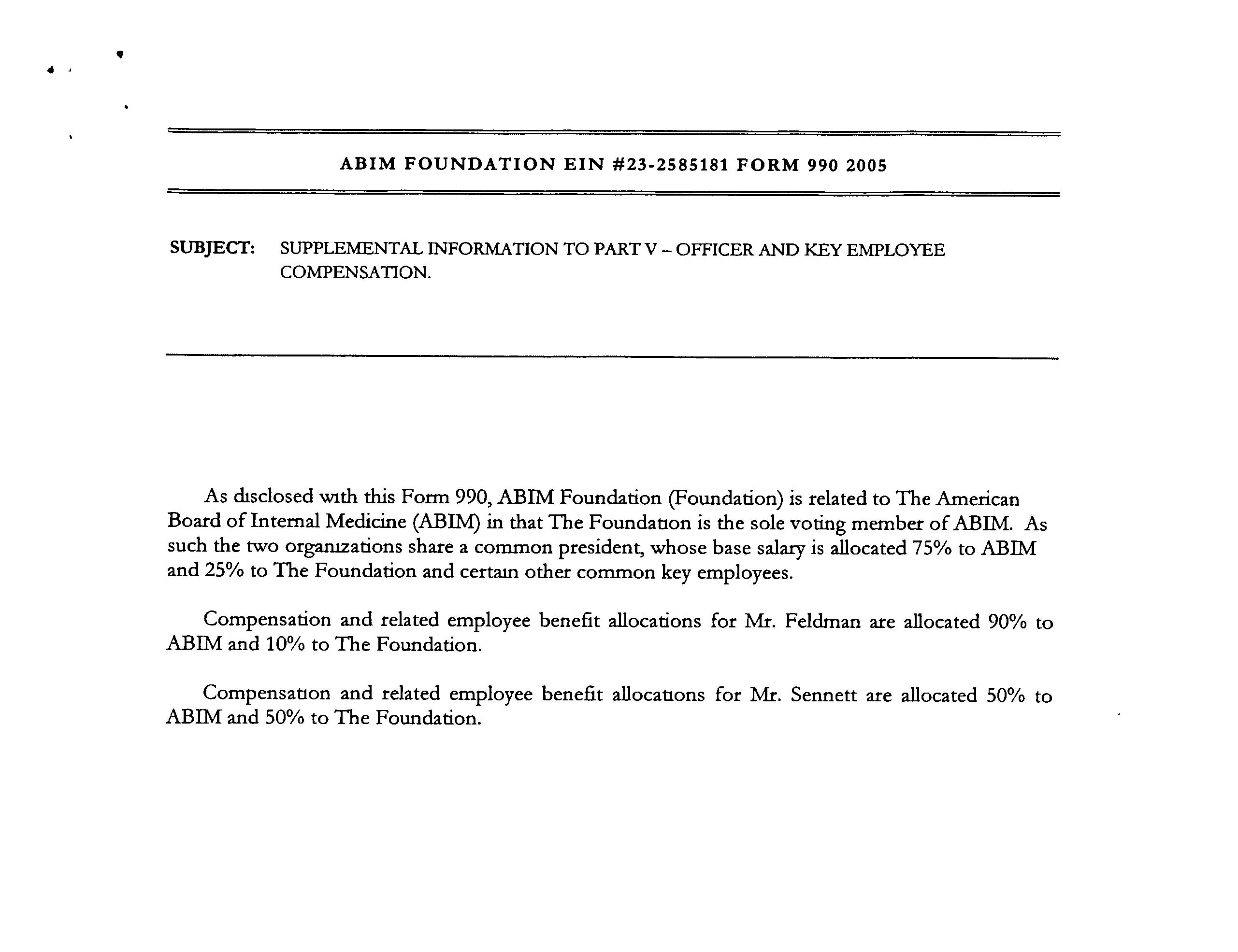
"The American Board of Internal Medicine (ABIM) is related to the ABIM Foundation (Foundation) in that The Foundation is the sole voting member of the ABIM. As such, the two organizations share a common president, a common CFO, and a common senior vice president whose base salaries are allocated between ABIM and The Foundation based on the time spent by each executive."To define "medical professionalism," the new Foundation enlisted other members of the non-profit world including the ABIM, the paid "directors" of the Foundation, the Robert Wood Johnson Foundation, the American College of Physicians-American Society of Internal Medicine and the European Federation of Internal Medicine. The group was chaired by Troy Brennan, MD, JD a paid "Director" of the Foundation who was also President and CEO of Brigham and Women's Physician Organization at the time. (He later became the Chief Medical Officer of Aetna in 2006, and now serves as the Executive Vice President and Chief Medical Officer of CVS Caremark). In 2002 this group published a white paper entitled "Medical Professionalism in the New Millenium: A Physician Charter" without peer review in the Annals of Internal Medicine (here) and The Lancet (here). At least the Annals editor, Harold C. Sox, MD mustered the courage to express concerns about the manuscript in his introductory remarks to his readers:
"The introduction contains the following premise: Changes in the health care delivery systems in countries throughout the industrialized world threaten the values of professionalism. The document conveys this message with chilling brevity. The authors apparently feel no need to defend this premise, perhaps because they believe that it is a universally held truth. The authors go further, stating that the conditions of medical practice are tempting physicians to abandon their commitment to the primacy of patient welfare. These are very strong words. Whether they are strictly true for the profession as a whole is almost beside the point. Each physician must decide if the circumstances of practice are threatening his or her adherence to the values that the medical profession has held dear for many millennia."The paper centered on three fundamental principles that the authors claimed defined "medical professionalism:" (1) the primacy of patient welfare, (2) patient autonomy, and a new concept, (3) the principle of social justice - that is, "the medical profession must promote justice in the health care system, including the fair distribution of health care resources." With this definition, physicians could no longer just be unwavering patient advocates concerned with the "primacy of their patient's welfare," they had also had to serve the financial needs of The System of medicine lest they be labeled "medically unprofessional."
Ten years later after accumulating some $76 million in assets, the Foundation began their hard-to-disagree-with "Choosing Wisely®" campaign to encourage physicians and providers to question the value of medical testing in an effort to eliminate unnecessary tests and procedures. The campaign has grown to include 70 societies and some non-physician organizations, including Consumer Reports, AARP, SEIU, and Univision among others. As part of the campaign, monetary grants from the Robert Wood Johnson Foundation are awarded to institutions willing to "educate practicing physicians about the recommendations from specialty societies, and building physician communication skills to facilitate conversations with their patients about the care they need."

The Money Trail
So how did the ABIM Foundation accumulate all that money? Reviewing public tax records of the ABIM and its Foundation reveals a significant portion of the Foundation's revenues came directly from the ABIM. Recall that ABIM receives 97% of its annual revenues from physician certification (62%) and re-certification fees (35%), with only 14% of these fees going toward physician examination development. In 2007 and 2008 alone, cash grants from the ABIM to its Foundation of $7 million and $6 million respectively were issued. The public records disclosed that $17,360,000 from the ABIM were made to its Foundation in the 7 years ending 6/30/2008. As a three-time participant in the ABIM certification process (candidate #127308), I can attest that to the best of my knowledge physicians were never made aware of this use of the testing fees they paid the ABIM.

The Luxury Condominium
 |
| Street View, "The Ayer Buidling," 210 W. Washington Square |
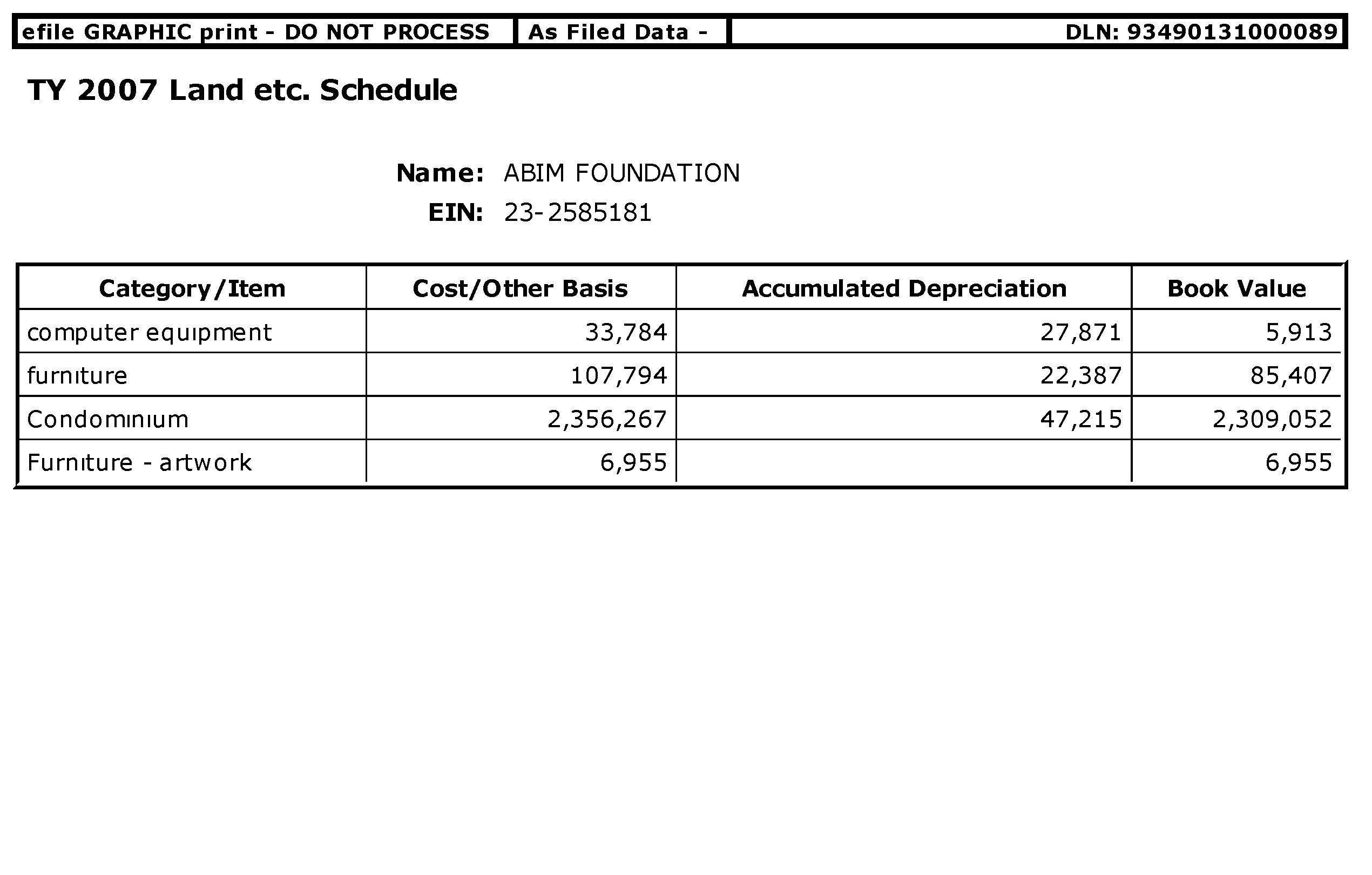
Since then, the Foundation has reported "condominium expenses" totaling $850,340 from December 2007 through June 30, 2013 (FY 2008: $42,522, FY 2009: $164,460, FY 2010: 161,957, FY 2011: $165,982, FY 2012: $161,980, FY 2013: $153,439 (most of these reported as "program service expenses")). In my view, these expenses were accrued while the ABIM appears to have been on an inherently unsustainable financial course from 2001 to 2012 with its net asset or fund balances on 6/30/2002 beginning with a negative balance of $10,762,954 and growing to a negative balance of $43,150,390 ending 6/30/2013. Meanwhile, over the same period its shadow organization, the ABIM Foundation, fund balance was $73,841,719 on 6/30/2013.



It should be noted that in the year of the condominium purchase the President and CEO of the ABIM, Christine Cassel, MD, earned $484,883 from the ABIM and $161,627 from the Foundation. Dr. Cassel continues to serve as President and CEO of the National Quality Forum despite a history of other seemingly conflicted financial dealings. Other executives of ABIM that year included F. Daniel Duffy, MD who served as Executive Vice President of the ABIM earning $379,915 from the ABIM, and Cary Sennett, MD, PhD who served as Senior Vice President earning $185,122 from the ABIM and $185,122 from the Foundation and now serves as a Vice President of Anthem, Inc., formerly Wellpoint. That year Dr. Richard Baron, the current President and CEO of the ABIM and Foundation, served as the secretary/treasurer of the ABIM Board earning $59,729 until 7/1/2008 when he became an unpaid Director of the Board. By comparison, according to one reliable source, the median general internal medicine physician salary in the U.S. was $205,441 in 2009.
More Questions
Reviewing the public record on when and where the ABIM Foundation was actually created discloses another discrepancy. We observe that the Foundation has recorded on their tax returns as being founded in 1999 with its "legal domicile" in Iowa, like the ABIM. However, a search for the organization in Iowa comes up empty, while a search in Pennsylvania Department of State (screen shot here) shows the Foundation was actually created in Pennsylvania in 1989. Which is correct?
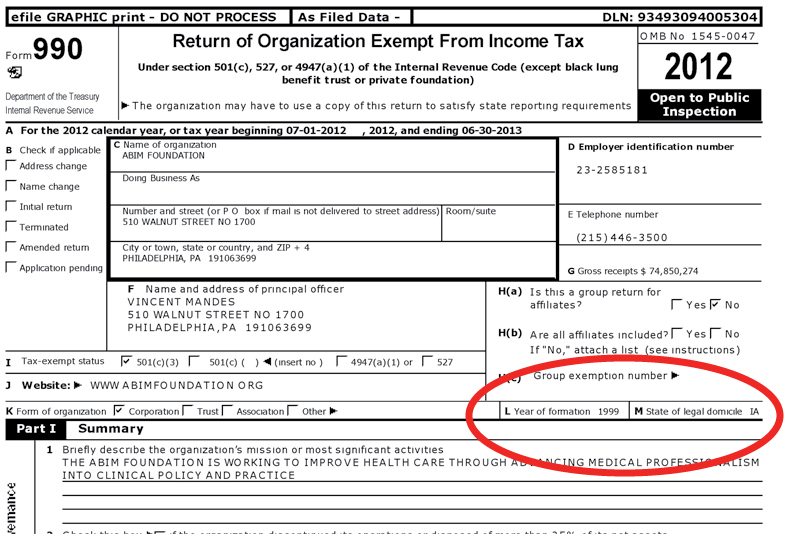

We should note that non-profits are not required to file financial statements with the state of Iowa, while Pennsylvania requires them. This raises uncomfortable questions. Is the Foundation's Iowa domicile sheltering the sources and uses of its funds? Why does a non-profit promoting "medical professionalism" need to accumulate this much revenue? Is this how the Foundation demonstrates their "medical professionalism" to the public? To whom is the ABIM and Foundation "accountable?" Anyone?
My Call to the ABIM
On 4 December 2014 I contacted the ABIM and requested an explanation regarding the condominium, the ongoing condominium expenses, and the discrepancy of the ABIM Foundation domicile and founding date. Richard Baron, MD, the current President and CEO of the ABIM returned my call and explained the following:
- Dr. Baron stated that the condominium was purchased as a "investment property" and part of the investment portfolio of the Foundation. He mentioned that real estate holdings were not uncommon with other similar non-profits. The condominium was used for several purposes, including housing ABIM personnel who resided out of state and returned to Philadelphia for meetings, by contractors (for instance, to house an IT team from India), and for off-site retreats and meetings with the Communications Group of the ABIM, for instance. He noted that when ABIM members use the Foundation's condominium, the Foundation is paid $150/night from the ABIM (compared to the "usual" Philadelphia hotel rate of about $190/night) and there was cash flow to the Foundation from the ABIM for the use of their facility.
- After revelations of the luxury condominium were disclosed at a 2 Dec 2014 Pennsylvania Medical Society town hall meeting, Dr. Baron mentioned in passing that the ABIM was putting the condominium up for sale. I asked Dr. Baron the name of the listing agent and the price. He stated he could not comment because "the paperwork was not in order" and the those details had not been finalized because they were advised that the real estate market would be better in the Spring.
- When asked about the high ongoing condominium expenses and the discrepancy about the ABIM Foundation's creation date and domicile, Dr. Baron could not immediately respond but sent this follow-up e-mail 4 Dec 2014 at 2:39PM (CST):
"Hi Dr. Fischer (sic)-
Attached please find the breakdown of the condo expenses. As I explained the depreciation $$ are a required reporting artifact for the condo as a business investment. The other costs are covered by the condo usage fees.
Regarding the 1989/1999 question - In 1999 ABIM Foundation became a separate operating foundation.
Thanks,
Rich
Richard J. Baron, MD
MACP
President and Chief Executive Officer
American Board of Internal Medicine" - In closing, Dr. Baron expressed his willingness to be open to further questions.
- Today I learned that the condominium is now listed with the following description:
"Extremely Spacious Three Bedroom, 3.5 Bath Home at the Ayer Condominium. Tremendous Entertaining Space. 11’7’’ ceiling heights. Bulthaup b-3 kitchen system, Miele and Subzero Appliances. Huge windows with northwest views. High floor offering stupendous sunsets. Gorgeous stone bathrooms. Abundant closet space. One garage parking space included. Concierge, doormen, valets, gym, chauffeur driven BMW 7-Series." (More details here.)
Larger Implications
Sadly, the medical profession has become a house divided. On one side are many non-clinical physicians who have become far removed from patient care and are firmly embedded in the non-profit, academic, and public policy circles making handsome salaries while seeing little problem with coercing their colleagues to pay fees to support their various economic, policy, or personal agendas. In the words of my colleague Jordan Grumet, MD: "they talk about 'accountability' as if they are the ones in the ICU having the family meetings. They pray at the altar of 'quality' yet fail to define the specifics of such a term. They resent 'over treatment' but never have suffered the consequences of not doing enough."
On the other side are the physicians buried in the work-a-day world of patient care, busy doing the best they can for their patients in our increasingly complicated health care system, working as "excellent sheep" as they do their difficult job and try not to rock the boat. While such a dichotomy is not unique to medicine (look to education, the public service sector, and politics, for instance), is ignoring this new reality useful to our profession? Might the unintended consequences of these unaccountable non-profit organizations and revolving-door employment practices with government and business interests be causing unimaginable harm to the integrity and credibility of our profession while simultaneously wasting valuable resources?
It is a shame that most physicians, particularly younger doctors saddled with exorbitant training debt and concerns of job acquisition and job security, are not in a position to protest the actions of the ABIM and its sycophants, particularly since their ability to practice medicine is increasingly tied to these ABIM board certification and their new perpetual maintenance of certification payments. But this is the point, isn't it? Regulatory capture. As these younger doctors gain experience and awaken to the realities of their new health care arena that is increasingly dominated by unaccountable organizations led by non-clinical members of our own profession, we risk creating cynicism in our ranks and physicians who must be more concerned with passing a test than providing direct patient care. Even worse, we risk promoting ourselves, career or cause over the complicated needs of our patients as the divide grows ever deeper. As a result, the brittle credibility and hard-earned trust with our patients is squandered beyond repair. In my opinion, this is what we risk when we have corruption within.
Is this what our profession and the public wants?
I can only hope that practicing US physicians and the public will demand a full accounting of the ABIM and their Foundation's entire financial dealings and non-transparent co-mingling of funds. I hope that Congress decides to investigate the ABIM's role in including their MOC program as a physician quality reporting measure in the Affordable Care Act (see pages 247 and 844-845) to determine its legitimacy in light of these findings. Furthermore, an investigation into possible violations of federal policy on the protection of human subjects (in this case practicing physicians involved in direct patient care) regarding the American Board of Medical Specialties' requirement for practice and patient survey collection for Part IV of their trademarked Maintenance of Certification® program that the ABIM helps conduct should occur, especially in light of lack of informed consent afforded to physicians regarding how the fees and data they collect are used.
It is time we hold the non-clinical members of our own profession that lead these organizations accountable to all physicians and the public at large. Until this occurs, physician-members of every ABIM subspecialty organization that profits from educational content provided to the ABIM should divest themselves and work to create their own, more credible, simplified and transparent life-long learning pathways. The American Association of Clinical Endocrinologists has already set a good example. While I understand that refusing to buck the coercion created by the multimillion dollar ABIM and its Foundation will be difficult, our credibility as stewards of our patients' best interests and the preservation of the integrity of our profession demands nothing less.
-Wes
Acknowledgement
I am indebted to Charles P. Kroll, CPA for his invaluable assistance collecting tax records of the ABIM and ABIM Foundation before 2007 and assisting in the understanding of the nuances of not-for-profit accounting methods. Mr. Kroll provided forensic accounting analysis to the Minnesota attorney general's office during the Medica-Allina scandal and testified at the Minnesota Senate hearing on the matter.
Saturday, July 26, 2014
MOC Points: The New Physician Currency
"Oh my God, I can't believe how complicated the American Board of Medical Specialties and the American Board of Internal Medicine has made this whole Maintenance of Certification (MOC) process!"
"Yeah, pretty amazing, isn't it? 10 points here, 10 points there, 20 points for a (required) Practice Improvement Module, then another 10 points if you complete another module online. And after all that, you're only half way there!"
"Where am I going to find the time? They need to make this process easier!"
"Face it. That isn't going to happen. Look at the ineffectual ideas the member board members are telling the ABIM leadership in their precious '3-5 minutes' of feedback: making sure physicians can get 'credit' for patient surveys and quality assurance projects they already do, making the ABIM website 'easier-to-navigate,' making patient surveys 'more flexible,' lowering costs, and 'providing more transparency from ABIM on how requirements are created.' I'm not seeing any cuts to any of this, I'm just seeing different versions of the same old same-old."
"Dude, you just completed your MOC process, how did you do it?"
"I'll tell you a secret, but you have to promise TOTAL secrecy."
"I promise! I'll do ANYTHING to get this MOC monkey off my back!"
"Okay, here's what you do. Remember that research project you wanted to do on kids but never could get off the ground because the IRB stonewalled you, claiming lack of consent in minors and all that red tape regarding research in minors?"
"Yeah."
"Well, just call your work a 'quality assurance project' you have to do for your MOC points! No one would dare question your intent, after all, it's to improve quality care and patient safety!"
"I can't do that."
"Sure you can! No one dares question the lofty ideals of the ABMS/ABIM's MOC program. After all, they interconnected with the ACGME, the Joint Commission, American Medical Association, the American Hospital Association, the whole works! You just do your thing and no one will think anything of it except 'you're the MAN!' I mean these MOC points are our new hall pass to do anything you like on people in the name of quality of care! It just has to sound reasonable. And man, you need those points, don't you? You'd be killing two birds with one stone and potentially get a publication out of it to boot! Better yet, you can claim "no conflicts of interest" because you never receive a dime for your efforts. Your IRB will never look, trust me. Paraphrasing a former famous politician: 'I've got this MOC thing, and it's f*%^in' golden!"
"I see. And if we do it your way, we can even get paid more, thanks to that CMS incentive they've created!"
"Now you're catchin' on. It's our new currency. I'm telling you, it's f*%^in' golden!"
-Wes
h/t: IP4PI blog
"Yeah, pretty amazing, isn't it? 10 points here, 10 points there, 20 points for a (required) Practice Improvement Module, then another 10 points if you complete another module online. And after all that, you're only half way there!"
"Where am I going to find the time? They need to make this process easier!"
"Face it. That isn't going to happen. Look at the ineffectual ideas the member board members are telling the ABIM leadership in their precious '3-5 minutes' of feedback: making sure physicians can get 'credit' for patient surveys and quality assurance projects they already do, making the ABIM website 'easier-to-navigate,' making patient surveys 'more flexible,' lowering costs, and 'providing more transparency from ABIM on how requirements are created.' I'm not seeing any cuts to any of this, I'm just seeing different versions of the same old same-old."
"Dude, you just completed your MOC process, how did you do it?"
"I'll tell you a secret, but you have to promise TOTAL secrecy."
"I promise! I'll do ANYTHING to get this MOC monkey off my back!"
"Okay, here's what you do. Remember that research project you wanted to do on kids but never could get off the ground because the IRB stonewalled you, claiming lack of consent in minors and all that red tape regarding research in minors?"
"Yeah."
"Well, just call your work a 'quality assurance project' you have to do for your MOC points! No one would dare question your intent, after all, it's to improve quality care and patient safety!"
"I can't do that."
"Sure you can! No one dares question the lofty ideals of the ABMS/ABIM's MOC program. After all, they interconnected with the ACGME, the Joint Commission, American Medical Association, the American Hospital Association, the whole works! You just do your thing and no one will think anything of it except 'you're the MAN!' I mean these MOC points are our new hall pass to do anything you like on people in the name of quality of care! It just has to sound reasonable. And man, you need those points, don't you? You'd be killing two birds with one stone and potentially get a publication out of it to boot! Better yet, you can claim "no conflicts of interest" because you never receive a dime for your efforts. Your IRB will never look, trust me. Paraphrasing a former famous politician: 'I've got this MOC thing, and it's f*%^in' golden!"
"I see. And if we do it your way, we can even get paid more, thanks to that CMS incentive they've created!"
"Now you're catchin' on. It's our new currency. I'm telling you, it's f*%^in' golden!"
-Wes
h/t: IP4PI blog
Tuesday, May 06, 2014
When We Reward Regulators More Than Doctors
Medicine has always had it regulatory fiefdoms, but in 2002 they were greatly expanded. At that time, a charter on "medical professionalism" was published by the American Board of Internal Medicine, the American College of Physicians, and the European Society of Internal Medicine in the Annals of Internal Medicine that touted three fundamental principles: (1) the principle of primacy of patient welfare, (2) principle of patient autonomy, and (3) principle of social justice. The first set of professional responsibilities for physicians was a "commitment to professional competence." While I would truly like to believe this article was sincere, increasingly I am concerned it was a regulatory ploy - one that is more concerned about financial gain than patient benefit.
Let me explain.
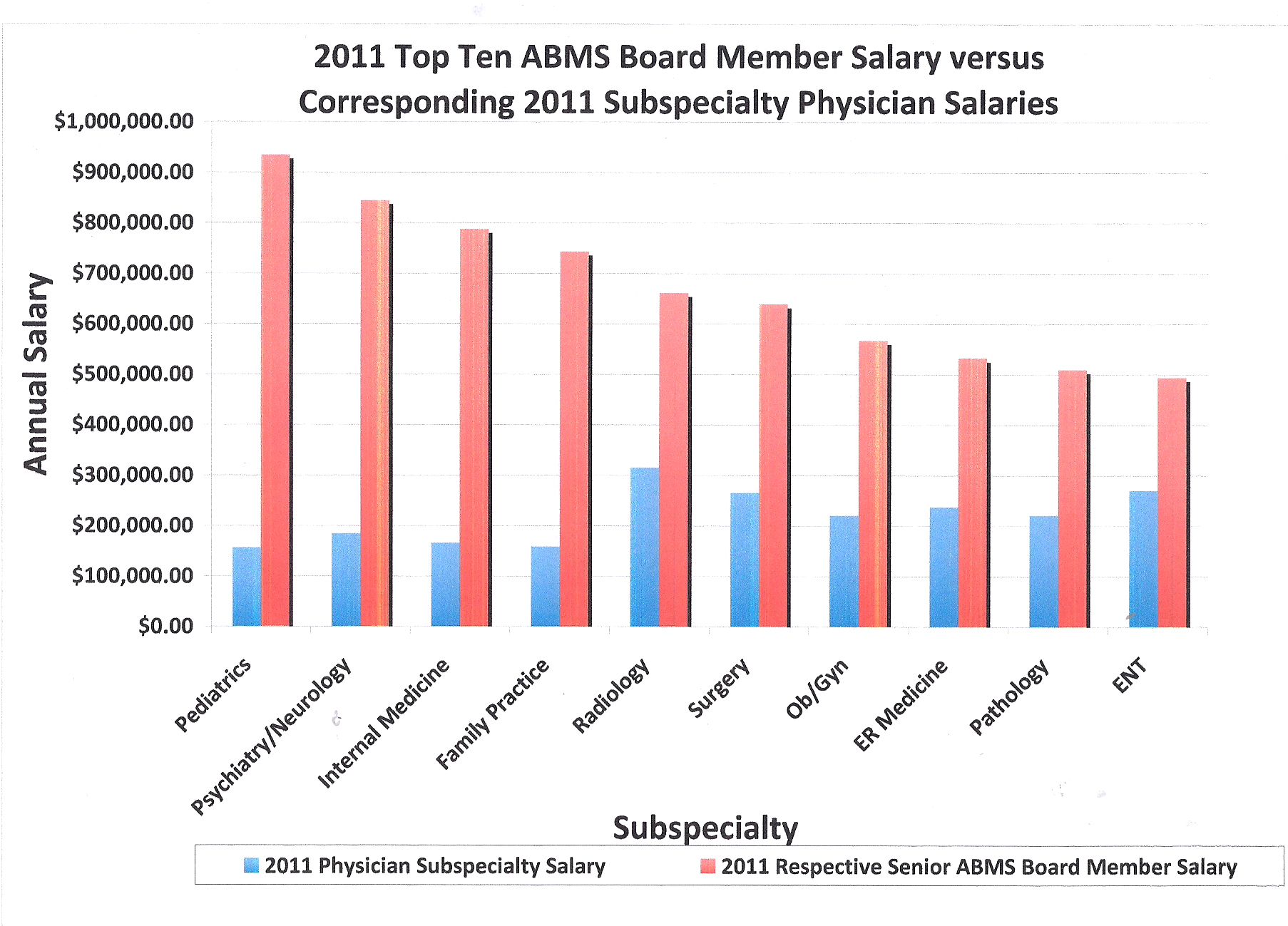
I have spent time reviewing the 2011 IRS Form 990 "Returns of Organization Exempt from Income Tax" (the last ones publically available) for each of the member boards of the American Board of Medical Specialties (ABMS) and the ABMS itself. I used the website Guidestar.org to gather these. I assembled the salaries and benefits of the senior executives from each of these organizations in descending order and was surprised what I found (here is the complete 2-page pdf of the data for your review). No more than the top three executive salaries of these organizations represented over $16 million in total compensation in 2011 alone. But even more troubling was the negative relationship that existed between the top-paid executives of these private ABMS member boards and the 2011 compensation for working subspecialty physicians they are supposed to represent. Recall that pediatrics, family medicine, and internal medicine are consistently some of the lowest paid physician subspecialties.
Here is a chart I made of the top 10 board members' annual income compared to the same subspecialty physician salaries in 2011 as reported by Medscape:
Clearly, the US physician credentialing system as it exists now overwhelmingly rewards people with regulatory oversight rather than those who provide patient care. Was this the intent? More specifically, was the intent of the ABIM's "medical professionalism" manuscript to line the pockets of the ABMS member boards in lieu of social justice? What kind of justice is this?
The answer now is not so clear.
To add insult to injury, realize that front-line physicians are increasingly burdened by very high medical school and residency debt for much of their career. As part of their rite of passage into their subspecialty, they must pay the credentialing fees that pay the salaries of these regulators. Should we insist our doctors pay such high fees to support these expensive salaries? How might patients be affected, especially when they have reduced access to doctors who must undergo repetitive certification and re-certification exercises. How do patient's benefit when the certification process appears so flawed?
To me, it seems that we are not seeing a definition of "medical professionalism" in the credentialing juggernaut that these private organizations have created.
We're seeing the definition of "greed."
-Wes
PS: Physicians are welcome to print out the pdf of 2011 ABMS Board members' salaries to share with colleagues and to sign the petition to stop the new onerous biannual MOC recertification requirements.
Let me explain.
I have spent time reviewing the 2011 IRS Form 990 "Returns of Organization Exempt from Income Tax" (the last ones publically available) for each of the member boards of the American Board of Medical Specialties (ABMS) and the ABMS itself. I used the website Guidestar.org to gather these. I assembled the salaries and benefits of the senior executives from each of these organizations in descending order and was surprised what I found (here is the complete 2-page pdf of the data for your review). No more than the top three executive salaries of these organizations represented over $16 million in total compensation in 2011 alone. But even more troubling was the negative relationship that existed between the top-paid executives of these private ABMS member boards and the 2011 compensation for working subspecialty physicians they are supposed to represent. Recall that pediatrics, family medicine, and internal medicine are consistently some of the lowest paid physician subspecialties.
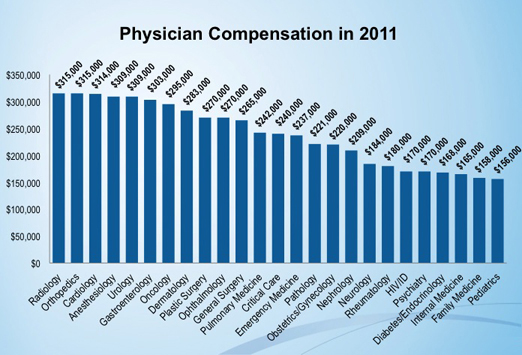
Here is a chart I made of the top 10 board members' annual income compared to the same subspecialty physician salaries in 2011 as reported by Medscape:
 |
| (Click to enlarge) |
Clearly, the US physician credentialing system as it exists now overwhelmingly rewards people with regulatory oversight rather than those who provide patient care. Was this the intent? More specifically, was the intent of the ABIM's "medical professionalism" manuscript to line the pockets of the ABMS member boards in lieu of social justice? What kind of justice is this?
The answer now is not so clear.
To add insult to injury, realize that front-line physicians are increasingly burdened by very high medical school and residency debt for much of their career. As part of their rite of passage into their subspecialty, they must pay the credentialing fees that pay the salaries of these regulators. Should we insist our doctors pay such high fees to support these expensive salaries? How might patients be affected, especially when they have reduced access to doctors who must undergo repetitive certification and re-certification exercises. How do patient's benefit when the certification process appears so flawed?
To me, it seems that we are not seeing a definition of "medical professionalism" in the credentialing juggernaut that these private organizations have created.
We're seeing the definition of "greed."
-Wes
PS: Physicians are welcome to print out the pdf of 2011 ABMS Board members' salaries to share with colleagues and to sign the petition to stop the new onerous biannual MOC recertification requirements.
Sunday, March 30, 2014
Is Maintenance of Certification Our Next Tuskegee?
“An experiment is ethical or not at its inception, it does not become ethical post hoc – ends do not justify means. There is no ethical distinction between ends and means.”
-- Henry K. Beecher, MD
New Engl J Med 274(24) June 16, 1966 pp 1354-1360.
“For the most part, doctors and civil servants simply did their jobs. Some merely followed orders, others worked for the glory of science."
-- John Heller, Director of the Public Health Service's Division of Venereal Diseases
The Tuskegee syphilis experiment was an infamous clinical study conducted between 1932 and 1972 by the U.S. Public Health Service to study the natural progression of untreated syphilis in rural African American men who thought they were receiving free health care from the U.S. government. The Public Health Service started working with the Tuskegee Institute in 1932. Investigators enrolled in the study a total of 600 impoverished sharecroppers from Macon County Alabama. Three-hundred ninety-nine (399) of those men had previously contracted syphilis before the study began, and 201 did not have the disease. The men were given free medical care, meals, and free burial insurance, for participating in the study. They were never told they had syphilis, nor were they ever treated for it. According to the Centers for Disease Control, the men were told they were being treated for "bad blood", a local term for various illnesses that include syphilis, anemia, and fatigue.
The 40-year study was controversial for reasons related ethical standards, primarily because researchers knowingly failed to treat patients appropriately after the 1940s validation of penicillin as an effective cure for the disease they were studying. Revelation of study failures by a whistleblower led to major changes in U.S. law and regulation on the protection of participants in clinical studies. Now studies require informed consent, communication of diagnosis, and accurate reporting of test results.
The Tuskegee Syphilis Study led to the 1979 Belmont Report and the establishment of the Office for Human Research Protections (OHRP). Importantly, it also led to federal laws and regulations requiring Institutional Review Boards for the protection of human subjects in studies involving human subjects.
Fast forward thirty-five years.
Could the new American Board of Internal Medicine (ABIM) mandate for participating in their Maintenance of Certification (MOC) process unilaterally imposed 1 January 2014 so they can maintain a publicly-reported maintenance of certification "status" be violating ethical standards set forth by the 1979 Belmont Report?
Let me explain why I think it does.
The increasingly complicated test- and survey-taking exercise called "Maintenance of Certification" has never been scientifically proven to improve physician quality. Our society's inability to agree on a definition of a "quality" physician (and how to measure those qualities) is part of the reason why this issue has never been studied. For instance, should we define a "quality" physician on the basis of his or her empathy, surgical skill, lack of complications, ability to recall facts or some combination of these or other attributes? The reality is, it is nearly impossible to adequately define a "quality" physician at the outset.
But the issue of maintaining "quality" health care delivery is critical to those paying for health care services (CMS and insurers, aka, "stakeholders"), especially now in this era of health care reform. Payers want to assure they receive the most value for their dollars spent in health care. Patients want to be reassured that they are receiving competent care by a physician, especially in a time where cost-cutting, deployment of unproven electronic medical systems, use of non-physician care-givers, and shortened physician training and work hours has occurred. Seeing an opportunity, the American Board of Medical Specialties (ABMS) and the ABIM stepped in to help the government define physician quality. Through the assurances of their leadership, the ABIM led "stakeholders" to believe that (1) quality is easy to measure (after all, they have a thorough testing "process") and (2) the responsibility for determining physician quality should rest with individual physicians. This leap of faith by government officials is similar to the Tuskegee era when government physicians were similarly obsessed with African American sexuality, believing that the responsibility for the acquisition of syphilis rested solely upon the individual.
Because the Maintenance of Certification process imposed by the American Board of Internal Medicine is unproven, it is, at best, an experiment that attempts to assure physician quality on patients without a defined hypothesis (what, really, does the ABIM test with the MOC process?) or informed consent. The issue of informed consent is critical, in my view, because the psychological, financial, and social consequences of NOT passing the test to doctors and their patients have never been evaluated.
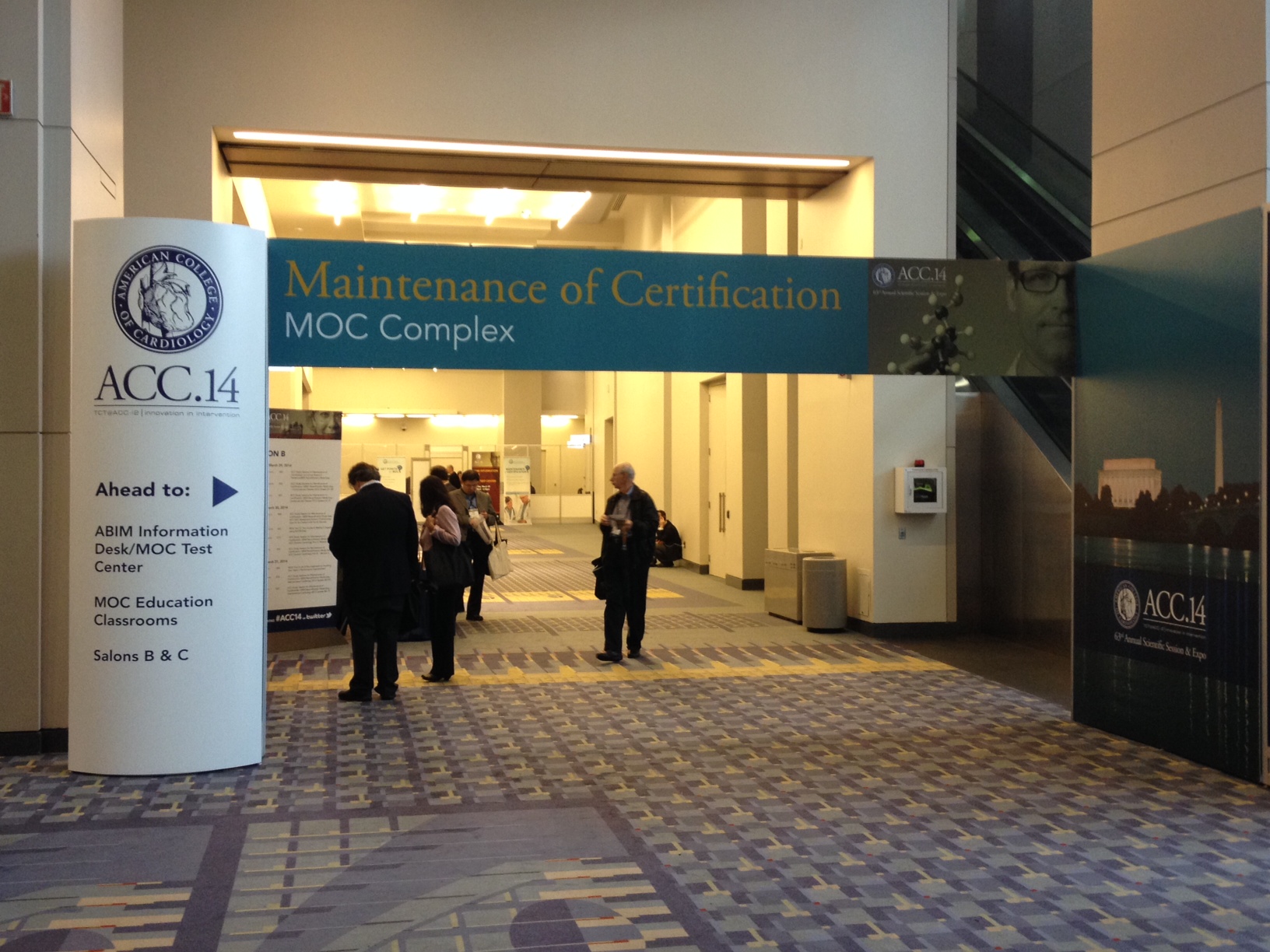 |
| The "MOC Complex" at ACC2014 (click to enlarge) |
First, I learned that the pass rate this year (2013) for internal medicine specialists was 86%, and for cardiac electrophysiologists was 84%. This means that fourteen percent of internists and sixteen percent of cardiac elecrophysiologists did not pass their test. (We were assured that 97% "ultimately" pass, however, but no data were supplied to the audience to this effect).
The second thing I learned directly from Dr. Baron yesterday during the question and answer period was this: the ABIM has never studied the psychological, social, or financial impact that NOT passing the MOC process upon physician test-takers. This is not a small issue, especially if one considers that many hospitals are beginning to tie the ongoing Maintenance of Certification process to the issuance of hospital privileges to practice medicine. How could anyone trained in the ethics of scientific study and research permit such an egregious oversight to the protection of physicians?
From the 1979 Belmont Report:
The expression "basic ethical principles" refers to those general judgments that serve as a basic justification for the many particular ethical prescriptions and evaluations of human actions. Three basic principles, among those generally accepted in our cultural tradition, are particularly relevant to the ethics of research involving human subjects: the principles of respect of persons, beneficence and justice.Let's examine each of these principles described in the Belmont Report in regards to MOC testing.
Regarding respect for persons:
Respect for persons incorporates at least two ethical convictions: first, that individuals should be treated as autonomous agents, and second, that persons with diminished autonomy are entitled to protection.Today, physicians are "persons with diminished authority" in the certification and licensure discussion. The decision to invoke every-two-year testing was imposed by leadership of several physician organizations whose leadership have had strong ties to government agencies (including the Center for Medicare and Medicaid Services, a la Dr. Baron) without the approval of their membership. Further, the MOC process is already being used by some hospitals as a lever to dispense hospital privileges without proof that the MOC process assures physician quality, however might have been defined.
Regarding beneficence:
Persons are treated in an ethical manner not only by respecting their decisions and protecting them from harm, but also by making efforts to secure their well-being. Such treatment falls under the principle of beneficence. The term "beneficence" is often understood to cover acts of kindness or charity that go beyond strict obligation. In this document, beneficence is understood in a stronger sense, as an obligation. Two general rules have been formulated as complementary expressions of beneficent actions in this sense: (1) do not harm and (2) maximize possible benefits and minimize possible harms.Given the fact that the negative consequences of failing to re-certify in medicine are very real for doctors, failing to pass the ABIM's tests may, in fact, harm them. No attempt to minimize harm to physicians has occurred. No attempt has been made to warn physicians about the negative consequences of what might happen to them if they fail to maintain their certification in good "status." Worse still: not allowing physicians to practice medicine may actually harm, rather than benefit, the doctor's patients! The ABMS and ABIM have clearly turned a blind eye to this possibility.
Finally, in regards to the last critical element of the Belmont Report, justice:
Who ought to receive the benefits of research and bear its burdens? This is a question of justice, in the sense of "fairness in distribution" or "what is deserved." An injustice occurs when some benefit to which a person is entitled is denied without good reason or when some burden is imposed unduly. Another way of conceiving the principle of justice is that equals ought to be treated equally. However, this statement requires explication. Who is equal and who is unequal? What considerations justify departure from equal distribution? Almost all commentators allow that distinctions based on experience, age, deprivation, competence, merit and position do sometimes constitute criteria justifying differential treatment for certain purposes. It is necessary, then, to explain in what respects people should be treated equally. There are several widely accepted formulations of just ways to distribute burdens and benefits. Each formulation mentions some relevant property on the basis of which burdens and benefits should be distributed. These formulations are (1) to each person an equal share, (2) to each person according to individual need, (3) to each person according to individual effort, (4) to each person according to societal contribution, and (5) to each person according to merit.So who is served by the Maintenance of Certification process, really? Are patients? Doctors? Or the leadership of ABIM?
Questions of justice have long been associated with social practices such as punishment, taxation and political representation. Until recently these questions have not generally been associated with scientific research. However, they are foreshadowed even in the earliest reflections on the ethics of research involving human subjects. For example, during the 19th and early 20th centuries the burdens of serving as research subjects fell largely upon poor ward patients, while the benefits of improved medical care flowed primarily to private patients. Subsequently, the exploitation of unwilling prisoners as research subjects in Nazi concentration camps was condemned as a particularly flagrant injustice. In this country, in the 1940's, the Tuskegee syphilis study used disadvantaged, rural black men to study the untreated course of a disease that is by no means confined to that population. These subjects were deprived of demonstrably effective treatment in order not to interrupt the project, long after such treatment became generally available.
There are significant financial incentives driving the marketing of the ABIM's ongoing MOC process to America's physicians. From the ABIM's own 2012 Form 990 that I could retrieve, the ABIM earned $30,661,314 from their members for examination fees, $17,509,141 for Maintenance of Certification, and an additional $970,415 for exam development, supplying duplicate certificates, and re-scores of the examination. Of the total revenues reported by the ABIM in 2011 ($49,304,645) fully 48.6% ($23,937,881) went to staff salaries, other compensation, and employee benefits. Christine Cassels, MD alone (who served as President and CEO at the time), earned $786,751 that year and had her spouse's travel fees to meetings thrown in, too. It goes without saying that the leadership of these organizations have received salaries far higher than most of their physician members. Justice (as defined by the Belmont Report) can hardly be served when scales are tipped so heavily toward those of our own profession that stand to benefit so handsomely from this certification process.
It is time that doctors and patients understand exactly what has transpired with the foisting of the ongoing MOC process upon America's physicians. Just as the Tuskegee experiments in Macon County Alabama did years ago, well-meaning members of our profession have represented physician "quality" by their own standards that include the ability to perform a serious of test- and survey-taking exercises without responsibly admitting the harms this process might have on their colleagues and their patients. Like the serious breaches of ethical standards that occurred when doctors worked "for the glory of science" in the Tuskegee era, this unfortunate unproven experiment of MOC re-certification by the ABIM continues unabated without checks and balances.
It is time for this injustice against physicians to stop. Responsible physicians and their patients everywhere need to rise up and demand accountability by the ABIM for their ethical breaches that have occurred. The heavy marketing of the benefit of this process without acknowledging its potential harms is dangerous to both doctors and patients. Further, it is not okay to entrap physicians by making them pay for an unproven process that could destroy their social status and ability to earn a living.
To believe otherwise is about as unethical as it gets.
-Wes
P.S.: Here's a link to an anti-MOC petition underway.
Sunday, February 16, 2014
Patient Safety and Medical Professionalism: How Far Do the Conflicts Go?
Recently, the US Department of Justice levied a 40 million dollar fine against CareFusion, makers of ChloraPrep® surgical skin antiseptic agent, because of kickback money paid to one member of the National Quality Forum's board, Dr. Charles Denham, MD. As a result, it's become clear that much of the physician demonizing and marketing hoopla surrounding the patient safety movement might not be just about patient safety, but rather more about a money grab. And it hasn't stopped there.
We have now learned that Christine Cassells, MD, former President of the American Board of Internal Medicine (ABIM) and the current President and CEO of the National Quality Forum has her own conflicts of interest since she was also serving as a paid consultant to several organizations who stand to benefit from the patient safety and quality initiatives created by the National Quality Forum.
Fool me once, shame on you. Fool me twice, shame on me.
Given these ongoing revelations, it seems only logical to investigate if other conflicts might exist with these same doctors who make their living in these professional society circuits, especially when they serve as authors of papers outlining how doctors should behave professionally. After all, the seemingly well-intentioned paper entitled "Medical Professionalism in the New Millenium: A Physician Charter" was published by Ms. Cassell's former organization that she lead at the time, the American Board of Internal Medicine (in conjunction with the
Not surprisingly, the current analysis is stunning.
For instance, remember the recent announcement from CVS Caremark about no more sales of tobacco products in CVS Stores splashed far and wide in the media - even by the President of the United States and the head of the Department of Health and Human Services? Well guess who now serves as the Executive Vice President and Chief Medical Officer for CVS Caremark? Troy Brennan, MD, JD, the lead author of the medical professionalism paper published in 2002. While employment in the private sector after a lifetime in medicine does not violate current ethical standards, we have to wonder if it's medically professional to leave the medical profession itself to a greener, more lucrative pasture sculpted by one's papers that now are seen to serve corporate (and perhaps self-) interests more than patients, especially when they invoke the relatively new ethical requirement for social justice: that is, the needs of the collective should supersede the needs of the individual patient in the name of cost savings.
Another author of the medical professionalism paper, Walter McDonald, MD, also seems to feel it's medically professional to serve as executive vice president and CEO of the ACP-ASIM while also serving as the senior vice president for QHc Advisory Group, LLC.
Double-standard, anyone?
Finally, let's not forget about Lisa J Lavisso-Mourey, MD, another of the paper's authors, who is President and CEO of the Robert Woods Johnson Foundation itself created from the riches of one of the sons of the Johnson and Johnson, Inc. fortune. According to the organization's 2012 Form 990, Dr. Lavisso-Mourey pulls in a cool $918,519 in salary and benefits as its President and CEO. Not a bad day job. But why was she authoring an article on medical professionalism? Shouldn't she have recused herself when not actually practicing medicine? We should note that before joining RWJF, Dr. Lavisso-Maurey was senior vice president of the Health Care Group and member of the Clinton Task Force for Health Care Reform, so a political motive might have superseded a truly medical motive. And since she was a co-author with Dr. Troy Brennan on the medical professionalism paper cited above, we should not be surprised that Dr. Lavisso-Mourey's had nothing but a glowing endorsement of the CVS Caremark decision to abandon tobacco sales. After all, the back-slapping by these old pals goes way back.
For patients and hard-working doctors in the trenches, what does all of this really mean? Can anything our professional organizations say to us and the public be trusted any longer? Are edicts on medical professionalism, patient safety, prevention, EMR order sets with their "meaningful use" requirements, more about a power and money grab than real ideals for patient care?
We have to wonder.
When any organization tolerates board members receiving kickbacks and ignoring cushy consultant positions that have clear conflicts of interest, a good, thorough, house-cleaning is needed. And that house-cleaning should start at the top. Anything else is window-dressing.
Without such a dramatic move, our professional organizations' credibility with those they pretend to serve will never recover.
-Wes
We have now learned that Christine Cassells, MD, former President of the American Board of Internal Medicine (ABIM) and the current President and CEO of the National Quality Forum has her own conflicts of interest since she was also serving as a paid consultant to several organizations who stand to benefit from the patient safety and quality initiatives created by the National Quality Forum.
Fool me once, shame on you. Fool me twice, shame on me.
Given these ongoing revelations, it seems only logical to investigate if other conflicts might exist with these same doctors who make their living in these professional society circuits, especially when they serve as authors of papers outlining how doctors should behave professionally. After all, the seemingly well-intentioned paper entitled "Medical Professionalism in the New Millenium: A Physician Charter" was published by Ms. Cassell's former organization that she lead at the time, the American Board of Internal Medicine (in conjunction with the
Not surprisingly, the current analysis is stunning.
For instance, remember the recent announcement from CVS Caremark about no more sales of tobacco products in CVS Stores splashed far and wide in the media - even by the President of the United States and the head of the Department of Health and Human Services? Well guess who now serves as the Executive Vice President and Chief Medical Officer for CVS Caremark? Troy Brennan, MD, JD, the lead author of the medical professionalism paper published in 2002. While employment in the private sector after a lifetime in medicine does not violate current ethical standards, we have to wonder if it's medically professional to leave the medical profession itself to a greener, more lucrative pasture sculpted by one's papers that now are seen to serve corporate (and perhaps self-) interests more than patients, especially when they invoke the relatively new ethical requirement for social justice: that is, the needs of the collective should supersede the needs of the individual patient in the name of cost savings.
Another author of the medical professionalism paper, Walter McDonald, MD, also seems to feel it's medically professional to serve as executive vice president and CEO of the ACP-ASIM while also serving as the senior vice president for QHc Advisory Group, LLC.
Double-standard, anyone?
Finally, let's not forget about Lisa J Lavisso-Mourey, MD, another of the paper's authors, who is President and CEO of the Robert Woods Johnson Foundation itself created from the riches of one of the sons of the Johnson and Johnson, Inc. fortune. According to the organization's 2012 Form 990, Dr. Lavisso-Mourey pulls in a cool $918,519 in salary and benefits as its President and CEO. Not a bad day job. But why was she authoring an article on medical professionalism? Shouldn't she have recused herself when not actually practicing medicine? We should note that before joining RWJF, Dr. Lavisso-Maurey was senior vice president of the Health Care Group and member of the Clinton Task Force for Health Care Reform, so a political motive might have superseded a truly medical motive. And since she was a co-author with Dr. Troy Brennan on the medical professionalism paper cited above, we should not be surprised that Dr. Lavisso-Mourey's had nothing but a glowing endorsement of the CVS Caremark decision to abandon tobacco sales. After all, the back-slapping by these old pals goes way back.
For patients and hard-working doctors in the trenches, what does all of this really mean? Can anything our professional organizations say to us and the public be trusted any longer? Are edicts on medical professionalism, patient safety, prevention, EMR order sets with their "meaningful use" requirements, more about a power and money grab than real ideals for patient care?
We have to wonder.
When any organization tolerates board members receiving kickbacks and ignoring cushy consultant positions that have clear conflicts of interest, a good, thorough, house-cleaning is needed. And that house-cleaning should start at the top. Anything else is window-dressing.
Without such a dramatic move, our professional organizations' credibility with those they pretend to serve will never recover.
-Wes
Thursday, February 06, 2014
When Academic Medical Centers Allow Double-Dipping
When leaders of public universities that receive their income from both tax payers and private industry interests, ethical lines become blurred when expensive technologies or industry-sponsored research protocols are promoted by that university. Are patients' best interests sufficiently protected?
Paul Levy, former CEO of Beth Israel Deaconess Medical Center and blogger over at the Not Running A Hospital blog, has broken the Chicago story that is ongoing at the University of Illinois which came to light after an advertisement promoting robotic surgery at the University was paid for by the robotics company. Today, Mr. Levy asks if the dean's disclosure documents filed with the Secretary of State (specifically the Statement of Economic Interests) are (1) sufficiently reviewed and (2) enforced to prevent such conflicts of interest inherent to such double-dipping.
Is the public being served best when conflicts such as these are ignored?
Mr. Levy deserves praise for his dogged coverage of this issue. Hopefully the Secretary of State and the University of Illinois (that is already reeling from earlier exposure regarding the University's former policy of admitting students based on patronage criteria), will resolve to commit to appropriate oversight and end such conflicts. As Levy points out: the silence has been deafening.
-Wes
Paul Levy, former CEO of Beth Israel Deaconess Medical Center and blogger over at the Not Running A Hospital blog, has broken the Chicago story that is ongoing at the University of Illinois which came to light after an advertisement promoting robotic surgery at the University was paid for by the robotics company. Today, Mr. Levy asks if the dean's disclosure documents filed with the Secretary of State (specifically the Statement of Economic Interests) are (1) sufficiently reviewed and (2) enforced to prevent such conflicts of interest inherent to such double-dipping.
Is the public being served best when conflicts such as these are ignored?
Mr. Levy deserves praise for his dogged coverage of this issue. Hopefully the Secretary of State and the University of Illinois (that is already reeling from earlier exposure regarding the University's former policy of admitting students based on patronage criteria), will resolve to commit to appropriate oversight and end such conflicts. As Levy points out: the silence has been deafening.
-Wes
Tuesday, November 26, 2013
Appropriateness Criteria® and Our New Medical Ethic
The Hippocratic Oath. Most medical students in America recite some version of this oath at their medical school graduation. Its text implies a sacred and overriding respect (ethic if you will) for the individual."I swear by Apollo the physician and AEsculapius and Health (Hygieia) and All-Heal (Panacea) and all the gods and goddesses, that, according to my ability and judgment, I will keep this oath and this stipulation—to reckon him who taught me this art equally dear to me as my parents, to share my substance with him, and relieve his necessities if required; to look upon his offspring in the same footing as my own brothers, and to teach them this art, if they shall wish to learn it, without fee or stipulation; and that by precept, lecture, and every other mode of instruction, I will impart a knowledge of my art to my own sons, and those of my teachers, and to disciples bound by a stipulation and oath according to the law of medicine, but to none others. I will follow that system of regimen which, according to my ability and judgement, I consider for the benefit of my patients, and abstain from whatever is deleterious and mischievous.
I will give no deadly medicine to anyone if asked, nor suggest any such counsel; and in like manner I will not give to a woman a pessary to produce abortion.
With purity and with holiness I will pass my life and practice my art.
(I will not cut persons labouring under the stone, but will leave this to be done by men who are practitioners of this work.)
Into whatsoever houses I enter, I will go into them for the benefit of the sick, and will abstain from every voluntary act of mischief and corruption, and, further, from the abduction of females or males, of freemen and slaves. Whatever, in connection with my professional practice, or not in connection with it, I see or hear, in the life of men, which ought not to be spoken of abroad, I will not divulge, as reckoning that all such should be kept secret.
While I continue to keep this Oath unviolated, may it be granted to me to enjoy life and the practice of the art, respected by all men, in all times! But should I trespass and violate this Oath, may the reverse be my lot!"
(Adams, II, 779, cf. Littre, IV, 628.)
Doctors are currently witnessing the profession of medicine moving from the ethic of the individual to the ethic of the collective. The passage of the Affordable Care Act has solidified this treatment ethic and, as a consequence, often creates conflicts between the treating physician and their individual patients.
Nowhere is this shift to the ethic of the collective clearer than our expanding attempt to determine treatment "appropriateness" using a look-up chart of euphemistically-scored clinical scenarios owned and trademarked as "Appropriateness Criteria®" or "AUC®" by our own medical professional organizations. For those unfamiliar, these "criteria" label the care rendered in hypothetical clinical situations as "appropriate", "uncertain" or "inappropriate." (ed's note: oops, this year's update labels these "appropriate," "may be appropriate," or "rarely appropriate"). While touted as "evidence-based," these criteria simply are not - they are a consensus opinion of a collection of physicians for clinical scenarios unrelated to any real patient.
What happened to doctors serving as advocates for their patients? Are doctors really turning to these tables to decide which clinical care to render? Or do we really use them to make sure their EMR note reflects aspects that will assure third-party payment for care?
As we wallow in this latest unfortunate mandate being served to doctors, perhaps there is some use in investigating the origins of these ridiculously-complex criteria, for it is telling.
A few clicks of a computer will show the idea of "appropriateness" came from the Europeans via the RAND corporation. The organization quickly spread abroad and is now RAND Health in Santa Monica, California, USA and RAND Europe in Leiden, the Netherlands. Most of all, it is telling who now sits on the RAND Health Advisory board (ed note: Vice President, Global Affairs for Anheiser-Busch, really?). Not surprisingly, it is those who stand to gain from the business of medicine, the vast majority of whom are not even doctors. It is also worth noting that this is the same RAND organization that promoted unrealistic estimates of cost-savings to our health system afforded by Electronic Medical Records subsidized and promoted by the government today; the same business interests who make billions upon billions on Wall Street.
Our professional subspecialty societies, often funded by these very same organizations who sit as board members of the RAND Corporation, have turned a blind eye to this conflict of interest. They have adopted the process "in response to the imperative for improving the utilization of cardiovascular procedures in an efficient and contemporary fashion" and few have ever questioned its downside. In turn, doctors who use these methods collude with our well-meaning professional society colleagues to perpetuate a health care delivery model that prioritizes business interests on behalf of the "collective" above those of the individual patient. Why are we allowing trademarked intellectual properties like "Appropriateness Criteria®" to substitute for clinical judgment about our patient's individual clinical circumstance? Could our societal self-appointed gurus ever know anything about the constellation of complicated medical and social circumstances that patients bring before us in the private confines of our office? Of course not.
Yet here we are.
It seems a day never ends that physicians aren't being instructed on what else we must do to massage a chart for the good of the collective without a moment's consideration of what their "criteria" might mean for our patient's best care.
This is our new ethic, our new reality.
Speak out against this practice and the doctor is instantly labeled "non-evidence-based," "greedy," "self-serving," and "unconcerned" about the "patient collective." So doctors actively put their heads down and care for their patients as best they can. Daily, doctors experience the angst of this movement. We don't want to admit what has happened. Time and again we find ourselves constrained by these "guideline"- or "appropriateness use"-directed care that has been authorized by our own "physician collective" as "appropriate" when, by its very nature, is outdated by the time the guidelines are published, static and fail to incorporate newly-vetted therapies, and conflict with our patient's actual medical needs. Our field of medicine has become so complicit with this movement that we've even allowed our political and justice systems to threaten or impugn those who step outside these or other outdated care guidelines.
When doctors abandon our most basic ethic of caring for the individual for that of the collective, we are served our just desserts. Perhaps writing something like this will open our eyes. Or perhaps, as we've been so quick to do, we'll choose to keep them closed and not admit that this has happened.
Remember this when others say no to the care your patient needs.
-Wes
Tuesday, April 16, 2013
Social Media Ethics and the Control of Physician Speech
The position paper from the American College of Physicians and the Federation of State Medical Boards, is a humbling reminder of the challenges that today's physicians face when entering the online space.
Their recommendations for online medical professionalism, written by ethics committees for the two organizations, "provides recommendations about the influence of social media on the patient–physician relationship, the role of these media in public perception of physician behaviors, and strategies for physician–physician communication that preserve confidentiality while best using these technologies" -- no small amount of territory to summarize.
But given the tenure of their document, I should probably hang up this blog right now. After all, why risk being vulnerable in the online world? While well-meaning on one hand, we should appreciate that physicians have officially been put on notice on how to behave online.
To be fair, I agree with most of what they say. All the things about patient confidentiality are appropriate. All the things about respect for persons, better still.
But to me, the part of the document that wanders off into the "influence of social media on the patient-physician relationship" and the influence of social media on the "public perception of physician behaviors," is more difficult to gauge in its benefit or detriment to the public discourse. After all, perception is in the eye of the beholder. When central health care planners muddle the ethics of patient safety by facilitating the deployment and mandating use of untested electronic medical records, should doctors sit quietly and act "professional" as the age-old ethics of research and study are cast aside in the name of the "public good?" Taking it a step further: should doctors, in the interest of political correctness, cower in our newly constructed cubicles and tow the corporate party line, even though it harms our patients, lest we run afoul of corporate social media gag clauses?
Yes, dear doctor, according to the guidelines, you should.
Don't harm the "profession." Be polite. Be respectful. Don't stir the waters, or if you do, stir them very gently. Stick with medical issues and don't wander into the political or the social mire. Instruct. Speak of the many wonders of medicine. Don't raise red flags for they may affect "public perception" of not just doctors, but the institutions that employ them. Tread very, very lightly, and if you can't play nice, don't play at all. To do otherwise, dear doctor, might affect our growth strategy.
This is the challenge that doctors must face online these days. It's not just about being ethical, for the lines of "ethics" is being blurred by others' perceptions of what we should be now, but rather it is being true to ourselves and our patients. Doctors increasingly work for large, soon-to-be "accountable care organizations" (ACOs) where ethical standards for an organization's success can conflict with the ethical requirements for the autonomous patient. With whom should we side, the patient or the organization?
The academic elite with little or no real experience with the nuance and complexities of this online world have little realization of the complexities of behavior online and even less appreciation how their position papers of online professionalism can come back to haunt those who delve into this space to tell our story. "Doctor, we want to talk to you in the front office about your blog. Do you remember that ethics document from the American College of Physicians and the Federation of State Medical Boards?"
Yes, perhaps I'm an alarmist, but we should appreciate the gravity of these seemingly well-intentioned documents to online physicians who strive to be patient advocates in an era of ACO employment of physicians.
This is our new professional calling.
Respectfully and ethically, of course.
-Wes
Their recommendations for online medical professionalism, written by ethics committees for the two organizations, "provides recommendations about the influence of social media on the patient–physician relationship, the role of these media in public perception of physician behaviors, and strategies for physician–physician communication that preserve confidentiality while best using these technologies" -- no small amount of territory to summarize.
But given the tenure of their document, I should probably hang up this blog right now. After all, why risk being vulnerable in the online world? While well-meaning on one hand, we should appreciate that physicians have officially been put on notice on how to behave online.
To be fair, I agree with most of what they say. All the things about patient confidentiality are appropriate. All the things about respect for persons, better still.
But to me, the part of the document that wanders off into the "influence of social media on the patient-physician relationship" and the influence of social media on the "public perception of physician behaviors," is more difficult to gauge in its benefit or detriment to the public discourse. After all, perception is in the eye of the beholder. When central health care planners muddle the ethics of patient safety by facilitating the deployment and mandating use of untested electronic medical records, should doctors sit quietly and act "professional" as the age-old ethics of research and study are cast aside in the name of the "public good?" Taking it a step further: should doctors, in the interest of political correctness, cower in our newly constructed cubicles and tow the corporate party line, even though it harms our patients, lest we run afoul of corporate social media gag clauses?
Yes, dear doctor, according to the guidelines, you should.
Don't harm the "profession." Be polite. Be respectful. Don't stir the waters, or if you do, stir them very gently. Stick with medical issues and don't wander into the political or the social mire. Instruct. Speak of the many wonders of medicine. Don't raise red flags for they may affect "public perception" of not just doctors, but the institutions that employ them. Tread very, very lightly, and if you can't play nice, don't play at all. To do otherwise, dear doctor, might affect our growth strategy.
This is the challenge that doctors must face online these days. It's not just about being ethical, for the lines of "ethics" is being blurred by others' perceptions of what we should be now, but rather it is being true to ourselves and our patients. Doctors increasingly work for large, soon-to-be "accountable care organizations" (ACOs) where ethical standards for an organization's success can conflict with the ethical requirements for the autonomous patient. With whom should we side, the patient or the organization?
The academic elite with little or no real experience with the nuance and complexities of this online world have little realization of the complexities of behavior online and even less appreciation how their position papers of online professionalism can come back to haunt those who delve into this space to tell our story. "Doctor, we want to talk to you in the front office about your blog. Do you remember that ethics document from the American College of Physicians and the Federation of State Medical Boards?"
Yes, perhaps I'm an alarmist, but we should appreciate the gravity of these seemingly well-intentioned documents to online physicians who strive to be patient advocates in an era of ACO employment of physicians.
This is our new professional calling.
Respectfully and ethically, of course.
-Wes
Thursday, November 17, 2011
Doctors Passing Fake Sick Notes Get Reprimand
From the Wisconsin Journal Sentinel:
Pity.
-Wes
h/t: Instapundit
The Medical Examining Board reached stipulations with seven doctors Wednesday in which they were formally reprimanded for failing to make adequate records on the patients they saw during the protests. The stipulations also required the doctors to pay $225 to $350 each for costs and take four hours of continuing education courses within 90 days on medical record keeping.A mere hand slap.
The reprimands will stay on the doctors' records permanently and will show up in a national database of physicians, Murray said. The doctors' reprimands would be a factor in determining discipline in future cases if any of the doctors come before the board again, he said.
Pity.
-Wes
h/t: Instapundit
Sunday, April 10, 2011
Just Fine
It was 11:00 pm when the pager vibrated, then beeped: it was the ER, Hospital #3.
"This is Dr. Fisher returning your page?"
"Thank you Dr. Fisher, just a moment for Dr. Frigamafratz."
A brief pause, then:
"Wes, I think we'll need your services. Old guy, found down at the nursing home, brought in unconscious, pulse 25 - hooked him up to an external pacer, he's back with us now."
"I'm on my way."
When I arrived, there was the usual cacophony of activity in the Emergency Room. Someone screaming in one corner. Intercom sounding. Ambulance en route to our location. Breathing treatments underway in Bay 5. Room 10 headed to the CT scanner. Has room 12 got a bed? By comparison my patient was easy: his disposition in the eyes of the ER staff had been made: he was on the Express Track to the EP lab.
There he was, chest twitching. Big forceful jerking. He was a big guy, uttering something with purpose but impossible to understand. Next to him, his wife, just arriving and removing her coat. "Is he going to be okay?"
My head scrambled for an answer. "He's okay for now," I think I replied.
I went about the business of trying to understand the situation, history, physical exam - at least as much as can be done with one constantly being externally paced and unable to articulate his situation - labs (have they even drawn them?), EKG, chest xray. What do we know about this gentleman? Answers were tough to come by, but slowly I learned about the speech difficulties for the past six months, the difficulty ambulating, the diabetes, the medication that hadn't been changed, "he was fine yesterday."
Stepping back from 50,000 feet, it was clear that he was not "fine." "Fine" is a relative term. "Fine" from an hour ago, a day ago, a year ago might be very different. "Fine" when your 90 means something very different that when you're "fine" at 50. "Fine" for him meant his speech was intact, though incomprehensible, "fine" was his prior stroke but alive, "fine" was bedridden yet impossibly non-communicative, "fine" was dependent on others to help him bathe, feed himself, and clothe himself. All perfectly "fine." At least until he lost consciousness earlier today. Suddenly, he wasn't "fine."
I turned to the stunned wife, thrown into the whirlwind of the Emergency Room amid bright lights, IV lines, medications, blood draws, monitors and strange devices that cause the chest to twitch to maintain a heart beat with her pleading husband's eyes as the backdrop. I explained to both of them that didn't have to continue, that we could keep him comfortable, that if the pads were stopped the jerking would stop and he would likely just pass out, painlessly, otherwise he'd need to undergo urgent implantation of a pacemaker - a minor surgery, mind you, but surgery nonetheless and his long-term prognosis would be impossible to predict.
Out of all of that, I think she heard one word: pacemaker.
This was her husband. How was I going to possibly understand their history together, their memories, their love? How could I spend the time to explain what this might mean in such a circumstance? She didn't know me and I didn't know her. How could I explain my rationale for withholding therapy to these strangers? He was awake, could hear, but could not speak in an understandable fashion. He shrugged his shoulders when asked what he wanted. Did he not understand, or did he not really want it? How could I tell? In contrast, his wife was awake, could speak and be understood, but metaphorically she could not hear. I tried, but the visuals before her were just too dramatic.
"If he has a pacemaker will he twitch like that?"
"No," I said.
"He should get the pacemaker," she said with resolve.
I slept well after his pacemaker was implanted and he was tucked in on the ward later that night. His procedure had corrected his principle problem, his chest no longer twitching. But I felt I had taken the easy road: doing something in medicine is always easier than doing nothing. When you do something, there is defined closure. There is a structure. Sure, there are risks, but we know what to do to prevent them. In contrast, to not do things is complicated, messy, risky, uncertain, constantly worrisome and even more time-consuming.
I lost track of that gentleman after he left the hospital to return to his nursing home. I often wonder what his ultimate fate became, how his days were played. I still wonder if I had really helped him that night – his existence in such a state prolonged. How might I have done things differently?
Yet strangely, even now, I find myself taking comfort in the fact that he's probably doing just "fine."
-Wes
"This is Dr. Fisher returning your page?"
"Thank you Dr. Fisher, just a moment for Dr. Frigamafratz."
A brief pause, then:
"Wes, I think we'll need your services. Old guy, found down at the nursing home, brought in unconscious, pulse 25 - hooked him up to an external pacer, he's back with us now."
"I'm on my way."
When I arrived, there was the usual cacophony of activity in the Emergency Room. Someone screaming in one corner. Intercom sounding. Ambulance en route to our location. Breathing treatments underway in Bay 5. Room 10 headed to the CT scanner. Has room 12 got a bed? By comparison my patient was easy: his disposition in the eyes of the ER staff had been made: he was on the Express Track to the EP lab.
There he was, chest twitching. Big forceful jerking. He was a big guy, uttering something with purpose but impossible to understand. Next to him, his wife, just arriving and removing her coat. "Is he going to be okay?"
My head scrambled for an answer. "He's okay for now," I think I replied.
I went about the business of trying to understand the situation, history, physical exam - at least as much as can be done with one constantly being externally paced and unable to articulate his situation - labs (have they even drawn them?), EKG, chest xray. What do we know about this gentleman? Answers were tough to come by, but slowly I learned about the speech difficulties for the past six months, the difficulty ambulating, the diabetes, the medication that hadn't been changed, "he was fine yesterday."
Stepping back from 50,000 feet, it was clear that he was not "fine." "Fine" is a relative term. "Fine" from an hour ago, a day ago, a year ago might be very different. "Fine" when your 90 means something very different that when you're "fine" at 50. "Fine" for him meant his speech was intact, though incomprehensible, "fine" was his prior stroke but alive, "fine" was bedridden yet impossibly non-communicative, "fine" was dependent on others to help him bathe, feed himself, and clothe himself. All perfectly "fine." At least until he lost consciousness earlier today. Suddenly, he wasn't "fine."
I turned to the stunned wife, thrown into the whirlwind of the Emergency Room amid bright lights, IV lines, medications, blood draws, monitors and strange devices that cause the chest to twitch to maintain a heart beat with her pleading husband's eyes as the backdrop. I explained to both of them that didn't have to continue, that we could keep him comfortable, that if the pads were stopped the jerking would stop and he would likely just pass out, painlessly, otherwise he'd need to undergo urgent implantation of a pacemaker - a minor surgery, mind you, but surgery nonetheless and his long-term prognosis would be impossible to predict.
Out of all of that, I think she heard one word: pacemaker.
This was her husband. How was I going to possibly understand their history together, their memories, their love? How could I spend the time to explain what this might mean in such a circumstance? She didn't know me and I didn't know her. How could I explain my rationale for withholding therapy to these strangers? He was awake, could hear, but could not speak in an understandable fashion. He shrugged his shoulders when asked what he wanted. Did he not understand, or did he not really want it? How could I tell? In contrast, his wife was awake, could speak and be understood, but metaphorically she could not hear. I tried, but the visuals before her were just too dramatic.
"If he has a pacemaker will he twitch like that?"
"No," I said.
"He should get the pacemaker," she said with resolve.
I slept well after his pacemaker was implanted and he was tucked in on the ward later that night. His procedure had corrected his principle problem, his chest no longer twitching. But I felt I had taken the easy road: doing something in medicine is always easier than doing nothing. When you do something, there is defined closure. There is a structure. Sure, there are risks, but we know what to do to prevent them. In contrast, to not do things is complicated, messy, risky, uncertain, constantly worrisome and even more time-consuming.
I lost track of that gentleman after he left the hospital to return to his nursing home. I often wonder what his ultimate fate became, how his days were played. I still wonder if I had really helped him that night – his existence in such a state prolonged. How might I have done things differently?
Yet strangely, even now, I find myself taking comfort in the fact that he's probably doing just "fine."
-Wes
Tuesday, April 05, 2011
Lessons
It was one of those lectures you never forget.
Years ago, in my first year of medical school, we took our first of many amazing classes: human anatomy. There you were, day 1, all bright-eyed and bushy-tailed, walking to the basement of the hospital with your assigned fellow-students after a rousing introductory lecture into the anatomy lab.
There, in a huge well-lit room, stood a sea of steel tables covered in thick plastic bags with their most unusual contents: human cadavers.
Your first job?
To remove the bag as a team.
No one can forget that day, or that semester for that matter, as a medical student. The smell of formaldehyde that pierces your nostrils and permeates every pore of your hands while seemingly flavoring your lunchtime meals. The smell was your identifier as you stood in the lunch line: you were a first-year.
It would be easy to write about those days in the lab, but this is a story outside the lab that stuck with me through all of these years in the every-Friday lecture called “Clinical Correlations.” In that lecture we would apply the anatomy we had learned from our careful dissections earlier in the week to other clinical scenarios. The class was conducted by a brilliant radiologist. He shared his vast library of carefully-categorized radiographs with us in class and pointed to a spot on the radiographs while asking: “What’s this?” Or as we learned more disease processes that affected anatomy: “What disease might cause this?”
Very cool.
One Friday late in the year after we had completed the laborious task of dissecting the entire abdominal contents, he brought in a series of “unknown” radiographs. He would have us compete to see who could answer correctly first: winner got a trinket; losers (incorrect answers) got public humiliation and laughs from their peers. It was always a very lively class.
Little did we know what he had in store for us.
Up went the first radiograph, a pause, then: “The kid swallowed a penny!” someone would shout. “No, a quarter,” he would answer, “… but close enough.”
Then another. People stared for a while, couldn’t recognize what it was but we all knew it was something mechanical, there, in the projection of the ascending colon. Um, could it be? Yes, another foreign body that had migrated there with the switch turned on. We call cringed, amazed that he had seen such a thing. (We were young).
Then finally, as if we had not had enough, a final flat plate of the abdomen. I think I saw it first, and started laughing. He looked at me with eyes that could have pierced the thick hide of a water buffalo. He didn’t crack a smile at all. Suddenly, another female classmate blurted out, “Oh my goodness, is that a lightbulb?”
He replied to our amusement, “Yes it is: a 60-watt bulb, wide end first, in a 40-watt rectum.” By now the entire class was howling while simultaneously turning to each other and cringing. But he looked serious.
“I’d like to say something to you as future physicians,” he said above the din of laughter. Things quieted a bit as he spoke. “You will see things in your careers that are far stranger than this,” he continued, “and you must forever remember that you are dealing with a real person in real need.” Silence. “This was a situation that required the utmost discretion to manage: can you imagine what would happen to that patient if the bulb broke?” We considered the horrible consequences. “How would you handle this?”
Suddenly, the entire class felt impotent, struggling to imagine themselves in such a scenario. We quickly realized the joke was on us. We were clueless as our minds whirled to find a solution. No one could.
In the end he described the general anesthesia, the delivery forceps, and the team approach required to manage such a challenging situation and closed with these words:
“Guys, no matter how weird, how repulsive, how funny, or how crazy a situation might seem, when you see that person you MUST speak with them as though it’s the fifth case like that you’ve seen that day and respect the person’s dignity no matter what. Don’t ever forget that.”
I never have.
-Wes
Years ago, in my first year of medical school, we took our first of many amazing classes: human anatomy. There you were, day 1, all bright-eyed and bushy-tailed, walking to the basement of the hospital with your assigned fellow-students after a rousing introductory lecture into the anatomy lab.
There, in a huge well-lit room, stood a sea of steel tables covered in thick plastic bags with their most unusual contents: human cadavers.
Your first job?
To remove the bag as a team.
No one can forget that day, or that semester for that matter, as a medical student. The smell of formaldehyde that pierces your nostrils and permeates every pore of your hands while seemingly flavoring your lunchtime meals. The smell was your identifier as you stood in the lunch line: you were a first-year.
It would be easy to write about those days in the lab, but this is a story outside the lab that stuck with me through all of these years in the every-Friday lecture called “Clinical Correlations.” In that lecture we would apply the anatomy we had learned from our careful dissections earlier in the week to other clinical scenarios. The class was conducted by a brilliant radiologist. He shared his vast library of carefully-categorized radiographs with us in class and pointed to a spot on the radiographs while asking: “What’s this?” Or as we learned more disease processes that affected anatomy: “What disease might cause this?”
Very cool.
One Friday late in the year after we had completed the laborious task of dissecting the entire abdominal contents, he brought in a series of “unknown” radiographs. He would have us compete to see who could answer correctly first: winner got a trinket; losers (incorrect answers) got public humiliation and laughs from their peers. It was always a very lively class.
Little did we know what he had in store for us.
Up went the first radiograph, a pause, then: “The kid swallowed a penny!” someone would shout. “No, a quarter,” he would answer, “… but close enough.”
Then another. People stared for a while, couldn’t recognize what it was but we all knew it was something mechanical, there, in the projection of the ascending colon. Um, could it be? Yes, another foreign body that had migrated there with the switch turned on. We call cringed, amazed that he had seen such a thing. (We were young).
Then finally, as if we had not had enough, a final flat plate of the abdomen. I think I saw it first, and started laughing. He looked at me with eyes that could have pierced the thick hide of a water buffalo. He didn’t crack a smile at all. Suddenly, another female classmate blurted out, “Oh my goodness, is that a lightbulb?”
He replied to our amusement, “Yes it is: a 60-watt bulb, wide end first, in a 40-watt rectum.” By now the entire class was howling while simultaneously turning to each other and cringing. But he looked serious.
“I’d like to say something to you as future physicians,” he said above the din of laughter. Things quieted a bit as he spoke. “You will see things in your careers that are far stranger than this,” he continued, “and you must forever remember that you are dealing with a real person in real need.” Silence. “This was a situation that required the utmost discretion to manage: can you imagine what would happen to that patient if the bulb broke?” We considered the horrible consequences. “How would you handle this?”
Suddenly, the entire class felt impotent, struggling to imagine themselves in such a scenario. We quickly realized the joke was on us. We were clueless as our minds whirled to find a solution. No one could.
In the end he described the general anesthesia, the delivery forceps, and the team approach required to manage such a challenging situation and closed with these words:
“Guys, no matter how weird, how repulsive, how funny, or how crazy a situation might seem, when you see that person you MUST speak with them as though it’s the fifth case like that you’ve seen that day and respect the person’s dignity no matter what. Don’t ever forget that.”
I never have.
-Wes
Wednesday, March 09, 2011
How Independent Are Our Peer-Reviewed Scientific Journals?
On September 27, 2010, the peer-reviewed scientific journal Europace published online-before-print a case report entitled "Spontaneous explosion of implantable cardioverter-defibrillator" by Martin Hudec and Gabriela Kaliska. In the pdf of that case report a figure containing a color photo of the affected patient's chest, chest xray, and two pictures of the extracted device (one seen here) were included.
The pictures and case presentation were dramatic. The case very rare. Both were perfect reasons to report such an important case to the medical literature.
And so these doctors sent the case to Europace on 29 June 2010 and the article was accepted after revision on 16 Aug 2010 with the article appearing online 27 September 2010.
The authors must have felt very proud to have an article published relatively quickly and the editors and reviewers of Europace must have thought the case was unique enough and important enough to have the article revised according to their specifications, then published online.
Until I reported the case on this blog 5 October 2010 and included images from a portion of the case report's figure.
Remarkably, later that same day, Europace removed the case report from its website without comment. The article simply vanished. I attempted to e-mail the editor of Europace to inquire about the reason for the retraction but received no reply, so I contacted the lead author, Martin Hudec, MD. He kindly responded to me and I included his email response in the comments to my post two days later. In his note he acknowledged "talking to engineers" about his paper:
So I did.
To be fair, Dr. Hudec has repeatedly stated that it was his decision alone to withdraw his case report and not Europace's editorial board. Eventually the dust settled, but many questions remained.
Until yesterday.
I learned that the revised case report was published online again on 17 February 2011 in Europace!
Somehow I had missed it.
Now we find the term "exploding" has been replaced with the term "heat dissipation" in the revised case report's title: "Case report of out-of-hospital heat dissipation of an implantable cardioverter-defibrillator."
But also gone is the figure containing the clinically relevant information regarding the patient: the patient's chest, the chest xray, the pictures of the explanted device. In its place: an sterile black-and-white AP and lateral xray of the device performed outside the body. The description of the injury now states:
Finally, in the section of the revised case report entitled "Overview of events with similar characteristics," the authors state that they identified "This and similar isolated cases (without an underlying cause) found in the MAUDE database for the years 2000-2010" and summarized them in a table. The table noted that three of the 10 cases had an "Audible noise ('pop') excluding notifier", three had "Damaged housing, battery, or subassembly", nine of 10 had "Burns or burning sensation" and two resulted in "Death/external rescue required." Not a single detail regarding the manufacturers, models, clinical circumstances of the ten previously-identified cases or specific FDA MAUDE report numbers were provided. Instead, a link to the FDA's MAUDE database search page was included in the references. You'll have to find the cases yourself, I guess.
Finally, in response to the dramatic findings of this case, the authors now conclude:
Or is the real story here that independent scientific peer-reviewed journals might not be so independent after all.
-Wes
The pictures and case presentation were dramatic. The case very rare. Both were perfect reasons to report such an important case to the medical literature.
And so these doctors sent the case to Europace on 29 June 2010 and the article was accepted after revision on 16 Aug 2010 with the article appearing online 27 September 2010.
The authors must have felt very proud to have an article published relatively quickly and the editors and reviewers of Europace must have thought the case was unique enough and important enough to have the article revised according to their specifications, then published online.
Until I reported the case on this blog 5 October 2010 and included images from a portion of the case report's figure.
Remarkably, later that same day, Europace removed the case report from its website without comment. The article simply vanished. I attempted to e-mail the editor of Europace to inquire about the reason for the retraction but received no reply, so I contacted the lead author, Martin Hudec, MD. He kindly responded to me and I included his email response in the comments to my post two days later. In his note he acknowledged "talking to engineers" about his paper:
What I see happening is some kind of media sensation being created without the facts. (ed note: this blog, a media sensation?) This concerns me because my only intention was to share a rare experience that would hopefully help my colleagues to more fully understand the possible complications that can occur, even if rarely, with such complex technology.Astoundingly, on 8 October, just three days after my original post, I met with Biotronik representatives eager to make sure I had their "internal company memo" with the facts regarding this case that I could use with their permission on this blog.
So, please allow me to give you the information that you are missing.
The term "explosion" is not accurate. After talking to engineers the more appropriate word would be 'venting' of the battery. The shape of ICD was distorted, but not ruptured in any way.
Furthermore, I have described what I believed was the first such a complication published, there are more reports about battery overheating which I got to my hands but not published in medical journals. These malfunctions are extremely rare and very unfortunate, however any device from any manufacturer could and has had such complications.
This information is important to put the report into the appropriate context.
So I did.
To be fair, Dr. Hudec has repeatedly stated that it was his decision alone to withdraw his case report and not Europace's editorial board. Eventually the dust settled, but many questions remained.
Until yesterday.
I learned that the revised case report was published online again on 17 February 2011 in Europace!
Somehow I had missed it.
Now we find the term "exploding" has been replaced with the term "heat dissipation" in the revised case report's title: "Case report of out-of-hospital heat dissipation of an implantable cardioverter-defibrillator."
But also gone is the figure containing the clinically relevant information regarding the patient: the patient's chest, the chest xray, the pictures of the explanted device. In its place: an sterile black-and-white AP and lateral xray of the device performed outside the body. The description of the injury now states:
Chest radiography displayed signs of pneumomediastinum and deformity of the ICD housing. A subsequent ultrasound of the left thorax identified a small pneumothorax. Interrogation of the ICD was not possible and the device was explanted within 5 h of the event. Burned necrotic tissue was observed on the device surface and along the internal aspect of the pectoral pocket. The patient has recovered from the explant procedure without further event."No mention of the appearance of the skin over the device as seen in the earlier pictures is described. The case report also fail to explain the root cause of the problem, stating:
Extensive analysis of the device suggested that the battery had overheated, possibly due to the presence of a foreign particle causing a short circuit. The resulting pressure forced the battery to vent inside (ed: emphasis mine) the ICD housing.What? Inside the housing? Seems the housing of the device ruptured and gas escaped OUTSIDE the housing causing significant patient trauma: how else would this patient have gotten a pneumomediastinum and pneumothorax? And what happened to the possible hypothesis for failure of a so-called "lithium reaction" described in the earlier case report?
Finally, in the section of the revised case report entitled "Overview of events with similar characteristics," the authors state that they identified "This and similar isolated cases (without an underlying cause) found in the MAUDE database for the years 2000-2010" and summarized them in a table. The table noted that three of the 10 cases had an "Audible noise ('pop') excluding notifier", three had "Damaged housing, battery, or subassembly", nine of 10 had "Burns or burning sensation" and two resulted in "Death/external rescue required." Not a single detail regarding the manufacturers, models, clinical circumstances of the ten previously-identified cases or specific FDA MAUDE report numbers were provided. Instead, a link to the FDA's MAUDE database search page was included in the references. You'll have to find the cases yourself, I guess.
Finally, in response to the dramatic findings of this case, the authors now conclude:
Implantable cardioverter-defibrillators are produced under strict regulatory and manufacturer quality controls. There are over 250,000 ICDs implanted worldwide each year, documenting a high level of established reliability. Clinicians implanting ICDs should be aware of the possibility that a normal risk of malfunction exists, however is far outweighed by the advantages that are gained from this state of the art therapy.Ahem. Aren't case reports about a person and not a device? Are doctors unable to advocate for their patients for fear of upsetting the medical device industry? Is the conclusion really that "cardioverter-defibrillators are produced under strict regulatory and manufacturer quality controls?"
Or is the real story here that independent scientific peer-reviewed journals might not be so independent after all.
-Wes
Friday, November 13, 2009
Waiting, and Hoping, For a Heart
A patient, recently listed for cardiac transplantation, tells his story about being rejected, then accepted, to the cardiac transplantation list:
I wonder.
-Wes
Next week, I'll check into Mayo, one of the world's premier hospitals, to undergo additional treatment in preparation for receiving a new heart. Since my brain tumor turned out to be benign and my prostate cancer has responded to treatment, doctors there said those issues no longer should disqualify me as a candidate for a heart transplant.With the competetion for patients underway as the large health care system land-grab extends across state lines and overseas (See here and here), have the selection criteria for transplant patients remained a form of rationing or really become a form of marketing?
Now that I'm on the list, I am on an around-the-clock standby alert. I have to be ready to be on the operating table within four hours once a compatible heart becomes available. The fact that Chicago is 331 miles from Mayo, in Rochester, Minn., complicates things since I don't have my own charter jet. But the Mayo Med Air charter service could assist me if a commercial flight can't get me there quickly enough.
The challenge now is the wait. The heart I need will become available only when the donor is declared brain-dead and his heart can be taken from him and implanted in me within four hours. I am told the fact my blood type is B positive increases the chances of me getting a transplant quicker, though there are other patients ahead of me.
I had wanted it all to happen at the University of Chicago Medical Center, where world-renowned Dr. Valluvan Jeevanandam, who performed a triple-bypass on me in 2001, has done more than 1,000 transplants. But that hospital takes a more conservative approach to the fact my prostate cancer still is in remission. They wouldn't put me on the transplant list until I had been using an implanted heart pump ''for several years.''
Fortunately, the Mayo Clinic and Northwestern Memorial Hospital feel I have progressed enough in my recovery from the slow-growing prostate cancer to be eligible for a heart now.
I wonder.
-Wes
Subscribe to:
Posts (Atom)