Showing posts with label Twitter. Show all posts

Saturday, July 30, 2016

When Patients Tweet Their Own Heart Attack

I was called at 04:30AM for a patient with tachycardia in the hospital and as I logged into my EMR from home, I saw this on Twitter:


In under two hours, there were 15 retweets, 44 "likes," and 19 comments that appeared on Twitter (so far), most wishing the patient the best, looking forward to pictures of the angiogram, etc.

This is the lovely world of social media, but it also demonstrates his very real limitations of the medium when potential life-and-death health care issues arise.

Not a single person on Twitter with its myriad of participants rushed to Dr. Rogers' aid, called an ambulance (tho' I suppose this depends on who's "following" Dr. Rogers on Twitter), started an IV, placed him on oxygen, gave him an aspirin, grabbed that EKG, prepped the cath lab, opened Dr. Rogers' coronary artery, spoke to his family, or held his hand. Social media reassurance, prayers, and good wishes can only go so far.

This is not too say there is not value in those prayers and good wishes. But we should remember that medicine and medical issues are real life, not digital.

And we should never forget the limitations of all of the digital technology in the world when it comes to delivering hands-on medical care to our fellow man, woman, or child. That requires those much-less-interesting real people, real workers, and real professionals (all on call 24/7/365) to help Mr. Rogers through his ordeal.

God speed, Dr. Rogers. I'm sure you're in the best of hands.

-Wes

Sunday, March 15, 2015

Live Video Feeds at Medical Conferences

I woke this morning in a cold sweat as I found myself wrestling with a thought.

Am I Big Brother?

The explosion of social media in our society, and at medical meetings in particular, is changing how our society, and medical professionals in particular, work and interact.  There is potential for tremendous good: social media to market, to promote, to communicate rapidly, to effect change.

But the social media story is not always one of roses.

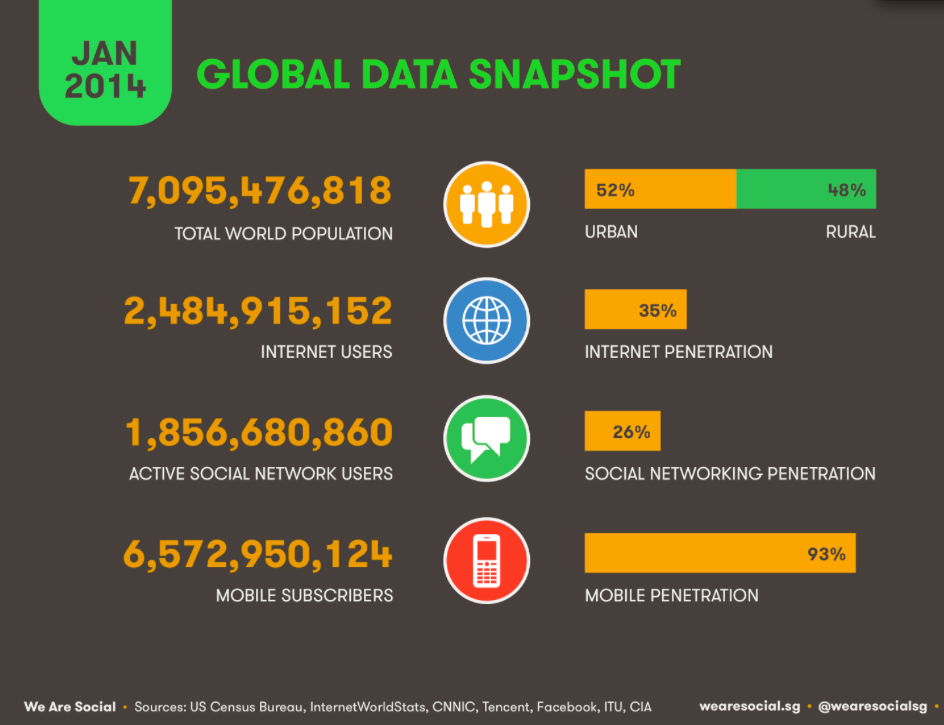
My talk at the 2015 American College of Cardiology Scientific Sessions referenced a factoid that I am not smart enough to completely verify, but I suspect isn't too far off the mark: that in January of 2014 there were 7,095,476,818 people in the world and 6,572,950,124 (93%) of them had mobile phones.

Think about that.

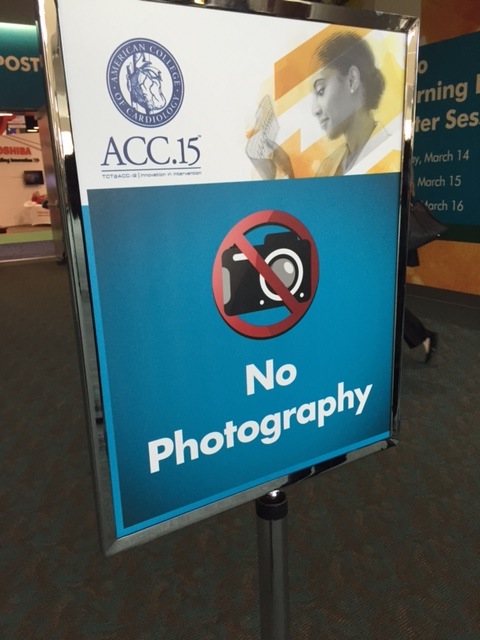
Everyone has a camera with them.  Everyone at meetings (especially scientific sessions far away from the office) is shooting pictures of abstracts, friends, selfies, drug company displays … whatever - despite a policy to the contrary.

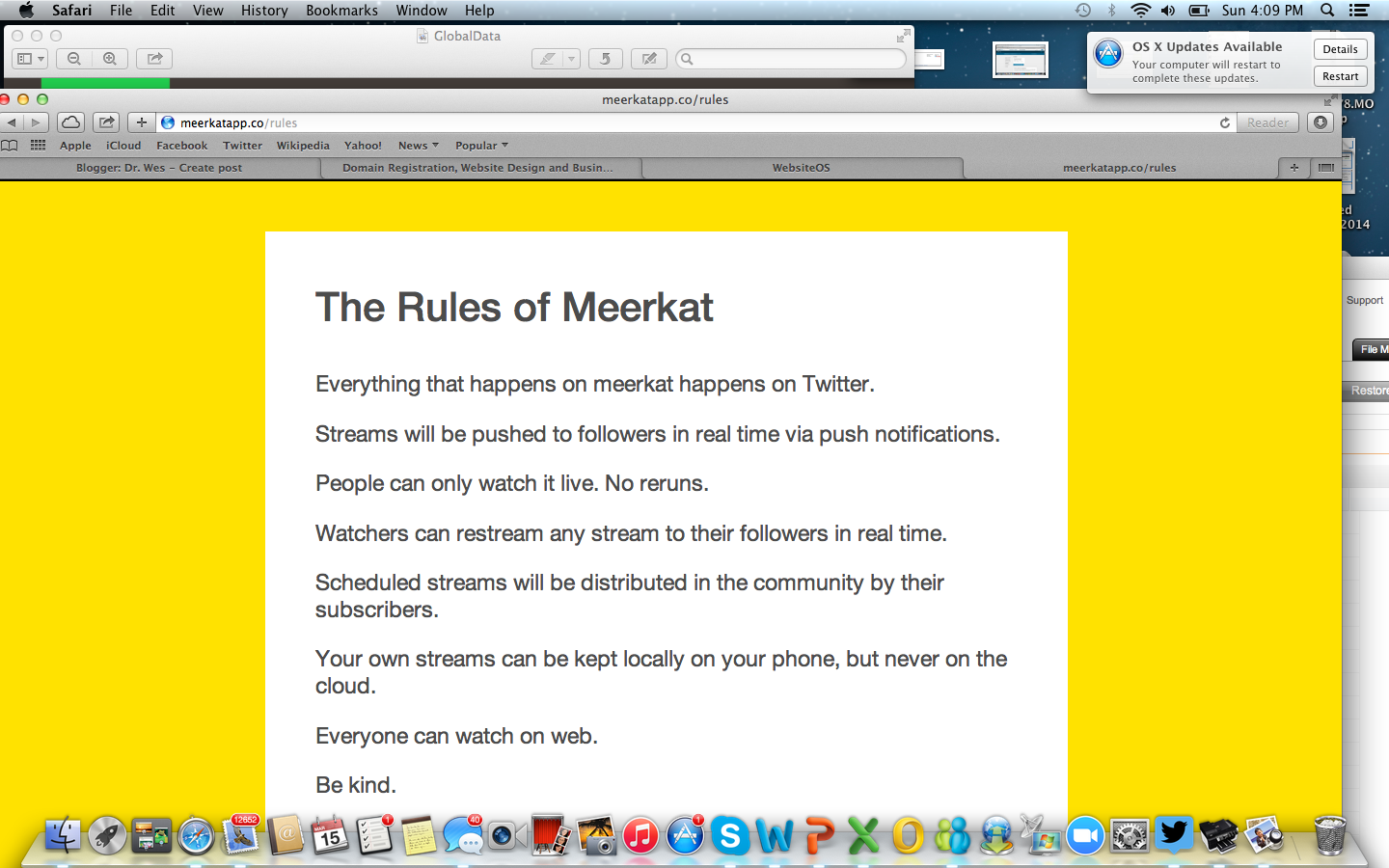
And now, there's even live streaming video on Twitter.  I experimented with one of these yesterday called Meerkat.  (Twitter recently announced a partnership with competing live video feed service called Periscope, so this feature is here to stay).  For $1.99 I downloaded the Meerkat app to my cell phone, linked my Twitter account, and my ability to transform any experience into a live video feed transmitted instantly to the world was complete.  There are some "rules" associated with Meerkat.  Yet even with these rules, I found it disquieting that I held Big Brother's camera in my hand, if only for a few minutes.  Those videos might not be on the "cloud" by policy, but how do I know where else they're stored, or used.

There is a remarkable power, subversiveness, and wonder in the simplicity of this new technology to send live video feeds from a mobile phone.  It is both novel and "cool."  But I still deleted the video that I sent from the ACC meeting yesterday from my iPhone this morning after I thought about things. Perhaps I'm being overly cautious because videos can still be taken at meetings and uploaded to YouTube for the world to share.  But somehow this live feed was different - so instantaneous, so uncontrollable.

And as a doctor, I don't want to become an agent for Big Brother.

-Wes


Friday, March 28, 2014

Social Media at Scientific Sessions

More and more physicians are entering the social media space - so much so that even our more classic academic physician colleagues are joining in.  But there can be challenges that arise at scientific sessions when the old way of professional discourse meets the new way of social media.

Robert A Harrington, MD (Chair, Dept of Medicine, Stanford University, CA) and Clyde W. Yancy, MD, MSc (Northwestern Medical Center, IL) discuss these challenges nicely at theheart.org and offer some interesting insights and tips for doctors, both young and old, as they consider entering the social media space.

-Wes

P.S.: Then again, if you're still unsure how Twitter even works, consider this Twitter primer.

Monday, October 07, 2013

When the Best Stuff Ends Up on Twitter

Keeping a blog, I feel like a dinosaur, but I do it because it's a place I can return to to find a thought.

I think, I write, I put some thoughts down in this space. The piece is published here and then "fed" to Twitter and to an "RSS feed" for wider distribution. People then come here and read the piece. People like the thought. Others hate it. So what do they do? They "retweet with comment" on Twitter (or Facebook) and their view evaporates in seconds to another social media space.

It's an interesting phenomenon, and perhaps one brought on by multiple social media outlets and voluminous comment "spam-bots" that have led folks like me to have to implement difficult "Captcha" screens to limit the garbage that can appear in the comments section of blogs. (Some IT spam marketing experts have discovered how to break Captcha screens, too).

Oh sure, I could put a live stream of Twitter comments on my sidebar, but as the Twitter feed scrolls on with time, the insightful (and often helpful) thoughts are lost into the void of the inter-webs. The conversation dies quickly and many people who read the post later miss those thoughts.

Does anyone know an easy way to automatically add Twitter "re-tweets with comments" that occur on Twitter to the comments of an individual blog post? This might help solve this conundrum.

In the meantime, consider taking a second to leave your comments here for others to read so your brilliant thoughts don't evaporate in seconds into the Internet ether.

After all, your thoughts matter in "social" media, remember?

-Wes

Wednesday, June 26, 2013

A Simple Idea for Collaborative Academic Research

With the rapid dissemination of medical information, global reach of the internet, and realization that more print journals doesn't mean better print journals, today's researchers use a variety of techniques to connect but most, sadly, have not kept pace with the times.

Yesterday, watching the nightly news, I saw something that caught my eye.  It came during a story about yet another shooting in Chicago.  The usual folks were interviewed by the media: distraught family members, friends, and eye witnesses to the crime.  One of the witnesses seemed intelligent, articulate, and surprisingly insightful and there, below his name on screen, was his Twitter handle.

Imagine how researchers could connect if Twitter accounts were added to their author lines in journal articles or next to their e-mail address in the article's contact information section.  Like-minded researchers could instantly connect, follow colleagues with similar interests, or message them questions.  Private conversations could continue via direct messaging or e-mail in follow-up.  Such a system would easily connect like-minded scholars as well as promote an individual's work.  Just as TV stations, news organizations, professional scientific organizations and the entertainment world have embraced the trend, so too should our stodgy academic world.

And why not?

After all, everyone's looking for research funding these days.

Who knows?  Good scientific work might just have a chance of receiving funds from the most unlikely of sources thanks to social media.

-Wes

Thursday, April 25, 2013

Technorati's Social Media Update 2013

In preparation for my upcoming talk at the Heart Rhythm Society's 2013 Scientific Sessions in May, I came across this information from TechnoratiMedia's 2013 Digital Influence Report.  While these data are primarily directed to general online consumer influence, doctors interested in social media might find this information interesting (my comments are italicized):
  • When it comes to community size, 54% of consumers agree that the smaller the community size, the greater the influence. (Healthcare is a niche market, subspecialties even more so)

  • Online services most trusted: (1) News Sites (51%), (2) Facebook (32%), Retail Sites (31%), YouTube (29%). Blogs (29%), Google + (26%), Twitter (16%), LinkedIn (5%) (Heh, glad to see blogs ranked neck-and-neck with kitty videos)

  • Online services shared the most: (1) Facebook (57%), (2) YouTube (40%), Blogs (26%), News Sites (26%), Google + (25%), Twitter (18%), LinkedIn (5%)  (Blogs are shared more than Twitter? Surprised by this - perhaps this is because of the relatively static nature of blog posts.)

  • Concerning creating influence: 86% of "Influencers" blog - one third of which have been blogging for more than five years.  (Rock on!)

  • Most bloggers operate 2-5 blogs (52%) while 43% operate just one.  (OMG, I can barely handle one).
-Wes

Friday, June 08, 2012

The DSM-Tw: Handbook of Twitter Personality Types

In an effort to assist the American Psychiatric Association with the publication of the fifth edition of Diagnostic and Statistical Manual of Mental Disorders (DSM-5) expected in May, 2013 it seemed only appropriate that a DSM-Tw (Twitter) supplement be provided to help classify newly emerging personality types on Twitter.  After all, the third and final (really, the FINAL) comment period for the DSM-V criteria ends June 15th!

292.891 Caffeine-induced disorder: Newscycling Disorder - chronic obsession with Tweeting main stream media news stories.  For instance, all topics that have an association with medicine are cited: even acne studies.   Diagnostic finding:  first to tweet the story so that others will "retweet" their tweet, as if it was their own.  Gaining followers is the name of the game, so they occassionally venture off on tangents, like American Idol, Justin Bieber or Venus in front of the sun.

787.62 Elimination Disorder: Encopresis with constipation and overflow incontinence, Cynic - chronic obsession with snark.  No matter what get's posted, they'll counter with a cynical comment.  Post something snarkier, they'll lose sleep at night until they quip with another one-liner that beats yours.  Yeah, suck on that one. (Discussions are underway to consider re-filing under "313.815 Conduct Disorder: Oppositional Defiant, Cynic")

307.213 Separation Anxiety Disorder of Childhood: The Pollyanna - They can never be nice enough.  Really.  If it isn't nice, it won't be mentioned, retweeted or fav'd.  But if it's about flowers, kitty cats, or the like, count on a high resolution picture link to Flickr or Photobucket.

301.811 Narcissistic Personality Disorder: The Narcissobsessive - They love themselves and they love Twitter.  So they tweet anything and everything.  A diagnostic feature: tweets-to-followers ratio typically exceeds 50:1.  Coffee shops, diners, movie themes are common topics.

297.32 Shared Psychotic Disorder, Boy (or Girl) Wonder Professional - Typically very sincere, advocates for a cause.  Well-liked by the Twitterverse.  Happy to share your tweet or there's.  Folds their underwear.

300.112 Conversion Disorder: #Hashtagger - One word tweet like "loser" with an attached concatenated hashtag like #runswithscissors.

So, what's your personality type?  Other personality / behavioral characteristics you'd like to provide?  Time is short!  They need our help!

-Wes

Thursday, January 26, 2012

Doctors Helping Doctors (and Their Patients) Via Social Media

It was supposed to be a closed meeting attended by doctors who had a large amount of experience dealing with patients with St. Jude Riata leads, a defibrillator lead that recently garnered an FDA Class I advisory (recall) status due to it's high failure rate. Only 55 doctors and a few industry personnel were brought together to try to determine what to recommend to the rest of us who must deal with this problem in the outside (real) world.

It was 20 January 2012. I was doing an EP case at the time. When I emerged from the room to begin typing my orders, a tech said to me: "Hey, did you see this?"

It was a live Twitter feed from the meeting of one of the attendees - an electrophysiologist from Christ Hosptial in Cincinnati, Edward J Schloss, MD. In those tweets were a play-by-play of important discussions and the results of opinion polls fielded during the meeting. Here's what I saw:
20 Jan Edward J Schloss MD @EJSMD
At Riata ICD Lead Summit in Minneapolis.

20 Jan Edward J Schloss MD @EJSMD
35% of #StJude #Riata Summit attendees think this is a worse problem than MDT Fidelis.

20 Jan Edward J Schloss MD @EJSMD
41% of #StJude #Riata Summit attendees are concerned about Durata and are not implanting it.

20 Jan Edward J Schloss MD @EJSMD
#StJude #Riata US Multicenter Retrospective Trial Riata/ST. Overall failure rate intermediate between Quattro and Fidelis.

20 Jan Edward J Schloss MD @EJSMD
#StJude #Riata bench testing model shows good performance of externalized conductors with or without ETFE insulation breach.

20 Jan Edward J Schloss MD @EJSMD
#StJude #Riata Panel discussants repeatedly emphasize lack of data on natural history of lead. Difficult to reach expert consensus.

20 Jan Edward J Schloss MD @EJSMD
#StJude #Riata Lunchtime conversation: Concern that we're on the leading edge of failures with these leads. Problem apt to get worse.

20 Jan Edward J Schloss MD @EJSMD
#StJude #RIata Ellis-Vanderbilt series of Riata: 26% of leads had externalitzation flouro abnormalities.

20 Jan Edward J Schloss MD @EJSMD
#StJude @Riata 5 of 10 members of one expert panel use flouro screening routinely (in spite of HRS recommendation against this).

20 Jan Edward J Schloss MD @EJSMD
#StJude #Riata Epstein lecture on extraction points out the unique difficulties associated with this lead. Harder than Fidelis.

20 Jan Edward J Schloss MD @EJSMD
@DeltaAssist I'm booked on flight 3104 MSP to CVG tonight and Delta APP indicates delay with no alternative. Help?

20 Jan Edward J Schloss MD @EJSMD
#StJude #Riata Summit poll at completion: Concern went up - now 58% say Riata problem is worse than Fidelis (up from 35%).

20 Jan Edward J Schloss MD @EJSMD
#StJude #Riata Summit poll at completion: Concern went up - now 44% would not implant Durata (up from 41%)

20 Jan Edward J Schloss MD @EJSMD
#StJude #Riata Summit poll at completion: Concern went up - now 55% favor routine flouroscopy (up from 42%)

20 Jan Edward J Schloss MD @EJSMD
#StJude #Riata Summit poll at completion: More conservative philosophy with externalized conductors 76% would not replace (up from 69%)

In reply to Paul Verrastro 20 Jan Edward J Schloss MD @EJSMD
#StJude #Riata Hauser wrap up: We need to look at Durata very closely "put it under the microscope." Calls on SJM to create trials

Edward J Schloss MD @EJSMD
@pjv2217 heading to airport.
(Dr. Schloss's full account of the meeting, with a link to the meeting's slides and St. Jude's response to the report, was published recently at the Cardiobrief blog.)

But what was remarkable to me about this whole affair is that a doctor took it upon himself to help report this important information to his colleagues. By doing so, he likely helped many more patients about to receive a new defibrillator system. After all, it is the doctors in concert with their patient, who ultimately must choose which ICD lead gets implanted when a defibrillator is installed.

My hat's off to Dr. Schoss.

-Wes

Monday, November 07, 2011

AMA Medical News: Social Media's Public Health Implications and Limitations

From a mention in today's AMA Medical News:
Many health professionals do not see social media-based research replacing more traditional study methods, because not everyone uses the Internet or social networking. But they expect data gathered from social media to play an increasingly larger role in addressing public health issues.

"Social media has huge potential for public health," Dr. Fisher said. "I don't think that people have even begun to realize that potential yet."
-Wes

Wednesday, September 21, 2011

Taking the Plunge Into Social Media

With the increased internet connectivity of doctors, nurses, medical residents and medical students, I find more and more health care people interested in taking the plunge into the social media world. Many of these same people wisely see the advantages and the potential disadvantages to entering this space, so they are appropriately reluctant to dive "all in." Nowhere is there more caution than with the medical professions, especially physicians. While there is no one way to dabble in the world of social media, for those looking to embark cautiously on this course, I might be able to offer an approach that is not too dissimilar from a child learning to swim.

The Baby Pool

Where to start?

While many might attempt to enter social media through simple "micro-blogging" sites like Twitter, realize that this is (professionally) a bit like diving into the deep end of the social media pool before learning how to swim. That's because Twitter is a two-way interactive medium; you can receive AND send out tweets there. For medical professionals constrained under HIPAA, it might be better to take a cautious approach to utilize a one-way (receiving) medium first by using a "feed reader" like Google Reader or BlogLines. A feed reader is a program that reads news feeds that are automatically sent out to the internet as a standardized "Really Simple Syndication (RSS) feed" anytime there is something new published. Feed readers allow you to "subscribe" to a site's feed so that anything new published can be collected and categorized by the feed reader program on your computer. Almost all of today's newspapers, scientific and popular media journals, and blogs provide "feeds" whenever things are published to the internet.
To help people locate the feed from a particular site, many post the standardized RSS feed symbol shown to the right. As a helpful tip, I have learned that most weekly medical journal and local newpaper health care section feeds are published to the internet either Monday evenings or early morning Tuesdays. Check your feed reader first thing each Tuesday morning and you'll have tons of articles to review from the select journals to which you've decided to "subscribe." The real beauty of a feed reader, though, is that you can then scan hundreds (I'm not kidding) of these article feeds in minutes to find the few that interest you. If they're not of interest (and most aren't) then they are marked as "read" and replaced with new articles when they come available. This system is fast, efficient, valuable for every doctor, nurse, or medical nerd out there. Once you master a feed reader, THEN I would consider moving to the more "social" aspect of social media and start to interact with others. This is when you'll move from the shallow end to the deep end of the social media pool.

The Deep End

But why wait? What's so bad about jumping in to the "deep end" of social media (a blog/Twitter/Facebook, etc.)?

Simply put: the deep end is where you can drown as a health care professional.

Caution, especially as a doctor on the internet, should be the rule. Also, despite how smart you may think you are and how much you want to say about your brilliance on a particular topic, you can bet your bippy that there is someone smarter out there. If you're a smart as$, plan to be handed your butt. (Heck, humbling others is the most popular sport in the blog-o-sphere!) Save yourself plenty of angst: be humble and write respectfully. If you do, you'll be rewarded with respect. Along the same line: if you make a mistake, admit it. Say something you shouldn't have? Own up to it and correct the error. Upset someone? Decide if you should reconsider. Yes, public figures are easier to slam (and get away with it) than private ones since it comes with the territory. But the line between respectful disagreement and slander is a line you don't want to explore in court. So choose your targets carefully and really consider playing nice (or at least nice enough). Don't get me wrong, I think it's important for passionate professionals to stand up for what they believe, but realize that there is likely to be others just as passionate about the counter argument you propose. As a rule of thumb, you'll get more mileage if you make it a point to consider the counter-argument in your blog post or tweet. Remember that your words on the internet have permanence and unless there's a real defensible reason to go there, you might want to tone that rant down a bit.

Better yet, sleep on it before you publish it.

Joining the Diving Team

Every developing physician blogger I know hits a few snags along the way. Suffice it to say there is no single right or wrong way to approach social media as a doctor. Learn from those that have passed before you. Write them a private note. Comment on a few blogs to get the feel of the pace and tenor of the interchange. Once you're up and running you'll soon be joining the team of advanced aquatics: the diving team. These are the people that multi-task using their feeder daily, their blog to make a point, and firing off posts to Twitter and Facebook (or Google +) via a feedburner, then making a video blog or internet radio show. Seriously, it's whatever you have the time and passion for.

For me, I've chose to stick with a blog. I find it hard enough to keep updates to it on a regular basis while keeping my day job. And while I can't always get to comments for instant replies (who can as a doctor?), I find them entertaining and informative. For the sake of a modicum of brevity, I won't dwell on the specifics of how to write a blog. Many others have already covered this topic in depth. I would make a few important points, though. If you decide to make a blog (favorites seem to be Wordpress or Google's Blogger as starting points), decide early if you want to accept comments on your blog or not. Those who accept comments on their blog can learn a great deal from others, but when you decide to accept comments, you also accept additional responsibilities. For this reason, I always recommend moderating your comments. Moderating allows you to review comments before posting them to your blog. Bloggers have been held legally responsible for comments made by others that appear on their blog and it's the sad reality of the internet that there are sometimes wacko's out there that latch on to a blog and won't let go. Stay in control and moderate. Perhaps most important as a doctor-blogger, moderating comments permits better complicance with HIPAA standards in the event an inappropriate comment should appear. Also, make sure to use links liberally and reference your sources. This provides credibility to your argument(s). It's also nice to acknowledge the work of fellow bloggers by offering "hat tips (or 'h/t')" containing a link to their work if appropriate. Finally, be sure to add a disclaimer to your blog. This isn't the place to offer medical advice - ever.

In summary then, be careful, be respectful, be smart and soon you'll be using the wide array of social media springboards, like Problogger.net, to launch your online presence to new heights and opportunities.

Oh yeah, and one more thing...

... most of all, have fun.

-Wes

Monday, August 22, 2011

Beware of Direct-Message Twitter Phishing

It was sent by direct message:
@personyoufollow Thought you'd should know they're saying really, really bad things about you over here http://ts.****.co
... or maybe this:
@personyoufollow Thought you'd like to see the photo I took of you... http://ts.****.co

I've seen a few of these Twitter messages on my iPhone and they seem to be more prevalent recently. The link provided in these messages doesn't take you to a forum or a photo, but rather to an official Twitter-like front page where you have to enter your "Full name" and e-mail as part of the log-in process. It is, of course, an attempt to gather your personal information. But for reason I don't understand, the iPhone OS (a la Safari) does not recognize these malicious URL's, but Firefox and Chrome on a more conventional desktop does recognize these sites for what they are: malicious software attempting to obtain your personal information.

Doctors and other health care providers may not be aware of these scams...

... 'til now.

So beware, it's the internet out there, remember?

-Wes

References:
BEWARE Of Twitter Phishing DM –“Someone said this real bad thing about you in a blog”

Twitter warns vs new direct-message phishing scam.

Mashable: WARNING: New Twitter Phishing Scam Spreading Via Direct Message

Friday, June 03, 2011

Twitter at Scientific Sessions

Bryan Vartabedian, MD over at 33 Charts has an interesting post on his blog today: Should Twitter be Restricted at Scientific Meetings? I encourage all to read it.

Increasingly, scientific sessions (many of which have heavy corporate sponsorship) have evolved from scientific endeavors to those of marketing and media endeavors. While there are benefits to pharamceutical and medical device representatives gaining "access" to "key opinion leaders" to explore ways to further innovate in medicine, there is also a chance that these interactions will influence and bias.

Doctors know this. So do device and pharmaceutical reps. As do the media.

But at most of the recent Scientific Sessions that I have attended, there is usually a sign at the door of the meeting telling us photographs are prohibited. And yet, without exception, I have seen people snapping pictures of slides and posters and friends, among other things.

Who are we kidding? The ubiquious nature of cell phones capable of snapping a picture and sending it around the world in seconds exists on nearly every attendee at these meetings. Yet somehow I haven't seen anyone wrestled to the ground to surrender their cell phone to authorities to date.

And most of these scientific meeting sponsors have welcomed social media as part of their marketing efforts, publishing updates on sessions underway, not to mention encouraging companies to market their wares at the meeting as well. Should doctors, then be restricted? We're not talking censorship of the scientists are we?

So should we restrict the use of Twitter at scientific sessions?

My thoughts on this: if you've invited the media to cover the event, then by default, you've invited Twitter.

-Wes

Friday, May 13, 2011

Fading or Evolving?

Perhaps its a natural evolution of a blogger on the internet: starting out strong, then fading. Perhaps it's a realization that you've said what you wanted or needed to say and newer content is harder to find. Perhaps it's the changing times or the changing of priorities. Perhaps it's because newer, faster ways have developed for doctors to communicate with the outside world, like Twitter.

Perhaps, it's all of these.

Whatever it is, my blogging frequency has slowed considerably since I started:


Will this trend continue to reach its inevitable asymptote of zero?

I suppose.

But as long as there are things that are interesting, bothersome, unique or funny to share, I'll continue - maybe not as a thoroughbred with as many posts per day, but an old mule who can occasionally give a good ride. (Whether that ride will be rough or smooth remains to be seen...) Still, as long as it remains fun to do, I'll keep her goin' for now. While it's taken a while to garner a faithful following of all six of you, I continue to be amazed at the impact one guy's blog can have. Thanks to all of you who have taught me, scolded me, praised me, and educated me along this wild journey.

A few other reflections at this juncture.

I feel a bit guilty that I cannot always post the comments left here in a timely fashion. I can assure you I read them all and appreciate the perspectives shared. But my day job requires that I perform procedures that happily remove my brain from the internet. I get to them when I can - hence why idle back-and-forth chat will never be my "M.O." And try remember to keep your comments clean, respectful of others, concise, and on message. (Remember, your mother's watching.)

By the way, to those that leave those "love your blog" comments with a link back to your overseas drug distribution, vibrator sales site, or similarly dissociated website: rest assured your comments will continue to be hastily labeled as "spam" for the great gods of Google to feast upon.

So happy Friday-the-13th and thanks for checking in from time to time. It's been a ball.

We'll now return to our regularly (yet less frequently) scheduled programming...

-Wes

Monday, May 02, 2011

In Pakistan: Cardiologists Threaten Suicide

As America awakened to news of Osama Bin Laden's death in Pakistan, conditions for cardiolists in Pakistan sound dire:
Dr Zaheeruddin, while talking to The Express Tribune said, “After waiting for so long, for our salaries and to get our services regularised, we have been left with no other option but to protest and commit suicide along with our families.”
The reach of social media was exemplified by the inadvertant live-tweeting of the attack on Bin Laden. I wonder if these cardiologists have considered using social media to amplify their message before resorting to suicide.

-Wes

Friday, April 08, 2011

Twitter Trepidation

"Dr. Wes, I've done Twitter before, can you show me what I need to do?"

It was easy, I helped her sign up, showed her how to send her first tweet to me and sent her one in turn. She giggled. I even showed her how she could send a more private "direct message" and how to search for things using hashtags. I then demonstrated how she could take URL's of a favorite webpage and place it into the dialog box and, presto, the URL would be shortened and the link shared with the masses.

I even became her first follower. "Now everyone will want to follow you," I joked.

She was thrilled to have learned so much so quickly. Yet anxious. "So that's all I have to do?"

"Pretty much. You'll get the hang of it in no time!"

No one explains the psychological cost of Twitter to first-time Twitter users.

She went home and logged on with her own computer, just to be sure she could remember how. There it was, her first tweet and my smiling avatar off to the right in her follower column. She logged off.

She came back a few days later just to look, not sure what to do. No change. She was relucatant to send another tweet. What should she say? Will I sound stupid? Why would anyone want to know what I think? She looked at her lone follower and wondered, is having lots of followers the good news or the bad news?

Until.... one day some time later.... she logged on and there it was:

... her second follower.

"What? Who's that?"

She had no clue. She knew she was going fishing in this great pool of social media, but no one told her there would be minnows nibbling at her toes once she waded in. The unexpectedness of it. The terror.

Having another Twitter follower means, implicitly, you're obligated to lead doesn't it?

Caveat emptor, Twitter newbies.

-Wes

Tuesday, February 22, 2011

Klout: How "Influential" Are You, Doctor?

I stumbled across Klout.com recently, thanks to an tweet by the well-respected web strategist and industry analyst at the Altimeter Group, Jeremiah Owyang. Needless to say, it's not a place doctors venture much.

But I found the site, and it's potential to characterize physician's on-line influence, interesting.

It works by giving people on Twitter and Facebook a "score", influenced by the lists that people are on, the number of original "tweets," number of times things are re-tweeted by others, and so on and then uses the metrics to classify the type and influence of the individual using social media. I suppose an analogy might be that its like looking at a bunch of personality tests to understand the type of person you're following.

So I looked into the scores and characteristics of a few physician bloggers. The results were interesting.

Yours truly gave a meager "Klout score" of 48 at the time of this writing and was classified as a "Specialist."

Kevin Pho, MD is a "Thought Leader" with a score of 69.

Grunt Doc, an ER doctor and long-time blogger is a "Thought Leader", too, but has a score of 38.

Doctor Anonymous is an "Explorer" with a Klout score of 50.

Ramona Bates, MD - a plastic surgeon - is a "Specialist" too with a score of 54.

Happy Hospitalist has a Klout Score of 24, but is considered a Thought Leader, too.

(You can check your "score" and inflence type with a twitter account and then enter it here.)
By the way, I have no commercial relationship with this website, but I found the concept intriguing for doctors as we enter the new internet age of social media. Certainly this is not the only site that purports to measure the influence of someone on social media (see Peerindex, for instance), but it was interesting to see it's accuracy in determining these few individual's influence on the internet based on their content tweeted.

While Mr. Owyang does a nice job explaining the limitations of these metric websites (especially as it relates to lack of a "Sentiment Index"), but I must say that from my cursory look at the few fellow physicians I queried, it classified some of these more prolific bloggers and twitter users that I know pretty well.

Looking forward, it would not be unrealistic to think that some day a new variant of the Klout website might just serve as another form of doctor rating website. If so, the benefit of developing an valued online social media "physician brand" now might pay professional dividends later.

-Wes

Friday, January 28, 2011

Social Media and the Challenge of Overcoming Intellectual Complacency

They lined the walls in a warm room as far from the central table as possible. They had come to learn about EKG's. Residents of at varying years of training sat amongst the interns, much the same way as the Democrats sat amongst the Republican's at the recent presidential State-of-the-Union address: cordial - not too aloof.

I was fortunate to be the lucky guy to teach them that day. I have always enjoyed this opportunity and generally the lectures seem to be well-received and attended. This was lecture toward the latter part of the year, so things were not the chip-shot tracings that most learn in ACLS. Still, we always harken back to the fundamentals of reading tracings to help us understand new concepts, but I encountered a strange silence when I discussed the EKG's of patients with pacemakers:

"We all hear the phrase "He's got a DDD pacemaker," right?

They all uniformly nodded they'd heard the phrase, so I asked further:

"What do the letters in the term 'DDD pacemaker' mean?"

Silence overcame the room.

Perhaps I had caught them off guard. Many of their eyes fell to the floor. Some smiled but failed to answer. Some were clearly unnerved by the question as they shifted in their seats. A cough could be heard in the corner - it might as well have been a pin dropping. In the back right-hand corner a pager sounded. Everyone turned to the lucky contestant who was saved by the beep. Finally, somewhere toward the opposite corner of the room came a faint suggestion:

"Isn't one of them mean which chamber is paced?"

Relieved, you could see a few heads nodding now.

"Which letter of the three represents that?"

Again, the room fell silent.

Needless to say, we moved on from there after a quick basic review of pacing terminology, but his got me thinking: where have we failed to teach our medical students and residents such fairly basic clinical concepts and vernacular we use every day? Are we spending too much time on the Krebs cycle and not enough time on clinically relevant concepts in medical school and internship? How do we get them to remember?

So I had an idea: what if I used social media?

We all know that every medical student and resident (and doctor and patient, for that matter) has a cell phone. Might we use Twitter to try to teach small snippets of information to our trainees? Obviously they would have to have a Twitter account. Also, not all concepts lend themselves to this appraoch very well, but it might be worth a trial.

Soooooo, look for an occassional Electrophysiology Quiz via Twitter from yours truly. (Others with ideas for ultra-short cardiac electrophysiology quizes are welcome to join in the fun, just use the hashtag '#epquiz' in your tweet.)

Soon, there might be an entire library of fun questions and answers for all to enjoy on Twitter that are easy to catalog! And who knows? Maybe some of our more engaged students, interns, and residents on social media just might remember a thing or two while contributing to the fun.

-Wes

Wednesday, November 03, 2010

How E-Prescribing is Just Like Twitter

I'm surprised I didn't notice this sooner, but e-prescriptions will only accept 140 characters in their instructions, just like Twitter. If you still must have longer instructions, you must print the prescription and hand it to the patient for it to be manually filled at their pharmacy.

Then again, maybe doctors will start to use some "twitter-like" abbreviations in their instruction fields now, like:

"Chk ur BP b4 taking b/c itz K 2 hold if nl. TIA."

Dude. That'd b fab.

-Wes

Wednesday, September 08, 2010

Tweeting Your Own Heart Attack

It's funny, until it's not:
Opportunity + Instinct = Profit. A good journalist can sense the moment that a story is developing and seize the moment. That’s why when White House correspondent Tony Christopher started having a heart attack, he immediately logged into Twitter and started covering it:

Approximately at 6pm on Sunday afternoon Christopher wrote, “I gotta be me. Livetweeting my heart attack. Beat that!” Presumably a few minutes later the paramedics arrived to tell Christopher he will be stable after his crisis.

An hour later Christopher joked about needing to own a cardiac cat, referencing a viral video in which a cat is trying to revive his dead feline friend. He also updated his followers about the pain he was feeling, “even after the morphine.”
So is this the message the White House wants sent to America?

Seems to me his time might have been better spent on (1) taking an aspirin, (2) calling 911, and (3) calling a friend, (4) and assembling a list of his current medications and past medical history for the doctors in case he loses consciousness.

But that's just me...

-Wes