Showing posts with label research. Show all posts

Sunday, July 10, 2016

Too Little Too Late: The ABIM Foundation Sells Its Condo

It was a story that broke on this blog nearly two years ago when the American Board of Internal Medicine (ABIM) Foundation was putting their luxury condominium, complete with a chauffeur-driven Mercedes S-Class town car that was purchased with physician certification and re-certification fees, up for sale.

Over 550 days later, we find the notorious ABIM Foundation condominium was finally sold on 6/21/2016 for $1,650,000 representing an up-front cash loss of $650,000.

But let's not forget the other associated fees required to sell a condo:

Real estate commission (6%): ($99,000)
Transfer Tax as buyer (2%) (2007): $46,000
Transfer Tax as seller (2%) (2016): $33,000
Title insurance: $10,000
Other fees: deed preparation, attorney fees, recording fees, etc. $10,000.
Furniture expense: $56,267


And then there's the annual condo fees, cable, phone, electric, cleaning, etc., that came to $41,000-$50,000 annually (approximately $450,000 over 9 years) (Source: Richard Baron, MD, President and CEO of the ABIM and ABIM Foundation)

All told, ABIM took $2,356,267 million of ABIM diplomat's cash and lost at least $1,265,267 on our behalf.

So much for "Choosing Wisely®."

But let's face it, incurring a financial loss on an "investment" is not necessarily illegal. After all, any of us could have made a horrible investment decision.  Rest assured we'll soon hear the ABIM trying to justify their real estate loss because they would have lost this money anyway if they had to pay hotel costs for all of their out-of-town guests and programmers from India eager for a cheap place to stay.

But we should ask ourselves now with the sale of this condominium, what was illegal at the ABIM Foundation? Anything?

Tax Fraud

First, recall that Dr. Baron claimed in my communications with him that much of the condominium expenses they claimed on their tax forms as program service expenses was actually a depreciation expense they lumped into the "program services expenses" of the condominium. Yet the ABIM and their accountants never claimed depreciation under the separate line item on their federal IRS Form 990 for this expense.

Honest mistake?

Unlikely. After all, other tax filing discrepancies with the ABIM Foundation have occurred repeatedly and systematically over many years. Any credible accounting audit should have disclosed most of them.

For instance, surely someone at the ABIM knew the difference between the two states of Iowa and Pennsylvania, didn't they? So why was the ABIM Foundation domicile claimed as Iowa for years when, in fact, it was domiciled in Pennsylvania but never disclosed? And isn't it striking that the ABIM Foundation was claimed for years as being formed in 1999 until this blog disclosed that it was actually created in 1989, some ten years earlier? Only in its most recent tax filings has that little "oversight" miraculously been corrected without explanation to the Internal Revenue Service.

And why didn't the ABIM disclose that it was lobbying Congress on its tax forms when it had been doing so for years? Was this merely a mistake? Or was it because the ABIM and their Foundation would have opened themselves up to closer scrutiny and lost their tax-exempt status if they had?

Unethical Research Practices

Finally, we have to ask ourselves just what kind of research on physicians for the betterment of health care requires a $2.3 million condominium? After all, the ABIM Foundation has always heavily touted their research work and publications.

Some may argue there wasn't "research" being conducted at the ABIM Foundation but rather "quality assurance" or "Quality Improvement" exercises performed there. If so, then why did the ABIM Foundation promote it's pioneering research by using the term at least five times on a single web page in May of 2007?
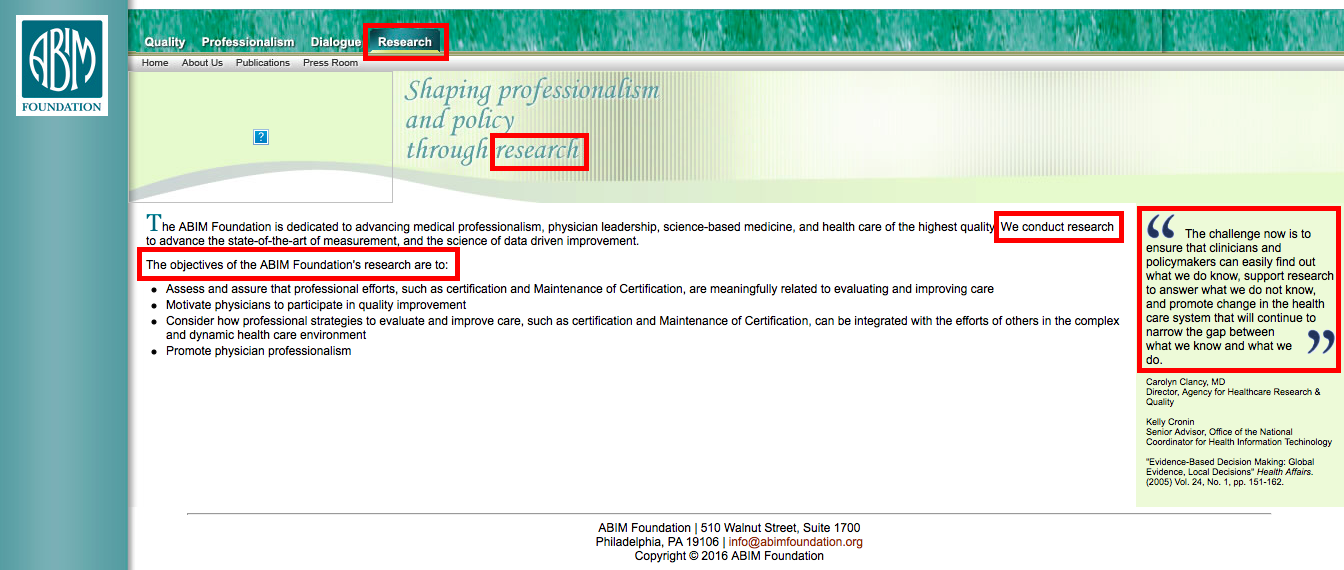
Archived Screen May 2007 - ABIM Foundation
(Click image to enlarge)
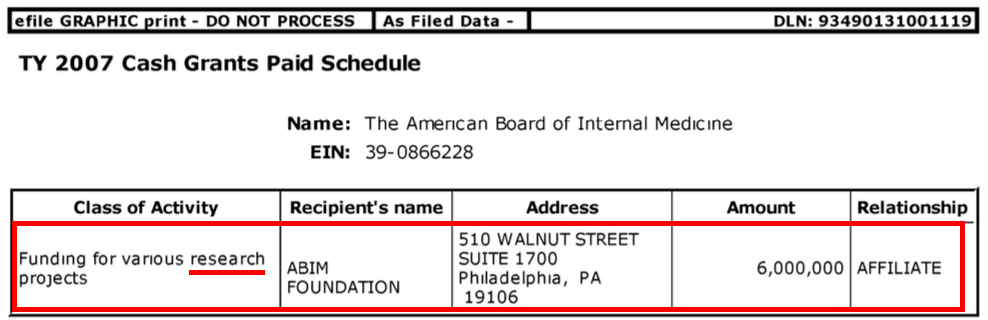
We also find that the ABIM funded "various research projects" at its Foundation in the fiscal year 2008 with the transfer of $6,000,000 of ABIM diplomat fees:

Evidence of ABIM Funding "research projects" at the ABIM Foundation
for $6 million in Fiscal Year 2008
(Click image to enlarge)

There is no escaping the fact that this was a very serious effort at conducting "research" on physicians.

Or not.

Was the whole "research" story told by the ABIM and ABIM Foundation just a front for other activities? I wish to bring my reader's attention that the ABIM Foundation no longer has the word "research" appear anywhere on its website. Instead, there are only words like "Medical Professionalism Charter," "Initiatives," "Grants" and "Choosing Wisely®." The cover-up continues.

Credentialing of physicians involves human testing. As such, it appears the ABIM Foundation unilaterally decided to perform research on physicians without informed consent, without an impartial Investigational Review Board, and without a clear research hypothesis, method, or analysis of the harms they might cause.

"Research" conducted in such a manner is dangerous for many reasons and some of the most egregious examples of dangerous research have happened in government agencies or when the individual or collective social beliefs or dogma were imposed on others as justification for "research."

The Nuremberg Doctrine which rose from the World War II war crimes is very clear in its requirements for human subject research, especially as it pertains to proper consent. From my recently conducted bi-annual CITI Training:
"The voluntary consent of the human subject is absolutely essential.

This means that the person involved should have the legal capacity to give consent; should be so situated as to be able to exercise free power of choice, without the intervention of any element of force, fraud, deceit, duress, over-reaching, or other ulterior form of constraint or coercion; and should have sufficient knowledge and comprehension of the elements the subject matter involved, as to enable him to make an understanding and enlightened decision. This latter element requires that, before the acceptance of an affirmative decision by the experimental subject, there should be made known to him the nature, duration, and purpose of the experiment; the method and means it is to be conducted; all inconveniences and hazards reasonably to be expected; and the effects upon his health or person, which may possibly come from his participation in the experiment.

The duty and responsibility for ascertaining the quality of the consent rests upon each individual who initiates, directs, or engages in the experiment. It is a personal duty and responsibility which may not be delegated to another with impunity."
It goes without saying that human subject research that involves real estate investment strategies to fund research on practicing physicians is unethical (at least) and likely highly illegal. As we have seen, the MOC recertification program can cause significant harm to physicians, their patients, and their families, especially when this credential is tied to physician employment and remuneration. Worse still, the average failure rate of the unproven "Maintenance of Certification" re-certification metric has averaged 13.2% over the past 10 years with wide year-to-year volatility in pass rates using an inconsistent metric. Was the impact of funneling money from the ABIM to the ABIM Foundation for the ABIM Foundation's "research" really that harmful?

Absolutely.

But this story isn't about a condominium or its sale, is it? It's about the wholesale sell-out by some in Organized Medicine that have systematically and repeatedly turned their back on their fellow practicing physicians and the doctor-patient relationship for their own political and financial benefit. For this story is not just restricted to the ABIM or its Foundation. This story extends to all member organizations of the Accreditation Council for Graduate Medical Education (ACGME) that tie the ABMS Board certification credential to medical training program directors, lab certifications, and a host of other regulatory traps, too. So it should come as a surprise to no one that we find more recently that each of these organizations appears to have been complicit with the ABIM Foundation moving funds derived from practicing physicians' "research" fees offshore.

In the end, the entire American Board of Medical Specialties' Maintenance of Certification® story has alway been about making money for their coffers at the expense of practicing physicians, irrespective of the specialty.

Always has been and always will be.

It's NEVER been about "Choosing Wisely®."

-Wes


Monday, June 09, 2014

ABIM's New Research on Physicians

"A systematic, intensive study intended to increase knowledge or understanding of the subject studied, a systematic study specifically directed toward applying new knowledge to meet a recognized need, or a systematic application of knowledge to the production of useful materials, devices, and systems or methods, including design, development, and improvement of prototypes and new processes to meet specific requirements"


It's one thing to ask a doctor to stay current on his knowledge, it's quite another to insist he survey his patients for a private enterprise, especially if that survey represents unvetted independent research.

Recently, a colleague of mine was attempting to maintain his "board certification" credential with the American Board of Internal Medicine (ABIM) and signed up for the ABIM's requirement for a "practice improvement module" worth a required "20 points" of 100 total required before he could sit for his specialty board re-certification examination.  For his module, he optimistically chose to offer a survey created by the ABIM to his patients, receive feedback on how he did on the survey, then repeat the survey to a later set of patients to show "improvement" of care.  In return for his considerable efforts, he would be granted his required "points" from the ABIM so he could qualify to sit for his specialty re-certification examination.

Here is an exact copy of the survey (pdf - 3.52 MBytes) my colleague was sent in its entirety.   He received a packet of 70 of these surveys from the ABIM, neatly shrink-wrapped, to distribute to his patients.

What could go wrong?

First, imagine the time and work involved to distribute these surveys. Whether he provided the survey to his patients himself or he tasked others to do so, what lab result was not reviewed or phone call not answered as a result?  We can only speculate.

Second, informed consent about the true nature of this survey was not obtained from patients nor my colleague.  Rather, my colleague was coerced into purchasing the survey because he might not be able to continue practicing medicine unless he complies with this requirement.  Informed consent would suggest that the doctor and his patients are informed of potential harms or risks involved with the collection of such survey data.    For the patient: what might their responses mean for their doctor's ability to practice medicine?  How might the working relationship with their doctor be degraded or the trust he has in them be compromised?  For the doctor: how are the data collected on the non-secure website protected, how will they be used against him? Will the data be used for future health care policy development or sold to third parties?

I have no doubt that many will see this survey collection as a benign attempt to truly improve a physician's practice or as an opportunity to empower patients with an means of changing physician behavior.  But I suspect these same people never consider the potential negative consequences of such a survey.  The very idea that this survey is a destructive intrusion into the doctor-patient relationship is a foreign concept to its designers.  We can only imagine the moral outrage and disavowal that will arise in the halls of ABIM with such an assessment.  Yet like a bull in a china shop, the collection of anonymous survey data completely disrupts one of the most tenuous and vulnerable relationships in medicine.  It ignores the vulnerable, highly-charged and often emotional circumstances that accompany any visit to a doctor's office while rendering valid concerns a patient might have about their experience into the muddied waters of anonymous data aggregation.  

Also, this unscientific research survey contains a host of dependent variables like age, race and self-assessments of general health status and mental illness.  Self-assessments make a mockery of non-biased data collection, yet the destructive assumptions made throughout the survey are clear: doctors should have unlimited time, provide unlimited access, and perfect manners toward patients without regard to forces (such as this ABIM survey) that increasingly pull them from what they yearn to do: care for their fellow man, woman or child.   This lack of concern with scientific validity and objectivity  leaves the end game of any particular individual or group "findings" only left to the imagination.  If we are going to investigate whether an individual doctor's behavior reflects an age/education/gender/race bias toward their patients (see questions 42 through 46), this is a serious question, deserving of the doctor's consent, and requiring scientific validity far past that of correlational survey data on an n of 70 patients. The possible "end result" or accusation is far too damning.  Or haven't the ABIM committee members thought of that? But we shouldn't worry - patient bias/irrationality/emotionalism is controlled for by question 41 - where the patient provides us with an assessment of his overall mental health.

If doctor's are subjecting themselves to this kind of scrutiny, shouldn't they (and their patients) know how it will be used? Whether aggregated or individual data, this kind of helter-skelter approach is surely designed to lead to progressive "quality" initiatives to adjust doctor's behavior whether findings are valid or not. We are participating in the first step of yet another new initiative in micro-managing and control of the already besieged doctor.

The intrusion of this survey into the sanctity of the doctor-patient relationship by an independent and non-accountable non-profit organization that ignores sound research and ethical principles should be stopped.  It's negative consequences far outweigh any benefit to patients.   In a recent survey of their membership of over 4000 cardiologists nationwide, the American College of Cardiology found that nearly a third of their respondents indicated that the changes imposed by the ABIM's subversive "re-certification" process (that includes these patient surveys as one tool) will affect their future career plans and will likely accelerate their decisions, such as early retirement, part-time work, or transition to non-clinical work.  Approximately one-quarter of physicians in practice for 15 years or more specified that early retirement is a likely outcome.  Exactly how will such a survey help patients already struggling to access care?  Is ABIM responsible for the repercussions of their physician bullying?

I know this is a time of multiple instances of moral outrage and demoralization for physicians.  But I would ask that you take that outrage and forward this survey to colleagues.  I would also ask that you contact your local professional subspecialty organizations, state licensure boards, and appropriate members of Congress to insist on an immediate moratorium to the American Board of Medical Specialties/American Board of Internal Medicine Maintenance of Certification process as it currently exists.

Believe me, this discussion is ongoing and far from over.

-Wes


Wednesday, June 26, 2013

A Simple Idea for Collaborative Academic Research

With the rapid dissemination of medical information, global reach of the internet, and realization that more print journals doesn't mean better print journals, today's researchers use a variety of techniques to connect but most, sadly, have not kept pace with the times.

Yesterday, watching the nightly news, I saw something that caught my eye.  It came during a story about yet another shooting in Chicago.  The usual folks were interviewed by the media: distraught family members, friends, and eye witnesses to the crime.  One of the witnesses seemed intelligent, articulate, and surprisingly insightful and there, below his name on screen, was his Twitter handle.

Imagine how researchers could connect if Twitter accounts were added to their author lines in journal articles or next to their e-mail address in the article's contact information section.  Like-minded researchers could instantly connect, follow colleagues with similar interests, or message them questions.  Private conversations could continue via direct messaging or e-mail in follow-up.  Such a system would easily connect like-minded scholars as well as promote an individual's work.  Just as TV stations, news organizations, professional scientific organizations and the entertainment world have embraced the trend, so too should our stodgy academic world.

And why not?

After all, everyone's looking for research funding these days.

Who knows?  Good scientific work might just have a chance of receiving funds from the most unlikely of sources thanks to social media.

-Wes

Tuesday, April 26, 2011

Social Media as Research Tool

With overregulation of the clinical research arena, the whole area is ripe for disruption, especially for research performed on rare disorders. Today, it appears that a new mode of assessing efficacy of novel therapies using social media might just be the perfect disruptor:
The new study, published online in the journal Nature Biotechnology, represents an early example of how social networking could play a role in clinical trials, an area of medical science with strict procedures that many would consider especially difficult to apply in the online world.

"The approach has tremendous potential,'' said Lee Hartwell, a Nobel Prize-winning scientist now at Arizona State University, and formerly president of the Fred Hutchinson Cancer Research Center. Standard clinical trials play a central role in the research enterprise of both of those institutions.

Dr. Hartwell, who wasn't involved in the study, said social-network trials aren't likely to replace conventional randomized, double-blinded, placebo-controlled trials, the gold-standard for generating medical evidence. But such trials have become so complicated and time-consuming that new models are needed, he said.
It's about to be a whole new world...

-Wes

Reference:
Wicks P, Vaughan TE, Massagli MP, Heywood J.
Accelerated clinical discovery using self-reported patient data collected online and a patient-matching algorithm Nature Biotechnology 24 April 2011 | doi:10.1038/nbt.1837

Friday, February 04, 2011

February: Heart Month or Marketing Month?

Heart disease and February. What relationship could be more cozy?

From the scary risks of shoveling snow (yep, you could DIE, so be sure to lift a little at a time!), Mercedes-sponsored red dress parades and government-sponsored National Wear Red Day®, to tips for identifying heart attacks in women (men, you need a different month I guess), February has all the important stories to improve your "awareness."

Such a polite term, "awareness."

But I wonder, now that the internet is upon us and people are seeing their insurance rates and co-pays skyrocket if maybe we're shooting ourselves in the foot with all this heart month marketing hype. People are sick and tired of testing "just to be sure." It's starting to directly cost them a fortune, and people are pissed at having to pay a fortune for health care, let alone heart care.

I know, I know, I should be at the forefront of working with patients to stomp out heart disease. And goodness, people DO need to be attuned to diet, exercise, and weight loss. But the reality is, if we're giving you the ten latest tips on how to detect a heart attack, we're probably a bit too late.

That's the problem with all these press releases: while there's a need to raise "awareness" of heart health, there's also a very real need for people to take us, heart disease professionals, seriously to help cut costs in health care here. The last thing our health care system needs is more frivolous testing. Yet this is exactly what all this marketing does for our health care system: and it helps those with the largest PR budgets most of all.

Of course, there are researchers who depend on a portion of the funds raised to continue their work. After all, research is ridiculously expensive. There really is a need to raise funds for these scientists if we're going to continue our tradition of creative innovations in cardiovascular health care.

Maybe that should be the story line.

Maybe it would be nice to highlight these researchers' work and what that work hopes to bring to people rather than splashing a big feel-good red dress parade all over the media. Maybe we could focus on real life stories and less on the hyperbole. Maybe we could focus on the challenges, rather than the accolades and perfection.

Maybe then we'd have people take us seriously.

-Wes

Wednesday, June 09, 2010

Dissin' Short People

From the Associated Press to the supposedly authoritative WebMD, short people (we are told) are more likely to die of heart disease.

This all stems from an article, no doubt released to the wire via a press release (ed. note: see below), from the European Heart Journal based on a review of the literature and meta analysis of 52 studies. It seems the reporters felt that this was so important to disclose to the world because the authors concluded: "The relationship between short stature and CVD appears to be a real one."

Please.

Meta-analyses and literature reviews of a large group of disparate studies culled from "MEDLINE, PREMEDLINE, and All EBM Reviews as well as from a reference list of relevant articles" could NEVER claim to reach such a conclusion, since just about every type of study bias known to man is introduced by such an approach. About the only thing that can be concluded from this so-called "analysis" is nothing more than maybe we should consider studying if this association actually exists.

In my view, the authors (and maybe even the editors of the European Heart Journal) have should explain what they have against short people in reaching their so-called "conclusion."

-The 5' 11", Wes

Addendum 1700 CST 9 June 2010: The European Heart Journal's press release:
Embargoed: 00.05 hrs London time (British Summer Time) Wednesday 9 June 2010

Short people are more likely to develop heart disease than tall people

Short people are at greater risk of developing heart disease than tall people, according to the first systematic review and meta-analysis of all the available evidence, which is published online today (Wednesday 9 June) in the European Heart Journal [1].
The systematic review and meta-analysis, carried out by Finnish researchers, looked at evidence from 52 studies of over three million people and found that short adults were approximately 1.5 times more likely to develop cardiovascular heart disease and die from it than were tall people. This appeared to be true for both men and women.

Dr Tuula Paajanen, a researcher at the Department of Forensic Medicine, University of Tampere, Tampere, Finland, said that over the years there had been a number of studies that had provided conflicting evidence on whether shortness was associated with heart disease.

“The first report on the inverse association between coronary heart disease (CHD) and height was published in 1951 and, since then, the association between short stature and cardiovascular diseases has been investigated in more than 1,900 papers. However, until now, no systematic review and meta-analysis has been done on this topic. We hope that with this meta-analysis, the association is recognised to be true and in future more effort is targeted to finding out the possible pathophysiological, environmental and genetic mechanisms behind the association, with eyes and minds open to different hypotheses,” she said.

Due to the many different ways that previous studies have investigated the association between height and heart disease, Dr Paajanen and her colleagues decided to compare the shortest group to the tallest group instead of using a fixed height limit.

From the total of 1,900 papers, the researchers selected 52 that fulfilled all their criteria for inclusion in their study. These included a total of 3,012,747 patients. On average short people were below 160.5 cms high and tall people were over 173.9 cms. When men and women were considered separately, on average short men were below 165.4 cms and short women below 153 cms, while tall men were over 177.5 cms and tall women over 166.4 cms.

Dr Paajanen and her colleagues found that compared to those in the tallest group, the people in the shortest group were nearly 1.5 times more likely to die from cardiovascular disease (CVD) or coronary heart disease (CHD), or to live with the symptoms of CVD or CHD, or to suffer a heart attack, compared with the tallest people.

Looking at men and women separately, short men were 37% more likely to die from any cause compared with tall men, and short women were 55% more likely to die from any cause compared with their taller counterparts.

“Due to the heterogeneity of studies, we cannot reliably answer the question on the critical absolute height,” write the authors in their study. “The height cut-off points did not only differ between the articles but also between men and women and between ethnic groups. This is why we used the shortest-vs.-tallest group setting.”

The findings have clinical implications. Dr Paajanen said: “The results of this systematic review and meta-analysis suggest that height may be considered as a possible independent factor to be used in calculating people’s risk of heart disease. Height is used to calculate body mass index, which is a widely used to quantify risk of coronary heart disease.”

It is not known why short stature should be associated with increased risk of heart disease. Dr Paajanen said: “The reasons remain open to hypotheses. We hypothesize that shorter people have smaller coronary arteries and smaller coronary arteries may be occluded earlier in life due to factors that increase risk, such as a poorer socioeconomic background with poor nutrition and infections that result in poor foetal or early life growth. Smaller coronary arteries also might be more affected by changes and disturbances in blood flow. However, recent findings on the genetic background of body height suggest that inherited factors, rather than speculative early-life poor nutrition or birth weight, may explain the association between small stature and an increased risk of heart disease in later life. We are carrying out further research to investigate these hypotheses.”

Dr Paajanen said that it was important that short people should not be worried by her findings. “Height is only one factor that may contribute to heart disease risk, and whereas people have no control over their height, they can control their weight, lifestyle habits such as smoking, drinking and exercise and all of these together affect their heart disease risk. In addition, because the average height of populations is constantly increasing, this may have beneficial effect of deaths and illness from cardiovascular disease.”

In an editorial on the research published at the same time [2], Jaakko Tuomilehto, Professor of Public Health at the University of Helsinki, Helsinki, Finland, welcomed the study, writing: “The systematic review and meta-analysis on this topic . . . is well justified 60 years after the first observation and the hundreds of other papers which have been published since then on this topic. The results are unequivocal: short stature is associated with increased risk of coronary heart disease. This meta-analysis provides solid proof for this, but, as the authors conclude ‘The possible pathophysiological, environmental, and genetic background of this peculiar association is not known’.”

He suspects that environmental events affecting growth before and after birth may be involved. “Socio-economic adversity in childhood is . . . associated with delayed early growth and shorter adult stature. The so-called catch-up growth during the first years of life among children who are born small has negative health effects in adulthood; much of the early growth is due to greater fat accumulation. Thus, it is most likely that short stature is the link to coronary heart disease, and that tallness is not a primary factor in preventing the disease, although it indicates healthy growth. Short stature seems to be a marker for risk.”

While more work is needed to understand the exact nature of the mechanisms at work, he writes that information on height can be used now for the prevention of heart disease and other chronic diseases linked to shortness. “Full term babies who are born small are likely to be short as adults. They should receive preventive attention early on. The primordial prevention of chronic diseases should start during foetal life, and health promotion should be targeted to all pregnant women with the aim of health development of the foetus. Low birth weight and some other birth characteristics can reveal potential problems during this period of life. After that, in babies with low birth weight, it is important to avoid excessive catch-up growth, i.e. early-life fatness.”

In adult life it becomes more difficult to discover best practices, but Prof Tuomilehto, thinks it is likely short adults would benefit from more aggressive risk factor reduction.

He concludes: “Most of us know approximately our own height ranking, and, if we are at the low end, we should take coronary risk factor control more seriously. On the other hand, tall people are not protected against coronary heart disease, and they also need to pay attention to the same risk factors as shorter people.”

(ends)

Notes:

[1] “Short stature is associated with coronary heart disease: a systematic review of the literature and a meta-analysis.” European Heart Journal. doi:10.1093/eurheartj/ehq155.

[2] “Is tall beautiful and the heart healthy?”. European Heart Journal. doi:10.1093/eurheartj/ehq183

Pdfs of the full research paper and the editorial are available before the publication date from Emma Mason or at:

http://www.oxfordjournals.org/our_journals/eurheartj/press_releases/freepdf/ehq155.pdf
and
http://www.oxfordjournals.org/our_journals/eurheartj/press_releases/freepdf/ehq183.pdf

The European Heart Journal is the flagship journal of the European Society of Cardiology (http://www.escardio.org). It is published on behalf of the ESC by Oxford Journals, a division of Oxford University Press. Please acknowledge the journal as a source in any articles.

The European Society of Cardiology (ESC) represents more than 62,000 cardiology professionals across Europe and the Mediterranean. Its mission is to reduce the burden of cardiovascular disease in Europe.


Contact: (media inquiries only):

Emma Mason: Tel: +44 (0)1376 563090
Mobile: +44(0)7711 296 986
Email: wordmason@mac.com

ESC Press & PR Office (for independent comment):

Tel: +33 (0)4 92 94 86 27. Fax: +33 (0)4 92 94 86 69. Email: press@escardio.org

Friday, October 09, 2009

Shipping Innovation Overseas

... might help some university hospitals get a jump on the competition, courtesy of an NIH grant:
Aided by a $4.5 million grant from the National Institutes of Health, the two universities are expected to immediately launch joint clinical programs to treat heart disease, based at both Yale-New Haven Hospital and (University College-London) UCL-affiliated hospitals.

While Yale has thousands of international partnerships, the scale of the new collaboration and the linking of two extensive hospital complexes is unique, Yale President Richard C. Levin said Thursday.

* * *

The joint effort is expected to create a “test bed for analysis of various clinical procedures,” Levin said, noting the partnership could eventually extend beyond cardiology, and would give Yale access to extensive British data systems.

Medical devices often receive approval in the United Kingdom before they are approved in the U.S. The partnership will enable Yale to study innovative drugs before they are available in the U.S., Levin noted.

“We can be immediate adapters on the frontier of medical innovation,” he said.
Look for increased pressure on universities to forge such collaborations in Europe as the regulatory environment in the U.S. becomes increasingly hostile to researchers.

-Wes

Thursday, September 17, 2009

XBox 360 Helps Heart Researchers

Need good graphics for a research project modeling the electrophysiology of myocardium? Well, sometimes the best ideas come from adapting existing technology used for the gaming community:
Dr Simon Scarle, a researcher on the Warwick team, used a single Xbox 360 Graphical Processing Unit (GPU) to model how electrical signals were transmitted through damaged heart cells.

The chip is able to perform parallel processing at a fraction of the cost of a dedicated "cluster" system or a network of PCs.

Dr Scarle said: “You don't quite get the full whammy of a cluster, but it’s close.

"Instead of pumping out stunning graphics, it's reworked; in the case of my research, rather than calculating the position of a structure and texture it's now working out the different chemical levels in a cell."
Maybe this is how we can start to recruit more teens for the basic sciences...

-Wes

Tuesday, June 30, 2009

Saturday, February 28, 2009

Engorgement

Another cocktail encounter tonight. This time, with an accomplished researcher from one of the major medical centers here in Chicago. She carried more than one NIH RL-1 grant. Interestingly, before the stimulus package was announced, she had to cut her research budgets 30% due to concerns over funding availability.

Then came the Obama Stimulus package.

"So, do you think you'll be able to reinstate those budget cuts for your current research?" I asked.

"Nothing's coming for several months," she said. "So we were told to think of a totally new project and not focus on our real needs for current projects. Instead, we were told we had to create an entirely new project with ridiculous requests for equipment and staffing, above and beyond what exists today. It's crazy."

"And the former work?"

"Who knows? We'll stick to our current budget," she said.

"What a waste."

"Yep. But that seems to be the way the game will be played."

-Wes

Monday, July 14, 2008

Messin' With People

Should news stories about new unproven innovations in medicine be reported in the mainstream media as though they were already safe and effective?

It's an age-old problem, but one that warrants revisiting.

Certainly for the companies developing the technology, there is a desire to find patients who might be good candidates for a clinical trial that tests the new device. Companies have limited budgets to negotiate the complicated regulatory environment of the Food and Drug Administration (FDA) in their quest to acquire approval for the sale of their device. So if a little "press release" escapes to the media about the new technology, well, all the better.

For the researchers, there are often powerful financial and academic incentives to being the most experienced individual in medicine with a new technology is launched: patients learn of one's expertise and the researcher gains first access to the data from the clinical trial permitting an opportunity for the researcher to be "first author" on the sentinel paper describing the technology in a major medical journal. Reputations are made in our profession by such notoriety.

Hospitals and research institutes, too, are constantly looking for more funds to grow their "foundations." Donors are urged to contribute to their next endeavors, holding their best and brightest researchers forward at their rubber-chicken fund-raisers.

For news agencies, too, the push to acquire new and interesting content for their readers and viewers improves readership and advertising revenues. Nearly always, the news outlets are interested in the "human interest" aspect of the technology: how does it affect the Average Joe? So they seek out a patient who has benefited from the technology to tell the story. "Doctor, do you have a patient who could describe their experience using this new gizmo?"

And there begins the problem.

Well-meaning doctors gush forth with the name of their favorite patient experience. The patient is called, tells the "Best Story Ever" and is affable and approachable. The media bring their lights, cameras, and sound equipment to the hospital. Patients and doctors feel important, valued. The marketing opportunity, the public relations benefit, the cache' of being the most cutting edge - it's all so sexy. Everybody's happy. Ahhhh, the glory! What's not to like?

Unfortunately, plenty.

There is much to lose by such PR. This practice of early reporting of technologies before they are proven safe or effective introduces unprecedented bias in to any trial: bias for the research subjects, bias of the researcher's perceptions of the technology, and bias for the public at large. The patient who didn't fare so well is never brought forward - this would too unseemly for the institution, the doctor-researcher, and the company's aspiration to sell their device. Unless trials are prospective, randomized, multi-center trials, it is rare to have negative results reported in the literature, since it is much harder to right about what went wrong than what went right. Who wants that scarlet letter on their resume'?

Clinical researchers have an obligation to tell our patients the good, the bad and the ugly about any new innovation. Certainly no one wants to short-change the opportunity for patients to know about new innovations that might help their condition. But a 90-second feel-good sound bite in the media is just not the place to do that.

Ever.

-Wes

Friday, June 06, 2008

English As A Second Language

An interesting issue came up today as I sat before our Investigational Review Board (IRB) on behalf of a colleague who was trying to get a multi-center, prospective, randomized NIH-sponsored trial approved. The trial uses a medical device in one arm (the subject of randomization). The issue at hand involved the insistence (by trial design) that the patient participants should be fluent in English.

Immediately, the reviewers of the protocol were concerned that excluding patients based on their language of origin might suggest enrollees were discriminated upon based on their ability to speak English. This was, after all, an NIH-sponsored trial. It is true that, historically, women and minorities have been underrepresented in national trial designs – the desire to adequately represent these groups seems appropriate. But I found it difficult not to require enrollees to be fluent in English for such a complicated trial involving over 2 years of follow-up – it is, after all, our national language. More importantly, I argued, the very reason we were sitting before the IRB was because the investigation was felt to pose “less than minimal risk” for our patients. If a problem arose during the course of the trial, and a non-English-speaking patient calls our center, would they be able to communicate their concerns? More importantly, would we have the capabilities to communicate with them? Would this potentially increase the risk to the patient if communication were compromised? In to how many languages should our consents be translated? Spanish? Hindi? Urdu? Mandarin? Russian? Polish? The list seems endless.

Are we discriminating against a sect of the population that is non-English-speaking by not offering them these trials or just playing it safe by excluding those not fluent in our language?

The answer seems obvious to me, but then, I speak English. Any one else have thoughts on this? Suggestions?

Friday, January 26, 2007

Venture Philanthropists

In a sign of the ever-growing frustration with academic medical centers to produce translational research - that is, research that can move lab-based experiments from cell to bedside, large non-profits are beginning to turn to for-profit companies to leap the seemingly insurmountable FDA hurdle:
It's a sign of desperation. One reason there have been so few drug breakthroughs lately is that the profit motive actually works against the development of new pharmaceuticals. Drug companies suffer from blockbuster-itis, the belief that only billion-dollar almost-sure things need apply for development. As a result, even the most brilliant discovery may not be translated into a drug unless it has 10-figure sales potential. Also, short time horizons on the part of venture capitalists, who generally want to see their biotech bets pay off in three years, don't mesh well with the lengthy drug-development process.
But the complicated business of moving a drug to market involves clinical trials as well. Perhaps nowhere else is the glacial pace of development slowed further than in academic medical centers, where highly-regulated Investigational Review Boards with over 20 members need to approve clinical trials before a research project can commence. While the well-meaning intent of such IRB's is for patient protection, more and more companies are moving away from academic centers in favor of busy clinical practices whose investigational oversight is less stringent, and approval process can takes weeks rather than months.

Academic medical centers desiring to participate in such trials need to appreciate the competitive disadvantage that they, too, are missing in the high-stakes world of clinical research. Maybe they, too, would then be privy to some of the "venture philanthropy" that exists in the marketplace.

-Wes

Reference: WSJ 26 Jan 2007, Section B1, "Why Non-Profits Fund For-profit Companies Doing Drug Research."