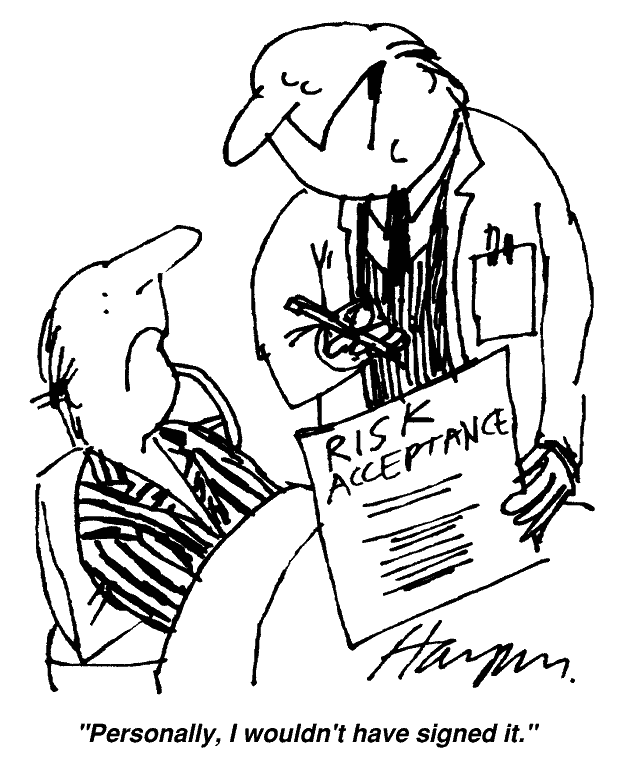
Showing posts with label consent. Show all posts

Monday, June 09, 2014

ABIM's New Research on Physicians

"A systematic, intensive study intended to increase knowledge or understanding of the subject studied, a systematic study specifically directed toward applying new knowledge to meet a recognized need, or a systematic application of knowledge to the production of useful materials, devices, and systems or methods, including design, development, and improvement of prototypes and new processes to meet specific requirements"


It's one thing to ask a doctor to stay current on his knowledge, it's quite another to insist he survey his patients for a private enterprise, especially if that survey represents unvetted independent research.

Recently, a colleague of mine was attempting to maintain his "board certification" credential with the American Board of Internal Medicine (ABIM) and signed up for the ABIM's requirement for a "practice improvement module" worth a required "20 points" of 100 total required before he could sit for his specialty board re-certification examination.  For his module, he optimistically chose to offer a survey created by the ABIM to his patients, receive feedback on how he did on the survey, then repeat the survey to a later set of patients to show "improvement" of care.  In return for his considerable efforts, he would be granted his required "points" from the ABIM so he could qualify to sit for his specialty re-certification examination.

Here is an exact copy of the survey (pdf - 3.52 MBytes) my colleague was sent in its entirety.   He received a packet of 70 of these surveys from the ABIM, neatly shrink-wrapped, to distribute to his patients.

What could go wrong?

First, imagine the time and work involved to distribute these surveys. Whether he provided the survey to his patients himself or he tasked others to do so, what lab result was not reviewed or phone call not answered as a result?  We can only speculate.

Second, informed consent about the true nature of this survey was not obtained from patients nor my colleague.  Rather, my colleague was coerced into purchasing the survey because he might not be able to continue practicing medicine unless he complies with this requirement.  Informed consent would suggest that the doctor and his patients are informed of potential harms or risks involved with the collection of such survey data.    For the patient: what might their responses mean for their doctor's ability to practice medicine?  How might the working relationship with their doctor be degraded or the trust he has in them be compromised?  For the doctor: how are the data collected on the non-secure website protected, how will they be used against him? Will the data be used for future health care policy development or sold to third parties?

I have no doubt that many will see this survey collection as a benign attempt to truly improve a physician's practice or as an opportunity to empower patients with an means of changing physician behavior.  But I suspect these same people never consider the potential negative consequences of such a survey.  The very idea that this survey is a destructive intrusion into the doctor-patient relationship is a foreign concept to its designers.  We can only imagine the moral outrage and disavowal that will arise in the halls of ABIM with such an assessment.  Yet like a bull in a china shop, the collection of anonymous survey data completely disrupts one of the most tenuous and vulnerable relationships in medicine.  It ignores the vulnerable, highly-charged and often emotional circumstances that accompany any visit to a doctor's office while rendering valid concerns a patient might have about their experience into the muddied waters of anonymous data aggregation.  

Also, this unscientific research survey contains a host of dependent variables like age, race and self-assessments of general health status and mental illness.  Self-assessments make a mockery of non-biased data collection, yet the destructive assumptions made throughout the survey are clear: doctors should have unlimited time, provide unlimited access, and perfect manners toward patients without regard to forces (such as this ABIM survey) that increasingly pull them from what they yearn to do: care for their fellow man, woman or child.   This lack of concern with scientific validity and objectivity  leaves the end game of any particular individual or group "findings" only left to the imagination.  If we are going to investigate whether an individual doctor's behavior reflects an age/education/gender/race bias toward their patients (see questions 42 through 46), this is a serious question, deserving of the doctor's consent, and requiring scientific validity far past that of correlational survey data on an n of 70 patients. The possible "end result" or accusation is far too damning.  Or haven't the ABIM committee members thought of that? But we shouldn't worry - patient bias/irrationality/emotionalism is controlled for by question 41 - where the patient provides us with an assessment of his overall mental health.

If doctor's are subjecting themselves to this kind of scrutiny, shouldn't they (and their patients) know how it will be used? Whether aggregated or individual data, this kind of helter-skelter approach is surely designed to lead to progressive "quality" initiatives to adjust doctor's behavior whether findings are valid or not. We are participating in the first step of yet another new initiative in micro-managing and control of the already besieged doctor.

The intrusion of this survey into the sanctity of the doctor-patient relationship by an independent and non-accountable non-profit organization that ignores sound research and ethical principles should be stopped.  It's negative consequences far outweigh any benefit to patients.   In a recent survey of their membership of over 4000 cardiologists nationwide, the American College of Cardiology found that nearly a third of their respondents indicated that the changes imposed by the ABIM's subversive "re-certification" process (that includes these patient surveys as one tool) will affect their future career plans and will likely accelerate their decisions, such as early retirement, part-time work, or transition to non-clinical work.  Approximately one-quarter of physicians in practice for 15 years or more specified that early retirement is a likely outcome.  Exactly how will such a survey help patients already struggling to access care?  Is ABIM responsible for the repercussions of their physician bullying?

I know this is a time of multiple instances of moral outrage and demoralization for physicians.  But I would ask that you take that outrage and forward this survey to colleagues.  I would also ask that you contact your local professional subspecialty organizations, state licensure boards, and appropriate members of Congress to insist on an immediate moratorium to the American Board of Medical Specialties/American Board of Internal Medicine Maintenance of Certification process as it currently exists.

Believe me, this discussion is ongoing and far from over.

-Wes


Sunday, June 01, 2014

Clicks Unchecked

"Where did that menu item come from?" I recently thought.  "Come to think of it, where did the Allergy field go? What's that?  I have to enter an 'Order' for a consent now?  Whatever happened to speaking with the patient?"

Such are the myriad of thoughts the EMR engenders lately.  So ridiculous.  So time-consuming.  Death my a hundred thousand clicks.  It's like my fingertips are on high continuous suction. Pretty soon I'll have to click the "Excuse Me" or "Pause" button so I can use the bathroom.

Seriously.  In medicine, everything is entered on the computer now.  Everything.  Not just notes and orders, but schedules, message boards, meeting notifications, billing check-boxes that must be paired with diagnosis check boxes.  If it isn't clicked, it didn't happen.  Every time a new "idea" for process improvement that springs forth is codified for the computer.   And guess who's the data entry clerk?

It's gotten so bad we now must scroll to display all the menu options. Even filtering the notes to ones you wrote is dreadfully slow.  Unfiltering them worse still.  Precious seconds of patient care time are repeatedly wasted.

It was bad before, but it's getting worse.  The foxes are minding the hen house of patient safety and doctor overload.  Not that computers aren't wonderful at some things - they are - but to suggest, even for a moment, that they can fix what ails health care in America is ludicrous; to suggest they aren't silently inflicting their own patient care comprise even crazier.

Yet the drumbeat of unending support for computers, simulation, data manipulation continues.  Profit does this.

The data clerks are growing weary.

And patients are noticing.

-Wes


Friday, May 31, 2013

How To Simplify Consents

He arrived at the emergency room diaphoretic, hypotensive, and with substernal chest pressure.  The patient was brought immediately to an emergency room care area and a stat EKG disclosed classic ST segment elevation in the inferior leads.  The cath lab team was immediately summoned as the ER team worked to stabilize the patient.  Within minutes, the attending cardiologist was on the scene, reviewed the EKG, examined the patient, and explained to the hoardes of family members with the patient what was taking place.  In the interest of being expeditious with his consent process as the team was arriving to take the patient to the cath lab, the attending said:

"There is a 1% risk that anything bad that you can think of could happen with this procedure.  If you'd like me to detail those things, I can."

The patient didn't want to hear, and off to the cath lab they went to open the patient's occluded right coronary artery to great relief of the patient and family.

Later, in follow-up, the attending cardiologist was making rounds and asked the patient his occupation.

"I'm a malpractice attorney."

Smiling, the cardiologist immediately asked, "How was my consent?"

"Perfect.  Absolutely perfect."

-Wes

Tuesday, April 13, 2010

Electronically Tailoring Consents

What would you rather know when undergoing a surgical procedure, what are your most likely complications during the proposed surgery based on your own personal characteristics, or all of the potential complications that could arise with your upcoming surgical procedure?

Several major medical centers are betting you'd like to know your tailored personal risks:
Integris Heart Hospital doctors are testing a high-tech consent form for patients considering angioplasty. A computer program draws from a database of 600,000 patients around the country to better predict individual risks and benefits of the procedure.

The new process replaces one-size-fits-all forms that were used primarily as a legal formality. The high-tech version uses simple language and illustrations to explain procedures, while mathematically predicting the risk of complications based on individual characteristics.
While it is impossible to know all of the risks that can occur during a surgical procedure, there may be some value prioritizing risks for a patient based on their renal or hepatic function, for instance. Still, I wonder if we risk sugar-coating invasive procedures (like a coronary angiogram) by suggesting to patients that their risk of stroke was virtually zero.

After all, if you have a stroke during the procedure (no matter how low the pre-operative risk assessment was), your risk suddenly becomes 100%.

-Wes

Sunday, February 21, 2010

Using Videos to Help Consent Patients

Consenting patients for complicated procedures like atrial fibrillation ablation takes considerable time to do well and our facility might do things very differently than other institutions. To assure patients heard a consistent message and to help facilitate our visits with them, we decided to create a 9-minute video to supplement our discussions during our procedural consenting process. While our video was professionally produced (and the circles around my eyes disclose the time of day this was shot), no doubt a simpler video using a hand-held HD video camera and iMovie software on a MAC could provide similar results at lower cost.

In general, I think our patients have appreciated that they can view the video online at home or here in our office as often as desired. We also have burned copies to a DVD so the video can be viewed on a DVD player at home. While the work cannot be completely comprehensive, doesn't have subtitles, and includes only a single patient testimonial, it assures that we convey salient points consistently about what the patient can expect before, during, and immediately after their ablation procedure. Needless to say, they still must sign our standard surgical consent form before undergoing their procedure.

Writing the script for this video forced all three electrophysiologists in our group to agree on the video's content - no easy task as each of us came to this procedure with minor biases as to what were the most important aspects to convey - but this exercise helped us focus our message. Our ongoing challenge will be to update the video as new innovations or information become available in this fast-moving field.

We are not the first ones to use video consenting. Similar efforts have been a common theme in research, such as HIV, neurologic stimulation or chemotherapeutic studies. One trial in performed before arthroscopic procedures showed improved comprehension of information with video compared to standard consent forms. It is also interesting to note that there is an NIMH trial underway to study video consenting in patients with mental illness compared to standard methods.

Important disclaimer: For those contemplating catheter ablation of atrial fibrillation, this video might prove helpful to improve general understanding of the procedure but should not be construed as representative of how other centers perform the procedure nor as a comprehensive list of all of the risks, benefits, or alternative therapies involved in treating atrial fibrillation.

-Wes

Image reference: Jason Wolfe.