Wednesday, October 12, 2016

MOC and DINOs Limit Patient Care in Michigan

Marc Keshishian, MD
BCBS - Michigan
Meet Marc Keshishian, MD.  He's a DINO - a Doctor in Name Only - who is the Medical Director of Blue Cross, Blue Sheild, Michigan.

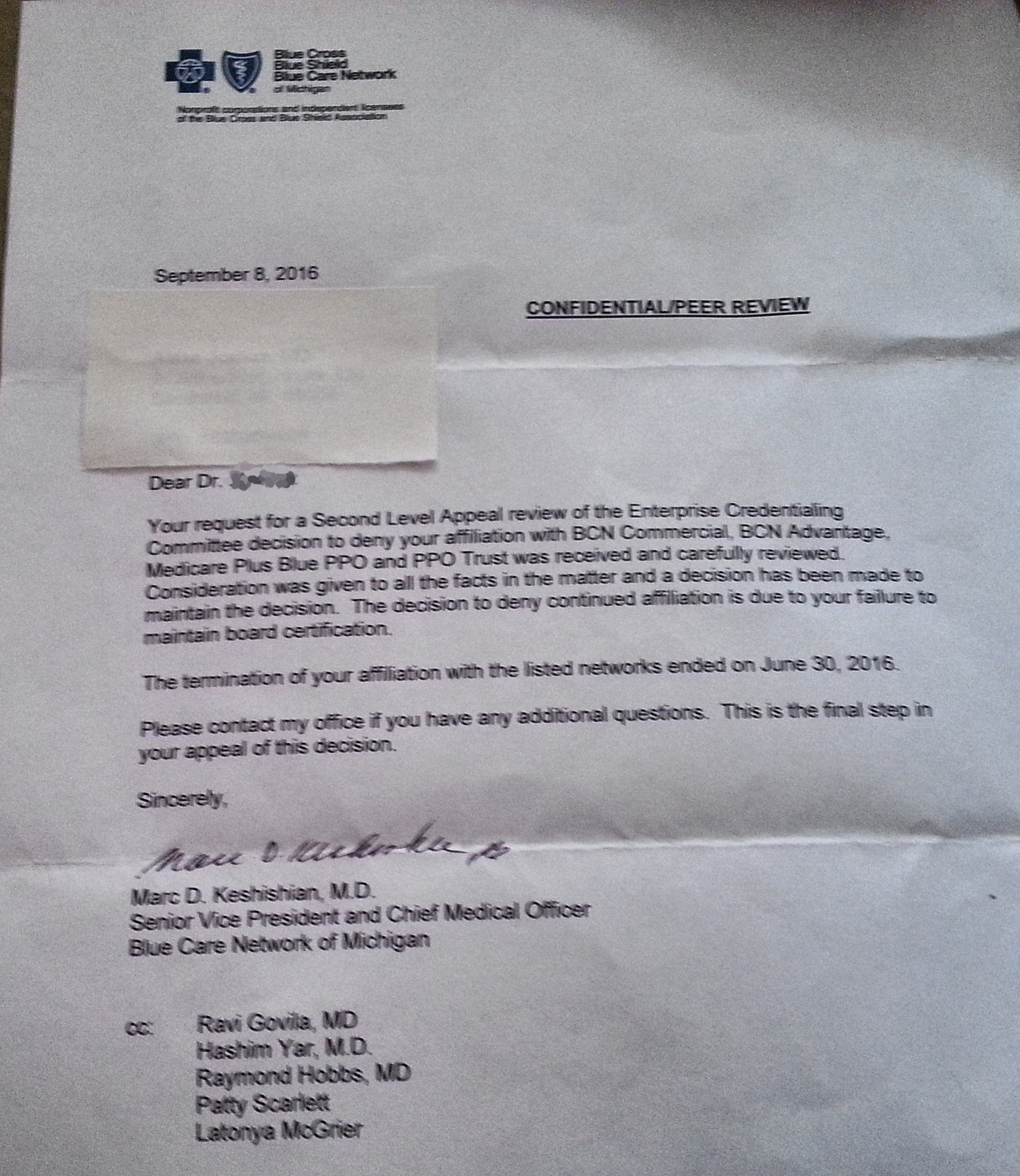
Marc (aka "Dr. Keshishian") believes in the ABMS Maintenance of Certification (MOC).  At least in principle. You see, Marc does not participate in MOC himself.  Instead, after a two-step "careful review," he just decides that those who do not participate in MOC are not worthy of his blessing to participate as a BCBS-Michigan provider, even if they have 10 years experience and are a minority physician provider.

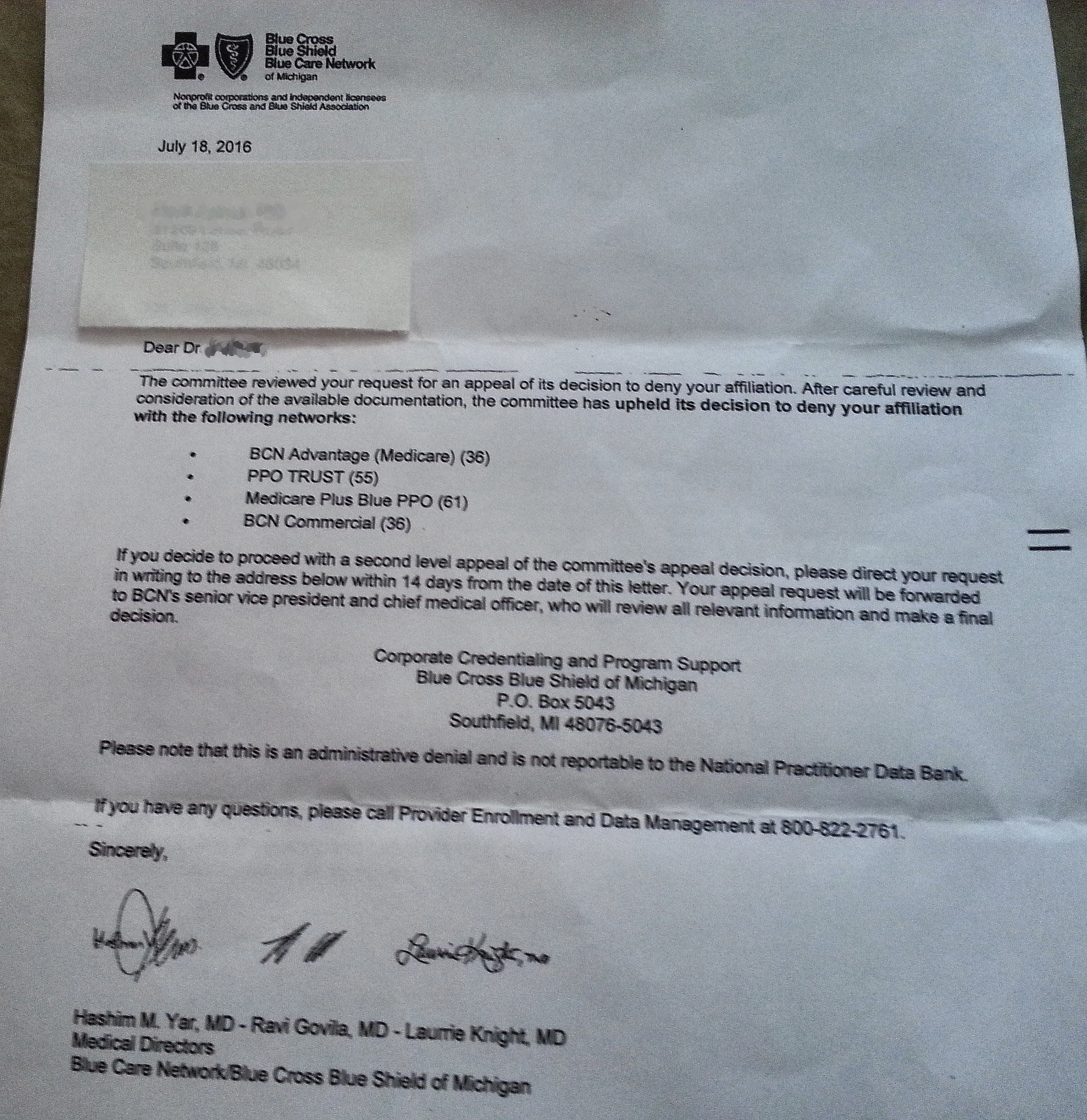
Here are the letters from that physician who refused to participate in the ABMS MOC program in Michigan and instead credentialed with the National Board of Physicians and Surgeons (NBPAS.org):

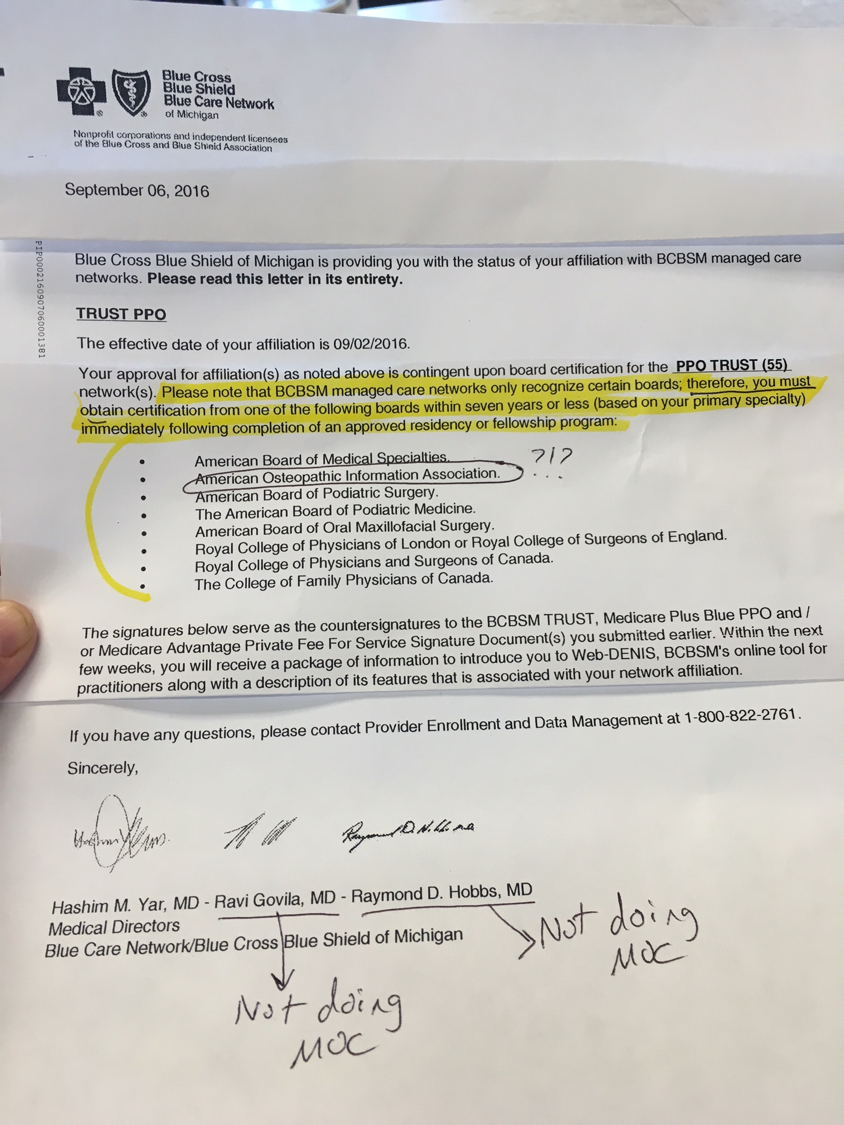
Initial notification of revocation of insurance panel participation by Blue Cross Blue Shield of Michigan
(Click to enlarge)

Second Appeal Letter from Dr. Keshishian dated 8 Sep 2016

Michigan patients should be furious. After all, these corporate DINOs are limiting patient access to physicians because credible physicians who refuse to participate in the unproven, costly, and corrupt ABMS MOC re-certification process. Because MOC has been documented to be more interested in its political and financial agenda than patient care, the AMA House of Delegates resolved to immediately end MOC. It is clear that corporate DINOs at Blue Cross Blue Shield Michigan don't care.

As we can now clearly see, MOC helps preserve the DINOs income and the company's bottom line by restricting access to hard-working (yet expensive) patient-care physicians.

-Wes


PS: Remember, while it is unsaid in his letter, there may be other conflicted DINOs responsible for Blue Cross Blue Shield's policy of requiring MOC for insurance panel participation.

Wednesday, September 28, 2016

Take Twenty-two Minutes to Learn About the ABIM

My talk given to the American Association of Physicians and Surgeons (AAPS):

For those who have been following this blog closely, much of this information won't be new. But to those who want the entire depth and breath of the corruption of the ABIM/ABMS MOC program summarized in 22 short minutes, this is a "must see." Learn, also, what can be done to disrupt the MOC re-certification cartel in medicine. The video was nicely produced and incorporates my slides into the video.

Tell your colleagues who might not know this story to watch.

Tell your local news reporters to watch.

Tell your state legislators and health care regulators to watch.

Then ask your friends at the IRS, FTC, and DOJ to watch.

After all, it's one amazing story that touches much of the bureaucratic house of medicine.

Thanks-

-Wes

Monday, September 26, 2016

Just Dues

She reached into her large canvas bag and handed it to me. “I read about your award, Dr. Fisher, and wanted you to have this to remember it by.”

I was stunned (and a bit embarrassed). “Thank you, Ms. Smith (not her real name).” There in my hands was a beautifully engraved replica of the front-page story in “The Journal,” the local National Naval Medical Center bulletin describing the Young Investigator Award I received from the North American Society of Pacing and Electrophysiology (NASPE) in 1992. Looking back, it was one of my proudest achievements in my young medical career that I can remember. That experience taught me how to do credible research, speak at a scientific session, support my work in a public forum, and write a scientific paper. Ultimately, the award opened important doors for me, like obtaining a fellowship slot at the University of California, San Francisco, one of the most academically productive electrophysiology programs in the country at the time. This plaque still hangs in my office today.

NASPE has since morphed to the Heart Rhythm Society (HRS) to better reflect the organization's more global mission to raise awareness and foster innovation in cardiac rhythm research and management. Cardiac electrophysiologists from around the world attend their annual scientific sessions to learn the latest and greatest innovations in our field. In 2015, HRS had $17M in revenues ($6.6M in registration fees (from Scientific Sessions and board review courses, I assume), $3M from grants, $2.7M from annual meeting exhibits, and $2M from membership dues, representing the largest source of revenues. These revenues were offset by $20M in expenses in FY 2015, somewhat larger than usual due to dissolution of the HRS Foundation which had accumulated a little more than $2M in losses due to lingering administrative overhead expenses. While it touts practicing physician officers, to each of their credit, none of them earned any revenue from their service to HRS in 2015. The CEO of HRS, Mr. James Youngblood, did enjoy a salary of $682,193 for his administrative services in 2015, however. So from what I can gather, MOC educational programs remain important to HRS’s bottom line. No wonder they are reluctant to lose those revenues for the organization! But supporting an illegitimate program that could damage a physician's career just for the revenue stream is wrong.

These past several weeks I received emails requesting renewal of my annual membership fees to HRS, fees I proudly paid every year since I won that NASPE Young Investigator Award. Usually, my administrative assistant would pay the annual fee automatically from my $2500 expense fund I receive from my hospital system. This year, after two years of struggling to have an impact on the MOC debacle and after having an internal debate with myself, I asked her to not pay my dues to both HRS and American College of Cardiology (ACC).

I do not make this decision lightly. I realize that many of my colleagues will think I’m being silly, rigid, or just plain dumb. After all, I won't be able to sit on steering committees for my profession without that membership or the opportunity to chair a scientific session. But most of them also know how strongly I feel about supporting the ABMS MOC program that was born from nothing more than a desire for our cash and is paid to an organization that has participated in blatant tax fraud, accounting irregularities, and strongman tactics that have threatened and intimidated too many unsuspecting and vulnerable physicians without just cause.

This is not to say I do not appreciate the earlier efforts the Heart Rhythm Society to change the MOC system for the better. Efforts like removing the double jeopardy requirement for cardiac electrophysiologists to have to certify in cardiology as a pre-condition to being granted recertification in cardiac electrophysiology, even though you passed the test, for instance, were influenced by their efforts. I also appreciated when they tried to hold sessions at their annual Scientific Sessions debating the need for MOC. But the session held with Dr. Douglas Zipes as MOC protagonist and Dr. Fred Kusumoto as MOC antagonist, allowed the protagonist to dictate the rules, insisting that no discussion of the finances of the ABIM and MOC program would occur, immediately stifling any real debate. Since that time, both the HRS (and their big brothers at the ACC) have increasingly shied away from their original public rebuke of the MOC program. It appears they have acquiesced to MOC's perpetuation, albeit in some as yet undisclosed “modified” form and with a new "blueprint." For this reason, I no longer find myself able to support any organization that allies itself with this scientifically and morally corrupt program.

The MOC re-certification cartel has become a $5.7 billion business enterprise annually in the US alone. It is incredibly divisive to our profession, dividing the bureaucratic in our ranks from those on the front line of patient care. Because this unproven and unwarranted program also threatens physicians’ ability to practice their trade and care for patients, I believe it causes significant harm to our patients by crushing the morale of too many physicians without legitimate cause just so the ABIM, the ABMS, and our own specialty societies can wallow in the MOC program's revenues. Many senior practicing physicians are leaving medicine because of this MOC requirement because they know it's just about the money. The fact that the adverse effects of this program to physicians and their patients have never been independently studied speaks volumes why this MOC program should end immediately.

I have no idea if withholding my dues will make a difference in the fight against MOC.  Certainly if HRS and ACC change their mind and work to end the MOC program entirely, I’ll be the first to reinstate my dues. But what else can I do in the short term? Keep paying? While I'll lose my subscriptions to the Heart Rhythm Journal and the Journal of the American College of Cardiology, I can search our library for articles I need. Still, I suspect I could lose some of the camaraderie that I have enjoyed in my relationship with HRS over the years, and that will be missed, but it seems like a relatively small price to pay.

My years-long investigation of the ABIM has taken me to places I never fathomed I'd have to go to get to the bottom of this story. It is strange the effect this story has had on me. On one hand, I feel greater connection to more of my peers than ever, yet on the other, I feel a quiet discontent from the House of Medicine's leadership that stands to lose the support of their rank and file as the story unfolds. I suppose I should not be surprised, especially since the MOC program has secretly funded so many for so long. But the stakes appear to be getting higher for all involved.* I just hope that exposing all of the corruption against practicing physicians by those in our own ranks ultimately brings the practice of medicine to a better place.

To offset this ennui, it would be great to have an opporuntity to meet those who might join me in my efforts to stop this program by refusing to pay their society dues. Perhaps we could arrange a trip to Chicago in May, 2017 to hoist a beer together in the epicenter of the ACGME MOC bureaucratic Machine together. It would seem quite apropos and I'd look forward to hosting that event. Let's call it "Lemonade out of MOC lemons."

We need to bring back the integrity of our profession ourselves, one dues payment at a time. It is clearer than ever that no one else will do this for us.  It would be quite remarkable if this movement gained steam, but I'm really not holding my breath.

But if it did, it would be nice to at my patient's thoughtful plaque and feel pride in what it means to be a member of a subspecialty medical society again.

-Wes

* I would have posted a picture of my award to accompany this post, but it appears my server may have been hacked. I'll know more in 48 hours as technicians are working to resolve the problem.

Sunday, September 18, 2016

Who Makes Insurance Companies Require MOC?

One of the largest reason physicians must participate in the ABMS Maintenance of Certification (MOC) program is because insurance companies demand it.

At least this is what the NCQA would like us to believe.

Those "evil-doer" insurance companies!

But it is the National Committee for Quality Assurance (NCQA), heavily marketed (video) by the likes of Atul Gwande, MD, that set the rules about which credentialing bodies US insurers can accept. Not surprisingly, the "Department of Health and Human Services (HHS) selected NCQA as an accrediting entity for Qualified Health Plan issuers participating in the Health Insurance Exchange Marketplace."

Who comprises the leadership ranks of the NCQA? Lots of good folks from the ABIM Foundation, the National Quality Forum, American College of Physicians (ACP), the Association of American Medical Colleges, and the insurance industry are members of its board of directors and its leadership team, who else?

And there you have it: a perfectly legal way to monopolize the credentialing process of US physicians, particularly one the ABMS, ACP, and ABIM stand to profit from.

And how much "quality" does the NCQA really require of insurance companies?

Not much:
(Click image to enlarge)
Sheesh. What an incredible waste of tax dollars.

If this is the hypocritical "quality" that the NCQA assures, we're all in trouble.

Time for the NCQA to add the National Board of Physicians and Surgeons (NBPAS.org) to that list of accepted credentialing bodies for insurance companies to utilize nationwide. Otherwise, given the number of suits being filed against the AOA (a.k.a., the "American Osteopathic Information Organization" as circled in the letter above) and the ABMS and its member boards these days, the NCQA board members might need an alternative, legitimate credentialing body to add to their list of acceptable credentialing boards in order to keep their jobs.

Just saying'-

-Wes

Sunday, September 11, 2016

I'm Thinking Vasodepressor Syncope

Hillary Clinton leaving the 9-11 memorial service:
There she was, standing in one place for quite a while while feeling poorly, being supported by one or more colleagues (? secret service agents?), when she tries to "walk" and stumbles toward the ground.

This just doesn't smack of an abrupt cardiac arrhythmia (usually there's no warning there), but rather hypotension. Perhaps a simple faint. Perhaps a side effect of medications. Whatever it was, there wasn't enough blood pressure to remain vertical unassisted.

Other thoughts? (Please be respectful).

-Wes

Thursday, September 08, 2016

A Rebuttal to ABIM President and CEO's Defense of MOC

In August, Medical Economics published an interview with Richard Baron, MD entitled: "The Man Behind MOC Defends the Program Against Critics." Medical Economics then solicited practicing physicians to write a rebuttal. I accepted, but with a warning:
After exchanging a series of Twitter direct messages and e-mails with the staff at Medical Economics, much to my surprise they seemed agreeable to publish my piece  and promised to move forward with the rebuttal for both print and online versions of Medical Economics.  So I signed a "Contributor License Agreement" with UBM LLC, a nearly $2.8 billion owner of Medical Economics (among lots of other throw-away publications) and proceeded to spend the better part of an evening composing my rebuttal and submitted it a few days later.

That was August 12, 2016.

I reached out to Medical Economics yesterday to inquire where things stood on the rebuttal and received a phone call a short time later from a more senior editor that they would be unable to publish my work, especially the part that dealt with the ABIM, but would be willing to write about modifications I might suggest for the MOC program. I thanked them for their review but saw no utility in promoting "modifications" to MOC over ending the program entirely. We parted company politely.

Needless to say, I'm frustrated, but this isn't the first time this has happened. (Welcome to the realities of the Medical Industrial Complex!).

*sigh*

But one of the beauties of social media and the disruptive force of the Internet is that anyone can be their own publisher. Glenn Reynolds famously coined our ability to compete with larger publishing firms "An Army of Davids."

And so, thanks to the wonders of technology, I present my rebuttal to Dr. Baron below.

* * *

Richard Baron, MD, President and CEO of the American Board of Internal Medicine (ABIM) and the ABIM Foundation, was recently interviewed by Jeff Bendix of Medical Economics and once again attempted to defend the ABIM's Maintenance of Certification (MOC) program by rehashing his usual talking points. Dr. Baron argues that because there is an explosion of medical information out there, doctors should use ABIM recertification metric to prove to themselves, patients, and institutions that they are staying current in medicine. Dr. Baron also seems to believe that taking computerized tests assembled from a database of rehashed test questions every ten years is superior to gaining 10 years of direct patient care experience.

Unfortunately, Dr. Baron and his bureaucratic colleagues at the ABIM seem to have forgotten that practicing physicians are committed to caring for patients, not to supporting Dr. Baron’s retirement fund.

While endlessly promoting their Maintenance of Certification (MOC) program to the public, the truth is that the potential adverse effects of ABIM re-certification on physicians and their patients have never been studied, nor has the American Board of Medical Specialties (ABMS) MOC program ever been shown to improve the quality or safety of patient care (See here, here, and here), especially as it pertains to a physician's specific practice environment. Their form of assessment is, in effect, a one-size-fits-all assessment of a physician's ability to retain facts and take a test, little more. Despite these facts and thanks to heavy lobbying to the medical community by those who stand to profit from the program, practicing physicians certified after 1990 must perform this ritual every 10 years to retain their hospital privileges or be allowed to be providers for many large insurance plans while physicians certified before 1990 do not - a discriminatory practice against younger, more economically vulnerable physicians.

As a triple "Board-certified" physician in good standing who has experienced the transition of the ABIM "Board certification" credential from a voluntary once-in-lifetime designation to a time-limited one, I have experienced first-hand the irrational and humiliating process of re-certification that makes a mockery of the entire health care accreditation process. After spending nearly $10,000 to "maintain" my certifications in cardiovascular diseases and cardiac electrophysiology in 2013 for the third time and having to be scanned, searched, and videotaped to assure my integrity in a PearsonVue testing center, I decided to study the finances, practices, and financial conflicts of interest that have come to define the ABIM and (as I have since learned) much of our physician credentialing system in the United States. Some of my earlier work has already been published. In the financial analysis of the ABIM, I was joined in my effort by Mr. Charles Kroll, a certified public forensic accountant specializing in health care non-profit organization accounting who has donated over 1500 hours of uncompensated time to this review. As our analysis has continued, other physicians have quietly come forward with additional information and personal stories of the impact of an ABIM sanction when the organization targets practicing physicians they feel are cheating while attempting to study for their unproven quality metric. I have reviewed the ABIM's federal Forms 990 from 1997 to the present and other sources including the internet archive (archive.org), IRS Form 1023, Guidestar.org, Brightscope.com, Pacer.gov, and called and emailed Dr. Baron to understand why my fees were so high and better understand why Dr. Baron is able to pay himself $812,000 per year (nearly four times the typical US internist salary) while the ABIM is $50,642,980 in debt according to its most recent Form 990 (line 22, "net assets and fund balances").

By expanding my review to the ABIM Foundation and other member boards of the American Board of Medical Specialties (ABMS) (of which the ABIM has the most physician diplomats), it became obvious that the problems I found at the ABIM were endemic to most of the United States physician credentialing system under the direction of the American Board of Medical Specialties (ABMS). For instance, the American Board of Pediatrics paid a $2.4 million golden parachute to their retiring 20-year veteran President and CEO, James A Stockman, III in 2012, yet still employed him two years later for $793,438 for working just eight hours a work-week: an almost incomprehensible $2066.24 per hour. Worse still, to the best of my knowledge and belief, all of these transgressions appear to have been conveniently ignored by the leadership of US medicine’s associated member organizations of the Accreditation Council of Graduate Medical Education (ACGME), including the American Medical Association, the Association of American Medical Colleges (AAMC), and the Council of Medical Subspecialty Societies (CMSS). The House of Medicine has become deeply divided between the bureaucratic elite of these organizations and those who struggle every day to do the real work of hands-on patient care.

After writing about by re-credentialing experience in 2013 on my blog, Dr. Wes (http://drwes.blogspot.com), my dive into the corrupt finances of the ABIM began in earnest 16 Dec 2014 with my article entitled "The ABIM Foundation, Choosing Wisely®, and the $2.3 Million Condominium." Since that time, a partial list of my ongoing investigation has uncovered the following:
  • The ABIM Foundation, which was flush with over $47 million in cash when it was supposedly "created" in Iowa in 1999 (as disclosed on its tax forms from 2008 through 2013), was actually secretly created on October 17, 1989, in Pennsylvania. It has since been determined (and later acknowledged by the ABIM on their revised website) that the organization was funded by making multiple (undisclosed) transfers of ABIM diplomat fees from the ABIM (IRS Form 990's for the Foundation are unavailable for review because the ABIM had the IRS remove available tax forms after it changed the name of their Foundation from the "American Board of Internal Medicine Foundation" to the ABIM Foundation in 1999). Additional revenues were transferred from the ABIM from 1999 through 2007, culminating in the purchase of a $2.3 million luxury condominium complete with a chauffeur-driven Mercedes S-class town car in December of 2007. It remains unclear why a 501(c)(3) non-profit testing agency would purchase a condominium as an "investment" or for housing ABIM staff and directors when other cheaper options for housing exist in the Philadelphia area. The list of names of those who actually used the ABIM Foundation's condominium has never been publicly disclosed.

  • One independent peer reviewed cost analysis of Maintenance of Certification has demonstrated the average cost for an internist to re-certify is $23,607 (95% CI, $5,380 to $66,383) and cost US physicians $5.7 billion in 2015. Despite all of these facts, the ABIM and ABMS managed to lobby Congress to have MOC included in the Medicare Access and CHIP Reauthorization Act of 2015 (MACRA) as a physician quality measure even though 501(c)(3) organizations like the ABIM should have lost their tax-exempt status when they covertly participated in this activity, according to federal law.

  • ABIM's own published Maintenance of Certification pass rates from 2000-2014 have demonstrated 13.2% of physician first-time test-takers failed their examination with large and inconsistent year-to-year pass rate volatility raising significant concerns of how the pass rate cut-off point is determined each year and the ABIM's motives for testing.

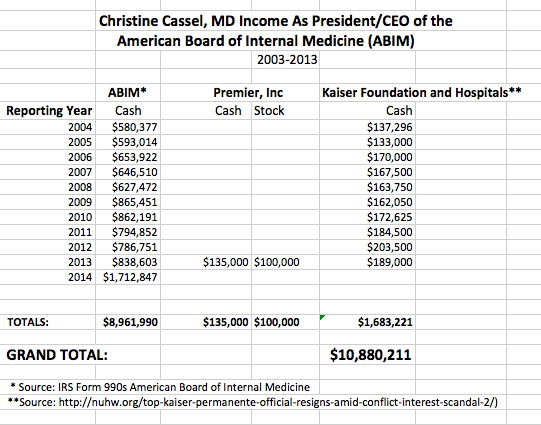
  • Christine Cassel, MD, the former President and CEO of the ABIM and its Foundation from 2004-2014 earned over $8.9 million dollars over 11 years she worked at the ABIM for 35 hours per week and never disclosed her financial conflicts of interest while she simultaneously served on the boards of Premier, Inc., and Kaiser Hospital Health Plans until these relationships were disclosed after she left the ABIM to serve at the National Quality Forum. Despite these ethical lapses, Dr. Cassel still describes herself as a medical ethics "expert" and still serves as a consultant to the highest office in the land: the U.S. President's Council of Advisors on Science and Technology (PCAST) without Maintaining her own Certification status.

  • The ABIM showers their executives with lavish perks on the backs of their physician diplomat fees. For instance, ABIM paid for spousal travel fees for Dr. Cassel for the ten-year duration of her term, even as residents and fellows struggle with the high fees for their certification while having record medical education debt.

  • The ABIM website registration requirements and registration agreement used for their MOC program, ABIM and the ABIM Foundation routinely conduct "research" on physicians and their practices without a research protocol, Investigational Review Board review, or informed consent in violation of FDA and Health and Human Services Protection of Human Subject statutes. Note that the enrollment agreement (no longer found on the current ABIM website) stated: "I understand that the ABIM may use my examination performance, training program evaluations, self-evaluations of knowledge and practice performance, and other information for research purposes, including collaboration with other research investigators and scientific publications." There is no mistaking the ABIM was (and still is) conducting "research" on their diplomats for their benefit.

  • Robert Wachter, MD, former President of the ABIM Foundation, earned stock options from the IPC Hospitalist Company while serving at the ABIM Foundation. While it is unclear what role Dr. Wachter played at IPC Hospitalist Company, the company remains under federal investigation for Medicare fraud.

  • From 2010-2014, the ABIM paid a little-known company to the practicing physician community, CECity, $5,568,538 for their services. Just before leaving ABIM, Dr. Christine Cassel received $130,000 in cash and $100,000 in stock from Premier, Inc, that then announced its purchase of CECity for $400 million a short time later on August 4, 2015.

  • The ABMS plans to sell physician certification data to a multitude of parties at ABMSSolutions.com and offer subscriptions to its CertiFACTS Online product (video). Funny how Dr. Baron and his colleagues at the ABMS fail to disclose this fact to major medical journals and Medical Economics when they are interviewed or publish their articles promoting the need for physician re-certification.

  • Since 1 January 2014, to facilitate the coverup of its operations and to limit transparency, the ABIM no longer permits archived webpages to be stored on a regular basis on the Wayback Machine at archive.org as seen by the absence of archived webpages after that date.

These are just a small sampling of the serious problems that have been uncovered by careful review of the ABIM's actions, ongoing cover-ups, and propaganda inherent to the ABMS MOC program that Dr. Baron supports. Legal fees (all paid by ABIM diplomats) are mounting against the ABIM and the ABMS member boards as they attempt to defend an antitrust lawsuit brought against them, attempt to sanction even more physicians, and have more threats legal action from the Pennsylvania Medical Society’s recent announcement of a vote of no confidence against the organization at the AMA House of Delegates Meeting in June of this year.

Practicing US physicians don't need any more propaganda from Dr. Baron in Medical Economics promoting the ABIM's Maintenance of Certification program, we need a careful independent audit of their finances and a thorough investigation of the ABIM and their collaborating organizations by appropriate authorities to end this unjustified, highly corrupt, and conflicted ABMS MOC program nationwide.

Westby G. Fisher, MD
Director, Cardiac Electrophysiology,
NorthShore University HealthSystem, Evanston, Illinois
Clinical Associate Professor of Medicine
Pritzker School of Medicine
University of Chicago

Monday, September 05, 2016

How the ABMS MOC Program Threatens Major Medical Journal Integrity

They are two of the most prestigious academic journal's in the United States: the New England Journal of Medicine (NEJM) and the Journal of the American Medical Association (JAMA). Both have published extensively on the American Board of Medical Specialties' (ABMS) Maintenance of Certification (MOC) program. Both have clear rules requiring full disclosure of conflicts of interest: the NEJM has its Integrity Safeguards and JAMA, like the NEJM, follow the conflict of interest disclosure recommendations (pdf) of the International Committee of Medical Journal Editors.

But what happens when authors who are widely published in these journals fail to disclose financial relationships that are more than de minimus? Are articles retracted? Are authors sanctioned? Or are conflicts that also benefit the bottom line of one of these medical journals just ignored?

Take, for instance, this article that was recently published in the NEJM: "Maintenance of Certification 2.0 — Strong Start, Continued Evolution" written by Mira B. Irons, MD and Lois M. Nora, MD. The disclosures of the authors reveal that "Dr. Irons reports being employed by the American Board of Medical Specialties" and "Dr. Nora reports being an employee of the American Board of Medical Specialties, and being a coauthor on work describing the American Board of Medical Specialties Maintenance of Certification program." In another correspondence, Drs Norris and Nora, both of the ABMS, disclosed "Dr. Norris reports being on the board and Dr. Nora reports being the president and chief executive officer of the ABMS. No other potential conflict of interest relevant to this letter was reported." In JAMA in August 2015 entitled "American Board of Internal Medicine and Maintenance of Certification Standards," a similar disclosure only lists Dr. Nora's affiliation with the American Board of Medical Specialties.

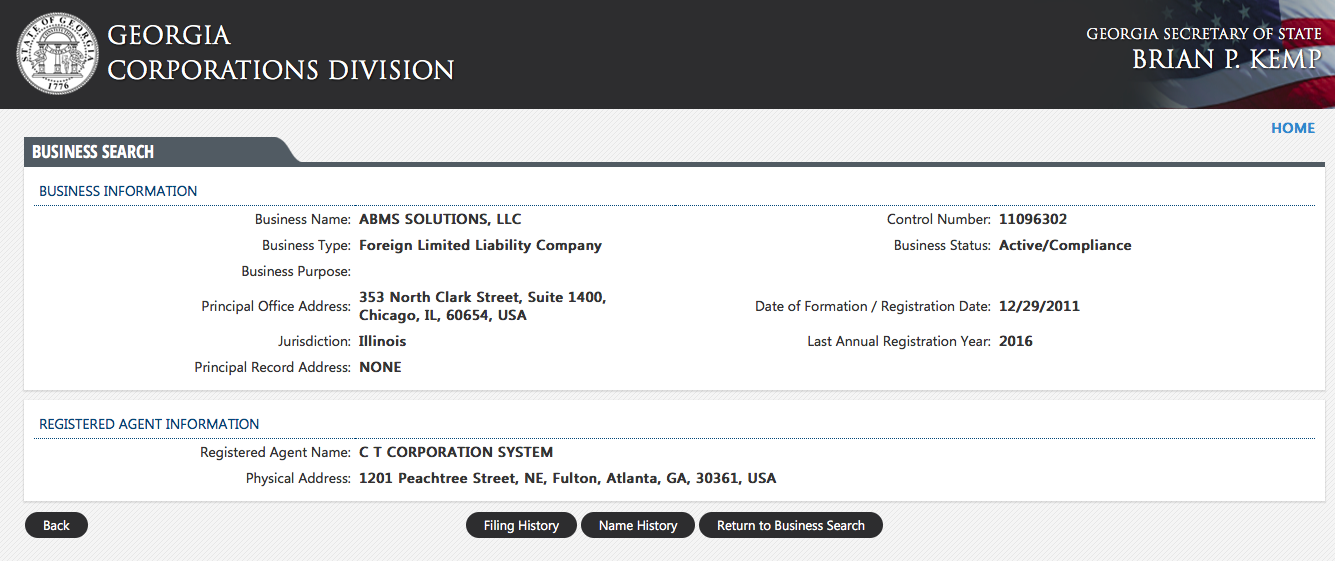
What was never publicly disclosed by either of these major medical journals was the authors' significant financial relationship with the Georgia-registered Foreign Limited Liability Corporation, ABMS Solutions, LLC (Control number 11096304), whose office address exactly matches that of the American Board of Medical Specialties in Chicago, IL. Furthermore, Dr. Nora, as President and CEO of the ABMS, never mentions the congressional lobbying the ABMS conducted with members of the Congressional Energy and Commerce Committee to solidify their MOC program as a "quality" standard for "800,000 licensed US physicians," to assure virtually unlimited funding of their organization through the sale of primary source verification of physician certification status to third parties via ABMS Solutions, LLC.

It is no secret that the New England Journal of Medicine also earns money for the sale of educational products for the ABMS Maintenance of Certification program through their 'NEJM Knowledge+' educational product. This relationship makes the NEJM's response more economically difficult for them. But if the NEJM and JAMA fail to actively address the failure of ABMS authors to publicly disclose their multiple significant financial conflicts with the ABMS MOC program at the time they submitted their manuscripts,  they risk compromising their own integrity with the entire international medical community.

-Wes

P.S.: I contacted the New England Journal of Medicine letter editor to make them aware of these conflicts. They are currently evaluating the situation.

11:05 CST 9/6/2016 - Link to the Georgia corporate registration fixed.

Addendum: For follow-up of the letters I sent to JAMA and New England of Journal Medicine regarding the perceived ABMS conflicts, click here.

Tuesday, August 23, 2016

Hillary Clinton's Physician Does Not Participate in MOC

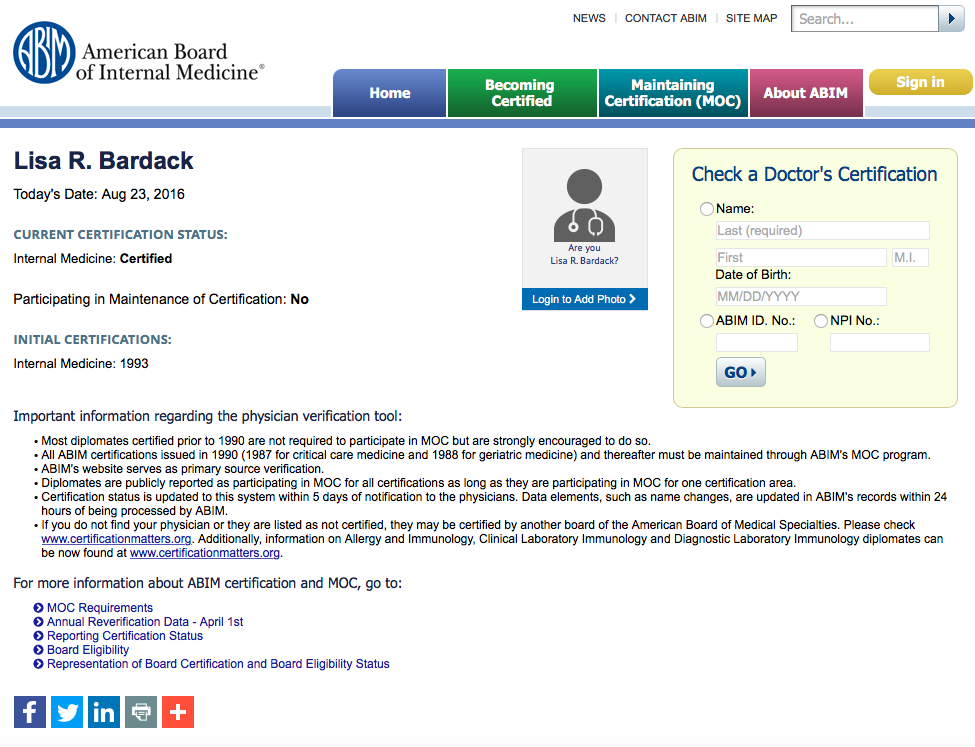
In case anyone cares, Lisa R, Bardack, MD, reportedly Hillary Clinton's personal physician who issued a letter in 2015 concerning Ms. Clinton's fitness to run for President of the United States, does not participate in the American Board of Medical Specialties' Maintenance of Certification (MOC) program:

(Click to enlarge)

Classic.

-Wes

Sunday, August 14, 2016

American College of Physicians Stands By ABIM MOC Program

Like the co-dependent spouse of a raging alcoholic, the American College of Physicians (ACP) continues to support the completely corrupt and untrustworthy American Board of Internal Medicine (ABIM) Maintenance of Certification (MOC) program.

In a carefully crafted e-mail to its members, Steven E. Weinberger, MD, Executive Vice President and Chief Executive Officer of the ACP recently stated:
"We're aware that serious concerns remain about issues related to MOC, expressed most recently in a statement of no confidence in ABIM by the Pennsylvania Medical Society, ACP, along with others, was asked to sign on to the statement. We chose not to because we believe the ACP should continue to press ABIM to improve the MOC process as quickly as possible to make it more relevant, efficient, valuable, and affordable to internal medicine specialists and subspecialists. Although we understand and respect the concerns of the PA Medical Society and others, ACP's priority is improving the process by which physicians demonstrate ongoing competence, and we believe we can have the greatest impact by taking a collaborative approach to making change rather than getting involved in other aspects about ABIM as an organization."
Despite the exposed corruption, illegal lobbying, financial malfeasance, strongman tactics, conflicts of interest, and illegal research performed on physicians for monetary gain, the ACP still choose to side with the Medical Industrial Complex rather than practicing physicians. Rather than siding with their own senior members who are Masters of the ACP, (i.e., Charles Culter, MD, MACP, who has been a outspoken critic and well-respected leader in exposing the ACP's own conflicted role in the physician education and credentialing cartel, among others), the ACP basically is telling their own membership they know what's best for them: MOC.

Then, like a frog leaping from the boiling bath of physician discontent regarding the corrupt and financially-conflicted ABIM MOC program, Dr. Weinberger (like Christine Cassel, MD, former President and CEO of the ABIM) decides to split and toss the MOC controversy hot potato to his successor, Dr. Darilyn Moyer:
"As many of you know, I am retiring from my position as ACP's Executive Vice President and CEO after Labor Day. At that time, I am delighted to turn over this responsibility to ACP's new EVP/CEO, Dr. Darilyn Moyer. As Dr. Moyer takes over her new position, I know she is as committed as I have been to seeing this process to a successful conclusion. Further updates will be coming from Dr. Moyer, but I will assist her as needed over the coming year as part of my interest and responsibility in assuring a smooth and seamless transition process."
Rest assured ACP members will remember Dr. Weinberger's "interest and responsibility" for supporting the MOC program. I encourage as many ACP physician members as possible to no longer renew your membership with the organization.

After all, it is now clear that the ACP is more about the ACP than its members' real concerns.

That's because their new "ACP Practice Advisor offers three new modules (author's note: for a price, of course) that (1) address key attributes and expectations of patient-centered medical homes, (2) are aligned with the Center for Medicare and Medicaid Innovation's Transforming Practice Initiative and the proposed MACRA rule, and (3) are eligible for CME credit and MOC points."

It's so sad to see that integrity, honesty, and financial transparency in our physician specialty societies are now officially being supplanted by little more than corporate greed as they abandon their responsibility to their members in favor of the virtually unlimited fees they can impose on their membership in the name of "health care reform."

-Wes

Thursday, August 04, 2016

ABIM Foundation: "Co-creating" Healthcare?

Should the American Board of Internal Medicine (ABIM) Foundation be using our testing fees to "co-create" healthcare?

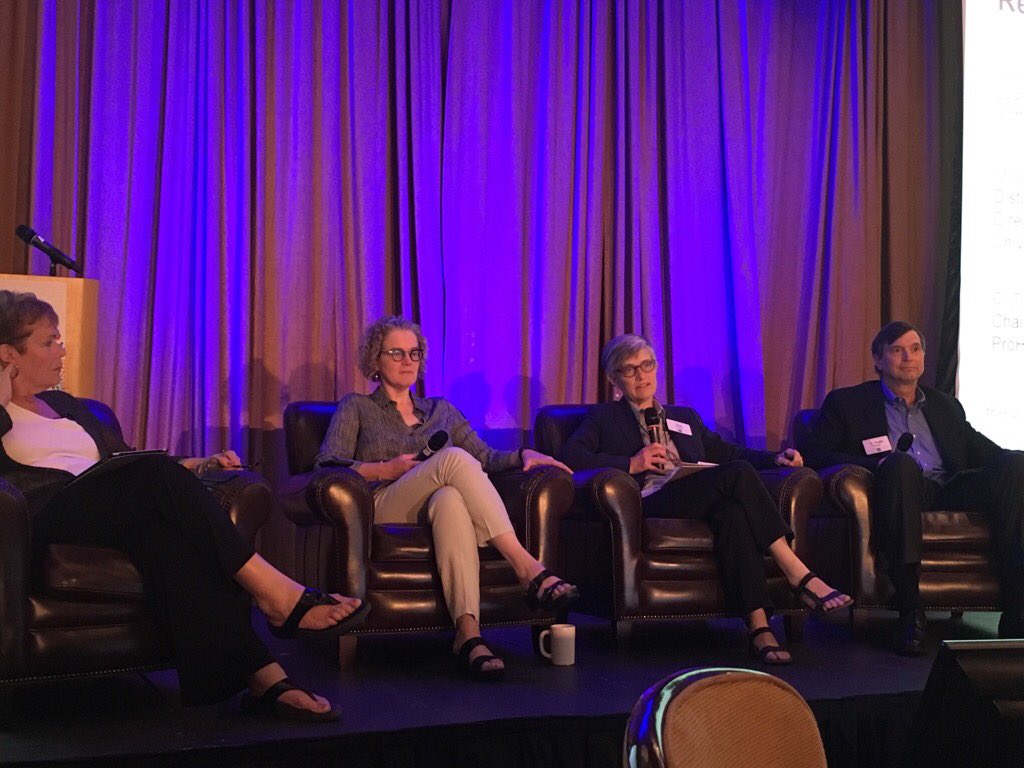
Here is what "cocreation" in action looks like:

As seen on Twitter

(Note the comfy chairs, uplit curtains, and microphones, all provided at ABIM diplomat expense). Real practicing physicians understand that words "co-create" are little more than corporate marketing-speak. Worse still, when the term "cocreation" is being used by members of the ABIM Foundation that has received a majority of funding from ABIM diplomat Board certification and re-certification fees, we see the breadth and depth of just how out of touch this organization is to the challenges practicing physicians face as they try to deliver real health care in America today.

Should front line practicing physicians be funding such waste? What the heck is the ABIM Foundation really for other than forwarding some perverted social agenda? Are they so flush with cash that they feel moved to hold expensive small group sessions with members of the insurance industry? Seriously? How is this helping patients? How is this helping our residents who can't afford the current testing fees at the ABIM?

Here is just a smapling of what just transpired at this year's ABIM Foundation 2016 Forum (just search hashtag #ABIMF2016 on Twitter to see what I mean):
  • A plug for rethinkhealth.org, a website for "dynamic modeling and strategy" funded by the Fannie E. Rippel Foundation, a $35-million financial conglomerate that issues selective grants to "organizations or individuals with whom we have developed partnerships or who we have identified as advancing our core initiatives." In other words, people who share their "vision" for corporate health care, like the Robert Wood Johnson Foundation.
  • A "Human Diagnosis Project" that promised "crowdsourcing will enable us to solve medical problems." (Seriously?)
  • "Health raising" (whatever that is) with multi-colored uninterpretable charts (More gobbledegook)
  • Don Berwick "discussing the complexity and imperative of co-creation in healthcare"
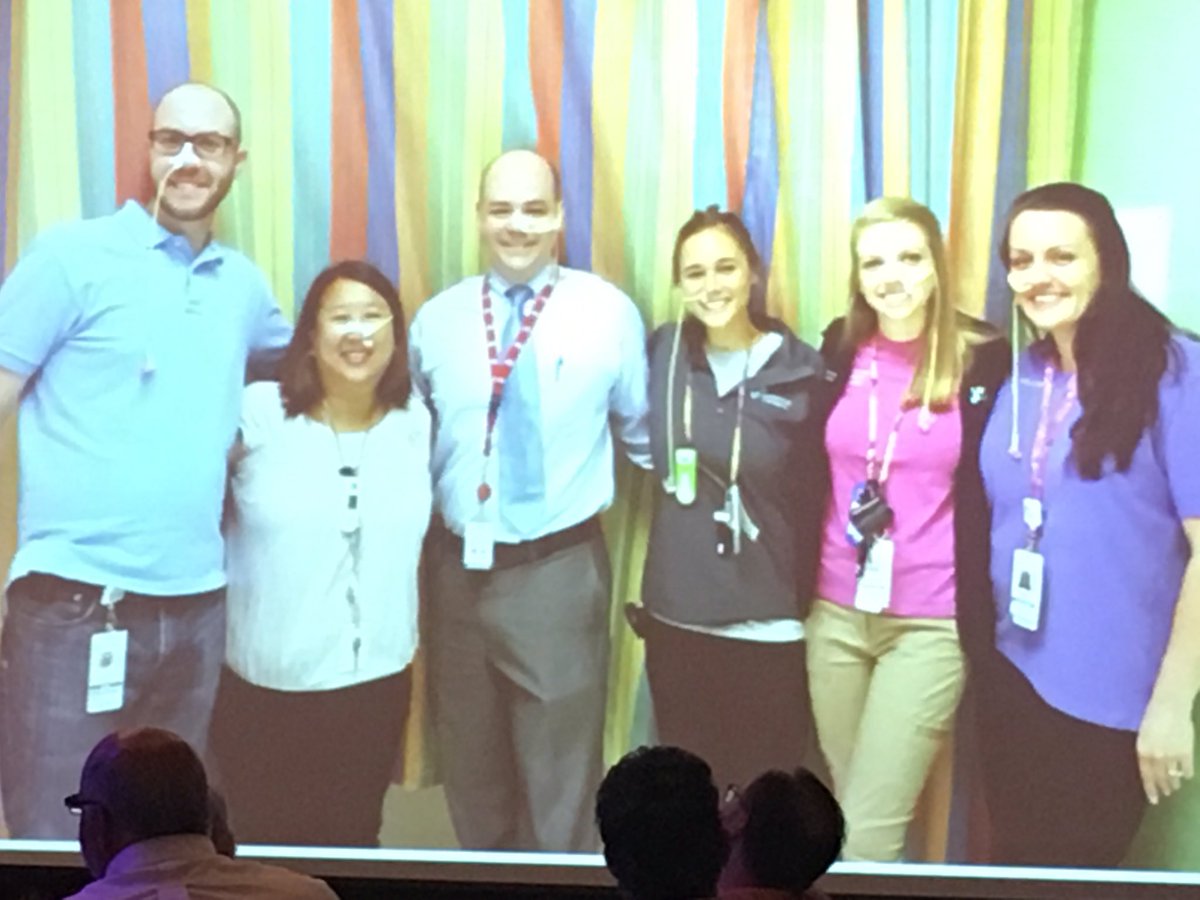
  • And my favorite: "Clinicians/dieticians... try NG tube on themselves(!) as part of cocreation:"
"Co-creating" NG tube placement?
The ABIM Foundation is not about physician credentialing and patient safety and care quality. On the contrary, the ABIM Foundation is spending physicians' hard-earned fees on wooing idealistic health care fluff.

No wonder the real ABIM Maintenance of Certification program and its myriad of conflicts has never been shown to benefit patient care quality or physician outcomes.

They're too busy wasting our money on themselves.

-Wes

Tuesday, August 02, 2016

Class Action Lawsuit Filed Against the American Osteopathic Association

From the Philadelphia Business Journal:
A group of osteopathic doctors have filed a class-action lawsuit against the American Osteopathic Association (AOA) seeking to recover millions of dollars in annual membership fees that the doctors allege they have been forced to pay for years to the organization.

The money, according to their complaint, is paid as a condition of obtaining and maintaining physicians’ board certification in any advanced medical specialty. The lawsuit, filed in U.S. District Court in Camden, N.J., contends the requirement that they purchase memberships is illegal, has no reasonable connection to the advanced certification and violates the antitrust laws.
The AOA forces hefty annual membership fees to the paid to "maintain certification" and the American Board of Internal Medicine (ABIM) assures fee payments to themselves by changing lifetime "board certification" to a time-limited credential without proof of patient benefit - both are variations on the same monetary theme.

This new class action suit adds to the politically-connected Accreditation Council on Graduate Medical Education (ACGME)'s growing "Maintenance of Certification" headache. First, it was the American Board of Medical Specialties (ABMS) with their 24 member boards (including the ABIM) having an antitrust lawsuit filed against them. Now, its another member of the ACGME, the AOA, seeing similar legal action.

Who will be next?

When more details of this corrupt "Maintenance of Certification" program surface, I suspect there will be many more lawsuits. No wonder the ABIM Foundation moved $6.5 million of ABIM diplomat's assets offshore to the Cayman Islands: legal battles.

-Wes

Saturday, July 30, 2016

When Patients Tweet Their Own Heart Attack

I was called at 04:30AM for a patient with tachycardia in the hospital and as I logged into my EMR from home, I saw this on Twitter:


In under two hours, there were 15 retweets, 44 "likes," and 19 comments that appeared on Twitter (so far), most wishing the patient the best, looking forward to pictures of the angiogram, etc.

This is the lovely world of social media, but it also demonstrates his very real limitations of the medium when potential life-and-death health care issues arise.

Not a single person on Twitter with its myriad of participants rushed to Dr. Rogers' aid, called an ambulance (tho' I suppose this depends on who's "following" Dr. Rogers on Twitter), started an IV, placed him on oxygen, gave him an aspirin, grabbed that EKG, prepped the cath lab, opened Dr. Rogers' coronary artery, spoke to his family, or held his hand. Social media reassurance, prayers, and good wishes can only go so far.

This is not too say there is not value in those prayers and good wishes. But we should remember that medicine and medical issues are real life, not digital.

And we should never forget the limitations of all of the digital technology in the world when it comes to delivering hands-on medical care to our fellow man, woman, or child. That requires those much-less-interesting real people, real workers, and real professionals (all on call 24/7/365) to help Mr. Rogers through his ordeal.

God speed, Dr. Rogers. I'm sure you're in the best of hands.

-Wes

Wednesday, July 27, 2016

Moving Forward With Ending MOC

Legislative action at the level of state medical societies to end requirements for participation in the unproven American Board of Medical Specialties (ABMS) /American Board of Internal Medicine (ABIM) Maintenance of Certification (MOC) program is moving ahead swiftly nationwide. Draft proposals for language for resolutions to end MOC at both state and federal levels can be found here (state - Word file - Enter your state name/medical society name at asterisks as appropriate) and here (federal - pdf file draft copy). BOTH are important.

I would encourage all working physicians to adapt these proposals presented by Ellen McKnight, MD of the Florida Medical Association and present them to your state medical society/association so they may be  adopted whole or in part.

Together, working physicians can end this unnecessary requirement imposed unilaterally by members of the ABMS, ABIM, and collaborators within the Accreditation Council of Graduate Medical Education (ACGME) and Accreditation Council of Continuing Medical Education (ACCME).

Wes Fisher, MD

Thursday, July 21, 2016

The Untold Story of Three ABIM-Sanctioned Physicians

He was a bright medical resident in his third year of internal medicine residency - industrious, committed, a team player. He never thought of himself as special. He had studied hard and achieved much in his short 30 years. Not only was he nearing the end of his residency training in Philadelphia, he was married and had his first child about to be born July 19, 2007. Like most first-time wage earners, his $42,000-a-year resident salary didn't go too far as a result.

As a US medicine resident in his third year of training, he would soon be sitting for his Internal Medicine Board examination in the Fall, a requirement to assure his later employability. So he began the process of registration with the American Board of Internal Medicine (ABIM). He read the requirements and the ABIM "Agreement of Conditions" statement on the their website at the time:
Before electronically signing your application, you will be asked to read the following statement:

"By this application to the American Board of Internal Medicine (the "ABIM"), I agree to be bound by the terms, conditions, and rules set forth in the ABIM's Policies and Procedures for Certification and in this Web site, as they may be amended from time to time. I understand that by applying, I am entering into a contract with the American Board of Internal Medicine to provide certain health care operations services, including practice assessment and evaluations. The ABIM HIPAA Business Associate Agreement is a part of this contract.

I agree to indemnify, release, and hold harmless the ABIM, its employees, officers, directors, members, agents, and those furnishing information about me to the ABIM from any claims, liability, or damage by reason of any of their acts or omissions, done in good faith, in connection with this application, information furnished to the ABIM, the evaluation of my qualifications, and examinations. I agree that the ABIM may use my examination performance, training program evaluations, self-evaluations of knowledge and practice performance, and other information for research purposes, including collaboration with other research investigators and scientific publications. In such research, the Board will not identify specific individuals, hospitals, or practice associations. All practice performance data is HIPAA compliant.

I hereby declare under penalty of perjury that the information given in my application is true and correct to the best of my knowledge and beliefs.

I agree to be legally bound by the foregoing."
This statement represented the entirety of his "informed" consent for the ABIM's "research" - and from the looks of things, he was "legally bound" to comply. On the web page this  "Copyrighted Materials" clause was included as well:
Copyrighted Materials

The Board's examinations are confidential and copyrighted under the Federal Copyright Act. Candidates agree not to copy, reproduce, reconstruct by dictation or other means, or disclose examination content in any manner. Board Self-Evaluation Process (SEP) modules are also copyrighted works. Candidates agree not to copy, reproduce, or make any adaptations of the modules in any manner; or to assist someone else in the infringement of this or any Board-copyrighted work.

Professionally and financially unable to do otherwise, he completed his application and paid his $1,135 registration fee for the examination.

A short time later, he turned to his program director to inquire which board review course he should attend. He was recommended to attend the "Arora Board Review" course led by Dr. Rajender Arora MD. Others had gone there and given it good reviews. His Pennsylvania residency program thought highly enough of the Accreditation Council of Graduate Medical Education (ACGME) sanctioned course that they paid his $1000 registration fee. He decided to attend the board review course offered in June 2007 just before his scheduled board examination in August 2007.

The Board Review Course

Five hundred economically vulnerable residents were in attendance at the Arora Board Review course in June 2007.  The young doctor thought the course was taught well and helped him gain confidence for the exam questions he might encounter. Dr. Arora was a dynamic teacher and the examples and commentary he provided were helpful at teasing out the critical concepts for the examination. At the end of the course, it was mentioned that if he'd like, he could help "pay-it-forward" to his fellow colleagues by sending Dr. Arora information about the topics and questions he could recall that he encountered on his Board examination.

He studied hard for his examination for the next several months, rising early and staying up late and foregoing other social obligations. He reviewed his texts, journal articles, and board review materials. Then the day came for his examination.

He arrived at the test center, checked in, had his biometric palm scan recorded, deposited his wallet, car keys and mobile phone in a locker, was later searched, and finally admitted into the PearsonVue examination computer room. There beside him were others, pounding on their keyboards taking examinations for other trades. He sat and got comfortable. On his computer screen was a big ABIM logo with his name below and a set of instructions. Just before the timed test began, he read a document that threatened him if he shared content of the test. He had the choice: either click "I Decline" and be escorted out of the examination center and thereby waste his test preparation and potentially sacrifice his career as a physician or click the "I Accept" button to start his examination. He accepted and took his test, yet never received a copy of the agreement that he had just electronically "signed."

He thought he did well on his certifying examination. He remembered the general concepts of the questions and while he couldn't remember all of the questions and distractors, he was eager to share what he remembered of the test with the person who helped him prepare, Dr. Arora. After all, others likely did the same for him. He decided to communicate with Dr. Arora via e-mail to thank him for his help and share with him what he could recall as a way to "pay it forward" to others as requested.

Time passed. In late October, 2007 he received notification that he had passed his boards and felt relieved that he had at least secured himself the potential for gainful employment as a "Board certified"  internal medicine physician. He had no intention of repeating that ordeal, at least not in the immediate future. As life would have it, his medical passion had evolved to physical medicine and rehabilitation. His second child was born November 10, 2009 and because residency slots were tough to obtain, he moonlighted to bridge the gap before his second residency in his chosen field began.

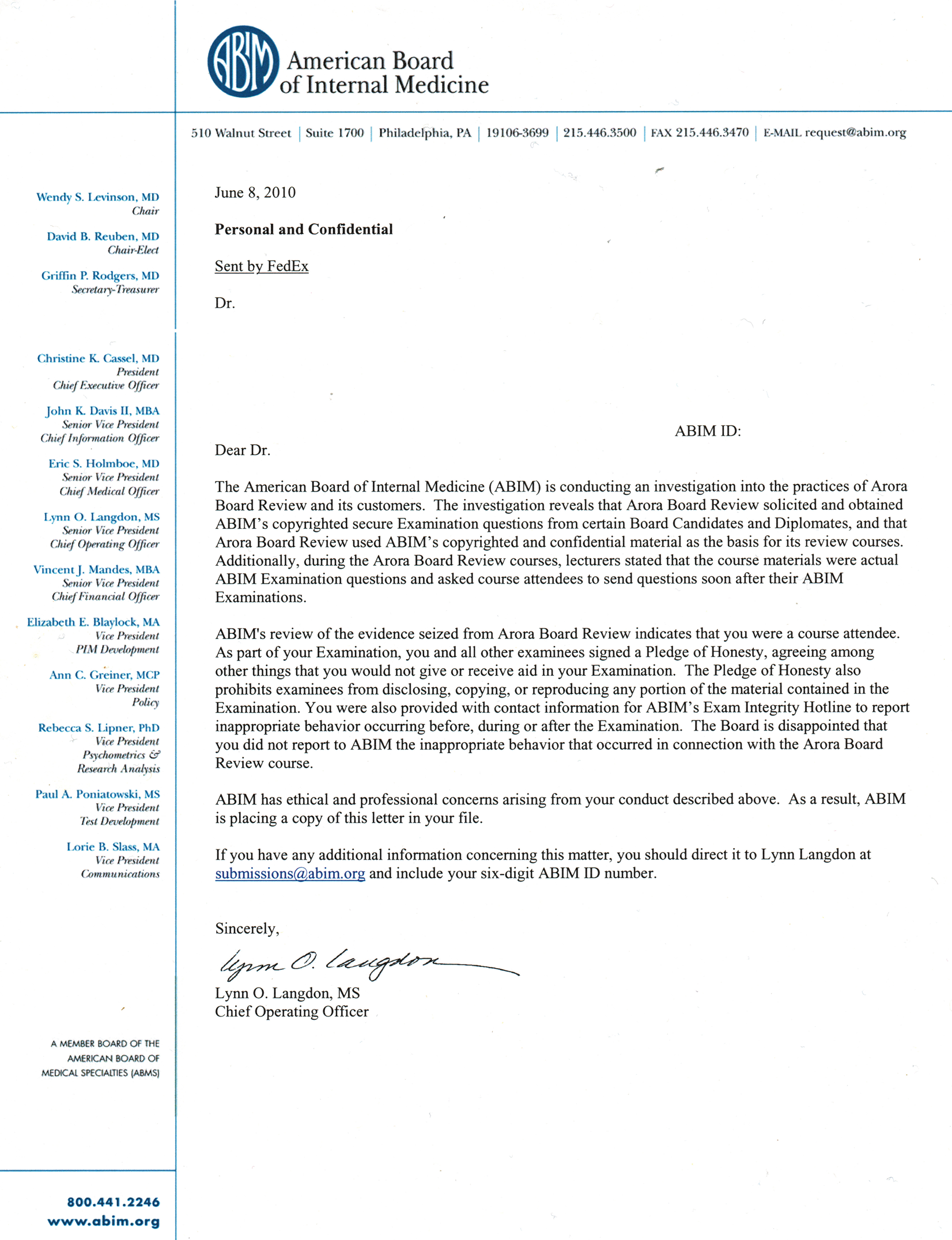
On June 8, 2010, he received a sanction letter from the ABIM. In that letter the young doctor learned that the ABIM had suspended his certification for three years because they alleged that he had shared question content from memory with Dr. Arora in violation of the ABIM's "Pledge of Honesty." His board certification status was immediately revoked without due process.

His mind spun. "How in the world?... What happened?" His life, quite frankly, had gone from idyllic to uncertain in an instant. He couldn't sleep. He was humiliated and had to tell his wife. But one thing he was sure of: he didn't want to have to take the test again. Four years of medical school. Three years of residency. Night call. Sleepless nights. Finally, realizing the magnitude of what had happened to him and the possible lifelong ramifications, he retained a lawyer.

He spoke with his lawyer - someone he'd worked with earlier. She was sympathetic. So calls were made to the ABIM's lawyers. At first, ABIM lawyers were unyielding: it was a three-year sanction and then he had to retake the examination.

A short time later, his lawyer called him to tell him about this article that had appeared in the Wall Street Journal June 9, 2010. He was not the only one; there were 138 others. His penalty could have been worse, he was told. At least he wasn't formally sued but his privileges to practice medicine were temporarily suspended at one of his hospitals from 2010 through part of 2011 and compromised his ability to moonlight to pay for his children's daycare.

"I can't take that test again. I just started my residency!" he thought. After pleading with ABIM, the sanction was reduced from three years to one on July 28, 2010, but he appealed this decision since the financial and professional implications of even a one-year sanction were devastating.

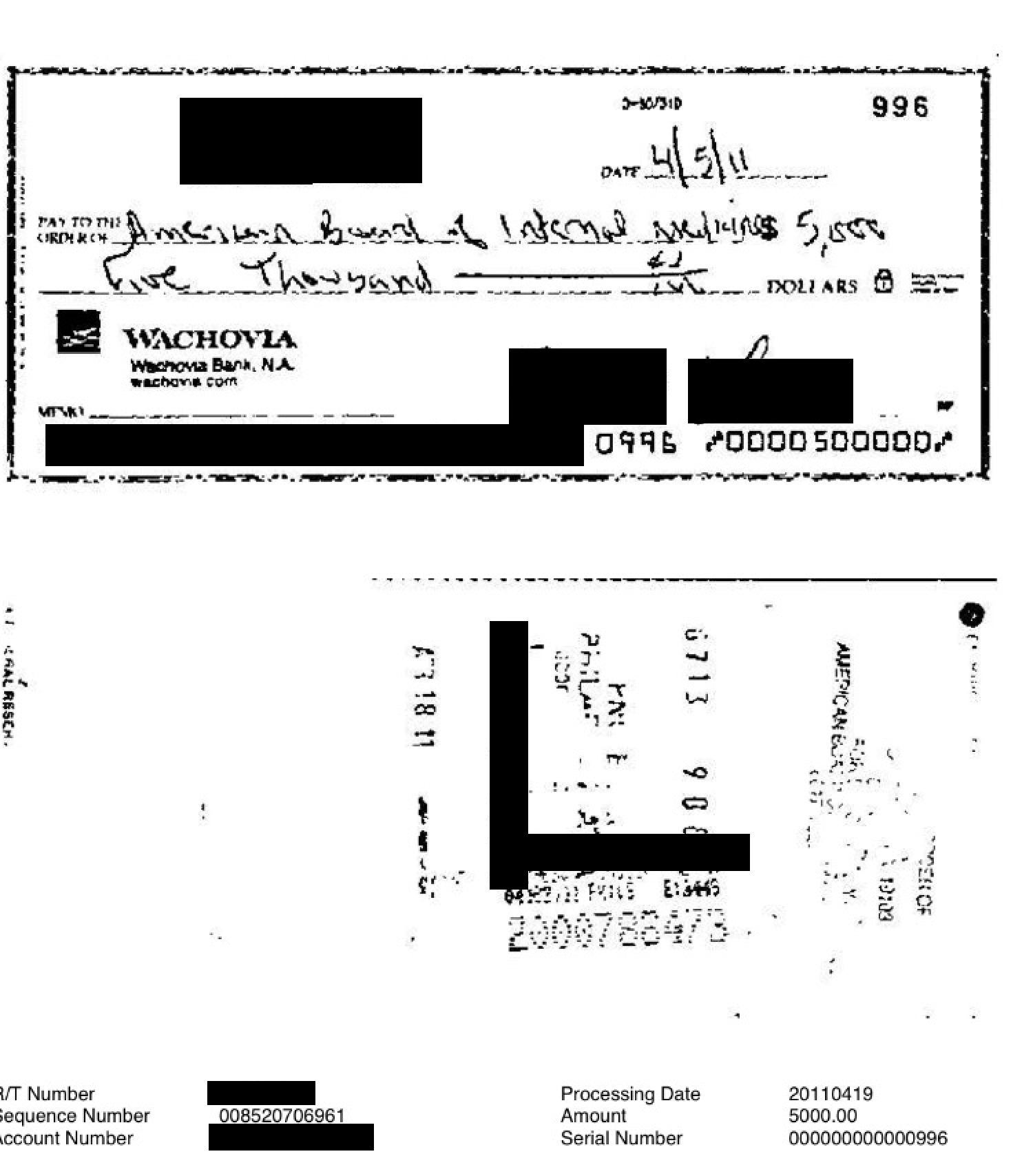
Months later after more letters and were exchanged a plea "deal" was struck with the ABIM April 5, 2011 - the ABIM agreed to settle with the doctor for a $5000 fine along with 20 hours of community service in a medical-related charity and proof of completion of an ethics course.

What choice did he have but to agree to those terms?

Cancelled Check Paid to ABIM to Reinstate Board Certification*
(Click to enlarge)
Finally on 1 Sep 2011, the young physician's Board certification was reinstated but the scars linger. From now on, he must always explain that he was "sanctioned" by the ABIM when completing a hospital credentials' packet or being licensed by his state. Needless to say, he no longer practices in a hospital setting.

Commentary: In retrospect what this young doctor didn't realize at the time was that the Arora Board Review course was secretly recorded as part of an ABIM-sanctioned "investigation," apparently without law enforcement  oversight.  On the basis of that recording and evidence gathered by a undisclosed ABIM employee that secretly attended the review course, this "evidence" was presented before a federal judge by Christine Cassel, MD, Ms. Rebecca Baranowski, and A. Benjamin Mannes (the ABIM's currently employed "Director of Investigations" who carries two felony convictions (for impersonating a police officer and carrying an unregistered firearm) and has unfettered access to the ABIM diplomat's files and personal information). On the basis of that information, the ABIM was granted a writ to seize under seal after providing $10,000 in collateral so Federal Marshals could secretly invade Dr. Arora's residence with ABIM attorneys accompanying them. According to court documents, the ABIM obtained images of Dr. Arora's computers, hard drives, and 36 boxes of course materials. To the best of my knowledge and belief and on the basis of this ABIM "letter of concern," only after obtaining those computers did the ABIM discover the emails of who attended the Arora Board Review Course course and had communicated electronically with Dr. Arora.  The earlier communications with Dr. Arora were thought to be private and occurred without financial renumeration to either party of any kind. As such, it appears the raid was little more than a fishing expedition for physicians' emails and addresses who attended the board review course. It appears to me that because the young doctor's email to Dr. Arora was found on one of those computers, and he represented a vulnerable target, he was immediately sanctioned without due process. Dr. Arora, on the other hand, worked a separate settlement deal with the ABIM that has never been made public.

Same Course, Different Doctors, Different Sanctions

Another Arora Board Review sanctioned physician-attendee had a different penalty imposed.  Not only was this physician sanctioned for three years initially, this physician was later forced to sign an agreement with the ABIM that he had committed an ethical violation, had his upcoming subspecialty medical board examination cancelled, and was required to re-take his internal medicine certification examination. But this was not his most difficult problem.

After learning of the ABIM's sanction, his state licensure board also required the physician pass a "maintenance of certification" examination, take an ethics course with an "unconditional pass," do 50 hours of community service, pay a $1000 fine, and provide peer review references before state would re-issue this state license to practice medicine. His online credential verification still documents his sanction today. All of these actions did not include the legal expenses the physician incurred to defend himself with two separate state licensure boards (WA and TX) and the ABIM itself.

Ongoing Litigation

Some nine years after the June 2007 Arora Board Course, the ABIM has still not finished sanctioning physicians. Jaime Salas Rushford, MD, a Puerto Rican physician who attended the same Arora Board Review course, learned of his sanction by the ABIM on 8 May 2012. In his sanction letter, his certification was revoked indefinitely. Shortly thereafter, Salas Rushford also learned that he had been sued by the ABIM as well. What the ABIM had not anticipated was that Dr. Salas Rushford's parents are lawyers. They filed a counter-suit (begins on page 32). The case has been ongoing four years later and full details of the ABIM's operations and tactics are being systematically uncovered in documents on Dr. Salas Rushford's website, doctorsjustice.com. Millions of dollars in legal fees paid by physician diplomats continue to flow to the ABIM's legal team. Unfortunately for all US physicians, this story is far from over and will likely become, as described by the Pennsylvania Medical Society in their recent vote of no confidence (more here), "the most expensive medical mistake in the history of medical education."

Epilog

Given what we now know about the ABIM's long-standing tenuous financial condition, the "research" the ABIM performed and funded from these vulnerable diplomat's exam fees without true informed consent, the undisclosed lobbying that ABIM participated in as a non-profit outside of federal regulations, the years of fraudulent tax filings, the funneling of $55 million of ABIM diplomat fees to fund the ABIM Foundation that performed additional "research" and purchased a luxury condominiums for its use, it is hard to imagine the ABIM has physicians' or our patients' best interests in mind. Furthermore, the American Board of Medical Specialties' (ABMS) (who overseas all of the ABMS member boards, including the ABIM) earlier Senate testimony that claimed they are expanding "new kinds of (undisclosed) partnerships with public payers, private payers, and particular patients and consumer groups who represent them to get a deeper appreciation for the kinds of information they seek and their expectations for care..." with numerous undisclosed revenue streams, there is only one question to ask of these unaccountable cartel-like physician credentialing "non-profit" organizations now.

Did the ABIM act in the public's best interest by sanctioning the many vulnerable resident physicians who attended the Arora Board Review course or did they engage in extortion for the ABIM/ABMS's financial benefit as a result of the ABIM's financial largess using police-state tactics?

-Wes

“The arc of the moral universe is long, but it bends towards justice.”

― Martin Luther King Jr.

*The redacted canceled check and redacted documents above were all used with the ABIM diplomats' permission.

Wednesday, July 13, 2016

ABMS vs The Poor

The chilling reality of what is happening to patients when the ABMS changes the definition of what is required to be Board certified and ties it to Medicaid payments:
CMS officials disagree, saying in so many words that it's "unfortunate," but these Tennessee doctors skipped over the details on who, and what services, qualified for the additional pay.

First, CMS rules specified that Medicaid providers had to be board certified in internal medicine, family medicine or pediatrics. These doctors weren't, in part because in rural areas, hospitals often don't require board certification and, for older doctors, it wasn't a mandate after training.

Second, for doctors without board certification, their status as primary care providers could be documented if 60% of the codes they submitted in their claims were for a select set of primary care evaluation and management (E&M) or vaccination services, not specialty services.
So for those doubters out there that thought this "physician" Maintenance of Certification (MOC) discussion was a "physician issue" and did not pertain to patient care delivery, think again.

-Wes

Reference:

MedPageToday: Medicaid Boom Turns to Bust for Tennessee Docs - Lack of certification triggers payback requirement

Sunday, July 10, 2016

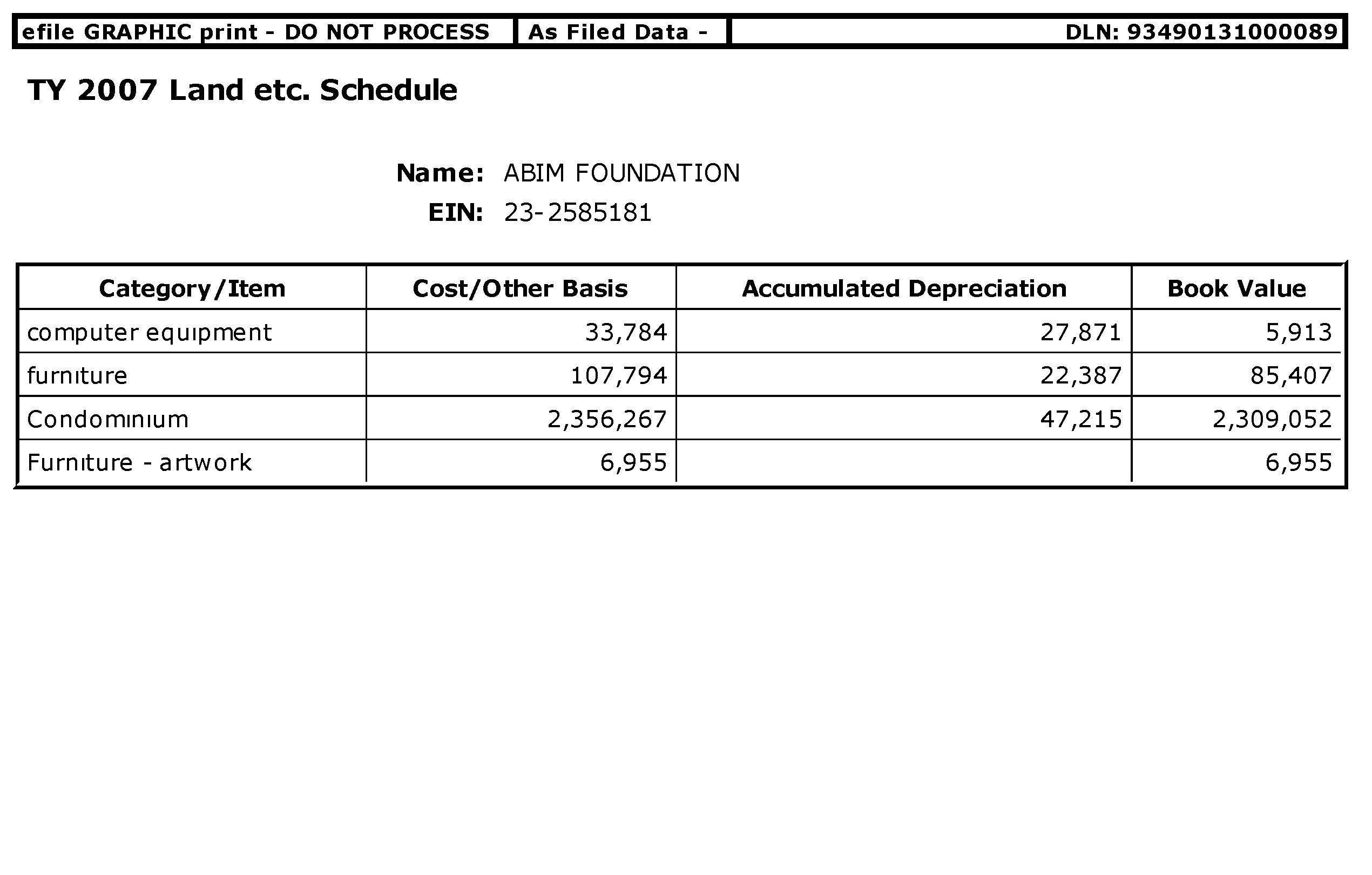
Too Little Too Late: The ABIM Foundation Sells Its Condo

It was a story that broke on this blog nearly two years ago when the American Board of Internal Medicine (ABIM) Foundation was putting their luxury condominium, complete with a chauffeur-driven Mercedes S-Class town car that was purchased with physician certification and re-certification fees, up for sale.

Over 550 days later, we find the notorious ABIM Foundation condominium was finally sold on 6/21/2016 for $1,650,000 representing an up-front cash loss of $650,000.

But let's not forget the other associated fees required to sell a condo:

Real estate commission (6%): ($99,000)
Transfer Tax as buyer (2%) (2007): $46,000
Transfer Tax as seller (2%) (2016): $33,000
Title insurance: $10,000
Other fees: deed preparation, attorney fees, recording fees, etc. $10,000.
Furniture expense: $56,267


And then there's the annual condo fees, cable, phone, electric, cleaning, etc., that came to $41,000-$50,000 annually (approximately $450,000 over 9 years) (Source: Richard Baron, MD, President and CEO of the ABIM and ABIM Foundation)

All told, ABIM took $2,356,267 million of ABIM diplomat's cash and lost at least $1,265,267 on our behalf.

So much for "Choosing Wisely®."

But let's face it, incurring a financial loss on an "investment" is not necessarily illegal. After all, any of us could have made a horrible investment decision.  Rest assured we'll soon hear the ABIM trying to justify their real estate loss because they would have lost this money anyway if they had to pay hotel costs for all of their out-of-town guests and programmers from India eager for a cheap place to stay.

But we should ask ourselves now with the sale of this condominium, what was illegal at the ABIM Foundation? Anything?

Tax Fraud

First, recall that Dr. Baron claimed in my communications with him that much of the condominium expenses they claimed on their tax forms as program service expenses was actually a depreciation expense they lumped into the "program services expenses" of the condominium. Yet the ABIM and their accountants never claimed depreciation under the separate line item on their federal IRS Form 990 for this expense.

Honest mistake?

Unlikely. After all, other tax filing discrepancies with the ABIM Foundation have occurred repeatedly and systematically over many years. Any credible accounting audit should have disclosed most of them.

For instance, surely someone at the ABIM knew the difference between the two states of Iowa and Pennsylvania, didn't they? So why was the ABIM Foundation domicile claimed as Iowa for years when, in fact, it was domiciled in Pennsylvania but never disclosed? And isn't it striking that the ABIM Foundation was claimed for years as being formed in 1999 until this blog disclosed that it was actually created in 1989, some ten years earlier? Only in its most recent tax filings has that little "oversight" miraculously been corrected without explanation to the Internal Revenue Service.

And why didn't the ABIM disclose that it was lobbying Congress on its tax forms when it had been doing so for years? Was this merely a mistake? Or was it because the ABIM and their Foundation would have opened themselves up to closer scrutiny and lost their tax-exempt status if they had?

Unethical Research Practices

Finally, we have to ask ourselves just what kind of research on physicians for the betterment of health care requires a $2.3 million condominium? After all, the ABIM Foundation has always heavily touted their research work and publications.

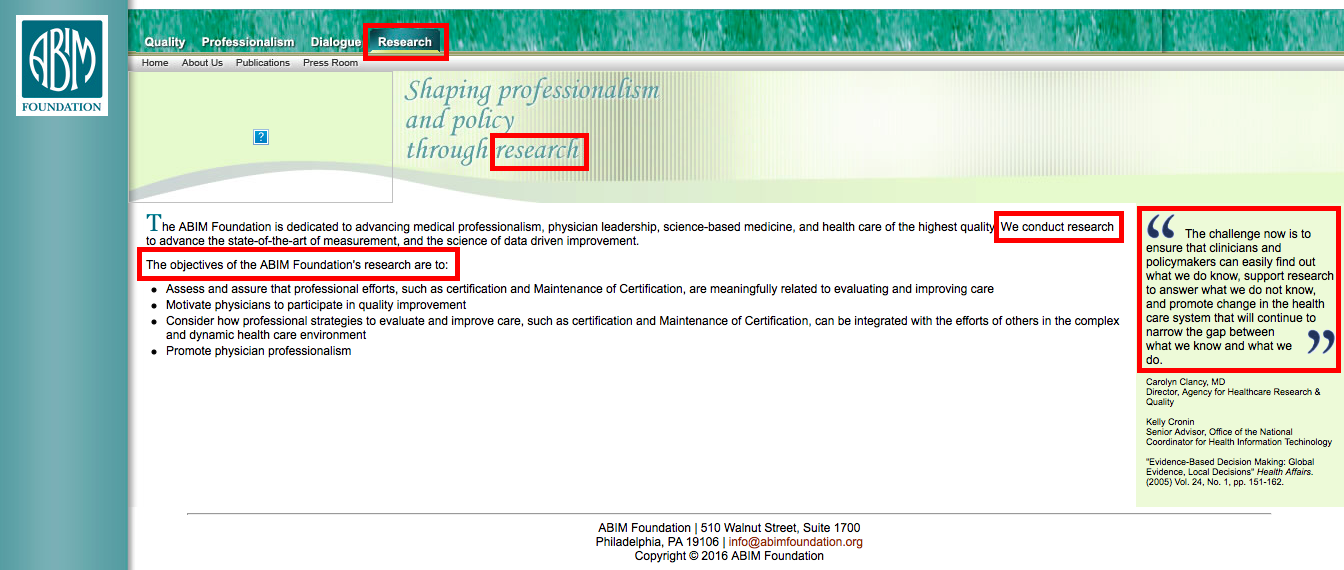
Some may argue there wasn't "research" being conducted at the ABIM Foundation but rather "quality assurance" or "Quality Improvement" exercises performed there. If so, then why did the ABIM Foundation promote it's pioneering research by using the term at least five times on a single web page in May of 2007?

Archived Screen May 2007 - ABIM Foundation
(Click image to enlarge)
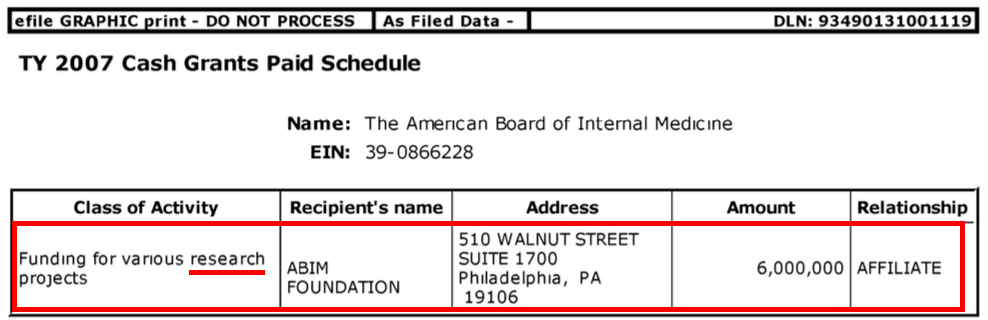
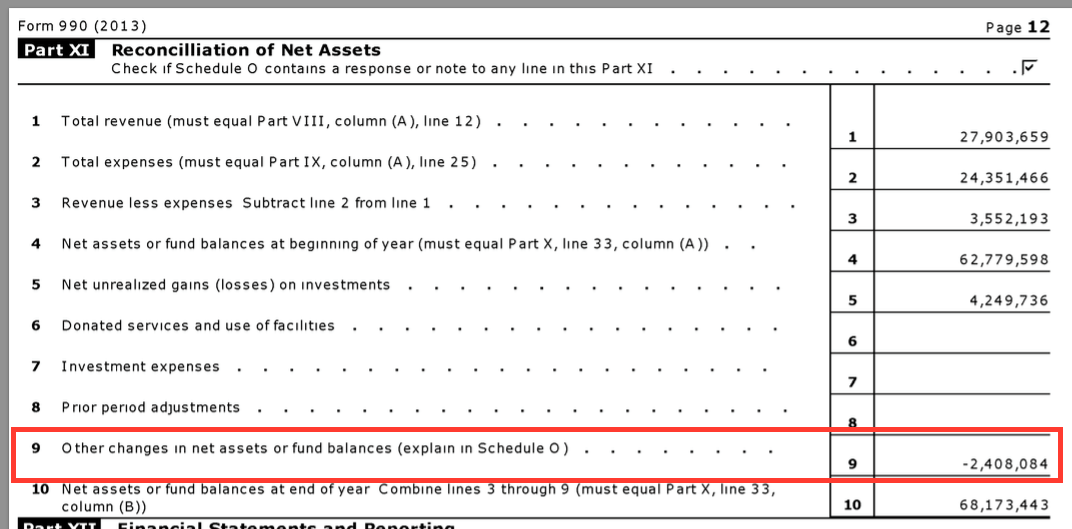
We also find that the ABIM funded "various research projects" at its Foundation in the fiscal year 2008 with the transfer of $6,000,000 of ABIM diplomat fees:

Evidence of ABIM Funding "research projects" at the ABIM Foundation
for $6 million in Fiscal Year 2008
(Click image to enlarge)

There is no escaping the fact that this was a very serious effort at conducting "research" on physicians.

Or not.

Was the whole "research" story told by the ABIM and ABIM Foundation just a front for other activities? I wish to bring my reader's attention that the ABIM Foundation no longer has the word "research" appear anywhere on its website. Instead, there are only words like "Medical Professionalism Charter," "Initiatives," "Grants" and "Choosing Wisely®." The cover-up continues.

Credentialing of physicians involves human testing. As such, it appears the ABIM Foundation unilaterally decided to perform research on physicians without informed consent, without an impartial Investigational Review Board, and without a clear research hypothesis, method, or analysis of the harms they might cause.

"Research" conducted in such a manner is dangerous for many reasons and some of the most egregious examples of dangerous research have happened in government agencies or when the individual or collective social beliefs or dogma were imposed on others as justification for "research."

The Nuremberg Doctrine which rose from the World War II war crimes is very clear in its requirements for human subject research, especially as it pertains to proper consent. From my recently conducted bi-annual CITI Training:
"The voluntary consent of the human subject is absolutely essential.

This means that the person involved should have the legal capacity to give consent; should be so situated as to be able to exercise free power of choice, without the intervention of any element of force, fraud, deceit, duress, over-reaching, or other ulterior form of constraint or coercion; and should have sufficient knowledge and comprehension of the elements the subject matter involved, as to enable him to make an understanding and enlightened decision. This latter element requires that, before the acceptance of an affirmative decision by the experimental subject, there should be made known to him the nature, duration, and purpose of the experiment; the method and means it is to be conducted; all inconveniences and hazards reasonably to be expected; and the effects upon his health or person, which may possibly come from his participation in the experiment.

The duty and responsibility for ascertaining the quality of the consent rests upon each individual who initiates, directs, or engages in the experiment. It is a personal duty and responsibility which may not be delegated to another with impunity."
It goes without saying that human subject research that involves real estate investment strategies to fund research on practicing physicians is unethical (at least) and likely highly illegal. As we have seen, the MOC recertification program can cause significant harm to physicians, their patients, and their families, especially when this credential is tied to physician employment and remuneration. Worse still, the average failure rate of the unproven "Maintenance of Certification" re-certification metric has averaged 13.2% over the past 10 years with wide year-to-year volatility in pass rates using an inconsistent metric. Was the impact of funneling money from the ABIM to the ABIM Foundation for the ABIM Foundation's "research" really that harmful?

Absolutely.

But this story isn't about a condominium or its sale, is it? It's about the wholesale sell-out by some in Organized Medicine that have systematically and repeatedly turned their back on their fellow practicing physicians and the doctor-patient relationship for their own political and financial benefit. For this story is not just restricted to the ABIM or its Foundation. This story extends to all member organizations of the Accreditation Council for Graduate Medical Education (ACGME) that tie the ABMS Board certification credential to medical training program directors, lab certifications, and a host of other regulatory traps, too. So it should come as a surprise to no one that we find more recently that each of these organizations appears to have been complicit with the ABIM Foundation moving funds derived from practicing physicians' "research" fees offshore.

In the end, the entire American Board of Medical Specialties' Maintenance of Certification® story has alway been about making money for their coffers at the expense of practicing physicians, irrespective of the specialty.

Always has been and always will be.

It's NEVER been about "Choosing Wisely®."

-Wes


Thursday, July 07, 2016

Pennsylvania Medical Society Spearheads Effort to End MOC Nationwide


Recently, the Pennsylvania Medical Society sent this letter to the executive vice presidents of all US state medical societies and many specialty societies regarding their vote of no confidence regarding the ABMS Maintenance of Certification® (MOC®) program and the current leadership at ABIM, stating specifically:

"... We believe that their current leadership is not capable of reforming the process in a timely, academically meaningful, and fiscally responsible way.

In keeping with the consensus of our members and physicians across the country, we call for the immediate replacement of the entire ABIM Board of Directors and leadership with new leadership, representative of physicians actively participating in the full-time practice of clinical medicine. The undersigned organizations would further offer to assist the ABIM and any of the ABIM subspecialties with the formation and transition to a new Board that is representative of and accountable to the physicians whom they will certify. ..."
For those interested in learning more or who's state is ready to sign on can email Dr. Scott Shapiro, President of the PA Medical Society at stat@pamedsoc.org‎ for more information.

Please forward a copy of this letter to all of your practicing physician colleagues (irrespective of specialty) and ask each of them to contact the leadership of their respective state medical societies and specialty societies to urge them to co-sign this letter and work with the PA Medical Society to end the corrupt ABMS MOC® re-certification requirement.

Only through aggressive, meaningful, nationwide collective action against this needless, unaccountable, expensive, and coercive ABMS re-certification program will practicing physicians restore sanity to our own life-long continuing medical education process.

Thank you-

-Wes

A copy of the letter to circulate to your colleagues can be downloaded here.

Wednesday, July 06, 2016

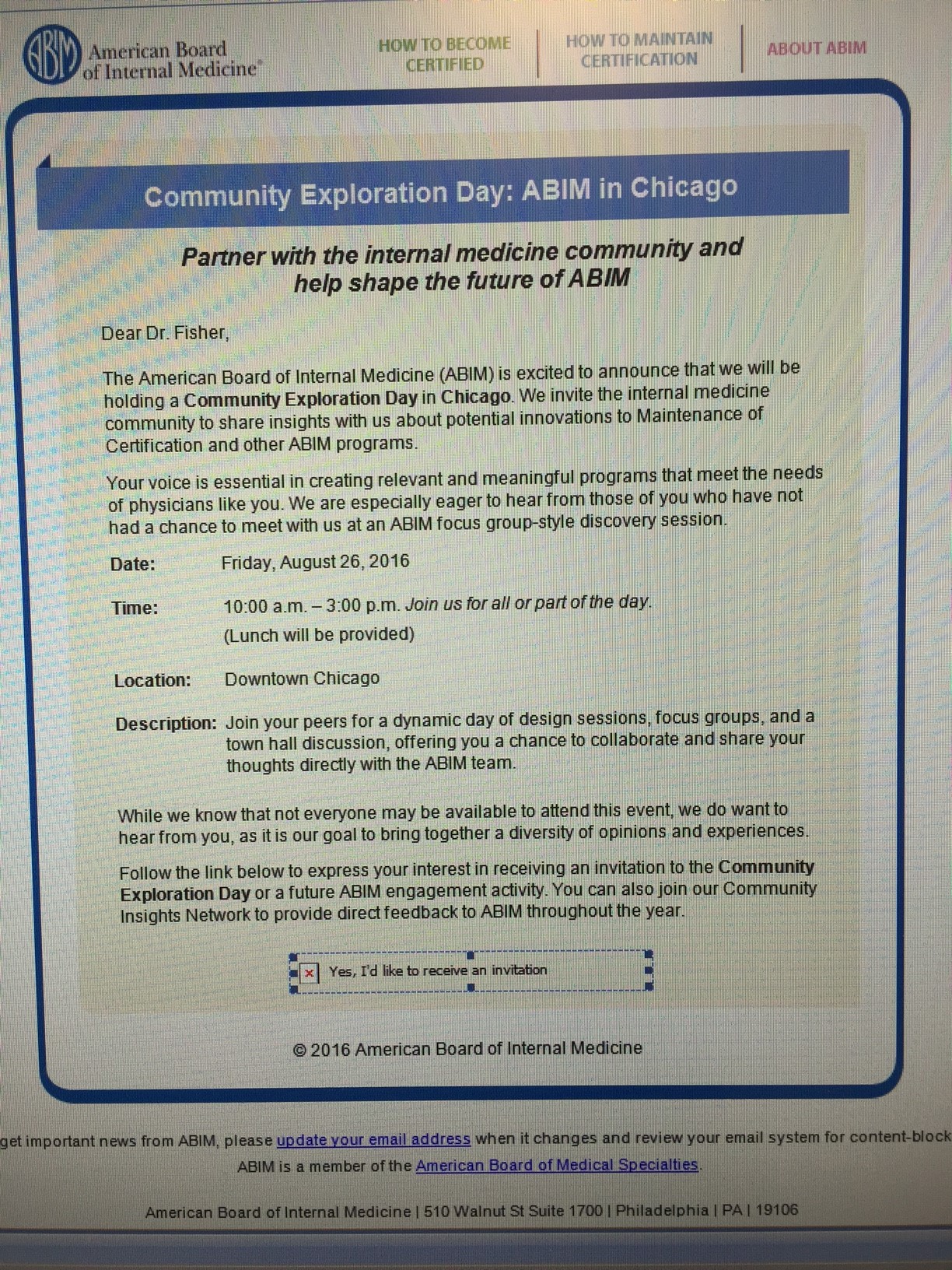
An Upcoming ABIM "Community Exploration" Day in Chicago!

(Click image to enlarge)

I just received the notice above in my inbox at work. It seems there's going to be an "ABIM Exploration Day" here in Chicago 26 August 2016. I requested an invitation but have a feeling I won't be sent one since I disclosed I was one of the ABIM's foremost critics of the ABIM MOC program. (That's right, you have to request an invitation at the link provided in this email blast)

Let's make this like open microphone night and feel free to leave your questions for the ABIM in the comments section on this blog. That way, no matter who goes to this hosted event, they'll have plenty of "exploration" questions to ask Yul Enjes, MD and Richard Baron, MD or their representatives. (Physicians are encouraged to identify themselves (and their ABIM diplomat number) so the ABIM knows you're real).

-Wes

Saturday, July 02, 2016

The ABMS MOC Contagion Spreads

It seems the humiliation of physicians to collect revenues by member boards of the American Board of Medical Specialties (ABMS) Maintenance of Certification (MOC) program knows no bounds.

This time, we begin our focus on the American Board of Pediatrics (ABP).

First, take a moment to read what happened to a younger physician mother-of-three who tried to re-certify in pediatrics when her child was 9 months old and still breast feeding.  Horrible.

Pediatricians are one of the lowest paid medical specialties in medicine. Yet like all US physicians, the must pay thousands to "re-certify" with the American Board of Pediatrics every 10 years.

And why must they pay such high fees?

Perhaps there's no better example than James A. Stockman, III, MD.

Dr. Stockman worked for the ABP for 20 years, retiring 31 Dec 2012.

Dr. James A Stockman III, MD Retires from ABP 31 Dec 2012
(Click image to enlarge)

As part of that retirement, we see the ABP paid him over $2.4 million:

(Click to enlarge)

(Click to enlarge)

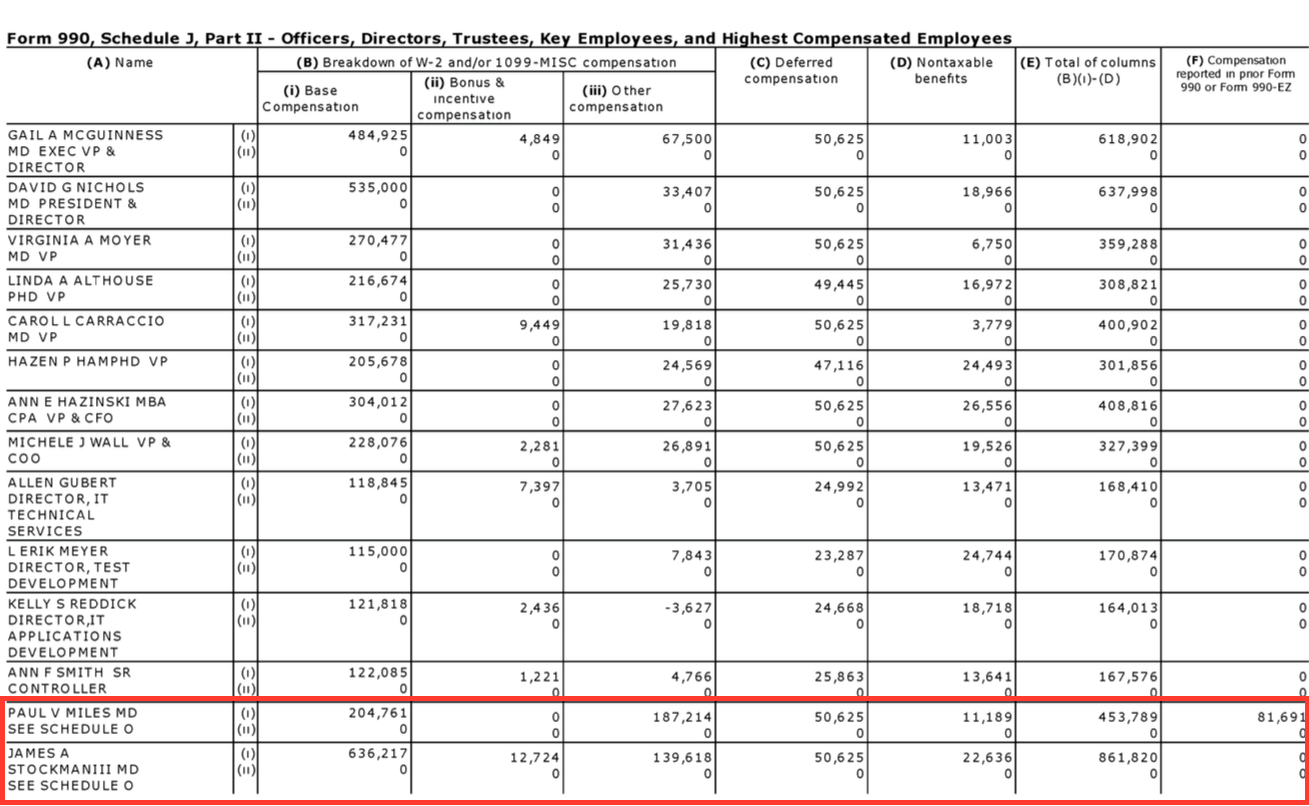
But this, you see, wasn't enough. Despite often earning over a million dollars a year prior to his retirement while working for the ABP, and then making a $2.4 million golden parachute on his retirement, Dr. Stockman stayed on as a "consultant" for the ABP. His first year there, he earned a cool $861,820 working 45-50 hours a week.
(Click image to enlarge)


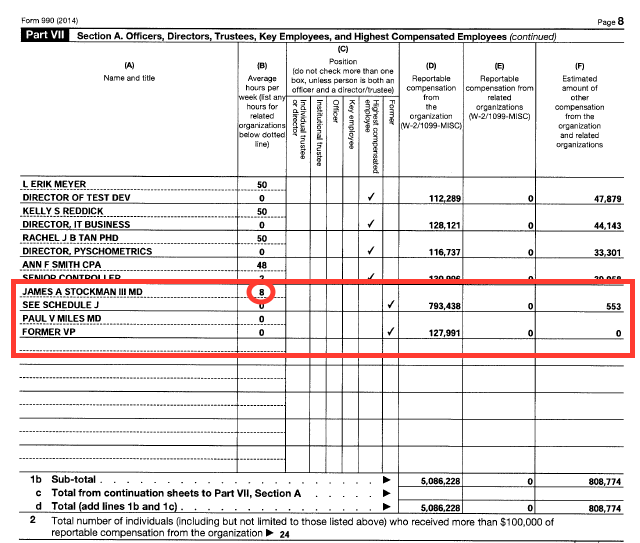
But the next year was even better. On their most recent 2014 Form 990, we see that Dr. Stockman earned $793,438 for working just eight hours a work-week:
(Click image to enlarge)

If we assume there are 48 work weeks in a year and Dr. Stockman works just eight hours a week for a total of 384 hours, then in 2014 Dr. Stockman earned a whopping $2066.24 per hour.

I think it's time pediatricians join internists and cry foul loud and clear.

The ABMS Maintenance of Certification extortion of US physicians has to go.

-Wes

Friday, July 01, 2016

One Small Step

Here's the official final wording of the AMA House of Delegates' Resolution 309, Continuing Medical Education Pathway for Recertification adopted June 15, 2016:
Resolution 309, Continuing Medical Education Pathway for Recertification, was adopted as amended. The final recommendations are as follows:

RESOLVED, That our American Medical Association call for the immediate end of any mandatory, secured recertifying examination by the American Board of Medical Specialties (ABMS) or other certifying organizations as part of the recertification process for all those specialties that still require a secure, high-stakes recertification examination; and be it further

RESOLVED, That our AMA support a recertification process based on high quality, appropriate Continuing Medical Education (CME) material directed by the AMA recognized specialty societies covering the physician’s practice area, in cooperation with other willing stakeholders, that would be completed on a regular basis as determined by the individual medical specialty, to ensure lifelong learning; and be it further

RESOLVED, That our AMA reaffirm Policies H-275.924 and D-275.954 (Author's note: use the AMA Policy Finder to review these policies); and be it further

RESOLVED, That our AMA continue to work with the American Board of Medical Specialties (ABMS) to encourage the development by and the sharing between specialty boards of alternative ways to assess medical knowledge other than by a secure exam; and be it further

RESOLVED, That our AMA continue to support the requirement of Continuing Medical Education (CME) and ongoing, quality assessments of physicians, where such CME is proven to be cost-effective and shown by evidence to improve quality of care for patients.

-Wes

ACGME Announces New Affiliation with ABMS

PRNewswire - (Chicago) July 1, 2016 - Today, the Accreditation Council of Graduate Medical Education (ACGME) announced a new affiliation with the American Board of Medical Stenographers (ABMS), promising new efficiencies and reduced medical transcription errors within the Electronic Medical Record (EMR). "Ever since the Institute of Medicine's (IOM) 1999 report entitled "To Err is Human" that claimed as many as 98,000 patient deaths as a result of medical errors, we've been looking for ways to reduce medical errors in today's hospitals and clinics," said Joseph Throckmorton, MD, President and CEO of the ACGME. "The public has been asking for a way to certify all US physician's typing skills to assure the highest standards of patient care quality and safety," he said.

As part of this program, the ABMS has instituted a Maintenance of Typical Skills® (MOTS®) program using a simple online typing test performed each month in the convenience of the physician's own home or via his or her mobile device. Test scores will be verified and uploaded to the ABMS CertificationMatters website for public review. The cost for physicians will be nominal - only $25 per month. Typing speed and error toleranance levels will be determined by the Board and subject to change. Physicians who fail the test can retake it twice before they must re-register to maintain their credential. A Pledge of Honesty is required of all participants.

"The importance of such a credential comes at a time when self-regulation of our profession is more important than ever," said Imso Boring, MD, JD, President and CEO of the ABMS. "We're proud we could play a part in the harmonization of this important patient care metric with other critical patient care quality and safety initiatives promoted by the ACGME."

Existing members of the ACGME include the American Board of Medical Specialties, the American Medical Association, the American Hospital Association, the Association of American Medical Colleges, the Council of Medical Specialty Socities, the American Osteopathic Association, and the American Association of Colleges of Osteopathic Medicine.

It is currently estimated that EMR typographical errors are the third leading cause of death in the United States.

* * *
 
Hope all my faithful readers have a happy and healthy 4th of July.
 
-Wes