Showing posts with label American Board of Internal Medicine. Show all posts

Monday, June 20, 2022

Antitrust 101: How to Build Medical Monopolies by Discrediting U.S. Physicians

Recently, there have been a rash of initiatives by unaccountable non-profit physician credentialing organizations (Federation of State Medical Boards, the American Boards of  Internal Medicine, Family Medicine and Pediatrics), and the American Medical Association to come to the public's rescue by de-credentialing U.S. physicians they accuse of spreading misinformation during the COVID-19 pandemic.

Physicians have seen this medical monopoly-building playbook before.

The video below reviews the antitrust, monopoly-making activities of the American Board of Internal Medicine (ABIM). The discrediting of certain U.S. physicians as "cheaters" and disseminators of "misinformation" serve as a smokescreen to their monopoly-building activities. As physicians worked tirelessly to care for patients during the COVID-19 pandemic, the ABIM used U.S. physicians' testing fees to redistribute physician testing fees for their "social justice" initiatives, most significant of which was lobbing Congress so their separate Maintenance of Certification (MOC) continuous testing produt would be a never-ending source of revenue and data metrics used by the Medical Industrial Complex. Sadly, this mandate on younger, more vulnerable ABMS-board certified US physicians has harmed hundreds of physicians and tens of thousands of patients as physicians burn out and leave the profession.

For all patients who wonder why health care prices are so high and access to a board-certified physician has become so difficult, look no further than the organizations above. 


Friday, February 25, 2022

What Entity or Person Serves As ABIM's "Restricted" Contributors?

 In late 2018 through 2020, The American Board of Internal Medicine (ABIM) was involved in a class action antitrust lawsuit for claims of illegal creation and maintenance of their monopoly power in the market for maintenance of certification (MOC). Even though there was an outpouring of physician support for the lawsuit from working physicians, the case did not survive massive legal efforts to kill the case on technical grounds before it went to trial.

Now, physicians are left with little choice but to cough up more money to pay the exorbitant salaries of the non-clinical academic elite who run the organization or risk losing their jobs.  It is the tie that binds ABIM's their proprietary MOC continuing education product to physicians' initial subspecialty board certification that allows ABIM to raise their costs without any oversight because physicians require their initial board certification credential to maintain their hospital privileges or place on insurance companies' rosters.

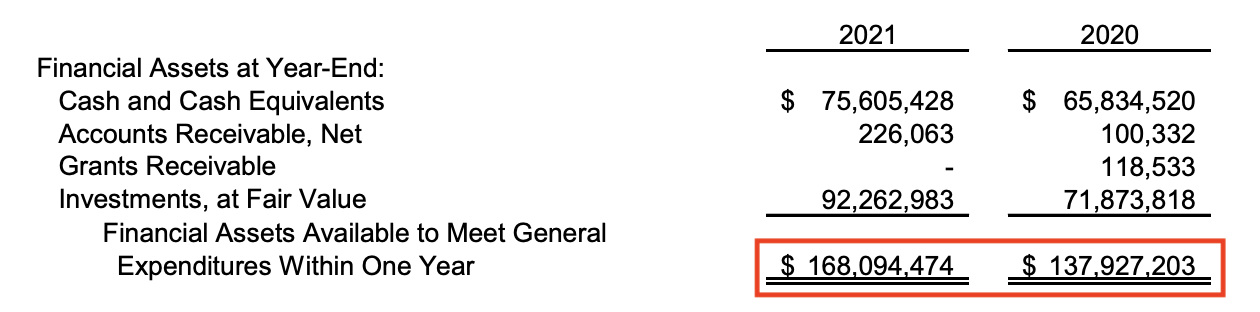
It is particularly concerning that ABIM decided to raise their MOC fees 25% in 2022 when their own assets mushroomed 18% in 2021 alone to more than $168 million:


ABIM has constantly billed itself as a "physician-led" non-profit 501(c)(3) organization. From their About ABIM webpage:

"ABIM is a physician-led, non-profit, independent evaluation organization driven by doctors who want to achieve higher standards for better care in a rapidly changing world."

But are they really? Who is really pulling the strings at ABIM?

We have already seen that the former CEO and President of ABIM, Christine Cassel, MD was serving as a board member of one of the largest Group Purchase Organizations, Premier, Inc, and serving on the Board of Kaisier Hospital and Health Systems while also serving as President and CEO of the ABIM - conflict that was never disclosed to physician-diplomates of the ABIM.

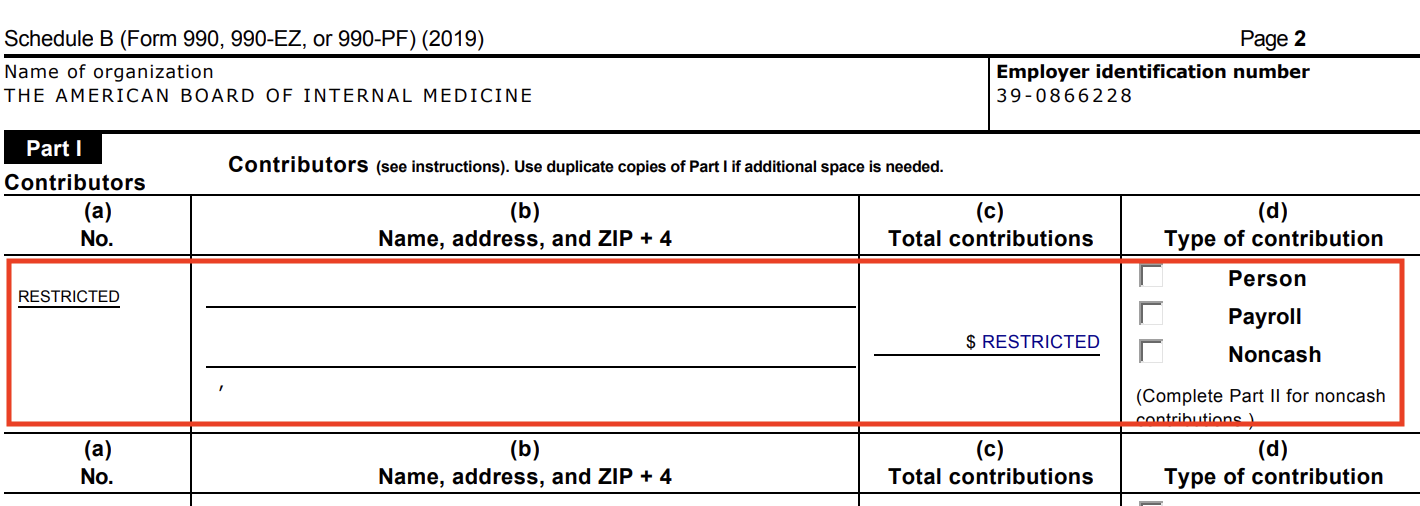
But now we see another concerning potential conflict that needs explanation, especially with the rate hike in fees physician must endure. Who are ABIM's "RESTRICTED" contributor(s) found buried on their latest IRS Form 990?

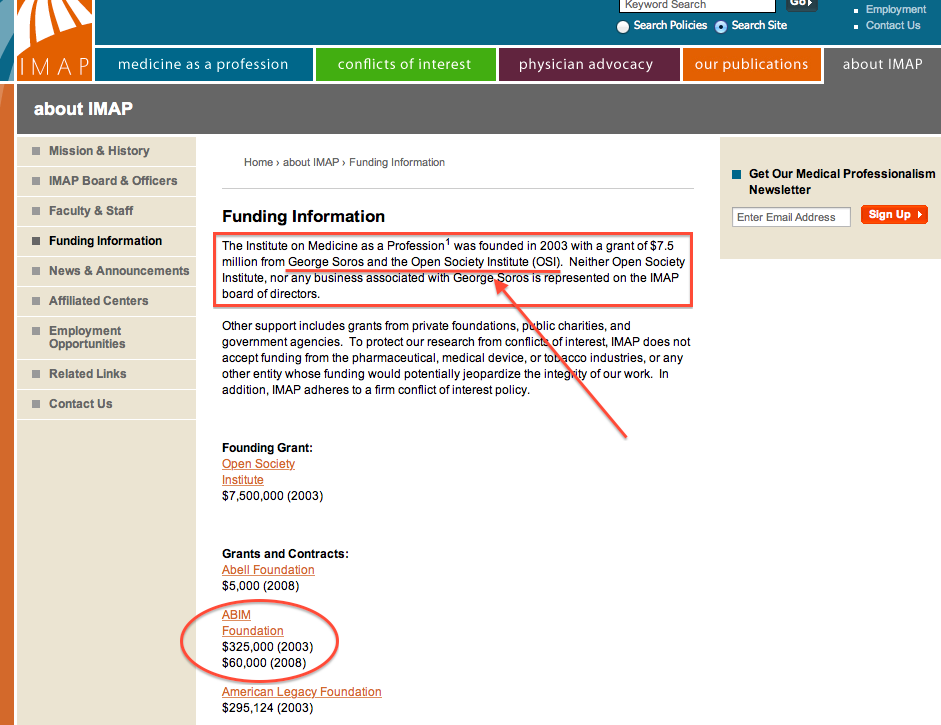
Might it be George Soros (since ABIM contributed to his Institute for Medical Professionalism in 2003 and 2008)?

Or might it be other members of the Accreditation Council of Graduate Medical Education (ACGME), like the American Medical Association (AMA) or American Hospital Association (AHA)? Who stands to profit from the control of physicians this way?

Physicians have a right to know what the heck is going on at ABIM and why are fees have gone up 25% in 2022 at a time when ABIM is more than flush with cash. We also deserve to know who their contributors are that are supporting his racket. 

Unless, of course, the US is running the physician regulatory system like the mob.

-Wes


PS: For those interested in staying abreast of our ongoing investigation, consider joining Practicing Physicians of America (it's free and allows us to know who wants further work in this arena).


Wednesday, January 27, 2021

Is ABIM Ending Its "Knowledge Check-In" MOC® Pathway?

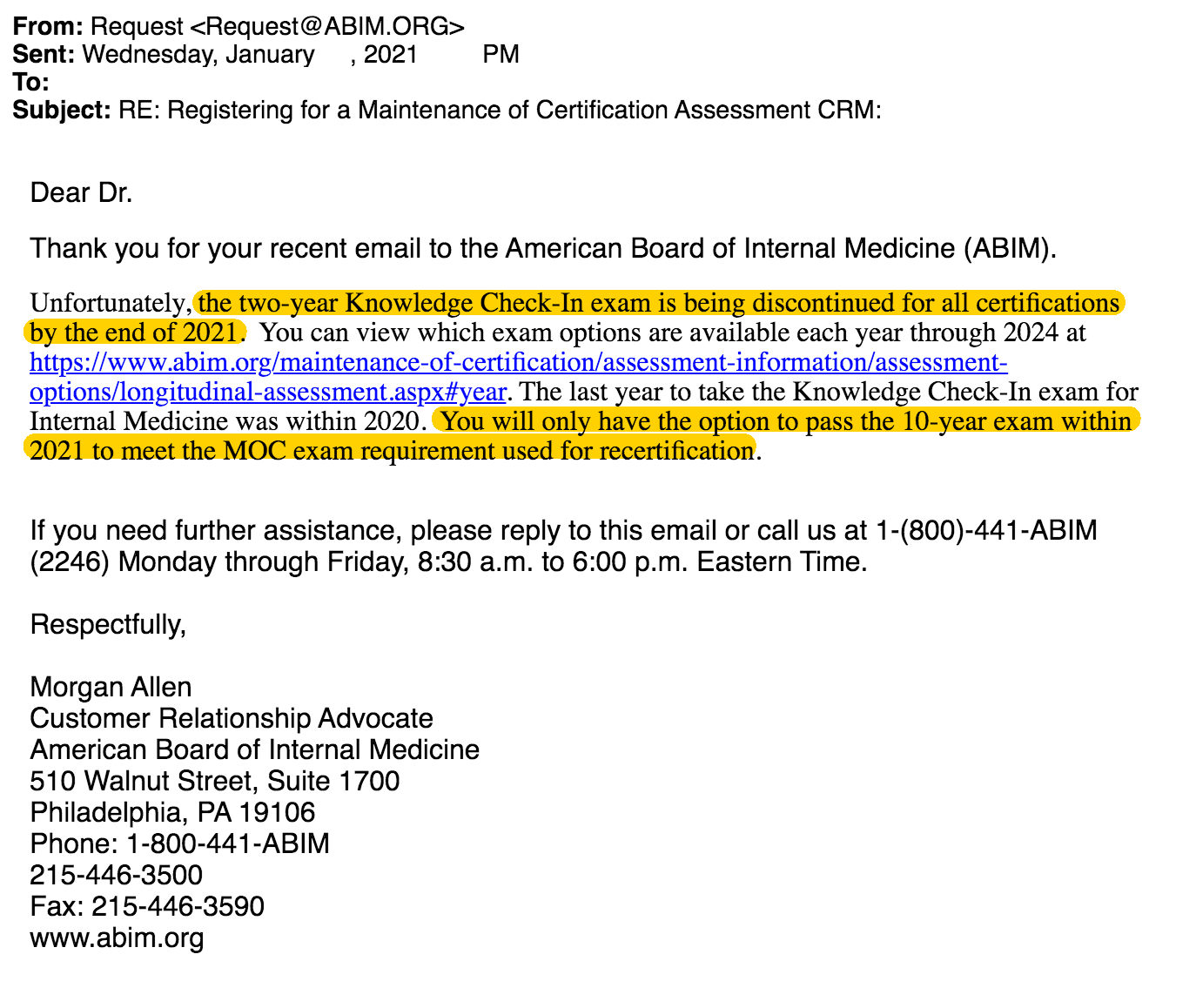
The following (redacted) email was received from Morgan Allen, Customer Relationship Advocate at the American Board of Internal Medicine (ABIM), in response to an ABIM diplomate that was unable register online for their every-two year Knowledge Check-In "continuous" Maintenance of Certification (MOC®) product.

According to this email, it seems the ABIM has decided to end its Knowledge Check-In recertification pathway and only permit its every-10-year high-stakes recertification examination for physicians to remain ABIM Board Certified.

At the time of this writing, I could find no public notification of this policy change on ABIM's website. Once again, working physicians are irresponsibly left uncertain of the latest requirements to remain ABIM Board Certified in good standing.

ABIM has a long history of changing the rules for the names and requirements for physician board recertification/maintenance of certification/continuous certification. But despite the many name and rule changes of this racket, each rebranding becomes more expensive and serves to perpetuate the discrimination against younger physicians and physicians of color from senior "grandfathered" physicians who are not required to purchase these products to retain their ABIM Board Certified status. The Knowledge Check-In recertification pathway was no different from its predecessors in this respect. But the Knowledge Check-In pathway also suffered from a plethora of technical, security, and (undisclosed) privacy issues for physicians. (See my earlier video that critically reviewed this recertification pathway and the people who created it.)

One thing is a constant, however. Ever since the ABIM changed Board certification from a lifetime to time-limited physician marketing accolade, this unproven repeated testing of working physicians remains a career-long psychological and economic stressor that distracts from what matters most: patient care.

-Wes

Friday, October 23, 2020

ABIM Stumbles in Appellate Court Arguments

The oral arguments in the appeal of the dismissal at the District Court level of the Kenney et al vs American Board of Internal Medicine (ABIM) class action antitrust, RICO, and unjust enrichment case were heard before the 3rd Circuit Court of Appeals today and are available via audio file here. The following interchange starting at 32:58 in the audio file was interesting (I have added a few personal comments/thoughts in italics):

Judge: "Could I just ask the follow-up there about forcing? How do we conclude that internists aren't forced to buy MOC at this stage in the litigation in light of the allegations that internists can't successfully practice without certification? Isn't the feasibility of practicing without certification ultimately a question of fact?"

ABIM Attorney: "I think you can first look to, um, look to the facts in this case. For instance, Dr. Manolo who, who never, who did purchase initial certification and never purchased Maintenance of Certification. I think that certainly shows that his purchase of initial certification was not contingent on the later purchase of Maintenance of Certification. (Comment: It also shows there are two products). So I think that is one way you can look at it. I think you can also look at it in the way that the Second Circuit indicated in the Smugglers Notch Homeowner's case which is a case where, which looked at, when you're entering in to the transaction and you know that, in fact, you're that going to be required, there are certain components, parts, of that entire transaction, and you know that up front, and you voluntarily nonetheless enter into that contract, that there is no forcing." 

Judge: "But counselor, what I'm talking about is it might not be so voluntary - they want to make a living, are they forced to buy your product? You seem to say no they're not forced to, but is that essentially an issue of fact more appropriate for summary judgement?"

ABIM Attorney: "Um, I would suggest not because I think when courts look to forcing they look at what is the situation at the time of the initial purchase? At the time of the initial purchase here ABIM had a program for certification and aspects of that program were initially passing the initial board certification exam and that that certification would expire after a set period of time - ten years - without unless diplomate passed subsequent examinations. And so when they, up front, bought that product they knew there would be a continuing obligation as part of the certification program, that they would have to demonstrate, in fact, that they possess the requisite knowledge to hold themselves out and say "Yes, I am ABIM, or board certified." So there is no forcing because there is the knowledge up front at the time of purchase of what certification entails, um, and that was the periodic demonstration of knowledge."

Judge: "But I suppose that the most basic form of your argument is, they don't have to go through ABIM to practice." 

ABIM Attorney: "Yes, your Honor. If you look at the Amended Complaint, the Amended Complaint is quite clear that board certification is not required to practice medicine in the United States. That is simply a function of state boards of medicine that license doctors. Um, you only need a license in your state, um, to practice medicine. Board certification is not required. Board certification is more like the "Stamp of Approval" that you can hold yourself out to have special qualifications. (As I have said all along, board certification is actually little more than a marketing accolade.) Some patients and employers look to that, others do not, but it is not a requirement to practice medicine in any state in the United States which is a fact that is pled in the Amended Complaint."

Judge: "But this does go to your market power, I mean, yeah, it's true, you don't need the ABIM certification. But is it really feasible not to have it, in reality? And I think, the allegations, don't they say, a lot of places won't let you practice, your malpractice rates are going to go higher, reimbursement's going to be an issue. So is it really feasible to practice without certification and is that something that should be a subject of discovery as opposed to, you know, at this juncture with a motion to dismiss to resolve?"

ABIM Attorney: "Well. well many, I would submit many internists do, in fact, practice medicine, um, without ABIM certification and there are many things that might affect how much you are paid, what your admitting privileges are - things like where you attended medical school and many other factors. (Comment: And if you believe this, I have some ocean-front property to sell you in Arizona). But it really comes back to, you know, what is at issue in this case and whether, in fact, there is a tying claim and whether or not there is, um, one product or two products and that really goes back to the Supreme Court test in Jefferson Parish about the character of demand and whether there is demand for the tied product in absence of the typing product.  And here, the Appellants want to hold themselves out as being "board certified." There is no separate demand for the tied product in the absence of the tying product. And that is something I think is, is something that, you know, the Court in Jefferson Parish makes clear. Justice O'Connor when she expands on the words in that saying that for products to be treated as distinct, the tied product must, at a minimum, be one that consumers might wish to purchase separately without also purchasing the tying product. And here's.. there's simply... there are no allegations of fact sufficient to move this case along to make a plausible case that there are, in fact, two products here because there is no consumers, there are no allegations showing there is demand to purchase the tied product without also tying the tying product." (Comment: OMG, Seriously?)

Judge: "Alright, thank you counsel."

The judges asked the right questions. Now we have to wait to see if this case is sent back to the District Court for discovery.

I will have additional comments about other aspects of these oral arguments in the days ahead.

-Wes

P.S.: MedpageToday covered the story as well here.

PPS: If you'd like to help the plaintiff's along their lengthy legal quest to improve the lot for all US physicians regarding MOC, please contribute to the GoFundMe page sponsored by Practicing Physicians of America.

Monday, July 27, 2020

Physician Plaintiffs File Reply Brief Against ABIM

The four Internal Medicine physician Plaintiffs-Appellants filed their latest Reply Brief in the class action lawsuit against the American Board of internal Medicine (ABIM) today. That reply brief summarized the alleged tying arrangement of ABIM board certification to "Maintenance of Certification (MOC)":
"ABIM’s monopoly power over certifications is undisputed. Certifications are an economic necessity for a successful medical practice. From 1936 to today ABIM certifications have assessed one thing: postgraduate medical education. 

Realizing that only so much in certification fees can be extracted from new residency graduates, MOC allows ABIM not only to charge internists a one-time certification fee at the outset of their practice, but to force internists to purchase MOC by revoking their “initial” certifications if they do not, requiring them to pay inflated MOC fees throughout their entire decades-long careers. The two products are separate because, in ABIM’s own words, MOC “means something different” from certifications and “speaks to the question of whether or not an internist is staying current.” (¶ 53). MOC’s true purpose, however, is to create a lucrative revenue stream for ABIM, resulting in hundreds of millions of dollars in new fees. (¶ 65). 

There are other products—not sold by ABIM—that help internists stay current, including continuing medical education products (“CME”). (¶ 54 (“MOC serves substantially the same function as CME”)).1 

MOC is ABIM’s fourth attempt to sell a product distinct from certifications to help keep internists current. Thousands of internists bought three previous voluntary MOC products separately from their certifications as part of ABIM’s Continuous Professional Development Program (“CPD”). (¶ 25). “Grandfathers” today also purchase MOC separately from their certifications. (¶ 35). Purchases by internists of MOC, CME, and other non-ABIM CPD products to stay current, demonstrate distinct demand for those products separate from the demand for certifications. ABIM’s earlier versions of MOC failed to generate the hoped-for revenue because ABIM did not revoke certifications of internists who did not buy them. That ABIM’s voluntary products were unsuccessful reflected internists’ preferences to buy products from others to stay current. (¶ 55). ABIM ensured, however, that MOC succeeded by tying it to “initial” certifications and making it mandatory. (emphasis mine) Plaintiffs’ claims do not threaten ABIM “standards” any more than ABIM’s earlier voluntary MOC products did. Plaintiffs ask only that ABIM’s illegal tie be severed and that MOC once again be voluntary."
In addition, the filed brief explains the basis of the RICO claims made by the physician Plaintiff-Appellants against the ABIM: 
"After ABIM was unable to generate hoped-for fees from its first three voluntary MOC products sold as part of its CPD Program, it realized it must force internists to buy MOC. ABIM did so by revoking the certifications of internists who did not buy MOC. In furtherance of its scheme, ABIM waged a campaign of fraudulent misrepresentations to deceive the public, including but not limited to hospitals and related entities, insurance companies, medical corporations and other employers, and the media, that MOC, among other things, benefits physicians, patients and the public and improves patient outcomes. As a result, ABIM has collected hundreds of millions of dollars in MOC fees under false pretenses."

Finally, in regard to the unjust enrichment claim dismissed by the earlier District Court judge:
"The district court’s sole rationale for dismissing Plaintiffs’ unjust enrichment claims is its conclusion that ABIM “did not ‘force’ Plaintiffs to purchase MOC.” A-41. ABIM similarly repeats its argument that internists “chose” to “pursue and maintain their certifications.” ABIM Br. 54. Plaintiffs have already debunked this argument, and clearly allege “forcing” notwithstanding the erroneous conclusions and arguments of the district court and ABIM. 
ABIM points out that certifications are not required for licensure. But it does not deny certifications are required for admitting privileges, insurance, and other requirements of a successful medical practice, and accordingly are an economic necessity. Finally, the district court opinion in In re Avandia Mtkg., No. 2007-MDL-1871, 2013 U.S. Dist. LEXIS 152726 (E.D. Pa. Oct. 22, 2013), does not support ABIM, as the unjust enrichment claim there failed for several reasons not pertinent here, most importantly because, unlike MOC, the purchases were voluntary. See ABIM Br. 55-56."
With this filing, it is clear that the class action lawsuit filed by working physicians against the ABIM is far from over. Read the whole Reply Brief here

-Wes

To support the physician plaintiffs in this ongoing lawsuit, consider contributing to their GoFundMe page.

Thursday, December 12, 2019

Just In Time for Christmas: The MOC Legal Juggernaut Intensifies

With the recent back-to-back announcements that the class action antitrust and racketeering lawsuit against the American Board of Internal Medicine (ABIM) and the antitrust lawsuit against the American Board of Radiology were dismissed (e.g., the ABIM announcement and ABR announcement), doctors everywhere - both young and old - seemed resigned to the fact that they will have to be subjects to lifelong extortion of private American Board of Medical Specialties member boards and their affiliates if they wanted to practice medicine in the United States.

But fear not, dear colleagues. I bring you tidings of great joy. The first great Supplemental Opposition to the Motion to Dismiss the lawsuit against the American Board of Psychiatry and Neurology (ABPN) was filed yesterday that promises to renew the call for justice on the basis of proper legal procedural grounds:
Defendant American Board of Psychiatry and Neurology (“ABPN”) illegally ties its initial certification product, which it sells to new doctors to demonstrate completion of their medical education and assess the quality of their residency program, and its MOC product, which it requires some older doctors, but not all, to purchase throughout their careers to demonstrate lifetime learning or forfeit their initial certification. ABPN brings to the court’s attention Kenney v. American Board of Internal Medicine, No. 18-5260, 2019 U.S. Dist. LEXIS 164725 (E.D. Pa.Sept. 26, 2019) (“Kenney”), and Siva v. American Board of Radiology, No. 19 C 1407, 2019 U.S. Dist. LEXIS 200645 (N.D. Ill. Nov. 19, 2019) (“Siva”). Kenney came first, followed by Siva which “agree[d] with the reasoning in Kenney.” Id. at *11.1

Nothing in those opinions changes ABPN’s unlawful conduct. A critical reading of the opinions and application of the universally accepted rule that well-pleaded factual allegations and all reasonable inferences therefrom must be taken as true compels the conclusion that Kenney and Siva were, respectfully, wrongly decided.
1  The tying claims in Kenney were dismissed with prejudice without plaintiffs being allowed to amend, the court finding as a matter of law that separate products could never be alleged. Plaintiffs are appealing that ruling. The claims in Siva were dismissed without prejudice and plaintiff is filing an amended complaint on January 10, 2020.
The supplemental opposition to the ABPN motion to dismiss then outlines multiple legal reasons why the plaintiffs believe the decisions were wrongly decided. In essence, the attorneys are arguing that the facts in this case were not even allowed to be considered past the judges' chambers.

We can anticipate that the multitude of moneyed interests behind Maintenance of Certification will stop at nothing to assure this unlawful program continues unchecked.

Still, a bit of hope and cheer is always welcome for working physicians this time of year.

Merry Christmas!

-Wes

P.S.: On a separate legal note:

Remember the Puerto Rican physician, Jaime Salas Rushford, MD, whom the ABIM revoked his board certification and dragged him through the court system since 2012 with a dismissed time-barred cheating claim while the President and CEO of the ABIM simultaneously failed to disclose her conflicts of interest with Kaiser and Premier Inc? Yesterday, the judge issued the following order to expedite the counterclaim suit filed against ABIM by Salas Rushford:
The American Board of Internal Medicine may file its motion for judgment on the pleadings no later than December 18, 2019. Dr. Salas-Rushford will respond no later than January 2, 2020. The Board may reply no later than January 9, 2020. The case schedule will be discussed at the scheduling conference to be held on January 31, 2020. Signed by Judge Francisco A. Besosa on 12/11/2019. (brc) (Entered: 12/11/2019)
It seems that case will soon be coming to a head, too.

Readers wishing to support the brave physician plaintiffs involved in these lawsuits trying to end the unlawful Maintenance of Certification program are encouraged to contribute to their GoFundMe campaign.

Saturday, October 12, 2019

Plaintiffs to Appeal ABIM Class-Action Lawsuit in Full

With the time to amend the earlier class action antitrust and racketeering lawsuit against the American Board of Internal Medicine (ABIM) past, this statement was issued by C. Phillip Curley, the Plaintiffs' lead attorney:
“Plaintiffs plan to appeal in full the dismissal of their case. While we respect the district court, we believe it was wrong at this early stage of the litigation to dismiss Plaintiff’s case and deprive them of their day in court. Plaintiffs look forward to the vindication of their claims on appeal.”
ABIM may have thought they won this case on dismissal, but it looks the plaintiffs' claims will get a second more critical review of the case with the 3rd Circuit Court of Appeals.

-Wes

Physicians wishing to support the plaintiffs in this unprecedented action are encouraged to contribute here.

Thursday, August 01, 2019

AntiMOC Lawsuit Update

As the summer winds on, I have been approached by more and more people who would like an update on where the litigation filed against the many member boards of the American Board of Medical Specialties stand since the lawsuits were filed. I will do my best to briefly summarize the status of those lawsuits as I understand them. (For background on why these lawsuits have been filed against so many of the American Board of Medical Specialties specialty boards, please review this video).

The antitrust suit against the American Board of Internal Medicine (ABIM) was originally filed 6 Dec 2018 and amended 23 Jan 2019 to include RICO charges, the antitrust lawsuit against the American Board of Radiology was filed 26 Feb 2019, and the antitrust lawsuit against the American Board of Psychiatry and Neurology (ABPN) was filed 6 MAR 2019. These cases were filed by a law firm based in Chicago. A fourth lawsuit was filed by a separate law firm in Southern District Court of California on 19 Feb 2019 against the American Board of Medical Specialties (ABMS), the American Board of Emergency Medicine (ABEM), and the American Board of Anesthesiology (ABA).

Each of the member boards are represented by different law firms.

Three of the specialty boards (ABIM, ABR, and ABPN) have appeared and, as expected, filed motions to dismiss with mostly overlapping arguments. The motion in the ABIM case was fully briefed a couple of months ago (Motion to Dismiss here, Opposition for Motion Dismiss here), the ABPN motion was fully briefed last month (Brief in Support of Motion to Dismiss here, Opposition to Motion to Dismiss here), and the briefing in the ABR case should be finished mid-August.

In the interim, a motion to consolidate the above cases (brought by the law firm representing the plaintiffs in the ABMS/ABEM/ABA case) which the plaintiffs in the ABIM, ABR, and ABPN cases opposed out of the concern that it might delay the cases and add to their cost, was denied. So these three cases (ABR, ABPN, and ABIM) will each continue on their own in the federal courts in Philadelphia (ABIM) and Chicago (ABR and ABPN).

It would not be unusual for the courts to take several months to decide the motions to dismiss, especially given their complexity and importance. Discovery for these cases will begin once the motions to dismiss are decided, which is hoped will be no later than the end of the year. As I am sure many of my readers have already observed, the litigation seems to be having a modest impact, as many specialty boards and specialty societies claim to be re-thinking their Maintenance of Certification (MOC) requirements, at least around the edges.

It is important that physicians continue to help fund the GoFundMe page sponsored by Practicing Physicians of America. (Remember, short of processing fees, every penny of those contributions will to toward these continuing legal efforts.)

In summary, I believe the legal cases are progressing as well as can be expected and I remain convinced that, together, working physicians CAN end Maintenance of Certification's stranglehold on US physicians nationwide.

-Wes

Tuesday, July 30, 2019

Why the U.S. Specialty Boards Were Sued and Why Those Lawsuits Are Important

I hope every working U.S. physician takes 9 minutes to view this video on why the lawsuits against  the American Board of Medical Specialties (ABMS) member boards were filed and why those lawsuits are so important to our profession.

Please view and share with your colleagues.

An update on the status of those lawsuits will appear on this blog's pages soon.


-Wes

Tuesday, April 02, 2019

What Do Working Cardiologists Really Think About the ACC's CMP Pathway?

What do US cardiologists and electrophysiologists REALLY think about the American College of Cardiology's (ACC) heavily-promoted collaboration with the American Board of Internal Medicine (ABIM) to create their "Continuous Maintenance Pathway" (CMP) for continually maintaining their ABIM board certification?

That's a question I wanted to know, so I helped create a quick 5-minute survey on the matter open to US cardiac electrophysiologists, cardiologists, and heart failure specialists.

I hope to have the results compiled by the Heart Rhythm Society in May, 2019.

I look forward to your responses and thoughts. Additional comments regarding the CMP program not covered in the survey can be left in the comments on this blog post.

Thanks-

-Wes

Tuesday, November 06, 2018

Ending MOC Nationwide

Continuing education for physicians is important (and we've been doing it all our lives on our own), but when working physicians' right to care for their patients is threatened by unaccountable non-profit testing organizations that have serious undisclosed conflicts of interest, we will take action.

 -Wes


P.S.: Patients, doctors: want to help? You can still donate.

Saturday, August 11, 2018

On Trust

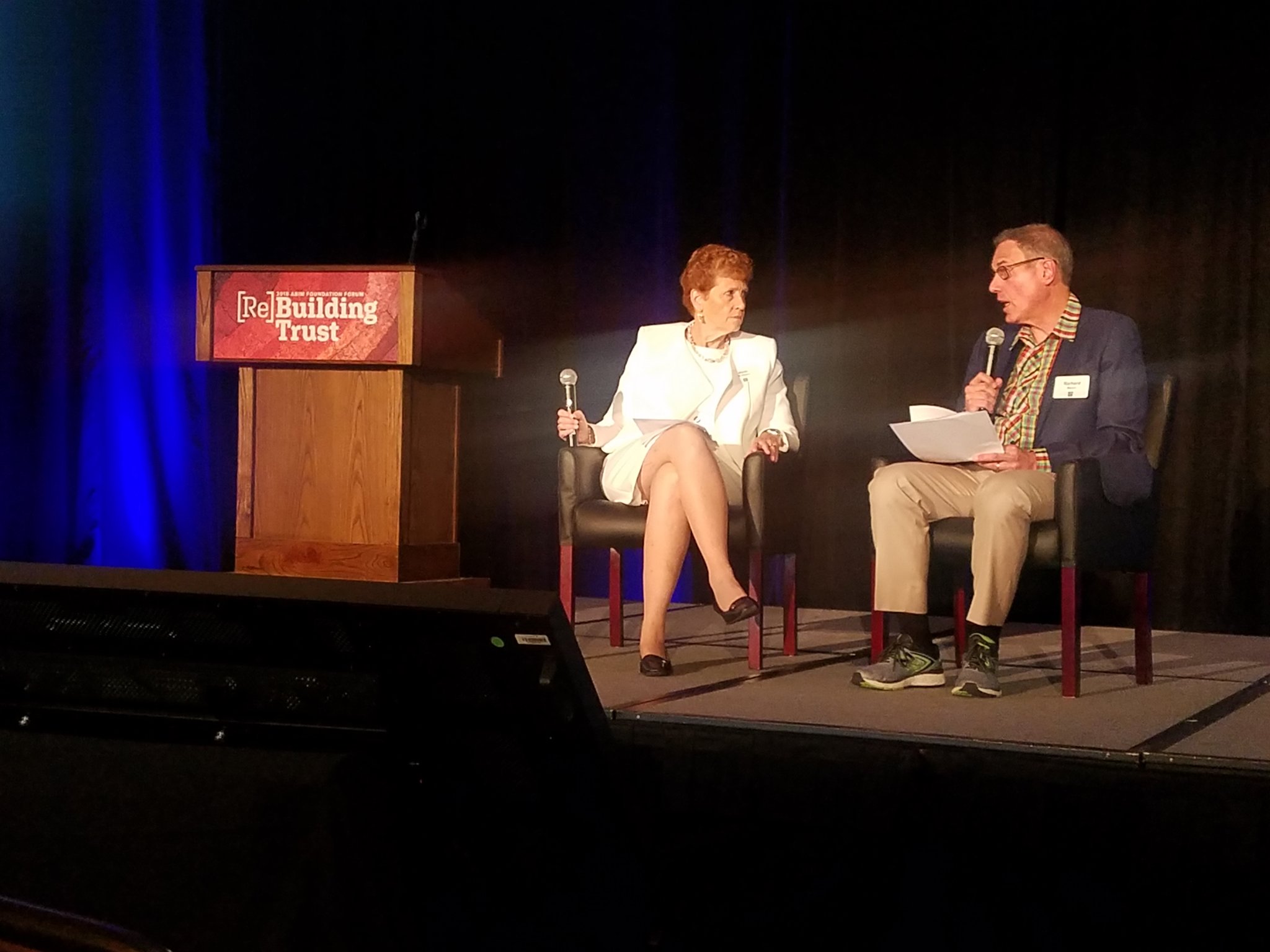
Elizabeth A. McGlynn, PhD, immediate past chair of the ABIM Foundation and Vice President for Kaiser Permanente Research and Executive Director of the Kaiser Permanente Center for Effectiveness and Safety Research (CESR) with Richard Baron, MD, President and CEO of the American Board of Internal Medicine,  at the 2018 ABIM Foundation Forum on "(Re-)Building Trust"
Recently, the ABIM Foundation hosted a webinar entitled "(Re-)Building Trust." Oh, the irony. The fact they need to have such a conference is telling of the dire straights the staid and outdated medical credentialing complex has become.

As physicians who funded the ABIM Foundation, why do we fund such nonsense?  The American Board of Internal Medicine has never sufficiently explained why this organization felt compelled to use over $78 million of physician testing fees to create the ABIM Foundation or how and why it uses that money. Is it really to fund such conferences?  Or might conferences like this really be a distraction for the real reason the ABIM Foundation was created: their retirement fund. By the way, whatever happened to those funds shipped off to the Cayman Islands? Why will we lose our privileges at hospitals or insurance payments if we don't pay into this scheme? And why is the ABIM Foundation colluding with Kaiser Permanente directors? What does Kaiser get for this relationship?

If physicians trusted the ABIM, we would not have to ask such questions and the ABIM Foundation would not have to hold conferences on "re-building" trust.

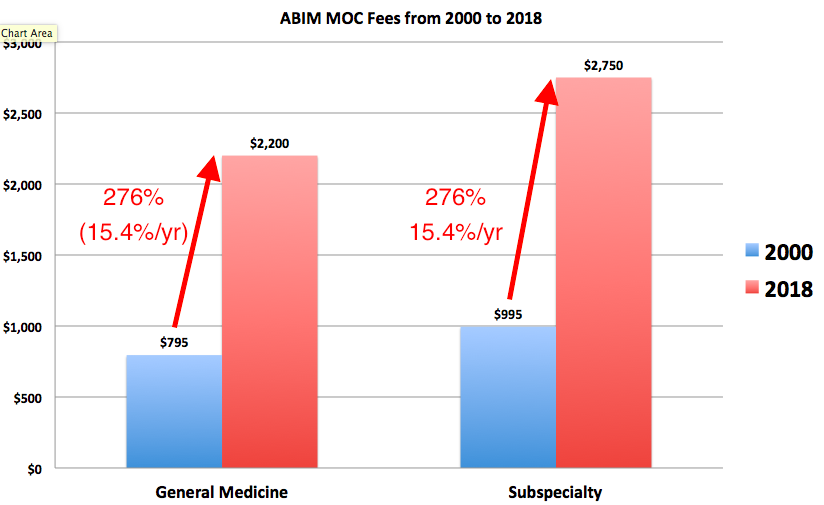
Three years ago, Richard Baron, MD issued the now infamous: "We got it wrong" mea culpa press release when the 2014 iterations of Maintenance of Certification (MOC) foisted on US physicians resulted in a powerful working physician backlash. Lots of soft-shoe, "listening," and MOC program changes have occurred since then. But in reality four years later, little has changed other than parsing our payments into annual aliquots rather than a single lump sum every-10-year payment. The growth of fees is back on schedule, climbing an incredible 276% in the past 18 years.  Even the ridiculous Part IV of MOC is back as before.

It is hard to trust any business, especially a nonprofit organization when they ignore the customer.

We should not lose sight that physicians are the customer of ABIM, not patients. We pay for their medical accolade and the paper certificate that ABIM issues when we successfully complete our initial Board certification and (now) subsequent MOC requirements.

There are many within the US medical board credentialing system who feel otherwise; for them, they are there to serve "the public." Yet this deflection is little more than a propaganda message created to justify their use of our money for their political and financial purposes.

When we see our funds continuing to be wasted at Las Vegas convention venues for American Board of Medical Specialties meetings with their "stakeholders" we realize that this old-school attitude of colleague disrespect and self-importance is endemic to the entire US medical board certification and medical credentialing industry. Hard to re-establish trust with overt demonstrations such as these.

-Wes

PS: Wonder what you can do to change things?  Donate here and get a free book at the same time! We're 78% of the way there!

Saturday, May 12, 2018

Taxing Medical Education with MOC

I just received this in my email in-basket from an attendee at this year's Heart Rhythm Society (HRS) Scientific Sessions:
I just got back from our annual EP meeting (HRS) which was in Boston. As you can imagine, the entire CME process has been bastardized to monetize the ABIM (American Board of Internal Medicine). After dutifully checking off which sessions I attended and rating the speakers, I noted a few things.

Firstly, all attendees were electronically tracked with RFID tags. Our attendance at the sessions were electronically tracked and automatically noted. A pretty neat feature and designed, I think, to prevent fraudulent CME behavior.

We had to answer a separate ABIM Maintenance of Certification (MOC) section and actually provide prose with a minimum and maximum word count. There was a warning stating that the content of our replies would be reviewed before the ABIM would bless them for the MOC process.

Which begs the question. Under what circumstances does the ABIM have the authority to legitimize or delegitimize my reply to their nonsensical questions? The MOC portion of the CME conversion was more of a sampling of my opinion. Is this the new MOC paradigm: impose an educational tax on our meetings and then also charge a toll on their MOC highway?

This process is not only corrupt and inefficient; it is now surreal and insane.
Yes. It. Is.

MOC® is little more than taxation of physicians without representation.

(And we still don't have ABIM's financials from 2017 for the public's review.)

-Wes

Wednesday, May 24, 2017

We Want to Know

Dear Richard Baron,

As President and CEO of the 501(c)(3) non-profit organization, the American Board of Internal Medicine (ABIM) and its affiliated Foundation, the ABIM Foundation, you are responsible for public disclosure of IRS tax forms 990 to the public. Those tax forms were due at the IRS office 15 May 2017 for the ABIM's 2016 fiscal year (1 July 2015-30 June 2016).

Where are they?

We want to know.

We want to know because the finances of the ABIM and its Foundation are of paramount importance to us, your diplomates. We believe those finances are the reason we are required us to participate in the ABMS trademarked Maintenance of Certification (MOC) program. Because of clever regulatory capture through this unproven and monopolistic educational program, your organization is responsible for the ability of one quarter of ALL US physicians to work.

We want to know where our money that we pay for your unproven testing is going.

We want to know how much you paid yourself and your officers.

We want to know your legal expenses.

We want to know if you lobbied last year and how much you paid for it.

We want to know if you purchased another condominium for your organizations.

We want to know how much your paid PearsonVue.

We want to know who were your revolving-door officers that year and how much you paid them.

Right now, seventeen states have brought forth legislation to combat MOC. Doctors are leaving work to testify against the requirement for MOC that has been carefully incorporated to our new payment formula (MACRA) and HEDIS requirements made by the National Committee on Quality Assurance for the nation's hospitals, courtesy to Ms. Margaret O'Kane (who doesn't even hold a medical degree), and her board participation with the American Board of Medical Specialties, of which the ABIM is one of 24 specialty organizations.

We want to know the ABIM's finances because our jobs depend on that information. We want to bring that information before state legislatures so we may objectively and factually highlight your spending.

We will not rest any longer, Dr. Baron.

We want to know and we have the right, by law, to know.

Westby G. Fisher, MD
ABIM Diplomate #127308

Monday, November 07, 2016

Thursday, July 07, 2016

Pennsylvania Medical Society Spearheads Effort to End MOC Nationwide


Recently, the Pennsylvania Medical Society sent this letter to the executive vice presidents of all US state medical societies and many specialty societies regarding their vote of no confidence regarding the ABMS Maintenance of Certification® (MOC®) program and the current leadership at ABIM, stating specifically:

"... We believe that their current leadership is not capable of reforming the process in a timely, academically meaningful, and fiscally responsible way.

In keeping with the consensus of our members and physicians across the country, we call for the immediate replacement of the entire ABIM Board of Directors and leadership with new leadership, representative of physicians actively participating in the full-time practice of clinical medicine. The undersigned organizations would further offer to assist the ABIM and any of the ABIM subspecialties with the formation and transition to a new Board that is representative of and accountable to the physicians whom they will certify. ..."
For those interested in learning more or who's state is ready to sign on can email Dr. Scott Shapiro, President of the PA Medical Society at stat@pamedsoc.org‎ for more information.

Please forward a copy of this letter to all of your practicing physician colleagues (irrespective of specialty) and ask each of them to contact the leadership of their respective state medical societies and specialty societies to urge them to co-sign this letter and work with the PA Medical Society to end the corrupt ABMS MOC® re-certification requirement.

Only through aggressive, meaningful, nationwide collective action against this needless, unaccountable, expensive, and coercive ABMS re-certification program will practicing physicians restore sanity to our own life-long continuing medical education process.

Thank you-

-Wes

A copy of the letter to circulate to your colleagues can be downloaded here.

Saturday, June 18, 2016

Video: The Gory Details of ABIM Maintenance of Certification

The Pennsylvania Medical Society posted the presentations made at the AMA House of Delegates Meeting at the Hyatt Regency Chicago on 13 Jun 2016 this morning (please see that link for all of the presentations made).

I post just two of those presentations here for your review.  First, the finances of the ABIM and ABIM Foundation that prompted the creation of Maintenance of Certification, as told by certified public accountant, Charles P. Kroll (27 min) (Slides here):


Next, my presentation on how Maintenance of Certification has affected practicing US physicians and their patients (22 min) (slides here):


Spend some time to review these videos and and inform yourself when you get a chance. Then work with your state medical societies and hospitals to end this onerous and corrupt physician program.

-Wes

Tuesday, June 14, 2016

AMA House of Delegates MOC Session Recap

It was a beautiful day in Chicago yesterday: sunny, not too humid. I left home early. The sun had risen some time ago and could be seen reflecting off the lake to the front of the downtown skyscrapers highlighting every detail of their construction. Lake Shore Drive is magnificent this time of day. I parked, as many must do each day, down in the basement of a nearby parking garage, making the "early bird special" parking fee of $16 when your arrive before 8 AM.

Nice.

(Click to enlarge)
I entered the Hyatt and saw a large meeting room across the foyer with a "Southeastern Delegate Meeting" sign outside the huge room. Lots of people with the representative state name on a card in front of them and a man in a bright kelly green jacket sitting next to the speaker stand who looked like a preppy leprechaun: the "Vice Chair." Heh.

I had to find registration at the Hyatt Regency Chicago: no easy task for someone who's never attended the AMA House of Delegates meeting, but approached what must have been a senior delegate adorned with his AMA badge with multi-colored tags draped some 14" beneath it highlighted by political stickers and little metal badges (I learned later you got some of these after contributing to various political action committees). He was cordial and helped direct me to the subterranean registration desk in the East Tower.

There were delightful ladies more than willing to help. "Are you a delegate?" they asked. "No, just a speaker." They gave me a registration card and I filled it out and was promptly handed a badge of my own with a lonely gray "speaker" badge dangling below.

"Don't listen to a thing he says, he's a doctor," someone said behind me. I turned around to find Charles Kroll, who has also just arrived, waiting to register.  I hadn't seen him for two years since we started to work together on the ABIM story. He grabbed his badge and we headed upstairs. I called David Winchester, MD, a delightful young cardiologist that I was introduced to via Twitter  (cardiologist and Florida delegate) and he joined me and Mr. Kroll for coffee.

AMA House of Delegates MOC Meeting
(Click to enlarge)
Next, I called Charles Cutler, MD from the Pennsylvania Medical Society who met us in the lobby of the East Tower. We headed to the meeting room and he introduced me to numerous people: Steven E. Weinberger, MD of the American College of Physicians (Executive VP and Chief Executive of the ACP), Stephen R. Permut, MD, JD, (Chair of the Board of Trustees of the AMA), and newly-elected Board Member of the American Board of Internal Medicine (ABIM), Yul Enjes, MD, among others. Only later did I realize Lois Margaret Nora, MD, President, and Chairman of the American Board of Medical Specialties (ABMS) was there, too, among many others (seated in the back, far right). Many stood in the back of the room despite available chairs in the front of the room (some things never change).

As luck would have it just before we began, the projector bulb blew shortly after it was turned on so another projector had to be retrieved. Meanwhile, the videographer had set up and was ready to go, but we had to remain seated as we spoke to use the available microphones. Once the new projector was secured, we were ready to begin.

Mr. Kroll went first (slides at link, video here) and explained his background as a forensic accountant specializing in health care and non-profits to the audience. He began discussing his educational background, credentials, prior experience with other non-profit shenannigans in Minnesota (Alina/Medica scandal) and his experience working with the attorney general there. He then explained how he stumbled across the ABIM story (a former article by Linda Girgis, MD asking if ABIM was "extorting" physicians). He pulled the ABIM's financials and immediately found discrepancies and outlined many of his findings to the audience. You could see heads shaking with disbelief. He kept it simple and understandable.  It was devastating. He then told the story how he contacted a mainstream media outlet who requested the last twelve years of audited financials from the ABIM and how the ABIM refused to produce all but the last year, and only if they met in persons to review them together. Evidently, the reporter politely declined and then requested these financials from the PA Attorney's Office (who never responded).  Only after a request was made to the press secretary of the PA Governor's office were the last two years' of audited financials produced. Mr. Kroll, who had these full financials in his possession, then noted that when the ABIM published them, they failed to publish six key parts of those financials on its website. Only after he disclosed this fact in an article in MedCityNews, did the ABIM recant and post the full financials. Finally, we concluded with a description of the meeting he help with the Iowa Attorney General's office and the recommendations he made regarding actions the Iowa AG could impose on the ABIM and their Foundation.

I was next.

In my presentation (a rather large Powerpoint presentation can be downloaded here, video here), I discussed my background, the background of how Board certification, how the philosophy of lifetime certification morphed to time-limited based on the ABIM's assertion that older physicians lost their skills over time, but then pointed to the paradox of the "grandfathering" of physicians and the inherent age discrimination against our most vulnerable physicians with that policy change. I also explained patient's definition of the excellent physician vs the ABIM's definition, and reviewed the costs in terms of out-of pocket costs and time involved (detracting from patient care). I also touched on the creation of the ABIM Foundation and the transfer of funds from the ABIM to the Foundation for "research" and showed the webpage asking for physician data for more "research" without informed consent and disclosure to physicians who were serving as study subjects in violation of the Belmont Report. With the purchase of the ABIM condominium, perhaps they were performing investment research instead, I suggested. I then summarized much of what has transpired with the ABIM and asked the important question, "How did it get this way?" and why I thought it happened. Finally, I summarized the disturbing code of silence that has surrounded the ABIM controversy by using the "Little Red Hen" allegory. The only people who will fix this mess is practicing physicians, starting with a full investigation of the responsible parties.

Next up was Bonnie Weiner, MD, board member of the National Board of Physicians and Surgeons (NBPAS.org) who gave an update of their efforts to create a more credible board credential for assuring continuing medical education. She expressed concern that future modifications to MOC will result in making one wasteful test taken once every ten years into many worthless tests over the same time period. She summarized the philosophy and finances of the NBPAS.org and explained that she could no longer serve as an interventional cardiology program director because she refused to perform MOC for that credential. (So much for "voluntary" certification!) She noted over 30 hospitals now accept NBPAS as an alternative to NBPAS.org and emphasized the need to have competition in the credentialing market.

With the last presentation by Scott Shapiro, MD, President of the Pennsylvania Medical Society, a shot was fired across the bow of the ABIM. Dr. Shapiro announced that the PA Medical Society was publicly announcing  their "vote of no confidence" against the ABIM and approved funds to evaluate legal options against the ABIM:
Today, at the AMA Annual Meeting in Chicago, our Pennsylvania Medical Society Delegation convened a national discussion panel to present their research findings, insights, and recommendations regarding the failures of the American Board of Internal Medicine and the MOC process. The discussion regarding the actions, finances and possible historical motivations for the ABIM actions was eye-opening and alarming.

Notably, during the conference, we announced that our PAMED Board of Trustees—after reviewing the available data and recent ABIM actions—voted and are now issuing a statement of no confidence in the ABIM's Board and leadership.

We also announced that, earlier this year, our PAMED Board approved the necessary funding to move forward with obtaining a legal opinion into whether PAMED would have standing to file a lawsuit against the ABIM. We hired a firm and recently received their opinion that not only would we have standing but they found potential legal claims consistent with our concerns that could be filed in a lawsuit against the ABIM.

Physician leaders from many other states have inquired about how their state can join PAMED's efforts. We look forward to these and other strategic conversations in the near future.
Boom.

You could have heard a pin drop.

After his announcements (and I probably missed a few key words), the floor was open for question and answer. Lots of people asked questions respectfully. Many were in support. Some were disappointed that there was not a more broad perspective of the opposite arguments for MOC on the panel. One physician with lots of tags on his chest approach the microphone saying," I learned a lot today in this session. Most of all I learned that I'm really glad I never became an internist." (He was an anesthesiologist). The room burst into laughter. He then went on to express his like of anesthesia's "MOCA minute" initiative but never disclosed if he had conflicts with the program or how much it cost. (By now, Dr. Nora from the ABMS had joined the question and answer line.)

It had to be difficult for Dr. Nora to enter this room, but I respected the fact that she came to the microphone to point out her views.  Unfortunately, rather than mentioning anything about the corruption we had just uncovered, Dr. Nora seemed upset that I had been inaccurate with my portrayal of where the ABMS gets their money (I am paraphrasing here). She also commented that we have been given a privilege to self-regulate and that we should consider carefully what we are doing. I then asked her a question as she walked away. She turned to answer. My question was this: "Have you ever studied what happens the physicians that you fail and what happens to their patients in turn?"  She stated she didn't "understand" my question and then proceeded to redirect to another topic before turning to walk away. Perhaps there will be an audio feed soon of this interaction. It wasn't one of our chief regulator's best moments.

Other questions kept coming, with many shifting to "what's next?"  Unfortunately the session went 30 minutes over and another meeting needed the room.

Finally, it was over.

I would like to take this moment to thank Charles Cutler, MD of the Pennsylvania Medical Society for his invitation to speak in this important venue. I am glad I could meet the players in this saga firsthand. There's no excuse for delaying any longer. Everyone knows the problems. Illegal stuff has occurred.

I can only hope those responsible take meaningful and serious steps to resolve the financial malfeasance, corruption, cronyism, and lack of accountability that has been ongoing at the ABIM (and other affiliated member boards of the ABMS hierarchy) for so long.  Otherwise, it's going to get very ugly very quickly.

Practicing physicians across the US have had enough of the ABMS MOC requirement shenanigans.

-Wes

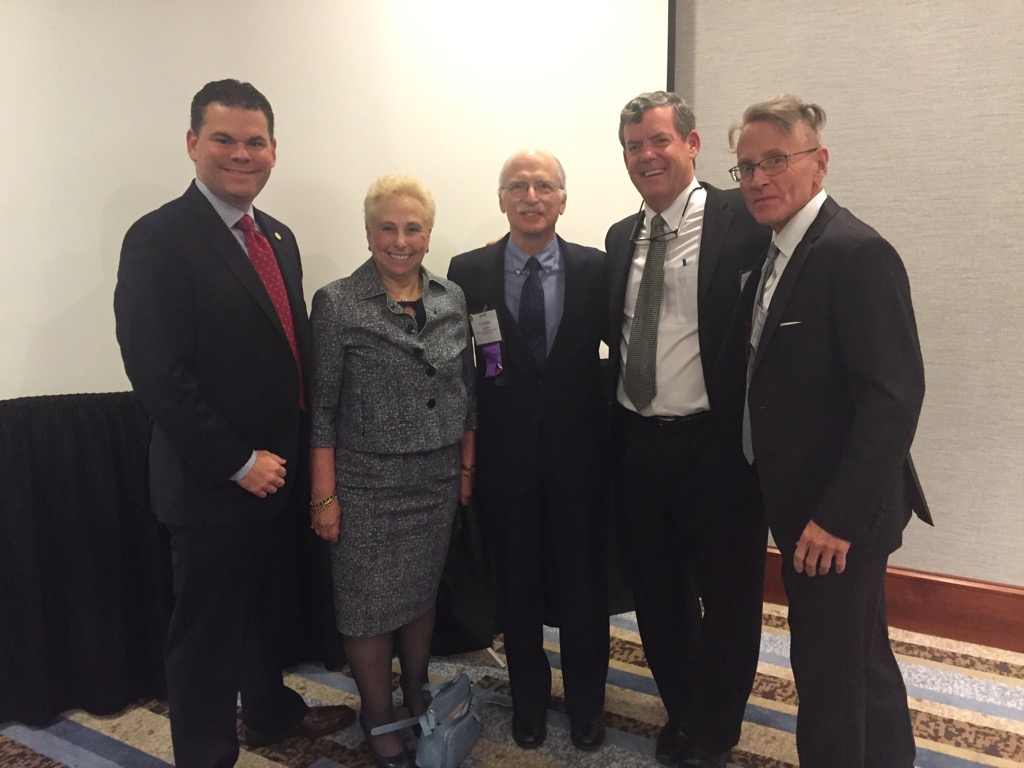
AHA House of Delegates MOC Session Speakers, June 13, 2016
(L to R: Scott Shapiro, MD, Bonnie Weiner, MD, Charles Cutler, MD,
Wes Fisher, MD, and Mr. Charles P. Kroll)

P.S.: I will post a link to the videos of the sessions as soon as they become available. (Update: links added where appropriate above)


Friday, May 27, 2016

Baron: "No Robust Evidence" for Maintenance of Certification

With the soft tinkling of gentle piano music playing in the background, Richard Baron, MD, President and CEO of the American Board of Internal Medicine (ABIM) and the ABIM Foundation, published a video on 20 May 2016 2014* attempting to justify the ABIM's high fees and requirement for "continuous" "Maintenance of Certification" (MOC) of physicians despite "no robust evidence" for the measure. Instead, he refers the viewer to the ABIM's "evidence summary" on their website and states "it's not randomized controlled trials but lots of what we do in healthcare is not randomized controlled trials. We do some things on a gut level of evidence, we do other things on a preponderance of evidence." (My detailed review of a portion of their "evidence" base can be found here.)

For $812,000 a year and countless lost hours of patient care and financial mismanagement, you would think he could do better than that.


Instead, Dr. Baron justifies the ABIM's actions on the basis that the ABIM was "preserving and protecting self-regulation at a time of change... otherwise it will be people, not physicians, who drive what all the expectations are for physicians." He claims the ABIM helps physicians "communicate to the public ways in which they communicate to the public that they have skills and that they have knowledge that other people don't have." As if physician's degree and training and countless years of experience and nights on call aren't enough.

According to Baron's own words, it appears the ABIM is little more than an exceedingly expensive marketing team working on our behalf.

But the real evidence of whom the ABIM has been working for can be found in the financial, political, and strong-man tactics used by the ABIM over the past forty years since "continuous" certification was conceived.

Dr. Baron never mentions the ABIM's secret transfer and cover-up of $55 million dollars taken from working physicians' test fees from 1990 to 2008 to create the ABIM Foundation and how the Foundation has moved a portion of those funds offshore.

Dr. Baron never mentions that the ABIM spent hundreds of thousands of dollars lobbying Congress to assure a perpetual money flow to the organization and hid these actions from the IRS to avoid paying taxes.

Dr. Baron never mentions that within all of their propaganda research the ABIM or ABIM Foundation never (once) studied the negative psychosocial effects of failing even one of their unjustified MOC examinations, nor the potential negative effects of cost saving initiatives promoted by the Foundation's "Choosing Wisely" campaign for the individual patient. He never mentions that  13.2% of clinically experienced physicians tested by their unproven metric failed their examination on their first try to the financial benefit of the ABIM and their partner professional societies.

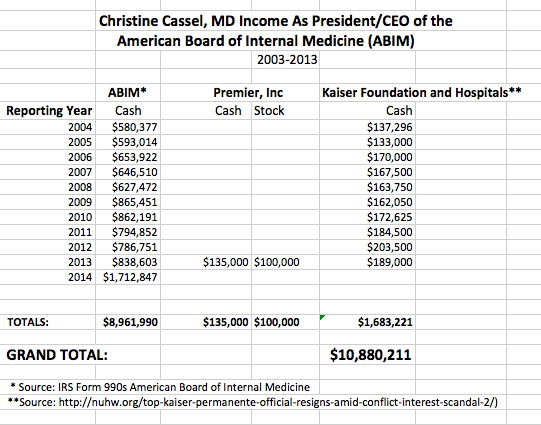
Dr. Baron never mentions the his predecessor, Christine Cassel, MD, earned $10.88 million (nearly $9 million of that amount from ABIM diplomats and an amount that included spousal travel fees) during her 11-year leadership at the ABIM and ABIM Foundation. Nor does Dr. Baron mention Dr. Cassel's long-standing conflicts of interest with Premier, Inc or Kaiser Foundation Healthcare and Hospital system. Nor does Dr. Baron mention Robert Wachter, MD's conflicts of interest with IPC Hospitalist company that is now under federal investigation for overbilling Medicare.

Dr. Baron also fails to mention how serious they are about protecting their monopoly - that they even use Federal Marshals to raid homes and seize assets, call physicians cheaters, then collect an amount estimated to be $3 to $4.5 million in hush money to justify their program that has "no robust evidence." He fails to mention have 139 physicians were sanctioned because the ABIM felt doctors were the one cheating. He also fails to mention that the ABIM continues to track down and hunt physicians from as far away as Puerto Rico some four years later after publishing their one-sided account of details of their raid in the Wall Street Journal for their benefit "as a message and a deterrent."

But not all of the blame for the acceptance of MOC as a facade for physician competency rests with just the ABIM.  The American Board of Medical Specialties (ABMS) and the Accreditation Council on Graduate Medical Education (ACGME) that has quietly insisted on this credential for hospital and graduate training programs just so they can assure they receive more money from Medicare deserves blame as well. Their lack of leadership to expose the egregious behavior of the ABIM is at least as concerning, if not more so, for our profession and society.

-Wes

* Note, it appears this ABIM video was published in 2014, not 2016 as I first published. I regret the error and have corrected the post. Thanks to the anonymous commenter to corrected the date. Hopefully that same commenter will address the other issues brought up in this blog post as well.

Tuesday, March 08, 2016

Medical Specialty Certification in the US - A False Idol?

For the first time, the history of the ABMS/ABIM board re-certification corruption scandal has reached a peer reviewed medical journal, the Journal of Interventional Cardiac Electrophysiology. I hope practicing physicians here (and others worldwide) take time to read the history and evolution of board certification in the US reviewed in the article and to review the associated references. 

I would like to thank my co-author, Edward J. Schloss, MD (Twitter: @EJSMD) for his contributions to this work and the many helpful editorial suggestions made by the JICE reviewers.

It is time we reconsider the ABMS "Maintenance of Certification" (MOC) program. It is also time to have an independent audit of the financials from 1989 to 2016 from the American Board of Internal Medicine and its Foundation, including full disclosure of the many financial conflicts of interest within the American Board of Internal Medicine (ABIM), the ABIM Foundation, and each of the 24-member boards that comprise the American Board of Medical Specialties. Finally, a full investigation of misleading tax filings and lobbying disclosures of the ABIM as a public tax-exempt 501(c)(3) corporation by the IRS and Department of Justice is long overdue in light of these revelations.

-Wes

Reference:
Fisher WG and Schloss EJ. Medical Specialty Certification in the United States - A False Idol? J Interventional Cardiac Electrophysiology doi: 10.1007/s10840-016-0119-4 Mar 8, 2016.