Showing posts with label Maintenance of Certification. Show all posts

Monday, June 20, 2022

Antitrust 101: How to Build Medical Monopolies by Discrediting U.S. Physicians

Recently, there have been a rash of initiatives by unaccountable non-profit physician credentialing organizations (Federation of State Medical Boards, the American Boards of  Internal Medicine, Family Medicine and Pediatrics), and the American Medical Association to come to the public's rescue by de-credentialing U.S. physicians they accuse of spreading misinformation during the COVID-19 pandemic.

Physicians have seen this medical monopoly-building playbook before.

The video below reviews the antitrust, monopoly-making activities of the American Board of Internal Medicine (ABIM). The discrediting of certain U.S. physicians as "cheaters" and disseminators of "misinformation" serve as a smokescreen to their monopoly-building activities. As physicians worked tirelessly to care for patients during the COVID-19 pandemic, the ABIM used U.S. physicians' testing fees to redistribute physician testing fees for their "social justice" initiatives, most significant of which was lobbing Congress so their separate Maintenance of Certification (MOC) continuous testing produt would be a never-ending source of revenue and data metrics used by the Medical Industrial Complex. Sadly, this mandate on younger, more vulnerable ABMS-board certified US physicians has harmed hundreds of physicians and tens of thousands of patients as physicians burn out and leave the profession.

For all patients who wonder why health care prices are so high and access to a board-certified physician has become so difficult, look no further than the organizations above. 


Friday, February 25, 2022

What Entity or Person Serves As ABIM's "Restricted" Contributors?

 In late 2018 through 2020, The American Board of Internal Medicine (ABIM) was involved in a class action antitrust lawsuit for claims of illegal creation and maintenance of their monopoly power in the market for maintenance of certification (MOC). Even though there was an outpouring of physician support for the lawsuit from working physicians, the case did not survive massive legal efforts to kill the case on technical grounds before it went to trial.

Now, physicians are left with little choice but to cough up more money to pay the exorbitant salaries of the non-clinical academic elite who run the organization or risk losing their jobs.  It is the tie that binds ABIM's their proprietary MOC continuing education product to physicians' initial subspecialty board certification that allows ABIM to raise their costs without any oversight because physicians require their initial board certification credential to maintain their hospital privileges or place on insurance companies' rosters.

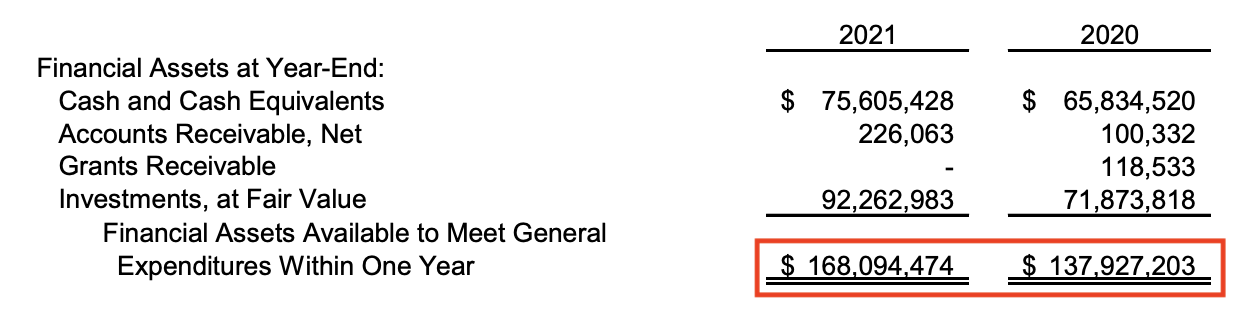
It is particularly concerning that ABIM decided to raise their MOC fees 25% in 2022 when their own assets mushroomed 18% in 2021 alone to more than $168 million:


ABIM has constantly billed itself as a "physician-led" non-profit 501(c)(3) organization. From their About ABIM webpage:

"ABIM is a physician-led, non-profit, independent evaluation organization driven by doctors who want to achieve higher standards for better care in a rapidly changing world."

But are they really? Who is really pulling the strings at ABIM?

We have already seen that the former CEO and President of ABIM, Christine Cassel, MD was serving as a board member of one of the largest Group Purchase Organizations, Premier, Inc, and serving on the Board of Kaisier Hospital and Health Systems while also serving as President and CEO of the ABIM - conflict that was never disclosed to physician-diplomates of the ABIM.

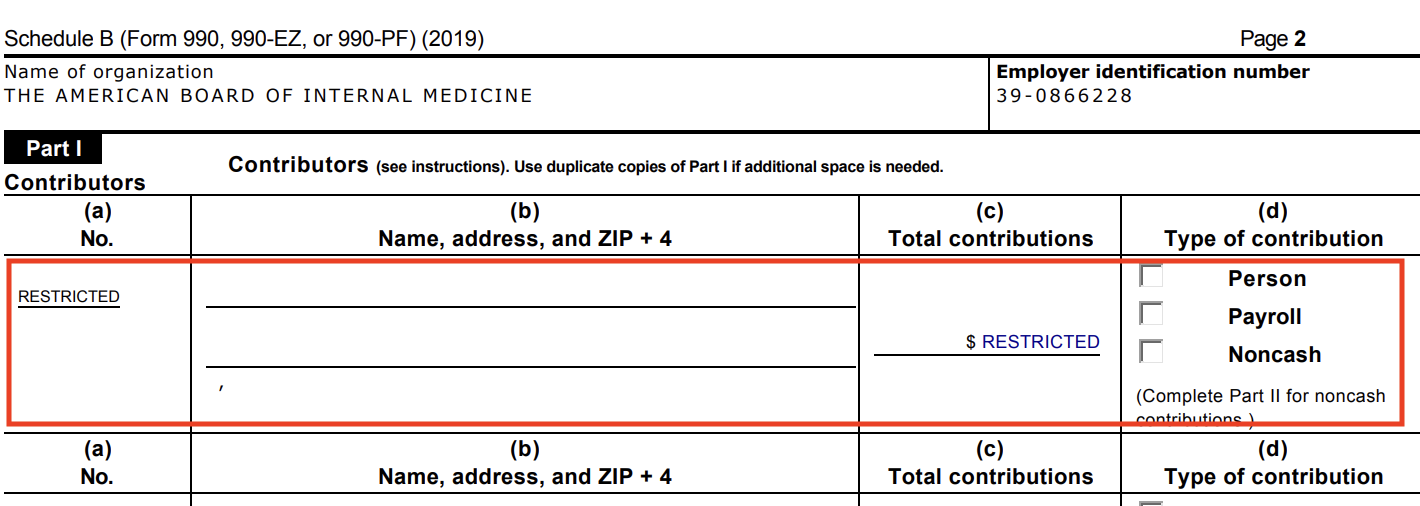
But now we see another concerning potential conflict that needs explanation, especially with the rate hike in fees physician must endure. Who are ABIM's "RESTRICTED" contributor(s) found buried on their latest IRS Form 990?

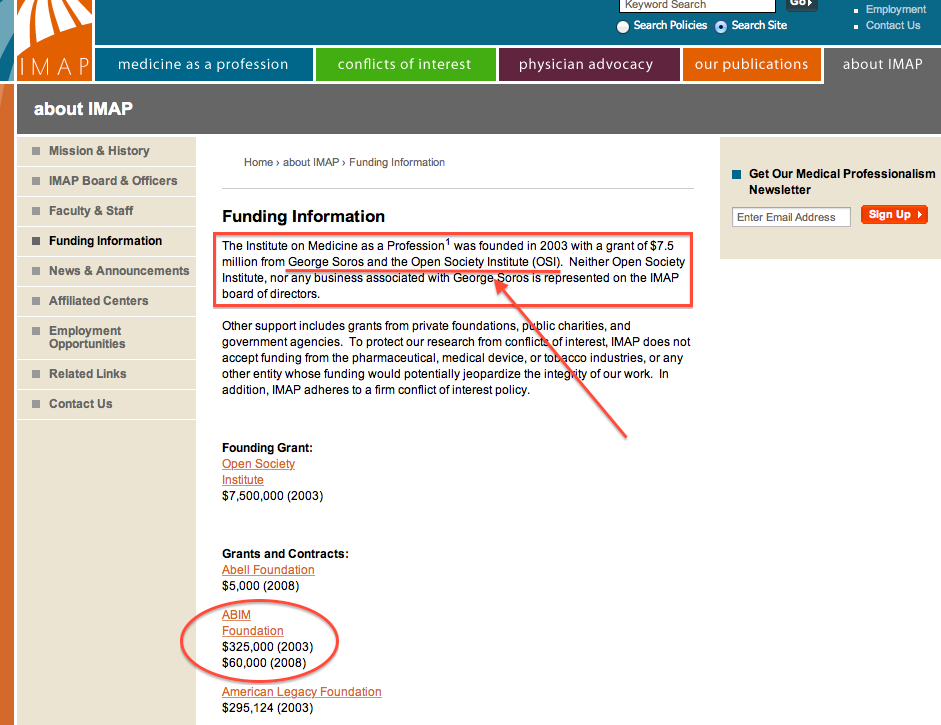
Might it be George Soros (since ABIM contributed to his Institute for Medical Professionalism in 2003 and 2008)?

Or might it be other members of the Accreditation Council of Graduate Medical Education (ACGME), like the American Medical Association (AMA) or American Hospital Association (AHA)? Who stands to profit from the control of physicians this way?

Physicians have a right to know what the heck is going on at ABIM and why are fees have gone up 25% in 2022 at a time when ABIM is more than flush with cash. We also deserve to know who their contributors are that are supporting his racket. 

Unless, of course, the US is running the physician regulatory system like the mob.

-Wes


PS: For those interested in staying abreast of our ongoing investigation, consider joining Practicing Physicians of America (it's free and allows us to know who wants further work in this arena).


Wednesday, January 27, 2021

Is ABIM Ending Its "Knowledge Check-In" MOC® Pathway?

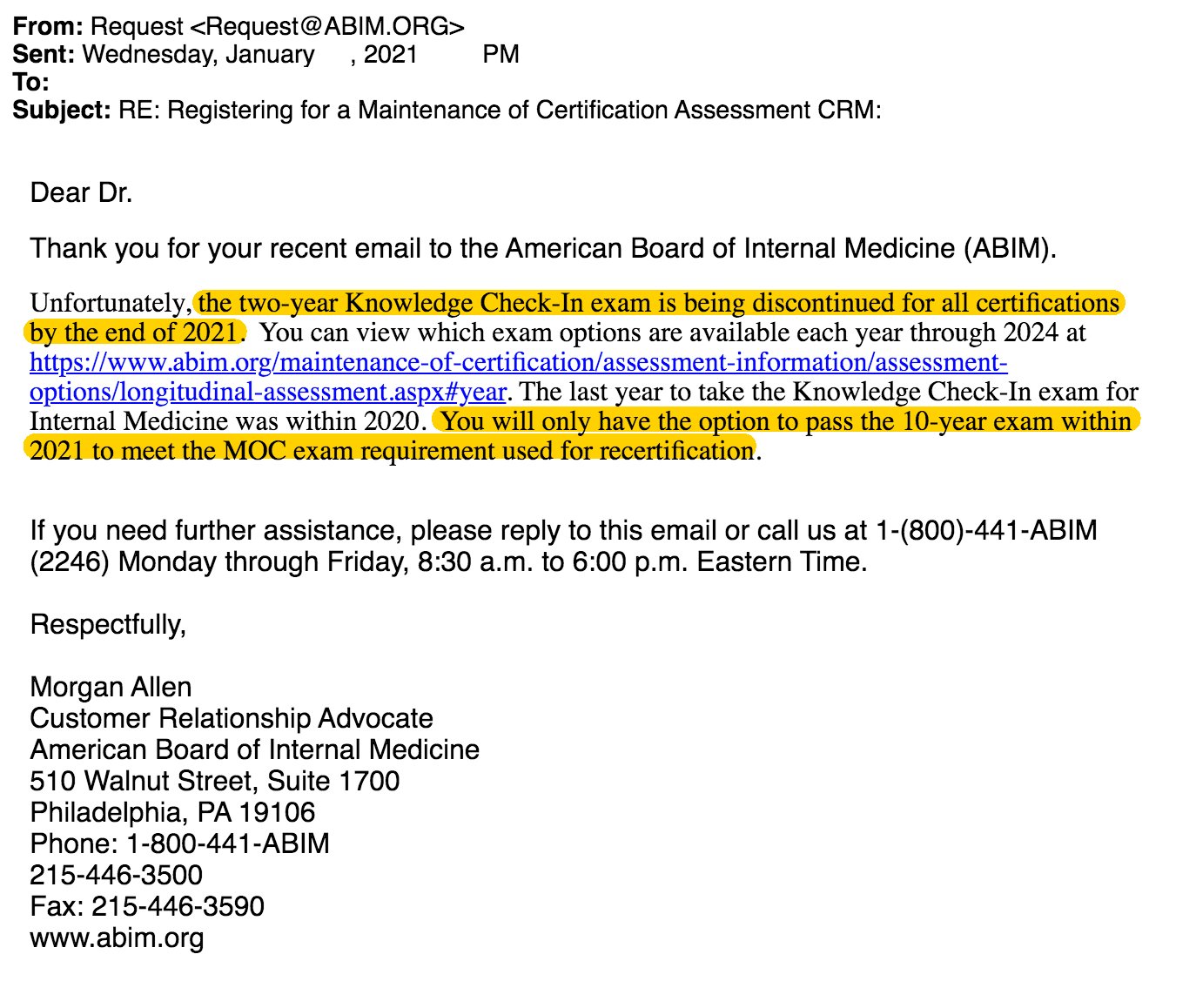
The following (redacted) email was received from Morgan Allen, Customer Relationship Advocate at the American Board of Internal Medicine (ABIM), in response to an ABIM diplomate that was unable register online for their every-two year Knowledge Check-In "continuous" Maintenance of Certification (MOC®) product.

According to this email, it seems the ABIM has decided to end its Knowledge Check-In recertification pathway and only permit its every-10-year high-stakes recertification examination for physicians to remain ABIM Board Certified.

At the time of this writing, I could find no public notification of this policy change on ABIM's website. Once again, working physicians are irresponsibly left uncertain of the latest requirements to remain ABIM Board Certified in good standing.

ABIM has a long history of changing the rules for the names and requirements for physician board recertification/maintenance of certification/continuous certification. But despite the many name and rule changes of this racket, each rebranding becomes more expensive and serves to perpetuate the discrimination against younger physicians and physicians of color from senior "grandfathered" physicians who are not required to purchase these products to retain their ABIM Board Certified status. The Knowledge Check-In recertification pathway was no different from its predecessors in this respect. But the Knowledge Check-In pathway also suffered from a plethora of technical, security, and (undisclosed) privacy issues for physicians. (See my earlier video that critically reviewed this recertification pathway and the people who created it.)

One thing is a constant, however. Ever since the ABIM changed Board certification from a lifetime to time-limited physician marketing accolade, this unproven repeated testing of working physicians remains a career-long psychological and economic stressor that distracts from what matters most: patient care.

-Wes

Friday, October 23, 2020

ABIM Stumbles in Appellate Court Arguments

The oral arguments in the appeal of the dismissal at the District Court level of the Kenney et al vs American Board of Internal Medicine (ABIM) class action antitrust, RICO, and unjust enrichment case were heard before the 3rd Circuit Court of Appeals today and are available via audio file here. The following interchange starting at 32:58 in the audio file was interesting (I have added a few personal comments/thoughts in italics):

Judge: "Could I just ask the follow-up there about forcing? How do we conclude that internists aren't forced to buy MOC at this stage in the litigation in light of the allegations that internists can't successfully practice without certification? Isn't the feasibility of practicing without certification ultimately a question of fact?"

ABIM Attorney: "I think you can first look to, um, look to the facts in this case. For instance, Dr. Manolo who, who never, who did purchase initial certification and never purchased Maintenance of Certification. I think that certainly shows that his purchase of initial certification was not contingent on the later purchase of Maintenance of Certification. (Comment: It also shows there are two products). So I think that is one way you can look at it. I think you can also look at it in the way that the Second Circuit indicated in the Smugglers Notch Homeowner's case which is a case where, which looked at, when you're entering in to the transaction and you know that, in fact, you're that going to be required, there are certain components, parts, of that entire transaction, and you know that up front, and you voluntarily nonetheless enter into that contract, that there is no forcing." 

Judge: "But counselor, what I'm talking about is it might not be so voluntary - they want to make a living, are they forced to buy your product? You seem to say no they're not forced to, but is that essentially an issue of fact more appropriate for summary judgement?"

ABIM Attorney: "Um, I would suggest not because I think when courts look to forcing they look at what is the situation at the time of the initial purchase? At the time of the initial purchase here ABIM had a program for certification and aspects of that program were initially passing the initial board certification exam and that that certification would expire after a set period of time - ten years - without unless diplomate passed subsequent examinations. And so when they, up front, bought that product they knew there would be a continuing obligation as part of the certification program, that they would have to demonstrate, in fact, that they possess the requisite knowledge to hold themselves out and say "Yes, I am ABIM, or board certified." So there is no forcing because there is the knowledge up front at the time of purchase of what certification entails, um, and that was the periodic demonstration of knowledge."

Judge: "But I suppose that the most basic form of your argument is, they don't have to go through ABIM to practice." 

ABIM Attorney: "Yes, your Honor. If you look at the Amended Complaint, the Amended Complaint is quite clear that board certification is not required to practice medicine in the United States. That is simply a function of state boards of medicine that license doctors. Um, you only need a license in your state, um, to practice medicine. Board certification is not required. Board certification is more like the "Stamp of Approval" that you can hold yourself out to have special qualifications. (As I have said all along, board certification is actually little more than a marketing accolade.) Some patients and employers look to that, others do not, but it is not a requirement to practice medicine in any state in the United States which is a fact that is pled in the Amended Complaint."

Judge: "But this does go to your market power, I mean, yeah, it's true, you don't need the ABIM certification. But is it really feasible not to have it, in reality? And I think, the allegations, don't they say, a lot of places won't let you practice, your malpractice rates are going to go higher, reimbursement's going to be an issue. So is it really feasible to practice without certification and is that something that should be a subject of discovery as opposed to, you know, at this juncture with a motion to dismiss to resolve?"

ABIM Attorney: "Well. well many, I would submit many internists do, in fact, practice medicine, um, without ABIM certification and there are many things that might affect how much you are paid, what your admitting privileges are - things like where you attended medical school and many other factors. (Comment: And if you believe this, I have some ocean-front property to sell you in Arizona). But it really comes back to, you know, what is at issue in this case and whether, in fact, there is a tying claim and whether or not there is, um, one product or two products and that really goes back to the Supreme Court test in Jefferson Parish about the character of demand and whether there is demand for the tied product in absence of the typing product.  And here, the Appellants want to hold themselves out as being "board certified." There is no separate demand for the tied product in the absence of the tying product. And that is something I think is, is something that, you know, the Court in Jefferson Parish makes clear. Justice O'Connor when she expands on the words in that saying that for products to be treated as distinct, the tied product must, at a minimum, be one that consumers might wish to purchase separately without also purchasing the tying product. And here's.. there's simply... there are no allegations of fact sufficient to move this case along to make a plausible case that there are, in fact, two products here because there is no consumers, there are no allegations showing there is demand to purchase the tied product without also tying the tying product." (Comment: OMG, Seriously?)

Judge: "Alright, thank you counsel."

The judges asked the right questions. Now we have to wait to see if this case is sent back to the District Court for discovery.

I will have additional comments about other aspects of these oral arguments in the days ahead.

-Wes

P.S.: MedpageToday covered the story as well here.

PPS: If you'd like to help the plaintiff's along their lengthy legal quest to improve the lot for all US physicians regarding MOC, please contribute to the GoFundMe page sponsored by Practicing Physicians of America.

Tuesday, September 29, 2020

With MOC, Will Working Physicians Ever Get Their Day in Court?

For the past seven years, the American Board of Medical Specialties (ABMS) member boards have been under fire regarding their trademarked Maintenance of Certification® (MOC) program that shifted lifetime ABMS board certification to a time-limited US physician credential in 1990. 

Physicians have long argued that before 1990, board certification was an independent and generally-accepted assessment of the quality of their post-graduate specialty training. After 1990, however, ABMS board certification became two separate products: (1) an assessment of their post-graduate training and (2) a "continuous professional development"  (CPD) product tied to their original post-graduate training assessment. 

The logic for this two-product theory is simple. Before January 1, 1990, the CPD product was truly voluntary for physicians to perform. But after a trial run of this voluntary testing, fewer and fewer physicians opted to participate in the program in large part because of its unproven value and expense. To counter the declining enrollment, the American Board of Internal Medicine (ABIM) "Task Force" (and eventually all other ABMS member boards) decided to tie participation in the ABMS CPD product to the validity of a physician's initial assessment of their post-graduate training:

"Thus, the stage was set for the Board to embark on a new era in which its diplomates would be asked, but not required, to renew the validity of their certificates at periodic intervals or face the uncertain circumstances of loss of their status as certified internists, subspecialists, or holders of certificates of added qualifications."(1)
It didn't matter if a physician had participated in other self-directed Continuing Medical Education (CME) on their own accord; unless a physician performed the ABMS-sanctioned CPD program, they would lose their original ABMS board certification credential and the privileges that credential imparts to physicians in terms of academic, professional, and economic value.

This tie between a physician's original post-graduate assessment and lifelong continuous professional development proved remarkably lucrative for the ABMS and their member boards. So much so, that the ABMS CPD program was later trademarked as "Maintenance of Certification®" (MOC®) and had its own profit line on ABMS member board tax forms. The tie was so lucrative, in fact, that the largest member board, the ABIM, created an undisclosed shadow organization, the American Board of Internal Medicine Foundation (later renamed the ABIM Foundation) and secretly funneled tens of millions of dollars for nearly ten years without disclosing its existence to physicians and the public and purchased a $2.3 million condominium for themselves. After its public debut online in 1999, the ABIM Foundation later off-shored millions of those funds to the Cayman Islands in 2015. 

Is it any wonder that physicians would be upset?

Yet here we are.

So far, the ABMS member boards have had exceptionally good fortune protecting their MOC® product in court, arguing before various district court judges that ABMS board certification is not two products that are illegally tied, but rather just one big "board certification" product.  

Last week was no exception. The long-running lawsuit filed by the Association of American Physicians and Surgeons (AAPS) suit against the ABMS was dismissed with prejudice.  In addition, the antitrust suit field by two psychiatrists against the American Board of Psychiatry and Neurology (ABPN) was similarly dismissed (along the same legal lines of the ABIM and ABR lawsuits) but WITHOUT prejudice. (The judge left room here for the original Complaint to be amended - perhaps because the ABR lawsuit was later amended and has been fully briefed but not yet decided). 

It is interesting to this observer that there has been little fanfare in the media regarding these last two rulings in favor of the ABMS member boards. I suspect the ABMS and their associated specialty boards know that all eyes are on the ABIM antitrust lawsuit appeal recently filed. That appeal explains the two-product tie created by the ABIM clearly. Perhaps they'd rather not bring attention to that case that's due for oral arguments on the 23rd of October. So much hinges on the outcome of that case for both them and working physicians.

Irrespective of the cases outcome, however, the credibility and value of ABMS board certification has been tarnished forever. Given the revelation of the conflicts of interests and lucrative nature of ABMS board certification, rhe only way the ABMS brand could redeem itself is for a full accounting of all that has transpired against working physicians by these self-appointed non-representative academic physicians and the non-physicians corporate directors now at the helm of these lucrative ABMS specialty boards.

-Wes

(1) Richard J. Glassock, MD, John A. Benson, MD, Robert B. Copeland, MD, Herman A. Godwin, MD, et al. Time-Limited Certification and Recertification: The Program of the American Board of Internal Medicine. https://doi.org/10.7326/0003-4819-114-1-59

P.S.: Working physicians are still encouraged to support these important ongoing legal battles by contributing to the GoFundMe page sponsored by Practicing Physicians of America.

Monday, July 27, 2020

Physician Plaintiffs File Reply Brief Against ABIM

The four Internal Medicine physician Plaintiffs-Appellants filed their latest Reply Brief in the class action lawsuit against the American Board of internal Medicine (ABIM) today. That reply brief summarized the alleged tying arrangement of ABIM board certification to "Maintenance of Certification (MOC)":
"ABIM’s monopoly power over certifications is undisputed. Certifications are an economic necessity for a successful medical practice. From 1936 to today ABIM certifications have assessed one thing: postgraduate medical education. 

Realizing that only so much in certification fees can be extracted from new residency graduates, MOC allows ABIM not only to charge internists a one-time certification fee at the outset of their practice, but to force internists to purchase MOC by revoking their “initial” certifications if they do not, requiring them to pay inflated MOC fees throughout their entire decades-long careers. The two products are separate because, in ABIM’s own words, MOC “means something different” from certifications and “speaks to the question of whether or not an internist is staying current.” (¶ 53). MOC’s true purpose, however, is to create a lucrative revenue stream for ABIM, resulting in hundreds of millions of dollars in new fees. (¶ 65). 

There are other products—not sold by ABIM—that help internists stay current, including continuing medical education products (“CME”). (¶ 54 (“MOC serves substantially the same function as CME”)).1 

MOC is ABIM’s fourth attempt to sell a product distinct from certifications to help keep internists current. Thousands of internists bought three previous voluntary MOC products separately from their certifications as part of ABIM’s Continuous Professional Development Program (“CPD”). (¶ 25). “Grandfathers” today also purchase MOC separately from their certifications. (¶ 35). Purchases by internists of MOC, CME, and other non-ABIM CPD products to stay current, demonstrate distinct demand for those products separate from the demand for certifications. ABIM’s earlier versions of MOC failed to generate the hoped-for revenue because ABIM did not revoke certifications of internists who did not buy them. That ABIM’s voluntary products were unsuccessful reflected internists’ preferences to buy products from others to stay current. (¶ 55). ABIM ensured, however, that MOC succeeded by tying it to “initial” certifications and making it mandatory. (emphasis mine) Plaintiffs’ claims do not threaten ABIM “standards” any more than ABIM’s earlier voluntary MOC products did. Plaintiffs ask only that ABIM’s illegal tie be severed and that MOC once again be voluntary."
In addition, the filed brief explains the basis of the RICO claims made by the physician Plaintiff-Appellants against the ABIM: 
"After ABIM was unable to generate hoped-for fees from its first three voluntary MOC products sold as part of its CPD Program, it realized it must force internists to buy MOC. ABIM did so by revoking the certifications of internists who did not buy MOC. In furtherance of its scheme, ABIM waged a campaign of fraudulent misrepresentations to deceive the public, including but not limited to hospitals and related entities, insurance companies, medical corporations and other employers, and the media, that MOC, among other things, benefits physicians, patients and the public and improves patient outcomes. As a result, ABIM has collected hundreds of millions of dollars in MOC fees under false pretenses."

Finally, in regard to the unjust enrichment claim dismissed by the earlier District Court judge:
"The district court’s sole rationale for dismissing Plaintiffs’ unjust enrichment claims is its conclusion that ABIM “did not ‘force’ Plaintiffs to purchase MOC.” A-41. ABIM similarly repeats its argument that internists “chose” to “pursue and maintain their certifications.” ABIM Br. 54. Plaintiffs have already debunked this argument, and clearly allege “forcing” notwithstanding the erroneous conclusions and arguments of the district court and ABIM. 
ABIM points out that certifications are not required for licensure. But it does not deny certifications are required for admitting privileges, insurance, and other requirements of a successful medical practice, and accordingly are an economic necessity. Finally, the district court opinion in In re Avandia Mtkg., No. 2007-MDL-1871, 2013 U.S. Dist. LEXIS 152726 (E.D. Pa. Oct. 22, 2013), does not support ABIM, as the unjust enrichment claim there failed for several reasons not pertinent here, most importantly because, unlike MOC, the purchases were voluntary. See ABIM Br. 55-56."
With this filing, it is clear that the class action lawsuit filed by working physicians against the ABIM is far from over. Read the whole Reply Brief here. 

-Wes

To support the physician plaintiffs in this ongoing lawsuit, consider contributing to their GoFundMe page.

Thursday, December 12, 2019

Just In Time for Christmas: The MOC Legal Juggernaut Intensifies

With the recent back-to-back announcements that the class action antitrust and racketeering lawsuit against the American Board of Internal Medicine (ABIM) and the antitrust lawsuit against the American Board of Radiology were dismissed (e.g., the ABIM announcement and ABR announcement), doctors everywhere - both young and old - seemed resigned to the fact that they will have to be subjects to lifelong extortion of private American Board of Medical Specialties member boards and their affiliates if they wanted to practice medicine in the United States.

But fear not, dear colleagues. I bring you tidings of great joy. The first great Supplemental Opposition to the Motion to Dismiss the lawsuit against the American Board of Psychiatry and Neurology (ABPN) was filed yesterday that promises to renew the call for justice on the basis of proper legal procedural grounds:
Defendant American Board of Psychiatry and Neurology (“ABPN”) illegally ties its initial certification product, which it sells to new doctors to demonstrate completion of their medical education and assess the quality of their residency program, and its MOC product, which it requires some older doctors, but not all, to purchase throughout their careers to demonstrate lifetime learning or forfeit their initial certification. ABPN brings to the court’s attention Kenney v. American Board of Internal Medicine, No. 18-5260, 2019 U.S. Dist. LEXIS 164725 (E.D. Pa.Sept. 26, 2019) (“Kenney”), and Siva v. American Board of Radiology, No. 19 C 1407, 2019 U.S. Dist. LEXIS 200645 (N.D. Ill. Nov. 19, 2019) (“Siva”). Kenney came first, followed by Siva which “agree[d] with the reasoning in Kenney.” Id. at *11.1

Nothing in those opinions changes ABPN’s unlawful conduct. A critical reading of the opinions and application of the universally accepted rule that well-pleaded factual allegations and all reasonable inferences therefrom must be taken as true compels the conclusion that Kenney and Siva were, respectfully, wrongly decided.
1  The tying claims in Kenney were dismissed with prejudice without plaintiffs being allowed to amend, the court finding as a matter of law that separate products could never be alleged. Plaintiffs are appealing that ruling. The claims in Siva were dismissed without prejudice and plaintiff is filing an amended complaint on January 10, 2020.
The supplemental opposition to the ABPN motion to dismiss then outlines multiple legal reasons why the plaintiffs believe the decisions were wrongly decided. In essence, the attorneys are arguing that the facts in this case were not even allowed to be considered past the judges' chambers.

We can anticipate that the multitude of moneyed interests behind Maintenance of Certification will stop at nothing to assure this unlawful program continues unchecked.

Still, a bit of hope and cheer is always welcome for working physicians this time of year.

Merry Christmas!

-Wes

P.S.: On a separate legal note:

Remember the Puerto Rican physician, Jaime Salas Rushford, MD, whom the ABIM revoked his board certification and dragged him through the court system since 2012 with a dismissed time-barred cheating claim while the President and CEO of the ABIM simultaneously failed to disclose her conflicts of interest with Kaiser and Premier Inc? Yesterday, the judge issued the following order to expedite the counterclaim suit filed against ABIM by Salas Rushford:
The American Board of Internal Medicine may file its motion for judgment on the pleadings no later than December 18, 2019. Dr. Salas-Rushford will respond no later than January 2, 2020. The Board may reply no later than January 9, 2020. The case schedule will be discussed at the scheduling conference to be held on January 31, 2020. Signed by Judge Francisco A. Besosa on 12/11/2019. (brc) (Entered: 12/11/2019)
It seems that case will soon be coming to a head, too.

Readers wishing to support the brave physician plaintiffs involved in these lawsuits trying to end the unlawful Maintenance of Certification program are encouraged to contribute to their GoFundMe campaign.

Tuesday, July 30, 2019

Why the U.S. Specialty Boards Were Sued and Why Those Lawsuits Are Important

I hope every working U.S. physician takes 9 minutes to view this video on why the lawsuits against  the American Board of Medical Specialties (ABMS) member boards were filed and why those lawsuits are so important to our profession.

Please view and share with your colleagues.

An update on the status of those lawsuits will appear on this blog's pages soon.


-Wes

Tuesday, April 02, 2019

What Do Working Cardiologists Really Think About the ACC's CMP Pathway?

What do US cardiologists and electrophysiologists REALLY think about the American College of Cardiology's (ACC) heavily-promoted collaboration with the American Board of Internal Medicine (ABIM) to create their "Continuous Maintenance Pathway" (CMP) for continually maintaining their ABIM board certification?

That's a question I wanted to know, so I helped create a quick 5-minute survey on the matter open to US cardiac electrophysiologists, cardiologists, and heart failure specialists.

I hope to have the results compiled by the Heart Rhythm Society in May, 2019.

I look forward to your responses and thoughts. Additional comments regarding the CMP program not covered in the survey can be left in the comments on this blog post.

Thanks-

-Wes

Tuesday, January 08, 2019

The ABMS Spider and the Fly

Mary Howitt

“Will you you walk into my parlour, said a Spider to a Fly;
'Tis the prettiest little parlour that ever you did spy.
The way into my parlour is up a winding stair,
And I have many pretty things to shew when you get there.
Oh, no, no! said the little Fly; to ask me is in vain:
For who goes up that winding stair shall ne'er come down again.

Said the cunning Spider to the Fly, Dear friend, what can I do
To prove the warm affection I have ever felt tor you?
I have within my parlour great store of all that's nice:
I'm sure you're very welcome; will you please to take a slice!
Oh, no, no! said the little Fly; kind sir, that cannot be;
For I know what's in your pantry, and I do not wish to see.

Sweet creature, said the Spider, you're witty and you're wise;
How handsome are your gaudy wings, how brilliant are your eyes!
I have a little looking-glass upon my parlour-shelf;
If you'll step in one moment, dear, you shall behold yourself.
Oh, thank you, gentle sir, she said, for what you're pleased to say;
And wishing you good morning now, I'll call another day.

The Spider turn'd him round again, and went into his den,
For well he knew that silly Fly would soon come back again.
And then he wore a tiny web, in a little corner sly,
And set his table ready for to dine upon the Fly;
And went out to his door again, and merrily did sing,
Come hither, pretty little Fly, with the gold and silver wing.

Alas, alas! how very soon this silly little Fly,
Hearing his wily flattering words, came slowly fluttering by.
With humming wings she hung aloft, then nearer and nearer drew.
Thinking only of her crested head and gold and purple hue:
Thinking only of her brilliant wings, poor silly thing! at last,
Up jump'd the cruel Spider, and firmly held her fast!

He dragg'd her up his winding stair, into his dismal den,
Within his little parlour; but she ne'er came down again.
And now, my pretty maidens, who may this story hear,
To silly, idle, flattering words, I pray you ne'er give ear;
Unto an evil counsellor close heart, and ear, and eye,
And learn a lesson from this tale of the Spider and the Fly.

~By Mary Howitt, 1829

* * *

If you do Maintenance of Certification, you are just a silly little Fly.

It is chillingly apposite: for the American Board of Medical Specialties (ABMS) and their 24 member boards' to live, autonomous independent-thinking physicians must die.

Spiders can never stop being Spiders.

"And now, my pretty MOC maidens, who may this story hear,
To silly, idle, flattering words, I pray you ne'er give ear;
Unto an evil ABMS counsellor close heart, and ear, and eye,
And learn a lesson from this tale of the Spider and the Fly..."

... then donate to Practicing Physicians of America's expanded legal fund drive.

-Wes

Tuesday, November 06, 2018

Ending MOC Nationwide

Continuing education for physicians is important (and we've been doing it all our lives on our own), but when working physicians' right to care for their patients is threatened by unaccountable non-profit testing organizations that have serious undisclosed conflicts of interest, we will take action.

 -Wes


P.S.: Patients, doctors: want to help? You can still donate.

Monday, July 03, 2017

Common Sense

Four years ago, I had to "re-board certify" in cardiology and cardiac electrophysiology or lose my ability to practice medicine at the hospital I have worked since 2001. The "de-credentialing" aspect of failing to participate in the American Board of Internal Medicine's (ABIM) self-proclaimed "Maintenance of Certification" (MOC) program infuriated me, but I was left with no choice but to "pay up and a just do it."

Like my colleague Meg Edison, MD, I seriously thought about not re-certifying at the time, but my wife intervened and suggested I'd be more effective at combating the requirement while remaining "certified" so I could not be passed off as a disgruntled doctor. So I reluctantly registered for the "program."

My! How "re-certification" had changed since 2002! As I registered, I quickly learned that I no longer just had to take a "test" to re-certify. I also had to perform unsupervised research surveys on my patients. I had to dream up a quality assurance project and test it on myself and my clinic. I also had to review volumes of information purchased from the American College of Cardiology for $1350 because if I did not pass my cardiology re-certification, I could not practice as a cardiac electrophysiologist because of the "double jeopardy" dual-board passing requirement in effect at the time. Due to the high-stakes nature of being unable to practice if I failed either of my examinations and to save time, I attended a three and a half day board review course sponsored by members the Heart Rhythm Society for another $1400. Reading the materials I had purchased was not enough. Only if I read the same material on a COMPUTER (with ridiculously slow screen load times), would I receive CME credit for my hours spent studying. All of this pulled me from the patient care I was also trying to provide, took precious free time away from time with my family, and done without any proof that MOC improved my patient's care quality or safety.

Puzzled by the complexity of the "new MOC" I had to endure, I started to investigate and write about my experience on this blog. What has transpired since beginning this effort over the last four years has been nothing short of remarkable. I quickly learned that I was not alone - that physicians across the country were just as infuriated as me. I was struck by the unassailable power the ABMS member boards had amassed over physicians' ability to treat their patients. As I kept writing and investigating, I was introduced to others who knew more than I did about the board certification and re-certification folly. I met real leaders in the fight against MOC: Paul Kempen, MD, PhD, Ron Benbassat, MD, Charles Cutler, MD, and Mr. Charles P. Kroll - a forensic accountant and fellow Illinois resident at the time - who helped me understand the depth and breadth of financial shenanigans going on.

Mr. Kroll and I eventually reviewed every Form 990 and 1023 tax document we could acquire on the ABIM and its Foundation - all the way back to 1997 (the earliest complete tax form I would find) and the years-long financial, political, and power agendas inherent to MOC became clear. Edward J. Schloss, MD (a fellow electrophysiologist) and I published the history and origins of MOC and the published veiled threats imposed on physicians if they failed to comply contained in the peer-reviewed literature. Gradually, things began to make more sense. What I was not prepared for, however, was the depth and breath of the professional societies' dependence on the program and their impotence at effecting real change. Time and time again, peer-reviewed articles and rebuttals to ABIM's publications weren't published.

With ongoing review, it soon became clear that things did not stop with the ABIM. Other ABMS member boards, the hospital lobby, and even entire departments of internal medicine at large state-owned academic medical centers appeared to conspire with the unproven need for MOC. Even the "National Committee on Quality Assurance" and one of the oldest and most influential medical societies (and owner of the New England Journal of Medicine) used MOC to create new revenue sources. Too much money was involved at practicing physicians' expense. Even the hospital lobby, always eager to the control the flow of patients to their group's facilities, were more than happy to play along when doctors brought legislation to states, insisting that MOC be tied to physicians' hospital privileges on the false promise it assured physician competency.

On and on our investigation went: from the ABIM Foundation (and the "Choosing Wisely" initiative), to the National Quality Forum, the National Committee on Quality Assurance, the Institute of Medicine, and even the President's Council of Advisors on Science and Technology! It was an amazingly intricate (and lucrative) physician education/testing/quality assurance cartel that has operated without any legitimate oversight or questioning of their actions for years.

It was clear that I (any many others) had opened an entire Pandora's box of corruption in the US medical education system and medical quality and safety empire, the likes of which I could not imagine.

At the same time, physicians from other locations wanted change, too. A petition hosted by Paul Teirstein, MD of Scripps Medical Center in La Jolla, CA garnered over 23,000 physician signatures and led him to create a competing credentialing body, the National Board of Physicians and Surgeons (NBPAS). The ABIM, feeling the pressure of legitimate competition, issued their now infamous "we're sorry" mea culpa promising to "listen" and modify the MOC program. Even the New England Journal of Medicine felt compelled to sponsor a limited journalistic "debate" between Dr. Teirstein of the NBPAS and Lois Margaret Nora, MD, JD of the ABMS. The comments were overwhelmingly in favor of Dr. Teirstein. But physicians were no longer fooled. Despite publishing these opposing articles,  physicians saw the Massachusetts Medical Society (publishers of the New England Journal of Medicine) promote their own MOC learning program: "Knowledge +". Everyone, it seemed, placed the money from MOC before the needs of practicing physicians and their patients.

Naively, I went to my professional society and raised red flags. While the Heart Rhythm Society initially appeared to take a strong public stand against MOC, hosting a debate between Fred Kusumoto, MD and Douglas Zipes, MD in 2015, there was little real debate. Dr. Zipes - a long-time director at the ABIM - refused to address anything about "the ABIM finances, fees, salaries, investments, etc." Later, it has become apparent that the revenues from MOC board review courses and the affiliation with ABIM were too important to the leadership at HRS to end their affiliation with the MOC program. Even when main stream media (a la Mr. Kurt Eichenwald from Newsweek) tried to expose the corruption in four well-researched articles on the ABIM (see here, here, here, and here), the ABIM and physician education establishment summarily dismissed all of the facts levied against the organization because Mr. Eichenwald failed to disclose his wife was an internist. (You can't make these things up.)

At the invitation of the Pennsylvania Medical Society in June 2016, I went to the AMA House of Delegates to tell my MOC story and there they all were: the chairman of the board and chief counsel for the AMA, the Senior Executive Vice President of the American College of Physicians, the President and CEO of the American Board of Medical Specialties. The room was packed as they listened, writing notes. The Pennsylvania Medical Society took the lead and bravely issued a formal "Vote of No Confidence" against the ABIM and the AMA House of Delegates later voted to end Maintenance of Certification (MOC) nationwide. There was hope, I thought.

Still, the AMA leadership failed to act to end MOC.

Many physicians would not rest. Not only had doctors become familiar with the incredible ABIM Foundation condominium story, they learned of the strongman tactics used by the ABIM in an issue of Philadelphia Magazine devoted to the ABIM controversy. Worse still, they saw the veiled threats from a Wall Street attorney levied for exposing the ABIM's felonious "Director of Test Security" in a subsequent issue of the magazine. Unfazed, brave, proactive physicians forwarded legislation across the country to end MOC as a condition of hospital credentials, medical licensure, and ability to participate in insurance panels. State after state attempted to pass legislation, only to realize how difficult it was to do so when they were fighting the hospital and insurance lobbies and colleagues suffering from Stockholm Syndrome as hospital-employed physicians.

This year, the Pennsylvania Medical Society organized another event at the AMA House of Delegates meeting to discuss the realities of trying to get anti-MOC legislation passed in state legislatures across the country. The AMA, ACP, and ABMS leadership were not readily apparent  this time. They had moved on, coordinating their message and confident in their cash reserves and lobbying team. It became readily apparent to those of us at that meeting that the insurance and hospital lobbyists would stop at nothing to prevent this legislation as intended from going forward. After all, not only does MOC remain a critical revenue stream for our bloated and overreaching US physician credentialing system, it also serves to limit competition for them as they insist this metric serves the "public" at physicians' personal and professional expense. While MOC remains in many parts of the country, through this process we have learned a lot. Multiple states now have anti-MOC laws on the books now with Texas's law going into effect 1 January 2018. Since that law was voted in to place, Houston Hospital Physicians voted unanimously to remove the ABMS MOC requirement for credentialing.
“The legislature did their job, Doctors Buckingham and Bonnen did their jobs, now all of us need to take back the autonomy we gave up when we allowed MOC,” Dr. Hampel said. “We need to vote it out of every bylaws in the state.”
So Where Do Working Physicians Go Now? 

What can practicing physicians on the front line of patient care delivery do?

We have two choices: 1) continue the status quo, or 2) organize to end the injustice. MOC is just one example of overreaching and damaging regulatory intrusion on the practice of medicine.

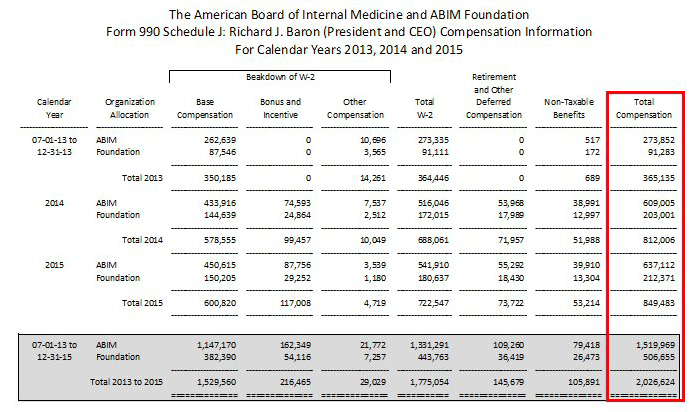
It is not okay that the ABIM secretly took at least $77 million of physician testing fees to create their own ABIM Foundation retirement fund and then offshored a hefty portion of that money for themselves. It is not okay that the ABIM, an unaccountable non-profit organization,  targeted vulnerable physicians trying to study for their examination using a known felon and their attorneys. It is not okay that Richard Baron, MD, President and CEO of the ABIM and its Foundation, earned $2 million from 2013-2015 while ABIM had $31.7 million in operating losses. It is especially not okay that the entire Accreditation Council for Graduate Medical Education (ACGME) member organizations continue to condone these activities by failing to act against them. Where evil and hypocrisy are rewarded and even called humane and good, it shows how twisted our words have become and how far corporate medicine has fallen.

As our new residents start training this Fourth of July weekend, if US physicians do not act collectively to end MOC, we condone the development of doctors that are little more than excellent sheep. Ignoring what has occurred to our profession due to our earlier indifference would risk the development of a medical education system that manufactures doctors who, as the wise professor William Deresiewicz put it, are "smart and talented and driven, but also anxious, timid and lost, with little intellectual curiosity and a stunted sense of purpose: trapped in a bubble of privilege, heading meekly in the same direction, great at what we're doing but with no idea why we're doing it." Aspiring to be excellent sheep is not in our patients' best interest. We should never forget why we're physicians and whom we truly serve.

Organizing is the only way we will end MOC nationwide and the many other intrusions created by clever unaccountable third parties behind closed doors for their own benefit.

To that end, I am not talking about unionizing. I am not talking about a partisan group to push a particular health care reform agenda.

Rather, I am talking about creating a representative member organization that does three things: (1) represents the needs and concerns of real-life practicing physicians who care for patients day to day, be they employed or in private practice, (2) acts to limit unnecessary, overbearing, and improper regulations against physicians (like MOC), and (3) works to assure that physicians are allowed to remain the principle advocate for their patients without threat from third party intrusions. Everything this organization does would be driven by these three principles.

Unfortunately our reality is that none of this can happen without money. It costs money to create an organization, hire a person to answer the phone, and pay an executive director to manage the operations while we continue to do what we love to do - care for patients. It takes money to send someone to testify in front of state legislators, the FTC, the IRS, or lobby Congress on our behalf. It takes money to develop a legal fund to combat the injustice of MOC that has occurred behind our backs. And it takes money to make sure such injustice never happens again.

Our nascent organization, Practicing Physicians of America, Inc. (PPA) which has come together on a shoestring and a prayer, has reached out to many of the leaders and organizations involved in the anti-MOC movement. Many have agreed to serve as our advisors. We have already been active on Capitol Hill, worked to coordinate the statewide legislative efforts against MOC, and testified in state legislative hearings. To continue our efforts, PPA is now formally open for membership (and donations) to bring our dream to a sustainable reality.

None of our board members are paid. For months we have donated countless hours in our spare time to this endeavor because we each believe in PPA's mission. But there's still an incredible amount left to do. We know we can't do this alone. Such an ambitious project will take a large coordinated effort from the entire practicing physician community to make this organization a sustainable reality and for it to have an impact on a national scale. Many disparate groups of practicing physicians exist with varying agendas, but none of them work as a collective umbrella group to help coordinate common needs of physicians and their patients. This is how we hope to magnify our voices. Membership is how we will celebrate our profession and collaborate with other like-minded physician groups and leaders across the country.

It is the MOC issue that has brought us together and will be the MOC issue that guides us as we forge ahead.

Take a moment to review the early version of our website, our introductory video by Judy Thompson, MD, and our MOC webpage to educate yourself. Then take a minute to become a member of PPA (or just give what you can). (For those who gave with our initial "soft opening in February" you're already "in" for the first year and will receive a code to apply when you register. Please don't despair if the system does not "know" you yet. Rest assured, your donations have helped us achieve what we have so far). For all of those who have not joined, we need your help, your voice, and your funding to act on our behalf in this anti-MOC fight and to build an organization devoted to the needs of working doctors and their patients unencumbered by special interest funding. The cost for a year is about what many pay for a monthly cellphone bill.

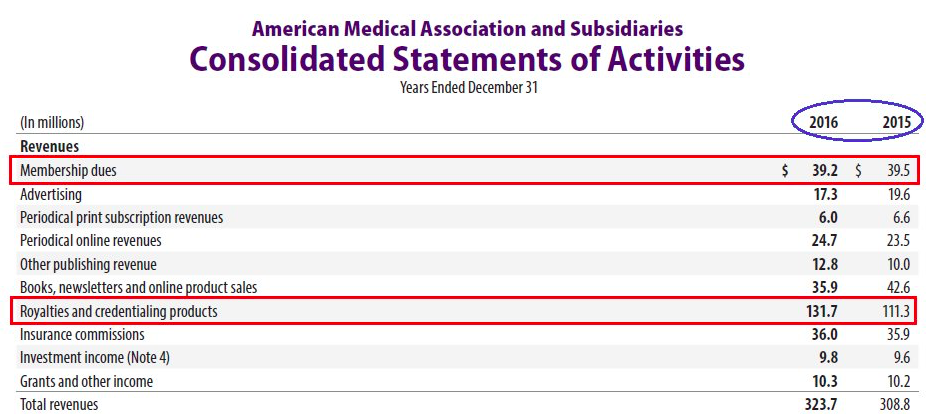
Many hands make light work. There is strength in numbers (this is the key: we need a lot of numbers) as we forge ahead. Each little bit helps. We should remember that only 15% of physicians are members of the AMA and AMA receives only 12.1% of its revenues from its membership. The vast majority comes from credentialing, insurance commissions, and licensure of their CPT codes. PPA hopes to represent the far greater silent majority of practicing physicians who work on behalf of their patients' best interest and want to end corrupt and burdensome regulatory intrusions.

For years physicians on the front line of patient care have yearned for an organization that speaks for them. Now the skeleton of that organization is in place. Help us grow to end the ability for unaccountable (non-profit) organizations like the ABMS, their member boards, insurance companies, and hospital groups to deprive physicians of our right to practice medicine on the basis of unproven, intrusive, and financially-conflicted programs like MOC.

Please join us. Then pick your phone and personally ask your colleagues to do the same. We need your help to make this dream succeed.

-Wes

Monday, June 26, 2017

Antitrust Suit Against AOA Proceeds to Discovery Phase in New Jersey

The United States' primary certifying body for osteopathic physicians, the American Osteopathic Association, is set to proceed to discovery in a fraud and antitrust suit in the District of New Jersey after a federal judge in Camden denied the association's motions to dismiss a suit by doctors.

The physician-plaintiffs who sued the American Osteopathic Association have sufficiently stated antitrust claims at the pleading stage stemming from the agency's alleged practice of tying board certification to association membership, U.S. District Judge Noel Hillman ruled Monday. The judge also ruled that the plaintiffs stated a viable claim under the New Jersey Consumer Fraud Act with their assertions about renewal fees imposed on doctors who had been promised their certifications would not expire.

Hillman also rejected the association's motion to transfer the case to the Northern District of Illinois, near the group's headquarters. The association did not argue that the District of New Jersey is an improper venue, but merely sought a transfer for its own convenience, he said.

This last detail is important, because the Association of American Physicians and Surgeons anti-trust suit against the American Board of Medical Specialties that was originally filed in New Jersey, was allowed to move to the Northern District of Illinois and has languished there since January 2015.

-Wes

Reference: Duane Morris LLP website press release.

Wednesday, May 24, 2017

We Want to Know

Dear Richard Baron,

As President and CEO of the 501(c)(3) non-profit organization, the American Board of Internal Medicine (ABIM) and its affiliated Foundation, the ABIM Foundation, you are responsible for public disclosure of IRS tax forms 990 to the public. Those tax forms were due at the IRS office 15 May 2017 for the ABIM's 2016 fiscal year (1 July 2015-30 June 2016).

Where are they?

We want to know.

We want to know because the finances of the ABIM and its Foundation are of paramount importance to us, your diplomates. We believe those finances are the reason we are required us to participate in the ABMS trademarked Maintenance of Certification (MOC) program. Because of clever regulatory capture through this unproven and monopolistic educational program, your organization is responsible for the ability of one quarter of ALL US physicians to work.

We want to know where our money that we pay for your unproven testing is going.

We want to know how much you paid yourself and your officers.

We want to know your legal expenses.

We want to know if you lobbied last year and how much you paid for it.

We want to know if you purchased another condominium for your organizations.

We want to know how much your paid PearsonVue.

We want to know who were your revolving-door officers that year and how much you paid them.

Right now, seventeen states have brought forth legislation to combat MOC. Doctors are leaving work to testify against the requirement for MOC that has been carefully incorporated to our new payment formula (MACRA) and HEDIS requirements made by the National Committee on Quality Assurance for the nation's hospitals, courtesy to Ms. Margaret O'Kane (who doesn't even hold a medical degree), and her board participation with the American Board of Medical Specialties, of which the ABIM is one of 24 specialty organizations.

We want to know the ABIM's finances because our jobs depend on that information. We want to bring that information before state legislatures so we may objectively and factually highlight your spending.

We will not rest any longer, Dr. Baron.

We want to know and we have the right, by law, to know.

Westby G. Fisher, MD
ABIM Diplomate #127308

Tuesday, April 18, 2017

Teirstein: An Urgent Call to Action

This important email has been widely circulated today from Paul Teirstein, MD, President of the National Board of Physicians and Surgeons (NBPAS) and is an urgent call to action for practicing physicians. I urge all physicians to take a brief moment and contact your representative as Dr. Teirstein suggests. He's made the process as easy as possible:

Dear Colleague,

Several states now have anti-MOC legislation pending. Recently the Georgia legislature passed HB 165, similar to Oklahoma's SB 1148 which prohibits Maintenance of Certification (MOC) as a condition of licensure or reimbursement from third parties. However, the ABMS and its member boards have been heavily lobbying state legislators to defeat the pending bills in other states (click here to view ABMS lobbying materials). Those of us opposed to MOC must educate legislators in these states regarding how MOC requirements are onerous, expensive, have no proven benefit, and are forced on physicians by conflicted, self-appointed private ABMS member boards.

Here is how you can make a huge difference:

  1. This is going to take you a few minutes. I spend hundreds of uncompensated hours per year on this issue. Please take 5 minutes of your time to help yourself and our profession.

  2. This is your action item:

  3. Click here to effortlessly send a letter by email to your district's state representatives. You will be asked to "register" by entering in your name, email and address.  That's it.  From your address the system will pull your specific state bill and a letter tailored for your specific state representatives you can edit (if desired) and click to send to all your district's legislators.  We have made it as easy as possible for you.

  4. There are currently many states with strong anti-MOC legislation pending. If your state currently has no anti-MOC legislation pending, your letter will encourage your representatives to create anti-MOC legislation.

  5. If you are curious and want to view all the sample letters we have written by state, click here.

  6. Please spread the word. We have 18,000 email addresses of physician supporters but we need many more. This will not work without your help getting this message out. Forward this email to your colleagues, your patients, your med staff office for hospital wide distribution, your specialty organizations, your FB, Twitter, Linked In and other social media friends. (You can also refer them to the NBPAS Advocacy Webpage).

  7. To join the National Board of Physicians and Surgeons (NBPAS.org) and obtain continuous certification based primarily on AACME accredited CME, click here.
Thank you for your help and support.

Respectfully,


Paul Teirstein M.D.
President
National Board of Physicians and Surgeons (NBPAS)

Monday, April 17, 2017

For Texas Legislators: MOC's Myriad Conflicts of Interest

The American Board of Medical Specialties' (ABMS) Maintenance of Certification (MOC) proprietary continuing education program has a myriad of conflicts of interest. I thought I would assemble a partial list of some of them below:

1) The American Board of Internal Medicine (ABIM), the largest ABMS member board responsible for credentialing one-quarter of all US physicians, is increasingly in debt thanks to high salaries and expenses. Its latest 2015 Form 990 shows a NEGATIVE asset and fund balance of balance of $50,642,980.

2) The cost of for participating in the proprietary ABMS MOC program has grown far in excess of the rate of inflation (16.3 to 17.2% annually), without adding any appreciable change to the product delivered to physicians or the public.

3) The ABIM Foundation, which was reported as being created in 1999 on federal tax forms from 2008-2013, has a POSITIVE balance of $77,255,188 on its 2015 Form 990. Much of this balance was secretly transferred from the ABIM physician testing fees from 1990-1999, ten years before the organization was reportedly "created." Furthermore, the Foundation is domiciled in PA, not Iowa, as it was claimed from 1999-2013. With some of those funds, the ABIM purchased a $2.3 million condominium that came complete with a chauffeur-driven Mercedes S-class town car for itself in December 2007.

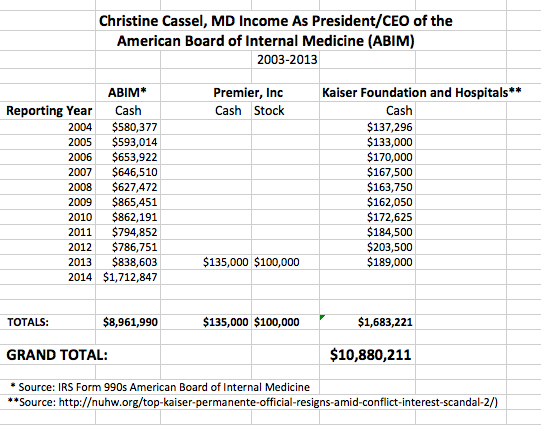
4) Christine Cassel, MD not only worked as President and CEO of the ABIM and its Foundation from 2004-2014, she also secretly served on the Board of Kaiser Foundation and Hospitals, earning $1,683,221. From 2008 through 2013, she also served on the Board of Directors at Premier, Inc, the largest US hospital procurement firm, earning 230,000 in case and stock in 2013. (Here's the breakdown of her take). None of these conflicts were ever disclosed until she was investigated by Propublica before becoming the President and CEO of the National Quality Forum. From 2010-2014, the ABIM paid a little-known company, CECity, Inc., over $5.5 million to process physician patient survey/practice improvement survey data. Shortly after Dr. Cassel left the ABIM, CECity, Inc was bought by Premier, Inc for $400 million in 2015.

5) Robert Wachter, MD served as a consultant and board member for IPC Hospitalist Company while working as Chairman of the Board of the ABIM/ABIM Foundation in 2014. IPC Hospitalist company was investigated for overbilling Medicare and Medicaid patients and paid $60 million to settle Medicare/Medicaid false claims act violations with the DOJ February 6, 2017.

6) The ABIM has been lobbying Congress for years, but such lobbying has never been disclosed to the public via Form 990 tax forms.

7) The adverse effects of MOC on physicians and patients have never been studied. Yet the ABIM has been conducting research on physicians (see here and here) without their consent or Institutional Review Board oversight, potentially in violation of Protection of Human Subject statutes of the Department of Health and Human Services.

8) The American Board of Medical Specialties (ABMS) and the American Hospital Association (AHA) are both member organizations of the Accreditation Council on Graduate Medical Education (ACGME). Maintenance of Certification (MOC) favors hospitals eager to limit competition.

9) Margaret E. O’Kane is founder and president of the National Committee for Quality Assurance (NCQA). Margaret E. O’Kane is founder and president of the National Committee for Quality Assurance (NCQA). The NCQA is responsible for credentialing insurance companies that must accept ABMS MOC as a condition if their credentialing under the Affordable Care Act. Ms. O'Kane is also a public board member of the American Board of Medical Specialties (ABMS) that actively promotes the ABMS MOC program that benefits the ABMS. In addition, Richard J. Baron, MD, the current President and CEO of the ABIM, served as member of the Standards Committee for the NCQA.

10) The ABMS sells credentialing information on physicians through its wholly-owned subsidiary, ABMS Solutions, LLC, a for-profit corporation based in Atlanta, Georgia.

11) The American Board of Family Medicine (ABFM), one of the ABMS member boards, holds ABFM Realty, LLC, a for-profit real estate company that manages commercial real estate and is funded almost entirely by physician testing fees.

12) The American Board of Pediatrics (ABP) has numerous real estate holdings surrounding its North Carolina address and contracted with its retired CEO, James A Stockman, III, MD to work 8 hours per week for $793,438 in 2014.

These are just a few of the conflicts inherent to the ABMS MOC product. Sadly, there have been many more throughout the years, including cozy relationships with major US academic institutions.

-Wes

Friday, February 24, 2017

Bringing the ABMS MOC Program Before the FTC

Looks like the new Federal Trade Commission Chairwoman Maureen K. Ohlhausen might take an interest in the onerous and costly American Board of Medical Specialties' Maintenance of Certification (MOC) program:
Testifying on behalf of the FTC before the Subcommittee on Antitrust, Competition Policy and Consumer Rights, Commissioner Maureen K. Ohlhausen noted that while occupational licensing can help protect consumers from health and safety risks and support other valuable public policy goals, unwarranted restrictions can harm competition, leaving consumers with higher-priced, lower-quality, and less convenient services.

“From, a competition standpoint, occupational regulation can be especially worrisome when regulatory authority is delegated to a board composed of members of the occupation it regulates,” Commissioner Ohlhausen said.

According to the testimony, this type of board may make regulatory decisions that serve the private economic interests of its members and not the policies of the state (emphasis mine). Such decisions could result in occupational restrictions that discourage new entrants; deter competition among licensees and from providers in related fields; and suppress truthful, nondeceptive advertising, and innovative products or services that could challenge the status quo.

The testimony notes that while the principles of federalism embodied in the state action doctrine limit the reach of federal antitrust laws when a restraint on competition is imposed by a state, this does not mean that all state regulators are exempt from antitrust scrutiny. Through its enforcement and advocacy work, the Commission has helped to define the contours of the state action doctrine for actions taken by state boards composed of private actors – culminating in last year’s decision by the Supreme Court in North Carolina State Board of Dental Examiners v. FTC.
-Wes

Friday, January 20, 2017

ABIM Stationary Sidebars: MOC and UCSF

I attended the University of California, San Francisco's (UCSF) electrophysiology program from 1993-1994. As I continue to explore the myriad of conflicts of interest inherent to the American Board of Medical Specialties (ABMS) Maintenance of Certification (MOC) program, it has come as quite a surprise to me that so many members of my alma mater (and the institution itself) were either passive or active participants in  the strongman tactics used by the American Board of Internal Medicine (ABIM) as a "message and deterrent" (as explained by former President and CEO of the ABIM, Christine Cassel, MD) to control the ABIM/ABMS monopoly on continuing medical education in the United States.

Let me explain.

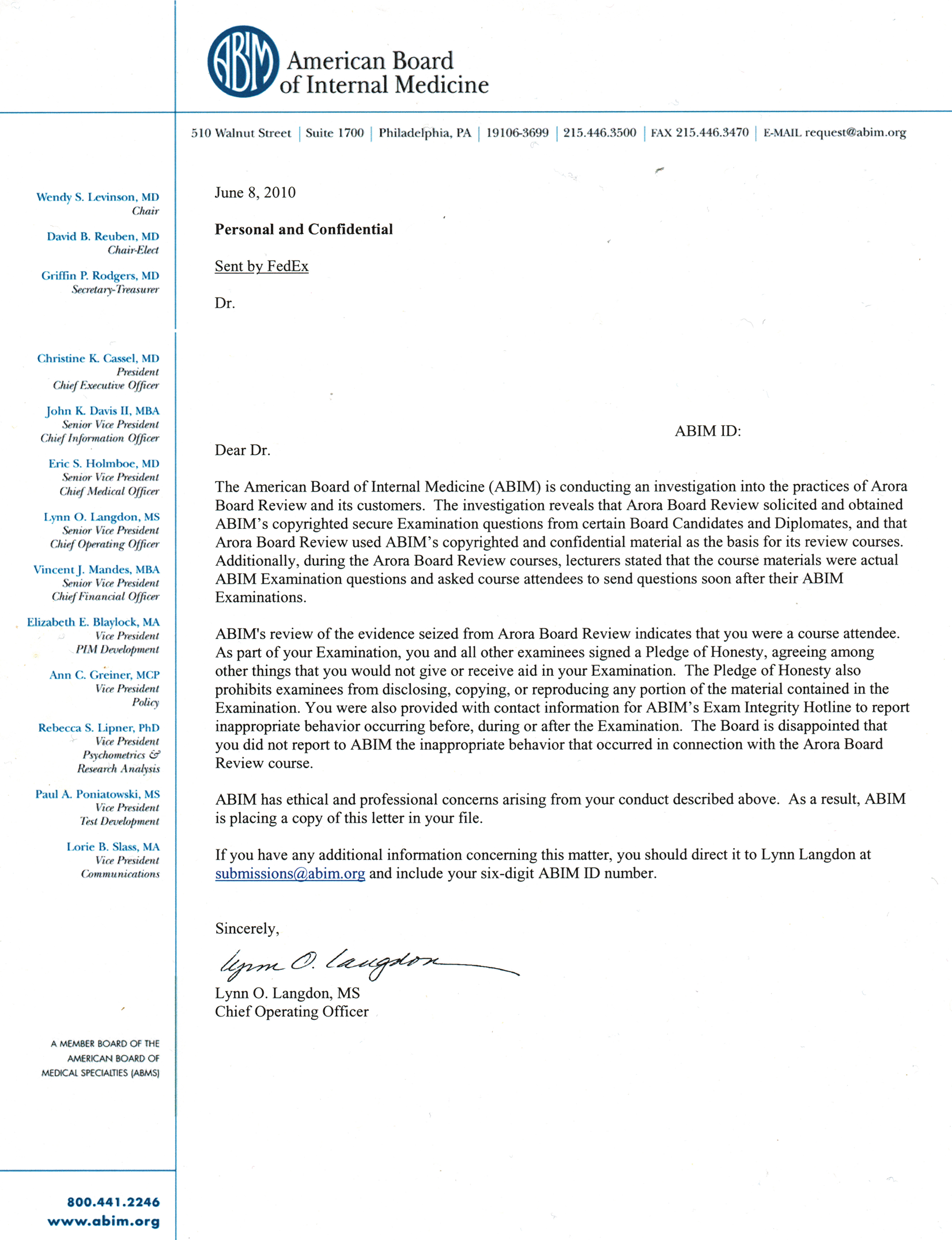
In a retaliatory letter dated May 8, 2012, authored by Ms. Lynn Landon, the non-physician Chief Operating Officer of the ABIM at the time, Jaime Salas-Rushford, MD was accused of forwarding, prior to ever taking the ABIM Board certification exam, board review questions to the ABIM-certified instructor of the CME-accredited Arora Board Review course. About three years after the fact and after 139 others had already been sued or sanctioned for attending the same course (or at the very least, like a flashback to the McCarthy era, had warning letters "added to their file") this retaliatory letter declared that ABIM imposed an immediate, unlimited revocation of Board certification of Dr. Sala-Rushford and to "notify the Medical Board in every jurisdiction in which you are licensed" without due process.

On the stationary sidebar of that letter appear the names of the officers of the ABIM and it’s board members at the time: Chair Catherine R Lucey, MD, Chair-Elect Robert M Wachter, MD, Secretary-Treasurer Talmadge E King, MD, and President and CEO Christine Cassel, MD among others. Were these leaders listed in the sidebar mere figureheads of the ABIM when this occurred or were they ultimately responsible for the organizations' actions as their positions suggest?

It is remarkable that three of the above senior ABIM leaders were on staff at UCSF at the time. These same individuals now hold significant leadership positions at the USCF medical school. Dr. King serves as Dean of the UCSF Medical School since 26 May 2015, Dr. Lucey as the Vice Dean for Education, and Dr. Wachter serves as Professor and Chair of the Department of Medicine. In addition to their current academic positions at UCSF, these same individuals hold leadership in other organizations within the Accreditation Council for Graduate Medical Education (ACGME):
  • Dr. Lucey serves as an at-large board member of the American Board of Medical Specialties 2016-2017 and on the Board of Directors of the of the Association of American Medical Colleges (AAMC).

  • Dr. King has a long history of serving on the Board of Directors of the National Committee for Quality Assurance (NCQA) from 2010-2017 as an unpaid board member and currently works alongside the organization’s founder and President, Ms. Margaret E. O’Kane. Remember that NCQA, under Ms. O'Kane's direction, developed, maintained, and expanded the Healthcare Effectiveness Data and Information Set (HEDIS), the nation's most widely used quality measurement tool and has grown to a $50 million company with almost 300 employees. NCQA is also the main accreditor of recognized medical homes and one of two accrediting organizations permitted by federal law to accredit plans in the new health insurance exchange marketplaces that came online October 1, 2010, under the Affordable Care Act (ACA). Because the NCQA also credentials insurance providers as part of the ACA, one insurer quality metric they created requires physicians to "maintain" their certification via ABMS MOC programs if they want to receive payments from those insurers. Furthermore, the NCQA and the ABMS will continue to directly benefit from "quality" rules that they have put into place and lobbied Congress to enact laws such as the Medicare Access and CHIP Reauthorization Act of 2015 (MACRA). MACRA's Merit-based Incentive Performance is MOC on steroids (see comments to the final rule). While NCQA maintains the quality measurement tool that is used in MACRA to determine US physician pay based on their notion of care "value," much of the NCQA's own IRS 2015 Form 990 is redacted. Who is protecting our patients' interests when even the IRS allows this to occur?

  • Dr. Wachter has his own financial conflicts with MOC that also benefitted the UCSF. According to IRS Form 990's, in 2012 when the above sanction letter was issued, Dr. Wachter served as 'Director-Chair" of the ABIM earning $38,888 from the ABIM and $6,626 from the ABIM Foundation.

    While serving as "Director-Chair" of the ABIM and Director of the ABIM Foundation, Dr. Wachter was also simultaneously serving as Director of the IPC The Hospitalist Company, Inc, reportedly running a “leadership development course (at UCSF) for their practice group leaders.” Dr. Wachter's financial haul from his relationship with IPC was significant. He pocketed 1,355 shares of IPC stock valued at $50.68 on 1 Aug 2013 and another 2650 shares of stock valued at $58.50 on 2 January 2014. According to SEC filings, he earned $210,586 in 2014 ($ 108,000 as cash, $ 55,000 in stock and $ 47,526 in options). USCF benefitted from a fellowship grant with IPC brokered by Dr. Wachter that began sometime in 2010 or 2011 (Dr. Wachter's description of the program was published on his blog 18 November 2011.) On 17 June 2014, the Department of Justice filed suit against IPC Hospitalist Company alleging the company overbilled federal health insurance systems for physician evaluation and services. Nonetheless, it appears Dr. Wachter still received a stock option award of 2186 shares of IPC on 2 Jan 2015. Undeterred by the DOJ suit (or perhaps because of it), TeamHealth acquired IPC Hospitalist Company for hefty $80.25 per share on 23 Nov 2015, again profiting Dr. Wachter and UCSF (with whom he had a publicly-disclosed sharing agreement where he kept 80% and UCSF received 20% of this relationship). As of 17 Jan 2017, it appears a settlement agreement in the DOJ's suit against IPC The Hospitalist Company will be reached soon. In retrospect, watching Dr. Wachter doing an Elvis impersonation at Mandalay Casino in Las Vegas on behalf of corporate medicine at patients' expense with the tacit approval of the Dean of the UCSF Medical School reflects poorly on the University. These activities also serve to erode any remaining trust practicing physicians have on the unproven ABMS MOC program to serve in our patients' best interest.
It is remarkably coincidental that on 27 December 2012, an article appeared in the New England Journal of Medicine by one of Wachter’s colleagues at UCSF, Robert B. Baron, MD written in conjunction with John Iglehart, a “national correspondent” for the New England Journal of Medicine, explaining the controversy surrounding MOC and reinforcing the need for it. Dr. Robert Baron (no relation to Richard Baron, MD of the ABIM) never disclosed his simultaneous collegial associations with so many in leadership positions of the ABIM at the time, nor did either author mention the fact that the "NEJM Group" would be announced in March, 2013 to profit the Massachusetts Medical Society that included the launch of their Knowledge+ Maintenance of Certification “state-of-the-art adaptive learning” educational product April 16, 2014.

Who wouldn't want to join such a financial and reputational party bestowed upon these former ABIM leadership physicians? What medical center wouldn't like to benefit from the ABMS MOC system so many from UCSF have? How many other institutions are? Given what we now know about these colluding private organizations and their ethical and financial tactics, why haven't these respected leaders come forward to denounce the activities of the ABIM for which they served? Perhaps these leaders are fearful UCSF would lose their ACGME accreditation as a teaching institution eligible for additional Medicare training funds if they did. Or perhaps these individuals saw little risk of collateral damage to their professional reputation if ABIM used its strongman tactics against a small number of vulnerable, less prominent physician colleagues.

The irony of the ABIM requiring doctor clients of Arora Board Review subject to the sting operation organized by an undisclosed convicted felon to participate in “ethics” courses and pay additional fees to the ABIM before their board certification credential could be reinstated should be lost on no one.

According to USCF's own Faculty Code of Conduct: "The integrity of the faculty-student relationship is the foundation of the University’s educational mission. This relationship vests considerable trust in the faculty member, who, in turn, bears authority and accountability as mentor, educator, and evaluator. The unequal institutional power inherent in this relationship heightens the vulnerability of the student and the potential for coercion. The pedagogical relationship between faculty member and student must be protected from influences or activities that can interfere with learning consistent with the goals and ideals of the University." I would argue that the unequal institutional power carried by the ABIM (and other ABMS member boards) that can revoke a physician's ability to practice or earn a living on the basis of an unproven repeated testing is even larger and warrants even greater scrutiny.

It is clear that the complex financial interrelations of many tax-exempt private organizations that require the ABMS MOC credential have developed over the years to monopolize the physician continuing education process. In my opinion, it is far too coincidental that all of these physicians a single institution just happened to hold unelected leadership positions in so many of these interrelated private entities that financially benefit from MOC at the same time. I also believe the fact that another physician from the same institution published a manuscript in the New England Journal of Medicine while his colleagues stood to benefit politically and financially from their positions gives the appearance of collusion. I believe the UC Board of Regents, Attorney General of California, and/or even the Governor of California have a responsibility to investigate the use of public monies and academic positions to benefit these many non-governmental private entities that act outside of University responsibilities and act, as one independent journalist described them, "more akin to a protection racquet."

The ABMS Maintenance of Certification controversy and those culpable for its strongman tactics extends far further than just the ABIM. When respected leaders of the academic community fail to speak out about the irresponsible activities that occurred during their tenure with the organization, I believe they passively condone them. I suspect this is why we have heard little from other members of the academic community since the collusion extends to current board members of the NCQA, AAMC, ABMS, the New England Journal of Medicine, and other prominent academic institutions like UCSF.

Practicing US physicians voted to end the ABMS MOC program before the AMA House of Delegates meeting in June 2016 because of the unexplained financial dealings and the strongman tactics employed by the organization, yet it continues, even now. This no longer surprises us since the AMA is a member organization of the ACGME, too.

How high do the conflicts go in the US medical education system?

It is now clear they go all the way to the top. It is also clear why.

It's time for the AMA to shut the ABMS MOC program down as practicing US physicians have voted because it's doing more harm than good, not only to reputable practicing US physicians nationwide, but to their patients and academic institutions (like my alma mater) that purport to train and educate physicians to become ethical, hard-working, trustworthy doctors without fear of reprisal for educating themselves any way they choose.

-Wes

Disclaimer: I serve as an expert witness on behalf of Jaime Salas-Rushford, MD.

Saturday, December 17, 2016

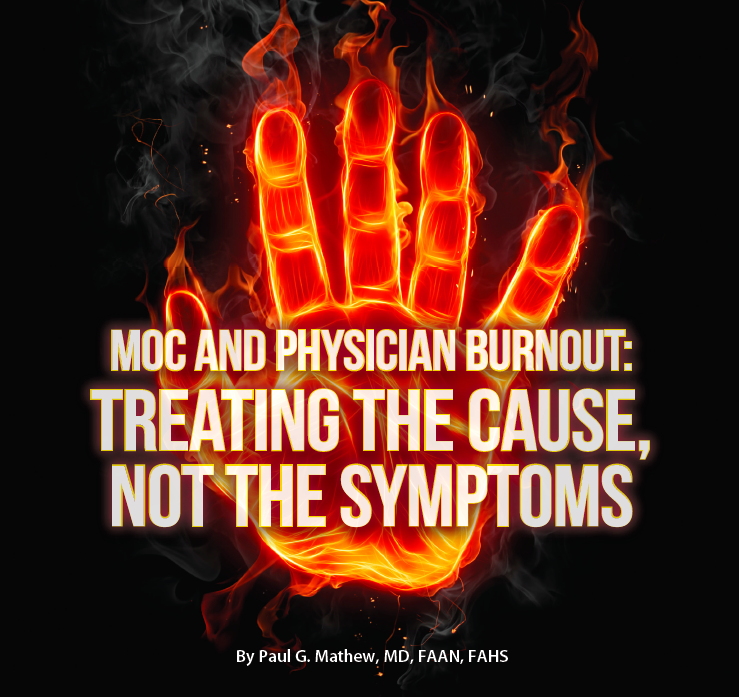
Physician Burnout and MOC: Treating the Cause, Not the Symptoms

This brilliant essay appeared in Practical Neurology Nov/Dec 2016 issue by Paul G. Mathew, MD, FAAN, FAHS. Dr. Mathew is on staff in the Department of Neurology and is Director of Continuing Medical Education at the Brigham and Women’s Hospital, John R. Graham Headache Center, and staff neurologist at Harvard Vanguard Medical Associates and the Cambridge Health Alliance. He  also serves as the neurology representative on the volunteer advisory board of the National Board of Physicians and Surgeons. 

Here's a brief example:

WHAT DO PRIVATE PAYERS GAIN FROM REQUIRING MOC?

As a volunteer board member of NBPAS (no compensation or honorarium as opposed to the salaries of ABMS board members, which can range from $300,000 to greater than $800,000), I have often wondered why private payers require MOC when Medicare does not require board certification or MOC. The answer is quite disturbing. Private payers actually participate in certification, which is issued by the National Committee of Quality Assurance (NCQA). Margaret E. O’Kane is the founder and president of the NCQA, and she is also a member of the ABMS Board of Directors. The NCQA requires private payers to require physicians to participate in MOC in order to be NCQA certified. Thus, anyone contracting with a private payer will require MOC. In the conflicted case of Ms. O’Kane, she profits from the NCQA requiring private payers to require physicians to participate in MOC, and then she profits again from her ABMS position when said physicians must pay to comply with MOC requirements.

Read the whole thing.

Dr. Mathew will be giving Neurology Grand Rounds at Michigan State University/Sparrow entitled "Maintenance of Certification: Reform or Reboot?" on 13 Jan 2017 from 07:30-08:30 AM EST. All are welcome to attend.

-Wes