Showing posts with label Appropriate Use Criteria. Show all posts

Tuesday, December 17, 2013

If The Hunger Games Came to Medicine

“A totalitarian state is in effect a theocracy, and its ruling caste, in order to keep its position, has to be thought of as infallible. But since, in practice, no one is infallible, it is frequently necessary to rearrange past events in order to show that this or that mistake was not made, or that this or that imaginary triumph actually happened.”
                                               - George Orwell
* * *

The brushed, steel belly of the scalpel blade pressed down on the orange antibacterial film and released the subcutaneous yellow fat globules surrounded by small beads of red blood.  The movement of his hand was fluid, purposeful, and without hesitation.  The electrocautery pen carefully seared the points where blood appeared.  A retractor was installed to spread the tissues farther apart as he worked quickly to gain access to the tissue plane just above the muscle.  His movements were deft for he knew they were watching.

The Capitol's campaign to ensure perfect outcomes was well underway. They had installed cameras throughout the hospital just four short years before: in the halls, the changing rooms, at the scrub sinks, and in the operating rooms.  The Capitol had discovered that the operating room was like yesterday's boxing ring, or even farther back in the mists, the Coliseum.  In the New World unpredictable events and venues that stirred primitive passions were few - and yet they were longed for as they were feared.  This context explained the popularity of the annual Hunger Games, created as punishment for the destruction of District 13 by a failed patient uprising after the health care financial apocalypse.  Each year, one male and one female physician "tribute" from each of the surrounding twelve Districts were selected by lottery and performance metrics to fight each other to the death. Providing spectators with a window into the drama, and ensuring that drama by creating just the right conditions, gave spectators a sense of aliveness that they barely remembered, and just enough to stimulate fear.  The Games also served as the perfect venue to deflect blame from the Capitol's expedience in sacrificing people for their own avarice.   

The call had come after a full, exhausting day.  The patient had presented to the Emergency Room only two weeks after open heart surgery for coronary disease and to replace his critically-narrowed aortic valve.  The surgeon-tribute wasn’t sure why his conduction system should fail this late after surgery but it didn’t matter; his heart rate had slowed to a dangerous 19 beats per minute. His blood pressure, while low, remained stable.  A quick review of this medication list disclosed the mandatory heart medications that included an anticoagulant for the heart valve and antiplatelet agents for his coronary disease.  No heart rate slowing medication was being used so the Capitol's appropriateness indication to proceed with the procedure was indisputable.  It was also fortunate that the anticoagulant the patient was taking hadn’t thinned his blood too far.   He decided to take him to the operating room directly.  It was 3 am.

Meanwhile, back at the TV studio:  “I tell you, Frank, every year the footage gets better and better!  How did your team know that these untenable circumstances would result in such great late night viewing?  This is so exciting!” 

The call team had been called, but was short-staffed.  Efficiency meant lower cost, fewer people, and longer work hours.  The designated scrub tech had car trouble and would be delayed.  So the other technician and nurse worked feverishly to ready the room.  The call had already been made to the device representative who brought the new pacemaker hardware, but he was barred from entering the operative suite for he was not part of the medical team.  Rules were rules.   The patient, of course, was agitated, gasping for breath.  The doctor worked as fast as possible to establish pacing – the air was tense.

“Are you kidding?  I love seeing this, don’t you?  The nervousness of his voice!  The anxiety!  The skeleton crew at night!  Beautiful!  I’m not sure it gets much better!”

John had no idea why his car wouldn’t start that night (but the spectators did).  He turned the key again and again, only to hear the engine spit in return.  He slammed his hand against the steering wheel, frustrated that he was unable to keep his car tuned for poor weather.  But such concerns were luxuries now that hospital budgets were tight thanks to the Capitol’s Bundled Payments for Care Improvement campaign.  Finding a ride to work became the imperative.  He raced back into the house to wake his wife in a panic, asking her whom he might call to give him a ride – they each knew the consequences of failure.  They called their neighbor and woke him from a sound sleep.  The pressured nature of their voices convinced him to loan them his car and five precious minutes later, he was off to work calling ahead to notify them of the delay.

At the hospital, Chloe answered John's call as she sat behind the monitoring console.  She was one of the best young technicians to graduate from her training school.  Still, her hospital’s equipment was not up to date because maintenance contracts were left to expire in these cost-saving times.  Still, although the software it ran was now several versions old, it still reliably fed data to the Capitol's chargemaster.  She looked down at the dust on the keyboard.  Seeing this, it was clear she couldn’t enter the room to assist because the risk of surgical contamination was too great.

The surgeon-tribute was glad he’d placed two venous sheaths to gain vascular access, rather than just one.   He had successfully placed both pacing wires through the sheaths to the patient’s right atrium, ready to be secured to their appropriate chamber.  But he needed a softer shaping wire – the stylette – to insert into the inner lumen of the pacing wire.  Without the stylette, the pacing wire had the consistency of a well-cooked spaghetti noodle.  With it, he could place the pacing wire to its appropriate chamber.    As he turned, his eyes left the surgical field for just a moment.  He scanned the table crammed with scattered instruments and hesitated briefly as he located the proper stylette. 

A hush fell over the audience as they saw the opening.  They leaned forward in anticipation, reveling in their luck to see such a careless mistake.

John leaned his head in the room to notify them he’d finally arrived and would assist as soon as he could change.  The surgeon smiled, acknowledging his dogged efforts to arrive as quickly as humanly possible.  He turned to the field and shaped  the stylette to the perfect curvature that would allow him to affix the pacing wire to the lower, primary pumping chamber of the patient’s heart.  He focused his blurring vision to place the tiny stylette in the endhole of the pacing lead.   Chloe broke the silence of the moment: “Hey guys, did an electrode fall off?”

The doctor looked up briefly to see atrial P waves dancing across the monitor screen without any corresponding ventricular electrical activity. With that, his worst nightmare was realized.  The patient began posturing on the table, his head thrown back beneath the drapes, his arms slowly but powerfully raising.  The surgeon leaned forward to grab the patient while trying to control the leads, stylette, and surgical wound sterility.  The patient began violently thrashing beneath the drapes, his face turning blue and lips crimson as saliva and exhaled gases mixed into a frothy spraying mess.  He was seizing uncontrollably.  His once steady escape rhythm had chosen this unfortunate moment to stop. 

If the surgeon was expecting help from a sponsor it was unlikely to be forthcoming.  Just yesterday, the tribute's most likely supporter/sponsor, Sylvia, a well-to-do matriarch from the Central District, had noticed an incipient sign of aging on her neck – subtle crepe-like thinning of her skin, this despite her  rigorous adherence to all of the Wellness Initiatives the Capitol had advertised.  She had reason to hate, didn't she? She'd  been failed one too many times.   She remembered sitting with her 65 year old mother gasping for air in one of those infernal assembly-line clinics with the young doctor glancing at the red, flashing "Do Not Admit" guideline on the computer screen as he sent them home with morphine with that flat, dead, passive expression on his face!  He didn't care then and so she wouldn't care now!

Seconds felt like hours as the patient's body slowly twisted sideways.  The nurse did all she could to support his weight and keep him from falling.  The surgeon, too, felt helpless as the powerful frame shook uncontrollably beneath the drape.  The restraints tethered his arms but his involuntary leg movement forced him further sideways.  John felt powerless as he watched from the door.  Finally, he could watch no longer and ran into the room just as the patient fell to the floor.

Four cannon blasts were heard in the distance.  The spectators roared.
 
-Wes

Monday, November 18, 2013

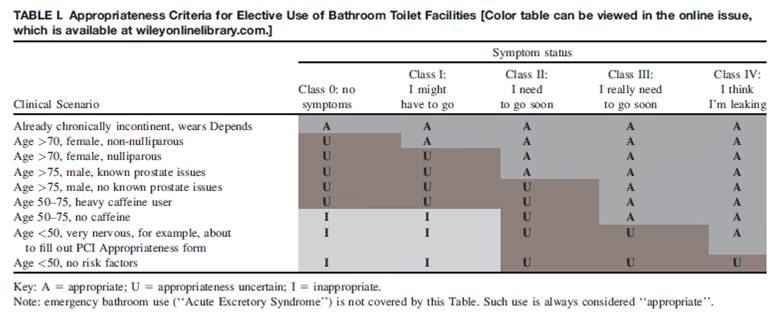
Appropriate Use Criteria's Next Steps

Dr. Kussmaul, you are my hero for publishing this letter to the editor:
"With detailed evidence-based regulation of our professional lives already in full swing, it seems inevitable that the same process will eventually extend to our personal lives. The SCAI (ed's note: Society for Cardiovascular Angiography and Interventions) has always striven to stay ahead of regulatory developments, so as to exert a leadership role.

In that spirit, I offer the following as a beginning of the conversation. Should an interdisciplinary committee be convened on this matter, I hereby volunteer to serve."

William G. Kussmaul III, MD
FSCAI Hahnemann University Hospital
Philadelphia, Pennsylvania
-Wes

PS: Heh. Reminds me of another post I wrote a while back along the same line.

Reference: Kussmaul WG. Letter to the Editor: "Appropriate Use Criteria: What's Next?" Catheterization and Cardiovascular Interventions 82:848 (1 Nov 2013), pg 848.

Saturday, August 03, 2013

A Case of Fraud

He was a slender-framed man, mid- to late-sixties, with a kind of ridden-hard-put-away-wet complexion.  It was clear the years had not always been good to him, but being the kind soul that he was, he had plenty of friends.  It was a beautiful summer day to spend with friends for a barbecue, but he arrived feeling puzzled why he collapsed at home earlier in the day.

He stopped at the keg and poured himself a beer in a red solo cup, and as he approached his friends with a smile, he did it again, this time which such gusto that his beer went flying and the thud he made when he hit the ground made everyone gasp.  He laid motionless for a moment face down on the ground while his friends rushed to his aid.  An ambulance was summoned as others rolled him over onto his back.  He began to move - slowly at first - then more purposefully.  As sirens approached, he asked his friends, "What just happened?'

A bit later, he arrived in the Emergency Room, awake, alert, pleasant, and seemed - on the surface at least - fine.  His vital signs were normal - perfect, in fact.  About the only things immediately noticeable was his thin frame, his coffee-stained teeth, and a clump of grass in his hair that the nurse kindly removed.  He was placed in the gurney, an IV was started, blood was drawn, and EKG was performed as a few "hellos" and "what happeneds" were exchanged, then off to the CT scanner he went to rule out an intracranial process.  It was normal and his EKG showed a first-degree AV block and incomplete left bundle branch block without evidence of acute injury or prior heart attack.

He returned from the CT scanner and was examined a bit more closely.  A loud, blowing, holosystolic murmur was heard by the medical student.  In fact, it was loud enough to create a "thrill" - a palpable vibration on the thin man's chest.  The medical student seemed pleased with himself, then ordered his first echo which revealed a relatively weak heart with a few chamber walls that didn't move so well, and a very leaky heart valve.  He was admitted, placed on telemetry, and seen by a cardiology consultant.  Closer inspection of the echo revealed a dilated left ventricle with a posterior wall motion defect and a central jet of mitral regurgitation large enough to fill the left atrium with a mosaic of color that extended to the pulmonary veins.  It was clear he'd need surgery, so a diagnostic catheterization was performed.  It showed three-vessel coronary artery disease and confirmed severe mitral regurgitation.  His medications were adjusted and surgery consulted.  A date for surgery was arranged at the neighboring hospital the following week and all seemed well.

But he had different plans.

As he settled down for dinner, he felt suddenly flushed, lightheaded, and broke out in a sweat.  With that, the telemetry alarm sounded and soon the room was full of people, crash carts, and hysteria.  His dinner table was shoved aside and he was laid flat as his chest was made bare.  He didn't know what all the excitement was about, but heard the words "He's fibrillating!" and then felt the cool metal discs covered with cold goo applied to his chest.  "What are you do...?" and with that, he felt his chest and arms jerk violently just before he passed out.  "Shit, he's still fibrillating!" someone shouted.  So they charged again and shocked him, this time to sinus rhythm.  The anesthesiologists who had arrived on the scene of the arrest took no chances: he was intubated and expeditiously transferred to the ICU.

Upon arrival to the ICU, the patient was clearly recovering well and quickly extubated the next day.  Beta blockers were administered additional anti-anginal and anticoagulants given.    Once stabilized, he was transferred to the surgical hospital and underwent urgent bypass surgery with mitral valve replacement.  At the time, the surgeon could see considerable endocardial scar.

His recovery was uncomplicated, but four days after his surgery, he still required external pacing.  Cardiac electrophysiology was consulted to consider an ICD placement, given his history of sinus node dysfunction, cardiac arrest, diminished LV function, and the visible presence of endocardial scar during surgery.

The electrophysiologist reviewed the case and noted that the patient's original in-house arrhythmia at the time of his "arrest" was actually an organized, rapid ventricular tachycardia that was then shocked into ventricular fibrillation by an asynchronous defibrillation attempt.  An echocardiogram performed post-operatively showed a very low EF of 23%, but a good repair of his valve and he appeared to be progressing quite nicely in his cardiac rehabilitation.  Still, it was felt he was at high risk for another arrhythmic event, so a wearable defibrillator as ordered as they waited out his conduction system a bit longer to see if it would recover function.   It never did.

So 10 days later after the sinus node failed to recover, the electrophysiologist had a choice: implant a pacemaker, or implant a defibrillator?   It shouldn't be a difficult decision in this case, should it?

But the electrophysiologist knew he'd be committing fraud if he implanted a defibrillator and billed Medicare for the device and procedure.  That's because Medicare's 2005 National Coverage Decision requires doctors to wait 90 days and then "reassessing" the patient's heart function later before implanting a defibrillator once the heart is revascularized surgically.

But he wondered about the extra risk of infection created by two surgeries (one for a pacemaker and one later to upgrade the device to an implantable defibrillator) instead of one.   He wondered if anyone ever considered the frequent venous occlusions that preclude later upgrade of pacemakers to defibrillators via the same side as the original pacemaker implant.   Even if he implanted a defibrillator lead at the same time he implanted the original pacemaker, wouldn't he be committing fraud if a more expensive defibrillator lead were billed to Medicare instead of a pacemaker lead?   And what about the added cost, inconvenience, and poor compliance rates of patients issued wearable defibrillators as they wait out the 90-day waiting period for an ICD?  Finally, what are the ethics of asking his patient to sign a form that obligates the patient to pay for his defibrillator if Medicare fails to do so when the actual costs involved to implant a defibrillator are closely held institutional secrets?

So he wrote his note.  He documented his rationale thoroughly.

Then proceeded to commit fraud.

-Wes

Refs: 

Fogel RI, et al. The Ultimate Dilemma: The Disconnect Between the Guidelines, the Appropriate Use Criteria, and Reimbursement Coverage Decisions JACC, 2013;() doi:10.1016/j.jacc.2013.07.016.

Dr. Wes: When the Feds Come Knocking

Sunday, June 30, 2013

The Infinite Loop

Doctor's can't help fix the health care cost problem because they are kept uninformed about prices or (worse) not allowed to disclose prices to patients or journalists (or health care researchers) once those prices become known to them lest they lose their job.

So, for example, there might be a technology a doctor wants to use to make a diagnosis on one of his patients.

Later he learns that his patient was charged many thousands of dollars for that simple diagnostic test because his patient informs him that the insurance company considered the test "unproven or experimental" and refused to pay for it.

Not only is the charge for the test exorbitant relative to the work required to perform it, but the doctor also learns that every local insurer will not pay for the simpler test he ordered but will pay for an invasive surgical procedure to gather the same exact same data at ten times the cost.

What should the doctor do now?

Should they refer future patients for the diagnostic surgical procedure that pays him and his employer well yet costs the patient very little, or should they do the least invasive and safest test to gather the data knowing their patients will be left with a hefty overpriced bill that will not be covered by their insurer?

For the solution to this problem, I'd refer the reader to the first sentence of this piece.

* * *

In the past when the majority of doctors were independent from large health care systems, doctors could advocate for their patients and move them to other centers that offered cheaper prices or had superior services.  Now it is estimated that nearly 75% of physicians will be employed by hospitals or large health care systems by 2014.  This may sound reasonably benign and irrelevant until patients contemplate what they are trusting their doctors to do.  

If the issue of quality and price transparency are important parts of our health care reform discussion, then another solution for reform than our present construct will have to be developed.

After all, with the passage of our new health care law (and its "accountable care organization" construct), it is becoming crystal clear that we have approved a system that perpetuates the impossibility of doctors serving as true advocates for their patients.

 -Wes


Wednesday, April 03, 2013

Judgment versus Big Data

Knowledge in Numbers?
Decisions in medicine are supposed to rest on concrete obervations and hard evidence. 

Often, hard evidence does not exist or when it does, it isn't used.  Why is this? 

Concrete observations, too, are increasingly missed as we stare at computer screens longer and patients less.  Yet we persist. Why?

This is our reality now; our evolving medical world.

But if we stop and think about it, medicine, by definition, is a world of technological faults, systemic frailties, and human inadequacies.  We are convinced we know how a patient dies, for instance, thanks to the wonders of unprecedented imaging capabilities but stand slack jawed when an all-too-underperformed autopsy discloses a surprise cause of death that was completely missed by all.

And our answer to these inadequacies?  Stop doing autopsies.  Even though autopsies have consistently shown that one in four deaths occurs from an unexpected outcome or complication of care.

Why did we stop doing them?  Let me count the reasons: we are human, you see.

History repeats. 

Increasingly we are foregoing clinical judgment and intuition in favor of "Big Data" to make decisions.  We construct 70-page Appropriate Use Criteria for ICD documents that cover (really) just a few special clinical circumstances for patients, as if the authors ever really know a patient's clinical circumstance.  Ask yourself how good we are at predicting the day a person will take their last breath?  Like the weather, life is impossible to predict even when you have a billion data points or more.

Big Data and its certainty are our hottest trend in medicine and academics right now.  We know why this is: we love technology.  It is rational.  It is understandable.  It is linear.  We want, desperately, to understand and compartmentalize our human condition, to minimize its variability, so we can ration our resources logically.  But rather than acknowledging the limitation of such an approach, we forge ahead and create logic from dissociated databases with incomplete or empty data fields based on highly-selected patient populations to make our points.  Outliers are considered nothing more than acceptable loss rations.  We manipulate and massage the incomplete or erroneous data using statistics to make our points seem more valid.  Then, like the azithromycin folly, we extrapolate that data and transmit our firmly held beliefs through government agencies to the masses.  We feel good about our myopic analyses and are happy our academic salary was secured for another day.  In return, the importance of medical judgment, experience, and intuition to medicine are cast aside by our fervent belief that trials, databases, and data manipulation are always free from bias and the influence of greed.

More inadequacies.

But in the face of medical uncertainty, what other than judgment and intuition does a physician have - or a patient have, for that matter?  The real patient that sits before us demands an answer where, more likely than not, no real answer exists. Real concrete clinical challenges are rarely represented in a clinical trial or computer database. So we listen. We observe. We review data. Perhaps we get a second opinion. Patient judgment, life experiences, and intuitions are factored, too. Then we decide, together. Medical judgment and intuition are like that: not all luck, not all logic.


But now with Big Data, the new requirement for wellness and fitness is going to be for patients to keep proper symptoms that stay within the lines.  Symptoms and findings must fit new rubrics.  If they don't, your "caregiver" won't know how to treat you, the computer won't know how to treat you, and the rubric won't know how to treat you.  Who are you to say your symptoms are unique? Who are you to deserve a special look?  In the great cattle call of commoditized medicine created by Big Data, who do you think you are?   A liability risk?  Please, stay normative; align your symptoms with Big Data.  And be happy about it, dear patient, because the ends justifies the means.

Ironically, the folly of man has always been that we think we can have all the answers.  Perhaps we should stop for a moment and really think about what we're creating, courtesy of Big Data.

-Wes