Food and Drug Administration (FDA) regulations have become the new pathway to riches for the pharmaceutical industry.
First, there was generic colchicine, used for years and years to treat gout for pennies a pill. The only problem was, there wasn't an FDA trial proving colchicine's efficacy in the treatment of gout. Takeda Pharmaceutical, seeing the opening, performed a trial and rebranded the formerly generic colchicine to Colcrys®, "the only authorized generic indicated to prevent and treat gout attacks." And how much does Colcrys® cost? Just $203 for thirty tablets at Costco.
But that's not all.
Today I learned that generic vasopressin (which can be stored at room temperature in stable form on crash carts), must be switched to the FDA-approved brand called Vasostrict® that requires dilution and refrigeration. It seems the generic form of vasopressin will no longer be available to be kept on crash carts since it's not "FDA-approved" for the indication of "increasing blood pressure in adults with vasodilatory shock (post-cardiotomy or sepsis) who remain hypotensive despite fluids and catecholamines." Vasostrict®, on the other hand, is "now the first and only vasopressin injection, USP, product with an NDA approved by the FDA." The catch is, it must diluted before use and discarded after 18 hrs (or after 24 hrs if refrigerated). This little regulatory quirk is a big deal for America's hospitals looking to save costs.
But hey, why should we worry about costs in health care? After all, you can never be too safe.
-Wes
Showing posts with label regulatory capture. Show all posts
Showing posts with label regulatory capture. Show all posts
Tuesday, January 20, 2015


Tuesday, January 13, 2015
Some Thoughts on the National Board of Physicians and Surgeons
I admire Paul Tierstein, MD's honest attempt to create a greatly simplified alternative to the ABMS's Maintenance of Certification® (MOC) program called the National Board of Physicians and Surgeons (NBPAS). I hope he's successful, but I sense there will be large headwinds for the effort ahead.
Here's why.
The Affordable Care Act (ACA) modified Sections 1848(k) and 1848(m) of the Social Security Act which defines how CMS pays physicians for their services. Section (k) is the section that defines how a "Quality Reporting System" is to be set up (with subsection (4) requiring the "Use of Registry-based Reporting") and Section (m) defining physician incentive payments physicians might receive if quality reporting occurs properly. (Sadly, those CMS incentive payments do not cover the cost of participating in MOC for most of us.)*
Section (k) was modified by the ACA to include the ABMS MOC program as a "physician registry." The registry was "defined" as requiring all four parts of the MOC program created by the ABMS, including the much-maligned "practice improvement modules" that have been described by the physician community as overly time-consuming, irrelevant and may even violate federal research statutes regarding the study of physicians, their practices, and patients.
Unfortunately the new NBPAS does not address these requirements of the our new health care law, leaving the creation of the NBPAS to look like a Rand Paul moment all over again with physicians signing up for something that, legislatively, means nothing.
Welcome to the concept of "regulatory capture."
Physicians should realize that special interests and their lobbyists (including the US hospital, pharmaceutical, survey companies, and insurance lobbying groups) were highly influential in the creation of our new health care law. They are also very good at politics. It is unlikely that these entities want to see MOC go away, irrespective of how corrupt the system has become. There's just too much money involved. Even our own specialty societies use the MOC program's educational requirements to coerce physicians to take their educational courses to "earn MOC points" to help pad their bottom lines as physician attendance (and corporate sponsorship) at scientific sessions has dwindled over the past years.
But what's more important to our patients in the long run? Time for their needs or time for test-taking and survey collection? Is it more important to satisfy government requirements or address the real needs of our patients? Certainly continuing education of physicians is needed, but irrelevant work for an unaccountable third-party organization so they can measure us rather than help us is not.
Physicians need to take the stick, but we can't do this alone since we care for patients. So we need to ask this question: will our specialty societies commit to supporting practicing physicians or the new bureaucratic divide? (They can't do both.) Will they truly step up to the plate and commit their considerable staff, dollars, pager-less hours, lobbying and legislative efforts to help remove the corrupt MOC program from the Affordable Care Act or allow practicing physicians - their members - to wallow in the corrupt status quo as they are coerced to participate in MOC?
I remain pessimistic that creating another "board" will fix the current deep-seated problems with the ABMS MOC construct with ABMS as the mothership directing a flotilla of 24 member boards. In my view the only way to truly "change" MOC is to have a coordinated effort from all specialty societies to insist our legislators remove the portion of our new health care law that requires we participate in a "physician registry" that robs not only practicing physicians, but patient care itself.
HRS and ACC, are you on board?
-Wes
*Addendum 2/12/2015:
It should be noted that the payment incentives offered 2012-2104 from CMS for participation in MOC ended January 1, 2015, but that MOC participation will still be used as a physician quality reporting metric.
Here's why.
The Affordable Care Act (ACA) modified Sections 1848(k) and 1848(m) of the Social Security Act which defines how CMS pays physicians for their services. Section (k) is the section that defines how a "Quality Reporting System" is to be set up (with subsection (4) requiring the "Use of Registry-based Reporting") and Section (m) defining physician incentive payments physicians might receive if quality reporting occurs properly. (Sadly, those CMS incentive payments do not cover the cost of participating in MOC for most of us.)*
Section (k) was modified by the ACA to include the ABMS MOC program as a "physician registry." The registry was "defined" as requiring all four parts of the MOC program created by the ABMS, including the much-maligned "practice improvement modules" that have been described by the physician community as overly time-consuming, irrelevant and may even violate federal research statutes regarding the study of physicians, their practices, and patients.
Unfortunately the new NBPAS does not address these requirements of the our new health care law, leaving the creation of the NBPAS to look like a Rand Paul moment all over again with physicians signing up for something that, legislatively, means nothing.
Welcome to the concept of "regulatory capture."
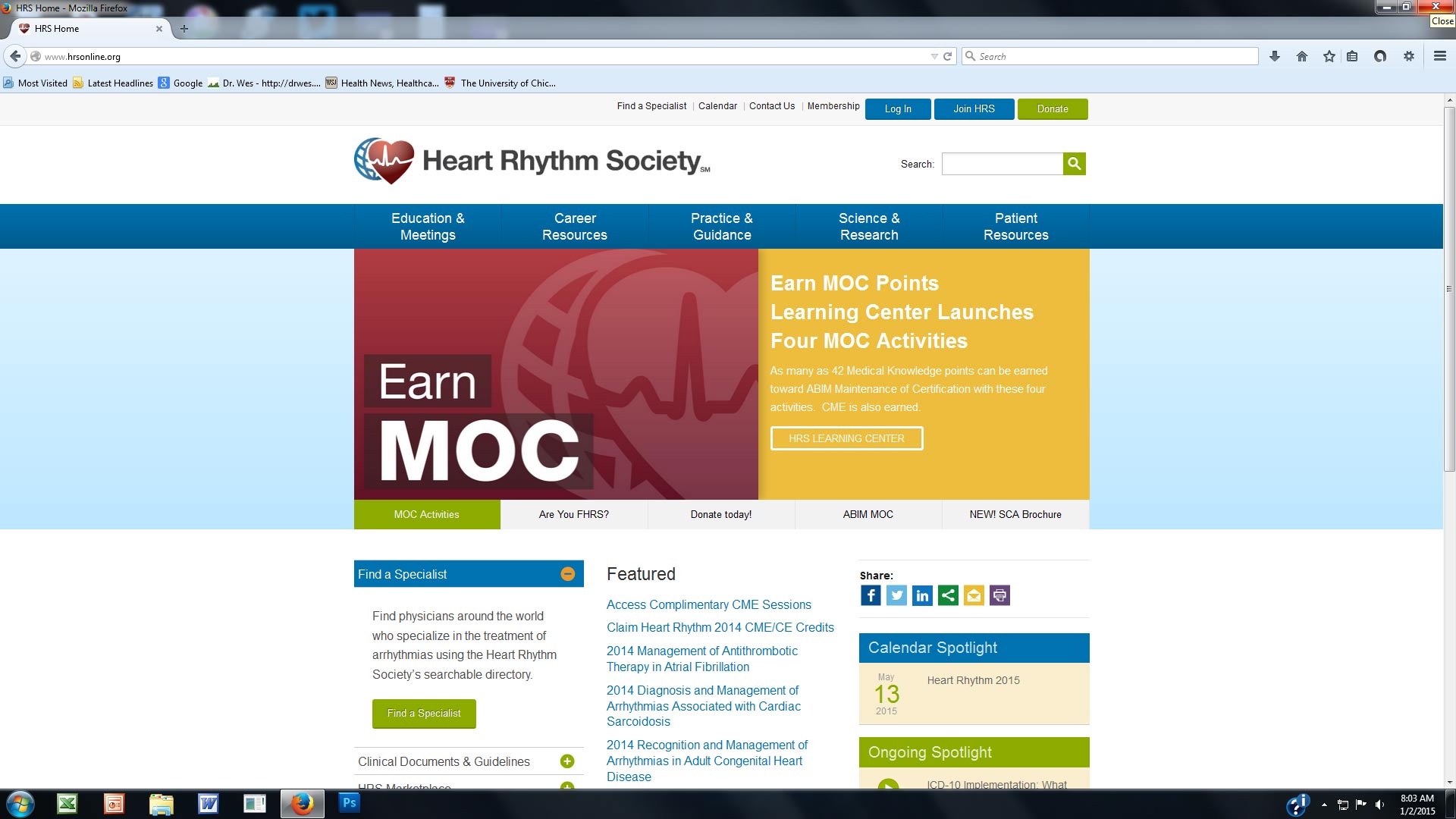 |
| Screenshot of Heart Rhythm Society webpage |
But what's more important to our patients in the long run? Time for their needs or time for test-taking and survey collection? Is it more important to satisfy government requirements or address the real needs of our patients? Certainly continuing education of physicians is needed, but irrelevant work for an unaccountable third-party organization so they can measure us rather than help us is not.
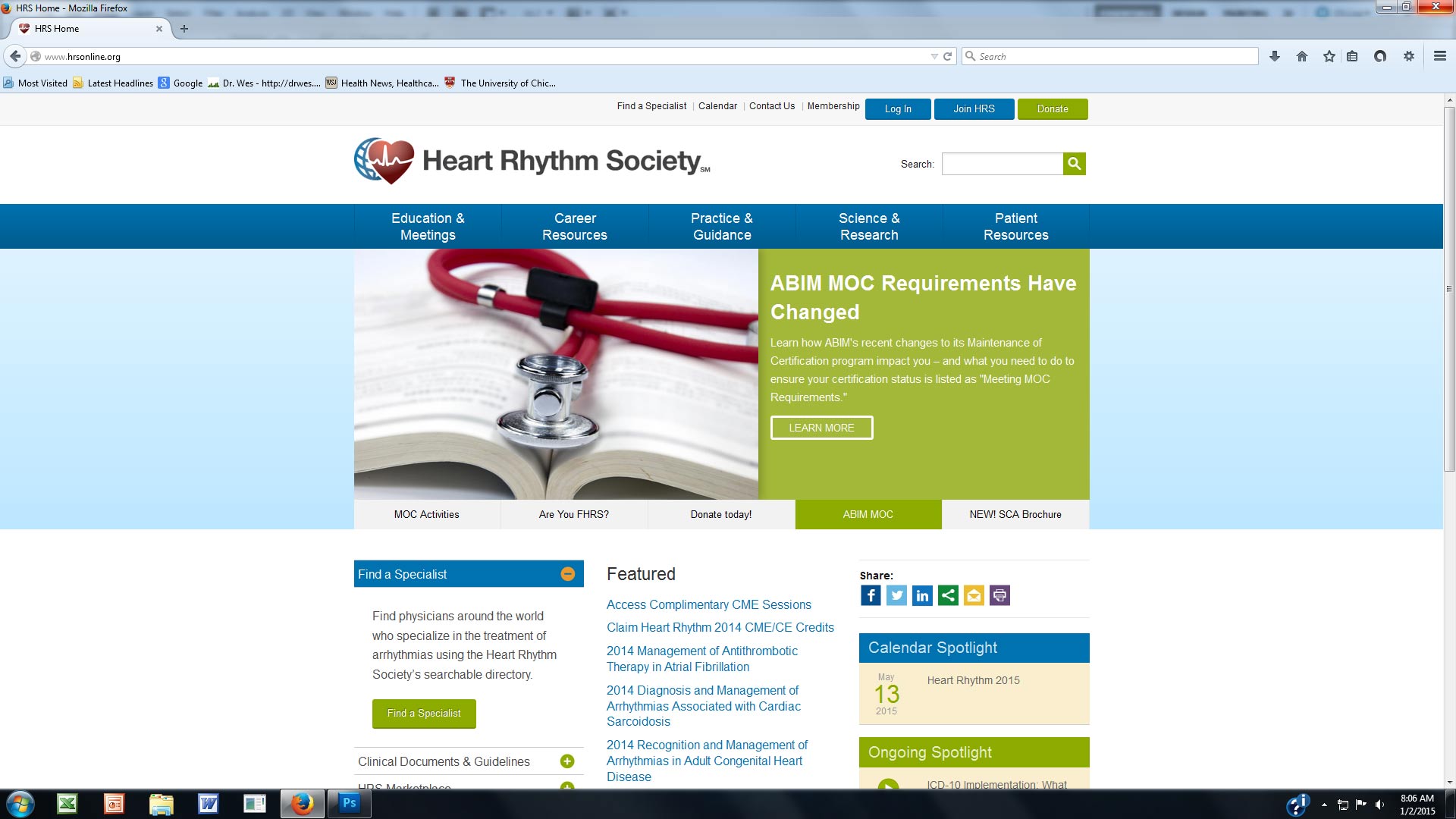 |
| A second Heart Rhythm Society webpage devoted to MOC |
I remain pessimistic that creating another "board" will fix the current deep-seated problems with the ABMS MOC construct with ABMS as the mothership directing a flotilla of 24 member boards. In my view the only way to truly "change" MOC is to have a coordinated effort from all specialty societies to insist our legislators remove the portion of our new health care law that requires we participate in a "physician registry" that robs not only practicing physicians, but patient care itself.
HRS and ACC, are you on board?
-Wes
*Addendum 2/12/2015:
It should be noted that the payment incentives offered 2012-2104 from CMS for participation in MOC ended January 1, 2015, but that MOC participation will still be used as a physician quality reporting metric.
Subscribe to:
Posts (Atom)