Physicians traveling to Philadelphia might want to inquire with the ABIM Foundation to see if they can stay at the Foundation's luxury condominium that they paid for before it's sold at a large loss.
Imagine, arriving to your condominium in your own BMW 7-Series chauffeur-driven town car that's available at your disposal...
... and being greeted at the door by your own personal doorman:
... and having a helpful Congierge lady that can help service your every need while in Philadelphia:
Then, after a hard day at work directing meetings or traveling to Washington, you can return home and cook dinner in a nice kitchen with somewhat dated amenities:
After that, you can take a nice shower in the Master Bath:
...while your guests use the second. slightly less glamorous second bathroom:
No doubt you'll have a relaxing stay in Philadelphia - all on the backs of your own colleagues board certification and Maintenance of Certification testing fees!
See what you can have when you Choose Wisely®?
-Wes
Saturday, January 31, 2015
Friday, January 30, 2015
Is the ABIM Hiding Something?
Mr. Charles Kroll, a health care non-for-profit accountant, notes a troubling discrepancy this morning in the 2014 consolidated financial statement recently released by the American Board of Internal Medicine (ABIM) and it's Foundation:
Ahem, where, exactly, did the money do? Why aren't supplemental information reports included in the 2014 financial statement? Might the ABIM "not be meeting MOC requirements" for public disclosures themselves?
-Wes
Addendum 09:25 am CST: Post edited (underlined text) to reflect changes made to the MedCityNews piece after it was originally republished here.
The American Board of Internal Medicine (ABIM) recently posted the Consolidated (i.e. including ABIM Foundation) Financial Report for the Year Ending June 30, 2014 (and June 30, 2013) to it’s Revenue and Expenses: Where Does the Money Go? page.So questions must be posed about the ABIM's disclosure policy on their "Where Does the Money Go?" webpage:
The Financial Report’s Contents page lists 3 Financial Statements and 12 pages of Notes to Consolidated Financial Statements.
The Consolidated Financial Report for the Year Ending June 30, 2013 (and June 30, 2012) filed with the State of Pennsylvania on April 7, 2014 Contents page lists 3 Financial Statements, 12 pages of Notes to Consolidated Financial Statements, and 6 Supplementary Information reports spanning 8 pages.
The Financial Report for the Year Ending June 30, 2013 was never posted on ABIM’s Revenue and Expenses page.
The 6 Supplementary Information reportslistedincluded at June 30, 2013, but not June 30, 2014, are as follows: Consolidating Statements of Financial Position (2 pages), Consolidating Statement of Activities (2 pages), Schedule of ABIM Changes in Unrestricted Net Assets (Deficit) from Operations, Consolidating Schedule of Administrative, Program and Project Expenses, Consolidating Schedule of Staff Expenses and Consolidating Schedule of Office Expenses.
Ahem, where, exactly, did the money do? Why aren't supplemental information reports included in the 2014 financial statement? Might the ABIM "not be meeting MOC requirements" for public disclosures themselves?
-Wes
Addendum 09:25 am CST: Post edited (underlined text) to reflect changes made to the MedCityNews piece after it was originally republished here.
Monday, January 26, 2015
Questioning the ABIM Leadership Compensation
Compensation amounts for the past President and CEO of the American Board of Internal Medicine (ABIM) were reviewed over the last 10 years of available tax documents. I have outlined them below. We should recall that US physicians fund 97% of the ABIM's revenue.
Total haul by one physician officer: $7,249,143 over 10 years (or $724,914/yr). This amount does not include the additional consulting fees outlined above. (Not too bad for a desk job that doesn't involve patient care.)
Which leads practicing US physicians to wonder how much compensation did the current ABIM President and CEO earned in fiscal year 2014. Might it have exceeded $1 million? (We should note the most recent audited financial statement available to date disclosed a $568,000 salary with $131,000 in deferred compensation for a "new key employee" hired effective 7 June 2013, but does not specify the additional compensation this "new employee" will recieve from the ABIM's own Foundation.)
The fiscal year 2014 ABIM Form 990 will be available soon enough. If the ABIM leadership salaries are indeed this high going forward, there should be little doubt why physicians must now pay the ABIM every two years to "maintain" their board certification status.
It seems that the salaries of the ABIM leadership demand it.
-Wes
Addendum: To all concerned physicians: consider signing my petition to stop the marketing of the ABMS/ABIM Maintenenace of Certification program, one professional society at a time.
| Fiscal Year | Compensation | Comments |
|---|---|---|
| 2004 | $580,377 | Includes $50,000 performance bonus awarded to Dr. Cassel by Compensation Committee of the Board of Directors of ABIM |
| 2005 | $593,014 | |
| 2006 | $653,922 | |
| 2007 | $646,510 | 35 hrs/wk. $2.3 million condo purchased by ABIM Foundation. |
| 2008 | $627,472 | 35 hrs/wk. Spousal travel fees also paid (not itemized). |
| 2009 | $865,451 | 35 hrs/wk. Spousal travel fees also paid (not itemized). |
| 2010 | $862,191 | 35 hrs/wk. Spousal travel fees also paid (not itemized). |
| 2011 | $794,852 | 35 hrs/wk. Spousal travel fees also paid (not itemized). |
| 2012 | $786,751 | 35 hrs/wk. Spousal travel fees also paid (not itemized). Also received $203,500 from Kaiser Health Plans and Hospitals |
| 2013 | $838,603 | 35 hrs/wk. Spousal travel fees also paid (not itemized). Additional compensation earned: $235,000 from Premier, Inc. |
Total haul by one physician officer: $7,249,143 over 10 years (or $724,914/yr). This amount does not include the additional consulting fees outlined above. (Not too bad for a desk job that doesn't involve patient care.)
Which leads practicing US physicians to wonder how much compensation did the current ABIM President and CEO earned in fiscal year 2014. Might it have exceeded $1 million? (We should note the most recent audited financial statement available to date disclosed a $568,000 salary with $131,000 in deferred compensation for a "new key employee" hired effective 7 June 2013, but does not specify the additional compensation this "new employee" will recieve from the ABIM's own Foundation.)
The fiscal year 2014 ABIM Form 990 will be available soon enough. If the ABIM leadership salaries are indeed this high going forward, there should be little doubt why physicians must now pay the ABIM every two years to "maintain" their board certification status.
It seems that the salaries of the ABIM leadership demand it.
-Wes
Addendum: To all concerned physicians: consider signing my petition to stop the marketing of the ABMS/ABIM Maintenenace of Certification program, one professional society at a time.
Friday, January 23, 2015
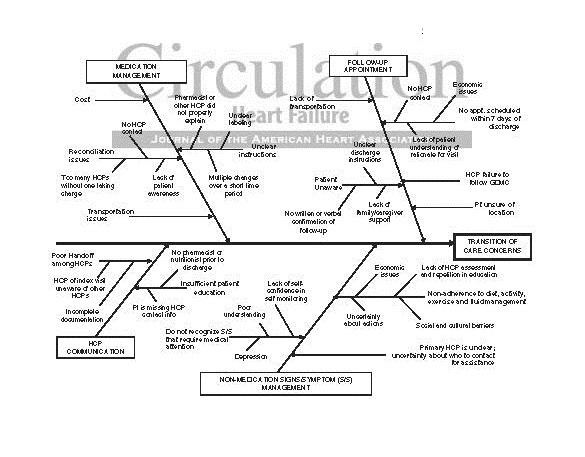
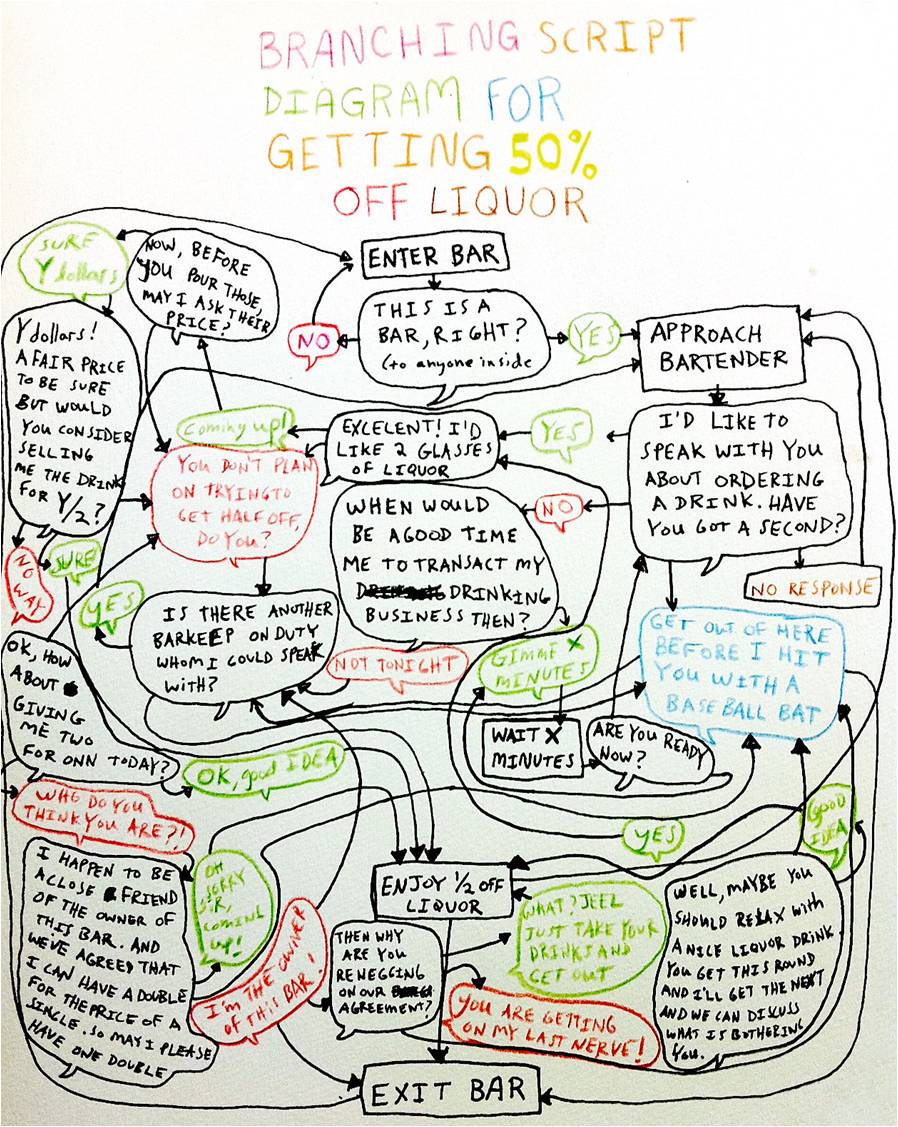
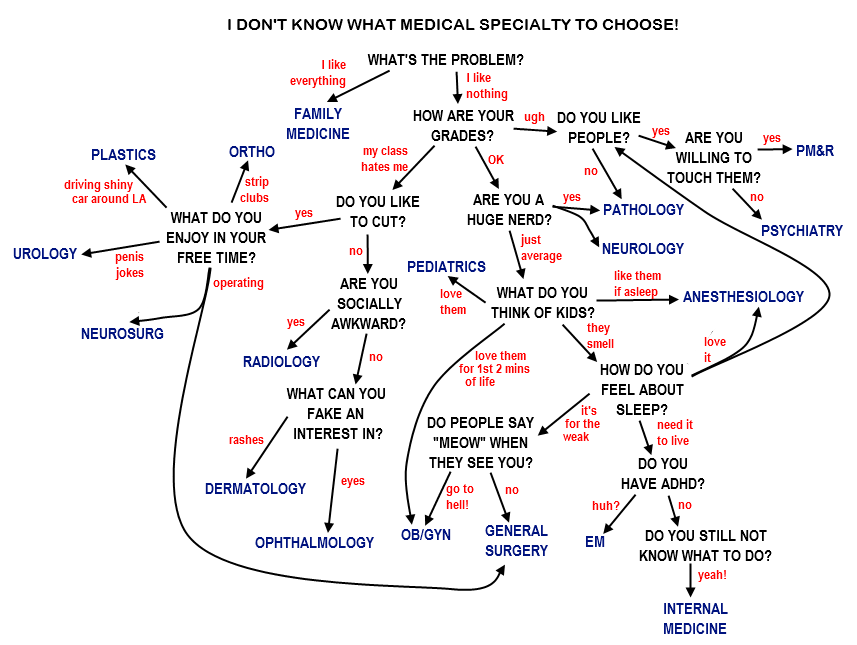
Care Pathways and Their Kin
| Transitions of Care in Heart Failure, Circulation Heart Failure, January 2015 |
| Living in Washington DC Brochure |
| (Getting 50% of Liquor - Courtesy Harringtonandselves.com) |
| (Choosing a Medical Specialty - Courtesy Surgical Sciences blog) |
-Wes
Wednesday, January 21, 2015
Katz: In Defense of the Annual Physical
David L, Katz, MD, Director of the Yale University Prevention Research Center and President, American College of Lifestyle Medicine, makes aa case in defense of the annual physical examination, once a cornerstone of American medicine.
-Wes
I would argue, then, that glib dismissal is misguided. Rather, the safest and most promising option in the absence of answers to all relevant questions, is to optimize the annual exam, not discard it. There is no need for a battery of perfunctory procedures or ridiculously low-yield lab tests. But these could be replaced with a review of lifestyle practices and use of relevant preventive services; with time for pertinent, customized lifestyle counseling; and with attention to whatever happens to be on a patient’s mind, building that very thing to which modern, evidence-based medicine may pay all too little attention: a relationship. A fundamental human connection.Read the whole thing.
-Wes
Tuesday, January 20, 2015
"Science" Takes ACLS Backwards
Food and Drug Administration (FDA) regulations have become the new pathway to riches for the pharmaceutical industry.
First, there was generic colchicine, used for years and years to treat gout for pennies a pill. The only problem was, there wasn't an FDA trial proving colchicine's efficacy in the treatment of gout. Takeda Pharmaceutical, seeing the opening, performed a trial and rebranded the formerly generic colchicine to Colcrys®, "the only authorized generic indicated to prevent and treat gout attacks." And how much does Colcrys® cost? Just $203 for thirty tablets at Costco.
But that's not all.
Today I learned that generic vasopressin (which can be stored at room temperature in stable form on crash carts), must be switched to the FDA-approved brand called Vasostrict® that requires dilution and refrigeration. It seems the generic form of vasopressin will no longer be available to be kept on crash carts since it's not "FDA-approved" for the indication of "increasing blood pressure in adults with vasodilatory shock (post-cardiotomy or sepsis) who remain hypotensive despite fluids and catecholamines." Vasostrict®, on the other hand, is "now the first and only vasopressin injection, USP, product with an NDA approved by the FDA." The catch is, it must diluted before use and discarded after 18 hrs (or after 24 hrs if refrigerated). This little regulatory quirk is a big deal for America's hospitals looking to save costs.
But hey, why should we worry about costs in health care? After all, you can never be too safe.
-Wes
First, there was generic colchicine, used for years and years to treat gout for pennies a pill. The only problem was, there wasn't an FDA trial proving colchicine's efficacy in the treatment of gout. Takeda Pharmaceutical, seeing the opening, performed a trial and rebranded the formerly generic colchicine to Colcrys®, "the only authorized generic indicated to prevent and treat gout attacks." And how much does Colcrys® cost? Just $203 for thirty tablets at Costco.
But that's not all.
Today I learned that generic vasopressin (which can be stored at room temperature in stable form on crash carts), must be switched to the FDA-approved brand called Vasostrict® that requires dilution and refrigeration. It seems the generic form of vasopressin will no longer be available to be kept on crash carts since it's not "FDA-approved" for the indication of "increasing blood pressure in adults with vasodilatory shock (post-cardiotomy or sepsis) who remain hypotensive despite fluids and catecholamines." Vasostrict®, on the other hand, is "now the first and only vasopressin injection, USP, product with an NDA approved by the FDA." The catch is, it must diluted before use and discarded after 18 hrs (or after 24 hrs if refrigerated). This little regulatory quirk is a big deal for America's hospitals looking to save costs.
But hey, why should we worry about costs in health care? After all, you can never be too safe.
-Wes
Monday, January 19, 2015
The Cancer of Our Profession
229. Unity and friendship in the medical society is important.Never has the divide between the practicing work-a-day physician and the non-practicing ivory tower elite physician been greater. It is the cancer of our profession: quick to spread, difficult to contain.
The first, and in some respects the most important, function is that mentioned by the wise founders of your parent society - to lay a foundation for that unity and friendship which is essential to the dignity and usefulness of the profession. Unity and friendship! How we all long for them, but how difficult to attain! Strife seems to be the very life of the practitioner, whose warfare is incessant against disease and against ignorance and prejudice, and, sad to have to admit, he too often lets his angry passions rise against his professional brother. The quarrels of doctors make a pretty chapter in the history of medicine.
Sir William Osler On the Educational Value of the Medical Society, In Aequanimitas, 335-6.
But this should not surprise us. It is a recurrent theme in history, just as Osler was quick to remind us. But the ideal that Osler advocated for has disintegrated under political, financial and partisan agendas that covertly operate without transparency.
If nothing else, social media is helping expose this divide and its corrosive effects on our profession.
-Wes
Friday, January 16, 2015
Grass Roots: It's Time To Take Action on MOC
As many long-term readers of this blog are aware, because of concerns over its coercive nature, I have been investigating the American Board of Medical Specialties (ABMS) Maintenance of Certification (MOC) program implemented in large part by the American Board of Internal Medicine (ABIM) since studying for my third round of re-certification. As part of that investigation, I have uncovered what appears to be a carefully crafted propaganda campaign using poor scientific methods, non-practicing authors from think-tanks, the veterinary profession, and the ABMS/ABIM hierarchy to serve as "evidence" of the program's legitimacy, as well as much more troubling financial dealings of the ABIM and the ABIM Foundation.
I brought these concerns to the leadership at the Heart Rhythm Society via an email left on their website on 2 January 2015 that included a link to my investigation of the ABIM's tax records. The Heart Rhythm Society's office as closed at that time (they returned 5 January 2015), but I never received a response to that email initially. So I called the Heart Rhythm Society on the 14th of January and asked to speak with Mr. James Youngblood, their President and CEO, about my concerns regarding the ABIM. I seems he was unavailable at the time but I was assured they had found the email and that I would receive a response "in 24-48 hours." Yesterday I received the email and this is what he said:
I would ask that Heart Rhythm Society members who agree with this petition to sign it and designate their membership status with the Heart Rhythm Society in the "Notes" section and then send it on to your colleagues.
It is time we send a strong message to our professional organizations that we demand more than words in response to our deep concerns with the ABMS/ABIM MOC program.
Thank you -
-Wes
I brought these concerns to the leadership at the Heart Rhythm Society via an email left on their website on 2 January 2015 that included a link to my investigation of the ABIM's tax records. The Heart Rhythm Society's office as closed at that time (they returned 5 January 2015), but I never received a response to that email initially. So I called the Heart Rhythm Society on the 14th of January and asked to speak with Mr. James Youngblood, their President and CEO, about my concerns regarding the ABIM. I seems he was unavailable at the time but I was assured they had found the email and that I would receive a response "in 24-48 hours." Yesterday I received the email and this is what he said:
"Sorry for the delay in responding to your email request. We appreciate the information you shared and your opinion in this matter. Regarding your follow-up voice message inquiring about what the HRS offers in support of ABIM-MOC, HRS provides the opportunity for members to earn up to 42 MOC medical knowledge points on a complementary basis. (Opportunity for MOC points expires 10/15/15)It seems the very public outcry by practicing physicians over the entire ABMS/ABIM-MOC program is being met with little action despite the evidence of its corrosive effects on our profession of medicine. Therefore, I have decided to begin a grass roots effort to ask my own professional medical society, the Heart Rhythm Society, to immediately cease their promotion and marketing of the ABMS/ABIM MOC program and instead to turn their considerable resources to removing the corrupt ABMS MOC program from the Affordable Care Act. To that end, I am now circulating a petition for Heart Rhythm Society members (and other interested practicing physicians) to sign to send a clear message to our society's leadership that we need more than words, we need action, to stop the use of this unproven and unethical MOC program that has been foisted without evidence of its effectiveness for improving patient care upon practicing US physicians. Anything less is unacceptable, given what we now know about the program.
We have extensive additional information provided at http://www.hrsonline.org/Education-Meetings/Maintenance-of-Certification#16575
We have provided ongoing feedback to the ABIM around our concerns with their approach to the MOC program. We will continue that dialogue.
With regard to an financial concerns with ABIM, we will continue to monitor the situation closely and inform our members should any action be required.
Thanks, J
James H. Youngblood
Chief Executive Officer
Heart Rhythm Society
NEW ADDRESS:
1325 G St. NW, Suite 400
Washington, DC 20005
(Phone numbers redacted)
www.HRSonline.org
I would ask that Heart Rhythm Society members who agree with this petition to sign it and designate their membership status with the Heart Rhythm Society in the "Notes" section and then send it on to your colleagues.
It is time we send a strong message to our professional organizations that we demand more than words in response to our deep concerns with the ABMS/ABIM MOC program.
Thank you -
-Wes
Tuesday, January 13, 2015
Some Thoughts on the National Board of Physicians and Surgeons
I admire Paul Tierstein, MD's honest attempt to create a greatly simplified alternative to the ABMS's Maintenance of Certification® (MOC) program called the National Board of Physicians and Surgeons (NBPAS). I hope he's successful, but I sense there will be large headwinds for the effort ahead.
Here's why.
The Affordable Care Act (ACA) modified Sections 1848(k) and 1848(m) of the Social Security Act which defines how CMS pays physicians for their services. Section (k) is the section that defines how a "Quality Reporting System" is to be set up (with subsection (4) requiring the "Use of Registry-based Reporting") and Section (m) defining physician incentive payments physicians might receive if quality reporting occurs properly. (Sadly, those CMS incentive payments do not cover the cost of participating in MOC for most of us.)*
Section (k) was modified by the ACA to include the ABMS MOC program as a "physician registry." The registry was "defined" as requiring all four parts of the MOC program created by the ABMS, including the much-maligned "practice improvement modules" that have been described by the physician community as overly time-consuming, irrelevant and may even violate federal research statutes regarding the study of physicians, their practices, and patients.
Unfortunately the new NBPAS does not address these requirements of the our new health care law, leaving the creation of the NBPAS to look like a Rand Paul moment all over again with physicians signing up for something that, legislatively, means nothing.
Welcome to the concept of "regulatory capture."
Physicians should realize that special interests and their lobbyists (including the US hospital, pharmaceutical, survey companies, and insurance lobbying groups) were highly influential in the creation of our new health care law. They are also very good at politics. It is unlikely that these entities want to see MOC go away, irrespective of how corrupt the system has become. There's just too much money involved. Even our own specialty societies use the MOC program's educational requirements to coerce physicians to take their educational courses to "earn MOC points" to help pad their bottom lines as physician attendance (and corporate sponsorship) at scientific sessions has dwindled over the past years.
But what's more important to our patients in the long run? Time for their needs or time for test-taking and survey collection? Is it more important to satisfy government requirements or address the real needs of our patients? Certainly continuing education of physicians is needed, but irrelevant work for an unaccountable third-party organization so they can measure us rather than help us is not.
Physicians need to take the stick, but we can't do this alone since we care for patients. So we need to ask this question: will our specialty societies commit to supporting practicing physicians or the new bureaucratic divide? (They can't do both.) Will they truly step up to the plate and commit their considerable staff, dollars, pager-less hours, lobbying and legislative efforts to help remove the corrupt MOC program from the Affordable Care Act or allow practicing physicians - their members - to wallow in the corrupt status quo as they are coerced to participate in MOC?
I remain pessimistic that creating another "board" will fix the current deep-seated problems with the ABMS MOC construct with ABMS as the mothership directing a flotilla of 24 member boards. In my view the only way to truly "change" MOC is to have a coordinated effort from all specialty societies to insist our legislators remove the portion of our new health care law that requires we participate in a "physician registry" that robs not only practicing physicians, but patient care itself.
HRS and ACC, are you on board?
-Wes
*Addendum 2/12/2015:
It should be noted that the payment incentives offered 2012-2104 from CMS for participation in MOC ended January 1, 2015, but that MOC participation will still be used as a physician quality reporting metric.
Here's why.
The Affordable Care Act (ACA) modified Sections 1848(k) and 1848(m) of the Social Security Act which defines how CMS pays physicians for their services. Section (k) is the section that defines how a "Quality Reporting System" is to be set up (with subsection (4) requiring the "Use of Registry-based Reporting") and Section (m) defining physician incentive payments physicians might receive if quality reporting occurs properly. (Sadly, those CMS incentive payments do not cover the cost of participating in MOC for most of us.)*
Section (k) was modified by the ACA to include the ABMS MOC program as a "physician registry." The registry was "defined" as requiring all four parts of the MOC program created by the ABMS, including the much-maligned "practice improvement modules" that have been described by the physician community as overly time-consuming, irrelevant and may even violate federal research statutes regarding the study of physicians, their practices, and patients.
Unfortunately the new NBPAS does not address these requirements of the our new health care law, leaving the creation of the NBPAS to look like a Rand Paul moment all over again with physicians signing up for something that, legislatively, means nothing.
Welcome to the concept of "regulatory capture."
| Screenshot of Heart Rhythm Society webpage |
But what's more important to our patients in the long run? Time for their needs or time for test-taking and survey collection? Is it more important to satisfy government requirements or address the real needs of our patients? Certainly continuing education of physicians is needed, but irrelevant work for an unaccountable third-party organization so they can measure us rather than help us is not.
| A second Heart Rhythm Society webpage devoted to MOC |
I remain pessimistic that creating another "board" will fix the current deep-seated problems with the ABMS MOC construct with ABMS as the mothership directing a flotilla of 24 member boards. In my view the only way to truly "change" MOC is to have a coordinated effort from all specialty societies to insist our legislators remove the portion of our new health care law that requires we participate in a "physician registry" that robs not only practicing physicians, but patient care itself.
HRS and ACC, are you on board?
-Wes
*Addendum 2/12/2015:
It should be noted that the payment incentives offered 2012-2104 from CMS for participation in MOC ended January 1, 2015, but that MOC participation will still be used as a physician quality reporting metric.
Saturday, January 10, 2015
Behind the Scenes of the Choosing Wisely® Marketing Campaign
How it's marketed:
How it's paid for:
Any questions?
-Wes
P.S.: For details, click here.
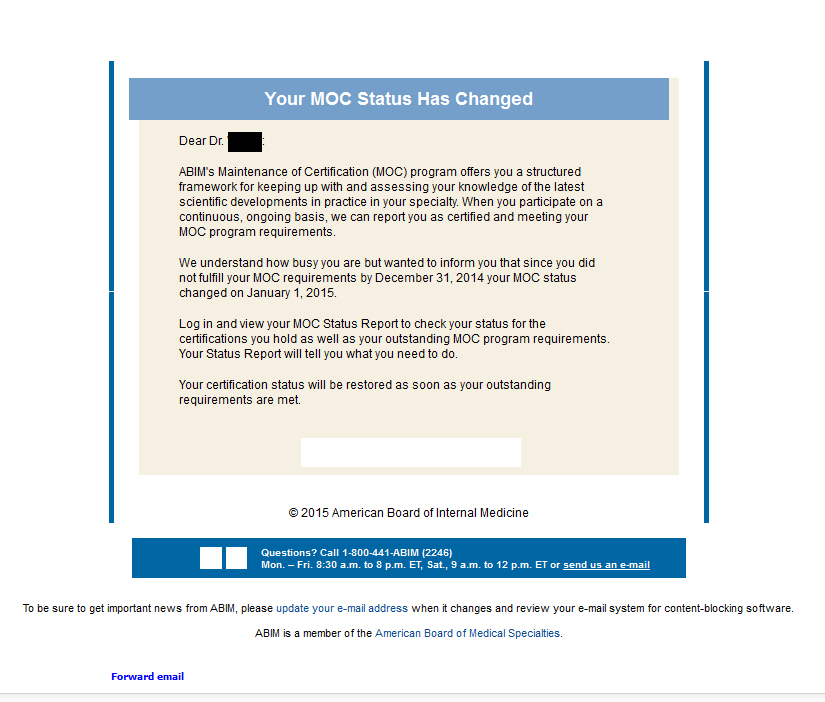
How it's paid for:
| Email received yesterday by some US doctors (click to enlarge) |
Any questions?
-Wes
P.S.: For details, click here.
Friday, January 09, 2015
Slow Down on Creating Alternate MOC Pathways
Yesterday was a remarkable day for practicing US physicians. It was the day two articles appeared side by side in the New England Journal of Medicine: one promoting the American Board of Medical Specialties' Maintenance of Certification® (MOC) program, and another that thoroughly debunked it. The comments placed to the stories told a story of solidarity, pent up rage, of corruption within our profession, and a commitment to change the status quo. Doctors were relieved to learn that an alternate pathway to MOC, the National Board of Physicians and Surgeons, might offer a slightly less expensive pathway to acquire MOC points.
But I worry physicians might be reacting, rather than carefully considering, the implications of the alternate proposal.
I should say that I applaud Dr. Paul Tierstein's phenomenal piece published yesterday in the New England Journal of Medicine. He cogently articulated the many problems with the ABMS MOC program but stopped short of dismantling the ABMS (and ABIM's) board re-certification process entirely as he promoted his new "National Board of Physicians and Surgeons instead:"
Troubling concerns of collusion of ABIM board members with the Center for Medicare and Medicaid Services (CMS) and the National Quality Forum (which receives the bulk of its revenues from grants supplied by CMS) exist. Christine Cassels, MD, who is the current President and CEO of the National Quality Forum, was President and CEO of the ABIM from 2003 to 2013 and ultimately responsible for the $2.3 million dollar luxury condominium purchase by the ABIM Foundation in December, 2007. Richard Baron, MD served as treasurer of the ABIM and later an unpaid Director of ABIM in 2007-2008. Dr. Baron also served as Group Director of Seamless Care Models at the CMS Innovation Center which claims it "Identifies, validates and disseminates information about new care models and payment approaches to serve Medicare and Medicaid beneficiaries seeking to enhance the quality of health and health care and reducing cost through improvement." Dr. Baron then became a full-time employee of CMS in 2011-2012 before returning to ABIM in 2013.
Which leads to the question: how much influence did the ABIM leadership have in establishing a continuous money stream for itself and its Foundation during the writing and mark-up of the Affordable Care Act? (see pages 247 and 844-845 of this large pdf). Clearly, there should be public record available to this effect and physicians should inspect this record before creating an alternate MOC pathway.
Because if the ABIM influenced the writing of the Affordable Care Act for its own enrichment, rather than for "public good," this represents further corruption of an already broken MOC model, in my view. There have been many experienced physicians adversely affected by the current MOC program.
So these are the questions practicing physicians should ask before enrolling in the current, or any other, MOC pathway:
(1) Do we need MOC at all? and
(2) Don't we need a full public disclosure of the audited financials of the ABIM and the ABIM Foundation and their financial dealings first? and
(3) Shouldn't we insist on removal of the corrupt MOC program entirely from the changes made to Social Security Law by the Affordable Care Act before creating another unaccountable organization to practicing physicians?
-Wes
But I worry physicians might be reacting, rather than carefully considering, the implications of the alternate proposal.
I should say that I applaud Dr. Paul Tierstein's phenomenal piece published yesterday in the New England Journal of Medicine. He cogently articulated the many problems with the ABMS MOC program but stopped short of dismantling the ABMS (and ABIM's) board re-certification process entirely as he promoted his new "National Board of Physicians and Surgeons instead:"
There will be three or four requirements, and you have to be certified by an ABMS board initially. We're not taking that on. I think the fellowship process is great, it's like a final exam for residency and fellowship. I think most people agree that it's okay (not perfect, but okay). You'll also have to have a valid medical license and not to have been denied privileges recently in your specialty. Then the key requirement is 50 hours of continuing medical education, provided by an ACCME-accredited provider over 2 years. And the cost will be far lower. The cost will be as little as possible.While this may be an acceptable solution to the current MOC conundrum created by the inclusion of ABMS and the MOC program in our new health care law, I believe we should first investigate how the ABMS and MOC program became part of the Affordable Care Act in the first place.
Troubling concerns of collusion of ABIM board members with the Center for Medicare and Medicaid Services (CMS) and the National Quality Forum (which receives the bulk of its revenues from grants supplied by CMS) exist. Christine Cassels, MD, who is the current President and CEO of the National Quality Forum, was President and CEO of the ABIM from 2003 to 2013 and ultimately responsible for the $2.3 million dollar luxury condominium purchase by the ABIM Foundation in December, 2007. Richard Baron, MD served as treasurer of the ABIM and later an unpaid Director of ABIM in 2007-2008. Dr. Baron also served as Group Director of Seamless Care Models at the CMS Innovation Center which claims it "Identifies, validates and disseminates information about new care models and payment approaches to serve Medicare and Medicaid beneficiaries seeking to enhance the quality of health and health care and reducing cost through improvement." Dr. Baron then became a full-time employee of CMS in 2011-2012 before returning to ABIM in 2013.
Which leads to the question: how much influence did the ABIM leadership have in establishing a continuous money stream for itself and its Foundation during the writing and mark-up of the Affordable Care Act? (see pages 247 and 844-845 of this large pdf). Clearly, there should be public record available to this effect and physicians should inspect this record before creating an alternate MOC pathway.
Because if the ABIM influenced the writing of the Affordable Care Act for its own enrichment, rather than for "public good," this represents further corruption of an already broken MOC model, in my view. There have been many experienced physicians adversely affected by the current MOC program.
So these are the questions practicing physicians should ask before enrolling in the current, or any other, MOC pathway:
(1) Do we need MOC at all? and
(2) Don't we need a full public disclosure of the audited financials of the ABIM and the ABIM Foundation and their financial dealings first? and
(3) Shouldn't we insist on removal of the corrupt MOC program entirely from the changes made to Social Security Law by the Affordable Care Act before creating another unaccountable organization to practicing physicians?
-Wes
Monday, January 05, 2015
Why I Won't Give ABIM My Practice Data
I recently received an email from the American Board of Internal Medicine (ABIM) requesting that I complete my "Practice Characteristics profile" on their website "which is required for ABIM board certified physicians participating in Maintenance of Certification (MOC)." Specifically, the survey stated that the information was "to identify similar types of practices for research purposes." The survey included a requirement to enter data on:
You see, when a non-profit physician testing organization is affiliated in some bizarre way with a second shadow organization with the same officers and address to promote their own version of medical professionalism that purchases $2.3 million dollar condominiums with chauffer-driven town cars with my fees without my knowledge, what other things might they purchase with the income they derive from selling my data or the data supplied by patients about us?
If the ABIM can legally grant funds to any other non-profit organziation (like their "Foundation") without my knowledge for their own benefit in the name of "professionalism," will they also transfer my data to that organization? Because if they transfer my data (which, by the way, is a lot harder to track), to another organization without recourse, then I believe all the data they collect and that we must pay to have them collect, no longer qualifies as just a quality assurance project in the name of the "public good" but rather qualifies as research - research they are conducting on behalf of their own version of "public good" that might include the occasional purchase of a luxury condominium.
So sorry ABIM -
My patients and I deserve a better example of "professionalism" that doesn't potentially violate federal statutes on research practices on me or my patients for your personal gain.
I would encourage others to do the same.
-Wes
- the percentage of time I spent in various clinical and non-clincal activities,
- the numbers of various types of procedures I performed
- the amount of professional time I spend reading EKGs, echos, diagnostic catheterizations, nuclear scans, CT's, MRIs and vascular imaging
- the number of adult congenital, cardiac transplant and peripheral vascular patients I see
- and whether my institution requires MOC in Internal Medicine, Cardiovascular Diseases or Cardiac Electrophysiology for maintaining my credentials
You see, when a non-profit physician testing organization is affiliated in some bizarre way with a second shadow organization with the same officers and address to promote their own version of medical professionalism that purchases $2.3 million dollar condominiums with chauffer-driven town cars with my fees without my knowledge, what other things might they purchase with the income they derive from selling my data or the data supplied by patients about us?
If the ABIM can legally grant funds to any other non-profit organziation (like their "Foundation") without my knowledge for their own benefit in the name of "professionalism," will they also transfer my data to that organization? Because if they transfer my data (which, by the way, is a lot harder to track), to another organization without recourse, then I believe all the data they collect and that we must pay to have them collect, no longer qualifies as just a quality assurance project in the name of the "public good" but rather qualifies as research - research they are conducting on behalf of their own version of "public good" that might include the occasional purchase of a luxury condominium.
So sorry ABIM -
My patients and I deserve a better example of "professionalism" that doesn't potentially violate federal statutes on research practices on me or my patients for your personal gain.
I would encourage others to do the same.
-Wes
Sunday, December 28, 2014
Dr. Wes: 2014 in Review
It has been a busy year for this blog and for doctors in general. While the number of posts have dwindled compared to my earlier experience in this space, I have enjoyed "diving deep" into topics with greater research behind them. Like others, I suspect my impact in the medical blog-o-sphere has been far more influential here than if I had stuck to a conventional medical journal format for publication of these topics. So far, 2015 promises to be no different.
So, for what it's worth, here are my most-read "top ten" blog posts of 2014:
10. The Effects of Maintenance of Certification and Crony Capitalism
9. Paid NEJM Subscriptions: There's No Such Thing As a Free Lunch
8. Reviewing the Regulators
7. The Importance of Demonizing Specialists
6. The New CMS National Coverage Decision for Pacemakers
5. The Business of Testing Physicians
4. For Medical Students, It Seems Nothing Has Changed
3. What Is Non-valvular Atrial Fibrillation?
2. How Much Do Doctors Really Earn? The public's interest in this topic seems insatiable.
1. The ABIM Foundation, Choosing Wisely, and the $2.3 Million Condominium The grand-daddy of them all, with already over 17,100 page views as of today and just posted a little over a week ago.
Yes, I'd say it's been a very productive year indeed.
-Wes
So, for what it's worth, here are my most-read "top ten" blog posts of 2014:
10. The Effects of Maintenance of Certification and Crony Capitalism
9. Paid NEJM Subscriptions: There's No Such Thing As a Free Lunch
8. Reviewing the Regulators
7. The Importance of Demonizing Specialists
6. The New CMS National Coverage Decision for Pacemakers
5. The Business of Testing Physicians
4. For Medical Students, It Seems Nothing Has Changed
3. What Is Non-valvular Atrial Fibrillation?
2. How Much Do Doctors Really Earn? The public's interest in this topic seems insatiable.
1. The ABIM Foundation, Choosing Wisely, and the $2.3 Million Condominium The grand-daddy of them all, with already over 17,100 page views as of today and just posted a little over a week ago.
Yes, I'd say it's been a very productive year indeed.
-Wes
Wednesday, December 24, 2014
Merry Christmas to All
To every person who finds themselves sick or alone this holiday season. To the many caregivers who toil without recognition this day and the next. May the peace and joy of this holiday season transcend it all as we pause and reflect on what really matters.
Merry Christmas and Happy Holidays to all.
-Wes
Merry Christmas and Happy Holidays to all.
-Wes
Monday, December 22, 2014
Medical Journals Should Disclose Conflicts Just Like Their Authors
In every medical journal, authors must disclose all conflict of interests that might exist to the editors of that journal as a condition of publication. However, as we are increasingly becoming aware, journal editors do not have to disclose payments they receive from outside sources (pharmaceutical industry, special interests, the government) to publish content in their own journal. I think they should.
Medical journals, especially those with large physician "reach," are being used less for scientific endeavors and more for political or marketing agendas. Of course, this is nothing new, in medicine, but it's high time medical journals understand that with the availability of information on the internet, that "special arrangements" with various entities might not remain so private any longer. As I noted in my earlier blog post regarding the simultaneous publication of a non-peer reviewed white paper in the Annals of Internal Medicine and The Lancet and this publication's association to recent revelations concerning the finances of the American Board of Internal Medicine and their Foundation, such a practice risks jeopardizing their scientific credibility, especially if those revelations are found to be credible. Legitimacy is an important asset to medical journals and medical journal editors should be aware that physicians who are increasingly being subject to political agendas are growing increasingly frustrated at this covert practice.
More recently, we've seen the editorial decision of another medical journal, the Journal of the American Medical Association (JAMA), decide to allow the conflict of interests of choosing Press Ganey Chief Medical Officer Thomas H Lee, MD as an editorial author for a discussion surrounding the American Board of Internal Medicine (ABIM) Maintenance of Certification (MOC) in their 10 Dec 2014 issue. Also, the fact that pointed questions to a webcast supporting the ABIM's MOC process had many questions cherry-picked by the moderators. I have no problem with a journal siding with one opinion or the other provided there is full disclosure about the financial relationships of the authors of the paper AND those of the journal itself. But any legitimate discussion requires the disclosure of real or potential conflicts of interests held by the journal to critically review the credibility of what is published. Any double-standard regarding the disclosure of conflicts of interest should not be tolerated by the medical community, especially by physicians who struggle to improve the care of our patients in our evolving health care system, especially when that health care system appears to be increasingly hostile toward physicians and their patients.
-Wes
Medical journals, especially those with large physician "reach," are being used less for scientific endeavors and more for political or marketing agendas. Of course, this is nothing new, in medicine, but it's high time medical journals understand that with the availability of information on the internet, that "special arrangements" with various entities might not remain so private any longer. As I noted in my earlier blog post regarding the simultaneous publication of a non-peer reviewed white paper in the Annals of Internal Medicine and The Lancet and this publication's association to recent revelations concerning the finances of the American Board of Internal Medicine and their Foundation, such a practice risks jeopardizing their scientific credibility, especially if those revelations are found to be credible. Legitimacy is an important asset to medical journals and medical journal editors should be aware that physicians who are increasingly being subject to political agendas are growing increasingly frustrated at this covert practice.
More recently, we've seen the editorial decision of another medical journal, the Journal of the American Medical Association (JAMA), decide to allow the conflict of interests of choosing Press Ganey Chief Medical Officer Thomas H Lee, MD as an editorial author for a discussion surrounding the American Board of Internal Medicine (ABIM) Maintenance of Certification (MOC) in their 10 Dec 2014 issue. Also, the fact that pointed questions to a webcast supporting the ABIM's MOC process had many questions cherry-picked by the moderators. I have no problem with a journal siding with one opinion or the other provided there is full disclosure about the financial relationships of the authors of the paper AND those of the journal itself. But any legitimate discussion requires the disclosure of real or potential conflicts of interests held by the journal to critically review the credibility of what is published. Any double-standard regarding the disclosure of conflicts of interest should not be tolerated by the medical community, especially by physicians who struggle to improve the care of our patients in our evolving health care system, especially when that health care system appears to be increasingly hostile toward physicians and their patients.
-Wes
Tuesday, December 16, 2014
The ABIM Foundation, Choosing Wisely®, and the $2.3 Million Condominium
Is it "medically professional" for a non-profit organization to use
physician testing fees to "choose wisely" a $2.3 million luxury
condominium complete with a chauffeur-driven BMW 7-series town car? In my view, obviously not. To most people such an action would conjure up images of hypocrisy, waste, and
corruption.
Yet, after a review of public and tax records, it appears to me this is exactly what has happened.
Background
In 1999 for reasons that are unclear, the American Board of Internal Medicine (ABIM), itself a tax-exempt 501 (c) (3) independent non-profit physician evaluation organization domiciled in Iowa, created (Editor's note 10/20/2015: referenced web page has since been edited by the ABIM Foundation; the original referenced web page can be viewed here) a second non-profit tax-exempt 501 (c) (3) organization, the ABIM Foundation (Foundation), to first define and later promote the term "medical professionalism." Both the ABIM and the Foundation share a common address in Pennsylvania and common officers:
Ten years later after accumulating some $76 million in assets, the Foundation began their hard-to-disagree-with "Choosing Wisely®" campaign to encourage physicians and providers to question the value of medical testing in an effort to eliminate unnecessary tests and procedures. The campaign has grown to include 70 societies and some non-physician organizations, including Consumer Reports, AARP, SEIU, and Univision among others. As part of the campaign, monetary grants from the Robert Wood Johnson Foundation are awarded to institutions willing to "educate practicing physicians about the recommendations from specialty societies, and building physician communication skills to facilitate conversations with their patients about the care they need."
The Money Trail
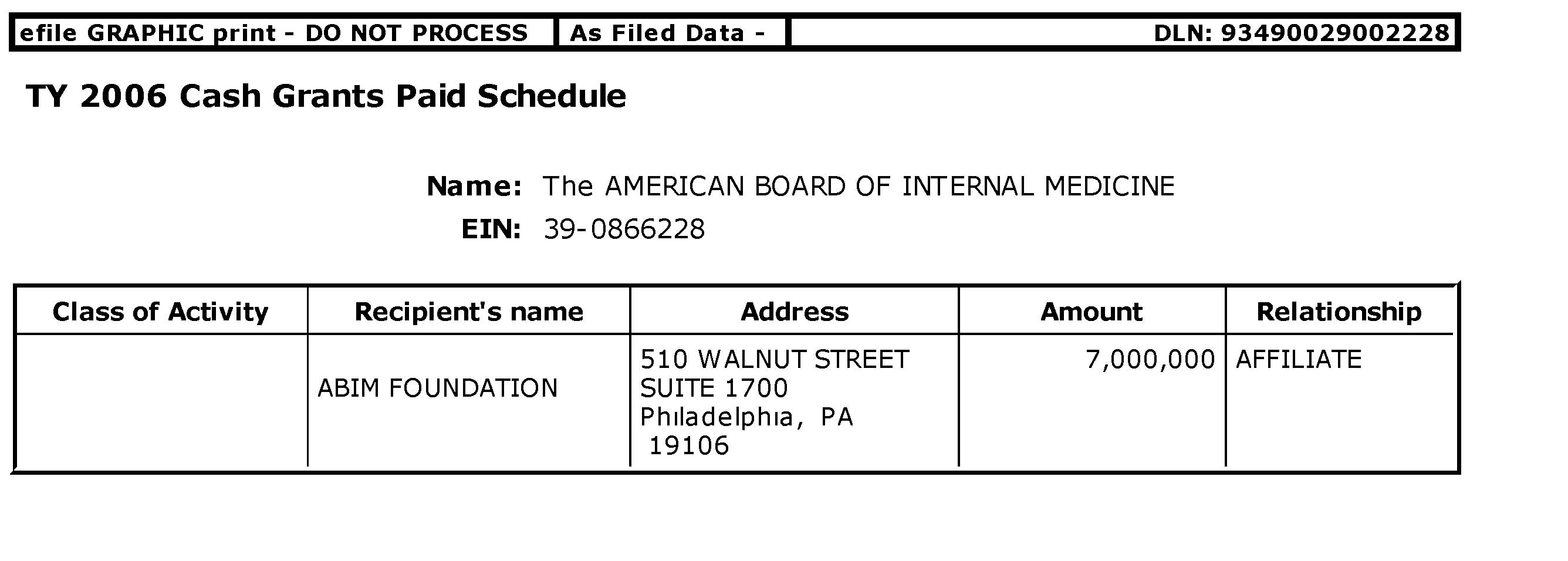
So how did the ABIM Foundation accumulate all that money? Reviewing public tax records of the ABIM and its Foundation reveals a significant portion of the Foundation's revenues came directly from the ABIM. Recall that ABIM receives 97% of its annual revenues from physician certification (62%) and re-certification fees (35%), with only 14% of these fees going toward physician examination development. In 2007 and 2008 alone, cash grants from the ABIM to its Foundation of $7 million and $6 million respectively were issued. The public records disclosed that $17,360,000 from the ABIM were made to its Foundation in the 7 years ending 6/30/2008. As a three-time participant in the ABIM certification process (candidate #127308), I can attest that to the best of my knowledge physicians were never made aware of this use of the testing fees they paid the ABIM.
The Luxury Condominium
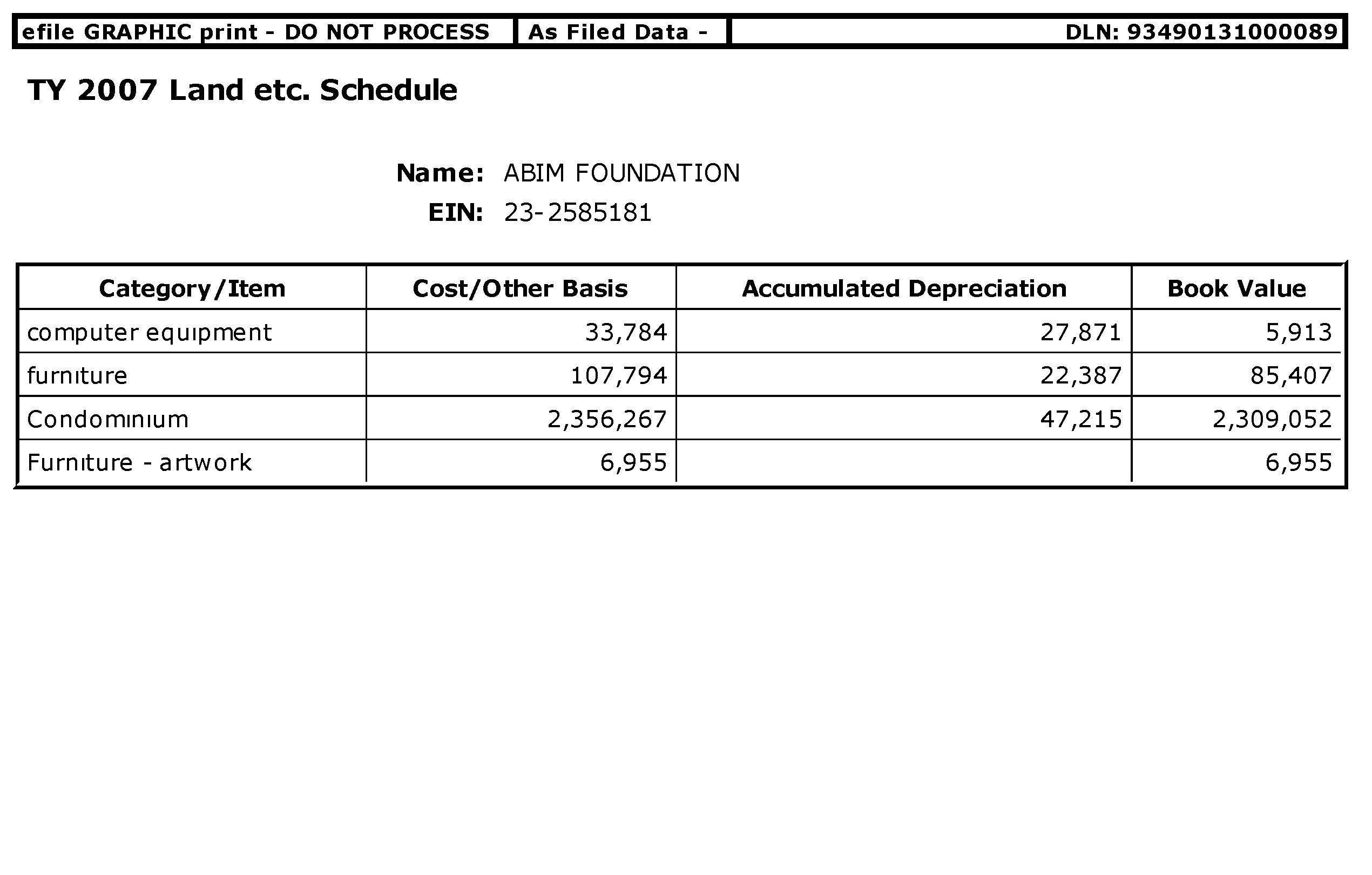
So why did the ABIM Foundation need all this cash from physicians? We can't be certain, but the Foundation disclosed in their 2008 Form 990 that a portion of the
money they received from the ABIM via physicians fees was used to purchase a 2,579 square foot 3-bedroom luxury
condominium (Unit #11NW, in the "Ayer" Building, 210 W. Washington Square, Philadelphia) in December 2007 for $2.3 million. The luxury property borders Washington Square Park of the most historic areas of Philadelphia, across the street from the Tomb of the Unknown Revolutionary War Soldier and the Eternal Flame. The condominium building previously advertised a chauffeur driven Mercedes Benz S-series town car (more pictures here).
Since then, the Foundation has reported "condominium expenses" totaling $850,340 from December 2007 through June 30, 2013 (FY 2008: $42,522, FY 2009: $164,460, FY 2010: 161,957, FY 2011: $165,982, FY 2012: $161,980, FY 2013: $153,439 (most of these reported as "program service expenses")). In my view, these expenses were accrued while the ABIM appears to have been on an inherently unsustainable financial course from 2001 to 2012 with its net asset or fund balances on 6/30/2002 beginning with a negative balance of $10,762,954 and growing to a negative balance of $43,150,390 ending 6/30/2013. Meanwhile, over the same period its shadow organization, the ABIM Foundation, fund balance was $73,841,719 on 6/30/2013.
It should be noted that in the year of the condominium purchase the President and CEO of the ABIM, Christine Cassel, MD, earned $484,883 from the ABIM and $161,627 from the Foundation. Dr. Cassel continues to serve as President and CEO of the National Quality Forum despite a history of other seemingly conflicted financial dealings. Other executives of ABIM that year included F. Daniel Duffy, MD who served as Executive Vice President of the ABIM earning $379,915 from the ABIM, and Cary Sennett, MD, PhD who served as Senior Vice President earning $185,122 from the ABIM and $185,122 from the Foundation and now serves as a Vice President of Anthem, Inc., formerly Wellpoint. That year Dr. Richard Baron, the current President and CEO of the ABIM and Foundation, served as the secretary/treasurer of the ABIM Board earning $59,729 until 7/1/2008 when he became an unpaid Director of the Board. By comparison, according to one reliable source, the median general internal medicine physician salary in the U.S. was $205,441 in 2009.
More Questions
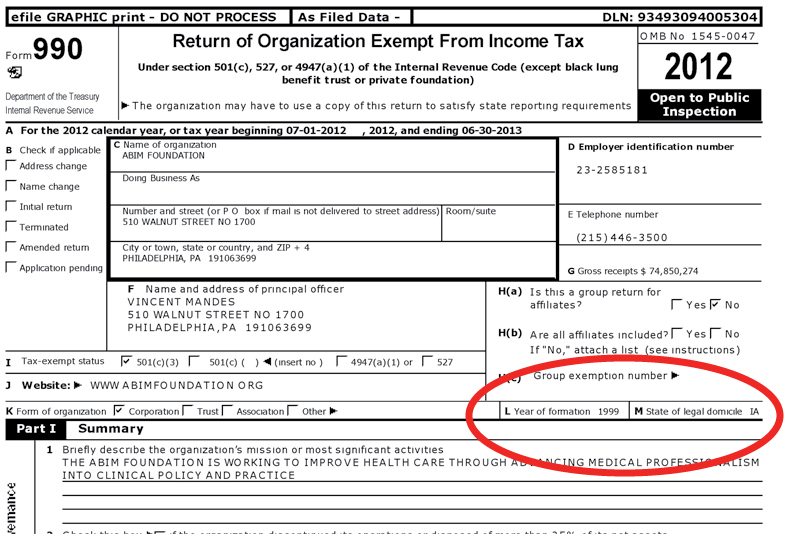
Reviewing the public record on when and where the ABIM Foundation was actually created discloses another discrepancy. We observe that the Foundation has recorded on their tax returns as being founded in 1999 with its "legal domicile" in Iowa, like the ABIM. However, a search for the organization in Iowa comes up empty, while a search in Pennsylvania Department of State (screen shot here) shows the Foundation was actually created in Pennsylvania in 1989. Which is correct?
We should note that non-profits are not required to file financial statements with the state of Iowa, while Pennsylvania requires them. This raises uncomfortable questions. Is the Foundation's Iowa domicile sheltering the sources and uses of its funds? Why does a non-profit promoting "medical professionalism" need to accumulate this much revenue? Is this how the Foundation demonstrates their "medical professionalism" to the public? To whom is the ABIM and Foundation "accountable?" Anyone?
My Call to the ABIM
On 4 December 2014 I contacted the ABIM and requested an explanation regarding the condominium, the ongoing condominium expenses, and the discrepancy of the ABIM Foundation domicile and founding date. Richard Baron, MD, the current President and CEO of the ABIM returned my call and explained the following:
Larger Implications
Sadly, the medical profession has become a house divided. On one side are many non-clinical physicians who have become far removed from patient care and are firmly embedded in the non-profit, academic, and public policy circles making handsome salaries while seeing little problem with coercing their colleagues to pay fees to support their various economic, policy, or personal agendas. In the words of my colleague Jordan Grumet, MD: "they talk about 'accountability' as if they are the ones in the ICU having the family meetings. They pray at the altar of 'quality' yet fail to define the specifics of such a term. They resent 'over treatment' but never have suffered the consequences of not doing enough."
On the other side are the physicians buried in the work-a-day world of patient care, busy doing the best they can for their patients in our increasingly complicated health care system, working as "excellent sheep" as they do their difficult job and try not to rock the boat. While such a dichotomy is not unique to medicine (look to education, the public service sector, and politics, for instance), is ignoring this new reality useful to our profession? Might the unintended consequences of these unaccountable non-profit organizations and revolving-door employment practices with government and business interests be causing unimaginable harm to the integrity and credibility of our profession while simultaneously wasting valuable resources?
It is a shame that most physicians, particularly younger doctors saddled with exorbitant training debt and concerns of job acquisition and job security, are not in a position to protest the actions of the ABIM and its sycophants, particularly since their ability to practice medicine is increasingly tied to these ABIM board certification and their new perpetual maintenance of certification payments. But this is the point, isn't it? Regulatory capture. As these younger doctors gain experience and awaken to the realities of their new health care arena that is increasingly dominated by unaccountable organizations led by non-clinical members of our own profession, we risk creating cynicism in our ranks and physicians who must be more concerned with passing a test than providing direct patient care. Even worse, we risk promoting ourselves, career or cause over the complicated needs of our patients as the divide grows ever deeper. As a result, the brittle credibility and hard-earned trust with our patients is squandered beyond repair. In my opinion, this is what we risk when we have corruption within.
Is this what our profession and the public wants?
I can only hope that practicing US physicians and the public will demand a full accounting of the ABIM and their Foundation's entire financial dealings and non-transparent co-mingling of funds. I hope that Congress decides to investigate the ABIM's role in including their MOC program as a physician quality reporting measure in the Affordable Care Act (see pages 247 and 844-845) to determine its legitimacy in light of these findings. Furthermore, an investigation into possible violations of federal policy on the protection of human subjects (in this case practicing physicians involved in direct patient care) regarding the American Board of Medical Specialties' requirement for practice and patient survey collection for Part IV of their trademarked Maintenance of Certification® program that the ABIM helps conduct should occur, especially in light of lack of informed consent afforded to physicians regarding how the fees and data they collect are used.
It is time we hold the non-clinical members of our own profession that lead these organizations accountable to all physicians and the public at large. Until this occurs, physician-members of every ABIM subspecialty organization that profits from educational content provided to the ABIM should divest themselves and work to create their own, more credible, simplified and transparent life-long learning pathways. The American Association of Clinical Endocrinologists has already set a good example. While I understand that refusing to buck the coercion created by the multimillion dollar ABIM and its Foundation will be difficult, our credibility as stewards of our patients' best interests and the preservation of the integrity of our profession demands nothing less.
-Wes
Acknowledgement
I am indebted to Charles P. Kroll, CPA for his invaluable assistance collecting tax records of the ABIM and ABIM Foundation before 2007 and assisting in the understanding of the nuances of not-for-profit accounting methods. Mr. Kroll provided forensic accounting analysis to the Minnesota attorney general's office during the Medica-Allina scandal and testified at the Minnesota Senate hearing on the matter.

Yet, after a review of public and tax records, it appears to me this is exactly what has happened.
Background
In 1999 for reasons that are unclear, the American Board of Internal Medicine (ABIM), itself a tax-exempt 501 (c) (3) independent non-profit physician evaluation organization domiciled in Iowa, created (Editor's note 10/20/2015: referenced web page has since been edited by the ABIM Foundation; the original referenced web page can be viewed here) a second non-profit tax-exempt 501 (c) (3) organization, the ABIM Foundation (Foundation), to first define and later promote the term "medical professionalism." Both the ABIM and the Foundation share a common address in Pennsylvania and common officers:
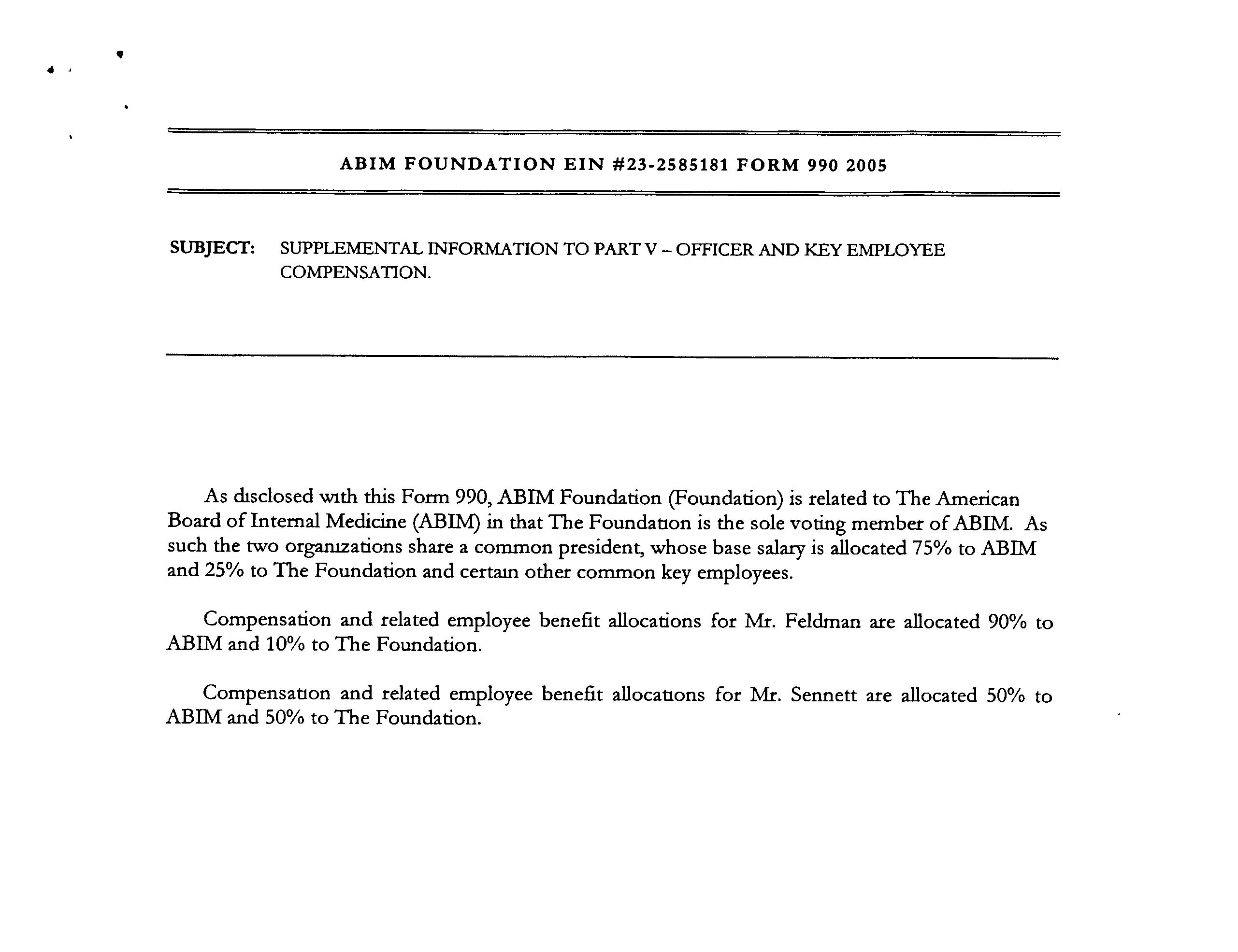
"The American Board of Internal Medicine (ABIM) is related to the ABIM Foundation (Foundation) in that The Foundation is the sole voting member of the ABIM. As such, the two organizations share a common president, a common CFO, and a common senior vice president whose base salaries are allocated between ABIM and The Foundation based on the time spent by each executive."To define "medical professionalism," the new Foundation enlisted other members of the non-profit world including the ABIM, the paid "directors" of the Foundation, the Robert Wood Johnson Foundation, the American College of Physicians-American Society of Internal Medicine and the European Federation of Internal Medicine. The group was chaired by Troy Brennan, MD, JD a paid "Director" of the Foundation who was also President and CEO of Brigham and Women's Physician Organization at the time. (He later became the Chief Medical Officer of Aetna in 2006, and now serves as the Executive Vice President and Chief Medical Officer of CVS Caremark). In 2002 this group published a white paper entitled "Medical Professionalism in the New Millenium: A Physician Charter" without peer review in the Annals of Internal Medicine (here) and The Lancet (here). At least the Annals editor, Harold C. Sox, MD mustered the courage to express concerns about the manuscript in his introductory remarks to his readers:
"The introduction contains the following premise: Changes in the health care delivery systems in countries throughout the industrialized world threaten the values of professionalism. The document conveys this message with chilling brevity. The authors apparently feel no need to defend this premise, perhaps because they believe that it is a universally held truth. The authors go further, stating that the conditions of medical practice are tempting physicians to abandon their commitment to the primacy of patient welfare. These are very strong words. Whether they are strictly true for the profession as a whole is almost beside the point. Each physician must decide if the circumstances of practice are threatening his or her adherence to the values that the medical profession has held dear for many millennia."The paper centered on three fundamental principles that the authors claimed defined "medical professionalism:" (1) the primacy of patient welfare, (2) patient autonomy, and a new concept, (3) the principle of social justice - that is, "the medical profession must promote justice in the health care system, including the fair distribution of health care resources." With this definition, physicians could no longer just be unwavering patient advocates concerned with the "primacy of their patient's welfare," they had also had to serve the financial needs of The System of medicine lest they be labeled "medically unprofessional."
Ten years later after accumulating some $76 million in assets, the Foundation began their hard-to-disagree-with "Choosing Wisely®" campaign to encourage physicians and providers to question the value of medical testing in an effort to eliminate unnecessary tests and procedures. The campaign has grown to include 70 societies and some non-physician organizations, including Consumer Reports, AARP, SEIU, and Univision among others. As part of the campaign, monetary grants from the Robert Wood Johnson Foundation are awarded to institutions willing to "educate practicing physicians about the recommendations from specialty societies, and building physician communication skills to facilitate conversations with their patients about the care they need."
The Money Trail
So how did the ABIM Foundation accumulate all that money? Reviewing public tax records of the ABIM and its Foundation reveals a significant portion of the Foundation's revenues came directly from the ABIM. Recall that ABIM receives 97% of its annual revenues from physician certification (62%) and re-certification fees (35%), with only 14% of these fees going toward physician examination development. In 2007 and 2008 alone, cash grants from the ABIM to its Foundation of $7 million and $6 million respectively were issued. The public records disclosed that $17,360,000 from the ABIM were made to its Foundation in the 7 years ending 6/30/2008. As a three-time participant in the ABIM certification process (candidate #127308), I can attest that to the best of my knowledge physicians were never made aware of this use of the testing fees they paid the ABIM.
The Luxury Condominium
| Street View, "The Ayer Buidling," 210 W. Washington Square |
Since then, the Foundation has reported "condominium expenses" totaling $850,340 from December 2007 through June 30, 2013 (FY 2008: $42,522, FY 2009: $164,460, FY 2010: 161,957, FY 2011: $165,982, FY 2012: $161,980, FY 2013: $153,439 (most of these reported as "program service expenses")). In my view, these expenses were accrued while the ABIM appears to have been on an inherently unsustainable financial course from 2001 to 2012 with its net asset or fund balances on 6/30/2002 beginning with a negative balance of $10,762,954 and growing to a negative balance of $43,150,390 ending 6/30/2013. Meanwhile, over the same period its shadow organization, the ABIM Foundation, fund balance was $73,841,719 on 6/30/2013.
It should be noted that in the year of the condominium purchase the President and CEO of the ABIM, Christine Cassel, MD, earned $484,883 from the ABIM and $161,627 from the Foundation. Dr. Cassel continues to serve as President and CEO of the National Quality Forum despite a history of other seemingly conflicted financial dealings. Other executives of ABIM that year included F. Daniel Duffy, MD who served as Executive Vice President of the ABIM earning $379,915 from the ABIM, and Cary Sennett, MD, PhD who served as Senior Vice President earning $185,122 from the ABIM and $185,122 from the Foundation and now serves as a Vice President of Anthem, Inc., formerly Wellpoint. That year Dr. Richard Baron, the current President and CEO of the ABIM and Foundation, served as the secretary/treasurer of the ABIM Board earning $59,729 until 7/1/2008 when he became an unpaid Director of the Board. By comparison, according to one reliable source, the median general internal medicine physician salary in the U.S. was $205,441 in 2009.
More Questions
Reviewing the public record on when and where the ABIM Foundation was actually created discloses another discrepancy. We observe that the Foundation has recorded on their tax returns as being founded in 1999 with its "legal domicile" in Iowa, like the ABIM. However, a search for the organization in Iowa comes up empty, while a search in Pennsylvania Department of State (screen shot here) shows the Foundation was actually created in Pennsylvania in 1989. Which is correct?
We should note that non-profits are not required to file financial statements with the state of Iowa, while Pennsylvania requires them. This raises uncomfortable questions. Is the Foundation's Iowa domicile sheltering the sources and uses of its funds? Why does a non-profit promoting "medical professionalism" need to accumulate this much revenue? Is this how the Foundation demonstrates their "medical professionalism" to the public? To whom is the ABIM and Foundation "accountable?" Anyone?
My Call to the ABIM
On 4 December 2014 I contacted the ABIM and requested an explanation regarding the condominium, the ongoing condominium expenses, and the discrepancy of the ABIM Foundation domicile and founding date. Richard Baron, MD, the current President and CEO of the ABIM returned my call and explained the following:
- Dr. Baron stated that the condominium was purchased as a "investment property" and part of the investment portfolio of the Foundation. He mentioned that real estate holdings were not uncommon with other similar non-profits. The condominium was used for several purposes, including housing ABIM personnel who resided out of state and returned to Philadelphia for meetings, by contractors (for instance, to house an IT team from India), and for off-site retreats and meetings with the Communications Group of the ABIM, for instance. He noted that when ABIM members use the Foundation's condominium, the Foundation is paid $150/night from the ABIM (compared to the "usual" Philadelphia hotel rate of about $190/night) and there was cash flow to the Foundation from the ABIM for the use of their facility.
- After revelations of the luxury condominium were disclosed at a 2 Dec 2014 Pennsylvania Medical Society town hall meeting, Dr. Baron mentioned in passing that the ABIM was putting the condominium up for sale. I asked Dr. Baron the name of the listing agent and the price. He stated he could not comment because "the paperwork was not in order" and the those details had not been finalized because they were advised that the real estate market would be better in the Spring.
- When asked about the high ongoing condominium expenses and the discrepancy about the ABIM Foundation's creation date and domicile, Dr. Baron could not immediately respond but sent this follow-up e-mail 4 Dec 2014 at 2:39PM (CST):
"Hi Dr. Fischer (sic)-
Attached please find the breakdown of the condo expenses. As I explained the depreciation $$ are a required reporting artifact for the condo as a business investment. The other costs are covered by the condo usage fees.
Regarding the 1989/1999 question - In 1999 ABIM Foundation became a separate operating foundation.
Thanks,
Rich
Richard J. Baron, MD
MACP
President and Chief Executive Officer
American Board of Internal Medicine" - In closing, Dr. Baron expressed his willingness to be open to further questions.
- Today I learned that the condominium is now listed with the following description:
"Extremely Spacious Three Bedroom, 3.5 Bath Home at the Ayer Condominium. Tremendous Entertaining Space. 11’7’’ ceiling heights. Bulthaup b-3 kitchen system, Miele and Subzero Appliances. Huge windows with northwest views. High floor offering stupendous sunsets. Gorgeous stone bathrooms. Abundant closet space. One garage parking space included. Concierge, doormen, valets, gym, chauffeur driven BMW 7-Series." (More details here.)
Larger Implications
Sadly, the medical profession has become a house divided. On one side are many non-clinical physicians who have become far removed from patient care and are firmly embedded in the non-profit, academic, and public policy circles making handsome salaries while seeing little problem with coercing their colleagues to pay fees to support their various economic, policy, or personal agendas. In the words of my colleague Jordan Grumet, MD: "they talk about 'accountability' as if they are the ones in the ICU having the family meetings. They pray at the altar of 'quality' yet fail to define the specifics of such a term. They resent 'over treatment' but never have suffered the consequences of not doing enough."
On the other side are the physicians buried in the work-a-day world of patient care, busy doing the best they can for their patients in our increasingly complicated health care system, working as "excellent sheep" as they do their difficult job and try not to rock the boat. While such a dichotomy is not unique to medicine (look to education, the public service sector, and politics, for instance), is ignoring this new reality useful to our profession? Might the unintended consequences of these unaccountable non-profit organizations and revolving-door employment practices with government and business interests be causing unimaginable harm to the integrity and credibility of our profession while simultaneously wasting valuable resources?
It is a shame that most physicians, particularly younger doctors saddled with exorbitant training debt and concerns of job acquisition and job security, are not in a position to protest the actions of the ABIM and its sycophants, particularly since their ability to practice medicine is increasingly tied to these ABIM board certification and their new perpetual maintenance of certification payments. But this is the point, isn't it? Regulatory capture. As these younger doctors gain experience and awaken to the realities of their new health care arena that is increasingly dominated by unaccountable organizations led by non-clinical members of our own profession, we risk creating cynicism in our ranks and physicians who must be more concerned with passing a test than providing direct patient care. Even worse, we risk promoting ourselves, career or cause over the complicated needs of our patients as the divide grows ever deeper. As a result, the brittle credibility and hard-earned trust with our patients is squandered beyond repair. In my opinion, this is what we risk when we have corruption within.
Is this what our profession and the public wants?
I can only hope that practicing US physicians and the public will demand a full accounting of the ABIM and their Foundation's entire financial dealings and non-transparent co-mingling of funds. I hope that Congress decides to investigate the ABIM's role in including their MOC program as a physician quality reporting measure in the Affordable Care Act (see pages 247 and 844-845) to determine its legitimacy in light of these findings. Furthermore, an investigation into possible violations of federal policy on the protection of human subjects (in this case practicing physicians involved in direct patient care) regarding the American Board of Medical Specialties' requirement for practice and patient survey collection for Part IV of their trademarked Maintenance of Certification® program that the ABIM helps conduct should occur, especially in light of lack of informed consent afforded to physicians regarding how the fees and data they collect are used.
It is time we hold the non-clinical members of our own profession that lead these organizations accountable to all physicians and the public at large. Until this occurs, physician-members of every ABIM subspecialty organization that profits from educational content provided to the ABIM should divest themselves and work to create their own, more credible, simplified and transparent life-long learning pathways. The American Association of Clinical Endocrinologists has already set a good example. While I understand that refusing to buck the coercion created by the multimillion dollar ABIM and its Foundation will be difficult, our credibility as stewards of our patients' best interests and the preservation of the integrity of our profession demands nothing less.
-Wes
Acknowledgement
I am indebted to Charles P. Kroll, CPA for his invaluable assistance collecting tax records of the ABIM and ABIM Foundation before 2007 and assisting in the understanding of the nuances of not-for-profit accounting methods. Mr. Kroll provided forensic accounting analysis to the Minnesota attorney general's office during the Medica-Allina scandal and testified at the Minnesota Senate hearing on the matter.

Stop Wasting Doctors' Time (and Money)
From the New York Times today:
In my opinion, there will be much more coming soon about this sordid and very sad MOC story.
-Wes
"To rely solely on memory, especially for rarer illnesses or complicated patients, would be malpractice. Which is why the huge exam that culminates each decade of recertification should be abolished. Memorizing reams of information to be regurgitated in a “secure testing center” is a waste of time and resources, and does not reflect how medicine is practiced. Most doctors agree with having some sort of process that updates and refreshes medical knowledge. But the process has become unmanageable."Unfortunately, the well-meaning physician author of this piece does not mention the additional costs and questionable ethics of the relatively recently expanded four-step Maintenance of Certification® (MOC) process that the American Board of Medical Specialties has trademarked (and the ABIM helps implement), especially as it pertains to the research being performed on working physicians without their consent. Furthermore, the recent revelations that a shadow organization of the ABIM, the ABIM Foundation, purchased a $2.3 million luxury condominium in December 2007 after the new, more onerous MOC requirements were announced in 2005 raises many more very troubling questions about the legitimacy of this program. For instance, is MOC more about improving corporate portfolios than patient outcomes?
In my opinion, there will be much more coming soon about this sordid and very sad MOC story.
-Wes
Saturday, December 13, 2014
Electronic Medical Record and the Threat of Physician Skill Fade
As I watch the business world's fascination with the electronic medical record (EMR) and all of the Big Data that it accumulates, I see more and more processes codified and treatment pathways carefully honed. Only one small thing remains until the computer can tell doctors how to behave based on the developed algorithms: to turn free text in the patient chart into easily-definable binary pushbutton selections, so now, this is being done.
The theory, of course, is for computers to understand doctor's free text and medical decision making. By making a myriad of discrete data entry choices, we are told, recommendations for care can be made based (of course) on the best "evidence-based" guidelines the world has to offer. Data can then be quantified. Physician selections, easily followed and tracked. "Quality measures" (as defined by guidelines) "simply" quantified. This is our latest "New Vision" for health care. And as our nation hurries to implement electronic health care delivery through government mandates and regulations to assure "meaningful use" of computers, the gushing assurances of improved care spews forth from many who stand to profit from the system.
Imagine: doctors won't have to think. They'll just click the buttons and be in compliance. Stay between the lines and you're quality scores will be perfect,. Your care will be impeccable in the eyes of the developer; efficient, timely, thorough.
What could go wrong? After all, the guesswork is gone. The knowledge base clearly defined. The treatment of the disease efficiently rendered. And now, everything can be perfectly quantified.
I should acknowledge that there are clearly efficiencies gained by such a tact. But there is also a downside that really hasn't been seriously considered by most: we risk developing physician skill-fade. This, in turn, introduces a new unforseen risks to our patients since practice freedom is restricted as each algorithm demands conformity rather than innovation, improvisation, and any semblance of risk taking on the patient's behalf. After all, the computer code is optimized for its creator, the health care Iron Triangle, not the patient.
I was struck by a recent article by Nicholas Carr in the Wall Street Journal entitled, "Automation Makes Us Dumb." In it, Mr. Carr describes the benefits and challenges that automation has produced and mentions the EMR:
In fact, who needs doctors at all if care is reduced to point and click? While our new breed of physicians have never known medicine without a computer, will all of their study and preparation to become clinicians at the bedside be rendered moot as these young doctors find themselves little more than data entry clerks? How will we keep them clinically skilled? Homogenized mannequins programmed to respond to regimented scenarios?
Creating disease-directed algorithms might be efficient at treating a medical problem but this does not really treat the patient. With the infinitely variable human condition, might we be fooling ourselves with a false promise of unwavering algorithmic simplicity? Since patients rarely have one health problem but many, do these simplified treatment pathways consider the effects of other confounding ailments? Do our programmers and engineers care?
This myopic vision for medicine is where we are currently heading. Scores of centrally-created computer mandates continue to restrict the freedom of developers to move where computer-aided treatment advances need to go. As we create our linear and static algorithms that are unyielding to nuance or change (and created during a tiny snapshot of history), we should remember these limitations since physicians' freedom to act in the best interest of their patients is lost if doctors become complacent and also financially incentivized to do so. Such restriction might lower costs, but at a risk to patient care.
Realizing computers in medicine are here to stay, I can only hope that in the years ahead as computerized health records develop, a new era of computerized algorithms will evolve that adapt to any number of physician-directed exceptions and exclusions appropriately. Computers and EMRs must inform the physician rather than mandate, instruct rather than impugn, encourage adaptation rather than thwart it, and always facilitate rather than inhibit patient care. This way physician skill-fade will be minimized and a more efficient care delivery that is patient-centered rather than industry-centered can thrive.
-Wes
The theory, of course, is for computers to understand doctor's free text and medical decision making. By making a myriad of discrete data entry choices, we are told, recommendations for care can be made based (of course) on the best "evidence-based" guidelines the world has to offer. Data can then be quantified. Physician selections, easily followed and tracked. "Quality measures" (as defined by guidelines) "simply" quantified. This is our latest "New Vision" for health care. And as our nation hurries to implement electronic health care delivery through government mandates and regulations to assure "meaningful use" of computers, the gushing assurances of improved care spews forth from many who stand to profit from the system.
Imagine: doctors won't have to think. They'll just click the buttons and be in compliance. Stay between the lines and you're quality scores will be perfect,. Your care will be impeccable in the eyes of the developer; efficient, timely, thorough.
What could go wrong? After all, the guesswork is gone. The knowledge base clearly defined. The treatment of the disease efficiently rendered. And now, everything can be perfectly quantified.
I should acknowledge that there are clearly efficiencies gained by such a tact. But there is also a downside that really hasn't been seriously considered by most: we risk developing physician skill-fade. This, in turn, introduces a new unforseen risks to our patients since practice freedom is restricted as each algorithm demands conformity rather than innovation, improvisation, and any semblance of risk taking on the patient's behalf. After all, the computer code is optimized for its creator, the health care Iron Triangle, not the patient.
I was struck by a recent article by Nicholas Carr in the Wall Street Journal entitled, "Automation Makes Us Dumb." In it, Mr. Carr describes the benefits and challenges that automation has produced and mentions the EMR:
In a study conducted in 2007-08 in upstate New York, SUNY Albany professor Timothy Hoff interviewed more than 75 primary-care physicians who had adopted computerized systems. The doctors felt that the software was impoverishing their understanding of patients, diminishing their “ability to make informed decisions around diagnosis and treatment.”But what is the real issue? While the development of treatment rubrics can improve health care efficiency and productivity for their creators, I fear rote implementation of these algorithms will also also atrophy a physician's clinical and reasoning skills. Binary decisions buttons might facilitate note creation and data gathering, but they discourage the use of physical examination (remember that?) and the evaluation of nuance or clinical exceptions. With creation of our current iteration of care pathways and guidelines, there is now little need for exceptional thinkers, only adequate thinkers. What would skill fade look like in medicine? And at what point do the exceptional experienced physicians start becoming vulnerable to skill fade?
Harvard Medical School professor Beth Lown, in a 2012 journal article written with her student Dayron Rodriquez, warned that when doctors become “screen-driven,” following a computer’s prompts rather than “the patient’s narrative thread,” their thinking can become constricted. In the worst cases, they may miss important diagnostic signals.
The risk isn’t just theoretical. In a recent paper published in the journal Diagnosis, three medical researchers—including Hardeep Singh, director of the health policy, quality and informatics program at the Veterans Administration Medical Center in Houston—examined the misdiagnosis of Thomas Eric Duncan, the first person to die of Ebola in the U.S., at Texas Health Presbyterian Hospital Dallas. They argue that the digital templates used by the hospital’s clinicians to record patient information probably helped to induce a kind of tunnel vision. “These highly constrained tools,” the researchers write, “are optimized for data capture but at the expense of sacrificing their utility for appropriate triage and diagnosis, leading users to miss the forest for the trees.” Medical software, they write, is no “replacement for basic history-taking, examination skills, and critical thinking.”
In fact, who needs doctors at all if care is reduced to point and click? While our new breed of physicians have never known medicine without a computer, will all of their study and preparation to become clinicians at the bedside be rendered moot as these young doctors find themselves little more than data entry clerks? How will we keep them clinically skilled? Homogenized mannequins programmed to respond to regimented scenarios?
Creating disease-directed algorithms might be efficient at treating a medical problem but this does not really treat the patient. With the infinitely variable human condition, might we be fooling ourselves with a false promise of unwavering algorithmic simplicity? Since patients rarely have one health problem but many, do these simplified treatment pathways consider the effects of other confounding ailments? Do our programmers and engineers care?
This myopic vision for medicine is where we are currently heading. Scores of centrally-created computer mandates continue to restrict the freedom of developers to move where computer-aided treatment advances need to go. As we create our linear and static algorithms that are unyielding to nuance or change (and created during a tiny snapshot of history), we should remember these limitations since physicians' freedom to act in the best interest of their patients is lost if doctors become complacent and also financially incentivized to do so. Such restriction might lower costs, but at a risk to patient care.
Realizing computers in medicine are here to stay, I can only hope that in the years ahead as computerized health records develop, a new era of computerized algorithms will evolve that adapt to any number of physician-directed exceptions and exclusions appropriately. Computers and EMRs must inform the physician rather than mandate, instruct rather than impugn, encourage adaptation rather than thwart it, and always facilitate rather than inhibit patient care. This way physician skill-fade will be minimized and a more efficient care delivery that is patient-centered rather than industry-centered can thrive.
-Wes
Thursday, December 04, 2014
Vignettes From A Brief Foray Into Knee Surgery
The phone rang one evening and a pleasant voice was on the other end. "Hi, my name is nurse So-and-so and I'm the educational coordinator for your upcoming knee surgery. Do you want to go to the patient orientation session?" she asked. "It's very helpful to go over things before and after your surgery and to answer any questions you might have."
I thought about this. The 11am session was right smack dab in the middle of my clinical day. But I thought it best to attend and agreed.
It is not easy deciding to have an elective surgery, especially one that will sideline you from your vocation for an extended period. Some said I waited too long. Others said you should wait as long as possible. For me: two good years of limping, looking at long halls that kept getting longer and seeing my formerly active social life dwindle spurred me to proceed. It was time to surrender myself to The System.
Unfortunately, clinical demands caused me to arrive 20 minutes late to my pre-op orientation. I entered a room filled with people and their spouses, all arranged in a large semicircle facing a middle-aged nurse educator in the middle of the room. Men and women of all ages - some younger, some older. Some with partners, some without. Teams. Total knee, partial knees, hips galore!
I had no idea.
"Here's and information packet," she said as she handed me an envelope as I became one of the crowd. "I'll review what your missed at the end of the session." I took a seat as discretely as I could.
Surely if they can do this," I pondered, "I can do this."
***
"Take everything off, then wipe yourself down with one of these towelettes, then put this on," she said, handing me a neatly folded hospital gown. "Follow the directions printed here on this diagram: there are eight of these towelettes, four in each package, use one towelette for both arms, one for your chest, one for your back, one for your abdomen, then one for each leg, one for your privates, one for your butt, your wife can help you with your back…"
Welcome to being a patient!
She left and I removed my clothes. Standing buck naked in a cubicle as I changed, quite a "patient-appreciation day." It was clear this was carefully choreographed preparatory dance, held solo by a doctor who stood naked and a bit confused about the intricacies of sterile towelette application to various body parts, then wiping this part and that - especially since she forgot to tell me that the warmed towelettes cooled quickly and their evaporative loss helped redefine the term "shrinkage" as my chemical pre-operative shower concluded.. Then came the comical assembly of the hospital gown he'd seen his patients endure so many times before. In a word: dashing!
***
"Hello, doctor."
I looked up to see an man somewhat older than me, who spoke with an accent - maybe he was from India? - I wasn't sure.
"I am here to shave your leg."
"She's all yours," I said.
And with that a pair of electric shears appeared and he went to work. It was clear he enjoyed his work. "Soon you will look like Miley Cyrus," he said softly, smiling quietly to himself . Looking down at my leg a short while later, I saw a sheen on my legs that I had never seen before - damn thing looked as smooth as a baby's butt. He proudly applied adhesive tape over the area to remove the excess hair. He walked away briefly to throw the tape away and then returned. He leaned over to my wife whispering loudly enough so I could hear: "I'm so sorry," he said shaling his head, "I made a mistake."
My wife, somewhat puzzled, looked briefly concerned.
He grinned: "He looks more like Madonna."
***
"Okay, I discussed the anesthesia plan with your doctor and he and I think the best option for you would be to have a spinal for this procedure, then we'll give you some propofol and you should do fine. First, I'm going to inject you leg above your knee to give you some ongoing pain relief after your surgery. I'm going to use an ultrasound machine to infuse this area, okay?"
"Uh, sure. Less pain, more gain for me!"
I watched as he localized the vascular bundle in my adductor canal using ultrasound, then injected local. It stung just a tiny bit as he local was infused, but wasn't too severe. Piece of cake, I thought.
"Now, I'd like you to sit at the edge of the bed."
I sat dutifully at the edge of the bed, placing my head in this contraption that contained a headrest and was clearly designed for this moment - complete with foot rests and the places to place your hands. As I leaned forward, I could feel him preparing the area on my lower back, draping it with a sterile drape, then feeling for the iliac crests bilaterally. Once, then again. Then…
"You might feel a little electric shock sensation down your leg - let me know…"
And almost instantly, I felt the slightest of electric shock sensations shoot down my left leg. I brought this to his attention. He did something to relieve the mild sensation.
"There, is that better?"
"Yes," I replied, comfortable as ever.
Moments later I could feel both my legs feel warm almost instantly. They helped be lie back in bed. Within seconds, the strangest sensation occurred: paralysis. No matter how hard my brain asked my legs to move, they refused. I felt just below my belly button. Nothing to feel there, either! Paralysis, particularly while you are conscious, is a bizarre sensation. Try as you might you try to move your legs: nothing. Like a Vulcan mind meld that goes bad you try to tell you legs to do anything and… nothing. I was able to feel a tiny piece of my right 2nd toe for a bit - at least I thought I could, but nothing else. I felt oddly peaceful despite it all - probably Versed, I thought.
"We're ready to take him to the OR," they told her as the transporter and anesthesiologist assisted. "Give him a kiss."
I remembered my wife's kiss, and later moving to the OR table, and from the corner of my eye a scrub nurse in an isolation suit that looked like an Ebola isolation outfit. "Can we get him to sleep now?" I heard someone say. "Let me get his systolic above 75 first," another female voice said. "Oh great," I remembered thinking, but somehow didn't care. Clearly it was a team effort. A guy was working on my foley, but I wasn't sure - couldn't feel a thing. Somehow that part scared me the most and it was nothing. Then...
I woke bit later - minutes it seemed. To the right of me was a lady - was it a nurse? - in a lit football helmet-like head gear. What the …? The drape over her face had been removed. Others were similarly garbed: modified Ebola outfits. Cool. I want these in my OR, I thought. Drugs are an amazing thing.
"We're going to move you off the table now, Wes." And they lifted me over to a gurney. I wheeled back to the holding area, feeling victorious. The procedure I had wanted, but dreaded, was over. Now the recovery.
"You can eat when you get upstairs."
I really wasn't that hungry.
***
"Welcome to your new room. I think it's the biggest on the floor!" she exclaimed. I'm here to give you your meds. Can I have your name and date of birth?"
She clicked this and that, then gave be the pills in a small plastic cup - all kinds of them!
"The pain team has a specific regimen of medications they want you on," she explained. Not wanting to rock the boat, especially when it came to pain, I complied. If you need anything, let us know. We'll keep the ICE machine full. Let us know if you think you need more ice. Here's you incentive spirometer - 3200 cc's every hour, okay?
It was a new room, equipped with all the amenities. Classy, welcome, bigger than I needed, but I was sure it would impress the family. I could hear the saline infusion cranking quietly in the background all night. I remembered my days on the ortho ward as an intern and promised to myself: "I'll be damned if I get in-land salt water drowning! Watch the fluids."
A continuous parade of individuals from the hospital, the nurses, the technicians, PT, OT paraded through. "We try to check on you once an hour," I heard them say. I wondered when I'd get sleep. A bit after midnight it finally happened, and with another Norco sleep came easily.
***
05:50AM: "Good morning, I'm hear to draw your blood."
Heck of a wake-up call. She was young, skilled, soft-spoken. She found my vein in an instant. I learned she left home at every day at 5am, made her rounds drawing blood, then went to school.
She came early every morning, then went on her way. It was easier once we knew each other and knew what to expect each day: a confident harpooning.
***
Being a patient is a good exercise for a doctor. You an see what works, and what doesn't. You can appreciate your vulnerability and the vulnerability of your patients. I saw the coldness of the EMR and the distant computer stares as they never looked up, clicking: "Name and date of birth, please." "Tell me your name and date of birth." The another time: "Name?" "Date of birth?"
Like someone taking a mini-mental status exam on a robot.
But I also saw a team of people who were genuinely concerned with my well-being, many of whom were the people you never hear about: the orderlies, the cleaning personnel, the medical assistants, the pharmacists, and food service personnel. Not to say that the nursing, physical therapy and physician staff weren't great (they were), but it was great to see so many people not just doing their jobs, but enjoying them too.
Perhaps more than this, though, there was a humbling revelation: that like our patients, we are aging. The unlimited days of racing to a code or standing in the cath lab correcting an arrhythmia for hours at a time aren't unlimited after all. As a doctor, we've known this intellectually. But as a patient, we see this and come to appreciate this reality first-hand. And as a result, I suppose I've found a new appreciation: an appreciation for what we do and the the brevity of the time we have to do it as a doctor, the wonder of caring for patients, teaching students, and having family and loved ones that have shared this journey with us. Perhaps most of all, becoming a patient gives us a new appreciation for the finite time we have doing what we love here on this earth.
-Wes
I thought about this. The 11am session was right smack dab in the middle of my clinical day. But I thought it best to attend and agreed.
It is not easy deciding to have an elective surgery, especially one that will sideline you from your vocation for an extended period. Some said I waited too long. Others said you should wait as long as possible. For me: two good years of limping, looking at long halls that kept getting longer and seeing my formerly active social life dwindle spurred me to proceed. It was time to surrender myself to The System.
Unfortunately, clinical demands caused me to arrive 20 minutes late to my pre-op orientation. I entered a room filled with people and their spouses, all arranged in a large semicircle facing a middle-aged nurse educator in the middle of the room. Men and women of all ages - some younger, some older. Some with partners, some without. Teams. Total knee, partial knees, hips galore!
I had no idea.
"Here's and information packet," she said as she handed me an envelope as I became one of the crowd. "I'll review what your missed at the end of the session." I took a seat as discretely as I could.
Surely if they can do this," I pondered, "I can do this."
***
"Take everything off, then wipe yourself down with one of these towelettes, then put this on," she said, handing me a neatly folded hospital gown. "Follow the directions printed here on this diagram: there are eight of these towelettes, four in each package, use one towelette for both arms, one for your chest, one for your back, one for your abdomen, then one for each leg, one for your privates, one for your butt, your wife can help you with your back…"
Welcome to being a patient!
She left and I removed my clothes. Standing buck naked in a cubicle as I changed, quite a "patient-appreciation day." It was clear this was carefully choreographed preparatory dance, held solo by a doctor who stood naked and a bit confused about the intricacies of sterile towelette application to various body parts, then wiping this part and that - especially since she forgot to tell me that the warmed towelettes cooled quickly and their evaporative loss helped redefine the term "shrinkage" as my chemical pre-operative shower concluded.. Then came the comical assembly of the hospital gown he'd seen his patients endure so many times before. In a word: dashing!
***
"Hello, doctor."
I looked up to see an man somewhat older than me, who spoke with an accent - maybe he was from India? - I wasn't sure.
"I am here to shave your leg."
"She's all yours," I said.
And with that a pair of electric shears appeared and he went to work. It was clear he enjoyed his work. "Soon you will look like Miley Cyrus," he said softly, smiling quietly to himself . Looking down at my leg a short while later, I saw a sheen on my legs that I had never seen before - damn thing looked as smooth as a baby's butt. He proudly applied adhesive tape over the area to remove the excess hair. He walked away briefly to throw the tape away and then returned. He leaned over to my wife whispering loudly enough so I could hear: "I'm so sorry," he said shaling his head, "I made a mistake."
My wife, somewhat puzzled, looked briefly concerned.
He grinned: "He looks more like Madonna."
***
"Okay, I discussed the anesthesia plan with your doctor and he and I think the best option for you would be to have a spinal for this procedure, then we'll give you some propofol and you should do fine. First, I'm going to inject you leg above your knee to give you some ongoing pain relief after your surgery. I'm going to use an ultrasound machine to infuse this area, okay?"
"Uh, sure. Less pain, more gain for me!"
I watched as he localized the vascular bundle in my adductor canal using ultrasound, then injected local. It stung just a tiny bit as he local was infused, but wasn't too severe. Piece of cake, I thought.
"Now, I'd like you to sit at the edge of the bed."
I sat dutifully at the edge of the bed, placing my head in this contraption that contained a headrest and was clearly designed for this moment - complete with foot rests and the places to place your hands. As I leaned forward, I could feel him preparing the area on my lower back, draping it with a sterile drape, then feeling for the iliac crests bilaterally. Once, then again. Then…
"You might feel a little electric shock sensation down your leg - let me know…"
And almost instantly, I felt the slightest of electric shock sensations shoot down my left leg. I brought this to his attention. He did something to relieve the mild sensation.
"There, is that better?"
"Yes," I replied, comfortable as ever.
Moments later I could feel both my legs feel warm almost instantly. They helped be lie back in bed. Within seconds, the strangest sensation occurred: paralysis. No matter how hard my brain asked my legs to move, they refused. I felt just below my belly button. Nothing to feel there, either! Paralysis, particularly while you are conscious, is a bizarre sensation. Try as you might you try to move your legs: nothing. Like a Vulcan mind meld that goes bad you try to tell you legs to do anything and… nothing. I was able to feel a tiny piece of my right 2nd toe for a bit - at least I thought I could, but nothing else. I felt oddly peaceful despite it all - probably Versed, I thought.
"We're ready to take him to the OR," they told her as the transporter and anesthesiologist assisted. "Give him a kiss."
I remembered my wife's kiss, and later moving to the OR table, and from the corner of my eye a scrub nurse in an isolation suit that looked like an Ebola isolation outfit. "Can we get him to sleep now?" I heard someone say. "Let me get his systolic above 75 first," another female voice said. "Oh great," I remembered thinking, but somehow didn't care. Clearly it was a team effort. A guy was working on my foley, but I wasn't sure - couldn't feel a thing. Somehow that part scared me the most and it was nothing. Then...
I woke bit later - minutes it seemed. To the right of me was a lady - was it a nurse? - in a lit football helmet-like head gear. What the …? The drape over her face had been removed. Others were similarly garbed: modified Ebola outfits. Cool. I want these in my OR, I thought. Drugs are an amazing thing.
"We're going to move you off the table now, Wes." And they lifted me over to a gurney. I wheeled back to the holding area, feeling victorious. The procedure I had wanted, but dreaded, was over. Now the recovery.
"You can eat when you get upstairs."
I really wasn't that hungry.
***
"Welcome to your new room. I think it's the biggest on the floor!" she exclaimed. I'm here to give you your meds. Can I have your name and date of birth?"
She clicked this and that, then gave be the pills in a small plastic cup - all kinds of them!
"The pain team has a specific regimen of medications they want you on," she explained. Not wanting to rock the boat, especially when it came to pain, I complied. If you need anything, let us know. We'll keep the ICE machine full. Let us know if you think you need more ice. Here's you incentive spirometer - 3200 cc's every hour, okay?
It was a new room, equipped with all the amenities. Classy, welcome, bigger than I needed, but I was sure it would impress the family. I could hear the saline infusion cranking quietly in the background all night. I remembered my days on the ortho ward as an intern and promised to myself: "I'll be damned if I get in-land salt water drowning! Watch the fluids."
A continuous parade of individuals from the hospital, the nurses, the technicians, PT, OT paraded through. "We try to check on you once an hour," I heard them say. I wondered when I'd get sleep. A bit after midnight it finally happened, and with another Norco sleep came easily.
***
05:50AM: "Good morning, I'm hear to draw your blood."
Heck of a wake-up call. She was young, skilled, soft-spoken. She found my vein in an instant. I learned she left home at every day at 5am, made her rounds drawing blood, then went to school.
She came early every morning, then went on her way. It was easier once we knew each other and knew what to expect each day: a confident harpooning.
***
Being a patient is a good exercise for a doctor. You an see what works, and what doesn't. You can appreciate your vulnerability and the vulnerability of your patients. I saw the coldness of the EMR and the distant computer stares as they never looked up, clicking: "Name and date of birth, please." "Tell me your name and date of birth." The another time: "Name?" "Date of birth?"
Like someone taking a mini-mental status exam on a robot.
But I also saw a team of people who were genuinely concerned with my well-being, many of whom were the people you never hear about: the orderlies, the cleaning personnel, the medical assistants, the pharmacists, and food service personnel. Not to say that the nursing, physical therapy and physician staff weren't great (they were), but it was great to see so many people not just doing their jobs, but enjoying them too.
Perhaps more than this, though, there was a humbling revelation: that like our patients, we are aging. The unlimited days of racing to a code or standing in the cath lab correcting an arrhythmia for hours at a time aren't unlimited after all. As a doctor, we've known this intellectually. But as a patient, we see this and come to appreciate this reality first-hand. And as a result, I suppose I've found a new appreciation: an appreciation for what we do and the the brevity of the time we have to do it as a doctor, the wonder of caring for patients, teaching students, and having family and loved ones that have shared this journey with us. Perhaps most of all, becoming a patient gives us a new appreciation for the finite time we have doing what we love here on this earth.
-Wes
Wednesday, November 19, 2014
My Interview at AHA 2014 on ABIM's Maintenance of Certification Program
Thanks for C. Michael Gibson, MD for hosting an interview with me on my concerns with the American Board of Medical Specialties (ABMS) / American Board of Internal Medicine's Maintenance of Certification Program earlier today on his Clinical Trial Results website. A direct link to the interview is included here (if you're using a mobile phone, click the "Download video" link on the webpage).
As the physician groundswell of opposition to the ABMS's proprietary MOC program grows, physicians (especially younger physicians) must understand the complex forces that are intervening between the doctor and patient. The ABMS/ABIM Maintenance of Certification Program is just one of these forces. I encourage all doctors to educate themselves by reviewing the materials collected about MOC at changeboardrecert.com. It's an excellent resource from a variety of physician voices around the United States. Overseas doctors, too, should be aware that the ABIM is extending its tentacles there as well (video), all without any independently-verified evidence base upon which to impose their program as a physician quality or patient safety measure. Doctors must understand the importance of becoming more involved in preserving our profession by becoming more politically engaged.
It is interesting that the AMA just adopted the following new "Principles for MOC" in their press release of 10 Nov 2014:
Similarly, the Pennsylvania Medical Society, just released their "statement of principles" for MOC that sound eerily similar:
Neither of these "principles" insist on researching the unintended negative consequences of the MOC program on physicians should they fail to re-certify, especially since failure rates of this program is 22%.
So why have these two prominent organizations suddenly produced these two similar documents? Might it be to distance themselves from anti-trust concerns with MOC that continue to weave themselves through the courts? Might it be because they see the ABIM becoming irrelevant as more revelations of the management of these organizations comes to light? Might the AMA still want to perpetuate the loss of physician autonomy to gain favor with large hospital systems that are being created by our new health care law today?
We must wonder.
These are big issues. For young doctors overwhelmed with the realities of beginning practice, taking another test seems the easier option than confronting these realities. But all of us as treating doctors must not sit idly by as our autonomy is increasingly usurped and corrupted to benefit the system rather protecting the real health care needs of our patients.
-Wes
As the physician groundswell of opposition to the ABMS's proprietary MOC program grows, physicians (especially younger physicians) must understand the complex forces that are intervening between the doctor and patient. The ABMS/ABIM Maintenance of Certification Program is just one of these forces. I encourage all doctors to educate themselves by reviewing the materials collected about MOC at changeboardrecert.com. It's an excellent resource from a variety of physician voices around the United States. Overseas doctors, too, should be aware that the ABIM is extending its tentacles there as well (video), all without any independently-verified evidence base upon which to impose their program as a physician quality or patient safety measure. Doctors must understand the importance of becoming more involved in preserving our profession by becoming more politically engaged.
It is interesting that the AMA just adopted the following new "Principles for MOC" in their press release of 10 Nov 2014:
The MOC principles will now include:On first blush, this seems so promising. But we should appreciate that the ABMS and ABIM was an earlier spin-off of the AMA, making those of us familiar with these facts suspect.
The American Board of Medical Specialties (ABMS) is the organization responsible for developing the MOC process. ABMS works with its 24 member boards in the ongoing evaluation and certification of physicians.
- MOC should be based on evidence and designed to identify performance gaps and unmet needs, providing direction and guidance for improvement in physician performance and delivery of care.
- The MOC process should be evaluated periodically to measure physician satisfaction, knowledge uptake, and intent to maintain or change practice.
- MOC should be used as a tool for continuous improvement.
- The MOC program should not be a mandated requirement for licensure, credentialing, payment, network participation or employment.
- Actively practicing physicians should be well-represented on specialty boards developing MOC.
- MOC activities and measurement should be relevant to clinical practice.
- The MOC process should not be cost-prohibitive or present barriers to patient care. The policy encourages specialty boards to investigate alternative approaches to MOC and directs the AMA to report annually on the MOC process.
AMA policy supports physician accountability, life-long learning and self-assessment. The AMA will continue to work with the appropriate organizations to ensure the MOC process does not disrupt physician practice or reduce the capacity of the overall physician workforce. In June, the AMA and ABMS convened stakeholders in Chicago to discuss Part III of the MOC exam, focusing on the value of MOC Part III and innovative concepts that could potentially enhance or replace the current thinking around the secure exam requirement of MOC.
Similarly, the Pennsylvania Medical Society, just released their "statement of principles" for MOC that sound eerily similar:
The Pennsylvania Medical Society is committed to lifelong learning, cognitive expertise, practice quality improvement, and adherence to the highest standards of medical practice. The Pennsylvania Medical Society supports a process of continuous learning and improvement based on evidence-based guidelines, national standards, and best practices, in combination with customized continuing education.While these "principles" from the AMA and the Pennsylvania Medical Society address many of physicians' concerns regarding these programs, both potentiate the concept of Maintenance of Certification (MOC), despite the many problems we've identified with this "program" to date (see here, here, here, and here for starters).
The Maintenance of Certification (MOC) process should be designed to identify performance gaps and unmet needs, providing direction and guidance for improvement in physician performance and delivery of care.
The Maintenance of Certification (MOC) process should be evaluated periodically to measure physician satisfaction, knowledge uptake and intent to maintain or change practice. Board certificates should have lifetime status, with Maintenance of Certification (MOC) used as a tool for continuous improvement.
The Maintenance of Certification (MOC) program should not be associated with hospital privileges, insurance reimbursements or network participation.
The Maintenance of Certification (MOC) program should not be required for Maintenance of Licensure (MOL).
Specialty boards, which develop Maintenance of Certification (MOC) standards, may approve curriculum, but should be independent from entities designing and delivering that curriculum, and should have no financial interest in the process.
A majority of specialty board members who are involved with the Maintenance of Certification (MOC) program should be actively practicing physicians directly engaged in patient care. Maintenance of Certification (MOC) activities and measurement should be relevant to real world clinical practice.
The Maintenance of Certification (MOC) process should not be cost prohibitive or present barriers to patient care.
Neither of these "principles" insist on researching the unintended negative consequences of the MOC program on physicians should they fail to re-certify, especially since failure rates of this program is 22%.
So why have these two prominent organizations suddenly produced these two similar documents? Might it be to distance themselves from anti-trust concerns with MOC that continue to weave themselves through the courts? Might it be because they see the ABIM becoming irrelevant as more revelations of the management of these organizations comes to light? Might the AMA still want to perpetuate the loss of physician autonomy to gain favor with large hospital systems that are being created by our new health care law today?
We must wonder.
These are big issues. For young doctors overwhelmed with the realities of beginning practice, taking another test seems the easier option than confronting these realities. But all of us as treating doctors must not sit idly by as our autonomy is increasingly usurped and corrupted to benefit the system rather protecting the real health care needs of our patients.
-Wes
Subscribe to:
Posts (Atom)