The best of Medical Blogging Grand Rounds is up at Dr. Anonymous. It's a job very, very well done.
-Wes
Tuesday, November 21, 2006


Monday, November 20, 2006
Holidays on "ICE"

Today, I learned about MedicAlert bracelets being offered to all children in Canada for free. For those unfamiliar with the MedicAlert bracelets, these are handy bracelets or necklaces used to notify Emergency or law enforcement personnel about important medical conditions or allergies in the event of an emergency. The bracelet contains relevant medical information on the "dog-tag" like necklace or bracelet. The only problem with these is that once they are printed, they are tough to modify. To counter this, they now have a MedicAlert "E-Health Key" (basically a USB thumb drive) which has been introduced that can carry much more information that can be modified on one's computer. For an annual fee, there is also a 24-hour service to notify EMS and law enforcement vital medical information or your family. We have historically encouraged our patients with pacemakers and defibrillators, or those on anticoagulation medications like warfarin (Coumadin), to have one of these. But now, we also might offer another suggestion.
What I'm thinking about is making sure every puts their Holidays (and Cell Phones) on "ICE." No, I'm not suggesting everyone go out and buy the new David Sedaris book by the same title as this post (although it is a funny read about dysfunctional families at holiday time). No, it's much more practical and virtually free.
With the near ubiquitous availability of cell phone's in many of today's children and adults (at least in much of the US), a similar readily-available means of medical information and contact information could also be achieved using an entry called "ICE," In Case of Emergency, on your child or loved one's cell phone. Enter your number for emergency contact information, and under, say, "ICE-2" you could place your child's allergies and under "ICE-3" your child's medications. With the cell phone idea, your information can be easily updated, and will not cost additional money and ER personnel are making it a habit to check the phone's address book for an ICE entry.
So if you don't register for a MedicAlert bracelet and notification service, consider updating your cell phone today. It could just save a life - even yours.
-Wes
For disclosure, I have no conflict of interest with Amazon, MedicAlert services or products, or David Sedaris.
Sunday, November 19, 2006
Cool Infect-o-Meter
I wish I had thought of this.
Pulse oximeters, devices that measure the oxygen level in a person's blood non-invasively in real-time, use the same technology. Only problem is, if no blood is reaching the wound to promote wound healing, no antibiotics will either. But the potential of this device to urge doctors to intervene earlier with treatment during wound healing is intriguing.
-Wes
Pulse oximeters, devices that measure the oxygen level in a person's blood non-invasively in real-time, use the same technology. Only problem is, if no blood is reaching the wound to promote wound healing, no antibiotics will either. But the potential of this device to urge doctors to intervene earlier with treatment during wound healing is intriguing.
-Wes
Saturday, November 18, 2006
On Schembechler's Death: Explant His Device?
I read the press reports of Mr. Schembechler’s death this morning (WSJ):
I think his death, like many others that we’re less likely to hear about, illustrates my earlier point about letting people die in peace. The recent call to explant all medical devices (pacemakers and defibrillators), like rushing to a airplane crash to look for the black box flight recorder to see what actually caused the demise of an individual, might not be appropriate in most circumstances. Mr. Schembechler had a long history of cardiac disease. People with severe heart disease die from heart rhythm disturbances and pump failure. Yes, some die from cardiac device malfunctions, but these are decidedly rare. There are those that feel that explanting every device and returning it to the manufacturer will improve quality products in the future. Perhaps. But once we embark on this tract, the potential to exacerbate the liability mess in medicine seems inevitable.
Let’s say (only conjecture here), that Mr. Schembechler’s “pacemaker” device was later explanted. Three months later the manufacturing company concludes that the "root cause" of the device malfunction was cosmic radiation that caused a short-circuit in a chip on his device. Certainly, there might be a later improvement in the manufacturing process to avoid a future problem. But should the family be informed that the reason their loved one died was the device? Who will notify them? Industry? One of Mr. Schembechler’s physicians?
I can hear the lawyers salivating, can’t you?
-Wes
Bo Schembechler, who became one of college football's great coaches in two decades at Michigan, died Friday after taping a TV show on the eve of the Wolverines' No. 1 vs. No. 2 showdown with perennial rival Ohio State. He was 77.First, let me say that I do not know the type of “pacemaker” device Mr. Schembechler received. Was it a "pacemaker" or "defibrillator?" The press rarely differentiate between these two “pacemaker-like” devices. (Defibrillators detect and treat rapid and slow cardiac rhythms while pacemakers just support slow cardiac rhythms). I don’t consider the age of 77 to be that old anymore and would likely have implanted a “defibrillator” rather than a pacemaker, given the degree of cardiac disease Mr. Schembechler suffered from. But this misses my central point today.
Mr. Schembechler collapsed at the studios at WXYZ-TV in the Detroit suburb of Southfield and was taken by ambulance to a nearby hospital. His death at 11:42 a.m. was confirmed by Mike Dowd, chief investigator for the medical examiner's office in Oakland County.
"It was probably not a heart attack; it just stopped working," Shukri David said.
Mr. Schembechler had a heart attack on the eve of his first Rose Bowl in 1970 and another one in 1987. He had two quadruple heart-bypass operations, and doctors implanted a pacemaker to regulate his heartbeat after he became ill during a taping at WXYZ on Oct. 20.
I think his death, like many others that we’re less likely to hear about, illustrates my earlier point about letting people die in peace. The recent call to explant all medical devices (pacemakers and defibrillators), like rushing to a airplane crash to look for the black box flight recorder to see what actually caused the demise of an individual, might not be appropriate in most circumstances. Mr. Schembechler had a long history of cardiac disease. People with severe heart disease die from heart rhythm disturbances and pump failure. Yes, some die from cardiac device malfunctions, but these are decidedly rare. There are those that feel that explanting every device and returning it to the manufacturer will improve quality products in the future. Perhaps. But once we embark on this tract, the potential to exacerbate the liability mess in medicine seems inevitable.
Let’s say (only conjecture here), that Mr. Schembechler’s “pacemaker” device was later explanted. Three months later the manufacturing company concludes that the "root cause" of the device malfunction was cosmic radiation that caused a short-circuit in a chip on his device. Certainly, there might be a later improvement in the manufacturing process to avoid a future problem. But should the family be informed that the reason their loved one died was the device? Who will notify them? Industry? One of Mr. Schembechler’s physicians?
I can hear the lawyers salivating, can’t you?
-Wes
Friday, November 17, 2006
Turkey Bowling
I looked in the room and there he was. Sitting up slumped forward in his wheelchair, a slight temporal wasting to his brow. I knocked. His head raised and he seemed happy to see me. His arthritic joints reached the arms of the wheelchair to adjust his posture.
“How was your day?” he asked, smiling.
“Fine. How about you?”
“I’m tired, but these folks are wonderful. They seem to have a real purpose up here on rehab – they really seem to have the common goal of getting you ready to go home.”
Then I spied a tiny gold trophy cup on his bedside table. On the outside it said: “Turkey Bowling Champion – First Place”
“What’s this?”
“Oh, it’s nothing,” he chuckled, somewhat embarrassed by the trophy. “It really was pretty funny.”
“How so?”
“Well, I was asked if I wanted to turkey bowl with some others on the ward. Now I had no idea what the heck this was, but it the staff here were really talking it up. Anyway, the next thing I knew, there I was with three other ladies, all older than me, each in our wheelchairs. What a pitiful site!
They came over and handed me a four-pound frozen turkey with a little handle on it. On the other side of the room they had arranged some bowling pins. Each of us got a chance to try to knock those damn pins down. None of us could walk, but we just swung our arms back and forth, back and forth, and then let ‘er go. I had those pins right in my site, but the damn turkey doesn't roll very true, you know…
Well the ladies, they were winning at first…”
“How many frames did you play?”
“Oh, about six or seven. Those nice kids would run down and set up the pins after we’d chuck that thing toward them. It took me a while to get used to it.”
“So what happened?”
“Damn if I didn’t get a strike in the last frame! I won, but It was all random you know. The way that thing rolls any one of us could have won. If you had told me that I would be sitting here turkey bowling three weeks ago, I never would have believed it.”
I wouldn't have believed it either.
I now have a newfound respect and appreciation for physical therapists and occupational therapists. Relearning the little things, like standing safely, controlled breathing as you walk, planning ambulation strategies - it's all new to someone bedridden for a month. Words of encouragement, a helpful hand, and gentle coaxing, with a little "turkey bowling" thrown in, are sure to help anyone get moving again - it is a special gift, indeed.
Now I can’t wait for the rest of the family to arrive at Thanksgiving so we can practice for the next match...
-Wes
“How was your day?” he asked, smiling.
“Fine. How about you?”
“I’m tired, but these folks are wonderful. They seem to have a real purpose up here on rehab – they really seem to have the common goal of getting you ready to go home.”
Then I spied a tiny gold trophy cup on his bedside table. On the outside it said: “Turkey Bowling Champion – First Place”
“What’s this?”
“Oh, it’s nothing,” he chuckled, somewhat embarrassed by the trophy. “It really was pretty funny.”
“How so?”
“Well, I was asked if I wanted to turkey bowl with some others on the ward. Now I had no idea what the heck this was, but it the staff here were really talking it up. Anyway, the next thing I knew, there I was with three other ladies, all older than me, each in our wheelchairs. What a pitiful site!
They came over and handed me a four-pound frozen turkey with a little handle on it. On the other side of the room they had arranged some bowling pins. Each of us got a chance to try to knock those damn pins down. None of us could walk, but we just swung our arms back and forth, back and forth, and then let ‘er go. I had those pins right in my site, but the damn turkey doesn't roll very true, you know…
Well the ladies, they were winning at first…”
“How many frames did you play?”
“Oh, about six or seven. Those nice kids would run down and set up the pins after we’d chuck that thing toward them. It took me a while to get used to it.”
“So what happened?”
“Damn if I didn’t get a strike in the last frame! I won, but It was all random you know. The way that thing rolls any one of us could have won. If you had told me that I would be sitting here turkey bowling three weeks ago, I never would have believed it.”
I wouldn't have believed it either.
I now have a newfound respect and appreciation for physical therapists and occupational therapists. Relearning the little things, like standing safely, controlled breathing as you walk, planning ambulation strategies - it's all new to someone bedridden for a month. Words of encouragement, a helpful hand, and gentle coaxing, with a little "turkey bowling" thrown in, are sure to help anyone get moving again - it is a special gift, indeed.
Now I can’t wait for the rest of the family to arrive at Thanksgiving so we can practice for the next match...
-Wes
Thursday, November 16, 2006
Pushing the Envelope of Atrial Fibrillation Ablation
A preliminary, pilot, very small, study of 77 patients randomized between primary pulmonary vein isolation versus biventricular pacing with AV junctional ablation was reported at the American Heart Association meeting yesterday. Remarkable “success” was reported with atrial fibrillation ablation compared to the "ablate and pace" approach. But this physician urges caution in interpreting these results.
90% success rates for atrial fibrillation ablation, especially in patients with heart failure is decidedly unusual in the world’s literature. Could there be a bias in their selection of patients or reporting? The data need to be peer-reviewed. Further, anyone who has performed these procedures understands the difficulty performing this procedure from a technical standpoint. Heart failure patients usually have multiple co-morbidities and are at increased risk of complications. Nowhere in this press release were complications reported. Spending 3-5 hours in the left atrium of patients performing these procedures is a big deal for the patient, I believe, compared to implanting a biventricular pacemaker and performing a AV junctional ablation. Furthermore, the procedural preparation time before and follow-up after these atrial fibrillation procedures is considerable. I am aware that the Cleveland Clinic employs eight full time advanced practice nurses to answer between 50 and 100 telephone calls per day from their atrial fibrillation patients – hence these data may not be easily transferable to lower-volume centers.
While I appreciate the novelty of addressing heart failure with atrial fibrillation ablation procedures, patients and physicians alike need to view these data cautiously.
-Wes
90% success rates for atrial fibrillation ablation, especially in patients with heart failure is decidedly unusual in the world’s literature. Could there be a bias in their selection of patients or reporting? The data need to be peer-reviewed. Further, anyone who has performed these procedures understands the difficulty performing this procedure from a technical standpoint. Heart failure patients usually have multiple co-morbidities and are at increased risk of complications. Nowhere in this press release were complications reported. Spending 3-5 hours in the left atrium of patients performing these procedures is a big deal for the patient, I believe, compared to implanting a biventricular pacemaker and performing a AV junctional ablation. Furthermore, the procedural preparation time before and follow-up after these atrial fibrillation procedures is considerable. I am aware that the Cleveland Clinic employs eight full time advanced practice nurses to answer between 50 and 100 telephone calls per day from their atrial fibrillation patients – hence these data may not be easily transferable to lower-volume centers.
While I appreciate the novelty of addressing heart failure with atrial fibrillation ablation procedures, patients and physicians alike need to view these data cautiously.
-Wes
Uterine Tissue Factories
Imagine growing artifical heart valves in utero from stem cells floating about in amniotic fluid within the womb. Incredible? Or what about artificial bladders or blood vessels. Well, it has been done. Reported yesterday at the American Heart Association meeting:
And millions will be better for it.
-Wes
Scientists for the first time have grown human heart valves using stem cells from the fluid that cushions babies in the womb -- offering a revolutionary approach that may be used to repair defective hearts in the future.The era of stem cell therapy is here. Little uterine tissue factories will soon the churning throughout the globe. Perhaps not first in humans. No, it will probably be done in dogs or rabbits first:
The idea is to create new valves in the lab while the pregnancy progresses and have them ready to implant in a baby with heart defects after it is born.
The Swiss experiment follows recent success growing bladders and blood vessels and suggests people may one day be able to grow their own replacement heart parts -- in some cases, before they're born.
...Japanese researchers said they had grown new heart valves in rabbits using cells from the animals' own tissue. It is the first time replacement heart valves have been created in this manner, said lead author Dr. Kyoko Hayashida.But it's just a matter of time.
And millions will be better for it.
-Wes
Wednesday, November 15, 2006
Medicaid HMOs: Dump 'Em
Every wonder how Medicaid HMO's like WellCare, Centene Corporation, Molina Healthcare and Amerigroup Corporation can make so much money? Me too. But their profits have been so impressive that they're "giving back" to their communities and to politicians, even when most of their clients can't afford health care. From this morning's Wall Street Journal:
Maybe then they'll get the message: patients come first, before communities and before politicians.
-Wes
Centene last year was the biggest donor for a $9.5 million renovation of an arts building in St. Louis, now called the Centene Center for Arts and Education, according to a spokeswoman for the center. The company paid $200,000 last year for the naming rights of a minor-league baseball stadium in Montana, where Centene employs 100 claims processors but doesn't have Medicaid clients. Centene also pledged $400,000 this year to the school district in Clayton, Mo., where the company has its headquarters, to rename the district's stadium.Could it possibly be because they are not health care insurance providers but health care insurance deniers? After all, Medicaid HMOs, like other HMOs, seek to save money by eliminating unnecessary care and paying for preventive treatments. But who is deciding what amounts to "unnecessary care?"
Kuldeep Singh, an internist in Valdosta, Ga., says that when Georgia began to move more than a million Medicaid recipients into HMOs this year, he suddenly faced hurdles not imposed by regular Medicaid. Recently, he says, one of his assistants had to wait on hold to get approval from WellCare for a hospital chest X-ray on a patient suspected of having pneumonia. "It was ridiculous," says Dr. Singh. A spokesman for WellCare says it sometimes requires such approval because hospital-based X-rays cost two to three times as much as those done in a doctor's office or imaging center.Oh, I get it, take a sick, coughing person from a hospital to a doc-in-the-box. Brilliant, just brilliant. At least our state has caught on:
In Illinois, the state and the Justice Department asserted in a lawsuit that Amerigroup spent only $131 million on medical care from 2000 to 2004 despite taking in $243 million from the state. The lawsuit accused Amerigroup of fraudulently trying to exclude pregnant and sick patients to reduce its medical costs. A jury in Illinois state court agreed last month, finding Amerigroup liable to the government for $144 million. Internal Amerigroup emails filed in court show managers contemplated disciplinary action for employees who signed up women in the third trimester.It doesn't take a rocket scientist to figure out these guys are bilking our health care system. It's time to dump 'em.
Maybe then they'll get the message: patients come first, before communities and before politicians.
-Wes
Tuesday, November 14, 2006
Still Smoking?
It's time to quit. It's the best thing you'll ever do for yourself and family.
Oh, and put that $4 per pack away in the bank instead - you'll be about $1500 richer by the end of the year, good enough to buy yourself one of these.
-Wes
Oh, and put that $4 per pack away in the bank instead - you'll be about $1500 richer by the end of the year, good enough to buy yourself one of these.
-Wes
Monday, November 13, 2006
ICD Therapy: Oversold or Underutilized?
The debate on implantable cardiac defibrillators (ICDs) heated up today after a study was presented that reported on results of a survey of heart failure patients and their perceptions of the devices at the American Heart Association meeting here in Chicago. Turns out that patients believe their device is more likely to save their life than they actually do. The lead author, Dr. Lynne Warner Stevenson wants to make sure they know what they’re getting into if a device is implanted:
The crux of the argument is the difference between “relative risk reduction” and “absolute risk reduction.” “Relative” to patients without an ICD implanted, there were 23% fewer deaths compared to the non-ICD group in the SCD-HeFT trial, on which she based the above data. In “absolute” terms, if 100 patients were implanted, 7.1 fewer deaths occurred in the ICD-treated group than in the non-ICD treated group, all other things being equal.
Now, you’re the one with the crummy heart. A doctor leans forward and gives you the data. Which would you choose?
But to take this a bit further, Dr Stevenson added those other more questionable tidbits of data – I especially like the one that says “10-20 will have a shock when they don't need a shock.” Data regarding appropriate, life saving shocks were not mentioned. Why not? Here’s the REAL data from the New England Journal of Medicine publication:
829 patients received a single-lead ICD in the SCD-HeFT trial. From the NEJM paper:
The medical device industry is very concerned about the drop in ICD implantation rates recently. Industry is worried the recall fiasco is what caused their ICD implantation rates to plummet. I suggest this might not be the main reason. Instead, I think Dr. Stevenson has struck a cord regarding the real reason ICD implant rates have fallen (remember, Dr. Stephenson is a referring doctor). Referring doctors now know that ICD’s are not infallible, certainly, but more importantly, they realize the number of their patients that would have to be implanted to save one life: 12 to 15.
Is this too many? Too much cost? You decide.
It is what it is. But to avoid the issue in asymptomatic patients with weak heart muscles might result in tragedies, too. Coaches Maggie Dixon and Randy Walker come to mind. They looked good didn’t they? Hell, they were coaching.
This is tough to swallow, but given the effectiveness of ICD’s over drug therapy, we’d be fools to ignore the benefit of ICDs to our patients, all things considered. But certainly, being informed about their upsides and downsides in a balanced manner will go a long way toward helping our patients make this tough, life-long decision.
Now the tough question: if your patient can't decide, what would you recommend?
-Wes
"We now tell a patient that if we put an ICD in 100 patients with heart disease like yours, over the next five years we would expect 30 patients will die anyway, seven to eight will be saved by the ICD, 10-20 will have a shock when they don't need a shock, five to 15 will have other complications, and the rest of the patients will never experience a shock from their devices."Could this be true? Have we oversold these devices?
The crux of the argument is the difference between “relative risk reduction” and “absolute risk reduction.” “Relative” to patients without an ICD implanted, there were 23% fewer deaths compared to the non-ICD group in the SCD-HeFT trial, on which she based the above data. In “absolute” terms, if 100 patients were implanted, 7.1 fewer deaths occurred in the ICD-treated group than in the non-ICD treated group, all other things being equal.
Now, you’re the one with the crummy heart. A doctor leans forward and gives you the data. Which would you choose?
But to take this a bit further, Dr Stevenson added those other more questionable tidbits of data – I especially like the one that says “10-20 will have a shock when they don't need a shock.” Data regarding appropriate, life saving shocks were not mentioned. Why not? Here’s the REAL data from the New England Journal of Medicine publication:
829 patients received a single-lead ICD in the SCD-HeFT trial. From the NEJM paper:
Of the 829 patients in the ICD group, 259 (31 percent) were known to have received shocks from their device for any cause, with 177 (68 percent of the shocks, or 21 percent of the ICD group) receiving shocks for rapid ventricular tachycardia or fibrillation. During five years of follow-up, the average annual rate of ICD shocks was 7.5 percent. For appropriate shocks only (i.e., shocks for rapid, sustained ventricular tachycardia or fibrillation), the average annual rate of ICD shocks was 5.1 percent.So as I see it, using Dr. Stevenson’s analogy: of 100 patients, 7 to 8 patients will receive a shock each year with 5 or 6 of these patients receiving an appropriate shock, while 2 or 3 will have an inappropriate shock. Said another way, 2-3 patients over 5 years gives us about 10-15 patients getting inappropriate shocks, while 25 to 30 receive appropriate, potentially life-saving shocks over the same time period. The argument for an ICD sounds a bit stronger when you give both sides of the argument, doesn’t it?
The medical device industry is very concerned about the drop in ICD implantation rates recently. Industry is worried the recall fiasco is what caused their ICD implantation rates to plummet. I suggest this might not be the main reason. Instead, I think Dr. Stevenson has struck a cord regarding the real reason ICD implant rates have fallen (remember, Dr. Stephenson is a referring doctor). Referring doctors now know that ICD’s are not infallible, certainly, but more importantly, they realize the number of their patients that would have to be implanted to save one life: 12 to 15.
Is this too many? Too much cost? You decide.
It is what it is. But to avoid the issue in asymptomatic patients with weak heart muscles might result in tragedies, too. Coaches Maggie Dixon and Randy Walker come to mind. They looked good didn’t they? Hell, they were coaching.
This is tough to swallow, but given the effectiveness of ICD’s over drug therapy, we’d be fools to ignore the benefit of ICDs to our patients, all things considered. But certainly, being informed about their upsides and downsides in a balanced manner will go a long way toward helping our patients make this tough, life-long decision.
Now the tough question: if your patient can't decide, what would you recommend?
-Wes
Let Them Rest In Peace
Some think we should explant all defibrillators after people die so manufacturers can see how their devices performed. Given that 99.3-99.8% of all defibrillators function normally, I say let these poor people rest in peace after they die.
There's plenty companies can do to improve quality besides obtaining devices from mortuaries.
-Wes
There's plenty companies can do to improve quality besides obtaining devices from mortuaries.
-Wes
Door-to-Balloon Time: Simple?
You feel heaviness in your chest, throat tightening. You pop and aspirin and have your wife (or husband) take you to the Emergency Room. You've just hit the "door." The story is classic and the ER, fortunately, expedites your evaluation. An electrocardiogram is performed and demonstrates and acute myocardial infarction pattern: a heart attack is in progress. "Guys, call the cath lab," the ER attending pleads.
"Er, sir, it's one in the morning."
"Well, then, call the cardiologist and get them here... yesterday!"
Calls are made. Beepers activated. A cardiologist is roused from sleep, young technicians fumble for their pants and car keys. You hurt like hell, sweat pouring from your brow. Traffic laws are ignored. Red lites make an effective effort to stall. Time is ticking. Faster. Faster!
The cardiologist arrives first, meds are increased, your blood pressure drops. The techs arrive, switches activated. Lites turned on. X-ray system booted. Gown. Hat. Mask. Booties. Scrub. Trays opened. "Call the ER, tell 'em we're ready."
"Okay." The phone is dialed.
"Shit! They have no one to transport the patient! You go!" The tech runs to the lab. IV's hang from every corner of your bed. Doctors look concerned. Minutes. Tick. Hurry. "Get the elevator!" A nurse runs ahead to call the elevator. Tick. Tick. Tick. The door opens. Your bed is pushed into the elevator. You feel and IV yanked from your arm. "Hold it!" the tech screems. His IV pole wheel just got caught in the gap between the floor and the elevator. You feel a warm fluid near your elbow. "Damn it, hold pressure!" The fluid is blood. An IV fell out. Heparin. "We'll get another IV when we get to the lab. Don't worry about it." Go! Go! First floor, second floor. Ding! The elevator door opens. "Easy on the way out of the elevator. Okay, we're clear."
You're hurried to the lab down the hall. Once there, you enter a foreign room, lites blaring. AC/DC's "Hell's Bells" shreaks in the background." You're lifted to the narrowest table ever. Stickers are applied to your shoulders, prongs plugged in your nose, a clip applied to your finger. A big cold jelly-fish-like pad applied to your chest on each side. Pants removed. Warm, wet soap applied to your groins. You hear the scrub sink, with its water running, in the distance. Soon it stops. Another gown worn, another set of gloves applied.
"You're going to feel a little sting down here," the cardiologist says as the anesthetic is applied. Another sting is felt at your forearm."
"Ouch!" The cardiologist pauses. "Did that hurt?"
"Not down there, on my arm!"
"Sorry, I was starting another IV," the tech confesses. The cardiologist continues. The artery entered. A catheter passed to the heart. The coronary artery engaged and contrast administered. "That one's okay," the cardiologist thinks. "JL4 guider." Catheter are exchanged. More die injected, shots taken. The cardiologist turns away, working at the table as quickly as he can. A balloon is prepped, then inserted. "Whisper wire." The lesion is crossed. Your chest is heavier now. The balloon inflated, deflated. Suddenly, the pressure subsides. You relax. "How are you feeling now?"
"Better."
Door-to-balloon time. Simple in theory, yet not so simple in practice. Sweeping changes would have to be implemented in urban areas to achieve this. Techs and cardiologists, likely, would have to reside in-house when on call, or else live very close to their hospital, an impractical option in many cases. And while some recommendations by the American Heart Association and American College of Cardiology seem "simple" to some, their ramifications are significant to all. At least one doctor thinks this is a good idea:
While I do not argue that short door-to-balloon times save heart muscle, serious consideration of the costs to all involved, especially those doing the procedures, needs to be carefully examined. Presently we only get paid for doing the job - not waiting. The real people who are pushing this are the payors and hospitals. Why? Because patients do better, certainly, and costs fall. And their wallets swell.
But if "time is muscle," time waiting for a case is also lost money and personal lives to those doing the procedures.
So, who's gonna pay for all that waisted time?
The answer: Doctors.
-Wes
"Er, sir, it's one in the morning."
"Well, then, call the cardiologist and get them here... yesterday!"
Calls are made. Beepers activated. A cardiologist is roused from sleep, young technicians fumble for their pants and car keys. You hurt like hell, sweat pouring from your brow. Traffic laws are ignored. Red lites make an effective effort to stall. Time is ticking. Faster. Faster!
The cardiologist arrives first, meds are increased, your blood pressure drops. The techs arrive, switches activated. Lites turned on. X-ray system booted. Gown. Hat. Mask. Booties. Scrub. Trays opened. "Call the ER, tell 'em we're ready."
"Okay." The phone is dialed.
"Shit! They have no one to transport the patient! You go!" The tech runs to the lab. IV's hang from every corner of your bed. Doctors look concerned. Minutes. Tick. Hurry. "Get the elevator!" A nurse runs ahead to call the elevator. Tick. Tick. Tick. The door opens. Your bed is pushed into the elevator. You feel and IV yanked from your arm. "Hold it!" the tech screems. His IV pole wheel just got caught in the gap between the floor and the elevator. You feel a warm fluid near your elbow. "Damn it, hold pressure!" The fluid is blood. An IV fell out. Heparin. "We'll get another IV when we get to the lab. Don't worry about it." Go! Go! First floor, second floor. Ding! The elevator door opens. "Easy on the way out of the elevator. Okay, we're clear."
You're hurried to the lab down the hall. Once there, you enter a foreign room, lites blaring. AC/DC's "Hell's Bells" shreaks in the background." You're lifted to the narrowest table ever. Stickers are applied to your shoulders, prongs plugged in your nose, a clip applied to your finger. A big cold jelly-fish-like pad applied to your chest on each side. Pants removed. Warm, wet soap applied to your groins. You hear the scrub sink, with its water running, in the distance. Soon it stops. Another gown worn, another set of gloves applied.
"You're going to feel a little sting down here," the cardiologist says as the anesthetic is applied. Another sting is felt at your forearm."
"Ouch!" The cardiologist pauses. "Did that hurt?"
"Not down there, on my arm!"
"Sorry, I was starting another IV," the tech confesses. The cardiologist continues. The artery entered. A catheter passed to the heart. The coronary artery engaged and contrast administered. "That one's okay," the cardiologist thinks. "JL4 guider." Catheter are exchanged. More die injected, shots taken. The cardiologist turns away, working at the table as quickly as he can. A balloon is prepped, then inserted. "Whisper wire." The lesion is crossed. Your chest is heavier now. The balloon inflated, deflated. Suddenly, the pressure subsides. You relax. "How are you feeling now?"
"Better."
Door-to-balloon time. Simple in theory, yet not so simple in practice. Sweeping changes would have to be implemented in urban areas to achieve this. Techs and cardiologists, likely, would have to reside in-house when on call, or else live very close to their hospital, an impractical option in many cases. And while some recommendations by the American Heart Association and American College of Cardiology seem "simple" to some, their ramifications are significant to all. At least one doctor thinks this is a good idea:
"Thirty-five percent of patients in America have an artery opened in 90 minutes or less. Our goal is 75 percent," said Dr. Steven Nissen, president of the American College of Cardiology.Really? All physicians want this? All physicians want to live in the hospital waiting for that magic moment when an acute heart attack hits the door? How often does this happen? Five, maybe ten times a month? And how many occur after hours? Do all the techs want to live there waiting, too? Who will pay us for our time sitting, waiting?
"Everybody we've asked to do this has said this is the right thing to do. Payers want it. Government wants it. Hospitals want it. Physicians want it."
While I do not argue that short door-to-balloon times save heart muscle, serious consideration of the costs to all involved, especially those doing the procedures, needs to be carefully examined. Presently we only get paid for doing the job - not waiting. The real people who are pushing this are the payors and hospitals. Why? Because patients do better, certainly, and costs fall. And their wallets swell.
But if "time is muscle," time waiting for a case is also lost money and personal lives to those doing the procedures.
So, who's gonna pay for all that waisted time?
The answer: Doctors.
-Wes
Sunday, November 12, 2006
American Heart Meeting: First Impressions
With the tunes crankin', I drove down to the American Heart Association's Scientific Sessions today. On the way, the clouds parted a bit permitting a nice view of the city from the car down Lake Shore Drive ("Yes, officer, I was only traveling 60 MPH"):

The event was held at McCormick Place Convention Center. Huge is the operative word. Make sure you bring your hiking shoes! I often wonder if huge meetings like this are effective venues to really learn: I find I miss so much more than I can consume and as such, it's frustrating. But humans love social life and interacting with others, and this meeting certainly permits both. And for the advertisers, it's invaluable to have all of us doctor "consumers" packed in a (relatively) small space.
Upon entering from the Lakeside Conference Building (where indoor parking is located), you'll have to walk across the bridge spanning Lake Shore Drive South to the North and South Buildings:

(They tell be that guy at the lower right hand side of the picture went to Notre Dame. I wonder why they think that...) Anyway, if you stop at the top of the bridge and look to the North, you'll see the city's skyline. The stadium (Soldier Field) can be seen at the base of the skyline (the somewhat horizontal steel structure). Stand there in awe a moment and contemplate the Chicago Bears' season... then move on:

Once you cross the bridge, you'll enter the sea of humanity that is the AHA Meeting. I'm told it's a bit smaller than prior years, in part due to the attrition of most of the interventional cardiologists that now attend the Transcatheter Cardiovascular Therapeutics conference. Nonetheless, the scale of this meeting remains massive, and the attendance appears quite good this year.

The meeting begins in earnest tomorrow, with the first of the Late Breaking Clinical Trials being presented. It's a bit late to summarize the day, but perhaps I can spend some time tomorrow discussing our brief whirlwind tour of new devices on the horizon for heart failure therapies. Till then...
... good night!
-Wes

The event was held at McCormick Place Convention Center. Huge is the operative word. Make sure you bring your hiking shoes! I often wonder if huge meetings like this are effective venues to really learn: I find I miss so much more than I can consume and as such, it's frustrating. But humans love social life and interacting with others, and this meeting certainly permits both. And for the advertisers, it's invaluable to have all of us doctor "consumers" packed in a (relatively) small space.
Upon entering from the Lakeside Conference Building (where indoor parking is located), you'll have to walk across the bridge spanning Lake Shore Drive South to the North and South Buildings:

(They tell be that guy at the lower right hand side of the picture went to Notre Dame. I wonder why they think that...) Anyway, if you stop at the top of the bridge and look to the North, you'll see the city's skyline. The stadium (Soldier Field) can be seen at the base of the skyline (the somewhat horizontal steel structure). Stand there in awe a moment and contemplate the Chicago Bears' season... then move on:

Once you cross the bridge, you'll enter the sea of humanity that is the AHA Meeting. I'm told it's a bit smaller than prior years, in part due to the attrition of most of the interventional cardiologists that now attend the Transcatheter Cardiovascular Therapeutics conference. Nonetheless, the scale of this meeting remains massive, and the attendance appears quite good this year.

The meeting begins in earnest tomorrow, with the first of the Late Breaking Clinical Trials being presented. It's a bit late to summarize the day, but perhaps I can spend some time tomorrow discussing our brief whirlwind tour of new devices on the horizon for heart failure therapies. Till then...
... good night!
-Wes
Project Valor-IT Makes Its Goal
Congrats to the organizers of Project Valor-IT, who met (and exceeded) their goal of $180,000 toward voice-activated computer laptops for our injured troops. You can still give to this great cause here. I joined the Naval team.
-Wes
Hat-tip: Gruntdoc
-Wes
Hat-tip: Gruntdoc
Chicago Hosts AHA Scientific Sessions

Chicago certainly lived up to its moniker "The Windy City" two nights ago. O'Hare airport was closed to incoming air traffic as sustained winds of 40 MPH lashed our city and gusts to over 55 MPH were seen as our wonderful warm spell gave way to the Arctic blast thoroughly anchoring itself over the city. It's 40 degrees (Fahrenheit) and cloudy right now, but the winds have finally calmed - typical Chicago weather.
But what better venue than this for the American Heart Association's 2006 Annual Scientific Sessions? While fewer and fewer clinical cardiologists tend to attend this meeting, it remains the premiere meeting for basic scientists from around the world to share research interests and meet like-minded cardiovascular researchers in the areas of heart and vascular disease.
I will be attending this meeting later today and have even been invited to host a session tonight - even despite my rant about last year's local chapter meeting. I'll try to see if I can make a post or two about what I learn. It's a great chance to see old friends and learn about some of the latest research in heart disease.
Hope to see you there!
-Wes
Photo credit.
Friday, November 10, 2006
A 'Cool Case'
We’ve all had ‘em. No one wants to be one. Anyone in medicine long enough sees a cool case. Here's one of mine:
Years ago as a young electrophysiologist, I was asked to see a patient for consideration of an automatic defibrillator. He was a relatively young 49 year-old man who worked as a roofer and had a one-and-a-half year history of arthritis involving primarily his hands, elbows, and knees. He was treated with non-steroidal anti-inflammatory agents of all varieties without effect. He sought evaluation with a rheumatologist and was thought to have a form of non-rheumatic arthritis as his serologies were non-conclusive. He was eventually placed on a short course of steroids with some improvement, but his symptoms would return when the steroid dose was dropped. He eventually was required Plaquenil, a drug that can also suppress the immune system but served to help with the inflammation of his joints.
He had been in and out of the hospital on several occasions recently for increasing shortness of breath and rapid heart rhythms. His echocardiogram demonstrated a moderate weakening of his heart, and he had a mild elevation of his resting heart rate. His room-air oxygen level was lower than I would have expected. So he was treated with Lasix by the referring physician with some improvement. Because of his fairly poor heart function and rapid heart rhythms, we were consulted to evaluate him.
When I saw him he was short of breath, but able to lie flat with no more shortness of breath than usual. This was unusual for congestive heart failure. The remainder of his examination was only remarkable for bilateral basilar lung rales (crackles),
and the swollen, tender joints.
I examined his chest x-ray. It looked like this:
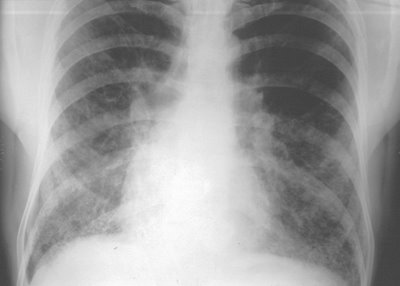
Now the fluffy infiltrative stuff in the lower lungs fields did NOT appear consistent with the usual causes of congestive heart failure that I had seen, so I thought I had better show the film to one of my pulmonary colleagues. He agreed with my interpretation and scheduled a bronchoscopy the next day, but later that day, he began coughing up blood. The procedure was expedited.
It was later that afternoon when the call came. "You're not going to believe this."
"What?"
And he proceeded to describe his findings on the bronchoscopy. Here's what he saw:

What did he find? (Click comments to see the answer).
-Wes
Years ago as a young electrophysiologist, I was asked to see a patient for consideration of an automatic defibrillator. He was a relatively young 49 year-old man who worked as a roofer and had a one-and-a-half year history of arthritis involving primarily his hands, elbows, and knees. He was treated with non-steroidal anti-inflammatory agents of all varieties without effect. He sought evaluation with a rheumatologist and was thought to have a form of non-rheumatic arthritis as his serologies were non-conclusive. He was eventually placed on a short course of steroids with some improvement, but his symptoms would return when the steroid dose was dropped. He eventually was required Plaquenil, a drug that can also suppress the immune system but served to help with the inflammation of his joints.
He had been in and out of the hospital on several occasions recently for increasing shortness of breath and rapid heart rhythms. His echocardiogram demonstrated a moderate weakening of his heart, and he had a mild elevation of his resting heart rate. His room-air oxygen level was lower than I would have expected. So he was treated with Lasix by the referring physician with some improvement. Because of his fairly poor heart function and rapid heart rhythms, we were consulted to evaluate him.
When I saw him he was short of breath, but able to lie flat with no more shortness of breath than usual. This was unusual for congestive heart failure. The remainder of his examination was only remarkable for bilateral basilar lung rales (crackles),
and the swollen, tender joints.
I examined his chest x-ray. It looked like this:

Now the fluffy infiltrative stuff in the lower lungs fields did NOT appear consistent with the usual causes of congestive heart failure that I had seen, so I thought I had better show the film to one of my pulmonary colleagues. He agreed with my interpretation and scheduled a bronchoscopy the next day, but later that day, he began coughing up blood. The procedure was expedited.
It was later that afternoon when the call came. "You're not going to believe this."
"What?"
And he proceeded to describe his findings on the bronchoscopy. Here's what he saw:

What did he find? (Click comments to see the answer).
-Wes
Device Programming Scam
I saw a case the other day that really disturbed me.
At first it seemed innocuous enough: a three-year old defibrillator whose battery was at end-of-life. But the battery voltage was unusually low: 1.59 volts. The elective replacement indicator (or “ERI,” as we call it) for this device was 2.51 volts.
Sometimes when battery voltages get real low, the devices don’t behave properly, so we elected to admit the patient and prep him/her (sex change for confidentiality reasons – you decide which gender you prefer to place in the sentence) for a battery change procedure.
While in the Electrophysiology Laboratory in a controlled setting, we checked the device, and were shocked to note that one of the leads was pacing at the maximum output of the device, but the pacing thresholds (the minimum voltage required to pace the heart) were much better than those settings. If the device had had its voltage dropped appropriately, battery voltage (and device longevity) could have been greatly preserved. The patient reassured me that he/she had been checked every three months while visiting another (undisclosed) state.
Now the potential explanations for this could be many: the person programming the device forgot to reset the lead voltage back to its appropriate setting, the threshold of the suspect lead actually DID improve (seems unlikely), the person programming the device wasn’t aware of the proper pacing threshold and wanted to “assure pacing,” or possibly as one of our local reps suggested (I hoped this was not the case), the doctor increased the voltage on the lead to burn out the battery faster so a new procedure would be needed sooner.
“Have you heard of this happening?” I asked the rep, who spoke on the condition of anonymity. After all, scores of engineers have worked tirelessly to develop algorithms (like St. Jude's Autocapture, or Medtronic's Capture Management and Search AV features) to preserve battery life and promote device longevity.
“Well, I’ve seen it. Usually not as dramatic as this, but voltages are increased to ‘assure safety’ but really they’re also interested in procedures,” he/she said.
Geez. How does one prove this if it is happening? There’s plenty of cover here: device reps often help busy doctors reprogram pacemakers (Device companies: can you say liability?). This leads to the “Gee, I didn’t know” syndrome to deflect liability. Could this be done “in the best interest of the patient” to assure pacing in those who are pacemaker-dependent for their hearts to beat? (Sounds noble, doesn’t it?) There seems to be no easy way to catch slimy physicians who might be involved in such a scheme. Patients need to be aware this could be happening and stay informed how their devices are programmed: ask for a copy of the interrogation of your device, my friends.
Fortunately, it appears that the FDA might have a way to thwart such behavior. There is a push at the FDA to develop powerful databases to monitor characteristics of implantable devices after they are approved to the public via large databases. Most of this is to assure product safety and reliability. But trends can be identified regarding implanters, as well. Scumbag physicians beware.
Additionally, the development of newer internet-capable medical devices that relay their programming information to a centralized database will permit the monitoring of trends to avoid such a programming “mistake” for patients, but doctors involved in the management of these patients need to remain vigilant for this potential scam.
-Wes
At first it seemed innocuous enough: a three-year old defibrillator whose battery was at end-of-life. But the battery voltage was unusually low: 1.59 volts. The elective replacement indicator (or “ERI,” as we call it) for this device was 2.51 volts.
Sometimes when battery voltages get real low, the devices don’t behave properly, so we elected to admit the patient and prep him/her (sex change for confidentiality reasons – you decide which gender you prefer to place in the sentence) for a battery change procedure.
While in the Electrophysiology Laboratory in a controlled setting, we checked the device, and were shocked to note that one of the leads was pacing at the maximum output of the device, but the pacing thresholds (the minimum voltage required to pace the heart) were much better than those settings. If the device had had its voltage dropped appropriately, battery voltage (and device longevity) could have been greatly preserved. The patient reassured me that he/she had been checked every three months while visiting another (undisclosed) state.
Now the potential explanations for this could be many: the person programming the device forgot to reset the lead voltage back to its appropriate setting, the threshold of the suspect lead actually DID improve (seems unlikely), the person programming the device wasn’t aware of the proper pacing threshold and wanted to “assure pacing,” or possibly as one of our local reps suggested (I hoped this was not the case), the doctor increased the voltage on the lead to burn out the battery faster so a new procedure would be needed sooner.
“Have you heard of this happening?” I asked the rep, who spoke on the condition of anonymity. After all, scores of engineers have worked tirelessly to develop algorithms (like St. Jude's Autocapture, or Medtronic's Capture Management and Search AV features) to preserve battery life and promote device longevity.
“Well, I’ve seen it. Usually not as dramatic as this, but voltages are increased to ‘assure safety’ but really they’re also interested in procedures,” he/she said.
Geez. How does one prove this if it is happening? There’s plenty of cover here: device reps often help busy doctors reprogram pacemakers (Device companies: can you say liability?). This leads to the “Gee, I didn’t know” syndrome to deflect liability. Could this be done “in the best interest of the patient” to assure pacing in those who are pacemaker-dependent for their hearts to beat? (Sounds noble, doesn’t it?) There seems to be no easy way to catch slimy physicians who might be involved in such a scheme. Patients need to be aware this could be happening and stay informed how their devices are programmed: ask for a copy of the interrogation of your device, my friends.
Fortunately, it appears that the FDA might have a way to thwart such behavior. There is a push at the FDA to develop powerful databases to monitor characteristics of implantable devices after they are approved to the public via large databases. Most of this is to assure product safety and reliability. But trends can be identified regarding implanters, as well. Scumbag physicians beware.
Additionally, the development of newer internet-capable medical devices that relay their programming information to a centralized database will permit the monitoring of trends to avoid such a programming “mistake” for patients, but doctors involved in the management of these patients need to remain vigilant for this potential scam.
-Wes
Thursday, November 09, 2006
Institute of Medicine's Big Error
Today's Wall Street Journal reports that Unitedhealth's chief executive William W. McGuire and his successor, Stephen J. Hemsley have agreed to pay back $390 million to Unitedhealth in an attempt to avoid "even the appearance of any unintended benefit from any past option grants." Of that amount, $200 million will come from Mr. McGuire - a fairly paltry portion (11.4%) of his $1.75 billion in total options issued. And worse still:
And what about the deficit that Mr. McGuire has caused to Unitedhealth's shareholders? If past history is any indication, anything where Mr. McGuire is "pleased to have reached an agreement" probably means he's still getting away with millions.
As such, should he really continue with the Institute of Medicine as a member of the National Institutes of Health National Cancer Policy Board? I suppose this is one medical error we'll never hear about from the Insititute of Medicine now will we?
-Wes
His attorney, David Brodsky, said, "Dr. McGuire is pleased to have reached an agreement to reprice his options. The agreement to forgo approximately $200 million means that Dr. McGuire will receive no benefit at all from dating issues in connection with his options."Earth to Mr. Brodsky: sounds like there's still some benefit in there to me.
But Dr. McGuire hasn't yet agreed to forfeit the reactivated options in which he and other employees were effectively able to get the same options twice, at favorable prices. For Dr. McGuire alone, those extra options are now valued at about $250 million. The issue of those options hasn't been resolved between Dr. McGuire and the company, according to people familiar with the situation.
And what about the deficit that Mr. McGuire has caused to Unitedhealth's shareholders? If past history is any indication, anything where Mr. McGuire is "pleased to have reached an agreement" probably means he's still getting away with millions.
As such, should he really continue with the Institute of Medicine as a member of the National Institutes of Health National Cancer Policy Board? I suppose this is one medical error we'll never hear about from the Insititute of Medicine now will we?
-Wes
Wednesday, November 08, 2006
Resurrecting Confidence
I visited Boston Scientific corporate headquarters yesterday trying to understand what they’re going to do to resurrect their business in the Cardiac Disease Management section of their company -- the Guidant portion of their business.
I met with a number of individuals: Mark Bartell, Senior VP, Global Sales and Marketing (tough job #1), a few of the heart failure marketing folks, Randy Ban, VP Marketing in charge of Corporate Communication Strategy, a fellow Dukie (go Blue Devils!) John Russell, who is in charge of the Latitude Patient Management System, and perhaps the most impressive person recruited to salvage the quality mess: Bill Young, VP of Reliability and Quality, a former Baxter quality professional with friends in high places at the FDA. This was a good pick as far as I can tell.
And why do you think I saw these particular individuals? Because they knew I am a skeptic. I have bright patients who read the newspapers and press reports. I have patients who say, “You can implant any device, except a Guidant device” when I tell them they need a defibrillator.
So what did I learn today?
In short: they’ve gotten the message.
They understand that a 99.2% or 99.3% device reliability is not good enough for the public and doctors, especially when you implant tens of thousands of these devices that must work years after they are implanted, charge hospitals and patients big bucks for them, and are withholding when problems with their devices surface. Like the airplane industry that has learned that it's not okay to have 1 in 1000 planes crash, I think they've made a good-faith effort to re-establish the importance of quality and long-term reliability in their products.
They also have learned that reporting failures TOO early can unnecessarily frighten patients, that doctors and the FDA can be helpful, that they’ve got more to do. All engines are geared right now to clearing their FDA 483 warning letter. They say they’re ready for their inspection, due any day. We’ll see. But they have changed personnel, recruited like crazy to shore up their quality and reliability shortcomings, and changed their corporate quality reporting structure to avoid internal conflicts of interest. Time will tell.
One of the best new standards they have implemented that can tangently be identified, was their online product performance reports. (Unfortunately it's still on their Guidant website - they really need to bury that name! But I digress.) Reportedly, this report is updated every three months. This, my friends, is impressive and welcomed. Now if a patient wonders about the reliability of a proposed implant, the information is quickly available on-line. This should be an industry standard.
And their marketing strategy? Lay low. Keep the old bad experiences out of the press. Look for plenty of “feel-good” pieces on Latitude, but also look for behind the scenes settling of their litigation burdens, which are considerable. Slowly. Quietly. Carefully.
Seems like a good plan. But all of this aside, it will mean nothing if they don't execute - and the raising of their FDA Warning Letter will be their first test.
-Wes
I met with a number of individuals: Mark Bartell, Senior VP, Global Sales and Marketing (tough job #1), a few of the heart failure marketing folks, Randy Ban, VP Marketing in charge of Corporate Communication Strategy, a fellow Dukie (go Blue Devils!) John Russell, who is in charge of the Latitude Patient Management System, and perhaps the most impressive person recruited to salvage the quality mess: Bill Young, VP of Reliability and Quality, a former Baxter quality professional with friends in high places at the FDA. This was a good pick as far as I can tell.
And why do you think I saw these particular individuals? Because they knew I am a skeptic. I have bright patients who read the newspapers and press reports. I have patients who say, “You can implant any device, except a Guidant device” when I tell them they need a defibrillator.
So what did I learn today?
In short: they’ve gotten the message.
They understand that a 99.2% or 99.3% device reliability is not good enough for the public and doctors, especially when you implant tens of thousands of these devices that must work years after they are implanted, charge hospitals and patients big bucks for them, and are withholding when problems with their devices surface. Like the airplane industry that has learned that it's not okay to have 1 in 1000 planes crash, I think they've made a good-faith effort to re-establish the importance of quality and long-term reliability in their products.
They also have learned that reporting failures TOO early can unnecessarily frighten patients, that doctors and the FDA can be helpful, that they’ve got more to do. All engines are geared right now to clearing their FDA 483 warning letter. They say they’re ready for their inspection, due any day. We’ll see. But they have changed personnel, recruited like crazy to shore up their quality and reliability shortcomings, and changed their corporate quality reporting structure to avoid internal conflicts of interest. Time will tell.
One of the best new standards they have implemented that can tangently be identified, was their online product performance reports. (Unfortunately it's still on their Guidant website - they really need to bury that name! But I digress.) Reportedly, this report is updated every three months. This, my friends, is impressive and welcomed. Now if a patient wonders about the reliability of a proposed implant, the information is quickly available on-line. This should be an industry standard.
And their marketing strategy? Lay low. Keep the old bad experiences out of the press. Look for plenty of “feel-good” pieces on Latitude, but also look for behind the scenes settling of their litigation burdens, which are considerable. Slowly. Quietly. Carefully.
Seems like a good plan. But all of this aside, it will mean nothing if they don't execute - and the raising of their FDA Warning Letter will be their first test.
-Wes
Subscribe to:
Posts (Atom)