Showing posts with label Insurance industry. Show all posts

Tuesday, August 12, 2014

Data Plan Health Care Shows Promise

CHICAGO - Citing mounting health care costs, electronic note bloat, and concerns with the quality and quality of Big Data, IBM, Apple, and EPIC Systems recently announced a new initiative to totally revamp US health care by offering health care services by data plan. The health care initiative was recently discovered in a little known section of the Patient Protection and Affordable Care Act (ACA) that changed portions of the U.S. Tax Code.

Under the new system, the brainchild of prominent Chicago physician-turned-health care entrepreneur Henry Throckmorton, MD, patients will purchase an initial 250 megabytes of data space on the EMR for all their health needs for $250 per month.  “It’s cheaper than most current cell phone service," Throckmorton explained. "When patients exceed their data allotment, health care ceases until patients purchase an additional data storage plan." Expansion data plans come in Bronze (250 M Bytes), Silver (500 Mbytes), Gold (5 G Byte), and Platinum (10 GB) storage increments.

Rollover plans for family members are also offered for those nearing the end of life.

“Health care systems that promise to limit the use of macros, dot phrases and cut-and-paste tactices have a real competetive advantage over competitors insensitive to the patient's data needs!” Throckmorton explained. "This system finally puts health care incentives in the right place.”

But Roger Wilco, spokesperson for America’s Health Insurance Plans (AHIP), the national trade association representing the health insurance industry, seemed less enthusiastic. "This is preposterous! Who do these flowery internet types think they are? Don't they realize there are advantages to more middle men in health care? How are we supposed to get our cut of the money?"

Dr. I.P. Knightly of Urocare Health System in Beaverton, New York, seemed less concerned about the middlemen and appreciated the improvements he's seen in patient care:  “Because I document everything on the EMR, including phone calls, results and work schedules, patient are less likely to call so I get a good night’s sleep!”

Nursing and medical students seem torn, however. While some see benefits to shorter notes, some like Tim Allen, MD, a hard-working fourth-year medical student from Roanoke, VA, sees other challenges “I’m still trying to understand ortho notes that no longer contain the critical information fields like the patient’s full name, VIP status, research status, and a complete review of systems. How's a guy supposed to understand what ‘Silt @ t/s/s/sp/dp’ means?”

Market analyst Rebecca Solomon of Lock, Stock and Barrel Equity Partners noted "Apple, IBM and EPIC are quickly gaining market share from more conventional insurance policies. The concept has also resonated with the Department of Health and Human Services because of the cost savings seen from fewer data-hungry imaging studies being ordered."

Mobile partnerships with AT&T, Verizon, and T-mobile are planned in the next fiscal year.

*  *  * 
 -Wes

P.S.: If you thought this press release might be real, even for a second, consider why.

Thursday, May 29, 2014

Medicine's Love-Me Wall

“We can never be gods, after all--but we can become something less than human with frightening ease.”
― N.K. Jemisin, The Hundred Thousand Kingdoms


I know it's click bait, but the top 100 most influential people in health care, according the Modern Healthcare, is worth a look. It contains the following individuals in its "Top Ten:"
  • Kathleen Sebelius (#1) who resigned as the head of Health and Human Services after the botched Healthcare.gov rollout
  • Oregon Governor John Kitzhaber (#2) who jettisoned the state's $248 million dollar attempt to arrange its own health care exchange website
  • President Barack Obama(#3) - of course
  • Mr. Stephen Hemsley of UnitedHealthcare (#4) who made a cool, $4.57 million in compensation last year and exercised $9.48 million in stock in 2013
  • Marilyn Taviner (#5), CMS who gets a little love each year from her prior employer, the Hospital Association of America on top of her salary as CMS Director
  • Mark Bertolini (#6), CEO of Aetna, who made $2.66M in compensation and exercised $4.52M in stock in 2013
  • Richard Bracken (#7), CEO of HCA, who earned $38.6 million for his role as CEO in 2013 before retiring and pocketed a cool $46.3M in 2012
  • newcomer Joseph Swedish (#8), CEO of WellPoint, who earned only $7.48M in 2013
  • George Halvorson (#9), of Kaiser Permanente, who doesn't report compensation (a bit of "Sunshine law" needed, perhaps?) but other sources pegged his compensation at $6.7 million back in 2009
  • Sister Carol Keehan (#10), of Catholic Health Association who likely made well in excess of $1M in 2011
And the list goes on...

Yet we wonder why our health care costs are so high.

Really?

-Wes

Wednesday, May 28, 2014

When Insurers Practice Non-evidence Based Care

With the approval of new, innovative, yet expensive medications, doctors can expect their lives to become miserable as insurers do their best to limit costs. No where is this more apparent than with the introduction of our latest slew of novel oral anticoagulants.

What is remarkable (yet not the least bit surprising to those of us who have been in the business of medicine for a while) is how insurers dismiss the importance of discussions that are held by those of us who attempt to explain the pros and cons of the various new medications to our patients. We see these conversations completely invalidated as soon as the insurance industry renders their "coverage decision." Discussions are immediately invalidated, the pros and cons of each medication ignored. Meanwhile, these same insurers bear no reponsibility for potential safety issues that might arise when their made-up care process is implemented. And there is no accountability, no person ultimately responsible.

When a doctor tries to call and speak with someone about their policy, we meet hushed tones that promise to approve the prescribed medication if we just send a letter explaining our rationale. Yet despite this effort, they stick by their policy nonetheless.

What a waste.

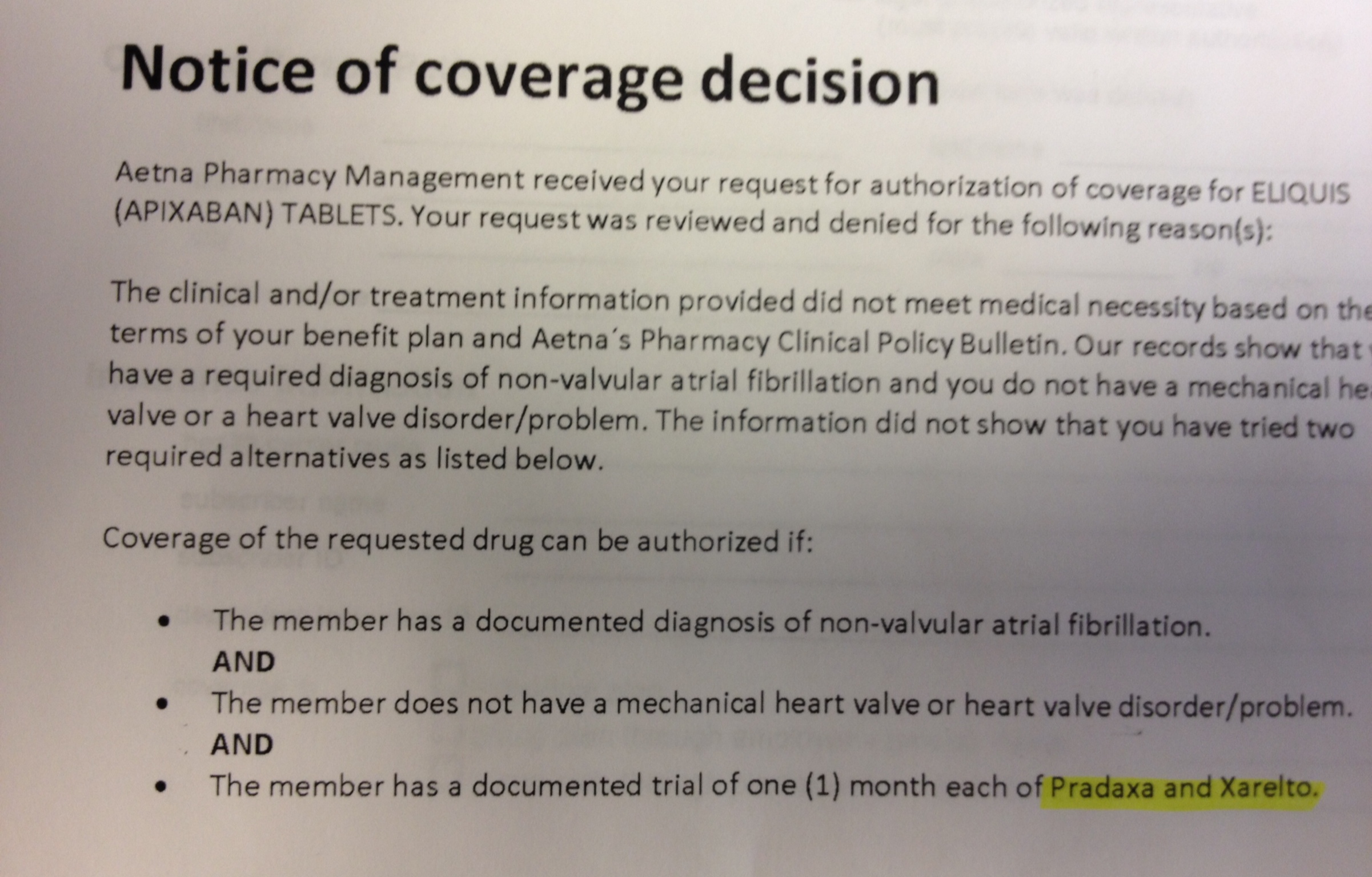
So I'm sending a few questions to Aetna about their new "coverage decision" regarding the new oral anticoagulant, apixaban:

An Aetna 'Coverage Decision' (click to enlarge)

Dear Aetna Pharmacy Management:
  1. When my patient has a GI bleed from Pradaxa, will you explain to them why you insisted I start this medication?
  2. When my patient gets nauseated from Pradaxa, will you take the call at 3 am and write the new script for him or her?
  3. When my patient accidentally overdoses on Xarelto thinking it was a twice a day drug like Pradaxa, will you explain to the plantiff's lawyer the safety of your non-evidenced based practice of switching anticoagulants on a monthly basis? 
  4. Along the same line of reasoning, where I might find data pertaining to the safety of monthly switches of anticoagulants in the world's literature?
  5. Is your effort to "manage" physician-prescribed medications in the patient's best interest or your stockholders'?
  6. Where can I send the bill for the wasted time spent by my staff and me to jump through your self-imposed hoops?
Aetna, may your latest policy find disfavor with the FDA safety brigade.

With sarcastic love of all you do -

-Wes

Wednesday, February 19, 2014

Are Drug Letters Harming Our Patients?

One week's worth of drug letters
Now that a new year has come and gone, I have been swamped with letters from pharmacy benefit manager and insurance companies.  Piles of them.  Not only do these letters consume hours of time each week to address (so much for the "efficiency" of the electronic medical record), I am worried some of the latest practices of these companies might be endangering my patients. 

Here's a typical (paraphrased) letter that has me most concerned:
"Dear Mr or Ms Patient:

This letter is to inform you that Insurance Plan XYZ ("the plan") has provided you with a temporary supply of the following prescription:

(Insert your favorite novel oral anticoagulant name/dose here)

As described in more detail on the following page, this drug is either not included on our covered drug list (formulary) or included on the drug list, but has certain limits on it.

Because you are within the first 90 days of coverage this plan year, TooBig Insurance Company is required to provide you with at least a 31-day supply of this drug.  The supply is less if the prescription is written for less and does not have refills...

It is important you understand this is a temporary supply of this drug.  Before this supply ends, you should talk with your doctor to decide if you should change your prescription.  (Emphasis mine) If your doctor feels that the coverage options listed on the following page are not clinically appropriate for your situation, your doctor can request a formulary exception from TooBig Insurance Company to continue coverage of this drug.

If you need help requesting an exception, please call TooBig Insurance Company Customer Service listed on the back of your member ID card."
Note that all novel oral anticoagulant medications carry a very specific black-box warning from the FDA regarding discontinuation of these medications. Here's the black box warning for rivaroxaban (Xarelto):
"A. PREMATURE DISCONTINUATION OF XARELTO® INCREASES THE RISK OF THROMBOTIC EVENTS

Premature discontinuation of any oral anticoagulant, including XARELTO®, increases the risk of thrombotic events. If anticoagulation with XARELTO® is discontinued for a reason other than pathological bleeding or completion of a course of therapy, consider coverage with another anticoagulant.
"
Should insurance companies be allowed to restrict the dispensing of any medication where doing so puts patients at risk of injury?  Why are insurance companies allowed to potentially violate FDA-mandated black box warnings if they do so?   How many lives are being placed at risk by this practice?  What about the patients that are blind or can't read?  What happens to them? 

On a more selfish note: why must the physician suffer the liability consequences of an insurer's profit-driven  actions that disregards the safety and well-being of our patients? 

Why?

-Wes


Thursday, May 30, 2013

A Critical Review of the Insurance Claim Denial Process

"If you can speak what you will never hear, 
if you can write what you will never read, 
you have done rare things."

-Henry David Thoreau

"Doctor, how much longer?"

The case had gone smoothly, but the challenges of mapping the infrequent skipped beats that signified the initiating sequence to the tachycardia was getting more difficult.  "Could it be left sided?" I wondered.  "Anterior or posterior?  I've tried the posterolateral area and that timing was late.  Clearly anteromedial was earlier.  All the darn beats look so similar with pace-mapping."  

I had been working for an hour and a half without effect when I had an idea: "Maybe the 3D mapping system would help."

And so, I deployed a highly sophisticated three-dimensional (3D) electroanatomical (EAM) mapping system that sped her successful ablation.  She was relieved.  That is until the bill arrived and the 3D EAM mapping was denied by her insurance carrier.

***

On December 19, 2012, I wrote about the insurance denial for this case.  I  was surprised that a denial for payment was made for a portion of a ventricular tachycardia (VT) ablation procedure that was commonplace in my field: three-dimensional (3D) electroanatomic mapping.   Worse, I was even more surprised that the denial came from an unknown physician who lacked training in my field and appeared to be nothing more than a foot-soldier of a Cigna insurance company medical coverage policy.  Such a denial had never happened to one of my patients before.

Since that blog post was written many months ago, my administrative staff and I have been enduring the appeal.  Here's how it's gone.

Shortly after my piece was published, I was notified that someone at Cigna had called our hospital and inquired if they were aware of my blog post.  They were.  My workplace has graciously permitted me to have this blog since 2005, provided I clearly state the views in that blog are my own, which they are.

Second, I learned that the individual who sent the original coverage denial letter to me was not our local Cigna "regional" medical director.  After my post was published, my local medical director from Cigna wanted to talk and explain the proper way that claim denials should handled.  A telephone conference was arranged between myself and my the medical director (a local pediatrician from a local academic center which will go un-named) along with another non-medical representative of the local regional office of Cigna.  I offered them the opportunity to publish a rebuttal to my post at this site if they desired, but they declined the offer. Instead, I was asked to contact them via e-mail or phone before going public with my concerns about their decision on a blog - "we have a set way of handling disagreements with policy decisions" I was told.  Was this because Cigna's leadership didn't want the bad press or was it a polite way of saying "cease and desist?"  I wasn't sure.

So, in the interest obtaining a reversal of my patient's claim denial as easily as possible, I complied.  I sent them my first rebuttal in writing and communicated with them via email as requested.  My rebuttal went something like this:

Cigna's original denial letter, dated 1 March 2012 stated:
"Use of an intracardiac electrophysiological 3-dimensional mapping system in the diagnosis, treatment, or management of ventricular arrhythmias or any other condition because there is insufficient scientific evidence to support its use does not meet Cigna guidelines for coverage because it is considered experimental, investigational, and/or unproven (E/I/U)."
Cigna's 2012-2013 Medical Coverage Policy regarding 3D electroanatomic mapping systems for VT ablation (which I have copied on my own server, lest it disappear) stated:
The authors state, "although not yet established as requisite or "core" equipment for the EP laboratory, these and other emerging technologies have had, and will continue to have, a major impact on the practice of cardiac arrhythmia management. It is also anticipated that additional new technologies will be developed at ever faster rates in the future" (Tracy, et al., 2006). There has been no update to this statement since 2006.
Baloney.  The EHRA/HRS Expert Consensus statement on VT ablation was subsequently published in in 2009 and that document specifically addresses the use of 3D EAM for VT ablation.  It said:
Technological advances have been critical to the development of the field and will continue to play an important role in improving outcomes. The evaluation of new technologies has generally been based on uncontrolled series. There is limited head-to-head comparison of different technologies. Although new technologies generally increase the cost of a procedure when they are introduced, the costs may be justified if they improve outcomes. 
...

The focal VT origin can be identified from activation and/or pace mapping.4,381,385,410 Systematic point-by-point activation mapping is the initial preferred technique.233,234,385,409 Some investigators use three-dimensional EAM systems to assist in relating the anatomy to the mapping data.4,124,125,233,381,385,428430 
Surely they wouldn't deny this claim made before that time given this information, right?

Wrong.

Two MORE submissions for higher-order reviews and over four months later, the verdict was handed down: my patient had exhausted all avenues of appeal for the claim.  The insurance company would not pay this portion of my patient's bill, no matter what.

Parsing Truths

When deciding what therapies are effective for our field, who should set the requirements for the level of evidence required to determine effectiveness of any therapy, EP societies or the insurance industry?  While it is true that prospective randomized trials comparing mapping techniques head-to-head for localizing ventricular arrhythmias have not been done, we should also understand that such a study will never be performed.  Why?  First, who would pay for such a study to be conducted?  The utility of 3D mapping for SVT has been demonstrated and proven effective, in large part because of the greater safety (and greater likelihood of obtaining FDA approval) when supraventricular rhythms are studied compared to ventricular arrhythmias.  Second, because the occurrence of the arrhythmia (in this case RVOT VT) is relatively rare, a compelling reason for industry (or government) to fund such a study doesn't exist.

But like SVT ablation, there are three real advantages to these 3D mapping systems for VT ablation that has been repeatedly demonstrated in the literature: (1) catheters can be returned to prior locations accurately whether the arrhythmia is occurring in a location or not, (2) real reductions in fluoroscopy times can be achieved and (3) certain 3D EAM systems that use mathematical algorithms (non-contact balloon mapping) can localize the origin of an arrhythmia using a single heart beat.  For the rare patient (like mine) that has infrequent arrhythmias, how would a randomized trial be constructed in hopes of proving the utility of such a technology over conventional mapping by point-to-point techniques?  Would such a trial be even ethical to conduct?   So, just because a prospective trial has not been performed to demonstrate the utility of a technology in rare circumstances, does this mean electrophysiologists should never utilize such a technology to achieve a successful ablation outcome when other means fail even though such a technology has been shown to be effective in single-center studies?  According to Cigna's policy statement, the answer to this question is "yes."

Too bad insurers never have to speak with patients when an ablation fails.

One Last Try

Because I did not want to take "no" for an answer, I asked my administrative staff to see if they could obtain the name of the Cigna "external" reviewer.  We had been assured that the case was externally reviewed by an electrophysiologist.  We were given the name of an individual but were surprised to find that the physician was a paid employee of Cigna with credentials as an internist and general cardiologist with a nuclear medicine background.  To me, it seemed Cigna "external" review was actually an "internal" review performed by a paid employee of different regional office of Cigna (hence "external" to our region) who was a general cardiologist, not a cardiac electrophysiologist.

I brought this concern to the attention of my local medical director of Cigna by e-mail.  In that email I also expressed my concerns about the long time each review had taken.  I asked him to examine both issues, since I felt my patient had not received a fair and unbiased claim review.  Also, while my patient had received a final denial letter, I never received a notification of their final determination for coverage. After some delay, the director promised to look into my concerns and contacted me by phone later in the week as promised. 

In our subsequent discussion, it appeared the director felt the timeliness of their reviews was satisfactory, despite a timeline that stretched over fourteen months for this entire process.  In regards to my concerns over who reviewed my patient's claim denial, he claimed there were two "internal" Cigna reviewers and reviewers "external" to Cigna who supported the denial.  Of the external reviewers, the director claimed one was board-certified in internal medicine and interventional cardiology and the other external reviewer was board-certified in internal medicine, cardiology and cardiac electrophysiology.  He refused to disclose either of the external reviewers' names.  When asked, the director stated that the electrophysiologist was in active practice.  I reiterated that I still felt the EHRA/HRS Expert Consensus statement suggested the 3D-mapping falls well within the standard of care.  Surely they should reconsider.  But despite my pleas for reconsideration, no reversal was forthcoming.

I hung up the phone.

Amazingly, there is little else I can do for my patient's insurance payment denial now.  Here I am, a non-anonymous board-certified cardiac electrophysiologist with over twenty years experience who was caught in a challenging case with my patient and am now being told by a pediatrician from an insurance company that there's no merit to my concerns about an unfair denial for coverage of the 3D mapping portion of my patient's claim.  I am dumbfounded, confused, and heartbroken for my patient.

So what have I learned?

1) In Cigna's case, some insurance coverage decisions disregard current standards of care and up-to-date expert consensus statements in lieu of poorly-updated corporate medical coverage policies.

2) Specific challenges I encountered with my patient's RVOT VT ablation case had no bearing on Cigna's  decision.

3) Physician reviewers often do not hold expertise in the specialty areas they are asked to review.  Because they are first and foremost paid employees of the insurer, they turn to corporate medical coverage directives for guidance, even though they are woefully lag current medical practice.  As health care dollars get tighter and medicine becomes increasingly codified, significant conflicts of interest will continue to rise for a fair and impartial review of payment denials.

4) If the insurance company claims to have an individual of the same specialty externally review a case, physician providers are not notified of the basis for the denial nor given the names of the reviewers, limiting one's ability to verify the reviewer's credentials or to understand the rationale for the denial.  As a result, there is no transparency to the process, nor opportunity for learning or system improvement.  To me, this practice should not be condoned.  Health care requires continuous quality improvement.  More importantly, health care requires trust of all those who touch the field, especially when the care provided, no matter how seemingly far removed, impacts a patient's physical or socioeconomic well-being.

5) Cardiac electrophysiologists should be aware that both Cigna (here) and Aetna insurance companies (here) in Illinois now have coverage policies that may opt to deny payment for three-dimensional electroanatomic mapping for VT ablation because they claim they are experimental procedures for this indication based on their outdated internal review of the literature.

6)  When confronted about the obsolete nature of their medical coverage policy,  Cigna refused to take this into consideration and still refused to overturn by patient's payment denial.  Instead, the medical director only promised to include the EHRA/HRS document I sent them in their next annual review of their corporate medical coverage policy for 3D mapping scheduled for 2013-2014.

7) There are technologies that have certain niche benefits for patients, but because they are not "proven" beneficial by randomized trials, in some cases they are no longer be paid for by insurers.

8) My patient will now has four months from the date of her final denial letter to ask for an state-directed independent external review of the Cigna's coverage decision via the Illinois Insurance Fairness Act as her only remaining avenue for recourse.

So now what?

As I reflect on this case, I used this sophisticated mapping technology because I felt I needed it to improve my patient's outcome and safety.  I wonder what this denial of coverage does to the relationship with my patient.  Has trust been eroded?  As I look forward, how I will perform my next RVOT VT ablation?  What do I say to the next patient with a similar arrhythmia?  Should I warn all my future patients requiring VT ablation that some of the technology we routinely use to expedite their procedure might not be paid for by their insurer because of a paucity of prospective randomized trials exist (and never will)?  Will I have to avoid the use of this technology knowing my patient may have to pay for it because a pediatrician or a general cardiologist who knows nothing about my field might not approve its use?   Can I afford to devote this amount of time for wrestling future insurance payment denials that surface?

These are not minor concerns.

So there's the current status of this long, arduous months-long insurance denial review process for just one patient, critically reviewed.  It would be easy to make this post a screed against one insurer, and while I have to say that the way this claim denial process was handled was poor at best, we should recall that other insurers have similar policies.  It is in the interest of insurers to make the payment denial/review process as difficult as possible for patients and providers.  It is also in insurers' best interest to keep out-of-date medical coverage policies in place that consider new technologies "experimental."   Better yet, it is even better for insurers to claim niche technologies are "unproven" despite evidence to the contrary and should therefore never be paid.  Finally, it is in insurers' best interest to perform internal reviews by uninformed physician reviewers of another subspecialty rather than peer-to-peer independent reviews.

What will it take to change this system?

Maybe we should start with the truth.

-Wes

Friday, April 05, 2013

The Physician Payment Reform I'd Like to See

In case you missed it, the "National Commission on Physician Payment Reform" issued their glossy, industry-produced white paper on 4 March 2013 containing twelve recommendations to provide a five-year "blueprint" for transitioning physician payment methods to a "blended payment system that will yield better results for both public and private payers, as well as patients."

Rules Are Only for the Little People

I was alerted to the presence of this report after an "Online First" article entitled "Phasing Out Fee-for-Service Payment" by Steven A. Schroeder, M.D., and William Frist, M.D. for the so-called National Commission on Physician Payment Reform was published March 27, 2013 in the New England Journal of Medicine.  (So much for Journal's Ingelfinger Rule that prevents the publication of works previously published elsewhere.  It is interesting that Dr. Schroeder, the lead author of this New England Journal of Medicine article, failed to disclose that he currently serves as an editor for the New England Journal of Medicine.  No doubt he "exempted" his own piece from the Ingelfinger Rule because this 5-year, 12-step program [pun intended] was felt to be "public-health information that needs to be brought to the public's or profession's attention without delay.")

But the concerns about this article and its authors' backgrounds go much further.  We should realize that this 14-member "National Commission on Physician Payment Reform" was supposedly created out of thin air by an obscure general internal medicine group called the Society of General Internal Medicine (SGIM) comprised of approximately 3000 academic internists. We are led to believe the SGIM doctors chose their 14-member National Commission with physician payment reform solely as their guiding light.  And why not?  What physician wouldn't want to enjoy not being paid for the work they do?

Whose Interests Are Served By Physician Payment Reform?

So let's look at a few of the members of their "National Commission."

First and foremost is the "honorary" commissioner and former US Senator, William H. Frist, MD.  Doctors should ignore Dr. Frist's deep, deep ties to Hospital Corporation of America (HCA), the largest operator of health care facilities in the world.  After all, he only held a few blind trusts that his 2005 financial disclosure form valued between $15 million and $45 million.  And we should ignore the fact that he sold his interests in those trusts just one month before HCA stock price precipitously fell in 2005 and was subject to a SEC investigation.  To be fair, no wrongdoing was ever found.  But that hasn't stopped our "own" Dr. Frist from serving as partner and Chairman of the Board for Cressey and Company, LP, a private investment firm based in Chicago and Nashville "focused on the health care industry."

I'm seeing this effort for physician payment reform as being all about patients, aren't you?

But there's more.

Another member of the 14-member commission is none other than Dr. Troyen A. Brennan.  Dr. Brennan is Executive Vice President and Chief Medical Officer of CVS Caremark, the nation’s largest pharmacy health care company.  In this role, he oversees the company’s MinuteClinic, Accordant Health Care, clinical and medical affairs, and health care strategy.  CVS was so happy about his appointment to this National Commission that it even sent out a press release!  While I have no idea about Dr. Brennan's salary with CVS, I'd bet my medical degree that his salary is higher than that of most US physicians.  One only has to look at the relative salary and benefits that CVS Caremark's Chief Executive Officer earns and you see why I am confident about Dr. Brennan's relative salary.  I mean, who wouldn't want that private jet?  No doubt America's doctors will feel nothing but goodwill and fuzzy feelings about helping to fund the nice retirement package CVS routinely gives to its chairmen as a result of Dr. Brennan's efforts on the Commission.

Another member of the Commission is none other than Dr. Lisa Latts.  Dr. Latts also serves as the Vice President of Public Health Policy for WellPoint, Inc, the largest managed health care, for-profit company in the Blue Cross and Blue Shield Association.  They insure nearly 11% of the US population.  But one could argue, cheap doctors should mean cheaper insurance, right?   I don't think so.  After all, it's not easy to keep paying for retirement packages for your retiring CEO's that cost $20.6 million.  But no worries.  Wellpoint's new CEO's compensation will include just an annual base salary of only $1.25 million with eligibility clauses for an incentive bonus of up to 300% of that amount, not to mention that he is also getting equity-incentive grants for 2013 with an $8 million target value, restricted shares with a grant date fair value of $1.5 million as "an inducement to joining" the company and a "make whole" payment currently estimated at almost $3.6 million for compensation he'll forfeit in switching jobs.   Poor guy. 

So physician payment problems really ARE a major cause of those high health care prices today, doctors, don't you see? 

So let's hear it for the Society of General Internal Medicine and the New England Journal of Medicine for providing their white paper to America on how to implement physician payment reform!  I'm so glad to see that all of the members of the National Commision of Physician Payment Reform were willing to do their part to sacrifice part of their hard-earned salary on behalf of our national health care cost crisis, too, aren't you?

Oh, wait...

A Solution?

Look, here's my idea: stop redirecting the truth about what's really eating up the cost of health care.  It's time we address the excessive costs of all of these excessive middle management healthcare leeches.  If you want physician payment reform, stop creating ridiculous fronts called "National Commissions" of doctors that act has our modern-day Physician Inquisitors.

Instead, pay us what we're each worth (trust me, it's not that hard to find out and it sure as heck doesn't take a year of meetings held at expensive hotels that results in just one white paper with 14 co-authors that carry innumerable conflicts of interest into the discussion.)  Pay us by the hour at our fair rate. And pay us for everything we do for our patients: every minute we type at the computer, answer a health-related e-mail, sit on a phone, sit at their bedside, remove an brain tumor, teach a medical student, look up labs, grow our practice, explain a procedure, or care for your mother after hours, too.  Then pay us double for every minute we take call after hours. 

Dissolve the RUC.  Flush the SGR formula that is never followed anyway and wastes too much time and money each year.  Rid us of stupid proprietary CPT procedure codes that must be linked (properly, mind you) to a ridiculous list of ICD-10 procedure codes so we can be paid.

Keep it simple, stupid. It's not that hard to do.

It's only hard to make changes to our current physician payment system when everyone that wants "physician payment reform" also wants to make sure they get their part of our already dwindling pay.

-Wes

Wednesday, March 20, 2013

Our New Inquisitors

A phone conference had been arranged.  They wanted to talk to me about a denial for payment on a portion of a patient's pre-authorized procedure after the fact.   It's participants: the regional medical director of a large insurance company, his female assistant administrator, and me.

He cordially introduced himself as a pediatrician by trade from a large well-known (and highly respected) academic institution with impeccable credentials responsible for our region of the United States.  It was clear we must remain professional.  I listened.  I was told there are proper ways to discuss claim denials - proper steps to follow - websites to consult.  We all must follow protocol.

Yet I had just learned by separate letter that my second request for the claim approval had already been denied.  I mentioned this.  It was unfortunate, but I was assured the the claim was re-reviewed by a specialist in my field.  Remaining professional, I wondered silently if that specialist still practiced. Then I pleaded my case once again on the phone to no avail.  I would have to submit my patient's claim a third time to an "independent" centralized reviewer, quietly please.

So I hung up and another letter was drafted.  This time a highlighted copy of our guidelines was included for  review.  "Standard of care," I thought, as if that would matter.  Guidelines for care mean little for payment when they are trumped by corporate policy directives.

We'll see.

* * *

For unclear reasons, a few members of our own traditionally underpaid or politically well-connected physician tribe are elevated  to work for insurance companies. Who can blame them?  Decisions must be made and who better than one of our own?  Whether a medical director of an insurance company or a member of an Independent Payment Advisory Board, these individuals must be carefully chosen. They must believe with all of their heart in the process.  They must believe the siren song that helping people achieve their "best possible personal health and wellness" rightfully sidelines the real-life costs of care that patients endure through no fault of their own.  Most of all, they must never, ever, speak of the money.

Then they are crowned the guild-masters, the rest of us, mere journeymen.  To them, it's about clipboards, corporate policy directives, and cost savings.  To the rest of us, clinical reality.  Increasingly, we we will be finding ourselves facing these modern-day Inquisitors - where principles for the "common good" supersede the needs of the commoner.

Medical decisions made by email, phone or fax.

No faces, please.

Quiet.

-Wes

Wednesday, December 19, 2012

No Longer Living in Denials

I received this notice, dated 1 March 2012, from our billing department after a denial for reimbursement following a successful right ventricular outflow tract ablation I performed:
"Paul Rossi DO, a Cigna Medical Director, reviewed Use of an intracardiac electrophysiological 3-dimensional mapping system in the diagnosis, treatment, or management of ventricular arrhythmias or any other condition because there is insufficient scientific evidence to support use and determined the service(s) is not a covered benefit as indicated below:

Service referenced: Electrophysiological 3-Dimensional Mapping and Catheter, electrophysiology, diagnostic/ablation, 3D or vector mapping

The use of an intracardiac electrophysiological 3- dimensional mapping system is considered medically necessary when used to guide supraventricular arrhthmias.  Based upon current available information, coverage cannot be approved to support the use of intracardiac electrophysiological 3-dimensional mapping in the diagnosis, treatment, or management of ventricular arrhythmias or any other condition because there is insufficient evidence to support its use.  At the present time, it is considered non-standard testing and falls under the category of experimental/investigational/unproven."
These denials are part of life for doctors - it's all part of the game.  But the era of social media is upon us, and with it, revenge.

We should first ask ourselves if Paul Rossi, DO, whose google search reveals he was an emergency room doctor working in "preventative medicine,"  should have ability to determine what constitutes standards of care in the field of cardiac electrophysiology when he, himself, is not credentialed in this subspecialty. 

But that's not all.

Even Cigna's own recently published "guidelines" for approval state:
The CARTO® EP Navigation System (Biosense Webster, Inc., Diamond Bar, CA) received 510(k) premarket approval in December 1999 by the U.S. Food and Drug Administration (FDA) as a Class II device for catheter-based cardiac mapping (FDA, 1999). The FDA indications for use state the intended use of the CARTO EP Navigation System is catheter-based cardiac mapping. The CARTO EP Navigation System and accessories have had numerous enhancements with the latest device, the CARTO 3 Version 1.05 EP Navigation System and accessories, receiving 510(k) premarket approval in 2009 (FDA, 2009; FDA, 2006; FDA, 2000).
Hardly experimental.

Furthermore, those same recommendations detail at least 8 different studies where 3-dimensional mapping was used for VT ablation and include this statement from the Joint Heart Rhythm Society/American College of Cardiology guidelines for ablation (2006):
"Electroanatomic magnetic mapping capabilities are being applied to aid in the diagnosis and nonpharmacological treatment of arrhythmias. The authors state, 'although not yet established as requisite or "core" equipment for the EP laboratory, these and other emerging technologies have had, and will continue to have, a major impact on the practice of cardiac arrhythmia management.'"
I'm sorry, but I do not see the words "experimental" in Cigna's own documentation nor does their document suggest that appropriate standard of care for 3D mapping be reserved exclusively for "supraventricular" arrhythmias.

Welcome to the world of social media, Cigna.  I can only hope that every employee out there with an option to choose insurers strongly consider picking another insurance carrier since they will be much better (and more safely) served when they need their ventricular tachycardia successfully ablated.  Rest assured, my response to Dr. Rossi's coverage denial decision is forthcoming.

Thanks so much for wasting my time.

-Wes

Tuesday, October 18, 2011

Bucking the Established

"Out with the old, in with the new!"

Who's your doctor? Do you have one?

If you have one, you aren't that interesting to them any longer because you're "established." This is not the fault of your doctor, but because of government rules for paying doctors: "new patient" visits pay better than "established patient" visits. "New patients" have a much better chance of needing new procedures, so they are even more special. Add to that the fact that more and more patients are going to need to become part of the "system" soon, and "new patients" quickly achieve the health care value trifecta.

Sorry. Those are the rules.

The higher payments made by insurers and government agencies for new patients was meant to offset the longer amount of time and cognitive challenges of dealing with a new patient that enters the doctors office. There is no question that there is more work to do when a new patient enters a medical facility: entering demographic data on a computer, actually taking a set of vital signs, performing a careful history and physical. But thanks to the explosion of ancillary health care assistants, imaging studies, the availability of the internet, and a constant push to do more in less time, doctors work differently today than they once did. Much of the data gathering is accomplished before the patient enters the office, imaging studies and baseline testing often occurs before a patient is even seen (remember those tests "required" for "quality" care?). Furthermore, because limitations for the frequency of testing has been imposed by government regulators, health care systems leap at the opportunity to "direct" doctors to order tests the moment the test might be needed. As such, "new patients" become particularly valuable to health care systems compared to "established" ones.

But are established patients really that tarnished? Should a doctor's time with them be valued any less than the time spent with a new patient? Is there value in that continuity of care? Or are we just creating a incentivized human funnel to our health care system that favors new patients over those with whom we might develop relationships? Is the doctor-patient relationship at risk as a result?

Absolutely.

Just as it was intended.

-Wes

Monday, September 12, 2011

Elementary, My Dear Watson

Should Watson, IBM's artificial intellegence computer seen on Jeopardy, be classified as a medical device?

We should ask ourselves that question now, especially since your insurer might be using Watson to mine your electronic medical record to determine if your claim will be paid.

Wellpoint, one of the nation's largest insurers is joining forces with IBM to use Watson as a medical decision support tool:
The first Watson deployment would come early next year with WellPoint nurses who manage complex patient cases and review treatment requests from medical providers.
As such, shouldn't such a computer program be subject to the same rigors as the medical device industry to achieve FDA clearance? Would regulators even be able to comprehend how Watson reaches it's comclusions as it culls through "200 million pages of information in less than three seconds?"

Or will this device be grandfathered in under a 510K exemption? After all, it's just a computer right? Seriously, what could go wrong with clinical decisions based on cold, hard, incomplete data sets that are extrapolated to patients?

Wait, I know!

It's the Daily Double!

-Wes

Tuesday, March 08, 2011

How Medication Lists Define Your Health Issues

Give me your medication list and I'll tell you your health problems.

It happens every day in emergency rooms across the country as confused elderly patients present for an acute problem unable to describe their past medical history but equipped with a list of medications in their wallet.

Metformin = type II diabetes

Synthroid = hypothyroidism

Lipitor + Altace + Lasix + Slo-K = ischemic cardiomyopathy

Lexapro = He's a little anxious or depressed

Viagra = Well, you know...

I bet I'd be right better than 90% of the time.

Now, imagine you're a pharmaceutical company wanting to target people with those chronic diseases. Where might you find them?

No problem. Just pay the insurers to provide you patients drug lists. No names need be exchanged in keeping with HIPAA requirements. But the drugs list attached to folk's cable TV box?

Perfect. You're in. With no legal strings attached. Then just fire away with that targeted direct-to-consumer advertising on TV, courtesy of your local health care insurance provider.

No wonder our health care industry movers and shakers love the electronic medical record.

Health care privacy? What health care privacy?

-Wes

Monday, October 11, 2010

Un-Insurance Reform

Who doesn't need insurance reform? Why the insurers like Aetna, Cigna and BCS Insurance!
By threatening to raise health care premiums by 200 percent or threatening to drop coverage altogether, the companies got the Department of Health and Human Services to cave. Now the companies have our government’s blessing to continue offering “insurance” to their employees that is capped at a few thousand dollars per year instead of the $750,000 required in the health care law.
Perhaps Gruntdoc said it best:
"I am not an Obamacare fan, and would like it repealed, with smaller, more focused Bipartisan fixes, but if the government is going to pass something then roll over this easily to special interests… it’s already worse than useless."
-Wes

Wednesday, September 01, 2010

The Scarlet Letter

... if you need a pacemaker or defibrillator as of 1 September 2010 in Illinois:


(Like UnitedHealthcare patients were so easily identifiable...)

-Wes

PS: Who will have the first pacemaker or defibrillator denial? Share your stories in the comments!

Sunday, August 22, 2010

Why Your Insurance Premiums With United Healthcare Are High

... because they're funding foot paths for the American Heart Association with them.

Never mind that walking can be done pretty much anywhere.

And I guess it would be presumptuous of me to ask the American Heart Association to fight on behalf of patients against the bureaucratic overhead imposed by United Healthcare's newly enacted Cardiology Notification Requirement starting 1 September in Illinois now that United Healthcare has given so much money to the American Heart Association, wouldn't it?

But look at it on the bright side: at least our patients will have some nice concrete to look at while they walk.

-Wes

Monday, August 16, 2010

Some Helpful Healthcare Advice for College-Bound Students

Call your lawyer first:
After a few clients ran into difficulty getting information about adult children who were ill, Sheila Benninger, an attorney in Chapel Hill, N.C., began recommending that clients' children designate a health-care power of attorney after they turn 18 to identify who can speak for them if they can't.

She also includes a Health Insurance Portability and Accountability Act, or HIPAA, release form that allows patients to determine who can receive information about their medical care and whether information about treatment for substance abuse, mental health or sexually transmitted diseases can be disclosed.

You don't have to use a lawyer. Generic health-care power-of-attorney forms can be found online. If the school has a HIPAA release online, it's best to use that more-tailored document.

Parents should keep a copy in an email folder, where it can be easily accessed in an emergency. And students should designate a general power of attorney so someone can pay bills or handle other issues if they go abroad.
It's good advice for those of us shipping one more child back to college this week.

-Wes

h/t: Instapundit.

Tuesday, August 10, 2010

Lab Wars and the Doctor-Patient Relationship

From a somewhat threatening form letter I received from Peter McCauley, MD, Midwest Marketing Specialist, CIGNA, dated 1 August 2010:
Dear Westby Fisher,

By using a CIGNA in-network laboratory, including two of the largest national laboratories, Laboratory Corporation of America (LabCorp) and Quest Diagnostics, Inc., as well as other regional and niche laboratories, you and your patients can have a greater choice and access to an extensive list of patient service center and quality service at competitive rates.

As highlighted below, using a non-participating laboratory has important implications:
Patients
  • Individuals, depending on the nature of their health benefits, face the potential of higher costs and avoidable impacts on their deductibles or health savings accounts.
  • Individuals with no out-of-network benefits may have no coverage at all.
  • Use of non-participating laboratories will decrease the amount of maximum lifetime benefits available to individuals.

Physicians
  • Under your contract with us, you agreed to refer your CIGNA patients to contracted in-network laboratories, unless otherwise authorized by CIGNA. It is important that this agreement be honored.
  • Unwarranted use of non-participating laboratories may adversely affect our business relationship
And the letter goes on to describe why I must transition my patients to CIGNA's labs.

What will I tell my employer whose lab services I use because they're integrated with our electronic medical record?

Let's see. Soon I will have to call one insurer to get an authorization to implant an emergent pacemaker and now I find I have to call another insurer's laboratory chain to obtain my patient's lab tests, even though that chain is not integrated with our EMR system.

Looks like it's time to add every patient's insurance provider to their medical problem list.

There is simply no way doctors can keep all of these insurance gymnastics straight AND provide health care, yet here we are with yet another example of how third parties are creating an adversarial relationship between doctors and their patients while actually decreasing the efficiency and quality of patient care.

-Wes

Monday, August 09, 2010

Insurers Excluding Pricey Hospitals

From Crain's Chicago Business:
Every one of the 60 workers at Amitron Corp. snapped up the suburban manufacturer's new health insurance plan this spring, even though they won't be able to use marquee hospitals like Northwestern Memorial, Children's Memorial or University of Chicago Medical Center.

Those pricey, brand-name places were among a handful left out of a new PPO plan from UnitedHealthcare of Illinois aimed at mid-sized businesses weary of spiraling health care costs. Cutting out more-expensive hospitals and doctors can save companies as much as 15% on premiums.

Amitron, a circuit-board maker, still offers UnitedHealthcare's standard PPO, which allows workers to go to any hospital in metro Chicago. “But nobody takes it because it's so expensive,” says Amber McKibben, office manager at the Elk Grove Village-based company.
Now, imagine what would happen if patients could chose from a range of insurers across state lines, too...

-Wes

Thursday, July 01, 2010

The Pool's Open!

It's summertime and the government's high risk insurance pool (made available by the recent passage of the health care reform bill ironically called the "Patient Protection and Affordable Care Act") opens today. Uninsurable people should jump on in if they can "afford" the hefty $400-$900 cost per month. Be sure to bring the whole family so they can help pay the bill, too!

You can learn about the specifics over at HealthCare.gov.

While the need for the uninsured to obtain insurance exists, the opening of this insurance "pool" provides another stark reminder of how the health care reform bill was railroaded through Congress with waves of magic wands and unrealistics promises of cost controls:
The biggest question hanging over the program is whether the $5 billion allocated will be enough.

Millions of people meet the basic qualifications for coverage, and technical experts who advise Congress and the administration have warned the funds could be exhausted as early as the end of 2011.

HHS officials sidestepped questions about what would happen if the money runs out. One option is for the government to limit enrollment. (Emphasis mine.)

Popper estimated about 200,000 people would be enrolled in the program at any one time, but other HHS experts estimated that 375,000 would sign up this year, and the Congressional Budget Office says the total could reach 700,000 in 2013.
It is now very clear that this bill, shoved through without critical review, is going to cost America a whole lot more than CBO's estimated $940 billion dollars.

Oh, and one more thing. That low price quoted above for monthly premiums? That doesn't include the $5000 deductible you'll have to pay to get that low price in Illinois. Not happy with this? You can find your rate at Illinois' Premium Rate Calculator.

-Wes

Your Doctor, the Insurance Broker

Call it sweet, delicious vindication.

It was clinic day yesterday. No longer had I completed my rant in this blog about UnitedHealthcare's program to require all cardiac elecrophysiologists to obtain a "notification number" before performing any pacemaker or defibrillator procedure, I discovered my letter from them dated 3 June 2010 on my desk stating that this requirement will begin 1 September 2010 for all Illinois electrophysiologists for "all electrophysiology procedures."

Not longer than an hour later, I was seeing a 67 year old patient in clinic who asked me, "I just got my Medicare (Part A) card and must decide about which insurer I should use for Part B, C, D, E, and F," he said jokingly. "Since I have the medical problem and might need some care in the future, is there any company you would recomend?"

I sat stunned, relishing my ever-so-brief, influential role. I told showed him UnitedHealthcare's letter.

"I'd avoid UnitedHealthcare," I found myself saying, "...and any other front man like AARP that peddles their supplemental insurance products and drains value from your policy."

My new role: insurance broker.

-Wes

Friday, April 09, 2010

Massachusett's: Foreshadowing Our Nation's Health Care System?

Paul Levy, President and CEO of Beth Israel Deaconess Medical Center in Boston, MA, today suggests we watch Massachusetts for what might be coming with health care reform:
Things are playing out just as one might predict in the Massachusetts small business and individual insurance market. The Insurance Commissioner turned down proposed rate increases, the state's insurers appealed to the courts, and now they can't write policies.
Perhaps more concerning is what Dennis Byron, a commenter on Mr. Levy's blog says about insurance exchanges:
I care because I am one of those that has been cancelled by my insurer (Fallon) solely I believe because I am an individual, have been told to go to the exchange, but the exchange does not work. This is a perfect example of why you don't want the guys that run the Registry running your health care.
If nothing else, this exposes the risks inherent to mandating unproven policy initiatives on a national scale that have yet to be even worked out in a single state.

*Sigh*

-Wes