Showing posts with label safety. Show all posts

Wednesday, December 18, 2013

When Physicians Drown in Noise

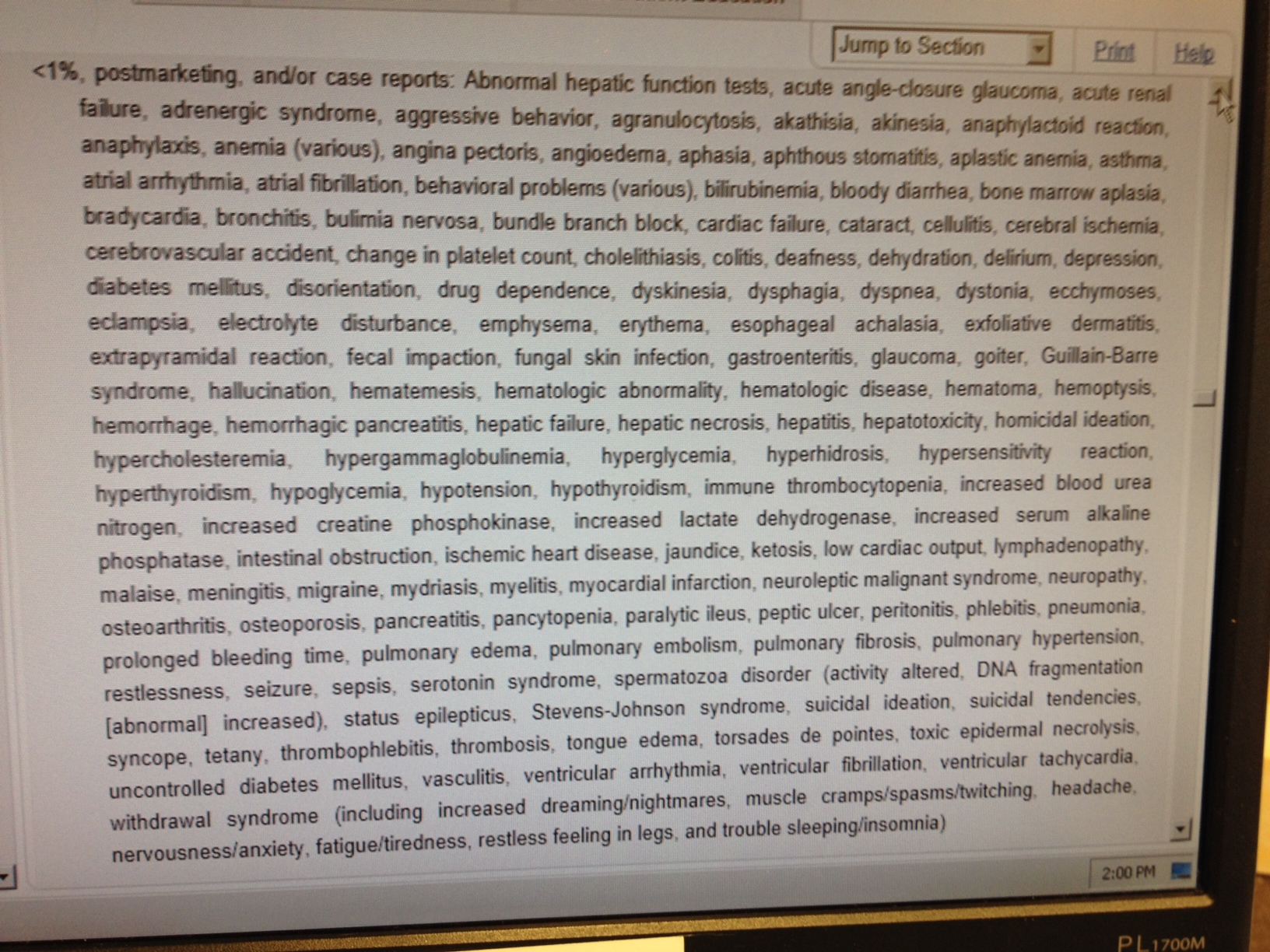
The infrequent side effects of Paxil
(Click to enlarge)

I was just trying to look up the side effects of Paxil and was greeted to this incredible and quite ridiculous array of potential side effects.

I had to ask myself: how helpful is such a list? Why do we have this noise available to us?

The answer, of course, is obvious to anyone who understands our legal system in America.

But we should ask ourselves another question: in our effort to assure patient safety, might we be losing important signals to care-givers amongst the recesses of all of this incredible noise?

-Wes

Tuesday, December 17, 2013

If The Hunger Games Came to Medicine

“A totalitarian state is in effect a theocracy, and its ruling caste, in order to keep its position, has to be thought of as infallible. But since, in practice, no one is infallible, it is frequently necessary to rearrange past events in order to show that this or that mistake was not made, or that this or that imaginary triumph actually happened.”
                                               - George Orwell
* * *

The brushed, steel belly of the scalpel blade pressed down on the orange antibacterial film and released the subcutaneous yellow fat globules surrounded by small beads of red blood.  The movement of his hand was fluid, purposeful, and without hesitation.  The electrocautery pen carefully seared the points where blood appeared.  A retractor was installed to spread the tissues farther apart as he worked quickly to gain access to the tissue plane just above the muscle.  His movements were deft for he knew they were watching.

The Capitol's campaign to ensure perfect outcomes was well underway. They had installed cameras throughout the hospital just four short years before: in the halls, the changing rooms, at the scrub sinks, and in the operating rooms.  The Capitol had discovered that the operating room was like yesterday's boxing ring, or even farther back in the mists, the Coliseum.  In the New World unpredictable events and venues that stirred primitive passions were few - and yet they were longed for as they were feared.  This context explained the popularity of the annual Hunger Games, created as punishment for the destruction of District 13 by a failed patient uprising after the health care financial apocalypse.  Each year, one male and one female physician "tribute" from each of the surrounding twelve Districts were selected by lottery and performance metrics to fight each other to the death. Providing spectators with a window into the drama, and ensuring that drama by creating just the right conditions, gave spectators a sense of aliveness that they barely remembered, and just enough to stimulate fear.  The Games also served as the perfect venue to deflect blame from the Capitol's expedience in sacrificing people for their own avarice.   

The call had come after a full, exhausting day.  The patient had presented to the Emergency Room only two weeks after open heart surgery for coronary disease and to replace his critically-narrowed aortic valve.  The surgeon-tribute wasn’t sure why his conduction system should fail this late after surgery but it didn’t matter; his heart rate had slowed to a dangerous 19 beats per minute. His blood pressure, while low, remained stable.  A quick review of this medication list disclosed the mandatory heart medications that included an anticoagulant for the heart valve and antiplatelet agents for his coronary disease.  No heart rate slowing medication was being used so the Capitol's appropriateness indication to proceed with the procedure was indisputable.  It was also fortunate that the anticoagulant the patient was taking hadn’t thinned his blood too far.   He decided to take him to the operating room directly.  It was 3 am.

Meanwhile, back at the TV studio:  “I tell you, Frank, every year the footage gets better and better!  How did your team know that these untenable circumstances would result in such great late night viewing?  This is so exciting!” 

The call team had been called, but was short-staffed.  Efficiency meant lower cost, fewer people, and longer work hours.  The designated scrub tech had car trouble and would be delayed.  So the other technician and nurse worked feverishly to ready the room.  The call had already been made to the device representative who brought the new pacemaker hardware, but he was barred from entering the operative suite for he was not part of the medical team.  Rules were rules.   The patient, of course, was agitated, gasping for breath.  The doctor worked as fast as possible to establish pacing – the air was tense.

“Are you kidding?  I love seeing this, don’t you?  The nervousness of his voice!  The anxiety!  The skeleton crew at night!  Beautiful!  I’m not sure it gets much better!”

John had no idea why his car wouldn’t start that night (but the spectators did).  He turned the key again and again, only to hear the engine spit in return.  He slammed his hand against the steering wheel, frustrated that he was unable to keep his car tuned for poor weather.  But such concerns were luxuries now that hospital budgets were tight thanks to the Capitol’s Bundled Payments for Care Improvement campaign.  Finding a ride to work became the imperative.  He raced back into the house to wake his wife in a panic, asking her whom he might call to give him a ride – they each knew the consequences of failure.  They called their neighbor and woke him from a sound sleep.  The pressured nature of their voices convinced him to loan them his car and five precious minutes later, he was off to work calling ahead to notify them of the delay.

At the hospital, Chloe answered John's call as she sat behind the monitoring console.  She was one of the best young technicians to graduate from her training school.  Still, her hospital’s equipment was not up to date because maintenance contracts were left to expire in these cost-saving times.  Still, although the software it ran was now several versions old, it still reliably fed data to the Capitol's chargemaster.  She looked down at the dust on the keyboard.  Seeing this, it was clear she couldn’t enter the room to assist because the risk of surgical contamination was too great.

The surgeon-tribute was glad he’d placed two venous sheaths to gain vascular access, rather than just one.   He had successfully placed both pacing wires through the sheaths to the patient’s right atrium, ready to be secured to their appropriate chamber.  But he needed a softer shaping wire – the stylette – to insert into the inner lumen of the pacing wire.  Without the stylette, the pacing wire had the consistency of a well-cooked spaghetti noodle.  With it, he could place the pacing wire to its appropriate chamber.    As he turned, his eyes left the surgical field for just a moment.  He scanned the table crammed with scattered instruments and hesitated briefly as he located the proper stylette. 

A hush fell over the audience as they saw the opening.  They leaned forward in anticipation, reveling in their luck to see such a careless mistake.

John leaned his head in the room to notify them he’d finally arrived and would assist as soon as he could change.  The surgeon smiled, acknowledging his dogged efforts to arrive as quickly as humanly possible.  He turned to the field and shaped  the stylette to the perfect curvature that would allow him to affix the pacing wire to the lower, primary pumping chamber of the patient’s heart.  He focused his blurring vision to place the tiny stylette in the endhole of the pacing lead.   Chloe broke the silence of the moment: “Hey guys, did an electrode fall off?”

The doctor looked up briefly to see atrial P waves dancing across the monitor screen without any corresponding ventricular electrical activity. With that, his worst nightmare was realized.  The patient began posturing on the table, his head thrown back beneath the drapes, his arms slowly but powerfully raising.  The surgeon leaned forward to grab the patient while trying to control the leads, stylette, and surgical wound sterility.  The patient began violently thrashing beneath the drapes, his face turning blue and lips crimson as saliva and exhaled gases mixed into a frothy spraying mess.  He was seizing uncontrollably.  His once steady escape rhythm had chosen this unfortunate moment to stop. 

If the surgeon was expecting help from a sponsor it was unlikely to be forthcoming.  Just yesterday, the tribute's most likely supporter/sponsor, Sylvia, a well-to-do matriarch from the Central District, had noticed an incipient sign of aging on her neck – subtle crepe-like thinning of her skin, this despite her  rigorous adherence to all of the Wellness Initiatives the Capitol had advertised.  She had reason to hate, didn't she? She'd  been failed one too many times.   She remembered sitting with her 65 year old mother gasping for air in one of those infernal assembly-line clinics with the young doctor glancing at the red, flashing "Do Not Admit" guideline on the computer screen as he sent them home with morphine with that flat, dead, passive expression on his face!  He didn't care then and so she wouldn't care now!

Seconds felt like hours as the patient's body slowly twisted sideways.  The nurse did all she could to support his weight and keep him from falling.  The surgeon, too, felt helpless as the powerful frame shook uncontrollably beneath the drape.  The restraints tethered his arms but his involuntary leg movement forced him further sideways.  John felt powerless as he watched from the door.  Finally, he could watch no longer and ran into the room just as the patient fell to the floor.

Four cannon blasts were heard in the distance.  The spectators roared.
 
-Wes
Saturday, May 04, 2013

The FDA Azithromycin Softshoe and Why It Matters

This week, a Danish study by Svanstrom and colleagues appeared in the New England Journal of Medicine that failed to show significant cardiovascular risk to azithromycin compared to other antibiotics in the Danish national health care system.  This report was in direct contradiction to an earlier report from Ray, et al. published in the New England Journal of Medicine (and widely hailed in press) that suggested a significant risk of cardiovascular death attributed to azithromycin compared to other antibiotics in a Tennesse Medicaid population - and a report that the FDA used to justify the wide dissemination of a Drug Safety Communication for azithromycin.

While I have been quite critical of the conclusions drawn by Ray, et al. before, I was even more surprised by the Drug Safety Communication for azithromycin issued by the FDA that basically said: "any time a patient has a bunch of conditions that are known to cause prolonged QT interval, be careful prescribing azithromycin."  Such warnings, of course, should apply to any drug that could cause prolongation of QT interval, but for some unclear reason, the FDA felt they had to act in the case of azithromycin.

Now it seems the FDA doing a softshoe on their earlier warning regarding azithromycin, trying to justify their warning that was based on retrospective data-mining techniques drawn from diagnosis and treatment codes, not randomized trials. 

In a perspective piece from Andrew D. Mosholder et al, from the FDA that accompanied the report from Svanstrom et al, the authors acknowedge the many limitations of the original study by Ray et al.:
"The study by Ray et al. has limitations that are intrinsic to obervational, nonrandomized clinical studies.  In particular, nonrandomized studies cannot exclude the possibility that patients receiving a drug under evaluation differ from the control patients in some important but undetected way, causing bias in the results. Such confounding may bias comparisons not only between patients receiving antibacterial drugs and those receiving no antibacterials but also between patients receiving different antibacterials."
Yet in the very next paragraph of the FDA member's perspective piece, they persist in their indifference to their prior statement regarding the bias inherent to Ray et al.'s report and decide to focus on timing:
"Despite these caveats, the results presented by Ray et al. warrant serious attention.  A chief strength of the study is the time-limited pattern of the risk: the azithromycin-associated increase in rates of death from any cause and from cardiovascular causes spanned days 1 through 5, reflecting the typical 5-day duration of azithromycin administration (e.g., Zithromax Z-pak)."
The FDA authors refuse to believe that there could be any other confounding variables that might have occurred in the first five days of hospitalization that lead to the increased cardiovascular risk seen in their azithromycin-treated group.  It is more important, I guess, to support retrospective data-mining and statistical data manipulation of diagnosis and procedure codes.  This, you see, they must support.  Big Data in our new era of expanded codes and computers is to be our new saving grace, you see.

Fortunately, I think the FDA folks mean well: they give us salient advice in their final paragraphs of their perspective piece explaining their mistake.  Things like "Clinicians must consider the arrhythmogenic potential not only of azithromycin but also of potential alternative antibacterial drugs." and "The risks and benefits of antibacterial therapy should be considered in prescribing decisions." 

No kidding.

But we will not see a black box warning retracted - that would be too obvious.  Nor will we see extensive news coverage about these new findings regarding this antibiotic's cardiovascular safety - that doesn't grab the main stream media's attention. 

What we have, instead, is something much more concerning to me when the members of our own FDA make claims based on poor data: irrelevance. 

Publishing warnings on QT prolongation that should apply to any drug administered to the patient that is older, bradycardic, with low potassium or magnesium levels, or already on known drugs that can cause prolonged QT - generates irrelevant noise for doctors.  Like the Boy Who Cried Wolf, we risk compromising the FDA's relevance to patient safety.   When they spend time on retrospective data-mining exercises that find risks in the neighborhood of 1 in 100,000, they risk failing to report important deaths related to new technologies with an incidence of at least 3 in 16,000 that reside in their own MAUDE database.

In today's internet age, doctors don't need any more Big Data-driven safety noise, we need razor-sharp analytic safety focus.

-Wes

Thursday, March 14, 2013

The Generality of the FDA's Recommendations on Zithromax

Tuesday's warning about Zithromax causing heart irregularities reportedly came after the FDA completed its own review of a New England Journal of Medicine article published in May 2012 and after reviewing additional data provided by Pfizer.  I have already voiced my concerns over the way this study was conducted in the first place since the data upon which the authors' risk estimates were made were shoddy at best.  Still, it is quite obvious to those of us in the business of cardiac arrhythmias that Zithromax, when combined with other medications likely to prolong QT interval or given to sick patients, could increase one's arrhythmic risk.

But  we should look closer at the FDA's new Drug Safety Communication on Zithromax which says: "Health care professionals should consider the risk of torsades de pointes and fatal heart rhythms with azithromycin when considering treatment options for patients who are already at risk for cardiovascular events." 

Gee, who knew?

If we probe deeper, we find the FDA recommends caution in prescribing antibiotics in patients likely to develop life-threatening cardiac arrhythmias like those with advanced age who are hospitalized, have low potassium or magnesium blood levels, or have slow heart rhythms.  The truth be known, each one of these conditions in and of themselves increases the risk of QT prolongation and makes them more susceptable to cardiac arrhythmias irrespective of the drug admininstered.

So how helpful was the FDA's warning on Zithromax to America's doctors?

Not very.

Perhaps we should add that warning to every drug out there, eh?

-Wes

Wednesday, February 20, 2013

When EMR Companies Muzzle Doctors

It started out as a satire about electronic medical records posted as a computer game review by an electrophysiologist in Kentucky.  The problem was, it contained real screenshots of a real EMR that highlighted certain (how do we say it nicely?) quirks of the software.  But this wasn't just any software, this is an electronic medical record that manages information on nearly 40% of all real live hospitalized patients in America, EPIC Systems.   Evidently, those screenshots were (and continue to be) off limits.  They're trade secrets that can't be shared publically, it seems.

So the doctor, fearing legal retribution, had to take the screenshots down.
I wonder what patients think of this behavior by a company that manages their medical records?   Should de-identified screenshots of an EMR software application be trade secrets or is such a move just cyber-bullying of a doctor's criticism by the company?  If this disclosure was against national policy in our era of interconnected EMRs, who was going to tell doctors nationwide that such disclosure was (and is) off limits? 

What should doctors and patients think when a multi-billion dollar company silences one of their end-users in such a fashion?  What might they be hiding?  What rights do patients have to see these screenshots?  After all, isn't it THEIR data that is held within these systems?  If doctors can't criticize the place where their patient's data is stored, who can?  What are the ethical implications of EPIC's move? 
It's now clear what at least one EMR company thinks about doctors criticising their computer user interface publically.  What do you think?

-Wes

PS: It will be interesting to see how long this post lasts...
 

Monday, February 18, 2013

Physician Burnout: Meet Patient Safety

The majority of doctors in America today care deeply about their patients.  After all, they're the ones that have personal relationships with them.  They're the ones who sit with them, speak with them eye to eye, feel their pain, and witness first-hand the scourge of disease on the human body and psyche.

But you'd never know this from the Patient Safety Movement.  From day one when the Institute of Medicine report entitled "To Err is Human" was published in 1999,  the nebulous "98,000 preventable deaths" number was circulated far and wide by media outlets.  Strangely, this important publication was never made available free to physicians for review.   But instantly, the media took notice of this sound bite.  Breathless outrage ensued.  Hospitals took notice.  Even doctors and doctors' associations noticed.  Worse yet, we were still told by the media and their self-appointed safety enthusiasts that "medical errors kill enough people to fill four jumbo jets a week."  But to everyone's credit, we all did some real soul-searching.

So change came to our industry.  Overnight, enough bureaucrats to bury the number of doctors in America three-fold were hired as patient safety do-gooders.  Entire new organizations hell-bent on imposing their vision for the future of patient safety sprang up to guide large hospital organizations to their vision of patient safety nirvana.  None were as influential as the organization called the Institute for Hospital Improvement (IHI) run by the soon-to-be knighted-as-acting-CMS-directorship, Donald Berwick, MD who made a cozy sum from the safety scare.  This is the same "institute" that still provides mandated safety training to hospital systems across the US even today.

But a strange thing has happened.  Despite their best intentions, after ten years of trying with more administrative hires and scores of new imperatives thrust on doctors and nurses with hours of carefully-constructed safety courses, and scores of white papers and media stories, not much has changed.   To be fair, not all efforts have been worthless, but self-reflection on the negative consequences of this movement have been limited.

And in its place, physician burnout has exploded.

But this morning, I saw a glimmer of hope.  People might be starting to do some introspection.

Take a minute and read Bob Wachter's post.  It is a prescient view of the problems created by well-intentioned (but misguided) initiatives that ultimately fall on America's physicians and nurses to implement:

The lack of evidence that all our hard work is paying off is also contributing to burnout. Several influential papers (such as here and here), using the IHI’s Global Trigger Tool methodology, have documented continued high rates of harm; one study of 10 hospitals in North Carolina showed no evidence of improvement between 2002 and 2007. On top of that, a steady drumbeat of studies (beautifully chronicled by Brad Flansbaum) demonstrates that nearly every policy intervention that we thought would work (readmission penalties, “no pay for errors,” pay for performance, promotion of IT, resident duty-hour reductions) has either failed to work, or has led to negative unanticipated consequences. For people who have given their hearts and souls to making the system work better for patients, the result is more demoralization. 
My second major concern about patient safety stems from the Affordable Care Act (ACA), one of whose main goals, paradoxically, is to place a premium on value over volume. You’d think that the patient safety field would benefit from such a law (which also includes significant new spending on safety), and perhaps it will… eventually. But in the short term, the ACA is yet another speed bump on the road to a safe system. 
Just as physicians are overwhelmed and distracted, so too are hospital CEOs and boards. As the healthcare system lurches from its dysfunctional model to a (God willing) better place, healthcare leaders are scrambling to be sure that their organizations have seats when the music stops. The C-suite and boardroom conversations that, a few years ago, were focused on how to make systems better and safer now center on whether to become Accountable Care Organizations, how to achieve alignment with the medical staff, what the insurance exchange will mean for our reimbursement, and the like. To the degree that people remain interested in improved value, here too the emphasis has shifted from the numerator of the value equation (quality, safety, patient experience) to the denominator: cutting costs.

Read the whole thing again and think about what he's saying and what's coming unless real change that improves the burden these safety initiatives have on doctors and nurses occurs.
"Don't it always seem to go, that you don't know what you've got 'til it's gone.  They paved paradise, and put up a parking lot." 
- from"Big Yellow Taxi" by Joni Mitchell
-Wes

Wednesday, May 16, 2012

Durata: Questioning the 99%

One of Many St. Jude Ad Trucks Seen at HRS 2012 Scientific Sessions
The boxing match about the safety of St. Jude Medical's newer Durata defibrillator lead reliability continues to spark interest in the EP community.  In one corner is the supporter of the reliability claims made by St. Jude, respected EP and lead explanter Charles Love, MD from Ohio State University Medical Center.  In the opposite corner this morning on Cardiobrief, comes respected ICD-watchdog Robert Hauser, MD:
Cardiobrief:  "Unfortunately, Dr. Greenberg was unable to attend today, but St. Jude’s Dr. Carlson stood bravely in the breach (no pun intended) to describe the performance of St. Jude’s 3500+ Durata leads in its OPTIMUM registry. Follow up was 2.4 years, and my only comment is that 2.4 years in my view is an early experience, not a mid-term experience. The event free survival was >99%. Excluding dislodgments and perforations, which may be operator dependent, there were only 5 lead mechanical problems, namely conductor fractures, in over 8400 implant years. Now this is truly spectacular. There were no inside-out insulation abrasions and no all-cause abrasions. But I have to say, that the Durata leads that I have been looking at in the FDA’s MAUDE database must not have been included in this study."
I'm starting to see the makings of a Tyson/Holyfield match.

-Wes

Friday, July 29, 2011

The Cost of Safety

At a time where the nation is struggling with a debt crisis driven in large part by the cost of our health care entitlement programs Medicare and Medicaid, the press reports of larger hospitals with fewer beds continue:
A southwestern Indiana hospital expects to start work in the coming months on a $100 million construction project to replace much of its existing facility that has parts dating back more than a century.

The master plan for the project approved by Good Samaritan Hospital's board includes a new 120-bed, five-story inpatient tower.

The completed project will see the hospital's capacity drop by 67 beds to 165, but Good Samaritan President Rob McLin said it will allow for growth in areas such as oncology, orthopedics and cardiology care.
You can never be too safe. Infection control requires single rooms with big screen TVs that have internet and personalized meals. Really it does.

No matter what the cost, it's safety, safety, safety. Entire institutes full of safety experts have sprung up the help hospitals make sure they keep the message coming and to fufill the lofty goal of never having a readmission. Hopsitals pay these institutions hefty sums to make sure they comply with mandated safety classes for all of their employees. In fact, these lessons is so important that they even give their directors millions of dollars of safety-inspired compensation packages to make sure their family members have a lifetime of safe health care after they retire.

And then there's that not-so-little issue of medical equipment expiration dates. Imagine if one of those foam headrests in the operating room were to expire! "You can't use those any more, doctor, they're expired!"

So we throw them away and order more.

In every hospital across our land this happens. Tons and tons and tons of medical waste because of expiration dates for things that, practically, shouldn't have expiration dates. But because we have regulations regarding how long things can sit on shelves in hospitals, we label them with expiration dates. "Order more, please." After all, if the Joint Commission finds expired headrests, hospitals might lose their accreditation. Our medical supply industry, full of middlemen like group purchase organizations that exist to get a better deal on bulk orders (really), is only too happy to comply.

My point here is not to speak badly of the need for safety in hospitals, rather a need to gain some equipoise on the subject. It is true that we've done a pretty good job improving surgical infection rates in America with things like pre-procedure antibiotics, antibacterial drapes, and good technique. But I wonder what's more expensive for our system in the long run, hand washing with soap and water or foam alcohol dispensers that have cannisters that have to be refilled and repurchased time and time again. what about all those plastic gowns we wear because a nasal swab shows traces of the genetic makeup of a single methicillin-resistant bacillus in a patient's nose? Or might all that plastic we purchase ultimately become more expensive to our health care system and environment in the long run?

These are not convenient questions to ask. But, given our concerns about the costs of health care and its affect on our economy, it seems to me that doctors AND patients had better start looking for (and demanding) ways to save money with the little things we do every day that might not be viewed as perfectly safe but rather, perfectly acceptable.

-Wes