Showing posts with label biventricular pacing. Show all posts

Wednesday, November 16, 2011

Pacing Without Wires

From Medgadget via The Medical Quack:


EBR Systems, a start-up out of Sunnyvale California, and Cambridge Consultants, the technology design and development firm, have developed a leadless pacemaker system for patients with advanced heart failure. The Wireless Cardiac Stimulation System (WiCS) comprises two units, an implantable electrode and an external control unit. The electrode incorporates an ultrasonic, wireless receiver and delivers an electrical stimulus to the heart based on triggering signals from the external control unit.

In its current iteration the WiCS system is designed to work with conventional pacemakers/defibrillators pacing the right ventricle of patients requiring biventricular pacing. The WiCS external control unit senses the pacing stimulus delivered to the right ventricle and initiates a burst of stimulus from the electrode implanted in the left ventricle. According to the company, the wireless left ventricular pacing approach removes the need for complex surgery and the complications often associated with the coronary sinus leads used to pace the left ventricle.
Nice.

But to suggest that a left heart catheterization to place their little device in the endocardium of the left ventricle "removes the need for complex surgery" is a stretch. Embolic complications, valvular complications and the potential for stroke complications (with the need for at least some anticoagulation) will quickly temper their enthusiastic press release. And what happens when a patient needs an ultrasound of their heart or has a capsule endoscopy? Could there be significant electromagnetic interference?

But we should not rain on these companies' parade too quickly, even if they are a bit late to the party. The implications of this technology as we move forward with more sophisticated pacing therapies are profound. One only needs to consider complex congenital heart cases with anomalous venous return, epicardial delivery of this technology, or its capability to paired with drug delivery systems in the future to see where things might go with such a novel means of pacing.

-Wes

Monday, June 20, 2011

Heart Failure Therapy Inappropriately Bashed

People who stretch the limits of science need to be called out.

Especially when their intent appears to be to change therapy recommendations based on conclusions from a retrospective meta-analyses. Meta-analyses are nothing more than selectively-pooled studies aggregated by statistical pseudoscientific hand-waving and data manipulation fraught with so many examples of bias that we have to wonder if the intent of the lead author's comments about such a study to the media were not focused on whether their hypothesis was an appropriate topic for future study, but rather if some just had another axe to grind.

Repeatedly this week we have seen the lead author of the meta-analysis that attempts to determine if QRS width can predict future responders to cardiac resynchronization therapy (CRT) promulgate opinion in the name of science. In fact, the study's lead author, Ilke Sipahi, MD leaps to such amazing conclusions about the study's findings that the mind just boggles. From the Wall Street Journal, to Consumer Reports and now, that bastion of scientific reporting, the New York Times, his comments resulted in a main stream media feeding frenzy on the technology. His conclusion?
"In this in-depth analysis, we found that pacemaker patients with less severe electrical disturbance in their hearts did not receive any benefit whatsoever from these expensive and potentially risky implants. Given the abundance of data showing lack of efficacy in this patient population, current treatment guidelines should be changed."
Wow. I'm speachless. Cause and effect to change medical practice from a meta-analysis! Since when?

Since never.

And how did the mainstream media interpret the study?

Here's a sample comical passage from a Consumer Reports article entitled "Many Heart Failure Patients Don't Benefit from Pacemakers:"
Current American Heart Association guidelines say that patients with a QRS (the measurement of the activity of the heart's left and right ventricles) of greater than 120 milliseconds should be treated with CRT (Cardiac Resynchrtonization Therapy). But the study found that patients with a QRS between 120 ms and 150 ms—38 percent of the participants—received little to no benefit from CRT. In contrast, the 60 percent of people who had a QRS of 150 or higher did benefit.
Said another way, 38% (about 40%) of patients with QRS widths between 120-150 had no benefit to CRT pacing, and 40% of patients with QRS widths greater than 150 also had no benefit to CRT pacing. (Yet a remarkably large 60% of these very sick patients with or without wide QRS complexes - most NYHA Functional Class III - benefitted from the therapy.)

Yep. That's the real data: pre-procedure QRS width does not predict who will respond to biventricular pacing therapy clinically. Some will. Some will not. Truth is, we can't predict a priori which patients will respond to this form of pacing therapy for heart failure. To suggest (suddenly and miraculously) that QRS width can predict response from these poor data aggregations when numerous other studies have failed to show such an effect is an irresponsible leap.

Now, please guys, can we stop bashing the best form of heart failure therapy for patients with wide QRS complexes above and beyond our maximal medical therapy and move on to more important issues like bathing salt bans extolled by our AMA leadership today?

Now there's science!

-Wes

P.S.: (For a much calmer evaluation of the trial and the media's response, see Dr. John Mandrola's blog.)

Reference: Sipahi I, Carrigan TP, Rowland DY, Stambler B, Fang JC.
Impact of QRS Duration on Clinical Event Reduction With Cardiac Resynchronization Therapy - Meta-analysis of Randomized Controlled Trials
Archives of Internal Medicine Published online June 13, 2011.

Disclaimer: Dr. Fisher is on the speaker's bureau for the medical device companies Medtronic and Boston Scientific and earned $2000 from each company in the past year for that teaching. Also, he often cares for real patients with heart failure and, yes, earns a portion of his living implanting CRT devices as a board-certified cardiac electrophysiologist.

Friday, April 03, 2009

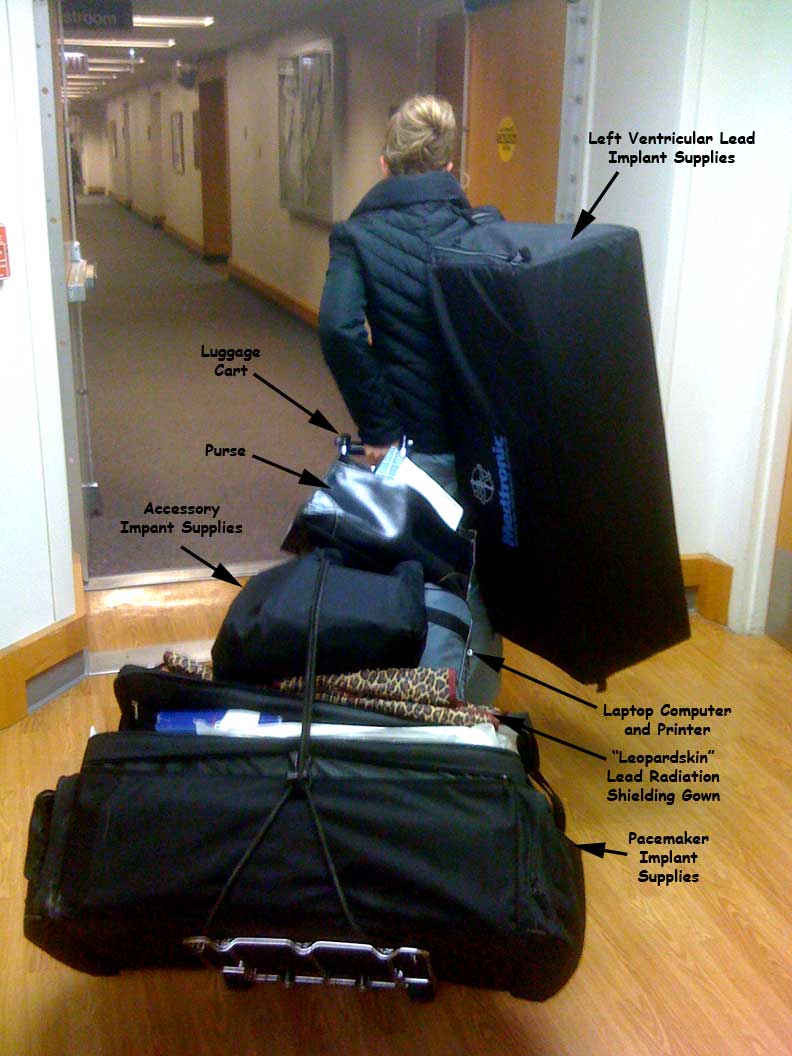
Heading Home on Friday

It's amazing what comes to the lab just for a few pacemaker implants these days...

Click to enlarge

-Wes

Tuesday, November 25, 2008

The Health Care Crisis in a Nutshell

This is a scary statistic:

The current average biventricular pacemaker implant costs only $3,714 less than median personal income of the US in 2006 and exceeded the median personal income of people from 21 states in the union that same year.

Wow.

-Wes

Wednesday, October 29, 2008

Devices Finished? I Don't Think So

If only biotechnology could deliver on its promises:
“You can’t keep stuffing gizmos into people to treat end-stage disease,” the keynote speaker said. “When biotechnology gets right, we’re finished. Because it’s restorative, not palliative as devices are.”
Biotechnology for pacemakers? Not yet. Biotechnology for treating tachyarrhythmias with stem cell injections? Not yet.

Maybe Mr. Osterle knows something that I don't know, but for now, I'm gonna keep "stuffing in" his company's devices. I just haven't seen the Fountain of Youth from biotech spring forward for my patients.

But heck, why not dream?

-Wes

Saturday, April 05, 2008

Affirmation

It happened at least twice a year, after birthdays and Christmas:

"You make sure to write those thank-you notes to the folks that sent you such nice presents, Wes."

"Ah, Mom, do I have to?"

"Yes you do. Just sit down and get it done. Then you can take it off your list of things to do."
* * *

Medicine is a complicated enterprise, with a myriad of talented individuals who work together to achieve a common goal: the care of our patients. While I often rail on this blog about certain aspects of healthcare that frustrate me, I find it is the patients themselves that reaffirm time and time again why I do what I do.

Throughout my career as a doctor, I have always prized thank you notes. They are sincere, gracious acknowledgements of our efforts, and the written word takes just a bit more effort than verbal one and can be cherished for years.

But none of us work in a vacuum. Behind every instance of care that doctors provide, there are a myriad of individuals who have helped sculpt the patient's experience.

So for the secretaries who took the calls,
the nurses who checked and rechecked the particulars,
the nurse practitioners who followed-up,
the technicians who were at the monitors,
the hospital administrators who maintained the facilities,
the phlebotomists who drew the blood,
the engineers who developed the technology,
the companies that made these devices,
and doctors who conceived of the technology,
and the researchers who brought biventricular pacing to fruition...

...this one's for you (used with patient permission):

Click to enlarge


-Wes

Wednesday, February 27, 2008

Reverse Medical Tourism

There has been a lot of buzz about losing patients overseas to other cheaper venues to deliver care, but we must not lose sight that America still has significant expertise in areas where world leaders come to gain access to our healthcare system, especially when it involves expensive devices or therapies.

Lech Walesa, Poland's former President and Nobel Peace Prize winner who was instrumental at struggling against communism, has sought treatment at Houston's Methodist Hospital for congestive heart failure. The Houston Chronicle reports:
Former Polish President and Nobel Peace Prize winner Lech Walesa is scheduled to be fitted with a pacemaker at a Houston hospital today, a day after tests left doctors hopeful he won't need a heart transplant anytime soon.

Walesa, 64, underwent tests at The Methodist Hospital on Tuesday for advanced heart failure. He traveled to Houston from Mexico, suffering from shortness of breath and fatigue that had caused some doctors to suggest he might need a transplant.

"The struggle with communism took a lot out of my health," said Walesa, speaking through a translator. "But to be part of the discussion regarding remaining questions, I need to be healthy."

Walesa also has significant lung disease, Methodist doctors said.

They didn't rule out that Walesa might eventually need a heart transplant but said such a scenario isn't on the horizon now. Emphasizing that they think Walesa's heart can be strengthened, they said most patients who get a pacemaker don't go on to need a transplant. Only if his heart worsens will they evaluate whether he needs a new heart, they said.

The doctors said they hope Walesa can be discharged from Methodist early next week
.
My bet is he won't receive just a pacemaker, but a biventricular implantable cardiac defibrillator in hopes that he'll gain benefit in his left ventricular function and shortness of breath. Data from the MIRACLE trial using biventricular pacing for severe heart failure in patients with markedly reduced ejection fractions and widened QRS complexes demonstrated symptomatic improvement in about 66% of patients. The CARE-HF trial also demonstrated a mortality benefit with biventricular pacing alone, while the COMPANION trial demonstrated superior mortality benefit to biventricular pacing coupled with a defibrillator when compared to beventricular pacing or drug therapies alone.

Who'll pay for this device and his care is another question: will it be former-President Walesa, the State Department, or Methodist Hospital? Will his device be donated by a device company for PR purposes?

I wonder how this is handled in these cases? Should VIP healthcare be different than that received by the average Joe here in the States?

-Wes

UPDATE: 1 Mar 08: An ICD it was.

Sunday, March 25, 2007

The Malignancy of Heart Failure

With the release of the results of the EVEREST trial at the American College of Cardiology Meeting in New Orleans and simultaneous publication in the Journal of the American Medical Association, a surprising revelation occurred to cardiologists who treat heart failure: fluid loss means little to overall survival.

For those unfamiliar with the EVEREST trial, it tested the effectiveness of a vasopressin inhibitor, tolvaptan, at reducing fluid retention in heart failure as a means to improve cardiovascular mortality. Vasopressin’s (also called “anti-diuretic hormone”) action in the kidney is to retain free water in the distal collecting tubules of the nephron in the kidney. It is alcohol’s inhibition of vasopressin that causes a brisk diuresis that contributes to the post-drinking hang-over and dehydration. Ah, enough about my college days…

Anyway, the drug tolvaptan also inhibits vasopressin, and permits excretion of increased free water (as evidenced by the sustained volume loss and elevation of serum salt (sodium) levels in this study). Unfortunately, these beneficial effects had no effect on all-cause or cardiovascular mortality after two years of follow-up in the trial.

What struck me was the high incidence of cardiovascular mortality in this heart failure patient population (NYHA Class III and IV): an incidence of about 20% - even in spite of aggressive therapy with beta blockers (70.2% of patients), angiotensin receptor blockers (ARBs) or angiotensin converting enzyme (ACE) inhibitors (84.2%), and diuretics (96.8%).

It seems we have a long way to go to improve mortality in this population.

Which then begs the question: in light of the improvements in mortality in severe heart failure documented in the MIRACLE, COMPANION, CARE-HF and SCD-HeFT trials, why is there no mention of device-based heart failure therapies in this trial? Were these devices implanted in these patients? If so, in whom?

Perhaps if these device therapies were deployed earlier in the course of treatment in this severe heart failure population, we could better impact this abysmal mortality rate.

-Wes

Wednesday, November 01, 2006

Heart Failure: Why Wait Until Extremes?


Today's New England Journal of Medicine disclosed the effectiveness of a left ventricular assist device (LVAD) and medical regimen at reverse-remodeling chronically dilated hearts back to near-normal in a small subset of 15 patients. While these data were novel and encouraging - one wonders if these individuals could have been spared the need for left-ventricular assist devices if they had had implementation of biventricular pacing earlier in their clinical course.

I was unable to find mention of the EKG duration of the patients followed in the New England Journal of Medicine article, nor did it appear that ANY of these patients had received a biventricular pacing device. I suppose I should not be surprised, since the New England Journal of Medicine study was funded by the LVAD manufacturer, Thoratec. But excluding this data omits important data regarding these severe heart failure patients: was all done for these patients before LVAD implantation? Although I appreciate that not all heart failure can be detected early, 12 of 15 of the patients in this study had been treated for at least 6 months before LVAD implantation without biventricular pacing, leading me to wonder if the implantation of a biventricular device could have prevented the need for the LVAD.

Biventricular pacing has now been firmly established as an effective means of treating patients with severe congestive heart failure on maximal medical therapy. It should probably be considered the standard of care, in my view, for patients with severe cardiomyopathy refractory to medical therapy with evidence of conduction delay during activation of the left ventricle (QRS duration >=120 msec). Biventricular pacing involves placing a left ventricular pacing lead in addition to a right ventricular pacing lead to re-coordinate the pumping action of the ventricular pumping chambers. Clinical studies have demonstrated that approximately 2/3rds of symptomatic patients have an improvement in their 6-minute hall walk test (walking on average an additional 50 meters), improve by about one New Heart Association heart failure class, and have improved quality of life using self-assessment measures. More importantly, the COMPANION and recently-released CARE-HF trials have demonstrated a mortality benefit to patients receiving biventricular pacing devices. Anecdotally, I have seen complete normalization of left ventricular function in a small subset of patients with non-ischemic cardiomyopathy (like those the the NEJM article) after this therapy has been deployed.

It should be noted that the effect of biventricular pacing trials has been so impressive that earlier intervention of biventricular pacing in heart failure is now being evaluated in the BLOCK-HF trial and its application to patients with normal EKG duration in St. Jude Medical's RethinQ trial.

Hopefully we'll remember the benefit of biventricular pacing therapy (with or without an implantable defibrillator) in our sickest heart failure patients and apply this before the need for an LVAD arises.

-Wes

Photo credit.