Sunday, September 29, 2019

Some Thoughts on the Recent ABIM Lawsuit Ruling

“Unless someone like you cares a whole awful lot,
Nothing is going to get better. It's not.”

― Dr. Seuss, The Lorax

After researching, investigating, and writing about the activities and finances of the American Board of Internal Medicine (ABIM) and the ABIM Foundation for the past five years, it would figure that a ruling on the class-action lawsuit challenging the ABIM Maintenance of Certification (MOC) program would occur during the week that I am on call. I simply have not had much time to put my thoughts in writing.

Perhaps that's a good thing.

But as the time has passed since the ruling, I believe I have more clarity now.

Initially, I must say I was surprised by Judge Kelly's ruling, but not shocked. We have encountered significant naiveté with non-physician legislators when attempting to pass anti-MOC legislation at the state legislative level. Most non-physicians do not have a clue what ABIM Board Certification and MOC are, let alone their history and current relationship to obtaining and maintaining physician hospital credentials and insurance payments.

I suspect the judge in the ABIM antitrust case was (and remains) similarly naive. (Just as I am naive about what it takes to be a lawyer or judge.) Perhaps nowhere is this naiveté more evident than the judge's paragraph concerning "grandfathering" of older physicians:
"Finally, Plaintiffs allege that ABIM does not consider MOC to be a requirement of initial certification because it has “grandfathered” those that purchased a lifetime certification prior to 1990. (Pls.’ Mem. Law in Opp’n Mot. to Dismiss 13.) However, Plaintiffs provide no support as to why ABIM should not be allowed to modify its certification process over time. We see no problem that at some point ABIM realized there was a need to have its certified internists undergo an MOC program, whether because the internists could not keep up with the advances in their particular field, saw their skills diminish, or any other reason. In fact, the need to require a MOC program is highlighted in this case, as Murray initially failed her infectious disease MOC program in 2009 and Joshua was unable to pass her required MOC program in 2014. (Am. Compl. ¶¶ 85, 109.)"
But the judge's logic falls apart here because he mentions only the plaintiffs' need to "keep up," and not the "grandfathers'" similar "need." Aren't older, grandfathered physicians who do not have to participate in MOC more likely to have "failed to keep up with the advances in their field or seen their skills diminish?" Why are they granted an ABIM board certification "hall pass" while the younger Plaintiffs in this case were not? Why is such an age- and gender-discriminatory double standard acceptable for board certification in the judges eyes? (Remember, younger physicians who must perform MOC are increasingly comprised of females and physicians of color.)

Would the judge feel similarly if he had to retake his bar examination and pay monopolistic fees to the Bar Association every 2-10 years to maintain his appointment to the bench?

Concerning the unjust enrichment dismissal, the judge makes a similar blunder and fails to even consider the Plaintiffs' concerns:
"Our analysis is again constrained by Plaintiffs’ misunderstanding of the product they purchased. Clearly, the first two elements of unjust enrichment are met for Plaintiffs that purchased MOC. However, the third element is not met because it is not inequitable for ABIM to keep the benefit since it did not “force” Plaintiffs to purchase MOC.(emphasis mine) Plaintiffs were, of course, free to decide to no longer be certified by ABIM and to, therefore, not purchase MOC."
The Plaintiffs in this case were free to decide that they did not need to purchase MOC just as they are free to decide to stop breathing. How long could the Plaintiff internists earn a living and work as internists if they cannot hold hospital privileges or receive insurance payments unless they purchase MOC?

This judges' entire ruling in favor of ABIM seems thin to me.

I look forward to seeing where the next chapter of this ongoing legal battle takes us in the weeks and months ahead.

-Wes

It is important to realize this case is far from over as the legal battle against MOC continues. Please help the Plaintiffs' efforts to end MOC by contributing here.

Friday, September 27, 2019

Federal Judge Dismisses MOC Class-Action Lawsuit, For Now

On 26 September 2019, a Pennsylvania judge has dismissed the current claims filed by the four internists challenging ABIM’s Maintenance of Certification (MOC) program (The full opinion here). The judge, however, has invited the plaintiffs to file amended claims on the monopolization and racketeering claims in the lawsuit in the next 14 days and, in contrast to what the ABIM said in their public statement, the case is far from over. Even if the plaintiffs are ultimately unsuccessful at the trial court level, all available appeals will be pursued.

No one ever thought this would be an easy fight - it is a David vs. Goliath effort after all - we remain committed to do whatever we can to bring an end to MOC.

-Wes

Tuesday, September 24, 2019

ABMS's Vision: Doubling Down on MOC

Since the American Board of Medical Specialties' (ABMS) "Vision Commission" issued its corporate white-paper "final report," it has become abundantly clear that the American Board of Medical Specialties (ABMS), medical subspecialty societies, and the entire Accreditation Council for Graduate Medical Education (AAMC, AMA, AHA, etc), have no intention of ending mandated re-certification requirements for US physician or osteopaths (also known as Maintenance of Certification (MOC), Continuous Certification, Maintenance of Certification in AnesthesiologyTM (MOCA®), ConCert™, or OCC).

Instead, they are doubling down.

One only has to look at the list of sponsors at this week's 2019 ABMS Conference here in Chicago to understand why.

Their "Premium Sponsor?" Certemy.com - a VC-funded startup from San Francisco infused with a cool $3 million investment run by a venture capitalist and Kaiser Permanente urologist eager to capitalize on the lucrative credentialing business. Or how about this ironically-named company in the ABMS co-branding line-up: MOCingbird that reminds you when all your lifelong credentialing paperwork and payments must be completed?

The data-selling opportunities are endless!

Might the for-profit ABMS-subsidiary ABMS Solutions, LLC provide Certemy.com, MOCingbird, and a whole host of other business middlemen the personal information, NPI numbers, addresses, cell-phone numbers, emails, MOC expiration dates, and test scores of physician, parsed psychometrically-designed test questions to insurers, hospitals, and anyone else who wants to hold physicians hostage for their financial purposes?

When you control a monopoly, anything's possible - especially when physicians are forced to "sign" an adhesion contract while paying for and enrolling in MOC as a condition of remaining employed.

From ABMS's own website, a dark, physician data deep-state has evolved:
  • An exhibit hall representing innovators in areas of assessment, test development and administration, data collection and measurement, and more.

  • Organizations can use data to better monitor and guide physicians’ work, trigger point-of-care decision making, and assess the impact of physicians’ improvement activities. In this session, the presenters will share how they identify the correct data and the appropriate source(s) of data and will discuss how data can be used to improve clinical decision making.

  • Discuss how data can be used at the point of care to improve clinical decision making

  • Psychometric analysis to create legally defensible exams
The world of the ABMS "continuous certification" monopoly is not only Orwellian, it's just plain creepy. Is this monopoly about lifelong physician continuing education or lifelong physician manipulation?

Given this ABMS corporate line-up and their self-serving focus demonstrated so clearly by their "conference," the intent of ABMS "continuous certification" is obvious.

It's time to put an end to this computerized madness masquerading as "physician improvement" because this MOC game that ABMS has doubled down on is getting utterly ridiculous.

-Wes

Sunday, September 22, 2019

How ABIM's MOC Product Ends Physician Careers

From Medical Economics:
Mark Lopatin, MD, has been a vocal opponent of ABIM’s MOC process for several years, but says that these new options are similar to changes he’d like to see in his subspecialty of rheumatology. His 1986 board certification in internal medicine is still considered valid, even though he hasn’t practiced in the field for 30 years, he says. But because rheumatology boards were not available in 1989, he took and passed the exam in 1990—one year too late to achieve grandfathered status—and has gone through the MOC process every 10 years since. He won’t be taking a fourth exam in 2020, however. “To take rheumatology boards means that I have to spend about three months preparing—at least three months—studying rote memorization of facts, esoteric stuff, trivial pursuit kinds of stuff that is not relevant to what I do on a day in, day out basis,” he says. “I’ll be 63 years old at that time, so if I took it and retired at 65, it buys me another year or two. It’s not worth it.”

While pleased to see ABIM collaborating with medical societies in some subspecialties, Lopatin says the testing component is still fundamentally flawed. “They’re still focused on that high-stress, timed exam that needs to be passed. What really needs to be measured is due diligence,” he says.

And despite his impending exit from medicine, Lopatin has already donated twice to PPA’s GoFundMe campaign. “I’ve been very outspoken about this, and this is my chance to put my money where my mouth is,” he says. “I am stopping my career because of this. To me, that’s a pretty strong statement about how I feel about what ABIM has done and is doing.”
MOC and these subspecialty "continuous certification" products are (and always were) about financial coercion, strongman threats, false claims, monopoly-making and deception. Medicine has no place for these things. Unfortunately, only a small percentage of doctors have donated to help end the MOC product's threat to a physicians hard-earned right to work.

Except physicians like Dr. Lopatin. Dr. Lopatin demonstrates something that MOC and all those costly pushed quizzes to our mobile phones will never be able to test...

... leadership and integrity.

Thanks, Mark.

Here's hoping others will follow your lead.

-Wes

Friday, September 20, 2019

When the Whole is Greater Than the Sum of Its Parts

"The whole is greater than the sum of its parts."
- Aristole


Since May 2018, over 1,600 physicians have made over 1900 contributions to our GoFundMe effort in support of physician plaintiffs involved in three class action antitrust lawsuits against the American Board of Internal Medicine (ABIM), the American Board of Radiology (ABR), and the American Board of Psychiatry and Neurology (ABPN). Details on those lawsuits can be found elsewhere on this blog.

Over the past months, I have watched us approach our funding goal for this effort bit by bit, as more and more physicians learn of the lawsuits and this work to help our working colleagues.

I recently completed an original 18" x 24" (acrylic) painting (with a hat tip to Chuck Close) celebrating this group effort by physicians. Up close, it doesn't look like much:


But viewed from farther away, the whole looks very different than those individual parts:


There is strength in numbers.

I just received a batch of full sized (18" x 24") limited-edition high-quality professional giclees of this artwork printed on heavy canvas paper that I will offer to $1000 donors to our GoFundMe campaign until we meet our funding goal, signed by yours truly. Just send me me the shipping address via the GoFundMe sight email after a donation is made if you'd like one and I'll be sure to send one on.

-Wes

Thursday, September 19, 2019

Plaintiff Lawyer Explains ABMS Medical Board Lawsuits

This past Saturday, A Zoom video conference sponsored by Citizen Health.io was held with the members of Practicing Physicians of America's (PPA) board and an invited speaker, Laura Feldman, one of the plaintiff attorneys with Robinson Curley, P.C. - the law firm that has brought suits against several American Board of Medical Specialty (ABMS) member boards. For my reader's convenience, I took the liberty of transcribing the first portion of the conversation that explained the ABMS Maintenance of Certification(MOC) antitrust lawsuits underway and their status. The transcription begins at approximately 06:12 of the video and participants at this point include myself (WF), Judith Thompson, MD (JT - President and Chairman of the PPA's board), and Laura Feldman (LF):
WF: Awesome, Well I think many of the people who have joined PPA or been involved with the Maintenance of Certification (MOC) process have realized there’s a lot of problems with it. We have problems that we now think may have been illegal and as a result of that, some physicians have been harmed through this process. For that reason, a number of physicians ultimately filed suit in December, 2018 against the American Board of Internal Medicine (ABIM).

That suit is a very complicated and far-reaching lawsuit and we’ve been fortunate enough to have Laura Feldman from Robinson Curley, the law firm that brought the suit…

JT: Wes? Wes? I hate to interrupt you for a minute. Listeners, please verify that your device is on mute. There is apparently background noise that’s interfering with other peoples’ ability to hear. Thank you, Wes.

WF: Yeah, no worries. So anyway, in December of 2018, four internists filed suit against the American Board of Internal Medicine and the basis of the suit were two allegations, main allegations anyway. It is a “class action lawsuit,” and it involves antitrust issues and racketeering issues. I thought it would be smart since most physician don’t know what these things are, to invite Laura to give us a quick, brief rundown what “antitrust” and the RICO portions of this lawsuit mean so that maybe we could have a better understanding before we go into more detail.

LF:Absolutely, so Dr. Wes thank you so much for the invitation and for including me in this group. I am delighted to be here and really delighted to be a piece of this litigation.

As Dr. Wes mentioned, the first suit challenging MOC was brought against ABIM. And it is a class action – an opt-out class action – and what that means is that any physician whether a DO or MD that has been forced to purchase MOC to maintain their initial certification is part of the class unless he or she chooses to opt out. There’s a couple of exceptions: if you’re related to the judge or affiliated with one of the boards, you’re not going to be part of the class – but otherwise you’re in the class unless you chose to withdraw.

Subsequent to the ABIM lawsuit, two plaintiffs filed suit against the ABPN which is the Psychiatry and Neurology board, … (smiling) Dr. Dixon is excited…, and one radiologist filed suit against the American Board of Radiology and we, along with our co-council, are the attorneys challenging those boards’ MOC programs. So over the next couple of minutes I’ll be brief. I’ll go over the Complaints, what’s happened so far in the suits, and the next steps in the litigation.

So as Dr. Wes mentioned, our main plaintiffs brought claims of anititrust violations and also unjust enrichment. And then against the ABIM, there’s also a racketeering claim.

So first, antitrust. So the main plaintiffs in the litigation accused the three boards , ABIM, ABPN, ABR, of illegally tying the initial certification product to the continuing, the MOC certification product. And what they’re alleging is that doctors are forced to purchase MOC and jump through all the hoops that MOC requires – its not just handing out some money – they’re forced to purchase MOC to order to maintain their underlying certification that they purchased. No in addition to this antitrust claim that is a tying claim, they’re also bring up a monopoly claim, alleging that these three boards have illegally created and maintained a monopoly power in the MOC marketplace stymying the efforts of competition like NBPAS (National Board of Physicians and Surgeons) and making it so that any other competition can’t enter the marketplace.

Now each of the three suits brings a state common law which is called “unjust enrichment” accusing the boards of unjustly enriching themselves at the expense of doctors like you. I mean, taking money off of your backs and unjustly enriching themselves.

Now racketeering, or the RICO claim, against ABIM is stating that ABIM waged a campaign to deceive the public about MOC’s benefits. So you’ve heard about their allegations if its benefits to physicians and to patients and to the public as a whole, and part of that racketeering claim is their inappropriate campaign to suggest that MOC constitutes "self-regulation." I know it’s a big buzzword. The complaint alleges ABIM misrepresented what passing MOC actually shows: the tests’ ability to actually demonstrate doctors’ qualifications or their lack thereof.

So those suits have been filed, we’re in litigation mode. Each defendant has filed a Motion to Dismiss, and those motions are fully briefed. What that means is that we have submitted to the Court our opposition to get rid of the suits and those briefs are pending before the three respective courts and we’re waiting for all three of those courts to decide whether or not to dismiss the lawsuits. We feel like we’re filed really strong briefs. You can read them online if you’d like at ABIMlawsuit.com, ABPNlawsut.com, or ABRlawsuit.com. So that’s where we are in the litigation. We’re waiting for them. We expect it could take several more months and in the meantime, we are preparing for discovery, which is the phase of litigation where you share information – we’ll be seeking information from the board and third parties and they’ll be seeking information from us. So sit tight.

WF: Let me ask a quick question if I may. What do you think the timeline is to get a decision on any of these lawsuits?

LF: Good question. We wish we knew, litigation is like a lot of hurrying up and waiting, so we’re busy, busy, busy, then we wait. They we’re busy, busy, busy, then we wait some more. We expect ABPN may be the last ruling we get because we were just assigned a new judge that just came onto the bench here in Chicago. So we’re guessing, I mean we’re looking at crystal ball, that we’ll get ABIM’s ruling or a ruling in ABR first. It’s our position that we’d be lucky if we hear something by the end of the year, but some judges turn thing around quicker than others. We just don’t know if we’re number 2 in the pile in the judge’s docket or number 200.

WF: Great, thanks so much.
An extensive question and answer session was held later in the video conference where viewers could post questions, and can be found at about 27:10 and contains additional valuable insights about MOC and the litigation underway.

I hope this has been informative and will continue to update my readers with the status of these suits as information on them comes available. If you find these efforts useful, please consider contributing what ever you can to the voluntary GoFundMe page in support of the plaintiffs. Hopefully together we can end MOC's stranglehold on working physicians nationwide.

Thanks-

-Wes

Thursday, August 29, 2019

American Board of Emergency Medicine Resorts to Adhesion Contract to Limit Its Liability and Legal Costs

A question posed recently by a physician on Facebook:
Can anyone tell me if this is legal? I have to check the American Board of Emergency Medicine's website for info regarding MOC and the Concert Exam. In order to have access, I have to agree to this statement. This leaves me no choice, yet MOC is mandatory. It feels like blackmail. And would this be enforceable in a class action lawsuit?
RELEASE OF ABEM

I agree to indemnify, and waive any right to sue, ABEM and its directors, examiners, committee members, officers, employees, and agents; to hold them harmless from any claims or damages including, but not limited to, attorneys’ fees and costs incurred in connection with my participation in activities to stay ABEM-certified, including but not limited to any action they, or any of them take or fail to take in connection with my participation in certification activities; my eligibility for examination; the gathering, furnishing and use of information about my training and practice; the grading or conduct of my tests or examination(s); and/or the failure of ABEM to issue me a certificate.

CONTROVERSY OR CLAIM RESOLUTION

I agree that if, despite the Release of ABEM in the paragraph above, I sue ABEM, I will bring that suit in Chicago, Illinois and that I will pay all of ABEM’s costs and attorneys’ fees in connection with such suit.
I would encourage all Emergency Physicians to join our fight against the American Board of Internal Medicine that has a similar adhesion contract embedded on its website behind its firewall, too. The RICO portion of the lawsuit addresses this collusion between the ABMS member boards to further their monopoly on physicians' initial board certification for their financial, political, and promotional purposes.

Contributions can be made here.

We'll see what the courts decide on the legality of this practice of coercing physicians using unavoidable adhesion contracts.

-Wes

ACP Supports ABIM Plans for More Continuous Certification

Yesterday, the American College of Physicians (ACP) issued a press release in support of the American Board of Internal Medicine's (ABIM) plans to develop a new "longitudinal continuous certification" educational product to maintain their initial board certification. In that press release, they confirmed that this "option" was in response the the American Board of Medical Specialties' (ABMS) Vision Commission's Final Report and the ACP's lengthy comments to that report that included a "Recommendation 12" for "annual participation" by internists.

Somewhat ironically (but not surprisingly), the press release contradicted ACP's earlier Recommendation 10 of those comments:
Recommendation 10: ABMS Boards must collectively engage in a regular continuous quality improvement process and improve the effectiveness and efficiency of continuing certification programs.

ACP agrees with the need for ABMS and its member boards to engage in internal continuous quality improvement, to build and sustain our members’ trust in the continuing certification process.

First of all, where are the data that longitudinal continuous certification (a product not yet developed for internists) provides "internal continuous quality improvement" of the ABMS or practicing physicians? Or is such a product really a means to just "improve the effectiveness and efficiency" of monetary collections for all of these independent non-profit organizations?

Importantly, does such an unsubstantiated statement "build and sustain our members' trust in the continuous certification process," particularly in light of the important and well-written antitrust and RICO lawsuit underway against the ABIM? Should participation in any physician ongoing educational program have the potential to limit a physician's ability to maintain their insurance panel participation, malpractice coverage, or hospital privileges like this "Continuous Certification" program does?

Of course not.

The ACP would be wise to distance themselves from support of the ABIM, lest they reinforce evidence for racketeering. But then again, I'm just a physician. Let's see if the courts decide there might be a basis for the claims made, especially in light of this latest ACP press release.

-Wes

Sunday, August 25, 2019

Assuring Longitudinal Physician Exploitation and Burnout

ABIM Email Notification
His day started at 07:15 AM with two planned atrial fibrillation ablation procedures and an implantable cardiac defibrillator (ICD) implantation scheduled. As the day progressed, another unscheduled ICD was added, then three emergent pacemakers had to be implanted. Squeezed between the cases were rounds, inpatient consults, phone calls, post-op checks, emails, EMR tasks, and echos in his inbox. He finally headed home at 10:45 PM; another dinner missed with his family.

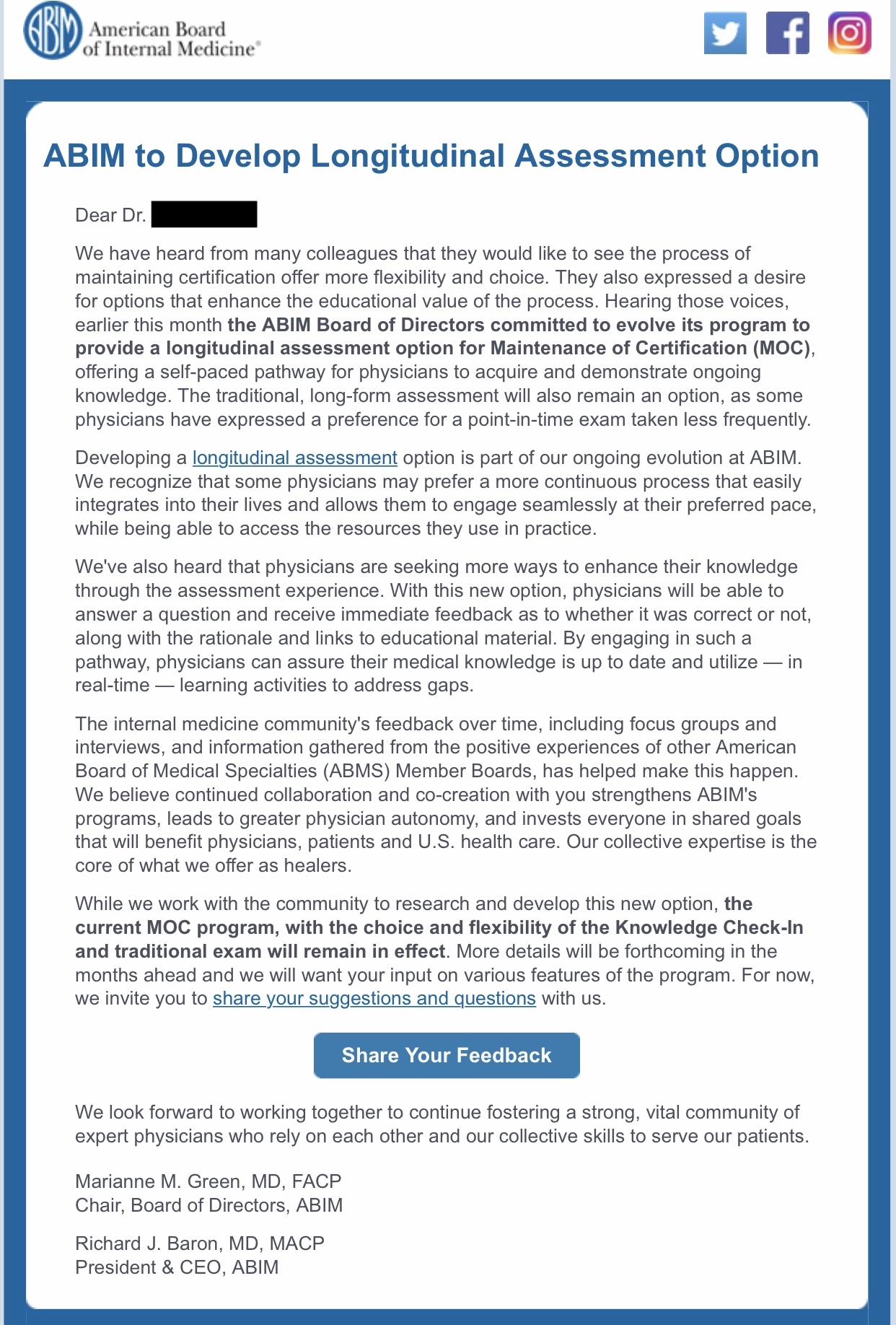
One of his emails included a notification that the American Board of Internal Medicine (ABIM) is developing a Longitudinal Assessment Option because they were "hearing those voices" from an overseas professor that implied "many of our colleagues have said they would like to see the process of maintaining certification offer more flexibility and choice." The ABIM now adapts behavioral and cognitive psychology to teach this busy electrophysiologist the "important competencies" of "professionalism, working in a team, and collaboration" promised by this new ABIM Longitudinal Assessment Option for MOC.

The ABIM stands on the head of a pin as it sends mixed messages about competency, professionalism, teamwork, and trust, all while maximizing the medical industrial complex's profit stream. It sends its email or tweets as they shape our next generation of physicians to continue to comply in being exploited and to make peace with the new medical group-think. A thinking person might see the contradictions inherent in these conflicting goals - but then this is the new MOC reality despite the lawsuits underway to end this program.

Pity the poor doc who now must decide at 10:45 PM whether he sits on his zafu, engages in relational maintenance with whoever is still up at home, or completes the graduated teaching assignment kindly forwarded by ABIM.

What we must never ask is whether there will ever be a MOC module or a pranayama sufficient to make this lifestyle sustainable.

-Wes

Thursday, August 15, 2019

MOC Issue Embroils EP Community

After I circulated my fund-raising video two weeks ago to the Electrophysiology Community via the Heart Rhythm Society (HRS) closed message board, a firestorm of challenges to the HRS leadership have erupted online. At their core, the HRS is now under increasing pressure to decide with whom they side: (1) their physician membership or (2) other corporate interests. The exchange has become so heated that the HRS has decided to issue a new "survey" to gage how their members feel about "continuous certification" and lifelong learning via the MOC paradigm. The re-issued survey closes 19 August 2019 and HRS members are encouraged to complete that survey just (re-)sent to them. (The first survey was shared publicly on social media and many physicians responded anonymously, making it difficult for HRS to determine their membership's responses, we are told).

Here are just a few of the comments being circulated, even as late as today, as HRS leadership try to defend their relationship with the American Board of Internal Mesicine (I have chosen to make comments anonymous out of respect to those who have made their feelings known publicly).
  • "Love it or leave love it. I am so looking forward to my body frisk looking for cheating materials at the Pearson View testing center in December - a $1200 massage will put me in the right frame of mind to take a day-long test, much of the content of which has no relevance to the things that matter towards helping my patients to live longer or live better. But no worries, I'm sure the HRS Board Review course (estimate >10K with room, board and lost wages, not to mention deduction from time for meaningful CME) will enlighten you as to the latest nitty gritty in IKwtf, so you'll be awesome at parties."


  • "As I’m sure you are fully aware, this money grab and power grab are far deeper reaching than most realize and your suggestion to deal with it locally cannot work. It’s extremely disingenuous of you to imply otherwise.

    A few years ago I decided to stand up for what I considered right and take a stand against the ABIM/ABMS. I refused to participate in MOC (though I go to HRS and a few other meetings every year and consider myself beyond competent). When my 10 years were up I chose not to take the recertification exam. I became board certified by the NBPAS. My local credentials committee didn’t know what to make of it, but when I met with them and explained my objection they went along. I told them if they didn’t I was leaving and I’m the only one who does a lot of the things I do in my institution. Then the insurers (BCBS) net with administration and their opinions changed. BCBS said they could no longer pay for anything I did unless I was pursuing recertification. The hospital administration said I needed to take the ABIM recertification exam or they could no longer employ me. I told them that’s fine, then I’ll quit and go into private practice and just see CMS patients (they don’t require ABIM certification). Administration told me if I did that then my privileges would be revoked. As I send this message I’m waiting for the first session to start at the board review course. I will never take this exam again. If this same bullshit exists in 10 years then I’ll retire at 56.

    Please don’t pretend that you are unaware that the NCQA which certifies insurance companies are in bed with the ABMS/ABIM who certify physicians. Don’t pretend that you are unaware that there are members who sit on both boards and profit tremendously off the backs of working physicians. I’ve met with the insurers who tell me they’d like to allow me an exception, but NCQA requires that all the physicians they contract with are ABMS (means ABIM in the EP world) board certified.

    So there you have it. ABIM requires MOC. If physicians refuse they revoke their certification. If they continue to object or seek alternative certification (NBPAS, IBHRE) then the rely on the NCQA to pressure payers (they threaten to revoke the insurers NCQA certification if they have physicians on their panel who are not “certified” by the one true board) to force physicians back in compliance by removing them from their panels. If physicians continue to refuse the payers threaten hospital administration and they threaten to revoke the physicians hospital privileges. If you don’t see a problem with this then I suspect you have a conflict of interest. Again please don’t attempt to deceive the HRS membership."
I have warned prior physician-presidents of HRS about this controversy, but it never dawned on me at the time that physicians no longer control the organization. That task, like so many in medicine today, was relegated to a non-physician non-profit executive long ago. It will be interesting to see how this will play out going forward, especially since the MOC monetary and conflict of interest genie is out of her bottle. The HRS leadership, be they physician or not, has a very serious fundamental decision to make: side with their physician membership, or side with their conflicted corporate partners who will stop at nothing to assure their profit margins.

Working cardiac electrophysiologists know that HRS has advocated for many of their needs over the years, but on this issue and it potential to affect their right to work, the conflicts of interest inherent to MOC with insurers, group purchase organizations, and hospital systems present a formidable challenge to the entire HRS leadership going forward.

Trust take years to develop. Let's hope HRS doesn't lose what they've earned in a heartbeat.

-Wes

Thursday, August 01, 2019

AntiMOC Lawsuit Update

As the summer winds on, I have been approached by more and more people who would like an update on where the litigation filed against the many member boards of the American Board of Medical Specialties stand since the lawsuits were filed. I will do my best to briefly summarize the status of those lawsuits as I understand them. (For background on why these lawsuits have been filed against so many of the American Board of Medical Specialties specialty boards, please review this video).

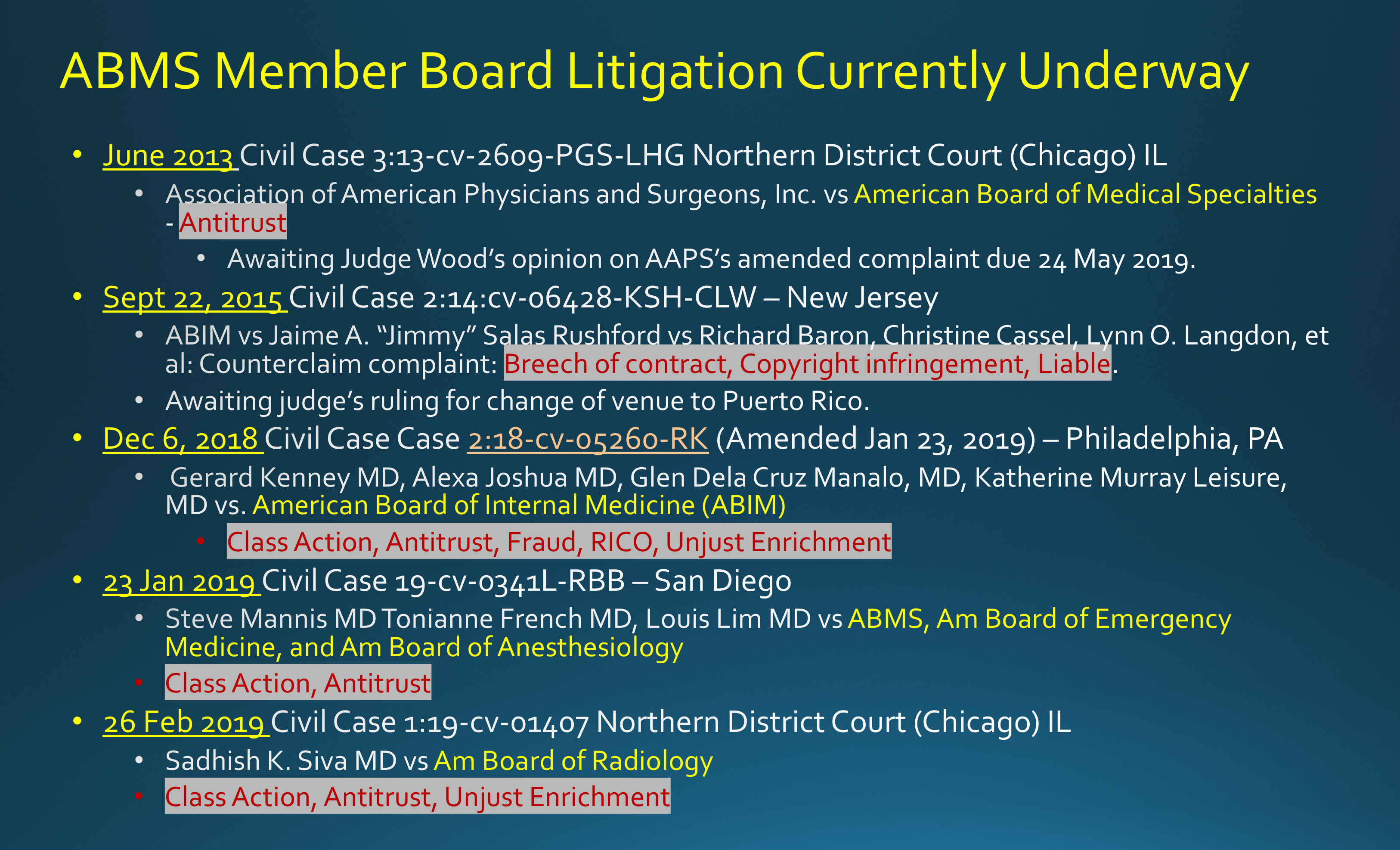
The antitrust suit against the American Board of Internal Medicine (ABIM) was originally filed 6 Dec 2018 and amended 23 Jan 2019 to include RICO charges, the antitrust lawsuit against the American Board of Radiology was filed 26 Feb 2019, and the antitrust lawsuit against the American Board of Psychiatry and Neurology (ABPN) was filed 6 MAR 2019. These cases were filed by a law firm based in Chicago. A fourth lawsuit was filed by a separate law firm in Southern District Court of California on 19 Feb 2019 against the American Board of Medical Specialties (ABMS), the American Board of Emergency Medicine (ABEM), and the American Board of Anesthesiology (ABA).

Each of the member boards are represented by different law firms.

Three of the specialty boards (ABIM, ABR, and ABPN) have appeared and, as expected, filed motions to dismiss with mostly overlapping arguments. The motion in the ABIM case was fully briefed a couple of months ago (Motion to Dismiss here, Opposition for Motion Dismiss here), the ABPN motion was fully briefed last month (Brief in Support of Motion to Dismiss here, Opposition to Motion to Dismiss here), and the briefing in the ABR case should be finished mid-August.

In the interim, a motion to consolidate the above cases (brought by the law firm representing the plaintiffs in the ABMS/ABEM/ABA case) which the plaintiffs in the ABIM, ABR, and ABPN cases opposed out of the concern that it might delay the cases and add to their cost, was denied. So these three cases (ABR, ABPN, and ABIM) will each continue on their own in the federal courts in Philadelphia (ABIM) and Chicago (ABR and ABPN).

It would not be unusual for the courts to take several months to decide the motions to dismiss, especially given their complexity and importance. Discovery for these cases will begin once the motions to dismiss are decided, which is hoped will be no later than the end of the year. As I am sure many of my readers have already observed, the litigation seems to be having a modest impact, as many specialty boards and specialty societies claim to be re-thinking their Maintenance of Certification (MOC) requirements, at least around the edges.

It is important that physicians continue to help fund the GoFundMe page sponsored by Practicing Physicians of America. (Remember, short of processing fees, every penny of those contributions will to toward these continuing legal efforts.)

In summary, I believe the legal cases are progressing as well as can be expected and I remain convinced that, together, working physicians CAN end Maintenance of Certification's stranglehold on US physicians nationwide.

-Wes

Tuesday, July 30, 2019

Why the U.S. Specialty Boards Were Sued and Why Those Lawsuits Are Important

I hope every working U.S. physician takes 9 minutes to view this video on why the lawsuits against  the American Board of Medical Specialties (ABMS) member boards were filed and why those lawsuits are so important to our profession.

Please view and share with your colleagues.

An update on the status of those lawsuits will appear on this blog's pages soon.


-Wes

Friday, July 05, 2019

Subject of Major Lawsuit, ABIM Struggles to Fill Positions

Seventy-three positions are needed for the American Board of Internal Medicine (ABIM) to fulfill "a new governance structure," the ABIM announced on its blog July 2, 2019. True to form for this private organization: the need for a "new governance structure" and how that structure will impact working physicians is not disclosed. Will the ABIM have difficulty filling their positions?

It is lost on few in the medical community that the ABIM is struggling to survive. With its Maintenance of Certification program seen as little more than a revenue-generating scheme of little value to working internists coupled with a formidable class action anti-trust and racketeering lawsuit levied against the organization by four internists, the viability of this once-powerful physician certifying organization is being questioned.

And for good reason.

Trust in the integrity of the ABIM and other member boards of the American Board of Medical Specialties that "grandfathers" older physicians' initial certification while forcing younger, more vulnerable working internists to fund the organization by paying larger and larger fees to "maintain" theirs, no longer exists.

The real question now is this: will the other members of the Accreditation Council on Graduate Medical Education (ACGME) that depend on the lucrative certification data gravy train keep the organization afloat?  Will politically powerful specialty society "collaborations" that have developed with the ABIM suffer the same fate?

-Wes

PS: Physicians can keep the pressure on the ABIM but continuing to contribute the the GoFundMe page created in support of the many physicians harmed by Maintenance of Certification.


Monday, July 01, 2019

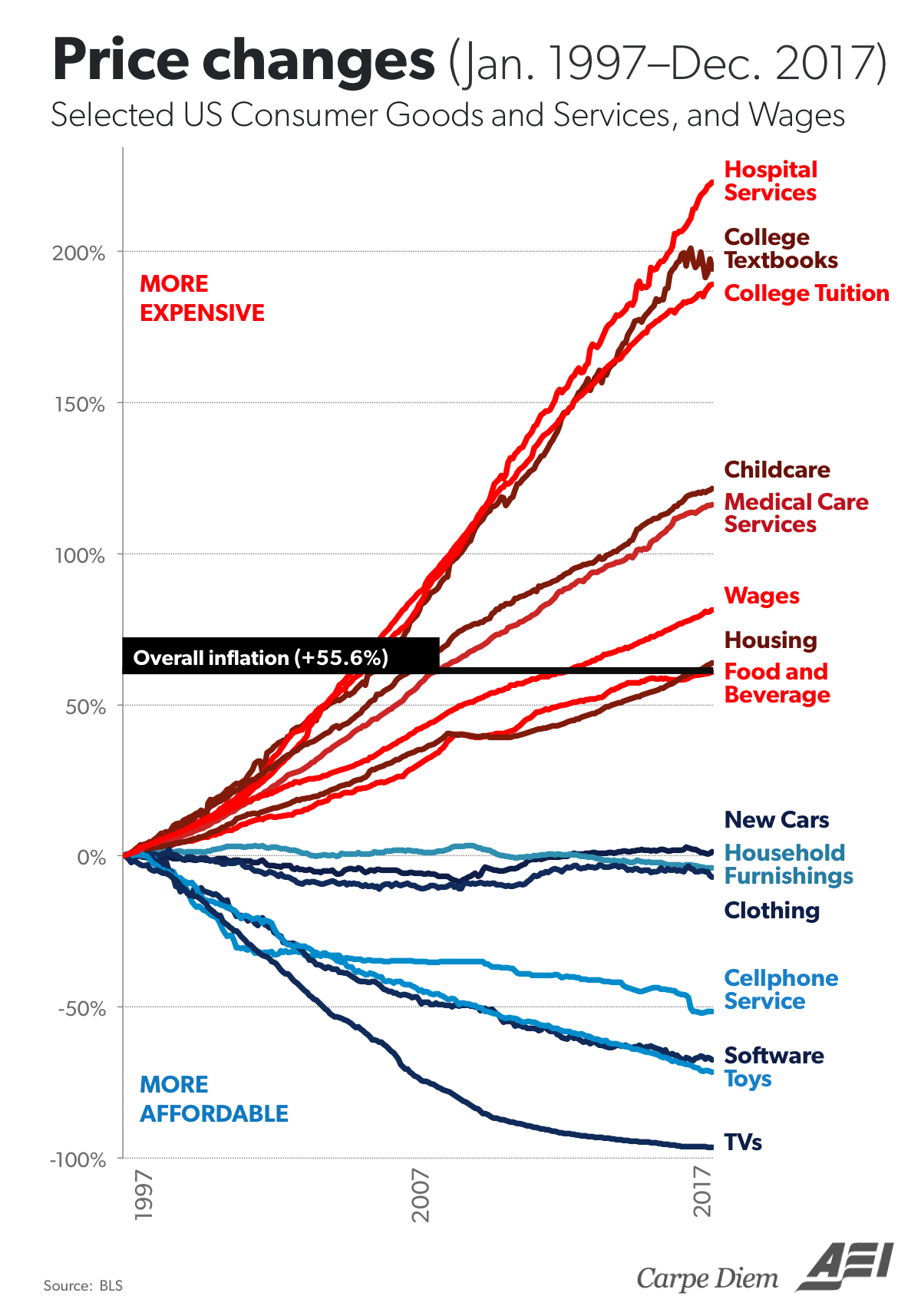
MOC's Incredible Price Growth


The chart above by Mark J. Perry, a scholar at the American Enterprise Institute and professor of economics and finance at the University of Michigan's Flint campus, was recently published demonstrating the rise in healthcare prices in government services affected by bureaucratic regulatory capture (red) and those that were not so affected (blue).

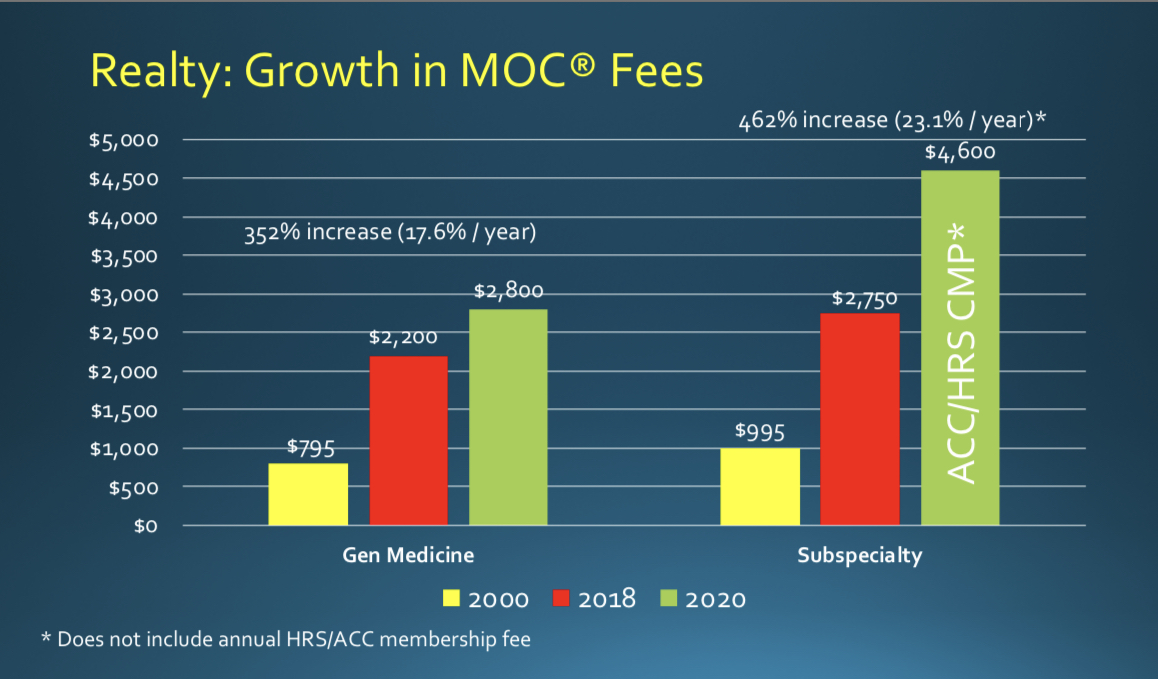
Physicians are directly feeling the brunt of this economic effect with American Board of Internal Medicine's (ABIM) Maintenance of Certification (MOC).

The American College of Cardiology and the Heart Rhythm Society have thrown their support behind the ABIM's MOC product by offering a new, even MORE expensive product, the Collaborative Maintenance Pathway (CMP), that will raise the cost for MOC over 462% from 2000-2020:


Think about that.

I would encourage all of my colleagues to support our GoFundMe effort the end the regulatory capture of the ABIM by contributing whatever you can to the anti-trust and racketeering lawsuit against them.

Thanks.

-Wes

Friday, June 28, 2019

The ABIM Tax Man Commeth... Again

Yesterday, lots of busy internists received email notices of another $140 check due to the American Board of Internal Medicine (ABIM). Physician's "Maintenance of Certification (MOC) fees are now an annual tax internists must pay to practice medicine. Physicians should ask themselves why they must pay for this unproven "educational promise" tied to their initial board certification that "tells the public" they keep up with their continuing medical education.

No doubt many will pay, simply because they have to do so - they signed an "adhesion contract" that binds them to this annual tax despite the fact that their payment will go to a private, unaccountable organization that has shown years of financial and political mismanagement.

I would advise physicians consider balancing the extortion with a contribution of any size to our GoFundMe page that supports the plaintiffs who sued the ABIM for alleged antitrust, racketeering, and unjust enrichment claims. Opposition to the ABIM's Motion to Dismiss has been filed, and the ABIM is on the ropes like never before. Now is our chance. It's now or never. There is simply no free lunch - legal fees are considerable for a legal case of this complexity.

Wouldn't it be nice to end this monetary and professional injustice once and for all?

-Wes

Monday, June 24, 2019

Re-Defining Medical Professionalism

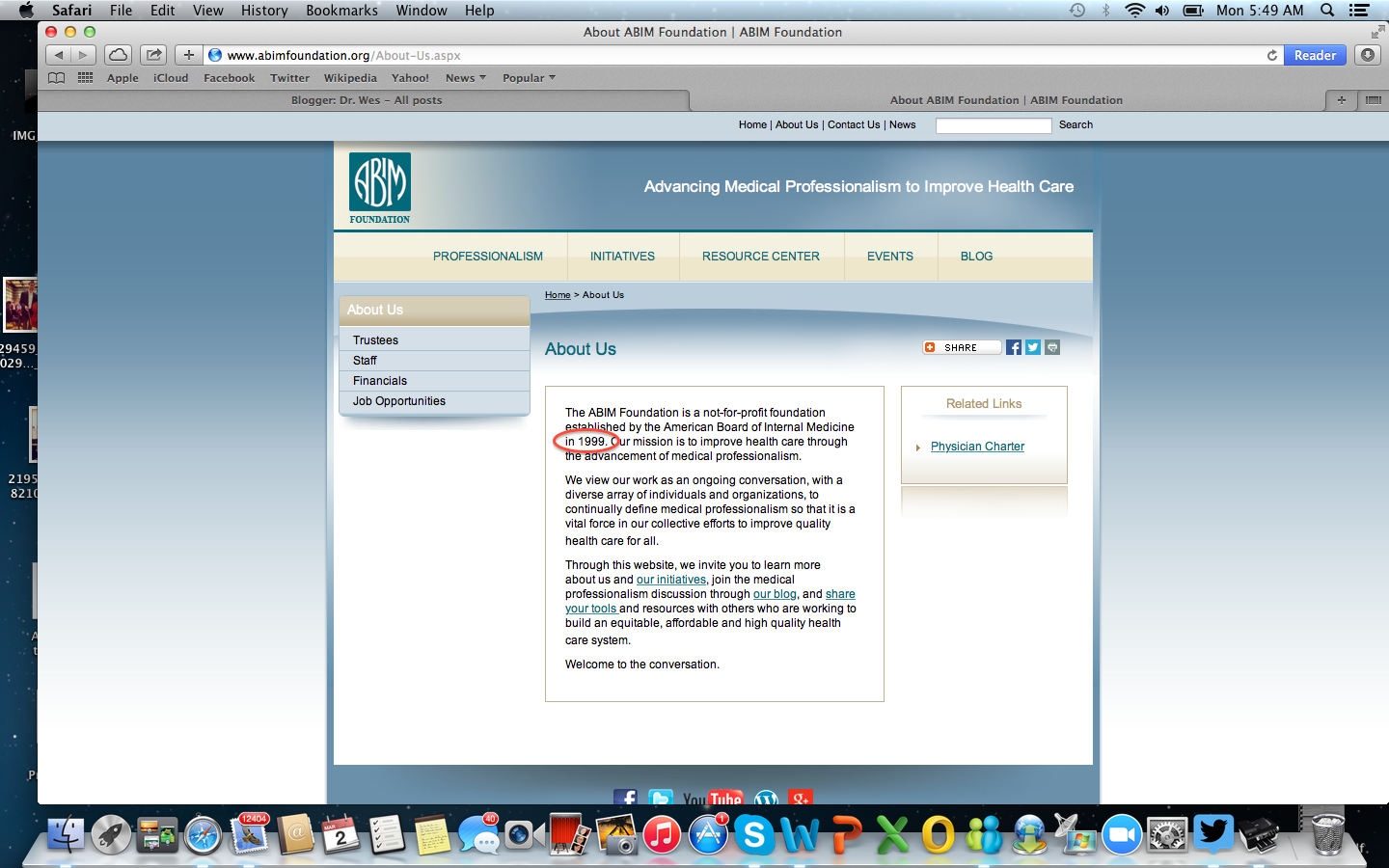
In 1999 we were told a new organization was created by the American Board of Internal Medicine (ABIM) to "improve healthcare through the advancement of medical professionalism." That organization then created a workgroup to create a white paper on "medical professionalism co-published simultaneously in the Annals of Internal Medicine and Lancet called "Medical Professionalism in the New Millennium - A Physician Charter."

The President and CEO of the ABIM Foundation has recently begun a speaking tour called "Rebuilding Patient Trust" that started with a Ted talk here in Chicago several weeks ago and now has spread West to the Aspen Ideas Festival. Given this, it is now abundantly clear that the ABIM Foundations' definition of "medical professionalism" needs rebuilding. As a past and future patient, the notion that the head of one of the most trust unworthy organizations in medicine is man-splaining to me how to "rebuild patient trust" is about as creepy as it gets. Visions of catholic priest pedophiles grooming their vulnerable victims comes to mind. Why is this?

Simply, the President and CEO of the ABIM and ABIM Foundation has not proven himself to be a trust-worthy individual. Trust-worthy individuals do not deceptively file tax forms. Trust-worthy individuals that run a 501(c)(3) non-profit organization do not purchase luxury condominiums for themselves. Trust-worthy individuals do not hire felons to serve as test security directors that raid people's homes. Trust-worthy-individuals to not lobby Congress as a 501(c)(3) organization and fail to claim this on tax forms. Trust-worthy individuals do not off-shore physician testing fees to the Cayman Islands. And trust-worthy individuals do not restrict their colleagues right to work because they refuse to succumb to tactics that leverage their false claims to hospitals and insurers to assure their products are purchased.

Patients know better.

Especially this one.

Honesty, transparency, and accountability are the foundations of medical professionalism.

Publicly gaslighting patients as a non-practicing physician in the name of re-establishing "trust" is true medical professionalism's antithesis.

-Wes

Saturday, June 15, 2019

"Nothing Else. Promise!"

From Sermo:
There is no evidence that recertification makes better doctors. All evidence points to a process that merely enriches the boards that impose their wills upon us.

I was one of the first classes to not be "grandfathered". Those who came before me said "Everyone needs to recertify, except us, we're special." But don't worry, they said, it'll just be an open-book, take-home exam every 10 years.

Except then then changed it to a proctored test that I have to drive 2 hours to, taking a full day off work, leaving the night before, and paying an exorbitant amount to be suspected of being a criminal as I show 2 forms of ID, and sign multiple documents stating I am who I say I am, and am video taped while taking the test, and can only use the bathroom during this time with permission.

But that s all! That said. Except it wasn't. We also need you to do a few CMEs. Just a few. Ok 100, alright 200. Better make that 300.

But that's it! Nothing else. Except for these self-assessment exams. You just need to do one. Ok 2. Alright fine, 4. But that's it!

Oh, except for this self-improvement project. Yeah, we need you, over several months, to do an experiment on your patients. No IRB oversight needed. Just pick something, make a change and tell us how much better your clinic is for doing this, ok?

But that's it! Nothing else!

Oh, except the money. Pay each year or we list you as "not current" on your MoC. Pay us, pay us again, and keep on paying us. Lots and lots of money to keep up. And we promise not to add anything else. PROMISE! (fingers crossed behind back).
Legal work takes money. That money is necessary to get past the numerous Motions to Dismiss attempting to throw out the numerous lawsuits recently filed against the ABMS member boards in order to proceed to discovery.

Have you done your part to help?

-Wes

Wednesday, June 12, 2019

More Legal Trouble for ABIM

Last Thursday, US District Judge Katherine Hayden ruled in favor of Jaime Salas Rushford, MD's motion to sever and transfer his counterclaims and third-party complaint against the American Board of Internal Medicine (ABIM) to the District of Puerto Rico.

For those unfamiliar with this case that began in 2014, a brief summary is included in the Opinion (references removed):
ABIM is an Iowa corporation that oversees the board certification process for internal medicine physicians, which includes administering a one-day, computer-based exam given annually on different days at testing centers nationwide and abroad. Salas Rushford resides and practices medicine in Puerto Rico, where he (was) registered to take the 2009 ABIM exam. In preparation, he enrolled in a preparatory course given in New York by Arora Inc., a New Jersey corporation that gives courses to physicians seeking board certification.

In December 2009, ABIM sued Arora (the “ABIM-Arora action”) in the Eastern District of Pennsylvania, alleging that the company “unlawfully obtained ABIM’s secure [e]xamination items by mobilizing course attendees to divulge the contents of the [e]xamination” in violation of federal copyright law. (Am. Bd. of Internal Med. v. Arora, No. 09-05707). That complaint also named John Doe defendants, “a presently unknown number of past and/or present candidates for Board Certification who have complied with [Arora’s] requests…to provide secure, copyrighted [e]xamination content to Arora for further dissemination.” The ABIM-Arora action settled and was dismissed in mid-2010. (June 11, 2010). Non-identical tests are offered through the month of August, which offers early test-takers the opportunity to alert later test-takers about content. To guard against this, ABIM requires that before they take the exam, all candidates must sign a “Pledge of Honesty” whereby they promise “not to disclose, copy, or reproduce any portion of the material contained in the Examination.”

It took ABIM until October 2014 to sue Salas Rushford in this district, alleging in a one count complaint that he was among those John Doe “past candidates” who unlawfully shared exam questions with Arora. Salas Rushford moved to dismiss for lack of personal jurisdiction. Early in 2015, while Salas Rushford’s motion to dismiss was pending in this district, ABIM sued him in the District of Puerto Rico in a parallel action, asserting a copyright infringement claim identical to the one it filed here. In both actions, Salas Rushford filed counterclaims against ABIM and a third-party complaint against the ABIM Individuals alleging malicious breach of contract, commercial disparagement under the Lanham Act, 15 U.S.C. § 1125(a), and tortuous conduct under Article 1802 of the Puerto Rico Civil Code. In these claims Salas Rushford challenged ABIM’s publication on its website that Salas Rushford’s board certification was “suspended” during a disciplinary investigation, as well as the manner in which that investigation and subsequent hearings were conducted. In addition to his motion to dismiss, Salas Rushford moved to stay the action in this district pending the result of the Puerto Rico litigation and for sanctions. In September 2015 this Court denied Salas Rushford’s motions and in the same month, the district court in Puerto Rico dismissed the parallel action without prejudice.

Salas Rushford then moved for judgment on the pleadings on the basis that ABIM’s lawsuit for copyright infringement was barred by the three-year statute of limitations. In March 2017, this Court granted the motion, and dismissed ABIM’s complaint with prejudice. Following that decision, ABIM and the ABIM Individuals (Richard Baron, M.D., Christine K. Cassel, M.D., Lynn O. Langdon, Eric S. Holmboe, M.D., David L. Coleman, M.D., Joan M. Von Feldt, M.D., and Naomi P. O’Grady, M.D.) moved for judgment on the pleadings on Salas Rushford’s counterclaims and third-party complaint, and Salas Rushford moved to sever and transfer them to the District of Puerto Rico. (Magistrate) Judge Waldor granted Salas Rushford’s motion to sever and transfer in the Opinion and Order from which ABIM now appeals.
The 2010 Arora-ABIM case led to this article published the Wall Street Journal. That article claimed as many as "140 physicians" were involved, and mentioned five physicians that the ABIM had just sued. Dr. Christine Cassel, President and CEO of the ABIM at the time was quoted as saying:
"Any high-school kid knows that cheating is unfair," said Dr. Christine Cassel, president and chief executive of the ABIM, who called the sanctions "a message and a deterrent."
What Dr. Cassel had never mentioned were the tactics the ABIM used to bring those charges against the vulnerable Arora course attendees. Furthermore, none of the charges brought by ABIM were ever upheld in court.

No doubt US internists who have been subjected to the strongman tactics used by ABIM sense a bit of schadenfreude knowing the "ABIM Individuals" may be traveling to Puerto Rico to stand trial there, too.

Sadly, their travel and legal fees will be at our expense, too.

-Wes

Monday, June 10, 2019

Plaintiffs Respond to ABPN's Motion to Dismiss

The recently-filed plaintiffs' Opposition to the American Board of Psychiatry and Neurology's (ABPN) Motion to Dismiss concisely summarizes the legal issues with Maintenance of Certification (MOC):
ABPN sells initial certifications to new doctors to demonstrate satisfactory completion of their graduate medical education. ABPN has a 100 percent market share in the market for initial certifications, possessing monopoly (and market) power. ABPN also sells a maintenance of certification product to older psychiatrists and neurologists (“MOC”). According to ABPN, MOC tests something it calls “lifelong learning.” ABPN sold initial certifications for more than sixty years before it began selling MOC. ABPN forces doctors to buy MOC or have their initial certifications terminated, illegally tying its MOC product to its initial certification product in violation of Section 1 of the Sherman Act.

Psychiatrists and neurologists do not want to purchase MOC or would prefer to buy “lifelong learning” products from other providers, but cannot without ABPN terminating their initial certifications subjecting them to substantial economic consequences. In this way, ABPN holds each doctor’s initial certification hostage and controls the maintenance of certification market. Through these and other anticompetitive acts ABPN also has a nearly 100 percent market share in the separate maintenance of certification market. It obtained and continues to maintain its monopoly position in that market in violation of Section 2 of the Sherman Act.
Plain an simple.

Let's hope the truth will set us free.

-Wes

A True Story

From the front line of health care in South Carolina:
It had been a long week of consults and surgeries when he received the call.

"Doctor, why are you behind on MOC®?"

"Really, that's none of your business," he said.

They threatened to take his privileges.

He said, "No you can't because I'm relinquishing them now."

They said, "Wait!..."

He left.
Please help end the abuse.

-Wes