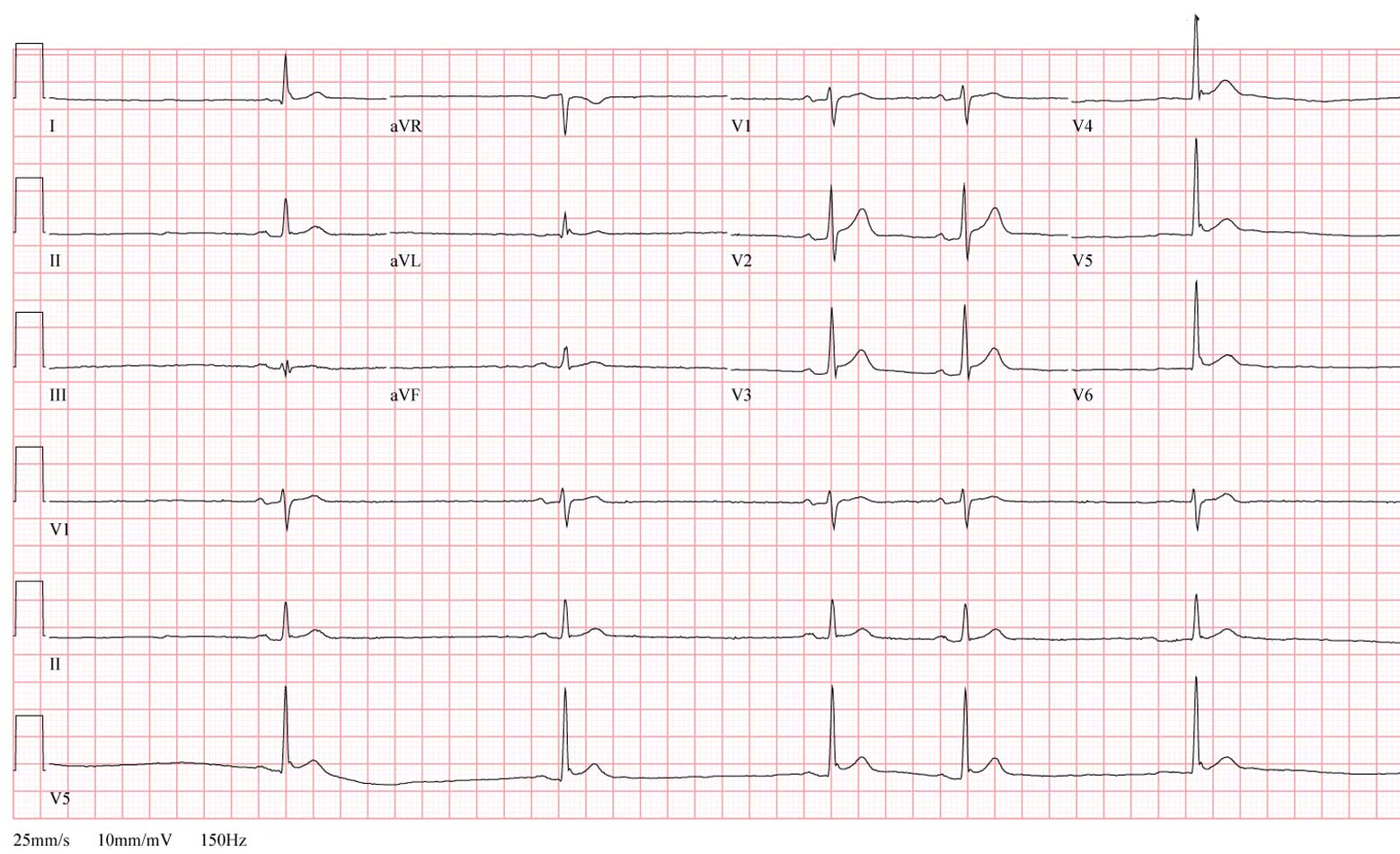
Click image to enlarge
An astute observer glanced at the EKG and posed an important question to the ER staff.
What was the question?
-Wes
Addendum 18:45 CST - The EKG image was updated to permit better enlarged viewing.
Urine noted to be bloody without clots.No doubt patient identification or their room number, was sent to identify the patient (I'm not sure which). I suppose a record of the physician covering the trauma service that night is discoverable.
Text message sent to 2290 (trauma pager) about hematuria.
Patient denies any pain at this time.
I am thankful for the teenagers who are complaining about doing chores -- that means they are home and safe.And one other thought: be sure to visit Paul F. Levy's blog, Running a Hospital, to learn about the Engage With Grace program to how you can engage in a conversation with your loved ones about their (and your) end of life wishes.
... for homework. It means we live in a country where education is valued and encouraged for all.
... for the taxes I pay; it means I have income.
... for the mess that I have to clean up after parties, because it means I am surrounded by friends.
... for the clothes that fit a little 'too snug' because it means I have enough to eat.
... for the lawn to mow, windows to wash and gutters to clean; it means I have a home.
... for the parking spot I found at the far end of the parking lot, because it means I am capable of walking and am blessed with transportation.
... for my huge heating bill, because it means I am warm.
... for the person behind me in church that sings off key, because it means I can hear.
... for the pile of laundry and ironing, because it means I have clothes to wear.
... for all the complaining I hear about the government; it means we have freedom of speech.
... for the alarm that goes off early in the morning because it means that I am alive!Author unknown
One factor that could be driving larger increases locally: Blue Cross & Blue Shield of Illinois, which historically has used its dominant 50%-plus marketshare to undercut competitors' prices, has been more aggressive with rates this enrollment season, brokers say.Funny that when hospital systems coalesce and raise prices to remain "competetive," the FTC cries foul, but when the insurance industry does the same thing, the FTC can't be bothered.
"Blue Cross is the one company that is consistently coming in with higher renewal increases," says Rob Wilson, an insurance broker and president of Westmont-based Employco Group.
A Blue Cross spokeswoman declines to comment.
11:30 pm - Cackling though the overhead intercom system:Now:
“Code Blue, Three East, Room 236”
A thunderous herd of medical students, residents, anesthesiologists, cardiologists, social workers, security personnel descend on the scene. Arriving, the chief resident is in charge at the foot of the bed. IV’s have been started, some young well-muscled individual is bobbing up and down on the unseen’s chest, brow glistening with sweat, but focused. An anesthesiologist, noting the agonal rhythm, works to secure the airway, then a central line. Nurses administer drugs, bring line kits. Airway secured. “EKG? Where’s the EKG?” Electrode replaced. “Story? Who’s got the story?” Ten. Twenty. Thirty. The minutes pass. Finally, silence, as the monitors removed and the group departs. Like sound and fury, signifying nothing.
11:30 pm – The pager sounds:-Wes
* bleep bleep bleep *
A digital image appears on the screen: CODE BLUE, Room 2001
I was not on call, but I wondered, “Was this a patient of mine?” “Did I forget someone?” I raised my head from the pillow and strolled in to the accompanying room where my outdated computer sat and waited while it booted. “What might have happened?” “Is it someone old or young?” Thoughts spun just as the disk drive. Waiting. I typed by keyfob’s codes, I entered by password twice, I waited some more then the electronic medical record appeared and I checked the name next to the room number. For the first time, the number meant something: a person, 88 yrs old, yet someone I did not know. The scene appeared from miles away.
I sat back and perused the chart. Heart attack, conservative management, hypotension, fluid bolus given, then nothing more.
A few more keystrokes and the computer went black.
Then sleep came poorly once again.
The discrepancy between what Medicare pays and our cost of providing care acutely impacts the sustainability of our primary care practice. Medicare reimbursements do not cover our actual costs of providing care, and therefore we have recently had to make some difficult decisions that will impact the Arrowhead Family Medicine practice. Effective January 1, 2010, the physicians at Mayo Clinic Family Medicine - Arrowhead will opt out of participating in Medicare, meaning that Medicare will no longer reimburse for the services they provide....With the $500 billion dollars of cuts to Medicare spending in the new health care bills proposed, will we see more of this in more affluent areas?
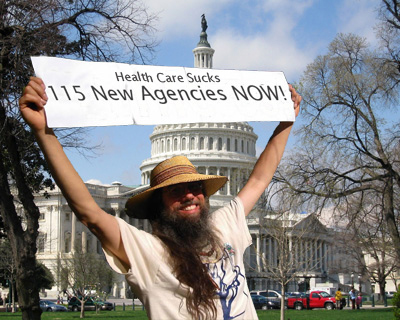
 Early US Health Care Reform Photoshop Contest entries are available to view here. (I did the one at left - sorry, it's ineligible). There's still plenty of time to submit your entry. Entries will be still be accepted until 30 Nov 2009 at 23:59 pm CST!
... There are lots of features of the House Bill and that are already in the Senate bill that change that (the way doctors are paid). We are beginning to move away, particularly in Medicare, from traditional fee-for-service pay that I would suggest not only causes redundancy but doesn’t encourage innovative, high quality, low cost practices to moving toward a system that exists in pockets, exists in Mayos, Geisinger, (Inter-)Mountain Health Care. We know what it looks like. It isn’t how medicine is practiced it isn’t the the hospitals and providers are paid, so "bundled payments," "medical care homes," "accountable care organizations" – all buzzwords for really providing financial incentives and eventually financial penalties for appropriate medical protocols and appropriate outcomes - stopping the system now where one out of every five who’s released from the hospital is back in 30 days having never seen a health care provider, reducing or eliminating hospital-based infections, which are now one of the top 10 leading causes of death in America. We know exactly the system that can be done to stop it. It doesn’t take any capital investment It doesn’t require any new technology.”I wonder what she means by "... eventually financial penalties for appropriate medical protocols and appropriate outcomes?"
Banos said the Diagnostic Clinic cardiologists recently approached Good Shepherd "demanding hundreds of thousands of dollars in compensation from Good Shepherd for providing call coverage to the patients of Good Shepherd."Before condoning the cardiology groups' actions strictly on the basis of greed, we should note that there is a precedent for higher pay for employees working after hours in industry. Hospitals, too, have resorted to paying "nocturnists" (night-shift hospitalists) higher salaries than their daytime hospitalist counterparts as they struggle to find staff willing to work the night shift managing inpatients. These salaries are not covered strictly by funds received from the paltry Evaluation and Management payments paid by Medicare, rather, they are subsidized by the hospital system.
"This is in addition to whatever money they are able to bill and collect from patients and their insurance companies for the services they actually provide when they are called in to perform a procedure," Banos said in his e-mail to Good Shepherd employees.
Banos said he believes the demands for compensation were "veiled threats to move their elective procedures to Longview Regional if we did not pay." He added Good Shepherd's stand is that meeting the compensation demands would "not be fair to the many other physicians on our medical staff who selflessly and without any expectation of pay [from the hospital] provide call coverage to our patients each day as part of their commitment to the community."
"We cannot meet the needs of our community and pay doctors for doing something that they are already obligated to do as a part of their community obligation" Banos said.
Banos said he believes Longview Regional agreed to pay the cardiologists more than $300,000 a year for on-call coverage.
"We do not believe that it was by chance that it was only after this agreement was reached that these physicians touted Regional's 'commitment to quality care' and announced their 'choice' of Longview Regional for their patients." Banos said. "We knew that taking a stand could result in these physicians moving their elective cases to Longview Regional, and it did."
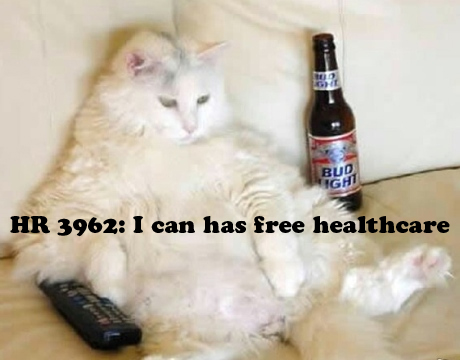

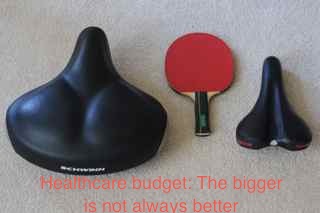



 If you'd like to help promote this contest on your blog by placing this tacky button on your sidebar, just copy the HTML in the textbox below and add it to the your blog's sidebar code:
FDA is investigating energy levels in (automatic) external biphasic defibrillators (AEDs) with shocks ≤ 200 J. FDA has received reports of 14 events since 2006 in which a 200 J biphasic defibrillator was ineffective in providing defibrillation/cardioversion therapy to a patient, whereas a subsequent shock from a different 360 J biphasic defibrillator resulted in immediate defibrillation/cardioversion. The majority of events occurred during attempts at cardioversion of atrial fibrillation, but there was at least one instance with defibrillation of a ventricular arrhythmia as well. FDA is seeking additional information in order to interpret the significance of these events, and to determine whether FDA activities are advised.I haven't seen this, but others may have, so let 'em know.
Next week, I'll check into Mayo, one of the world's premier hospitals, to undergo additional treatment in preparation for receiving a new heart. Since my brain tumor turned out to be benign and my prostate cancer has responded to treatment, doctors there said those issues no longer should disqualify me as a candidate for a heart transplant.With the competetion for patients underway as the large health care system land-grab extends across state lines and overseas (See here and here), have the selection criteria for transplant patients remained a form of rationing or really become a form of marketing?
Now that I'm on the list, I am on an around-the-clock standby alert. I have to be ready to be on the operating table within four hours once a compatible heart becomes available. The fact that Chicago is 331 miles from Mayo, in Rochester, Minn., complicates things since I don't have my own charter jet. But the Mayo Med Air charter service could assist me if a commercial flight can't get me there quickly enough.
The challenge now is the wait. The heart I need will become available only when the donor is declared brain-dead and his heart can be taken from him and implanted in me within four hours. I am told the fact my blood type is B positive increases the chances of me getting a transplant quicker, though there are other patients ahead of me.
I had wanted it all to happen at the University of Chicago Medical Center, where world-renowned Dr. Valluvan Jeevanandam, who performed a triple-bypass on me in 2001, has done more than 1,000 transplants. But that hospital takes a more conservative approach to the fact my prostate cancer still is in remission. They wouldn't put me on the transplant list until I had been using an implanted heart pump ''for several years.''
Fortunately, the Mayo Clinic and Northwestern Memorial Hospital feel I have progressed enough in my recovery from the slow-growing prostate cancer to be eligible for a heart now.