"It's that time of year."
"For what?"
"For our annual performance reviews. You know, where we rank our employees as "does not meet expectations, meets expectations, or exceeds expectations." They laughed. It was a plesant, social affair, and while he didn't work in a hospital, he did work for a health care corporation. I couldn't help but listen to the conversation, since it sounded so familiar.
"... and if they don't meet expectations, we have to develop a 'PIP'."
"PIP?"
"A Performance Improvement Plan. And that will lead us to a good discussion about an ACR."
"ACR?"
"Annual compensation review. This of course, drives the merit increase conversation."
"Merit increase conversation?"
"The merit increase must average 2.5%, ranging between 1 and 4% depending on whether you're below expectations, meet expectations, or exceed expectations. Hah! It doesn't really matter, now does it, since state taxes have gone up so much around here. So there you have it. I love my job," he chuckled as he sipped his beer.
It's strange how much our medical vernacular has changed and is starting to sound like the corporate vernacular:
"Meaningful use."
"Guidelines."
"P4P"
"Measures."
"MGMA Benchmark."
Won't be long until I have a PIP.
-Wes
Showing posts with label healthcare. Show all posts
Showing posts with label healthcare. Show all posts
Sunday, February 13, 2011
Sunday, August 22, 2010
Why Your Insurance Premiums With United Healthcare Are High
... because they're funding foot paths for the American Heart Association with them.
Never mind that walking can be done pretty much anywhere.
And I guess it would be presumptuous of me to ask the American Heart Association to fight on behalf of patients against the bureaucratic overhead imposed by United Healthcare's newly enacted Cardiology Notification Requirement starting 1 September in Illinois now that United Healthcare has given so much money to the American Heart Association, wouldn't it?
But look at it on the bright side: at least our patients will have some nice concrete to look at while they walk.
-Wes
Never mind that walking can be done pretty much anywhere.
And I guess it would be presumptuous of me to ask the American Heart Association to fight on behalf of patients against the bureaucratic overhead imposed by United Healthcare's newly enacted Cardiology Notification Requirement starting 1 September in Illinois now that United Healthcare has given so much money to the American Heart Association, wouldn't it?
But look at it on the bright side: at least our patients will have some nice concrete to look at while they walk.
-Wes
Tuesday, May 25, 2010
Vanishing Oath Premiere A Success
 I would like to take a moment to thank the over 120 people who took time out from their busy schedules to attend the Chicago premiere of The Vanishing Oath at the Wilmette Theatre last evening. For many, it was the first time people they were exposed to the challenges that confront physicians daily in our current health care system.
Following the film, the audience (comprised of approximately 65% non-physicians) participated in a question and answer session with film's producer, Ms. Nancy Pando (pictured here with me following the show). The critiques and comments were invaluable to the film team as they work to engage more people in the efforts underway to protect the doctor-patient relationship. Working with Ms. Pando, I hope to assemble a short video clip of a few of people's impressions about the film in the days ahead.
For those interested, there will be a second showing of the film on the south side of Chicago tonight at the the Dorothy Menker Theatre, Moraine Valley Community College, 9000 West College Parkway, Palos Hills, IL from 7-9pm. Both Ms. Pando and the film's director, Ryan Flesher, MD, will be attending.
-Wes
Tuesday, December 01, 2009
The Electronic Medical Record and The Challenges Ahead
For those who have not seen it, one of the better discussions on the achievements, limitations, and future challenges of the adoption of the Electronic Medical Record can be found at the blog of Howard Luks, MD, The Orthopedic Posterous in a guest blog by R. Vaughn, MD. Be sure to read the comments from some very informed patients, IT experts, doctors and even, yes, yours truly.
Although long, you'll learn something.
Not bad for an ortho guy...
;)
-Wes
Although long, you'll learn something.
Not bad for an ortho guy...
;)
-Wes
Sunday, November 15, 2009
US Health Care Reform Photoshop Entries
Last updated 24 NOV 2009 @ 06:00 AM.
Early entries for the US Health Care Reform Photoshop Contest are shown below in the order they were received. Remember, the deadline for entries is 11:59 CST 30 Nov 2009. This post will be updated from time to time as new entries arrive.
(Editor's note: We're putting the entries up as they're sent. Remember, you'll ultimately be the judge.)
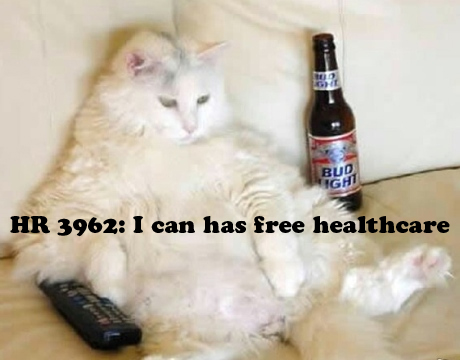
1) "Health Care Cat" (in the spirit of LOLCats):
2) "Gonnorrhea for Rationed Health Care"

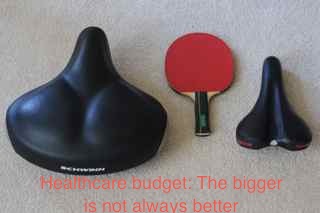
3) "Healthcare Budget":
4) "Taking Care of the Healthcare Pest":

Early entries for the US Health Care Reform Photoshop Contest are shown below in the order they were received. Remember, the deadline for entries is 11:59 CST 30 Nov 2009. This post will be updated from time to time as new entries arrive.
(Editor's note: We're putting the entries up as they're sent. Remember, you'll ultimately be the judge.)
1) "Health Care Cat" (in the spirit of LOLCats):
2) "Gonnorrhea for Rationed Health Care"
3) "Healthcare Budget":
4) "Taking Care of the Healthcare Pest":


Thursday, September 03, 2009
Strong-arming Caregivers
"Hey Sally, us guys wanna help you wid your kid, see? Maybe gets you a few more dollas, ya know. All ya gots to do is sign dis here form and we'll take care of da rest, capeesh?"
"Uh, I'm not sure I really want unions representing me as I care for my son at home."
"Whatdyamean? Everybody knows dat da governor here in Illinois is on board. Heck he allowed collective bargaining by, ya know, 'individual providers of home-based support services.' So dat means you, Sally. We're nothing but angels, really."
"Are you saying I can go on strike and not wipe my son's rear end?"
"Hey, not so harsh, Sally! You know we'd never suggest such a thing! Look, for a mere $2000 a year, we'll represent your interests down state. It'll be nothin' but roses, seriously. I mean, look at 'em. No one's got answers on nuthin' down der. Ain't it time to make some heads roll? Comeon, Sal. Sign da form."
-Wes
"Uh, I'm not sure I really want unions representing me as I care for my son at home."
"Whatdyamean? Everybody knows dat da governor here in Illinois is on board. Heck he allowed collective bargaining by, ya know, 'individual providers of home-based support services.' So dat means you, Sally. We're nothing but angels, really."
"Are you saying I can go on strike and not wipe my son's rear end?"
"Hey, not so harsh, Sally! You know we'd never suggest such a thing! Look, for a mere $2000 a year, we'll represent your interests down state. It'll be nothin' but roses, seriously. I mean, look at 'em. No one's got answers on nuthin' down der. Ain't it time to make some heads roll? Comeon, Sal. Sign da form."
-Wes
Tuesday, March 24, 2009
On The Defensive
A scenario:
Although I'm not proud of this, I caved to the paranoia. She stayed in the hospital another 18 hours because of it. A small price to pay, I suppose, but I am convinced I did not render the best care, just the safest care... for me.
It never ceases to amaze me how the threat of litigation constantly influences the medical care we deliver.
-Wes
Dr. Wes: "I wonder if I could treat a pregnant woman, 36 weeks gestation, who wants to breast feed, is hemodynamically stable but has atrial fibrillation with rapid ventricular response unresponsive to digoxin/beta blockers, with short-acting Ibutilide?"Guess which drug I used?
Dr. Google: "Several case reports exist treating pregnant patients with atrial fibrillation and atrial flutter without injury to mother or fetus and with no adverse effects."
The Obstetrician: "What's ibutilide?"
The Neonatologist: "Ibutilide? Has teratogenic potential at high dose in animals, including cleft lip and scoliosis, but at 36 weeks?...Maybe... Let me check with a pediatric electrophysiologist..."
Pediatric electrophysiologist: "We've used it in kids, but very cautiously... Never in pregnancy."
Pharmacist: "We have some concern, given the lack of human data."
ACC Guidelines 2006-Atrial fibrillation in Pregnancy(pdf): (Level of evidence: II-b or not II-b): "Ancient ineffective antiarrhyhmic drugs like quinidine sulfate or procainamide are generally thought to be safe in pregnancy."
Although I'm not proud of this, I caved to the paranoia. She stayed in the hospital another 18 hours because of it. A small price to pay, I suppose, but I am convinced I did not render the best care, just the safest care... for me.
It never ceases to amaze me how the threat of litigation constantly influences the medical care we deliver.
-Wes
Tuesday, March 03, 2009
Health Care Cost Comparisons
If you're uninsured and need a radiology test or medication, what might it cost here in Chicago? Thanks to Leslie's List, you can compare different centers head-to-head, albeit with some limitations:
What I also found was that the type of CT (16- or 64-slice) was not mentioned in the site (newer scanners might have different prices), but still, I found this site easy-to-use and informative.
So go ahead, check it out and compare. It might just save you a bundle.
-Wes
h/t: The Chicago Tribune's Triage blog.
BE AWARE! The prices quoted here may be in error for a multitude of reasons, including: erroneous information given by radiology center staff, improper recording of the information by Leslie's List(TM) staff, improper entering of the data into the database, and price changes made by the radiology center since we last called them.Leslie further clarifies what the prices mean:
"Just wanted to clarify the pricing of the testing included on our site. We always ask what physician reading fees are, as we realize that can tack on another 10-20% or so to the total charge. In many cases, the fee is included. In other cases, okay I'll just say it- often in the large hospital facilities- noone was ever able to tell us what the fees were, even after several calls to different deparments in the hospital. So in those cases, the fee is not included. In LesliesList.org you can click on the individual sites on the search results and you can see the breakdown of charges. Lastly, we only include radiology tests that each radiology site is fully accredited to do by the American College of Radiology."Although the number of centers is limited, it demonstrates the wide price differential between centers. CT of the chest with and without contrast can vary between $543 and $2498, depending on where its performed.
What I also found was that the type of CT (16- or 64-slice) was not mentioned in the site (newer scanners might have different prices), but still, I found this site easy-to-use and informative.
So go ahead, check it out and compare. It might just save you a bundle.
-Wes
h/t: The Chicago Tribune's Triage blog.
Monday, February 23, 2009
Health Care Cut Backs
... are affecting everyone:
-Wes
"Doctors are noticing the trend as patients skip or defer treatments because of the troubled economy.It was interesting to note that the article quoted a local "recently retired" internist. The untold story within this story is that hospital systems are equally strained as procedural revenues dwindle, placing increased pressure on their physician workforces to "produce."
Many decline procedures even when they have medical insurance, doctors said, because the procedures are so expensive they can't afford the out-of-pocket costs. For a colonoscopy, a stress test, an MRI or a CT scan, the patient's co-pay can run to hundreds of dollars."
-Wes
Thursday, January 29, 2009
Specialist Health Care of the Future?
AsktheMedicalSpecialist.com: Two questions answered for $19.99... within 48 hours... guarenteed or your money back. With some liability disclaimers, I'm sure.
-Wes
PS: I'm still trying to figure out how their cardiologist will handle my symptoms of an acute MI. Maybe he'll just say, "Best of luck?"
-Wes
PS: I'm still trying to figure out how their cardiologist will handle my symptoms of an acute MI. Maybe he'll just say, "Best of luck?"
Friday, January 23, 2009
Selling a Bill of Goods
A provocative piece about Dr. Anthony Marlon, former chief executive of Sierra Health Services appeared in the Las Vegas Sun today:
Seems like a screw job to me.
So, as a scientist and fellow physician, I ask Dr. Marlon to please, please, please explain the merits of his salary to his members who paid his salary year after year from their ever-increasing premiums. Why, exactly, does an insurance executive warrant a salary that is over 41 times a general cardiologist's salary?
After all, it's all about transparency, right?
What, cat got your tongue?
-Wes
Marlon is the founder and former chief executive of Health Plan of Nevada, the Las Vegas Valley’s introduction in 1982 to a health maintenance organization. Since early last year, Marlon has worked as a consultant for UnitedHealthcare after selling Sierra Health to UnitedHealth Group for $2.4 billion. His contract is up in February.$14.5 million in compensation made off the backs of the its 500,000 members? Hmmm, that translates to $29 per policy holder, just to pay his ridiculous salary each year.
. . .
In 2007 Marlon was the highest paid nongaming executive in Las Vegas, with total compensation of $14.5 million, according to In Business Las Vegas’ 2008 Book of Business Lists.
Today the company has 500,000 members.
And that health insurance companies put patients before profits “is an age-old adage as inane as the person mouthing it. You don’t stay in business, and build an organization as we have here, by screwing the public. (emphasis mine) That’s not the way it works. You’ve got to provide a quality product that somebody comes back and wants to buy again.”
Health Plan of Nevada offered the first insurance policies that covered preventive care when its doors opened in 1982.
Seems like a screw job to me.
So, as a scientist and fellow physician, I ask Dr. Marlon to please, please, please explain the merits of his salary to his members who paid his salary year after year from their ever-increasing premiums. Why, exactly, does an insurance executive warrant a salary that is over 41 times a general cardiologist's salary?
After all, it's all about transparency, right?
What, cat got your tongue?
-Wes
Monday, January 19, 2009
Once Again, the Airlines Have the Answer
I made it back from Boston the other night after attending the Boston Atrial Fibrillation Symposium - a huge affair that has grown way beyond my expectations. There were very-well prepared talks with doctors from (literally) all over the world in attendance. (Imagine a football field with eight giant big-screen TV's at one end).
But traveling to and from was tough.
At lunch the last day, I sat with some nice nurse practitioners from Canada and asked them about how things work at their hospital in the electrophysiology department - after all they worked for a big regional hospital outside a major metropolitan city like mine. I asked how many electrophysiologists they had there: three - two of whom do afib procedures and one who does more device rather than ablation work. I asked how many defibrillators performed a year and asked who paid for them, and she said the government. "But we got authorization to do five more devices next year," she said.
"Only five?" I asked in disbelief.
"Yep, and we were lucky. Other centers got fewer. They're expensive, you know. We have to be very careful about who we select to get one of those. It's not like America - people here are used to waiting."
"But what about SCD-HeFT and MADIT-II and the other trials?"
She smiled and looked down at her plate. "We have no choice, people up here don't have to pay for their care, so we have to choose who we think the best candidates are and do the best we can."
Suddenly, I thought about American Airlines. That's because my cell phone rang. An automated lady's voice answered: "Hello, this is American Airlines. We are calling to notify you that your flight, number.... 1-1-7-8 from.... Boston to....Chicago O'Hare.... has been cancelled." The phone went silent. I held, hoping beyond hope that the voice would continue with more information, like if I was rescheduled on another flight and when that flight might be, or why, just my flight to Boston my flight was cancelled. None came: only a faint background hiss. Silence. So I hung up.
I called back to arrange an alternative flight. I waited.
I smiled as it dawned on me, just as before, that while many have championed that the health care industry should emulate the airline industry, the airline industry has also learned a thing or two from the health care industry in its time of cost overruns:
... like covert rationing.
And then I wondered: would America ever be capable of overt rationing, as in Canada?
-Wes
But traveling to and from was tough.
At lunch the last day, I sat with some nice nurse practitioners from Canada and asked them about how things work at their hospital in the electrophysiology department - after all they worked for a big regional hospital outside a major metropolitan city like mine. I asked how many electrophysiologists they had there: three - two of whom do afib procedures and one who does more device rather than ablation work. I asked how many defibrillators performed a year and asked who paid for them, and she said the government. "But we got authorization to do five more devices next year," she said.
"Only five?" I asked in disbelief.
"Yep, and we were lucky. Other centers got fewer. They're expensive, you know. We have to be very careful about who we select to get one of those. It's not like America - people here are used to waiting."
"But what about SCD-HeFT and MADIT-II and the other trials?"
She smiled and looked down at her plate. "We have no choice, people up here don't have to pay for their care, so we have to choose who we think the best candidates are and do the best we can."
Suddenly, I thought about American Airlines. That's because my cell phone rang. An automated lady's voice answered: "Hello, this is American Airlines. We are calling to notify you that your flight, number.... 1-1-7-8 from.... Boston to....Chicago O'Hare.... has been cancelled." The phone went silent. I held, hoping beyond hope that the voice would continue with more information, like if I was rescheduled on another flight and when that flight might be, or why, just my flight to Boston my flight was cancelled. None came: only a faint background hiss. Silence. So I hung up.
I called back to arrange an alternative flight. I waited.
I smiled as it dawned on me, just as before, that while many have championed that the health care industry should emulate the airline industry, the airline industry has also learned a thing or two from the health care industry in its time of cost overruns:
... like covert rationing.
And then I wondered: would America ever be capable of overt rationing, as in Canada?
-Wes
Monday, December 29, 2008
Health Care Information Giants Like the Auto Industry?
Rick Peters, MD over at The Health Care Blog thinks so, describing them as "a few large players who build big, expensive systems on outdated technology platforms."
Ouch.
-Wes
h/t: Dr. Bobbs via Health Care BS.
Ouch.
-Wes
h/t: Dr. Bobbs via Health Care BS.
Tuesday, November 25, 2008
The Health Care Crisis in a Nutshell
This is a scary statistic:
The current average biventricular pacemaker implant costs only $3,714 less than median personal income of the US in 2006 and exceeded the median personal income of people from 21 states in the union that same year.
Wow.
-Wes
The current average biventricular pacemaker implant costs only $3,714 less than median personal income of the US in 2006 and exceeded the median personal income of people from 21 states in the union that same year.
Wow.
-Wes
Friday, November 21, 2008
Stakeholders

I really don't like it when policy wonks use the term "stakeholder" in the health care debate.
I mean, what do they mean? Do they mean someone holding a stake?
Or maybe it's someone holding a steak, and they just misspelled the term.
I suppose we all know what a stakeholder is: it's someone who has a "stake" in making a profit monetarily from our health care system. As such, the term really has nothing to do with patients, since patients are always the one's paying the for the big, juicy 64-ounce porterhouse "steak" that health care has become.
You see, "stakeholder" is a business buzzword, and make no mistake, health care is business, America. Big business. And Big Business wants what's best for you - really - just so long as they get their piece first. Rest assured that the back-room dealings in our non-transparent system will assure that they will continue to adjust prices to assure their profits, paying themselves first and justifying payment costs to the doctors and nurses ultimately responsible for your care in turn. That's the way business works - they MUST respond to their shareholders - those with a financial stake in their business - before they respond to their customers. For viability, business interests must always come first.
So who are these "stakeholders?"
The Insurance Companies
Insurance companies are powerful players in the health care debate. This is not to say that insurers are not important to future health care policy. On the contrary: insurers can play a vital role at making health care affordable to many by spreading risk across many contributors. But insurers do not currently modify their practices based on the individual policy holder's needs. No, insurers answer to the individual's employers, and regrettably a conflicted intermediary is born: one who wants to limit costs and bids on behalf of their group of patients, rather than individual preference or need.
The Employers
Employers are the next big "stakeholder" in the health care debate. They feel they have to pay the bill. At least they did. Suddenly, with the increasing costs associated with health care, they're finding harder than ever to offer health insurance to their employees. They know that without insurance, they might be placed at a competitive disadvantage when recruiting new talent for their company if this benefit is NOT offered. So they succumb to market pressures, and offer a policy that will be affordable, yet just accommodating to the majority of their employees. Lately, these policies shunt more of the costs to the employees themselves.
Hospitals
But the complexity (and "stakeholders") expands further. Hospitals compete for the large patient population of patients held by employers. They spruce up their facilities, increase their market footprint, and buy the latest gadgetry in a never-ending marketing push to secure more of the patient population under their care. There is a business imperative to be all-accommodating to patients and open, Walgreens-like, a clinic on every corner. With more patients, they drive a harder bargain with insurers, pointing to the high cost of doing business as rationale enough to justify their demands for higher payments from the insurers. Insurers, then, court the businesses, and
The Pharmaceutical, Device, and Health Care Support Industries
The fight between hospitals and insurers would not be as brisk if it weren't for the high cost of consumables in health care. Drugs and devices are the easy entities to discuss, but one cannot overestimate the ancillary service industries that have sprouted to support the complicated billing-denial-payment collection cycle that is now commonplace in health care delivery today. Everyone gets a piece of the action. A new cardiac device supplants the old, without any real need, because it adds a new bell or whistle and market analysis says "it's wanted." We have over 75 drugs to treat hypertension, but only the latest and greatest are touted. Advertisers subsume the nightly news with their commercials asking the public if they've talked to their doctor about erections lasting four hours. It's crazy.
You
Meanwhile, the patient is paying the bill for this expansion and market positioning through higher insurance premiums, higher deductibles, and higher cost markups that appear on their health care bill.
With our most recent election, our health care funding crisis began to surface as a critical issue. Americans voted for "change." But so far it appears we're going to get more of the same when it comes to health care, simply because the system of third parties remains intact. In its current iteration, it appears now another layer of bureaucracy is being envisioned: a board modeled on the Federal Reserve to “offer a public framework within which a private health-care system can operate more effectively and efficiently — insulated from political pressure yet accountable to elected officials and the American people.”
What?
The only real objective "change" I have heard discussed has been an overt shift of Medicare payments from specialists to primary care to support the primary care troops.
Okay. I'm game. Socialists principles are applying. I get it.
But employers will still be paying for their employee's insurance, insurers will still be bickering with hospitals and courting employers, hospitals will still be growing their networks and facilities, and the patients will still be paying all of the costs, except now some of those costs will be conveniently disguised as our national debt.
In essence, we seem to have a bunch of plate-spinning going on here by the
And so, from the 50,000-foot view, patients will ultimately be left holding the financial bag, unless somehow, some way, we wrestle control of our own money from that of the third party stakeholders and assume responsibility for our own long-term well-being and health. Structuring such a system would amount to real change.
But then, we want the government to make the change for us, don't we?
-Wes
Image reference: Sizzle on the Grill
Friday, November 14, 2008
The Harsh Reality
Daniel Callahan explains his position on rationing health care for the elderly: is 80 years of age where we draw the line?
-Wes
There are in the end only two decisive ways to control Medicare costs: raise taxes, cut benefits, or both. Neither political party is game to raise taxes, for Medicare or anything else. As for cutting benefits, Congress this year voted for $20 billion in new expenditures, ignoring the need for frugality.Ninety seems like a safer bet to be palatable right now than eight as an age limit, but his points are worth pondering.
Yet there is nothing of importance left to do other than to reduce benefits. That move would mean denying elderly patients both what they might want and need. Or are there some less draconian alternatives? A long-standing refrain of many older people is that much money could be saved if they were more easily free — by living wills or the appointment of surrogates — to turn down expensive life-prolonging measures of dubious benefit. Maybe so, but some studies have shown that would not make much economic difference in an overall Medicare budget of hundreds of billions.
More important, despite what they say in advance, many elderly people will in fact choose to be aggressively treated for a critical illness even when there is a good chance it will not save them — but just might. Doctors endlessly complain to me that excessive patient expectations of medical miracles, or those of their family members, make it harder, not easier, these days to curtail aggressive treatment. Not all of us can resist the lure of a slightly longer life, despite what we may have said in advance.
-Wes
Talking Sense
Ben Brewer, MD lays out his proposal to treat our health care crisis:
I don't think so.
And yet, make no mistake, the push back will be substantial from those who benefit from the bureaucracy.
I am aware that even large physician groups such as ours, already equipped with the latest electronic gadgetry to track pay-for-performance initiatives, in their zest to go "all in" on the concept to earn their "gold stars" on the government's pitiful quality website (which is rarely consulted by patients, by the way), failed to cover the cost of implementing the initiative its first year. It's been just too many personnel, spending too many precious resources to gather data of limited value, rather than applied to the delivery of health care. (If you want to see just how bad it's become, check out the specifics over at the Happy Hospitalist.) This initiative has been a colossal failure in my book, but sold lock, stock and barrel to the populous by the policy wonks on Capital Hill.
So I can hear it now: "What will happen to all of those people paid to collect the data? They might become unemployed at this time of our colossal economic downturn! Our unemployment numbers will go up! We can't have that!"
Please.
We cannot afford NOT to make a significant change to the way we do health care today. I am convinced as Americans consider the options ahead of them, that they'll make the right choice and realize the consequences if they don't. Dr. Brewer's proposal makes a lot of sense.
After all, managing our own cash is looking pretty good right now.
-Wes
Looking at the way the government is doling out money these days, I have a proposal to help improve people's health and our system of care. What if the government gave each person $365 of their tax money back to be spent on primary health care?Is his idea so far fetched?
That amount could be paid directly to each person's primary care doctor for a year's worth of services. Imagine if everyone in America could contract privately for medical care for themselves with a primary care doctor without government or insurance company red tape.
The patient would choose the doctor. The basket of services would be predefined, and the price would be locked in for a year, paid as a monthly subscription like cellphone service or movie rentals.
Money spent that way would cover a lot of preventive health, office visits, management of chronic diseases, email contact with the doctor, and after-hours advice. Make it tax deductible for individuals as well as businesses.
Doctors like the idea of universal coverage, but don't like the idea of unfunded mandates, like some programs to improve quality that cost physicians more to implement than can ever be recouped.
They don't want to be conscripted into a national program that pays them less than their costs. They don't see Medicaid or Medicare for all as solutions because those systems skimp on primary care and impose crushing paperwork and regulation.
But it seems to me that it is time to get beyond the argument of whether health care is a right or a privilege. We need to do something practical to bring affordable, basic health care to working people. Primary care isn't cheap, but it's less expensive than any other option.
We have had a financial stimulus package. My patients spent their $600 checks on $4 gas to get to work. A better and longer-lasting use of the money would be a health-care stimulus package.
The attraction for the doctor would be no billing hassles, no massive insurance coding system, no extensive overhead, and no bogus pay-for-performance schemes that cost more than they save. The infusion of money would also bolster primary care and might make it more attractive to new doctors over the long haul.
For primary care doctors, a $1 per patient per day would make for reasonable income from a smaller group of patients than most of see now. Patients would get more time with their doctor when they need it. There would be fewer office visits just so the doctor can get paid for giving advice.
I don't think so.
And yet, make no mistake, the push back will be substantial from those who benefit from the bureaucracy.
I am aware that even large physician groups such as ours, already equipped with the latest electronic gadgetry to track pay-for-performance initiatives, in their zest to go "all in" on the concept to earn their "gold stars" on the government's pitiful quality website (which is rarely consulted by patients, by the way), failed to cover the cost of implementing the initiative its first year. It's been just too many personnel, spending too many precious resources to gather data of limited value, rather than applied to the delivery of health care. (If you want to see just how bad it's become, check out the specifics over at the Happy Hospitalist.) This initiative has been a colossal failure in my book, but sold lock, stock and barrel to the populous by the policy wonks on Capital Hill.
So I can hear it now: "What will happen to all of those people paid to collect the data? They might become unemployed at this time of our colossal economic downturn! Our unemployment numbers will go up! We can't have that!"
Please.
We cannot afford NOT to make a significant change to the way we do health care today. I am convinced as Americans consider the options ahead of them, that they'll make the right choice and realize the consequences if they don't. Dr. Brewer's proposal makes a lot of sense.
After all, managing our own cash is looking pretty good right now.
-Wes
Friday, November 07, 2008
Disrupting Healthcare
Interesting read from Forbes:
-Wes
The general hospital is not viable, and most would collapse tomorrow in the absence of subsidies, restraints on competition and philanthropic life support. Trying to diagnose and treat any disorder that anyone might bring through their doors has forced them to separate their individual specialist physicians and their pieces of equipment (i.e., radiology and surgery suites). This is good for shuffling patients from one department to the next in a flexible way, but it means that hospitals lack the tight integration that allows them to address adequately the different needs of individual patients. This complexity drives up their overhead and has in many cases led to inconsistent quality and safety. This is why many patients now opt to get their knees, spines and cancer treated in specialty hospitals designed around a narrower set of procedures. Hospitals need to disrupt themselves, or be disrupted by others, to reduce cost and improve quality.Interesting perspective that's worth the read.
-Wes
Wednesday, November 05, 2008
What's a Hospital Cost These Days?
The Illinois Health Facilities Planning Board today approved the merger of Skokie-based Rush North Shore Medical Center (RNS) with NorthShore University HealthSystem (NorthShore). This was the final regulatory requirement in the Certificate of Need process. The Change of Ownership Exemption Request stated:
-Wes
The fair market value of the facility is $53,734,360. ENH (now NorthShore) will provide approximately $54,000,000 to discharge Rush North Shore Medical Center’s indebtedness. In addition ENH (NorthShore) has committed to fund over $100 million in capital improvements at Rush North Shore Medical Center and will contribute $10 million to the Rush North Shore Foundation. The applicants have attested that all beds and services will not substantially change for at least 12 months following the completion of the proposed Exemption Application transaction, and there will be no change resulting in the restriction of patient admissions or reductions in access to care or a more restrictive charity care policy.But not to be outdone, earlier this week Northwestern Memorial Healthcare (formerly affiliated with NorthShore) agreed on a whopping $400 million dollar purchase of Lake Forest Hospital only 6.2 miles from NorthShore's Highland Park Hospital:
The 215-bed Lake Forest Hospital has been viewed as a prime acquisition target amid a string of hospital deals in the northern suburbs.Economic crisis? What economic crisis?
The hospital, though profitable, faces big capital-spending needs in coming years, including an eventual overhaul or replacement of its aging facility for more than $400 million. CEO Thomas McAfee has been seeking a partner to help the 108-year-old hospital access capital.
The deal would mark a major strategic shift for Northwestern Memorial Healthcare, which operates the Streeterville hospital and affiliated physician groups but does not have much of a suburban presence.
Northwestern University’s medical school also was expected to seek another training site for medical students and residents after severing ties earlier this year with NorthShore University HealthSystem (formerly Evanston Northwestern Healthcare).
The statement said that adding Lake Forest to Northwestern Memorial would “accelerate the building of the pre-eminent academic medical center for Chicago, Lake County and the surrounding regions.”
-Wes
Sunday, October 19, 2008
Health Care and Cronyism

I picked up the New York Times this morning and saw the front page story entitled "Building Flawed American Dreams" and expected to find a story about American health care. Instead, I found it was really a front page story about Henry Cisneros and his involvement in the backroom-dealings of the housing industry - the subprime mortgage deals that led to our current economic crisis. The story chronicles the myriad of regulators, financial institutions, and cronyism that created this crisis, unfettered by transparency, free market competition or disinterested oversight. Somehow, I couldn't help but think that the story was about health care after all.
Why?
Because the parallels to our proposed health care system of the future are, I'm afraid to say, remarkably similar:
Homeownership has deep roots in the American soul. But until recently getting a mortgage was a challenge for low-income families.Homeownership's roots in our soul pales in comparison to our own health care needs. Additionally. many families can no longer afford health care, or even the insurance policies that are supposed to be our saviour. "What do you mean we can't have health care for all? Of course we must! It is our moral imperative!" This is emotional manipulation - appealing to our most primal fears -a roof over our heads is primal, mortality more so.
So we stand on this slippery slope.
Enter the money.
We've gotten to the point where even our own presidential candidates have espoused health care as a "right" for every American. As we consider this entitlement, we must now ask ourselves how, exactly, the government will implement this initiative to make healthcare a "right." Can the government really supply the facilities, the doctors, the finances to make this happen? Or will they, like the housing industry, turn to private corporations to lead the charge? Who will get the contracts? What special legislation will be enacted to make it happen? Importantly, what business deals will be struck? What back-room deals and shennanigans will be cooked to make this impossible-to-finance system continue? Or will the parallels be as Mr. Cisneros said:
"I'm not sure you can regulate when we're talking about an entire nation of 300 million people and this behavior becomes viral.""Health care for all" has already become "viral." The entitlement attitude for affordable health care has become the cornerstone of healthcare policy in America. So can we expect to regulate a bloated system of bureaucracy that, like the housing industry, has its own set of self-interested parties?
If the housing crisis is any indication, I doubt it. The HUD-insured subprime mortgage party lasted through both the Clinton and most of the Bush administration. The private and public organizations that fed at the government trough have taken their money elsewhere. Or perhaps they are waiting in the wings for nationalized health care - follow the money. When will we ever learn?
And when the propped up government funded health-care system fails, then what happens?
-Wes
Subscribe to:
Posts (Atom)