Just added a new page to my ICD Tutorial that includes special precautions for people undergoing diagnostic or therapeutic medical or dental procedures.
--Hope this is helpful-
--Wes
Thursday, March 30, 2006


Tuesday, March 28, 2006
Atrial fibrillation - now what?
Got a tough question about atrial fibrillation? I'm thinking of updating my tutorial on Atrial Fibrillation. I'd love suggestions on what should be included....
--Wes
Monday, March 27, 2006
Elder care benefits.... are they worth it?
It was with interest that I read about employers offering benefits for employees to help them care for their aging parents. I have two parents over 80 years of age and things are getting tougher and tougher for them on a day-to-day basis to do the basic daily activities of living alone. Together they are able to barely hang in there, gratefully, but should either one of them become incapacitated, the other's needs are obvious. I'd like to help, and I don't think my employer pays for such benefits, so I'm accumulating "vacation days" to help out. But the duration of their needs are likely to exceed my vacation days. Should I expect my employer to fund someone to help my parents? Certainly if I generate tons of money for our hospital system (and the types of procedures I do certainly generate zillions of dollars for the hospital system each year...) but would it be cost-effective for them to supply funds for me to hire folks to help my parents? Or should that be my responsibility? (I think so and expect this). The cost to the patients and insurers will increase if such care is provided... Do we need these extra costs to the health care system? Now I could make them my "dependents" and use a "flexible spending account" to put away dollars, but this takes time, and the needs of my parents are much more likely to occur on an unexpected, urgent basis. Like it or not, this scenario is going to be played out my more and more individuals as the baby boomers hit their 60's and their parents are well into their 80's. Unlike employers providing child care (which has its own psychologic and emotional limits as busy work-a-day mothers drop their kids off a child care each day but occurs at expected times and for known durations) the care of elders is less predictable, but the benefits to their kids of being able to be with them during their final days no less important, regardless of the cost.
--Wes
Sunday, March 26, 2006
Fire your doctor.... or the insurer?
Interesting read from the NY Times on 22 March 2006 from Peter Salgo who makes a plea for a patient-directed revolution to fix the health care system by firing you doctor if you don't like him... Most docs I know spend alot more than "7 minutes" with their patients.... No doubt health care has changed, not necessarily for the better, but is this the answer? Plenty of people had some good points regarding this article in today's NY Times op-ed page. What do you think?
--Wes
Thursday, March 23, 2006
Microvolt T-wave Alternans Approved - Now what?
On 21 March 2006, the microvolt T-wave alternans as a reimbursible test to screen patients with reduced heart muscle function that might be at high risk for ventricular arrhythmias that can lead to sudden cardiac death.
So what is "microvolt t-wave alternans testing (MTWA)?" Well, the test is performed by placing special high-resolution electrodes designed to reduce electrical interference on a patient's chest prior to a period of controlled exercise. These electrodes detect TINY beat-to-beat changes in a portion of the EKG (the "T-wave") that represents a "resetting" current after the heart is stimulated. The changes are in the order of one millionth of a volt ("microvolt" range). A special mathmatical method of detecting these changes called "spectral analysis" is used to measure the timing change and amplitude change of the electrical signals. A positive test was present if the MTWA onset heart rate was <=110, negative if the maximum MTWA onset heart rate was >=105 and all others considered indeterminate. Indeterminate tests occurred because of noise (slightly less than 10% of the time), skipped heart beats (ectopy), inability to achieve a heart rate of 105, or inability to sustain t-wave alternans during testing.
One of the better recent prospective studies to evaluate T-wave alternans was recently published by Bloomfield et al. in the Journal of the American College of Cardiology (Vol 47, No 2, 456-63): "Microwave T-wave Alternans and the Risk of Death or Sustained Ventricular Arrhythmias in Patients with Left Ventricular Dysfunction." This is a follow-up investigation that expands the applicability of the test published in Circulation in 2004 which looked at just ischemic cardiomyopathy patients (weak heart muscles from coronary disease). In Bloomfield et al.'s recent study, 549 patients were studied, only 1/2 of which had ischemic coronary heart disease. In this study, either positive or indeterminate tests were lumped together and compared to a negative test. Bottom line: A negative test means there is a 2.5% chance of death or arrhythmia in 2 years, vs a 12.3% (positive test) to 17.5% (indeterminate test) risk of death or cardiac arrhythmia.
What was interesting was the numbers.... 549 patients (average ejection fraction 25%), 189 had normal (negative) tests (with 4 events), 360 patients had abnormal MTWA tests (with 47 events). "Abnormal" MTWA tests included either positive (162 patients) or indeterminant (198 patients) tests.
So will ICD implant rates in patient's with low EF be decreased if this test is widely deployed? I don't think so. Given the LARGER total number of patients with positive or indeterminate tests, relative to the number of patients with negative tests in this study. If this test is widely implemented in stress labs, while the patients with negative tests might be spared an ICD, the increased screening using this test might actually INCREASE the number of implanted devices, since far more patients will have positive or indeterminate tests AND CMS seems to be willing to pay for the testing.....
I guess the next question is will smaller cardiology offices be willing to shell out the $30,000 to purchase this machine and the $75 for electrode patches per test? You have to do a lot of T-wave alternans testing to see a return on that investment if the CMS reimbursement rate is low....
--Wes
Tuesday, March 21, 2006
Semi-colon's Unite!
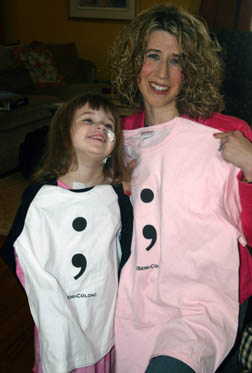
I had a wonderful opportunity to meet the wonderful mother and daughter team of Terri and 4 year old Gemma, (seen here) both of whom have Crohn's disease. Crohn's disease is one form of inflammatory bowel disease, an autoimmune disorder (where the body considers some of its own cells to be "foreign") and is thought in some cases to be linked to a genetic mutation of gene called NOD2/CARD15 and is marked by recurrent bouts of inflammation anywhere in the gastrointestinal tract. Although there is no known cure, there are lots of therapies that are effective in reducing the bouts of inflammation. It is estimated the Crohn's disease effects 500,000 people in the United States alone. They are busy advocating on behalf of folks with all forms of inflammatory bowel disease. They are seen with our "Semi-Colon" t-shirts from MedTees.com which they use to raise awareness and "bring out of the closet" the difficult issues associated with these diseases and to urge continued support of research into this disease. Importantly, they are also working to prevent cuts in research funding at the National Institute of Health, which is estimated to be reduced bu one million dollars in fiscal year 2007. Terri also participates in this Parents of Kids with Inflammatory Bowel Disease support group. Check them out, lend your support, and learn more about this illness from the Crohn's and Colitis Foundation of America.
--Wes
Thursday, March 16, 2006
Bioabsorbable stents might be on their way....
This news from the ACC from theheart.org:
Bioabsorbable magnesium-alloy stent safe to implant
March 13, 2006
Michael O'Riordan
Atlanta, GA - An interventional strategy that aims to eventually do away with the stent altogether has shown promising, albeit very early, results. Presenting data on a new bioabsorbable magnesium-alloy stent, investigators showed that the bare-metal stent met its primary end point, with a major adverse cardiac event (MACE) rate of 23.8% at four months.
Speaking with heartwire, lead investigator Dr Raimund Erbel (University Clinic, Essen, Germany) said that after four months, despite the complete disappearance of the stent, "the vessel lumen is nicely opened and we have not seen elastic recoil as a problem."
The results of the study, known as the Clinical Performance and Angiographic Results of the Coronary Stenting and Absorbable Metal Stents trial, known as PROGRESS-AMS, were presented during an i2 Summit late-breaking clinical-trials session here at the American College of Cardiology 2006 Scientific Sessions. The PROGRESS study was a prospective, multicenter, consecutive, nonrandomized trial evaluating the clinical feasibility of the stent, made by Biotronik in Berlin, Germany, in the treatment of a single de novo lesion in a native coronary artery.
Cool stuff. Now stents might not interfere with CT scans and MRI's.... just need to have a little drug ellution added to prevent restenosis...
--Wes
Wednesday, March 15, 2006
This article from Rand Health, a non-profit "policy" thinktank with plenty of corporate board members sounds alot like corporate CEO's flexing their collective desire for automation of the medical record, just like the "Leapfrog Group." Just look at the questionaire used to assess the care delivered. I always answered 'no' to test questions that include the word 'ALL' or 'ALWAYS', since rarely does a disease exist in isolation to other pathologies a patient might have. Looking at these "quality measures:" there are lots of 'ALL' and 'ALWAYS' measures.... wonder if this is why we scored so poorly as doctors... or could it be to make us look bad relative to computers?
Tuesday, March 07, 2006
Coffee, the Heart, and Starbucks....
OMG, just saw this story on "rapid" and "slow" metabolizers of caffeine and the variable effects coffee might have on the heart. (I'm sure I'm a rapid metabolizer....). Wonder if that's why Starbucks coffee stock (SBUX) took a 1.5% dip today.... Good to know that prior, LARGE studies demonstrated no additonal cardiovascular effects to caffeine. A study of nearly fifty thousand male health professionals showed no increase of cardiovascular disease due to coffee-drinking [THE NEW ENGLAND JOURNAL OF MEDICINE 323:1026-1032 (1990)] -- a result in agreement with the Framingham Study [ARCHIVES OF INTERNAL MEDICINE 149:1169-1172 (1989)].
--Wes
Monday, March 06, 2006
Soft drink peddlers beware....
Finally, this post exposes that non-dietary soft drinks and their high fructose corn syrup are soon to be on the obesity stage... and the response of the beverage industry is laughable....
--Wes
Sunday, March 05, 2006
Cutting my teeth on my first podcast...
Had a great time on my first podcast hosted by fellow bloggers, Dr. Helen Smith (a.k.a. Dr. Helen and Glenn Reynolds (a.k.a. Instapundit.com) and in conjunction with Laurie Anderson, RN of WebMD.
You can listen to it here. Love to get your feedback....
--Wes
Saturday, March 04, 2006
First Prospective Randomized Study in Chronic Afib Ablation
Chronic atrial fibrillation ablation may be coming to fruition after all. The 2 March 06 article from the New England Journal of Medicine by Oral, et al. from the U of Michigan and Milan, Italy researchers published a prospective randomized study of 146 patients with chronic arial fibrillation in which circumferential pulmonary vein isolation was superior to drug therapy at maintaining normal rhythm. 77 patients were randomized to the ablation arm (pulmonary vein isolation) and 69 were randomized to the control arm (amiodarone + 2 cardioversions). In an intention-to-treat analysis, 74 percent of the ablation patients were free from afib without antiarrhythmic medications at one year versus 58 percent of the controls. Of the 69 controls, 53 crossed over to catheter ablation.
The bad news is that over one quarter of the patients had recurrent atrial fibrillation (26%) and often troublesome atypical atrial flutters (6%) requiring a repeat procedure (not a big surprise, given the chronicity of the arrhtyhmia and the size of the atria involved). It is also important to realize that this study was performed collectively in two of the larger a-fib ablation centers worldwide, and results are not likely to be replicated as easily by low-volume centers. Nonetheless, it was encouraging that no other significant complications occurred in this study.
Bottom line: Afib ablation is coming, albeit slowly, and will take lots of patience and perserverence to achieve a 74% cure rate. Hence 26% of folks still will NOT be cured with this technique. We still need better tools, but the technology and techniques continue to improve. My hat's off to these centers and their work...
--Wes
Wednesday, March 01, 2006
Afib Ablation Makes ACC Managment Guidelines
This report from Cardiology News:
Any why not first line therapy? Well, not all folks agree on the safety and efficacy data, but there seems to be some consensus that centers with a higher volume of procedures have better outcomes.
The placement seems appropriate to me, since often patients can greatly reduce their number of episodes non-invasively with medical therapy before venturing into an ablation procedure. Also, the requirement that only ONE antiarrhythmic drug needs to be tried (especially if that drug is amiodarone, flecanide, sotalol or propafenone), permits the patient to seek non-pharmachologic therapies earlier, if desired. Note that in the substudy of the AFFIRM trial, amiodarone was the most effective antiarrhythmic medication of those listed above...
--Wes
"Catheter ablation for atrial fibrillation has been set as second-line therapy for all patients in the treatment guidelines scheduled to be released later this year by the American College of Cardiology, the American Heart Association, and the European Society of Cardiology. By the new guidelines, patients have to fail only one drug before they become eligible for catheter ablation. This recommendation applies to all patients with atrial fibrillation, including those with concurrent heart failure, oronary artery disease, or hypertension..."
Any why not first line therapy? Well, not all folks agree on the safety and efficacy data, but there seems to be some consensus that centers with a higher volume of procedures have better outcomes.
The placement seems appropriate to me, since often patients can greatly reduce their number of episodes non-invasively with medical therapy before venturing into an ablation procedure. Also, the requirement that only ONE antiarrhythmic drug needs to be tried (especially if that drug is amiodarone, flecanide, sotalol or propafenone), permits the patient to seek non-pharmachologic therapies earlier, if desired. Note that in the substudy of the AFFIRM trial, amiodarone was the most effective antiarrhythmic medication of those listed above...
--Wes
Monday, February 27, 2006
No wonder drugs are so expensive....
This from the Wall Street Journal today 2/27/2006 (See "Pfizer Shuffles Executive Roles"):
" ...Henry McKinnell, Pfizer's chairman and chief executive, earned $15.9 million in 2005, and is set to receive a pension valued at $83 million when he retires, which is scheduled for early 2008."
Geez.... And to think this year's salary is estimated to be 22% less than last year's.... How much is a single Lipitor pill?
--Wes
Sunday, February 05, 2006
A Shameless Marketing Campaign or Real Good for Girls?
I just got done watching the Super Bowl and was struck by Dove's "Campaign for Real Beauty" launched at young girls. Lots of multiethnic photos of cute, quite young girls with large doe eyes and a fund raising campaign (for the Girl Scouts) because over "92% of girls" don't like something about their appearance. According to whom? Where's the data? And what, Dove's gonna come to their rescue? Oh, PLEASE! And how much did this COST? ($2.4 million or so for 30 seconds?). I dare say that ALL of us, EVERY ONE, doesn't like something about our appearance, but we learn to live with it, we learn to accept ourselves for who we are rather than what we look like. And what about BOYS? (Note that not a SINGLE boy was shown in the ad.... why, because boys don't usually buy facial creams and beauty products! God knows that acne tormented me when I was young, but it certainly helped me understand that my body was changing and I knew with perserverance, its scourge would pass. Why? Because I knew and trusted my parents and friends who helped me through this time in my life. No Dove commercial made that happen! My friends were still friends, even if I had a zit on my forehead. And here's the deal... I HAVE a daughter. (She hasn't seen this ad, at least yet, she was playing with friends at the time). But the REAL issues is we're all human and the human body, ALL of 'em, are miraculous, incredible machines that are our very being and certainly need to be respected, and cherished, and yes, held in high esteem, but not because DOVE is gonna make it so, I'm perfectly capable of doing this. Please Dove, leave my daughter alone!
And if you're for the campaign (and I know many might disagree with me), then at least donate to the Boy Scouts of America, too.
--Wes
Thursday, February 02, 2006
Go Red for Women

Seems appropriate that February has been designated "heart month" by the American Heart Association. The "Go Red for Women" campaign is an important campaign to increase awareness of heart disease in women. If you want an eye-opening testimonial, just review the compelling story of Dr. Helen on our website, MedTees.com. Just yesterday, the Chicago Tribune had a piece on the WISE study which has illustrated the cause of some of the differences in presentation clinically of heart disease in women as opposed to men. It is remarkable that breast cancer, causing about 42,000 deaths annually in the U.S., has had a lobby/PR effort that has been so effective at getting their message out, but the heart disease lobby has had trouble reaching the masses regarding the sad fact that nearly 356,000 deaths in women occur per year in the U.S. from cardiovascular causes, nearly eight times that of breast cancer.
So tomorrow, wear red. Shirt, pants, socks, ties, and yes, t-shirts. Red, red, red. Time to get folks thinking about the impact of obesity, hypertension, diabetes, and genetics to contribute to this near-epidemic of heart disease in women. It's a lot more likely to kill you than bird flu, which seems to be having way too much press lately....
--Wes
Wednesday, January 25, 2006
The Ultimate Valentine's Day Message
For doctors and women of ALL ages, this piece that aired on the 24th of January, 2006 on WBIR TV in Knoxville, Tennesee in their "Style" program and featuring Dr. Helen, might be the most important Valentine's Day message out there we can give our loved ones. Wonderfully, it shows Helen wearing our "Death" shirt as she describes the concerning story about the lack of awareness of women's heart disease that continues to exist in our health care system. The disparity of symptoms that exists between men and women and the bias held by the medical profession (and I admit, it could just have been me who missed her heart attack) emphasizes the need to get this message out and remain ever-vigilant to heart disease in women.
The piece is faily lengthy (10 min), but is worth the time. I encourage all to view it. Please support the American Heart Association's "Go Red for Women" campaign.
--Wes
Monday, January 09, 2006
The incredible power of patients and friends....
Thanks so much to Dr. Helen and Instapundit for making our site ROCK yesterday! We have had some AMAZING suggestions for shirts from patients and friends of patients from ALL corners of the blog-o-sphere and world. We'll get 'em up as soon as we can.
Folks seemsed to resound with the idea of fun shirts for medical problems, and ideas were popping up all over, like this thread from a great Ankylosing Spondilitis bulletin board (yeah, it's a genetic arthritis that can effect the young and old alike and sets up shop in the spine, hips, pelvis...)
Keep those ideas rollin' Everyone benfits!
--Wes
Sunday, January 08, 2006
Join the Counterculture!
Well, it seems our little website, MedTees.com, is gaining momentum in its countercultural revolution to acknowledge that illness happens, it’s okay, and we can get through it. Dr. Helen is wonderfully quoted by Patrick Kampert of the Chicago Tribune in the brief article. Sorry the article’s picture of us wearing some of the shirts isn’t on line… but there’s still time to purchase the paper (see the Q section)! Thanks to all who’ve made our site so rewarding and so FUN. Spread the word, you just might make someone’s day a bit brighter…after all, that’s what it’s all about!
--Wes
Thursday, December 29, 2005
Atrial Fibrillation and Conflicts of Interest
Man, lots of interesting read from the Wall Street Journal about the relationship of the Cleveland Clinic and their investigators failure to disclose conflicts of interest with their patients.... Big centers like this can leverage their name for professional and even personal gain it seems. There are lots of smart docs out there looking for ways to develop equity in the field of their expertise, but they HAVE to disclose this relationship. The technology with Atricure is cool, tho' (uses a scissor-like clamp to burn tissue between the two blades using a bipolar application of radiofrequency energy during either open chest or "minimally" invasive "keyhole" cardiothoracic surgery to place insulating lines in the atrium to fix atrial fibrillation). I understand the surgeon's enthusiasm for the technology - but it still doesn't get these docs off the hook for non-disclosure. These are big boys in the big leagues. They took lots of tests and checked LOTS of boxes on standardized tests correctly to get where they are.... the "oops, I checked the wrong box" excuse just doesn't fly.
I actually worked with Mike Hooven (now"Chief Technical Officer" (but the real brains)) of Atricure which was a spin off from his first venture in bipolar scissors for minimally-invasive vein harvesting for coronary bypass grafting, Enable Medical) when I was in Cincinnati Ohio about 5 years ago. Atricure is now public and Mike has made a few zillion bucks, I'm sure. My hat's off to him. Mike's one smart "engi-nerd".... but I left Cincinnati for personal reasons (the medical climate there is tough, to say the least: too many hospitals, not enough patients/businesses) and was surprised to see all this! But the story really isn't about Mike, it's about the relationship of major centers taking stake in a company and "researching" and "teaching" without disclosing to the patient's or community to whom they teach (like fellow docs). Hmmm, seems the course at The University of Oklahoma Health Sciences Center Cardiac Arrhythmia Research Institute on "Minimally Invasive Surgical Ablation for Atrial Fibrillation" recently scheduled for 1 Feb 2006 was recently "rescheduled" after the Wall Street Journal piece appeared... Atricure, I'm sure, was to play prominently in the meeting.
Here's the problems in a nutshell:
The Cleveland Clinic has been an advocate of heart surgery with a device from AtriCure Inc. and has done the operation on 1,247 patients while having undisclosed ties to the manufacturer.
Among them:
A venture fund the Cleveland Clinic helped set up and put money into invested in AtriCure.
The Clinic's CEO (Cosgrove) helped manage that fund and invested in it himself.
The Clinic's CEO (Cosgrove) sat on AtriCure's board.
Cosgrove developed a device AtriCure plans to market, which would bring him royalties.
Another Clinic doctor, who used the device and reviewed it favorably in publications, was a paid consultant to AtriCure.
It might be best to let the dust settle a bit before having that conference....
--Wes
PS: I recently updated my bit on atrial fibrillation with a few more figures. Hopefully it will help out folks trying to sort all the incredible information out there. If it's too technical, let me know. I can clarify if need be. The point is to take yet another approach to the discussion and evaluation of afib that keeps the patient first.... Hmmm, an interesting approach these days....
PPS: Oh, for purposes of disclosure, I am on the Speaker's Bureau for Medtronic, Inc. :)
Subscribe to:
Posts (Atom)