I completed an implant of a biventricular pacemaker-defibrillator system on a 72-year old man the other day, and a nurse came out of the room after the procedure feeling uncomfortable, to say the least.
"He had a leopard-skin thong on! You know, with strings to hold up the sides and all..."
My natural response was:
"And?"
"Well, you know with sedation and all,..." she said. (I told her I'd heard enough).
Music in the operating room is well-established but varies by personal taste. Should there be a dress code for minor procedure rooms like cath labs and electrophysiology labs? After all, the dress code for operating rooms is already established: those ridiculous patient gowns and your birthday suit...
--Wes
Monday, June 19, 2006


On Heart Failure and ICDs
I was asked recently about the link between heart failure and implantable cardioverter-defibrillators (ICDs).
In a recent retrospective review of the landmark 2002 Multicenter Automatic Defibrillator Implantation Trial (MADIT-2) trial, it was found that patients with a weak heart muscle caused by a prior heart attack or coronary artery disease who had an implantable cardioverter-defibrillator (ICD) installed were at increased risk of new or recurrent heart failure (usually manifested by fluid on the lungs, cough, shortness of breath or leg swelling) after the first delivery of an appropriate shock. On the other hand, the study found, inappropriate shocks (e.g., those delivered for upper chamber rhythms that caused the device to reach its rate cut-off for calling a heart rhtyhm abnormal) apparently doesn't increase later heart failure risk. According to Heartwire:
Beta blockers they felt reduced the risk of hospitalization for heart failure significantly and doctors should be vigilant to watch for heart failure development in ICD patients who have suffered their first clinical shock. My experience has been that after an episode of recurrent appropriate ICD shocks, if we treat heart failure in many of these patients (especially with beta blockers), their shock frequency dramatically improves.
Whether biventricular pacing for heart failure (a newer technique that adds an additional lead to pace the left side of the main pumping chamber of the heart (the left ventricle) in tandum with the more conventional right ventricular lead installed with defibrillators and was found in other trials to reduce heart failure risk) should be considered in all patients is being studied now in the MADIT-3 trial. Stay tuned.
In short, if you have an ICD, its a good thing, you'll live longer. But there may be significant issues regarding heart failure development later if you need to use it.
--Wes
In a recent retrospective review of the landmark 2002 Multicenter Automatic Defibrillator Implantation Trial (MADIT-2) trial, it was found that patients with a weak heart muscle caused by a prior heart attack or coronary artery disease who had an implantable cardioverter-defibrillator (ICD) installed were at increased risk of new or recurrent heart failure (usually manifested by fluid on the lungs, cough, shortness of breath or leg swelling) after the first delivery of an appropriate shock. On the other hand, the study found, inappropriate shocks (e.g., those delivered for upper chamber rhythms that caused the device to reach its rate cut-off for calling a heart rhtyhm abnormal) apparently doesn't increase later heart failure risk. According to Heartwire:
"Our interpretation of this is that the ICD shocks by themselves don't damage the heart and don't increase the risk of heart failure—it's the life-saving ICD therapy transforming the risk of sudden death into a subsequent heart-failure risk," according to Dr Ilan Goldenberg (University of Rochester, NY), lead author of the post hoc study from the second Multicenter Automatic Defibrillator Implantation Trial (MADIT-2).
Another major finding from the analysis, he told heartwire, is that HF risk started rising after appropriate-shock delivery by either single- or dual-chamber ICDs compared with nondevice conventional therapy. That appears to contrast with some earlier studies suggesting that dual-chamber ICDs, as compared with backup single-chamber devices, can promote heart failure. But Goldenberg said a subanalysis including only patients with ICDs showed dual-chamber devices accounted for "a little more" of the risk increase. ICD shocks by themselves don't damage the heart and don't increase the risk of heart failure—it's the life-saving ICD therapy transforming the risk of sudden death into a subsequent heart-failure risk.
Beta blockers they felt reduced the risk of hospitalization for heart failure significantly and doctors should be vigilant to watch for heart failure development in ICD patients who have suffered their first clinical shock. My experience has been that after an episode of recurrent appropriate ICD shocks, if we treat heart failure in many of these patients (especially with beta blockers), their shock frequency dramatically improves.
Whether biventricular pacing for heart failure (a newer technique that adds an additional lead to pace the left side of the main pumping chamber of the heart (the left ventricle) in tandum with the more conventional right ventricular lead installed with defibrillators and was found in other trials to reduce heart failure risk) should be considered in all patients is being studied now in the MADIT-3 trial. Stay tuned.
In short, if you have an ICD, its a good thing, you'll live longer. But there may be significant issues regarding heart failure development later if you need to use it.
--Wes
Sunday, June 18, 2006
Saturday, June 17, 2006
The Plastic Stethoscope
Remember this scene from the 1967 movie, The Graduate when Benjamin is learning what he REALLY needs to know about life?
There may be more truth in this line that I realized since first seeing this movie.
When we were young eager medical students with our open-eyed wonder at the incredible intricacies and complexities of medicine, the physical exam opened an incredibly interesting and cost-effective way to actually diagnose ailments with the touch of your finger, sounds reaching your ear, or discovering the characteristic sweet infectious smell of pseudomonas aeruginosa colonizing an open wound. Each of us were given the almost magical opportunity at making important diagnostic revelations with only our senses. Perhaps most important to me, a budding young cardiologist-to-be, was the revelation that when I placed my first Sprague-Rappoport stethoscope to my ears, I could actually hear those subtle heart sounds that I had been taught. No cheap substitute stethoscope would do - it just didn't have the acoustic characteristics to bring the subtle heart tones to my ears like that bright, shiny, heavy, testimonial- to- careful- engineering could bring. It was like the difference between HD radio of today and the old AM stations of earlier times. No comparison.
Last Thursday (6/15/06) in the Wall Street Journal, there were two articles juxtaposed on the same page: "Hospital Intiative to Cut Errors Finds About 122,300 Lives Saved" and "Ambulances Find Overwhelmed ERs 'At Breaking Point'." One article extolled the phenominal gains of the new initiatives in heath care delivery to minimize errors juxtaposed to the crisis confronting guys on the front lines of Emergency Medicine - the medical safety net that often can't meet the demand imposed upon it due to overcrowding in our Emergency Rooms.
And then I've realized that every bed in our hospital has converted to private rooms. Why? Certainly its nice to offer such nice confines to our patients, but the push to reduce 'errors' has necessitated the conversion to limit the spread of infection from one patient to the next, we're told. In fact, patients with a so much as a positive nasal swab for methicillin-resistant staphlococcus aureus (MRSA) but no sign of clinical infection are placed in a private room and labeled for "contact isolation." Any person having contact with this patient must remove their hospital coat, don a plastic "gown" over their clothes, wear plastic gloves and mask, and surrender their $150 stethoscope for a plastic tube attached to a thin plastic wafer that stays in the patient's room. Let me be clear: the engineering properties of this plastic auditory apparatus serves no useful clinical purpose rather than the placebo effect for the patient that someone really is listening to a their lung sounds.
"Here we are, seeing fewer patients, but with fewer errors. Perfection wins out over the real need."
The report from Harvard that I noted in the Wall Street Journal claimed that in 18 short months we've saved "122,300 lives" through this hospital error-reducing initiative. Amazing. Earlier we were told in a much-quoted study from the "Institute of Medicine (IOM)" that reduction of medical errors would save between "44,000 to 98,000 errors" annually (average 71,000). And miraculously, in 18 months we've actually saved more lives than previously expected! Are we really? I just haven't clinically seen that many people cooling it from this many medical errors. Another review of hospital deaths by physician reviewers, felt the IOM's report greatly exagerated their findings. And yet here we are, seeing fewer patients, but with fewer "errors." Perfection wins out over the real need.
While in the Navy, I took the Combat Casualty Care Course (or "C4" as we called it). We learned about the medical term of triage - do the most good for the most people. Look at what looms before us: the baby boom generation coupled with the advances of medical care, technology, and improvements in therapies that have increased life expectancy like never before. Bird flu might be around the corner. Terrorist activities have strained the medical community before. Third world countries see teams of people die from HIV. Yet here we are, reaching "error perfection" in a sea of humanity who needs our help. And I can't even use the most cost-effective technology that exists: a fine acoustically-tuned stethoscope.
Medicine needs a reality check. The fact that the early stages of a hospital initiative that already fixed more errors than really existed in the first place seems little more than political (or perhaps professional) grand-standing to me. Perfection might be reasonable goal to strive for with noble intentions, but could we be causing the greatest medical error of all: sacrificing care to the many with huge expense (how much do all those plastics we wear and place to our ears cost in terms of missed diagnoses and missed admissions?) so that we can get paid by Medicare for reaching perfection in the few?
As I put on my 7th plastic gown, gloves, and facemask while shuffling from room to room on rounds and reached for the tubing with plastic wafer attached, I wondered...
--Wes
Mr. McGuire: I want to say one word to you. Just one word.
Benjamin: Yes, sir.
Mr. McGuire: Are you listening?
Benjamin: Yes, I am.
Mr. McGuire: Plastics.
There may be more truth in this line that I realized since first seeing this movie.
When we were young eager medical students with our open-eyed wonder at the incredible intricacies and complexities of medicine, the physical exam opened an incredibly interesting and cost-effective way to actually diagnose ailments with the touch of your finger, sounds reaching your ear, or discovering the characteristic sweet infectious smell of pseudomonas aeruginosa colonizing an open wound. Each of us were given the almost magical opportunity at making important diagnostic revelations with only our senses. Perhaps most important to me, a budding young cardiologist-to-be, was the revelation that when I placed my first Sprague-Rappoport stethoscope to my ears, I could actually hear those subtle heart sounds that I had been taught. No cheap substitute stethoscope would do - it just didn't have the acoustic characteristics to bring the subtle heart tones to my ears like that bright, shiny, heavy, testimonial- to- careful- engineering could bring. It was like the difference between HD radio of today and the old AM stations of earlier times. No comparison.
Last Thursday (6/15/06) in the Wall Street Journal, there were two articles juxtaposed on the same page: "Hospital Intiative to Cut Errors Finds About 122,300 Lives Saved" and "Ambulances Find Overwhelmed ERs 'At Breaking Point'." One article extolled the phenominal gains of the new initiatives in heath care delivery to minimize errors juxtaposed to the crisis confronting guys on the front lines of Emergency Medicine - the medical safety net that often can't meet the demand imposed upon it due to overcrowding in our Emergency Rooms.
And then I've realized that every bed in our hospital has converted to private rooms. Why? Certainly its nice to offer such nice confines to our patients, but the push to reduce 'errors' has necessitated the conversion to limit the spread of infection from one patient to the next, we're told. In fact, patients with a so much as a positive nasal swab for methicillin-resistant staphlococcus aureus (MRSA) but no sign of clinical infection are placed in a private room and labeled for "contact isolation." Any person having contact with this patient must remove their hospital coat, don a plastic "gown" over their clothes, wear plastic gloves and mask, and surrender their $150 stethoscope for a plastic tube attached to a thin plastic wafer that stays in the patient's room. Let me be clear: the engineering properties of this plastic auditory apparatus serves no useful clinical purpose rather than the placebo effect for the patient that someone really is listening to a their lung sounds.
"Here we are, seeing fewer patients, but with fewer errors. Perfection wins out over the real need."
The report from Harvard that I noted in the Wall Street Journal claimed that in 18 short months we've saved "122,300 lives" through this hospital error-reducing initiative. Amazing. Earlier we were told in a much-quoted study from the "Institute of Medicine (IOM)" that reduction of medical errors would save between "44,000 to 98,000 errors" annually (average 71,000). And miraculously, in 18 months we've actually saved more lives than previously expected! Are we really? I just haven't clinically seen that many people cooling it from this many medical errors. Another review of hospital deaths by physician reviewers, felt the IOM's report greatly exagerated their findings. And yet here we are, seeing fewer patients, but with fewer "errors." Perfection wins out over the real need.
While in the Navy, I took the Combat Casualty Care Course (or "C4" as we called it). We learned about the medical term of triage - do the most good for the most people. Look at what looms before us: the baby boom generation coupled with the advances of medical care, technology, and improvements in therapies that have increased life expectancy like never before. Bird flu might be around the corner. Terrorist activities have strained the medical community before. Third world countries see teams of people die from HIV. Yet here we are, reaching "error perfection" in a sea of humanity who needs our help. And I can't even use the most cost-effective technology that exists: a fine acoustically-tuned stethoscope.
Medicine needs a reality check. The fact that the early stages of a hospital initiative that already fixed more errors than really existed in the first place seems little more than political (or perhaps professional) grand-standing to me. Perfection might be reasonable goal to strive for with noble intentions, but could we be causing the greatest medical error of all: sacrificing care to the many with huge expense (how much do all those plastics we wear and place to our ears cost in terms of missed diagnoses and missed admissions?) so that we can get paid by Medicare for reaching perfection in the few?
As I put on my 7th plastic gown, gloves, and facemask while shuffling from room to room on rounds and reached for the tubing with plastic wafer attached, I wondered...
--Wes
Friday, June 16, 2006
Medicare Approves Reimbursement for Remote Heart Device Follow-up
As predicted (and after lots of work from the device industry) Medtronic announced today that implantable cardiac defibrillators (including cardiac resynchronization devices) AND pacemakers can be followed remotely using Medtronic's Carelink system (or systems from St. Jude and Guidant , er, Boston Scientific, as I have previously reviewed) and reimbursements made to physicians for this follow-up effective 10 July 2006. While this is good news for patients and doctors, it is PARTICULARLY good news for Medtronic, Boston Scientific, and St. Jude, since these device manufacturers might be able to off-load many of the device checks their field clincial personnel are asked to perform on behalf of physicians, and hence improve their availability for what they're really paid to do: sell devices.
--Wes
--Wes
Why Heart Patients Should Know Their 'EF'
I continue to be amazed at the number of people who come into my clinic and know their cholesterol "numbers" like their "total" cholesterol, LDL (or "bad") cholesterol, and HDL ("good" cholesterol), or even their blood pressure, but when I ask a patient with heart disease what their "EF" number is, they look at me with a blank stare.
What is my "EF"?
"EF," or ejection fraction, is the percentage (or fraction) of blood that is ejected (squirted out) from the main pumping chamber of the heart, the left ventricle, with each heart beat. If half the blood is pumped out of the left ventricle with each heart beat, then your "EF" (or "ejection fraction") is 50%. If only one quarter of the blood is ejected from the left ventricle with each heart beat, your EF is 25%.
Why is The EF Important?
The ejection fraction is the single most powerful measurable index in cardiology that can determine one's mortality from heart disease and heart rhythm abnormalities. In study after study, patients with low EFs are more likely to die of cardiac causes than those with normal EFs - plain and simple. Its a really important number for your cardiologist to know as well.
Who Should Know Their EF?
Anyone with a history of heart problems or family history of heart problems, be it hardening of the arteries (atherosclerosis), heart failure (weak heart muscle), valvular heart disease, or heart rhythm disturbances, should know their EF. People seeing their doctor for other non-heart related matters probably should not concern themselves about this number.
How is the EF Determined?
The ejection fraction is usually determined using either an echocardiogram (an ultrasound of the heart) or a nuclear medicine scan (sometimes called a "thallium scan" or "MUGA" scan). These tests are generally ordered by cardiologists or internists if there is a suspicion of possible heart disease. So if you get one of these tests, you should ask what your EF value was.
What is a NORMAL EF value?
Normal ejection fractions are typically 50% or greater.
What Does a Low EF Number Mean?
Patients with mildly reduced EF's (36-49%) often need to be on medications to preserve heart muscle function. Medications found to be particularly helpful in this regard include:
My EF is under 35%. What should I do?
First an foremost, you should be on good medical therapy with at least some of the classes of drug outlined earlier for the moderately reduced ejection fraction people. In addition, you should discuss surgical implantation of a permanent implantable cardiac defibrillator with your doctor. An automatic cardiac defibrillator is a device that is surgically implanted beneath the skin (usually beneath the collar bone) and is connected to wires placed into the heart that has the ability to pace or shock the heart to restore abnormal heart rhythms back to normal. (Questions I often answer regarding defibrillators can be found here).
Since 2004, very important information about the life-saving benefits of defibrillators was conclusively studied in a broad group of patients with markedly reduced ejection fractions. These include:
--Wes
What is my "EF"?
"EF," or ejection fraction, is the percentage (or fraction) of blood that is ejected (squirted out) from the main pumping chamber of the heart, the left ventricle, with each heart beat. If half the blood is pumped out of the left ventricle with each heart beat, then your "EF" (or "ejection fraction") is 50%. If only one quarter of the blood is ejected from the left ventricle with each heart beat, your EF is 25%.
Why is The EF Important?
The ejection fraction is the single most powerful measurable index in cardiology that can determine one's mortality from heart disease and heart rhythm abnormalities. In study after study, patients with low EFs are more likely to die of cardiac causes than those with normal EFs - plain and simple. Its a really important number for your cardiologist to know as well.
Who Should Know Their EF?
Anyone with a history of heart problems or family history of heart problems, be it hardening of the arteries (atherosclerosis), heart failure (weak heart muscle), valvular heart disease, or heart rhythm disturbances, should know their EF. People seeing their doctor for other non-heart related matters probably should not concern themselves about this number.
How is the EF Determined?
The ejection fraction is usually determined using either an echocardiogram (an ultrasound of the heart) or a nuclear medicine scan (sometimes called a "thallium scan" or "MUGA" scan). These tests are generally ordered by cardiologists or internists if there is a suspicion of possible heart disease. So if you get one of these tests, you should ask what your EF value was.
What is a NORMAL EF value?
Normal ejection fractions are typically 50% or greater.
What Does a Low EF Number Mean?
Patients with mildly reduced EF's (36-49%) often need to be on medications to preserve heart muscle function. Medications found to be particularly helpful in this regard include:
- Beta blockers (like Metoprolol (Toprol), Atenolol (Tenormin), or carvedilol (Coreg)),
- ACE inhinbitors (like enalapril (Vasotec), lisonopril (Zestril), captopril (Capoten), and others) , or
- ARB inhibitors (like Altace, Cozaar, and others)
My EF is under 35%. What should I do?
First an foremost, you should be on good medical therapy with at least some of the classes of drug outlined earlier for the moderately reduced ejection fraction people. In addition, you should discuss surgical implantation of a permanent implantable cardiac defibrillator with your doctor. An automatic cardiac defibrillator is a device that is surgically implanted beneath the skin (usually beneath the collar bone) and is connected to wires placed into the heart that has the ability to pace or shock the heart to restore abnormal heart rhythms back to normal. (Questions I often answer regarding defibrillators can be found here).
Since 2004, very important information about the life-saving benefits of defibrillators was conclusively studied in a broad group of patients with markedly reduced ejection fractions. These include:
- MADIT II - The Multicenter Automatic Defibrillator Implantation Trial - II - Studied 1232 patients with prior heart attack and EFs less than or equal to 30% and found a 31% reduction in mortality in the group with defibrillators over the group treated just with the best medical therapy available.
- SCD-HeFT - Sudden Cardiac Death in Heart Failure Trial - Demonstrated that patients with a history of significant heart failure from any cause with EFs less than 35% treated with a defibrillator had a 23% reduction in mortality than patients treated with medications alone.
- COMPANION - A large device trial that compared conventional medical therapy with a novel pacing therapy for heart failure called cardiac resynchronization therapy (CRT), and a third arm which included CRT pacing with a defibrillator all in one device (CRT-D) in patients with severe heart failure and ejectrion fractions less than 35%. The trial was stopped early because of the superiority of defibrillators to prevent sudden unexpected death in these patients.
--Wes
Thursday, June 15, 2006
Gates Sets the Philanthropy Bar
Isn't it amazing that someone outside the healthcare field can set a philanthropy standard that other CEO's who make it big could emulate. This is a rare story, indeed, these days.
Now, Bill, about my work in Tanzania, my checking account routing number is ...
--Wes
Now, Bill, about my work in Tanzania, my checking account routing number is ...
--Wes
Wednesday, June 14, 2006
T-Shirts for Bird Flu!
Reuters: We just learned that a t-shirt mask might be all we need to protect ourselves from the bird flu pandemic about to strike!
So, in the interest of saving countless lives (and donating to the American Lung Association) we've designed a t-shirt idea for the occasion. Use this as a guide to make your mask and click the design to order your own t-shirts:
"A simple, locally made, washable (t-shirt) mask may be a solution if commercial masks are not available," Virginia Dato, David Hostler and Michael Hahn wrote in the journal Emerging Infectious Diseases.
So, in the interest of saving countless lives (and donating to the American Lung Association) we've designed a t-shirt idea for the occasion. Use this as a guide to make your mask and click the design to order your own t-shirts:
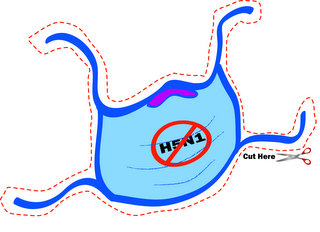
It says "I'm ready." on the back.
--Wes
One Step Closer to Fantastic Voyage
Today, we got one step closer to participating in Jules Verne's Fantastic Voyage journey through the body with the announcement of approval by the FDA of Given Imaging's PillCam for gastrointestinal endoscopy. You see upper endoscopy can determine if someone is bleeding from the upper GI system, like a stomach ulcer or tear in the esophagus (the swallowing tube that leads to the stomach). Lower endoscopy, or more commonly called colonoscopy, lets those GI doctors look up your, er, see inside your colon.
But in between, doctors have had a heck of a time looking in the yards of small intestine to determine sites of bleeding or tumor, until now.
But why, pray tell, does a cardiac electrophysiologist care about this development? Well the answer lies buried in this story.
You see with this approval, the FDA permits Given Imaging's software to remotely reset the PillCam.
As far as I am aware, this is the first time the FDA has permitted reprogramming of a medical device over the internet. A crack in the dam has surfaced. It does not take too much of a leap to suspect that it's just a matter of time before we'll not only be able to analyze cardiac defibrillators via the internet (as we do now), but also reprogram them.
--Wes
But in between, doctors have had a heck of a time looking in the yards of small intestine to determine sites of bleeding or tumor, until now.
But why, pray tell, does a cardiac electrophysiologist care about this development? Well the answer lies buried in this story.
RAPID Access (the software that accompanies the PillCam) also allows physicians to remotely initialize a DataRecorder to administer the Company's PillCam(R) video capsules to patients at satellite sites. Data can then be sent to a central location for processing and interpretation.
You see with this approval, the FDA permits Given Imaging's software to remotely reset the PillCam.
As far as I am aware, this is the first time the FDA has permitted reprogramming of a medical device over the internet. A crack in the dam has surfaced. It does not take too much of a leap to suspect that it's just a matter of time before we'll not only be able to analyze cardiac defibrillators via the internet (as we do now), but also reprogram them.
--Wes
Tuesday, June 13, 2006
Don't Have Afib Ablation Just to Stop Warfarin
I am seeing increased numbers of patients for atrial fibrillation ablation, particularly in light of the favorable results displayed in recent trials in patients for intermittent episodes of atrial fibrillation and chronic atrial fibrillation. The most common reason for referral: "I want to get off coumadin."
But this is the wrong reason to have a afib ablation, I believe.
First and foremost, it is important to remember the patient population decribed in the studies above: generally healthy population without other coexistant cardiovascular disease, those under the age of 75, and with small left atria (< 5.0 cm on echocardiogram). Hence it is difficult to apply these studies to the larger subset of patients with structural heart disease.
Secondly, atrial fibrillation ablation carries very real, significant procedural risks (like stroke, cardiac perforation, gastroparesis (stomach paralysis), development of other atrial arrhythmias caused by the lesions applied within the heart, etc., etc.) and even a risk of mortality (usually from the rare complication of perforation of the esophagus.)
Finally, it is quite common (some would say even expected) that an episode of atrial fibrillation is likely to occur in the first month after the ablation procedure, so most physicians advocate continuing warfarin for 3 to 6 months after the procedure. And not all stroke comes from atrial fibrillation. Remember that stroke can be caused by hypertension, atherosclerotic plaque that flies from the ascending aorta or carotids up to the brain, or carotid narrowing. Hence, strokes come from other areas outside the heart and prevention often requires a systemic approach including blood pressure control and systemic anticoagulation in patients at high risk of stroke (those with hypertension, age over 75, diabetics, people with weak heart muscles, or prior stroke).
Atrial fibrillation ablation should be performed, I believe, in those who are highly symptomatic despite therapy with more conventional means. Warfarin (coumadin) should be discontinued only if patients do not have one of the risk factors outlined above and have been treated for at least 6 months after their catheter ablation procedure and monitored to assure no asymptomatic episodes of atrial fibrillation are ocurring after the ablation. Remember, there is no long-term, prospective, randomized trial demonstrating a survival advantage of catheter ablation over more conventional medical therapies. Symptoms despite conventional therapies are the trump card that moves us toward recommending catheter ablation, NOT the desire to stop anticoagulation.
--Wes
Sugar Cane Extract Policosanol Useless to Lower Cholesterol?
Recent studies from South Africa and Germany have demonstrated that policosanol, a sugar cane derivative found in many over-the-counter dietary supplements, has no effect in lowering cholesterol. The Wall Street Journal today (and previously reported by MedPage Today) disclosed that this is in direct opposition to dozens of former studies, almost all of which were from Cuba (a large sugar cane producing country). Officials from Cuba's National Center for Scientific Research and Dalmer Laboratories couldn't be reached for comment. Alternative medicine enthusiasts would be wise to take notice.
--Wes
--Wes
Monday, June 12, 2006
Taxes on Soft Drinks? No Way!
Oh, come on now. It seems the best the AMA can do to stem the tide of childhood obesity is recommend a tax on soft drinks. The minute doctors promote taxation, we're all in trouble.
I just rounded this weekend and took care of a very unfortunate 38 year old woman weighing 598 pounds after having part of her pannus removed (that large part of her pendulous lower abdomen) and a portion of her foot amputated. She could no longer observe her feet and developed an infection of the bone there. Taxation of soft drinks would not have prevented this unfortunate situation. Rather a serious look at the psychosocial dynamics of her family who acted as co-dependents to her problem (she hadn't left her house for three years) might have been more effective.
What about filming a few unfortunate obese soles who are agreeable to tell their stories so others can learn from this experience and stand them next to their skinny children, similar in emphasis like the former antismoking ads like the Marlboro ads of the sixties or like this:

Taxing the entire populace to thwart the few won't work. We all have a responsibility to educate our kids about nutrition and health.
And what will these taxes be used for? Probably to support the AMA's sagging physician membership fees. Like mine.
--Wes
Sunday, June 11, 2006
Saturday, June 10, 2006
"There's No Gangsta Rap in my O.R."
Music in the operating room setting is important, I believe. There can be difficulties prioritizing who listens to what as this piece from the NYT demonstrates. But the priority for who gets to listen to what goes in this order in our lab:
1) the patient (they ALWAYS get priority)
2) the attending
3) the nurses and technicians
4) residents (senior residents supercede junior ones)
5) medical students
So patients are encouraged to bring their own music with them and we play their selection until their either asleep, or drugged enough to not care, then the other priority regimen kicks in. It works well this way.
Oh, and one other song we NEVER play in our EP Lab: Eric Clapton's "Stairway to Heaven."
--Wes
Friday, June 09, 2006
Coumadin Beats Aspirin+Plavix
Once again, the anticoagulant warfarin (Coumadin) demonstrated clear superiority to even Aspirin and clopidogrel (Plavix) therapy in a study of 3334 patients as reported in today's Lancet:
There continues to be no easy way out of those finger-sticks for blood-thinning levels (or INR's) yet -
--Wes
The study was stopped early because of clear evidence of superiority of oral anticoagulation therapy. There were 165 primary events in patients on oral anticoagulation therapy (annual risk 3·93%) and 234 in those on clopidogrel plus aspirin (annual risk 5·60%; relative risk 1·44 (1·18–1.76; p=0.0003). Patients on oral anticoagulation therapy who were already receiving this treatment at study entry had a trend towards a greater reduction in vascular events (relative risk 1·50, 95% CI 1·19–1·89) and a significantly (p=0·03 for interaction) lower risk of major bleeding with oral anticoagulation therapy (1.30; 0.94–1.79) than patients not on this treatment at study entry (1·27, 0·85–1·89 and 0·59, 0·32–1·08, respectively).
There continues to be no easy way out of those finger-sticks for blood-thinning levels (or INR's) yet -
--Wes
Will CMS Get Real?
The Center for Medicare and Medicaid Services (CMS) is likely to reduce Medicare reimbursements to physicians by 4.6% in 2007 due to increased program spending on physician services. CMS adjusts Medicare reimbursement rates for physicians annually based on physician costs, with an additional adjustment based on a comparison of program spending on physician services with the sustainable growth rate (SGR). CMS reduces Medicare reimbursements to physicians when program spending on physician services exceeds the SGR. Contact your members of Congress, urging them to replace the SGR with a reimbursement system that provides stable, annual updates reflecting physician’s increased practice expenses. Has anyone out there seen a negative rate of inflation of 4.6%?
Learn more about the flawed SGR.
h/t: Heart Rhythm Society
--Wes
Learn more about the flawed SGR.
h/t: Heart Rhythm Society
--Wes
World of Warcraft to Become Reality TV
From the front page of the Wall Street Journal today: Texas Govenor Perry plans to install night vision Webcams along the Mexican border and let Internet users serve as volunteer, round-the-clock sentinels. I can see it now, ask the millions of young adult gamers to sign on to this immigrant watch: the first live-action video game goes reality TV opportunity. Who knows, this may herald a new era in survellance. So let me be first to supply the new recuiting poster for this effort:

--Wes
Thursday, June 08, 2006
MedTees Patient's T-shirts in the Press
There's a REALLY nice article in Sioux City, Iowa's own Siouxland Health June/July 2006 issue on MedTees. I think Mr. Bruce Miller, their editor, captured the essence of what we're trying to do with MedTees concept nicely. You can see a pdf file of the article here (658k). Mr. Miller is pictured (with his xray) on the front cover.
Thanks, Bruce.
-Wes
Thanks, Bruce.
-Wes
Wednesday, June 07, 2006
Will Your Bathroom Scale Have an 'Intel Inside' Logo?
Well it might not have an "Intel Inside" logo, but it's sure to soon have a "Continua Health Alliance" logo on it, that is if the Alliance has anything to say about it. Yesterday the Wall Street Journal discussed the concerns corporate biggies in the healthcare arena have noticed: they're having one heck of a time transporting data, especially your personal health data, between computer platforms.
Correction, Dr. Kvedar FOUNDED Partners telemedicine unit and has a reason to spin this story for more than altruistic reasons, I'm sure. But I digress...
It is clear that we are moving toward more and more healthcare being delivered (or at least monitored for now), at home. Intel, IBM, Cisco, Medtronic, Motorola, Samsung Electronics, Philips, Kaiser Permanente, and Partners Healthcare System, Inc. are partnering to improve interconnectivity of databases of healthcare information. You can be sure other corporations will join in soon. Interestingly, I was surprized one other "biggie" wasn't yet part of the party, but you can bet that they'll be joining soon: Microsoft. Why? Well the XBox has capabilities that can download medical information and has one of the fastest array of microprocessors going.... On a more serious note, all of these other companies have to integrate the lion's share of PC's installed at US hospitals and running doctors' offices. It wouldn't surprise me that deep in Microsoft's new Vista operating system, is the ability to transport and view this data more securely.... But first, open standards for free-flow of information from one company's database to another's have to be developed, and this is where the "Alliance" comes in. Guys working to integrate individual data fields for clinical information on pacemaker and defibrillator function, insulin pumps, graphical information like xrays and EKG's, and the like, all must be converted to a secure standard and transported via the internet.
Standards ARE necessary, particularly for information as vital as healthcare data. And with a powerful lobby on the capital and with the FDA, look for a flood of new gadgets and gizmo's to be integrated with the internet, shipping your health data to a corporation, hospital, insurer, mobile phone, and electronics store near you.
--Wes
Participants are reponding to an impending crisis. as a fixed number of doctors and nurses will confront an expected explosion in chronic diseases. "We've lost the battle already," says Joseph Kvedar, vice chairman in dermatology at Harvard Medical School and director of a Partners unit that offers remote health care services. "We have to move quickly."
Correction, Dr. Kvedar FOUNDED Partners telemedicine unit and has a reason to spin this story for more than altruistic reasons, I'm sure. But I digress...
It is clear that we are moving toward more and more healthcare being delivered (or at least monitored for now), at home. Intel, IBM, Cisco, Medtronic, Motorola, Samsung Electronics, Philips, Kaiser Permanente, and Partners Healthcare System, Inc. are partnering to improve interconnectivity of databases of healthcare information. You can be sure other corporations will join in soon. Interestingly, I was surprized one other "biggie" wasn't yet part of the party, but you can bet that they'll be joining soon: Microsoft. Why? Well the XBox has capabilities that can download medical information and has one of the fastest array of microprocessors going.... On a more serious note, all of these other companies have to integrate the lion's share of PC's installed at US hospitals and running doctors' offices. It wouldn't surprise me that deep in Microsoft's new Vista operating system, is the ability to transport and view this data more securely.... But first, open standards for free-flow of information from one company's database to another's have to be developed, and this is where the "Alliance" comes in. Guys working to integrate individual data fields for clinical information on pacemaker and defibrillator function, insulin pumps, graphical information like xrays and EKG's, and the like, all must be converted to a secure standard and transported via the internet.
Continua hopes ... (to publish) guidelines so manufacturers can be assured that products that they make will work with those from other firms. ... Products that meet its guidelines will sport a logo that consumers can look for, as can hospitals trying to marry their informations systems with home sensors. The venture plans to lobby regulatory agencies to develop policies that help spread the use of certified technology, and make it easier for consumers to get reimbursed from insurers for using monitoring technology in the home.
Standards ARE necessary, particularly for information as vital as healthcare data. And with a powerful lobby on the capital and with the FDA, look for a flood of new gadgets and gizmo's to be integrated with the internet, shipping your health data to a corporation, hospital, insurer, mobile phone, and electronics store near you.
--Wes
Tuesday, June 06, 2006
Intermittent Explosive Disorder or Depression?
Take a guy of middle age, mix in a teenager, have him worry about paying for college, then work him like a dog, mix in another teenager staying out too late, and what do you have? Intermittent explosive disorder! Sorry, but this newest craze to hit the psychologic airwaves seems too "popularist" to me. I have seen good guys lose it when they're depressed, sleep-deprived, or stressed. Could, in fact, Intermittent Explosive Disorder (or IED) be actually a form of male depression or post-traumatic stress disorder? I suspect that the bias in the psychologic literature about the incidence of women's depression being higher than the incidence of men's depression is false. Men often express depression or anxiety differently than women. And for a guy to call himself depressed, geez, that's a sign of weakness!
Now don't get me wrong, I have great respect for the field of clinical psychology (after all I married one) and I certainly am not an expert, but the fact that this hit the media outlets by storm makes me wonder which drug company will introduce a new pharmaceutical for this "IED disorder" next week. Oh, but maybe the real reason for this "discovery" is buried in this comment toward the end of this press release:
Newsflash: if we think the Great American Public School system is going to identify this problem earlier and impose more "violence prevention programs" in our schools that reshape our kids, think again. It might not be that simple.
The real work starts at home. Especially if Dad is depressed.
--Wes
Now don't get me wrong, I have great respect for the field of clinical psychology (after all I married one) and I certainly am not an expert, but the fact that this hit the media outlets by storm makes me wonder which drug company will introduce a new pharmaceutical for this "IED disorder" next week. Oh, but maybe the real reason for this "discovery" is buried in this comment toward the end of this press release:
Since IED so often arises at a young age, the researchers write, early detection "would most reasonably take place in schools and might well be an important addition to school-based violence prevention programs."
Newsflash: if we think the Great American Public School system is going to identify this problem earlier and impose more "violence prevention programs" in our schools that reshape our kids, think again. It might not be that simple.
The real work starts at home. Especially if Dad is depressed.
--Wes
Monday, June 05, 2006
New Podcast on Atrial Fibrillation
I just finished the first of a series of podcasts on the heart rhythm disorder atrial fibrillation entitled, "So You Have Atrial Fibrillation." (20.3 Meg MP3 file and lasts 17 min 39 sec) It covers some of the basics as an introduction and is borrowed from my Atrial Fibrillation Tutorial. I hope to perform one on catheter ablation of atrial fibrillation soon. Since this is my first attempt, I welcome your feedback.
You can download it here.
--Wes
You can download it here.
--Wes
Alcohol-flavored Cigarettes?
Alcohol-flavored cigarettes? Big tobacco keeps up its shameful ways. Thanks to R.J. Reynolds for making sure my kids can go to a good college.
I'm glad the American Lung Association is taking a stand against these yahoos.
--Wes
I'm glad the American Lung Association is taking a stand against these yahoos.
--Wes
Sunday, June 04, 2006
Beating Heart Transplant
A beating heart transplant was performed in the UK. This technique might make more hearts viable for needy recipients... Medgadget has more on the technology used.
--Wes
--Wes
Saturday, June 03, 2006
Should Pharmacists be Able to Refuse and Refer?
Should pharmacists be able to refuse to dispense a 'morning-after' pill if they morally object? The Seattle Board of Pharmacy voted 5-0 to approve draft changes to board policy to permit pharmacists to "refuse and refer" if they so inclined. There is a 30-day review before a final vote. The proposed changes in legislation can be viewed here. The wording suggests that women could be referred to another individual in the same pharmacy to fill the script, but an individual pharmacist could refuse to dispense the medication based on their beliefs. The compromise is being heralded as "a slippery slope" by much of the mainstream press and women's groups.
Doctors who object to performing abortions don't have to perform them. Should a pharmacist equally at odds with dispensing abortifacients have to dispense such drugs based on similar principles? Is this discrimination against women or the pharmacist? To hear the pharmacists' side:
Doctors who object to performing abortions don't have to perform them. Should a pharmacist equally at odds with dispensing abortifacients have to dispense such drugs based on similar principles? Is this discrimination against women or the pharmacist? To hear the pharmacists' side:
Pharmacists should have the right to decline work that conflicts with their beliefs as long as they respect the patient, Rod Shafer, executive
director of the Washington State Pharmacy Association, said earlier this year.
"We are not dispensing machines," Shafer said. "We are professionals
who have as many rights as anybody else."
In 2005, Illinois Gov. Rod Blagojevich ordered Illinois pharmacies to fill all prescriptions for the pill. He was promply sued. Walgreens Company has joined the suit which is pending.
What do you think?
--Wes
Panera - the Devil's in the Details
We had a gorgeous day here in Chicago and decided to stroll over to Panera in true yuppy fashion to have lunch with my wife. I ordered the chicken ceasar salad and did not have the roll or chips. My wife had the Frontega Chicken sandwich on Focaccia bread. The place was packed, mostly by teens and parents with their kids. We had to wait for a few minutes to receive our order, so I picked up Panera's printed information on nutrition in their store. Interestingly, while individual bread, roll, and salad information was ready printed, I could not find my wife's sandwich on the information. Seems you have to go the their website (http://www.panerabread.com) to get such information. Hmmm. Always take pause when this happens.
So after we returned home I booted my computer and check their website out and was shocked to find that Panera's Frontega Chicken on Focaccia sandwich had more calories and fat that a double quarter pounder with cheese at McDonalds!
Smokehouse Turkey Panini on Asiago Cheese Focaccia at Panera
Serving Size: 13 oz
Calories: 840
Sodium: 2770mg
Total Fat: 37g
Total Carbohydrate: 77g
Saturated Fat: 15g
Dietary Fiber: 5g
Trans Fat: 0.5g
Sugars: 6g
Cholesterol: 120mg
Protein: 51g
Double Quarter Pounder with Cheese at McDonalds
Serving Size: 13 oz
Calories: 730
Sodium: 1330mg
Total Fat: 40g
Total Carbohydrate: 46g
Saturated Fat: 19g
Dietary Fiber: 3g
Trans Fat: 3g
Sugars: 9g
Cholesterol: 160mg
Protein: 47g
With more and more findings of teen obesity and its effects on our kids health, especially the new finding published yesterday in the 6 June 2006 issue of the Journal of the American College of Cardiology documenting decreased heart muscle function in obese kids compared to fit ones:
"The Strong Heart study (SHS) is a longitudinal study of cardiovascular
risk factors and cardiovascular disease that enrolled 4,549 people in American
Indian communities in Arizona, Oklahoma, and North and South Dakota. This
analysis included data from examinations of 460 participants age 14 to 20
years (245 girls and 215 boys).
The researchers used ultrasound and other methods to measure the size,
shape and pumping function of the teenagers' hearts. The left ventricles of the
hearts of both overweight and obese teenagers were larger and heavier than those
of normal weight participants; but the obese teenagers also showed signs of
impaired heart function. The changes were not entirely explained by changes by
high blood pressure."
So educate yourself, consider alternate food choices or another dining location, and perhaps most importantly, educate your kids.
--Wes
Friday, June 02, 2006
New T-shirt Fashion Buzz: Cut it Up
Since I'm in the t-shirt circles as a doctor, I thought I'd share this with you.
If you have kids and want them to be cool at their next school field day, take a look at what my daughter walked down in this morning: a brand new field day t-shirt sliced to bits, but carefully reassembled using knots in this trendy fashion. We did not help her at all.

If you have kids and want them to be cool at their next school field day, take a look at what my daughter walked down in this morning: a brand new field day t-shirt sliced to bits, but carefully reassembled using knots in this trendy fashion. We did not help her at all.
Seems she cut the shirt up along the side seams, then cut horizonal strips about an inch wide up the sides so these strips could be knotted together. Then she cut off the sleeves and used a strip of the sleeve to tie the shoulders together and to make a hair bow, and then cut a more plunging neckline (I'm not sure I like this part). The result is shown. She tells me about half the girls at field day (5th and 6th grade) will have a shirt like this today.
Although not (or should it be "knot"?) new, a little research shows how to turn a t-shirt into a skirt or make a TaeBo shirt for the exercise-concious. Perhaps we'll get a few folks with MedTees making them look just as cool!
--Wes
Medicare's Hospital Payment Disclosure
Yesterday, the Center for Medicare and Medicaid Services (CMS) released a listing of the 30 highest-reimbursed Medicare payments made to hospitals in the U.S. (Excel spreadsheet, 1.2 Meg). The data also contain volume information by hospital and reimbursement ranges by geography for all to see. The implications for this disclosure are already being felt from many angles.
Because I am a cardiac electrophysiologist who performs implantation of implantable cardiac defibrillators (ICDs), I recompiled their data for all 50 states for just the ICD procedures (Excel spreadsheet, 880K) and will limit my discussion to just this procedure because it simplifies important issues raised for patients, doctors, hospitals, insurers, the device industry, and CMS. For those unfamiliar with a few terms, a DRG is a "Diagnosis-Related Group" where payments made my Medicare were for a primary diagnosis and therefore "bundled" into one payment, irrespective of a person's length of stay in the hospital (it incents hospitals to discharge patients sooner and limits costs to Medicare). DRG's 515 and 536 are commonly used for ICD implantation.
Regarding these payments made by Medicare to hospitals in the case of ICD's:
For patients: I would want to know why there are "charges" typically three times those of "payments" and wonder if Medicare (part A) only overs the lower amount, what part of the remainder do I have to pay? (This area remains unclear to the patient).
For doctors: Now you can see patient volumes regarding the same procedures you may be performing at other area hospitals (your competition). It gives doctors an appreciation of their marketability. Additionally, doctors can understand what hospitals receive for their skills versus what you are paid and realize that the cost of the implantable device from industry (20-30K) is the most a significant cost to the hospital in the case of ICD reimbursement.
For the device industry: They now can see what each hospital performs for TOTAL volume each year in the Medicare population, and check their database to see what percentage of the business they garner from an individual hospital system each year. This may permit them to construct a more or less powerful negotiating position with the hospital system each year.
For hospitals: They observe a snapshot of volume of these expensive procedures and can plan for recruiting efforts in areas that are weak compared to their competition.
For insurers: Negotiated payments might be simpler to negotiate with hospitals.
For CMS: They can review why most hospitals bill predominently for DRG 515 in one geographic area for an ICD implant while others ONLY bill for DRG 536 (the higher reimbursing code). (Hmmm, could there be a billing descrepency here?).
These items (and I'm sure more) can be gleaned from these data. You can bet there will be more to come, and it's likely to be good for all in the long run.
But will patient's select their hospital based on this data? I doubt it. Convenience (and circumstances) will win out in the majority of cases (if you have a heart attack or cardiac arrest, are you going to check this list first?). Nonetheless, I think its long overdue.
--Wes
Thursday, June 01, 2006
Diabetics Take Note
Now this is really interesting. Imagine if there was a way to coat insulin-producing islet cells with a biocompatible substance (widely-used medical lubricant, polyethylene glycol) that resists attack by the immune system, yet provides egress of insulin to the surrounding tissues from within.
New work is underway in a collaborative agreement between the Juvenile Diabetes Research Foundation and Novocell, Inc on this very venture. Study specifics can be found here. Here's more about where Novocell's got most of its funding.
New work is underway in a collaborative agreement between the Juvenile Diabetes Research Foundation and Novocell, Inc on this very venture. Study specifics can be found here. Here's more about where Novocell's got most of its funding.


 (Pictures courtesy of Novocell's web site)
Now don't tell me stem cell research isn't a good thing.... I just hope if the subcutaneous approach doen't work, that they try an intraperitoneal approach (in the belly cavity). Prior work with insulin pumps that used ultra-short-acting insulin showed the intraperitoneal approach was superior to subcutaneous insulin injections at minute-to-minute control.
--Wes
Wednesday, May 31, 2006
Pills R Us
NYT: Cute, but this pill dispenser needs a display (and instructions) that folks can read!
 (But I do like the database of phone numbers it contains to call for help...)
-Wes
Tuesday, May 30, 2006
Defibrillator Cost-effectiveness: 2 months of life for $39,000
One of those important U.S. policy-defining studies just appeared in the Journal of the American College of Cardiology today: "The Cost-Effectiveness of Implantable Cardioverter-Defibrillators: Results from the Multicenter Automatic Defibrillator Implantation Trial (MADIT)-II." Researchers from the University of Chicago and University of Rochester along with many of the MADIT-II investigators reported their results of a cost-effectiveness evaluation comparing the incremental cost effectiveness ratio calculated as the difference in discounted costs divided by the difference in discounted life expectancy within the fairly short follow-up period of 3.5 years (the length of the MADIT-II trial).
The bottom line: during the 3.5 year period of the study, the average survival gain for the defibrillator arm was 0.167 years (2 months), the additional costs of the defibrillator arm over the conventional drug-treated arm was $39,200, and the incremental cost-effectiveness ratio was $235,000 per year-of-life saved. Using estimates if the study had been continued for 12 years, the incremental cost-effectiveness ratio would have declined to $78,000 to $114,000 per year-of-life saved (a smaller number implies improved cost-effectiveness). For comparison, studies of dialysis have suggested a cost of $50-80,000 per year-of-life saved. Given the size of the eligible population, this study has profound consequences for US policy makers. These data were also in line with projections made by the Canadians. As the investigators concluded:
"The relatively high estimate if the iCER (incremental cost-effectiveness ratio) is largely the result of the high initial cost of implantation and the relatively small YOLS (years-of-life saved), the latter partially reflecting the underlying heterogeneity of the MADIT-II study population and the significant risks of non-arrhythmic death (40% of the classifiable deaths in conventionally treated patients (without defibrillators) were assigned to other causes."
Look for more pressure on Guidant (now Boston Scientific), Medtronic, and St. Jude to lower their ICD prices, and look for means to risk stratify patients who are high-risk versus low-risk of arrhythmias (like t-wave alternans testing by Cambridge Heart) to become the norm in an attempt to lower costs to the cardiovascular health care system.
--Wes
Finally, Some Good News From Guidant...
I just received Guidant's 2006 Product Performance Report Q2 Summary Edition which contains invaluable information including:
Thanks, Guidant.
--Wes
- Pulse Generator survival probabilities
- Worldwide confirmed malfunction counts for each of their devices
- Confidence intervals for survival probability data
- Pulse generator and lead survival probabilities with descriptions of complications and malfunctions
- And current safety advisory information for each device.
Thanks, Guidant.
--Wes
"Those With More are not Happy..."
And now this study from Dartmouth Medical School as reported in today's Chicago Tribune:
"High rates of hospitalization, tests and specialist referrals lead to poorer patient outcomes when such things as degree of illness and death rates are accounted for. The researchers estimated that 30 percent of Medicare spending is waisted on unnecessary care. ... A major reason healthcare costs continue to escalate is that the system is geared toward paying for diagnostic tests, medical procedures, and other interventions and fails to reward personal contact with patients through which doctors can ascertain patients' problems more effectively and devise effective treatments..."
Just ask any physician I work with the amount of "screen time" they spend in front of a computer terminal versus the amount of face-to-face contact time they spend with patients, and you can't help but laugh that this research was required to expose what many already perceived: doctors are revenue generators, not care providers.
Medical students today are afflicted by the same dilemma: better documentation to assure reimbursement vs. better diagnosis through a thorough history and physical? You see it is far simpler (and some would argue better) to order an expensive CT scan to rule out intracranial bleeding than examine the patient for neurologic deficits. It takes less time for the provider and reduces liability (can you say "expensive defensive" medicine?). Add to this the fact that we "cap" the number of patients med students can see each day, so that we assure skills like time management and physical examination are not developed. News to med students: most of us are seeing more than 5 patients a day. Most internists see many more patients as an ever-increasing rush to see more patients in less time mounts due to declining revenues. Eventually, busy doctors become unhappy doctors.
So how do we change things? Imagine if physicians were compensated for returning phone calls instead of ordering another test, or discovering a physical exam finding that was diagnostic and avoided testing.
But as 'House' on Fox has taught us: if it's hoof-beats, think zebras instead of horses - it pays better.
But that's hardly a way to keep docs intellectually stimulated and happy.
--Wes
Monday, May 29, 2006
Memorial Day
Thanks to all the wonderful men and women of our Armed Forces that permit those of us with slip-n-slides to enjoy this great country!


Hope you had a great day!
-- Wes
Hope you had a great day!
-- Wes
Sunday, May 28, 2006
Politics and the New England Journal of Medicine
In case you missed the most recent issue of the New England Journal of MEDICINE's (the capital font is for emphasis) publishing of Hillary Clinton and Barack Obama's 2008 presidential bid perspective piece entitled "Making Patient Safety the Centerpiece of Medical Liability Reform" on their proposal for medical liability reform, it can be found, available for free and to all (unlike most of the other peer-reviewed research studies and reviews published by physicians in the Journal) here. Interesting that this piece was displayed so prominently in the medical press but has failed to be picked up by the political press. As you read this piece ask yourself, why does this piece appear where it does?
When you combine politics and medicine as in this piece's title, you get on-the-Hill "position speak" which coins such terms as "patient safety" and creates the unspoken bind that any alternative position is "against patient safety." This is typical political Hill strategy but now it inserts itself into a health-care community not seasoned to this type of manipulation.
Now don't get me wrong, medical liability reform is needed. Certainly there are points made by senators Clinton and Obama that warrant careful consideration. But manipulation of physicians with such patient-centric titles (who doesn't want patient safety?) and legislation not yet "peer reviewed" in the halls of Congress (especially when no retort is published) in one of the most influencial and cited medical journals screams of bias and limits the objective credibility desired by its readers.
Does the publication of this work (which reiterates the legislation now moved to committee in the Senate and published previously) violate the Journal's own Ingelfinger rule? The NEJM boasts: "Just 8% of manuscripts submitted are accepted for publication and none are reported in any other medium prior to publication in NEJM." It now seems legislative opinion pieces are permitted a double standard - after all, this piece was presented before in the U.S. Senate on 28 Sept 2005 as Senate Bill 1784.
None of us are ignorant to the political overtones of this debate. Some have even suggested this legislation might consitute a bribe of physicians. Certainly more balanced opinions exist regarding this legislation and even more opinions exist on the validity of the data regarding medical liability and medical errors. But I ask: where are the senatorial perspective pieces in the Journal on the other medical liability reform legislation (like S. 22 or S. 23) recently fillibustered and defeated by Democratic interests on the Hill?
Or does this perspective piece fall under the guise of a Journal advertorial? If so, it was not properly labeled.
Perspectives are just that: perspectives. Certainly the influential nature of the authors of this piece bear notice. But their political position should not be permitted to manipulate the medical community in a medical journal until acceptably vetted on the floor of the Senate.
--Wes
Friday, May 26, 2006
For Teen Depression
Got a nice note this AM from a mom regarding a post I did on our MedTees forum last year and thought I'd share it with the blog-o-sphere:
"Hi Wes -Found your posting of last fall about Out Of The Woods Walk and Dominic Palumbo, the 15 year old who founded the walk. Last year's efforts saw 73 walkers raise almost $13,000, providing about 140 pro bono counseling sessions for low-income or uninsured children, adults and families.
So we're doing it again this year on September 30, just in time to kick off Mental Health Awareness month. Please visit www.outofthewoodswalk.org to be a part of this event. Dominic and Scott Costello, some of the counselors at PSC, are working on a teen and adolescent outreach program to educate kids about the symptoms of depression and to eliminate suicide.Hope to see you and friends/family at Out Of The Woods Walk on September 30!"
The power of people to make a difference. Cool.
--Wes
Wednesday, May 24, 2006
On the topic of "Don't Get Me Started..."
NYT 25 May 06: Kudo's to AthenaHealth for their take-off-the-gloves exposure of what we physicians have seen happen time and time again: non-payment of insurance claims by our esteemed insurance middlemen. And why did Athenahealth do this? Because their collections are tied to their client's (physicians) reimbursement. But this problem might be endemic throughout the insurance industry.
Hard to believe Humana scored so well on the time to payment score, but perhaps that's because they're reimbursement rates are so low relative to other payors. Interesting that Medicare was fastest of all. And Unitedhealth, they have no right to suggest that these data are skewed when their own leadership has been caught with their pants around their ankles in the option-timing scandal, fleecing their shareholders and members. These guys need to embrace such reporting, not shirk it as inaccurate or flawed. Perhaps then physicians and insurers could have a real dialog on this topic.
What I have noticed is the incredible complexity and changes to the rules of claims processing midstream seem clearly designed to delay phyician payments (last months' clean bill wouldn't be clean this month). And have you ever tried to speak with the people running these outfits? Most have no clue what's going on, particularly if a claim falls anywhere outside their rubric of rules for reimbursement.
Constant updating of Athenahealth's Monitoring Site (available after 25 May 06) and exposure or poor compliance with reasonable timing and tracing of reimbursements might also leave these slow or non-paying firms open to litigation.
Revenge is sweet.
Thanks Athenahealth.
--Wes
And the winner of American Idol? Ford.
The producers of the American Idol did a pretty good job appealing to the 200 million viewers tonight. My 10 year old daughter was a bit appalled by Prince, couldn't believe how metrosexual Clay Aiken looked (Hollywoodified and all), and she thought Burt Bacharach and Dionne Warwick looked old, but at least she recognized their incredible talent even as Dionne's voice became flat when holding the last note. She even commented how "cool" Randy Jackson looked tonight (definetely the best-dressed). But I have to hand it to Ford Motor Company for their "Bold Moves" commercial concept. The idea of a soccer player putting on his prosthetic limb, and a women shaving her hair for the "Race for a Cure" breast cancer campaign, and the toughness of this being placed with other "bold moves," once again shows how ready society is to embrace illness as a normal part of living, and living "bold."
--Wes
--Wes
West VA and KY Get Tough
When there is a federal imperative to treat all patient's that present to an Emergency Room in our great country, initiatives by government legislators in West Virgina that threaten to take away Medicaid benefits if poor folks don't "promise" to show up for appointments and not use the ER for non-emergencies seems ridiculous but offers states a legal way to ration care. They will take away benefits so they can make SURE they show up at the most expensive place they can get care: emergency rooms.
--Wes
--Wes
Taking the Surgical Error Thing a Bit too Far
Video games for surgeons? 11 seconds better? I'll pass, thanks. I think most of my patients would be upset to learn I was in the locker room on a video game just before their surgery, irrespective of the technique I used.
--Wes
--Wes
Tuesday, May 23, 2006
Medication Errors: Perhaps an Answer Exists
Laura Landro in today's issue from the Wall Street Journal describes an initiative hospitals are taking to collect better medication information on their patient's in a rather feeble attempt to prevent medical errors. This is in response to a national patient safety standard that went into effect in January called "medication reconciliation." This means hospitals must have in place means for collecting complete drug and allergy histories and comparing them with new medications that their doctors order.
Stanford Hospital has initiated a "Vial of Life" program with local EMS services where the patient's medication lists are printed on paper and placed in an old medication vial and stored in that highly accessible and often visited location: the refrigerator. Huh? Have you ever heard the adage, "Out of sight, out of mind?" This seems like an unlikely place to keep medication changes up-to-date and current. People I know don't carry a refrigerator. Perhaps most important, the reliance on patients to become "more proactive" in knowing their medications is sure to fail. When I see patients in clinic, most don't know the names of medications, but might know they're on a "water pill" at best, and more often have NO idea the purpose of each medicationn, let alone their names. On top of this, to expect them to know the milligram dosage of each drug is unrealistic. And that dosage, which has been stored in the refrigerator vial for 6 months, is not likely to be updated. Sincerety and spin don't save lives.
I am fortunate to work in one of the "100 most wired" hospital systems in the country. Yet even our system is insufficient. We use the EPIC medical system, touted to be the next frontier of health care, that is integrated between the outpatient physicians' offices and the hospital. Medications entered by the patient's outpatient physician alters the same medical record that providers within the hospital see. This adds incredible continuity of care on many fronts. But I am frustrated at the incredibly complex screen that is displayed when I reorder a myriad of medications and have to "reconcile" their complex and innumerable interactions. More challenging is that if my patient travels to a physician's office outside our network, no information can flow easily with them. Suffice it to say, this system goes well beyond "the paper in a vial" approach.
It was with awe that I had the chance to meet with Ross Fletcher, MD, Chief of Staff, from the VA Medical Center from Washington DC last week. Ross has been instrumental in developing and promoting the VA's Vista Electronic Medical Record (EMR) used by the VA Medical system, and a model for the EMR industry. Best of all, its free. It's power is demonstrated in its ability to incorporate geographically disparate graphical and data-driven information and display it for the physician in a organized, easy-to-comprehend fashion on any commercially-available computer screen. And this data is culled from every VA medical center across the United States, in seconds. Information from a VA in California, Utah, and Washington can be viewed side-by-side in chronological order.
While sitting with Ross at dinner, his pager went off. He looked down, smiled, and delighted in the fact that a seasonal variation in effectiveness of therapy was suggested by analyzing over 1 billion vital signs on veterans collected over the preceeding five years across the U.S. using multivariate analysis. The sleepy old VA?
And you can bet their medication lists are up to date.
--Wes
Monday, May 22, 2006
Catheter Ablation for Your Lungs
According to this article, seems radiofrequency catheter ablation is now being performed for asthmatics. Although I'm not sure the power used (I suspect its much lower than what we use in the heart because there is no heat loss due to blood flow), caution will still be needed to avoid collateral damage like recurrent laryngeal nerve paralysis (supplies the vocal cord and wraps beneath the left mainstem bronchus), as well as other mediastinal structures. It's a clever application nontheless.
--Wes
--Wes
Sunday, May 21, 2006
Robots: The New Globalization of Medicine?
There's a tremendous interest in robotics aiding medical care recently. Hospitals are rushing for the DaVinci system to perform intricate surgical procedures through tiny openings in patients abdomens and thoraxes. I had the opportunity to review two new contenders for robotics in the catheter ablation of cardiac arrhythmia arena: Hansen Medical (see pictures below), and Stereotaxis, Inc. Both offer a means to steer an ablation catheter within the heart, most importantly, the left atrium of the heart.
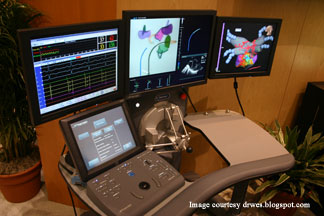
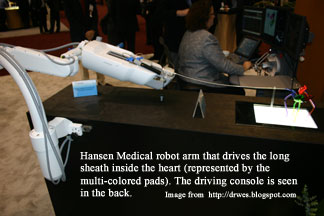
You see the left atrium is the focus of significant attention lately because of inroads to successfully ablating (another word for cauterizing) the most common arrhythmia in men and women: atrial fibrillation. And in 2004, the number of catheter ablation procedures to cure atrial fibrillation worldwide was estimated to be approximately 10,000. In 2007, it is estimated that the number of these procedures will approach or exceed 100,000. The problem is, these procedures are time-consuming and carry significantly more potential risks to the patient than non-invasive medical therapy, yet carry the promise of better long-term treatment of the disorder (i.e. a 70-80% of curing this disorder).
An atrial fibrillation ablation procedure requires an amazing array of instrumentation and equipment to perform safely today. Procedures in most centers last from 2.5-5 hours in duration, liimiting the number of procedures that can be performed by an individual operator per day due to time and operator fatigue constraints. Enter robotics. These devices promise to be able to steer the ablation catheter within the left atrium with remarkable dexterity using a virtual model displayed for the doctor on four or five computer screens. The Hansen Medical system uses a virtual joy-stick-like arrangement to steer the conventional catheter through a specially-designed (approximately $2000) sheath that steers the deflectible catheter using a mechanical drive motor, that can rotate, pitch and yaw the catheter to different locations (outlay price for hospitals not disclosed at the meeting). The Sterotaxis system steers a soft, noodle-like catheter containing a magnet inside the catheter using a forceful (0.8 Tesla) magnetic field that changes its direction by moving two huge magnets on opposite sides of the patient's body (Hosptial capital outlay: about $1.2 million BEFORE contruction costs, special non-magnetic outfitting with equipment in the patient's room, etc.). Where the catheter is placed is again determined by a virtual rendition of the heart on a bunch of computer screens.
Both of the systems use a 3D image of the left atrium obtained from a CT scan merged with their software to move the catheter, but also use some fluoroscopic localization to assure proper placement of the catheter. Like surgical robotics, the surgeon's skill to initially place the catheter within heart and the chamber of interest must be maintained (it won't do this for you). Furthermore, the image used to navigate is static, unlike the normal heart which beats and moves in space with the movements of respiration. Hence good ol' xray naviagation remains to confirm location as the catheter is moved.
The one big advantage for the physician is the promise of being seated and outside the room as the catheters were advanced. Remarkably, there was a demonstration at the Heart Rhythm Society meeting of a physician in Boston, Massachusetts steering the catheter within a patient's heart in Milan, Italy. Globalization gone wild, I'd say. But the implications are nontheless important to grasp. Will there be large "surgicenters" performing the intricate part of the procedure from India? Italy? China? Perhaps a doctor will place the catheters in his patient's heart, then sip coffee as his colleagues in Milan place a curative pattern of cauterizations within his patient's heart chamber. It's analogous to waiting for the dishwasher to complete it's work before putting away the dishes.
Gratefully, noone has figured out a way to reimburse physicians who provide this service..... yet. And importantly as we've seen in the airline industry, medical care is not like flying an unmanned drone, it's more like flying a 747 across the ocean: a team of pilots an crew are still needed to have the patient arrive at their destination safe and sound.
--Wes
"There is no thing endowed with life - from man, who is enslaving the elements, to the nimblest creature - in all this world that does not sway in it's turn. Whenever action is born from force, though it be infinitesimal, the cosmic balance is upset and the universal motion results. "
-- Nikola Telsa, 1925
Thursday, May 18, 2006
High Frequency Ultrasound Balloon for Ablation
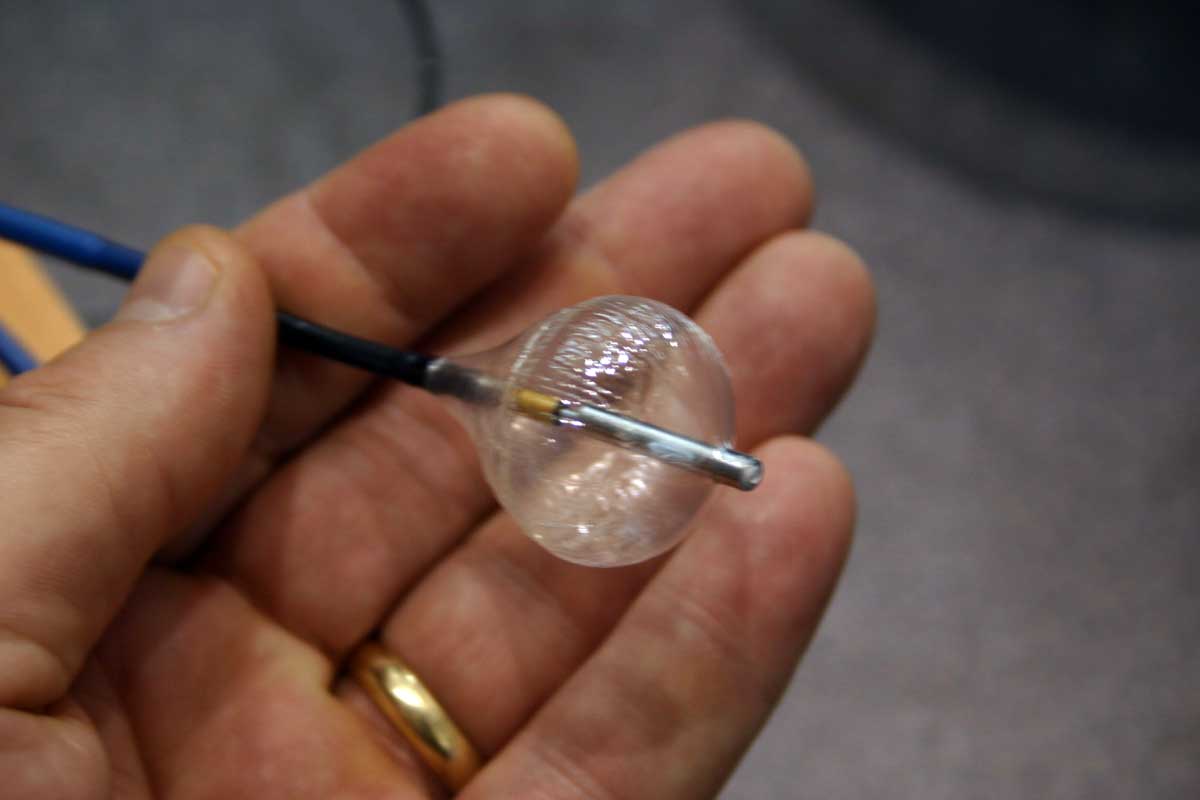
Cool new(er) technology might speed the time it takes to perform catheter ablation of atrial fibrillation: the high frequency ultrasound balloon. It has a fluid-filled inner chamber and an outer carbon dioxide-filled balloon that helps focus the ultrasound in a ring-like pattern in an attempt to ablate (or burn) around the pulmonary veins in the left atrium (the site where it's thought the atrial fibrillation comes from). Average lesion time takes 40-90 seconds and it covers LOTS of territory in the left atrium. It's just starting clinical trials.... Seems promising. We'll see....
--Wes
Is Our Government Discriminating Against our Vets?
It is a sad state of affairs when I learned from Pam Karasik, MD of the Washington VA Medical Center that she often has to borrow medical equipment (ablation catheters) from the Washington Hospital Center due to budget constraints at the VA Medical System. Their cardiology budget, excluding implantable defibrillators (which fall under their own separate budget) is only $50,000 per quarter. When I estimated our hospital's costs for this budget, I would only be able to treat at most 10 patients in that three month period in our hospital in Chicago.
There is no question that additional dollars for the health care of our veterans should be a priority in Congress. It is unconscionable that these men and women who have sacrificed life and limb to serve our country have their health care financially rationed.
--Wes
There is no question that additional dollars for the health care of our veterans should be a priority in Congress. It is unconscionable that these men and women who have sacrificed life and limb to serve our country have their health care financially rationed.
--Wes
Wednesday, May 17, 2006
"Leadless" ICD - Has it's time come?
There was interesting information from the "leadless" ICD front reported by Andrew A. Grace, MD, PhD from Papworth Hospital NHS Trust, Cambridge, United Kingdom at the Heart Rhythm Society Meeting in Boston, MA today:
First of all, the device is not "leadless." Rather, there are no leads placed inside blood vessels with this defibrillator, produced by Cameron Health, Inc. The device does have a lead that is tunneled beneath the skin from the upper left chestbeneath just below the level of the clavicle to the level of about the breast, then tunneled laterally to the side of the chest beneath the arm. The device uses the subcutaneous lead to sense the heart rhythm and can detect rapid arrhythmias from the surface EKG created between the lead electrode and the can of the device. It's maximum shocking output is 80 joules (about 2 1/2 times existing devices). It requires no xray system to implant the device and took about 12-15 minutes on average for experienced operators to install in an operating room setting. If the ability to convert the rhythm from ventricular fibrillation to normal rhythm was excessive, a conventional defibrillator lead placed inside the blood vessel could be attached.
53 patients were studied the the information provided. The average defibrillation threshold without any internal lead was 36 joules. No inappropriate shocks occurred, even when there was an aggressive attempt to induce sensing of muscular potentials with vigorous arm movement.
It's only drawback: there was no backup pacing provided by the device, so if the rhythm is converted from ventricular fibrillation to asystole (no heart beats... and this CAN happen), then the patient still might not survive. Nonetheless, the implications for decreasing physician reimbursement for electrophysiologists (since now any surgeon could implant these) and what this will do to pressure existing device companies to drop their prices once the device reaches the mainstream US market for primary prevention of life-threatening arrhythmias, remains to be seen.
--Wes
First of all, the device is not "leadless." Rather, there are no leads placed inside blood vessels with this defibrillator, produced by Cameron Health, Inc. The device does have a lead that is tunneled beneath the skin from the upper left chest
53 patients were studied the the information provided. The average defibrillation threshold without any internal lead was 36 joules. No inappropriate shocks occurred, even when there was an aggressive attempt to induce sensing of muscular potentials with vigorous arm movement.
It's only drawback: there was no backup pacing provided by the device, so if the rhythm is converted from ventricular fibrillation to asystole (no heart beats... and this CAN happen), then the patient still might not survive. Nonetheless, the implications for decreasing physician reimbursement for electrophysiologists (since now any surgeon could implant these) and what this will do to pressure existing device companies to drop their prices once the device reaches the mainstream US market for primary prevention of life-threatening arrhythmias, remains to be seen.
--Wes
Guidant's Ad at HRS Meeting
Instilling confidence, here's Guidant's ad found on the back of the "Heart Rhythm Daily" produced by the Heart Rhythm Society, dated 17-18 May 2006:
I assure you, this is not my picture.
--Wes
I assure you, this is not my picture.
--Wes
Guidant: What We're Not Hearing at the HRS Meeting
It seems Guidant, now a division of Boston Scientific, might have some other news we're NOT hearing about at the Heart Rhythm Society meeting in Boston this week.
As most of us doctors in the field of heart rhythm disorders know, Guidant has been struggling to ressurrect itself from legal problems regarding disclosure of problems with implantable cardiac defibrillators. To reassure investors, a new wireless transmission system,Lattitude Latitude, was developed using the frequency bandwidth of approximately 900MHz (update 18May06: 913-924MHz), the same as cellular phones and some patient telemetry systems in hospitals, that permits communication with their device to interrogate their Contak Renewal 3 ICD to alert patients and doctors about changes in electrical characteristics about the device. The Lattitude system can also be cleverly connected to a weight scale at home so the patient can transmit their weight along with ICD statistics to a central registry database offering additional therapeutic information to physicians about their patient's condition.
Well, wouldn't you know, the system has considerable interference issues with cell phones, electrical noise, and even some telemetry services in hospitals. Yet no patient or physician safety advisory has been issued. It would hurt sales.
To be fair, the problem does not cause reprogramming of the patient's device, but rather interruptions with the downloading of information from the patient's device.
But where's the reassurance to investors, doctors, hospitals, and most of all, patients when these issues are not disclosed?
Medtronic's wireless system for their Virtuoso and Concerto ICD and CRT-D product lines was developed under a special2.5GHz 402-405MHz mixed bandwidth (used for some weather balloons and a bandwidth reserved for medical device use to avoid such interference), was just approved by the FDA the day before yesterday. As usual, Medtronic is late to the wireless ICD party, but did its homework before jumping on the easy-to-engineer 900MHz bandwidth for their wireless device.
--Wes
For purposes of disclosure, I do serve on the speaking bureau for Medtronic, but hold no other financial positions with either company mentioned in this post.
Update: 18 May 2006: Seems there have been documented interference issues, particularly in hospitals, with a commercially-available Spectralink phone systems that use the same frequency band. It is routine for Guidant to "sweep" hospitals for such sources of interference before deploying the technology.
As most of us doctors in the field of heart rhythm disorders know, Guidant has been struggling to ressurrect itself from legal problems regarding disclosure of problems with implantable cardiac defibrillators. To reassure investors, a new wireless transmission system,
Well, wouldn't you know, the system has considerable interference issues with cell phones, electrical noise, and even some telemetry services in hospitals. Yet no patient or physician safety advisory has been issued. It would hurt sales.
To be fair, the problem does not cause reprogramming of the patient's device, but rather interruptions with the downloading of information from the patient's device.
But where's the reassurance to investors, doctors, hospitals, and most of all, patients when these issues are not disclosed?
Medtronic's wireless system for their Virtuoso and Concerto ICD and CRT-D product lines was developed under a special
--Wes
For purposes of disclosure, I do serve on the speaking bureau for Medtronic, but hold no other financial positions with either company mentioned in this post.
Update: 18 May 2006: Seems there have been documented interference issues, particularly in hospitals, with a commercially-available Spectralink phone systems that use the same frequency band. It is routine for Guidant to "sweep" hospitals for such sources of interference before deploying the technology.
Tuesday, May 16, 2006
Health Moves Below the Fold
Too bad "Health" has moved "below the fold" on the new Yahoo home page (That means you have to scroll down to see it, for those who are techno-speak challenged), but gee whiz, "Entertainement" gets TWO spots above the fold... * Sigh *
--Wes
--Wes
Monday, May 15, 2006
More Guidant ICD Safety Alerts
I found out today about more Guidant ICD safety alerts for the Vitality HE and Contak Renewal 3 and 4 product lines. The official info can be found on Guidant's webpage for physician communications under the files dated 11 and 12 May 2006. Seems the thin case for these devices (what was once one of their marketing attributes) might not be so great when that defibrillator generator case is put under unusual stress. This stress can be caused by a subpectoral implant (when the device is placed under the breast muscle) and when the serial number is pointed toward the ribs. It seems in certain circumstances this places the circuitry near significant compressive forces (the device hitting the rib) and can short out the device's circuitry. No deaths have been reported, but one patient had a near miss with the pacemaker output failing and he had to be externally paced until a new temporary pacemaker (and eventually a new device) had to be implanted. Only 2 patients have been reported to have had this problem as of 12 May 2006. The incidence of subpectoral implants is VERY low, but realize that this is NOT part of the normally-reported implant data that is stored on registries. (Heart Rhythm Society/FDA, did you HEAR this?) So ask your doctor if you're not sure where your device was implanted, but realize that over 98% of our device implants are NOT subpectoral, and therefore NOT part of this advisory "safety" alert.
--Wes
--Wes
Sunday, May 14, 2006
On Mother's Day
My son's card to his mother read:
"Wish big
Live large
Worry less
Enjoy more
Relax often
Play hard
Talk lots
Listen deep
Laugh long
Smile easy
Love well
Dream true
Be you.
Happy Mother's Day!
Thanks for putting up with all my craziness. I'll look back on this someday and laugh."
Amazing insight for an 18-year old.
--Wes
"Wish big
Live large
Worry less
Enjoy more
Relax often
Play hard
Talk lots
Listen deep
Laugh long
Smile easy
Love well
Dream true
Be you.
Happy Mother's Day!
Thanks for putting up with all my craziness. I'll look back on this someday and laugh."
Amazing insight for an 18-year old.
--Wes
Saturday, May 13, 2006
Clip and Tuck for your Leaky Mitral Valve
If you're a heart patient with a leaky mitral valve, you might have heard about this trial, EVEREST II, reported today that uses a small clip manufactured by Evalve, Inc. to repair the leak. Our own Ted Feldman, MD is the principle investigator on this trial. It's important to realize the selection criteria for this trial is very limited, but if you're quite symptomatic AND have the right anatomy, this might be a great way to avoid open heart surgery.
So what is the mitral valve? It's the valve that is the "intake" heart valve of the main pumping chamber of your heart (the left ventricle). If it's blocked, blood has a hard time entering this main pumping chamber. If the mitral valve leaks, or "regurgitates", blood passes backward during the pumping action of the left ventricle, to push blood backward into the lungs, making people short of breath, especially when they exert themselves.
This new Evalve system seeks to correct an excessively leaky mitral valve by placing a small clip on the two leaflets of the mitral valve and effectively "tucking" them together, making two smaller openings of the mitral valve from its one large opening. While this decreases the forward flow a bit, it can (in the correctly chosen cases) minimize the backward flow of blood to the lungs dramatically.
What I've been impressed with is that these cases require tremendous patience and operator skill. The procedure is performed using both xray and ultrasound guidance (using a transesophageal echo probe inserted in the esophagus or swallowing tube). Yes, you are asleep during this procedure. The physician then passes a sophisticated apparatus from a vein in the legs through the wall between the upper chambers of the heart to access the left atrium just above the mitral valve. It is from this vantage point that the physician literally must grab each of the mitral valve leaflets as they move and securely place this clip on each leaflet of the mitral valve. Wrong placement might lead the device to dislodge and the person need surgery to repair the valve. It is this technical challenge that requires the right type of leaky mitral valve to assure success. Since we started this procedure at our institution, there have been steady improvements in the design of the device, but enrollment has been very careful and slow because of the selection process employed.
Cool stuff. Just not quite ready for the majority of leaky mitral valves.... yet.
--Wes
Are you a Crunchy Con?
From HomelessPolitico: Seems there's a lack of conservative political training courses for women candidates. I wonder why....
--Wes
--Wes
Thursday, May 11, 2006
MedTees.com on ABC News
Well if you didn't see it earlier today, check out the ABC News 7 Chicago segment by Karen Meyer that was aired today about our tshirt site, MedTees.com.
--Wes
PS: Quick note: seems the video download cuts off about at about 1:16 into the video, scroll ahead about 30 sec and it will pick back up again. I called ABC to see if it can be corrected.... we'll see.
PPS: 5/13/06: Thanks to Terri (seen in the video) and the ABC Techno-geeks, the video seems to be playing fine now... But it will only air thru Monday, 15 May 2006....
Wednesday, May 10, 2006
Man-bashing: science with an agenda
Why weren't women included in this 'study' by psychologists in Knox College in Galesburg, IL? It seems 30 men were "blinded" to giving saliva samples after either disassembling a gun or a game of Mouse Trap. The headline: "In Men, 'Trigger-Happy' May Be a Hormonal Impulse" appeared in the New York Times. I bet a women's epinephrine level (and maybe even testosterone level) would have climbing just as much disassembling a gun versus a game of Mouse Trap. Pity these sexist studies persist. Pity worse the NT Times for publishing this blather.
--Wes
--Wes
Heart Rhythm Society to Meet Next Week
The annual international Heart Rhythm Society meeting will occur next week in Boston, MA. Most of the sessions will cover issues related to heart rhythm disorders and heart failure therapies. Issues regarding how doctors are handling the device recalls, new therapies and technologies on the horizon, and late-breaking clinical trials will also be covered. I'll have a chance to interview a few thought leaders and device industry representatives while there. Let me know questions you might have out there in the blog-o-sphere. I'll post as many answers as possible next week or, depending on the responses received, might do a podcast so you can hear their responses as well.
--Wes
--Wes
Tuesday, May 09, 2006
Could the First Amendment Right Healthcare Costs?
"Pricing confidentiality has long been a standard practice" in the medical device industry, a spokesman for Guidant, now a division of Boston Scientific said. "Through negotiations, we are able to reach mutually beneficial terms best suited to each customer's (a.k.a., hospital system) individual needs and circumstances."
Can anyone find the little guy (the patient) in this negotiation? According to the Wall Street Journal this morning, the Emergency Care Research Instutute (ECRI) , a non-profit publisher, filed a lawsuit against Guidant claiming it has a First Amendment right to publish Guidant prices. ECRI’s legal team is composed of litigators from the Ralph Nader's public interest law firm Public Citizen and from Montgomery, McCracken, Walker & Rhoads, LLP, Philadelphia, PA. You can bet Medtronic, Cordis, St. Jude and others will be watching this one closely. The pressure to become transparent regarding prices in healthcare is finally upon us.
Most hospitals have invested heavily in the cardiovascular services product line - one of its most profitable - and recommendations from MedPac, the advisory board to the Center for Medicare and Medicaid Services (CMS) will include approximately a 7-15% reimbursement cut for implantable defibrillators, and up to 25% reduced reimbursement for cardiac stenting procedures. It is interesting to note that about 400 hospitals had previously shared their prices for these devices with ECRI. So it looks like the hospitals don't want to get stuck holding the bag.
Here's my prediction: If Guidant has to disclose prices (and they will), those prices will be hugely inflated.
--Wes
Monday, May 08, 2006
MedTees.com's First Video Infomercial
After a few weeks work, some new software, and lots of help from my son who is much more computer-literate than me, we've completed our first infomercial for MedTees.com. It's about 10 meg in size for download (be patient) and lasts about 4 minutes, 30 seconds. Thanks to Diana, Kristin, Terri and Gemma who shared a bit of their stories. Enjoy!
--Wes
--Wes
Friday, May 05, 2006
From the Shrink's Desk
If you get a chance, check out this month's installment of From the Shrink's Desk authored by my wife, Diane Fisher, PhD, for our website, MedTees.com. It's a monthly feature that shares some thoughts on the psychologic aspects of coping with chronic illness. We'd love to get your feedback and suggestions regarding other areas of interest.
Have a great weekend.... I'm on call, entries might be a bit bleak 'til Monday...
--Wes
Have a great weekend.... I'm on call, entries might be a bit bleak 'til Monday...
--Wes
Don't Forget the Nurses Next Week
I was just reminded, National Nurses Week starts tomorrow: May 6-12, 2006! Don't forget them.... After all, they are where the rubber meets the road when it comes to healthcare delivery.
--Wes
--Wes
Health Care Non-reform
Leave it to Massachusetts to really screw up any chance at Health Care reform. From Betsy McCaughey of the Wall Street Journal today about "Romneycare’s Fine Print":
--Wes
- Individuals who elect to buy their own insurance there must buy HMO policies. Preferred provider plans (PPO’s), which permit you to choose your own doctor or treatment, are not allowed. (Section 65)
- Employers with more than 10 employees must supply their employees health insurance or pay $295 per employee as an annual tax a state fund. Not participating would mean the employer is on the hook for 100% of medical expenses his employee or family member incurs should they become sick.
- But best of all: Union shops are exempt. (Section 32)
--Wes
Thursday, May 04, 2006
Device Names: Another Potential for Medical Errors
Device companies need to be keenly aware that physicians can mistake pacemaker models with similar names, just like a nurse adminstering the wrong drug due to "sound-alike" characteristics. Case in point: Enpulse, Entrust, Enrhythm - all made by Medtronic, Inc. Quick quiz: one is a defibrillator, not a pacemaker, can you guess which one?
--Wes
--Wes
Tuesday, May 02, 2006
On Coping With Difficult Illnesses
Sometimes your colleagues in medicine say it best. Kudos to Dr. Benjamin Brewer in this article from the Wall Street Journal today. My wife and I believe that the attitude one develops after being diagnosed with a difficult disease is important, and that an upbeat attitude can be helpful at times. Not that this attitude will necessarily improve outcomes as Dr. Brewer confirms, but rather in building community with others in a time of crisis. I suppose it's this realization that inspired our website, Medtees.com, that makes t-shirts geared to people with difficult or chronic diseases. Socialization and support are important for the psychological, spiritual, and physical needs people encounter in their journey with their disease. Our testimonial page has lots of wonderful people who have generously shared their inspiring stories with us. Yet we don't offer these shirts in hospital gift shops. Why? Because when the initial diagnosis is made (often in a hospital) it just wouldn't be appropriate to offer them there. People need time to digest the diagnosis and grieve. And there are times when people don't want others to worry, help them, or console them. Loved ones need to appreciate and respect these desires just as well. But after the dust settles and one is capable of comprehending the myriad of issues and potential life style changes that their new diagnosis imposes, perhaps a simple smile or working to advocate on behalf to others with a similar predicament can help people cope or, even better, help someone else.
--Wes
--Wes
Monday, May 01, 2006
Stay Ahead: Network With Your Surgeon
Seems if you want to get ahead, consider networking with your surgeons. From a January poll by Downtown Womensclub.com from Brookline, Massachusetts, in a poll of 1000 women asked where the best place to network, one considered surgery: "When else do you get three surgeons together?"
Perhaps, but use caution: the sedatives can make you make funny decisions and often make you forget your experience.
--Wes
Perhaps, but use caution: the sedatives can make you make funny decisions and often make you forget your experience.
--Wes
Subscribe to:
Posts (Atom)