Asking the system to fix the system in regards to physician and nursing burnout is like asking the fox to watch the henhouse.
They have no clue.
Case in point: the recent article published online before print in the Journal of the American Medical Association (JAMA) (where else?) preaching a "systems-based approach to clinician well-being and provide better patient care."
What "system" is recommending this "approach? None other than the Accreditation Council for Graduate Medical Education comprised of the American Medical Association (AMA), the American Hospital Association (AHA), and the American Board of Medical Specialties (ABMS), among others, with work performed by a committee comprised of friends from Blue Cross Blue Shield.
Most concerning, however, is this report was co-authored by one of the most conflicted authors in the health care business, Christine K. Cassel, MD. Recall that Dr. Cassel failed to disclose her board seats (and income) with Kaiser Hospitals and Health Systems and Premier (the largest health care Group Purchase Organization for the nation's hospitals) while serving as President and CEO of the American Board of Internal Medicine.
Christine K. Cassel, MD was President and CEO of the ABIM from 2004-2014. During her tenure at the ABIM, Dr. Cassel received a highly influential political appointment on the President's Council of Advisors for Science and Technology under President Obama in April 2009, just before the Affordable Care Act was signed into law in 2010.
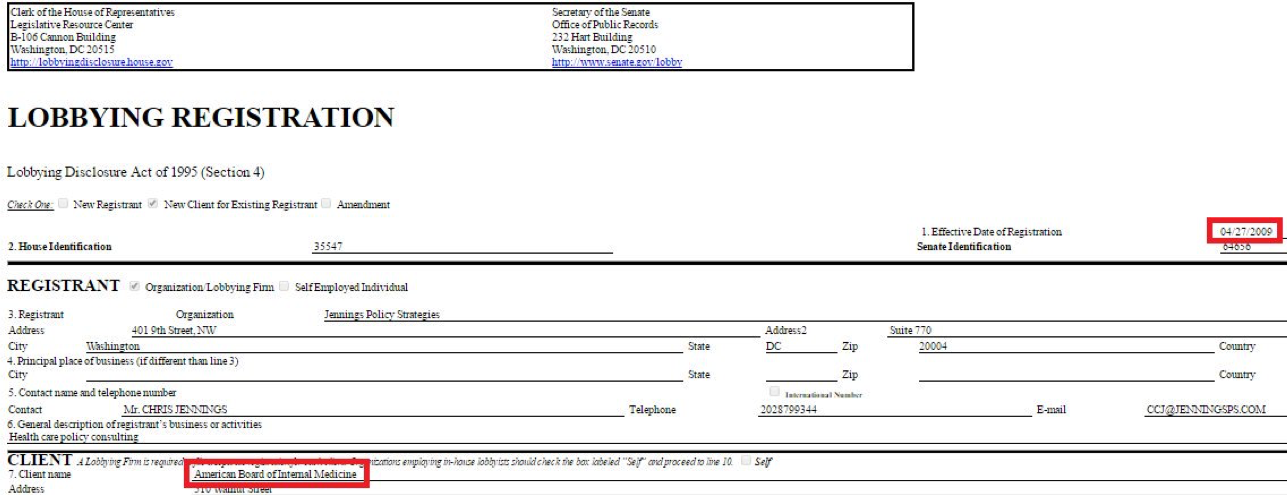
The same day she announced that political appointment, the ABIM contracted with Washington lobbying firm Jennings Policy Strategies, Inc. yet never publicly disclosed this relationship. Instead, ABIM tax forms from 2010 listed this firm as hired for "consulting services." It appears to this lay physician that these "services" were in direct violation of IRS regulations concerning lobbying, especially given Dr. Cassel's substantial non-disclosed financial ties to Premier, Inc., one of the nation's largest Group Purchase Organizations for the nation's hospitals. At least one other lobbying firm was retained by ABIM (named Mehlman Castagnetti Rosen Bingel and Thomas, Inc.) until June 30, 2015, and this relationship was never publicly disclosed to ABIM's physician diplomates, the IRS, or the public either.
According to a Newsweek reporter, the ABIM used obfuscatory accounting techniques during and after Dr. Cassel's tenure: "I had an easier time figuring out the compensation of officials at Enron, WorldCom and Adelphia—all famous for lying on financial filings—than I did for those at the ABIM, where enormous effort seems to have been taken to make murky what should be crystal clear." The ABIM reportedly paid Dr. Cassel $1.7 million in her final year.
Some things never change: Dr. Cassel once again claimed "no conflicts" in the disclosures to this most recent JAMA article on physician burnout either.
Gaslighting physicians and nurses is not the way to fix burnout.
It would be far better for the members of the ACGME to hold a mirror before themselves to understand how their conflicts of interest have systematically done more to harm our profession over the years. Our current house of Medicine has gleefully created the world's most expensive typing pool with physicians and nurses as little more than data entry clerks clicking away whether home or at work. Our current non-transparent health care system has evolved this way thanks in large part to the AMA's behind-the-scenes business model dependent on licensing its ever-changing "Current Procedural Terminology" (CPT) codes for use by the electronic medical record companies and insurance companies to covertly ration care. At the same time, the ACGME supported and promoted the transition from lifetime ABMS board certification to an unproven and wasteful "continuous board certification" by insisting on lifetime testing and payments from physicians for themselves, the lucrative publishing and testing industries, and a vast network of physician specialty societies without ever examining the harms this extortion has caused physicians and the patients they care for. It is telling there was no mention in the recent JAMA article of the "Maintenance of Certification" (MOC) controversy that has led to multiple ongoing federal class action antitrust and racketeering lawsuits, deprives physicians of personal and family time, and steals any semblance of self-educational autonomy from physicians for the benefit of the ACGME members and their collaborators.
To fix burnout we need doctors and nurses looking up at patients rather than looking down at computer screens. We don't need hand-holding wellness exercises, life coaches, and yoga classes. We especially dont need them right after witnessing the unfortunate death of a child or having a patient die beneath our hands despite our best efforts.
Doctors and nurses are not babies or widgets in an assembly line.We entered into this real-life drama of medicine with eyes wide open knowing full well that medicine and health care can be challenging. Yet much of corporate medicine has taken on its role to push our limits to make the system more "productive" for the system at the expense of its caregivers. Medicine is hard damn work that is both emotionally draining yet exhilarating all at the same time. We take the ultimate responsibility for our patients. The ACGME and their protected bureaucratic workshop do not. We risk falling prey to this exploitation if we fail to expose these many undisclosed conflicts of interest with the authors and "committee" wrote and published this paper in JAMA.
This is not to say I see a day where medicine will occur without the use of computers. But computers and secret sharing of data health care data can have its consequences if patients and physicians are kept in the dark. The depersonalization that computers bring to medicine has a nasty side effect on the care we provide: physicians and nurses need face-to-face, hand-to-hand, and heart-to-heart time with patients and their colleagues, not computers, procedure codes, and recommendations from people who foisted MOC upon us, stood to gain financially from it, but never participated in MOC themselves.
Distrust of our self-imposed corporate overlords is a large part of why we're where we are currently, particularly when they insult us with their self-serving "mission" to have physicians help themselves. What do these physician-bureaucrat posers know what's really happening on the front line of health care today?
Humility at admitting mistakes would go a lot further at curing physician burnout than beating the same corporate drum that wedges itself between what really matters: doctors and nurses caring for patients without the self-appointed, politically- and industry-funded National Academy of Medicine and their cronies telling us how to do our jobs. It would be far better if they took off the chains they bind us with and let us do what we do best.
-Wes
Showing posts with label physician burnout. Show all posts
Showing posts with label physician burnout. Show all posts
Friday, October 25, 2019


Saturday, December 17, 2016
Physician Burnout and MOC: Treating the Cause, Not the Symptoms
Here's a brief example:
WHAT DO PRIVATE PAYERS GAIN FROM REQUIRING MOC?
As a volunteer board member of NBPAS (no compensation or honorarium as opposed to the salaries of ABMS board members, which can range from $300,000 to greater than $800,000), I have often wondered why private payers require MOC when Medicare does not require board certification or MOC. The answer is quite disturbing. Private payers actually participate in certification, which is issued by the National Committee of Quality Assurance (NCQA). Margaret E. O’Kane is the founder and president of the NCQA, and she is also a member of the ABMS Board of Directors. The NCQA requires private payers to require physicians to participate in MOC in order to be NCQA certified. Thus, anyone contracting with a private payer will require MOC. In the conflicted case of Ms. O’Kane, she profits from the NCQA requiring private payers to require physicians to participate in MOC, and then she profits again from her ABMS position when said physicians must pay to comply with MOC requirements.
Read the whole thing.
Dr. Mathew will be giving Neurology Grand Rounds at Michigan State University/Sparrow entitled "Maintenance of Certification: Reform or Reboot?" on 13 Jan 2017 from 07:30-08:30 AM EST. All are welcome to attend.
-Wes
Subscribe to:
Posts (Atom)