Showing posts with label Bill Clinton. Show all posts

Friday, March 20, 2015

Heart Rhythm Society and MOC: It's Not About the Doctors

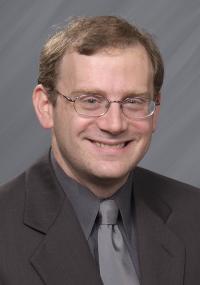
Dr. Fogel
Richard Fogel, MD, President of the Heart Rhythm Society (HRS), finally released HRS's current stance in the debate on the American Board of Medical Specialties' (ABMS) Maintenance of Certification (MOC) program that has pitted one quarter of US practicing physicians against the American Board of Internal Medicine (ABIM) and its Foundation.  As a member of the Heart Rhythm Society, I sent Dr. Fogel links to my work on the ABIM in a relatively lengthy email some time ago.  As a result, I am sure Dr. Fogel is fully aware of the financial dealings that have transpired with the ABIM and its Foundation prior to writing his press release.

From Dr. Fogel's announcement, it appears the Heart Rhythm Society is carefully choosing its words so as not to seem too adversarial to the ABIM by recommending (1) the removal of the requirement of being dual-MOC certified in BOTH cardiology and cardiac electrophysiology, (2) permanently ridding electrophysiologists of having to perform the busy-work of "practice improvement modules" and (3) "continuing the discussion" at a later time.

While Dr. Fogel's statement is pleasant and forthright, those are not exactly fighting words.

Dr. Fogel also announced a "debate" on MOC that will take place at the Heart Rhythm Society Scientific Sessions being held in Boston in May of this year.  It will be moderated by Mike Gold, MD with Doug Zipes, MD as the pro-MOC advocate and Fred Kusumoto, MD taking the contrary argument. I'm sure the session will be well-attended and, who knows, maybe a few carefully-selected questions will be hand-picked from the audience!  But will the "debate" do anything?  No.
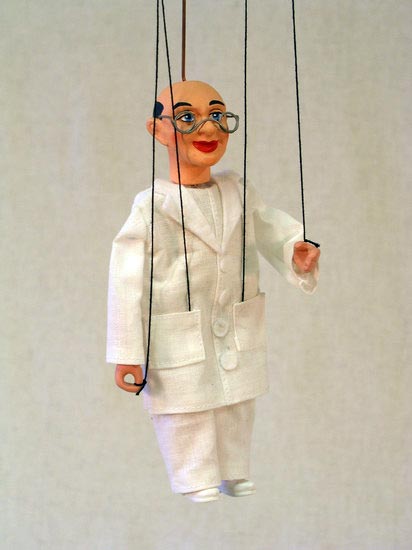
MOC Debaters?
Step back and consider this upcoming HRS "debate" for a moment.  Note how one doctor is being pitted against another doctor as though there is a debate between doctors on the value of MOC to our patients. The whole scenario is like physician puppets on a string having their message crafted by some ABMS/ABIM puppeteer! Is there really a debate that our physician testing fees should be used to purchase $2.3 million condominiums with a chauffeur-driven BMW 7-series town car? Is there really a debate that it's okay for an organization to fail physicians based on an unproven metric after 30 years of clinical practice? Is there really a debate that the evidence base substantiating MOC was written in large part by ABIM members themselves?  Given the overall negative sentiment of the majority of electrophysiologists, to pretend there is a 50-50 split in opinion on the subject of MOC is silly.  Nothing could be further from the truth. In fact, I'm not sure I've ever seen such consensus by the entire practicing U.S. physician community about the detrimental effects of MOC to our profession no matter what subspecialty or what side of the political divide they hail.  There simply is no debate: MOC is a mess.

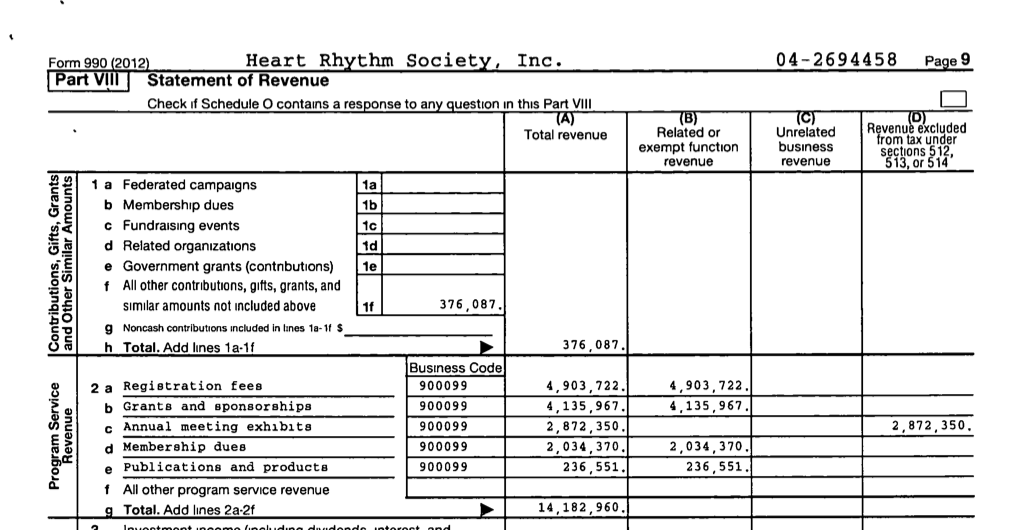
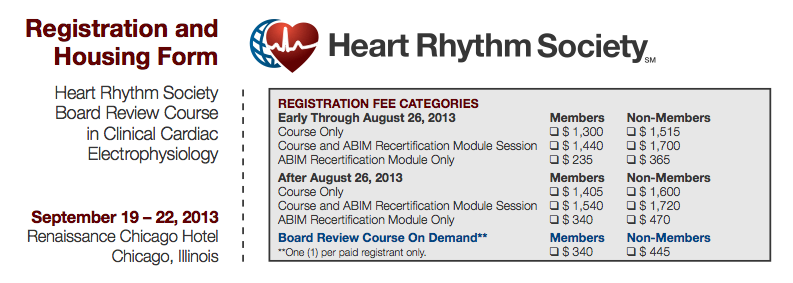
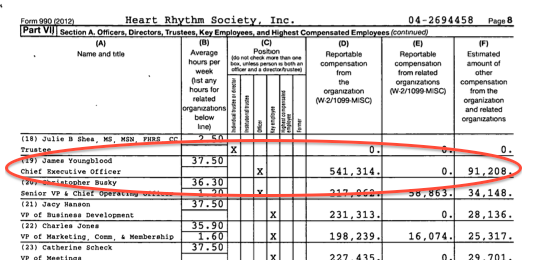
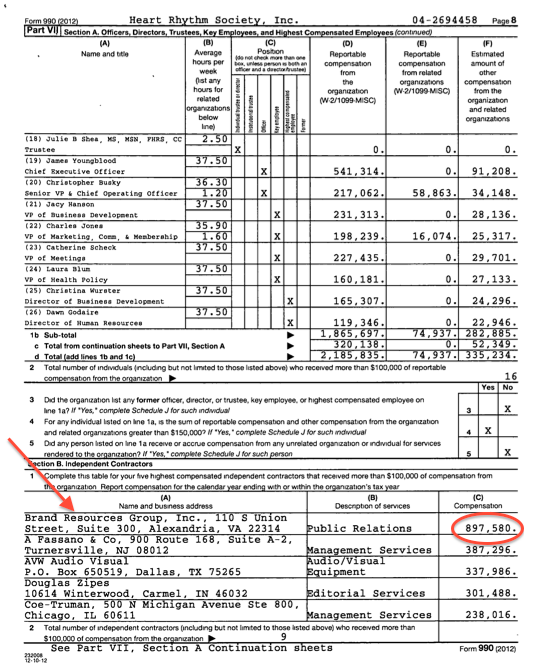
Maybe the real debate at this year's Heart Rhythm Society meeting should be about the $4.9 million in registration fees the organization collects from its members each year for MOC review courses so they can pay their non-physician CEO's salary of $632,522 and Bill Clinton's public relations firm $897,580 to show up at the 2013 Heart Rhythm Society Scientific Sessions in Denver, Colorado.

Please note that the ABIM still has not publicly posted their 2014 Form 990 (due Feb 17, 2015). It is clear they want to wait as long as possible to do so.  But even with an extension, the form must be filed by May 15, 2015, the day before the 2015 HRS Scientific Sessions end. It's very hard to have a "debate" on MOC when all the facts on the finances of the ABIM remain cloaked in secrecy, too.

Physicians should remember that just because the 0.5% incentive payment from Medicare to physicians who participated in the MOC ended 1 Jan 2014, it doesn't mean the coercive practice has gone away. Through their many political supporters, the ABMS made sure that MOC remained a component of the Medicare Physician Quality Reporting System (PQRS) as a part of the Center for Medicare and Medicaid Services (CMS) "Physician Compare" initiative.  The majority of US physicians are now employed by hospitals eager to compete for a growing number of newly-insured patients. As such, hospitals are increasingly requiring physicians to participate in MOC as a condition for gaining credentials in their hospital.  By even pretending to side with any form of MOC, the Heart Rhythm Society tactically agrees that MOC may continue to coerce money from their own physician consumers for the their benefit and that of ABMS's constituents.

Let's be clear: MOC is not a doctor issue, it's a political issue.

It is remarkable that the US government is now the only government in the world that officially requires repeated "re-certification" of physicians for them to practice medicine. Thanks to MOC, it is also the only government in the world that acts as imprimatur to an unproven pay-to-play scheme.

Doctors are done playing this game.  It's time for HRS to stop the faux debating and start aggressively acting on behalf of their membership.

The time to end MOC as a faux physician quality measure - all of it - is now.

-Wes


Thursday, May 09, 2013

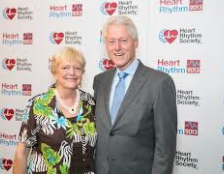
Former President Bill Clinton Kicks off Heart Rhythm Society Meeting

While the above title is true, I admit that it was used more for garnering readership than suggesting that former U.S. President Bill Clinton had any real news to share with the world's pool of heart rhythm specialists.  Oh how we hoped he would tell us about his pacemaker or implantable defibrillator that he had installed but, alas, it was not to be.

But the man can still draw a crowd.  The large auditorium was filled by just about everyone that attended the conference it seemed, and he received a standing ovation upon entry.  He seemed relaxed, but often glanced down a bit toward the floor when he spoke on occasion as he gauged the audience and weighed his commentary.  For the first part of his talk, he stood behind the podium with teleprompters at its side, but unlike other presidents we know, those seemed more for those introducing the former president, rather than the former president himself.

Mr. Clinton was politely received by what could have been a viper's den of cardiac subspecialists.  He's a gifted speaker and many of us were impressed by the depth and breadth of humanitarian efforts taken on by his Clinton Foundation following his stint in the White House.  It was interesting to hear about all of the places hes been and the work his organization has done and at the outset.   After the polished introductory video of the Clinton Foundation's excellent work was shown to the audience of political neophytes, many of whom had never seen a president before, it was clear no one was going to kill the baby seal.  This was to be the Bill Show and sadly, there was never a single mention of the support team behind his foundation.

Still, there were moments in his speech that were captivating, especially the part where he described his own post-bypass ordeal of being told that he had fluid around his heart after his heart surgery and how he had to return to the operating room to have "my chest cracked open again" to manage it.  We got a glimpse at his real fears and his real appreciation for his doctors and the technologies that cared for him.  We heard how he ignored his chest tightness that occurred at rest after his bypass operation and how foolish he felt in retrospect after receiving two stents to a "badly mangled artery."  Then we heard about how all of this lead his efforts to change his own dietary habits and to work with PepsiCo to develop policy for school kids to lower caloric intake of sugary drinks: "We found a way to change the system without having to take it down.  That's what we need to do."

But his efforts to circle back to health care reform were disjointed much of the time as he waxed back and forth from his experience in Rowanda building clinics and providing logistics to the US, and then to comparing the relatively small Netherlands' health care system to the US's system, leaving many doctors wondering when he was going to say anything of real substance.  Still, he tried to make the point about a "systems approach" and paying for "performance" rather than "procedures" as a partial way to fix things.  He seemed to yearn for a simpler system than the one we've got.  When asked point blank if his perspective on health care had changed since having his expensive care, he masterfully deflected the question by saying "I have a deeply personal regard for the American health care system, but we're limp at preventing errors." No doubt doctors who worked so hard on his behalf appreciated that comment.

Overall, most people I spoke with after the event seemed generally pleased with Mr. Clinton's performance, especially when he admitted the limitations of the Affordable Care Act (ACA).  They liked his quip about how 99.5% of people's DNA are identical, yet we spend so much time focused on making sure others know the differences in the remaining 0.5% of their genome.  It was clear he was a master at reaching across the aisle and he opined for a more collaborative approach to resolving our nation's health care problems.  When asked whether he thought the ACA (Affordable Care Act) would fix what's wrong with America's health care system, he said honestly "Maybe.  Maybe not."  But he stuck with the partisan narrative of error management, paying by "performance" rather than procedures and asking doctors to do their part to fix the system, seemingly unaware of the 30% drop in RVU payments that took hold 1 January 2013 and the 2% Medicare payments to physicians that recently affected many members of his audience. It seems he felt doctors needed to do more, but many doctors wondered silently how much more we can take.

It was clear the Europeans I spoke with after the talk loved his speech.  But they were also quick to point out another little fact: Mr, Clinton's appearance fee is somewhere in the order of $250,000.  A quick fact check showed that was a gross understatement: it's closer to $500,000 or more.  If this is the price we've paid for this hour of entertainment it's no wonder our health care's cost crisis is such a mess.

And if so, maybe Mr. Clinton should do his part for health care reform, too, and stay home.

-Wes