Saturday, October 31, 2015

Part II: Why Washington?

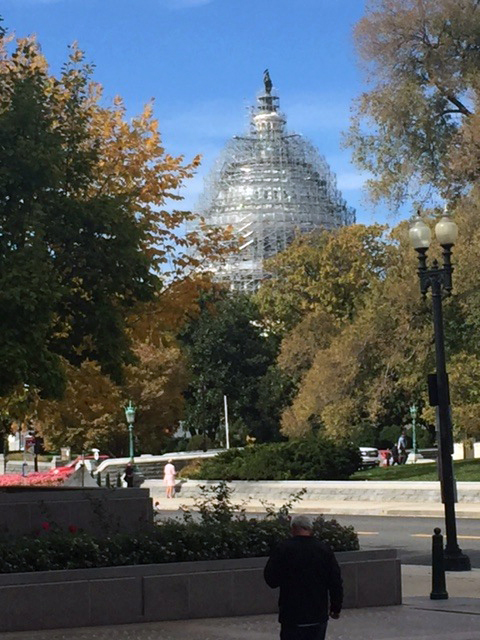
I looked out the airplane window and saw we were approaching Reagan National Airport from the south. The crisp morning sun pierced the fluffy clouds and found its way through the slit of the partially-opened airplane window shade to momentarily blind me. A small apex of the Washington Monument could be seen in the distance. To its right, the US Capitol dome shrouded in scaffolding.

Washington DC.

Having my luggage, I Uber-ed my way to my hotel. Boutique hotel next to the Capitol. Nice place. Quaint pastel-painted row houses nearby. French bistro, too. A 30-somthing hipster lady was checking out as a host brought her a few knickknacks to munch on for breakfast. The smartly dressed man  behind the front desk had an Australian or South African accent. Or was he from Belize? I couldn't tell. Relaxed. Confident. Good eye contact. He checked me in.

 This is the life of a policy wonk, I caught myself thinking.

My room was larger than I needed, the bathroom tiny, but functional. I pulled back the curtain and saw the many marble buildings surrounding the hotel and blocked the viewed of the streets further away that I remembered weren't quite so inviting.  Lots of construction in view.  Booming. I wondered if any of the other people who frequented this establishment ever saw the very different life that exists in rural areas outside the Beltway.

Probably not.

No matter. It was Washington. Time to explore. Crisp air. School kids bursting with excitement and rushing to the street corner, starry-eyed. Ever-patient chaperons shouting they could only see the Capitol if they made two parallel lines. "Quiet, please! Line up. Come on, now." Others in dark suits walking the streets. High heels with lanyards and  name badges. People walking in tandem, sharing secrets, telling jokes. Black Towncars, Escalades with tinted glass, Mercedes.  Large white buildings that dwarfed their visitors, like Poseidon looking down on a flotilla of tiny ships at sea.  Supreme Court. Library of Congress. Madison, Jefferson, Dirksen, Hart, Cannon, Longsworth, Rayburn. White. Marble. Big. Powerful. At least so it seemed. Certainly not for the faint of heart. Security everywhere. Metal detectors. Strange white mechanical roadblocks that clanked up and down to let the Important People drive their beat-up Subaru over it to head home.

A foreign land for a practicing doctor. Almost surreal.

I had arranged to meet two colleagues before the introductory dinner gathering. Each a name on The List. We never met before but shared some emails once. Nice to put faces with the names. They were more seasoned in this environment than me. But real doctors. Not pretend. Independents. Just came from work. Drove all day or flew from far away. Eager to meet others. Passionate. Each with their story - a reason to be here. Certain they could speak to a piece of the puzzle. Frustrated with things but determined to do something. I settled in. We exchanged numbers. You on Twitter? Defiantly: "Why should I use a smartphone when a tiny flip phone will do?"


* sigh * Reality.

Soon we headed to the introductory dinner. Staffers handing out sticky paper name tags that never seem to stick. (Except to things they shouldn't.) Pleasant smiles. A glass of wine. Pasta on the menu. Mingle. Where are you from? I see. The Congressman will be here a bit later. Then the Congressman arrived. Thanks for coming. Relax. Enjoy your stay. Tomorrow we'll show you our plan. Want to get your ideas, feedback. What brings you to Washington?

They all seemed to know. Me? Better to lay low for now. Who are all these people, really?

Would what I had to say make any difference? There was another plan. Another agenda.  Mine? Very small, unimportant. One doctor with a few others in a big very big pond, treading water, learning to swim. Would this be worth it? Others seemed to think so.

I still wasn't sure.


Friday, October 30, 2015

Justice Department Fines 457 Hospitals for Inappropriate ICD Implantations

From the Heart Rhythm Society via email today:
Today, the Department of Justice announced that it has reached settlements in its investigation of hospitals for billing Medicare for ICDs implanted in Medicare patients that did not meet Medicare coverage requirements. The announcement includes 70 settlements involving 457 hospitals in 43 states for more than $250 million.

The Heart Rhythm Society (HRS) has recognized that the misalignment between the Medicare National Coverage Determination and the clinical practice guidelines created gaps between the payment policy and clinical decision-making and places physicians and their patients in an untenable position. To help mitigate the problem, HRS published "2013 HRS/ACCF/AHA Expert Consensus Statement on the Use of Implantable Cardioverter Defibrillator Therapy in Patients Who Are Not Included or Not Well Represented in Clinical Trials”.

Moving forward, the Society’s priority is to do everything possible to assist the heart rhythm care community in managing the patient care pathway. HRS and other medical specialty societies are currently working with the Centers for Medicare and Medicaid Services (CMS) to identify the appropriate time to reopen the existing national coverage policy. The Society will provide CMS with recommendations to update the clinical indications for reimbursement. With this preparation, we stand ready to work with our partners to revise the Medicare coverage policy to reflect current clinical practice.
Outdated CMS National Coverage Decisions from 2005 just whacked hospitals. "Misalignment's" Catch-22. So much for evidence-based medicine. So much for practice guidelines. So much for innovation in health care.

CMS NCDs rule now, no matter how outdated, from now on.

The Justice Department has spoken.

-Wes

References: Justice Department press release with list of hospitals affected.
More on the history of this action here.

Part I: Why Washington?

When I lived in Washington DC years ago, there was a saying my wife and I heard on occasion from our friends who worked on the Hill:
"In New York, it's about finance;
In Boston, it's about power;
In Washington (DC), it's about access."
* * *


The invitation came in a regular envelope. An invitation to go to Washington DC.  Who asked me? What was this for? Was it real?

I studied the invitation: a "personal" invite from Congressman Pete Sessions (R-TX), dinner the first night (dutch treat), then meetings started the next day at 08:30 am in the Rayburn Building, presentations, other Senators and Congressman to be invited (names to be decided). New plans. Need input, discussion, dinner afterward.

I showed the invitation to my wife: "Do you think this is the real thing? Why would they ask me?"

"Looks real. Call them," she said. "Find out who's going.  Maybe there's someone you know."(My wife, unphased, used to testify on the Hill when I was a young staff doctor at the National Naval Hospital in Bethesda, MD many years ago).

I waited a few days, then called. "Well, fifty-five doctors have already RSVP'd so far," said the exasperated voice on the end of the line." Ugh, I thought. "We'll be sending out a revised agenda with a list of the attendees when the date gets closer."

Would it be worth it? Fifty-five doctors? Were doctors being asked to come to Washington at their own expense just so it would look like we were "at the table" when, in fact, we were "on the menu?"  Given health care's recent history and how things got to where we are now, it was very hard to suppress my cynicism. Who funds Representative Sessions, I wondered? I checked. Got it. Then I really pondered: why me?

My wife looked at me like I was an idiot. "You have to go," she said. "You can't go through all of these hours of investigation, research, fire, and brimstone, and not go to Washington. Make some appointments.  Maybe you could stay with our old friends Jack and Jill  (not their real names) while you're there."

"But the time from work... it's so expensive..."

"You decide," she said. "But if it was me, I'd make it worth every minute. Look, Washington is really kind of, well, government. Think DMV. Big hallways. Linoleum floors. Fluorescent lighting. All puffed up, but not that glamorous when you think about it, it's no big deal." My wife sure knows how to sell things...

That night, I stared at the computer screen on my desk. "How much does it cost to fly to Washington?" I searched Orbitz. I'd have to cancel a clinic day, maybe two. Maybe I could swing this if I only missed an extra half a day of my clinic. Folks at work won't like this. Oh heck, she's right. I'd never forgive myself if I didn't go.

After weighing things, I booked the flight, then rearranged and blocked my clinic schedule the next day, though I still wasn't sure. Will it be worth it?

A few weeks later a more finalized agenda came with the names of who would be attending. I googled everyone (this seemed to take forever). I made a list. 18 states. Most were practicing doctors. Most of those orthopedic physicians, (Huh?) a few AMA representatives (young and semi-retired), a few older retired doctors, a few lawyers, an economist, a doctor who ran an ICD-10 coding company, a person who owned a medical collection company, some physician advocacy group representatives, a lobbyist.

Sheesh.

"Mouth of the lion," I thought. "How am I going to get a word in edgewise?" Fifty-five people had grown to sixty.  "It'll be a waste of time," I thought.  The next day I finished my overbooked clinic, then returned home to tell my wife what I had decided. I told her I probably won't go to Washington after all.

"You have to go," she reinforced.

"It's all about access."


Thursday, October 22, 2015

Sunshine

From Jonathan Edwards (video):
"Sunshine go away today
I don't feel much like dancing
Some man's gone, he's tried to run my life
Don't know what he's asking

He tells me I'd better get in line
Can't hear what he's saying
When I grow up I'm going to make it mine
But these aren't dues I been paying

(Chorus)
How much does it cost, I'll buy it
The time is all we've lost, I'll try it
But he can't even run his own life
I'll be damned if he'll run mine, Sunshine

Sunshine go away today
I don't feel much like dancing
Some man's gone he's tried to run my life
Don't know what he's asking

Working starts to make me wonder where
The fruits of what I do are going
He says in love and war all is fair
But he's got cards he ain't showing

(Chorus)

Sunshine come on back another day
I promise you I'll be singing
This old world, she's gonna turn around
Brand new bells'll be ringing."
I'll be heading to Washington, DC on my own dime next week. Seems there are plenty of people who want to know more about the American Board of Internal Medicine.

Who knows? Maybe I'll learn a thing or two, also.

-Wes

Thursday, October 15, 2015

Can Medical Knowledge Be Copyrighted?

A patient with a history of syncope, first degree AV block with evidence of a bundle branch block and 2:1 block on telemetry is examined and 1:1 conduction ensues with carotid massage. You recommend a pacemaker because you understand the electrophysiologic principle of "gap phenomenon" but realize that you had a question that looked just like that on a prior cardiac electrophysiology medical board examination. You recall that just prior to that examination, you electronically signed a statement that contained something like the following contract language just before the computerized examination started (but recall you were never given a copy of that mystical agreement):
I understand that all ABIM materials are protected by the federal Copyright Act, 17 U.S.C. § 101, et seq. I further understand that ABIM examinations are trade secrets and are the property of ABIM. Access to all such materials, as further detailed below, is strictly conditioned upon agreement to abide by ABIM's rights under the Copyright Act and to maintain examination confidentiality.

I understand that ABIM examinations are confidential, in addition to being protected by federal copyright and trade secret laws. I agree that I will not copy, reproduce, adapt, disclose, solicit, use, review, consult or transmit ABIM examinations, in whole or in part, before or after taking my examination, by any means now known or hereafter invented. I further agree that I will not reconstruct examination content from memory, by dictation, or by any other means or otherwise discuss examination content with others. I further acknowledge that disclosure or any other use of ABIM examination content constitutes professional misconduct and may expose me to criminal as well as civil liability, and may also result in ABIM's imposition of penalties against me, including but not limited to, invalidation of examination results, exclusion from future examinations, suspension, revocation of certification, and other sanctions.

Can you divulge this principle of gap phenomenon (and a similar example of this phenomenon) that once appeared in an almost identical way on your board examination to your residents?

According the American Board of Internal Medicine (ABIM) and the above agreement, it would seem that I cannot.

But is such a medical principle and my personal example displayed on this blog truly copyrightable by the ABIM?

According to prior court decisions, under the principle of the "merger doctrine" my example does not violate the Copyright Act. In fact, according to Mazer v. Stein, 347 U.S. 201, 217 (1954), the Supreme Court stated "Unlike a patent, a copyright gives no exclusive right to the art disclosed; protection is given only to the expression of the idea—not the idea itself." This protects my First Amendments' free speech right and the fact that this same principle was shown to me years before by my mentor, Mel Scheinman, MD at the University of California, San Francisco when I trained as a fellow in cardiac electrophysiology.

To be clear, the disclosure of an exact replica of a board question and its detractors (wrong answers) might be subject to a copyright dispute, but it is clear that simply mentioning to residents that you saw a "similar question" on your specialty board examination and providing an example to your residents and fellows does not compromise your ability instruct your residents about such an important electrophysiologic principle as "gap phenomenon." In actuality, it is hard to copyright medical information that is widely available in the medical literature.

But this has not deterred the ABIM from continuing its legal battles against physicians who they claim may have shared information about their certifying examination question content.

More Suits Against Physicians Filed

Currently, the ABIM is continuing to sue physicians for possible Copyright Act infringement of their secure board examinations from participants in the Arora Board Review course given in 2009 (!), this time a young internal medicine physician from Puerto Rico (the full text of this suit can be viewed here). While this trial has yet to be heard, it will be interesting to see if the ABIM's Copyright Act infringement claims have merit. The suit is interesting because it gives a detailed accounting of the ABIM's test creation methods and the damages they hope to recover. I encourage my physician readers to review the suit.

Even more interesting to me, however, is the answer to the claims made in the ABIM's suit by the defendant and the countersuit filed against them (seen here). The claims of the "ABIM Individuals' Illicit Conduct" (beginning on page 22) are important to review, for if they are found to be true, they offer insight into the extent ABIM will go to protect their intellectual property and the damages they inflict of physicians that might be wrongly accused, including the use of a "spy," claims fo the violation of a "Pledge of Honesty" that the defendant never saw, public claims that he was "unethical and unprofessional," and having only 10 days before every medical licensing board in his jurisdiction would be notified of the ABIM's decision, leaving (in my view) no opportunity for due process.

These are extremely important issues for physicians to understand as the "restructuring" of the ABIM continues in light of the ABIM getting it "wrong" and the financial revelations and deceptive disclosure practices of the ABIM raised on this blog and elsewhere.  If the court finds in favor of the defendant in many of the claims made by him, I have a feeling there will be many more suits against the ABIM to follow.

It also raises the very real possibility that the ABIM Foundation was not created as a means to define and promote "medical professionalism," but rather to serve as a legal defense fund for the ABIM as they protect their monopoly interest in the physician specialty accreditation process.

-Wes


Thursday, October 08, 2015

Every 10-year ABIM MOC Exam On It's Way Out? Careful What You Wish For

According to MedScape:
The American Board of Internal Medicine (ABIM) has announced that it will consider replacing its 10-year maintenance of certification (MOC) exam with shorter, more frequent testing that physicians could take home or in the office.

The proposal to eliminate the 10-year examination is one of several recommendations issued today by ABIM's "Assessment 2020 Task Force," convened in 2013 to improve its controversial MOC progam for internal medicine (IM) physicians and IM subspecialists. ABIM released the task force report less than a week after the American Board of Anesthesiology (ABA) announced that it would replace its 10-year MOC exam with continuous online testing next year.

"The results of the smaller, more frequent lower-stakes assessments would provide insight into performance and accumulate in a high-stakes pass/fail decision," the task force said in its report. "A failure at this point may necessitate taking a longer exam or another form of assessment in order to maintain certification."
Let's think about this a moment.

ABIM's Task Force 2020 wants to replace MOC with MORE testing, more often, and still reserve the right to force a physician to take a "longer exam or another form of assessment in order to maintain certification?"

This isn't better, it's worse. Much worse. Instead of every 10-years, it will be daily or weekly MOC-minutes!

More MOC distraction pushing physicians away from their patients and toward even more computer time.

What are these "Task Force 2020" members smoking?

Of course the money can't be denied. Pharmaceutical companies are licking their chops. Think how many MOC® questions we'll soon have to answer on novel oral anticoagulant use instead of that old, cheap, outdated warfarin! Pushed to our iPhones, these new MOC-minute® questions are sure to turn your head away from patient care toward an easy payment plan! I wouldn't be surprised that thanks to the ABMS stumping for Big Tobacco in the sixties, we'll all be answering questions on the praises of e-cigarettes and pharmaceutical aids for smoking cessation, too!

It's truly fascinating to watch these attempts at social engineering of practicing physicians by the ABIM. But the ABIM has already tried voluntary re-certification and knows it failed miserably. They had to make it mandatory by veiled threats over what the loss of Board certification might mean or no one would pay into their scheme.

Want proof that the ABIM isn't serious about ending their MOC® exam?  Read the contract physicians must sign before entering into the ABIM MOC® program. Read about "trade secrets" and "federal Copyright Act, 17 U.S.C. § 101, et seq." and "forensic techniques" they use to protect their products. And let's not forget that "disclosure or any other use of ABIM examination content constitutes professional misconduct and may expose me to criminal as well as civil liability, and may also result in ABIM's imposition of penalties against me, including but not limited to, invalidation of examination results, exclusion from future examinations, suspension, revocation of certification, and other sanctions."

These guys and gals of the ABIM mean, er, BUSINESS!

All this for a costly and completely unproven metric foisted on physicians to assure the ABIM's cash flow.

MOC® isn't about physician education or patient welfare, it's about intimidation, $2.3 million condominiums, $1.7 million golden parachutes, and secret transfers of millions upon millions of physician testing fee dollars to the ABIM Foundation in the name of "social justice."

It's about an organization that has allowed itself to sink $47 million in the hole (Fiscal Year 2014 Form 990 line 22) and balances its financials on a whopping $94 million in deferred revenue (Form 990 Page 11 of the pdf, Form X, line 19).  

That $94 million will be coming from somewhere (can you say "ACA?") and since the ABIM gets 98% of is fees from practicing physicians, you can bet your last silver dollar that these totally  unproven MOC® programs will be paid for by practicing physicians, one MOC® exam or MOC-minute® at a time.

And the ABIM is SERIOUS. Recently, despite all that has been uncovered about the ABIM, they continue to sue doctors over their intellectual property, just as before, this time in Puerto Rico (case 3:15-cv-01016). Oh, golly, what's a few more million dollars in legal fees to protect your income stream, right?

If you believe there will be no MOC® exam of any type, ever, and given the honesty and integrity the ABIM has demonstrated over its finances over the past 30 years, I've got some ocean-front property in Arizona I'd like to sell you.

-Wes

9 Oct 2015 06:00AM Link to ABIM's Puerto Rico case fixed.


Monday, October 05, 2015

Heart Rhythm Society and ABMS: Friends for Life

Patients are dropping like flies in Electrophysiology Laboratories across the country. Death and destruction everywhere. Poor quality. Unsafe standards. Pitiful results.

What, you haven't heard? 

Clearly this MUST BE THE CASE! That's why it's SO important that the Heart Rhythm Society and the Intersocietal Accreditation Commision (IAC) INSIST (seriously) that EVERY electrophysiology laboratory in the United states have a MEDICAL DIRECTOR certified by the American Board of Medical Specialties.  Otherwise, your electrophysiology laboratory will be labeled as "NOT UP TO STANDARDS." And we wouldn't want that now, would we?

I just received this disappointing e-mail from David Haines, MD, president of the "IAC Cardiac Electrophysiology Accreditation" on behalf of the Heart Rhythm Society (who is clearly colluding with the American Board of Medical Specialties to assure regulatory capture of every electrophysiology laboratory in the United States) under the guise of EP laboratory standardization:
Last week, I sent an email discussing the recent partnership between the Heart Rhythm Society, the Intersocietal Accreditation Commission (IAC), and other key stakeholders to develop and operate an EP Lab Accreditation Program. Developed by the IAC Cardiac Electrophysiology Board of Directors, the draft IAC Standards and Guidelines for Cardiac Electrophysiology Accreditation are now available for public comment and I am requesting your assistance on this important initiative. Please review the draft standards and provide feedback to ensure that they meet the expectations and the field’s needs.

Listed below are the instructions to provide comments. The IAC Comment Form must be completed and submitted electronically by December 1, 2015.


To submit a comment on the proposed IAC Standards:
  • Visit the IAC website.
  • Click on the proposed Standard you wish to review and/or comment from the menu.
  • A window will expand with the description of the Standard and a PDF to view the section of the Standards available for comment.
  • Click on the PDF to open it in a separate window for review.
  • On the right, fill in your name and provide your comments about the proposed Standards in the boxes provided.
  • Push submit.
At the close of the comment period, the IAC Cardiac Electrophysiology Board of Directors will review all submitted comments, consider modifications, and vote on the Standards final approval. The new Standards will be posted to the IAC Cardiac Electrophysiology website and available for download in late 2015.
Don't you get it?  The new "Standards" are coming whether you like it or not.

I would suggest every electrophysiologist comment on this decision by the Heart Rhythm Society to insist that EP laboratories must meet certain "standards" regulated by yet another unaccountable body to the physician and patient (who the heck is the "Intersocietal Accreditation Commission?") After all, this is ALL about regulatory capture and the money generated for the ABMS and their member boards.

Where's the proof that patient care will be improved as a result of such standardization?

Instead, everything (including our "re-certification" expenses) will cost us more and more as the regulatory capture of medicine by the ABMS and the IAC/ and their pals continues unabated.

-Wes

Sunday, September 27, 2015

ABIM Maintenance of Certification: The Gift That Keeps on Giving

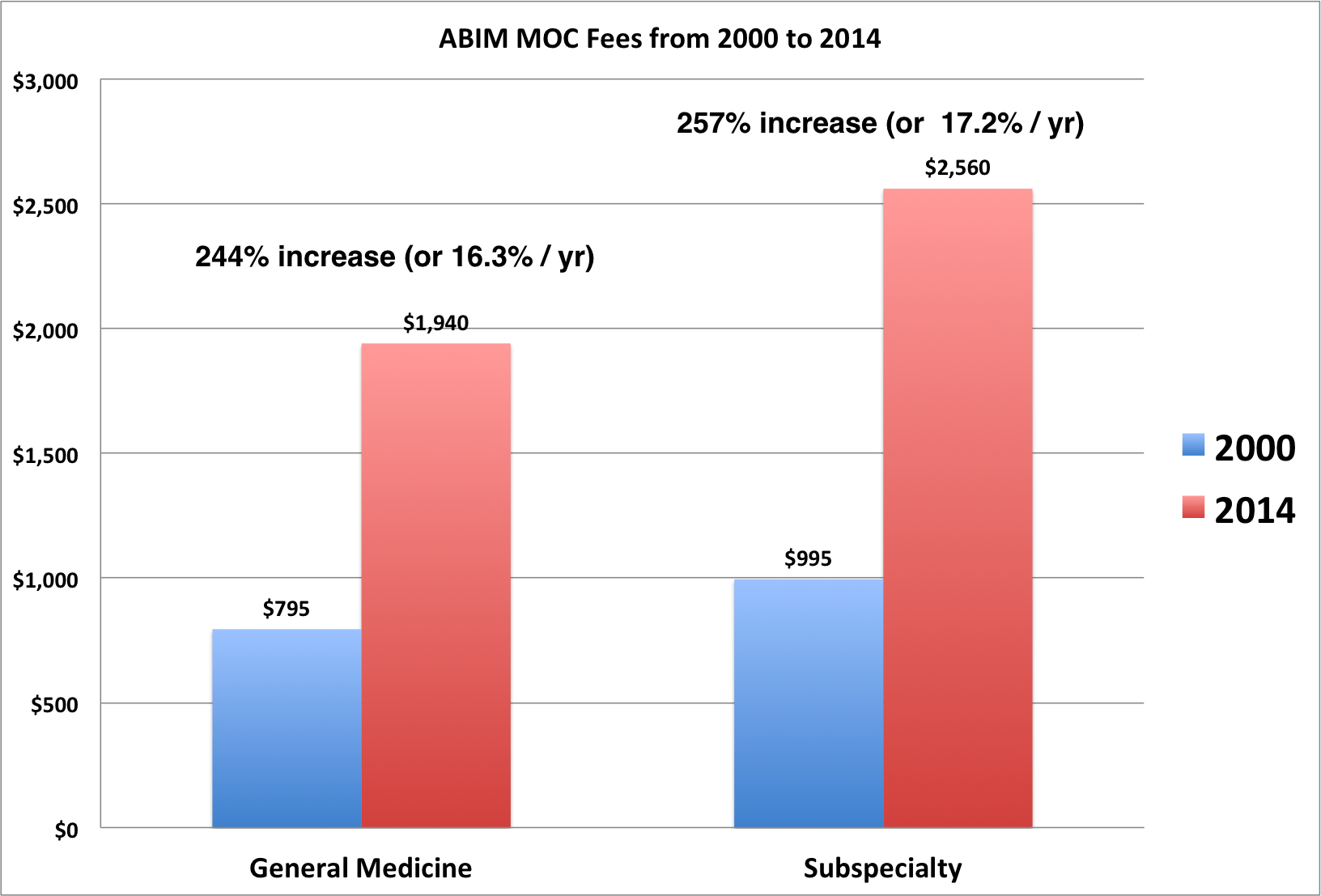
The incredible growth in American Board of Internal Medicine (ABIM) Maintenance of Certification (MOC) fees from 2000 to 2014 in one graph:


The growth of these fees far exceed the growth of inflation and the stock market over the same period of time.

-Wes

P.S.: The fee for certification by the ABIM in 1936 was $40. It cost $10 more to obtain your "certificate."

Friday, September 25, 2015

ABIM First-Time MOC Pass Rates 2000-2014

I reviewed the past 15 years of first-time pass (and therefore failure) rates of the American Board of Internal Medicine (ABIM) MOC secure examination for every internal medicine subspecialty.  Because of the work involved, I wanted to see if I could get these data published in a major peer-reviewed journal nearly two months ago to no avail.

I first submitted a manuscript with these data to the New England Journal of Medicine and it was rejected immediately before the manuscript even reached the peer review process.  (I even gave the editor access to a password protected webpage containing the infographic you will see below).  They weren't interested. (Perhaps because this is a retrospective review?)

I then submitted a slightly revised manuscript to JAMA.  The after a preliminary review, the editor of JAMA would not submit my manuscript for peer review, but thought the work might warrant review as a 600-word "Research Letter to the Editor" that allowed only one figure and one table and no more than 6 references.  Needless to say, nearly a month later, I just learned that my "research letter" was rejected by both JAMA and JAMA Internal Medicine. The reviewers comments were helpful should I ever decide to re-submit these data to a peer-reviewed journal again in a different format. However, given the many changes occuring to the ABMS MOC program recently, I felt time is of the essence and elected to proceed with publishing my data here on this blog. I feel these data are too important to sequester behind a medical journal paywall and encourage physicians to use these data to question the credibility and reproducibility of the American Board of Medical Specialties' (ABMS) MOC secure examination and the remainder of the MOC program as a requirement for maintaining hospital practice credentials. By publishing my data on this blog, I can publish ALL of the data I collected and collated, not just a tiny fraction of it. Also, I have found that this blog's reach is equal to or larger than many medical journals, particularly when a post contains important and credible  information.

METHODS: The ABIM's first-time MOC pass rate data were gathered from current and prior archived ABIM web pages for each subspecialty between 2000 and 2014 using the Internet Archive Wayback Machine (https://archive.org/index.php).  (Only the past 5-years of pass rate data were available for Hospital Medicine and 10-years of  pass rate data were available for Interventional Cardiology because they were "newer" internal medicine subspecialties). The number of physicians failing their examination each year was then calculated by subtracting the product of the total number of physicians who took the examination by the published pass rate from the total number of physicians who took each subspecialty MOC examination. Linear regression trend lines of annual pass rates with their correlation coefficients over time were calculated for each subspecialty. Historical volatility of pass rates was calculated as the standard deviation of the data range of year-to-year percent change of pass rate. For example, published pass rates for General Internal Medicine from 2000-2014 were 89%, 92%, 91%, 85%, 86%, 84%, 79%, 83%, 92%, 90%, 88%, 87%, 84%, 78% and 80% respectively. The percent pass rate change from 2000 to 2001 was calculated as 0.92/0.89 - 1 = 3.37%. The 14-value dataset of  percent pass rate annual changes for the years 2000-2014 therefore was 3.37%, -1.09%, -6.59%, 1.18%, -2.33%, -5.95%, 5.06%, 10.84%, -2.17%, 2.22%, -1.14%, -3.45%, -7.14%, 2.56%. The historical volatility of pass rate percent changes for General Internal Medicine equaled the standard deviation of this dataset, or 4.93.

RESULTS: First-time ABIM MOC pass rate trends (and the raw data for each internal medicine subspecialty's first time MOC pass rate) with their linear regression trend lines can be displayed using the interactive infographic below (just click the specialty circle to display the detailed annual pass/fail data):
Internal MedicineNephrologyGastroenterologyHematologyOncologyRheumatologyHospital MedicineAggregate Failure RateCritical CarePulmonaryGeriatricsInfectious DiseaseEndocrineInterventional CardiologyCardiac ElectrophysiologyCardiology

The total number of physicians who took the test over 15 years and the percentage of physicians who failed their MOC exam on the first try are shown by subspecialty in the table below. Year-to-year historical volatility of pass rates by subspecialty also shown (bolded historical volatility values exceed one standard deviation from the mean of all subspecialty volatilities):

Subspecialty Physicians Undergoing MOC Examination (n) Number of Physicians that failed MOC exam on their first attempt (%) Pass Rate Historical Volatility (Minimum/Maximum annual percent pass rate change)
General Medicine 61,050 9,212 (15.3%) 4.93 (-7.14 / 10.84)
Cardiology 10,486 1,386 (13.2%) 3.23 (-3.53 / 6.10)
Cardiac Electrophysiology 1,398 113 (8.1%) 4.33 (-7.45 / 5.49)
Critical Care 5,596 552 (9.9%) 4.62 (-7.69 / 8.33)
Endocrine 2,308 310 (13.5%) 7.48 (-10.4 / 13.16)
Gastroenterology 6,255 770 (12.3%) 4.35 (-6.45 /4.71)
Geriatrics 6,559 539 (8.2%) 7.64 (-14.13 / 20.51)
Hematology 2,427 338 (13.9%) 7.11 (-9.76 / 13.51)
Hospital Medicine* 829 113 (13.6%) 1.09 (-2.27 / 0.00)
infectious Disease 3,520 312 (8.9%) 5.00 (-10.53 / 7.32)
Interventional Cardiology 3,182 244 (7.7%) 2.24 (-5.32 / 2.33)
Nephrology 4,129 466 (11.3%) 3.81 (-8.42 / 5.56)
Oncology 4,568 456 (10.0%) 3.87 (-8.79 / 6.90)
Pulmonary 5,792 803 (13.9%) 6.57 (-11.24 /13.92)
Rheumatology 2,143 217 (10.1%) 3.56 (-6.59 / 5.81)
TOTAL 120,242 15,832 (13.2%)

ABBREVIATED DISCUSSION:
  • A very significant 15,832 physicians (13.2%) have failed their MOC secure examination on the first try. This has a significant impact on physician morale without justification and has affected patient access to their physician as a result.
  • A large variation in year-to-year pass rates exists for many subspecialties, particularly Endocrinology, Geriatrics, Hematology, and Pulmonary suggesting inconsistent content, irrelevant content, and/or inconsistent setting of pass rate cut-offs year to year using the ABIM's modified Angoff method of determining pass rate cut-offs.
  • First-time MOC failure rates vary by as much as 51% between subspecialties, with General Internal Medicine having the highest failure rate (15.3%) and Interventional Cardiology having the lowest (7.7%)
  • Fourteen of 15 subspecialties had declining pass rate trends in this 15-year review of ABIM MOC pass rates (see infographic). Was this because the tested material is increasingly irrelevant to patient care? Or might there be another ulterior (financial?) motive for the decline? Or are most physicians simply unable to cram larger and larger amounts of information into their heads and regurgitate the proper answer in a limited time period thanks to the exponential growth of health care information over the last 15 years?
  • Year-to-year first-time MOC pass rates could vary by as much as 20.5% (Geriatrics).
  • The steepest pass rate decline was interventional cardiology (1.62% decline in pass rate per year), though low numbers of physicians took the exam the first several years it was offered.
  • Since MOC participation is increasingly tied to hospital credentials as "board certification" became "time-limited" in 1990, what responsibility does the ABIM assume to patients when they fail a physician? How many physicians of each internal medicine subspecialty had to retake their examination (and how many times did each have to repeat)? What is the total cost to the doctor and the health care system for this unproven "quality" metric in terms of real dollars, patient access, and care delivery?
  • Given the large number of physicians that have failed their MOC examination, why has the ABIM not studied the psychological, social, professional, and clinical impact their failure of physicians? Or don't they care?
These are just some of the questions these ABIM MOC pass and failure rate trends garner. I look forward to hearing what others think about these data in the comments of this blog - especially physicians and hospital administrators who might not understand the impact the MOC secure examination has had on physicians and their patients.

A word of caution: the American Gastroenterological Association (AGA) has recently posted a video promising to bring an end to the MOC secure examination for gastroenterologists.  Instead of ending the MOC program, however, (and after reviewing the full proposal about to be published in November) the AGA promises to replace MOC with an even more complicated "Continuous Professional Develppment" program "tailored to your needs" called "GAPP", the "Gastroenterologists Accountable Professionalism Pathway." This pathway promises to be an even more complicated 13-step program rather than MOC's 4-step program.  It is a spin-off from the ABIM's similar "Continuous Professional Development" program used before by the ABIM that still has no proof of its value to patient care and without any disclosure of the cost this program for working physicians. It maintains the need to participate in their program for physicians to remain credentialed to practice medicine in their hospital.  Before leaping for joy that the MOC examination is being phased out, realize that our specialty boards are reeling from the exposure of the financial reality of their "programs" to our health care programs and are creating new "programs" to assure ongoing financial and time-commitments from working physicians without proof that recertification is of any value to patient care over traditional self-directed Contining Medical Education. Worse yet: the AGA uses the term "Professionalism" in the title of their new re-certification proposal - a word defined via a "Task Force" of the corrupt ABIM Foundation.

Please feel free to share this post with interested journalists, friends, and colleagues. If you have further questions or ideas about these data, feel free to leave a comment or send me a note at wes - at - medtees dot com.

-Wes

Tuesday, September 15, 2015

Pulling the Plug on ABIM; Pulling the Plug on MOC

Kurt Eichenwald in Newsweek strikes again:
Dr. Jones has been a physician for decades. His hundreds of online patient reviews are consistently positive, with an average of just under five stars and raves that he is caring and attentive. Based on those assessments, it’s clear he is the kind of physician who focuses on quality patient care and eases America’s critical shortage of internists.

Unfortunately, as a single father with a disabled child, Dr. Jones can’t manage his practice, care for his family and study for the certification exams administered by the American Board of Internal Medicine. The tests purportedly insure doctors’ competence, but, like many physicians, Dr. Jones says the questions often have nothing to with what he sees in his practice and are little more than a game of medical Trivial Pursuit. Dr. Jones can’t afford the thousands of dollars for study guides and classes to learn obscure, often irrelevant information, and has no time to review the material every night for months. He failed the test, so his hospital will no longer allow him to admit patients because he couldn’t answer questions about diseases he will never encounter.

And so, Dr. Jones—who asked me not to use his real name out of fear the ABIM will somehow block him from ever treating patients again—has closed his practice. The patients who love him will have to find someone else, and America’s shortage of primary care physicians has become just a little bit worse. “I’m hoping that maybe I can find a job as a high school science teacher,” he told me.

It’s a horror story that has played out for years throughout the U.S. as the ABIM abuses its monopoly power to force doctors to do whatever it decrees, while ignoring the many doctors who have demanded for years that independent researchers conduct comprehensive studies to determine if ABIM’s requirements do anything to improve patient care. This medical protection racket has made millionaires of ABIM top officers, financed a ritzy condominium, limousines, and first-class travel, all while sucking huge sums of cash out of the health care system.

But now, after decades of unchecked rule by ABIM, cracks are appearing in the organization’s facade of power. Thousands of doctors began a widespread revolt months ago and, in the last few weeks, evidence that their efforts are succeeding has started rolling in. ABIM officials have proclaimed that they are rushing to make changes—and indeed have announced some changes—but it seems they waited too long and are changing too little.
Read the whole thing.

Then ask yourself the real question: why have all of us practicing physicians allowed the American Board of Specialties and it's 24 member boards (including the ABIM) to be unaccountable to us when we pay all the fees?

It is time to change that model and insist out specialty boards have elected officials and not act as a membership society.

It's also time to end the ABMS MOC program - every bit of it. It is hurting doctors and, in turn, hurting patients without any credible proof it improves patient care or quality. When will our professional organizations quit this insanity and return to physicians maintaining continuing medical education credits like before? No other country in the world wastes this much time and money on such an unproven metric.

Not one.

-Wes

Sunday, September 13, 2015

Maintenance of Certification's Real Problem: The Four Deceptions

By now, most specialty boards in medicine appear to have "heard" practicing doctors over their displeasure over the American Board of Medical Specialties' (ABMS) proprietary MOC® program.  They understand.  They agree with us.  They want to play nice.  Really.  They know how much we really don't like that secure examination every ten years that makes sure about 10-15% of experienced physicians fail because, well, someone has to fail. They understand that the busywork created by the ABMS MOC® program is time-consuming, duplicitous, expensive and meaningless for assuring quality care. A few of them even acknowledged, by golly, that they got it wrong and promise to make things better by setting up new "design principles" for further MOC® development.

But our ABMS Specialty Boards really don't seem to get the big problem: fraud.

Instead, some keep asking doctors to cough up $2100 for "new and improved" exercises that excludes the old MOC® secure examination and replaces them with annual "mini-assessments."

Fortunately, there's a small group of specialty societies that want change, but appear a bit too nervous about ridding themselves of the term "MOC®."  They include the American Gastroenterological Association, the American Association of Clinical Endocrinologists, the American College of Rheumatology, and (maybe) the Heart Rhythm Society (although this statement is a greatly toned down version of an earlier one).

But these Specialty Boards and professional organizations are relatively small fry compared to the much larger and richer specialty boards like the American College of Cardiology and the American College of Physicians who remain surprisingly quiet on the controversy.

"It's complicated," I'm told.

No, it's not.

***

The American Board of Medical Specialties (ABMS) has a problem.  A big problem.

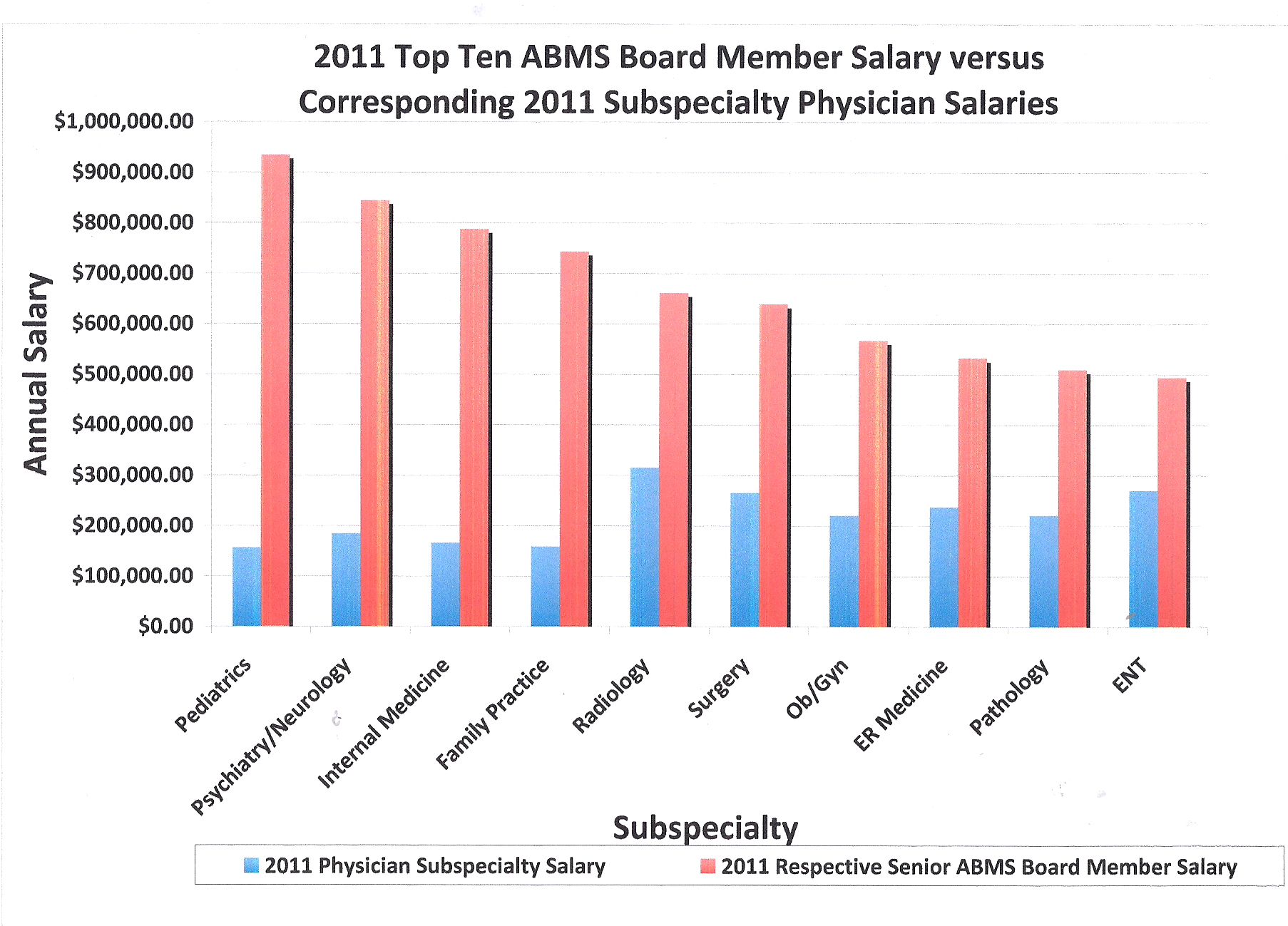
Their credibility bloom with practicing physicians is off the rose. Once an icon for assuring ethical, quality specialty medical education, the ABMS and their fellow member boards of the ACGME needed more.  Much more. So they over-reached. They paid themselves handsomely despite the origins of the Specialty Boards being frugal.  Almost without exception, the leadership of every ABMS specialty board has Presidents and CEOs that make far more income than their contemporary practicing colleagues - way more. They fly first class (or have until 2000), commonly have expensive dinners at the finest five-star hotels, some of which even overlook the Pacific Ocean, travel overseas to spread their regulatory gospel, all because they can. After all, they are special and they are unregulated.  Meanwhile, residents and fellows making $50,000 a year are wondering where they'll come up with the $3000 or so it takes to become "certified" by the ABMS in their specialty.

The result? Practicing doctors don't trust our ABMS specialty boards any longer. Worse still, the more recent transgressions have prompted a look back at history, and history has shown the ABMS non-clinical specialty board leadership stumping for corporate interests for personal gain instead of stumping for patients' best interests. Is this what the Boards call "professionalism?" The ABMS member boards also continue to allow their Presidents and CEOs to lead their organizations far past the usual maximum one-, two- or three-year term limits of the original boards, all while these executives earn lavish salaries and benefits as they appoint new "Chairs" and "Directors" to make each organization seem "fresh."

The ABMS's largest member board also happens to be the American Board of Internal Medicine (ABIM).

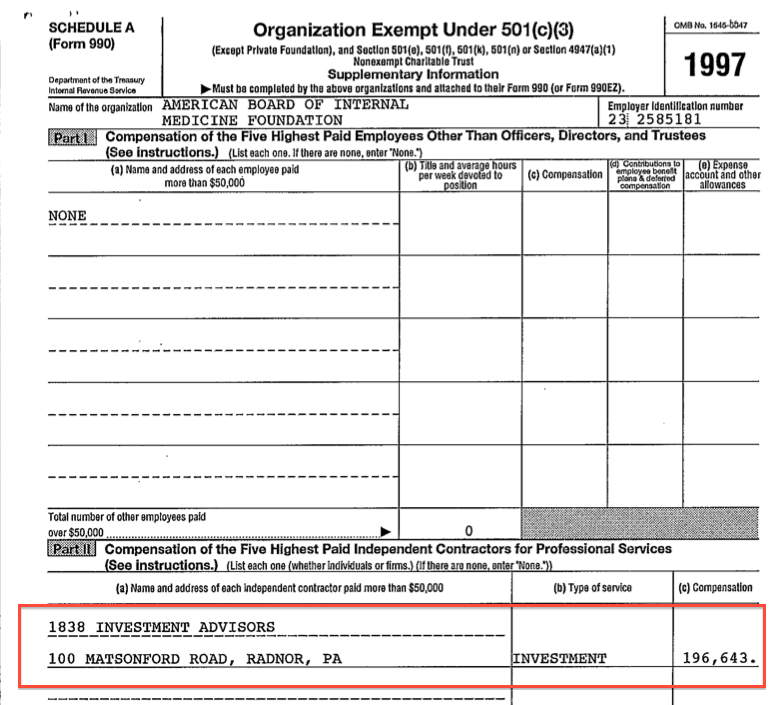
The ABIM still has the sizable problem of their ABIM Foundation that no one wants to mention: that "secret society" without a credible public mission other than "to support the ABIM" when it was created in 1989. The only logical reason for its creation was to accumulate money from the pockets of practicing physicians to fund an investment portfolio created by the now defunct 1838 Investment Advisors (which were paid handsomely each year to do so). The ABIM leadership did very well using practicing physicians' money for this purpose, accumulating a bankroll of over $59 million without concern of IRS intervention. They also lied about their government lobbying activity that likely helped cement the ABMS MOC® program in the Affordable Care Act. Then, in what can only be considered (at best) an incredible lapse of judgment, they bought their infamous luxury condominium (complete with chauffeur) with some of their colleagues' testing fees they "granted" to the Foundation.

What a deal.

But it's hard to shelter that a profit motive for a non-profit from the IRS unless you have a plan, and who is smarter than the folks and lawyers at the ABIM?

First, for Deception #1, you have to file a request for tax-exempt status for your newly-created "American Board of Internal Medicine Foundation" with the IRS. Note that this was a very different name from the "ABIM Foundation" that was filed with the state of Pennsylvania in 1989.  That way, the "American Board of Internal Medicine Foundation" never had too many dollars in its coffers to be tracked by the Internal Revenue Service (IRS).

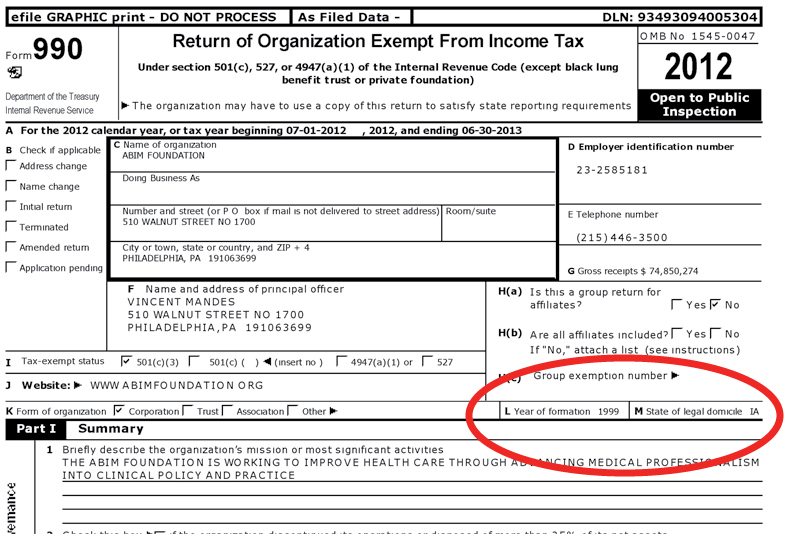
Next, to avoid the tax consequences of accumulating a lot of money in a non-profit, you have to deflect.  Unfortunately for the ABIM, changes in the IRS Form 990 made in 2008 required them to start reporting a "state of domicile." Deception #2: tell the IRS and the public (repeatedly until this year) on their Form 990 that the ABIM Foundation was domiciled in Iowa where no financial audit is required.

Then, when you realize your Foundation (that's supposed to be supporting the ABIM) has made a lot of cash covertly from the wallets of ABIM diplomats and investments, you magically perform Deception #3: ask the IRS to change the name of your "American Board of Internal Medicine Foundation" to the "ABIM Foundation" yet keep it 'domiciled' in Iowa. Oh, and be sure the "computer-generated notices" are "changed" and a new non-profit determination letter is re-issued in the new name because, gosh, they got it wrong when they first applied.

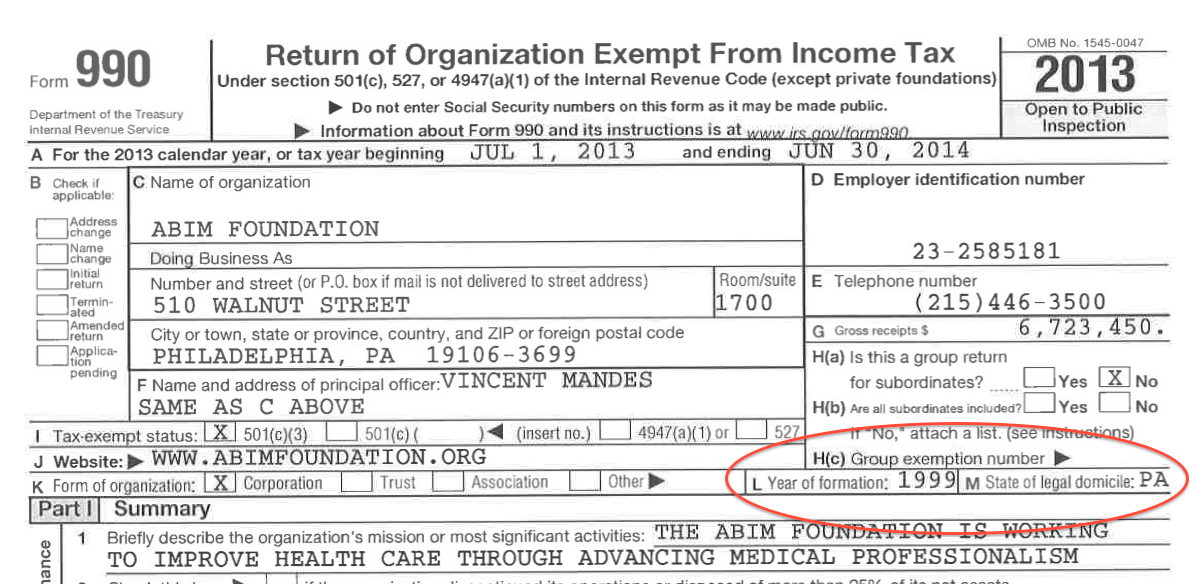
And guess what happens? The new ABIM Foundation magically has a boat-load of physician-supplied cash to give back to the ABIM (or their many cash-hungry friends who promise to spread the gospel of "Choose Wisely®") without an easily traceable trail because (as the ABIM Foundation website and their tax forms claimed) the ABIM Foundation really didn't exist (in the public or the IRS's eyes) before 1999!

Finally, it is very important to perform Deception #4: Make up a reason the ABIM Foundation was "created" in 1999 and delete the web page the stated the ABIM Foundation was "restructured" in 1999 as an operating Foundation to 'complement' the ABIM." Then be sure the reason for the "new" Foundation sounds really sincere - like "to advance the core values of medical professionalism to promote excellence in health care." (Forget to mention you created your own definition of "medical professionalism") Who could argue with such a "mission?" Also, make sure to create a Physician Charter of all your best bureaucratic and academic friends so they can join you at really nice venues to talk about things. Then make sure doctors "Choose Wisely®" treatments that they must forego in the name of "social justice."  Once you've done all of these things, no one will ever know (or have time to suspect) where all that ABIM Foundation money came from.

It's a clever way to hide the money trail to the ABIM, it's officers and membership fees paid by the ABIM to the ABMS, don't you think?

(No wonder "it's complicated.")

Now, let's end the ABMS MOC® program entirely - every last bit of it - shall we?

That would be the truly professional thing to do and every ABMS specialty board today knows it.

-Wes

Wednesday, September 09, 2015

The ABIM and Big Tobacco - A Love Story

Some of us were shooting spitballs in class in 1963, more interested in the political machinations of the playground than we were with those affecting our future professions. But for those of us trying to understand now how the American Board of Internal Medicine (ABIM) and the American Board of Medical Specialties (ABMS) have run so far afield of representing the average working physician in America today, that is the time in history we have to return to.

It turns out ABIM colluded with Big Tobacco in 1963.  Before then, its aims were more educational and helped to serve the public interest, that is until it climbed into bed with the likes of RJ Reynolds and Phillip Morris.

This morning, I woke to an anonymous blog contributor who offered the story of Dr. Thomas Brem, former Chair of the ABIM and President of the "Advisory Board of Medical Specialties" (our current ABMS) stumping for Big Tobacco. Included in the link is Dr. Brem's curriculum vitae. Turns out, Dr. Brem heard the siren song of stumping for profit-making companies on the basis that the "rate of increase" of cancer incidence that declined year after year despite mounds of evidence that the total incidence of lung cancer was increasing annually since the introduction of cigarette smoking.

So when it seems shocking that the ABIM got this far purchasing condos, lobbying Congress and filing false tax forms while hiding tax dollars, we should realize that the corruption in ABIM and the ABMS has been more than 50 years in the making.

But it's not how specialty boards started.

And it certainly is not how we have to continue.

-Wes

Tuesday, September 08, 2015

Why the History of the Specialty Boards Is Important

According the American Board of Medical Specialties' website, the creation of the first medical specialty board was widely attributed to the ophthalmologist Derrick M. Vail, Sr., MD  because of remarks he made in his presidential address to the American Academy of Ophthalmology and Otolaryngology (AAOO) in 1908.  In 2012 while researching the origins of modern-day specialty boards, Denis O'Day and Mary Ladden from Vanderbilt in Nashville, TN performed a historical literary criticism of the ABMS's assertion that the ophthalmologist Derrick M. Vail, Sr., MD conceived of the specialty board system. By O'Day and Ladden's careful research, the true origin of specialty boards was likely created over a 12-year period by much of the work of ophthalmologist Edward M. Jackson, MD whose "Education for Ophthalmologic Practice" presidential address four years earlier at the AAOO meeting in 1904 sewed the seeds for board certification education system as we know it.

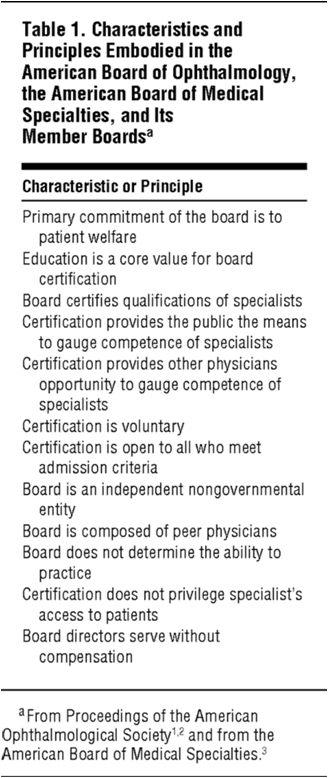
In their paper, O'Day and Ladden published the sentinel characteristics and principles embodied in the American Board of Ophthalmology (the "first" specialty board), the American Board of Medical Specialties, and its Member Boards:
(Click to enlarge)

Today, many of these founding characteristics and principles have been cast aside long ago, specifically, (1) the "Board does not determine the ability to practice" and (2) "Board directors serve without compensation", and (3) "Certification is voluntary."


For instance, with Maintenance of Certification (MOC), a trademarked product created by the ABMS, the program goes much further and is increasingly tied to hospital credentials and is now thoroughly incorporated into the new Medicare Access and CHIP Reauthorization Act of 2015 (MACRA) ensconcing the program with the US government and will impact how physicians are paid after the law takes effect in 2019.  So much for the ABMS principle of "not determining the (physician's) ability to practice" or keeping the ABMS "a non-governmental entity."

Also, the entire 24-member specialty board system of the ABMS is mired in large conflicts of interest created by their physician officers earning millions of dollars in compensation on the backs of working physicians.  Only the National Board of Physicians and Surgeons (NBPAS.org) has unpaid board members for its recertification program created to compete with the AMBS MOC program, yet is still at its infancy of being accepted by hospitals in the United States.

Clearly, the original creators of specialty boards recognized the potential for conflicts of interest to arise when non-clinical physicians earned handsome incomes regulating their peers and worked to limit such conflicts.  This is clearly not the case with the ABMS today.

As history reminds us, board certification was once performed to assure the proper education of specialty physicians, not to assure a money stream to the boards. "Re-certification," it seems, is little more than a means to subsidize the overpaid leadership of the ABMS and its member boards.


-Wes

P.S. Be sure to listen to Paul Tierstein, MD's NPR interview that aired yesterday for more on the origins of the NBPAS.

References:

History of the ABMS. ABMS.org website. Archived Jan 31, 1998. Available at: https://web.archive.org/web/19980131095657/http://www.abms.org/history.html 


O’Day DM and Ladden MR. The Influence of Derrick T Vail Sr, MD, and Edward M. Jackson, MD, on the Creation of the American Board of Ophthalmology and the Specialist Board System in the United States. JAMA Ophthalmology Feb 2012 130(2): 224-232.

Friday, September 04, 2015

The Unintended Consequences of Performance Measurement

When it rains, it pours.

So it is with the unintended consequences of performance measurement.

Performance measurement is an important part if our new health care law. The problem is, most of the people who wrote the law have no idea how to define "proper" performance or "quality" care. And when these bureaucrats and political minds attempt to apply individual health care principles to the arena of public health, they simply cannot perceive all of the unintended consequences their policies unleash in turn, especially when payments to physicians are tied to them.

Like a "V-8 head-slapping moment," two important articles have appeared this week, one by Lisa Rosenbaum, MD in the New England Journal of Medicine, and the other on Robert Centor, MD's blog. Each discusses the unintended consequence of performance measurement tied to medical payments: risk aversion.

Rosenbaum's article chronicles how New York's cardiothoracic surgical services are cherry-picking less complicated patients and pairing them with less experienced surgeons in the name of assuring better Medicare payments, and Centor's blog discusses his recent epiphany of the lack of proof of the benefits of performance measures but lots of examples of their unintended consequences.

Yet medicine is inherently risky, especially when caring for the complicated, critically ill, indigent, poor, and uneducated.

This same problem exists with the American Board of Medical Specialties' (ABMS) Utopian vision of improving physician performance by requiring them to perform their highly lucrative Maintenance of Certification re-examinations every six to ten years without EVER understanding the negative consequences of this mandate. No where has any member board of the ABMS ever studied the repercussions of their mandate upon practicing physicians and the patients they care for.  Rather than acknowledging the reality that their MOC program is expensive and increasingly tied to physician's hospital credentials and can directly affect their employment, their member boards deflect and create new "design principles" that promise "shared purpose and impact first," to make patients "the North Star," "simplicity and relevancy," to "think internal and external," to "always include the WHY, HOW, and WHO," "to balance the community centered-design with ABIM's expertise and research," to promise "participation and not just communication," and transparent decisions."

I'm not sure I've ever heard such doublespeak to justify the unintended consequences of an unproven and potentially dangerous exercise that could do more harm than good to patient care.

Perhaps as these unintended consequences of performance measurement gain an understanding with patients and legislators, we'll see a change in our health care law that could really help reduce costs and help patient care:

... the dissolution of these needless, unproven, and expensive exercises in futility.

-Wes


Sunday, August 30, 2015

The Level 2 Inpatient Encounter

Ever what a doctor needs to type for a 20-minute inpatient visit? Here's what it took me:


(Note: my poor typical skills are evident in the repetitive pounding on the "Delete" key...)

-Wes

P.S.: Here's the data from a carefully-conducted "study" on age vs. typing skills I conducted some time ago.

Sunday, August 23, 2015

American Gastroenterological Association Takes Important First Step to Oppose ABMS MOC® Program

One by one, Internal Medicine subspecialties are fleeing the sinking American Board of Internal Medicine (ABIM) Maintenance of Certification® ship and creating new, non-punitive learning pathways in lieu of "recertification."


Especially important in this proposal is the permanent rejection of the need for additional "Performance Improvement" and "Patient Voice" modules AND the rejection of the high stakes secure examination after initial certification.

Here's why.

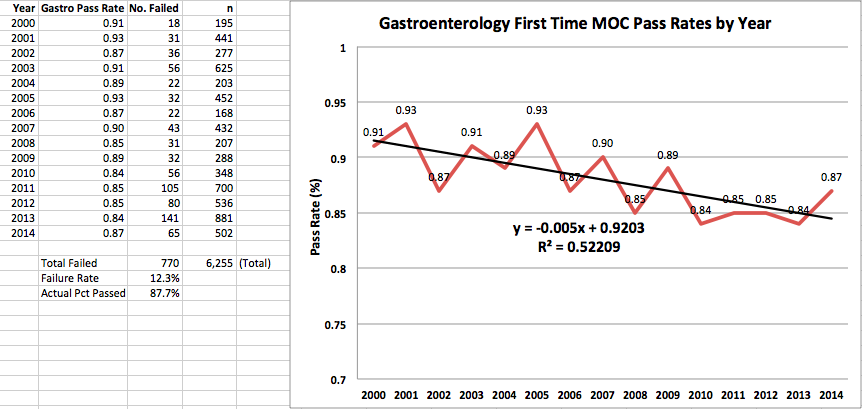
Here are the gastroenterology ABIM Maintenance of Certification secure examination first-time pass rate results for the past 15 years:

(Click to enlarge)
Note the linear regression line of the published first-time pass rates of the ABIM gastroenterology Maintenance of Certification® secure examination has declined steadily by a remarkable 0.5% per year since 2000. The pass rate also changes year to year, suggesting a lack of precision of this testing metric. As more and more gastroenterologists have had to participate in MOC®, this declining pass rate of the secure examination results in a progressively higher number of gastroenterologists that must take time away from caring for patients to retake their MOC® secure examination (and pay for more review courses) to ultimately pass. Yet there are simply no data that taking the MOC® secure examination after a gastroenterologist has practiced a minimum of six years makes them a better or safer gastroenterologist. More importantly, because participation of the American Board of Medical Specialties'  (ABMS) MOC® program is increasingly tied to a physician's hospital credentials (likely thanks to the fact that the ABMS and the American Hospital Association are both member boards of the ACGME), clinical gastroenterologists now realize they could lose their ability to practice in a hospital setting without cause if they fail this unproven secure examination metric (see this reference).

Look for other medical and surgical subspecialty organizations to quickly follow suit.

The ABMS's lucrative continuing medical education monopoly over practicing physicians will slowly but surely come to an end.

The next question will be: how will this new paradigm affect the new CMS physician payment scheme?

-Wes

Saturday, August 15, 2015

The ABIM Foundation: Increasing Transparency or More Cover-up?

It is one thing to have a financial scandal.

It's a whole new thing when you try to cover it up.

But it appears this is what we should expect from an organization that has exhaustively defined their version of the term "medical professionalism" using testing fees of practicing physicians worldwide.

The American Board of Internal Medicine (ABIM), a non-profit 501(c)(3) corporation, has been under pressure since the story broke about its Foundation purchasing a $2.3 luxury condominium complete with a chauffeur-driven Mercedes S-class town car in December of 2007. The bizarre tale of a physician testing organization creating a separate non-profit charitable "Foundation" funded by physician testing fees while its own balance sheet dwindled to a $48 million deficit was unimaginable at first. But as the story grew and gained media notoriety in Newsweek, it appears the ABIM will still stop at nothing in an attempt to hide the truth. 

Given the money involved, this was predictable.

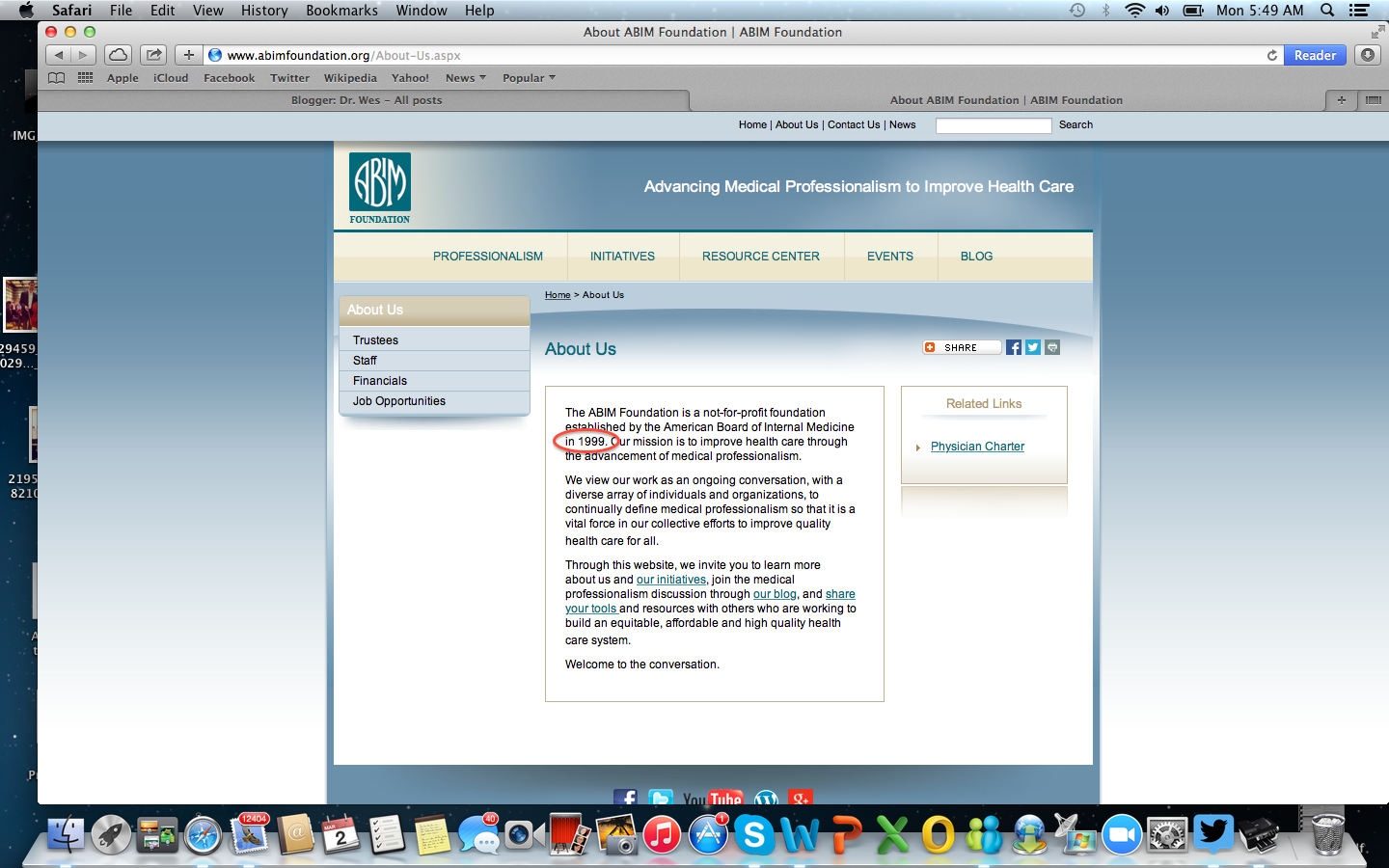
Here is the ABIM Foundation's "About Us" web page I captured as late as June 13, 2015.  

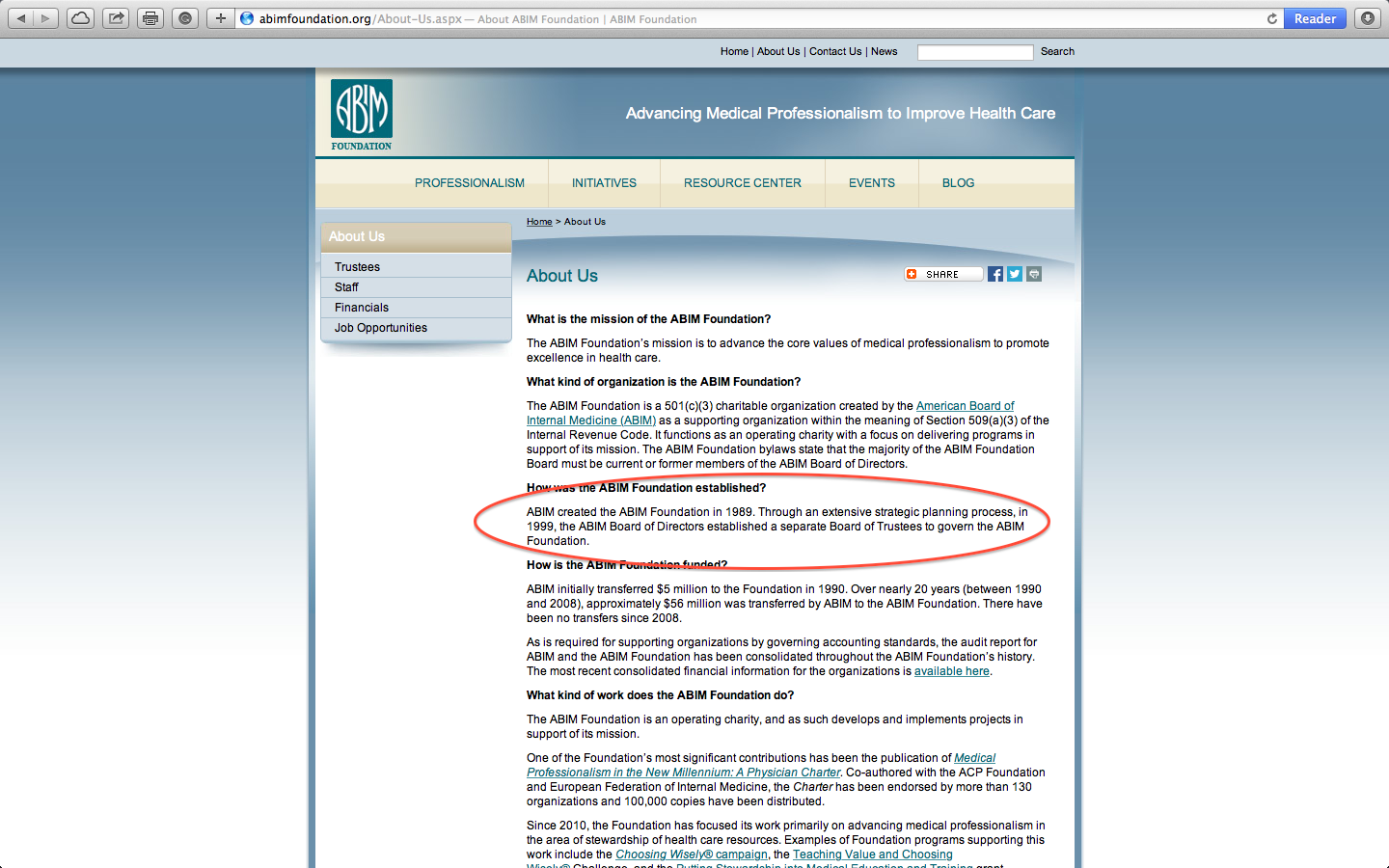
Here is the ABIM Foundation's "About Us" page today. (In case the ABIM changes the page again, I have it copied here).

Note the difference in the dates of creation of the ABIM Foundation on the two web pages - the first claiming the ABIM Foundation was started in 1999, the second stating the Foundation was started in 1989. 

Let's examine what is said on the new web page more carefully.

First the new Foundation About Us web page says: 
"How was the ABIM Foundation established?

ABIM created the ABIM Foundation in 1989. Through an extensive strategic planning process, in 1999, the ABIM Board of Directors established a separate Board of Trustees to govern the ABIM Foundation."
Note that the ABIM now admits the ABIM Foundation was indeed created in 1989 as this blog uncovered in December 2014. This does not explain why the ABIM Foundation was established and why they hid its existence before 1999 on their website previously. In fact, the US Internal Revenue Service should be VERY interested in why the Foundation still lists its creation date as 1999 on its most recent tax filing made this year.

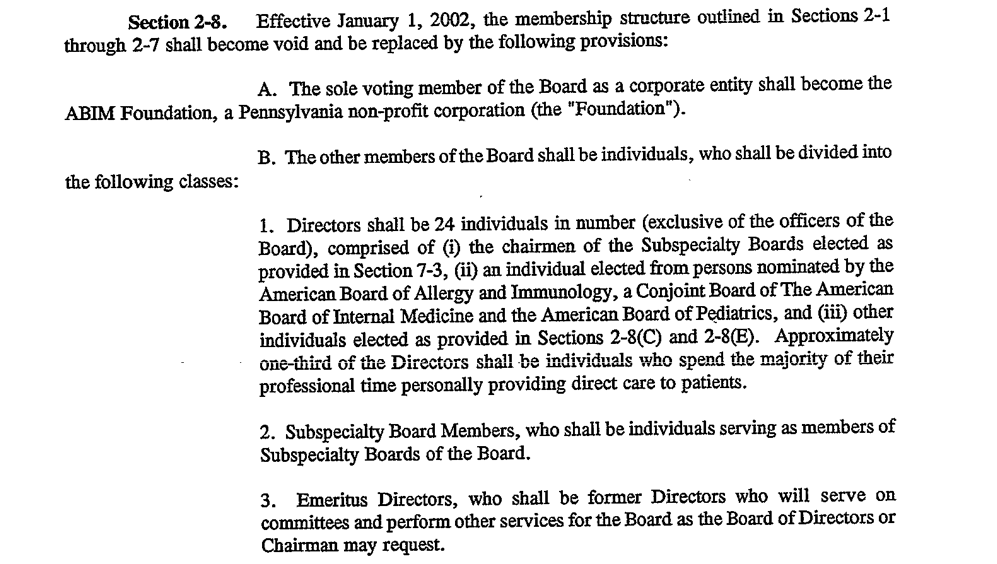
It is interesting that the ABIM suggests there was "an extensive strategic planning process" to create a separate "Board of Trustees to govern the ABIM Foundation." This still does not explain the ABIM Foundation origination date discrepancy nor does it relieve the organization of its responsibility to disclose to the public the existence of the Foundation before 1999. In 1998 the ABIM did change its bylaws, however. At that time, the new ABIM bylaws made the ABIM Foundation the "sole voting member of the Board as a corporate entity" effective 1 January 2002.

Continuing:
How is the ABIM Foundation funded?

ABIM initially transferred $5 million to the Foundation in 1990. Over nearly 20 years (between 1990 and 2008), approximately $56 million was transferred by ABIM to the ABIM Foundation. There have been no transfers since 2008.

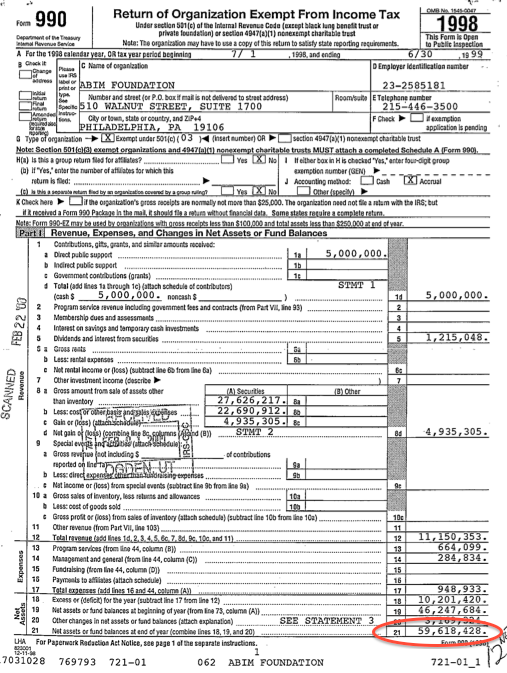
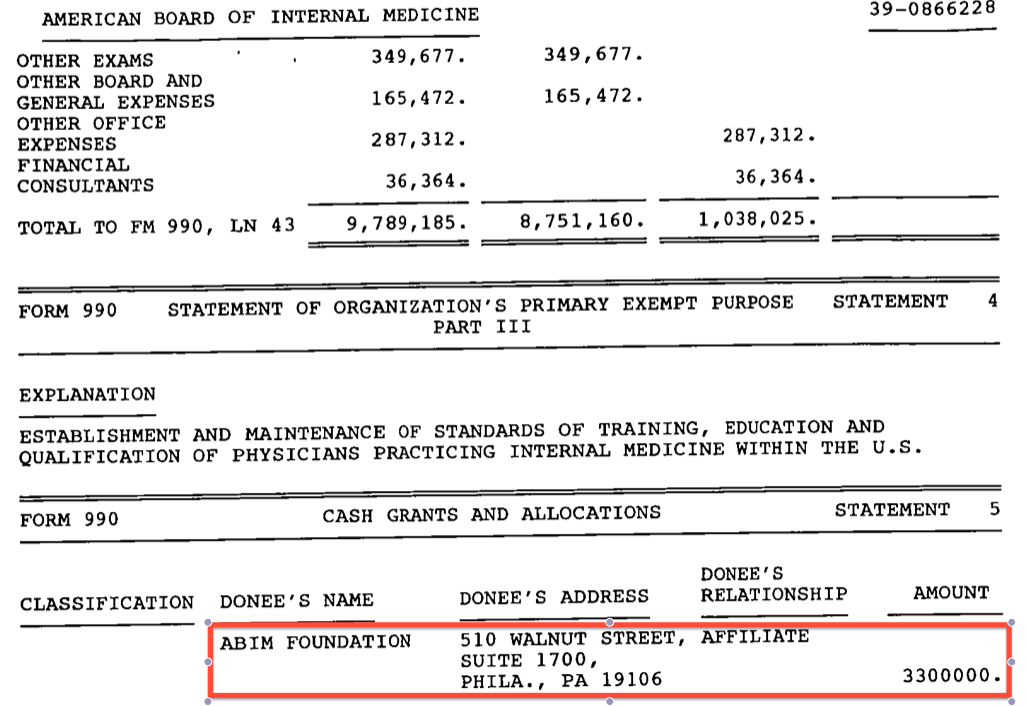
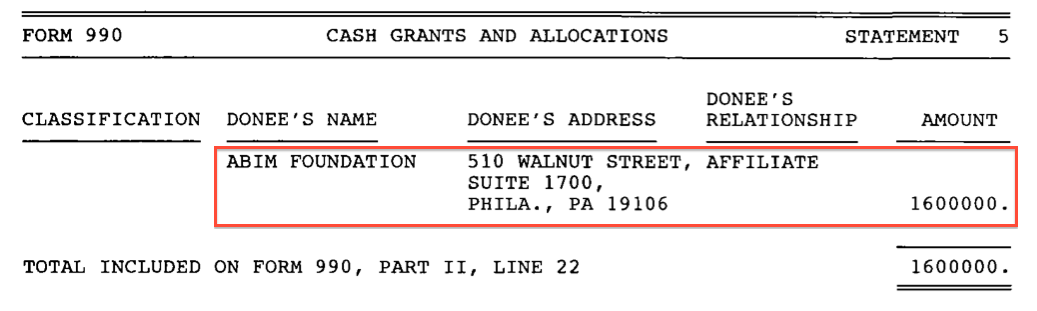
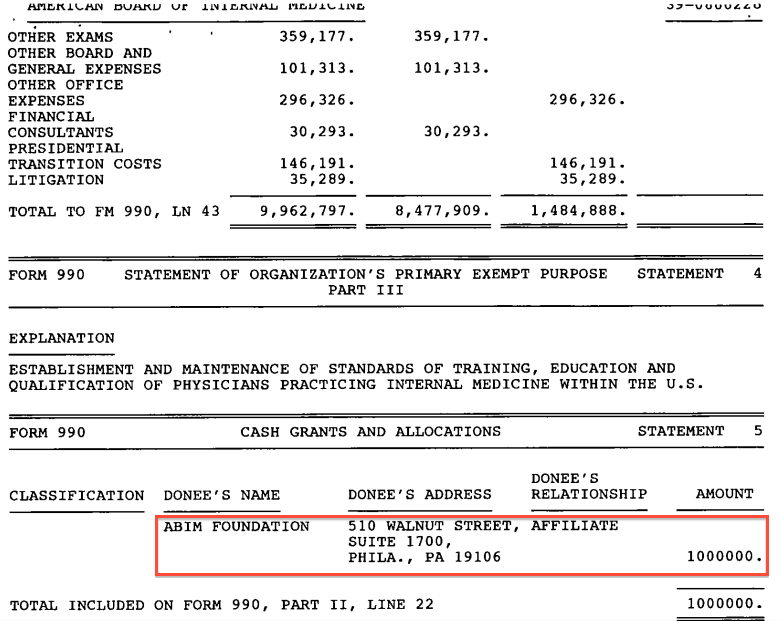
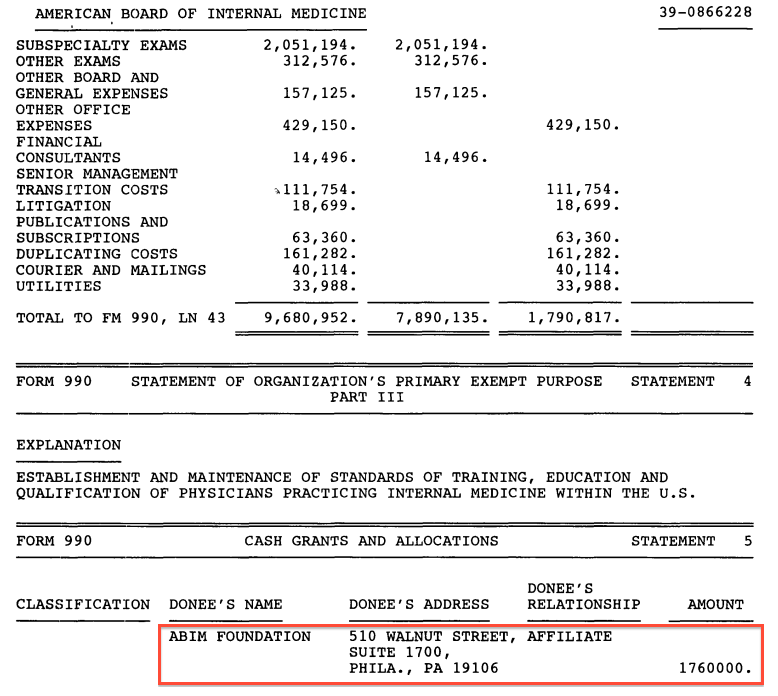
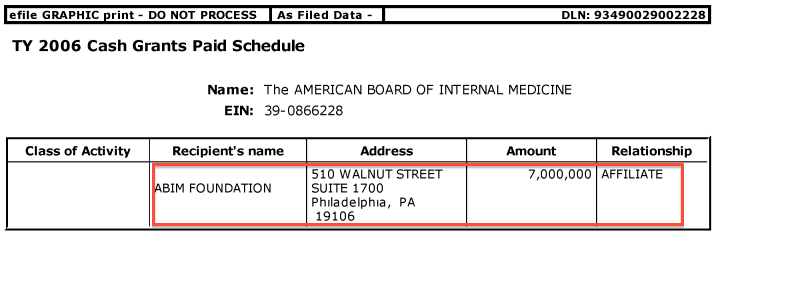
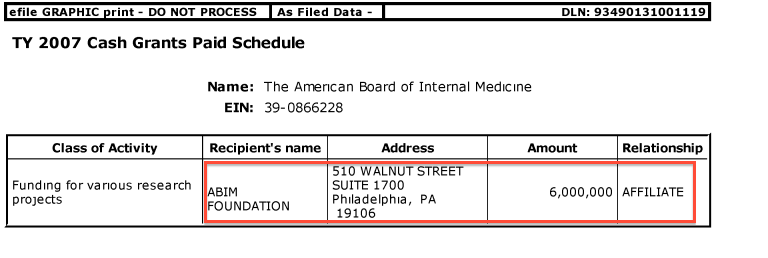
According to the above statement, the ABIM Foundation claimed they received "approximately" $56 million of physician testing fees to their Foundation for their own use. We should note that the ABIM Foundation already had $59,618,428 million in assets by 30 Jun 1999.  It appears the Foundation is using a very loose definition of "approximate" because the amount transferred was much more. In fact, an additional $20,660,000 were transferred to the Foundation from 2000-2007 for a grand total amount of accumulated assets courtesy of US physicians of $80,278,428. (Links to the itemized transfer amounts are included here for your review: In 2000: $3,300,000; in 2001: $1,600,000; in 2002: $1,000,000; in 2003: $1,760,000; in 2006: $7,000,000, and in 2007: $6,000,000.)

And what does the ABIM Foundation do with all that money?
What kind of work does the ABIM Foundation do?

The ABIM Foundation is an operating charity, and as such develops and implements projects in support of its mission.

One of the Foundation’s most significant contributions has been the publication of Medical Professionalism in the New Millennium: A Physician CharterCo-authored with the ACP Foundation and European Federation of Internal Medicine, the Charter has been endorsed by more than 130 organizations and 100,000 copies have been distributed.
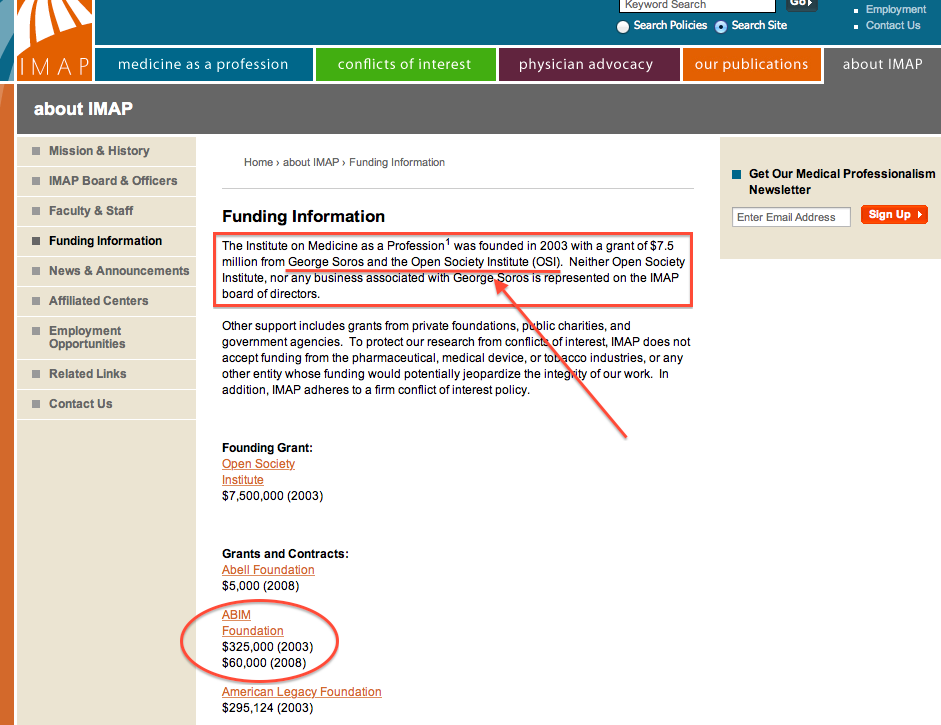
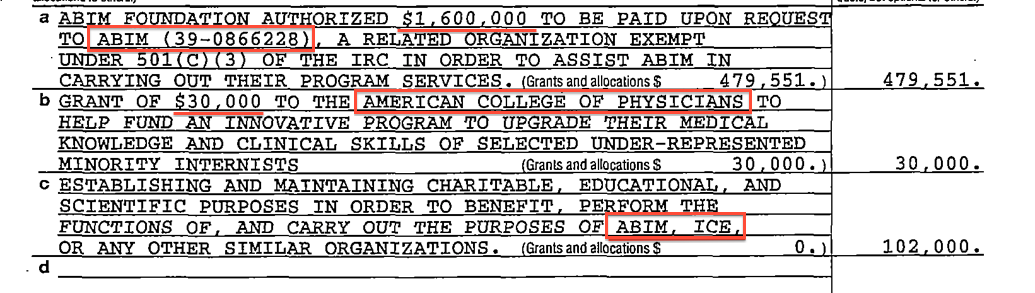
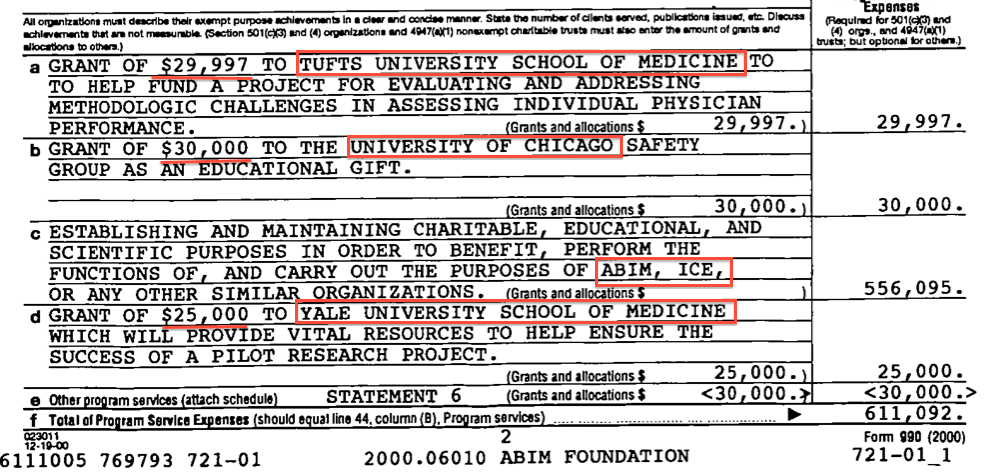
The "mission" here remains undefined. We should recall that the Medical Professionalism in the New Millenium paper wasn't published until 2002 and the team assembled to "define" the term "medical professionalism" didn't start work until 1999.  This leaves a gaping hole in the "mission" of the ABIM Foundation from 1989-1999. In fact, it appears that the ABIM Foundation was little more than an investment vehicle for the ABIM and a way to shelter cash from the ABIM and a means to pay their friends other grants that are undisclosed on their new "About Us" web page. For instance, the ABIM Foundation paid money to the George Soros' group, IMAP, and paid back funds to the ABIM and to the American College of Physicians. In addition, the Foundation has made grants to their own (now defunct) Institute of Clinical Evaluation among others. Is the ABIM Foundation ever going to mention these transfers of physician testing fees to these many institutions? It seems unlikely.

A thorough house cleaning and investigation of the ABIM and its Foundation is long overdue. The recent attempts at "transparency" by the ABIM Foundation are only making things worse.  It is no longer tolerable that our professional organizations who have supplied content to the ABIM for their Maintenance of Certification program permit the ongoing cover-up of the ABIM's financial actions over the past twenty-five years.  The longer these other organizations collude with the ABIM, the more they risk their own credibility with today's practicing physicians.

It's time to stop the madness and for the ABIM and their collaborators to come clean.

-Wes

Wednesday, August 12, 2015

On the Origins of Note Bloat

"If all clinicians needed to do with our documentation was practice medicine, our notes would be more logical and much less bloated. Laundry lists of irrelevant and inaccurate diagnoses would not populate into every note. Copy and paste would occur a lot less often, and likely could be limited to appropriate uses such as carrying over past medical history (which should always be copy and pasted after verification to reduce errors). Only relevant physical exam findings would be reported, so these would not be lost in a sea of normals. Useful information that is not valued externally, such as personal touches – i.e. patient’s wedding anniversaries, achievements of their children, would have it’s own optimized workflow.

Regulatory compliance and malpractice protection, are responsible for the large majority of the drivel that shows up in our notes. Believe me, we doctors would all love to confine our work to health care delivery, but external forces box us into this uncomfortable place, and this creates junk documentation."
Read the whole thing.

-Wes

Monday, August 10, 2015

Tuesday, July 28, 2015

An Independent Cost Analysis of the ABIM Maintenance of Certification Program

Today, the first independent cost analysis of the American Board of Internal Medicine (ABIM) Maintenance of Certification (MOC) program was published online before print in the Annals of Internal Medicine from the University of California San Francisco and the Veterans Affairs Palo Alto Health Care System.

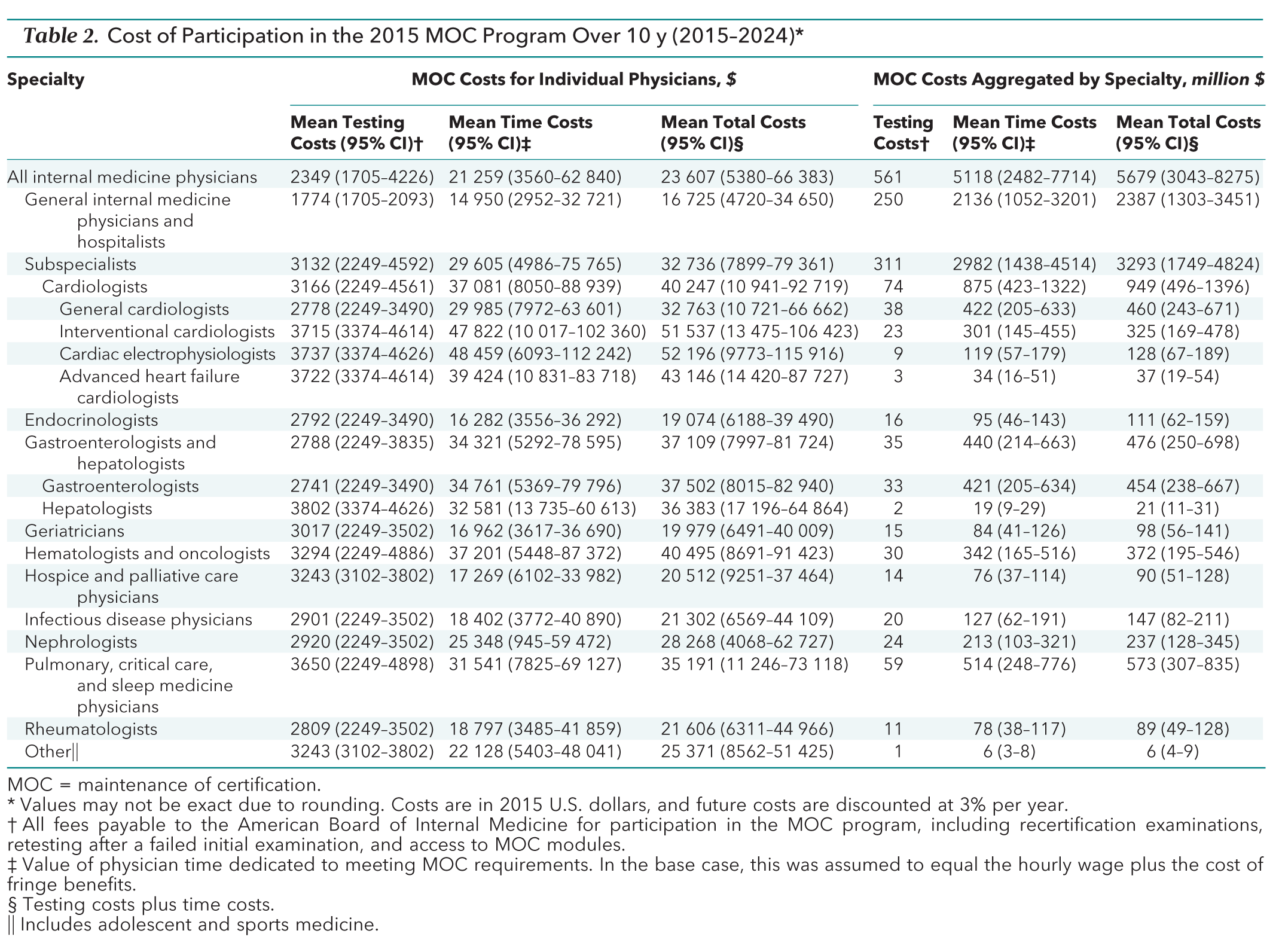
The results of the Base-Case Analysis are remarkable: "Internists will incur an average of $23,607 (95% CI, $5,380 to $66,383) in MOC costs over 10 years, ranging from $16,725 for general internists to $40,495 for hematologists-oncologists. Time costs account for 90% of MOC costs. Cumulatively, 2015 MOC will cost $5.7 billion over 10 years, $1.2 billion more than 2013 MOC (emphasis mine). This includes $5.1 billion in time costs (resulting from 32.7 million physician-hours spent on MOC) and $561 million in testing costs."

How much does it cost by specialty over 10 years? Here's a copy of one of the tables from the article included for your review:

Cost to Participate in MOC by Subspecialty (Click to enlarge)

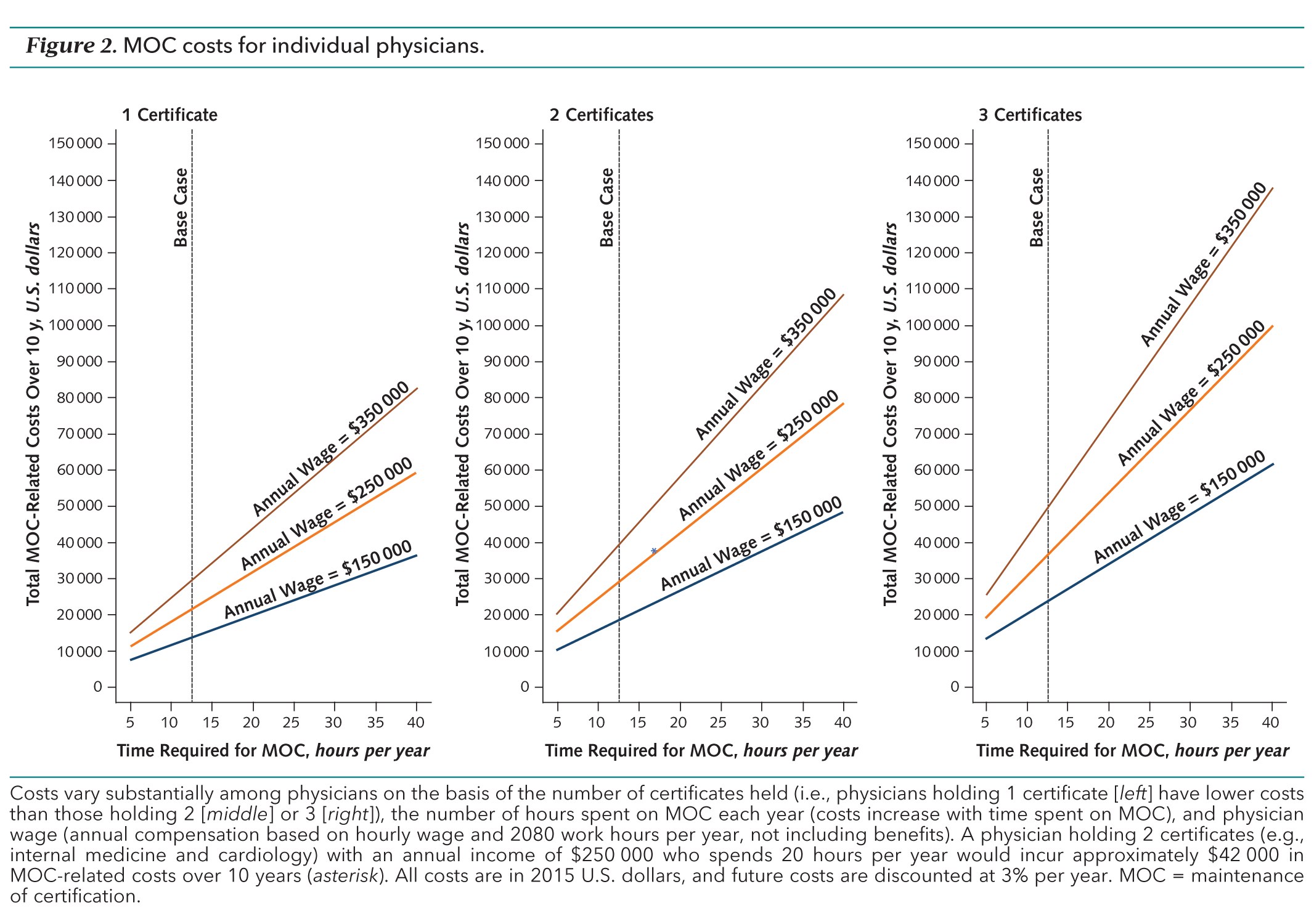
Here's a breakdown of MOC costs for individual physicians from the article based on the number of certificates they maintain with confidence intervals displayed:

MOC Costs for Individual Physicians - (Click to enlarge)

MOC is not an educational program based on evidence of improved patient outcomes or care quality.  Rather, it is an educational program that was created by fear - fear of loss of credentials and fear of loss of insurance panel participation and payments.  As such, it is inherently coercive.

If there ever was a time to stop the wasting of physicians resources and time that has yet to demonstrate any evidence that the program improves patient outcomes or care quality, the time is now.

-Wes

Reference: 
Alexander T Sandhu ,  R. Adams Dudley, Dhruv S. Kazi. "Cost Analysis of the ABIM Maintenance of Certification Program" Ann Intern Med 28 July 2015,(), doi: 10:7326/M15-1011.

Addendum 29 Jul 2015 @ 12:41PM CST:
Dr. Richard Baron responds to this Cost Analysis on the ABIM blog as "The Cost of Keeping Up." No public comments are taken on the blog any longer, but the ABIM is accepting e-mails.  Baron's response fails to acknowledge that the authors projected ABIM will make more than half a billion dollars in ten years and that this cost estimate is ten times higher than Dr. Baron has mentioned on numerous occassions (see here and here), irrespective of the time required by physicians "to keep up."