Friday, May 30, 2014

Maintenance of Certification and Licensure: Regulatory Capture of Medicine

An important article by Paul Martin Kempen, MD, PhD that critically reviews the American Board of Internal Medicine (ABIM) and American Board of Medical Specialty's (ABMS) Maintenance of Certification (MOC) process recently appeared in the Journal of Anesthesia and Analgesia.  Unfortunately, the article resides behind a pay wall.  As such, I can only publish a small sampling of the article for discussion here, but I think the points raised are important ones to bring to the public's attention for discussion ( I have also included the appropriate references at the end of the excerpt):

MOC: RESEARCH VERSUS MARKETING

The ABMS emphatically stresses that multiple articles support MOC. A quick review of these proffered ABMS articles readily identifies the authors as overwhelmingly ABMS paid executives and/or hired paid consultants.(4,c)

These corporate authorships mitigate scientific validity and introduce significant bias into these retrospective data-base interpretations, as would occur for any proprietary medical device or drug.(5) At best, they can statistically substantiate only associations and not causality. Negative studies may never be published. Publication further occurs in journals owned, edited, managed or supported by organizations strongly influenced by ABMS senior staff or national societies, otherwise exhibiting significant financial interests in proprietary and endorsed products associated with recertification programs.(4,c) Executive members of ABMS boards are frequently found to serve as executives of all national medical societies, associated journal editorial boards, and many academic departments. Corporately sponsored/authored publications of both FSMB and ABMS affiliates, financed with the $374 million in ABMS’ gross annual receipts, repeatedly support a significant corporate advertising campaign, without significant opportunity for opposing views from practicing physicians.(6,7)

In 2002, the ABMS unsuccessfully attempted to validate board certification itself, via meta-analysis coauthored by 2 ABMS (executive and associate) vice presidents documenting, “Few published studies (5%) used research methods appropriate for the research question,” and “Perhaps one lesson to be learned from this review is the need to thoughtfully examine this recertification process to document its value.”(8) Cochrane Collective Database Review (another quality indicator) also fails to support MOC or board certification validity. The only ABMS-funded prospective randomized study found in the Cochrane database (yet missing from ABMS listing), however, did document “no benefit regarding primary outcome” from the specifically studied practice improvement module.9 These facts together emphasize significant scientific limitations supporting validation of the ABMS program, despite ABMS insistence to the contrary.

PRACTICE IMPROVEMENT MODULES—BREACHING ETHICAL RESEARCH STANDARDS?

MOC practice improvement modules require physicians to define subset populations in their practice, where patient care might be improved. A plan is introduced for selected
patients, and changes in care are introduced. Data are collected to specifically demonstrate quality improvements in one’s own practice to the ABMS to enable recertification. This practice improvement modules method is initiated to facilitate the individual physician’s personal certification, that is, personal gain.

Practice improvement modules constitute an experiment: changing practice to demonstrate a positive result. This experimentation occurs without any institutional review or written informed consent. Patients unknowingly assume the costs and risks of the practitioner’s experiment. Without IRB oversight, review, and approval, practice improvement modules violate the Nuremberg Code of 1947(d) (safeguarding humans from experimentation) and the Declaration of Helsinki.(e) This represents a significant moral concern. No individual rigorous review of methods, adverse outcomes, risks, or costs is mandated or occurs.

As a physician working for an internationally recognized center of medical excellence, I should not be allowed to tamper with proven protocols merely to meet ABMS requirements for my very personal recertification needs. For example, perhaps I want to change my practice to improve (reduce) hemoglobin A1c levels. Thus, I become more aggressive with insulin management to achieve this worthy goal. However, we know that tight control of insulin can be extremely dangerous and the burden of treatment associated with therapeutic complexity and risk of harms increases with lower targets.(11,12) Such experimentation with changing insulin management to meet personal recertification needs may result in fatalities. Is such tinkering with standard practice worthwhile, ethical, or even likely to improve quality?

REGULATORY CAPTURE OF PHYSICIANS

Recent attempts by the testing/regulatory corporation, the FSMB Inc., to legally mandate MOC nationally with testing every 5 years exemplify regulatory capture: monopolies or special interest groups co-opting policymakers, or political bodies (e.g., regulatory agencies), to further their own ends.(13,14) While current board certification is generally a prerequisite for hospital privileges and applicant hiring, informed physicians are now proactively pushing to prohibit bylaws that require recertification compliance as documented by resolutions passed at the 2013 annual meeting of the American Medical Association (AMA) in Chicago, IL. Passage of anti–MOC-MOL resolutions in New York, New Jersey, Iowa, Michigan, North Carolina, Oklahoma, and recently Florida followed Ohio’s State Medical Society’s lead in recent years. These are specific examples of the rising concern among working physicians that unproven certification restrictions and costs are becoming mandated by private and corporate interest groups. These efforts strive to place time-limited certificate holders on equal ground with grandfathered lifelong certified physicians. Nationally, the Association of American Physicians and Surgeons and Doctors for Patient Care have led the opposition, followed by AMA actions at the annual meeting in Chicago, IL, in 2013. Examples of physicians losing hospital privileges and/or the ability to participate with insurance programs including Medicare over recertification have been noted. This led the Association of American Physicians and Surgeons to file a lawsuit on behalf of the national membership against the ABMS in April of 2013 seeking redress on multiple issues regarding conspiracy and restraint of trade (see United States District Court for the District of New Jersey Docket No.  3:13-cv-2609-PGS-LHG). While the FSMB’s MOL program (linking participation to the ability to practice) goes further than the ABMS currently voluntary certification proposals, neither protects against lawsuits nor insures competence, while both limit competition from noncertified physicians and intimidate physician compliance with ABMS programs.(15) The ABA has now expanded testing, which requires mandatory passage of their part 1 test before allowing completion of any residency training program. This undermines any appearance of voluntary participation and provides a clear trend for the future.

Renowned contemporary medical leaders simply never need MOC to secure their newest or next position, their reputation suffices. Thus, certification is mostly a marketing mechanism for employment, required by industry insiders and overwhelmingly ignored and unappreciated by the general population. Multiple ABMS executives themselves have published statements indicating long-term failure to recertify or participate in MOC, complying only when it has become a recent job requirement as ABMS officers, individual chief executive officers (CEOs) having been paid 6 and 7 figure salaries (Table  1).(16,17) The chairman of the American Board of Pediatrics received $1,241,588.00 as annual income, when, in 2009, the board’s corporate deficit  (expenses-revenues per the 2009 filed Internal Revenue Service 990 forms) was documented at $2,713,406.00.(18)

These salaries pale in comparison to the $374 million yearly expenditure for ABMS certifications. The current 2013 ABMS and FSMB physician CEOs were not enrolled in MOC and have never recertified as of January 2013, as verified by ABMS databanks found at the ABMS and ABIM Web pages to verify a physician’s certification. This strongly undermines any personal statement regarding conviction of certification’s personal value versus corporate profits from ABMS programs. One might argue that these CEOs are no longer practicing medicine. However, why should the many administrative physicians be required to submit to the MOL or MOC protocols and costs to maintain licenses necessary to work in administrative or research positions? On the contrary, executives in the certification industrial complex, along with our academic colleagues pushing for certifications, are typically not those practicing full time and maintaining their clinical skills. This push for certifications by executives in the certification industrial complex may be simply reflecting their myopic prejudice arising from their academic distance from practice, when often treating patients only several hours per day, week, or month, if at all. Those physicians near retirement may be economically and inappropriately forced to retire, rather than to maintain a full license and ABMS certification protocol. With the 10-year certification intervals, retirement may become an economic enticement at 10-year intervals from first certification.

The ABMS has, nonetheless, actively and effectively lobbied Congress to pass Physician Quality Reporting System-MOC (PQRS-MOC) legislation, requiring ABMS MOC compliance for payment. The ABA openly disclosed that the 0.5% initial PQRS-MOC benefits would not cover the costs of MOC, which is soon slated to become a 2% penalty for nonparticipants. (f) Only 9 specialty boards had fulfilled PQRS-MOC requirements to become providers, leaving all other 15 physician specialist groups (ABA included) exposed to reap only PQRS-MOC’s future penalties, because 2013 is the prescribed index year required for such protections.(g) Only recently did the ABA attain provider status despite openly declining to do so in 2010, declaring then “Based on its understanding of the current CMS requirements, the ABA does not believe that the additional requirements for the MOC bonus will have a sufficient impact on patient care, nor will the reimbursement bonus justify the additional time and resource burden on its diplomates.”(f) Many individual ABMS specialty affiliates opposed transitioning to time-limited programs but succumbed to ABMS corporate directives to comply or lose ABMS accreditation and these exclusive franchise rights.

While the ABMS argues that MOC is inexpensive, the ancillary cost of travel, study, time away from patient care, locums coverage, and busywork are quite significant. However, these minor costs are deemed insignificant, if the benefit is a measurable improvement in patient care. The burden of proof for any claim rests with the claimant. If the ABMS believes there is value to offset the costs, then it has the burden of proof to support this claim and this claim remains to be conclusively demonstrated by objective and reproducible means.
If you have the time, be sure to read the whole thing.  I welcome responsible comments and encourage doctors so moved to sign the petition to roll back the MOC process.

-Wes

Addendum 2 JUN 2014: The full article has now been posted online here: http://www.changeboardrecert.com/documents/KempenANesAnalg.pdf

References:

(c ) ABMS Maintenance of Certification® (ABMS MOC®) Updated March 20, 2013 Myths & Facts. Available at:   http://www.abms.org/maintenance_ of_certification/pdfs/ABMS_MOCMythsFacts_3-20-13.pdf . See LISTS 1–5 (Qualidigm, Middletown, CT [Drs. Wang, Meehan, and Ho and Ms. Tate]). Accessed January 16, 2014.

(d) The Nuremberg Code. Available at: http://history.nih.gov/research/down-loads/nuremberg.pdf . Accessed May 28, 2013.

(e) WMA Declaration of Helsinki—Ethical Principles for Medical Research Involving Human Subjects. Available at: http://www.wma.net/en/30publications/10policies/b3/index.html . Accessed May 28, 2013.

(f) The American Board Of Anesthesiology, Inc. Maintenance of Certification and Physician Quality Reporting System Requirements. Available at: http://www.theaba.org/pdf/MOC_PQRS.pdf . Accessed February 28, 2013.

(g) Qualified Maintenance of Certification Program Incentive Entities for 2012. Available at:     http://www.cms.gov/Medicare/Quality-Initiatives-Patient-Assessment-Instruments/PQRS/Downloads/Fully-Qualified-2012-MOC-Posting-Document-Rev-11282012.pdf . Accessed February 28, 2013.

(4) Chaudhry HJ, Talmage LA, Alguire PC, Cain FE, Waters S, Rhyne JA. Maintenance of licensure: supporting a physician’s commitment to lifelong learning. Ann  Intern Med 2012;157:287–9

(5) Lehman RS. Nullius in verba: don’t take anyone’s word for it. JAMA Intern Med 2013;173:1049–50

(6) Kempen P. Maintenance of licensure. Ann  Intern Med2013;158:219

(7) Chaudhry HJ, Talmage LA, Rhyne JA. Maintenance of  licensure-Reply. Ann Intern Med2013;158:219

(8) Sharp LK, Bashook PG, Lipsky MS, Horowitz SD, Miller SH. Specialty board certification and clinical outcomes: the missing link. Acad Med 2002;77:534–42

(9) Simpkins J, Divine G, Wang M, Holmboe E, Pladevall M, Williams LK. Improving asthma care through recertification: a cluster randomized trial. Arch Intern Med 2007;167:2240–8

(10) Vollmann J, Winau R. Informed consent in human experimentation before the Nuremberg code. BMJ 1996;313:1445–9

(11) Finfer S, Liu B, Chittock DR, Norton R, Myburgh JA, McArthur C, Mitchell I, Foster D, Dhingra V, Henderson WR, Ronco JJ, Bellomo R, Cook D, McDonald E, Dodek P, Hébert PC, Heyland DK, Robinson BG; NICE-SUGAR Study Investigators. Hypoglycemia and risk of death in critically ill patients. N Engl J Med 2012;367:1108–18

(12) Lipska KJ, Montori VM. Glucose control in older adults with diabetes mellitus–more harm than good? JAMA Intern Med 2013;173:1306–7

(13) Federation of State Medical Boards. Report from the Maintenance of Licensure Implementation Group. Euless, TX: Federation of State Medical Boards, 2011

(14) Dal Bó E. Regulatory capture: a review. Oxf  RevEcon Policy 2006;22:203–25

(15) Wallace DA. Occupational licensing and certification: remedies for denial. William Mary Law Rev 1972;14:46–127. Available at: http://scholarship.law.wm.edu/wmlr/vol14/iss1/3

(16) Johnson DH. Maintenance of certification: confession of a grandfather. J Oncol Pract 2012;8:203–4

(17) Brennan TA. Recertification for internists–one “grandfather’s” experience. N Engl J Med 2005;353:1989–92

(18) American Board of Pediatrics. 2009 IRS 990 form, part VII. http://www.changeboardrecert.com/tax-returns.html . Accessed January 16, 2014

Thursday, May 29, 2014

Medicine's Love-Me Wall

“We can never be gods, after all--but we can become something less than human with frightening ease.”
― N.K. Jemisin, The Hundred Thousand Kingdoms


I know it's click bait, but the top 100 most influential people in health care, according the Modern Healthcare, is worth a look. It contains the following individuals in its "Top Ten:"
  • Kathleen Sebelius (#1) who resigned as the head of Health and Human Services after the botched Healthcare.gov rollout
  • Oregon Governor John Kitzhaber (#2) who jettisoned the state's $248 million dollar attempt to arrange its own health care exchange website
  • President Barack Obama(#3) - of course
  • Mr. Stephen Hemsley of UnitedHealthcare (#4) who made a cool, $4.57 million in compensation last year and exercised $9.48 million in stock in 2013
  • Marilyn Taviner (#5), CMS who gets a little love each year from her prior employer, the Hospital Association of America on top of her salary as CMS Director
  • Mark Bertolini (#6), CEO of Aetna, who made $2.66M in compensation and exercised $4.52M in stock in 2013
  • Richard Bracken (#7), CEO of HCA, who earned $38.6 million for his role as CEO in 2013 before retiring and pocketed a cool $46.3M in 2012
  • newcomer Joseph Swedish (#8), CEO of WellPoint, who earned only $7.48M in 2013
  • George Halvorson (#9), of Kaiser Permanente, who doesn't report compensation (a bit of "Sunshine law" needed, perhaps?) but other sources pegged his compensation at $6.7 million back in 2009
  • Sister Carol Keehan (#10), of Catholic Health Association who likely made well in excess of $1M in 2011
And the list goes on...

Yet we wonder why our health care costs are so high.

Really?

-Wes

Wednesday, May 28, 2014

When Insurers Practice Non-evidence Based Care

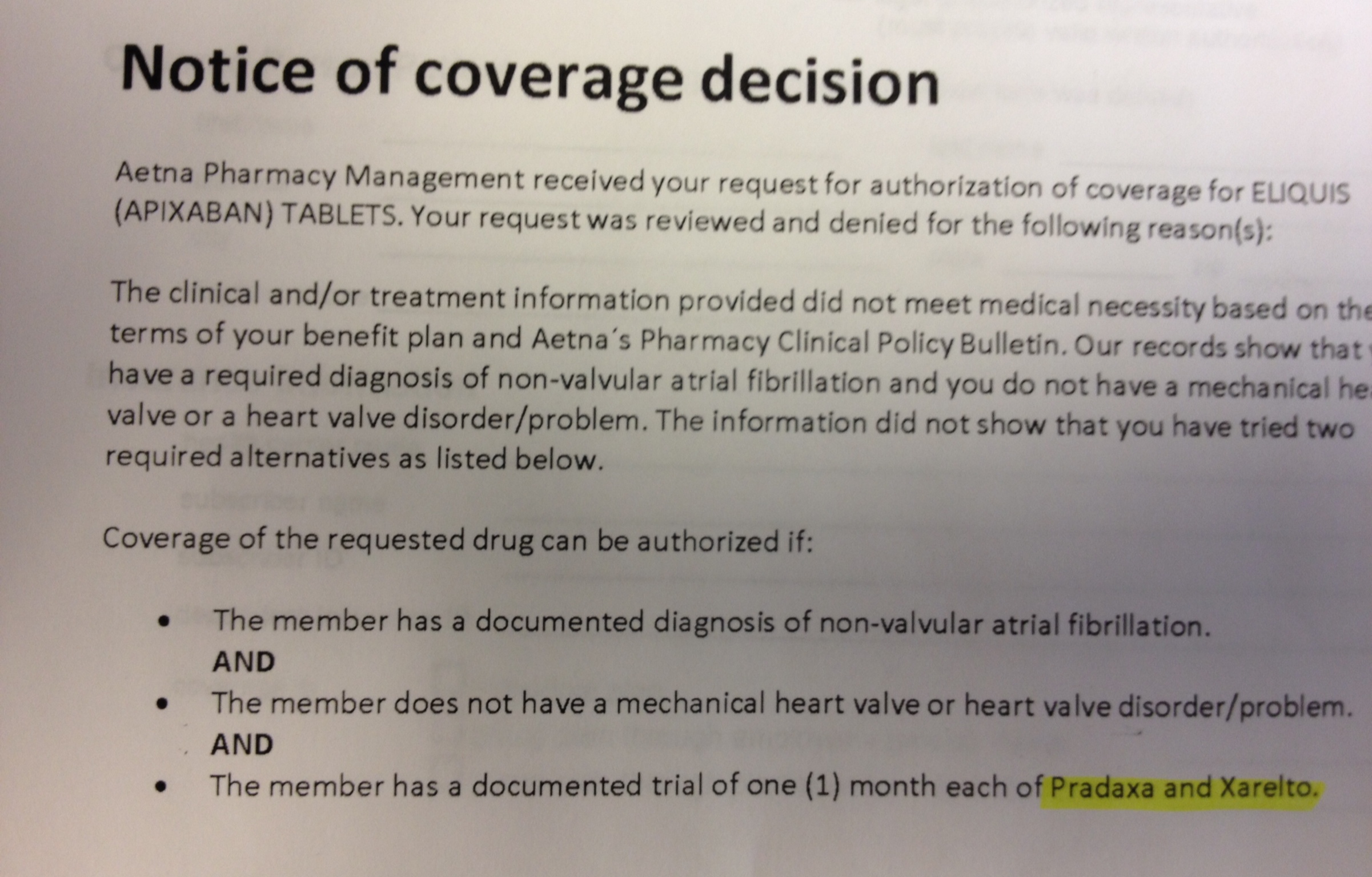
With the approval of new, innovative, yet expensive medications, doctors can expect their lives to become miserable as insurers do their best to limit costs. No where is this more apparent than with the introduction of our latest slew of novel oral anticoagulants.

What is remarkable (yet not the least bit surprising to those of us who have been in the business of medicine for a while) is how insurers dismiss the importance of discussions that are held by those of us who attempt to explain the pros and cons of the various new medications to our patients. We see these conversations completely invalidated as soon as the insurance industry renders their "coverage decision." Discussions are immediately invalidated, the pros and cons of each medication ignored. Meanwhile, these same insurers bear no reponsibility for potential safety issues that might arise when their made-up care process is implemented. And there is no accountability, no person ultimately responsible.

When a doctor tries to call and speak with someone about their policy, we meet hushed tones that promise to approve the prescribed medication if we just send a letter explaining our rationale. Yet despite this effort, they stick by their policy nonetheless.

What a waste.

So I'm sending a few questions to Aetna about their new "coverage decision" regarding the new oral anticoagulant, apixaban:

An Aetna 'Coverage Decision' (click to enlarge)

Dear Aetna Pharmacy Management:
  1. When my patient has a GI bleed from Pradaxa, will you explain to them why you insisted I start this medication?
  2. When my patient gets nauseated from Pradaxa, will you take the call at 3 am and write the new script for him or her?
  3. When my patient accidentally overdoses on Xarelto thinking it was a twice a day drug like Pradaxa, will you explain to the plantiff's lawyer the safety of your non-evidenced based practice of switching anticoagulants on a monthly basis? 
  4. Along the same line of reasoning, where I might find data pertaining to the safety of monthly switches of anticoagulants in the world's literature?
  5. Is your effort to "manage" physician-prescribed medications in the patient's best interest or your stockholders'?
  6. Where can I send the bill for the wasted time spent by my staff and me to jump through your self-imposed hoops?
Aetna, may your latest policy find disfavor with the FDA safety brigade.

With sarcastic love of all you do -

-Wes

Saturday, May 24, 2014

It's The End of The World As We Know It

Team by team, reporters baffled, trumped, tethered, cropped
Look at that low plane, fine, then
Uh-oh, overflow, population, common group
But it'll do, save yourself, serve yourself
World serves its own needs, listen to your heart bleed
Tell me with the Rapture and the reverent in the right, right
You vitriolic, patriotic, slam fight, bright light
Feeling pretty psyched

It's the end of the world as we know it
It's the end of the world as we know it, and I feel fine

- R.E.M.

I always enjoy people who predict the end of doctors.  Clearly, they have never been sick.

So I have an idea for Mr. Vinod Khosla who recently predicted that doctors cannot compete against machines.  After all, he appears fit and certainly we all wish him continuing good health.

If Mr. Khosla, a venture capitalist billionaire, truly stands by his prediction, he should be the first to take the data-driven patient care vow.  Start today.  After all, there is enough data-driven resources for Mr. Khosla available to provide his health care:  phenomenal computer power, thousands and thousands of discrete fields, zettabytes of data points, every kind of  algorithm imaginable.  This is an opportunity for serious leadership!

Go ahead and pull the trigger.  Use all that data out there to replace most physicians by a computer as you encounter the vagaries of aging and (dare I say it) mortality.

Take the pledge. Be an example. The moment is now.  Practice what you preach.

There's just one small complication, though.

You have to stick with it.

-Wes

Thursday, May 22, 2014

Breaking: Senior Vice President of Doctoring

It's a job description for "Senior Vice President of Doctoring", being advertised by the American Board of Internal Medicine.  Remarkably, the position requires no patient care whatsoever. 

It's interesting how history repeats.

If you wonder why your health care costs are so high, consider what's happening in our new era of highly-paid Physician Inquisitors.

-Wes

Sunday, May 18, 2014

It's Not About the Physician

In his piece, Why Physician's Are So Pissed Off, Jordan Grumet, MD explains how our current health care system is eroding patient care:
The conductor becomes less effective if also asked to manage the lighting. Nuance is lost if water balloons are hurled on stage during the most dramatic moments of performance. And so it has become with physicians.
If we can allow, even for a brief moment, that this is true across the country in every doctor's office, might this matter to you the patient when you arrive in your doctor's office in your most vulnerable state? Would you like to place your mortal physical body in the hands of a person in such a compromised position?

We repeatedly trust our government with more demands, yet abhor its result. Our approval of Congress rests, at best, at an abysmal 15%. And yet, we indulge ourselves with the Utopian vision of progress in health care which necessitates an ignoring of the realities on the ground. Like an alcoholic, we are enabled in our denial, blindly handing our co-dependent government the keys to our own care.

Now, do we get in the car? Or do we take the wheel?

-Wes

Friday, May 16, 2014

When We Worship Process More Than Patients

If you read nothing else this week, please read these words from Saurabh Jha, MD, Assistant Professor of Radiology at the University of Pennsylvania (republished here with permission):
Writing in the Wall Street Journal (WSJ) Dr. Daniel F. Craviotto Jr., an orthopedist, made a plea to physicians to declare independence from third parties and emancipate themselves from servitude to payers, mandates and electronic health records (EHR).

As rants go, this was a first class rant. But its effect was that of a Charles de Gaulle’s whisper to Vichy France rather than a Churchillian oratory at the finest hour.

The article went viral (it has been tweeted nearly 3000 times), though with little virulence. And it is not WSJ’s paywall to blame.

The author might have assumed that most the healthcare community in general and physicians in particular wish to be free from regulations. I have serious doubts that this assumption is correct in the aggregate. The relationship between regulators and physicians is more complex and symbiotic than it first appears.

Some physicians believe in bureaucracy. Rationalism will march us out of our healthcare wilderness. This belief in scientific managerialism, faith in technocracy, is the new theism. The rationale of the new theists is that regulations fail not because they are inherently useless but because there are so few of them, and even fewer that are actually smart.

Like the first religions started with polytheism, the new believers want more agencies, more alphabet soups, more gods.

This type of reasoning can empirically neither be proven nor disproven. Hence, the comparison to religion is apt. It is like the argument made by neo-Keynesian economists: stimulus failed because it was too small. How do we know it was too small? Because it failed.

This circular reasoning is immortal and akin to an infinite set; one can always impute upon it the promise of success if only one added just a little more.

Convinced of their own virtue and the vice of others, many physicians crave more regulations. They hope that in the next round will emerge the regulatory Thor wielding his nuanced hammer on evil Medicare serpents and fraudsters. Instead we receive the leviathanic, uncoordinated Moby Dick that throws Quuequeg out with Ahab and splashes a lot of salt water in the process.

Some meet any criticism of third party players, coding and regulatory waste with a false dichotomy “so now you want to abolish insurance and Medicare, what’s your alternative?” or “you are against ICD-10, so should we descend in to anarcho-capitalism and send poor kids to workhouses?”

This line of thinking reminds me of the willful scarcity of cerebral activity that allows some to interpret in any government intervention a short step to National Socialism. The phenotype is the same. The polarity is merely reversed.

The rest of us, those who can see the vast zone between a dysfunctional Electronic Health Record and Zero Government, are merely quibbling about the price, not the principle.

And quibble we must.

We should question the marginal utility of regulations, the evidence base from which they arise, the unintended consequences of their complexity, their opportunity costs and the waste of tax payer’s money for rules that do not improve outcomes.

Outcomes, remember outcomes? We hold a new drug or device to this metric, why not a regulatory decree that is both perennially alive and permanently fossilized?

And so the author of the rant has a point.

An inordinate time of physicians is spent on non-clinical work such as coding, billing and compliance. This has been estimated to be as high as 80 % (I am waiting for the regulated shape shifter to say this is clinical work, really). One recognizes that non-clinical work is unavoidable to an extent, and in saying that 80 % is too high I hope the binary minds of some do not infer that I think it should be zero percent. But if 80 % is not too high how about 90 %? 99 %? 99.5 %? Is there no limit?

If physicians spend more time in activities that allow them to be measured than the activity for which the measurements are sought, this is a sign of dysfunction. The clinical “horse” is being grounded by the regulatory “cart.”

And this has consequences for patient care. Physicians rarely make eye contact with patients these days staring, instead, at the vast dark matter of their EHR wondering how many words it takes to say the patient has a common cold.

As Nietzsche warned, well sort of, “If you gaze into the EHR, the EHR also gazes in to you. Beware physicians, lest you become an electronic health record.”

We are living an epidemic of documentation of such utter clinical irrelevance that one struggles to comprehend. And yet some demand even more rules, more codes and more metrics as more granularity is desired and imperfection of information even less tolerated.

To paraphrase Churchill “never was so little owed by so few to so many.” Never was so little achieved by so many. A giant bureaucratic sledgehammer is being wielded against a nut it repeatedly fails to crack.

Craviotto’s declaration of independence is misplaced. To rue government involvement in healthcare within the safety of a guild, protected from the vicissitudes of the market and competition with Rajeev from Bangalore is a tad rich and rather like the famous ungrateful climber who was carried on the back of Sherpas to within a canter of the summit of Everest.

He should, instead, have appealed to our sanity and common sense, the only weapons we have to tame the bipartisan regulatory Goliath.
Saurabh Jha, MD's (@RogueRad) piece first appeared on The Health Care Blog, where it caught my attention.

The Iron Triangle and Evidence-based Medicine

From the Journal of Evaluation in Clinical Practice:
It is naïve to think that we can prevent vested interests from introducing bias. Politicians cannot tally their votes and in sport we rely on umpires, not player, to call the penalties. What are we thinking relying on industry provide evidence about health interventions that they have developed, believe in and stand to profit from? We need to recognize this inherent bias and take action against it.

It is beyond the scope of this paper to discuss practical solutions in great detail, however, we make the following suggestions:

  1. The sensible campaign to formalize and enforce measure sensuring the registration and reporting of all clinical trials (see http:// www.alltrials.net/) should be supported – otherwise trials that do not give the answer industry wants will remain unpublished.
  2. More investment in independent research is required. As we have described, it is a false economy to indirectly finance industry-funded research through the high costs of patented pharmaceuticals.
  3. Independent bodies, informed democratically, need to set research priorities.
  4. Individuals and institutions conducting independent studies should be rewarded by the methodological quality of their studies and not by whether they manage to get a positive result (a ‘negative’ study is as valuable as a ‘positive’ one from a scientific point of view).
  5. Risk of bias assessment instruments susch as the Cochrane risk of bias tool should be amended to include funding source as an independent item.
  6. Evidence-ranking schemes need to be modified to take the evidence about industry bias into account. There are already mechanisms within EBM evidence-ranking schemes to up- or downgrade evidence based on risk of bias. For example, the Grading of Recommendation Assessment, Development and Evaluation (GRADE) system allows for upgrading observational evidence demonstrating large effects, and downgrading randomized trials for failing to adequately conceal allocation (and various other factors). However, currently such schemes are agnostic to the origins of evidence and do not expressly recognize the high risk of bias when the producers of evidence have an invested interest in the results. It would be easy to introduce an evidence quality item based on whether a trial was conducted or funded by a body with a conflict of interest. If so, the evidence could be downgraded. Given the failure of current evidence-ranking schemes to detect and rule out industry-funding bias, this is a necessary step if EBM critical appraisal is to remain credible.
Read the whole thing.

-Wes

h/t: Ivan Oransky on Twitter

Wednesday, May 14, 2014

What's Wrong With This Picture?

A US medical conference opening plenary session:

Heart Rhythm Society Meeting 2014 (Click to enlarge) From https://twitter.com/HugoOC/status/464204486576058368

A European medical conference opening plenary session:

NICE Annual Conference 2014 (Click to enlarge) From https://twitter.com/LockOn_Tweets/status/466514188521598976
Just sayin' -

-Wes

Friday, May 09, 2014

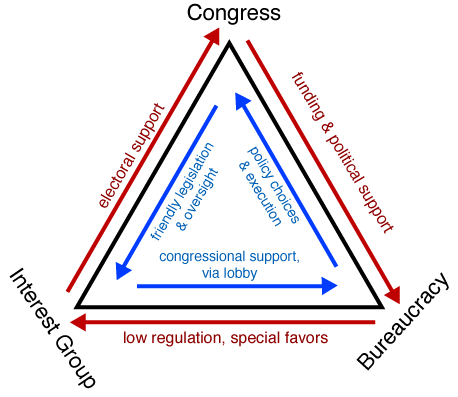
The Health Care Industrial Complex and the Iron Triangle

Walking to the 2014 Heart Rhythm Society (HRS) Scientific Sessions this morning, I couldn't help but marvel how beautiful San Francisco seemed today. The weather was perfect, the streets bustling, the quaint shops and eateries doing brisk business in a very hip metropolitan city with a distinctive West Coast vibe. As I walked up to the Moscone Conference Center, I was struck by the size and scope of the facility and its cool, corporate look.

"Welcome," I thought, "to the Health Care Industrial Complex."  This meeting was, after all, designed for me and the other Heart Rhythm Specialists from all over the world.

HRS Infinity Circle Supporters
After picking up my badge I shuttled off to my first session and picked up the fresh flier published on the previous day's events.  The publication was remarkably professional, processed with all the proper public relation jargon and complementary hyperbole.  The Heart Rhythm Society app that I downloaded on my iPhone, too,  looked eerily similar to the polished one at the ACC meeting earlier this year, just the sponsor page that blinked "Biotronik" instead of  "Amgen" as it had earlier this year.  Finally, as I turned by attention back to the flier, there on page two was a picture of Hugh Calkins, MD the current President of HRS and James Youngblood, the Society's "professional" CEO, honoring the "HRS Infinity Circle Supporters" from Medtronic.  Infinity Circle Gold members from Biosense Webster, Boerhinger Ingelheim, Boston Scientific and Janssen and Silver member St. Jude Medical also were honored in the picture's caption.

Of course they were.

Twenty-six years ago I entered the North American Society and Pacing and Electrophysiology (NASPE) as a young fellow in cardiac electrophysiology competing for the Young Investigator Competition.  I was nervous as hell as I practice and re-practiced by presentation.  I was competing against some of the best and brightest and was thrilled at the opportunity, the heady notoriety, and the opportunity to rub noses with the reviewers (international senior mentors) first hand.  Back then I did not have the perspective I have now with the interplay of forces that have come to define US health care.  I had no concept of the powerful influence that the vast sums of money, lobbies, special interests, regulators, and oversight agencies have in medicine.

Since that time, NASPE has changed its name to the Heart Rhythm Society to reflect a more global mission.  Over the years I have seen the bureaucratic and political influence change the landscape of medicine as I never imagined as I struggle to cope with what it means to practice medicine today.  I suppose when one considers that for many communities in America, health care is their economy, I shouldn't be surprised that the business and politics of medicine are now more important than ever.

Years ago near the start of the Vietnam War, President Dwight D. Eisenhower coined the phrase "military industrial complex" in his farewell speech to America.  He was describing the policy and monetary relationships that exist between legislators, our national armed forces, and the military industrial base that supports them.  These relationships include political contributions, political approval for military spending, lobbying to support bureaucracies and oversight of the industry.  The concept began with the concept of coordination between the government and the private sector to provide weaponry to government-run forces.

Now we have the private sector providing funding for our instruments of health care.  We see companies that supply medical devices, drugs, insurance, electronic medical records and companies that support lobbying efforts and data mining and richly-paid oversight entities.  Today, however, the budget is much, much larger for medicine than the military.  Our "health care industrial complex" has grown into the monster it is today with a supporting flotilla of corporate, special interest, regulators and oversight entities, with doctors and patient's swept up by its wake.

Some have called this the "Iron Triangle."  And just like it's original reference for the military, we should recognize that it pertains to health care, too.  While this may be distasteful to many (including myself), I have also come to recognize that like the military, we need health care.  Unfortunately for all of us, this monstrous bureaucratically-wasteful system is what we've created.   For me, I find it helpful to understand this interplay, because it helps me focus on my role as a doctor today.


The Iron Triangle

I can only hope that our younger medical students, residents, fellows, and younger doctors get taught this perspective.  Much too often I see them looking more like lambs being led to slaughter.  Hopefully, a little insight will help them cope with the seemingly endless bureaucratic and oversight "ideas" that keep surfacing as we struggle to care for our patients.  Hopefully this perspective will keep them engaged in pushing back when the onerous becomes intolerable.  Hopefully they'll come to understand what they're up against before they throw up their hands in disgust.

Perhaps bringing these concepts to consciousness will allow us to become coordinated advocates for our patients who are being affected by these very same forces.  Maybe then, we can continue to hold true to what we love about medicine, and beat back the Iron Triangle that is making it so difficult to do so.

-Wes

Thursday, May 08, 2014

Case Study: When Technology Collides

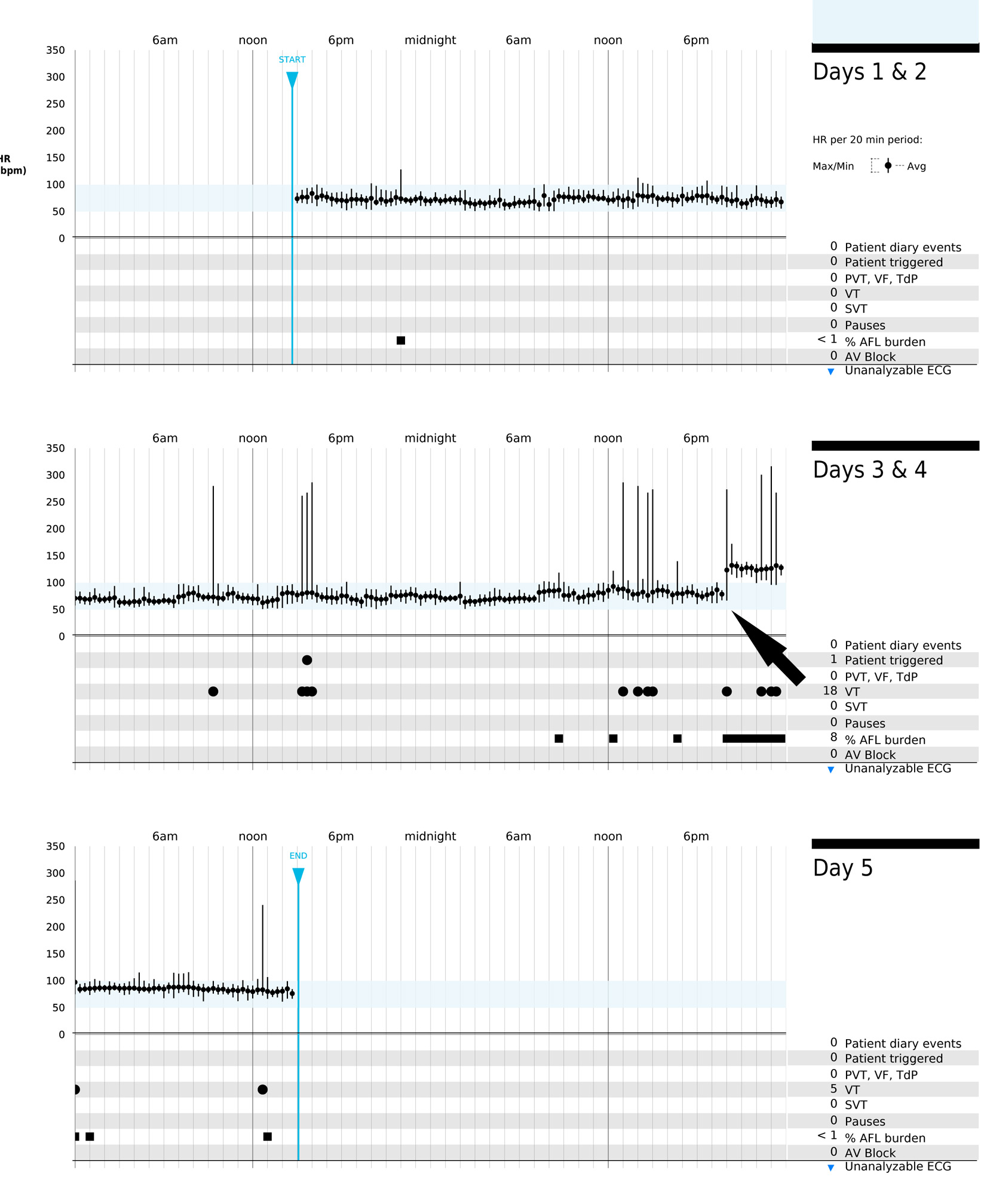
With the advent of the iRhyhm Xio XT patch monitor capable of recording a single lead EKG for up to 14 days, new moments in cardiac electrophysiology have been born.  Some of these moments are anxiety producing for the individual who has to interpret the reports generated by these devices.

Here's a few pages of one I read not too long ago that disclosed some, shall we say, interesting findings and a considerable clinical conundrum.

To orient the reader, when a doctor reads the information collected by the Xio XT patch, he or she first  reviews a summary sheet of all the heart rhythm data measured by the device.  A clever graphic is supplied that permits rapid overview of the tracing with parallel vertical lines closely arranged next to each other.  Each tiny vertical line represents a  20-minute interval of heart rate whose ends represent the minimum and maximum heart rate over those 20 minutes.  A dot in the center of the line represents the mean heart rate.  Below these closely-arranged parallel lines are other dots that fall on a row representing an arrhythmia or action taken by the patient. Here's what the overview picture of the patient I reviewed looked like (note that only 5 days of heart rhythm data were collected):

Click to enlarge. Note the increase in average heart rate that occurred at the arrow.
A closer inspection of the rhythms represented by the vertical lines with high heart rates reveals some important findings:

Click to enlarge


The bottom part of the tracing continues on to the next page:

Click to enlarge (Note the artifact at the arrow)

Finally, on the next page, the wide complex rhythm stops, but a more rapid supraventricular rhythm is discovered:

Click to enlarge

So now what?  Clearly, one of the rhythms appears to be a rapid, potentially life-threatening episode of a wide-complex tachycardia.  So I called the doctor who ordered the study, a solo doctor (yes, some still exist) and reach his answering service.  I have him paged.  There was no answer, so I leave a voicemail message urging a return of my phone call.  I then attempt to call the patient.  No answer.  I call again.  No answer to either the doctor or the patient's home/work/cell phone.

Uh oh.

So here's a question: When reading such a study, how much more should the reading doctor be expected to do?

-Wes


Tuesday, May 06, 2014

When We Reward Regulators More Than Doctors

Medicine has always had it regulatory fiefdoms, but in 2002 they were greatly expanded. At that time, a charter on "medical professionalism" was published by the American Board of Internal Medicine, the American College of Physicians, and the European Society of Internal Medicine in the Annals of Internal Medicine that touted three fundamental principles: (1) the principle of primacy of patient welfare, (2)  principle of patient autonomy, and (3) principle of social justice.  The first set of professional responsibilities for physicians was a "commitment to professional competence." While I would truly like to believe this article was sincere, increasingly I am concerned it was a regulatory ploy - one that is more concerned about financial gain than patient benefit.

Let me explain.

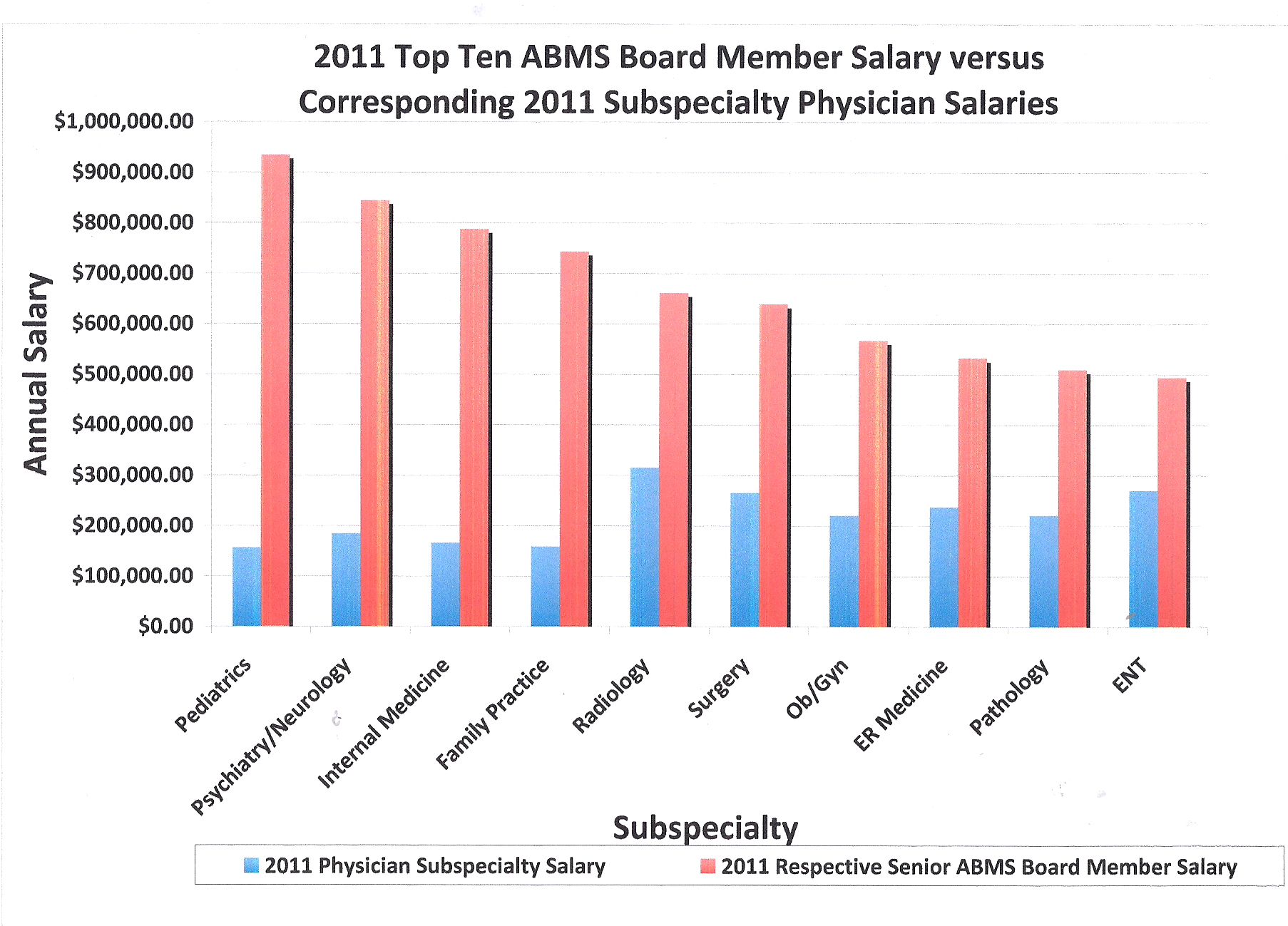
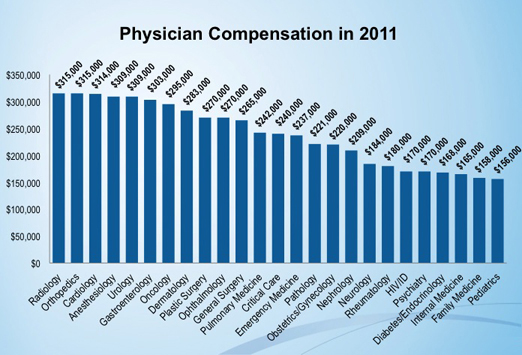
I have spent time reviewing the 2011 IRS Form 990  "Returns of Organization Exempt from Income Tax"  (the last ones publically available) for each of the member boards of the American Board of Medical Specialties (ABMS) and the ABMS itself.  I used the website Guidestar.org to gather these.  I assembled the salaries and benefits of the senior executives from each of these organizations in descending order and was surprised what I found (here is the complete 2-page pdf of the data for your review).  No more than the top three executive salaries of these organizations represented over $16 million in total compensation in 2011 alone.  But even more troubling was the negative relationship that existed between the top-paid executives of these private ABMS member boards and the 2011 compensation for working subspecialty physicians they are supposed to represent. Recall that pediatrics, family medicine, and internal medicine are consistently some of the lowest paid physician subspecialties.

Here is a chart I made of the top 10 board members' annual income compared to the same subspecialty physician salaries in 2011 as reported by Medscape:

(Click to enlarge)

Clearly, the US physician credentialing system as it exists now overwhelmingly rewards people with regulatory oversight rather than those who provide patient care.  Was this the intent?  More specifically, was the intent of the ABIM's "medical professionalism" manuscript to line the pockets of the ABMS member boards in lieu of social justice?  What kind of justice is this?

The answer now is not so clear.

To add insult to injury, realize that front-line physicians are increasingly burdened by very high medical school and residency debt for much of their career.  As part of their rite of passage into their subspecialty, they must pay the credentialing fees that pay the salaries of these regulators.  Should we insist our doctors pay such high fees to support these expensive salaries?  How might  patients be affected, especially when they have reduced access to doctors who must undergo repetitive certification and re-certification exercises.  How do patient's benefit when the certification process appears so flawed? 

To me, it seems that we are not seeing a definition of "medical professionalism" in the credentialing juggernaut that these private organizations have created.

We're seeing the definition of "greed."

-Wes

PS:  Physicians are welcome to print out the pdf of 2011 ABMS Board members' salaries to share with colleagues and to sign the petition to stop the new onerous biannual MOC recertification requirements.

Thursday, May 01, 2014

Who's In?

“If you understand, things are just as they are; if you do not understand, things are just as they are.”

― Zen Proverb


Today, the clock strikes one: One May, 2014.  Today, doctors who failed to enroll in the ABMS Maintenance of Certification (MOC) process will wear the scarlet letter of "Not Meeting MOC Standards" on the American Board of Medical Specialities' CERTIFICATION MATTERS™ website (provided you register on the website and follow the ABMS Terms of Use Agreement).

Just a few days ago, on 28 April 2014, the American Board of Internal Medicine refused to change their policy of requiring physicians to enroll in the MOC process and pay "$200-400" per year to the ABIM despite a petition signed by over 11,800 board-certified physicians who felt the frequency of participation to be expensive and excessively complex and called on the ABIM "to recall the changes in MOC and institute a simple pathway consisting of a recertification test every ten years."

Despite this request from over 11,800 board certified physicians, they refused to budge on their every-two-year MOC requirement.

So at least we know where the American Board of Internal Medicine stands.

But where do the other member boards stand?  Do they stand with practicing board certified physicians or do they stand with regulators who continue to heap more unnecessary busywork of uncertain value on already stretched physicians? We should understand that the threat to physicians and our profession is much more severe, especially when MOC is increasingly tied to hospital credentialing and doctors'  ability to earn a living.   The MOC pass rate for internists was only 78% in 2013.

Today, each member board of ABMS has a unique opportunity to demonstrate their solidarity with the practicing board-certified physicians of their subspecialty.  Each member board should publish a statement regarding the MOC petition circulated by physicians on their websites and where they stand on the issue, just as the American Board of Internal Medicine did.  Subspecialty physicians deserve a response.

Nietzche once wrote, " Hope is the evil of evils because it prolongs man's torment." What we need in the face of what Nietzche calls "a strict, hard factuality" is a clear view of the playing field.  When physicians are feeling increasingly anxious and unclear who truly represents them, we need to have "courage in the face of reality."

Here's a list of the 24 member boards of the American Board of Medical Specialties:
To the leadership of the above organizations: your board certified physician members would like to know where you stand on the new MOC changes imposed by the ABMS today.

-Wes

Tuesday, April 29, 2014

ABIM Thumbs Its Nose at Senior US Physicians

Yesterday, the President and CEO of the American Board of Internal Medicine (ABIM), in a moment that must have been heartbreaking for him, found himself in the position of having to chasten more than 10,000 unruly senior US physicians, thanks to a petition drive.  In his statement, the aggrieved Dr. Baron, in a plea for common sense, bemoans the fact that physicians do not care enough about patient care or safety to spend $200-400 dollars per year for the ABIM.  This is what the benighted ABIM is up against!  Senior physicians are nothing more than penurious whiners who fail to be appreciative of the Mothership.

For those cynics out there might cast a jaundiced eye on the image of the ABIM as the Mothership,  let's not forget the sterling flotilla that the Mothership floats with.  Recall that the ABIM rides in the wake of the American Board of Medical Specialities (ABMS).  Recall that both the ABIM and ABMS arose from the shipyard of the Amedican Medical Association (AMA)  that produces the trademarked CPT procedure codes that Electronic Medical Record industry celebrates.  Recall that Dr. Baron hails  from the Center for Medicare and Medicaid Services.  Recall that the former president of the ABIM, Christine Cassells, had an exemplary friendship with Premier, Inc, a North Carolina company that provides group purchasing and performance improvement consulting for an alliance of 2,900 hospitals and Kaiser Foundation Health Plans and Hospitals. With these kind of credentials, physicians should trustingly take their hands off the policy rudder and know that their profession is secure.

How could doctors doubt the purity of the Mothership?  Given their tireless efforts on the behalf of physicians and our patients, we should, in fact, be holding a fund-raising drive for the ABIM!  How can we be unsympathetic to the responsibility and burden of reimbursing the ABIM's necessary expenses, such as Doctor Baron's $800,000 annual salary or the bottom line of their testing agency?  Don't doctors know that they are singlehandedly preserving the integrity of our specialties and subspecialties that the rest of us would squander willy nilly?

I'd like to reassure President Baron.  It appears we've reached a tipping point.  Physicians are starting to understand the need for active advocacy in protecting our patients and our medical profession.   Disturbingly for the current regime who have commandeered the dignity of practicing physicians for their own benefit, there are appear to be heavy seas ahead.

-Wes

Monday, April 21, 2014

Paid NEJM Subscriptions: There's No Such Thing As A Free Lunch

My hospital system, like many hospital and academic medical centers in America, provides an open-access journal subscription to the New England Journal of Medicine (NEJM) for it's doctors on their private intranet. While I do not know the price of this subscription (I'm sure it's substantial), in the past I have thought it was a nice gesture by our hospital staff to keep doctors current with the latest medical information from the medical journal with the highest impact factor.

Now, I'm not so sure.

New conflict of interests between the NEJM and my hospital have arisen that make me question the wisdom of this policy of free subscriptions provided to doctors, not only our institution, but all other medical centers that offer such an free subscriptions to their medical staff.  As they say, there's no such thing as a free lunch.

Especially when the lunch being served supports tying Maintenance of Certification to maintaining doctors'  hospital privileges.

On 7 April 2014, the New England Journal of Medicine launched their NEJM Knowledge+ website, a product of the NEJM Group, a division of the Massachusetts Medical Society, that breathlessly markets their own costly version of preparing for the ABIM's MOC process to their readership.  A tiny sliver of their exhaustive marketing even promotes the use of their product during the few remaining non-medical hours of a physician's day:
"Whenever you’ve got a moment to lean back and reflect, Internal Medicine Board Review is there with you — whether it’s in line at the supermarket, in the parking lot while waiting for your child’s soccer practice to let out, or during an unplanned minute between patients."
Seriously?

Never is there a mention what NOT passing the ABIM MOC testing means to doctors and their families.   Never is mentioned that since the advent of MOC re-certification, the financial reserves of the ABIM and ABIM Foundation have increased substantially; in 2006 and 2007, the ABIM transferred $13 million to its "foundation."  Never is there a mention that reserves of this magnitude demand accountability to physicians upon which their system has been foisted without any unbiased scientific evidence of its merits.  Never is there a mention of the cozy financial relationship that exists between Area9 Labs (the manufacturer of the NEJM Group's new Knowledge+ website), McGraw-Hill publishing, and the NEJM. Never is mentioned how Area9 distributes and markets the web-based physician learning data it collects on the Knowledge+ website.

Most of all, there is never a mention of the ABIM's unrelenting efforts to link their MOC process to doctors' hospital privileges and their ability to practice their trade - hence where my concern with the conflict of interest exists when hospitals and medical centers purchase the NEJM free of charge for their physicians. Hospitals don't need to buy into this manipulation of their staff.  Almost every medical group has mechanisms to acquire continuing medical education for their staff that are open and not restricted to the ABIM's costs and onorous re-certification process.  By purchasing paid subscriptions to the NEJM, are our hospitals supporting the ABIM's proprietary, self-mandated and scientifically unproven educational process that ties passing a test to the maintenance of hospital privileges?

It is very troubling that the NEJM Group has decided to ally with the ABIM in its MOC efforts.  The ABIM leadership continues to exist under a non-transparent and unethical conflict of interest policy.   The ramifications of the conflicts that existed with former and current members of the ABIM leadership are only now coming to light. This leaves the ABIM's professional credibility seriously in question with physicians.  Is the money that the NEJM Group receives from doctors of all levels of training on their Knowledge+ website worth the damage to their credibility as they ally with the ABIM?

It seems so.  After all, the NEJM seems more concerned about its educational subscription fees than the ethics and scientific integrity of the training process they're promoting.

Because of the clear and present danger that the promotion of the ABIM's MOC process presents to physicians' reputations and their ability to practice sound medicine, I recommend immediate termination of free paid subscriptions to the NEJM for physicians at our institution and others like it until the NEJM Group abandons its support of the ABIM's highly-flawed and manipulative MOC process.

After all, the conflict of interest problems inherent to this cozy institutional arrangement between the ABIM, NEJM Group, and the nation's hospitals far exceed anything that existed when pharmaceutical representatives supplied doctors with free pens.

-Wes

Sunday, April 20, 2014

Smile Because She Happened

“Don’t cry because it’s over, smile because it happened.”

- Ted Geisel (Dr. Seuss)


It seems just yesterday she came to us, quiet, silky, trusting, needing just a finger to rest her head upon.  Unwavering trust.  Unconditional love.  There in the morning yearning to go with us.  There in the evening, excited to greet us at the end of our day.  She was there before the iPhone and stayed true to us after.  She was the only dog my kids have ever known.

Dogs are a wonderful addition to a young family.  Ours taught us the meaning of devotion.  She taught our young kids the meaning of love.  She knew what we were thinking before we said a word.  When sad, she'd offer her head upon our lap; when happy, she'd show her unbounded joy by quivering her adorable stunted tail at a rate that none of us could fathom.  She would defend us against cement lawn ornaments that startled her, and threaten cats and squirrels fearlessly, as if we shouldn't put up with their misbehavior.

Her black tender nose saved the day more than once.  Perhaps her greatest moment was the day the family hedgehog was lost in the back yard during a brief moment of inattention.  The anxiety and family search party, despite their best efforts could not find the little creature.  But there, wagging happily, was a little dog pointing at a spot in the ground cover.  Beneath her, a hedgehog.  And with that, tears of joy and another family crisis averted.

Her love of tennis balls, like life itself, evolved over the years.  At first she'd chase them darting across the lawn in a burst of enthusiasm.  Who knew such a simple toy could engender such joy?  Then, as the years went by and her cataracts took her sight from her, she'd find their scent buried deep amongst thick bushes or hostas, wagging victoriously as she spirited them back home like treasures to store in our living room.  Once there, she'd lie on the floor with the ball between her legs, then shove the ball forward with her nose as if to say, 'Come play!"  We roll it back between her legs, and she'd shove the ball back to us over and over again in a game of blind dog catch.

Slowly, gradually, her hearing left her too, but her trusty nose would allow her to find her way, tail wagging all along.  We'd come home, the head would raise, the tail would wag, and our presence would be acknowledged as she had so many times before - quietly, graciously, and with a tender heart.

Now we are gathered for Easter, seeing her breathing quicken, even at rest.  We have to lift her to her favorite spot on our couch on occasion.  She's not as hungry at mealtimes now.  We know our time with her is short, but our lessons from her will last a lifetime.

And we can be happy.  Really happy.

That she happened to our grateful family.

Happy Easter.

-Wes

Friday, April 04, 2014

The Business of Testing Physicians

If you want to understand the world of professional board certification, it is important to understand the business and politics of testing professionals. Such testing is big business. So big in fact, that huge international media and education companies that trade on the New York Stock Exchange have been created to service this need. According to one article on Reuters from 2012, "the entire education sector, including college and mid-career training, represents nearly 9 percent of U.S. gross domestic product, more than the energy or technology sectors."

Part of the expense of "maintaining" one's professional board certification goes for fees for the testing center where the computerized testing occurs.  Because cardiac electrophysiologists must hold two board certificates (Cardiac EP and Cardiology), we must pay for two rounds of test-taking fees: the first is included with our cardiology maintenance of certification (MOC), then we must pay a second $750 testing fee for the second EP test.  (Each test contained 180 questions - $4.17 per question).  I am assuming almost all of this goes to the company that administered my test: Pearson VUE.

ABIM holds a contract with Pearson VUE, a professional testing subsidiary of Pearson Education, the North American subsidiary of Pearson, PLC (NYSE: PSO) - an 9 billion dollar British corporation that claims it is the largest commercial testing company and education publisher in the world. It boasts Penguin Random House publishing and the Financial Times Group as some of its other far-reaching subsidiaries. Mr. John Fallon is the 52 year-old Chief Executive Officer of Pearson, PLC and earns a cool $2.55 million dollars annually while holding 282,147 shares of Pearson stock and plently of stock options.  He is joined by Mr. William T. Ethridge, age 62, who serves as "advisor" currently, but was previously responsible for the North American Educational Division of Pearson.  According to one source, William Ethridge was once chief executive of Pearson's North American Education division in 2008. According to Forbes, his total compensation in 2011 was $1,390,000 and he held a half million shares of Pearson stock at that time.

Pearson VUE states it "is built on a foundation of experience in electronic testing."  My experience with Pearson VUE was parodied in an earlier blog post. As I reflect, it seemed that Peason VUE was more concerned about storing my biometric palm scans and a digital photograph as much as they wanted to assure a fair testing environment. While the ABIM discloses this process on their website, doctors unaccustomed to such paranoid security measures are caught off-guard by these tactics and should be concerned about how this information is stored and used. Are previously-certified doctors really this sketchy?

Pearson VUE earns a pretty penny from its professional testing and its physician testing in particular. According to Pearson's most recent SEC filing:
"Professional testing continued to see good revenue and profit with growth test volumes at Pearson VUE up 25% on 2012 to almost 12 million [pounds] ($19.9 million). Key contract renewals included tests for the American Board of Internal Medicine, the Association of Social Work Boards and the Pharmacy Technician Certification Board. "
But profitting from physician education is a politically hot topic, too. Not surprisingly, Pearson Education seems quite active in this space spending $2,100,000 to lobby Washington during the last presidential election cycle in 2011 and 2012, contributing 7:1 to the Democratic side of the political aisle. Also, 6 of the eight current Pearson lobbyists have previously held government jobs.

Doctors should understand how and where their money and personal information are being used in the ABIM's MOC testing process, since much of those funds seem to support the corporations and political aspirations of those who are doing the testing rather than the needs of patients that the ABIM is pretending to protect.

-Wes

Thursday, April 03, 2014

Mandrola: A Time-Out for ABIM MOC Mandate

From theheart.org (registration required), John Mandrola, MD calls for a "time-out" for the American Board of Internal Medicine's (ABIM) Maintenance of Certification (MOC) mandate:
The matter for debate is whether the ABIM method - and to be frank, it's arm-twisting tactics - is the best means to achieve physician quality.

Doctors are taught to be skeptical of evidence. Here, there is simply no evidence to judge. We can't know whether this brand of medical education achieves improved patient outcomes. Maybe it will. Maybe it will not. Or, perhaps it could make it even worse. How could aggressive education and measuring quality make things worse? Think heart-failure metrics and an 89 year old, who, a week later presents with a broken hip from all those evidence-based pills. I have many more examples, but I promised brevity.
Read the whole thing.

Some additional thoughts and suggestions to the ABIM:
  • Given the unproven nature of the MOC process to assure physician quality and the ethical breeches created by the ABIM's proprietary process, "board certification" as defined by the ABIM should revert to a lifelong certification to put the ABMS and its subsidiaries in competition with all the CME sources available.
  • The new ABIM MOC rules that are now set to go into effect 1 May 2014 can cause "sudden and unanticipated" revoking of Board Certification based on failure to completely comply with MOC at ANY TIME. This should not be permitted.
  • Since state medical boards are all headed by physicians, the marketing my the American Board of Medical Specialties and the ABIM that physician perform their MOC process to prevent government agencies from providing an alternative to their MOC process is pure propaganda. There are many many government and private agencies that monitor physician performance including hospitals, insurance companies, CMS, Medicare, Medicaid, trial lawyers, the Better Business Bureau to name a few.
  • The ABIM's "board certification" is based on test-taking ability and not patient care metrics. As such it cannot be considered a patient care quality measure of any kind and should not be tied to CMS Physician Quality Reporting System (PQRS) payments to those who care for Medicare patients.
I believe it would be in the best interest of the ABMS and ABIM to listen the the growing chorus of dissatisfaction that is currently echoing throughout the country. I know many physicians are already boycotting the process. Until the ABIM and ABMS change their policies this boycott will continue, especially since doctors know that the incomes of these societies are being directly paid by their physician fees.

Just sayin'-

-Wes

Here's a link to an anti-MOC petition underway.

Monday, March 31, 2014

ACC14: The Quickening Pace of Change

I just returned from the American College of Cardiology and wanted to write down a few of my 50,000-foot impressions from the meeting for, as the song goes, the times, they are a-changin'.

First, while I don't know the overall attendance at the meeting, there really appeared to be fewer attendees.  Interestingly, the outside-the-US contingent seemed strong, but by comparison, the US presence at the meeting seemed much lighter (no facts to support this, just my impression).

The pharmaceutical and medical device displays seemed awkwardly overdone.  Gigantic displays, lots of sales people standing around, with really not much to do.  The amount of money these companies spend to attract doctors in an era when doctors really aren't the purchasers of this stuff anymore, seems crazy - like they haven't gotten the memo.  And for goodness sakes, pharma needs to understand how bad it looks when they're charging $6 a pill to our patients on novel oral anticoagulants and they've got these bulls**t displays.  Either tone it down, or cut your price… er, never mind: do both.

Surprisingly, I never saw a single model walking on a regular treadmill - a standard at every cardiology meeting I have ever attended.   What this means, I'm not sure.  Perhaps the ACC has matured to realize that women cardiologists are a growing force, or (more likely) the advertisers understand that no one cared about regular treadmills (they don't make any revenue) and are sick and tired of standing in from of them at work.

RFID tracking seemed larger than ever.  Little scanner doomajiggies were all over the place to track us wherever we went, that is, of course if we agreed to have one in our badge.  (I was happy to see that the ACC respected by wishes not to have the RFID in my badge, and none was there).  One thing that several doctors noticed (and I confirmed): they really didn't care if you had your badge on UNTIL you went to the expo floor, showing what really matters, I guess.

I had the great pleasure of meeting and chatting with a few fellows from across the country and around the world: New York, Massachusetts, North Carolina, California, China, China, and China.  These younger folks were cool, but clearly lamenting that it might not be one they participate in much longer.  For the most part, most of them were there on much of their own nickel.  I quickly polled them to inquire about the annual stipend they receive from their institutions for these things, and the numbers I heard were quite low: from $1500 to $2500.  Between cuts to doctors' income and low expense stipends, it is no wonder more and more physicians are staying away - kind of sad for doctors, sure, but really sad for these bright, eager residents and fellows.  One is starting to wonder how many more years such expensive sessions will continue.

The other big thing that I noticed at this meeting: not much was scientifically new.  It was striking. Think about it: the big trials were a trial on TAVR, a few talks on Mitra-clip, renal denervation, cardiac resynchronization, and pericarditis.  Maybe the PCSK9 inhibitors that drop LDL substantially in folks with familial hypercholesterolemia were novel, but that one's not really my bag…  It just seems that the  of innovation in US medicine has taken a pause.  Even in the posters: meta-analyses of old big trials seemed to outnumber and new big trials.  It's different now.  The cuts are real.

Finally, there was an important first at the meeting.  I was impressed that the topic of social media in medicine was given it's own real, live session with it's own central room at #ACC14.  I was even more amazed they invited me.  After all, I haven't exactly ingratiated myself with the College lately.  To their credit, however, they are giving folks like you and me a place to learn about and a platform to promote what I believe to be an important tool for physicians in the years ahead.  For that, I am truly grateful.   We are, after all, are all professionals all doing this crazy work of medicine together.  We may not agree at times, but I think we all want to improve the system for our patients' sake, and social media is a very powerful way to affect change, act collectively, vet ideas, and improve our health care system for the better.  Industry, too, is learning from doctors and patients as they use social media to critique, explain, and promote ideas and tools for better patient care.  Sure there will be bumps.  Sure there will be disagreements.   And change may not come right away.  But more more often than not, with enough collective voices reaching some compromise, there will be effective change for the better.  Seriously, where else can we get value like that?

So to the ACC leadership and all the great people I had the chance to meet, discuss, learn from, share ideas with, thank you.  It was a blast.

-Wes


Sunday, March 30, 2014

Is Maintenance of Certification Our Next Tuskegee?

“An experiment is ethical or not at its inception, it does not become ethical post hoc – ends do not justify means. There is no ethical distinction between ends and means.”
-- Henry K. Beecher, MD
 New Engl J Med 274(24) June 16, 1966 pp 1354-1360.

“For the most part, doctors and civil servants simply did their jobs. Some merely followed orders, others worked for the glory of science."
-- John Heller, Director of the Public Health Service's Division of Venereal Diseases

The Tuskegee syphilis experiment was an infamous clinical study conducted between 1932 and 1972 by the U.S. Public Health Service to study the natural progression of untreated syphilis in rural African American men who thought they were receiving free health care from the U.S. government. The Public Health Service started working with the Tuskegee Institute in 1932. Investigators enrolled in the study a total of 600 impoverished sharecroppers from Macon County Alabama. Three-hundred ninety-nine (399) of those men had previously contracted syphilis before the study began, and 201 did not have the disease. The men were given free medical care, meals, and free burial insurance, for participating in the study. They were never told they had syphilis, nor were they ever treated for it. According to the Centers for Disease Control, the men were told they were being treated for "bad blood", a local term for various illnesses that include syphilis, anemia, and fatigue.

The 40-year study was controversial for reasons related ethical standards, primarily because researchers knowingly failed to treat patients appropriately after the 1940s validation of penicillin as an effective cure for the disease they were studying. Revelation of study failures by a whistleblower led to major changes in U.S. law and regulation on the protection of participants in clinical studies. Now studies require informed consent, communication of diagnosis, and accurate reporting of test results.

The Tuskegee Syphilis Study led to the 1979 Belmont Report and the establishment of the Office for Human Research Protections (OHRP). Importantly, it also led to federal laws and regulations requiring Institutional Review Boards for the protection of human subjects in studies involving human subjects.

Fast forward thirty-five years.

Could the new American Board of Internal Medicine (ABIM) mandate for participating in their Maintenance of Certification (MOC) process unilaterally imposed 1 January 2014 so they can maintain a publicly-reported maintenance of certification "status" be violating ethical standards set forth by the 1979 Belmont Report?

Let me explain why I think it does.

The increasingly complicated test- and survey-taking exercise called "Maintenance of Certification" has never been scientifically proven to improve physician quality.   Our society's inability to agree on a definition of a "quality" physician (and how to measure those qualities) is part of the reason why this issue has never been studied.   For instance, should we define a "quality" physician on the basis of his or her empathy, surgical skill, lack of complications, ability to recall facts or some combination of these or other attributes? The reality is, it is nearly impossible to adequately define a "quality" physician at the outset.

But the issue of maintaining "quality" health care delivery is critical to those paying for health care services (CMS and insurers, aka, "stakeholders"), especially now in this era of health care reform.  Payers want to assure they receive the most value for their dollars spent in health care.  Patients want to be reassured that they are receiving competent care by a physician, especially in a time where cost-cutting, deployment of unproven electronic medical systems, use of non-physician care-givers, and shortened physician training and work hours has occurred.  Seeing an opportunity, the American Board of Medical Specialties (ABMS) and the ABIM stepped in to help the government define physician quality.  Through the assurances of their leadership,  the ABIM led "stakeholders" to believe that (1) quality is easy to measure (after all, they have a thorough testing "process") and (2) the responsibility for determining physician quality should rest with individual physicians. This leap of faith by government officials is similar to the Tuskegee era when government physicians were similarly obsessed with African American sexuality, believing that the responsibility for the acquisition of syphilis rested solely upon the individual.

Because the Maintenance of Certification process imposed by the American Board of Internal Medicine is unproven, it is, at best, an experiment that attempts to assure physician quality on patients without a defined hypothesis (what, really, does the ABIM test with the MOC process?) or informed consent.  The issue of informed consent is critical, in my view, because the psychological, financial, and social consequences of NOT passing the test to doctors and their patients have never been evaluated.

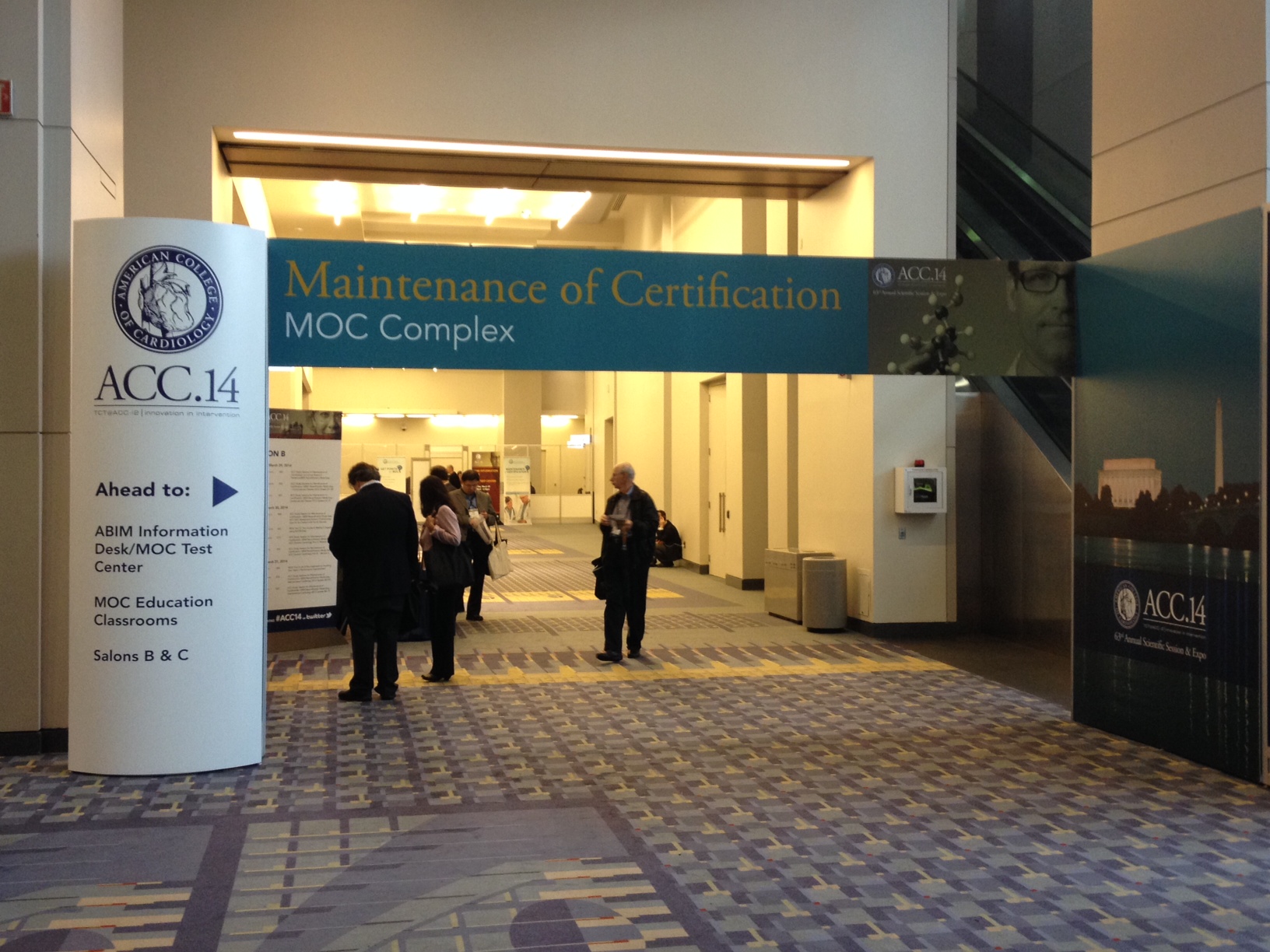
The "MOC Complex" at ACC2014 (click to enlarge)
Yesterday, I attended the session entitled "Changes to ABIM's Maintenance of Certification (MOC) Process" at the American College of Cardiology Scientific Sessions in Washington, DC.  Drs. Richard Baron, MD, President and CEO of the American Board of Internal Medicine (ABIM) and the ABIM Foundation, William Little, MD (who also receives considerable compensation from the ABIM) and Henry Ting, MD  were speakers.  I learned several important things at that session about the 2013 MOC examination results.

First, I learned that the pass rate this year (2013) for internal medicine specialists was 86%, and for cardiac electrophysiologists was 84%.  This means that fourteen percent of internists and sixteen percent of cardiac elecrophysiologists did not pass their test.  (We were assured that 97% "ultimately" pass, however, but no data were supplied to the audience to this effect).

The second thing I learned directly from Dr. Baron yesterday during the question and answer period was this: the ABIM has never studied the psychological, social, or financial impact that NOT passing the MOC process upon physician test-takers.   This is not a small issue, especially if one considers that many hospitals are beginning to tie the ongoing Maintenance of Certification process to the issuance of hospital privileges to practice medicine.  How could anyone trained in the ethics of scientific study and research permit such an egregious oversight to the protection of physicians?

From the 1979 Belmont Report:
The expression "basic ethical principles" refers to those general judgments that serve as a basic justification for the many particular ethical prescriptions and evaluations of human actions. Three basic principles, among those generally accepted in our cultural tradition, are particularly relevant to the ethics of research involving human subjects: the principles of respect of persons, beneficence and justice.
Let's examine each of these principles described in the Belmont Report in regards to MOC testing.

Regarding respect for persons:
Respect for persons incorporates at least two ethical convictions: first, that individuals should be treated as autonomous agents, and second, that persons with diminished autonomy are entitled to protection.
Today, physicians are "persons with diminished authority" in the certification and licensure discussion. The decision to invoke every-two-year testing was imposed by leadership of several physician organizations whose leadership have had strong ties to government agencies (including the Center for Medicare and Medicaid Services, a la Dr. Baron) without the approval of their membership. Further, the MOC process is already being used by some hospitals as a lever to dispense hospital privileges without proof  that the MOC process assures physician quality, however might have been defined.

Regarding beneficence:
Persons are treated in an ethical manner not only by respecting their decisions and protecting them from harm, but also by making efforts to secure their well-being. Such treatment falls under the principle of beneficence. The term "beneficence" is often understood to cover acts of kindness or charity that go beyond strict obligation. In this document, beneficence is understood in a stronger sense, as an obligation. Two general rules have been formulated as complementary expressions of beneficent actions in this sense: (1) do not harm and (2) maximize possible benefits and minimize possible harms.
Given the fact that the negative consequences of failing to re-certify in medicine are very real for doctors, failing to pass the ABIM's tests may, in fact, harm them.  No attempt to minimize harm to physicians has occurred.  No attempt has been made to warn physicians about the negative consequences of what might happen to them if they fail to maintain their certification in good "status."  Worse still: not allowing physicians to practice medicine may actually harm, rather than benefit, the doctor's patients!  The ABMS and ABIM have clearly turned a blind eye to this possibility.

Finally, in regards to the last critical element of the Belmont Report, justice:
Who ought to receive the benefits of research and bear its burdens? This is a question of justice, in the sense of "fairness in distribution" or "what is deserved." An injustice occurs when some benefit to which a person is entitled is denied without good reason or when some burden is imposed unduly. Another way of conceiving the principle of justice is that equals ought to be treated equally. However, this statement requires explication. Who is equal and who is unequal? What considerations justify departure from equal distribution? Almost all commentators allow that distinctions based on experience, age, deprivation, competence, merit and position do sometimes constitute criteria justifying differential treatment for certain purposes. It is necessary, then, to explain in what respects people should be treated equally. There are several widely accepted formulations of just ways to distribute burdens and benefits. Each formulation mentions some relevant property on the basis of which burdens and benefits should be distributed. These formulations are (1) to each person an equal share, (2) to each person according to individual need, (3) to each person according to individual effort, (4) to each person according to societal contribution, and (5) to each person according to merit.

Questions of justice have long been associated with social practices such as punishment, taxation and political representation. Until recently these questions have not generally been associated with scientific research. However, they are foreshadowed even in the earliest reflections on the ethics of research involving human subjects. For example, during the 19th and early 20th centuries the burdens of serving as research subjects fell largely upon poor ward patients, while the benefits of improved medical care flowed primarily to private patients. Subsequently, the exploitation of unwilling prisoners as research subjects in Nazi concentration camps was condemned as a particularly flagrant injustice. In this country, in the 1940's, the Tuskegee syphilis study used disadvantaged, rural black men to study the untreated course of a disease that is by no means confined to that population. These subjects were deprived of demonstrably effective treatment in order not to interrupt the project, long after such treatment became generally available.
So who is served by the Maintenance of Certification process, really?  Are patients?  Doctors?  Or the leadership of ABIM?

There are significant financial incentives driving the marketing of the ABIM's ongoing MOC process to America's physicians.  From the ABIM's own 2012 Form 990 that I could retrieve, the ABIM earned $30,661,314 from their members for examination fees, $17,509,141 for Maintenance of Certification, and an additional $970,415 for exam development, supplying duplicate certificates, and re-scores of the examination.  Of the total revenues reported by the ABIM in 2011 ($49,304,645) fully 48.6% ($23,937,881) went to staff salaries, other compensation, and employee benefits.  Christine Cassels, MD alone (who served as President and CEO at the time), earned $786,751 that year and had her spouse's travel fees to meetings thrown in, too.  It goes without saying that the leadership of these organizations have received salaries far higher than most of their physician members.  Justice (as defined by the Belmont Report) can hardly be served when scales are tipped so heavily toward those of our own profession that stand to benefit so handsomely from this certification process.

It is time that doctors and patients understand exactly what has transpired with the foisting of the ongoing MOC process upon America's physicians.   Just as the Tuskegee experiments in Macon County Alabama did years ago, well-meaning members of our profession have represented physician "quality" by their own standards that include the ability to perform a serious of test- and survey-taking exercises without responsibly admitting the harms this process might have on their colleagues and their patients.  Like the serious breaches of ethical standards that occurred when doctors worked "for the glory of science" in the Tuskegee era, this unfortunate unproven experiment of MOC re-certification by the ABIM continues unabated without checks and balances.

It is time for this injustice against physicians to stop.  Responsible physicians and their patients everywhere need to rise up and demand accountability by the ABIM for their ethical breaches that have occurred.  The heavy marketing of the benefit of this process without acknowledging its potential harms is dangerous to both doctors and patients.  Further, it is not okay to entrap physicians by making them pay for an unproven process that could destroy their social status and ability to earn a living.

To believe otherwise is about as unethical as it gets.

-Wes

P.S.: Here's a link to an anti-MOC petition underway.