Showing posts with label politics. Show all posts

Tuesday, August 12, 2014

The Tradeoffs of Obamacare

A few from above, from Saurabh Jha, MD (Twitter: @roguerad):
The biggest trade-off is between a constitutional republic, with all its checks and balances, and a centrally-planned healthcare.  The two are fundamentally incompatible.  The future will yield many more convulsions.  Many more Halbigs.

The optimism surrounding the ACA, summed up by President Obama's promise "if you like your doctor, you can keep your doctor," gave many the impression, myself included, that healthcare reform can be Pareto optimal; a win-win for all.

Regrettably, trade-offs are a fact of life.  Which means there are winners and there are losers.  This is not unusual.  But by not acknowledging the trade-offs we have created resentment in the losers, and widened the partisan chasm.
Read the whole thing.

-Wes

Thursday, May 29, 2014

Medicine's Love-Me Wall

“We can never be gods, after all--but we can become something less than human with frightening ease.”
― N.K. Jemisin, The Hundred Thousand Kingdoms


I know it's click bait, but the top 100 most influential people in health care, according the Modern Healthcare, is worth a look. It contains the following individuals in its "Top Ten:"
  • Kathleen Sebelius (#1) who resigned as the head of Health and Human Services after the botched Healthcare.gov rollout
  • Oregon Governor John Kitzhaber (#2) who jettisoned the state's $248 million dollar attempt to arrange its own health care exchange website
  • President Barack Obama(#3) - of course
  • Mr. Stephen Hemsley of UnitedHealthcare (#4) who made a cool, $4.57 million in compensation last year and exercised $9.48 million in stock in 2013
  • Marilyn Taviner (#5), CMS who gets a little love each year from her prior employer, the Hospital Association of America on top of her salary as CMS Director
  • Mark Bertolini (#6), CEO of Aetna, who made $2.66M in compensation and exercised $4.52M in stock in 2013
  • Richard Bracken (#7), CEO of HCA, who earned $38.6 million for his role as CEO in 2013 before retiring and pocketed a cool $46.3M in 2012
  • newcomer Joseph Swedish (#8), CEO of WellPoint, who earned only $7.48M in 2013
  • George Halvorson (#9), of Kaiser Permanente, who doesn't report compensation (a bit of "Sunshine law" needed, perhaps?) but other sources pegged his compensation at $6.7 million back in 2009
  • Sister Carol Keehan (#10), of Catholic Health Association who likely made well in excess of $1M in 2011
And the list goes on...

Yet we wonder why our health care costs are so high.

Really?

-Wes

Friday, May 09, 2014

The Health Care Industrial Complex and the Iron Triangle

Walking to the 2014 Heart Rhythm Society (HRS) Scientific Sessions this morning, I couldn't help but marvel how beautiful San Francisco seemed today. The weather was perfect, the streets bustling, the quaint shops and eateries doing brisk business in a very hip metropolitan city with a distinctive West Coast vibe. As I walked up to the Moscone Conference Center, I was struck by the size and scope of the facility and its cool, corporate look.

"Welcome," I thought, "to the Health Care Industrial Complex."  This meeting was, after all, designed for me and the other Heart Rhythm Specialists from all over the world.

HRS Infinity Circle Supporters
After picking up my badge I shuttled off to my first session and picked up the fresh flier published on the previous day's events.  The publication was remarkably professional, processed with all the proper public relation jargon and complementary hyperbole.  The Heart Rhythm Society app that I downloaded on my iPhone, too,  looked eerily similar to the polished one at the ACC meeting earlier this year, just the sponsor page that blinked "Biotronik" instead of  "Amgen" as it had earlier this year.  Finally, as I turned by attention back to the flier, there on page two was a picture of Hugh Calkins, MD the current President of HRS and James Youngblood, the Society's "professional" CEO, honoring the "HRS Infinity Circle Supporters" from Medtronic.  Infinity Circle Gold members from Biosense Webster, Boerhinger Ingelheim, Boston Scientific and Janssen and Silver member St. Jude Medical also were honored in the picture's caption.

Of course they were.

Twenty-six years ago I entered the North American Society and Pacing and Electrophysiology (NASPE) as a young fellow in cardiac electrophysiology competing for the Young Investigator Competition.  I was nervous as hell as I practice and re-practiced by presentation.  I was competing against some of the best and brightest and was thrilled at the opportunity, the heady notoriety, and the opportunity to rub noses with the reviewers (international senior mentors) first hand.  Back then I did not have the perspective I have now with the interplay of forces that have come to define US health care.  I had no concept of the powerful influence that the vast sums of money, lobbies, special interests, regulators, and oversight agencies have in medicine.

Since that time, NASPE has changed its name to the Heart Rhythm Society to reflect a more global mission.  Over the years I have seen the bureaucratic and political influence change the landscape of medicine as I never imagined as I struggle to cope with what it means to practice medicine today.  I suppose when one considers that for many communities in America, health care is their economy, I shouldn't be surprised that the business and politics of medicine are now more important than ever.

Years ago near the start of the Vietnam War, President Dwight D. Eisenhower coined the phrase "military industrial complex" in his farewell speech to America.  He was describing the policy and monetary relationships that exist between legislators, our national armed forces, and the military industrial base that supports them.  These relationships include political contributions, political approval for military spending, lobbying to support bureaucracies and oversight of the industry.  The concept began with the concept of coordination between the government and the private sector to provide weaponry to government-run forces.

Now we have the private sector providing funding for our instruments of health care.  We see companies that supply medical devices, drugs, insurance, electronic medical records and companies that support lobbying efforts and data mining and richly-paid oversight entities.  Today, however, the budget is much, much larger for medicine than the military.  Our "health care industrial complex" has grown into the monster it is today with a supporting flotilla of corporate, special interest, regulators and oversight entities, with doctors and patient's swept up by its wake.

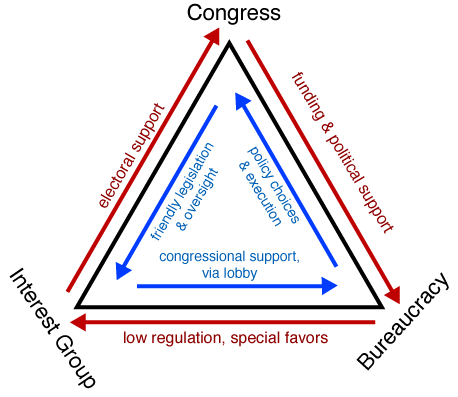
Some have called this the "Iron Triangle."  And just like it's original reference for the military, we should recognize that it pertains to health care, too.  While this may be distasteful to many (including myself), I have also come to recognize that like the military, we need health care.  Unfortunately for all of us, this monstrous bureaucratically-wasteful system is what we've created.   For me, I find it helpful to understand this interplay, because it helps me focus on my role as a doctor today.


The Iron Triangle

I can only hope that our younger medical students, residents, fellows, and younger doctors get taught this perspective.  Much too often I see them looking more like lambs being led to slaughter.  Hopefully, a little insight will help them cope with the seemingly endless bureaucratic and oversight "ideas" that keep surfacing as we struggle to care for our patients.  Hopefully this perspective will keep them engaged in pushing back when the onerous becomes intolerable.  Hopefully they'll come to understand what they're up against before they throw up their hands in disgust.

Perhaps bringing these concepts to consciousness will allow us to become coordinated advocates for our patients who are being affected by these very same forces.  Maybe then, we can continue to hold true to what we love about medicine, and beat back the Iron Triangle that is making it so difficult to do so.

-Wes

Saturday, November 16, 2013

When Medical Content Providers Go Political

It is an interesting time in medicine.

If we step back a few thousand feet and look down on America's medical world, we see a mess.  We see rules and regulations run amok.  We see doctors under unprecedented pressure to click rather than to care. We see government websites built with the promise of access to health care, collapsing under its own weight.  We see politicians promising one thing, then delivering another.  Then we see them give exceptions to some or outright lying to others.  Then we see them get cozy with the insurance lobby after they're caught red-handed  in hopes of making a "fix."

We, the lowly patients and doctors in this political power game, turn our heads in disgust as we struggle to help people live (literally) another day.

US medicine is now all about power and money.  As such, medicine is now more about a political vision rather than reality.   Politics, after all, is all about sales: selling a vision to stay elected and to stay in charge.

So where better to turn to promote your political sales job than WebMD (and their subsidiaries like Medscape and theheart.org), that "trusted" purveyor of all things medical?  It seems WebMD and its MedScape affiliates like theheart.org have quietly accepted a $4.8 million grant  to promote the Affordable Care Act and have refused to disclose this little factoid to doctors and their readers.

There does not need to be a  Sunshine law for politicians and medical content providers these days, only doctors.

But it doesn't stop there.  Ironically, shortly after this disclosure by the Washington Times, an article entitled "Conflicts of Interest: Concepts, Conundrums, and Course of Action" appeared on theheart.org/Medscape Cardiology's website.  (Update: this morning there's an article on the Physician Payment Sunshine Act, too!)  As I tried to read this article I laughed as I clicked through a Brilinta ad and was subject to Bystolic and Belviq ads in Medscape's sidebar.

Here's a real "course of action" I'd suggest to doctors bothered by the double-standard of disclosure imposed on us from our political class: dump the Medscape app on your cellphone, give a little shout-out to theheart.org, er, Medscape Cardiology, and ask why they haven't said anything.

Then cancel anything related to WebMD.

Then, at least, we'd be sure we're getting past the political propaganda and back to medicine.

-Wes

h/t: A faithful reader.

Addendum 16 Nov 2013 @ 12:20 PM CST: It seems WebMD felt compelled to release this press release regarding their editorial integrity, but it did not reference the above conflict disclosed here specifically.

Sunday, April 28, 2013

Story Lines

Doctors are trying to rationalize our current story line:  the loss of autonomy and pay cuts are a necessary evil for the greater good.   We're taking one for the excess-health care cost team.  We're willing to take this personal sacrifice for our fellow man and woman.   It is the noble thing to do.   It will be good for America's healthcare system if we do our part, work harder to improve inefficiencies.   There are even doctors in leadership positions who reflect in their three-year "honest assessment" of our current health care law that higher taxes and near-30% rise in insurance premiums are a necessary evil for extending insurance to 30 million more Americans.  "I am glad to do my part," they comment.  How could anyone argue with such beneficence?

Doctors who sacrifice and give tirelessly to their patients are our storybook ideal; what every American loves to envision.  But we should also acknowledge that there is another story line: that many physicians are deeply concerned with the realities of what's taking place in health care lately.

Doctors are witnessing health care costs greatly outstripping inflation, especially since our new health care law was put in place.
  • People aren't using their coverage because they fear the cost of their much higher deductibles.

  • Insurance companies have created their own convenient loophole to avoid the consequences of their own new law.

  • With the initial deployment of the law only eight short months away, the promised insurance "exchanges" have yet to be fully deployed nor explained to the public.

  • The small business health care program has been delayed.

  • People with pre-existing conditions stopped being covered in February, 2013  because the government agency responsible for this portion of the law ran out of funds.
  •  
  • More concerning for those who are budget-minded, as of today, not a single member of the the law's Independent Payment Advisory Board, the 15-member panel that is supposed to recommend cuts to the Medicare program beginning 1 January 2014 to maintain its solvency, has been selected, much less approved.
Meanwhile, our nation's leadership is enjoying the black-tie White House Correspondent's Dinner in appreciation of those who serve as our Great Distributor of Washington story lines, aptly named "Nerd Prom."

Perhaps I shouldn't be so harsh.  After all, it was just in the spirit of poking fun.  I should also accept that since American Medicine is our largest employer and nation's largest business, American Medicine will forever be tainted by politics.  But as we have seen time and time again, it is common in politics to sell Story A when, in fact, the real motivation for something is Story B. When political initiatives are deployed that are uncomfortable there has to be something that people will emphatically rally behind.  How else could we send our children off to war, for instance?

And so it has been with health care.

Story A was that this whole health care story line was about the uninsured.

Yet people were never waving flags and demonstrating in the streets for wellness initiatives with free mammograms, physicals and flu shots.  People were not looking for more and more middle layers of bureaucracy, red tape, and management.   People are not demanding that first-year medical residents see patients for only 12% of their day because of training rules. People were not looking for their doctor to become a nursing supervisor, medical coder or typist.    People were not picketing the Supreme Court for double-digit insurance company stock market returns so they could enjoy higher premiums and deductibles.    People were not hoping for $100-million golden parachutes for pharmaceutical executives. People were not lobbying for bigger hospitals competing with other hospitals for wealthy patients, each filled with outdated computers, waterfallsbig screen TVs and kiosks in "anticipation" of what was to come.   And people were REALLY not expecting the government to burn through their cash so fast that they'd be asking for more money so soon.  

Yet here we all are, realizing our new, disturbing story line.

Doctors, patients, ...

... and Nerd Prom.

-Wes

Sunday, December 09, 2012

The End of Our Health Care Happy Meal

With the publication in the New York Times of how taxes would be affected because of the Affordable Care Act, our health care Happy Meal was officially pulled from the menu.

Suddenly, the colorful trinkets and tchotchkes that were the first items pulled from the health care law's brightly colored bag are now being followed by a hefty bill that most people aren't too happy with paying: their personal tax bill.

The political backlash was so swift, so sure, that even the White House noticed.
 
So how did the White House respond?
... Treasury Secretary Timothy Geithner has the power to adjust how much is withheld from paychecks for tax purposes — for all taxpayers or just for some.  By doing so, Geithner could ensure paychecks reflect the White House position that wealthier taxpayers with annual income higher than $250,000 see their taxes rise. Geithner at the same time could leave withholding tables where they are for the middle class, ensuring those workers don’t see a higher cut from their paychecks.
But America's doctors should remind the White House why this is not a good idea.  After all, Congress uses this kick-the-can-down-the-road approach with us each time they grant a reprieve to the scheduled physician pay cuts mandated by law as part of the Medicare sustainable growth rate adjustments contained within the Balanced Budget Act of 1997.

Look where this approach has gotten physicians: each year, since 1997, CMS threatens to cut Medicare payments to physicians some 2.5%. Instead of making the cuts each year as directed by law, Congress caved to political pressure and has delayed the cuts year after year.  But the cuts don't go away: they're just added the the following year's paycut amount.  Now the amount has grown to nearly 30% or so with no easy solution in sight.

Imagine what could happen to America's patients if the same approach delay tactic for collecting taxes to pay for our new health care entitlement law is taken.  Can America's health care cost crisis really afford this political approach that ignores reality?

I'm just a doctor, but methinks this idea of leaving withholdings from people's paychecks unchanged is not a good idea just so the White House can dodge a political bullet. 

Since the White House and democratically-controlled Congress helped push our new law through, they should deal with its ramifications responsibly.  To do otherwise is fiscally irresponsible and risks making our horrible health care cost crisis even larger.

-Wes

Tuesday, May 17, 2011

What Does Propublica Want?

It's an healthy question to ask after Propublica's recent exposes on the Heart Rhythm Society and SCAI. So I turned to the internet to find this piece published previously in Slate:
What do the Sandlers want for their millions? Perhaps to return us to the days of the partisan press. The couple made their fortune, which Forbes estimates at $1.2 billion, at Golden West Financial Corp. In recent years, they've spent millions on politics. The Federal Election Commission database shows the two of them giving hundreds of thousands of dollars to Democratic Party campaigns. In 2004, Herbert Sandler gave the MoveOn.org Voter Fund $2.5 million, again according to the FEC database. The Center for Responsive Politics Web site reports donations of $8.5 million from Herbert and Marion to the 527 group Citizens for a Strong Senate, in the 2004 cycle. CSS was formed by "a group of strategists with close ties to former North Carolina Sen. John Edwards," writes the washingtonpost.com's Chris Cillizza. American Banker reported in 2005 that Herbert also gave $1 million to the California stem cell initiative and that the pair have also funded the progressive Center for American Progress.
While I do feel there's a need for healthy disclosure of industry ties with physician groups, it's helpful to keep in perspective the origins of the recent investigative reporting. Is it meant to beat down doctors further into submission in the health care debate to make us cogs in the corporate wheel rather than innovators in care?

It's low-hanging fruit to take shots at the sources of funding to doctors' societies. I wonder if Propublica will perform similar reporting for the sources of funding for members of our Judiciary?

-Wes

Tuesday, November 17, 2009

Sebelius: Talking the Talk or Walking the Walk?

Here's a bit of the transcript from Kathleen Sebelius, Department of Health and Human Services Secretary, speaking to the Wall Street Journal's CEO Council (approximately 2 min, 45 sec into video) about saving health care costs:
... There are lots of features of the House Bill and that are already in the Senate bill that change that (the way doctors are paid). We are beginning to move away, particularly in Medicare, from traditional fee-for-service pay that I would suggest not only causes redundancy but doesn’t encourage innovative, high quality, low cost practices to moving toward a system that exists in pockets, exists in Mayos, Geisinger, (Inter-)Mountain Health Care. We know what it looks like. It isn’t how medicine is practiced it isn’t the the hospitals and providers are paid, so "bundled payments," "medical care homes," "accountable care organizations" – all buzzwords for really providing financial incentives and eventually financial penalties for appropriate medical protocols and appropriate outcomes - stopping the system now where one out of every five who’s released from the hospital is back in 30 days having never seen a health care provider, reducing or eliminating hospital-based infections, which are now one of the top 10 leading causes of death in America. We know exactly the system that can be done to stop it. It doesn’t take any capital investment It doesn’t require any new technology.”
I wonder what she means by "... eventually financial penalties for appropriate medical protocols and appropriate outcomes?"

Why penalize people for adhering to appropriate medical protocols? Or maybe she just needs some sleep...

And then there's this quick fact check:

Septicemia: #10 in 2006 (1.3% of deaths) CDC list for death in America and was #11 in 2004 (1.4%) but is substantially better than rates in 1997 (2.4% of deaths).

(Just keeping it real.)

-Wes

Friday, January 09, 2009

Blago's Impeached

Surprise, surprise.

Now that the fall guy's taken it, will pay-to-play politics cease to exist?

No.

But at least we now can feel good we did something about it.

-Wes

Friday, December 12, 2008

Pay-to-Play: Could It Happen With National Health Care Reform?

Say it ain't so.

But as the depth and extent of the pay-to-play backbone of Chicago politics unfolds, we should ask ourselves if the same scenario could happen nationally as the government Big Boys consume increasing influence over health care, the backbone of our economy.

One only need to look at the indictment of Governor Blagojevich to see the depths that people go to acquire Mercy hospital's Certificate of Need approved by the State Planning Board (a la the Tony Resko scandal), or of the threatened withholding of funds to Children's Hospital by the governor when he didn't get his backdoor campaign contribution from CEO Patrick Magoon.

Again in the Tribune today, we find a story about a fundraiser for Jessie Jackson, Jr. with more than two dozen attendees aimed at supporting Mr. Jackson's bid for the soon-to-be-up-for-sale Senate seat in Illinois, one of whom was a Joliet pharmacist Harish Bhatt.

It seems Bhatt's two Basinger Pharmacy outlets might have needed a few "regulatory favors" after helping the state's top pharmacy regulator win his job.

And why would Raghu Nayak, a political community leader in Chicago's Indian community "who has raised several hundred of thousands of dollars for Blagojevich, including more than $200,000 from Najak, his wife, and various corporations" need to support Blagojevich? Could it have something to do with the series of surgery centers Nayak owns on Chicago's North Side or the drug testing laboratory with millions of dollars in Illinois public aid contracts in which he retained an ownership stake?

Could similar behind-the-scenes dealings happen as our new health care policy initiatives are constructed and the Big Boys on the Hill make their plays with their campaign contributors in mind? Could there be, like the Tribune's columnist John Kass suggests, a man or two behind the curtain as our new health care plan is being hatched?

Say it ain't so.

-Wes

Tuesday, December 09, 2008

Smoke-Free White House?

It seems the White House is a smoke free zone. So what will happen when Barack Obama, who we find has yet to quit smoking, takes up residence there?
"Uh, excuse me Mr. President, we have to ask you to put out that cigarette."

"Tom, I'm tired of all of your nagging! You big ol' senators think you know it all. If I weren't so perplexed about the health care system and needed someone to take the fall when the next attempt at reform fails, you'd be fired! You hear me? Fired, I tell you! So be glad I offered you that post over there at the Department of Health and Human Services. Hey, how's the sale of your book going now that I appointed you? Good? Glad to hear it! Now you go about your way now and leave me alone. I've got bigger fish to fry with this damn economy. Criminy!"

"But Mr. President, sir, the White House has balconies..."

"Tom, dammit! Stop! Wouldn't you suck on one of these babies if you had to figure out a way to shore up our economy? I don't see you working like I am. I hired all of those famous economists and they keep telling me this and that - who knows what's right? And if I get cancer, well then, heck, at least I'd be leading by example and supporting the continued reliance on health care to support our economy, right? I mean look at all the new jobs we've created there - even now as the rest of the economy tanks. You could scan me and test me time and time again, then give me one of those super duper chemo drugs that costs, what, $5000 per month, and save my sorry little butt so I can get back to work. So I don't have to stop smoking, Tom. The nation needs me in this time of crisis to show them the way!"

"But health care's struggling, too, Mr. President. I mean ER's are seeing more and more of the uninsured, they're overcrowded. Pressures being put on hospitals to see these folks who can't pay..."

"What do you mean, hospitals are hurting? I know that some are doing quite well. Some are building like crazy. Some are growing. Don't tell me hospitals are hurting!"

"Really, Mr. President, some are. Lots of them have thought about closing - not because they can't continue seeing patients and raising prices. It seems it's really because they couldn't get credit to update their facilities and make 'em look as nice as their competitors. So all they could see were the locals. They couldn't attract people from outside their locale that could actually pay their bills and got stuck with the hoi polloi - and lots of those common folk have lost their insurance when they lost their job, Mr. President."

(Loud sucking sound heard, followed by a plume of smoke rising from the Predident's lips) "Oh, hell, Tom, you're such a fuddy duddy. We all know who's paying their bills! Medicare! What the hell you taking about? Those guys just keep seeing the over-65 crowd and they're set! You know as well as I do that we're providing them a bigger continuing bailout package than GM! Maybe WAY more! They just hire those hospitalists to keep ordering tests and workin' like beavers and with all those fancy electronic medical records auto-ordering tests and immunizations and drugs, hell, they're in the money. We pay 'em well enough, Tom. They'll make it. Let's focus on the big stuff. Don't weigh me down in such trivialities - we have the finest health care system in the world."

"But Mr. President, aren't we suppose to find all that waste, fraud and abuse in the hospitals? With those damn electronic records, that's getting hard! Won't that take even more money from the hospitals?"

"Tom, seriously. You know how this works. If the programs are making it tough to find some loopholes, just change the rules! That's what we do, remember? All we have to do is find a few million here and there so the press feels we're doing our job to save our health system from ourselves and it'll buy time. Don't get bogged down in such trivialities. We need our hospitals right now! Just make those doctors fall in line a bit more! Withhold a few more billion of their pay and then offer them a chance to earn back a few more percent in payments by prescribing electronically! We all know only 15% of those suckers don't have EMR's, so that should be a win-win for us, right? And the pharmacies and drug companies will love us, too, as those scrips go flying out the door! And speaking about the drug companies, can't we jack up the FDA's drug review fees some more? They're under your umbrella. There's a revenue stream if I've EVER seen one! And what's up with Grassley? Doesn't he know what's important right now? Geez! Isn't there another committee we can give him?"

"(* cough *) Mr. President. The smoking..."

"There you go again, Tom. Look, just give the people what they want. Make it look free, or affordable, and for God sake, universal. Right now we've got the world by the balls. Make a new line item deduction on peoples' paychecks. Make the businesses pay, too, and we'll get through this. Don't start to ask about why things cost so much. Just get it done. Don't worry about all the middle men. Hell, if we start trimming there, we'll have a real mess on our hands! You know what the unemployment numbers would look like then? Just keep it complex. Keep it fuzzy, and keep those billing, collections, and regulatory people employed, dammit! You know how to do it: make sure every last sucker scrubs their hands with expensive gels rather than plain ol' soap and water. Feed the economy, Tom, feed it! (*sssslllluuuurrrrrpppp*)"

"Okay, Mr. President, but what about your daughters. What will they think about your smoking..."

"Tom, leave them out of this. Look, I'm already giving them a puppy..."
-Wes