In this morning's New York Times, David Gelles, writes a gushing piece on how Aetna is using meditation and mindfulness to "reshape his company's future."
Much of the article idealizes the management approach of Aetna's 58 year-old CEO, Mark T. Bertolini, and tugs at the heart strings of America by focusing on his near-death experience after an unfortunate ski accident he suffered in 2004. The crux of the article focused on how Mr. Bertolini became "enamored with yoga's intellectual and cultural history," and how "Mr. Bertolini found that difficult thoughts and emotions became easier to manage" with mindfulness techniques. He later expanded these practices to the rest of his employees on a voluntary basis, using metrics of heart rate variability and cortisol level measurement ("common measures of anxiety") to assess the efficacy of his programs to his company's bottom line. Most remarkable, Mr. Gelles implies that "productivity gains" and cost savings were attributed, in part, to his practices. In fact, if it weren't for these practices, we are told, he might "not have been inspired to act on his impulse" to raise their lowest paid employees salaries from $12 an hour to $16 dollars an hour as the "latest phase of Mr. Bertolini's grand experiment."
It is remarkable that any reporter, much less one from the New York Times, would attribute Aetna's windfall to mindfulness and meditation practices without even mentioning the impact that our new health care law and its higher premiums and co-pays has had to Aetna's bottom line. It doesn't take much digging to find in Aetna's own 2014 Investor Conference data that health care premiums have increased four times faster than inflation, employee costs are rising 50% faster than employer costs, and average deductibles to patients have increased over 50% in the past five years. Nor did Mr. Gelles even deem it important to mention that Mr. Bertolini made over $30 million dollars in compensation and benefits in just one year (2013) on the backs of Aetna's own customers as well.
There his a mindfulness practice called "Mettā" where practitioners chant "May I be healthy. May I be happy. May I be well. May I be free from harm." Maybe Aetna and Mr. Gelles should practice a little "Mettā" on behalf of Aetna's customers rather than just for Aetna's bottom line.
-Wes
Showing posts with label Aetna. Show all posts
Showing posts with label Aetna. Show all posts
Sunday, March 01, 2015


Wednesday, May 28, 2014
When Insurers Practice Non-evidence Based Care
With the approval of new, innovative, yet expensive medications, doctors can expect their lives to become miserable as insurers do their best to limit costs. No where is this more apparent than with the introduction of our latest slew of novel oral anticoagulants.
What is remarkable (yet not the least bit surprising to those of us who have been in the business of medicine for a while) is how insurers dismiss the importance of discussions that are held by those of us who attempt to explain the pros and cons of the various new medications to our patients. We see these conversations completely invalidated as soon as the insurance industry renders their "coverage decision." Discussions are immediately invalidated, the pros and cons of each medication ignored. Meanwhile, these same insurers bear no reponsibility for potential safety issues that might arise when their made-up care process is implemented. And there is no accountability, no person ultimately responsible.
When a doctor tries to call and speak with someone about their policy, we meet hushed tones that promise to approve the prescribed medication if we just send a letter explaining our rationale. Yet despite this effort, they stick by their policy nonetheless.
What a waste.
So I'm sending a few questions to Aetna about their new "coverage decision" regarding the new oral anticoagulant, apixaban:
Dear Aetna Pharmacy Management:
With sarcastic love of all you do -
-Wes
What is remarkable (yet not the least bit surprising to those of us who have been in the business of medicine for a while) is how insurers dismiss the importance of discussions that are held by those of us who attempt to explain the pros and cons of the various new medications to our patients. We see these conversations completely invalidated as soon as the insurance industry renders their "coverage decision." Discussions are immediately invalidated, the pros and cons of each medication ignored. Meanwhile, these same insurers bear no reponsibility for potential safety issues that might arise when their made-up care process is implemented. And there is no accountability, no person ultimately responsible.
When a doctor tries to call and speak with someone about their policy, we meet hushed tones that promise to approve the prescribed medication if we just send a letter explaining our rationale. Yet despite this effort, they stick by their policy nonetheless.
What a waste.
So I'm sending a few questions to Aetna about their new "coverage decision" regarding the new oral anticoagulant, apixaban:
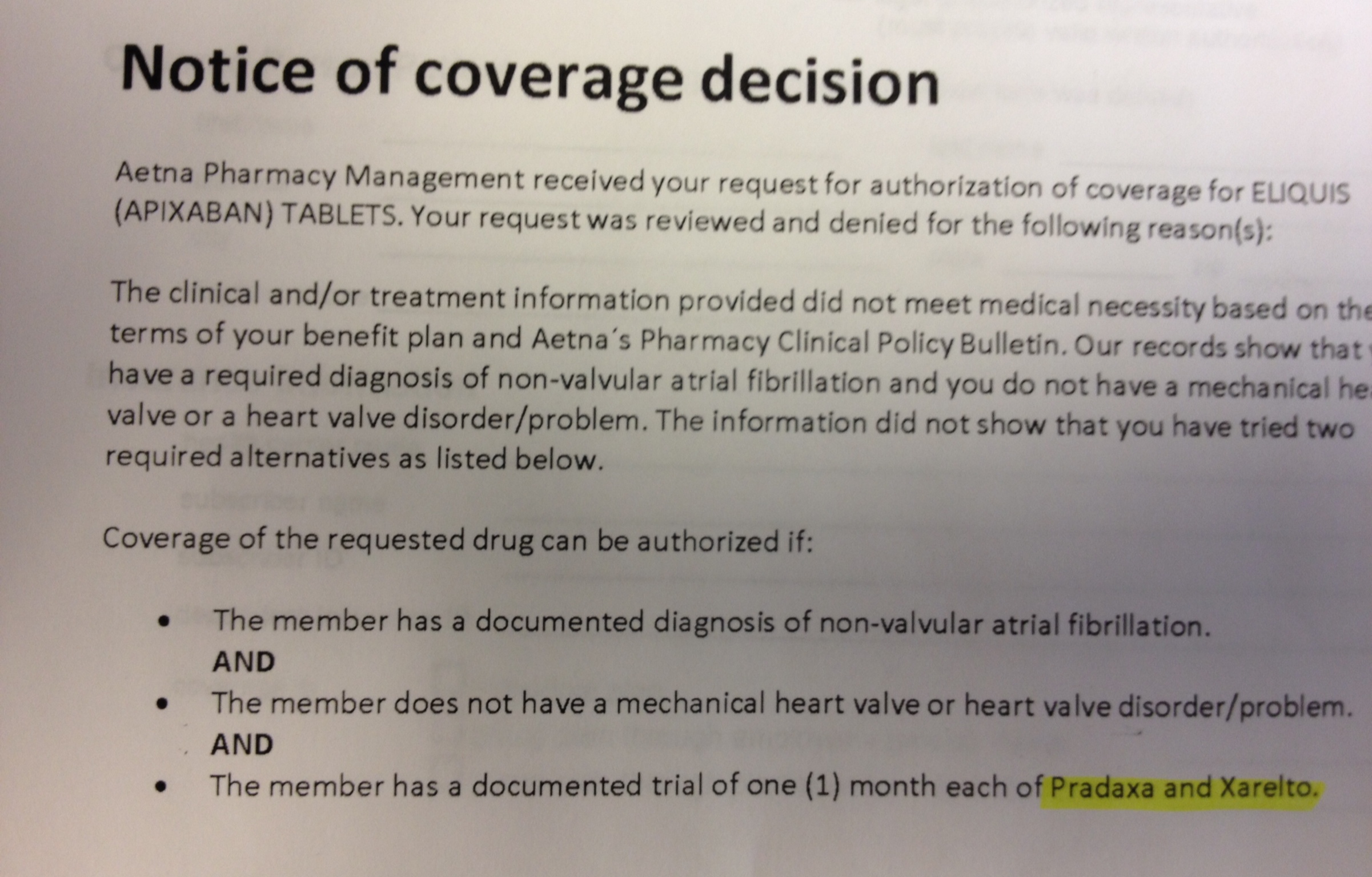 |
| An Aetna 'Coverage Decision' (click to enlarge) |
Dear Aetna Pharmacy Management:
- When my patient has a GI bleed from Pradaxa, will you explain to them why you insisted I start this medication?
- When my patient gets nauseated from Pradaxa, will you take the call at 3 am and write the new script for him or her?
- When my patient accidentally overdoses on Xarelto thinking it was a twice a day drug like Pradaxa, will you explain to the plantiff's lawyer the safety of your non-evidenced based practice of switching anticoagulants on a monthly basis?
- Along the same line of reasoning, where I might find data pertaining to the safety of monthly switches of anticoagulants in the world's literature?
- Is your effort to "manage" physician-prescribed medications in the patient's best interest or your stockholders'?
- Where can I send the bill for the wasted time spent by my staff and me to jump through your self-imposed hoops?
With sarcastic love of all you do -
-Wes
Subscribe to:
Posts (Atom)