I'll be traveling to the far reaches of the earth for an extended weekend with little Internet access. As a result, comment moderation (and certainly the frequency of posts) will suffer.
Back Tuesday.
Happy Summer!
-Wes
Friday, July 30, 2010


Senator Grassley to Mr. Berwick: Show Us the Money
In a letter to Dr. Donald Berwick, the newly appointed Director of the Center for Medicaid and Medicare Services (CMS), Senator Charles Grassley asks for clarification of Mr. Berwick's potential conflicts of interest as Director of his Institute of Health Care Improvement:
Imagine an auto mechanic not taking his car to his own shop.
Imagine a hospital administrator not receiving care in his own hospital.
And yet the American people are to receive care in a system where it's own directors, tasked with making literally life and death decisions on their behalf, are exempt from receiving care in the same system.
-Wes
Reference: IHI's 2009 Federal Tax Form 990.
One of the many significant issues related to your nomination that remains unresolved is the potential for conflicts arising from donors to the Institute for Healthcare Improvement (IHI), the organization you founded and led a Chief Executive Officer. The public has the right to know whether the numerous and significant policy decisions that you make are vulnerable to these potential conflicts of financial interest.More importantly, Mr. Grassley asks:
In addition, please indicate whether IHI continues to provide benefits to you and your family including health care coverage as indicated in IHI's audited financial statement.Imagine a cook not eating at his own restaurant.
Imagine an auto mechanic not taking his car to his own shop.
Imagine a hospital administrator not receiving care in his own hospital.
And yet the American people are to receive care in a system where it's own directors, tasked with making literally life and death decisions on their behalf, are exempt from receiving care in the same system.
-Wes
Reference: IHI's 2009 Federal Tax Form 990.
Wednesday, July 28, 2010
Health Care Reform: Research on Human Subjects?
Every time an experiment on human subjects in proposed in our hospital (or any hospital in the United States for that matter), there is an exquisitely sensitive tuning fork that exists to protect human subjects: the investigational review board or "IRB." Any researcher who has ever brought a research proposal before an IRB knows that any hint of potential harm to a human subject that exists in a research project will kill the proposal faster than you can say "boo."
An IRB submission is required for all research projects using human subjects in accordance with the Federal Policy for the Protection of Human Rights 45 CFR 46, the Food and Drug Administration (FDA) regulations 21 CFR 50, 56 , and with the Federalwide Assurance granted by the H.H.S. Office of Human Research Protections (OHRP).
Every doctor, nurse, hospital administrator, drug or device company involved in human research knows this.
As a researcher on human subjects, I am required to re certify that I understand certain inalienable principles that govern experimentation on human subjects. I re-learn about the 10 principles of the Nuremberg Code and the Belmont Report that grew from our own US Public Health Service's Tuskegee syphilis experiment performed between 1932 and 1972 that studied the natural progression of untreated syphilis on 399 African-American sharecroppers. (The 40-year study was controversial primarily because researchers failed to treat patients appropriately after the 1940s validation of penicillin as an effective cure for syphilis.)
From this grew the six fundamental ethical principles used by the Department of Health and Human services for using any human subjects for research:
Health Care Reform's Upcoming Research
With the passage of the Patient Protection and Affordable Care Act (PPACA) Congress developed the construct for our new health care system going forward, but many, many portions of the law require further study. For instance, experiments (called "pilots" in the legislation) include a national payment pilot on payment bundling (Sec 3202), evaluation of community-based prevention and wellness programs for Medicare beneficiaries (Sec 4202), Pilot testing pay-for-performance programs for certain Medicare providers (Sec 10326), testing the law's affordability provisions, medical home pilot project, and medical liability and medical liability demonstration projects to be undertaken by the states, to name a few. This research will be conducted by a nacient branch of the Department of Health and Human Services called the Center for Medicare and Medicaid Innovation (CMI). It goes without saying that many of the pilots proposed could have grave consequences (either positively or negatively) for our patients. From a recent paper in the New England Journal of Medicine describing the function of the CMI (emphasis mine):
Who will sit on the Investigational Review Board overseeing the government's principle investigator, the Secretary of the Department of Health and Human Services, to assure our patients' most fundamental ethical principles are maintained?
-Wes
An IRB submission is required for all research projects using human subjects in accordance with the Federal Policy for the Protection of Human Rights 45 CFR 46, the Food and Drug Administration (FDA) regulations 21 CFR 50, 56 , and with the Federalwide Assurance granted by the H.H.S. Office of Human Research Protections (OHRP).
Every doctor, nurse, hospital administrator, drug or device company involved in human research knows this.
As a researcher on human subjects, I am required to re certify that I understand certain inalienable principles that govern experimentation on human subjects. I re-learn about the 10 principles of the Nuremberg Code and the Belmont Report that grew from our own US Public Health Service's Tuskegee syphilis experiment performed between 1932 and 1972 that studied the natural progression of untreated syphilis on 399 African-American sharecroppers. (The 40-year study was controversial primarily because researchers failed to treat patients appropriately after the 1940s validation of penicillin as an effective cure for syphilis.)
From this grew the six fundamental ethical principles used by the Department of Health and Human services for using any human subjects for research:
(1) Respect for persons: protecting the autonomy of all people and treating them with courtesy and respect and allowing for informed consent;These principles are the basis for the Health and Human Services human subject protection regulations.
(2) Beneficence: maximizing benefits for the research project while minimizing risks to the research subjects; and
(3) Justice: ensuring reasonable, non-exploitative, and well-considered procedures are administered fairly (the fair distribution of costs and benefits to potential research participants.)
(4) Fidelity: fairness and equality.
(5) Non-maleficence: Do no harm.
(6) Veracity: Be truthful, no deception.
Health Care Reform's Upcoming Research
With the passage of the Patient Protection and Affordable Care Act (PPACA) Congress developed the construct for our new health care system going forward, but many, many portions of the law require further study. For instance, experiments (called "pilots" in the legislation) include a national payment pilot on payment bundling (Sec 3202), evaluation of community-based prevention and wellness programs for Medicare beneficiaries (Sec 4202), Pilot testing pay-for-performance programs for certain Medicare providers (Sec 10326), testing the law's affordability provisions, medical home pilot project, and medical liability and medical liability demonstration projects to be undertaken by the states, to name a few. This research will be conducted by a nacient branch of the Department of Health and Human Services called the Center for Medicare and Medicaid Innovation (CMI). It goes without saying that many of the pilots proposed could have grave consequences (either positively or negatively) for our patients. From a recent paper in the New England Journal of Medicine describing the function of the CMI (emphasis mine):
First, the CMI would run pilot programs rather than demonstration projects. The proposal would give the secretary of health and human services authority to expand pilots that she determines would reduce spending or improve the quality of care. This provision is critical, because the need for congressional approval has delayed or derailed past initiatives.Now given this broad authority granted in this legislation, the poorly defined "objectives" (is cost, quality or quantity of care the "objective?) and no disclosed requirements for the members of CMI, we should ask ourselves a very important question:
. . .
Second, although the CMI proposal lists 18 payment or delivery models for consideration, the center would have broad authority to select the programs best suited to its objectives. In contrast, the CMS’s Office of Research, Development, and Information has far less flexibility, because a large proportion of its resources are devoted to congressionally mandated projects.
A third critical difference is that the CMI would not have to require projects to be budget-neutral during their initial testing period. Many health care innovations require initial investments in staff, training, and infrastructure to achieve long-term efficiencies. But federal budget-neutrality requirements frequently discourage potential applicants, leave valuable concepts on the cutting-room floor at the Office of Management and Budget, and cut short promising programs that appear to be increasing Medicare costs.
Who will sit on the Investigational Review Board overseeing the government's principle investigator, the Secretary of the Department of Health and Human Services, to assure our patients' most fundamental ethical principles are maintained?
-Wes
Tuesday, July 27, 2010
Super Sexy (Adult) CPR
Employment Alert: While there is no frank nudity, viewing video might be best done after hours.
Although this ad for lingerie might not be sanctioned by the American Heart Association, I'll bet you'll never forget CPR after seeing it:Yeah, I know: I'm a dog. And the ad doesn't use the latest no-breath CPR technique.
Still, you have to admit...
... it beats the heck out of the Bee Gees...
-Wes
Dispatching Quangos: Taking a Lesson From Across the Pond
From a recent white paper from England's Prime Minister, Deputy Prime Minister, and Secretary of State for Health about the National Health Service (NHS) we find maybe it's not so great (emphasis mine):
Should be interesting...
Meanwhile, as if blind to England's "model" health care system's struggles, we've just passed a law that emulates their system in its earlier iteration and adds all kinds of yet-undefined and un-budgeted quangos in the name of "cost savings."
Yep, should be interesting...
-Wes
“... the NHS has achieved relatively poor outcomes in some areas. For example, rates of mortality amenable to healthcare, rates of mortality from some respiratory diseases and some cancers, and some measures of stroke have been amongst the worst in the developed world. In part this is due to differences in underlying risk factors, which is why we need to re-focus on public health. But international evidence also shows we have much further to go on managing care more effectively. For example, the NHS has high rates of acute complications of diabetes and avoidable asthma admissions; the incidence of MRSA infection has been worse than the European average; and venous thromboembolism causes 25,000 avoidable deaths each year.And so, the NHS is embarking on a new initiative to reduce their bureaucracy by asking their doctors to not only care for patients, but serve as government contractors for the procurement of supplies using the government's money.
The NHS also scores relatively poorly on being responsive to the patients it serves. It lacks a genuinely patient-centred approach in which services are designed around individual needs, lifestyles and aspirations. Too often, patients are expected to fit around services, rather than services around patients. The NHS is admired for the equity in access to healthcare it achieves; but not for the consistency of excellence to which we aspire."
Should be interesting...
Meanwhile, as if blind to England's "model" health care system's struggles, we've just passed a law that emulates their system in its earlier iteration and adds all kinds of yet-undefined and un-budgeted quangos in the name of "cost savings."
Yep, should be interesting...
-Wes
If You're Wondering Where That Cheap Stethoscope Went
... ask your local electrophysiologist:

Now the tough part: remembering who I lent them from...
-Wes
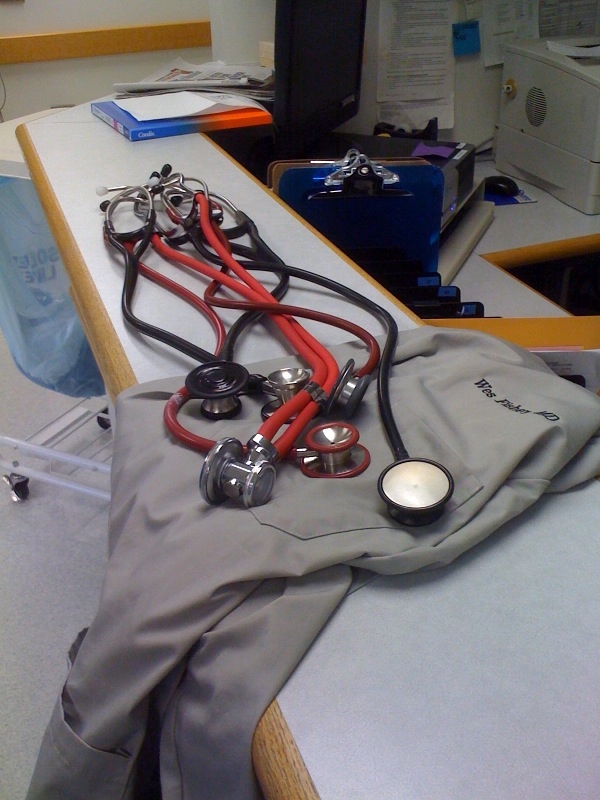
(Collection found in various lab coats)
Now the tough part: remembering who I lent them from...
-Wes
Malaria Vivax Causing Heart Attacks?
Malaria vivax (caused by the usually more indolent plasmodium vivax) is causing a stir in India because of a rash of what sounds like disseminated intravascular coagulation affecting the coronary arteries:
Blood clotting due to malaria till now was seen to occur only in small vessels. An artery getting clogged in new," he said.-Wes
At the Hinduja Hospital, five cases of heart trouble induced by malaria vivax have been treated in the past ten days. Chest specialist Dr Khusrav Bajan said, "Normally we have malaria vivax-positive patients coming in with high fever and body ache.
But this time, almost 30 per cent patients are coming with heart problems, severe breathlessness and restlessness. Some had suffered heart attacks too. Echo clearly indicated depressed heart functions."
Dr Bajan said the number of malaria vivax cases far outsrip that of malaria falciparum this year. "The malaria strain in the city is rapidly mutating and thus the symptoms exhibited by patients are different. The vivax malaria, which earlier was mild in nature, has turned very potent," he added.
Sunday, July 25, 2010
Living Poets Society
 Dr. Charles is hosting a science and medicine poetry contest over at his blog, The Examining Room of Dr. Charles.
 It's a great way to exercise your synapses and maybe earn $500 cool ones and a cherry tomato from his garden.
-Wes
Saturday, July 24, 2010
More Questions About Donald Berwick Surface
With the unvetted recess appointment of Donald Berwick to the Centers for Medicare and Medicaid Services (CMS), some interesting questions that would have been asked at his Senate confirmation hearing were skuttled, like this one:
So it begs the question: who did?
-Wes
This is no small issue since this man now controls nearly half of the half the US health care budget. I can assure you, doctors did not contribute that kind of money to Mr. Berwick's coffers.
Beyond that, the GOP is especially curious about a nonprofit organization Berwick founded, the Institute for Healthcare Improvement. A 501(c)(3) tax-exempt organization, the institute reported receiving $12.2 million in contributions and grants, among other revenues, in 2008 (the most recent year for which figures are publicly available). Given all the money that has flown around in the health care debate, Republicans wanted to know where the $12.2 million came from. The recess appointment meant that Berwick didn't have to answer.
The institute has also been very good to Berwick personally. He received $2.3 million in compensation in 2008 (a figure that included retirement funds), and was paid $637,006 in 2007 and $585,008 in 2006. On top of that, investigators discovered a little-noticed paragraph in an audit report revealing that in 2003 the institute's board of directors gave Berwick and his wife health coverage "from retirement until death."
So it begs the question: who did?
-Wes
Thursday, July 22, 2010
Doctors Debate Obamacare Tonight
Should be an interesting debate on WGN Radio 720 TONIGHT from 10pm-12 midnight Central Standard Time with Milt Rosenberg moderating.
The "favor" physician will be Dr. Arnie Widen, Medical Director of the Office of the Illinois Attorney General and is the immediate past president of CommunityHealth of Chicago. Dr. Widen has been a tireless advocate for CommunityHealth, spending countless hours at the facility, mentoring medical students and treating patients. Like all the doctors there, he believes in the founding statement of CommunityHealth: "Nobody should go without health care." CommunityHealth is the largest volunteer-based, non-profit health care provider in Illinois and one of the largest free clinics in the country.
To "opposing" physician will be Dr. Mark Neerhof, a practicing high-risk obstetrician/fetal medicine specialist and member of Docs4PatientCare, an organization of thousands of concerned physicians committed to the establishment of a health care system that preserves the sanctity of the doctor-patient relationship, promotes quality of care, supports affordable access to all Americans, and protects patients' personal health care decisions.
You should be able to click here to listen in.
-Wes
The "favor" physician will be Dr. Arnie Widen, Medical Director of the Office of the Illinois Attorney General and is the immediate past president of CommunityHealth of Chicago. Dr. Widen has been a tireless advocate for CommunityHealth, spending countless hours at the facility, mentoring medical students and treating patients. Like all the doctors there, he believes in the founding statement of CommunityHealth: "Nobody should go without health care." CommunityHealth is the largest volunteer-based, non-profit health care provider in Illinois and one of the largest free clinics in the country.
To "opposing" physician will be Dr. Mark Neerhof, a practicing high-risk obstetrician/fetal medicine specialist and member of Docs4PatientCare, an organization of thousands of concerned physicians committed to the establishment of a health care system that preserves the sanctity of the doctor-patient relationship, promotes quality of care, supports affordable access to all Americans, and protects patients' personal health care decisions.
You should be able to click here to listen in.
-Wes
The Public Option is Not Dead
No, in fact it is very much alive.
According to the CBO:
My suggestion for Chairman Stark: show us the government can fix Medicare first.
-Wes
According to the CBO:
This morning CBO released a letter to Chairman Fortney Pete Stark analyzing a proposal to add a “public plan” to the options available through the health insurance exchanges that will be established under the recently enacted health care legislation—the Patient Protection and Affordable Care Act, or PPACA (Public Law 111-148).Only problem is, since our government bureaucrats couldn't balance the health care budget with the much smaller Medicare program, what makes them think their next ploy will be any better?
Under the proposal, the Department of Health and Human Services would establish and administer a public health insurance plan and would charge premiums to fully cover its costs for benefit payments and administrative expenses. The plan’s payment rates for physicians and other practitioners would be based on Medicare’s current rates but would not be subject to the future reductions required by Medicare’s sustainable growth rate formula; instead, those rates would initially increase by 5 percent and then would rise annually to reflect estimated increases in physicians’ costs. The plan would pay hospitals and other providers the same amounts that would be paid under Medicare, on average, and would establish payment rates for prescription drugs through negotiation. Health care providers would not be required to participate in the public plan in order to participate in Medicare.
My suggestion for Chairman Stark: show us the government can fix Medicare first.
-Wes
Yet Another Boston Scientific Defibrillator Advisory
With their stock struggling to survive, the latest Boston Scientific defibrillator advisory could not come at a worse time:
-Wes
Addendum:
08:20AM 23 Jul 2010: The Boston Scientific 'Dear Doctor' letter (pdf) regarding the advisory.
Boston Scientific Corp. warned physicians that three of its implantable defibrillators have a defect that can prevent them from working properly, in the latest problem for the company's heart devices.The original physician communication, dated today, can be found in pdf format here.
A magnetic switch on the implantable cardiac defibrillators can get stuck, stopping the devices from delivering an electric shock to the hearts of patients who need the therapy, the company said in a letter to doctors.
The Contak Renewal 3, Contak Renewal 4 and Vitality HE ICDs were made in 2006 and 2007, and about 34,000 remain implanted in patients, according to the Natick, Mass., company, which said on Thursday that it had issued the advisory.
It is unclear how Boston Scientific learned about the problem, and why it issued the advisory now. A company spokeswoman didn't immediately respond to requests for comment.
Boston Scientific said in its product advisory that the risk of harm was remote, and it hasn't received any reports of deaths or injuries. Doctors have replaced some of the devices, according to the advisory, but the company recommends against it.
-Wes
Addendum:
08:20AM 23 Jul 2010: The Boston Scientific 'Dear Doctor' letter (pdf) regarding the advisory.
Wednesday, July 21, 2010
Cell Phone Karma
It was innocent enough. A patient. Syncope. Enough AV block to make you wish the pacemaker was implanted yesterday. Next to the patient: a team of concerned family members in the exam room.
The ER summary and EKG were reviewed. The history taken. The patient politely asked if they might be examined in the presence of family members. "No problem," was the reply.
Examination completed, a blank piece of paper is assembled. A pen, nowhere to be found, was retrieved from the front desk.
Returning, a figure is drawn. The entire room focused. Waiting. Staring at the figure. Total silence.
The explanation begins, then...
With that, a family member dives for their cell phone and hurries to stop the ringtone.
Too late.
The bad karma was released.
-Wes
The ER summary and EKG were reviewed. The history taken. The patient politely asked if they might be examined in the presence of family members. "No problem," was the reply.
Examination completed, a blank piece of paper is assembled. A pen, nowhere to be found, was retrieved from the front desk.
Returning, a figure is drawn. The entire room focused. Waiting. Staring at the figure. Total silence.
The explanation begins, then...
..."Ooh, ooh, ooh, ooh, oohWhat the...?
And she's buying a stairway to heaven."
With that, a family member dives for their cell phone and hurries to stop the ringtone.
Too late.
The bad karma was released.
-Wes
Tuesday, July 20, 2010
The Error In Our Ways
It seems doctors can never do enough. Not only must we diagnose and treat medical illness, this morning in the Chicago Tribune we learn from a study in the Annals of Internal Medicine that used actors posing as patients that seventy-eight percent of doctors make medical errors because we obtain no "contextual history" (another word for "social history?") and adjust our treatment strategies accordingly:
One thing I'm sure of, however, is a doctor's time with a patient is finite. For every click on a computerized quality check-box, we're stealing from the face-to-face time with the patient. Instead of appreciating this fact, our governmental overlords have consistently swollen the number of "quality measures" from 74 in 2007, 119 in 2008, 153 in 2009, to a whopping 179 in 2010. I figure at this rate, using linear regression, we will have about 319 measures by 2014, the same year another 30 million uninsured will be joining our new health care system.
And the government will be proud we're providing such "quality care."
Click. Click. Click.
Never mind these "quality" clicks might just be doing more harm than good.
-Wes
"A lot of doctors are going to say, 'God almighty, it's not enough to be a brilliant clinician? You're telling me I've got to be a financial counselor or social worker on top of that or I'm doing something wrong? Give me a break!'" said John Banja, a medical errors expert at Emory University.Of course, the lack of social history (or many other aspects of the patient's history) is the predictable consequence of shortened office visits, increased administrative burdens, shift-style medical care, and the push to see more patients in less time. It's hard to cover all the bases in seven minutes.
One thing I'm sure of, however, is a doctor's time with a patient is finite. For every click on a computerized quality check-box, we're stealing from the face-to-face time with the patient. Instead of appreciating this fact, our governmental overlords have consistently swollen the number of "quality measures" from 74 in 2007, 119 in 2008, 153 in 2009, to a whopping 179 in 2010. I figure at this rate, using linear regression, we will have about 319 measures by 2014, the same year another 30 million uninsured will be joining our new health care system.
And the government will be proud we're providing such "quality care."
Click. Click. Click.
Never mind these "quality" clicks might just be doing more harm than good.
-Wes
Why Every Heart Patient Should Order Pizza
... because the delivery man might just save your life:
Linn's wife says he had just gone into cardiac arrest Friday when the pizza deliveryman knocked on the door of their Colorado home to bring their order. Kami Linn says she opened the door to "some burly-looking dude" and immediately asked for help.-Wes
Monday, July 19, 2010
Boundaries
Doctor and patient, running a marathon together. Such an inviting story, it just warms the cockles of your heart:
But in reality, blurring the divide between doctor and patient can present considerable problems, too. Psychoanalysts have long understood this problem; they call it countertransference. Maintaining boundaries in our relationships with patients maintains one's ability to remain objective while assessing conditions and while providing recommendations for appropriate therapies. Further, doctor-patient boundaries avoid the potential for a perception of favoritism between patients. For instance, what might other patients that are not invited into the cozy comfort of their doctor's personal life perceive?
This is not to say it is not important to develop professional relationships built on trust with patients. But trust requires us to sometimes recommend things patients might not want to hear if we feel it's in their best interest. This might be harder to do if a relationship becomes enmeshed. Our job is not to be people's friends, but their doctors - and maintaining a healthy divide between professional and social "friends" can be very difficult at times.
So if people wonder why I don't "friend" them on Facebook, it's not because I don't like them. On the contrary, it's because I must respect the delicate boundary that must be maintained between a doctor and patient in order to maintain our professional relationship.
-Wes
“I got to thinking, Hey, I’m going to take full advantage of my health now — I’m going to do a triathlon,” he said.And on the surface, it seems like such an ideal story.
To raise the stakes, he decided to challenge Stewart, who was not a likely triathlete, either. As a doctor who performs 400 heart surgeries a year, each about six hours long, Stewart did not have much spare time to spend at the gym. His usual dinner, he said, was pizza or Taco Bell.
But he accepted O’Keeffe’s challenge, even if he had doubts.
But in reality, blurring the divide between doctor and patient can present considerable problems, too. Psychoanalysts have long understood this problem; they call it countertransference. Maintaining boundaries in our relationships with patients maintains one's ability to remain objective while assessing conditions and while providing recommendations for appropriate therapies. Further, doctor-patient boundaries avoid the potential for a perception of favoritism between patients. For instance, what might other patients that are not invited into the cozy comfort of their doctor's personal life perceive?
This is not to say it is not important to develop professional relationships built on trust with patients. But trust requires us to sometimes recommend things patients might not want to hear if we feel it's in their best interest. This might be harder to do if a relationship becomes enmeshed. Our job is not to be people's friends, but their doctors - and maintaining a healthy divide between professional and social "friends" can be very difficult at times.
So if people wonder why I don't "friend" them on Facebook, it's not because I don't like them. On the contrary, it's because I must respect the delicate boundary that must be maintained between a doctor and patient in order to maintain our professional relationship.
-Wes
Sunday, July 18, 2010
EMR Lingo
Quick EMR quiz:
Just thought you should know.
-Wes
Which is the most different?Programmers: the semantics of the subtleties between a "result," "unresult," or "overdue result" (not to mention why a medication cosign should any different from all our other order cosigns) leaves all of us who do real medicine completely in the dark.(1) An "unresulted order"Answer:
(2) An "overdue result"
(3) A "result"
(4) An "order cosign"
(5) or a "medication cosign?"
Group highlights (and hence group sign-offs) are not allowed for "unresulted orders" whereas they are for all the others.
(This means I must click every single "unresulted order" one-at-a-time, even though I have no clue how an unresulted order is different from any other order or result.)
Just thought you should know.
-Wes
Social Media Tonality
I sit before the computer this morning struggling to write. It happens from time to time, I know, but for come reason I find myself at a particularly difficult impasse.
No doubt being on call this weekend has contributed to my state of ennui, but I often stop to think about the direction of this blog and it's tone. After all, the tone of any blog (heck, any social media venue) not only defines your writing style, but it increasingly defines you to the public. Too light and you're not authoritative. Too heavy and you lose people. Too pessimistic and you sound like a cry baby. Too optimistic and people will wonder what you're smoking.
For this reason, blog tone (and the tone of any social media venue for that matter) should probably be appreciated more by bloggers and social media enthusiasts. After all, not only does the tone of the blog define the writer, but it likely defines the type of person who reads the blog, too.
These days in health care, I find this to be particularly true.
I worry about sounding too pessimistic about the changes I see in health care. I don't want to sound like a "Debbie Downer." If I talk about the discouraging changes to health care under way, I'll be labeled a whiner - just another disgruntled, impotent doctor who has nothing to contribute. Worse: that's not a leadership stance to take in our new Accountable Care Organization.
Who wants to be that guy?
Instead, I should be a cheerleader for health care in the interest of my patients and health care system going forward. I must overcome, improvise, adapt. "When the going gets tough, the tough get going." We must do more with less and do it with quality - 179 measures of nothing but the best. So go ahead. Check the boxes. Show the world the wonderful things we do in health care every day! Look at our gorgeous new facilities and beautiful clinics! We can do it with fewer people than ever before because we keep finding new efficiencies! Everyone's a winner!
And let my online persona reflect my enthusiasm, the opportunity, the wonderful!
I'm just glad to know that I'm not the only one who's discovered this secret to success.
-Wes
No doubt being on call this weekend has contributed to my state of ennui, but I often stop to think about the direction of this blog and it's tone. After all, the tone of any blog (heck, any social media venue) not only defines your writing style, but it increasingly defines you to the public. Too light and you're not authoritative. Too heavy and you lose people. Too pessimistic and you sound like a cry baby. Too optimistic and people will wonder what you're smoking.
For this reason, blog tone (and the tone of any social media venue for that matter) should probably be appreciated more by bloggers and social media enthusiasts. After all, not only does the tone of the blog define the writer, but it likely defines the type of person who reads the blog, too.
These days in health care, I find this to be particularly true.
I worry about sounding too pessimistic about the changes I see in health care. I don't want to sound like a "Debbie Downer." If I talk about the discouraging changes to health care under way, I'll be labeled a whiner - just another disgruntled, impotent doctor who has nothing to contribute. Worse: that's not a leadership stance to take in our new Accountable Care Organization.
Who wants to be that guy?
Instead, I should be a cheerleader for health care in the interest of my patients and health care system going forward. I must overcome, improvise, adapt. "When the going gets tough, the tough get going." We must do more with less and do it with quality - 179 measures of nothing but the best. So go ahead. Check the boxes. Show the world the wonderful things we do in health care every day! Look at our gorgeous new facilities and beautiful clinics! We can do it with fewer people than ever before because we keep finding new efficiencies! Everyone's a winner!
And let my online persona reflect my enthusiasm, the opportunity, the wonderful!
I'm just glad to know that I'm not the only one who's discovered this secret to success.
-Wes
Friday, July 16, 2010
Anesthesiologists See the Cool Stuff
... like this atrial myxoma after it's been resected.
-Wes
P.S.: A pretty good review on myxomas can be found here.
-Wes
P.S.: A pretty good review on myxomas can be found here.
Thursday, July 15, 2010
Clevand Clinic In Chicago?
All I can say is, best of luck:
Unless, of course, it costs a whole lot less to buy a Ford.
-Wes
In a move likely to shake up the market for heart care in the Chicago area, the well-known Cleveland Clinic’s cardiac surgery program said Thursday that it has signed an affiliation agreement with Central DuPage Hospital in the western Chicago suburbs.This won't shake up the market in Chicago. After all, when you have a bunch of Cadillac's in garage, why go after a Ford?
The internationally known Cleveland Clinic draws patients from more than 85 countries around the world for everything from open-heart surgery and valve replacement to heart transplants. Its deal with Central DuPage, in Winfield, is designed to enhance the heart care provided at the 313-bed community hospital and potentially bring Cleveland Clinic patient referrals at a time heart surgeries are less needed than they were a decade ago.
Unless, of course, it costs a whole lot less to buy a Ford.
-Wes
Subscribe to:
Posts (Atom)