He arrived at the emergency room diaphoretic, hypotensive, and with substernal chest pressure. The patient was brought immediately to an emergency room care area and a stat EKG disclosed classic ST segment elevation in the inferior leads. The cath lab team was immediately summoned as the ER team worked to stabilize the patient. Within minutes, the attending cardiologist was on the scene, reviewed the EKG, examined the patient, and explained to the hoardes of family members with the patient what was taking place. In the interest of being expeditious with his consent process as the team was arriving to take the patient to the cath lab, the attending said:
"There is a 1% risk that anything bad that you can think of could happen with this procedure. If you'd like me to detail those things, I can."
The patient didn't want to hear, and off to the cath lab they went to open the patient's occluded right coronary artery to great relief of the patient and family.
Later, in follow-up, the attending cardiologist was making rounds and asked the patient his occupation.
"I'm a malpractice attorney."
Smiling, the cardiologist immediately asked, "How was my consent?"
"Perfect. Absolutely perfect."
-Wes
Showing posts with label malpractice. Show all posts
Showing posts with label malpractice. Show all posts
Friday, May 31, 2013


Wednesday, November 30, 2011
Rationing Health Care For Seniors
A sure-to-be controversial article appears in the Chicago Tribune this morning asking the sensitive question of 'Health care at any age, any cost?:'
It's good we're having this discussion. And yes, since doctors are increasingly employed by hospital systems eager to fund their operations, pressure continues to mount on proceduralists to offer newer and advanced therapies to patients. But it's not all about the money. There really ARE wonderful therapies out there for seniors these days and, thanks to the virtually unlimited marketing of them to elders (especially via direct-to-consumer advertising) seniors will continue to demand them. Adding fuel to the procedural fire, lack of liability protections for health care facilities and doctors who opt not to treat a patient for some very good reasons will further add pressure on doctors and hospitals.
Once again, because of special interest resistance to malpractice reform, centralized government control will become the default option.
And maybe, just maybe, we need to rethink our stand on direct-to-consumer advertising of expensive medications to the populace on the Nightly News.
-Wes
"If you want to save all lives, you're in trouble," said Callahan, co-founder of The Hastings Center, a bioethics research institute in New York, and a faculty member at Harvard Medical School, in an interview. "And if you want to save all lives at any cost, you're really in trouble."The article goes on the make some bold demands of doctors:
Callahan and co-author Nuland, a retired professor of surgery at Yale School of Medicine who wrote the best-selling "How We Die," were both 80 when the article was published.
"We need to stop thinking of medicine as an all-out war against death, because death always wins," said Callahan.
That said, McKoy believes doctors have a responsibility to spend medical resources where they do the greatest good. They must police themselves — otherwise, the government will come in and do it for them, she warns.While I agree that the doctors on the ground should be making these decisions, I, too, have problems with a central regulator imposing a random age limit where all services to functional seniors stop. More importantly, this article ignores another reality for doctors who must make these difficult decisions: the nearly unlimited liability exposure if the family members disagree with all members of the health care team, including hospital ethics panels.
This is not easy, she said, describing the tremendous pressure doctors are under to perform procedures and prescribe medicine that will not help. And, she said, they often give in.
"We get selfish families, and it's often easier for doctors to pull out prescription pads," she said. "Doctors need more often to say no, to say (if a patient is dying): 'We will give you palliative care, but not give you chemotherapy. We will not give you new expensive drugs because it will not make you better.'"
Likewise, medical schools also need to train students to understand the cost-effectiveness of treatments, and to administer them based on medical research into their effectiveness — not just because they are available.
It's good we're having this discussion. And yes, since doctors are increasingly employed by hospital systems eager to fund their operations, pressure continues to mount on proceduralists to offer newer and advanced therapies to patients. But it's not all about the money. There really ARE wonderful therapies out there for seniors these days and, thanks to the virtually unlimited marketing of them to elders (especially via direct-to-consumer advertising) seniors will continue to demand them. Adding fuel to the procedural fire, lack of liability protections for health care facilities and doctors who opt not to treat a patient for some very good reasons will further add pressure on doctors and hospitals.
Once again, because of special interest resistance to malpractice reform, centralized government control will become the default option.
And maybe, just maybe, we need to rethink our stand on direct-to-consumer advertising of expensive medications to the populace on the Nightly News.
-Wes
Monday, June 28, 2010
Why Lawyers Will Get Every Heart Test Known to Man
... because if you don't predict the unpredictable, they sue:
While I do not know the circumstances surrounding the case in question, it is clear that our society increasingly accepts that all diseases are preventable, life is limitless, and all tests we perform perfect. Of course, none of these are true. Yet when something doesn't follow the Western psyche's playbook, someone has to pay. All too often, that someone is the doctor.
This, my friends, is why doctors will continue to order every test known to man... as this case exemplifies, there is simply no incentive to do otherwise.
-Wes
A doctor failed to see that former Tompkins County District Attorney George Dentes had heart disease, and this professional negligence led to Dentes' fatal heart attack in October 2006, his widow is alleging in a medical malpractice suit starting in county court this week.Remember, the doctor did not give this patient heart disease, God did.
Dr. Jonathan Mauser of Cayuga Cardiology Associates P.C. improperly interpreted Dentes' April 2005 stress echocardiogram, failed to suspect that Dentes had coronary artery disease and failed to recommend or perform a cardiac catheterization to confirm it, Elsie Dentes claims in the suit. Mauser and Cayuga Cardiology Associates are named as defendants.
While I do not know the circumstances surrounding the case in question, it is clear that our society increasingly accepts that all diseases are preventable, life is limitless, and all tests we perform perfect. Of course, none of these are true. Yet when something doesn't follow the Western psyche's playbook, someone has to pay. All too often, that someone is the doctor.
This, my friends, is why doctors will continue to order every test known to man... as this case exemplifies, there is simply no incentive to do otherwise.
-Wes
Sunday, May 09, 2010
The Vanishing Oath: A Review
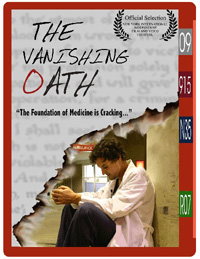 Yesterday, a much-anticipated package arrived in the mail containing a documentary film directed (and acted) by a young emergency room physician, Ryan Flesher, MD and produced by a former clinical social worker, Nancy Pando, LICSW entitled "The Vanishing Oath."
As background, the film is a three-year project born in 2007 just before the great US health care reform debate began. Over 200 hours of interviews were conducted explore a simple question: why Dr. Flesher had grown to hate medicine.
It would have been easy for Dr. Flesher and Ms. Pando to make his story nothing but a rant, but instead, we find that their story is an honest attempt to understand how someone so enthusiastic at the start of their training could become so quickly discontented with the realities of emergency room care and our bloated health care delivery system.
To understand the origin of his disillusionment, we journey with Dr. Flesher and Ms. Pando as they return to interview people on the street, his family, fellow medical students, mentors, scholars, colleagues and plantiff's attorneys. They attempt to interview many of the many "vested interests" involved in our current health care system, including:
American Medical AssociationOf those that responded to their requests for an interview, all wanted to see the questions beforehand. Ultimately, none of them opted to go on record in the making of this film.
Many insurers, including Blue Cross, Aetna, Cigna
Three congressman
Six state representatives
Many hospital administrators and 11 Boston-area hospital CEO's
The Joint Commission
Dr. Groopman, author of "How Doctors Think,"
Ewe Reinhardt, medical economist
Regina Herzlinger, Author of "Who Killed Healthcare"
Press Ganey and
Five CEO's of major drug manufacturers.
The viewer is left to wonder why.
Still, they manage to gather a few insightful interviews from those with health care administrative backgrounds. More importantly, we quickly realize that Dr. Flesher is not alone. The same forces that shaped his discontent are revealed in fourth year medical students unsure what lies ahead for them and in the colleagues he turned to during fellowship training. We are introduced to a young aspiring hand surgeon who left (video clip) medicine after all of his years of training because of the toll it took on himself and his family. The footage is powerful. The people and emotions, real.
Suddenly, the viewer is confronted with the reality of how our health care system has grown to affect doctors. Worse, we realize what this might mean to each of us.
Additionally we see, firsthand, the effects that the fear of malpractice has on doctors and their behaviors. More to the point, we hear (video clip) from several doctors who had been sued and are even ushered into the office of an anonymous doctor in the midst of a suit at the time. Only later, and contained in a separate clip contained on the film's DVD, do we learn that the anonymous doctor interviewed was doctor Robert P. Lindeman, MD, the no-longer anonymous physician blogger former known as "Flea" as he was being tried in court just before he was unmasked on the stand by the prosecuting attorney. (A remarkably insightful follow-up interview with Dr. Lindeman a year and a half after his trial was settled is included on the film's DVD and is especially humbling. For instance, in the follow-up interview we learn that his medical malpractice rates increased 40% for the "settlement.")
In the end, we aren't quite sure if Dr. Flesher decides to return to medicine or not. You'll have to see the film to draw your own conclusion.
At times I felt the film leaned too heavily on the question of why doctors are unhappy at the expense of other critical health care issues. After all, not everything in medicine hinges upon whether doctors are unhappy or not, and that question is probably the least important to the public at large. Still, the issues of physician burnout and attrition, coupled with our ever-burgeoning health care bureaucracy and the loss of physician autonomy, will no doubt continue to affect the recruitment of future generations of physicians and perhaps the caliber of doctors in the future.
Nonetheless, both Dr. Flesher and Ms. Pando are to be congratulated for their bravery and fortitude at completing this documentary. It's a raw, unapologetic look behind the curtain of our current health care system from a physician's point of view. To my knowledge, this is the first time a doctor has used the creative venue of film to so vividly document the challenges we face.
Let's hope it's not the last.
-Wes
Disclaimer: I purchased the film for this review and have no conflicts of interest with the film team or production company.
Addendum: The film will be premiered in Chicago on 25 May 2010. Seating is limited.
Thursday, February 04, 2010
Illinois Supreme Court Strikes Down Medical Malpractice Caps
From Crain's Chicago Business:
-Wes
The Illinois Supreme Court on Thursday struck down limits on jury awards in medical malpractice cases passed by the Legislature four years ago amid spiking liability costs for medical providers.Another blow to health care tort reform...
The court ruled that the caps on pain and suffering and other non-economic damages — $500,000 per case for doctors and $1 million for hospitals — are unconstitutional.
The court’s opinion upholds a 2007 ruling by a Cook County Circuit Court judge determining that the law violated the Illinois Constitution’s “separation of powers” clause, essentially finding that lawmakers interfered with the right of juries to determine fair damages.
It’s the third time the state’s high court has quashed limits on medical malpractice awards, having tossed out similar laws in 1976 and 1997.
The ruling is a blow to physicians, hospitals and malpractice insurers, who successfully argued in 2005 that frivolous lawsuits and runaway jury verdicts were driving up insurance rates and forcing physicians to leave the state.
-Wes
Saturday, October 03, 2009
Specialists Become Hospitalists: The Consolidation Continues
From Columbus, Ohio:
Not only do doctors need portability of their own health insurance from one job to the next, they need portability of their malpractice insurance, too.
-Wes
Addendum: Another example in Asheville, NC.
In the past, hospitals hired primarily family doctors who would refer patients to the facility for medical tests. Now, hospitals are employing more specialists.Another reason specialists are consolidating with hospital systems is the high cost of bringing on other experienced specialists that have insurance "tails" from their former practice. These insurance "tails" assure continued malpractice insurance coverage on patients from their former practice as they start employment (and new malpractice insurance coverage) with their new group.
For example, having a neurologist or cardiologist on staff allows quicker patient consults than waiting for a private-practice doctor to come to the hospital.
"The reason we even employ specialists is to provide inpatient coverage on our floors in the hospital," said Cindy Sheets, senior vice president ambulatory services for Mount Carmel Health System.
Not only do doctors need portability of their own health insurance from one job to the next, they need portability of their malpractice insurance, too.
-Wes
Addendum: Another example in Asheville, NC.
Friday, September 19, 2008
Malpractice, Aussie-Style
One defibrillator, three operations, $1700 waived.
This case is remarkable on many fronts. Glad to see he's finally doing well.
-Wes
Addendum 16:15 CST - Seems some quality data is about to be forthcoming to improve patient's lot over there:
This case is remarkable on many fronts. Glad to see he's finally doing well.
-Wes
Addendum 16:15 CST - Seems some quality data is about to be forthcoming to improve patient's lot over there:
An audit by the health department's Clinical Excellence Commission last year of 1317 patient files at 16 hospitals, previously unnamed, showed complication rates for pacemaker implantation varied from 8.5 per cent for the best-performing hospital to 17 per cent for the worst.I'm impressed at the relatively high complication rate at all of the facilities...I wonder what they're counting: deaths, infections, lead dislodgements, etc.? Or are simpler things like minor hematomas added in also. This is why quality data, without explanation (or as they mention, without respect to the number or complexity of procedures performed), are difficult to view in context.
Saturday, September 22, 2007
Why Doctors Should Sue Their Patients
“Maybe doctors could get the Democrats to like them if they started suing their patients.”
-Ann Coulter
Imagine the possibilities:
* * *
If this seems repugnant to you, consider how adverse the climate is for doctors facing these exposures every day. Even for the best doctors and the best hospitals, aspects of healthcare are an inherently unpredictable, uncontrollable enterprise.
If it seems absurd to insert the legal profession into defending doctors, perhaps it is equally absurd to invite the legal profession into any aspect of the doctor-patient relationship.
-Wes
h/t: KevinMD.
Imagine the possibilities:
A patient gets sick at 2AM, and a call to the physician's home deprives him of much-needed sleep, causing him to have a car accident as he drives to the hospital – clearly the patient should get sick during regular business hours.
A physician spills hot coffee on himself and suffers second-degree burns as he tries to stay awake treating the ill patient – clearly it was the patient’s fault.
A patient develops renal insufficiency while taking either an ACE inhibitor or an angiotensin receptor blocker (ARB), thereby destroying the physician’s perfect record of providing appropriate therapy for left ventricular systolic dysfunction thereby negatively affecting his PQRI Measurement Score - leading to lost revenues.
A doctor inserts an emergency intravenous catheter into a car crash victim and the woman dies. Because the doctor was one of a number of physicians named in a medical malpractice suit alleging that he should have "appreciate[d] the signs and symptoms of hypovolemic shock and internal bleeding" and that he should have "surgically repair[ed] the bleeding" be must now list the filing anytime he applies for medical liability insurance for the rest of his career - how much damage is that?
If this seems repugnant to you, consider how adverse the climate is for doctors facing these exposures every day. Even for the best doctors and the best hospitals, aspects of healthcare are an inherently unpredictable, uncontrollable enterprise.
If it seems absurd to insert the legal profession into defending doctors, perhaps it is equally absurd to invite the legal profession into any aspect of the doctor-patient relationship.
-Wes
h/t: KevinMD.
Thursday, April 12, 2007
On Doctors Saying They're Sorry
"If you cut, you bleed."
So said a sage surgical colleague of mine. He was referring, of course, to the fact that unfortunate outcomes are part of what we do as doctors. No one is perfect. No invasive procedure without risks and no two cases are alike or medical co-morbidities the same. Doctors who "cut" usually spend significant time explaining the procedure, its inherent risks, and possible outcomes - hopefully good, but sometimes, not so good. Even in the best of hands, unfortunate outcomes do occur.
But as hard as it may be for many to realize, a bad outcome does not always mean that malpractice occurred during the course of a procedure. When unfortunate outcomes occur, I still believe it is appropriate to say you're sorry. Doctors are humans too, after all, and most care deeply about their patients.
Risk managers seem to welcome doctors speaking with patients after a mishap and saying they're sorry.
-Wes
Reference: US Department of Justice Bureau of Justice Statistics: Medical Malpractice Insurance Claims in Seven States, 2000-2004.
So said a sage surgical colleague of mine. He was referring, of course, to the fact that unfortunate outcomes are part of what we do as doctors. No one is perfect. No invasive procedure without risks and no two cases are alike or medical co-morbidities the same. Doctors who "cut" usually spend significant time explaining the procedure, its inherent risks, and possible outcomes - hopefully good, but sometimes, not so good. Even in the best of hands, unfortunate outcomes do occur.
But as hard as it may be for many to realize, a bad outcome does not always mean that malpractice occurred during the course of a procedure. When unfortunate outcomes occur, I still believe it is appropriate to say you're sorry. Doctors are humans too, after all, and most care deeply about their patients.
Risk managers seem to welcome doctors speaking with patients after a mishap and saying they're sorry.
The wave of "I'm sorry" laws is part of a movement in the medical industry to encourage doctors to promptly and fully inform patients of errors and, when warranted, to apologize. Some hospitals say apologies help defuse patient anger and stave off lawsuits.But malpractice insurers are not thrilled with the risks inherent to this procedure:
A law in Vermont exempts only oral statements of regret or apology, not written ones. Illinois gives doctors a 72-hour window to safely apologize after they learn about the cause of a medical mishap.
Boston-based ProMutual Group, which insures 18,000 doctors, dentists and health care facilities in the Northeast, warns its clients against apologies that admit guilt -- even in states that have laws protecting doctors who say they are sorry.But the real reason risk managers are eager for doctors to fess up early is not to show our altruistic side, I've learned. It's actually about legal statute of limitations.
It distributes a tip sheet cautioning doctors against uttering the words "error," "mistake," "fault" or "negligence."
"We encourage physicians to apologize about the outcome, not necessarily for any error that may have occurred," ProMutual spokeswoman Nina Akerley said. "Apology is not about confession."
(Chicago Tribune) On average, the states took 15 to 24 months before a medical injury was reported to insurance carriers. For Illinois and Nevada, it took 67 months on average to close after injury.In Illinois, the minute a doctor acknowledges that there was a problem, a hidden clock starts that lasts three years. You see defense attorneys know about the bungled system of justice here in the US, and once an admission of responsibility about an injury occurs, plaintiffs have three years to have the case tried. And given my experience with how long it took a civil suit to wind its way to the courthouse, I can see why there's a push by risk managers to have doctors disclose.
"Several factors influence the decision concerning when to file a medical malpractice claim, including statute of limitations restrictions and the need to ascertain various medical, work-related, and pain and suffering expenses," the authors said.
-Wes
Reference: US Department of Justice Bureau of Justice Statistics: Medical Malpractice Insurance Claims in Seven States, 2000-2004.
Wednesday, February 28, 2007
Patient Safety and Physician Regulation
At a symposium yesterday at the University of Denver Sturm College of Law, leaders of the medical and legal professions in Colorado and national and international experts in medical regulation discussed how improvements in medical regulation and medical injury dispute resolution can support patient safety enhancements, with particular attention to the role of state medical boards. Speakers included Dr. Randy Bovbjerg of The Urban Institute, Dr. James Thompson, President and CEO of the Federation of State Medical Boards, David Swankin, President of the Citizen Advocacy Center, and Dr. Marie Bismark, a medical injury compensation expert from New Zealand. The event was coordinated by Common Good Colorado. The overriding theme?
-Wes
Hat tip: Sarah, web editor, Common Good.
If we could improve the regulatory environment of health care, what would those improvements be, and what would it take for us to achieve them?A webcast of the proceedings can be seen here (just click on the person's name in the left-hand column to view their presentation - Windows Media player required).
-Wes
Hat tip: Sarah, web editor, Common Good.
Sunday, November 26, 2006
Infectious Disease: Bad Place for Malpractice Law
It's amazing how fast plantiff's lawyers will dump their clients seeking compensation for acquiring MRSA infections in Kentucky once real data regarding infection rates (and the difficulties with their interpretation) become available.
-Wes
-Wes
Subscribe to:
Comments (Atom)