Showing posts with label catheter ablation. Show all posts

Friday, March 14, 2014

Case Study: An Unusual Catheter Course to the Right Atrium

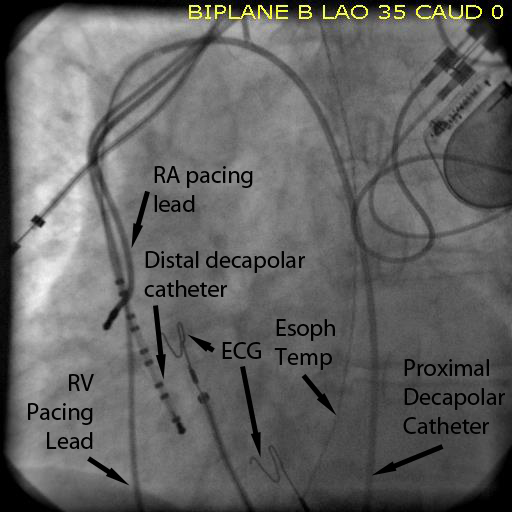
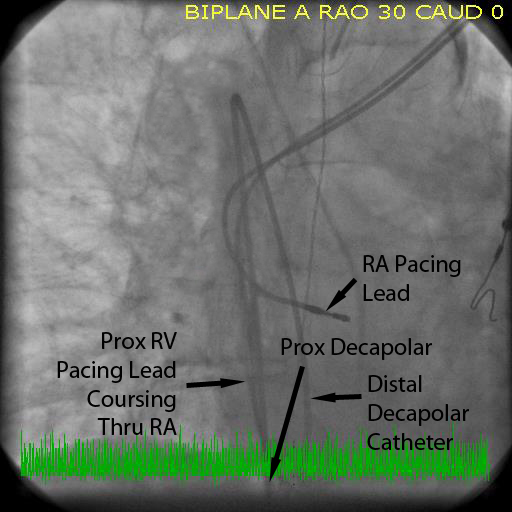
Recently, our laboratory was performing a catheter ablation of paroxysmal atrial fibrillation in a patient with a permanent pacemaker previously implanted from the left axillary venous approach.  The fellow placed a decapolar catheter from the left femoral vein, but it took an unusual course to the right atrium.    Attempts to place the catheter via a more typical course could not be achieved.

Here are the RAO and LAO fluoroscopic images he saw (labeled for your convenience):

RAO Fluoroscopic Image (click to enlarge)

LAO Fluoroscopic Image (click to enlarge)
At first, the fellow thought the catheter was extravascular was the catheter passed behind the heart, but continued advancement resulted in the catheter entering the right atrium.

Here's the LAO Cineangiogram of the finding that helped us identify the cause:


Here's the RAO image of the same shot:


What is this?  What happened next?

-Wes

PS:  If you can't wait, here's a link to a pretty illustration of the anatomy.  Note the hepatic drainage to the right atrium is separate from the drainage of the IVC in this anomaly.  Here's another link to factoids from the radiology literature regarding this interesting finding.

Friday, January 10, 2014

Case Study: Mitral Annular Left Atrial Flutter

Sometimes what we do is just cool.

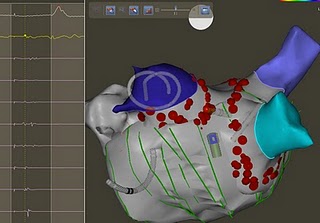
Cardiac electrophysiology has amazing technology at its disposal. One of these is three dimensional mapping. While three-dimensional mapping is not always required to perform catheter ablation, it can be invaluable when mapping and ablating forms of post-surgical atypical atrial flutter. The video below shows one such case we performed with the three-dimensional mapping system from Endocardial Solutions.

This system uses an X/Y/Z coordinate system created by referencing impedance changes that occur between paired electrodes placed on the patient's chest. Moving a single mapping catheter inside the left atrium during the patient's tachycardia permits localization of both the ablation catheter and the signal recorded.  An "activation map" from approximately 200 different points (the tiny white dots) that we collected in patient's left atrium is displayed below. The low amplitude signals (less than 0.5 mV) were colored grey. The map had the area of the mitral valve "cut away" using software so the endocardial surface could be better seen.

In this map, endocardial activation proceeds in a clockwise fashion and slows ever-so-slightly in the posterolateral mitral annulus near the blue dot. A single radiofrequency energy application at this location immediately terminated the patient's incessant left atrial flutter.


I love my job.

-Wes

Wednesday, August 21, 2013

Why Do I Try So Hard?

It's always the same: It's the fifth hour of the procedure. As your ankles ache and the perspiration drips beneath your lead, you stand there wondering why you try so hard to fix this arrhythmia. You realize this is not cost effective. You're tying up the lab. The staff and anesthesiologist are getting restless. The music drones on. You feel you're not getting anywhere. "Then again, maybe if I just try this...," you think. And you try this and it fails. Meanwhile, the fluoroscopy clock ticks, your fight continues.

Then you remember the story: the syncope, the wife, the kids, the vocation. They're depending on you. Not a tech, not an anesthesiologist, not a nurse, not an administrator. You. So you keep going, just a bit longer.

And then, sometimes, miraculously, you win. It's all worth it. You've completely changed that person's life. You are the hero. You are the superstar.

But just as often, you have to quit. Your feet are too sore, the radiation dose too high, and the hour too late to safely continue. You have to face the family, the disappointed looks, the doubt about whether you were the right person to do this procedure, and the sad look on your patient's face when you break the news.

And you find yourself asking once again:

Why do I try so hard?

Why?

-Wes

Wednesday, April 17, 2013

With Patient Deaths, the Afib Cryoablation Bloom is Off the Rose

Cryoballoon ablation of atrial fibrillation, once considered a safe means of performing pulmonary vein isolation for the treatment of atrial fibrillation because it was widely believed to be a safer form of ablation, has claimed its first deaths.  Two cases of esophageal perforation, one posted on the FDA Maude database 3/27/213 and another 9/18/2011, has received remarkably little public dissemination as far as I can tell in the EP community.

It has long been recognized that esophageal ulceration can occur with cryoablation balloon catheters, but esophageal perforation has previously not been widely reported.  The challenge for the technology, of course, is the ability to control the depth of lesion during long applications of freezing applications is difficult, especially when the technology is compared with the rapid onset and offset of existing radiofrequency energy applications.

I suspect we'll be hearing more about this soon in the scientific literature (at least I hope), but for now, electrophysiologists should be aware that cryoablation for pulmonary vein isolation in patients with atrial fibrillation, just like radiofrequency ablation, can cause esophageal perforation and should be used with appropriate caution.

-Wes

Addendum: The direct link to the FDA Maude database reporting the patient death from cryoablation.

Another case report in the literature: http://onlinelibrary.wiley.com/doi/10.1111/j.1540-8167.2012.02324.x/abstract;jsessionid=ABE88B7ED0954662425E6946A0633063.d04t02?deniedAccessCustomisedMessage=&userIsAuthenticated=false

Wednesday, March 13, 2013

Want Cheaper Life Insurance? Have an Ablation!

When I see patient's with supraventricular tachycardia, we discuss the the various options for therapy: (a) conservative treatment, (b) medical treatment, or (c) catheter ablation therapy for their arrhythmia.  More often than not, patients elect to have catheter ablation of their arrhythmia because of the procedure's proven track record for success, safety, and the need to avoid long-term medical therapy to suppress the arrhythmia.

But in adults, the mortality of supraventricular tachycardia is actually quite low.  Also, there are a group of patients who find they're not too bothered by the arrhythmia, or it's self-limited, or it's well-controlled with a minimal amount of medication.  For these patients, an invasive ablation procedure seems excessive, so they avoid it.

But now, it seems, there's another reason patient's might want to have a catheter ablation of their supraventricular tachycardia.  A patient recently brought us a letter they received after they inquired about a recent premium hike they noticed from their life insurance company:
"Dear Ms. Frigamafratz (not her read name):

Thank you for your inquiry regarding the change in premium.  The original premium estimate was given, as is customary, in the absence of all known medical history.  With the information now available from your verbal responses and physician records, an updated current premium quote is now provided. USAA strives to insure every member at competitive premiums which fairly reflect risk.

Careful review of your medical history reveals recurrent problems with supraventricular tachycardia.  In some cases, lesser premiums are permissible for members who have successfully undergone the ablation procedures to remedy the problem, and subsequently remain without manifestations for at least six months.  Alternatively, we can consider a more favorable premium for individuals with supraventricular tachycardia who have had a thorough cardiac evaluation and documented spontaneous remission of the problem for at least five years.  The latter is not an endorsement nor recommendation of any medical treatment, but gives insight to elements of risk approval used to determine your life insurance premium quote.  You are encouraged to provide any new medical information to support a better rate and we will be happy to review."
I should be quick to mention that the recommendations or information given on this blog are not an endorsement nor recommendation of any medical treatment either, but at least you now know one more advantage to catheter ablation for supraventricular tachycardias: the potential for cheaper life insurance premiums!

But I have to wonder, is a adult patient with symptomatic paroxysmal supraventricular tachycardia really going to have reduced mortality if they undergo a catheter ablation procedure?  While mortality of SVT ablation has been quoted as low as 0.1%, that low mortality comes with an adverse event rate of 2.9%.  I am unaware of a direct comparison of conservative or medical therapy mortality to catheter ablation, but I suspect with such a low incidence of mortality, such a mortality trial will never be performed because of the large number of patients required to show a statistical difference in mortality between the treatment arms.

So I wonder where the data are that support USAA's higher life insurance premium rate for adults?

-Wes

Thursday, January 03, 2013

To EPs: Happy Coding New Year!

Well, well, well.  It's another year and another chance to enjoy new procedural coding changes for electrophysiologists in 2013!  In case you missed it, the old catheter ablation codes for supraventricular and ventricular tachycardia ablations (93651 and 93652) have been deleted effective 1 Jan 2013.

That's right:  Gone.  Kaput.  Fi-ne. 

In their place we now have five new codes, two of which are specific for atrial fibrillation ablation:

  • 93653 - For use with SVT/WPW/Focal ATach/IVC-Tricuspid annular-dependent flutter ablations - Don't even THINK about coding separately for transseptal catheterization with this one - it's now bundled.  (If 3D mapping is needed, it looks like it's still okay to add 93613 to this code - for now.  Also, for Afib ablations, do NOT use this code, but rather a separate code (See 93656 and 93657 below)). RVU Value: 15.


  • 93654 - For use with Ventricular Tachycardia Ablation - This includes everything from placement of catheters, to the transseptal (if needed), AND the use of 3D mapping, and the ablation of VT.  (Remember: no separate code of transeptal and 3D mapping with this code.) RVU Value: 20.


    • If there is a SECOND arrhythmia focus that is ablated during EITHER SVT or VT ablation codes above, you can use add-on code 93655 but must specify the second arrhythmia targeted.  Total RVU value: 7.5
  • 93656 - For use with Atrial Fibrillation ablations - This includes the placement of catheters, the transseptal, pacing, mapping, giving meds, etc. up to and including isolation of the pulmonary veins.   (It appears 3D mapping (93613) can be billed separately for this code, unlike for the VT ablation)Total RVU value: 20.02.


    • 93657 - Used in addition to the Afib ablation code, 93656, if linear lines are developed in the atria following pulmonary vein isolation procedure. Total RVU value 7.5
Full details on these new codes, how they were developed, and how they should (really) be applied can be found on the Heart Rhythm Society website. (Please take what I say with a grain of salt).

Happy coding!

-Wes


Monday, December 03, 2012

On Folding

Every surgeon has been there at some time in their career.

It's a horrible, exhausting feeling.

Yet one we all must come to grips with: knowing when to stop.

There you are, six hours into a case, legs rubbery, mind racing, and barely conscious of the world outside the narrow view of the operative field. A life, literally in your hands, asleep now, but hoping (with you) for the best of outcomes on this last try.

"Maybe if I just..." you think, and a new idea is tried to no avail.

"Now, let's look at that again," you ask your techs. "Which electrogram's earlier? That one is CLEARLY earlier...right?" as you try to convince yourself that another choice is better. "What about here?" You go back and recheck once more, just to be sure...

So you do.

And it's still a dangerous spot to burn.

"Maybe it's on the left side?" So you cross to the left side and repeat the process. Everything maps back to the spot your dreaded before.

"Maybe if I give just a little energy here...." You hold your breath.

No effect.

"But if I burn here, I risk giving the patient a pacemaker. We never talked about a pacemaker," you think.

Yet the tachycardia persists, as if laughing at you and your inability to locate its origin.

* Bruuuuhaaaahhaaaahhaaaa... *

"Bastard!" you think. "I can get this!"

So you map above, below, left and right, forward and back...

* Bruuuuhaaaahhaaaahhaaaa... *

Like stubborn mule, you fail to give in. Again.

And again...

Until finally...

... you quit. A white flag raised. It beat you. Yes, you lost.

The supporting team with you, ever helpful, feels the patient's loss with you. They are relieved, though, for a pacemaker will not be in the offing. Like you, they know there will be another day, another arrhythmia: another victory to quell the sting of this defeat.

And while the Defeated hangs his head low to talk to the family, you then realize the the family is just as exhausted and concerned as you.  They thank you for trying.  They understand.

That's when you know you did the right thing.

-Wes

Wednesday, May 25, 2011

Atrial Fibrillation Ablation - Marketing Through Scientific Publications?

Circulation, a major cardiology medical journal, just published an article on atrial fibrillation ablation, complete with extensive video - all available for free online. It's an informative piece, but I found myself wondering why this piece was "unlocked" and available to the public for free when the most of the rest of the journal is locked. In the video, the atrial fibrillation magically disappears - I'm not sure how. Was it by ablation? Or did a cardioversion occur that we didn't see? And where is the discussion of potential complications? Should they be mentioned? The viewer is left to wonder if we're watching a promotional video rather than a truly balanced perspective on the technology. Might industry have supported this publication? Or maybe it was the hospital system's marketing department?

It isn't that the article doesn't have value. I just wonder if a new form of critical scientific review or additional disclaimers are warranted when video supplements are added to journal articles now that print-media is nearly obsolete.

-Wes

Friday, November 19, 2010

Ablating Hypertension

Refractory hypertension might be approached with radiofrequency catheter ablation techniques in the future, provided it's found the cure is not worse than the disease.

This week, the first non-blinded, prospective, randomized industry-sponsored Symplicity HTN-2 Trial of drug-refractory hypertension using endovascular low-power radiofrequency ablation within the renal arteries in 52 patients was reported. It is thought that this form of catheter ablation denervates the perivascular sympathetic innervation of the kidneys decreasing renin production and, therefore, blood pressure. (The guys over at Medgadget have some cool industry-sponsored pictures and videos about this technology). The ablation therapy in this trial appeared to carry promise at better blood pressure lowering compared to conventional medical therapy:
106 (56%) of 190 patients screened for eligibility were randomly allocated to renal denervation (n=52) or control (n=54) groups between June 9, 2009, and Jan 15, 2010. 49 (94%) of 52 patients who underwent renal denervation and 51 (94%) of 54 controls were assessed for the primary endpoint at 6 months. Office-based blood pressure measurements in the renal denervation group reduced by 32/12 mm Hg (SD 23/11, baseline of 178/96 mm Hg, p < 0.0001), whereas they did not differ from baseline in the control group (change of 1/0 mm Hg [21/10], baseline of 178/97 mm Hg, p=0·77 systolic and p=0·83 diastolic). Between-group differences in blood pressure at 6 months were 33/11 mm Hg (p < 0.0001). At 6 months, 41 (84%) of 49 patients who underwent renal denervation had a reduction in systolic blood pressure of 10 mm Hg or more, compared with 18 (35%) of 51 controls (p < 0.0001). We noted no serious procedure-related or device-related complications and occurrence of adverse events did not differ between groups; one patient who had renal denervation had possible progression of an underlying atherosclerotic lesion, but required no treatment.
This is an interesting study, but the long-term effects of this therapy to the renal arteries remains to be seen. The effects of low energy (6-8 watts of energy)applied over 2 min for each lesion will likely have variable effects at the tissue level.

Electrophysiologists have had a long history of experience with radiofrequency energy to ablate things. We have learned over the years that catheter tip temperature bears little resemblance to the tissue temperatures achieved. We know that low, long power applications make for larger lesions, provided tip catheter contact is stable. The low power applications used in this technology may have significant effects on surrounding tissues.

But we've also learned about the challenges with this technology inside vascular structures. We have learned (the hard way) about the development on intimal hyperplasia and later stenosis of vessels with radiofrequency ablation (in our case - pulmonary vein stenosis). If bilateral renal artery stenosis were to occur, how might the patient's blood pressure behave? Similarly, we have learned that stents placed in arteries cause inflamation and restenosis as well. Are we to think, naively, that inflamation inside renal arteries that have burn lesions applied inside them are more resistant to inflamation and later stenosis?

Hard to know.

Some protective effect against burns probably exists within the lumen of arteries thanks to the cooling effect of the brisk blood flow there. This convective cooling effect of the blood flow might be why these patients fared as well as they did while sufficient effects of heating occured in the outer adventitial layers of the renal arteries.

But there's also the question: what if it works too well? There are very effective treatments for patients with orthostatic hypotension (blood pressure that falls excessively with standing). It is interesting that one such patient was described in the USA Today article that covered this trial, but no mention of this complication occured in the peer-reviewed journal article published in Lancet which said:
Minor periprocedural events requiring treatment and possibly related to the procedure consisted of one femoral artery pseudoaneurysm that was treated with manual compression, one post-procedural drop in blood pressure resulting in a reduction in antihypertensive drugs, one urinary tract infection, one extended hospital admission for assessment of paraesthesias, and one case of back pain that was treated with analgesics and resolved after 1 month. Seven (13%) of 52 patients who underwent renal denervation had transient intraprocedural bradycardia requiring atropine; none had any sequelae.
No doubt a much larger trial will be forthcoming to evaluate these concerns. Still, this innovation might offer an interesting option for drug-refractory hypertension in the future but the jury's still out on it's long-term safety profile.

-Wes

Wednesday, September 22, 2010

Another Robotic Catheter Joining the Afib Ablation Fray

... and according to this press release, this one deflects in a very cool way (video here):
Existing commercial catheters are manually controlled and can only move in two directions. These catheters require doctors to painstakingly manipulate the catheter to control exactly where each individual lesion should be applied.

But the robotic catheter developed by Buckner's team significantly reduce operating times, utilizing "smart materials" to provide significantly better maneuverability. The smart materials act as internal muscles, contracting when an electric current is applied. This allows the catheter to bend left, right, up, down or any combination of those directions. Furthermore, doctors can use a specialized joystick to locate key points on the atrium. A computer program can then trace a curve along those points – essentially connecting the dots – creating a solid line of scar tissue that will block the electric signals causing fibrillation.
A few words of caution about this press release. First, to my knowledge this catheter has not been commercially developed nor tested in humans.

Second, I find catheter manipulation is not "painstaking" but fun (just me, I guess). Further, moving catheters to a location in the heart is the relatively easy part during catheter ablation - holding it at a location and applying an appropriate amount of pressure to the heart so that energy can be applied safely without perforating the heart are even more important engineering prerequisites for any of these robotic catheters to be adopted clinically.

Still, the prototype's flexibility and mobility are impressive and sure would make for some exciting entertainment possibilities at home in the lab, too!

-Wes

Reference: Press release from North Carolina State University

Saturday, July 10, 2010

Atrial Fibrillation: To Ablate or Not Ablate - That Is the Question

I should have referenced this earlier: Dr. John Mandrola, cardiac electrophysiologist from Lousville, KY offers his thoughts on the complexities of trying to decide when atrial fibrillation ablation therapy is appropriate (as opposed to medical therapy) and provides an excellent overview of the varying factors that weigh upon that decision.

I would only like to reinforce his suggestion for patients to consider enrolling in the NIH-sponsored prospective randomized CABANA trial that compares drug versus ablative therapy in symptomatic patients with atrial fibrillation. Only through careful, systematic study of this disorder can we hope to improve our understanding of the best treatment recommendations for atrial fibrillation.

-Wes

h/t: Reminder offered by @HRSOnline via Twitter.
Image courtesy the Dr. John M blog.

Thursday, March 11, 2010

On the Surgical Ablation of Atrial Fibrillation

It seems okay that if a surgeon wants to cut apart the atrium and sew it back together to fix atrial fibrillation (called the surgical MAZE procedure) during open heart surgery, that's okay.

But if the surgeon wants to use a device that heats the tissue non-invasively to create non-conducting lines in the atrium, that's not okay in the eyes of the law because it isn't labeled for that use specifically for use in the left atrium by the FDA, even though the FDA approved (one example) the device for medical use.
You may, therefore, market the device, subject to the general controls provisions of the Act. The general controls provisions of the Act include requirements for annual registration, listing of devices, good manufacturing practice, labeling, and prohibitions against misbranding and adulteration.
Does anyone else find that strange?

Using the current analogy, most of the catheters we've been using for years to ablate left-sided arrhythmias percutaneously aren't approved specifically for that use either, but rather right atrial type I flutter (See here or here, for example).

Uh, oh, sorry... (just trying to make a few hundred thousand dollars as a whistleblower....)

-Wes

Sunday, February 21, 2010

Using Videos to Help Consent Patients

Consenting patients for complicated procedures like atrial fibrillation ablation takes considerable time to do well and our facility might do things very differently than other institutions. To assure patients heard a consistent message and to help facilitate our visits with them, we decided to create a 9-minute video to supplement our discussions during our procedural consenting process. While our video was professionally produced (and the circles around my eyes disclose the time of day this was shot), no doubt a simpler video using a hand-held HD video camera and iMovie software on a MAC could provide similar results at lower cost.

In general, I think our patients have appreciated that they can view the video online at home or here in our office as often as desired. We also have burned copies to a DVD so the video can be viewed on a DVD player at home. While the work cannot be completely comprehensive, doesn't have subtitles, and includes only a single patient testimonial, it assures that we convey salient points consistently about what the patient can expect before, during, and immediately after their ablation procedure. Needless to say, they still must sign our standard surgical consent form before undergoing their procedure.

Writing the script for this video forced all three electrophysiologists in our group to agree on the video's content - no easy task as each of us came to this procedure with minor biases as to what were the most important aspects to convey - but this exercise helped us focus our message. Our ongoing challenge will be to update the video as new innovations or information become available in this fast-moving field.

We are not the first ones to use video consenting. Similar efforts have been a common theme in research, such as HIV, neurologic stimulation or chemotherapeutic studies. One trial in performed before arthroscopic procedures showed improved comprehension of information with video compared to standard consent forms. It is also interesting to note that there is an NIMH trial underway to study video consenting in patients with mental illness compared to standard methods.

Important disclaimer: For those contemplating catheter ablation of atrial fibrillation, this video might prove helpful to improve general understanding of the procedure but should not be construed as representative of how other centers perform the procedure nor as a comprehensive list of all of the risks, benefits, or alternative therapies involved in treating atrial fibrillation.

-Wes

Image reference: Jason Wolfe.

Monday, February 15, 2010

The Risks of Hospitals Live-Tweeting Surgeries

Should hospitals send twitter "updates" on patients undergoing complicated catheter ablation procedures using "pre-approved" scripted story lines?
In a far corner of the operating room Thursday, a Web producer and a cardiac expert with St. Vincent’s huddled over a laptop. They chronicled the procedure largely from a script that Oza had signed off on a day earlier.

The procedure uses radio frequencies to scar parts of the heart. The scars block signals sent from a quartet of veins in the left atrium, signals that cause the heart to go haywire. The entire procedure is done using a catheter inserted into a patient’s groin while the patient is anesthetized.

Given several hours of time to fill and only a page and a half of script, Candy Bowen, the Web producer, sprinkled in descriptions about atrial fibrillation and gave health tips. Meanwhile, in the waiting room, Peacock’s family watched the updates on a wide-screen television.

“It’s some reassurance that everything’s going well,” Melissa Peacock said.

A few minutes before 6 p.m., this message popped up on Twitter: “Mr. P says Hi, and is responsive.” And then a minute later: “Mr. P has been informed that his family has been updated. And he’s smiling.”
I'm all for education using social networking, but when doctors and technicians tweet live (even if it's scripted), they risk appearing more concerned about their marketing efforts than the patient's well-being. If a complication ever arose in such a situation, what would happen? Would the world be updated? What about the family watching the tweets on television as a doctor returns to explain what really happened during the procedure?

One only has to look back at the problems a formerly anonymous doctor blogger encountered when his identity was revealed in court during a malpractice trial and the contents of his blog than might have been used against him in court. He settled.

As trendy as tweeting "live" surgical procedures might seem, I fail to see how this benefits the patient undergoing surgery at all. Education of a surgical procedure can always occur before or after a procedure. If a complication were to arise during a live-tweeted or scripted-tweet surgery, the responsible doctor and hospital might ultimately find themselves in the very uncomfortable position of having to explain their actions to a jury.

-Wes

Tuesday, November 10, 2009

Where Treatment Guidelines Fall Flat

... when cases don't follow the rule book:
All of the planned means of tackling Stellan's SVT today during his ablation failed initially. Heart block was induced each and every time from each and every angle they tried to ablate. Dr. A and his team were left with little choice but to ablate Stellan's AV node in order to get rid of his accessory pathway. But before they did, one of Dr. A's colleagues threw out a wild idea.

"Let's try to go through his aorta."

Not in the plan. Not even in the possible or hypothetical plans. Not considered safe or feasible or wise on a 10 kilo baby. But with few options left before destroying Stellan's node, they decided to risk it.

To be honest, I'm glad I didn't know about it at the time.

So from his groin, they threaded the catheter up into his aorta, down into his atrium and through his valve toward his ventricle. From that angle, even though Dr. A said they were in the exact same spot as they'd tried ablating earlier, there was a money shot. He tried cryoablation. It started to zap his SVT with no heart block. So he tried a little more cryo. Again, no heart block.

So Dr. A pulled out the big dog. The radio frequency ablation catheter. His ultimate goal was to get 2 to 3 seconds of ablating done, even if it destroyed his node.

1 second. 2 seconds. 3, 4, 5.

From that angle, through the aorta, Stellan's AV node remained untouched.

Unbelievably, Dr. A was able to crank up the wattage and ablate Stellan's extra pathway for one solid minute before declaring his pathway dead on arrival.

And his AV node is as happy as the day is long.
Certainly this case didn't "Get With the Guidelines" and might not be the approach most would take in this circumstance. Huge risk was involved for the pediatric electrophysiologist: a higher incidence of stroke for the child, unknown long-term affects to the aorta, a potential to injure the coronary arteries, and a large risk to one's professional career if anything went wrong.

At yet, the doctor considered all other options and did what he thought was best for the child given the circumstances...

... then hit a home run.

And judging by the picture of the child in the referenced blog's sidebar, it looks like the doctor did a pretty fine job.

-Wes

h/t: A faithful reader.

Friday, March 20, 2009

Living With Atrial Fibrillation

I read this recent article by New York Times business writer Duff Wilson regarding his mother's difficulties managing atrial fibrillation: the need for anticoagulation, ineffectiveness of cardioversion, the side effects of the antiarrhythmic drugs, and her indecision regarding future drug or device therapies. For now she has decided leave her rhythm alone and (hopefully) stick with just anticoagulation. For some, doing nothing might just be the best option, provided the heart rate is well-controlled.

Our drugs are just not that effective for atrial fibrillation. Any of them. Even the upcoming dronedarone. Certainly some may work better in some patients than others, but once you fail one drug (especially amiodarone), the odds of having long-term success with another drug is limited (dofetilide might be an exception here, but can only be used in patients with normal or near-normal kidney function).

Sometimes, though, I find its helpful to try to determine what causes some one's fatigue. Is it the rapid heart rate, the irregularity of the heart rhythm, or the loss of mechanical synchronization between the atria (top chambers) and the ventricles (bottom chambers) of the heart.

If the patient complains of racing heart rhythms, then using rate control medications like beta blockers or calcium channel blockers may be all that's needed to improve their symptoms.

If the patient complains that the irregularity of the rhythm is what bothers them, then there is a good chance that a pacemaker might improve their symptoms since their rhythm can be regularized after implanting the pacemaker and then ablating the AV node. While this has the downside of rendering someone pacemaker-dependent for their heart to beat, in the older age group, this therapy has been shown to demonstrate marked improvement in symptoms with only the need for ongoing anticoagulation without the potential side effects and toxicities of antiarrhythmic medications. In the older crowd, this might not be such a bad option.

Finally, if the person's primary complaint centers on fatigue, there are two options: (1) do nothing and continue anticoagulation (since fatigue may be a difficult symptom to resolve) or (2) consider catheter ablation of the atrial fibrillation - provided the risks of the procedure are carefully reviewed. In a small subset of patients, octogenarians were thought to be as safely treated with catheter ablation as younger adults. This study was limited, however, by its retrospective design and limited numbers. What has not been shown yet is a mortality advantage to this approach and certainly there are plenty of risks with this procedure.

Finally, the need for follow-up after any one of these therapies is undertaken might vary and influence which therapy to recommend. The take-home message here is that no two patients' needs are alike and sometimes it's tough to always make the "perfect choice."

Anyway, just some thoughts. It'd be interesting to read what others might recommend.

-Wes

Monday, January 19, 2009

Robots Getting Rusty

There can be no denying that the highlight of the Boston Atrial Fibrillation Symposium was the lively debate between Andrea Natale, MD and Carlo Pappone, MD. It was a spirited affair between the soft and the stiff - catheters that is - of the Sterotaxis robotic system vs. Hansen Medical's system. Pappone argued that Hansen was not safe due to its stiffness. Natale countered that it is safer than conventional techniques. Pappone said "I don't believe you." Natale related Pappone's data to a little boy who though he saw a Ferrai because he saw a white horse on a red car as his father had mentioned. At least until he showed him the picture of what he had seen:


To which Pappone countered that after hearing Natale tell this story so often that he decided to have a real Ferrari made to order, custom, and had Natale's name imprinted on it.

Both seemed happy with their good-hearted performance.

But the winner of the debate between the two came from an audience member who, after sitting throught the many earlier sessions devoted to tackling afib ablation, asked the pointed question: "Can either of the robotic systems accommodate a cryo balloon or multi-electrode catheter to evaluate for CFE's (continuous fractionated electrograms)?"

The room was briefly silent. The audience knew the importance of this question, particularly since no one is fooling them selves any longer just how demanding (physically and emotionally) these procedures can be for the operator. The audience was looking for a means to make these procedures not safer, but more effective on the first attempt, and they had heard promising news on other technical fronts.

Natale and Pappone had to admit that neither robotic system could not accommodate these other catheters.

And suddenly, the both robotic systems started to look a little rusty.

-Wes

Sunday, May 18, 2008

Best Trick from the HRS Meeting

For all the electrophysiologists out there, the best trick for crossing the interatrial septum that is resistant to transseptal puncture came from the group in Pessac Bordeaux, France.

Although rare, these authors found that 6 of 280 (2%) of transseptal crossings were difficult. They proposed a simple solution: After they ensured accurate positioning of the transseptal sheath and needle on the interactrial septum, they applied unipolar radiofrequency electrocautery energy at 20W (using it's "cut" setting) to the needle within the sheath and advanced the needle slightly against the septum to cross. The contact was achieved outside the patient at the proximal end of the needle with the energy transmitted to its tip. RF energy was effective at perforating the septum in all 6 patient's in 4 +/- 4 seconds and no complications occurred.

Nice.

-Wes

Reference: A Straightforward Solution for Interatrial Septae Resistant to Transseptal Punctures. Knecht S, Matsuo S, Wright M, et al. Hopital cardiologique du Haut L'Eveque, Pessac Bordeaux, France. Poster PO5-41, Heart Rhythm VolL 5, Issue 5S, May 2008.

Friday, May 16, 2008

New Technologies for Atrial Fibrillation Ablation

One of the highlights of the Heart Rhythm Society 2008 meeting in San Francisco was the “EP TV” live cases performed today. In the morning were two ventricular tachycardia cases, and the afternoon, two atrial fibrillation ablation cases. They were professional and very well-attended.

One of the more interesting interactions occurred in the afternoon atrial fibrillation case discussions which included doctors Warren M. “Sonny” Jackman, MD (Oklahoma City, OK), Fred Morady, MD (Ann Arbor, MI), Andrea Natale, MD (his lab was operating – Austin, TX), Douglas Packer, MD (Rochester, MN), and Koonlawee N. Nademanee, MD (Inglewood, CA) as panelists and John D. Day, MD (Salt Lake City, UT) as moderator. There were two paroxysmal atrial fibrillation cases being performed – one with manual catheter manipulation and CartoSound ultrasound image development, and the other using the Hansen robotic mapping system coupled with the ESI Nav-X 3D mapping system that used their new “Fusion” software to superimpose a pre-procedural-obtained CT volume rendered image over the Nav-X geometry.

I have attempted to paraphrase the commentary (taken from notes taken) in response to a question e-mailed to the participants from the audience:

“What does the image overlay and all of this technology add to doing this procedure?”

Jackman: Well, with the known limitations of registration with these systems, I am cautious when using them. CartoSound is okay, because you’re imaging the surface of the heart directly. And certainly pre-operative CT imaging is helpful to understand the anatomy. But I would have wanted to get a feeling for this arrhythmia first (the patient was in sinus rhythm at the time) – I would want to initiate the rhythm first to see if there might be something I might understand to ablate before proceeding with the whole afib ablation. I might not find anything else most of the time, but if I did it’d be helpful.

Nademanee: I just use Carto to create a very simple map – you know, the His, CS, and pulmonary veins and use about 6-7 minutes of fluoro for the whole case after the geometry is developed – I don’t think Stereotaxis would help reduce that time very much. I use image guidance with fluoro, because my technique uses electrograms and I’m going to move that catheter because my technique relies on proper electrograms.

Morady: I don’t think there is a dispute over the role for 3D mapping of the left atrium – it cuts down on fluoro, and registering the locations of the ablation points is helpful. The extra imaging with “Merge” and CartoSound is nice but it could be that a mistake if 1-2 mm will be the difference between thinking you’re in the left atrial appendage or the ridge outside the left superior pulmonary vein. We still need a cost-benefit evaluation. Will outcomes be better? I don’t know. In the top labs around the world, they’ve ben doing a pretty good job already – it’s hard for me to think it’ll be improved with this technology.

Day: Andrea, tool or toy?

Natale: In the hands of people who do this everyday, it might not be that helpful, but for people who don’t do it everyday, I think it will be useful.

Packer: I agree with Fred’s (Morady) comments. In the more complicated cases, the utility of 3D images increases our success we think. We’ve done validation (on accuracy) with CT images. CT’s are yesterday’s news, ultrasound is today’s. Ultrasound gives about a 2mm error, vs. 3D mapping systems that give 6-8 mm error. How fast can we do it? How much does it cost. We’ve found we’re doing less pre-procedure CT’s with ultrasound now… The utility of all of this will need to be sorted out in prospective randomized trials…

Hopefully this will give a flavor for their enthusiasm. Consider purchasing the actual CD for the actual conversations from the Heart Rhythm Society if you’d like to hear more…

-Wes

Addendum: The funniest moment of the whole event was when Rodney P. Horton, M.D was introducing his atrial fibrillation case. Imagine, a room the size of two or three football fields full of cardiac electrophysiologists from around the world, analysts from every major venture capital firm in this space, and tons of industry personnel - all whom have collectively performed thousands upon thousands of catheter ablation procedures for atrial fibrillation. Then Dr. Horton says:

"...atrial fibrillation is an experimental procedure and is not approved by the FDA..."

and there, lying on the table is a patient with a Hansen robot in their leg (approved by the FDA) and an ESI mapping system (approved by the FDA) mapping their heart.

The whole room started quietly chuckling...

...like anyone cared. Now, it seems, every operation performed in the US will have to be "approved by the FDA" before it can occur.

-Wes
Monday, May 12, 2008

Skinny or Fat: A-fib Ablation is Effective

Worried fat patients might not benefit as much as skinny patients after catheter ablation of atrial fibrillation?

It seems it doesn't matter.

-Wes