Major changes are underway for one of the signature comparative effectiveness research trials promoted by government interests on Capitol Hill as a critical path forward to controlling costs in health care. It seems such research might not be so easy and "cost-effective" as some had hoped.
The Catheter Ablation Versus Anti-arrhythmic Drug Therapy for Atrial Fibrillation (CABANA) trial was slated to have total mortality as its primary endpoint, but with the trial's most recent revision, the primary endpoint will instead become a composite endpoint of 1) total mortality, 2) disabling stroke, 3) serious bleeding, or 4) cardiac arrest.
While some may not see this as a significant development, we should understand that clinicians will be left without a definitive answer to which therapy, catheter ablation or anti-arrhythmic drug therapy, will prolong life the best in symptomatic patients with atrial fibrillation. Instead, doctors will have to read tea leaves based on a composite score of several endpoints to make their own personal judgment.
Changes to the protocol from its original design have occurred because (1) there was a lower-than-expected mortality rate seen in the trial so far and 2) (and perhaps most importantly) accrual of patients worldwide was occurring at a lower rate than expected. Careful consideration of these issues led to a decision by the study leadership to (a) change the primary endpoint in the trial from total mortality to the new composite endpont described above and (b) to reduce the sample size from 3000 to a number (2000-2200) with longer follow-up (5-7 yrs) to shorten the study duration and more realistically achieve the new endpoint within the study's funding.
While these develops are disappointing to many of us who serve as regional investigators for this trial, this study remains our best chance to get closer to determining which therapy for symptomatic patients with atrial fibrillation and CHA2DS2-Vasc scores > 2 is most likely to reduce death AND/OR stroke.
As the CABANA Trial has now clearly shown us, the realities of conducting proper research to make definitive claims about patient care are much more difficult to prove than our politicians and policy wonks on Capital Hill would like us to believe.
On a larger scale, we should remain skeptical that comparative effectiveness research (CER) is necessarily the best and most cost-effective means to determine the best therapies for our patients. This is especially important to grasp since the Patient Care Outcomes Research Institute (PCORI), formed by the 2009 Stimulus Bill and quietly funded by patient fees attached to their new insurance premiums, necessarily involves insurers and other "stakeholders" in this CER research initiative. Their participation worries me that spectrum, reporting, analytical and data-snooping bias can be introduced when interpreting such imperfect CER trial results. After all, the fox is irrevocably in our CER research henhouse.
-Wes
Showing posts with label CABANA Trial. Show all posts
Showing posts with label CABANA Trial. Show all posts
Monday, February 10, 2014


Tuesday, August 31, 2010
The Realities of Comparative Effectiveness Research
If there was one place research should be easy to perform, it’s on a disease that’s incredibly common.
Further, if there are two generally-accepted strategies to treating symptomatic patients with that ailment – one invasive and the other not – it should be pretty easy to compare which is best, right?
Maybe. Maybe not.
Welcome to the real life world of comparative effectiveness research, that politically and pundit-popular means to decide which treatment approach doctors should utilize and which, based on the results of these studies, our government will decide which approach they will fund.
But first, before starting the study, decide which way you’re leaning. Call that your “hypothesis”. Make sure your desired approach is the invasive one (this is very important) - that way, patients feel that at least you are trying to do something.
Good.
Now, be sure there are plenty of articles in the literature supporting your approach, but also discussing the substantial risks that might occur if that option is used and an accident happens.
Then have plenty of articles in the literature that talks about the other non-invasive but potentially dangerous treatment option.
Then go before your Investigational Research Board (IRB). Show them how cool it is and convince them this is the first prospective randomized trial comparing the two forms of treatment for this incredibly common disorder. Have a 15-page all-inclusive consent for the patient describing the good, the bad, and the potentially ugly. No, make it 17 pages just to be sure. (They’ll like that). Get the IRB’s blessing.
Then announce the trial to your colleagues and patients.
Then wait for the patient referrals from your colleagues who do not have the same vested interest in the trial as you, or wait for the Perfect Patient to enter your exam room.
Spend an hour with them telling them about the trial.
Then tell them that you really don’t know which option for therapy is best (and that's why you're doing the study), even though they have come to you in hopes you’ll explain to them which treatment option is best.
Look at their confused faces.
Offer plenty of time for them to decide if they want to be in the trial or not.
When they don’t call back, call them again to remind them about the importance of the trial. Talk to them for two more hours to answer their questions. Try to stay neutral to let them decide.. Hear them looking up things on the internet. Clarify the purpose of the trial to them. Sense their pressure.
Then watch them decline simply because they can’t decide whether to be in the trial or not.
Lather. Rinse. Repeat.
* * *
Sound familiar to others trying to do this work?
Now look at which topic was #1 of the Institute of Medicine’s Top 100 stand-alone topics for the First Quartile in which to perform Comparative Effectiveness Research.
Yep, atrial fibrillation.
Here’s the sad reality: the first comprehensive NIH and industry-sponsored comparative effectiveness trial studying the best approach to treat atrial fibrillation, the CABANA Trial, is having one hell-of-a-time enrolling subjects.
No one knows why.
But I suspect there are several reasons:
1) CER is complicated. Perhaps too much is being asked of these trials and their investigating centers since not only are clinical endpoints being studied, but costs as well.
2) These trials cost more to perform than they are funded. People can only work so long out of the goodness of their hearts until they must turn to some income-producing endeavor to justify their existence. In our current cost-conscious era, resources are limited for any complex, underfunded study.
3) Patients are better informed about their treatment options than ever before. This affects recruitment of subjects in several ways: (a) because of pre-conceived biases favoring one therapy over the other before a patient is even invited in to a trial, (b) a more educated subject population regarding the risks of any proposed therapy.
The real question becomes, can we really expect to put all our health care reform financial eggs in the unrealized promise of comparative effectiveness research trials when it’s so damn hard to enroll patients in these trials?
-Wes
Further, if there are two generally-accepted strategies to treating symptomatic patients with that ailment – one invasive and the other not – it should be pretty easy to compare which is best, right?
Maybe. Maybe not.
Welcome to the real life world of comparative effectiveness research, that politically and pundit-popular means to decide which treatment approach doctors should utilize and which, based on the results of these studies, our government will decide which approach they will fund.
But first, before starting the study, decide which way you’re leaning. Call that your “hypothesis”. Make sure your desired approach is the invasive one (this is very important) - that way, patients feel that at least you are trying to do something.
Good.
Now, be sure there are plenty of articles in the literature supporting your approach, but also discussing the substantial risks that might occur if that option is used and an accident happens.
Then have plenty of articles in the literature that talks about the other non-invasive but potentially dangerous treatment option.
Then go before your Investigational Research Board (IRB). Show them how cool it is and convince them this is the first prospective randomized trial comparing the two forms of treatment for this incredibly common disorder. Have a 15-page all-inclusive consent for the patient describing the good, the bad, and the potentially ugly. No, make it 17 pages just to be sure. (They’ll like that). Get the IRB’s blessing.
Then announce the trial to your colleagues and patients.
Then wait for the patient referrals from your colleagues who do not have the same vested interest in the trial as you, or wait for the Perfect Patient to enter your exam room.
Spend an hour with them telling them about the trial.
Then tell them that you really don’t know which option for therapy is best (and that's why you're doing the study), even though they have come to you in hopes you’ll explain to them which treatment option is best.
Look at their confused faces.
Offer plenty of time for them to decide if they want to be in the trial or not.
When they don’t call back, call them again to remind them about the importance of the trial. Talk to them for two more hours to answer their questions. Try to stay neutral to let them decide.. Hear them looking up things on the internet. Clarify the purpose of the trial to them. Sense their pressure.
Then watch them decline simply because they can’t decide whether to be in the trial or not.
Lather. Rinse. Repeat.
* * *
Sound familiar to others trying to do this work?
Now look at which topic was #1 of the Institute of Medicine’s Top 100 stand-alone topics for the First Quartile in which to perform Comparative Effectiveness Research.
Yep, atrial fibrillation.
Here’s the sad reality: the first comprehensive NIH and industry-sponsored comparative effectiveness trial studying the best approach to treat atrial fibrillation, the CABANA Trial, is having one hell-of-a-time enrolling subjects.
No one knows why.
But I suspect there are several reasons:
1) CER is complicated. Perhaps too much is being asked of these trials and their investigating centers since not only are clinical endpoints being studied, but costs as well.
2) These trials cost more to perform than they are funded. People can only work so long out of the goodness of their hearts until they must turn to some income-producing endeavor to justify their existence. In our current cost-conscious era, resources are limited for any complex, underfunded study.
3) Patients are better informed about their treatment options than ever before. This affects recruitment of subjects in several ways: (a) because of pre-conceived biases favoring one therapy over the other before a patient is even invited in to a trial, (b) a more educated subject population regarding the risks of any proposed therapy.
The real question becomes, can we really expect to put all our health care reform financial eggs in the unrealized promise of comparative effectiveness research trials when it’s so damn hard to enroll patients in these trials?
-Wes
Saturday, July 10, 2010
Atrial Fibrillation: To Ablate or Not Ablate - That Is the Question
I should have referenced this earlier:  Dr. John Mandrola, cardiac electrophysiologist from Lousville, KY offers his thoughts on the complexities of trying to decide when atrial fibrillation ablation therapy is appropriate (as opposed to medical therapy) and provides an excellent overview of the varying factors that weigh upon that decision.
I would only like to reinforce his suggestion for patients to consider enrolling in the NIH-sponsored prospective randomized CABANA trial that compares drug versus ablative therapy in symptomatic patients with atrial fibrillation. Only through careful, systematic study of this disorder can we hope to improve our understanding of the best treatment recommendations for atrial fibrillation.
-Wes
h/t: Reminder offered by @HRSOnline via Twitter.
Image courtesy the Dr. John M blog.
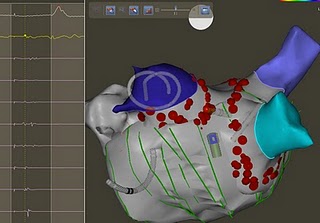 Dr. John Mandrola, cardiac electrophysiologist from Lousville, KY offers his thoughts on the complexities of trying to decide when atrial fibrillation ablation therapy is appropriate (as opposed to medical therapy) and provides an excellent overview of the varying factors that weigh upon that decision.
I would only like to reinforce his suggestion for patients to consider enrolling in the NIH-sponsored prospective randomized CABANA trial that compares drug versus ablative therapy in symptomatic patients with atrial fibrillation. Only through careful, systematic study of this disorder can we hope to improve our understanding of the best treatment recommendations for atrial fibrillation.
-Wes
h/t: Reminder offered by @HRSOnline via Twitter.
Image courtesy the Dr. John M blog.
Tuesday, June 08, 2010
When Atrial Fibrillation Recurs
... as told this morning in the Washington Post:
Yet despite the widespread prevalence of atrial fibrillation, the study has been slow to enroll. We should ask ourselves "why?"
Let me count he ways.
First, is the public and referring doctors are not aware of the study and the pivotal trial is just getting underway. (This morning's article should help a bit.)
But there are other issues...
... like the media and other doctors' pre-conceived understanding of the procedure - "I-hear-that-ablation-stuff-is 90-98% effective, so just go in there and get your afib ablated and you'll be fixed" attitude. Patients have seen the glowing early results of catheter ablation, touted by some early on with "85 percent" success rates (which, quite frankly, are hogwash, unless we count people who continue to take antiarrhythmic drugs following their ablation - hardly a comparison of the two approaches).
But other early trials that only looked only at the time to first afib recurrence have had glowing press coverage as well, potentially biasing recruitment efforts for the CABANA trial.
Finally, there's the complexity of recruiting patients. Patient's usually prefer a "guick-fix" and many might be less inclined to participate in the CABANA trial's five-year duration. Also, gathering the vast quantities of information required for such a comprehensive evaluation of these two widely-disparate treatment approaches involves numerous medication, heart rhythm, and patient evaluations throughout the study's course. When one tries to capture every single warfarin medication adjustment or palpitation on event recorder, the manpower needs and time required to complete such a "comparative effectiveness research" trial in the era of manpower constraints being imposed on hospital systems limits enthusiasm for conducting such large trials. Are we to assume doctors who are already taxed with ever-growing clinical responsibilities can easily pick up the slack? That's why centers with higher research nurse-to-doctor ratios will be the centers most likely to recruit faster.
Which leads other less well-endowed medical centers to wonder if the results of these types of trials will really reflect "real-world" clinical medicine.
Probably not.
But when you don't have much else to go on, and the money for research is increasingly showered on large health care systems, it might be the best we can do as a country. What this might mean to smaller, more rural health care delivery as the government applies the results of this trial across the nation remains to be seen.
-Wes
Disclaimer: I am the principle investigator for CABANA trial at our institution and yes, we have one research nurse dedicated to this trial.
"I was amazed at how quiet my heart was," says Currier, a 69-year-old resident of Springfield. But the benefits of the treatment, called catheter ablation, didn't last. Soon her heartbeat became erratic again, forcing her to ask: What should I do?So I found it interesting that while the above article alluded to, but did not mention by name, the multi-center, prospectively randomized pivotal trial ongoing now called the CABANA trial (Catheter ABlation versus ANtiarrhythmic drug therapy for Atrial fibrillation). So far, only 46 patients of nearly 3000 patients needed to complete the study have been enrolled. It is anticipated that over 140 centers around the world will participate.
That's the dilemma facing more than 2.2 million Americans who have atrial fibrillation, the most common heart arrhythmia and one of the most vexing to control. While treatments ranging from medication to surgery are proliferating -- and often are marketed aggressively by hospitals -- no one can say with certainty which will work best for any individual patient. And each treatment has side effects, some of them serious.
"We don't have great evidence to help patients and doctors make a fundamental choice among the treatment options, which differ dramatically," says Steven Pearson, president of the Institute for Clinical and Economic Review, which evaluates medical treatments and is affiliated with Harvard Medical School.
That makes A-fib, as it's commonly called, a top candidate for comparative effectiveness research, say Pearson and other experts. Congress set aside $1.1 billion last year for this type of research, which involves head-to-head testing of drugs and treatments to determine which work best, and for which types of patients. Advocates say such research will improve health care and help get costs under control.
More information about A-fib therapies, for instance, would allow doctors to customize treatment for specific patients, says Harold Sox, a prominent internist who headed an Institute of Medicine committee advising Congress on how to spend the comparative effectiveness research funds. The committee issued a report recommending that atrial fibrillation should be a top candidate for such funding when it is given out by the government in the coming months.
Yet despite the widespread prevalence of atrial fibrillation, the study has been slow to enroll. We should ask ourselves "why?"
Let me count he ways.
First, is the public and referring doctors are not aware of the study and the pivotal trial is just getting underway. (This morning's article should help a bit.)
But there are other issues...
... like the media and other doctors' pre-conceived understanding of the procedure - "I-hear-that-ablation-stuff-is 90-98% effective, so just go in there and get your afib ablated and you'll be fixed" attitude. Patients have seen the glowing early results of catheter ablation, touted by some early on with "85 percent" success rates (which, quite frankly, are hogwash, unless we count people who continue to take antiarrhythmic drugs following their ablation - hardly a comparison of the two approaches).
But other early trials that only looked only at the time to first afib recurrence have had glowing press coverage as well, potentially biasing recruitment efforts for the CABANA trial.
Finally, there's the complexity of recruiting patients. Patient's usually prefer a "guick-fix" and many might be less inclined to participate in the CABANA trial's five-year duration. Also, gathering the vast quantities of information required for such a comprehensive evaluation of these two widely-disparate treatment approaches involves numerous medication, heart rhythm, and patient evaluations throughout the study's course. When one tries to capture every single warfarin medication adjustment or palpitation on event recorder, the manpower needs and time required to complete such a "comparative effectiveness research" trial in the era of manpower constraints being imposed on hospital systems limits enthusiasm for conducting such large trials. Are we to assume doctors who are already taxed with ever-growing clinical responsibilities can easily pick up the slack? That's why centers with higher research nurse-to-doctor ratios will be the centers most likely to recruit faster.
Which leads other less well-endowed medical centers to wonder if the results of these types of trials will really reflect "real-world" clinical medicine.
Probably not.
But when you don't have much else to go on, and the money for research is increasingly showered on large health care systems, it might be the best we can do as a country. What this might mean to smaller, more rural health care delivery as the government applies the results of this trial across the nation remains to be seen.
-Wes
Disclaimer: I am the principle investigator for CABANA trial at our institution and yes, we have one research nurse dedicated to this trial.
Thursday, May 10, 2007
Atrial Fibrillation Ablation: What's Missing?
"Did you attend the AFib Sumnmit?"
"Yeah," I said.
"So what's the answer?"
I paused. What was this person from industry trying to ask me? I pondered his question a bit not sure where he was going. So I gave him my honest answer:
"I dunno," I said, in my most professional tone.
"I don't either," he said. "I mean, we've been hearing about the same thing for the past two years now. All these approaches to afib ablation, lots of these guys getting up there telling us how we should do this: pulmonary vein altral isolation, ganglionic plexus targetting, ablating every little small, fractionated potential everywhere in the left atrium... I mean, what are we doing?"
"I dunno," I said again. "But it does work sometimes..."
"Yeah, but no one has the answer to how to make this procedure easy, reliable, and safe, do they?"
"Well, we're getting better at it - I still have trouble knowing an endpoint to ablation though."
"Exactly. I mean, even the consensus statement for ablation of afib states that terminating afib does not mean you were not effective at ablation saying 'in patients with longstanding persistent atrial fibrillation ... an endpoint of noninducibility of AF does not appear to be feasible or even necessary.' I mean, when do you quit? When all of the atrium is destroyed?"
That got me thinking. I knew that not all of the atrium had to be 'destroyed' to achieve success, but is a carpet-bombing approach or precise creation of an ablation line what is needed? Do we need both approaches, or will one suffice?
These questions are important, in part because industry thinks we need fancy new robots and things to drive catheters around inside the heart. They want us to spend considerable financial, spacial, and temporal commitments to buy theit gizmos to help us drive around in the atrium, yet we still don't know where to go, or what lesion sets we need to achieve the best outcomes. All the "Gee-Wizardly" gizmos in the world will never substitute for careful observation and prospective randomized multi-center trials.
Dr. Eric Prystowsky, in his introductory remarks at the beginning of the AF Summit yesteday, estimated that there will have been 8,473,000 catheter ablation procedures for atrial fibrillation performed in the world between 2000 and 2007. Yet as of now, guidelines have already been published jointly by the Heart Rhythm Society, European Heart Rhythm Asociation, and the European Cardiac Arrhythmia Society that admit that only five randomized clinical trials with different endpoints and comparisons have been performed on a TOTAL of 605 patients. Furthermore, there are wide variations in the reported efficacy and complication rates, and the duration of follow-up has been less than 12 months in all of the studies performed so far.
Fortunately, at least one large, multi-center NIH-sponsored trial, the Catheter Ablation vs Antiarrhythmic Drug Therapy for Atrial Fibrillation (CABANA) Trial, is underway to determine the mortality benefit of catheter ablation compared to drug therapy in a population similar to the AFFIRM population in over 4000 patients. Unfortunately that study is estimated to take five years to complete. But at least it's a step in the right direction.
I just hate saying "I dunno" all the time.
-Wes
Addendum (5:30 PM MST): I met briefly with Dan Starks from St. Jude Medical briefly today and asked him what he thought about Dr. Prystowky's estimate regarding the number of atrial fibrillation ablation procedures being performed. He stated that last year, St. Jude estimated that about 55,000 atrial fibrillation procedures were performed in the United States. If one assumes approximately 100,000 procedures were perfomed in the world, then the MOST procedures performed from 2000-2007 would likely be closer to 500,000-600,000. Still the point remains, we need more prospective randomized clinical trials, especially trials evaluating the safety, efficacy, and mortality benefit of afib ablation.
"Yeah," I said.
"So what's the answer?"
I paused. What was this person from industry trying to ask me? I pondered his question a bit not sure where he was going. So I gave him my honest answer:
"I dunno," I said, in my most professional tone.
"I don't either," he said. "I mean, we've been hearing about the same thing for the past two years now. All these approaches to afib ablation, lots of these guys getting up there telling us how we should do this: pulmonary vein altral isolation, ganglionic plexus targetting, ablating every little small, fractionated potential everywhere in the left atrium... I mean, what are we doing?"
"I dunno," I said again. "But it does work sometimes..."
"Yeah, but no one has the answer to how to make this procedure easy, reliable, and safe, do they?"
"Well, we're getting better at it - I still have trouble knowing an endpoint to ablation though."
"Exactly. I mean, even the consensus statement for ablation of afib states that terminating afib does not mean you were not effective at ablation saying 'in patients with longstanding persistent atrial fibrillation ... an endpoint of noninducibility of AF does not appear to be feasible or even necessary.' I mean, when do you quit? When all of the atrium is destroyed?"
That got me thinking. I knew that not all of the atrium had to be 'destroyed' to achieve success, but is a carpet-bombing approach or precise creation of an ablation line what is needed? Do we need both approaches, or will one suffice?
These questions are important, in part because industry thinks we need fancy new robots and things to drive catheters around inside the heart. They want us to spend considerable financial, spacial, and temporal commitments to buy theit gizmos to help us drive around in the atrium, yet we still don't know where to go, or what lesion sets we need to achieve the best outcomes. All the "Gee-Wizardly" gizmos in the world will never substitute for careful observation and prospective randomized multi-center trials.
Dr. Eric Prystowsky, in his introductory remarks at the beginning of the AF Summit yesteday, estimated that there will have been 8,473,000 catheter ablation procedures for atrial fibrillation performed in the world between 2000 and 2007. Yet as of now, guidelines have already been published jointly by the Heart Rhythm Society, European Heart Rhythm Asociation, and the European Cardiac Arrhythmia Society that admit that only five randomized clinical trials with different endpoints and comparisons have been performed on a TOTAL of 605 patients. Furthermore, there are wide variations in the reported efficacy and complication rates, and the duration of follow-up has been less than 12 months in all of the studies performed so far.
Fortunately, at least one large, multi-center NIH-sponsored trial, the Catheter Ablation vs Antiarrhythmic Drug Therapy for Atrial Fibrillation (CABANA) Trial, is underway to determine the mortality benefit of catheter ablation compared to drug therapy in a population similar to the AFFIRM population in over 4000 patients. Unfortunately that study is estimated to take five years to complete. But at least it's a step in the right direction.
I just hate saying "I dunno" all the time.
-Wes
Addendum (5:30 PM MST): I met briefly with Dan Starks from St. Jude Medical briefly today and asked him what he thought about Dr. Prystowky's estimate regarding the number of atrial fibrillation ablation procedures being performed. He stated that last year, St. Jude estimated that about 55,000 atrial fibrillation procedures were performed in the United States. If one assumes approximately 100,000 procedures were perfomed in the world, then the MOST procedures performed from 2000-2007 would likely be closer to 500,000-600,000. Still the point remains, we need more prospective randomized clinical trials, especially trials evaluating the safety, efficacy, and mortality benefit of afib ablation.
Subscribe to:
Posts (Atom)