Sunday, March 30, 2008

First, Blame the Patient

Here's a prescription for health care reform in case some of us are not aware of the fete accompli that we have reached in the policy world with the upcoming election - here's a quick summary of what's coming:
1. First, blame the patient.*

2. Do not, under any circumstances blame:
  • the relentless bureaucracy hell-bent on continued expansion
  • the rising cost of technology
  • the lack of tort reform
  • overtesting occurring because of defensive medicine
  • the annually increasing percentage of administrative overhead for healthcare delivery in the US, now approaching 30% of the entire healthcare bill
  • direct-to-consumer advertising
  • the un-checked hospital construction industry
  • the increasing median age of our populace
  • the lack of transparency of true costs within the system
  • No restriction on healthcare delivery in futile situations
3. Next, assemble an impressive array of like-minded and highly gifted individuals who sincerely believe the patient is the problem.

4. Assemble lots and lots of "partners" with financial conflicts in this debate to stand by your side.

5. Build a very fancy website at significant cost.

6. Spend lots and lots of money on "new media consultants" to be sure the blog-o-sphere learns of this website (h/t: Thanks, Chris)

7. Pat yourself on the back for defining "the problem."
We appreciate the detailed spreadsheets of costs provided by the Partnership to Fight Chronic Disease. Given their apparently extensive talent bank and funding for this type of analysis, we look forward to seeing comparable line-item analyses for the costs of ever-burgeoning healthcare bureaucracy.

-Wes


* Of course, do not CALL it "the patient," instead, call it working to "fight chronic disease."

ADDENDUM: Lisa Emrich at Brass and Ivory blog adds her perspective as a patient with chronic disease.

You Can Never Be Too Careful


I saw this while traveling this weekend.

I wonder if there's a MRSA epidemic being spread at gas pumps...

Anyone know how this foam hand sanitizer works on grease?

-Wes

Thursday, March 27, 2008

Imagine A World Without Medicare

Imagine if Medicare were to become insolvent. What would happen?

Would the sky fall?

Would people stop needing or receiving healthcare?

I don’t think so.

The implications of this are interesting to ponder.

I suspect the majority of us would be fine. Healthcare would be delivered, but the world of healthcare as we know it would rapidly change. Congress would likely attempt to take the path of least resistance to maintain solvency by raising taxes, imposing a healthcare mandate, or delaying the Medicare eligibility age.

But what if all hell broke loose and no Medicare were available. What would our healthcare world look like?

First and foremost, existing entities dependent on Medicare payments would scurry to assure their viability and potential for profitability any way possible. For most, rationing of healthcare benefits would rapidly accelerate. High risk individuals would be denied insurance coverage or face exorbitant premiums. Competition for low-risk patients would accelerate between insurers. The weak insurers would die out or be consolidated and the strong would likely survive. Hospitals would shift billing from their largest insurer to the patients themselves. Patients would have an eye-opening experience when the reality of their price markup reveals the perversity of health care prices. Grass-root advocacy groups would call for immediate change to include price transparency. Hospitals would be forced to compete for high-cost services. Simultaneously, hospitals would recognize the need to greatly restrict new debt obligations (like construction costs) to conserve resources to cover bad debt. The unchecked hospital construction boom would quickly cease. Unnecessary administrative and support personnel would be weaned. Hospitals would put pressure on suppliers to reduce costs: pharmaceutical companies and medical device companies would be forced to cut costs, lest their customers go bankrupt, too. Pharmaceutical companies, eager to cut costs, might remove the excess cost-ballast of direct-to-consumer advertising. CEO’s salaries and severance packages would come into line with reality. No one would be spared cost-cutting measures.

Regrettably, many patients with existing illnesses would likely be forced into bankruptcy as hospitals would increasingly employ legions of collection agents to extract payments from their patients' assets. Some would turn to Medicaid or another government safety net system. These stories would likely make heart-wrenching press stories and more pressure would be placed on the healthcare system to reduce costs or develop cost-effective options for the disenfranchised. Suddenly, patients will ask, “Could this happen to me?”

Doctors would immediately opt out of accepting any Medicare reimbursement due to the unreliability of payment. At least the threat of reimbursement cuts would cease. Especially since the ultimate reimbursement cut had just occurred. Patients would have to negotiate with doctors to provide care. Each test ordered on behalf of their care would be closely scrutinized for necessity. Costs would have to be transparent. Patients would become frugal lest they squander their life savings. Insurers would adapt to providing patients with insurance options to cover their costs. Employers would have the options of purchasing insurance for their employees at varying levels of coverage as a “perk,” provided the costs were not excessive. Since healthcare would no longer an entitlement, people would have to prioritize their savings to adjust for the inevitable need for late life care. Health savings accounts, or their equivalent, would flourish.

Admittedly, there are those less fortunate who cannot afford to contribute meaningfully to their healthcare costs, or there will always be individuals whom have been afflicted with a malady that has left them unable to contribute. For those, a bare-bones government-sponsored health plan would have to be available. To do otherwise would be inhumane. But healthcare, like hotels and restaurants, will gradually be tailored to meet the needs of patients. Those wanting 5-star Hilton-like accommodations and can afford them, will pay for them. Those that can only afford a Motel-6 accommodation will pay less. Nothing will be free any longer. Come to an Emergency Room? Expect a bill. Can’t pay? Apply for government assistance or a low-cost insurance or payment plan. That’s the way it’ll have to be.

Additional pressure would also be applied to limit unnecessary and costly testing in a non-Medicare era. Pressure to establish meaningful nation-wide tort-reform will simultaneously take place. Since medical errors in any healthcare system are inevitable, peer-directed health courts or a no-fault payment policy would have to be implemented. Perhaps then, and only then, patients with legitimate complaints will be heard and compensated, while exorbitant and costly legal posturing and judgments with grossly overpaid expert witnesses and the like, will end.

Without Medicare, for the first time healthcare policy would become a priority, not an afterthought.

Imagine. Real change.

And most for the better.

-Wes

Wednesday, March 26, 2008

Eleven Years and Counting

How old will I be in 11 years when Medicare’s Trust Fund goes bankrupt?

I’ll be sixty.

Five years before I’m eligible for the program.

I mean, I’m entitled to healthcare! Just like everybody else. Free is for me! Doesn’t anybody care about this?

So, how old will you be when Medicare goes belly-up?

And who will take care of all of us 60-year olds when we start really needing healthcare because we have been unable to “prevent” ailments or impose cost controls because we have to insure the ubiquitous “47 million ” as we accelerate the pace to assure that hundreds of millions more of us will join these ranks in just eleven years?

Probably doctors.

But not just any doctors. There will be doctors who are risk-averse and will stay with the system, and entrepreneurial doctors who have opted out of the rat race: a two-tiered system.

Oh, sure, there’ll be “universal (‘free’) healthcare” for all - after all that sounds so politically-correct. But the system we rely on today is dying a rapid death.

One way or another, look for Americans to shoulder more and more of the healthcare costs through taxes, or mandates, or higher deductibles or more and more rationing as government invades physicians’ space.

Just to support the ridiculous bureaucratic machine that is healthcare today.

But we as patients could make a difference if we just took an interest in our own well-being.

Maybe there’s a better way...

Perhaps we should just declare Medicare dead now and wake up to the reality so we can finally start working on a healthcare reform package that will be sustainable rather than perpetuating this ruse through empty promises.

-Wes

Tuesday, March 25, 2008

Monday, March 24, 2008

Hypoperformance Anxiety Syndrome

My suggestion for a new diagnosis for the upcoming American Psychiatric Associations' Medicare coding criteria, DSM-V:

Hypoperformance Anxiety Syndrome (HPAS)

Definition:

Axis I: An acute state of unrest, sleeplessness, and agitation caused by Pay for Performance measures which are no longer measuring productivity while on vacation.

Yes, I know, I'm leaving out Axis II...

-Wes

Saturday, March 22, 2008

Meet My Blog Parents

Yesterday on our way South we had a chance to meet some mega-bloggers: Dr. Helen Smith (Dr. Helen) and Glenn Reynolds of Instapundit.com fame. Helen and Glenn were the people who were instrumntal at introducing me to the blog-o-sphere.

It was funny how I learned of this strange world: Glenn posted a picture of Helen wearing one our t-shirts from MedTees.com on Instapundit, sending such a flood of traffic that I wondered if I was having a denial-of-service attack.

So Glenn and Helen, here's to you! I hope my three readers flood your sites with some blog love, too!

-Wes

Friday, March 21, 2008

Spring Break!

Can't wait. Off for a few days. Blogging might be a bit more sporatic for a while. But hopefully, I'll still have internet access from time to time as I recharge my batteries. Got to rest up before and active week upon my return...

-Wes

Thursday, March 20, 2008

How to Piss Off An Attending

Noon conference, for those unfamiliar, is an educational endeavor where an attending physician gets to spoon-feed medical residents factoids and pearls about various medical conditions or treatments critical for their training. Usually it consists of "core" educational topics felt by their peers to be those topics necessary to prepare them for passing their National Board Examination. For attendings, these aren't the most exciting lectures to give, but they certainly serve an important purpose. For the residents, it's a chance to hear from experienced attending physicians from various departments throughout the hospital who have spent considerable time, energy and effort to organize the critical themes central to their education. The residents get to sit back, interact, and learn.

And sometimes in the dark, warm, post-prandial post-call setting, residents drift off to sleep. I'm okay with that.

But being at noontime, residents often eat lunch since their many responsibilities preclude much time to stop by the cafeteria. Not uncommonly, nice, attractive drug reps bring tantalizingly scrumptious cuisine upon which they can munch during the lecture. They, too, want to make that the budding doctors-to-be know how to give the latest dose of Drug X or Drug Y, and "here's-a-corparately-sponsored-study-we-thought-you'd-like-to-see."

So let me be perfectly blunt.

The minute residents start prioritizing their interactions with the industry drug rep over the attending's lecture, I'd suggest they consider another field...

... like marketing.

-Wes

Resident vs. Hospital Cafeteria

Kudos to Dr. Rob Stevenson:
The irony is that the hospital, which helped develop the nutritious menu at the new school, is now being used to circumvent its own efforts.

And that irony is not lost on a group of cardiology doctors and nurses, who last month protested their own hospital’s lax nutrition standards by staging an eat-in at the high school.

Dissatisfied with Capital Health’s tepid response, cardiology resident Rob Stevenson penned an opinion piece, published in this paper on Wednesday, in which he urged the hospital to deep-six the deep fryers.
Well done, my man. Well done.

-Wes

My Job is Secure

Pretty optimistic forecast for my field from these guys:
According to Millennium Research Group's Global Markets for Atrial Fibrillation (AF) Treatment Devices 2008 report, over 32,000 electrophysiology (EP) procedures were performed for the treatment of AF in the US in 2007. AF EP procedure volumes will increase at a compound annual growth rate of over 25% from 2008 to 2012.

Growth in procedure volumes will be driven by the increasing physician acceptance of EP ablation as a viable and effective treatment for AF. Over the next several years, these procedures will be used more often over medical therapy than in the past. The introduction of new technology will also support greater procedure volumes through 2012; these new devices will enable physicians to increase the safety, efficiency, and efficacy of EP ablation catheter procedures. By 2012, over 109,000 EP procedures will be performed to treat AF in the US.
While "increasing physician acceptance" helps to drive this market, regrettably, so does economics - catheter ablation still pays better than most procedures electrophysiologists perform.

We still need a multi-center, prospective, randomized mortality trial to determine the long-term safety and efficacy of primary therapy of atrial fibrillation ablation compared to medical therapy. Until this occurs, only symptomatic patients refractory to medical therapy should be considered for referral for this procedure.

-Wes

Tuesday, March 18, 2008

Single or Multiple-Use Medical Instruments?

Today's Wall Streeet Journal rejuvenates a long-standing debate in hospitals: that of re-cycling equipment that is labeled "single use" to save on costs. Re-sterilization of instruments has become a multi-million dollar industry. Why? Because what hospitals care about most these days is saving money on consumables, and what better way to save than to recycle an instrument for a small fee and charge the patient for a new single-use instrument.

In effect, this is done every day in hospitals that reprocess instruments.

Now to be fair, what really happens from the hospitals' perspective is they get a lump sum reimbursement payment for a procedure and must use that amount to pay for all of the procedural consumables, including instruments. That lump sum payment amount is negotiated with the insurer well before any talk of re-using instruments occurs. It is usually negotiated assuming new "single-use" instruments are used. Further, because reprocessing has been "approved" by the FDA for some instruments under careful regulation, it's legit and hospitals can save a bundle.

Although rare, legal precedent has been established where re-used catheters were found dangerous. Was this a frivolous case or were there circumstances that were less than ideal? At least one jury thought their might have been a problem.

Cases like this sent shock waves around local hospitals - at least for a time.

But money is a strong motivator. Equipment and staff aren't getting cheaper. So to reassure hospitals, the re-sterilization industry began offering liability coverage as a form of indemnity against potential legal challenges regarding the safety of their service. Also, they point to the FDA which has sanctioned their process as "safe."

So naturally, many hospitals have entered back into the fold of re-use.

The instrument manufacturing industry is now understandably incensed and outraged at these reprocessors because the practice of instrument re-use substantially cuts into their bottom line profits. In my estimation, manufacturers sell about one tenth of their usual instruments to hospitals, since it is not uncommon for a "single-use" non-metallic instruments to be reprocessed 8 to 10 times before being discarded. Some metallic instruments may be used far longer.

Meanwhile, patients do not see the savings - the hospitals pass this on to cover other expenses. C'est la vie.

But the manufacturers have one thing on their side: the patient safety argument. You can never be too safe these days.

The manufacturers can point to ethylene oxide (used to sterilize instruments that cannot withstand heat) that can be harmful to humans, and there have been instances where excessive levels were detected on re-processed electrophysiology catheters when screened. For the clinician, there's no readily-apparent way to detect for residual ethylene oxide contaminants before procedures at the patient's bedside, so we take it in trust that levels are satisfactorily low. Were the instruments allowed to "air" for 14 days? Impossible to tell - we have to rely on those handy-dandy FDA inspections to assure compliance. Or alternatively, there have been small studies that found proteinacious material on catheters after re-sterilization. Eeeewwww.

So to combat the large preprocessing industry, device manufacturers wanted patient's to consent to the use of re-sterilized and re-used equipment during their surgeries. Seems reasonable, right?

But this hasn't happened.

Imagine.

Now to be fair, I have been on both sides of this debate - I have worked at institutions that have re-sterilized instruments and I have worked at institutions that are single-use. I found that doctors are shoved into this debate unwittingly: we need the hospital to do our procedures and provide the instruments, but may not like having to use re-processed instruments on our patients. In the case of electrophysiology catheters - they just don't handle the same. Further, the thought that a patient is unaware of this practice is unsettling. Because of the nature of medicine these days, we assume the responsibility for the patient's well-being in tandem with the hospital. Yet often, we are not part of the discussion regarding the use of preprocessed instruments. If we are, then the whole murky area of what it took for doctors to agree to using these re-used catheters begins to raise its ugly head.

So while economic arguments exist on both sides of the device re-reprocessing fence, we must not lose sight that it's the patient that matters here. Certainly, if re-used instruments are being used in a laboratory, I believe that patients should be made aware and have this included in their informed consent, with any potential risks spelled out. Further, if a patient knew they could apply some of the cost savings of re-processing toward their procedure costs, then perhaps they'd be more willing to agree to the practice.

But the subterranean way things happen now is not acceptable.

Given the current satate of affairs, here's the ultimate litmus test on this issue in my book:

If you were having a procedure, which instrument(s) would you want used on yourself: re-processed or single-use?

-Wes

EKG Du Jour #3

It seems it's a slow news day in the field of Cardiology, so continuing the "EKG Hall of Fame" series, here comes the toughest diagnosis yet...

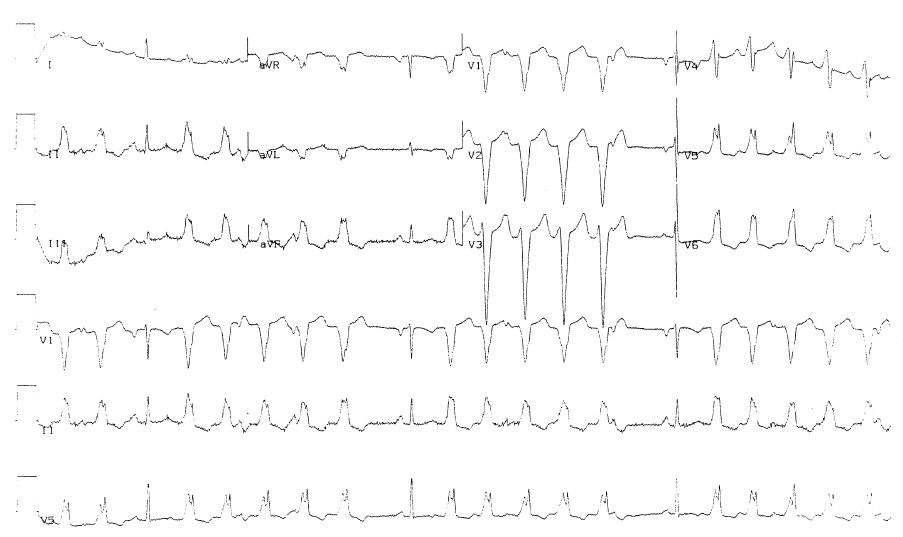
A 17 year old high school senior presents to the Emergency Room with intermittent shortness of breath and lightheadedness unrelated to exertion. He has never lost conciousness. He is otherwise "healthy" and is new to the health care system. He denies any recent illness, fever, cough, or history of lung disease. He has no family history of heart disease or unexpected death. His physical examination is completely normal and are the usual cauldron of ER blood tests. An EKG is obtained and you are called to review the EKG because the ER staff is "concerned." The EKG is shown below:


Click to Enlarge

So, what's the diagnosis? If you're unsure, what other history, exam findings, test(s) would you order?

Finally, would you send him home or admit him?

-Wes

Monday, March 17, 2008

They Missed Something

By causing the blood vessels that supply the heart to abruptly occlude, cocaine can also cause your heart to fibrillate (stop) resulting in

sudden  
 cardiac 
  death


... and can happen before you ever get to an Emergency Room.

Any questions?

-Wes

Sunday, March 16, 2008

With Whom Will I Hang?

Yesterday's Chicago Tribune laid bare a troubling reality: Evanston Northwestern Healthcare (my institution) is in a spat with Northwestern University's Feinberg School of Medicine over some form of interesting affiliation fee. I had no idea there were such fees, but hey, I'm just a doctor. Guess you gotta pay to play.

I had never heard of Rosalind Franklin University of Medicine and Science until I read the article. It seems that's the new name they gave the old Chicago Medical School. I'm embarrassed to say that I had to use Google Maps to know where they were located. (I guess I don't get out very much. Yikes, it's smack dab in the Great Lakes Naval Training Center and the North Chicago VA - geez, guys, I just retired!)

Can't wait to catch the buzz tomorrow morning. I wonder if it has anything to do with this? Rumor has it that Northwestern University Medical Center downtown was interested in the Rush North Shore Medical Center acquisition, too.

-Wes

A Call for Equipoise

My head is still reeling after the reports of doctors hacking into the wireless transmissions of an automatic defibrillator.

Oh, it’s not so much the fact that it was done. Really, that was something. It certainly took our best and brightest a remarkable amount of scientific expertise to reverse-engineer the protocol for communication with Medtronic’s defibrillator device. The resources they used and all – what was it? $30,000 or so? And how many hours did it take for those engineers and computer scientists to crack the code? Certainly many. I suppose we should congratulate them for their ingenuity and fortitude. I feel safer now.

But that’s not what I see as disturbing.

It’s the bigger picture that bothers me.

You see, I’m worried about what it means to our profession as doctors.

Doctors must continually strive for equipoise in medicine. While it is a noble cause to want to always cure disease, strive for perfect patient safety in all arenas, and help mankind progress to the ultimate prize of immortality, we realize that each of these goals, taken to their extreme, is an impossibility. We have to balance the inevitability and cruelty of disease, the social and political climates in which we work, and even the sometimes atrocious things that one human being does to another, to help the unfortunate patient, victims and family members cope with the reality of their medical predicaments.

To me, it seems that since the Institute of Medicine’s report on medical errors was published admonishing the safety record of medicine as a whole, we’ve begun tipping to one side of the scale of medical reality. We strive for perfect safety records and implement protocols analogous to airline checklists to become robotic and perfect in our actions. Mountains of paperwork and regulation requirements are completed by teams of well-meaning individuals each day. Countless hours are devoted to record-keeping to prove that we’ve been keeping our records. Electronic medical records spew forth past medical histories, medication lists, family histories, social histories time and time again not because it helps the patient, but because we don’t want to “miss anything” that might be perceived as “inadequate” documentation for the patient. (In reality, we just have to do that stupid requirement just to get paid adequately – but that’s a discussion for another essay.)

Now I have nothing against improving our health care delivery system, and Lord knows there are areas where the Institute of Medicine’s wakeup call has helped patients. But politically, we’ve already seen how neat and tidy the patient safety argument becomes. I mean, what compassionate physician in their right mind could ever not argue for patient safety? It would be professional suicide.

But exactly how safe is safe enough?

Should all surgeons, in their quest to minimize infection, scrub for 3 minutes, 5 minutes, 10 minutes, 30 minutes, or become obsessive hand washers in the interest of minimizing the possible spread of that last remaining bacterium from their hand before entering the operating room? When do we stop?

Or maybe, since defibrillator wireless transmissions can be tapped now, we should encrypt other wireless transmission devices, like entire telemetry units or hospital administrators’ cell phone conversations? Better yet, barricades should be erected around hospitals just in case a doctor goes ballistic and decides to crash an ambulance into the main building. And why aren’t there metal detectors and people checking shoes at all of the hospital entrances – aren’t we missing another potential patient safety opportunity?

Sure, these examples are extreme, but they illustrate my point.

We have so many incredibly difficult challenges ahead in medicine: funding of healthcare, the loss of primary care doctors, the social problems in our inner cities, the overcrowding of our emergency rooms – the list goes on and on. Be it cardiology, medicine, obstetrics, or neurology, or general surgery, etc. – each branch of our profession has a million more important clinical and non-clinical problems to tackle right now. But when we start looking for problems in areas that do not represent active problems, thereby creating a new problem where none existed previously, we begin to tip the balance of equipoise in medicine to the penurious. And when this scale is tipped too far toward one side, we completely miss the boat as a profession as what it will take to maintain our clear perspective in our upcoming challenges.

Our resources are finite. When we spend so much money on safety trivialities in our most esteemed medical education establishments relative to the Big Picture of healthcare today, all of us who proclaim to be purveyors of our patients’ best interests have completely dropped the ball.

-Wes

16 March 2008 19:00 CST Addendum: Roy Poses over at Health Care Renewal doesn't agree with me, but it's good to get both sides of the argument. What do you think?

Saturday, March 15, 2008

Insurers and Doctors' Identity Theft

Dr. Val had a recent post describing "Medical Identity Theft." This is where a non-insured individual acquires the insurance information of another patient and uses this to rack up all kinds of health care bills while rendering the victimized patient virtually uninsurable later.

What she didn't tell us, though, was that some doctors have already been having a different form of identify theft: from their friendly, neighborhood managed care company.

What's that you say, Dr. Wes?

Well, remember those voluminous forms with all that personal insformation that you had to fill out to obtain insurance reimbursements? It took FOREVER to complete those forms. Entering your name, address, social security number, date of birth, Medicare UPIN number, DEA number, your state's controlled substance number, mother's maiden name (well, not really that one) on all of those forms sure was arduous, wasn't it?

But you complied and dutifully entered all of that information because you wanted to get paid by our omnipotent healthcare insurance system. In return, you were afforded the utmost confidence that your data (like that of your patients) would be held in strict confidence, remember?

Well, it seems there might have been a little problem.

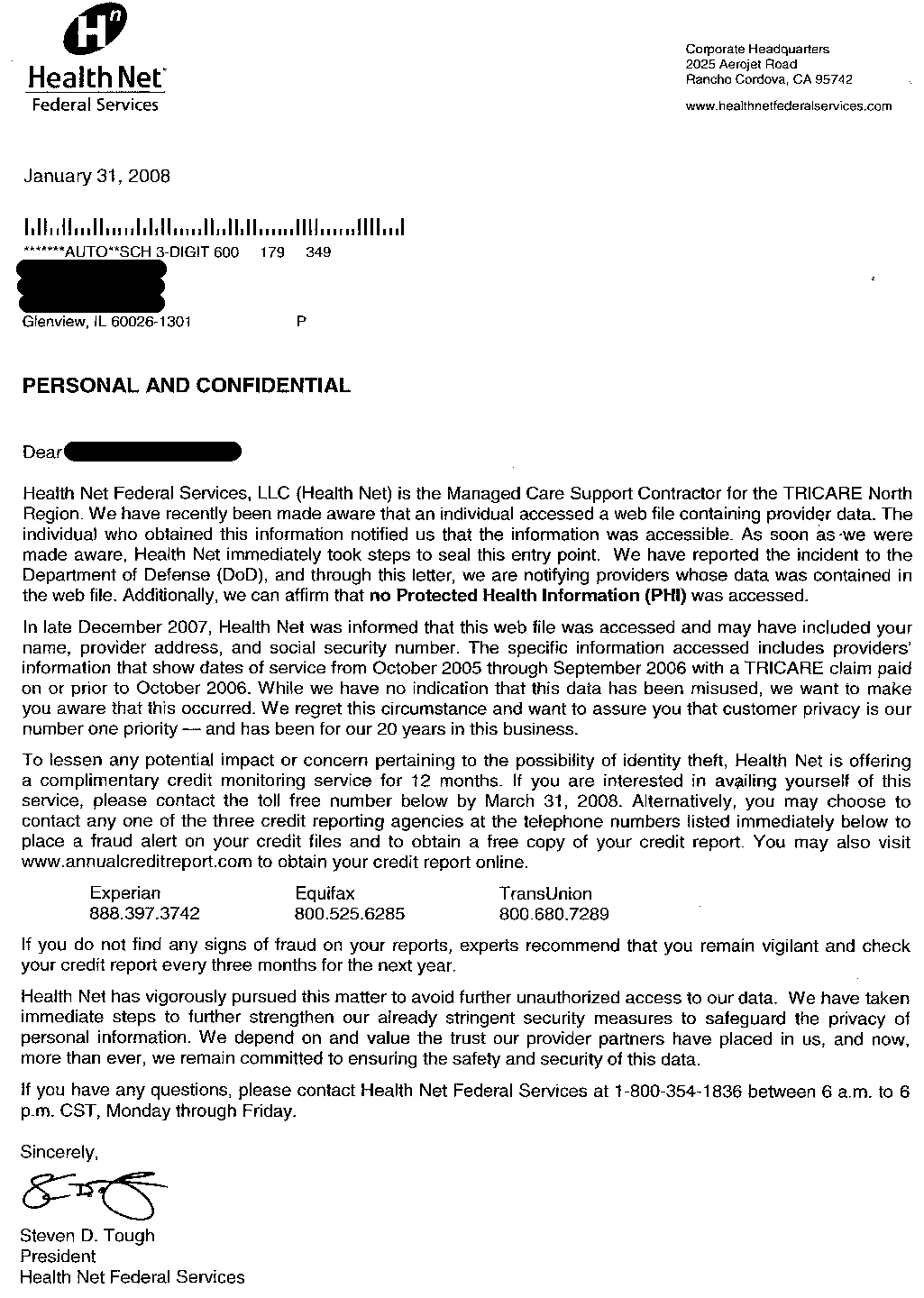
It seems at least one managed care company who handles the military's health care program, HealthNet Federal Services, LLC, had a little security breach.

From their "Dear Doctor" letter:
In late December 2007, Health Net was informed that this web file was accessed and may have included your name, provider address, and social security number. The specific information accessed includes providers' information that show dates of service between October 2005 through September 2006 with a TRICARE claim paid on or prior to October 2006.
Oops.

But its okay. They'll offer you a free complimentary credit monitoring service absolutely free for 12 months and give you some online resources and phone numbers where you can get a free credit report!

Wow, what a deal!

Come on, doctors, what are you waiting for? Sign up NOW! You won't want to miss out on this exciting offer...

-Wes

Friday, March 14, 2008

Tabled

With no love lost between the two Democratic presidential candidates about health care mandates and such, so much for making patient safety the centerpiece of medical liability reform, huh?

Seems this "critical legislation" hasn't gone anywhere since 9/28/2005.

I guess this NEJM piece was nice window dressing - especially when we review the legal professions' contributions to the democratic candidates...

Sorry. It's just NOT about the patients, is it?

-Wes

Thursday, March 13, 2008

EKG Du Jour - #2

Over the years, there have been memorable cases that go into my teaching file - I call it my "EP Hall of Fame" file. One such case was presented earlier on this blog. These serve as a rich source of instructional material for my students, residents, fellows, and cardiology colleagues, so I thought I'd share a case with the blog-o-sphere. These are not particularly tough for most electrophysiologists, but I find its helpful to review these cases once in a while to remind our colleagues to be on the lookout for these not-so-uncommon arrhythmias.

She was a 42-year old mother of three children who presented with a chief complaint of exertional shortness of breath and progressive swelling of her lower extremities for the past two months. She could not lie flat at night and required three pillows to sleep comfortably. She never had syncope or near syncope, but did note lightheadedness if standing quickly from a sitting position. She had no family history of heart disease or sudden death. She was on no medications, did not drink alcohol, smoke, or use illicit substances.

Her physical examination showed a rapid, irregular pulse of about 120 b/min and a blood pressure of 94/62, jugulovenous distention to the angle of her jaw at 30 degrees, and bilateral rales half-way up both lung fields. She had moderate lower extremity edema. Here's her EKG:


Click to Enlarge


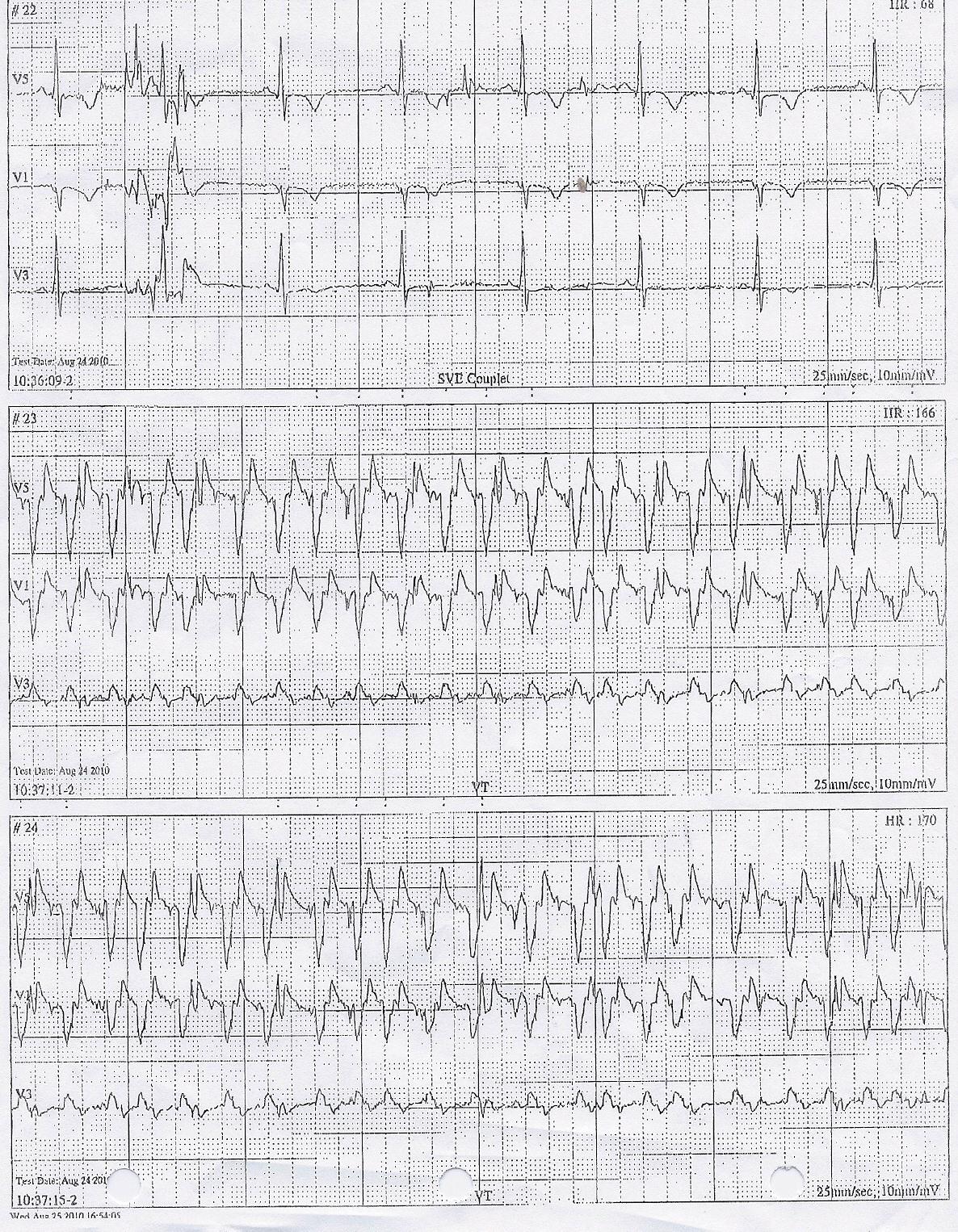
She was admitted and placed on telemetry, a 60-minute strip from which is shown here:


Click to Enlarge


Her echo demonstrated a markedly dilated right and left ventricle with moderate-to-severe mitral regurgitation and left atrial enlargement. Her estimated ejection fraction was 22%.

Sooooo. What is this and what therapy (therapies) would you recommend?

-Wes

Getting A Blog Off the Ground

Thinking about starting a blog? Here are some brief thoughts of mine published in the February issue of EP Lab Digest.

-Wes