Yesterday, the FDA approved Edward Lifescience's percutaneous transvalvular aortic valve replacement catheter for human use. Despite this, it appears unlikely that implants of these valves will progress in short order due to concerns of demand for the expensive technology in the era of increased scrutiny of device utilization by payers, especially CMS. Which constraints will be placed on cardiologists and which institutions will be approved for this technology are issues still being considered. At the current rate, it appears unlikely at this time that this technology will be deployed before the end of the year.
One new trend in cardiovascular circles (and a trend that is very politically-correct in our new "Accountable Care Organization" era of medicine that also plays well with health care marketing teams) has been the installation of new, very expensive 'hybrid' catheterization laboratory/operating rooms capable of transitioning from a conventional operating room to a catheterization laboratory (or back again) in larger hospitals. It is clear that patient selection for percutaneous valve procedures will likely require collaboration between cardiothoracic surgeons and cardiologists and some valvular procedures may require both specialists in complicated cases.
Here's a time-lapse video of the conversion of a hybrid operating room from the University of California, San Diego where a patient first had a DaVinci robot-assisted single-vessel off-pump coronary bypass operation followed by placement of an intracoronary stent in another coronary artery by cardiologists. (Not sure why it was done this way, but I don't know specifics about the case.)
While staged DaVinci robot procedures with angioplasty probably won't be common, these fancy "hybrid" operating rooms (OR's) are much more likely to be used for percutaneous valve implantations or even atrial fibrillation ablations using simultaenous epicardial and endocardial approaches.
Fun times.
-Wes
Showing posts with label open heart surgery. Show all posts
Showing posts with label open heart surgery. Show all posts
Thursday, November 03, 2011


Monday, October 11, 2010
Friday, September 17, 2010
Are Large Health Care Systems Gouging Patients?
With patients having to pay more of what's charged for their health care, comparisons between medical systems like this one in Pennsylvania, makes us wonder if bigger necessarily means better:
At least that's the hope to our more ardent reformers.
But there is the political reality that hospitals are large employers. Also, they are slow to publish this information lest they show their hand to insurers with whom they negotiate group prices or risk discouraging their patients from using their shiny new facilities up front. This is why patients have a tough time determining what a procedure will cost before they have it.
If we were to continue to permit personal costs to loom larger in our new health care reform era, as larger health systems' catchment areas overlapped it would be likely that the institution that moved first and most aggressively to make cost data available prospectively while maintaining quality might be the one with a significant advantage over their non-disclosing competitors.
But the costs and consequences of such an approach is unacceptable to our professional politicians. Things must be kept "easy" and "painless" for their constituents. As such, patients will soon have even less skin in the game for their care as we move forward with the "Affordable" Care Act in 2014, allowing this ridiculous, unrelenting upward cost spiral will continue. Bundled government payments for services won't be enough since they'll likely be negotiated to keep prices artifically inflated.
Don't think so?
Just look at the construction going on right now at area hospitals around the country. I would say our big, branded hospital systems are loving their prospects in the years ahead.
-Wes
The Pennsylvania Health Care Cost Containment Council study looked at four regional hospitals that offer cardiac surgery: Geisinger Wyoming Valley, Plains Twp.; Community Medical Center and Mercy Hospital, Scranton; and Pocono Medical Center, East Stroudsburg.Hospital charges are a poor way to compare costs since they are often inflated. Worse, retrospective data that is several years old is of little use to patients seeking care today. But as patients are left to pay more and more out-of-pocket for their care, these types of data might tarnish patients' love-fest for large "branded" health care systems that historically have used their brand and market share to raise prices.
Among the four, Geisinger Wyoming Valley carries the biggest price tag. In 2008, the average hospital charge for a coronary artery bypass graft surgery was $108,029 and the average hospital charge for valve surgery was $132,740, according to information in the report.
Having both surgeries simultaneously at Geisinger resulted in an average hospital charge of about $162,051.
Coming in as the most affordable in 2008 was Community Medical Center, according to the council's report. The average hospital charge that year for bypass surgery was about $63,767, and the average hospital charge for a valve surgery was $90,411.
Pocono Medical Center was the most affordable when it comes to having simultaneous bypass and valve surgeries - the average hospital charge was $92,352.
At least that's the hope to our more ardent reformers.
But there is the political reality that hospitals are large employers. Also, they are slow to publish this information lest they show their hand to insurers with whom they negotiate group prices or risk discouraging their patients from using their shiny new facilities up front. This is why patients have a tough time determining what a procedure will cost before they have it.
If we were to continue to permit personal costs to loom larger in our new health care reform era, as larger health systems' catchment areas overlapped it would be likely that the institution that moved first and most aggressively to make cost data available prospectively while maintaining quality might be the one with a significant advantage over their non-disclosing competitors.
But the costs and consequences of such an approach is unacceptable to our professional politicians. Things must be kept "easy" and "painless" for their constituents. As such, patients will soon have even less skin in the game for their care as we move forward with the "Affordable" Care Act in 2014, allowing this ridiculous, unrelenting upward cost spiral will continue. Bundled government payments for services won't be enough since they'll likely be negotiated to keep prices artifically inflated.
Don't think so?
Just look at the construction going on right now at area hospitals around the country. I would say our big, branded hospital systems are loving their prospects in the years ahead.
-Wes
Saturday, April 24, 2010
One Man's Mission
Mr. Ron Murray, a tranplant heart recipient, tells his story:
From the video:
-Wes
From the video:
"… if the transplant issue ever comes up for anyone listening, that’s almost the first thing they would think, too. If I had time to think about it over that year, I would have realized, oh my God, I would have apprehension all built up about how I would react to...I mean is it going to change my way of thinking? Is it going to alter my own thoughts? None of that holds up, ultimately.Remarkable guy. May his message reach millions.
When I realized that there was going to be, forever, an emotional component, and maybe a spiritual component to this thing that I hadn’t thought about, is when I became – God, I don’t even know if I can tell you about it – that I began to grieve for the donor, that brought be to tears several of those nights.
But they weren’t bad tears, they were were just, like tears you feel when you go to a funeral – someone you know – and I didn’t know Kevin but I did now, is the way I looked at it. And so, the rest of my time in the hospital was an alternating time between listening to music in my head and writing it and making it up, and thinking about Kevin and his family and what all of this really means to my future life.
So, I formulated a plan to try to reach a lot of people for the specific reason that I passed up so many deserving people on the Austin transplant waiting list. There were 12 people ahead of me who had been waiting for a heart, sometimes up to a year, and I had only been on the list three weeks and here I am jumping ahead to get the heart. (By the way, he saved four or five people that night – he was a donor of everything).
So I figured the reason that I jumped ahead of so many people was because there was such a severe shortage of donors, and ultimately that proved to be true. So anyway, my effort now is to reach as many people as possible, and this is part of that effort…”
-Wes
Sunday, January 17, 2010
Wide Awake Open Heart Surgery
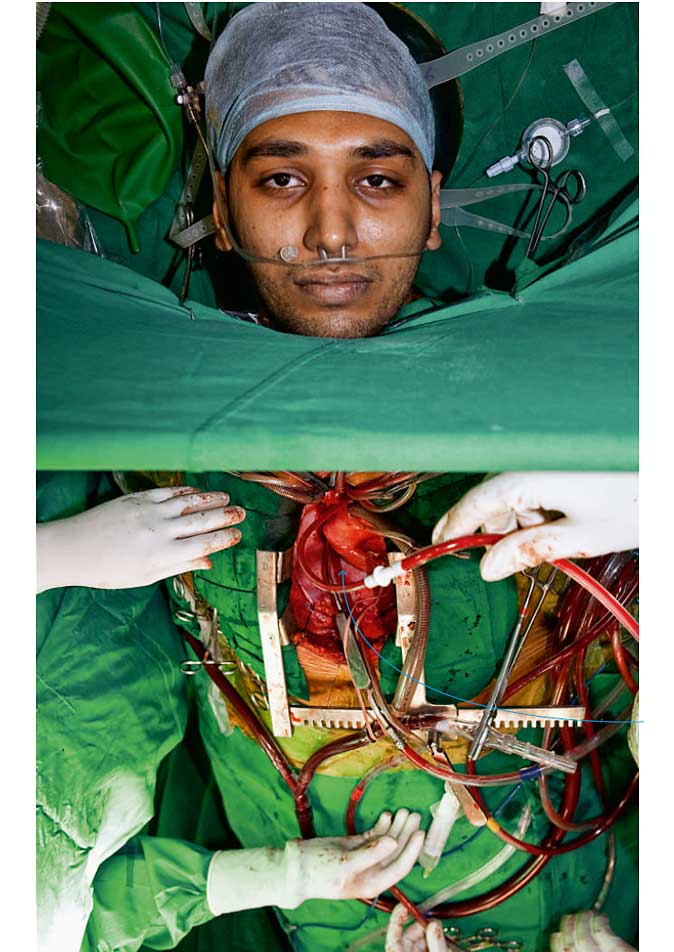
Click image to enlarge
Why someone would want to do this, I haven't a clue.
Swaroup Anand, 23, from Bangalore, is fully conscious as he undergoes open-heart surgery. An epidural to the neck, administered at the city’s Wockhardt Hospital, has numbed his body. Dr Vivek Jawali pioneered the technique ten years ago and has recently released a tutorial on DVD which gives a step-by-step guide to the procedure – sorry, but you can only get a copy if you’re a surgeon or an anaesthetist.Seems there would be considerable risk of respiratory compromise is the epidural went too high. But according to this video, over 400 cases have been performed, including a bypass with aortic valve replacement!
I don't know... I'm not sure I could stomach the sound of the bone saw or, worse, if the surgeon said "Oh, crap..."
-Wes
h/t: Slashdot
Reference:
Chakravarthy MR, Jawali V, Patil TA, Srinivasan KN, Manohar M, Khan J, Jayaprakash K, Das JK, Mahajan V. "High thoracic epidural anaesthesia as the sole anaesthetic technique for minimally invasive direct coronary artery bypass in a high-risk patient." Ann Card Anaesth. 2003 Jan;6(1):62-4.
Subscribe to:
Posts (Atom)