Showing posts with label left ventricular assist device. Show all posts

Thursday, July 14, 2011

Power By Induction?

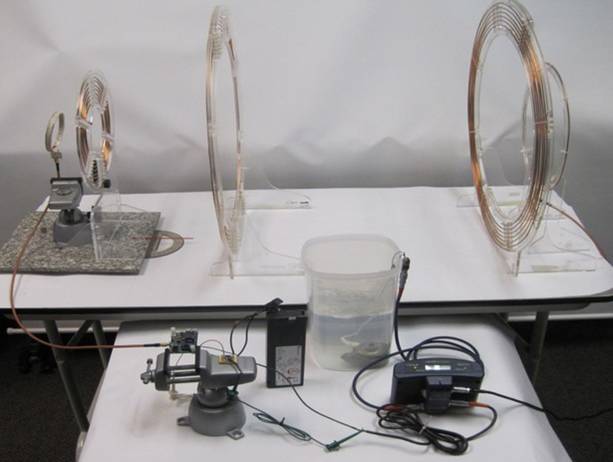
From the University of Washington: The experimental setup has a large transmission coil, at the right, connected to the building's electricity. At the left is the receiving coil, and near it is a smaller coil connected to a commercial heart pump sitting in a jar of fluid.

Interesting concept: using inductive power to possibly power a left ventricular assist devices.

Hope it works some day.

-Wes

Wednesday, June 15, 2011

The Double-LVAD

There's a nice picture of a paired left ventricular assist devices (I guess to serve as left and right ventricular assist devices) over at Wired magazine:


Kind of cool.

Of course it would be nicer if it wasn't a post-op chest xray with four chest tubes...

-Wes

Addendum: h/t to @rlbates on Twitter to pointing me to this nice piece from NPR about this case.

Tuesday, October 12, 2010

Life and Death With an LVAD

Left ventricular assist devices (LVADs) are dramatically altering the field of heart failure care. There are pros and cons with the use of these devices, and this Reuter's article does a good job exploring them in simple terms.

Cardiologists need to become more familiar with these devices' limitations, too:
We have to address what is the meaning of death on one of these pumps," said Dr. Valluvan Jeevanandam, chief of cardiac and thoracic surgery at the University of Chicago Medical Center and an investigator for Thoratec's clinical trials.

Roughly 70 percent of patients on the HeartMate II were alive after a year, and nearly 60 percent were alive after two years, according to the latest data.

"It's not hard to imagine a person who has had severe stroke that has impacted both sides of the brain, the kidneys are shutting down, he is on a respirator, but yet the LVAD just keeps churning along," said Martin Smith, a clinical ethicist at the Cleveland Clinic.

Under U.S. law, patients are allowed to ask that implanted devices be turned off. But Dr. Diane Meier, a professor in the department of geriatrics and palliative medicine at the Mount Sinai School of Medicine, said cardiologists are particularly bad at preparing patients for death, especially this kind of death.
Like pacemakers and ventillators, these devices intervene on the natural course of the dying process and when the quality of life declines sufficiently after their use, it is ethical for patients and family members to request such support be withdrawn.

The challenge, of course, is what to do when these members of the care team aren't there...

-Wes

Thursday, August 09, 2007

Mini-Motors For Your Heart

For patients with severe congestive heart failure, new innovative technologies seem to be developing rapidly, perhaps because heart failure represents a very common end-stage cardiac ailment and transplant donors are just too rare.

Recently, there have been a slew of new miniature pumps being developed for heart failure patients. One such device, recently implanted in the first human in Europe, is Synergy, a new left ventricular assist device from Circulite, Inc. The first patient was enrolled in their European Bridge To Transplant Feasibility Trial in June, 2007 with the first implant announced in a press release yesterday.

The technology is interesting on several fronts. First, the pump is of a remarkably small size and is designed to withdraw blood from the left atrium via the fossa ovalis, and pump blood into a subclavian artery.


This may permit an eventual percutaneous approach to implantation. Unfortuantely, it seems a portion of the device still resides outside the patient, making the potential for long-term use due to infection risks limited.


Nonetheless, the pump may offer an interesting left ventricular assist capability for patients with the most severe forms of heart failure.

My only criticism is on such early technologies is the marketing they do when a new gizmo is under development. Take, for instance, Circulite's video (downloadable here) that demonstrates the mechanism that the pump facilitates the heart. In the end, we see a moderately overweight smiling fellow looking like a terrorist bomber with the batteries strapped to his chest, throwing on his sport coat and jaunting off happily. Given that most of these sick pre-transplant heart patients can't even walk from their bed to the bathroom, could they please spare the feel-good shenanigans?

-Wes

Hat tip: MedLauches.com
Saturday, February 24, 2007

A New LVAD Device Begins Early Testing

Testing of a new left ventricular assist device (LVAD) developed by an Australian company, Sunshine Heart, is in its very early stages of testing that has the advantage of not contacting the blood pool. In its early design shown here, an inflatable bladder encases the ascending aorta and uses the patient's own EKG to time the inflation and deflation of the bladder surrounding the aorta - it deflates when the heart contracts (systole) and inflates when the heart is relaxed (diastole). It function is analogous to intraaortic balloon pumps used in catheterization laboratories that use counterpulsation to decrease the work of the heart and improve coronary blood flow, but its mechanism resides outside the aorta, rather than within it, limiting the need for blood thinners with the device. An animation of the device is also demonstrated at the company's website.

At first glance, I was surprised that the device was placed on the ascending aorta (probably to facilitate access by the implanting surgeon), but the potential for migration of the device toward the coronary arteries and aorta (causing compromized coronary blood or changes to closure of the aortic valve) and its potential to disturb existing plaque in the ascending aorta and shower it to the brain suggests its use, in its present design, will be limited to younger patients or those without aortic disease. Whether such problems with this new device will manifest remains to be seen.