Saturday, March 02, 2019

Why the ACC Threw Cardiologists and EPs Under The MOC® Bus and Why We Let Them

In its latest update with Maintenance of Certification (MOC®), the good ol' boy network of the American College of Cardiology (ACC), Society for Cardiovascular Angiography and Interventions (SCAI), Heart Rhythm Society (HRS), and Heart Failure Society of America (HFSA), announced their commitment to "continuous certification" and MOC® and all its lucrative trappings for US cardiologists and cardiac electrophysiologists.

It seems the authors of this announcement, all older white men without much to lose, just can't get enough of the money associated with locking their younger, more vulnerable colleagues into continuous participation in their expensive board review courses, scientific sessions, self-assessment programs, and pricey study materials. They convened a "Task Force" (or was it a "Committee?") some time ago to study the revenue lost without MOC® verses the money made with MOC®'s leverage on their programs, and it appears they have decided they just can't let go.

So they have a plan.
  1. First, make a lukewarm statement that is supposed to sound opposed to the ABMS Vision Commission, but really says nothing.

  2. Second, to co-brand their own version of "continuous certification" with the American Board of Internal Medicine (ABIM) and call it another name to assure annual payments continue.

They thought hard - really - and recruited lots of their well-respected academic partners and thought leaders in cardiology and EP - to create their own ABIM MOC® pathway called the "Collaborative Maintenance Pathway." (You can't make this stuff up.)

As if cardiologists are deaf, dumb, and blind.

But cardiologists and electrophysiologists have to be honest: we live with the reality that our skills and intellect are uniquely valuable to hospital and health care systems. Without us, they'd die. And now that 75% of cardiologists are employed by hospitals, hospitals need us just as we need them.

The ACC, tied irrevocably to the good fortunes of the Medical Industrial Complex and the realities of managed care data collection, knows this.

So they sugar-coat their decision to side with "continuous certification" as a "commitment to lifelong learning" instead of what it really is, an adhesion contract with the ABIM and the ACC, SCAI, HRS, and HFSA for their lifelong funding at our expense.

In effect, the ACC is saying "Cardiologists and EP's - get over it - you have no choice but to be the breadwinners for US hospitals and health care systems. We scratch their backs so they can scratch ours, so you have to pay up."

Ooops, I just said the unspeakable.

I can hear it now:

"But we are beneficent, selfless 'care providers' who do the work, take call, and save lives at 3 AM when we're dead tired, not just the funding vehicles for US hospitals! We are the good guys, need to keep up with the latest advances, and deserve what we get! How can you dare say such a thing?!?"

Because, deep down inside, it's the truth.

A growing tension is exacerbated by the ACC siding with the corrupt ABMS MOC® program: cardiologists serving hospitals' best interests verses cardiologists serving their patients' best interests. Certainly no one will argue with the benefit to a patient for stenting an occluded coronary at 3AM - it's the magic of what we do and why we do it. But there is also a growing conflict of interest that develops when we must live in fear of losing our credentials (and our jobs) because we don't participate in MOC® and MOC® is tied to our ability to make a living only at hospitals: that tie makes us beholden to our employer before our patient.

It has been revealing to be a student of MOC®'s evolution over the years. I believe there is are complicated psychological and economic principles at play with MOC® (or "continuous" certification).

First, MOC® forces the doctors to split. Psychologic splitting is commonly used to justify unreasonable behavior. Why else would highly intelligent people put up with the now highly public political, financial, and monopoly-making activities of the ABIM? Perhaps its because by participating in MOC®, we can remain the "good guy" in a guideline-directed decision making world of medicine while the ABIM can remain the "bad guy." No need to consider the realities involved with their conflicts of interests. By continuing to participate in MOC® (or it's latest "continuous" iteration, doctors don't have to worry themselves with the nasty details of the high cost of medicine, the waterfalls in the front lobby, and the big screen TV's in every patient's room. We are "just" the beneficent doctors working within the "guidelines." So we "keep up" with our education and those "guidelines" (thanks to the ACC and their "Collaborative Maintenance Pathway") to impress our patients (and truth-be-known somewhere deep inside, ourselves) by promoting this "board certified" marketing accolade and not dealing with its unpleasant realities.

Secondly, MOC® influences the "behavioral economics" of physicians in perverted ways. As an example, behavioral economics states that even if a doctor wants to lose weight and sets his mind on eating healthy food going forward, his end behavior will be subject to cognitive bias, emotions, and social influences. What is a bigger cognitive bias and social "influencer" than the fear of losing your credentials or ability to receive insurance payments because of lack of participation in MOC®?

So the next time you wonder why the GoFundMe page to fight Maintenance of Certification has been fairly slow to reach its ultimate goal, I believe this is why.

Many doctors are putting up with the MOC® charade because they are afraid of losing their job if they speak out and are not completely honest about the MOC®'s role in maintaining healthcare's costly financial status quo.

Perhaps it's time we be honest with ourselves. Who ultimately loses with MOC®'s perpetuation?

Not just younger, more economically vulnerable physicians, but our patients, too.

-Wes

Wednesday, February 27, 2019

Doctors Take the MOC® Stick: Legal Avalanche Unfolds

Working doctors have made their dissatisfaction with the American Board of Medical Specialties' (ABMS) time-limited certification known for years. They have tried to reason with the American Board of Internal Medicine (ABIM). They have exposed the corruption for all to see. They have gone to Washington DC. They have presented these findings to the leadership of the American Medical Association, ABMS, American College of Physicians, and the AMA House of Delegates. They have tried to get meaningful legislation passed at the state level for years. They created their own competing non-profit "board" to offer an alternative to the time-limited credential. They contacted major medical journal editors about the lack of proper disclosure of financial conflicts of interest. They tried to publish an article documenting the harms caused by MOC® (and called "very important" by one reviewer) was repeatedly suppressed from publication. They contacted the Internal Revenue Service. Then they gave one last "Hail Mary" pass to the ABMS by submitting survey results organized by that alternate board from 21,000 physicians to the ABMS Vision Commission, all to no avail.

MOC® (or some bizarre, fractionated form of MOC® rebranded as "continuous certification") continues with all its lucrative trappings.

Now a new, tactic is unfolding to end ABMS time-limited certification nationwide: litigation.

A new free-to-join non-profit was created, run by a multi-specialty group of working physicians from across the nation (disclosure: I'm a co-founder). They created a GoFundMe page to fund anti-MOC litigation that has already raised over $200,000 and is supported by over 1000 physicians (and growing).

In light of the ABMS boards ignoring working physicians' demands to end MOC®, or even allow a meaningful alternative to MOC®, physicians across specialty boards have felt empowered to initiate litigation against time-limited certification. Rather than thinking of this as doctors suing other doctors, it is more accurate to say that this is doctors taking a collective stand against insulated, self-elected, answer-to-no-one bureaucratic bodies; organizations that hide behind humanistic slogans while churning billions of hidden dollars for themselves.

The recent litigation timeline:
  • 6 December 2018 - The first class action anti-trust lawsuit against the ABIM - the largest ABMS member board - is filed.

  • 23 January 2019 - The ABIM suit is amended to include racketeering and unjust enrichment claims.

  • 26 Feb 2019 - Yesterday, another class action antitrust suit  on behalf of approximately 25,000 US radiologists was filed in federal district court in Chicago against the American Board of Radiology.
How many more ABMS member boards will be sued?

ABMS and its member boards may claim to be nothing less than "a selfless ministry" in the service of medicine and that these lawsuits are frivolous, irresponsible, or even unprofessional. Nothing could be further from the truth. Those on the front lines of patient care fully understand the time and cost involved. But you can be sure of this: litigation was not the frontline physicians' first option. Far from it. All other less time-consuming and expensive alternatives have already been exhausted.

To paraphrase Theodore Roosevelt, justice consists not in being neutral between right and wrong, but upholding the right against the wrong. All working physicians should climb off the sidelines and join this fight to end the unproven MOC® and "continuous certification" programs and recognize the legal battle against MOC® for what it is: not a campaign against continuing medical education, but rather a campaign against the massive runaway train of economic exploitation, self-enrichment, and micro-management of our professional lives that are now the hallmark of ABMS and its member boards.

-Wes

Addendum 6 Mar 2019 - The MOC® legal battle now includes the American Board of Psychiatry and Neurology, too.

Sunday, February 24, 2019

Examining the ABIM's Evidence for Maintenance of Certification®

In response to an recent article in MDEdge about the GoFundMe page supporting four plaintiffs who brought suit against the American Board of Internal Medicine (ABIM), Richard Baron, MD, President and CEO of the ABIM said:
“Valuable credentials with standards behind them gain market share because they are meaningful and say something important about the doctors who hold them,” Dr. Baron said in an interview. “There is evidence in peer-reviewed journals that doctors holding our credential are more likely to meet quality metrics throughout their careers [Ann Intern Med. 2018 Jul 17. doi: 10.7326/M16-2643], that they are more likely to order mammograms for women who need them [Womens Health Issues. 2018 Jan-Feb. doi: 10.1016/j.whi.2017.10.003], that they provide care of equivalent quality at lower total cost [JAMA. 2014 Dec 10. doi: 10.1001/jama.2014.12716], and that they actually earn higher salaries [Health Serv Res. 2013 Jun. doi: 10.1111/1475-6773.12011]. All doctors should be concerned if making evidence-based claims about our credential based on data published in peer-reviewed journals gives rise to litigation alleging fraud.”
Breaking Dr. Baron's comment down:

The first reference Dr. Baron cites is a retrospective report of an association (not causation) between Maintenance of Certification (MOC®) status and performing Healthcare Effectiveness Data and Information Set (HEDIS) measures for industry. The study's abstract states in its "Limitations:"
"Potential confounding by unobserved patient, physician, and practice characteristics; inability to determine clinical significance of observed differences."
The second reference cited by Baron is another retrospective review of two single-year cohorts of internists performing mammogram screening in a single year before and a single year after time-limited certification was implemented. This study is subject to innumerable biases (sampling, recall, and information). It is no wonder that the authors state in the study's limitations:
"Finally, more research is needed to fully understand the causal mechanism by which MOC® participation might impact mammography screening specifically and quality of care more generally. In addition, changes to the MOC® program have occurred since 2001, and future research is needed to determine whether associations with the MOC® requirement we report were sensitive to this."
From the limitations of the third retrospective study Baron cites above:
"...more research is needed to determine whether the negative associations we report between MOC® and growth in costs were due to improvements in care quality not captured by our quality measure, reductions in wasteful practices unrelated to patient outcomes, or negative consequences not captured by our outcome measures.
The last study Baron cites in his quote above pertains to initial board certification and only supports the supposition that doctors make more money if board certified - a finding that is not patient-centric at all, but physician-centric.

All of the studies cited by Dr. Baron were retrospective studies and therefore only hypothesis forming. None of the references he cites in his response to the interviewer were causal.

Finally, Baron said:
"All doctors should be concerned if making evidence-based claims about our credential based on data published in peer-reviewed journals gives rise to litigation alleging fraud."
I agree. All doctors should be concerned. What does this say about our journals that publish these studies? Why would a group of practicing physicians with full case loads create a wholly new non-profit (Practicing Physicians of America) to represent the interests of working physicians? Why would those same working physicians create a GoFundMe page to raise money to support litigation to end MOC®? Lastly, why would such an organization support four fellow physicians that dared to challenge those in positions of power by bringing unprecedented claims of antitrust, racketeering, unjust enrichment, wire fraud and mail fraud?

These are very important questions.

Especially when the President and CEO of the ABIM offers poor "evidence-based claims about (the ABIM certification) credential based on data published in peer-reviewed journals" that "gives rise to litigation alleging fraud" in response to questions posed of him.

-Wes

Saturday, February 16, 2019

Grifters Will Always Be Grifters

On 12 Feb 2019, the American Board of Medical Specialties (ABMS) Vision Commission created 25 September 2017, issued its Final Report to the ABMS Board of Directors on its controversial and very lucrative "continuous certification" programs.

Not surprisingly, the self-appointed Commission thumbed its nose at the overwhelming majority (88%) of US physicians who find no value to continuous certification,  and instead relied on testimony of many ABMS Boards, members of the ACGME including the Association of American Medical Colleges, the National Board of Medical Examiners, "psychometricians," ABMS Portfolio Program Sponsors, eight (of 50) state medical associations, five subspecialty societies (Anesthesiology, Family Medicine, Internal Medicine, and Pediatrics), consumer groups like (AARP-funded by UnitedHealthcare, the conflicted Consumer Reports, and the problematic Leapfrog Group). Nowhere was the possibility of ending continuous certification ever discussed or considered.

In the end, this was the conclusion from 17 months of testimony for ABMS Vision Commission:
"The Commission thanks the presenters who came and provided valuable testimony about their perspectives of continuing certification. The information will inform the next steps of the process. What is clear is the majority of the presenters recognize the necessity of lifelong learning. While they appreciate the innovation and engagement of the Boards as changes are made to continuing certification programs, they look forward to seeing how the programs continue to evolve. All are interested in being part of the future of continuous certification."
In other words, grifters will always be grifters.

-Wes

Maintenance of Certification: Do We Have a Certified Crisis in Medicine?

From Paul G. Mathew, MD in Practical Neurology:
Between the growing number of states adopting laws to protect physicians from forced MOC compliance, the increasing number of hospitals/institutions accepting NBPAS as an alternative to ABMS recertification for physician credentialing purposes, and the potential ramifications of a decision in favor of the plaintiffs (practicing physicians) in the ongoing class action lawsuit against the ABIM, practicing physicians everywhere may at some point in the near future witness meaningful reform or possibly an end to forced MOC compliance.
Additional leverage against the forced Maintenance of Certification (MOC) compliance imposed by the American Board of Medical Specialties and their member boards can be achieved by contributing to the legal effort underway (click here).

-Wes

Sunday, February 03, 2019

Evolving Board Certification

From the New England Journal of Medicine and the American Board of Anesthesiology, the MOCA Minute® (Cost $210/yr + 100/yr for subsequent certifications):
The MOCA Minute, a longitudinal assessment program introduced in 2016, enables anesthesiologists to identify their scope of practice and answer 30 practice-relevant multiple-choice questions per calendar quarter to continually assess their knowledge and problem-solving skills (see table). The questions focus on relevant information that physicians should know without having to consult references, so only 60 seconds is allotted for answering each question. After responding, physicians rate their level of confidence in their answer using a three-point scale (very confident, somewhat confident, or unsure). This system helps clarify what physicians know, when they are merely guessing, and where their blind spots lie. When physicians realize they have responded confidently yet incorrectly, they are more likely to engage in further education and retain knowledge. This process creates a data-driven basis for seeking out and completing appropriate CME. Questions answered incorrectly or with low confidence are repeated at varying intervals to maximize reinforcement and retention. After each response, physicians are told whether their answer was correct and are given a critique that includes the key point of the question and offers more information about the topic, literature references, and connections to corresponding CME.

From the American College of Cardiology, come the proposed Collaborative Maintenance Pathway® (CMP) (cost <$500/year):
Under the proposed CMP, the respective SAPs (self-assessment program) are expected to consist of 3 components: 1) a comprehensive didactic review of the entire discipline including written material, videos and slide decks that the learner may access in his/her own style and at his/her own pace; 2) a library of several hundred practice questions presented in a modular format corresponding to the topic area under study; and 3) a set of “performance” questions requiring a passing score, which will be made available on a modular basis when engagement with the learning material has been documented and when CME credits have been granted for the module. The didactic material of the SAP will be divided into 5 modules of approximately equal length, so that yearly assessments will cover approximately 20% of the discipline’s knowledge.

The entire CMP process is expected to provide, in a 5-year cycle, all the CME required for licensure in most states (∼25–30 h per year), all the medical knowledge (Part II) points required for MOC (100 points per 5 years), and a convenient, online assessment activity that will complete the MOC requirements for participating cardiologists (assuming a passing score on the performance questions for each of the annual modules).

It is anticipated that the discounted fee for the SAP component of the CMP will be priced approximately 25% lower than the cost of the current ACCSAP product. Members in good standing of the ACC, SCAI, HRS, and HFSA will all be eligible for the planned discount. ABIM fees will be assessed by the ABIM separately from the SAP component. The entire CMP (ABIM and ACC) process is expected to cost <$500 per year.
Finally, from the American Medical Association / American Board of Medical Specialties "Vision Commission" member and former Executive Vice President of the American College of Physicians:
The response to the MOC controversy has varied across the physician community from the extremes of acceptance of MOC to outright anger, with the flames of discontent often stoked by blogs and comments on social media. Within this spectrum of responses is a more centrist position, accepting the need for some sort of process that ensures ongoing professional development and competence as medical science evolves, but acknowledging that significant reforms are needed in the current MOC requirements.
Despite the many efforts to "modify," "adapt," "reform," Maintenance of Certification to new models, each of them has three huge flaws.
  1. There is no independent evidence-based proof that "maintaining" our initial board certification improves patient care or safety. Instead, there are now real examples before a federal judge of harm Maintenance of Certification has caused physicians.
  2. All of these programs result in little more than glorified rent-seeking that has proven remarkably lucrative for the ABMS, it's member boards, and physician specialty societies. Each proposed program fails to mention how testing data are shared with third parties, including (but not limited to) insurance companies and group purchase organizations like Premier, Inc. It is troubling that these demonstrated conflicts are never disclosed.
  3. Any computerized educational program that can restrict a physician's right to work based on completion of certain computer tasks is not acceptable to working physicians. This is not what education is about. "Centrists" are willing to accept voluntary, self-directed CME. They are not willing to accept a lifetime of expensive, coerced, directed CME on behalf of unaccountable and undisclosed third parties. Using the threat of loss of credentials and one's ability to work as a cudgel for physician participation not only is immoral and harms morale, it may be illegal and harmful to patients struggling to access their physician.
In summary, forcing physicians to look at more computer or cell phone screens for the financial benefit of medical bureaucrats distracts from what is really important: patient care. This has not changed. As such, Maintenance of Certification (MOC) - in whatever form proposed - must end.

-Wes

P.S.: Please help support the legal fund created by Practicing Physicians of America to combat MOC.

Friday, January 25, 2019

ABIM Class Action Lawsuit Against MOC Amended to Include Racketeering and Unjust Enrichment

On Wednesday, 23 Jan 2019, the class action antitrust lawsuit previously filed against the American Board of Internal Medicine (ABIM) in Pennsylvania federal court was amended to include claims under the RICO Act and state law unjust enrichment claims. From the 50-page amended Complaint:
Finally, this case is about ABIM’s violation of Section 1962(c) of the RICO (Racketeer Influenced and Corrupt Organizations) Act. As detailed below, ABIM has successfully waged a campaign in violation of RICO to deceive the public, including but not limited to hospitals and related entities, insurance companies, medical corporations and other employers, and the media, that MOC, among other things, benefits physicians, patients and the public and constitutes self-regulation by internists. Believing ABIM’s misrepresentations to be true, hospitals and related entities, insurance companies, medical corporations and other employers require internists to participate in MOC in order to obtain hospital consulting and admitting privileges, reimbursement by insurance companies, employment by medical corporations and other employers, malpractice coverage, and other requirements of the practice of medicine.
In addition, the suit claims violations of unjust enrichment laws:
Plaintiffs and members of the Class conferred a benefit on ABIM in the form of the money and property ABIM wrongfully obtained as a result of Plaintiffs and other internists being de facto forced to pay MOC-related fees, as described in detail above. ABIM has retained these benefits that it acquired from charging Plaintiff and members of the Class inappropriate, unreasonable, and unlawful MOC-related fees. ABIM is aware of and appreciates these benefits. ABIM’s conduct has caused it to be unjustly enriched at the expense of Plaintiffs and the other Class members. As such, it would be unjust to permit retention of these monies by ABIM under the circumstances of this case without the payment of restitution to Plaintiffs and Class members. ABIM should consequently be required to disgorge this unjust enrichment.
All physicians can follow the progress of the lawsuit at http://www.abimlawsuit.com. Physicians wishing to assist the plaintiffs in their effort to end Maintenance of Certification (MOC) are encouraged to donate to the GoFundMe page organized by Practicing Physicians of America.

-Wes

Tuesday, January 15, 2019

Council of Medical Specialty Societies Weigh In on Their Vision for MOC

Just in the nick of time, the Council of Medical Specialty Societies (CMSS), another (smaller) member of the Accreditation Council on Graduate Medical Education (ACGME) that represents medical specialty societies, issued its public comment on the ABMS Vision Commission Draft Report on Maintenance (and Continuous) Certification on the last day the Commission is taking comments.

What is important is not only what the Specialty Societies said in the statement, but what they did not say.

WHAT THEY DID SAY

  • That initial certification and continuing certification are two separate products offered by ABMS and their member boards and have "different purposes."
  • Specialty societies are in support of initial certification and the value of a secure examination for that purpose.
  • The recognition that boards have a responsibility to "inform organizations that continuous certification should not be the only criterion in these decisions" and further "encourage hospitals, health systems, payers, and other health care organizations to not deny credentialing or certification to a physician solely on the basis of certification status."
  • They had "serious concerns" with four issues:
    • Use of high-stakes, summative examinations as part of continuing certification
    • The practice improvement component
    • The role clarity between certifying boards and specialty societies
    • The timeline for implementation.
  • They likened the issue of trying to improve ongoing assessment of physician competence to "trying to change the tire on a moving car."
  • It was clear the specialty societies wanted to divorce themselves from the "assessment" side of continuous certification to the kinder and gentler "learning" side of "continuous certification."
  • And it looks like the specialty societies want to leverage the ABIM's earlier definition of "professionalism" created by the ABIM Foundation to leverage their own social justice imperative to participate in continuous certification, rather than just that needed by ABMS.
  • They acknowledge the high degree of physician burnout and the need to implement their recommendations in a timely manner.
  • They raised the "grandfather" and "grandmother" issue and voiced strong wording that the ABMS better not to mess with that exclusion, less the "grandfathers" at the specialty societies have to participate in continuous certification, too.
  • They thank the Commission and "require further collaboration and discussion prior to implementation."


WHAT THEY DO NOT SAY

  • They do not mention the finances of the ABMS member boards and the $5.7 billion dollars physician spend annually to participate in continuous certification.
  • They do not mention how the data collected from computerized testing of US physicians is used to ration their patients' care by insurance companies.
  • They do not mention how certification data are used to dovetail clinical registry data, physician data, and electronic medical record data, and the money earned by specialty societies for that collaboration.
  • They insist in continuous certification even though it has never been independently shown to improve patient care quality or safety over participation in independent physician-driven continuing medical education.
  • They do not address the excessive salaries and perks offered to the board members and officers of the ABMS Board system or the ACGME itself. (Should the head of the National Board of Medical Examiners really earn $1.2 million annually, for instance?).
  • No mention is made of the many conflicted parties that have benefited financially from the continuous certification process, including, but not limited to, PearsonVue, Premier, Inc., state medical societies (like Massachusetts Medical Society - owners of the New England Journal of Medicine), specialty societies (like ACC), medical publishers (like Wolters Kluwer and Elsevier), and the finances collected by AMBS Solutions, LLC.
  • Finally and most importantly in this CMSS comment letter, there was no mention (or acknowledgement) of the harms caused to physicians by "continuous certification" in terms of financial and psychological hardship, decreased patient access to physicians, strongman (coercive) tactics used to force participation, political motives that benefit these organizations, and the limitations that such a highly restrained and controlled educational product like "continuous certification" places on working physicians who must also deal with their overriding responsibility of caring for patients every single day.
In my opinion (as I've said all along), Maintenance of Certification was a clever shell game used to force physician purchase of a product created by American Board of Internal Medicine (ABIM). That product is far beyond any imposed by states to maintain licensure and requirements for Continuing Medical Education. MOC was rebranded and modified on multiple occasions by ABMS and its member boards to generate continuous cash flow to the ABMS member boards (and now specialty societies) without proof of its value to patients.

Without acknowledging and dealing with the corrupt realities of the MOC (and continuous certification), the recommendations issued by CMSS in their comment letter should be rendered moot.

-Wes

Please give generously to our legal fund to end this corrupt educational product nationwide.

Sunday, January 13, 2019

Physician Online Gaming for MOC Points

This email was forwarded to my inbox from a colleague who was invited to play this "8-week online computer game and clinical care competition" with colleagues for 4 MOC® points from the University of California San Francisco in collaboration with the Accreditation Council for Graduate Medical Education (ACGME):


From: "Trever Burgon, PhD"
Date: January 12, 2019
To: *************
Subject: CME/MOC Online Clinical Competition: You’re Invited
Reply-To: "Trever Burgon, PhD"

Dear Dr. *************,

You are invited to participate in Quality IQ, an 8-week online game and clinical care competition with primary care providers across the country. Each week, you’ll have a chance to compete against your colleagues, with prizes available for the winners.

One case weekly: Every week you will work-up, diagnose and treat one virtual patient on your phone, tablet or computer. Each case should take you less than 10 minutes.
Compete: See how your care compares with your peers on a weekly leaderboard.

CME and MOC: Earn up to 4 Category I CME credits and 4 Part II ABIM MOC credits for completing your 8 cases.*
Prizes: Amazon gift cards for top performers.
Free: There is no charge to participate in this competition.
The competition is part of an evidence-based medicine study being conducted by academic researchers at UCSF, QURE Healthcare and CE Outcomes.
Your individual responses will be kept confidential, but the overall results are expected to contribute to improved patient care and to be submitted to a national journal for publication.

We will only enroll individuals who meet the specific study requirements below and will discontinue recruitment when the desired sample is achieved. You will qualify to participate if you:
    * Are board certified in internal medicine or family medicine
    * Have access to the internet
    * Read and understand English
    * Care for a panel of at least 1,500 patients

Follow this link join:
Signup and Access First Case

Or copy and paste the URL below into your internet browser:
http://ceoutcomes.qualtrics.com/jfe/form/********************************


If you would like to recommend a colleague for the study please reply with the name and email address and we will send them an invitation to participate.

If you have any further questions about the study, please don’t hesitate to call 415-678-5328 or email support@qurehealthcare.com.

*CME and MOC Accreditation and Designation: This activity has been approved by The University of California, San Francisco School of Medicine (UCSF) which is accredited by the Accreditation Council of Continuing Medical Education to provide continuing medical education for physicians. UCSF designates this enduring material for a maximum of 4 AMA PRA Category 1 Credit(s)TM. Physicians should claim only the credit commensurate with the extent of their participation in the activity. Successful completion of this CME activity, which includes participation in the evaluation component, will also enable participants to earn up to 4 MOC points in the American Board of Internal Medicine's (ABIM) Maintenance of Certification (MOC) program. Participants will earn MOC points equivalent to the amount of CME credits claimed for the activity.

Thank you for your participation.

Trever Burgon, PhD
Vice President
450 Pacific Ave, Suite 200
San Francisco, CA 94133
www.qurehealthcare.com
Office: 415-321-3388 ext 102
Mobile: 650-465-5982


Several interesting points to note:
  • This gaming research is being conducted by a QURE Healthcare that shares the identical address of two law firms, the San Francisco office of Thompson Welch Soroko & Gilbert LLP and JRA Law Partners. Is this company just a shell for data collection?

  • QURE Healthcare shares data with another company, CEOutcomes.com. From their website: "CE Outcomes is the premier independent evaluator trusted by CME providers and pharmaceutical/biopharma companies. Impact evaluations are cost effective and produce level 5 outcomes data."
Looks like the American Board of Internal Medicine Maintenance of Certification (MOC®) Product 3.0 is evolving to little more than a bizarre form of "Quality Hunger Games" on a computer between doctors.

You can't make this stuff up.

Please give generously to the PPA legal fund to support of our physician colleagues who have sued the ABIM to end this nonsense.

-Wes

Saturday, January 12, 2019

Proposed Maintenance of Certification Changes Ignite Controversy (Again)

From MDLinx' PhysicianSense blog:
Dr. Westby Fisher, a vocal critic of MOC who has been investigating ABMS finances, referred PhysicianSense to this blog post when asked for comment. Fisher argues that public comment on the future of MOC is moot when there is no plan to end MOC outright.
Precisely.

You can't negotiate with a Spider when you are forced to be a Fly.

Instead, you have to exterminate the Spider.

Please give generously in support of our four colleagues. It's time to end this abusive MOC nonsense.

(Unless, of course, you want to do unproven, costly forced testing the rest of your career.)

-Wes

Tuesday, January 08, 2019

The ABMS Spider and the Fly

Mary Howitt

“Will you you walk into my parlour, said a Spider to a Fly;
'Tis the prettiest little parlour that ever you did spy.
The way into my parlour is up a winding stair,
And I have many pretty things to shew when you get there.
Oh, no, no! said the little Fly; to ask me is in vain:
For who goes up that winding stair shall ne'er come down again.

Said the cunning Spider to the Fly, Dear friend, what can I do
To prove the warm affection I have ever felt tor you?
I have within my parlour great store of all that's nice:
I'm sure you're very welcome; will you please to take a slice!
Oh, no, no! said the little Fly; kind sir, that cannot be;
For I know what's in your pantry, and I do not wish to see.

Sweet creature, said the Spider, you're witty and you're wise;
How handsome are your gaudy wings, how brilliant are your eyes!
I have a little looking-glass upon my parlour-shelf;
If you'll step in one moment, dear, you shall behold yourself.
Oh, thank you, gentle sir, she said, for what you're pleased to say;
And wishing you good morning now, I'll call another day.

The Spider turn'd him round again, and went into his den,
For well he knew that silly Fly would soon come back again.
And then he wore a tiny web, in a little corner sly,
And set his table ready for to dine upon the Fly;
And went out to his door again, and merrily did sing,
Come hither, pretty little Fly, with the gold and silver wing.

Alas, alas! how very soon this silly little Fly,
Hearing his wily flattering words, came slowly fluttering by.
With humming wings she hung aloft, then nearer and nearer drew.
Thinking only of her crested head and gold and purple hue:
Thinking only of her brilliant wings, poor silly thing! at last,
Up jump'd the cruel Spider, and firmly held her fast!

He dragg'd her up his winding stair, into his dismal den,
Within his little parlour; but she ne'er came down again.
And now, my pretty maidens, who may this story hear,
To silly, idle, flattering words, I pray you ne'er give ear;
Unto an evil counsellor close heart, and ear, and eye,
And learn a lesson from this tale of the Spider and the Fly.

~By Mary Howitt, 1829

* * *

If you do Maintenance of Certification, you are just a silly little Fly.

It is chillingly apposite: for the American Board of Medical Specialties (ABMS) and their 24 member boards' to live, autonomous independent-thinking physicians must die.

Spiders can never stop being Spiders.

"And now, my pretty MOC maidens, who may this story hear,
To silly, idle, flattering words, I pray you ne'er give ear;
Unto an evil ABMS counsellor close heart, and ear, and eye,
And learn a lesson from this tale of the Spider and the Fly..."

... then donate to Practicing Physicians of America's expanded legal fund drive.

-Wes

Monday, January 07, 2019

Giving Credit Where Credit Is Due

Why does a physician who is strong-armed into participating in Maintenance of Certification (MOC®), pays for MOC®-eligible educational materials, studies and performs the online testing to receive "MOC®-points" from the American Board of Internal Medicine, not get credit for the work completed?

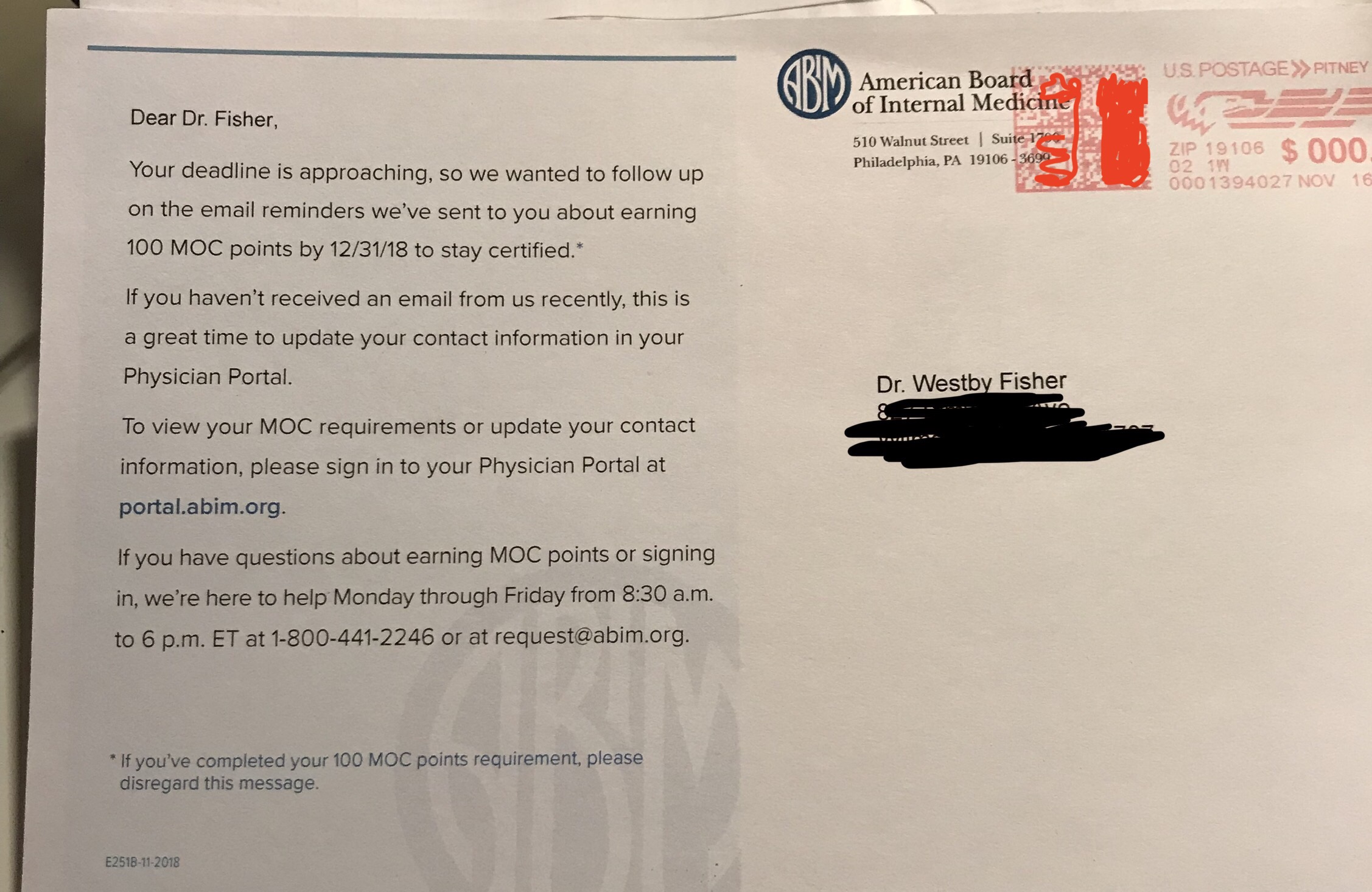
I received a threatening notice from the American Board of Internal Medicine (ABIM) with the loss of my ABMS board certification credential in November 2018 via mail if I did not acquire 100 MOC points by 12/31/2018.

Given the ramifications to my ability to retain credentials at my hospital system that requires "ABMS Board Certification" for its credentials, I did not feel I could risk the implications of this change to my original understanding of MOC® when I originally purchased the product in 2013. Consequently, I tried to find enough educational materials with sufficient MOC® points to meet that requirement in the short time I had left to complete this requirement that was appropriate for my subspecialty. Unfortunately, only the ACCSAP-9 had enough MOC® points (at about $10 per point) to reach that goal, so I spent $1600 to purchase their product.

I began working on ACCSAP9, spending hours reading and answering the questions provided so I might be able to acquire enough "points" to reach 100 by the deadline. Needless to say, because of clinical and family demands, I didn't reach that goal.

I never received "credit" for rounding at four hospitals before 12/31/2018.

I never received "credit" for spending time with my kids and only remaining father-in-law before 12/31/2018.

I never received "credit" for trying to balance work and family life before 12/31/2018.

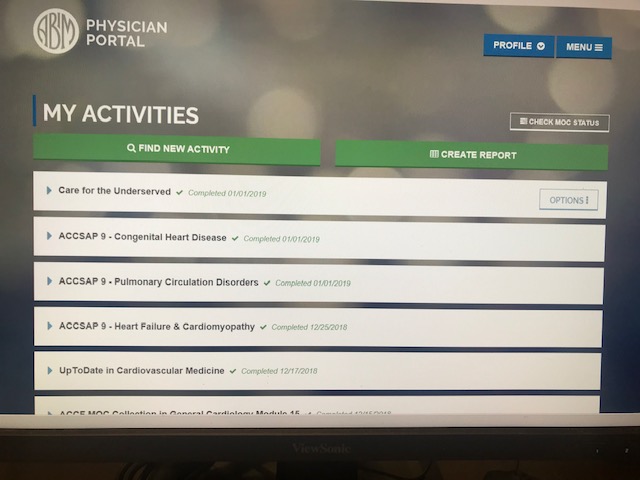
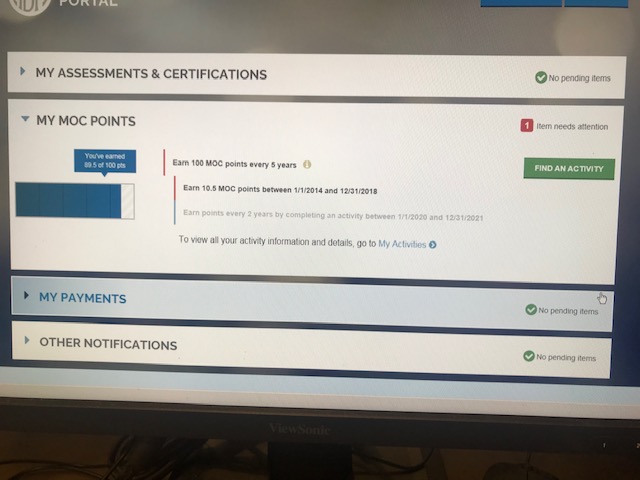
And despite completing 100 points on 1 January 2019 (the day after they were due), I now find I didn't received "credit" for the hours spent completing even more questions on the one day I had off from work on 1 January 2019:

Documentation of work performed for MOC® 1 Jan 2019
Documentation on ABIM Physician Portal that no credit was received for MOC®
points earned on 1 Jan 2019, despite itemized list above.
Nor did my family receive "credit" from the ABIM for my time spent in front of my computer at home on New Years' Day 2019.

But at least I'm still "certified" by the ABIM and "participating" in MOC® despite their threats and not completing 100 MOC® points by 12/31/2018!

* * *

It is clear to me by all that has transpired in this latest shakedown of physicians by ABIM, that they could care less about MOC® points, they just want our money will stop at nothing to secure funds for themselves and their collaborating professional societies.

That's why I'd like to give "credit" to the four physicians who bravely filed suit against the ABIM in December.

I'd like to give "credit" to the one Puerto Rican physician who still has a pending countersuit against the ABIM that still has not had a chance have his case heard in court.

I'd like to give "credit" to the 750 physicians, many of whom remain "anonymous" out of fear of retribution, and helped fund the investigation that led to the antitrust suit filed against the ABIM in just over four months.

And I'd like to announce that an additional $250,000 is being sought to continue our investigation against the ABIM to consider additional claims against them (see "Update 18").

It's time to give credit where credit is due: to the working physicians who continue to try to do their job caring for patients without coercive education tactics for funds that result in no credit of any kind to them.

Please give generously to our new campaign to end this corruption.

It is time to end, once and for all, the deceptive ABMS "continuous certification" scam for all physicians nationwide.

-Wes


Wednesday, January 02, 2019

Happy New Year, MOC!

As many of us head back to work to start a New Year, let's not forget that physicians have until January 15, 2019 to "comment" on the ABMS Vision Commission's (un-editable) Draft Report.

While Paul Teirstein, MD and his colleagues at the National Board of Physicians and Surgeons (NBPAS) did a nice job dissecting many of the problems with the Vision Commission's report and made it easy to "comment" to the Commission's Draft Report using SurveyMonkey, I would like to add a few important observations about the Vision Commission's report (and the response by NBPAS) that are not mentioned and remain stumbling blocks for me.

First of all, should physicians be bound by an adhesion contract (seen here) with Board Certification and MOC (or whatever "continuous certification" becomes called) that can change on the whim of the ABMS and their member boards "from time to time?" This gives unilateral control to ABMS and prevents appropriate checks and balances. How is this helpful to anyone except the ABMS member boards and their collaborating corporate entities - all of whom already enjoy a substantial position of power and monetary influence. Remember the history of MOC reviewed in the antitrust complaint (starting on Page 5) filed five days before the Vision Commission's "Draft Report" appeared.

Also, those corporate entities that collude with MOC are not mentioned and are extensive. A partial list includes ABMS Solutions, LLC, hospitals and the ABMS Multispecialty Portfolio Program, publishers like the Massachusetts Medical Society and Wolters Kluwer, Pearson LLC, CECity, Premier, Inc, PriceWaterhouseCooper, and subspecialty societies like the ACC and ACP - all who stand to benefit financially from MOC. Remember, a significant portion of the ABMS Vision Commission are not practicing clinical physicians and are deeply conflicted with corporate entities.

And let's not forget that the Commission's report leaves the harms already experienced by physicians and their families unmentioned (for obvious reasons) - again, see the recent antitrust Complaint filed. MOC was always about money and power for the ABMS and their member boards. The ABMS fully intends for MOC (soon to be rebranded as CertLink®) to shift from a desktop platform at a PearsonVue testing center to a mobile platform in the palm of our hands as "MOC pilots" become permanent in 2019! This translates to more distractive screen time for physicians away from patients and a lucrative life-long money stream to ABMS and their collaborators.

I would encourage physician to consider copying the content of this blog post and morph it into your own "comment" to the Vision Commission if you feel it would be worthwhile.

Also, consider donating to Practicing Physicians of America's legal fund. I believe you'll get more for your hard-earned money that protects your interests that way.

-Wes

Sunday, December 30, 2018

My Example of ABIM's Deceptive Trade Practices

As I work to complete my first 100 "MOC points" suddenly due 12/31/2018, I think my readers should be aware of the deceptive trade practices that have impacted me since I paid for the American Board of Internal Medicine's (ABIM) Maintenance of Certification® (MOC®) program in 2013.

First of all, after realizing my Board certification in Cardiovascular Diseases would expire in 2013, I paid for my Maintenance of Certification product to qualify to take my recertification examination in Cardiovascular Disease the Fall of 2013. At that time, I was subject to the ABIM's "double jeopardy" situation - if I did not pass my Cardiovascular Diseases re-certification, when it came time to re-certify in Cardiac Electrophysiology, it too would expire since the Cardiovascular Disease requirement was a pre-requisite for sitting for my Cardiac Electrophysiology re-certification examination. (This "double jeopardy" requirement was removed in 2015).

After paying for the ABIM MOC® product, this flier was sent to me explaining "Maintenance of Certification at a Glance."

On page 2 of the above flier, we can clearly see that I purchased the ABIM MOC® product that required only "100 points of Self-Evaluation of Medical Knowledge and Self-Evaluation of Practice Performance credit" to be in good standing with the ABIM for 10 years.

After completing the secure examination in the Fall of 2013, I received this letter on 22 January 2014 notifying me that I had passed the Cardiovascular Disease examination. It stated by Board certification "will remain valid until 2023." Also on that letter, I was told that "requirements to maintain certification will be changing in 2014."

Little did I know that after 2014 they would require twice as many MOC points (100 "points" every five years) to keep my time-limited ABIM board certification in good standing.

I did not agree to this change when I purchased my MOC® product from ABIM. As a result, I have now spent an additional $1675 purchasing continuing education modules from the American College of Cardiology to meet this new requirement.

While I am not an attorney, I believe changing these rules for the MOC® product that I had already purchased in 2013 from ABIM represents deceptive trade practices and will not rest until the ABMS MOC® product and its requirement for continuous certification (with its continuous payments to the ABMS member boards and their supporters) comes to an end.

-Wes

Amazing Grace: On the ABMS Vision Commission's Draft Report


Amazing Grace, How sweet the sound
That saved a wretch like me
I once was lost, but now am found
T'was blind but now I see...

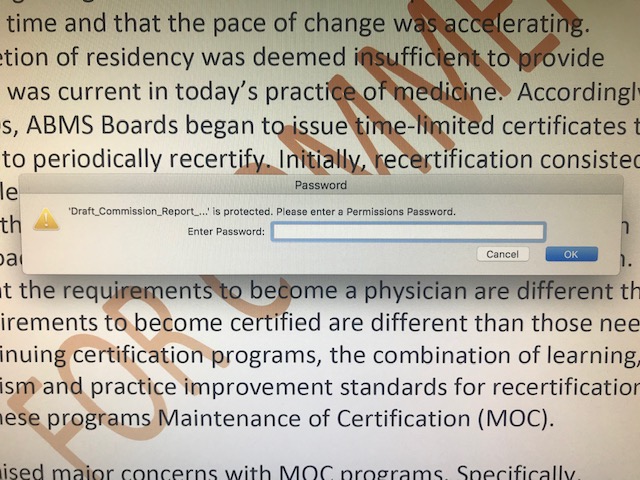
ABMS Vision Commission's Password-Protected "Draft" Report
(Click image to enlarge)

From the Terms contract for ABMS Board Certification available behind the ABIM physician portal firewall and not readily available to the public for inspection:
"I agree to indemnify, release, and hold harmless ABIM, its employees, officers, directors, members, agents, and those furnishing information about me to ABIM from any claims, liability, or damage by reason of any of their acts or omissions, done in good faith, in connection with: this application; information furnished to or by ABIM; the evaluation of my qualifications; ABIM examinations; the enforcement of ABIM's Policies and Procedures for Certification, and the policies for recertification outlined on ABIM's website, as well as all terms, conditions, and rules set forth in this website, as they may be amended from time to time; and any other action taken with respect to any certification or recertification granted by ABIM.

I understand that all ABIM materials are protected by the federal Copyright Act, 17 U.S.C. § 101, et seq. I further understand that ABIM examinations are trade secrets and are the property of ABIM. Access to all such materials, as further detailed below, is strictly conditioned upon agreement to abide by ABIM's rights under the Copyright Act and to maintain examination confidentiality.

I understand that ABIM examinations are confidential, in addition to being protected by federal copyright and trade secret laws. I agree that I will not copy, reproduce, adapt, disclose, solicit, use, review, consult or transmit ABIM examinations, in whole or in part, before or after taking my examination, by any means now known or hereafter invented. I further agree that I will not reconstruct examination content from memory, by dictation, or by any other means or otherwise discuss examination content with others. I further acknowledge that disclosure or any other use of ABIM examination content constitutes professional misconduct and may expose me to criminal as well as civil liability, and may also result in ABIM's imposition of penalties against me, including but not limited to, invalidation of examination results, exclusion from future examinations, suspension, revocation of certification, and other sanctions."

From the recently filed class-action anti-trust Complaint filed 6 December 2018 against the ABIM:
"2. This case is also about ABIM’s illegal creation and maintenance of its monopoly power in the market for maintenance of certification. ABIM is the monopoly supplier of initial certifications for internists. Beginning in or about 1990, ABIM used its monopoly position to create a second monopoly in the maintenance of certifications for internists. Since then ABIM has used various anti-competitive, exclusionary, and unlawful actions to promote MOC and prevent and limit the growth of competition from new providers of maintenance of certification for internists. ABIM’s conduct, including but not limited to tying and exclusive dealing, has harmed competition by preventing competition from others providing cheaper, less burdensome, and more innovative forms of maintenance of certification desired by internists.

3. The tying product is ABIM’s initial board certification, which it sells to internists nationwide. ABIM sells initial certification services to physicians in internal medicine and twenty foundational subspecialties within the field of internal medicine. Many internists hold multiple ABIM certifications, purchasing initial certifications in both internal medicine and one or more additional subspecialties.

4. The tied product is MOC, ABIM’s maintenance of certification. ABIM has tied MOC to its initial certification. As described more fully below, to drive sales of MOC and to monopolize the market for maintenance of certification, ABIM has forced physicians to purchase MOC, charged inflated monopoly prices for MOC, and thwarted competition in the market for maintenance of certification.

5. Approximately one of every four physicians in the United States (including those practicing in fields other than internal medicine), or about 200,000 internists, have purchased initial ABIM certifications. ABIM has throughout the relevant period controlled approximately 100% of the market for initial certification of internists in the United States. Through its MOC program, ABIM has also controlled in excess of 95% of the market for maintenance of certification of internists. ABIM has unlawfully obtained and maintained its monopoly power in the market for maintenance of certification services for the anti-competitive purpose of requiring internists to purchase MOC and not deal with competing providers of maintenance of certification services.

6. Plaintiffs bring this Class Action to recover damages and injunctive and other equitable relief on behalf of all internists required by ABIM to purchase MOC to maintain their initial ABIM certifications."
To suggest, even for a moment, that the ABMS's Vision Commission's Draft Report is fully transparent regarding the financial, corporate, and political conflicts that have embroiled MOC® from its inception, working physicians should understand that the "Vision Commission" is little more than a puppet for corporate interests. All the "public comment" in the world - especially when the draft is un-editable and proposes no action to end MOC® - makes a mockery (pun intended) of the entire "ABMS Vision Commission" process.

The ABIM employs a medical director with close ties to Price Waterhouse Cooper (PwC), a fact not disclosed on his ABIM employment announcement in 2015. PwC is a network of firms in 158 countries, 721 locations, with 250,930 people that earned $37.7 billion in 2017 alone.

I believe PwC is working with ABMS to salvage MOC® - however it is ultimately branded. Why else would so many non-physicians with ties to insurance companies and other interests sit on the Commission, too? Even worse, we now see that the entire Draft Report is based on the same propaganda and "professionalism" definition that led to the MOC® controversy in the first place four years ago.

Given these realities, it becomes crystal clear that the Vision Commission's Draft Report is little more than 96-pages of unprofessional deception that is not working to end "continuous certification," but rather perpetuate it.

What, then, do the public's comments to the ABMS Vision Commission's Draft Report mean?

Nothing.

T'was Grace that taught my heart to fear
And Grace, my fears relieved
How precious did that grace appear
The hour I first believed

Through many dangers, toils and snares
We have already come.
T'was grace that brought us safe thus far
And grace will lead us home,
And grace will lead us home

Amazing grace, how sweet the sound
That saved a wretch like me
I once was lost but now am found
T'was blind but now I see

Was blind, but now I see.


-Wes

P.S. For those who still feel inclined to comment on the ABMS Vision Commission's Draft Report, please read the National Board of Physician and Surgeon's critique of the draft report that recommends "an immediate moratorium on several harmful components of MOC."

Personally, given the deceptive history of MOC® and the harms caused to physicians and their patients, I see no redeeming qualities to MOC® (or any other forms of "continuous certification" proposed by the ABMS and their member boards) whatsoever and believe the entire process should end immediately for the sake of our profession and our patients.

Sunday, December 23, 2018

The Maintenance of Certification Controversy 2018: The Year in Review

The American Board of Medical Specialties/American Board of Internal Medicine (ABMS/ABIM) Maintenance of Certification® (MOC) controversy continued unaffected in 2018 despite significant pushback from working physicians.

Background

For those unfamiliar with this controversy, ABMS board certification of a US physicians was once a completely voluntary lifetime accolade physicians could elect to hold after they completed their residency. They paid to take a test created by a self-appointed "board" of academic physicians in their specialty - analogous to the legal bar examination - that "certified" they had a fund of knowledge acceptable to practice their trade. Physicians used this "board certification" as a marketing accolade with their peers to garner referrals from colleagues. 

Prior to 1990, ABMS board certification was never required to practice medicine in any US state or territory. Rather, it was the responsibility of the accredited residency program to train doctors and document they had sufficient experience to enter the workforce as that specialist safely. State licensing agencies verified that training and stipulated that physicians earn "Continuing Medical Education" credits to remain current in their field to maintain their state licensure in good standing.

In the 1960's, seeing the financial struggles of older boards formed 30 years before that created the lifetime board certification accolade, the American Board of Family Medicine, a new ABMS member board, was created with a new financial model that proved to be very lucrative: time-limited certification. The ABFM would soon be rolling in cash, earning tens of millions of certification and re-certification fees annually. Not surprisingly, it was not long before all 24 ABMS member boards shifted their certification models to implement time-limited certification by 1990, arguing that doctors had an obligation to keep up in their field (and pay the boards recurrent fees to do so). By 2015, the physician board certification and recertification industry mushroom into a $5.7 billion a year bonanza for the academic elite and their industry colleagues with publishing priority in influential specialty medical journals while not disclosing their conflicts of interest

The pushback began in 2012 when one physician became frustrated with the arduous and needless re-certification process. After even more new requirements to time-limited certification were added in 2014, a full-blown civil war in medicine between the bureaucratic elite and working physicians began. It was December 2014 when the full extent of the controversy became apparent:  "medical professionalism" defined by luxury condominiums complete with their chauffeur-driven Mercedes S-class town cars, spousal travel fees, high salaries, and undisclosed conflicts of the leadership of the member boards.

Never once in the history of time-limited certification were the potential harms of time-limited certification to working physicians considered or acknowledged.

Caught with their hands in working physicians' financial cookie jar, the ABIM issued an unprecedented mea culpa message in February 2015 to its physician membership, but instead of coming clean, the cover-up and tap dancing began in an attempt to preserve the money flow.

Recaps of the revelations and cover-up/pivoting of the process are included here:

2015: The Maintenance of Certification Controversy 2105: The Year in Review

2016: The ABMS/ABIM Controversy 2016: Year in Review

2017: The ABMS/ABIM MOC Controversy 2017: Year in Review

The 2018 summary of events are recapped below:

 * * *

12 Jan 2018: Practicing Physicians of America (PPA) sponsors a national survey (questions asked here) of physician attitudes about maintenance of certification, including evaluating potential harms to physicians caused by the process.

27 Jan 2018: Psychology of MOC and the Gaslighting of America's Physicians discussed.

2 February 2018: The ABMS tries to quell physician unrest and forms a 'Vision Initiative' with medical specialty societies and state medical societies (among others) concerning MOC.

8 February 2018: The ABMS Vision Initiative Committee is announced and is laced with numerous non-physicians with many conflicts of interest.

15 Feb 2018: The self-selected ABMS Vision Initiative Committee launches their own survey of physician attitudes toward Maintenance of Certification but steers clear of assessing negative consequences of MOC on physicians.

25 Mar 2018: ABMS/ACP announce partnerships with medical specialty societies to keep the money flowing

6 April 2018: ABIM publishes its "how-to" video on the Knowledge Check-in program revealing its mechanics.

23 May 2018: After ABIM publishes its tax forms late, PPA announces GoFundMe crowdfunding effort effort to raise funds for a pre-litigation investigation into the ABIM and the ABIM Foundation's activities.

11 Jun 2018: Results of the PPA survey on MOC announced at the AMA House of Delegates meeting in Chicago.

28 June 2018: A critical review of the ABIM Knowledge Check-in option for Maintenance of Certification (video) is published questioning a physician's right to privacy.

2 Aug 2018: The Federation of State Licensing Boards tries to legislate away their liability.

26 Aug 2018: The ABMS releases the results of their survey on MOC and the results are similar to the survey sponsored by Practicing Physicians of America.

6 Sep 2018: A video reviewing the main PPA survey results on MOC from 7007 physicians is published.

7 Sep 2018: PPA's GoFundMe effort reaches its goal of $150,000.

14 Sep 2018:  DOJ issues opinion on MOC, calling the program "anti-competitive."

25 Sep 2018: The ABMS and American Board of Urology offer their spin on the DOJ letter concerning MOC®.

1 Dec 2018: The ABIM Knowledge Check-In program crashes and hundreds of physicians are left in limbo.

6 December 2018: Four physicians sue the ABIM in a class action lawsuit representing over 100,000 physicians claiming anti-trust violations, among others.

10 December 2018: ABIM issues a statement concerning the suit on its blog promising that "the organization will vigorously defend itself, recognizing that doing so will consume resources far better dedicated to continuous improvement of its programs."

21 December 2018: The far-reaching implications of the antitrust suit reach across the pond.

* * * 

It's been quite a ride.  Here's to a productive New Year in 2019!

-Wes

Sunday, December 16, 2018

Primum Non Nocere

Primum non nocere - latin for "first, to do no harm" - is a philosophy working physicians aspire to throughout their careers when caring for patients. It defines a bioethical baseline for physicians and should be their guiding light in clinical decision making throughout their careers. Unfortunately, as is too often the case when politics and power enter the picture, it is easy for physicians to fall prey to avarice and greed, placing their financial and political interests before their patients and physician  colleagues.

Such is the case, in my opinion, with the bureaucratic ranks within the academic House of Medicine. Today, it is "pay to play" for hundreds of thousands of US physicians thanks to the American Board of Medical Specialties (ABMS)/American Board of Internal Medicine(ABIM)'s Maintenance of Certification (MOC) program.

As I mentioned in an earlier blog post, I received a notice in late November of this year by US mail that I had to earn 100 Maintenance of Certification (MOC) points, or I could see a "change in my certification status." The ABIM webpage displays that notice prominently as well.

Recall that I certified in both Cardiac Electrophysiology and Cardiology with the 2013 testing cycle. At that time, according to the ABIM's website and this archived webpage from January 18th, 2013, MOC required that I perform 100 MOC points every 10 years. When I purchased MOC and registered to take my recertification test in October 2013, this is what I thought I was purchasing.

Now I find the ABIM has changed the rules. Now we must perform 100 MOC points every 5 years.

Needless to say, I had only 10 MOC points when I received that notice from the ABIM after the Thanksgiving holiday. I had vowed not the earn another point until it might be needed 10 years from the data I enrolled for my MOC exam and have been working to end MOC through conventional channels since that time. I have talks at the AMA House of Delegates, Ohio Health committee, and help with the Texas anti-MOC legislation as proof of that effort. One guy doesn't stand a chance, I learned.

Still, I became worried about the implications of now needing another 100 MOC points and the time, focus, and commitment required so I could keep seeing patients. I searched for ways I could fulfill my requirements without paying the ABIM another dime.

This is where things got interesting.

It seems I pre-paid for "30 MOC points" - one for a 2017-2019 Hospitalist Update, a 2017-2019 Internal Medicine Update, and a "Care for the Underserved" module that offered 10 MOC points. (The other offerings that might have been there before had "expired.") These thirty points wouldn't be enough to get me where I needed to be by 21/31/2018. Furthermore, learning about these non-applicable topics to my specialty seemed to be a waste of time. Still, I needed points, so I did what I could and even performed the Hospitalist update. I was surprised to find that the ABIM's own Robert Wachter, MD, "Mr. Hospitalist" himself, helped author this module.  Because it was outside my wheelhouse, that module took way too long to successfully complete, but I finally did it to earn my "points."

Nothing to see here folks...

I was getting concerned. I checked the Heart Rhythm Society's webpage hoping they would have a module closer to my specialty that I could complete quickly and was surprised to find that they could only offer me 6.75 MOC points if I purchased a $650 Medical Knowledge update in Electrophysiology - a cost of $96.30 per MOC point! That was an astronomical price per MOC point and one that wouldn't get me anywhere near my goal of 100 total points.

I moved on.

The ABIM site suggested I look at the various offerings provided by the ACCME at http://www.cmefinder.org - a horribly rudimentary website that had poor filtering capabilities for the offerings I might need. They sent me to this hospital system and that hospital system with ways to game the system, but nothing would work for me or each offering gave me 0.5 to 1 MOC point each. Everyone, it seemed, were more than happy to offer a point here or a point there, but every point required a post-MOC survey of how I liked it, it the exercise was free from commercial bias, etc. - all very time-consuming - so I kept looking.

I turned to the American College of Cardiology's website since I am a Fellow of the American College of Cardiology and looked at their MOC offerings. I still needed a LOT of points if I was to make 100 by 12/31/2018. That's when it struck me: this was the plan! Whether you're an ACC member or not, you've got to pay the Man.

There, on the ACC's MOC webpage was this offering: ACC Self Assessment Program 9 (ACCSAP9) for $1600 in return for 155 potential MOC points good through mid-2019, a bargain-basement price of $10.32 per MOC point!

Left with few options this late in the do-or-die MOC extortion game to keep my hospital privileges and insurance payments coming, I purchased ACCSAP-9.

Before I could get started, I had to agree to a "Credit Agreement." In that agreement I had to agree to "read all text, watch all presentations and answer all questions within the topic for which you claim credit. You must obtain 70% or better on the questions, but you may answer the questions as many times as necessary to achieve that score."

Please.

Then there was the indemnify and hold harmless "Disclaimer" clause of the Credit Agreement: "The American College of Cardiology is not responsible for the results obtained from the use of the information contained in this publication... The American College of Cardiology does not warrant the information contained herein is in every way accurate or complete, and disclaim all responsibility."

Ahem, isn't this WHY we're being forced into this expensive exercise? If I can't rely on them to assure patient and "the public's" safety, what good are these "Knowledge Assessments" for patients?

Having no choice but to "agree" to their terms, lest I lose my hospital privileges and insurance payments to my hospital on 1 Jan 2019, I reluctantly clicked "I agree" and started the arrhythmia section of the testing the week before Christmas.

My wife and kids were not pleased.

"Dad, be here now. It's Christmas! Here you are, 35 years of experience, doing these mindless exercises and getting all stressed out. Haven't you done this long enough?"

"Honey, it's always me doing everything for Christmas while you get all stressed out and have to sit at that damn computer, doing quizzes. Will it ever end? How many years has it been?"

I realize that they are right. Years of being Mr. Good Guy while they lost out on their father. Experience means nothing to the ABMS. Money is everything with MOC. It is clear to me now that the "lifelong" educational system for physicians is horribly broken - a once reasonable voluntary system of continuing medical education required for state licensure, has morphed to an do-or-die extortion scheme for doctors' money. It's not about the patients or the doctor. These organizations  indemnify themselves of this responsibility. It's just about the money.

And for hospitals and insurers, it's about control of the doctors to keep their profits high.

The ACC - our cardiovascular specialty society that looks more and more like the AMA, has found a way to get rich - very rich - using the threat of my loss of privileges to fund their organization via the ABIM's MOC program. No wonder they collaborate.

The American College of Physicians (ACP) has their Medical Knowledge Self-Assessment Program (MKSAP) likely does the same thing. So does the American Board of Pediatrics. Whether the ABMS member board is a "continuous certification" or MOC participant, the ABMS mothership keeps the money flowing to all of these entities who claim to educate using computer products while hiding behind "Disclaimers" that relinquish their responsibility.

Buying a product in 2013 thinking one thing, only to find it's another, is fraud as far as I'm concerned. Doctors like me don't like being swindled and forced to play games that have no meaning so they can keep providing patient care. There simply are not enough hours in the day for any of us to put up with these shenanigans required by the members of the Accreditation Council for Graduate Medical Education (like the ABMS) for their financial benefit. They are not only hurting doctors, but hurting their families at Christmas time, too. The ACGME members and ABMS Vision Commission should each carefully read how the ABMS MOC program has harmed doctors in this latest serious anti-trust Complaint filed in federal court against the American Board of Internal Medicine.

The "ABMS Vision Commission's" Draft Report fails to disclose these potential harms caused to physicians by MOC and its numerous conflicts of interest. Do they really think their assets will  indemnify them of their responsibility to the well-being of working US physicians, and in turn, their patients?

I think not.

Primum non nocere.

-Wes


Sunday, December 09, 2018

Boarded to Death: Physicians Sue the ABIM

On Thursday 6 December 2018 in the Federal District Court of Eastern Pennsylvania, a class action lawsuit on behalf of over 100,000 internal medicine physicians was filed against the American Board of Internal Medicine (ABIM) by four internists.

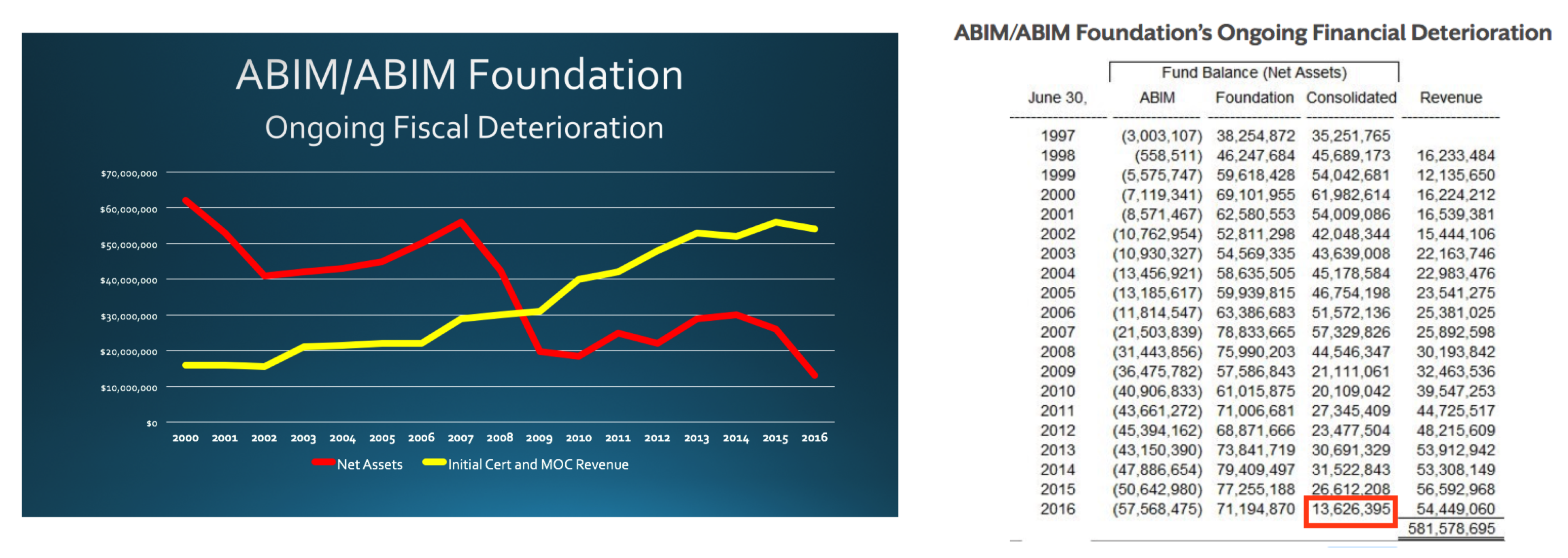
The plaintiffs brought the action pursuant to the Clayton Antitrust Act, 15 U.S.C. §§ 15 and 26 to recover treble damages, injunctive relief, costs of the suit, and reasonable attorney’s fees arising from violations of Sections 1 and 2 of the Sherman Act (28 U.S.C. §§ 1 and 2). The suit alleges that there is illegal tying of the ABIM’s initial board certification product to its maintenance of certification® (MOC®) product in violation of Section 1 of the Sherman Act and illegal monopolization and monopoly maintenance in violation of Section 2 of the Sherman Act. The suit claims that after the ABIM's attempts to sell a voluntary "Continuous Professional Development" accolade program failed to recruit enough physician interest, the ABIM created a wholly new market product for itself, time-limited board certification (later branded as "Maintenance of Certification®" or MOC®), forcing physicians to purchase this product or lose their specialty certification. It also alleges ABIM induced hospitals and related entities, insurance companies, medical corporations, and other employers to require internists to be ABIM-certified to obtain hospital consulting and admitting privileges, reimbursement by insurance companies, employment by medical corporations, malpractice coverage, and other requirements of the practice of medicine. As an indication of ABIM's illegal tying and monopoly maintenance, the suit claims, is that the ABIM is able to charge inflated monopoly prices for MOC®, increasing the fees it generates from MOC® 276% since 2000. Each of the plaintiffs have claimed substantial harm caused by MOC®.

A link to the full Complaint can be found here.

-Wes

Update: The original class action anti-trust Complaint filed 6 Dec was amended 23 January 2019 to include claims under the RICO Act and state law unjust enrichment claims.

Tuesday, December 04, 2018

Doctors' Right to Privacy: Is MOC Collapsing Under Its Own Weight?

On Saturday, 1 December 2018, the American Board of Internal Medicine (ABIM) suffered a meltdown of its highly touted "Knowledge Check-in" ("KCI") alternative to its mandated Maintenance of Certification® (MOC) program.
At 09:45 AM, Saturday, December 1, 2018, during the ABIM Internal Medicine Knowledge Check-In (KCI) administration, Pearson VUE – ABIM’s exam delivery provider – experienced network instability issues that affected hundreds of physicians scheduled to take the Internal Medicine KCI exam.

As a result of these issues, over a period of approximately two hours, physicians were unable to start the KCI, and those who were in the process of testing were unable to proceed.
"KCI," a program that requires continuous payments to ABIM of $155 per year per US physician, was heavily promoted by ABIM as a "kinder, gentler MOC" that physicians could perform in the comfort of their own home, provided of course, that the physician's computer met ABIM's exacting standards. If not, the physician was required to pay an additional $130 to take their MOC examination at a PearsonVue testing center. Sadly on Saturday, hundreds, if not thousands, of US physicians (we really don't know) - all of whom had already funded millions upon millions of dollars for expensive executive salaries, benefits, and contractor expenses to the ABIM for years - lost another of their few precious free weekends staring at computer screens like guinea pigs for academic medicine's biggest income redistribution Ponzi scheme, MOC®.

Not surprisingly, after a lackluster apology, the ABIM tried to deflect blame to someone else: Pearson VUE.
“We at Pearson VUE take full responsibility for Saturday’s disruptive outage of service for ABIM’s Internal Medicine Knowledge Check-In. ABIM did everything they could to help us – and support you – during this time. It was our system that had these issues. As we have promised them, we promise you that we are taking additional steps in order to prevent this from happening again. We are extremely sorry for this unfortunate and rare occurrence and also apologize to the ABIM organization for the disruption and surrounding issues this may have caused. We are committed to continue working in partnership with ABIM in the care and handling of this incident.”
Calls made to ABIM assured physicians that only Pearson VUE was involved in the online proctoring. But there is an important disconnect in the announcement made by ABIM about this incident. Note that the press release issued to the public mentions that physicians at home AND at Pearson VUE testing centers were affected:
At approximately 9:45 AM (EST), on December 1, 2018, ABIM began receiving reports from Pearson VUE and individual test takers that they were unable to begin the exam or were unable to continue it if they had already started.
Their explanation is incomplete.

Might the problem have gone beyond Pearson VUE since individuals at home were similarly affected?

Recall that security of ABIM's examination is of utmost importance to them. They've even had a "Director of Test Security" and even sent their own director of test content to spy on physicians attending a board review course without their knowledge and later sanctioned or suspended over 130 physicians' board certification certificates accusing them of "cheating" in 2009. At that time, the same Director of Test Security for ABIM also worked for a litle known test security firm, Caveon Test Security. It was David Foster, PhD, CEO and President of Caveon Test Security, who was also a Chief Scientist at Kryterian Global Testing Services that touted the security and reliability of their patented keyboard and eyeball monitoring services to the American Board of Pediatrics Foundation on 15 May 2015. It was Kyterion's home testing platform that the ABIM's entire KCI initiative was based.

ABIM diplomates like myself want to know what role the link to Kryterian Global Testing Services had in the events of December 1, 2018 KCI meltdown. ABIM is obligated to come clean on this issue, since it appears more than just testing was occuring that Saturday in December. If the link to Kryterion's keyboard and eyeball tracking technology were involved, physicians' privacy rights may have been violated as well in the name of test security during this latest MOC® debacle.

-Wes

Saturday, December 01, 2018

ABIM Fees Place Physician Bank Accounts on High Continuous Suction

The American Board of Internal Medicine's (ABIM) ongoing seemingly endless changes to their Maintenance of Certification® (MOC®) product is affecting physicians who re-certified a short five years ago - like myself.

Let's review precisely what has taken place since time-limited certification was implemented by the ABIM in 1990:
  • From 1936 to 1990, ABIM Board certification was a lifetime credential.

  • From 1990 to 2005, ABIM ended lifetime certification, and began issuing only time-limited certification to physicians for those certified after January 1, 1990, requiring re-testing (and renewed payments to them valued at more than a thousand dollars) every 10 years.

  • In 2006, "Maintenance of Certification," a product rebranded from "Continuous Professional Development" (note the similarities of these two linked webpages) was implemented. MOC was later trademarked by the American Board of Medical Specialties who stipulated programatic alignment from ALL physician subspecialty boards and required them to perform additional practice performance tasks and earn 100 "MOC points" AND re-take their board certification test every 10 years. Additional fees were often required to earn points from "MOC-eligible" courses.

  • In 2013, the ABIM imposed more burdensome changes to MOC, not only having to re-take their examination every 10 years, but a "MOC activity" had to be completed every 2 years with patient safety, patient "voice", and survey modules or "Practice Improvement Modules" performed every 5 years and they also had to accumulate 100 MOC points every 5 years.

  • Now the ABIM requires internists to pay not only an annual program fee to participate in MOC, but  an "Assessment Fee" for MOC examinations. Internists can sign up for Knowledge Check-in examination every two years, or still take the 10 year examination.

Through self-serving rule changes, the ABIM has become a tax-exempt for-profit money machine that has placed physician bank accounts on high continuous suction. They coerce physicians by  threatening them with the loss of their credentials or ability to receive insurance company payments to keep the money flowing.

We know why: thanks to their own hubris and avarice, they are failing financially. They have lost the trust of US physicians. And are a partisan organization beholden to the Medical Industrial Complex, not patients.

Given then above information, I believe the ABIM's tax-exempt status should be revoked. Their fees have skyrocketed from $795 to $2200 over 18 years (2000 to 2018) - or 276% - while providing the same product, "certification" of working internists since 1936, nothing more.

-Wes


Sunday, November 25, 2018

ABIM To Diplomates: Merry Christmas! Participate in MOC or Else

This weekend, I received this orange notice from the American Board of Internal Medicine (ABIM) in the mail:

(Click to enlarge)


At first I was going to ignore this flier, since I am board certified until 2023 in Cardiology and 2024 in Cardiac Electrophysiology.

But then I read the reverse side of the flier, and noticed this threatening sentence:
"Your deadline is approaching, so we wanted to follow-up on the email reminders we've sent to you about earning 100 MOC points by 12/31/2018 to stay certified." (emphasis mine)
(Click image to enlarge)

It appears the ABIM will revoke the "time-limited" certification(s) I have paid for through 2023 in Cardiovascular Diseases and through 2024 in Cardiac Electrophysiology because I have refused to earn 100 Maintenance of Certification® (MOC®) points by 12/31/2018.

Must diplomates who have "pre-paid" for their certifications now ALSO have to participate in MOC just to maintain their pre-paid certificates?

I certainly hope not. If so, things could get ugly very quickly for everyone involved.

-Wes

Tuesday, November 06, 2018

Ending MOC Nationwide

Continuing education for physicians is important (and we've been doing it all our lives on our own), but when working physicians' right to care for their patients is threatened by unaccountable non-profit testing organizations that have serious undisclosed conflicts of interest, we will take action.

 -Wes


P.S.: Patients, doctors: want to help? You can still donate.