Carter was diagnosed with a disease called amyloidosis two months ago, a condition that damages the heart through protein build-up.-Wes
“It just sort of fractured as we cut across it,” said Mayo Clinic Cardiovascular Surgeon Dr. Lyle Joyce. “It was just crunchy.”
As a result, neither ventricle could pump blood. Joyce performed the operation, first taking out Carter’s real heart. For a man without a heart, Carter shows a lot of heart.
Monday, May 14, 2012
"The Tin Man is Happy"
... because he's living without a heart:


Sunday, May 13, 2012
Amazing Grace
“Would you like some crackers? Maybe some cheese? You must be hungry.”
“No thank you. But
could I have a glass of water?”
I sat outside perplexed, reading assembly instructions for a small
gas grill that contained no words, only pictures. She sat inside, a prisoner of sorts, worrying
about me. I, of course, was fine, but
she had sent a foot soldier to make sure I was fine.
Much has changed, but much remains the same.
Soft supple skin has given way to tissue paper. Arms and
shoulders once cushioned by the right amount of subcutaneous fat and muscle
have given way to boney prominences punctuated with atrophic recesses. Her ankles, once speckled with tiny varicosities that she blamed on us, were wrapped to provide physical pressure where oncotic pressure has failed. Her beautiful blue eyes stood fast and
captivating, only their lids proved unreliable.
Much has changed, but much remains the same.
With my recent trip there, we spoke of the parties, the anniversaries, the projects, the
plans. While short, she would chuckle at the
craziness of it all. She could still marvel at my pictures: the kids, my wife, my wife's family and especially my father. Her tender gaze and audible sigh spoke volumes
as she pined for another time and him.
Much has changed, but much remains the same.
I wish that I could be there today to make you breakfast. I wish that I could see your smile. I wish you could see the kids - they’ve gotten so big I wish you could see our flowers. Maybe we could watch a movie together? Or share a bit of guitar? It was hard seeing your appetite dwindle, Mom, your
challenges with solid food.
Could I get you some crackers or maybe some cheese? You must be hungry.
Are you sure?
-Wes
PS: Happy Mother’s Day, Mom.
Saturday, May 12, 2012
More on the DOJ ICD Investigation
Edward J Schloss, MD reviews comments made at HRS regarding the recent DOJ investigation of ICD implantation indications on Cardiobrief :
-Wes
Suneet Mittal MD of Columbia University gave a detailed account of his group’s experience with a Department of Justice investigation of ICD implantation outside of NCD guidelines.
...
In his HRS discussion, Mittal was careful to distinguish between a CMS audit and a DOJ investigation. CMS is responsible for enforcing National Coverage Determinations (NCD). He indicated that the NCD for ICD implants is unique: “this is the first time in the history of US medicine that a National Coverage Decision is being nationally enforced.” To CMS, the NCD is “analogous to the 10 Commandments” with little room for nuance or interpretation.
In contrast, the Department of Justice serves as a bridge between CMS and clinicians, and has the ability to exercise what Mittal termed “incredible prosecutorial discretion.” Their charge is enforcement of the False Claims Act and Mittal found them to exercise more flexibility than CMS.
Mittal said that penalties for unacceptable deviations are still being determined. Penalties under the false claim act can recover up to triple the monetary damages of the event. He added the DOJ would consider prior patterns of infraction and ongoing hospital corporate integrity agreements in assessing penalties.Good stuff. Read the whole thing.
-Wes
A Heart Rhythm Society 2012 Scientific Session Wrap-Up
This year’s Heart Rhythm Society Meeting in Boston, MA was a relatively well-attended affair with plenty of excitement, controversy, and collegial interactions for all. It’s always great to head to these sessions each year and catch up on the latest advancements in our field and to see good friends and colleagues from over the globe. I was particularly struck by the number of senior electrophysiologists I spotted who helped shape the Heart Rhythm Society in its earliest days as NASPE and continue to do so today: Ralph Lazarra, MD, Ben Scherlag, MD, Warren (Sonny) Jackman, MD, Melvin Scheinman, MD, Doug Zipes, MD, to name a few.
The exhibit floor did seem too overdone: most people there appeared appropriate – no food vendors selling “heart healthy diets” were detected, seems those have been relegated to the ACC meeting. But of course, John Mandrola and I still had to check out the Ford Motor car that was supposed to have an EKG-sensing optional passenger seat installed. (We wanted to be the "Walt Mossbergs" of EP and do a cutting-edge review.) Sadly, we learned the one working prototype remained in Europe. Nonetheless, we had an opportunity to ask about the concept with one of Ford's German engineers. He was kind enough to provide us with a bit more technical information (1.2 Meg pdf file) beyond what I have blogged about (somewhat tongue-in-cheek) regarding the concept last year. Still, even without the nerdly car seat in place, John Mandrola, MD appeared ready to buy the car anyway.
Thursday night concluded with my social media talk for doctors. It was very well attended by nurses, ancillary care providers, physicians and as a surprise dignitary, Dr. Mel Scheinman – my former fellowship director at UCSF. Despite AT&T’s data service dying just before the event (seriously, no internet) things went off without a hitch, thanks to some faithful Zoll LifeVest employees and Dr. Schloss’s iPad that used a Verizon data plan! (Thanks, Jay!)
 |
| HRS 2012 Poster Session |
But I also noted another trend: the number of attendees from overseas compared to those from the US. It was pretty cool to walk through the poster sessions and listening to the people from Germany, the Netherlands, China, Japan, England represented. Sure there were plenty of US doctors, too, but it seemed the proportion of US doctors was less compared to earlier years - as if it’s become too expensive for our own doctors to attend but prevalent industry sponsorship for foreign doctors remains. (Just a hypothesis)
On Wednesday I attended and live-tweeted the Atrial Fibrillation Symposium. (Here's an interactive map of ALL of the the tweets with the hashtag #hrs2012 – click on my “node” to see my list of tweets and scroll down). The event was VERY well-attended (sold out, I think) and had pearls from many of yesterday’s and tomorrow’s leaders in our field packed in a very short period of time. Clearly the work of Sanjiv Narayan, MD from San Diego VA, originally presented at last year’s Scientific Sessions via the preliminary CONFIRM trial, was a standout. His physiologically-based ablation approach (identifying and targeting the mechanism of the arrhythmia using FIRM (Focal Impulse and Rotor Modulation) mapping), rather than a strictly anatomically approach, was intriguing. I discussed the mapping system with other physicians who had used the system from U of Indiana and Ohio State and they shared similar excitement. The technique is not without its skeptics, however, but the initial reports from others with some limited experience suggested “it’s real” and “doesn’t work on everybody but seeing persistent afib stop with ablation is pretty common.” The mapping system is being marketed by Topera Medical.
Staying at the Seaport Hotel in Boston, while lovely, proved very interesting. At 2 am early Thursday morning, I was woken from a sound sleep by a fire alarm saying "This is NOT a drill." After gathering my cellphone and donning enough clothing to be presentable, I proceeded down the stairs 16th floor (!) with other bedraggled hotel patrons. I couldn't help but think how ironic it was that I came to Boston to escape my pager only to be awakened like this! Seeing folks in their robes, t-shirts, nightgowns all huddled beneath a neighboring building's overhang was somewhat comical and the light show created by the stairway alarm strobes was captured (Quicktime movie, 500K - turn your head sideways) by yours truly and proved quite entertaining. (No, those are not defibrillator firings!) Fortunately, the hotel soon received an "all clear" from the fire department.
The following morning (Thursday), the Riata lead recall updates were presented. Needless to say, I didn't quite make that packed session early enough. Edward J. Schloss, MD (@EJSMD) live-tweeted this event for us. (Click on his “node” on the above Twitter graphic to display). Ultimately, many people wanted to know how likely St. Jude Medical’s later-generation defibrillator lead, the Durata, might fare since it shares some of the design characteristics with the Riata family of leads. Enter Charles (Chuck) Love, MD whose presentation went far at allaying many of those fears, at least for now.
My late Thursday morning was spent discussing and planning a possible social media session at the 2013 Heart Rhythm Society Meeting in Denver, CO with Kevin Campbell, MD (his reflections on HRS can be found here) and John Mandrola, MD – two guys I had known from social media circles but had never met face-to-face. There was lots to consider and some buy-in still needed from the Heart Rhythm Society, but so far the interest appears strong. As we move forward in this endeavor, input from others is welcome as we try to construct a session and perhaps a how-to hands-on breakout session on how to use social media for information feeds, marketing and professional collaboration.
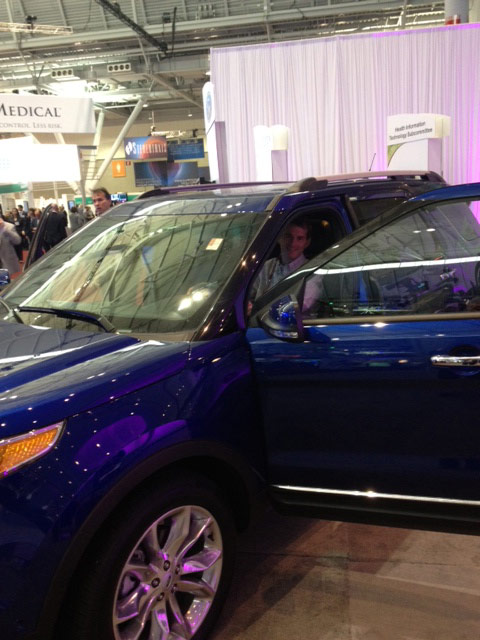 |
| Cars at Scientific Sessions? |
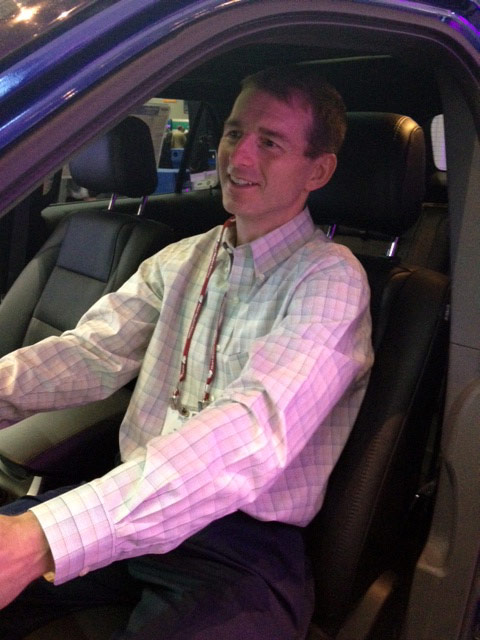 |
| John Mandrola, MD |
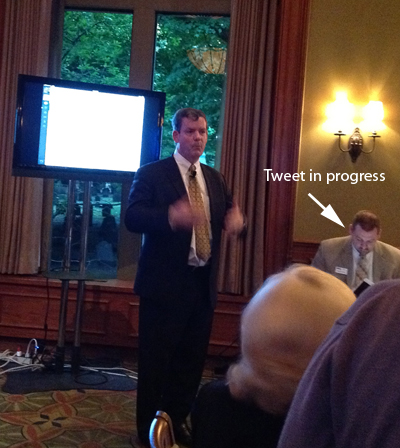 |
| Dr, Wes in action |
Friday was filled with more sessions: left atrial appendage occluding devices, a few talks of the newer anticoagulants and anti-arrhythmic choices for people with atrial fibrillation, and a lively debate on the pros and cons of cryoballoon ablation catheters from the folks from Germany nicely rounded out the meeting. Then, before I knew it, it was time to head back to the airport.
So there you have it: a brief synopsis of what I felt was a very interesting and interactive scientific session this year. Thanks to everyone who made it such a great affair!
-Wes
Friday, May 11, 2012
A New Day: Interim Thoughts on the 2012 Heart Rhythm Society Scientific Sessions
I woke this morning to sunshine pouring through my hotel window as the heavy clouds of the last several days in Boston have disappeared. A whole new day has arrived.
It has been interesting to take a 50,000-foot view of our scientific proceedings in Boston so far, especially since I carry with me many memories of former scientific sessions, including those of the American College of Cardiology sessions earlier this year.
What is clear is that my field of cardiac electrophysiology, like a dividing amoeba, has nearly completely divorced itself from its former professional and scientific kin, the ACC. While many similarities of the two meetings' format are similar, many differences are apparent, too.
As Bruce Wilkoff, MD, President of the Heart Rhythm Society, read the teleprompter at the opening plenary session Wednesday, we heard that the Center for Medicare and Medicaid Services (CMS) has officially sanctioned the field of cardiac electrophysiology as its own separate billable specialty. I wondered (ever-so-briefly) why this mattered. But a quick reality check reminded me that up until now, thanks to a convoluted and ever-changing set of governmental billing rules, CMS would not pay electrophysiologists for their expertise in patient care because (not uncommonly) the patient had already been seen by a cardiologist from the same practice group on the same day. Never mind that the two specialties really are different. That's the way it had stood electronically according to CMS until this year.
But this divorce from our general cardiology colleagues comes with mixed feelings to this older clinical cardiac electrophysiologist.
You see we miss important connections to our general cardiology colleagues when we separate ourselves from them for billing purposes. The irony in all of this (and part of my concern) is that cardiac electrophysiologists still must maintain general cardiology board certification as a prerequisite to remaining board-certified in cardiac electrohysiology according to our certification overlords, the American Board of Internal Medicine. Obviously, the separation of specialties makes staying current in both fields even MORE expensive and time-consuming now. For the leadership of our professional societies who are nearing the end of their productive clinical careers, there is little concern about this issue. But for our younger specialists facing recertification in two separate specialties every ten years, the ability to stay current in both fields so we may remain certified is now officially a costly and burdensome full time job that encroaches significantly on our time with patients.
Beyond this regulatory concern, we also now see that very few electrophysiology posters hang at the ACC meeting any longer. Likewise, there was not a single coronary stenting poster anywhere at these HRS Scientific Sessions. No doubt many will applaud this. But at the ACC meeting, general cardiologists' concern about maintaining skill at complex EKG reading and pacemaker management is forgotten. So too is my basic understanding of new, powerful antiplatelet agents commonly used after coronary revascularization procedures. We lose something when we divorce ourselves intellectually from our general cardiology colleagues. But perhaps this is part of the plan, since dividing the two fields makes us more manageable for hospital administrators, too.
But it's a new day in medicine, isn't it? Despite all that's happening, the sun still shines bright some days. There is tremendous value in attending meetings like this for those of us relegated to the dark confines of the EP lab or office much of our existence. Seeing the original innovators in this field who have grown to become close friends, like Ben Scherlag, MD and Mel Scheinman, MD, totally clears the air for me. Connecting with EP social media pals Jay Schloss, MD (aka Edwin Janszen Schloss, MD on Cardioexchange) and theHeart.org's John Mandrola, MD (whom I have never met in person until yesterday and who secured a press pass to scoop me, damn it) was fantastic and forever seals our friendship.
And while many of the posters I have seen are strikingly similar to posters that were there years ago, there are still remarkable insights to our field that are occurring. The work on mapping rotors in atrial fibrillation may have promise. The improvements in 3D mapping systems, while expensive, seems to be making our job safer. And although there are still too many company reps for too few doctors here, getting back to the basics of sharing science and professional connections, rather than tracking our every movement with RFID tags (yes, they are no longer on our name badges!), still gives me hope that as a professional society, we're getting somewhere.
And yes, I'm looking forward to my last day here.
-Wes
It has been interesting to take a 50,000-foot view of our scientific proceedings in Boston so far, especially since I carry with me many memories of former scientific sessions, including those of the American College of Cardiology sessions earlier this year.
What is clear is that my field of cardiac electrophysiology, like a dividing amoeba, has nearly completely divorced itself from its former professional and scientific kin, the ACC. While many similarities of the two meetings' format are similar, many differences are apparent, too.
As Bruce Wilkoff, MD, President of the Heart Rhythm Society, read the teleprompter at the opening plenary session Wednesday, we heard that the Center for Medicare and Medicaid Services (CMS) has officially sanctioned the field of cardiac electrophysiology as its own separate billable specialty. I wondered (ever-so-briefly) why this mattered. But a quick reality check reminded me that up until now, thanks to a convoluted and ever-changing set of governmental billing rules, CMS would not pay electrophysiologists for their expertise in patient care because (not uncommonly) the patient had already been seen by a cardiologist from the same practice group on the same day. Never mind that the two specialties really are different. That's the way it had stood electronically according to CMS until this year.
But this divorce from our general cardiology colleagues comes with mixed feelings to this older clinical cardiac electrophysiologist.
You see we miss important connections to our general cardiology colleagues when we separate ourselves from them for billing purposes. The irony in all of this (and part of my concern) is that cardiac electrophysiologists still must maintain general cardiology board certification as a prerequisite to remaining board-certified in cardiac electrohysiology according to our certification overlords, the American Board of Internal Medicine. Obviously, the separation of specialties makes staying current in both fields even MORE expensive and time-consuming now. For the leadership of our professional societies who are nearing the end of their productive clinical careers, there is little concern about this issue. But for our younger specialists facing recertification in two separate specialties every ten years, the ability to stay current in both fields so we may remain certified is now officially a costly and burdensome full time job that encroaches significantly on our time with patients.
Beyond this regulatory concern, we also now see that very few electrophysiology posters hang at the ACC meeting any longer. Likewise, there was not a single coronary stenting poster anywhere at these HRS Scientific Sessions. No doubt many will applaud this. But at the ACC meeting, general cardiologists' concern about maintaining skill at complex EKG reading and pacemaker management is forgotten. So too is my basic understanding of new, powerful antiplatelet agents commonly used after coronary revascularization procedures. We lose something when we divorce ourselves intellectually from our general cardiology colleagues. But perhaps this is part of the plan, since dividing the two fields makes us more manageable for hospital administrators, too.
But it's a new day in medicine, isn't it? Despite all that's happening, the sun still shines bright some days. There is tremendous value in attending meetings like this for those of us relegated to the dark confines of the EP lab or office much of our existence. Seeing the original innovators in this field who have grown to become close friends, like Ben Scherlag, MD and Mel Scheinman, MD, totally clears the air for me. Connecting with EP social media pals Jay Schloss, MD (aka Edwin Janszen Schloss, MD on Cardioexchange) and theHeart.org's John Mandrola, MD (whom I have never met in person until yesterday and who secured a press pass to scoop me, damn it) was fantastic and forever seals our friendship.
And while many of the posters I have seen are strikingly similar to posters that were there years ago, there are still remarkable insights to our field that are occurring. The work on mapping rotors in atrial fibrillation may have promise. The improvements in 3D mapping systems, while expensive, seems to be making our job safer. And although there are still too many company reps for too few doctors here, getting back to the basics of sharing science and professional connections, rather than tracking our every movement with RFID tags (yes, they are no longer on our name badges!), still gives me hope that as a professional society, we're getting somewhere.
And yes, I'm looking forward to my last day here.
-Wes
Wednesday, May 09, 2012
Reality SoMe: Live Tweeting Brain Surgery
Reality TV has officially come to the operating room and the health care marketers are going wild:
It's hard to argue with a stunt that garners such a marketing reach. People love blood and guts. And no doubt Memorial Hermann's lawyers have looked into the legal implications of encroaching on HIPAA's Privacy Rule and it's 18 Personal Health Identifiers. But we have to wonder if the government is sanctioning this media circus at the expense of one 21-year old woman's privacy in Houston, Texas, while simultaneously bitch-slapping doctors who posted their surgical schedule on a publically-available internet calendar.
No doubt this patient gave permission to have this surgery live-tweeted, photographed, videoed and posted online for the world to see, but we have to wonder how this influenced the planned surgical approach when the doctor spoke with her about the procedure. We should wonder how the distractions of the photographers and videographers and social media marketers will have on the surgeon. We should ask ourselves what will happen if things go a little sour. And what about this whole notion of distracted doctoring? Could brain tumor patients who view this hand-picked surgery be misled about brain surgery's risks in general as a result?
Nah. Never mind. There's bigger, more lucrative efforts that take precedence to patient safety and privacy, right? This is the new world of Reality SoMe! Marketing baby, marketing!
And it's all in the interest of the public's "education," remember?
-Wes
Doctors will live tweet the brain surgery from Houston's Memorial Hermann hospital beginning at 8:30 a.m. EST Wednesday morning, reports Mashable.
Dr. Dong Kim, the neurosurgeon leading the procedure on the 21-year-old female patient, tells ABC news that the point of the brain surgery Twitter broadcast is to educate patients on what happens during surgery.
“The main reason I wanted to do this was for the educational possibilities. I spend a lot of my time with patients on what to expect and what the steps are,” Kim said. “A lot of anxious patients want to know exactly what happens. With this they will be able to see what happens.”
According to ABC News, Dr. Kim's co-worker will live tweet from the operating room using a laptop, while a video camera will shoot clips of the surgery and a photographer will take shots on a digital camera.
...
Natalie Camarata, Memorial Hermann's digital marketing manager, told Mashable the plan to live tweet the operation was hatched following the open-heart surgery, which was viewed an estimated 125 million times through Twitter, Storify and media coverage.
It's hard to argue with a stunt that garners such a marketing reach. People love blood and guts. And no doubt Memorial Hermann's lawyers have looked into the legal implications of encroaching on HIPAA's Privacy Rule and it's 18 Personal Health Identifiers. But we have to wonder if the government is sanctioning this media circus at the expense of one 21-year old woman's privacy in Houston, Texas, while simultaneously bitch-slapping doctors who posted their surgical schedule on a publically-available internet calendar.
No doubt this patient gave permission to have this surgery live-tweeted, photographed, videoed and posted online for the world to see, but we have to wonder how this influenced the planned surgical approach when the doctor spoke with her about the procedure. We should wonder how the distractions of the photographers and videographers and social media marketers will have on the surgeon. We should ask ourselves what will happen if things go a little sour. And what about this whole notion of distracted doctoring? Could brain tumor patients who view this hand-picked surgery be misled about brain surgery's risks in general as a result?
Nah. Never mind. There's bigger, more lucrative efforts that take precedence to patient safety and privacy, right? This is the new world of Reality SoMe! Marketing baby, marketing!
And it's all in the interest of the public's "education," remember?
-Wes
Tuesday, May 08, 2012
The First Annual Heart Rhythm Society Worst Accepted Abstract Award

Sadly, no one will cover the worst abstract that made the cut for the meeting.
But now, thanks to the entrepreneurial spirit of the blog-o-sphere, the worst abstract of this year's Scientific Sessions can be crowned!! The criteria for such an award HAS to include the abstract that contributes the smallest amount to our field while demonstrating the worst grammar, the most bureaucratic lingo and, of course, verbosity.
Ladies and gentleman, I give you the unofficial 2012 Heart Rhythm Society's Worst Accepted Abstract of the Year:
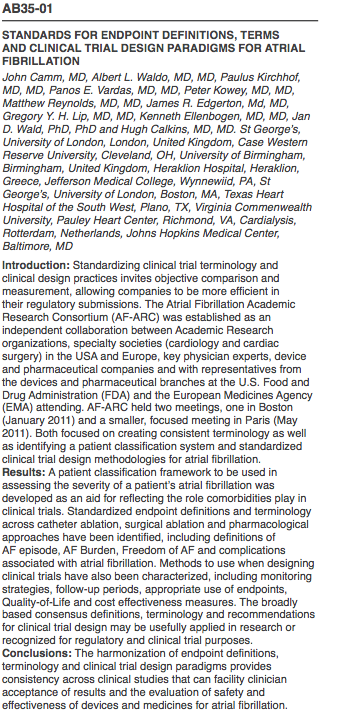
The sentence that clinched it?
The conclusions:
"Conclusions: The harmonization of endpoint definitions, terminology, and clinical trial design paradigms provides consistency across clinical trial studies that can facility (sic) clinician acceptance of results and the evaluation of safety and effectiveness of devices and medicines for atrial fibrillation."
Congratulations, Abstract # AB35-01!
-Wes
Saturday, May 05, 2012
The Real Life Repercussions of Medicare Audits
This 21-minute video documentary produced by the North Caroline Medical Society and Physician's Advocacy Institute chronicles the challenges of a Medicare audit for a 35-man physician practice in rural North Carolina. The pernicious nature of these audits and their real-life implications to doctors and their patients is revealed:
And we wonder why there's a primary care physician shortage in rural America -
-Wes
h/t: Art Fougner, MD via Twitter
And we wonder why there's a primary care physician shortage in rural America -
-Wes
h/t: Art Fougner, MD via Twitter
Wednesday, May 02, 2012
A Quick Reminder
For those readers out there attending the Heart Rhythm Society Scientific Sessions May 8-12, 2012 who would like to share some good times, good food, and good information on social media in medicine, be sure to register for my talk Thursday, PM at Ruth's Chris Steakhouse at 6:30 pm in the heart of downtown Boston (click for details on the event and how to register here). They're trying to establish an approximate head count to acquire the appropriate room size.
Let's shock 'em with our support of health care social media, shall we?
So please go now and register if you haven't already. A couple hundred registrants should do...
See you there!
-Wes
Let's shock 'em with our support of health care social media, shall we?
So please go now and register if you haven't already. A couple hundred registrants should do...
See you there!
-Wes

Tuesday, May 01, 2012
The Dark Side of EKG Screening in Athletes
They sat nervously with their son in the doctor's office, wondering why they were there. John was, after all, the picture of health and had just received a scholarship to Stanford University to play soccer. His mother and father had been to every soccer match through his formative years, enduring the travel schedule with its weekends away from home, long hours, horrible weather. John was staring at his iPhone, his mother clutching a Kleenex. John's father stared out the window. It was raining.
The door opened.
"Hello, I'm Dr. Kiljoy. They asked me to see your son about a finding on his EKG."
"Hello," they said back.
"As you know, we've been looking into EKG's in athletes because we have suspected for some time that an EKG will help us better detect students who might be at risk for sudden cardiac death while participating in sports. You know, even if we can prevent one death in these young people, it would be worth it. None of us want a young person to die. That New York Times article yesterday... dang... with that crying family and all right there at the top... poor boy collapsed, people had no clue what happened at first, people thought he overheated, then waited... only later did they find that AED. Then it didn't work 'cause the battery was dead. So sad! We really are trying to prevent that from ever happening. Seriously. Sad as hell. And to think we could have caught this if that teenager had just had an EKG..."
"Yes, of course!" said John's mother. "I'm SO glad you did this! We'll be so reassured to know that John's going to be okay. "
A pause filled the room...
"He IS going to be okay, isn't he?" she asked.
"Well, Mrs Smith, we're not sure, we have to run some other tests. You see he had a slight elevation to his ST segments in these leads here, see? Then look at his heart rate, it's so slow! And that voltage here, it's more than we usually see... It's probably okay, but I'm going to order an echo to look at his chamber sizes."
"Okay..."
"And a then I'm going to have one of our EP people see him to make sure he doesn't have a congenital ion channel disorder..."
"A what?"
"A channelopathy - a genetic defect of some ion channels in his heart - the most common form is called Brudaga Syndrome..."
"How do you spell that?" She waited with pen and paper to jot it down...
"B-R-U-G-A-D-A. Look, he's probably okay, be we want to be absolutely sure, especially with that ST segment elevation in those leads... We'll also check a stress test to make sure his heart rate comes up appropriately with exercise and that there aren't any funny EKG changes with exercise that might suggest an anomalous coronary artery - I've seen three people die like a dog with that one!"
"How often does that happen?" she asked.
"Well, it's pretty uncommon, but if it's there, sometimes we have to do open heart surgery to reimplant it so that it won't get pinched between the pulmonary artery and aorta when he exercises."
"But he's never had a problem! And no one has ever died suddenly in our family - ever!"
"Mrs. Smith. Remember why we're doing this: John's safety. This is all about John's safety."
"And if you find something in all these tests, then what?"
"Well, he wouldn't be able to play soccer."
John's eyes suddenly lift from his cell phone. "What did you say?" he asked.
"You won't be able to play soccer," Dr. Kiljoy repeated.
"Mom, what the f#$*!? If I don't play soccer, I don't go to Stanford. If I don't go to Stanford, I'll never play soccer again! Are you serious?"
The father, sensing his son's concern, returns to the room from his window transcendental meditation.
"Son, let's just get the tests. Your mother's concerned."
"Mom's concerned? What the hell do you mean 'Mom's concerned?' What about me? I never wanted to get this frickin' EKG anyway! Look, I'm FINE. I never so much as farted wrong. We have no family history of heart disease. I've never felt my heart race, I've never passed out, I'm faster than everyone else on my team and we just won the State Championship! How's THAT for a stress test? I've worked my ass off for YEARS to get this scholarship. And now, just because of this EKG with bullshit findings that don't pertain to kids my age they're going to do a million tests just to be sure? Seriously? Honestly Dad, you gotta be kidding me... How much is all this gonna cost, huh? And maybe I'll lose my scholarship, too? How much is THAT worth?"
"John, honey, it's for your safety," his mother whispers, tears streaming down her cheeks. "We love you so. We just don't want anything bad to happen to you...."
"Your Mom's right, John. We just want to be sure... really....", Dr. Kiljoy continued.
John looked up at Dr. Kiljoy, and said slowly, painfully, with tears in his eyes:
"Doctor, f*&% you."
-Wes
P.S.: For more, please see Dr. John M's take on the New York Times's abysmal reporting on this issue.
The door opened.
"Hello, I'm Dr. Kiljoy. They asked me to see your son about a finding on his EKG."
"Hello," they said back.
"As you know, we've been looking into EKG's in athletes because we have suspected for some time that an EKG will help us better detect students who might be at risk for sudden cardiac death while participating in sports. You know, even if we can prevent one death in these young people, it would be worth it. None of us want a young person to die. That New York Times article yesterday... dang... with that crying family and all right there at the top... poor boy collapsed, people had no clue what happened at first, people thought he overheated, then waited... only later did they find that AED. Then it didn't work 'cause the battery was dead. So sad! We really are trying to prevent that from ever happening. Seriously. Sad as hell. And to think we could have caught this if that teenager had just had an EKG..."
"Yes, of course!" said John's mother. "I'm SO glad you did this! We'll be so reassured to know that John's going to be okay. "
A pause filled the room...
"He IS going to be okay, isn't he?" she asked.
"Well, Mrs Smith, we're not sure, we have to run some other tests. You see he had a slight elevation to his ST segments in these leads here, see? Then look at his heart rate, it's so slow! And that voltage here, it's more than we usually see... It's probably okay, but I'm going to order an echo to look at his chamber sizes."
"Okay..."
"And a then I'm going to have one of our EP people see him to make sure he doesn't have a congenital ion channel disorder..."
"A what?"
"A channelopathy - a genetic defect of some ion channels in his heart - the most common form is called Brudaga Syndrome..."
"How do you spell that?" She waited with pen and paper to jot it down...
"B-R-U-G-A-D-A. Look, he's probably okay, be we want to be absolutely sure, especially with that ST segment elevation in those leads... We'll also check a stress test to make sure his heart rate comes up appropriately with exercise and that there aren't any funny EKG changes with exercise that might suggest an anomalous coronary artery - I've seen three people die like a dog with that one!"
"How often does that happen?" she asked.
"Well, it's pretty uncommon, but if it's there, sometimes we have to do open heart surgery to reimplant it so that it won't get pinched between the pulmonary artery and aorta when he exercises."
"But he's never had a problem! And no one has ever died suddenly in our family - ever!"
"Mrs. Smith. Remember why we're doing this: John's safety. This is all about John's safety."
"And if you find something in all these tests, then what?"
"Well, he wouldn't be able to play soccer."
John's eyes suddenly lift from his cell phone. "What did you say?" he asked.
"You won't be able to play soccer," Dr. Kiljoy repeated.
"Mom, what the f#$*!? If I don't play soccer, I don't go to Stanford. If I don't go to Stanford, I'll never play soccer again! Are you serious?"
The father, sensing his son's concern, returns to the room from his window transcendental meditation.
"Son, let's just get the tests. Your mother's concerned."
"Mom's concerned? What the hell do you mean 'Mom's concerned?' What about me? I never wanted to get this frickin' EKG anyway! Look, I'm FINE. I never so much as farted wrong. We have no family history of heart disease. I've never felt my heart race, I've never passed out, I'm faster than everyone else on my team and we just won the State Championship! How's THAT for a stress test? I've worked my ass off for YEARS to get this scholarship. And now, just because of this EKG with bullshit findings that don't pertain to kids my age they're going to do a million tests just to be sure? Seriously? Honestly Dad, you gotta be kidding me... How much is all this gonna cost, huh? And maybe I'll lose my scholarship, too? How much is THAT worth?"
"John, honey, it's for your safety," his mother whispers, tears streaming down her cheeks. "We love you so. We just don't want anything bad to happen to you...."
"Your Mom's right, John. We just want to be sure... really....", Dr. Kiljoy continued.
John looked up at Dr. Kiljoy, and said slowly, painfully, with tears in his eyes:
"Doctor, f*&% you."
-Wes
P.S.: For more, please see Dr. John M's take on the New York Times's abysmal reporting on this issue.
Saturday, April 28, 2012
Why the Electronic Medical Record Needs to Be Viewed as a Medical Device
In our rush to establish a national electronic medical record (EMR) system as part of the American Recovery and Reinvestment Act of 2009, powerful silos of independent EMR systems have sprung up nationwide. While most systems are being developed responsibly, like the Wild, Wild West, many have been developed without an objective eye toward quality and the potential harm they may be causing our patients.
As most readers of this blog are aware, since 2005 the medical device industry in which I work has had widely publicized instances of patient deaths splashed all over the New York Times and other mainstream media outlets from defibrillator malfunctions that resulted in a just a few patient deaths. The backlash in response to these deaths was significant: device registries were developed, software improvements to devices created, and billions of dollars in legal fees and damages paid to patients and their families on the path to improvement. In addition, we also learned about the limits of corporate responsibility for these deaths thanks to legal precedent established by the Reigel vs. Medtronic case.
Should Electronic Medical Records Be Considered Medical Devices?
This week I received a medical record from a large academic medical center somewhere in the United States (the details are unimportant) that has one of these new pioneering EMR systems manufactured by $13 billion-dollar company, Cerner Corporation. Now before I go on a rant about Cerner's EMR system, I should preface my remarks to say that I have never personally used Cerner's system. But I am a doctor who received a note composed on Cerner's system and what I saw was one of the better examples of how EMR's are contributing to misinformation and confusion when health care is delivered.
I received a copy of an internal medicine consult that was performed on a patient at this outside hospital. I have extracted the "medications" portion of the internist's note exactly as it was displayed in the note below (although the list extended over more than one page, so I joined the list together as one figure). Needless to say, I was terrified at what the system had listed as the patient's medications:
In this example, we see multitudes of medications listed more than once. We see drugs of similar classes (antihistamines, beta blockers) on the same list. We see warfarin, one of our most dangerous drugs dispensed, without a dose included. We see what seems to be outpatient meds listed with inpatient meds, I'm not sure. Honestly, we really have no idea what medications are actually being taken from this list. And yet this list of medications is listed by the EMR as the patient's "Active Medications."
What the heck have we created?
Certainly, any capable physician who cares for patients would describe this medication list as worthless. So why is it in there? (Don't get me wrong, the fact that any doctor would allow such crap to be displayed in his or her medical note by using an EMR shortcut to enter them uncorrected is beyond me. Certainly, we as doctors must accept a big portion of the responsibility for this).
But when EMR developers and their hospital administration customers purchase software capable of spewing forth completely useless AND potentially lethal information about our patients that is then transmitted far and wide, (not to mention to local direct caregivers) doctors have an obligation to speak up.
These kinds of documentation problems are the EMR's Achilles' heel. But beyond this, EMR software updates are routinely deployed without real-world real-life testing. Ever. And yet, like patients with a defibrillator who die outside the hospital before a root cause of a defibrillator defect can be discovered, I acknowledge that it is incredibly difficult to prove that the death of an individual was caused by an EMR software problem.
And yet, we must.
So how will we measure problems with EMRs? It seems industry representatives would rather not address these concerns. We should ask ourselves, is anyone thinking about this?
Right now, the prevailing belief is that the electronic medical record might be one of the most important medical devices doctors have at our disposal to care for patients. I tend to agree. But it's potential to do harm is also enormous if it is not used responsibly and accurately. After all, as the above example shows, the potential to introduce unintended yet potentially lethal errors into patient care is huge. More importantly, since nearly every person in the United States will soon have their medical data housed within these systems, the number of people that could be adversely affected by these systems is much larger than what we've seen with our recent defibrillator malfunctions.
Perhaps, like the ICD registry, we should try to to develop an EMR registry of adverse patient outcomes caused by these software systems. That way, every independent EMR company can learn from the other's mistakes. Because, guess what ...
... like other man-made medical devices, EMR's are not perfect either.
-Wes
As most readers of this blog are aware, since 2005 the medical device industry in which I work has had widely publicized instances of patient deaths splashed all over the New York Times and other mainstream media outlets from defibrillator malfunctions that resulted in a just a few patient deaths. The backlash in response to these deaths was significant: device registries were developed, software improvements to devices created, and billions of dollars in legal fees and damages paid to patients and their families on the path to improvement. In addition, we also learned about the limits of corporate responsibility for these deaths thanks to legal precedent established by the Reigel vs. Medtronic case.
Should Electronic Medical Records Be Considered Medical Devices?
This week I received a medical record from a large academic medical center somewhere in the United States (the details are unimportant) that has one of these new pioneering EMR systems manufactured by $13 billion-dollar company, Cerner Corporation. Now before I go on a rant about Cerner's EMR system, I should preface my remarks to say that I have never personally used Cerner's system. But I am a doctor who received a note composed on Cerner's system and what I saw was one of the better examples of how EMR's are contributing to misinformation and confusion when health care is delivered.
I received a copy of an internal medicine consult that was performed on a patient at this outside hospital. I have extracted the "medications" portion of the internist's note exactly as it was displayed in the note below (although the list extended over more than one page, so I joined the list together as one figure). Needless to say, I was terrified at what the system had listed as the patient's medications:
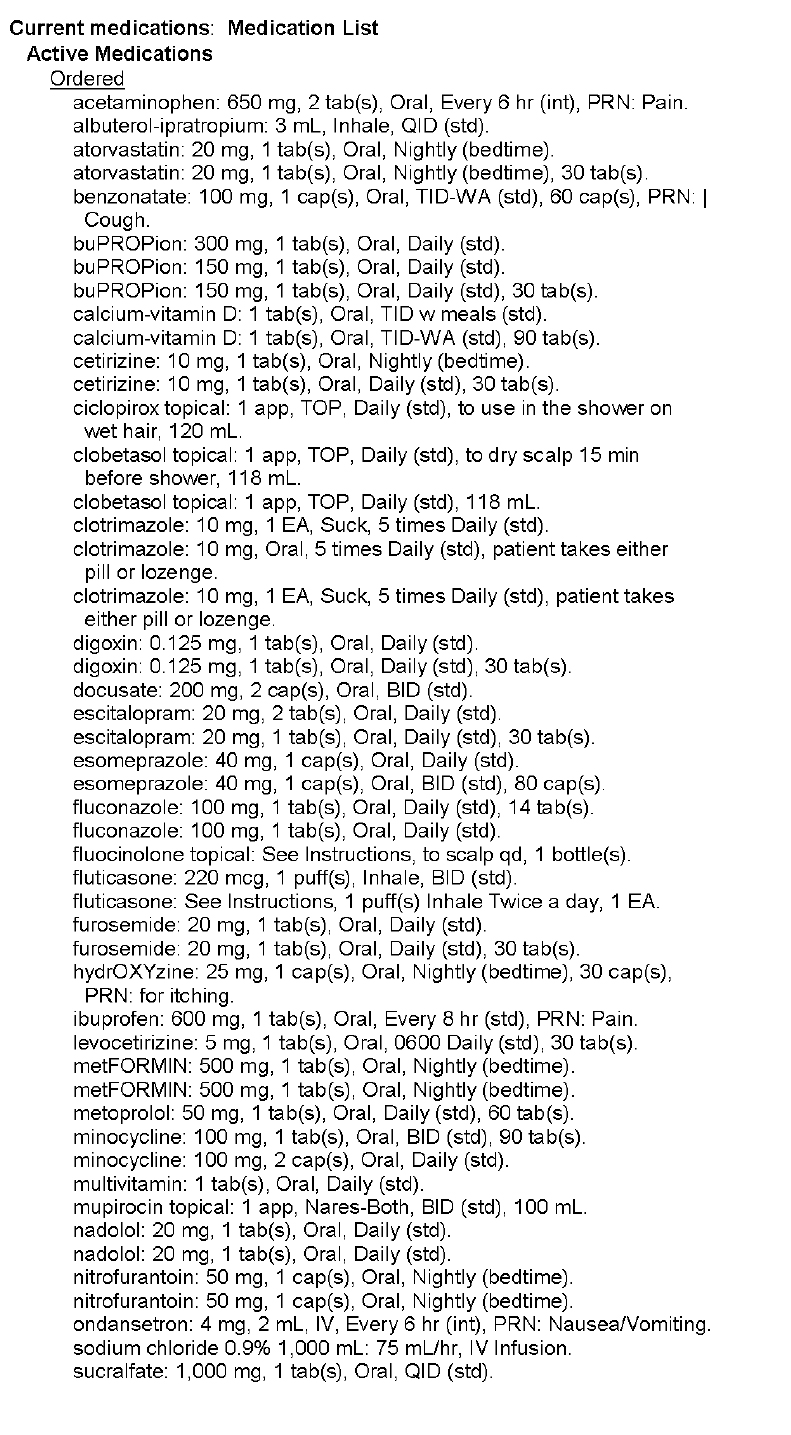 |
| Med List (Page 1) - Click to enlarge |
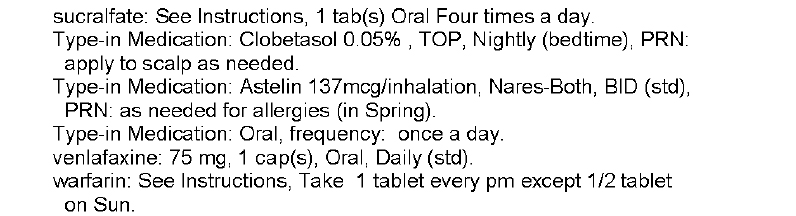 |
| Med List (Page 2) - Click to enlarge |
In this example, we see multitudes of medications listed more than once. We see drugs of similar classes (antihistamines, beta blockers) on the same list. We see warfarin, one of our most dangerous drugs dispensed, without a dose included. We see what seems to be outpatient meds listed with inpatient meds, I'm not sure. Honestly, we really have no idea what medications are actually being taken from this list. And yet this list of medications is listed by the EMR as the patient's "Active Medications."
What the heck have we created?
Certainly, any capable physician who cares for patients would describe this medication list as worthless. So why is it in there? (Don't get me wrong, the fact that any doctor would allow such crap to be displayed in his or her medical note by using an EMR shortcut to enter them uncorrected is beyond me. Certainly, we as doctors must accept a big portion of the responsibility for this).
But when EMR developers and their hospital administration customers purchase software capable of spewing forth completely useless AND potentially lethal information about our patients that is then transmitted far and wide, (not to mention to local direct caregivers) doctors have an obligation to speak up.
These kinds of documentation problems are the EMR's Achilles' heel. But beyond this, EMR software updates are routinely deployed without real-world real-life testing. Ever. And yet, like patients with a defibrillator who die outside the hospital before a root cause of a defibrillator defect can be discovered, I acknowledge that it is incredibly difficult to prove that the death of an individual was caused by an EMR software problem.
And yet, we must.
So how will we measure problems with EMRs? It seems industry representatives would rather not address these concerns. We should ask ourselves, is anyone thinking about this?
Right now, the prevailing belief is that the electronic medical record might be one of the most important medical devices doctors have at our disposal to care for patients. I tend to agree. But it's potential to do harm is also enormous if it is not used responsibly and accurately. After all, as the above example shows, the potential to introduce unintended yet potentially lethal errors into patient care is huge. More importantly, since nearly every person in the United States will soon have their medical data housed within these systems, the number of people that could be adversely affected by these systems is much larger than what we've seen with our recent defibrillator malfunctions.
Perhaps, like the ICD registry, we should try to to develop an EMR registry of adverse patient outcomes caused by these software systems. That way, every independent EMR company can learn from the other's mistakes. Because, guess what ...
... like other man-made medical devices, EMR's are not perfect either.
-Wes
Friday, April 27, 2012
Medical Device Advisories: Moving the Needle
In 2005, a flurry of medical device recalls shook the implantable cardiac defibrillator market. The first of these recalls occurred after the former Guidant Corporation (just purchased by Boston Scientific) was forced to admit that a header malfunction of one of their Prism II ICD's had short-circuited and failed to deliver appropriate resusciating shocks to several patients. The company had decided not disclosed the known defect immediately to physicians since the frequency of the events were rare. It was only after two physicians reported their findings to the mainstream media, that a recall of the device was announced the following day. Guidant stock tanked. A flurry of negative press and lawsuits resulted and the ICD market was forever changed.
Shortly thereafter Guidant's other competitors had recalls of their defibrillator pulse generators. First, Medtronic had a defibrillator battery with a shorting issue. To avoid the fallout that Guidant had experienced, they initiated a "recall" and offered to pay for device replacement. Hundreds of devices were replaced nationwide as a result. Unfortunately, another problem came to light as a result of that action: infection. Only after some time was it recognized that the infection rate of device replacement was higher than the device failure the replacements were supposed to fix.
Time offers unique insights to device problems, we learned.
Even St. Jude Medical, who escaped the early firestorm of recalls, had their own issue with cosmic radiation's effects on some of the components of their devices. Another physician advisory letter was issued. Fortunately, the lessons from the other generator recalls helped doctors to be slower to react reflexively. A more cautious wait and watch approach ensued.
The development of a robust registry of implanted device utilization took on new urgency. Devices capable of self-checks that automatically transmit alerts to a central database without patient intervention were developed (see here, here, and here). We felt we were on top of our game.
But then the problems with pulse generators evolved to defibrillator leads. In October, 2007, Medtronic's down-sized but highly popular 7-French Sprint Fidelis defibrillator lead was beginning to show a higher-than-expected failure rate. Several deaths occurred as a result. At first when Medtronic attempted to determine a "root cause" for the problem, they identified several clusters of failure and suggested to physicians that the problems might be due to physician implant technique. Later when it became obvious that even there most trusted implanters were having problems with the lead, Medtronic had a "mea culpa" moment and issued a sweeping lead "advisory." (There was concern that the word "recall" might spur doctors to extracting these leads in all cases). And while many of those leads are still in place today, it is clear the Sprint Fidelis still shows problems with its reliability over time. To facilitate , careful survellance of the leads using software enhancements to existing devices, the problem appears to be managable, though remains challenging.
More recently in 2010, St. Jude Medical recalled earlier versions of their downsized 7Fr Riata and Riata ST defibrilaltor leads because of a different failure mechanism: so-called "inside-out" insulation problems. Deaths were reported with this lead also, but St. Jude took the unusual tactic of seeking a withdrawl of the information from a peer reviewed journal, arguing that the analysis of their lead's performance was improper when it's characteristics were compared to their competitor's defibrillator lead that remains on the market. Given the history of the market recalls before, implanting doctors (including this one) were surprised to see such an action. Where things will fall out on this issue continues to evolve.
What is clear from all of this, is that these devices, no matter how wonderful they may seem, all can have problems. In fact, electrophysiologists are increasingly aware of system components that might fail and lead to problems with these devices, irrespective of manufacturer. As much as we'd like to think these amazing devices are fool-proof, we are constantly reminded they are not.
But an interesting thing happened earlier this week; something that was a welcome development in this continuing saga of device recalls and advisories.
Yesterday, the press got hold of Boston Scientific's latest "product performance update" notification that involved a transformer component of one of their newer defibrillator product lines that, by Boston Scientific's own admission, had resulted in one patient death. Predicably, the stock market price of Boston Scientific plummeted with the news. The major news organizations spread the news far and wide. But then the stock price rebounded to within 8 cents of the stock's price before the news.
Why?
Unlike the original Guidant mess in 2005, Boston Scientific took the step of quietly notifying their physician base over a week before the news hit the wire by way of a personalized request to review their latest "product performance report.". The magnitude of the problem was fairly well quanitated, occurring in an estimated "1 in 8900 devices." Doctors had time to digest the information, and while still concerning, it's implications to patients understandable when compared to the problems with other advisories. While still early in this latest advisory, doctors are increasingly realizing that these problems with the many human-made components of these devices are not infallible.
So we're seeing a glimpse of a new era of device recall management. Rather than waiting for several deaths, the first case of death is divuldged. Importantly, doctors who deal with these devices are informed early. When this occurs, trust in the integrity of the device companies is improved as both doctors and their patients learn the magnitude of the inevitable challenges with these devices.
Call me an idealist, but I think we're making progress in management of these sophisticated devices and I think that there's lots of good that can be learned by Boston Scientific's latest decision to come clean early with their latest device problem. While there are still many issues that need improvement, like post-market surveillance of devices, things seem to be heading the right way.
Our next big challenge will be helping patients understand the realities concerning the reliability of these complex devices when deciding to implant them and communicating the efforts underway to assure their continued safety.
-Wes
Shortly thereafter Guidant's other competitors had recalls of their defibrillator pulse generators. First, Medtronic had a defibrillator battery with a shorting issue. To avoid the fallout that Guidant had experienced, they initiated a "recall" and offered to pay for device replacement. Hundreds of devices were replaced nationwide as a result. Unfortunately, another problem came to light as a result of that action: infection. Only after some time was it recognized that the infection rate of device replacement was higher than the device failure the replacements were supposed to fix.
Time offers unique insights to device problems, we learned.
Even St. Jude Medical, who escaped the early firestorm of recalls, had their own issue with cosmic radiation's effects on some of the components of their devices. Another physician advisory letter was issued. Fortunately, the lessons from the other generator recalls helped doctors to be slower to react reflexively. A more cautious wait and watch approach ensued.
The development of a robust registry of implanted device utilization took on new urgency. Devices capable of self-checks that automatically transmit alerts to a central database without patient intervention were developed (see here, here, and here). We felt we were on top of our game.
But then the problems with pulse generators evolved to defibrillator leads. In October, 2007, Medtronic's down-sized but highly popular 7-French Sprint Fidelis defibrillator lead was beginning to show a higher-than-expected failure rate. Several deaths occurred as a result. At first when Medtronic attempted to determine a "root cause" for the problem, they identified several clusters of failure and suggested to physicians that the problems might be due to physician implant technique. Later when it became obvious that even there most trusted implanters were having problems with the lead, Medtronic had a "mea culpa" moment and issued a sweeping lead "advisory." (There was concern that the word "recall" might spur doctors to extracting these leads in all cases). And while many of those leads are still in place today, it is clear the Sprint Fidelis still shows problems with its reliability over time. To facilitate , careful survellance of the leads using software enhancements to existing devices, the problem appears to be managable, though remains challenging.
More recently in 2010, St. Jude Medical recalled earlier versions of their downsized 7Fr Riata and Riata ST defibrilaltor leads because of a different failure mechanism: so-called "inside-out" insulation problems. Deaths were reported with this lead also, but St. Jude took the unusual tactic of seeking a withdrawl of the information from a peer reviewed journal, arguing that the analysis of their lead's performance was improper when it's characteristics were compared to their competitor's defibrillator lead that remains on the market. Given the history of the market recalls before, implanting doctors (including this one) were surprised to see such an action. Where things will fall out on this issue continues to evolve.
What is clear from all of this, is that these devices, no matter how wonderful they may seem, all can have problems. In fact, electrophysiologists are increasingly aware of system components that might fail and lead to problems with these devices, irrespective of manufacturer. As much as we'd like to think these amazing devices are fool-proof, we are constantly reminded they are not.
But an interesting thing happened earlier this week; something that was a welcome development in this continuing saga of device recalls and advisories.
Yesterday, the press got hold of Boston Scientific's latest "product performance update" notification that involved a transformer component of one of their newer defibrillator product lines that, by Boston Scientific's own admission, had resulted in one patient death. Predicably, the stock market price of Boston Scientific plummeted with the news. The major news organizations spread the news far and wide. But then the stock price rebounded to within 8 cents of the stock's price before the news.
Why?
Unlike the original Guidant mess in 2005, Boston Scientific took the step of quietly notifying their physician base over a week before the news hit the wire by way of a personalized request to review their latest "product performance report.". The magnitude of the problem was fairly well quanitated, occurring in an estimated "1 in 8900 devices." Doctors had time to digest the information, and while still concerning, it's implications to patients understandable when compared to the problems with other advisories. While still early in this latest advisory, doctors are increasingly realizing that these problems with the many human-made components of these devices are not infallible.
So we're seeing a glimpse of a new era of device recall management. Rather than waiting for several deaths, the first case of death is divuldged. Importantly, doctors who deal with these devices are informed early. When this occurs, trust in the integrity of the device companies is improved as both doctors and their patients learn the magnitude of the inevitable challenges with these devices.
Call me an idealist, but I think we're making progress in management of these sophisticated devices and I think that there's lots of good that can be learned by Boston Scientific's latest decision to come clean early with their latest device problem. While there are still many issues that need improvement, like post-market surveillance of devices, things seem to be heading the right way.
Our next big challenge will be helping patients understand the realities concerning the reliability of these complex devices when deciding to implant them and communicating the efforts underway to assure their continued safety.
-Wes
Thursday, April 26, 2012
The Sad Reality of What Our Younger Generation is Learning About Pacemakers
A conversation I had last night:
Seriously, if you have a pacemaker, consider not viewing this. While there have been reports of at least one group reverse-engineering an implantable defibrillator's programmer, the idea of a video game controller "controlling" a pacemaker from another room stretches reality too far. Still, there are enough components of reality with this skit to create anxiety in patients with pacemakers. Furthermore, while I accept this was created for "entertainment," there are also enough inaccuracies to be concerned about what our younger generation might think about these devices when they get old enough to need them.
So here's the link.
I'd be interested to see what my readers think about this show's episode: good, bad, funny, sad.
Perhaps the Heart Rhythm Society should consider sending VIACOM Media Networks (the owner of Spike TV) a letter on behalf of all of us who deal with these life-saving devices every day to make this episode "pay-per-view" rather than free to all as it exists now.
-Wes
ICU Nurse: "Did you see the video on the guy who hacked his pacemaker?"I show this rendition of the entertainment industry's version of "funny" with considerable reluctance, but I think it's important that doctors understand what today's younger generation is seeing these days on TV concerning pacemakers. While the skit starts off fairly comically, the writers of this script couldn't stop with a hacker playing with his own pacemaker, they had to include a video gamer "owning" the hacker, ultimately leading to "Way to Die #371."
Me: "Seriously?"
ICU Nurse: "Yeah, I think it was on Spike TV's show "1000 Ways to Die"
Seriously, if you have a pacemaker, consider not viewing this. While there have been reports of at least one group reverse-engineering an implantable defibrillator's programmer, the idea of a video game controller "controlling" a pacemaker from another room stretches reality too far. Still, there are enough components of reality with this skit to create anxiety in patients with pacemakers. Furthermore, while I accept this was created for "entertainment," there are also enough inaccuracies to be concerned about what our younger generation might think about these devices when they get old enough to need them.
So here's the link.
I'd be interested to see what my readers think about this show's episode: good, bad, funny, sad.
Perhaps the Heart Rhythm Society should consider sending VIACOM Media Networks (the owner of Spike TV) a letter on behalf of all of us who deal with these life-saving devices every day to make this episode "pay-per-view" rather than free to all as it exists now.
-Wes
Our Hospital of Cards
Andrew Foy, MD, a cardiology fellow at Penn State-Hershey University Medical Center pens an excellent overview of the causes of our current health care crisis in his perspective piece "Hospital of Cards." It simply is a must-read.
More than ever, the causes of our cost crisis in health care need to be understood if we are ever going to have a chance to right our Healthcare Hindenburg.
-Wes
More than ever, the causes of our cost crisis in health care need to be understood if we are ever going to have a chance to right our Healthcare Hindenburg.
-Wes
Monday, April 23, 2012
When Health Care is Promoted As "Free"
Health expenditures in the United States neared $2.6 trillion in 2010, over ten times the $256 billion spent in 1980. The rate of growth in recent years has slowed relative to the late 1990s and early 2000s, but is still expected to grow faster than national income over the foreseeable future.
So imagine my surprise when I saw this Medicare commercial last night that stated preventative health care services provided by Medicare were "free:"
CMS also uses the word "free" in the description of the new health care law's provisions on their Youtube channel:
Of course, public policy experts who promote these deceptive advertising techniques argue that these ads are justified because they encourage people to participate in preventative health services, thereby saving costs. But where are the data that these ads really work? Scientists know the realities of indeterminate, false positive and false negative testing of any screening test. We know the huge costs of additional testing that occurs in such in instance. Given our overriding health care cost concerns, should we not insist on proof of the cost-effectiveness of such a large-scale, national approach to preventive medicine services rather blithely assuming it works?
After all, the reality of health care today is that it is anything but "free."
-Wes
So imagine my surprise when I saw this Medicare commercial last night that stated preventative health care services provided by Medicare were "free:"
CMS also uses the word "free" in the description of the new health care law's provisions on their Youtube channel:
"For those with Medicare, the health care law offers most preventive health care services for free."Describing health care services as "free" dissociates people the cost reality of providing these services. It perpetuates the myth that we can have health care services without having to pay for them. Further, calling services "free" devalues the expertise and cost of facilities and regulatory oversight required to support such services.
Of course, public policy experts who promote these deceptive advertising techniques argue that these ads are justified because they encourage people to participate in preventative health services, thereby saving costs. But where are the data that these ads really work? Scientists know the realities of indeterminate, false positive and false negative testing of any screening test. We know the huge costs of additional testing that occurs in such in instance. Given our overriding health care cost concerns, should we not insist on proof of the cost-effectiveness of such a large-scale, national approach to preventive medicine services rather blithely assuming it works?
After all, the reality of health care today is that it is anything but "free."
-Wes
Thursday, April 19, 2012
Dr. Wes to Speak in Boston in May
If you're in Boston for the Heart Rhythm Society Scientific Sessions May 8-12, 2012 please join me Thursday night, May 10th, 6:30 pm at Ruth's Chris Steakhouse, 45 School Street in the Old City Hall, Boston, MA 02108 (just 10 minutes by taxi from the Boston Convention and Exhibition Center). I will be speaking on the value and challenges of social media for tomorrow's physicians. Like my earlier ACC talk, the event is once again graciously sponsored by Zoll LifeVest (the wearable defibrillator folks). The full invite with RSVP details is here.
Due to the event's overwhelming popularity at the ACC and the swank upcoming venue, please RSVP by 1 May to help Zoll with an approximate head count. For those who remain socially challenged, please come anyway. We understand. Rest assured you'll still be welcomed and there should be enoughfood, drink, er, educational content to convert even the most schizoid among us. After all, this is SOCIAL media we're talking about.
A live, interactive Twitter feed will accompany the talk for those who's like to follow along out there in the InterNets but can't attend in person - just use the hashtag #ZollHRS and a software program like Tweetchat to see the streaming commentary in near real-time. Feel free to post your questions and comments, too. The moreentertaining educational, the better. (It'll be fun to see how many distinguished anonymous commenters we can identify!)
Also, I have learned that my fellow cardiac electrophysiology colleagues (who are forces in the social media in their own right) will be attending: John Mandrola, MD of Louisville, KY who blogs at the Dr. John M blog and for theheart.org's Trials and Fibrillations blog (Twitter: @drjohnm), and Edward J Schloss, MD of Cincinnati, OH (Twitter: @EJSMD). No doubt they'll be happy to share some of their insights with you as well.
Finally, if you're feeling particularly brave, consider leaving a comment to this post if you'll be attending so others can see who will be joining us. (Doing so just might inspire others who are on the fence about attending.)
See you in Boston!
-Wes
Due to the event's overwhelming popularity at the ACC and the swank upcoming venue, please RSVP by 1 May to help Zoll with an approximate head count. For those who remain socially challenged, please come anyway. We understand. Rest assured you'll still be welcomed and there should be enough
A live, interactive Twitter feed will accompany the talk for those who's like to follow along out there in the InterNets but can't attend in person - just use the hashtag #ZollHRS and a software program like Tweetchat to see the streaming commentary in near real-time. Feel free to post your questions and comments, too. The more
Also, I have learned that my fellow cardiac electrophysiology colleagues (who are forces in the social media in their own right) will be attending: John Mandrola, MD of Louisville, KY who blogs at the Dr. John M blog and for theheart.org's Trials and Fibrillations blog (Twitter: @drjohnm), and Edward J Schloss, MD of Cincinnati, OH (Twitter: @EJSMD). No doubt they'll be happy to share some of their insights with you as well.
Finally, if you're feeling particularly brave, consider leaving a comment to this post if you'll be attending so others can see who will be joining us. (Doing so just might inspire others who are on the fence about attending.)
See you in Boston!
-Wes
Tuesday, April 17, 2012
What Social Media Can Bring to the Physician Skeptic
There are few terms I can live without when it comes to social media. One is the term "engagement."
"Engage" your audience. "Engage" your patients. "Engage" your peers. Engage. Engage, Engage.
Do these administrative and marketing types who love this term realize how phony this term sounds to most doctors? In fact, most doctors I know look at me as though I have three heads when I suggest they get involved in social media, much less "engage" with their colleagues or patients. I get the "there's no time," "too risky," or "not interested" rebuff from most.
But I also sense a growing tacit anxiety amongst the doctors unfamiliar with social media for the simple reason that these doctors don't like being late to innovative approaches in medicine. Deep down inside, they might even acknowledge that they should know more about this space, but really just don't want to spend the time to do so.
We should acknowledge, whether we like it or not, that the great majority of doctors are scared of using social media in health care. Sure, a Facebook page with family and friends is generally accepted. But a blog? Twitter? No frickin' way!
But I'd like to suggest something to the physician skeptics out there: don't "engage" in social media, "lurk" instead.
What do I mean by "lurk?" I mean, get an account, follow a group of people with common backgrounds and interests to yours, and don't say or type a thing. Just listen.
Here's why.
Most skeptical doctors have very real concerns about the permanence of what is written on the internet. They also are concerned about the many potential legal pitfalls that can befall doctors who use social media. After all, what might seem appropriate to one individual might be completely inappropriate to another. This might put a doctor on the defensive.
Fair enough.
But I believe doctors should still register with a social media service (Twitter, for instance) and reserve a name for themselves. Then they should try following a few people on the service. Then maybe follow a few more. Just look and listen to what is said there, but don't participate. Just "lurk." See what others say. If it agrees with you or is interesting, add those people to your follow list. Follow a journal. Follow a favorite newspaper, local news station or hobby website. Maybe even follow "the enemy" (whoever that might be). But just get used to the process. In time, I can almost guarantee that even the most skeptical of physician will see how these services can bring ideas and insights to them that they simply would never have had any other way. They'll be up on current affairs and might even learn something new before their friends or colleagues without having to utter a word online. And believe it or not, with practice they can even learn how to collaborate with others offline using direct (non-public) messaging.
Now more than ever, beyond all of these things, I believe there's something that social media provides to doctors that they don't appreciate at first. It is something that doctors are missing as medicine transforms from an independent solo or group practice setting to a series of giant corporate conglomerates:
Social media helps restore a sense of professional autonomy.
Doctors know they must keep current in the fast-changing world of medicine, particularly these days. Doctors need to appreciate their colleagues' struggles and concerns as the medical world evolves around us. Doctors need to know what patients are thinking, too.
But the beauty of social media for doctors is that it can help them with each of these needs without anybody knowing if a doctor so chooses. For doctors, I believe social media is a critical tool, but should not be considered an end-all. Just learning how to listen to the social media conversation not only provides an opportunity to participate in the medium IF (and only if) the doctor desires, but permits an instantaneous opportunity to raise one's voice to affect change when it's really needed.
Yep, it's the autonomy, not engagement, that matters to most of us.
-Wes
"Engage" your audience. "Engage" your patients. "Engage" your peers. Engage. Engage, Engage.
Do these administrative and marketing types who love this term realize how phony this term sounds to most doctors? In fact, most doctors I know look at me as though I have three heads when I suggest they get involved in social media, much less "engage" with their colleagues or patients. I get the "there's no time," "too risky," or "not interested" rebuff from most.
But I also sense a growing tacit anxiety amongst the doctors unfamiliar with social media for the simple reason that these doctors don't like being late to innovative approaches in medicine. Deep down inside, they might even acknowledge that they should know more about this space, but really just don't want to spend the time to do so.
We should acknowledge, whether we like it or not, that the great majority of doctors are scared of using social media in health care. Sure, a Facebook page with family and friends is generally accepted. But a blog? Twitter? No frickin' way!
But I'd like to suggest something to the physician skeptics out there: don't "engage" in social media, "lurk" instead.
What do I mean by "lurk?" I mean, get an account, follow a group of people with common backgrounds and interests to yours, and don't say or type a thing. Just listen.
Here's why.
Most skeptical doctors have very real concerns about the permanence of what is written on the internet. They also are concerned about the many potential legal pitfalls that can befall doctors who use social media. After all, what might seem appropriate to one individual might be completely inappropriate to another. This might put a doctor on the defensive.
Fair enough.
But I believe doctors should still register with a social media service (Twitter, for instance) and reserve a name for themselves. Then they should try following a few people on the service. Then maybe follow a few more. Just look and listen to what is said there, but don't participate. Just "lurk." See what others say. If it agrees with you or is interesting, add those people to your follow list. Follow a journal. Follow a favorite newspaper, local news station or hobby website. Maybe even follow "the enemy" (whoever that might be). But just get used to the process. In time, I can almost guarantee that even the most skeptical of physician will see how these services can bring ideas and insights to them that they simply would never have had any other way. They'll be up on current affairs and might even learn something new before their friends or colleagues without having to utter a word online. And believe it or not, with practice they can even learn how to collaborate with others offline using direct (non-public) messaging.
Now more than ever, beyond all of these things, I believe there's something that social media provides to doctors that they don't appreciate at first. It is something that doctors are missing as medicine transforms from an independent solo or group practice setting to a series of giant corporate conglomerates:
Social media helps restore a sense of professional autonomy.
Doctors know they must keep current in the fast-changing world of medicine, particularly these days. Doctors need to appreciate their colleagues' struggles and concerns as the medical world evolves around us. Doctors need to know what patients are thinking, too.
But the beauty of social media for doctors is that it can help them with each of these needs without anybody knowing if a doctor so chooses. For doctors, I believe social media is a critical tool, but should not be considered an end-all. Just learning how to listen to the social media conversation not only provides an opportunity to participate in the medium IF (and only if) the doctor desires, but permits an instantaneous opportunity to raise one's voice to affect change when it's really needed.
Yep, it's the autonomy, not engagement, that matters to most of us.
-Wes
When the Government Puts Prices on Patients' Heads
Recently, another predictable Trojan-horse provision of the Patient Protection and Affordable Care Act appeared that promises to pit doctor versus patient by literally placing a price on patients' heads:
Of course, no real assessment of physician "quality" is taking place with this scheme nor any outcome assessment. "Quality" as it is defined in this scheme consists of only an electronic review of patient costs, doctor billing codes, and the patient characteristics of age, gender, Medicaid eligibility, and medical conditions. No government entity will actually observe and assess any physician in practice to determine their "value" to the system. Instead, patients electronically determined to be "low-cost" will be heralded as favored electronic "value" benchmarks. Even the health care law's original physician cheerleader, former Administrator of the Center for Medicare and Medicaid Services Donald Berwick, MD, was taken back:
-Wes
Twenty-thousand physicians in four Midwest states received a glimpse into their financial future last month. Landing in their e-mail inboxes were links to reports from Medicare showing the amount their patients cost on average as well as the quality of the care they provided. The reports also showed how Medicare spending on each doctor’s patients compared with their peers in Kansas, Iowa, Missouri and Nebraska.
The “resource use” reports, which Medicare plans to eventually provide to doctors nationwide, are one of the most visible phases of the government’s effort to figure out how to enact a complex, delicate and little-noticed provision of the 2010 health-care law: paying more to doctors who provide quality care at lower cost to Medicare, and reducing payments to physicians who run up Medicare’s costs without better results.
Of course, no real assessment of physician "quality" is taking place with this scheme nor any outcome assessment. "Quality" as it is defined in this scheme consists of only an electronic review of patient costs, doctor billing codes, and the patient characteristics of age, gender, Medicaid eligibility, and medical conditions. No government entity will actually observe and assess any physician in practice to determine their "value" to the system. Instead, patients electronically determined to be "low-cost" will be heralded as favored electronic "value" benchmarks. Even the health care law's original physician cheerleader, former Administrator of the Center for Medicare and Medicaid Services Donald Berwick, MD, was taken back:
“We do have to be cautious in this case. It could lead to levels of gaming and misunderstanding and incorrect signals to physicians that might not be best for everyone.”Ya think?
-Wes
Sunday, April 15, 2012
Shaping Doctors for Health Care That Won’t Exist

“Yes, we’ve fallen in love with technology, and patients are crying out, saying, ‘Sit down and listen to me,’ ” said Dr. Charles Hatem, a professor atand an expert in medical education. Harvard Medical School
While I’m the first one to support a patient-centric approach to health care, why would the AAMC prepare their medical students for a health care world that will not exist? Are we not pretending and misleading our future physicians with such a pre-requisite for medical school admission?
The AAMC’s has a responsibility to prepare their students for the realities of today’s physician. Developing selection criteria for medical school based on social and humanitarian coursework without addressing the reality of today’s increasingly computer-screen-focused medical practice is whistling in the dark. As it is developing today, they would be more effective by preparing their students with typing lessons and pre-selecting them for unflagging conformity and rule-following skills.
In my experience, most medical students and fellows today have no idea of the looming threat that exists to practicing medicine in the way they imagine it. If the AAMC is truly concerned about patient-centric medicine, they would promote student activism to participate in policy changes that insist on more patient contact. But as it stands now, the idea that the inclusion of these social science pre-requisites to the MCAT is like dancing while Rome
-Wes
Friday, April 13, 2012

St. Jude Medical's Riata Lead Data Gets Peer Reviewed
When articles are submitted for publication in a scientific journal, they undergo a process called peer review. In that process, highly respected scientists with experience in the subject matter of the submitted manuscript review the new work and decide if it is worthy for publication. During the process of peer review, the reviewers determine if the hypothesis of the work is supported by the available data and if the work is sufficiently valuable to the scientific community. Usually there are at least two reviewers who independently reach their conclusion regarding the manuscript and who report their decisions to the journal's editor. The editor ultimately determines the manuscript's fate. During this process, the authors are notified of the publication decision and feedback is provided to the authors by way of a written critique. That way, if a paper is rejected, authors can still benefit from the process in the hopes future submissions are improved.
This morning, St. Jude Medical undergoes a similar process, but in a more public way. Because the company chose to seek retraction of a scientific peer-reviewed manuscript by Dr. Robert G. Hauser from the Heart Rhythm Journal, an independent customer-reviwer, Edward J. Schloss, MD, Director of Cardiac Electrophysiology at The Christ Hospital in Cincinnati, OH, decided to subject St. Jude Medical's request to scientific review. (I'll call it a "customer review") Dr. Schloss hypothesized that differences in search methodology of the MAUDE database used by the company could explain the discrepancy in numbers of deaths found by Hauser et al’s Heart Rhythm Journal manuscript and the company's own numbers. His crystal clear analysis appears this morning at Cardiobrief and brings into sharp focus the severe shortcomings of St. Jude’s claims.
By way of background, readers of his work should know that Dr. Schloss attempted to offer this analysis at the Heart Rhythm Journal before publishing his analysis in its current format, but recieved a one-sentence reply from the Heart Rhythm Journal's editorial staff, stating the work would not be worthy of publication there. We can only speculate why his request was rejected.
So he published his analysis on Cardiobrief instead.
Dr. Schloss should receive our appreciation for his dogged determination to get to the truth. With his matter-of-fact and scientific analysis, he provides an invaluable service to his colleagues and our patients. Like all of us, he wanted to understand the truth behind the Riata/Riata ST defibrillator lead safety statistics.
But the value of this work extends further. Just like the scientific peer review process that rejects a manuscript on its first pass, we can only hope that St. Jude Medical learns a powerful lesson about their customers and the ever-watchful and increasingly influential medical blog-o-sphere.
-Wes
Addendum: For another excellent take on this fiasco, please see the comments and analysis by Dr. John Mandrola.
Addendum: For another excellent take on this fiasco, please see the comments and analysis by Dr. John Mandrola.
Thursday, April 12, 2012
When Medical Device Children Behave Badly
The St. Jude-MDT smackdown on the Riata lead performance continues. (For some background, here's my original post).
After seeking a retraction of Robert Hauser, MD's paper that identified 22 deaths from the Riata lead in the Heart Rhythm Journal, St. Jude's attempt to secure the retraction of the peer-reviewed paper that was released electronically is rebuffed by the journal's editor, Doug Zipes, MD:
Next, St. Jude offers their side of the causes of the deaths in a letter from their medical director. This letter was helpful but still leaves questions regarding the leads' long-term reliability.
And then St. Jude issues yet another press release that displays 377 deaths from Medtronic's Sprint Quatro lead on their website. The reader is left to wonder why. It's almost like a scene from Keeping Up With the Kardashains, where they just can't stop their incredulous foot stomping.
St. Jude acknowledged years ago there there were problems with this class of defibrillator leads. To those of us in practice, it is not suprising there are problems with these same leads now. If fact, we continue to find new clinical challenges when managing these leads. We are concerned about at least one case report (to be presented at HRS this year) of device defibrillation failure from multiple high voltage shocks supposedly delivered through a high voltage lead impedance of 0 ohms. Why St. Jude continues to suggest that their pulled Riata leads really aren't as bad as claimed seems incongruous with their professed need to recall them.
Electrophysiologists and patients need more credible information about the likelihood of failure of these leads and ways to follow patients to prevent further deaths. New softare upgrades to provide eaarly warning alerts, registries, or updated recommendations regarding the routine follow-up of these leads would be welcomed.
What we don't need are more media temper tantrums. This problem is hard enough without having to endure the spin.
-Wes
After seeking a retraction of Robert Hauser, MD's paper that identified 22 deaths from the Riata lead in the Heart Rhythm Journal, St. Jude's attempt to secure the retraction of the peer-reviewed paper that was released electronically is rebuffed by the journal's editor, Doug Zipes, MD:
“I have no knowledge of their data and therefore cannot accept a statement from them to contravene the results from the peer review process,” Zipes said.
Next, St. Jude offers their side of the causes of the deaths in a letter from their medical director. This letter was helpful but still leaves questions regarding the leads' long-term reliability.
And then St. Jude issues yet another press release that displays 377 deaths from Medtronic's Sprint Quatro lead on their website. The reader is left to wonder why. It's almost like a scene from Keeping Up With the Kardashains, where they just can't stop their incredulous foot stomping.
St. Jude acknowledged years ago there there were problems with this class of defibrillator leads. To those of us in practice, it is not suprising there are problems with these same leads now. If fact, we continue to find new clinical challenges when managing these leads. We are concerned about at least one case report (to be presented at HRS this year) of device defibrillation failure from multiple high voltage shocks supposedly delivered through a high voltage lead impedance of 0 ohms. Why St. Jude continues to suggest that their pulled Riata leads really aren't as bad as claimed seems incongruous with their professed need to recall them.
Electrophysiologists and patients need more credible information about the likelihood of failure of these leads and ways to follow patients to prevent further deaths. New softare upgrades to provide eaarly warning alerts, registries, or updated recommendations regarding the routine follow-up of these leads would be welcomed.
What we don't need are more media temper tantrums. This problem is hard enough without having to endure the spin.
-Wes
The Audible
The EKG hung outside the door with a new name attached. On a cursory glance, it looked pretty normal. He entered the room. There before him was a relatively young patient, medium build, nothing unusual. The computer schedule suggested it was just another case of atrial fibrillation. You’ve got an hour, he thought. Plenty of time. But he knew there was never just another case of atrial fibrillation. There are just too many plays in the playbook for this disorder.
But he was a seasoned veteran at the game. He had seen most things and had strategies for most of them. If X, then Y. If Y then Z. Not that hard, really. Most of the time. But this was not to be “most of the time.”
He reviewed the story, examined the patient, and reviewed the tracings. Delightful patient: productive, married, young kids, otherwise healthy, no risk factors for stroke. Amongst the screens and screens of collected data on this nice person, there it was: classic paroxysmal atrial fibrillation with relatively fast ventricular response, starting and stopping, starting and stopping, again and again on the Holter recording.
At first, it seemed like a chip shot: “I can fix this.”
Until he inquired further. “Seriously, you don’t feel this?”
Didn’t feel a thing. Felt fine, in fact. If it weren’t for the spouse, the patient wouldn’t be here.
He paused.
“But I can fix this!”
Then he thought: “But what if the cure is worse than the disease? What if there was a complication? What if he made things worse instead of better? Imagine a stroke in this person, this parent, this worker. How much better can you make someone who’s asymptomatic?”
“But I can fix this!”
There are a million things we can do to patients with atrial fibrillation: ablations, cardioversions, atrial occlusion devises, lariats, endocardial and epicardial mazes, all in the interest of curing the disorder. Our training, skills, equipment, reimbursement, marketing teams, egos, productivity clauses and culture of care constantly drives this process. In turn, we splash the happy patient who was cured from their disorder across our billboards, ever eager to do more.
But what most people will never see is the patient who is turned away; the one whom doing nothing invasive was the safest and best treatment for that individual even though the procedure, more likely than not, would have been successful.
Such a play is not sexy. It’s not innovative. It occassionally results in an adverse patient online rating. And for the system, it’s not lucrative.
But good medicine often calls an audible to the playbook.
-Wes
Tuesday, April 10, 2012
Patients Say the Darndest Things
"Medical pricing is irrational.Ours.
It's like going to a grocery store for food but no price labels exist on any of the items. You collect these items and then go to the checkout counter. Your items are scanned but the clerk's screen shows no prices and the no one in the store has any idea what the items cost.
You then leave with the items, paying nothing at the time, only to receive a bill months later for an exorbitant amount that has been determined by someone who colluded with the store owners to set the price. Then these same miscreants decide a percentage that you must pay.
What kind of system is that?"
-Wes
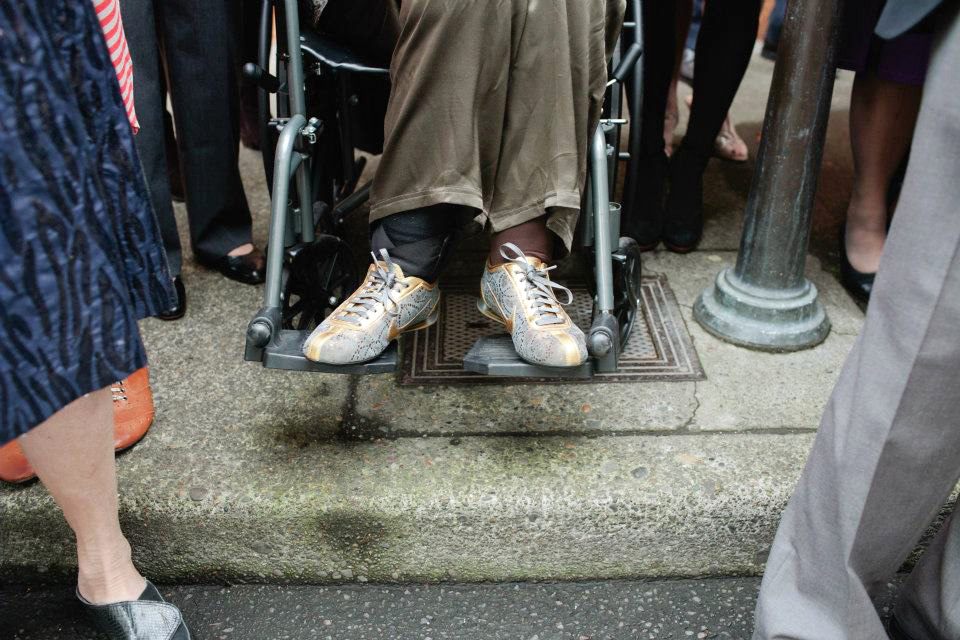
Friday, April 06, 2012
David vs. Goliath: St. Jude Medical Seeks Retraction of Heart Rhythm Journal Manuscript
St. Jude Medical, a widely-used manufacturer of implantable cardiac devices, finds they have a bit of a problem with a form of insulation that surrounds wires contained in several lines of their pacing and defibrillator leads. They decide to pull these products from the market after substantial evidence that their leads' reliability falls below their standards.
A credible doctor, Robert G. Hauser, MD, known for his work in reviewing medical device safety issues, published a perspective piece critical of the post-market surveillance of the Riata leads in the New England Journal of Medicine. St. Jude Medical takes issue with Dr. Hauser, and publishes a rebuttal in the same issue of New England Journal of Medicine.
Dr. Hauser then submits a paper to the scientific peer-reviewed Heart Rhythm Journal for publication. The paper reveals deaths that might be caused by St. Jude Medical's faulty leads. The reviewers feel it is an important paper to share with their readership. The paper is published.
Today we find that St. Jude Medical is REALLY not happy with Dr. Hauser and demands that his paper be retracted from the Heart Rhythm Journal on the basis of their competitor's lead data reliability that they feel was misreported. The same letter fails to mention their own quality issues.
They then issue a press release to assure viral media spread in an attempt to discredit the physician's findings far and wide before facts can be verified. They say in their press release that they are justified in their action because Dr. Hauser failed to come to them before publishing his article:
Interestingly, word on the street is that a not-so-pleasant article about St. Jude's lead issue and the problems therein is about to be published in a major newspaper. (Addendum 4/6/2012 @ 11:07pm: Here's the New York Times article now in print)
As Shakespeare famously said: "The lady doth protest too much, methinks."
-Wes
A credible doctor, Robert G. Hauser, MD, known for his work in reviewing medical device safety issues, published a perspective piece critical of the post-market surveillance of the Riata leads in the New England Journal of Medicine. St. Jude Medical takes issue with Dr. Hauser, and publishes a rebuttal in the same issue of New England Journal of Medicine.
Dr. Hauser then submits a paper to the scientific peer-reviewed Heart Rhythm Journal for publication. The paper reveals deaths that might be caused by St. Jude Medical's faulty leads. The reviewers feel it is an important paper to share with their readership. The paper is published.
Today we find that St. Jude Medical is REALLY not happy with Dr. Hauser and demands that his paper be retracted from the Heart Rhythm Journal on the basis of their competitor's lead data reliability that they feel was misreported. The same letter fails to mention their own quality issues.
They then issue a press release to assure viral media spread in an attempt to discredit the physician's findings far and wide before facts can be verified. They say in their press release that they are justified in their action because Dr. Hauser failed to come to them before publishing his article:
St. Jude Medical was not consulted prior to the publication, nor asked to validate any of the data against its returns analyses. Since the manuscript was published, the company has spent more than 300 hours attempting to reach the same conclusions as Dr. Hauser, but can find no way of analyzing the MAUDE database that reproduces the same numbers reported in the manuscript. The company has identified duplicate reports, inconsistent categorizations and failures to include all available reports.Ladies and gentlemen, this is an electronic SMACKDOWN!
Interestingly, word on the street is that a not-so-pleasant article about St. Jude's lead issue and the problems therein is about to be published in a major newspaper. (Addendum 4/6/2012 @ 11:07pm: Here's the New York Times article now in print)
As Shakespeare famously said: "The lady doth protest too much, methinks."
-Wes
Wednesday, April 04, 2012
St. Jude Medical's Woes Continue: Line of LV Leads Show Externalization
Today, St. Jude Medical will be proactively informing physicians and patient of the withdrawal of their older-generation Quicksite and QuickFlex silicone left ventricular pacing leads (Models 1056T, 1058T, 1156T and 1158T) from the market after reports have surfaced of externalized conductors. According to their notification, there have been 39 confirmed cases out of 171,000 leads sold worldwide. While none of the pacing leads have demonstrated evidence of malfunction, the nature of this malfunction is important because it can occur without detection unless the patient undergoes fluoroscopic (x-ray) evaluation. The newer versions of the unipolar QuickFlex (Model 1056K) and Quickflex Micro (Model 1258T) and Quartet model 1458Q are NOT subject to this recall because their construction utilizes St. Jude's Optim insulation rather than silicone insulation.
For St. Jude Medical, this latest revelation comes at a difficult time as physicians are still trying to deal with the management of St.Jude's earlier-generation recalled silicone defibrillator leads, the Riata and Riata ST. The revelation that this externalization can now affect St. Jude's bradycardia left ventricular pacing leads will no doubt affect physician's device selection. It is also clear that St. Jude Medical's portfolio of products for their lucrative cardiac rhythm management division will be significantly impacted.
For patients with these left ventricular pacing leads, follow-up of their system may involve x-ray evaluation on an intermittent basis, but I do not think that St. Jude and its physician advisory board will recommend removal of these leads, given the risks of infection and trauma that might be inherent to that procedure.
More likely, careful routine follow-up of these leads will be all that is required for now with the addition of at least one surveillance x-ray evaluation of the patient's LV lead and RV lead systems.
-Wes
4 Apr 2012 @ 10:55 am CST: Updated to include photo.
Disclaimer: Please understand that the opinions expressed in this blog are mine alone and do not represent the views of St. Jude Medical nor NorthShore University HealthSystem. I have no financial ties with St. Jude Medical but do serve on the speaking circuits for Medtronic, Boston Scientific, and Zoll Medical.
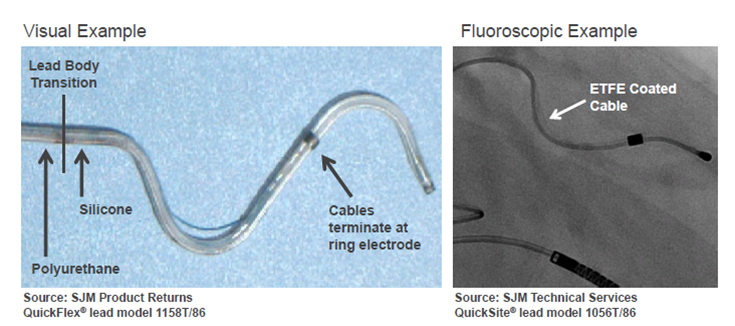 |
| (Click image to enlarge) |
For St. Jude Medical, this latest revelation comes at a difficult time as physicians are still trying to deal with the management of St.Jude's earlier-generation recalled silicone defibrillator leads, the Riata and Riata ST. The revelation that this externalization can now affect St. Jude's bradycardia left ventricular pacing leads will no doubt affect physician's device selection. It is also clear that St. Jude Medical's portfolio of products for their lucrative cardiac rhythm management division will be significantly impacted.
For patients with these left ventricular pacing leads, follow-up of their system may involve x-ray evaluation on an intermittent basis, but I do not think that St. Jude and its physician advisory board will recommend removal of these leads, given the risks of infection and trauma that might be inherent to that procedure.
More likely, careful routine follow-up of these leads will be all that is required for now with the addition of at least one surveillance x-ray evaluation of the patient's LV lead and RV lead systems.
-Wes
4 Apr 2012 @ 10:55 am CST: Updated to include photo.
Disclaimer: Please understand that the opinions expressed in this blog are mine alone and do not represent the views of St. Jude Medical nor NorthShore University HealthSystem. I have no financial ties with St. Jude Medical but do serve on the speaking circuits for Medtronic, Boston Scientific, and Zoll Medical.
Monday, April 02, 2012
A Writer Describes His Heart Transplant
A remarkable first-hand account of getting a heart transplant:
These days, it feels like my life is a tale of two ends of the emotional spectrum. There are days when I am so elated and full of exuberance that it would rival Mary Poppins. Other days are melancholy, which fills me with guilt. As much as I tell myself I have absolutely no right to feel anything but happy and grateful for the rest of my life, I occasionally feel sad and angry.-Wes
But I have come to realize that feeling bad at times is OK. After all, it's all a part of life.
I can't seem to quell my desire to make up for lost time. Thanks to the selfless act of an organ donor I will never meet, I now have the time to learn how to savor every second of the rest of my life.
Where's Waldo Comes to EP
Here's the picture (yes, there's a heart in there somewhere):

Now, name the technologies seen.
-Wes
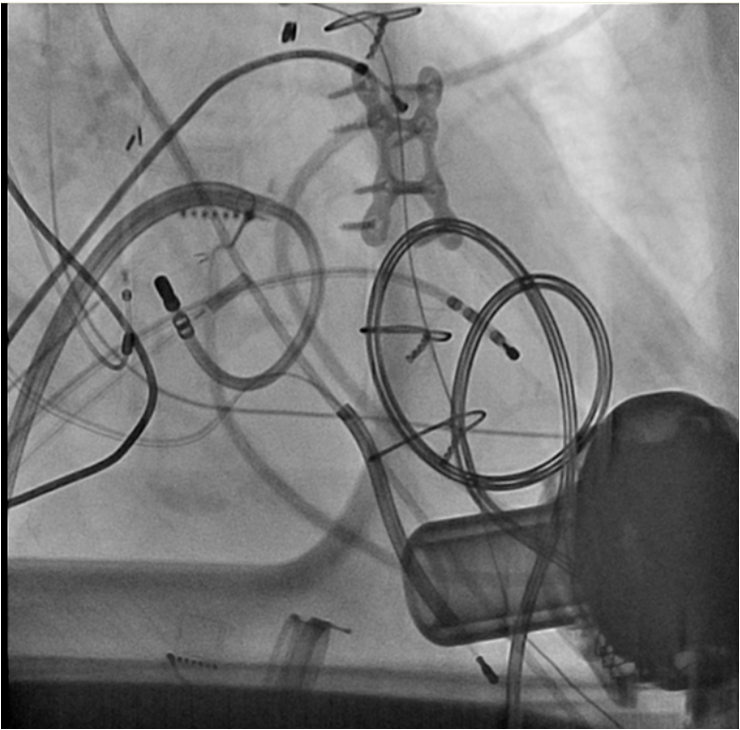
Now, name the technologies seen.
-Wes
Sunday, April 01, 2012
If Obamacare Falls
Until last week, the government's confidence on the constitutionality of the Patient Protection and Affordable Care Act (PPACA) seemed all but certain. Now, they're not so sure it might stand.
Of course, most American's are wondering: "Okay, if it gets repealed, then what?"
First, it is unlikely things will change right away. Many of the changes we've seen in health care with funding of the electronic medical record and forcing the collaboration between doctors and hospitals were created by the earlier economic "Stimulus" package funding, not the PPACA.
But for those of us involved in health care, a whole host of opportunities arise for our health care system if the PPACA falls. It is no secret that the biggest problem of our health care system is its rising cost relative to inflation. While the constitutionality of Obamacare may become its immediate undoing, the continued runaway costs that were not managed by the creation of such a gigantic new system would have eventually destroyed our health care system (and perhaps our economy) anyway. Already, new 10-year cost estimates far exceed original estimates.
If the PPACA is struck down, legislators will have an opportunity to address the problem of cost sustainability head-on to our health care system. The current health care ruling, if it plays out as anticipated, will need a viable, solvent alternative. The alternative will be a challenge to construct as special interests spend millions to lobby our legislators. But Congress should be increasingly aware that they are viewed by most Americans as divisive and largely ineffective; this could be a chance to change that perception for there is much both sides of the aisle can agree upon. They understand the need for affordable health care for the most needy. And most understand the cost conundrum must be addressed.
So what should Congress do?
In many ways, the answer might be easier than we all think:
Fix what's broken first.
Rather than creating a new, larger government health care system based on an 2700-page nearly unreadable health care law that creates at least 115 new agencies and winds between countless government agencies and disconnected bureaucracies, we should move to fix what's broken with Medicare and Medicaid first with an eye toward fixing what matters most to Americans.
If we've got waste, fraud, and abuse to the extent we are told, then fix it. We don't need new agencies to do so.
Admit there are limits to what can and will be paid for, set a budget, and stick to it.
If we care about our kids being uninsured, then fix it.
If care about people with pre-existing conditions not being insured, then fix it. But be honest with limits.
If people with sufficient means aren't contributing enough for their health care, fix it, but don't restrict what care those folks can obtain on their own nickel.
If doctors are saying they are overburdened with documentation requirements that don't improve patient outcomes or safety, then fix it. Stop perpetuating wasteful documentation mandates that add nothing to patient outcomes.
If we care about families going broke from health care expenses, then fix it. As a corollary:
if people don't know what things cost until it's too late to avoid bankruptcy, then fix it.
If costs are too high for medications, then fix it. Don't allow direct-to-consumer advertising and save a billion dollars (or more) for consumers. Open overseas markets to generic medication manufacturers that can prove the quality of their product. Things like this make patients the priority, not special interests.
If we don't have enough people caring for our population, then fix it. But move with caution - quality must be maintained: consider the costs of truncating supervised clinical training in favor of producing doctor mills.
If prices for materials and goods are held artificially high by government's fee payment schedule, then fix it. Legislators should ask themselves: do we really need pharmacy benefit managers and group purchase organizations that add no value for the patient? Can you say "i-n-t-e-r-n-e-t?"
Rather than trying to fixing exerything that ails our system all at once, take it piece by piece. Vet the issues openly rather than behind closed doors. Since prices are the priority, make prices for elective procedures and medical equipment available online to patients AND doctors. Patients must be the priority to our new initiatives, not special interests. Most of all, make the lower cost of health care and quality of health care the priorities and stop promising that the quantity of care we provide can remain unlimited to all.
Improvise. Adapt. Who knows: we might just overcome our current health care crisis bit by little bit.
But the one thing that Congress should absolutely NOT do is kick the health-care-cost can down the road any further. Otherwise, any new measure to preserve our health care system will be just as worthless to the sustainability of health care and our economy as the paper they're printed on.
-Wes
Of course, most American's are wondering: "Okay, if it gets repealed, then what?"
First, it is unlikely things will change right away. Many of the changes we've seen in health care with funding of the electronic medical record and forcing the collaboration between doctors and hospitals were created by the earlier economic "Stimulus" package funding, not the PPACA.
But for those of us involved in health care, a whole host of opportunities arise for our health care system if the PPACA falls. It is no secret that the biggest problem of our health care system is its rising cost relative to inflation. While the constitutionality of Obamacare may become its immediate undoing, the continued runaway costs that were not managed by the creation of such a gigantic new system would have eventually destroyed our health care system (and perhaps our economy) anyway. Already, new 10-year cost estimates far exceed original estimates.
If the PPACA is struck down, legislators will have an opportunity to address the problem of cost sustainability head-on to our health care system. The current health care ruling, if it plays out as anticipated, will need a viable, solvent alternative. The alternative will be a challenge to construct as special interests spend millions to lobby our legislators. But Congress should be increasingly aware that they are viewed by most Americans as divisive and largely ineffective; this could be a chance to change that perception for there is much both sides of the aisle can agree upon. They understand the need for affordable health care for the most needy. And most understand the cost conundrum must be addressed.
So what should Congress do?
In many ways, the answer might be easier than we all think:
Fix what's broken first.
Rather than creating a new, larger government health care system based on an 2700-page nearly unreadable health care law that creates at least 115 new agencies and winds between countless government agencies and disconnected bureaucracies, we should move to fix what's broken with Medicare and Medicaid first with an eye toward fixing what matters most to Americans.
If we've got waste, fraud, and abuse to the extent we are told, then fix it. We don't need new agencies to do so.
Admit there are limits to what can and will be paid for, set a budget, and stick to it.
If we care about our kids being uninsured, then fix it.
If care about people with pre-existing conditions not being insured, then fix it. But be honest with limits.
If people with sufficient means aren't contributing enough for their health care, fix it, but don't restrict what care those folks can obtain on their own nickel.
If doctors are saying they are overburdened with documentation requirements that don't improve patient outcomes or safety, then fix it. Stop perpetuating wasteful documentation mandates that add nothing to patient outcomes.
If we care about families going broke from health care expenses, then fix it. As a corollary:
if people don't know what things cost until it's too late to avoid bankruptcy, then fix it.
If costs are too high for medications, then fix it. Don't allow direct-to-consumer advertising and save a billion dollars (or more) for consumers. Open overseas markets to generic medication manufacturers that can prove the quality of their product. Things like this make patients the priority, not special interests.
If we don't have enough people caring for our population, then fix it. But move with caution - quality must be maintained: consider the costs of truncating supervised clinical training in favor of producing doctor mills.
If prices for materials and goods are held artificially high by government's fee payment schedule, then fix it. Legislators should ask themselves: do we really need pharmacy benefit managers and group purchase organizations that add no value for the patient? Can you say "i-n-t-e-r-n-e-t?"
Rather than trying to fixing exerything that ails our system all at once, take it piece by piece. Vet the issues openly rather than behind closed doors. Since prices are the priority, make prices for elective procedures and medical equipment available online to patients AND doctors. Patients must be the priority to our new initiatives, not special interests. Most of all, make the lower cost of health care and quality of health care the priorities and stop promising that the quantity of care we provide can remain unlimited to all.
Improvise. Adapt. Who knows: we might just overcome our current health care crisis bit by little bit.
But the one thing that Congress should absolutely NOT do is kick the health-care-cost can down the road any further. Otherwise, any new measure to preserve our health care system will be just as worthless to the sustainability of health care and our economy as the paper they're printed on.
-Wes
Subscribe to:
Posts (Atom)