Showing posts with label remote programming. Show all posts

Friday, September 19, 2014

Case Study: What They Don't Teach You in EP Fellowship


These days, pacemakers and defibrillators are often interrogated via a home-monitoring system that uploads information contained in the implanted cardiac devices automatically to a central server so it can be accessed by physicians remotely.  This feature was added to most defibrillators after the rash of recalls struck the industry in 2005-6.  Not only can the information be uploaded electively by the patient, it can also be automatically uploaded if a nightly self-check detects a parameter out of range.  In this case, the patient was being monitored by Medtronic's Carelink remote monitoring system.

"Dr. Fisher, I think we have a problem with Mr. Smith's RV lead (not his real name)," my device nurse said as she handed me the Carelink transmission that triggered an superior vena cava (SVC) high voltage coil impedance warning:
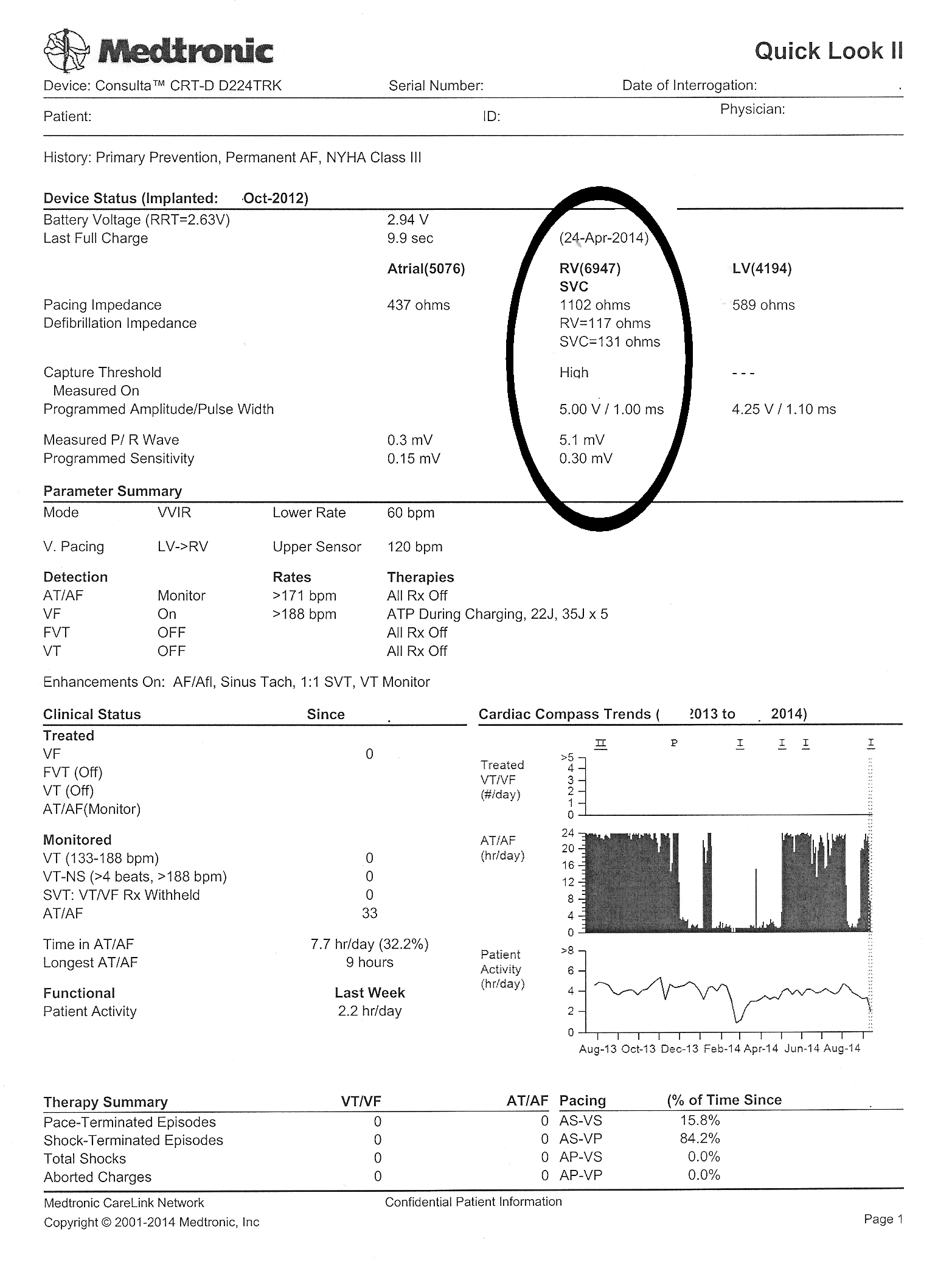
Click to enlarge

"What did the last interrogation look like?" I asked.

"Here's the old one was sent just three days before and looked fine," she said. "It's so weird.  We've not had a problem with this patient's device since it was implanted in 2012."
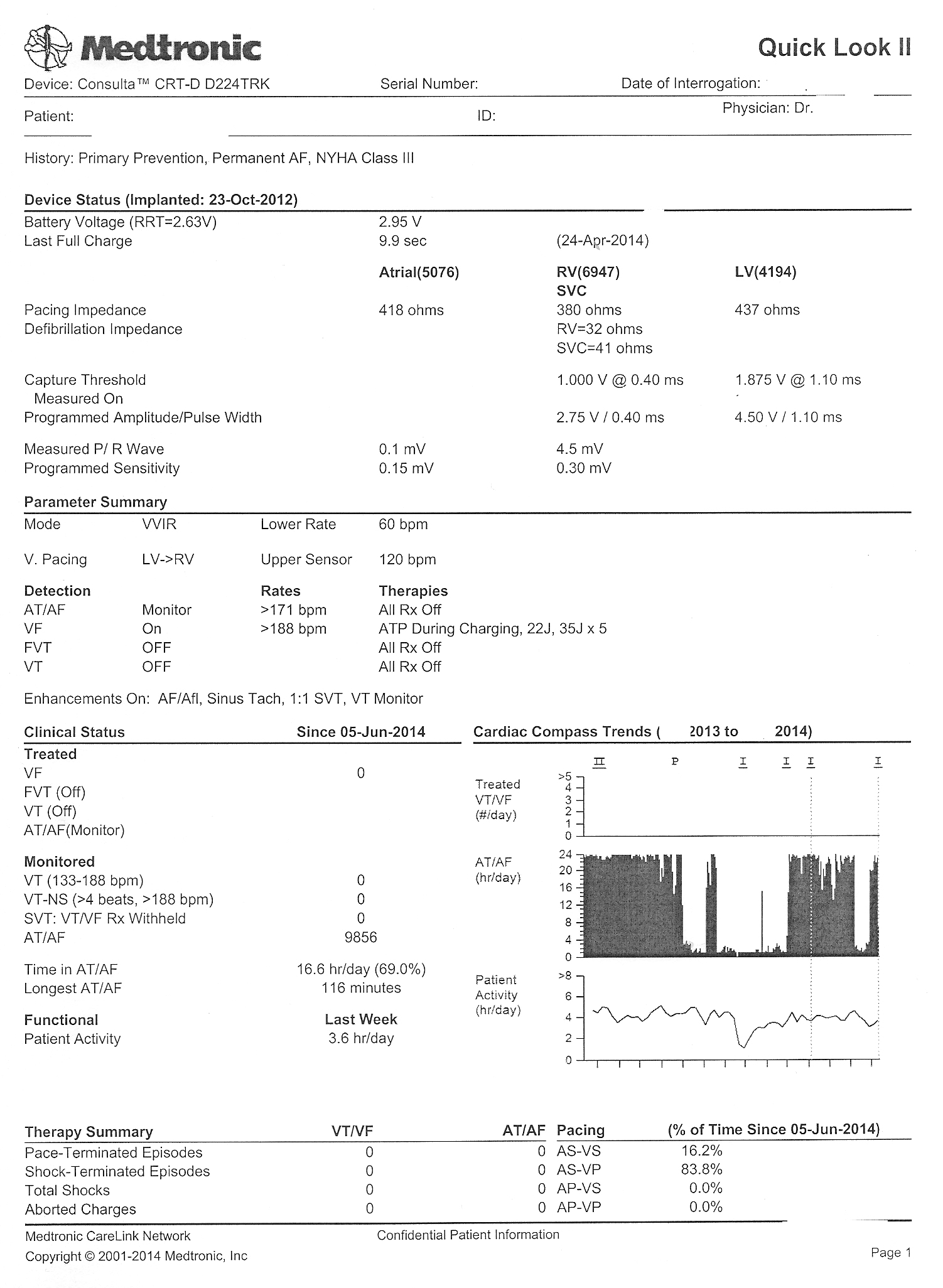
Click to enlarge


Real-time intracardiac electrograms seen on the earlier transmission - Click to enlarge


"Strange.  I'm not sure what to make of this.  Give him a call - we might have to change that RV lead," I said.

"Okay," she said, then returned to the device clinic and I went back to seeing patients.

Some time later, my nurse returned.

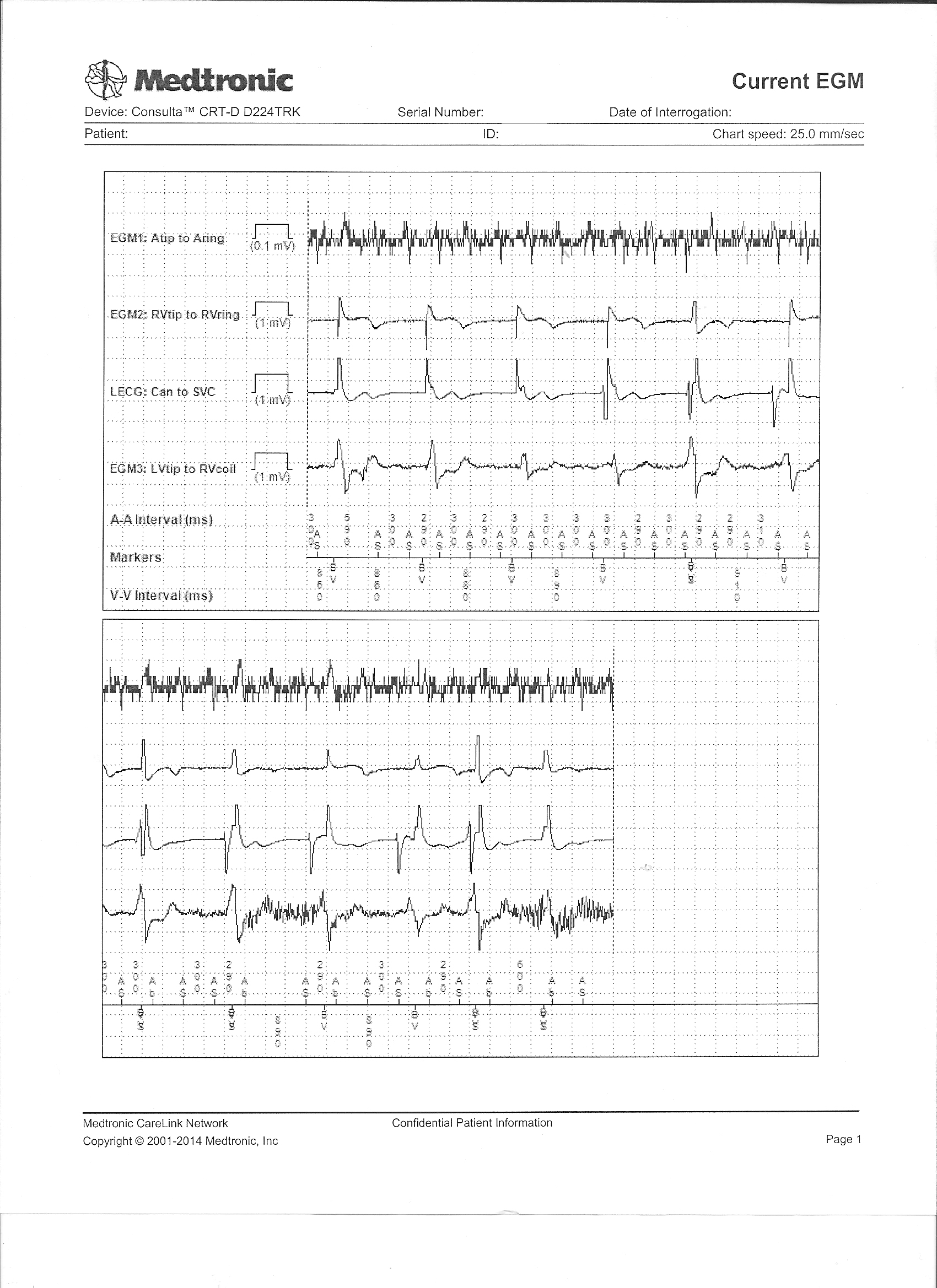
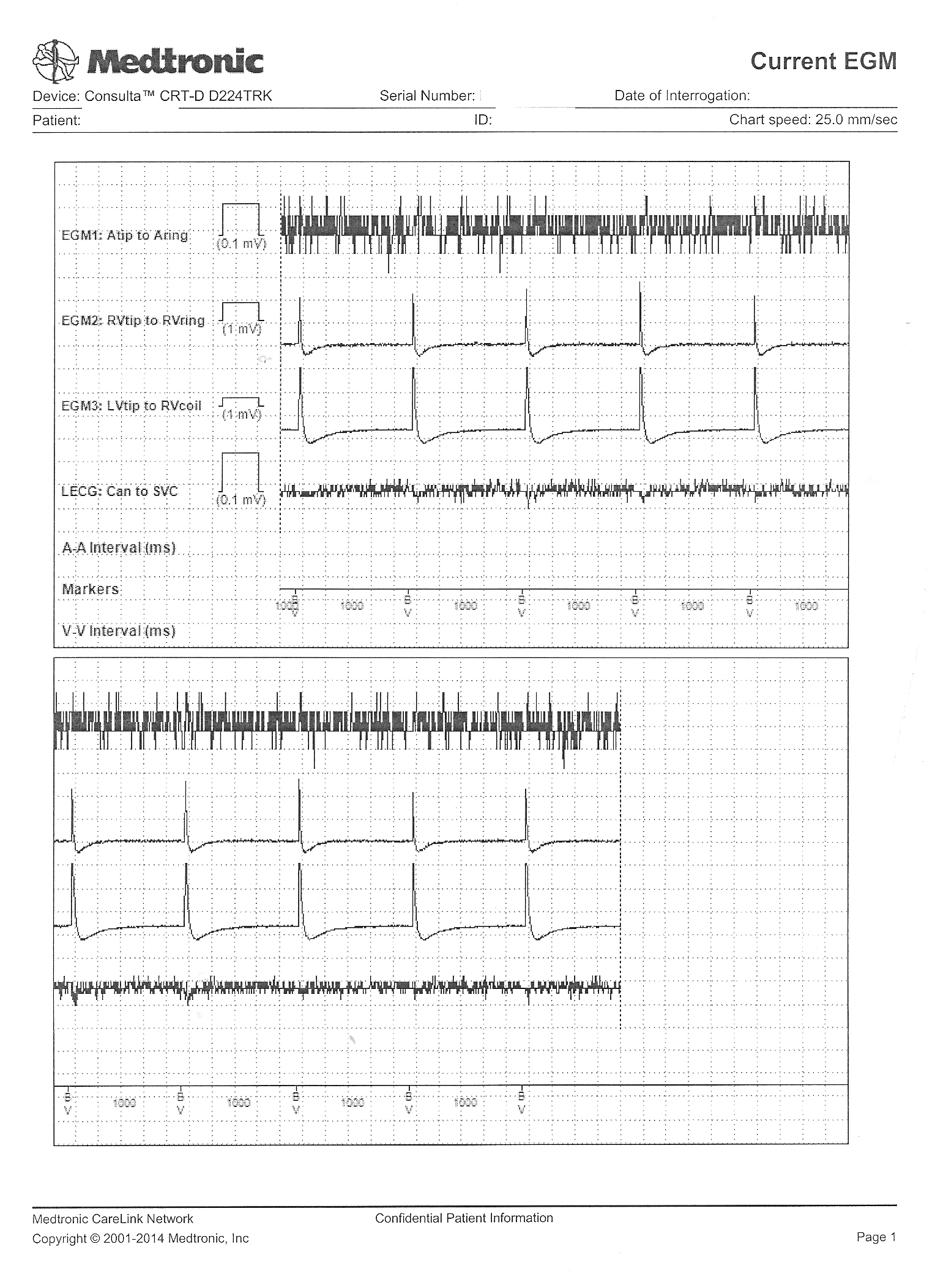
"Um, Dr. Fisher, could I speak with you a moment?" she asked.  "I got some more information.  I think you better look at this" and she handed me his most recently transmitted real-time intracardiac electrogram recording that was sent with the latest transmission.

What did it show and why were the RV lead parameters abnormal?

-Wes

Sunday, May 16, 2010

The Case for Remote Medical Device Programming

With the recent reports of hacking ICD's, especially when a skilled set of engineers stand within six inches of the device, we can see the next Tom Clancy story line:
"A famous head of state, lounging in the comfort of his home, suddenly is afflicted with a series of shocks from his defibrillator, then collapses to the floor. His aides, uncertain what just happen, attempt to revive him, to no avail. Meanwhile, in a country far, far away, the terrorists are exchanging high fives..."
These threats, as we can clearly see, are a Clear and Present Danger. (I know, not very original, but you get the drift.)

Not that security isn't important, it is. But should it be a show-stopper to innovation as we attempt to deliver care to our burgeoning patient population in the years ahead?

The reality on the ground is that doctors should have the ability to make adjustments to certain ICD programmed features remotely. The reality on the ground is that already we have non-medical personnel programming devices - even turning them off.

These devices need continuous follow-up, and a lot of it. For every device implanted, I would estimate that there are four times the number of patient visits made for these devices to a doctor's office that for patients without devices. Is this on-site follow-up burden sustainable? Currently, entire clinics are manned full-time by device nurses to manage the volume. Even with these clinics, devices must to reprogrammed at other times, like just before and after surgery, or de-activated when people reach the end of their life. With cost constraints limiting the number of personnel available for device management, we simply not have the number of individuals at all the geographic sites necessary to reprogram devices in person. So we've turned to industry representatives who hold no medical degree to make changes to programmed parameters on our behalf, many of which go undocumented. Physicians "oversee" these adjustments, of course (someone has to be legally responsible, right?), but the reality is is that people with medical degrees are not always the ones out there pushing the buttons.

This issue will only grow more dire as the baby boomers age and the number of devices continues to grow as we push to keep patients out of the hospital. For these reasons, and reasons of legal accountability, I foresee that the need for remote programming of devices will be all but inevitable.

And this isn't just for cardiac devices. Insulin pumps, neural stimulators, and a whole host of new innovative implantable devices will also need follow-up after their implantations.

Certainly, secure interlocks can be developed to assure safe remote reprogrammings - maybe even patient-and-physician hand-shake protocols, for instance. But in this era of increasingly wired health care delivery there should be no reason the FDA, in a brief moment of clarity, should discourage the development of carefully-developed protocols to modify device settings remotely.

What the heck are we waiting for?

-Wes