She was only 12 years old when her sudden cardiac arrest was captured on a school security camera. Thankfully, she was saved by the quick actions of a few teachers and the school's automatic external defibrillator:
It's good to remember that sudden cardiac arrest is not just limited to the elderly.
-Wes
Addendum: Oh, and I'm sure she had an implantable cardiac defibrillator installed after her event rather than just a more conventional pacemaker as mentioned in the article.
Showing posts with label AED. Show all posts
Showing posts with label AED. Show all posts
Tuesday, October 11, 2011


Sunday, November 14, 2010
Salamanca Soccer Player Miguel Garcia's Sudden Cardiac Arrest
How fast does sudden cardiac arrest cause unconsciousness?
Just seconds.
Here's video of Salamanca soccer player Miguel Garcia's episode. At the start of the video, Mr. Garcia can be seen in the background of the image kneeling behind the players in the foreground. Watch carefully as he stands after tying his shoes.
Although it is difficult to see, it appears an automatic external defibrillator arrives in about 2 minutes, though given the fact his shirt is still on as he's taken from the field, we note the device is on his gurney as he's hurried to a nearby ambulance. Reportedly, he survived this sudden cardiac arrest event.
This was NOT a heart attack, but rather an loss of cardiac function caused by a rapid, often disorganized heart rhythm disorder. Compare the relatively long time to resuscitation using an external automatic defibrillator verses the very rapid response afforded to Belgian soccer player Anthony Van Loo whose internal defibrillator was already installed before he played as primary prevention of sudden death from right ventricular dysplasia.
-Wes
h/t: Electrophysiology Fellow blog
Just seconds.
Here's video of Salamanca soccer player Miguel Garcia's episode. At the start of the video, Mr. Garcia can be seen in the background of the image kneeling behind the players in the foreground. Watch carefully as he stands after tying his shoes.
Although it is difficult to see, it appears an automatic external defibrillator arrives in about 2 minutes, though given the fact his shirt is still on as he's taken from the field, we note the device is on his gurney as he's hurried to a nearby ambulance. Reportedly, he survived this sudden cardiac arrest event.
This was NOT a heart attack, but rather an loss of cardiac function caused by a rapid, often disorganized heart rhythm disorder. Compare the relatively long time to resuscitation using an external automatic defibrillator verses the very rapid response afforded to Belgian soccer player Anthony Van Loo whose internal defibrillator was already installed before he played as primary prevention of sudden death from right ventricular dysplasia.
-Wes
h/t: Electrophysiology Fellow blog
Down. Set. Hut. Clear!
Sudden cardiac death survivor stories are never boring. From the NY Post:
Hearing the commotion, I wonder if the crowd started singing' "Ah, Ah, Ah, Ah, Stayin' Alive, Stayin' Alive..."
-Wes
A veteran Brooklyn high school athletic director suffered a near-deadly heart attack while announcing a football game yesterday but was brought back to life by the team doctor as stunned spectators listened to the dramatic rescue over the PA system. "Clear!" Dr. Ed Golembe shouted as he applied the pads of a defibrillator on Marshall Tames, the athletic director at Erasmus Hall HS, around 1 p.m. at Midwood High's field. The rescue was inadvertently broadcast over the PA system at the 2,000-seat stadium where Erasmus was in a playoff game with the Bronx's Dewitt Clinton HS.It seems a defibrillator might have been responsible for the coach losing the game, but it sure helped one man live to see another one.
"As I was calling a play, I turned around and heard all this happen," said Erasmus coach Danny Landberg. "I got flustered."
Hearing the commotion, I wonder if the crowd started singing' "Ah, Ah, Ah, Ah, Stayin' Alive, Stayin' Alive..."
-Wes
Monday, August 23, 2010
Game-changer: A Great Idea for AED Deployment
AED4.eu for everybody:
-Wes
h/t: ePatientDave via Paul Levy at Running a Hospital blog.
Radboud University Medical Center in Nijmegen has built an emergency Augmented Reality display that allows you to look through your mobile phone's camera view and locate the nearest automatic external defibrillators (AEDs) located in a public place. It's the first independent database of AEDs in the world operated by an Academic Hospital.This is proof that some of the best ideas are the simple ones.
-Wes
h/t: ePatientDave via Paul Levy at Running a Hospital blog.
Friday, February 19, 2010
Swiss Call Girls Offer Full Cardiovascular Services
... all in the name of satisfied customers who will hopefully live long enough to assure payment:
-Wes
h/t: @rlbates via Twitter.
Prostitutes in the picturesque Swiss lakeside town of Lugano are adding defibrillation to their list of services following the death of several elderly punters whose hearts just couldn't take the pace.Looks like we've done a good job getting the message out on the benefits of automatic external defibrillators...
According to the Corriere della Sera, there are currently 38 brothels and sex clubs in the Lugano area, and more are planned to accommodate the rising tide of customers who pop over the border from Italy.
For some, though, this proves to be a day trip too far. The most recent case was a pensioner who suffered a heart attack while enjoying Lugano's delights with the aid of "pharmaceutical assistance".
-Wes
h/t: @rlbates via Twitter.
Friday, December 18, 2009
Can a Website Teach CPR?
 The American Heart Association, in conjunction with a $1 million dollar grant from the Medtronic Foundation, thinks it can, especially if schools can win a thousand bucks for their effort promoting the idea:
Through the Be the Beat campaign, the Medtronic Foundation is providing $1,000 grants for school staff to help fund CPR and AED training outreach programs within their school or community. The deadline for application is January 15, 2010. More information is available in the “Teachers and Administration” section of the Be the Beat Web site, BetheBeat.heart.org/schools.Sadly, the music selections that play at 100 beats/minute, (like "Stayin' Alive" and "Another One Bites the Dust") aren't available for download, but a expanded list of songs that play at that rate is included. Songs like U2's "I Still Haven’t Found What I’m Looking For" or Simon and Garfunkle's "Cecilia" (yep, "Celilia, you're breakin' my heart, I'm down on my knees, beggin' you please, to come home, to come home!" made the list. This alone is sure to be a source of endless entertainment, though I'm not sure about the appropriateness of singing ABBA's "Dancin' Queen" during CPR...)
BetheBeat.heart.org engages 12- to 15-year-olds to learn the basics of cardiopulmonary resuscitation (CPR) and how to use an automated external defibrillator (AED) through interactive games, videos and songs on the Web.
And while the games kids are expected to play on the website are right up there in challenge level with the first iteration of "Pong," the concept of getting a broader, younger demographic to even think thirty seconds about CPR and how to use an AED is a novel one.
-Wes
Friday, November 13, 2009
Problems With Low-Energy External Defibrillators?
Seems the FDA wants to know more:
-Wes
FDA is investigating energy levels in (automatic) external biphasic defibrillators (AEDs) with shocks ≤ 200 J. FDA has received reports of 14 events since 2006 in which a 200 J biphasic defibrillator was ineffective in providing defibrillation/cardioversion therapy to a patient, whereas a subsequent shock from a different 360 J biphasic defibrillator resulted in immediate defibrillation/cardioversion. The majority of events occurred during attempts at cardioversion of atrial fibrillation, but there was at least one instance with defibrillation of a ventricular arrhythmia as well. FDA is seeking additional information in order to interpret the significance of these events, and to determine whether FDA activities are advised.I haven't seen this, but others may have, so let 'em know.
-Wes
Thursday, May 07, 2009
Man vs. Machine During CPR
 Sometimes, even our best efforts to save lives fails us.
In an effort to minimize the time to deliver shocks in patients in cardiac arrest, hospitals across the country have turned to automatic external defibrillators to reduce the time to first shock, thereby improving cardiac arrest outcomes. More often than not, this policy has been effective at assuring that nursing staff and even locally-available non-medical personnel can at least treat a patient as soon as possible after a cardiac arrest.
But might there be an instance where the AED gets it wrong?
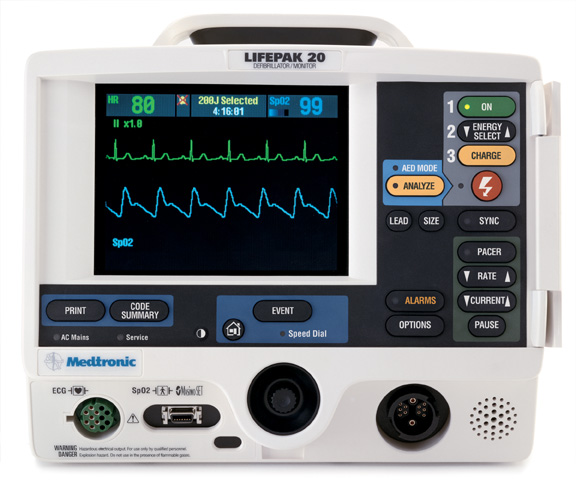
Well, of course. No shock algorithm is perfect. Take a look at this strip obtained from a Medtronic's Life Pak 20 defibrillator set to default to AED mode after a telemetry alarm prompted nursing personnel to rush to be patient's room, only to see the patient lose consciousness:
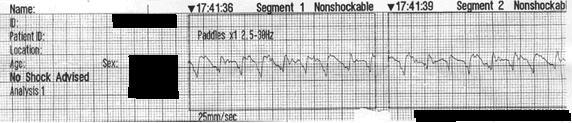
Click image to enlarge
CPR is started, but no shock was delivered. Why? Because the AED considered the rhythm "NONSHOCKABLE."
A quick call to the company suggests the algorithm (which is not published anywhere to my knowledge) involves five factors to attempt to be highly sensitive and fairly specific for ventricular arrhythmias: heart rate over 120, amplitude of the signal, slope of the received EKG morphology, QRS width, and something called "flat line content." Careful review of this rhythm demonstrates that it represents a heart rate over 120, is irregular, has varying QRS widths, and probably has different "slopes" and has an unknown "flat line content," whatever that represents.
While these findings are interesting for engineers, man (and women) must be allowed to intervene when it is perceived a machine is in error and anyone in a new, wide complex rhythm that causes a team of people to initiate CPR should consider the obvious:
Shock 'em anyway (synchronized to the QRS, of course).
Oh, and how do you deactivate the automatic nature of the AED on a Lifepak 20? Push any button besides the "Shock" button on the device and you'll be placed in manual mode.
-Wes
Tuesday, February 24, 2009
This Is What We've Come To?
Excuses, excuses:
But alas, legal liability issues have raised their ugly head once more. The recent the ruling in California that parsed the Good Samaritan law based on a definition of what it means to "rescue" a fellow human being has sent negative reverberations across our country. Certainly, there are plenty of barriers to entry with AEDs, but this is one doctor who remains convinced that these devices are more than worth the risks, hassles and expense.
-Wes
"Hotels worry that if they have the (Automatic External Defibrillator) devices, which cost about $1,200 to $2,000 each, they could be sued for failing to have enough units, failing to put them in the right places, or failing to replace batteries or maintain them properly.Batteries? Make sure your guests in medical distress are treated by trained personnel? Really? Are you serious? How about "we want to make sure guests in medical distress get treated as soon as possible to improve their chance of survival." Wouldn't that sound better in a national PR release?
Another concern: hotel worker training. "Our goal is to make sure guests in medical distress are treated by trained personnel, such as EMTs or paramedics," says a spokesman for Marriott.
But alas, legal liability issues have raised their ugly head once more. The recent the ruling in California that parsed the Good Samaritan law based on a definition of what it means to "rescue" a fellow human being has sent negative reverberations across our country. Certainly, there are plenty of barriers to entry with AEDs, but this is one doctor who remains convinced that these devices are more than worth the risks, hassles and expense.
-Wes
Tuesday, June 24, 2008
AED's - The Barriers to Entry
Melinda Beck of the Wall Street Jounal, did a nice piece on the need for automatic external defibrillators (AEDs) in public spaces today and started to address some of the issues of why these amazing gizmo's aren't available more widely:
So why aren't these devices more readily available?
First and foremost: is cost. These devices are still expensive: the cheapest quoted goes for about $1300. But there are other costs not commonly discussed: like the cost of new batteries every 2-7 years (depending on the cost of the model) that can set folks back at least a $100 for each device. And what about those defibrillator patches placed on the chest? They contain a gel that improves the conductivity of the patches on the chest, making the devices more reliable at correcting the normal heart rhythm. That gel degrades and the patches must be replaced every two to seven years, too - to the tune of about $100 a set, too. These are the unspoken issues with AEDs that are never written about and schools and institutions must understand these additional costs and maintenance requirements if they are to assure the proper functioning of these devices.
Next, is the location consideration: where will these devices be used? Will they be in the office setting, car trunk, or placed next to the baseball field? Humidity, motion, and other environmental issues might require a more expensive device to be deployed without the bargain-basement price. Certainly, in the NIH-sponsored trial "Home Automated External Defibrillator Trial (HAT)," home use has not been found to be more effective than a conventional call to 911: in part because of the low incidence of events that occur in the home when a responder is present (58 patients out of 7001 studied, and only 32 had AEDs used and only 4 survived to hospital discharge).
But the cost and efficacy considerations might be offset if more defibrillators were deployed in public spaces where more responders were present and events occurred - thereby driving down the costs. I suppose it would be utopia if these devices could be deployed and maintained within 3 minutes of whereever a person traveled. But the path to implementation, especially with staffing and budget shortfalls, is a lengthy one. As a case in point: many doctors' offices, dialysis centers, and rehab units still do not have these devices and instead rely on calling 911 for a response in emergencies.
Sad, but true.
-Wes
Some states now require AEDs in schools; some require them in health clubs, shopping malls and golf courses. There's little uniformity; despite their foolproof nature, some businesses oppose them out of fear of being sued if something goes awry with an on-site AED. "I predict that 10 years from now, people will say, 'I'm not going to work in a building or stay in a hotel or eat in a restaurant that doesn't have an AED," says San Diego city-council member Jim Madaffer, who helped place nearly 5,000 AEDs in public facilities since 2001. They've saved 49 lives.As electrophysiologists, we often get to see the "saves" made by these devices: the young boy playing baseball, struck in the chest by a fast ball ("commodio cordis") that fibrillates his heart and the police officer who responds with the AED in the trunk of his squad car to save the boy's life; or the father who collapses just outside the fire department and is rescued by their defibrillator. These event happen every day, but unfortunately as experienced in the Tim Russert case, many more are not so fortunate.
Schools have been a tough sell, too, largely because of cost. Some parents are raising money for AEDs themselves, often after a tragedy. Evelyn and Larry Pontbriant have donated 32 AEDs to Norwich, Conn., schools since last summer, when their 15-year-old son, an athlete with no known heart problems, suffered a fatal cardiac arrest during a running event in the local park. An AED arrived on the scene too late. "It's a good investment to have on hand in your school," says Mrs. Pontbriant. "It benefits not just the athletes, but also the teachers, coaches, referees, grandparents and siblings."
So why aren't these devices more readily available?
First and foremost: is cost. These devices are still expensive: the cheapest quoted goes for about $1300. But there are other costs not commonly discussed: like the cost of new batteries every 2-7 years (depending on the cost of the model) that can set folks back at least a $100 for each device. And what about those defibrillator patches placed on the chest? They contain a gel that improves the conductivity of the patches on the chest, making the devices more reliable at correcting the normal heart rhythm. That gel degrades and the patches must be replaced every two to seven years, too - to the tune of about $100 a set, too. These are the unspoken issues with AEDs that are never written about and schools and institutions must understand these additional costs and maintenance requirements if they are to assure the proper functioning of these devices.
Next, is the location consideration: where will these devices be used? Will they be in the office setting, car trunk, or placed next to the baseball field? Humidity, motion, and other environmental issues might require a more expensive device to be deployed without the bargain-basement price. Certainly, in the NIH-sponsored trial "Home Automated External Defibrillator Trial (HAT)," home use has not been found to be more effective than a conventional call to 911: in part because of the low incidence of events that occur in the home when a responder is present (58 patients out of 7001 studied, and only 32 had AEDs used and only 4 survived to hospital discharge).
But the cost and efficacy considerations might be offset if more defibrillators were deployed in public spaces where more responders were present and events occurred - thereby driving down the costs. I suppose it would be utopia if these devices could be deployed and maintained within 3 minutes of whereever a person traveled. But the path to implementation, especially with staffing and budget shortfalls, is a lengthy one. As a case in point: many doctors' offices, dialysis centers, and rehab units still do not have these devices and instead rely on calling 911 for a response in emergencies.
Sad, but true.
-Wes
Friday, September 28, 2007
The $20-million-dollar Heart?
That's what Sotheby's wants for this 9-foot heart.
And to think we can't get enough money to purchase defibrillators for our first-responders.
-Wes
And to think we can't get enough money to purchase defibrillators for our first-responders.
-Wes
Tuesday, August 28, 2007
Should Defibrillators Be In Schools?
 Just in time for the back-to-school season comes this report on the epidemiology of cardiac arrest in our schools.
The report adds much to our knowledge of the epidemiology of sudden death in schools from two large counties near Seattle, WA, USA. Of 3773 episodes of cardiac arrest in a public domain over 16 years, 97 arrests occurred in 671 schools but only 12 of these occurred in children.
The incidence of sudden death among (adult) school staff was 25-fold greater than that among students. Given the additional contribution of other adults not employed by the school, greater than 90% of cardiac arrests in schools occurred among adults. The finding supports the assertion that school-based CPR and AED programs would benefit faculty and staff members, as well as visitors to the school who, because of their age, are at greater risk of cardiac arrest than the students.
And while some doctors are in favor of expanding CPR and AED distribution, others are not:
"It is estimated that over 350,000 individuals die of sudden cardiac arrest in the U.S. each year," said Dr. Gregg C. Fonarow, a professor of cardiology at the University of California, Los Angeles. "Improved cardiac arrest recognition and emergency activation, early CPR, and early defibrillation, including the use of AEDs, can significantly increase the chances of surviving sudden cardiac arrest."But what was remarkable in this study was the unusually high success rates of public access defibrillation by lay rescuers. From the study:
This study provides important community-based data on the incidence, circumstances and outcome of cardiac arrest in the school setting, Fonarow said. "This study found that half of the student cardiac arrests were not associated with physical exertion or sports participation, and student risk was similar for elementary school, middle school, high school and college," he said.
The majority of cardiac arrests in schools occurred among adults, Fonarow noted. "The finding supports the assertion that school-based CPR and AED programs would benefit not only students, but faculty, staff members, as well as school visitors, and provides important data for considering increasing CPR training and the availability of AEDs in the school setting," he said.
Another expert disagrees. The very rarity of cardiac arrests at schools makes having AEDs available unnecessary, he said.
"Any cardiac arrest in a student, especially if it occurs on school grounds, gets a lot of media attention," said Dr. Byron Lee, an associate professor of cardiology at the University of California, San Francisco. "This has led some to call for AED in every school."
However, because cardiac arrest at schools is extremely rare, and only a minority of cardiac arrests occurs in the students, "it seems unlikely that putting an AED in every school would be cost-effective," Lee said.
Seven of the school-based cardiac arrests received lay-rescuer defibrillation. Survival to hospital discharge among cardiac arrests was 39% in school settings (46% for initial rhythm of ventricular fibrillation) compared with 27% in other public locations.These data, in my view, make a compelling case for the wide availability of public access defibrillation. It is survival to discharge from a hospital that matters, and there is nothing that will improve survival in that setting better than a beating heart. The chest thumping of CPR, while helpful temporarily, only mildly improves the chance of survival following cardiac arrest until the coordinated contraction of the heart can be restored with defibrillation.
-Wes
Reference: Katayoun Lotfi BS, Lindsay White MPH*, Tom Rea MD, MPH, Leonard Cobb MD, Michael Copass MD, Lihua Yin MBA, Linda Becker MA, and Mickey Eisenberg MD, PhD. "Cardiac Arrest in Schools," Circulation 2007 doi:10.1161/CIRCULATIONAHA.107.698282
Image credit.
Monday, April 23, 2007
Free AED? Check the Serial Number
Wednesday, April 04, 2007
Sudden Cardiac Death Preparedness in School Athletic Programs
Despite these new guidelines published in the April issue of the journal Heart Rhythm that addresses preparedness for cardiac arrest in high school and college athletic programs, many schools still have no automatic external defibrillators (AEDs) on site. But the guideline's lead author, Dr. Jonathan Drezner (University of Washington, Seattle), makes an important point on TheHeart.org:
It just makes sense for our kids.
-Wes
"Many schools are acquiring defibrillators through donations, and while that's not a bad thing, it's solving only half the problem," said Drezner. "You have the equipment, but do you have the plan that goes with it? If the defibrillator is kept in the nurses' office in a locked cabinet, it doesn't really do you much good if a player has a cardiac arrest on the football field or the basketball court."But why stop with high schools and colleges? In my view, elementary schools should have a similar plan and equipment in place.
After communication, personnel, and equipment, the emergency action plan must be ready to work smoothly when the situation arises. "This is something that has to be practiced," emphasized Drezner. "You have to get your likely first responders, your athletic trainers, your team physicians, your school nurses, coaches, and administrators, and bring them out to the practice field and simulate a cardiac arrest. Go over that emergency practice plan, and go over it at least once a year."
It just makes sense for our kids.
-Wes
Sunday, February 25, 2007
Protecting Kids from Sudden Cardiac Death
More sadeness reigned down on the Denver Broncos as they lost another young athlete, Darien Nash, to sudden death. It is interesting to note that his younger brother had a heart ailment that required a transplant the year before. Whether it as an idiopathic dilated cardiomyopathy (enlarged weakened heart muscle) or hypertrophic cardiomyopathy (thickened, stiff heart muscle), these ailments can be transmitted in an autosomal dominant fashion (50% of offspring). The mother is absolutely right in insisting that her daughter be tested for the potential of carrying a gene that may have caused Darien Nash's death.
As if pre-ordained, this segment aired on MSNBC Nightly News the very same day that Darien Nash died - a story about another mother, Rachel Moyer, simarly affected after the death of her son, age 15, collapsed after a basketball game.
But this story has an important message. Ms. Moyer has helped organize a non-profit foundation, Parent Heart Watch, which brings together the collective efforts of families who have lost children to sudden death to raise funds to provide automatic external defibrillators for high schools. More important, they lobby Congress to assure defibrillators are available in our kids' schools across America. Amazingly, only 8 of 50 states (Texas, Illinois, Colorado, Florida, Pennsylvania, Maryland, New York and Ohio) have enacted these laws, even though 20% of sudden deaths occur to people under 21 years of age. Parent Heart Watch is pushing for an AED in every elementary, middle school and high school in America.
So support this legislation in your state or around the globe. If one life is saved, especially if it's a child, then it makes that single $2000 investment for an automatic external defibrillator seem totally worthwhile.
-Wes
After one son’s death and a heart ailment that caused another son to require a transplant last year, Kim Nash is taking her daughter to a cardiologist next week.How very ironic and very sad.
“My son,” she told The Associated Press amid sobs, “is giving me the strength right now to talk.”
Damien Nash collapsed in his suburban St. Louis home after returning by limousine with his wife, Judy Nash, and their daughter from a game at his high school to benefit The Darris Nash Find a Heart Foundation. The organization raises money for heart transplant research.
As if pre-ordained, this segment aired on MSNBC Nightly News the very same day that Darien Nash died - a story about another mother, Rachel Moyer, simarly affected after the death of her son, age 15, collapsed after a basketball game.
But this story has an important message. Ms. Moyer has helped organize a non-profit foundation, Parent Heart Watch, which brings together the collective efforts of families who have lost children to sudden death to raise funds to provide automatic external defibrillators for high schools. More important, they lobby Congress to assure defibrillators are available in our kids' schools across America. Amazingly, only 8 of 50 states (Texas, Illinois, Colorado, Florida, Pennsylvania, Maryland, New York and Ohio) have enacted these laws, even though 20% of sudden deaths occur to people under 21 years of age. Parent Heart Watch is pushing for an AED in every elementary, middle school and high school in America.
So support this legislation in your state or around the globe. If one life is saved, especially if it's a child, then it makes that single $2000 investment for an automatic external defibrillator seem totally worthwhile.
-Wes
Subscribe to:
Posts (Atom)