Wednesday, May 03, 2023

ABMS Maintenance of Certification – Its Origins, Realities, and Implications for Medicine – Part II


This piece first appeared on Sensible Med on 5/3/2023.


The Legal Challenges to ABMS Maintenance of Certification

ABMS board certification is not voluntary (despite ABMS member board claims), especially as specialization in medicine is the norm today. And thanks to regulatory capture, physicians who work at ACGME-accredited medical training hospitals in particular must pay for and participate in MOC before funds can be devoted to personally directed continuing professional development (CPD) products provided by others.

Forced participation in MOC and the harms it imposed on physicians have resulted in multiple federal class action antitrust lawsuits being filed against different ABMS member boards beginning in late 2018. These include Kenney v. ABIM (2:18-cv-05260), Siva v. American Board of Radiology (1:19-cv-01407), and Lazarou v. American Board of Psychiatry and Neurology (1:19-cv-01614). Kenney was filed in Philadelphia, PA while the Siva and Lazarou cases were filed in Chicago, IL. Here’s how this non-lawyer physician interprets what has occurred with these cases so far.

Background: Antitrust Law for Dummies

In layman’s terms, federal law prohibits any agreement that creates an unreasonable restraint of trade. One type of restraint of trade is when a seller creates a “tie” by forcing a buyer to purchase separate products together. Here, certification is separate from MOC, and physicians are forced to buy MOC because if they do not their certifications are revoked.

Kenney v. ABIM (2:18-cv-05260)

In Kenney, ABIM argued that MOC was merely a component or modification of certification, and that the two were one product and not separate. Plaintiff argued that ABIM’s analysis failed to examine the two products before MOC was implemented. The court sided with ABIM.

Siva v American Board of Radiology (1:19-cv-01407)

The American Board of Radiology used the same argument as Kenny that certification and MOC were not separate products. The lower court agreed. But the appeals court found (page 12) that certification and MOC were, in fact, separate products:

“In the pre-tie world, Board certification was not something that needed to be “maintained” through completion of any CPD program; it was valid for life. So the district court was right to observe that "CPD products serve a different purpose from certification and had nothing to do with it" prior to the introduction of the MOC program. But the district court never went the next step to see that, in Siva's view, this is precisely the problem: CPD products, he alleges, still have nothing to do with certification—in other words, consumer demand for the two products remains distinct. As such, Siva says, the Board's decision to name its CPD product "maintenance of certification" is nothing but a clever means of dis-guising a tying arrangement. Siva therefore urges that we see through that strategic naming decision—that marketing ploy—in conducting the separate-products analysis.”

Nonetheless, the appeals court upheld the dismissal of plaintiff’s claims because it did not feel MOC was a substitute for other CPD products. This argument was new and had not been addressed before by either the lower court or the parties.

Lazarou v American Board of Psychiatry and Neurology (1:19-cv-01614)

The lower court recently requested that the Lazarou parties file a brief addressing the impact of the Siva opinion. Plaintiffs explained how Siva had found certification and MOC to be separate products, and described in detail how MOC was indeed a CPD product, and that MOC and other CPD products are substitutes for and interchangeable with each other. Whether the Lazarou case can go forward now lies in the judge’s hands.

Implications of MOC

Regardless of how the judges have ruled or will rule in these cases, MOC has already had far-reaching effects on the US health care system. In my opinion, the MOC story reflects a remarkable betrayal of working physicians by other physicians for one reason: greed. The physician-sycophants who head these organizations have become incredibly wealthy at working physicians’ expense and failed to actively deal with their organizations’ numerous conflicts of interest permitted by their very own bylaws. Physicians are leaving our profession in droves as they are gaslighted, no longer feel valued, and are forced to buy MOC to remain privileged at hospitals, receive insurance payments, and lower their malpractice costs, despite no credible proof that MOC improves patient care or safety.

Worse, countless hours of patient care have been wasted on test preparation and performing worthless data entry exercises. To have never considered that thousands of patients suffer as a result of MOC is bizarre – unless, of course, patients are of no real concern to those that impose the extortionate MOC program.

It is disturbing when organizations like the Physician Consortium for Performance Improvement (ThePCPI.org) with the same address as the American Board of Medical Specialties, magically disappear from the internet when their collaboration with the medical industry is exposed. Thanks to the digitization if health care, MOC tears a playbook sheet directly from the old AMA CPT-coding and Facebook-Cambridge Analytica playbook: data make you rich and can advance a political agenda.

Being slippery about MOC’s purpose voids any semblance of trust by physicians in our health care system. Moral injury is playing a large role in physicians’ disillusionment. All the cute websites in the world called “BuildingTrust.org” made by the ABIM Foundation that secretly re-purposed tens of millions of dollars from physicians for political and retirement fund purposes certainly doesn’t help. Rather, it is a sick example of how low medicine has stooped to transfer working physicians’ forced-MOC fees to others in return for political favors.

Worst of all perhaps, in a clear and present danger to all patients, MOC promotes the silencing of scientific debate. ABIM, American Board of Pediatrics, and American Board of Family Medicine recently issued a statement with the Federation of State Medical Boards that threatens revocation of certification and even state licensure as a cudgel to quell anything they consider “dissemination of misinformation” by physicians. Meanwhile, Orwell and Semmelweis are rolling in their graves.

All these activities and wasteful spending make me wonder if certification should be continued at all. Our bureaucratic House of Medicine has lost its way. The drive for money and political influence have become so dire that even our own medical specialty societies are now partnering with the ruse.

As I near retirement, I have a choice: use my forty-plus years of medical experience to help train and teach my younger colleagues, continue to care for patients, and pay up and shut up to perpetuate the ruse, or quit medicine to avoid another round of extortion to remain certified in order to practice at the hospital system I have served for 22 years.

I wish I didn’t have to make such a decision. Medicine is what I do. My patients are what matters, not the ABMS member boards’ retirement funds.

I serve in the trenches with some of the most sterling, heroic physicians I’ve ever had the privilege to work with. I am sure you do, too. I’d just like our regulatory bodies to have the modicum of honesty and credibility that we deserve.

-Wes

Thursday, April 27, 2023

ABMS Maintenance of Certification – Its Origins, Realities, and Implications for Medicine – Part I


This piece first appeared on Sensible Med on 4/26/2023.


If you’re a board-certified internist, you’re probably quite familiar with the controversy surrounding the American Board of Internal Medicine (ABIM) that began when lifelong board certification mysteriously became time-limited in 1990.

Physicians were told the justification for this change was that doctors needed to keep up with ever-changing medical innovations and that their skills and intellect atrophied with age. Never mind that the physicians who insisted on this change exempted themselves from the process and a system was already in place that addressed continuing professional development (CPD) of physicians using ACCME-accredited Continuing Medical Education (CME).

The annual market for physician CPD products in the US is massive: about $3 billion per year. Faced with the limited income stream of initial board certification of physicians in their specialty, CPD products were an attractive target for the American Medical Association and their subsidiary organizations, the ABIM and the ABMS (American Board of Medical Specialties). With the stroke of a pen, and with the help of medical societies and clever politics, the era of board “re-certification” and lifelong “Maintenance of Certification” (MOC) was born.

To assure physicians participated in board re-certification, the “Task Force on Recertification” threatened “uncertain circumstances” if physicians failed to “maintain” their board certification through repeated testing. As physicians confronted increasing regulations to practice medicine independently, more of them became employed. Thanks to their hospitals insisting that their staff physicians be ABMS board-certified to garner admitting privileges, doctors could no longer buy the CPD products of their choosing, but rather had to purchase CPD products that offered “MOC points” if they wanted to practice medicine.

MOC soon grew to include not only testing of physicians but added requirements for “practice improvement modules” and “Patient Voice” modules (whatever those were). A “Director of Test Security” was appointed to catch physicians who might share test content with their colleagues and compromise the money-gathering process. That individual was well-suited to the task, holding felony and misdemeanor convictions for impersonating a police officer and carrying an unregistered firearm in Washington DC after he was fired from the Washington DC police force for targeting a journalist.

Through political lobbying disguised as “consultant” work on tax forms and with the help of medical “stakeholders,” MOC was quietly added to the Affordable Care Act (ACA) as a “quality registry.” No one ever mentioned to physician diplomates of the ABIM that the President and CEO of their organization also sat on the boards of Kaiser Health Plans and Hospitals and Premier, Inc, the largest Group Purchase Organization for hospitals and nursing homes at the time the Affordable Care Act was being passed in Congress.

A close look at MOC enrollment shows physicians must agree to an adhesion contract that makes them a “business associate” with ABIM. MOC is not about physicians “keeping up” any more, it’s about diverting CPD funds to the ABMS member boards and selling the data the ABMS member boards collect on physicians via the for-profit ABMS subsidiary, ABMS Solutions, LLC at our expense.

Might the ABIM’s press release that was leaked to the Wall Street Journal about doctors cheating been timed for the passing of the ACA law later in 2010? Since the former President and CEO of the ABIM was a member of the President’s Council of Advisors on Science and Technology and soon began serving as the director of the National Quality Forum, the timing of these events is remarkably coincidental.

As I face the prospect of board certifying in cardiology and cardiac electrophysiology for the FOURTH time (I am “grandfathered” in Internal Medicine), I can’t believe this program has been allowed to continue. But as I hold my nose and reach deep into my bank account to pay nearly $3600 dollars for study materials worth one-fifth of my re-certification bill, I now completely understand.

Ten years ago on this blog, I began looking into the activities of the ABIM and other member boards of the ABMS, especially since the side effect of their policies on US physicians (and their legality) have never been studied. I reviewed 75 of their “studies” they published, many behind firewalls, to justify their extortion of working physicians. Most were written by ABIM officers themselves, some by members of Washington think tanks, and at least one included a veterinarian as author.

With the help of a forensic accountant, I began investigating the ABIM’s finances in 2013. In December 2014, I published my investigation on the ABIM Foundation, the Choosing Wisely campaign, and their undisclosed $2.3 million 2-bedroom condominium purchase using our test fees. Later in 2017, with the help of a diverse set of physicians and doctors of osteopathy, I co-founded Practicing Physicians of America, (PPA) a non-profit 501c6 organization with free membership, to continue our work fighting MOC and supporting working physicians.

At nearly the same time, Paul Teirstein, MD created a recertification board with academic colleagues to compete with the ABMS medical boards’ CPD product called the National Board of Physicians and Surgeons (NBPAS). Unfortunately, for physicians who work at teaching hospitals, the ACGME accreditation requires ABMS-board certified physicians, so NBPAS is not recognized at academic hospitals that wanted to remain ACGME-accredited (The ABMS is a member organization of the ACGME), nor has it been able to penetrate this political firewall as of this writing.

In response to an outpouring of negative feedback from physician diplomates and others, ABIM began amending the MOC process in 2018 to introduce it by another name in 2022—the Longitudinal Knowledge Assessment (LKA). This new program promised more frequent testing and money-gathering pushed to doctors’ cell phones.

Working physicians explored multiple avenues to end maintenance of certification, including the passage of an AMA resolution, having a “vote of no confidence” issued by the PA Medical Society, and a state-by-state effort to pass legislation to end the ABMS member boards stranglehold on physicians. None of these efforts succeeded in ending ABIM’s monopoly on certification.

What options did working physicians have to end the injustices and discrimination that the implementation of MOC created?

Legal action.

Part two of this piece will appear next week and will briefly summarize the outcome and status of lawsuits filed against the boards because of MOC and the consequences of this program to our profession.

-Wes

Sunday, April 02, 2023

MOC and the Demise of CME

With the ongoing forcing of participation in Maintenance of Certification (MOC) of US physicians by the American Board of Medical Specialties (ABMS)and its 24 member boards, we are seeing the slow demise of physician-selected Continuing Medical Education (CME) in America. Attendance at specialty society meetings is at an all-time low. Doctors, increasingly employed and facing the reality of how to spend their continuous professional development budget, must choose to maintain their board certification or pay for  CME credits at a course of their choosing. Paying even more money to socialize and interact with colleagues, to share ideas, review posters, and participate in group learning sessions is going away. 

Specialty societies have read the tea leaves. Their budgets are tight now too. Is there any wonder then that the largest subspecialty society, the American College of Cardiology (ACC), buddied up with the American Board of Internal Medicine (ABIM) to sell their continuous professional development products like ACCSAP (ACC Self Assessment Product), EchoSAP (Echo Self-Assessment Product), CathSAP, HFSAP (Heart Failure Self-Assessment Product), and (the soon-to be) EP SAP (Electrophysiology Self Assessment Product)? Buy their products for the cool tune of $1500-1900 for "20% review of the field," and doctors get CME and MOC credits "without the stress of having to achieve a passing score" on their Performance Assessment!

The Federation of State Medical Boards (FSMB), a private non-profit, has been working tirelessly to influence state medical boards on the value of MOC, too.  Their Interstate Licensing Pact requires their physicians to (1) pay $700 on top of each state's licensing fee, (2) be fingerprinted with background checks, and (3) requires physicians to be ABMS board certified (and participate in MOC). At least two states, Georgia and Illinois, now accept participation in MOC in lieu of CME requirements for licensure.

Meanwhile, there is no proof MOC makes us better doctors. 

None.

But we sure become wonderful computerized data points.

Consequently, physicians are left isolated from their colleagues. They are no longer valued for their creativity, intellect or social skills, but work productivity. They are data points shared between those of Medical Industrial Complex hospital systems, insurers, drug companies and their pharmacy benefit managers, and medical device companies that pay hefty fees for access to that data.

Physicians are burning out an leaving medicine in droves. Gaslighting of physicians by the member organizations of the Accreditation Council of Graduate Medical Education (read AMA, ABMS, CMSS, AHA, among others) regarding the "importance" of maintaining your certification through MOC (or is it LKA "Longitudinal Knowledge Assessment" now?) is a big reason why.

Yes Virginia, CME is on life support and its prognosis, thanks to MOC, is grim.

-Wes


Monday, June 20, 2022

Antitrust 101: How to Build Medical Monopolies by Discrediting U.S. Physicians

Recently, there have been a rash of initiatives by unaccountable non-profit physician credentialing organizations (Federation of State Medical Boards, the American Boards of  Internal Medicine, Family Medicine and Pediatrics), and the American Medical Association to come to the public's rescue by de-credentialing U.S. physicians they accuse of spreading misinformation during the COVID-19 pandemic.

Physicians have seen this medical monopoly-building playbook before.

The video below reviews the antitrust, monopoly-making activities of the American Board of Internal Medicine (ABIM). The discrediting of certain U.S. physicians as "cheaters" and disseminators of "misinformation" serve as a smokescreen to their monopoly-building activities. As physicians worked tirelessly to care for patients during the COVID-19 pandemic, the ABIM used U.S. physicians' testing fees to redistribute physician testing fees for their "social justice" initiatives, most significant of which was lobbing Congress so their separate Maintenance of Certification (MOC) continuous testing produt would be a never-ending source of revenue and data metrics used by the Medical Industrial Complex. Sadly, this mandate on younger, more vulnerable ABMS-board certified US physicians has harmed hundreds of physicians and tens of thousands of patients as physicians burn out and leave the profession.

For all patients who wonder why health care prices are so high and access to a board-certified physician has become so difficult, look no further than the organizations above. 


Friday, February 25, 2022

What Entity or Person Serves As ABIM's "Restricted" Contributors?

 In late 2018 through 2020, The American Board of Internal Medicine (ABIM) was involved in a class action antitrust lawsuit for claims of illegal creation and maintenance of their monopoly power in the market for maintenance of certification (MOC). Even though there was an outpouring of physician support for the lawsuit from working physicians, the case did not survive massive legal efforts to kill the case on technical grounds before it went to trial.

Now, physicians are left with little choice but to cough up more money to pay the exorbitant salaries of the non-clinical academic elite who run the organization or risk losing their jobs.  It is the tie that binds ABIM's their proprietary MOC continuing education product to physicians' initial subspecialty board certification that allows ABIM to raise their costs without any oversight because physicians require their initial board certification credential to maintain their hospital privileges or place on insurance companies' rosters.

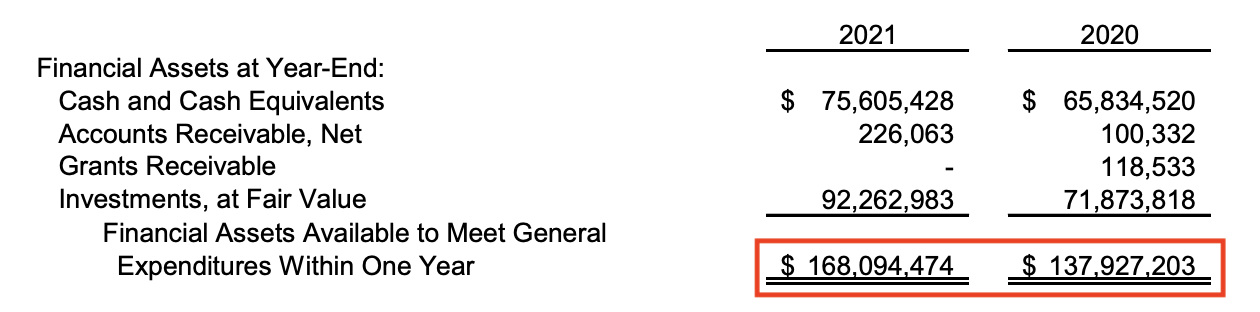
It is particularly concerning that ABIM decided to raise their MOC fees 25% in 2022 when their own assets mushroomed 18% in 2021 alone to more than $168 million:


ABIM has constantly billed itself as a "physician-led" non-profit 501(c)(3) organization. From their About ABIM webpage:

"ABIM is a physician-led, non-profit, independent evaluation organization driven by doctors who want to achieve higher standards for better care in a rapidly changing world."

But are they really? Who is really pulling the strings at ABIM?

We have already seen that the former CEO and President of ABIM, Christine Cassel, MD was serving as a board member of one of the largest Group Purchase Organizations, Premier, Inc, and serving on the Board of Kaisier Hospital and Health Systems while also serving as President and CEO of the ABIM - conflict that was never disclosed to physician-diplomates of the ABIM.

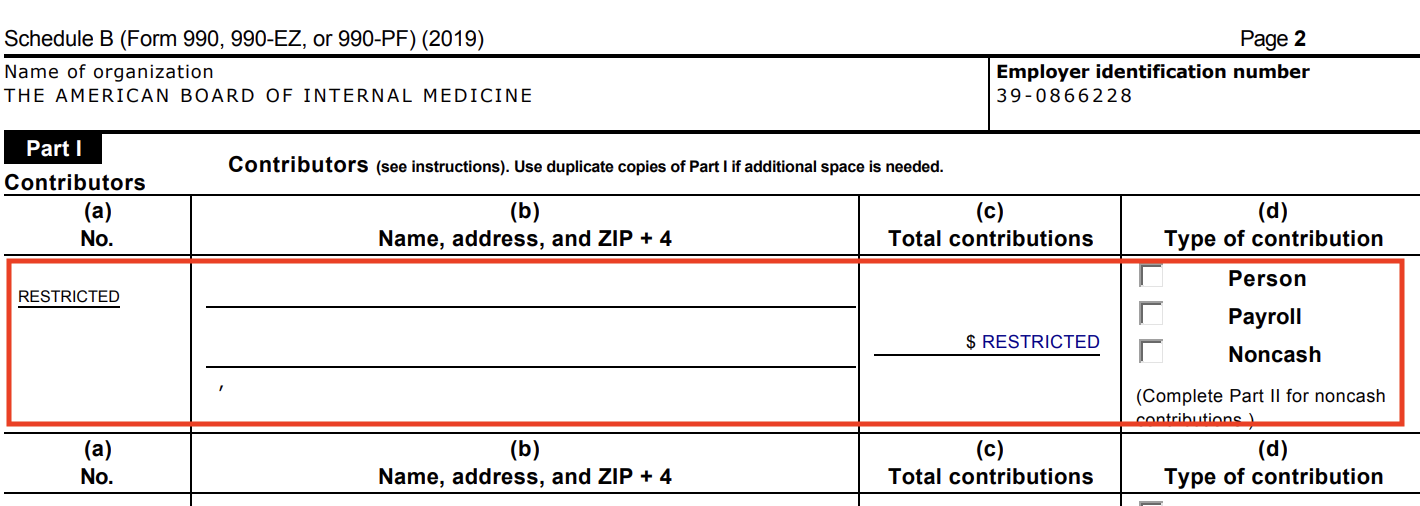
But now we see another concerning potential conflict that needs explanation, especially with the rate hike in fees physician must endure. Who are ABIM's "RESTRICTED" contributor(s) found buried on their latest IRS Form 990?

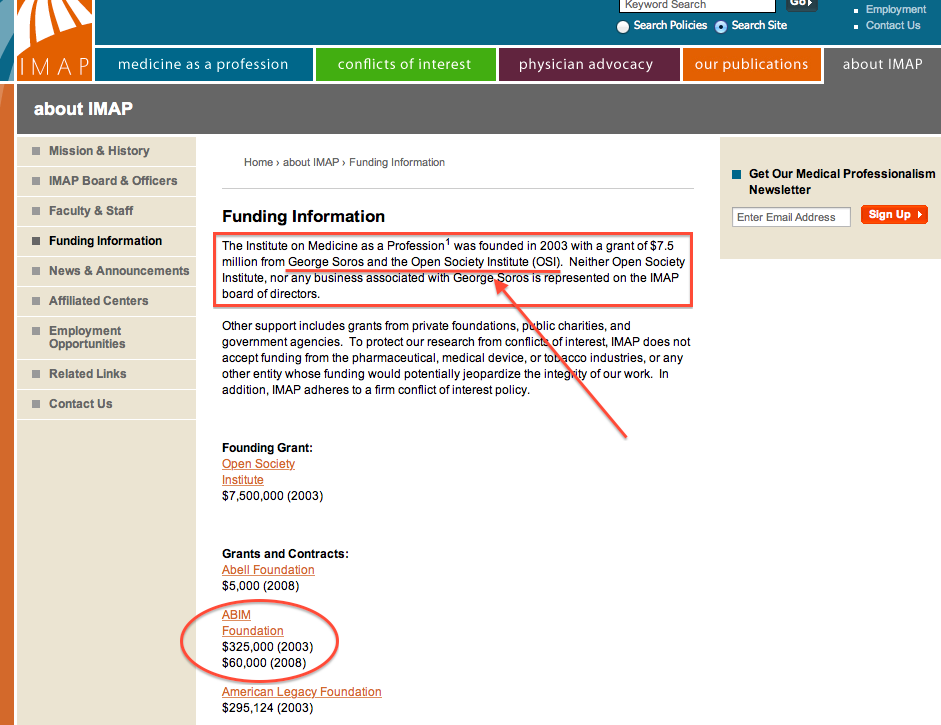
Might it be George Soros (since ABIM contributed to his Institute for Medical Professionalism in 2003 and 2008)?

Or might it be other members of the Accreditation Council of Graduate Medical Education (ACGME), like the American Medical Association (AMA) or American Hospital Association (AHA)? Who stands to profit from the control of physicians this way?

Physicians have a right to know what the heck is going on at ABIM and why are fees have gone up 25% in 2022 at a time when ABIM is more than flush with cash. We also deserve to know who their contributors are that are supporting his racket. 

Unless, of course, the US is running the physician regulatory system like the mob.

-Wes


PS: For those interested in staying abreast of our ongoing investigation, consider joining Practicing Physicians of America (it's free and allows us to know who wants further work in this arena).


Monday, February 14, 2022

Can There Ever Be a "Kinder and Gentler" MOC?

It has been a long time since I have written anything concerning the American Board of Medical Specialties' (ABMS) Maintenance of Certification (MOC) board re-certification program. But when I read pieces in the media, like the one recently published in Medscape that spin the soothing narrative that MOC can become "kinder and gentler," I feel the need to speak out.

Like a child bring groomed by serial molester, the media miss the seriousness of the harms imposed to physicians and patients by the industry-levied Maintenance of Certification mandate begun in 1990, largely because patients and the public really don't understand US physician board certification and the conflicts of interest with industry that exist. The public knows they want a "board certified" physician (thanks to the marking muscle and self-generated congratulatory "research" articles generated over the years by these multimillion-dollar organizations), but they fail to realize that board certification, once little more than a voluntary lifetime marketing accolade before 1990, became time-limited, mandatory, and an economic necessity for physicians to work, have hospital privileges, or be included in insurance panels since then. 

This change from a lifetime accolade to a time-limited necessity for physicians was unilaterally imposed on (only) US physicians by the highly conflicted and highly political ABMS and their member boards in conjunction with their parent organizations (where the ABMS is also a "member organization") from the Accreditation Council of Graduate Medical Education (ACGME), including the American Medical Association (AMA), American Hospital Association (AHA) and the Association of American Medical Colleges (AAMC). Thanks in large part to the nuances of often-delayed non-profit tax filings, all of these organizations enjoy their tax-exempt status and multi-million dollar budgets on the backs of working US physicians who are the major source of their funding.

The seemingly impenetrable nature of medical journal pay-walls has served to perpetuate the ruse of the scientific validity of time-limited US board certification. There is simply no scientifically valid proof that "longitudinal assessment" questions pushed to physician cell phones or taking day-long tests every 10 years improves patient care. Could it be these actions distract from patient care just to keep the money flowing?

More importantly, patients suffer as physicians become burned out or quit. Patients suffer as the boards  sell all the physician data they reap from that testing to Group Purchase Organizations (like Premier, Inc) and hospital organizations (like Kaiser) that increasingly consolidate and limit access in the name of lucrative health care "efficiencies."

The monopoly stranglehold on US board Certification (and specifically time-limited "Maintenance" of Certification, or MOC) and the vast conflicts of interest and millions of dollars it generates, is why the ABMS member boards are being sued right now. Their actions, I (and thousands of others) believe, violate anti-trust and unjust enrichment laws. It is not okay that a physician with years of dedicated service to his or her patients can lose their job or ability to care for their patients based on an unproven testing mandate. Nowhere does a physician's years of experience count to these AMBS member boards; only their money.

This is why I, along with many other men and women, help co-found Practicing Physicians of America, a non-profit 501(c)(6) organization, in part so we can work collectively to attempt to end the monopoly status of the American Board of Medical Specialties and their member boards on US Physician board certification. We hope that justice can be served to the hundreds (and perhaps thousands) of physicians  harmed by this discriminatory mandate imposed on us since 1990.

Physicians wanting to learn more or want to help can e-mail me at wes - at - practicingphysicians dot org. Donations for our work can be made at http://www.gofundme.com/practicing-physicians-of-america or (if you don't want to use GoFundMe, mailed to our organization at the following address:

Practicing Physicians of America
876 Loop 337 Bldg 101
New Braunfels, TX 78130

-Wes

Monday, December 06, 2021

The Danger and Hypocrisy of Physician Censorship

In late July 2021, the Federation of State Medical Boards (FSMB), a non-profit self-selected lobbying organization for US state medical boards, issued a press release threatening suspension or revocation of medical licenses for physicians that “generate and spread COVID-19 vaccine misinformation or disinformation.” The American Board of Internal Medicine, American Board of Pediatrics, and American Board of Family Medicine issued a joint press release in support of the FSMB’s statement and further threatened to revoke a physician’s specialty certification on similar grounds.

While likely well-intentioned and politically favorable on its surface, this policy risks compromising physicians’ due process, free speech, and patient care. Physicians serve on a multitude of research data safety monitoring boards and for the Food and Drug Administration, among others. Is leveling a cudgel against US physicians to control speech really in the best interest of promoting thoughtful scientific discourse? It is chilling to think that any private business can control what medical information constitutes “misinformation.”

Misinformation is common in the midst of any pandemic, especially when so much remains unknown about the coronavirus, its origin and variants, their spread, and potential therapies proposed to combat the disease and its comorbidities. While false information has been spread on social media channels by a tiny handful of physicians, the vast majority of working US physicians support the appropriate use of COVID-19 vaccines.  Giving strong, scientifically credible rebuttals to vaccine skeptics is much more likely to quiet skepticism of the vaccines than idle threats from afar by little known non-profit organizations with little real power to control speech.  

Working physicians are familiar with political propaganda, another form of “misinformation” that has become all too commonplace in US healthcare that is increasingly dependent of government funding. The FSMB is a self-interested private business that is not actively supervised by the state(s) and has a long history of attempting to link Maintenance of Licensure for physicians to the lucrative Maintenance of Certification physician educational product promoted by the member boards of the American Board of Medical Specialties, including the American Board of Internal Medicine, American Board of Pediatrics, and American Board of Family Medicine. In 2018 the FSMB also supported legislation that tried to circumvent the 2015 Supreme Court decision that held unsupervised professional boards could not make decisions that potentially violated antitrust laws and quashed competition.

The American Board of Internal Medicine (ABIM) also engaged in "misinformation" by secretly funneling $80 million of physician test fees from 1989-1999 to create the ABIM Foundation that  magically appeared to the public in 1999. Physician were told the Foundation was created to define “medical professionalism,” the same year the ABIM Foundation purchased a $2.3 million 2-bedroom condominium complete with a chauffeur-driven town car. Physicians can only assume that same “medical professionalism” the ABIM promotes extends to their undisclosed offshoring of over $6.5 million dollars to the Cayman Islands in 2015 and labeling their lobbyists in Washington as “consultants” on their tax forms, too. 

The profession of medicine and scientific inquiry are never perfect but demand constant vigilance to ensure its integrity. Just as any medical treatment demands careful weighing of its risk and benefits to our patients, the self-interested private entities that comprise the US medical regulatory system should carefully weigh the adverse effects of their edicts before they are unilaterally imposed on practicing US physicians.

Caveat emptor. Primum non nocere.

-Wes

Monday, March 01, 2021

The Courts Speak: Internists to Be Boarded to Death

It is with great sadness and a heavy heart that I must announce that on Thursday this past week, the United States 3rd Circuit Court of Appeals ruled in favor of the American Board of Internal Medicine (ABIM) and upheld the earlier District Court dismissal of the antitrust, racketeering and unjust enrichment lawsuit filed by four internists in December 2018. An attorney for the physician-Plaintiffs issued this statement following the ruling:
"The Plaintiffs are disappointed by the Court’s opinion but not discouraged. They remain committed to bringing an end to Maintenance of Certification (MOC). The ruling was based on a narrow and technical principle of antitrust law: whether ABIM Certification and MOC should be viewed together as a single product. The decision was specifically classified by the Judges as “Not Precedential” – meaning it should not be cited as precedent in other cases.

“It is important to understand that the ruling cannot be viewed as an endorsement of MOC or ABIM’s conduct. Contrary to ABIM’s litigation position, Certification and MOC are not voluntary. As admitted by its own leadership, they are an economic necessity for a successful medical practice.

“Significantly, the decision does not take issue with the many studies documenting the complete absence of any evidence of a causal connection between MOC and improved patient care. There simply is no reason for MOC to exist other than the hundreds of millions of dollars in fees it generates for the ABMS Boards and their management.

“Plaintiffs would also like to take the opportunity to thank the thousands of doctors across all specialties that have joined with them in this struggle. The emails and phone calls of support have been inspirational and demonstrate how deeply unpopular MOC and the ABMS Boards are with rank and file doctors, physicians who actually practice medicine and treat patients outside the corporate medical establishment.

“All remaining options are being considered, including the possibility of seeking a rehearing by the full Third Circuit Court of Appeals.”
The fight against MOC and in support of practicing physicians continues. The wellspring of our inspiration for supporting the Plaintiffs has been the Oath that we both earned and then gave when we became doctors. It might be stifled but it will never be extinguished.

-Wes

Thursday, February 18, 2021

ABIM and Its Washington Lobbyists

The American Board of Internal Medicine (ABIM) is a 501(c)(3) non-profit organization that certifies "internists and (medical) subspecialists who demonstrate the knowledge, skills and attitudes essential for excellent patient care." According to the IRS, "In general, no organization may qualify for section 501(c)(3) status if a substantial part of its activities is attempting to influence legislation (commonly known as lobbying). A 501(c)(3) organization may engage in some lobbying, but too much lobbying activity risks loss of tax-exempt status."

In April of 2015, Kurt Eichenwald wrote an opinion piece in Newsweek that exposed the ABIM's tax-reporting discrepencies concerning its lobbying activities:
Start with ABIM's Form 990. This is the document a nonprofit organization has to file with the Internal Revenue Service to disclose its activities and prove it deserves tax-free status. In Part IV, which appears on Page 3 of the document, the government asks a simple question on line 4: "Did the organization engage in lobbying activities?" And year after year, ABIM has answered "no."

Unfortunately, the real world answer is "yes." According to the Center for Responsive Politics, from 2009 through 2014, ABIM paid $390,000 to Mehlman Vogel Castagnetti, a lobbying firm. Asked about this, an ABIM representative says it complied with all rules governing IRS filings. Maybe. Yet according to Independent Sector, a prominent organization for nonprofits, the words "lobbying activities" in line 4 includes elements as miniscule as holding strategy meetings to coordinate lobbying with others and time spent preparing arguments to be advanced to government officials. Unless ABIM just wrote a check and never spoke to its lobbyists, it's hard to see how it complied with those standards. (Side note: A random check of seven 501(c)(3)s that paid less than ABIM to lobbying firms showed all of them answered with a "yes" on line 4.)

So what did ABIM spend all this lobbying money on? According to Mehlman Vogel's filings with the government, ABIM's lobbyists provided "strategic advice" on issues related to Obamacare, including "physician quality reporting requirements." And if you haven't guessed yet, what does the ABIM consider "physician quality reporting requirements"? Maintenance of certification (MOC), the program that so many doctors say is worthless—and that ABIM refuses to show has any impact on "physician quality" with independent research or other science-y stuff.

Did the lobbying work? Yup. Under Obamacare, physicians who participated in MOC through 2014 qualified for an incentive payment. The description of MOC is so specific in the law that ABIM and similar groups in ABMS were the only organizations that met the definitions. In other words, in the first few years of Obamacare, the government was paying doctors to pay ABIM and related certification organizations to participate in a program that has never been proven to do squat.
So it should come as no surprise to working physicians that lobbyists have come to the rescue of the ABIM by filing Amicus briefs in support of the ABIM in the lawsuit failed against them by four working internists. One of these lobbying groups is a seasoned veteran of the Washington scene while the other two are relaively new, formed in large part to fight the national physician pushback against Maintenance of Certification (MOC): the American Society Association Executives (1575 I St. NW, Washington, DC), the Institute for Credentialing Excellence (2001 K Street, Washington DC). and the Professional Certification Coalition (formed "to address efforts to enact state legislation that would undermine the activities or recognition of certifications developed or offered by non-governmental, private certification organizations" and actively promoting their work in support of ABIM on their website).

Think there's money in continuous re-certification and lifelong testing of physicians?

You bet.

Will the public ever learn of the extent of lobbying that the ABIM performs to advance their political and economic agendas?

Never.

Unless, of course, the current lawsuit against the ABIM wins its appeal and the case goes to discovery.

-Wes

Wednesday, January 27, 2021

Is ABIM Ending Its "Knowledge Check-In" MOC® Pathway?

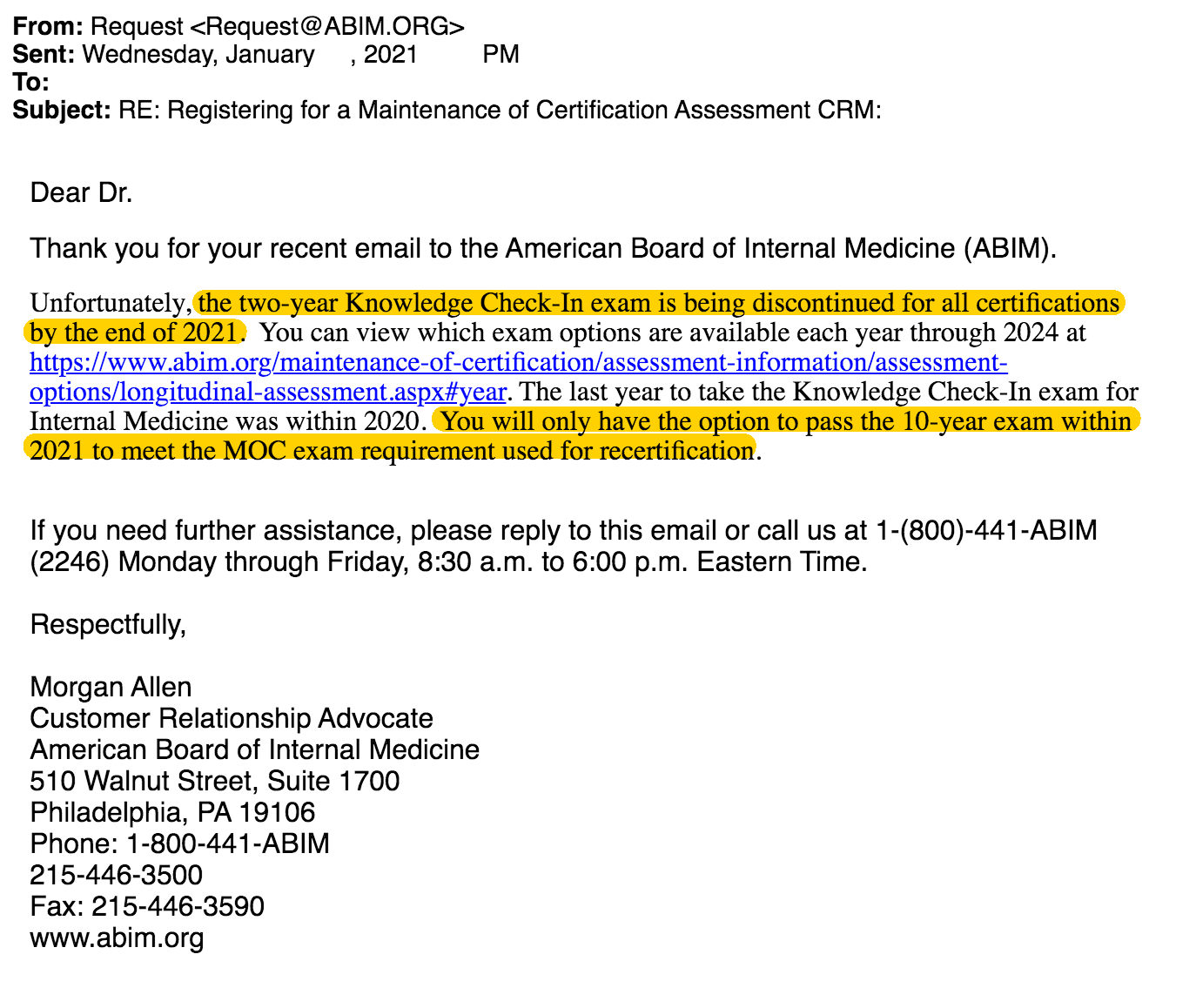
The following (redacted) email was received from Morgan Allen, Customer Relationship Advocate at the American Board of Internal Medicine (ABIM), in response to an ABIM diplomate that was unable register online for their every-two year Knowledge Check-In "continuous" Maintenance of Certification (MOC®) product.

According to this email, it seems the ABIM has decided to end its Knowledge Check-In recertification pathway and only permit its every-10-year high-stakes recertification examination for physicians to remain ABIM Board Certified.

At the time of this writing, I could find no public notification of this policy change on ABIM's website. Once again, working physicians are irresponsibly left uncertain of the latest requirements to remain ABIM Board Certified in good standing.

ABIM has a long history of changing the rules for the names and requirements for physician board recertification/maintenance of certification/continuous certification. But despite the many name and rule changes of this racket, each rebranding becomes more expensive and serves to perpetuate the discrimination against younger physicians and physicians of color from senior "grandfathered" physicians who are not required to purchase these products to retain their ABIM Board Certified status. The Knowledge Check-In recertification pathway was no different from its predecessors in this respect. But the Knowledge Check-In pathway also suffered from a plethora of technical, security, and (undisclosed) privacy issues for physicians. (See my earlier video that critically reviewed this recertification pathway and the people who created it.)

One thing is a constant, however. Ever since the ABIM changed Board certification from a lifetime to time-limited physician marketing accolade, this unproven repeated testing of working physicians remains a career-long psychological and economic stressor that distracts from what matters most: patient care.

-Wes

Monday, December 07, 2020

ABIM and Its Appellate Court Arguments

The unofficial transcribed 3rd Circuit Appellate Court arguments held 23 Oct 2020 between Mr. Philip Curley (lead attorney representing the physician Plaintiffs) and Ms. Leslie John (representing the American Board of Internal Medicine (ABIM)) are now available for US physician review. The appeal was filed after the 3rd Circuit District Court dismissed the Plaintiffs complaints before discovery because, as Mr. Curley states in those arguments:

"And that's what the district court did here that was incorrect; it concluded that as a matter of law, there could only be one product, and it shouldn't have arrived at that or any other conclusion in our judgment. It arrogated to itself a determination of the ultimate fact issue which is out of the separate products. It was indifferent to our allegations. It improperly weighed evidence. It explicitly made findings. It used those words, and had accepted ABIM's affirmative defenses that are outside of the Complaint. All those are in violation of the proper standards in ruling on a 12(b)(6) motion to dismiss. And we respectfully point out to the Court that this is not a motion where only conclusory recitations of law are pleaded or claims rote elements are simply recited. This is a highly detailed and factual Complaint, and we are entitled to discovery and the right to prove our claim. So we respectfully ask that the district court be reversed."

While I made some earlier observations when only the audio file of the arguments became available, there are a number of other observations that I believe are important from those arguments.

ABIM Never Answers the Question About Forcing or Monopoly Control of Certification

On Page 27 of the transcript, Judge Chagaras asked Ms. John the following question: 

"Could I just ask a follow-up there about forcing? How do we conclude that internists aren't forced to buy MOC at this stage in the litigation in light of the allegations that internists can't successfully practice without certification; and isn't the feasibility of practicing without certification ultimately a question of fact?"

Rather than answering the question, Ms. John responds:

"I think you can first look to the facts in this case. So, for instance, Doctor Manalo who never -- who did purchase initial certification and never purchased Maintenance of Certification, I think that certainly shows that his purchase of initial certification was not contingent on the later purchase of Maintenance of Certification. So I think that is one way you can look at it."

Recall that in the Amended Complaint, Dr. Manalo has been unable to become employed as a result the fact that he refused to participate in MOC. The judge presses further:
"But, Counsel, what I'm talking about is it may not be so voluntary. If they want to make a living, are they forced to buy your product? You seem to say no, they're not forced to, but is that essentially an issue of fact that's more appropriate for summary judgment?"

And of course, Ms. John forgets the fact that many physicians are grandfathered and don't have to perform MOC, but states:

"I would suggest not because I think when courts look to forcing, they look at what is the situation at the time of the initial purchase, and at the time of the initial purchase here ABIM had a program for certification; and aspects of that program were initially passing your initial Board certification exam, and then that that certification would expire after a set period of time, ten years, without -- unless that diplomate passed subsequent examinations. And so when they up front bought that product, they knew there would be a continuing obligation as part of the certification program that they would have to demonstrate, in fact, that they possess the requisite knowledge to hold themselves out and say, yes, I am ABIM or Board certified. So there is no forcing because there is the knowledge up front at the time of purchase of what certification entails, and that was the periodic demonstration of knowledge."
Unfazed, the judge then asks:
But I suppose that the most basic form of your argument is they don't have to go through ABIM to practice?"
To which Ms. John answers as only a lawyer can:
"Yes, your Honor. So, for instance, if you look at the Amended Complaint, the Amended Complaint is quite clear that Board certification is not required to practice medicine in the United States. That is simply a function of state boards of medicine that license doctors. You only need a license in your state to practice medicine. Board certification is not required. Board certification is more like the stamp of approval that you can hold yourself out to have special qualifications. Some -- some patients and employers look to that; others do not, but it is not a requirement to practice medicine in any state in the United States, which is a fact that is pled in the Amended Complaint."
Fortunately, the judge did not back down, politely recognizing the doublespeak:
"Well, but I mean this does go to your market power. I mean, yeah, it's true you don't need the ABIM certification, but is it really feasible not to have it in reality? And I think that the allegations, don't they say you -- a lot of places won't let you practice. Your malpractice rates are going to go higher. Reimbursement is going to be an issue. So is it really feasible to practice without certification, and is that something that should be a subject of discovery as opposed to, you know, at this juncture with a motion to dismiss to resolve?
We should note that as long ago as 1991, Dr. Benson (the first President of the ABIM) wrote in the Annals of Internal Medicine that certification "is no longer an option for the physician entering the marketplace." A later ABIM President agreed, Dr. Christine Cassel, writing in a climatology journal article in 2008 that "many physicians really feel that board certification is not optional." Finally, the Arthritis Care and Research article from 2019 concluded in no uncertain terms that "Board certification, which started as a voluntary achievement and remains so in theory has become involuntary in practice, making participation in MOC programs mandatory for many if not most physicians in order to maintain employment and clinical privileges, or receive reimbursement." 

We should note, then, that ABIM's own leaders have conceded the issue that it's own attorney in these arguments would not. 

ABIM is Not a Professional Society

And then there was this exchange from Mr. Curley's final rebuttal statement:

So another fact question that arose from your inquiry was professional society. Is ABIM even a professional society? We don't believe it is, but in any event, there certainly is nothing in the Complaint that speaks to that. That's another example of an affirmative defense that ABIM is trying to raise, standards, professional society, internists aren't keeping up, all sorts of things that can only be resolved after discovery.
Given these revelations made from the arguments before the Appellate judges. It is hard for this physician to not be encouraged by what transpired before the Appellant Count judges. I'd love to hear what others think as well.

One thing's for sure: if the Appellate Court refers this case back to the District Court for discovery, Pandora's Box will open for the ABIM and all other member board of the American Board of Medical Specialties.

-Wes

Monday, November 23, 2020

For ABPN: Their Legal Headaches Aren't Over Until They're Over

Today, the first amended class action anti-trust complaint was filed by Drs. Emily Elizabeth Lazarou and Aafaque Akhter against the American Board of Psychiatry and Neurology (ABPN) in the US District Court for the Northern District of Illinois in response to Judge Martha Pacold's 11 Sep 2020 dismissal without prejudice of their earlier complaint. Much of the Amended Complaint is noteworthy, but paragraphs 20 and 21 drive home the true motivation behind Maintenance of Certification (MOC):

20. MOC is not about maintaining standards as ABPN contends. It is a revenue-driven commercial endeavor, motivated by tens of millions of dollars in new MOC fees.  (Emphasis mine) As indicated by the failure of its earlier voluntary CPD product, MOC is financially successful only because it is mandatory and tied to certifications. ABPN’s financial results amply document this. After the launch of MOC, from 2004 through 2018, ABPN’s “Program service revenue” exceeded its total expenses by a yearly average of $4,448,338, as reported in its Forms 990 filed with the Internal Revenue Service (“IRS”). But for its reporting status as a supposed not-for profit organization, this translates into almost $4,500,000 in average annual profits before investment and other income is taken into account.

21. During the same time, ABPN “Net assets or fund balances” skyrocketed over 971%, from $12,610,227 at the beginning of 2004 to $122,470,594 in 2018. In other words, while it took ABPN almost seventy years to accumulate net assets (assets less liabilities) of $12,610,227 from selling certifications, ABPN net assets increased almost ten-fold to $122,470,594 as a result of selling MOC, including $97,169,079 in cash, savings, and securities on hand at year-end 2018. (Emphasis mine)
The Amended Complaint filed today greatly simplifies the case for a better understanding by the judge: the extortion of US physicians for an unproven and falsely marketed educational product must end.

-Wes

Sunday, October 25, 2020

Thanks to All!


As treasurer of Practicing Physicians of America, it gives me great pleasure to announce that we hit our goal of raising $400,000 in support of the Plaintiff-physicians who filed class action antitrust lawsuits against the American Board of Internal Medicine, American Board of Radiology, and the American Board of Psychiatry and Neurology.

Over 1,800 individuals, the vast majority of whom are working US physicians from a diverse range of subspecialties, contributed to this effort. These contributions were truly voluntary and made by people who felt strongly that the monopoly power these organizations unjustifiably enjoy over us needed to be held accountable for the harms (economically, emotionally, and professionally) they are causing to working physicians and our profession. This milestone proves that physicians can still do incredible things when they put aside their differences and work together.

While the results of the multi-year legal effort remain uncertain, many beneficial results have already occurred. But we should acknowledge that nearly 40% of our contributions were anonymous donations owing to the threat many physicians still feel from these organizations at their workplace. Simply put: our work is not done.

While there is still much to do in this David vs. Goliath effort, on behalf of all of us at Practicing Physicians of America,  thanks to all of our contributors for a job well done.

Westby G. Fisher, MD
Treasurer, Practicing Physicians of America and
Organizer of this legal-support GoFundMe campaign

P.S. Further updates regarding the status of these class action anti-trust cases will continue. Physicians still wanting to contribute are encouraged to do so.

Friday, October 23, 2020

ABIM Stumbles in Appellate Court Arguments

The oral arguments in the appeal of the dismissal at the District Court level of the Kenney et al vs American Board of Internal Medicine (ABIM) class action antitrust, RICO, and unjust enrichment case were heard before the 3rd Circuit Court of Appeals today and are available via audio file here. The following interchange starting at 32:58 in the audio file was interesting (I have added a few personal comments/thoughts in italics):

Judge: "Could I just ask the follow-up there about forcing? How do we conclude that internists aren't forced to buy MOC at this stage in the litigation in light of the allegations that internists can't successfully practice without certification? Isn't the feasibility of practicing without certification ultimately a question of fact?"

ABIM Attorney: "I think you can first look to, um, look to the facts in this case. For instance, Dr. Manolo who, who never, who did purchase initial certification and never purchased Maintenance of Certification. I think that certainly shows that his purchase of initial certification was not contingent on the later purchase of Maintenance of Certification. (Comment: It also shows there are two products). So I think that is one way you can look at it. I think you can also look at it in the way that the Second Circuit indicated in the Smugglers Notch Homeowner's case which is a case where, which looked at, when you're entering in to the transaction and you know that, in fact, you're that going to be required, there are certain components, parts, of that entire transaction, and you know that up front, and you voluntarily nonetheless enter into that contract, that there is no forcing." 

Judge: "But counselor, what I'm talking about is it might not be so voluntary - they want to make a living, are they forced to buy your product? You seem to say no they're not forced to, but is that essentially an issue of fact more appropriate for summary judgement?"

ABIM Attorney: "Um, I would suggest not because I think when courts look to forcing they look at what is the situation at the time of the initial purchase? At the time of the initial purchase here ABIM had a program for certification and aspects of that program were initially passing the initial board certification exam and that that certification would expire after a set period of time - ten years - without unless diplomate passed subsequent examinations. And so when they, up front, bought that product they knew there would be a continuing obligation as part of the certification program, that they would have to demonstrate, in fact, that they possess the requisite knowledge to hold themselves out and say "Yes, I am ABIM, or board certified." So there is no forcing because there is the knowledge up front at the time of purchase of what certification entails, um, and that was the periodic demonstration of knowledge."

Judge: "But I suppose that the most basic form of your argument is, they don't have to go through ABIM to practice." 

ABIM Attorney: "Yes, your Honor. If you look at the Amended Complaint, the Amended Complaint is quite clear that board certification is not required to practice medicine in the United States. That is simply a function of state boards of medicine that license doctors. Um, you only need a license in your state, um, to practice medicine. Board certification is not required. Board certification is more like the "Stamp of Approval" that you can hold yourself out to have special qualifications. (As I have said all along, board certification is actually little more than a marketing accolade.) Some patients and employers look to that, others do not, but it is not a requirement to practice medicine in any state in the United States which is a fact that is pled in the Amended Complaint."

Judge: "But this does go to your market power, I mean, yeah, it's true, you don't need the ABIM certification. But is it really feasible not to have it, in reality? And I think, the allegations, don't they say, a lot of places won't let you practice, your malpractice rates are going to go higher, reimbursement's going to be an issue. So is it really feasible to practice without certification and is that something that should be a subject of discovery as opposed to, you know, at this juncture with a motion to dismiss to resolve?"

ABIM Attorney: "Well. well many, I would submit many internists do, in fact, practice medicine, um, without ABIM certification and there are many things that might affect how much you are paid, what your admitting privileges are - things like where you attended medical school and many other factors. (Comment: And if you believe this, I have some ocean-front property to sell you in Arizona). But it really comes back to, you know, what is at issue in this case and whether, in fact, there is a tying claim and whether or not there is, um, one product or two products and that really goes back to the Supreme Court test in Jefferson Parish about the character of demand and whether there is demand for the tied product in absence of the typing product.  And here, the Appellants want to hold themselves out as being "board certified." There is no separate demand for the tied product in the absence of the tying product. And that is something I think is, is something that, you know, the Court in Jefferson Parish makes clear. Justice O'Connor when she expands on the words in that saying that for products to be treated as distinct, the tied product must, at a minimum, be one that consumers might wish to purchase separately without also purchasing the tying product. And here's.. there's simply... there are no allegations of fact sufficient to move this case along to make a plausible case that there are, in fact, two products here because there is no consumers, there are no allegations showing there is demand to purchase the tied product without also tying the tying product." (Comment: OMG, Seriously?)

Judge: "Alright, thank you counsel."

The judges asked the right questions. Now we have to wait to see if this case is sent back to the District Court for discovery.

I will have additional comments about other aspects of these oral arguments in the days ahead.

-Wes

P.S.: MedpageToday covered the story as well here.

PPS: If you'd like to help the plaintiff's along their lengthy legal quest to improve the lot for all US physicians regarding MOC, please contribute to the GoFundMe page sponsored by Practicing Physicians of America.

Monday, October 19, 2020

The Important Week Ahead

This Friday, 23 October 2020, oral arguments will be heard before the Third Circuit Court of Appeals regarding Kenney et al vs. the American Board of Internal Medicine (ABIM) class-action antitrust, racketeering, and unjust enrichment lawsuit (Case 20-1007). Some eyes of US physicians and all the eyes of the US certification industry will be on these arguments, even though the oral arguments are, for all intents and purposes, little more than theatre since written arguments have been fully briefed on both sides.

But the stakes for working US physicians and the physician certification industry could not be higher. Since the introduction of Maintenance of Certification® (MOC®) in 1990, ABMS board certification and lifelong re-certification have evolved into a $1 billion enterprise annually in the United States, nearly all of it funded by US physician-paid fees leveraged by coercive tactics and the monopoly on US certification enjoyed by the ABMS and its member boards. 

As this week unfolds, 

  • Let us not forget the accusatory physician sanction letter sent by the ABIM to thousands of vulnerable residents who attended an ACGME-accredited board review course with "concerns about their ethical and professional behavior" and promising to "place a copy of this letter in their file."

  • The unilateral revoking of ABIM board certification for three years that occurs without trial if the ABIM deems a physician does not "maintain moral, ethical, or professional behavior satisfactory to the board."

  • Let us not forget the strong-arming convicted felon who served as the ABIM's Director of Test Security and his work at the shady test security firm Caveon after orchestrating a raid with Federal Marshals on a physicians' home to seize computers and private email lists of physicians.

  • Let us not forget about the young physician who the ABIM pursued and accused of "cheating" - only to lose their case - and whose countersuit continues against the ABIM in Puerto Rico for the past seven years and counting.

  • Let us not forget the numerous tax form discrepancies (fraud?) published by the American Board of Internal Medicine and the Foundation over the years, that included misstated date of origin of the ABIM Foundation, the indulgent purchase of a $2.3 million personal condominium, undisclosed lobbying efforts, and off-shoring of millions in physician testing fees to the Cayman Islands.

  • Let us not forget that the ABIM has never allowed an independent audit of their finances as stipulated by the AMA House of Delegates.

  • Let us not forget the reporting of Kurt Eichenwald of Newsweek on the ABIM and their finances here, here, here, and here.

  • Let us not forget that physicians must agree to an adhesion contract that requires them to be research subjects without their informed consent.

  • Let us not forget that physicians' board data are sold by a subsidiary of ABMS for profit.

  • Let us not forget about the cool $1.426 million dollars paid to the CEO of ABIM and the ABIM Foundation in 2018.

  • And let us not forget that, in the end, this lawsuit is really about the integrity of US Medicine and the justice working US physicians deserve.
-Wes


Monday, October 12, 2020

The Unjust Enrichment at ABIM

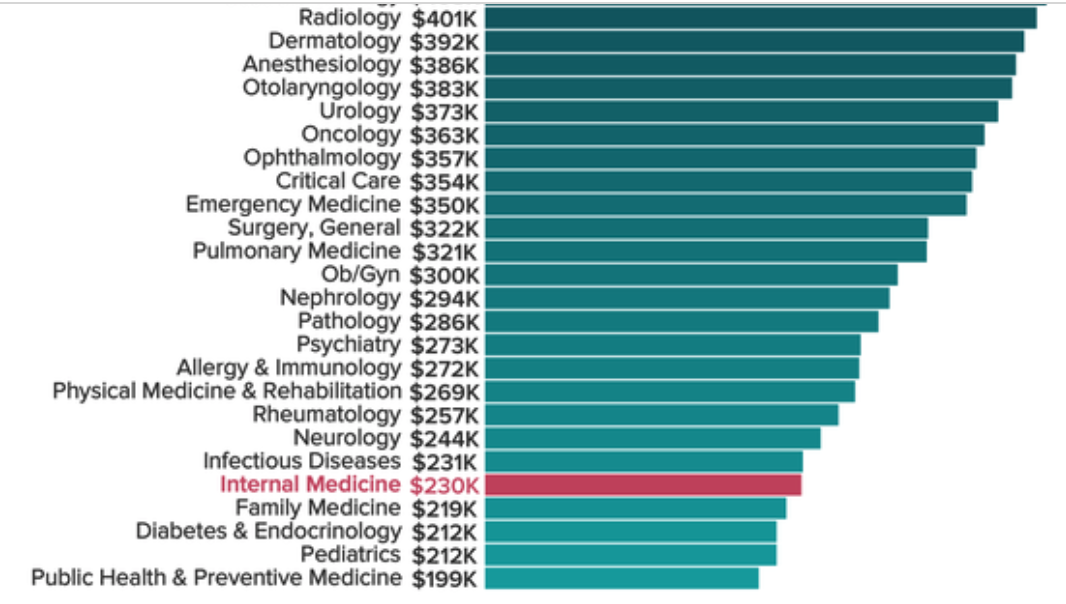
 According to a Medscape survey of US internists in 2018, their average salary was $230,000.


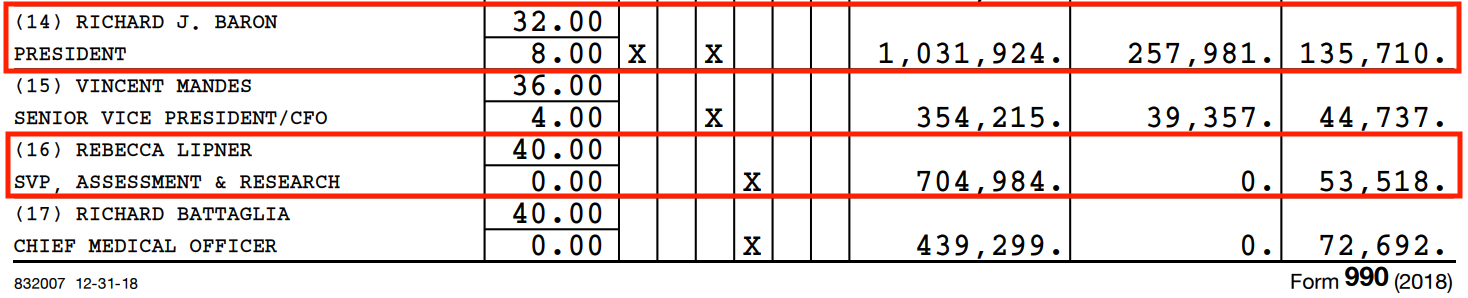
That same year, according to recently-released tax documents, Richard Baron, MD, President and CEO of the American Board of Internal Medicine (ABIM)  and the ABIM Foundation, earned a cool $1,425,605 and non-physician Rebecca Lipner, the Senior Vice President, and Chief Financial Officer (who has never authored a study that wasn't supportive of the certification industry in her tenure with ABIM) earned $758,502:


(It is also notable that ABIM has a former PriceWaterhouseCooper executive serving as Chief Medical Officer that earns over half a million dollars annually as well).

Internists pay these salaries from their testing fees. Those same testing fees also pay "bonuses" that these executives unilaterally decide to bestow upon themselves, including "retention bonuses." But a "retention bonus" from an "early retirement severance package" makes absolutely no sense at all. 
From ABIM's 2018 Form 990:

"IN 2016, ABIM MADE AVAILABLE TO CERTAIN ABIM EMPLOYEES AN EARLY RETIREMENT SEVERANCE PACKAGE WHICH INCLUDED A PROVISION FOR YEARS OF SERVICE. REBECCA LIPNER, ABIM SENIOR VICE PRESIDENT OF ASSESSMENT & RESEARCH, QUALIFIED FOR THIS EARLY RETIREMENT SEVERANCE PACKAGE. IN AN EFFORT TO ENCOURAGE HER TO STAY, ABIM OFFERED REBECCA LIPNER A RETENTION BONUS TO REMAIN EMPLOYED WITH ABIM AS SENIOR VICE PRESIDENT OF ASSESSMENT & RESEARCH THOUGH 6/30/2018. THE 2-YEAR AGREEMENT, SIGNED IN MARCH 2016, PROVIDED FOR THE PAYMENT OF A RETENTION BONUS WITHIN 30 DAYS AFTER 6/30/18 IF CERTAIN TERMS AND CONDITIONS, AS PROVIDED IN THE AGREEMENT, HAD BEEN FULFILLED. 

AS OF 6/30/18, THE TERMS AND CONDITIONS PROVIDED FOR IN THE AGREEMENT HAVE BEEN FULFILLED. IN COMPLIANCE WITH TERMS OF THE SIGNED AGREEMENT, IN JULY 2018, ABIM RESEARCH, A ONE-TIME RETENTION BONUS IN THE AMOUNT OF $300,000. AS PER INSTRUCTIONS FOR SCHEDULE J, $300,000 WAS INCLUDED ON SCHEDULE J PAID REBECCA LIPNER, ABIM SENIOR VICE PRESIDENT OF ASSESSMENT..."
Salaries to some executives of the ABIM have almost doubled since 2010. These exorbitant salaries and questionable "bonuses" are little more than taxation to physicians without appropriate representation. 

It is time to end this nonsense.

-Wes


Tuesday, September 29, 2020

With MOC, Will Working Physicians Ever Get Their Day in Court?

For the past seven years, the American Board of Medical Specialties (ABMS) member boards have been under fire regarding their trademarked Maintenance of Certification® (MOC) program that shifted lifetime ABMS board certification to a time-limited US physician credential in 1990. 

Physicians have long argued that before 1990, board certification was an independent and generally-accepted assessment of the quality of their post-graduate specialty training. After 1990, however, ABMS board certification became two separate products: (1) an assessment of their post-graduate training and (2) a "continuous professional development"  (CPD) product tied to their original post-graduate training assessment. 

The logic for this two-product theory is simple. Before January 1, 1990, the CPD product was truly voluntary for physicians to perform. But after a trial run of this voluntary testing, fewer and fewer physicians opted to participate in the program in large part because of its unproven value and expense. To counter the declining enrollment, the American Board of Internal Medicine (ABIM) "Task Force" (and eventually all other ABMS member boards) decided to tie participation in the ABMS CPD product to the validity of a physician's initial assessment of their post-graduate training:

"Thus, the stage was set for the Board to embark on a new era in which its diplomates would be asked, but not required, to renew the validity of their certificates at periodic intervals or face the uncertain circumstances of loss of their status as certified internists, subspecialists, or holders of certificates of added qualifications."(1)
It didn't matter if a physician had participated in other self-directed Continuing Medical Education (CME) on their own accord; unless a physician performed the ABMS-sanctioned CPD program, they would lose their original ABMS board certification credential and the privileges that credential imparts to physicians in terms of academic, professional, and economic value.

This tie between a physician's original post-graduate assessment and lifelong continuous professional development proved remarkably lucrative for the ABMS and their member boards. So much so, that the ABMS CPD program was later trademarked as "Maintenance of Certification®" (MOC®) and had its own profit line on ABMS member board tax forms. The tie was so lucrative, in fact, that the largest member board, the ABIM, created an undisclosed shadow organization, the American Board of Internal Medicine Foundation (later renamed the ABIM Foundation) and secretly funneled tens of millions of dollars for nearly ten years without disclosing its existence to physicians and the public and purchased a $2.3 million condominium for themselves. After its public debut online in 1999, the ABIM Foundation later off-shored millions of those funds to the Cayman Islands in 2015. 

Is it any wonder that physicians would be upset?

Yet here we are.

So far, the ABMS member boards have had exceptionally good fortune protecting their MOC® product in court, arguing before various district court judges that ABMS board certification is not two products that are illegally tied, but rather just one big "board certification" product.  

Last week was no exception. The long-running lawsuit filed by the Association of American Physicians and Surgeons (AAPS) suit against the ABMS was dismissed with prejudice.  In addition, the antitrust suit field by two psychiatrists against the American Board of Psychiatry and Neurology (ABPN) was similarly dismissed (along the same legal lines of the ABIM and ABR lawsuits) but WITHOUT prejudice. (The judge left room here for the original Complaint to be amended - perhaps because the ABR lawsuit was later amended and has been fully briefed but not yet decided). 

It is interesting to this observer that there has been little fanfare in the media regarding these last two rulings in favor of the ABMS member boards. I suspect the ABMS and their associated specialty boards know that all eyes are on the ABIM antitrust lawsuit appeal recently filed. That appeal explains the two-product tie created by the ABIM clearly. Perhaps they'd rather not bring attention to that case that's due for oral arguments on the 23rd of October. So much hinges on the outcome of that case for both them and working physicians.

Irrespective of the cases outcome, however, the credibility and value of ABMS board certification has been tarnished forever. Given the revelation of the conflicts of interests and lucrative nature of ABMS board certification, rhe only way the ABMS brand could redeem itself is for a full accounting of all that has transpired against working physicians by these self-appointed non-representative academic physicians and the non-physicians corporate directors now at the helm of these lucrative ABMS specialty boards.

-Wes

(1) Richard J. Glassock, MD, John A. Benson, MD, Robert B. Copeland, MD, Herman A. Godwin, MD, et al. Time-Limited Certification and Recertification: The Program of the American Board of Internal Medicine. https://doi.org/10.7326/0003-4819-114-1-59

P.S.: Working physicians are still encouraged to support these important ongoing legal battles by contributing to the GoFundMe page sponsored by Practicing Physicians of America.

Saturday, September 12, 2020

The Latest Roundup of ABMS Antitrust Lawsuits


Since December 2018, a rash of antitrust lawsuits have been filed against the American Board of Medical Specialties (ABMS) and their member boards. While it might seem that little has transpired since then since there are rarely press releases about the court dealings underway, I thought it would be helpful to bring my physician colleagues up to date on the current status of the many lawsuits in play, as best as I can tell from public record. 

What follows is a roundup of those lawsuits and the current legal activity as confirmed public court dockets at Pacer.gov, the legal search engine used by the courts.
Kenney et al. v American Board of Internal Medicine (2:18-cv-05260)
(Filed 12/6/2018)
SUMMARY

This case had four claims: (1) allegations that the ABIM unlawfully tied its initial certification, the “tying” product, and its MOC programs, the “tied” product." (2) allegations that the ABIM used “anticompetitive conduct,” including unlawful tying, to obtain and maintain monopoly power over the certification market, (3) the allegation that the ABIM violated Section 1962(c) of the RICO Act by fraudulent misrepresentations that MOC has a beneficial impact on physicians, patients, and the public and finally, (4) unjust enrichment claims.

The first antitrust claim in this case was dismissed with prejudice in part because the court sided with ABIM, stating that "Internists are not buying 'initial certification' or 'maintenance of certification,' but rather ABIM certification. This is made clear by hospitals and other medical service providers requiring ABIM certification, in general. This fundamental misconception about the nature of the entire certification product offered by ABIM undercuts Plaintiffs’ arguments." The court continued: "We are unconvinced by Plaintiffs’ arguments that ABIM’s initial certification and MOC programs are distinct products. Plaintiffs’ failure to establish two products means there can be no unlawful tying arrangement and we need not continue our analysis."

The second monopoly and third RICO claim were dismissed without prejudice, in part because the court felt the Plaintiffs lacked "standing" and failed to document their monetary damages. The fourth unjust enrichment claim was also dismissed with prejudice, despite some agreement with the plaintiffs: "Clearly, the first two elements of unjust enrichment are met for Plaintiffs that purchased MOC. However, the third element is not met because it is not inequitable for ABIM to keep the benefit since it did not “force” Plaintiffs to purchase MOC. Plaintiffs were, of course, free to decide to no longer be certified by ABIM and to, therefore, not purchase MOC." (To this physician, it appears the court did not fully understand the consequences to physicians who fail to purchase MOC in terms of insurability, employability, and legal and professional reputation.)

CURRENT STATUS

On 4 May 2020, this entire case was appealed (Case 20-1007) to the 3rd Circuit Appellate Court on the grounds that "The district court assumed there is one product without any basis other than its unsupported conclusion that internists are “actually buying” ABIM certification rather than certifications and MOC. In doing so it arrogated to itself determination of the ultimate factual issue, and simply took as true ABIM’s arguments rather than Plaintiffs’ factual allegations to the contrary. A proper reading of the Complaint taking all well-pled allegations as true and construing all inferences in their favor confirms Plaintiffs have alleged facts showing certifications and MOC are separate products and have also alleged all other elements of a per se tying claim. Thus, dismissal was erroneous and should be reversed."

In addition, regarding the RICO claim, the amended complaint states: "The RICO scheme here is simple and plausible. ABIM’s first CPD product, its voluntary 'Continuous Professional Development Program,' failed due to lack of sales. ABIM realized its new CPD product, MOC, could generate the fees desired by ABIM only if internists were forced to buy MOC to keep their certifications from being revoked. Knowing MOC could not succeed on its own merits, ABIM waged a campaign, “to deceive the public, including but not limited to hospitals and related entities, insurance companies, medical corporations and other employers, and the media, that MOC, among other things, benefits physicians, patients and the public and constitutes self-regulation by internists.”

At present, it appears oral arguments from both sides will be heard before the Appellate Court 23 Oct 2020.

Mannis et al. v American Board of Medical Specialties, American Board of Emergency Medicine, and the American Board of Anesthesia (3:19-cv-00341)
(Filed 2/19/2019)
SUMMARY

This is another class action antitrust case that claims the following: "Defendants conduct alleged herein constitutes illegal tying of the purchase of MOC to defendants’ initial medical specialty certifications, as well as the creation and maintenance of a monopoly in the MOC market. During the relevant period, defendants and co-conspirators engaged in a continuing combination or conspiracy to unreasonably restrain trade and commerce in violation of the Sherman Act by the conduct alleged herein, artificially reducing or eliminating competition in the MOC market, and artificially fixing, raising, and/or maintaining the costs of MOC in the United States. Such conduct constitutes a per se violation of the Sherman Act."

There was an attempt to consolidate this antitrust case with the former ABIM case, but that attempt failed. Each case will be tried individually.

CURRENT STATUS

There have been multiple entries on Pacer.gov for changes of lawyers but no activity documented on the court docket since June 2020.
Siva v American Board of Radiology (1:19-cv-01407)
(Filed 2/26/2019)
SUMMARY

This is another class action antitrust lawsuit with three claims: (1) that the American Board of Radiology (ABR) engaged in illegal tying of MOC to initial certification in violation of Section 1 of the Sherman Act, (2) that ABR was involved in illegal monopolization and monopoly maintenance in Violation of Section 2 of the Sherman Act, and that ABR's activities resulted in its unjust enrichment.

This case was initially dismissed by the judge, largely on grounds based on precedent created by the ruling of the similar antitrust case filed earlier against the ABIM. However unlike the ABIM case, the plaintiff opted to amend his complaint with much more evidence to support his claims.

Since that amended complaint was filed, there has been a legal back and forth between the Plaintiff and the ABR. ABR moved to dismiss the amended complaint, the Plaintiff opposed their motion to dismiss the amended complaint, the ABR replied in support of their motion to dismiss, the the Plaintiff offered a surreply to the ABR's motion to dismiss.

CURRENT STATUS

The case now awaits the decision of the judge on whether the Plaintiff's Amended complaint merits moving the case forward or dismisses the Plaintiffs complaints. The timing of that decision is uncertain given the pandemic and court back-log but may come before the end of the year.
Lazarou et al v American Board of Psychaitry and Neurology (1:19-cv-01614)
(Filed 3/6/2019)
SUMMARY

This is another class action antitrust lawsuit with three claims: (1) that the American Board of Psychiatry and Neurology (ABPN) engaged in illegal tying of MOC to initial certification in violation of Section 1 of the Sherman Act, (2) that ABPN was involved in illegal monopolization and monopoly maintenance in Violation of Section 2 of the Sherman Act, and (3) that ABPN's activities resulted in its unjust enrichment.

A ruling has yet to be made in this case, since the case was referred to a new District Judge with many other cases to review. As expected, the ABPN filed a brief moving to dismiss the Complaint which the Plaintiffs opposed. The Plaintiffs then supplemented their complaint with information from the ABIM and ABR cases underway. ABPN then filed a brief the those amendments again moving to dismiss the latest Complaint. More recently, the Plaintiffs brought to the attention of the court a recent decision by the 7th Circuit Court of Appeals Viamedia, Inc. v. Comcast Corp. and Comcast Cable Comm. Mgmt., Inc., No. 18-2852 that may have bearing in their case against the ABPN.

CURRENT STATUS

The case now awaits the decision of the judge on whether the Plaintiff's Amended Complaint merits moving the case forward or dismisses the Plaintiffs complaints. The timing of that decision is uncertain given the pandemic situation and the judge's case docket.
I hope this brings the US physician community up to date regarding the many class action antitrust lawsuits underway against the American Board of Medical Specialties and its member boards.

-Wes

Physicians wishing to support the ongoing legal efforts of the physician Plaintiffs are encouraged to contribute to the GoFundMe page set up by Practicing Physicians of America for these efforts.