With the rapid dissemination of medical information, global reach of the internet, and realization that more print journals doesn't mean better print journals, today's researchers use a variety of techniques to connect but most, sadly, have not kept pace with the times.
Yesterday, watching the nightly news, I saw something that caught my eye. It came during a story about yet another shooting in Chicago. The usual folks were interviewed by the media: distraught family members, friends, and eye witnesses to the crime. One of the witnesses seemed intelligent, articulate, and surprisingly insightful and there, below his name on screen, was his Twitter handle.
Imagine how researchers could connect if Twitter accounts were added to their author lines in journal articles or next to their e-mail address in the article's contact information section. Like-minded researchers could instantly connect, follow colleagues with similar interests, or message them questions. Private conversations could continue via direct messaging or e-mail in follow-up. Such a system would easily connect like-minded scholars as well as promote an individual's work. Just as TV stations, news organizations, professional scientific organizations and the entertainment world have embraced the trend, so too should our stodgy academic world.
And why not?
After all, everyone's looking for research funding these days.
Who knows? Good scientific work might just have a chance of receiving funds from the most unlikely of sources thanks to social media.
-Wes
Wednesday, June 26, 2013


Tuesday, June 25, 2013
Mad Honey Poisoning Causing Arrhythmias?
Could the honey from bees cause cardiac arrhythmias? At least one European Heart Society abstract, already fed by press release to the "inter-Webs," suggested it could:
Heh. Maybe that explains why the "honey badger don't care." Especially since the testing of the honey consumed by the two individuals only tested for the presence of Rhododendrons and not grayanotoxin.
-Wes
Dr. Ugur Turk, from Central Hospital, Izmir, Turkey, reports on the cases of a 68 year old father and 27 year old son who were both admitted to the Izmir emergency department at the same time with symptoms of vomiting and dizziness. Surface ECGs revealed both patients to have complete atrioventricular block and atrial flutter with slow ventricular responses.
When a history was taken both father and son reported that their breakfasts over the past three mornings had included high amounts of honey from the Black sea region of Turkey. This information immediately triggered Turk and colleagues to consider that their patients could be suffering from 'mad honey poisoning'.
Mad honey poisoning occurs after people consume honey contaminated with grayanotoxin, a chemical contained in nectar from the Rhododendron species ponticum and luteum. Grayanotoxin is a neurotoxin that binds to the sodium channels in the cell membrane, maintaining them in an open state and prolonging depolarisation.
"It's like the effect of cholingeric agents, and results in stimulation of the unmyelinated afferent cardiac branches of the vagus nerve which leads to a tonic inhibition of central vasomotor centres with a reduced sympathetic output and a reduced peripheral vascular resistance,"says Dr. Turk, "This in turn triggers the cardioinhibitory Berzold-Jarisch reflex which leads to bradycardia, continued hypotension, and peripheral vasodilatation."
Mad honey poisoning generally lasts no more than 24 hours, with symptoms of the mild form including dizziness, weakness, nausea, vomiting, excessive perspiration, hypersalivation and paraesthesia. Symptoms of the more severe form include syncope, seizures, complete atrioventricular block and even fatal tachyarrhythmias (due to oscillatory after potentials).
While no specific antidote exists for grayanotoxin poisoning mild cases can be treated with atropine and selective M2 muscarinic receptor antagonists; while for the more severe form treatment options include temporary pacemaker implantation, and vasopressor agents.
Heh. Maybe that explains why the "honey badger don't care." Especially since the testing of the honey consumed by the two individuals only tested for the presence of Rhododendrons and not grayanotoxin.
-Wes
Monday, June 24, 2013
For Physicians: The Challenges of Promoting Social Media
It is hard to teach an old dog new tricks.
No where is this more apparent than working to get physicians to understand the potential of social media for their practice. The adoption of social media by doctors - even something as relatively simple as Twitter, is tough.
Face it: Thinking that a re-tweeting how much we want - really - more doctors on Twitter by next year is just preaching to the social media choir. After all, those on social media are already supporters. How do we get physicians who are NOT on social media to understand its potential value to them?
This is not a simple undertaking. Doctors are being forced to spend more computer screen time than they ever wanted to thanks to the mandatory documentation requirements of electronic medical records. What physician also wants to spend even more time glued to a computer screen - or cell phone - texting little tidbits to Twitter, posting pictures to Facebook, or browsing Pintrest photos?
Please.
For doctors to accept social media, they have to understand its value to them. There's only one way I know to do that: demonstrate it to them.
Those of us who are believers have to show them a well-organized RSS feed reader containing journal articles and news reports they're want to say up up to date with and likely read. We have to show them how to use social media to collaborate (in near real-time) with colleagues to write an article or crowd-source a talk. We need to show them the contacts - many who they'd recognize - you've made around the globe. Show them how they can lurk and get the information they need without having to expose themselves to any potential legal issues. We should show new graduating residents and fellows how they can stay in touch with their professors so they can continue to tap their network for answers to difficult clinical questions and get a rapid response. And if all else fails: we must show them how they can stay in touch with their kids once they leave their homes.
Then, slowly, one-by-one, a grass-root physician social media movement can begin. Otherwise, we'll just be preaching to our same old same-old physician social media circle.
-Wes
No where is this more apparent than working to get physicians to understand the potential of social media for their practice. The adoption of social media by doctors - even something as relatively simple as Twitter, is tough.
Face it: Thinking that a re-tweeting how much we want - really - more doctors on Twitter by next year is just preaching to the social media choir. After all, those on social media are already supporters. How do we get physicians who are NOT on social media to understand its potential value to them?
This is not a simple undertaking. Doctors are being forced to spend more computer screen time than they ever wanted to thanks to the mandatory documentation requirements of electronic medical records. What physician also wants to spend even more time glued to a computer screen - or cell phone - texting little tidbits to Twitter, posting pictures to Facebook, or browsing Pintrest photos?
Please.
For doctors to accept social media, they have to understand its value to them. There's only one way I know to do that: demonstrate it to them.
Those of us who are believers have to show them a well-organized RSS feed reader containing journal articles and news reports they're want to say up up to date with and likely read. We have to show them how to use social media to collaborate (in near real-time) with colleagues to write an article or crowd-source a talk. We need to show them the contacts - many who they'd recognize - you've made around the globe. Show them how they can lurk and get the information they need without having to expose themselves to any potential legal issues. We should show new graduating residents and fellows how they can stay in touch with their professors so they can continue to tap their network for answers to difficult clinical questions and get a rapid response. And if all else fails: we must show them how they can stay in touch with their kids once they leave their homes.
Then, slowly, one-by-one, a grass-root physician social media movement can begin. Otherwise, we'll just be preaching to our same old same-old physician social media circle.
-Wes
Sunday, June 23, 2013
Why the Secrecy on Our New Insurance Rate Costs?
Why are American's being kept in the dark about how much insurance rates will jump once the major provisions of Obamacare are implemented 1 January 2014? How on earth are American's supposed to budget for their health care?
Is it just because the The Secretary of the Department of Health and Human Services is still negotiating the prices with insurers as they flail to set up all of the necessary insurance exchanges?
Or might it be because the price shock is going to be so significant that, politically, it would be unwise to mention?
Or maybe, despite the higher price, coverage won't be so keen after all?
From the Chicago Tribune this morning:
Maybe the real reason that politicians are so wary about revealing real insurance costs to America's populace until the last minute is because the curtain of health care costs will rise, in plain dollars and cents, to their electorate.
Suddenly, American's will see that "health care for all" doesn't mean "health care for free." Suddenly, "affordable health care" might not seem so "affordable" after all. Then they'll realize that this law is the most expensive, unread law to ever be imposed on each of us. And that's before the IRS gets involved in making sure we pay for it.
No wonder they're so quiet about costs.
-Wes
Is it just because the The Secretary of the Department of Health and Human Services is still negotiating the prices with insurers as they flail to set up all of the necessary insurance exchanges?
Or might it be because the price shock is going to be so significant that, politically, it would be unwise to mention?
Or maybe, despite the higher price, coverage won't be so keen after all?
From the Chicago Tribune this morning:
It could be that HHS is keeping a lid on rates because it wants to avoid a California-like debacle.
Last month, California officials crowed that health insurance premiums would fall in their Obamacare exchange. "This is a home run for consumers in every region of California," said the exchange's executive director.
But California officials were off base, according to economists who scrutinized the figures.
Some insurers reportedly controlled costs by cutting out the most expensive hospitals and doctors from their networks and by boosting patients' out-of-pocket payments. "The premiums for the policies that will be offered ... are much higher than analogous plans being sold today," Daniel Kessler, a professor of business and law at Stanford University, wrote in a Wall Street Journal op-ed.
Bottom line: The cost of health insurance in California and the rest of the country will spike for many people, especially the young. At the same time, millions of Americans will be pushed into fledgling, sure-to-be-glitchy exchanges to buy that insurance.
With roughly 100 days before the Oct. 1 opening of exchanges nationwide, federal and state officials have blown deadlines and remain tangled in regulatory confusion, according to twin reports last week from the Government Accountability Office.
Many states running their own small-business exchanges, for example, hadn't finished nearly half the tasks that were supposed to have been done by the end of March, the GAO said. Some states have scaled back offerings to meet the deadline. Others have abandoned the idea of running their own markets and ceded control to the feds.
"Whether (the Centers for Medicare and Medicaid Services') contingency planning will assure the timely and smooth implementation of the exchanges by October 2013 cannot yet be determined," the GAO noted in a rousing vote of no confidence.
The states are scrambling to install a complex system that relies on computers to share data with the Internal Revenue Service, state tax offices, Medicaid, Medicare and other agencies in order to verify customer information. A consultant for Utah's exchange told The Wall Street Journal: "Something will be up and running on Oct. 1. It will be full of issues, bugs and technological challenges." Ack.
The states also need to train tens of thousands of customer service agents to help customers navigate the exchanges. A massive public outreach campaign looms.
Maybe the real reason that politicians are so wary about revealing real insurance costs to America's populace until the last minute is because the curtain of health care costs will rise, in plain dollars and cents, to their electorate.
Suddenly, American's will see that "health care for all" doesn't mean "health care for free." Suddenly, "affordable health care" might not seem so "affordable" after all. Then they'll realize that this law is the most expensive, unread law to ever be imposed on each of us. And that's before the IRS gets involved in making sure we pay for it.
No wonder they're so quiet about costs.
-Wes
Friday, June 21, 2013
Journals R.I.P.
I cleaned house today: a few years of my favorite print journals were stacked high, soon to enter the recycling bin:
It's funny. As a medical student, I cut out articles and carefully sorted them by topic in manila folders separated by organ systems in a large standup file cabinet for easy reference. I cherished that file system for it contained the latest and greatest articles on whatever topic I needed.
Next came the purview of the really cool docs: bound journals. Boy, did you look bad-ass having bound journals on your shelf (just like those in the library!). It only cost a minor fortune to send them to a binding company, wait several months and, presto, you were as cool as your professors and ALWAYS had the latest articles you needed close by.
But as fast as that moment arrived, it disappeared.
After all, the volume of journals you needed quickly quadrupled, quintupled, and expanded faster than vinegar to baking soda. Stacks and stacks of journals accumulated in my office so quickly that I found I never had time to read them all. So I triaged: New England Journal of Medicine? Nope. Annals of Internal Medicine? Nope. JACC? Sure. Heart Rhythm? Have to have that one. PACE? Not so much.
And on and on it went.
But now, thankfully, there's RSS feeds. And Google.
So goodbye my paper-backed friends, it's been wonderful. Thanks for all the memories and the security of knowing you were there.
May you now, officially, rest in peace.
Somewhere else.
-Wes
 |
| R.I.P., journal clutter. |
It's funny. As a medical student, I cut out articles and carefully sorted them by topic in manila folders separated by organ systems in a large standup file cabinet for easy reference. I cherished that file system for it contained the latest and greatest articles on whatever topic I needed.
Next came the purview of the really cool docs: bound journals. Boy, did you look bad-ass having bound journals on your shelf (just like those in the library!). It only cost a minor fortune to send them to a binding company, wait several months and, presto, you were as cool as your professors and ALWAYS had the latest articles you needed close by.
But as fast as that moment arrived, it disappeared.
After all, the volume of journals you needed quickly quadrupled, quintupled, and expanded faster than vinegar to baking soda. Stacks and stacks of journals accumulated in my office so quickly that I found I never had time to read them all. So I triaged: New England Journal of Medicine? Nope. Annals of Internal Medicine? Nope. JACC? Sure. Heart Rhythm? Have to have that one. PACE? Not so much.
And on and on it went.
But now, thankfully, there's RSS feeds. And Google.
So goodbye my paper-backed friends, it's been wonderful. Thanks for all the memories and the security of knowing you were there.
May you now, officially, rest in peace.
Somewhere else.
-Wes
The End of the $10 Co-Pay Bubble
A conversation somewhere in a doctor's office near you:
"I'm sorry the I chose to be a Blue Cross / Blue Shield provider, Mr. Smith, but I need to determine the money I need to earn, not an insurance company."
"How could you do such a thing? You have an obligation to continue our therapy! I've been seeing you for years! What you're doing amounts to nothing less that patient abandonment!"
"Mr. Smith, I am not abandoning you. I am only saying that under my new construct, I am not willing to take the negotiated price the insurance company wants me to accept. As we have discussed, I am willing to negotiate a reduced rate for you given our history, but I am not willing to see you for less than $100/session."
"You're so damn greedy. How could you do such a thing?"
"Did you really think that I would be willing to continue to see you for only $10 a session? This expectation has created a cost of care bubble expectation that is incredibly destructive to the realities of health care costs today. I would suggest that if you feel this reduced rate of $100/session is not fair that you consider seeing another psychologist. I'll keep your appointment on the books for next week at your regular time. I suggest you think about it, and if you decide to cancel, let me know."
With that, he left in a huff. Forty-eight hours later he called, asking that his appointment be cancelled. She complied and booked another new patient in his place.
* * *
Weeks passed. Then a phone message appeared amongst her many telephone messages:
"Doctor, would it be possible to see you next week at the reduced rate we discussed?"
* * *
-Wes
Tuesday, June 18, 2013
When Patients Make Their Own Diagnosis
"Doctor, I've been taking my vitals signs and they've been very stable, but recently I've noted I just have no "get-up-and-go." I feel short of breath climbing stairs now. Any idea what might be going on? Here's what I've recorded:"
So, what's the diagnosis?
(Hint: remember who the patient came to see...)
-Wes
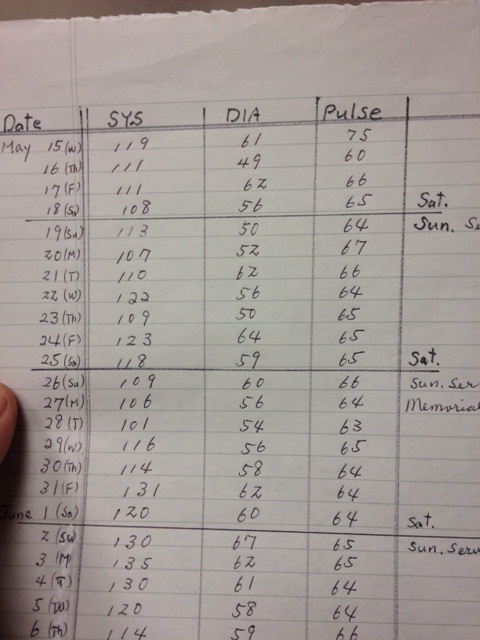 |
| The patient's self-recorded vital signs (Click to enlarge) |
So, what's the diagnosis?
(Hint: remember who the patient came to see...)
-Wes
Thursday, June 13, 2013
How to Quell Physician Discontent with EMRs
How do you quell physician discontent with Electronic Medical Records (EMRs)?
Easy.
Have the leadership of your physician organization interview the National Coordinator for Health Information Technology, then make sure your physicians read the spin. This is one of my favorite excerpts:
There. You're a believer in in all things EMR now, right?
Doctor?
Doctor?
-Wes
Easy.
Have the leadership of your physician organization interview the National Coordinator for Health Information Technology, then make sure your physicians read the spin. This is one of my favorite excerpts:
Q: Many physicians are not seeing the expected financial return on investment after EHR implementation. Why is that?If you can stomach more, go on over and read the whole thing. (And consider leaving them a comment about how you really feel about this spin).
A: How you implement the technology has a lot to do with the results you achieve. (ed: Now, note how he dodges the question) But the bigger issue is how the compensation system is designed. If physicians are operating in a fee-for-service environment, then many of the gains of EHRs -- for instance, in quality, safety and patient engagement -- aren't reflected in revenue. Physicians are doing more work and delivering better care and service, but the added value is not reflected in the reimbursement. (ed: Okay, that's what we said: we're seeing lower pay, not higher, despite doing more and more meaningless data entry work with EHRs. We are often not finding return on our investment with the additional work. Why are you now addressing nebulous issues with physician payment reform? Could you stick with the question, please?)
We've been an advocate for making sure that when value is added, it's reflected in increased physician reimbursement whether it's through the patient-centered medical home (PCMH) setting (ed: Alas: no. It is impossible for the Coordinator to stick to the question. Now we're on to Value-Based Purchasing. WTF? Doctors aren't PURCHASING value, dammit, we're providing CARE!), value-based purchasing or part of an accountable care structure. That's where the ability to manage information -- not just for individual patients but for populations (ed: Remember dear doctor, it's not about you and your patient, EHRs are about the population manipulation! Huh?)-- becomes an absolute necessity, because in those models, it's not a question of whether there's a return on investment with electronic health records. (ed: Yes, dear Coordinator, in case you forgot, this WAS the original question) A physician can't function in those models without an EHR. (ed: Really? Since when?)
There. You're a believer in in all things EMR now, right?
Doctor?
Doctor?
-Wes
Saturday, June 08, 2013
The IRS, NSA, and Justice Department Scandals and What They Mean for HIPAA
As my head reels at the implications of the IRS scandal mushrooming in Washington, the IRS's recently disclosed ability to access e-mails without warrant, the intricacy of the NSA PRISM wiretap techiques that includes their ability to acquire tech firms' digital data, and even the Justice Department's ability to secretly acquire telephone toll records from the Associated Press, I wonder (as a doctor) what all this means for the privacy protections afforded by the Health Insurance Portability and Accountability Act of 1996 (HIPAA) in our new era of mandated electronic medical records. Are such privacy protections credible at all?
It doesn't seem so.
Now it seems everyone's health data is just as vulnerable to federal review as their Google search data. This is not a small issue. We have already seen that discovering "leaks" of personal health information has produced some very handsome rewards for the feds, so it is not beyond reason to think that HIPAA might also be a funding tool for our government health care administration disguised as a beneficent effort to protect the health care data of our populace.
But even more concerning is the role the IRS scandal has for America's health care system. After all, the Affordable Care Act is ultimately funded by the IRS by administering some 47 tax provisions. These include the right to levy a penalty against businesses and individuals who don't provide or acquire insurance and determining how to distribute annual subsidies to 18 million people who make less than $45,000 a year and thus qualify for subsidies in buying health coverage. In addition, the agency will collect taxes on medical devices and a surtax on people making more than $200,000 a year, as well as conducting compliance audits of tax-exempt hospitals.
We are left to wonder: given the IRS's recent actions in favor of one political party, could other aspects of our evolving health care system be similarly politically targeted? What if the government agencies turn a disapproving eye on physician-run hospitals or independent concierge medical practices? What if the market place emergence of a two-tier health care system is systematically crushed? For these types of concerns we instinctually rely on a fair, beneficent government, but these latest revelations challenge that assumption.
To the political class, the ends always justifies the means. Now, we're seeing that the means includes stealth digital tracking, e-mail browsing, and wiretaps.
Health care data protection by HIPAA?
Meh.
We should think about the far-reaching implications of what we're seeing from our government agencies as we turn the reins of health care financing over to them lock, stock, and barrel. Perhaps Peggy Noonan said it best:
Very, very small.
-Wes
Addendum: Thanks to @BillHart46 for pointing me to this: Suit Alleges IRS Improperly Seized 60 Million Personal Medical Records
It doesn't seem so.
Now it seems everyone's health data is just as vulnerable to federal review as their Google search data. This is not a small issue. We have already seen that discovering "leaks" of personal health information has produced some very handsome rewards for the feds, so it is not beyond reason to think that HIPAA might also be a funding tool for our government health care administration disguised as a beneficent effort to protect the health care data of our populace.
But even more concerning is the role the IRS scandal has for America's health care system. After all, the Affordable Care Act is ultimately funded by the IRS by administering some 47 tax provisions. These include the right to levy a penalty against businesses and individuals who don't provide or acquire insurance and determining how to distribute annual subsidies to 18 million people who make less than $45,000 a year and thus qualify for subsidies in buying health coverage. In addition, the agency will collect taxes on medical devices and a surtax on people making more than $200,000 a year, as well as conducting compliance audits of tax-exempt hospitals.
We are left to wonder: given the IRS's recent actions in favor of one political party, could other aspects of our evolving health care system be similarly politically targeted? What if the government agencies turn a disapproving eye on physician-run hospitals or independent concierge medical practices? What if the market place emergence of a two-tier health care system is systematically crushed? For these types of concerns we instinctually rely on a fair, beneficent government, but these latest revelations challenge that assumption.
To the political class, the ends always justifies the means. Now, we're seeing that the means includes stealth digital tracking, e-mail browsing, and wiretaps.
Health care data protection by HIPAA?
Meh.
We should think about the far-reaching implications of what we're seeing from our government agencies as we turn the reins of health care financing over to them lock, stock, and barrel. Perhaps Peggy Noonan said it best:
What does it mean when half the country—literally half the country—understands that the revenue-gathering arm of its federal government is politically corrupt, sees them as targets, and will shoot at them if they try to raise their heads? That is the kind of thing that can kill a country, letting half its citizens believe that they no longer have full political rights.In the blink of an eye, HIPAA privacy protections now seem small.
Those who think this is just business as usual are ahistorical, and those who think nothing can be done, or nothing serious should be done, are suffering from Cynicism Poisoning.
Very, very small.
-Wes
Addendum: Thanks to @BillHart46 for pointing me to this: Suit Alleges IRS Improperly Seized 60 Million Personal Medical Records
Thursday, June 06, 2013
Guideline Apathy
With yesterday's publication of the 2013 ACCF/AHA Guidelines for the management of heart failure, the 101st guideline for cardiologists since 2005 published jointly by the ACC and American Heart Association appeared in the literature (if my count is correct). Then again, the National Guideline Clearing House set up by our own US Government suggests there are 483 previous guidelines pertaining to cardiovascular diseases, but only 52 published by either the AHA or ACCF for cardiologists. Does ANYONE know how many guidelines there are for us to review and stay current with? Which version should we apply to patient care? When new guidelines are published, how long do we have to implement the new recommendations for care in real life? Given the pace of medical innovation worldwide, are new guidelines already obsolete once they're published?
With so many publications, constantly updated over and over again, each new set of guidelines joins the maw of guideline publications for physicians that are increasingly ignored. Worse, the level of evidence for most guidelines are meager at best. As a result, their importance has been relegated to armament for legal authorities rather than eagerly anticipated recommendations for care. It has also become clear that payors don't follow these guidelines for payment decisions either; instead they turn to their internal corporate medical coverage policies.
It would be helpful to have a "What's New" section in the guidelines but, alas, we must repeatedly endure the rambling preamble that rehashes methodology and hope we don't miss the important stuff contained in these tombs when new versions are published. Despite their effort to be all-encompassing, nuances in complex medical care inherent to sick patients with multiple organ system diseases limit the applicability of these documents in many cases. So doctors practice their art as they always have: with care and compassion and their best clinical judgment.
It's too bad, guidelines were once helpful years ago. Now, clinical doctors are officially numb to them, just like they're numb to ubiquitous telemetry alarms that are overused and constantly ring on our wards.
-Wes
With so many publications, constantly updated over and over again, each new set of guidelines joins the maw of guideline publications for physicians that are increasingly ignored. Worse, the level of evidence for most guidelines are meager at best. As a result, their importance has been relegated to armament for legal authorities rather than eagerly anticipated recommendations for care. It has also become clear that payors don't follow these guidelines for payment decisions either; instead they turn to their internal corporate medical coverage policies.
It would be helpful to have a "What's New" section in the guidelines but, alas, we must repeatedly endure the rambling preamble that rehashes methodology and hope we don't miss the important stuff contained in these tombs when new versions are published. Despite their effort to be all-encompassing, nuances in complex medical care inherent to sick patients with multiple organ system diseases limit the applicability of these documents in many cases. So doctors practice their art as they always have: with care and compassion and their best clinical judgment.
It's too bad, guidelines were once helpful years ago. Now, clinical doctors are officially numb to them, just like they're numb to ubiquitous telemetry alarms that are overused and constantly ring on our wards.
-Wes
Tuesday, June 04, 2013
What I'd Tell the Graduating Medical School Class of 2013
Next week I'll be attending our medical school graduation and I wondered what I would tell them if I were chosen to give them a commencement address. This would not be an easy speech to write right now, given all of the uncertainties in health care that lie ahead, but I thought it would be interesting to try. Readers are invited to add their words as well in the comments section.
Dear Graduating Class of 2013 -
I appreciate the opportunity to address such an impressive pool of medical school attendees. From the first day of medical school when you were introduced to your cadaver, you have endured countless lectures and lab hours, physical examination and sensitivity training sessions, and ward rotations under the watchful eye of senior residents and attendings. Today, you will hold something that few people are privileged to sign behind their name: the letters "M.D."
This time in medicine is both a particularly exciting and particularly challenging one for doctors. How you deal with these challenges will determine your staying power in the profession.
During your training and long hours, you carefully cultivated your taste for fine coffee. At first, time allowed for a daily Venti-sized Starbucks mocha latte, but later as you learned the contributions of carbohydrates to your waist line, you switched to "only" black Ethiopian Harrar. Good for you. No doubt your upcoming days of residency will allow you some time to enjoy these delights a bit longer, but rest assured that by the time you call yourself an attending physician, you will be satisfied to drink a late night splash of automated coffee machine chemicals called "Coffee, Black" as you clean up the remaining work load left by residents who have exceeded the work hour restrictions you once enjoyed yourself. With this graduation, your sheltered medical workshop days are quickly coming to a close.
While most of you think this day is about you, realize there are some very important team players that have helped you get to where you are today. First and foremost are members of your family. They have encouraged you, guided you, and likely funded much of your way to this point. And the funding for medical school has been significant. The average medical school costs today, when one includes living expenses, exceeds $200,000. For those of you who did not have family members supporting you, realize that $200,000 of debt obligations translates to $843.21 per month if you plan to pay that loan off over 30 years at a low 3% interest rate. If your interest rate is higher, I feel for you. Yes, Virginia, medical school has become much too expensive.
But there is some good news. For the first time ever, instead of paying in to the health care education system, the health care system will start "giving back" and paying you. Admittedly at a very low rate. But at least it's your first tiny step in the right financial direction. Hopefully by the end of your residency training, the additional clinical experience you gain will finally allow you to make a bit higher salary than the nurse practitioners you work beside.
Fortunately, each of you began life as a medical student-doctor in the Gilded Age of Information Technology. Anything, you were taught, is possible with enough Big Data. But more data is not always better data. More data can confuse and obfuscate. More data might not be important data. And all that data comes at a cost to you: repetetive motion injuries. You see, Big Data is created from the information you will be asked to enter on your keyboard, iPAD, or via mouseclick or Google Glass. And since Big Data must now include a myriad of new procedure and diagnosis codes that you must learn, residency is not only a time to master disease states, but also a time to master your typing and coding skills. What ever you do, don't let Big Data detract from what matters most: your patient.
Your greatest challenge as a newly minted doctor in this Information Age will be to put your cellphone down. Looking up from its glowing screen will let you see your patient's downward stare as they tell you their deepest, personal secrets. If recognized, a trusting doctor-patient relationship will blossom. If missed, a feeling that you don't care may result. Remember that despite what the information technology zealots have been telling you, patients are not digital widgets, but analog, non-linear, feeling creatures who demand respect and intelligence. If you remember this, you will go far.
Many of you will be switching to new cities and new institutions to begin your residency training at a highly-esteemed medical school now that you've "matched." As you work to learn the clinical side of medicine, stay flexible. Fellowship positions are getting harder to come by as cuts to income for specialists continue. So hang on to those cardboard moving boxes - they might be needed sooner than you think. Honing hospitalist skills will probably be a wise choice, too.
And be prepared to have your heart broken. People will die despite your very best efforts. Complications occur, even to the most skilled and most cautious. Administrators will tell you to do things a certain way when you know that way's inefficient, but it pays your salary. People will deny payments for things that you know they shouldn't. A single malpractice lawsuit, even if ultimately found to be unwarranted, will forever change you - not for the better - but for the worse. And your wife and kids will still be affected when you arrive home late after missing your daughter's dance recital even though she says, "That's okay, Dad."
But despite all of these realities, there remain some wonderful aspects of medicine. People still will look up to you. People will still respect what you do and say. People will trust you, confide in you, and appreciate your efforts. You can do amazing things for people if you don't let the system get you down. Get involved in the process. Work to set the needs of your patients before that of the system and you'll usually be rewarded.
Because in the end, this is what really matters.
So go forward, not with an artificial glow about all that you have achieved, but with the stark reality of what lies ahead. These are challenging times for doctors as we increasingly encounter efforts to devalue all we've learned and experienced. Work to make the system better. Stay strong, work hard, and appreciate all you've got.
After all, there's plenty of people who would give anything to be in your shoes.
Good luck and God bless each and every one of you.
-Wes
Dear Graduating Class of 2013 -
I appreciate the opportunity to address such an impressive pool of medical school attendees. From the first day of medical school when you were introduced to your cadaver, you have endured countless lectures and lab hours, physical examination and sensitivity training sessions, and ward rotations under the watchful eye of senior residents and attendings. Today, you will hold something that few people are privileged to sign behind their name: the letters "M.D."
This time in medicine is both a particularly exciting and particularly challenging one for doctors. How you deal with these challenges will determine your staying power in the profession.
During your training and long hours, you carefully cultivated your taste for fine coffee. At first, time allowed for a daily Venti-sized Starbucks mocha latte, but later as you learned the contributions of carbohydrates to your waist line, you switched to "only" black Ethiopian Harrar. Good for you. No doubt your upcoming days of residency will allow you some time to enjoy these delights a bit longer, but rest assured that by the time you call yourself an attending physician, you will be satisfied to drink a late night splash of automated coffee machine chemicals called "Coffee, Black" as you clean up the remaining work load left by residents who have exceeded the work hour restrictions you once enjoyed yourself. With this graduation, your sheltered medical workshop days are quickly coming to a close.
While most of you think this day is about you, realize there are some very important team players that have helped you get to where you are today. First and foremost are members of your family. They have encouraged you, guided you, and likely funded much of your way to this point. And the funding for medical school has been significant. The average medical school costs today, when one includes living expenses, exceeds $200,000. For those of you who did not have family members supporting you, realize that $200,000 of debt obligations translates to $843.21 per month if you plan to pay that loan off over 30 years at a low 3% interest rate. If your interest rate is higher, I feel for you. Yes, Virginia, medical school has become much too expensive.
But there is some good news. For the first time ever, instead of paying in to the health care education system, the health care system will start "giving back" and paying you. Admittedly at a very low rate. But at least it's your first tiny step in the right financial direction. Hopefully by the end of your residency training, the additional clinical experience you gain will finally allow you to make a bit higher salary than the nurse practitioners you work beside.
Fortunately, each of you began life as a medical student-doctor in the Gilded Age of Information Technology. Anything, you were taught, is possible with enough Big Data. But more data is not always better data. More data can confuse and obfuscate. More data might not be important data. And all that data comes at a cost to you: repetetive motion injuries. You see, Big Data is created from the information you will be asked to enter on your keyboard, iPAD, or via mouseclick or Google Glass. And since Big Data must now include a myriad of new procedure and diagnosis codes that you must learn, residency is not only a time to master disease states, but also a time to master your typing and coding skills. What ever you do, don't let Big Data detract from what matters most: your patient.
Your greatest challenge as a newly minted doctor in this Information Age will be to put your cellphone down. Looking up from its glowing screen will let you see your patient's downward stare as they tell you their deepest, personal secrets. If recognized, a trusting doctor-patient relationship will blossom. If missed, a feeling that you don't care may result. Remember that despite what the information technology zealots have been telling you, patients are not digital widgets, but analog, non-linear, feeling creatures who demand respect and intelligence. If you remember this, you will go far.
Many of you will be switching to new cities and new institutions to begin your residency training at a highly-esteemed medical school now that you've "matched." As you work to learn the clinical side of medicine, stay flexible. Fellowship positions are getting harder to come by as cuts to income for specialists continue. So hang on to those cardboard moving boxes - they might be needed sooner than you think. Honing hospitalist skills will probably be a wise choice, too.
And be prepared to have your heart broken. People will die despite your very best efforts. Complications occur, even to the most skilled and most cautious. Administrators will tell you to do things a certain way when you know that way's inefficient, but it pays your salary. People will deny payments for things that you know they shouldn't. A single malpractice lawsuit, even if ultimately found to be unwarranted, will forever change you - not for the better - but for the worse. And your wife and kids will still be affected when you arrive home late after missing your daughter's dance recital even though she says, "That's okay, Dad."
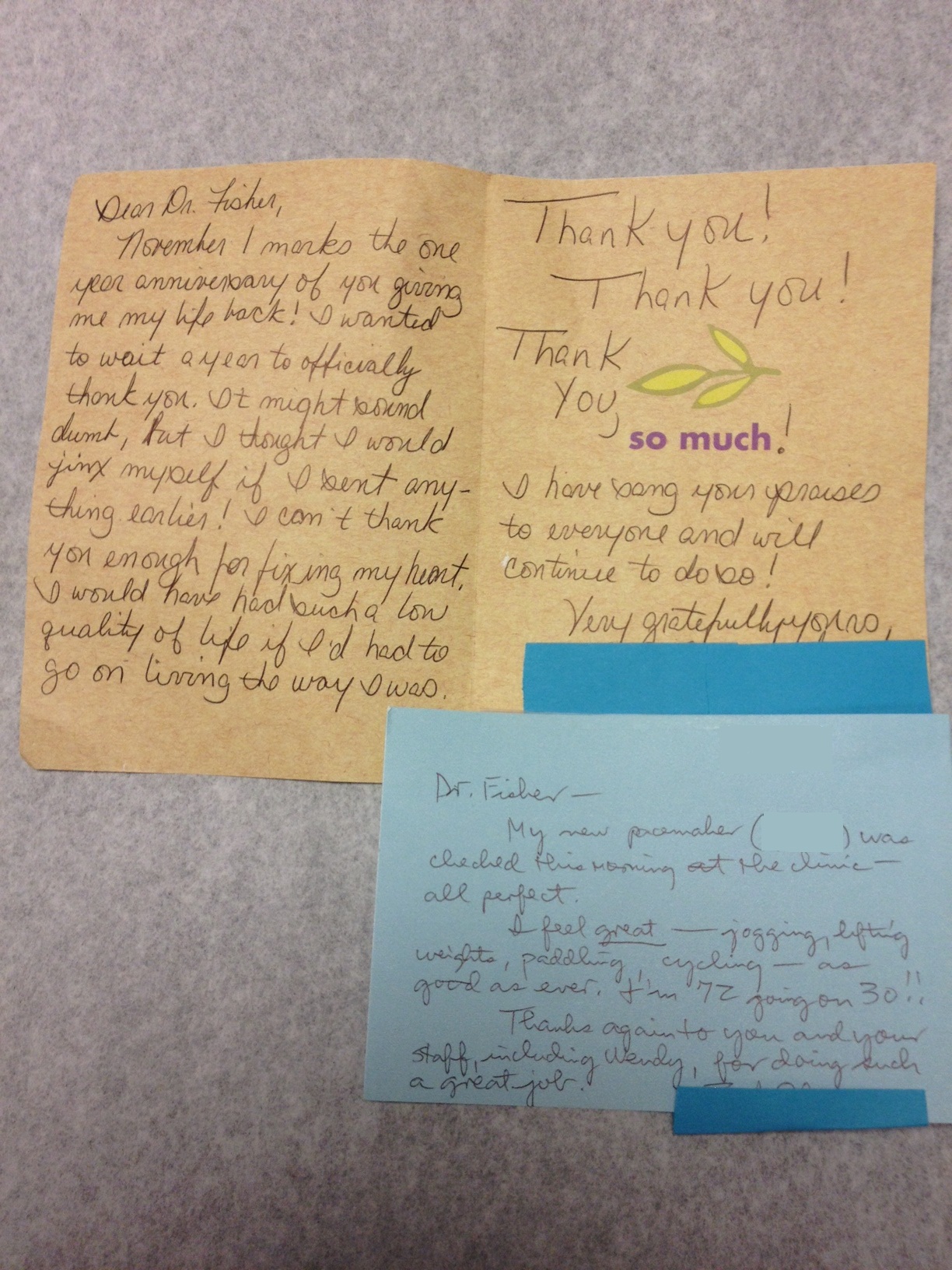 |
| An example of a few much-appreciated thank-you notes you'll receive (Click to enlarge) |
Because in the end, this is what really matters.
So go forward, not with an artificial glow about all that you have achieved, but with the stark reality of what lies ahead. These are challenging times for doctors as we increasingly encounter efforts to devalue all we've learned and experienced. Work to make the system better. Stay strong, work hard, and appreciate all you've got.
After all, there's plenty of people who would give anything to be in your shoes.
Good luck and God bless each and every one of you.
-Wes
Friday, May 31, 2013
How To Simplify Consents
He arrived at the emergency room diaphoretic, hypotensive, and with substernal chest pressure. The patient was brought immediately to an emergency room care area and a stat EKG disclosed classic ST segment elevation in the inferior leads. The cath lab team was immediately summoned as the ER team worked to stabilize the patient. Within minutes, the attending cardiologist was on the scene, reviewed the EKG, examined the patient, and explained to the hoardes of family members with the patient what was taking place. In the interest of being expeditious with his consent process as the team was arriving to take the patient to the cath lab, the attending said:
"There is a 1% risk that anything bad that you can think of could happen with this procedure. If you'd like me to detail those things, I can."
The patient didn't want to hear, and off to the cath lab they went to open the patient's occluded right coronary artery to great relief of the patient and family.
Later, in follow-up, the attending cardiologist was making rounds and asked the patient his occupation.
"I'm a malpractice attorney."
Smiling, the cardiologist immediately asked, "How was my consent?"
"Perfect. Absolutely perfect."
-Wes
"There is a 1% risk that anything bad that you can think of could happen with this procedure. If you'd like me to detail those things, I can."
The patient didn't want to hear, and off to the cath lab they went to open the patient's occluded right coronary artery to great relief of the patient and family.
Later, in follow-up, the attending cardiologist was making rounds and asked the patient his occupation.
"I'm a malpractice attorney."
Smiling, the cardiologist immediately asked, "How was my consent?"
"Perfect. Absolutely perfect."
-Wes
Thursday, May 30, 2013
A Critical Review of the Insurance Claim Denial Process
"If you can speak what you will never hear,
if you can write what you will never read,
you have done rare things."
-Henry David Thoreau
"Doctor, how much longer?"
The case had gone smoothly, but the challenges of mapping the infrequent skipped beats that signified the initiating sequence to the tachycardia was getting more difficult. "Could it be left sided?" I wondered. "Anterior or posterior? I've tried the posterolateral area and that timing was late. Clearly anteromedial was earlier. All the darn beats look so similar with pace-mapping."
I had been working for an hour and a half without effect when I had an idea: "Maybe the 3D mapping system would help."
And so, I deployed a highly sophisticated three-dimensional (3D) electroanatomical (EAM) mapping system that sped her successful ablation. She was relieved. That is until the bill arrived and the 3D EAM mapping was denied by her insurance carrier.
***
On December 19, 2012, I wrote about the insurance denial for this case. I was surprised that a denial for payment was made for a portion of a ventricular tachycardia (VT) ablation procedure that was commonplace in my field: three-dimensional (3D) electroanatomic mapping. Worse, I was even more surprised that the denial came from an unknown physician who lacked training in my field and appeared to be nothing more than a foot-soldier of a Cigna insurance company medical coverage policy. Such a denial had never happened to one of my patients before.
Since that blog post was written many months ago, my administrative staff and I have been enduring the appeal. Here's how it's gone.
Shortly after my piece was published, I was notified that someone at Cigna had called our hospital and inquired if they were aware of my blog post. They were. My workplace has graciously permitted me to have this blog since 2005, provided I clearly state the views in that blog are my own, which they are.
Second, I learned that the individual who sent the original coverage denial letter to me was not our local Cigna "regional" medical director. After my post was published, my local medical director from Cigna wanted to talk and explain the proper way that claim denials should handled. A telephone conference was arranged between myself and my the medical director (a local pediatrician from a local academic center which will go un-named) along with another non-medical representative of the local regional office of Cigna. I offered them the opportunity to publish a rebuttal to my post at this site if they desired, but they declined the offer. Instead, I was asked to contact them via e-mail or phone before going public with my concerns about their decision on a blog - "we have a set way of handling disagreements with policy decisions" I was told. Was this because Cigna's leadership didn't want the bad press or was it a polite way of saying "cease and desist?" I wasn't sure.
So, in the interest obtaining a reversal of my patient's claim denial as easily as possible, I complied. I sent them my first rebuttal in writing and communicated with them via email as requested. My rebuttal went something like this:
Cigna's original denial letter, dated 1 March 2012 stated:
Since that blog post was written many months ago, my administrative staff and I have been enduring the appeal. Here's how it's gone.
Shortly after my piece was published, I was notified that someone at Cigna had called our hospital and inquired if they were aware of my blog post. They were. My workplace has graciously permitted me to have this blog since 2005, provided I clearly state the views in that blog are my own, which they are.
Second, I learned that the individual who sent the original coverage denial letter to me was not our local Cigna "regional" medical director. After my post was published, my local medical director from Cigna wanted to talk and explain the proper way that claim denials should handled. A telephone conference was arranged between myself and my the medical director (a local pediatrician from a local academic center which will go un-named) along with another non-medical representative of the local regional office of Cigna. I offered them the opportunity to publish a rebuttal to my post at this site if they desired, but they declined the offer. Instead, I was asked to contact them via e-mail or phone before going public with my concerns about their decision on a blog - "we have a set way of handling disagreements with policy decisions" I was told. Was this because Cigna's leadership didn't want the bad press or was it a polite way of saying "cease and desist?" I wasn't sure.
So, in the interest obtaining a reversal of my patient's claim denial as easily as possible, I complied. I sent them my first rebuttal in writing and communicated with them via email as requested. My rebuttal went something like this:
Cigna's original denial letter, dated 1 March 2012 stated:
"Use of an intracardiac electrophysiological 3-dimensional mapping system in the diagnosis, treatment, or management of ventricular arrhythmias or any other condition because there is insufficient scientific evidence to support its use does not meet Cigna guidelines for coverage because it is considered experimental, investigational, and/or unproven (E/I/U)."Cigna's 2012-2013 Medical Coverage Policy regarding 3D electroanatomic mapping systems for VT ablation (which I have copied on my own server, lest it disappear) stated:
The authors state, "although not yet established as requisite or "core" equipment for the EP laboratory, these and other emerging technologies have had, and will continue to have, a major impact on the practice of cardiac arrhythmia management. It is also anticipated that additional new technologies will be developed at ever faster rates in the future" (Tracy, et al., 2006). There has been no update to this statement since 2006.Baloney. The EHRA/HRS Expert Consensus statement on VT ablation was subsequently published in in 2009 and that document specifically addresses the use of 3D EAM for VT ablation. It said:
Technological advances have been critical to the development of the field and will continue to play an important role in improving outcomes. The evaluation of new technologies has generally been based on uncontrolled series. There is limited head-to-head comparison of different technologies. Although new technologies generally increase the cost of a procedure when they are introduced, the costs may be justified if they improve outcomes.
...
The focal VT origin can be identified from activation and/or pace mapping.4,381,385,410 Systematic point-by-point activation mapping is the initial preferred technique.233,234,385,409 Some investigators use three-dimensional EAM systems to assist in relating the anatomy to the mapping data.4,124,125,233,381,385,428–430
Wrong.
Two MORE submissions for higher-order reviews and over four months later, the verdict was handed down: my patient had exhausted all avenues of appeal for the claim. The insurance company would not pay this portion of my patient's bill, no matter what.
Parsing Truths
When deciding what therapies are effective for our field, who should set the requirements for the level of evidence required to determine effectiveness of any therapy, EP societies or the insurance industry? While it is true that prospective randomized trials comparing mapping techniques head-to-head for localizing ventricular arrhythmias have not been done, we should also understand that such a study will never be performed. Why? First, who would pay for such a study to be conducted? The utility of 3D mapping for SVT has been demonstrated and proven effective, in large part because of the greater safety (and greater likelihood of obtaining FDA approval) when supraventricular rhythms are studied compared to ventricular arrhythmias. Second, because the occurrence of the arrhythmia (in this case RVOT VT) is relatively rare, a compelling reason for industry (or government) to fund such a study doesn't exist.
But like SVT ablation, there are three real advantages to these 3D mapping systems for VT ablation that has been repeatedly demonstrated in the literature: (1) catheters can be returned to prior locations accurately whether the arrhythmia is occurring in a location or not, (2) real reductions in fluoroscopy times can be achieved and (3) certain 3D EAM systems that use mathematical algorithms (non-contact balloon mapping) can localize the origin of an arrhythmia using a single heart beat. For the rare patient (like mine) that has infrequent arrhythmias, how would a randomized trial be constructed in hopes of proving the utility of such a technology over conventional mapping by point-to-point techniques? Would such a trial be even ethical to conduct? So, just because a prospective trial has not been performed to demonstrate the utility of a technology in rare circumstances, does this mean electrophysiologists should never utilize such a technology to achieve a successful ablation outcome when other means fail even though such a technology has been shown to be effective in single-center studies? According to Cigna's policy statement, the answer to this question is "yes."
Too bad insurers never have to speak with patients when an ablation fails.
One Last Try
Because I did not want to take "no" for an answer, I asked my administrative staff to see if they could obtain the name of the Cigna "external" reviewer. We had been assured that the case was externally reviewed by an electrophysiologist. We were given the name of an individual but were surprised to find that the physician was a paid employee of Cigna with credentials as an internist and general cardiologist with a nuclear medicine background. To me, it seemed Cigna "external" review was actually an "internal" review performed by a paid employee of different regional office of Cigna (hence "external" to our region) who was a general cardiologist, not a cardiac electrophysiologist.
I brought this concern to the attention of my local medical director of Cigna by e-mail. In that email I also expressed my concerns about the long time each review had taken. I asked him to examine both issues, since I felt my patient had not received a fair and unbiased claim review. Also, while my patient had received a final denial letter, I never received a notification of their final determination for coverage. After some delay, the director promised to look into my concerns and contacted me by phone later in the week as promised.
In our subsequent discussion, it appeared the director felt the timeliness of their reviews was satisfactory, despite a timeline that stretched over fourteen months for this entire process. In regards to my concerns over who reviewed my patient's claim denial, he claimed there were two "internal" Cigna reviewers and reviewers "external" to Cigna who supported the denial. Of the external reviewers, the director claimed one was board-certified in internal medicine and interventional cardiology and the other external reviewer was board-certified in internal medicine, cardiology and cardiac electrophysiology. He refused to disclose either of the external reviewers' names. When asked, the director stated that the electrophysiologist was in active practice. I reiterated that I still felt the EHRA/HRS Expert Consensus statement suggested the 3D-mapping falls well within the standard of care. Surely they should reconsider. But despite my pleas for reconsideration, no reversal was forthcoming.
I hung up the phone.
Amazingly, there is little else I can do for my patient's insurance payment denial now. Here I am, a non-anonymous board-certified cardiac electrophysiologist with over twenty years experience who was caught in a challenging case with my patient and am now being told by a pediatrician from an insurance company that there's no merit to my concerns about an unfair denial for coverage of the 3D mapping portion of my patient's claim. I am dumbfounded, confused, and heartbroken for my patient.
So what have I learned?
1) In Cigna's case, some insurance coverage decisions disregard current standards of care and up-to-date expert consensus statements in lieu of poorly-updated corporate medical coverage policies.
2) Specific challenges I encountered with my patient's RVOT VT ablation case had no bearing on Cigna's decision.
3) Physician reviewers often do not hold expertise in the specialty areas they are asked to review. Because they are first and foremost paid employees of the insurer, they turn to corporate medical coverage directives for guidance, even though they are woefully lag current medical practice. As health care dollars get tighter and medicine becomes increasingly codified, significant conflicts of interest will continue to rise for a fair and impartial review of payment denials.
4) If the insurance company claims to have an individual of the same specialty externally review a case, physician providers are not notified of the basis for the denial nor given the names of the reviewers, limiting one's ability to verify the reviewer's credentials or to understand the rationale for the denial. As a result, there is no transparency to the process, nor opportunity for learning or system improvement. To me, this practice should not be condoned. Health care requires continuous quality improvement. More importantly, health care requires trust of all those who touch the field, especially when the care provided, no matter how seemingly far removed, impacts a patient's physical or socioeconomic well-being.
5) Cardiac electrophysiologists should be aware that both Cigna (here) and Aetna insurance companies (here) in Illinois now have coverage policies that may opt to deny payment for three-dimensional electroanatomic mapping for VT ablation because they claim they are experimental procedures for this indication based on their outdated internal review of the literature.
6) When confronted about the obsolete nature of their medical coverage policy, Cigna refused to take this into consideration and still refused to overturn by patient's payment denial. Instead, the medical director only promised to include the EHRA/HRS document I sent them in their next annual review of their corporate medical coverage policy for 3D mapping scheduled for 2013-2014.
7) There are technologies that have certain niche benefits for patients, but because they are not "proven" beneficial by randomized trials, in some cases they are no longer be paid for by insurers.
8) My patient will now has four months from the date of her final denial letter to ask for an state-directed independent external review of the Cigna's coverage decision via the Illinois Insurance Fairness Act as her only remaining avenue for recourse.
So now what?
As I reflect on this case, I used this sophisticated mapping technology because I felt I needed it to improve my patient's outcome and safety. I wonder what this denial of coverage does to the relationship with my patient. Has trust been eroded? As I look forward, how I will perform my next RVOT VT ablation? What do I say to the next patient with a similar arrhythmia? Should I warn all my future patients requiring VT ablation that some of the technology we routinely use to expedite their procedure might not be paid for by their insurer because of a paucity of prospective randomized trials exist (and never will)? Will I have to avoid the use of this technology knowing my patient may have to pay for it because a pediatrician or a general cardiologist who knows nothing about my field might not approve its use? Can I afford to devote this amount of time for wrestling future insurance payment denials that surface?
These are not minor concerns.
So there's the current status of this long, arduous months-long insurance denial review process for just one patient, critically reviewed. It would be easy to make this post a screed against one insurer, and while I have to say that the way this claim denial process was handled was poor at best, we should recall that other insurers have similar policies. It is in the interest of insurers to make the payment denial/review process as difficult as possible for patients and providers. It is also in insurers' best interest to keep out-of-date medical coverage policies in place that consider new technologies "experimental." Better yet, it is even better for insurers to claim niche technologies are "unproven" despite evidence to the contrary and should therefore never be paid. Finally, it is in insurers' best interest to perform internal reviews by uninformed physician reviewers of another subspecialty rather than peer-to-peer independent reviews.
What will it take to change this system?
Maybe we should start with the truth.
-Wes
Transitions
 |
The world was ahead of him now as the year ended. He had so much to do, so much ahead: a graduation, new city, wife with a new job, a need to find a home and new nanny, the need to learn a new hospital, community, and yes, even a need to sit through four hours of EPIC training, again, to fulfill his educational prerequisite for his new hospital's orientation.
"You bet," his mentor said, "good luck with everything. This will be an incredibly exciting time for you" as the fellow left. Silently, the older doctor reflected on the excitement and stress that change brings. He could see that the young fellow was already gone, his attention turned elsewhere. Good for him: focused, excited, slightly anxious, but eager to move forward.
 |
 |
Good for her, he thought.
As the cool carbonated bubbles of a lime Lacroix slid down his throat, he sat back, eyes closing, thankful he wasn't on call this night.
Good for me, he thought.
-Wes
Wednesday, May 22, 2013
Status Check
For my regular followers, I apologize for being so negligent on updating this blog recently. Rest assured, I'm not dead, sick, or having family troubles - I'm just busy as hell. Taking a week off for attending a Scientific Session wreaks havoc on one's professional life these days.
I also find that I am more judicious about what I post these days. For me, I enjoy supplying original content to the blog-o-sphere rather than just links to cool articles. Sure, there's a place for that and, honestly, I could probably monetize this blog to a rockin', sockin' monetary powerhouse by doing little else, but that's not why I'm here. (My Adsense volume is about enough to pay for my server fees.) I do this, I've finally realized, because I enjoy writing, having a voice, and advocating for a cause. Doctors, you see, need a voice in this huge, increasingly corporate world of medicine these days. This is my place of refuge, my therapist, my touchstone for what matters.
So if I'm not posting all the time, consider it a sign of blogging maturity, not negligence. I'd rather post something of relevance rather than just drivel. Rest assured, there are things cooking in the background that I can't wait to share with you.
Thanks for hanging in there.
-Wes
I also find that I am more judicious about what I post these days. For me, I enjoy supplying original content to the blog-o-sphere rather than just links to cool articles. Sure, there's a place for that and, honestly, I could probably monetize this blog to a rockin', sockin' monetary powerhouse by doing little else, but that's not why I'm here. (My Adsense volume is about enough to pay for my server fees.) I do this, I've finally realized, because I enjoy writing, having a voice, and advocating for a cause. Doctors, you see, need a voice in this huge, increasingly corporate world of medicine these days. This is my place of refuge, my therapist, my touchstone for what matters.
So if I'm not posting all the time, consider it a sign of blogging maturity, not negligence. I'd rather post something of relevance rather than just drivel. Rest assured, there are things cooking in the background that I can't wait to share with you.
Thanks for hanging in there.
-Wes
Sunday, May 12, 2013
Heart Rhythm Society 2013 Scientific Session Wrapup
 |
| Opening Day HRS2013 |
First, we should acknowledge the efforts by the Heart Rhythm Society to limit the bling at the meeting. There were fewer large advertising displays, trucks driving through the streets with ads on top of them, and late-night rendezvous. Heart Rhythm Society handbags were like paper-thin grocery bags or recycled from prior years. Technology was used to a much greater extent, especially for smart phones, with an iPhone app meeting organizer that showed promise, but still needs some fine-tuning, especially in its scheduling functionality. As a result, aside from the Bill-Fest, the meeting felt more like a scientific session rather than a trade show.
Next we saw the evolution of thinking about the most common arrhythmia that electrophysologists treat: atrial fibrillation. Work on our understanding of atrial fibrosis via MRI assessment as it might pertain to long-term success of ablation was intriguing. Even more, since the introduction of the mystical focal impulse and rotor modulation (FIRM) mapping several years ago, attention is clearly returning back to understanding of the electrophysiology of atrial fibrillation from one of just approaching the disease anatomically. Many of the abstracts and studies presented revolved round (pun intended) an understanding of rotors or point sources (or both) for the genesis of atrial fibrillation. With this comes an entirely new vocabulary of cardiac electrophysiology with terms like "clockwise or counterclockwise rotor," "phase mapping," "frequency gradients," and "singularities." The black box nature of Topera Medical's FIRM mapping technique with it's 1960's music box-like maps (video) (that are difficult to interpret) adds to the mysticism of the moment, but it was clear that there was an appreciation that they are on to something.
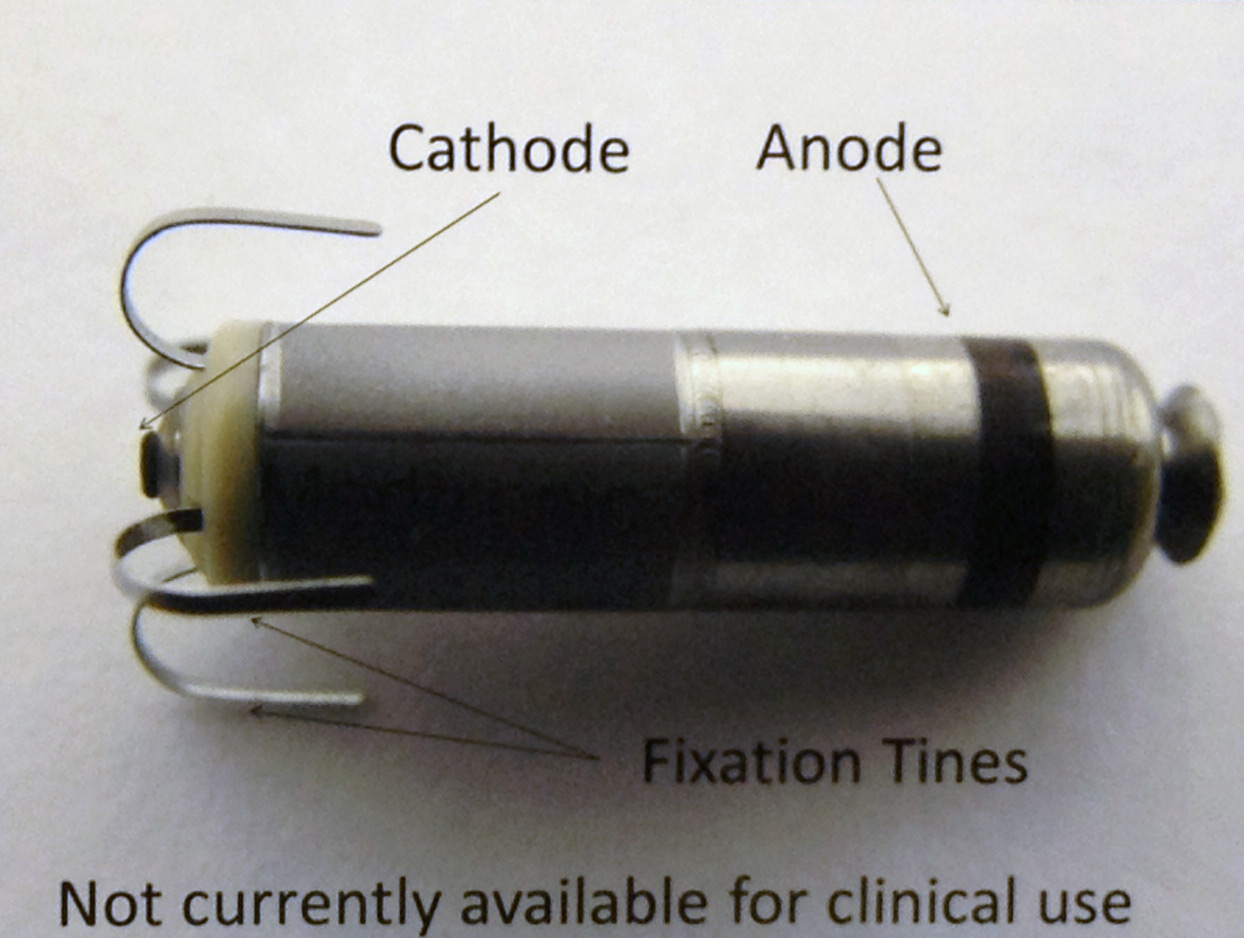 |
| Medtronic's version of the leadless pacemaker |
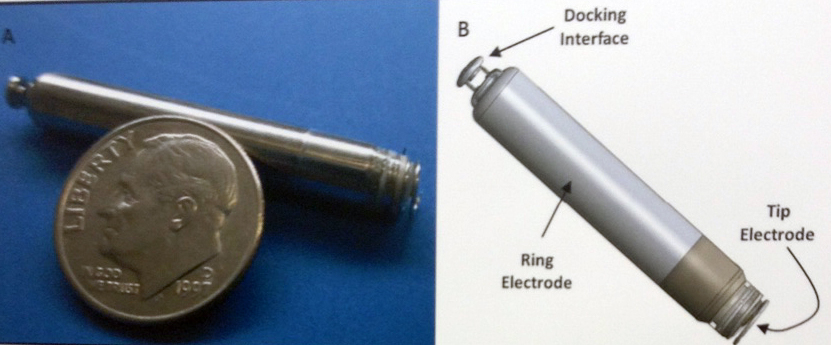 |
| Boston Scientific's version of the leadless pacemaker |
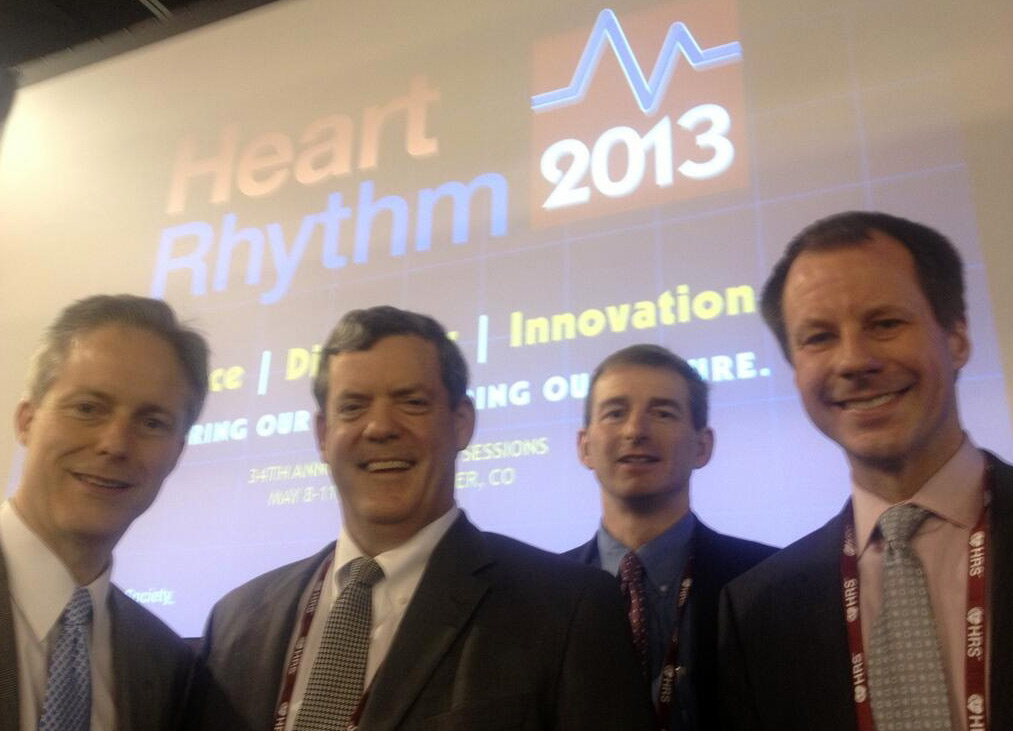 |
| "Physician in Social Media" participants (L to R) Mr. Bob Coffield, yours truly, John Mandrola, MD, and Edward J. Schloss, MD |
-Wes

Thursday, May 09, 2013
Former President Bill Clinton Kicks off Heart Rhythm Society Meeting
While the above title is true, I admit that it was used more for garnering readership than suggesting that former U.S. President Bill Clinton had any real news to share with the world's pool of heart rhythm specialists. Oh how we hoped he would tell us about his pacemaker or implantable defibrillator that he had installed but, alas, it was not to be.
But the man can still draw a crowd. The large auditorium was filled by just about everyone that attended the conference it seemed, and he received a standing ovation upon entry. He seemed relaxed, but often glanced down a bit toward the floor when he spoke on occasion as he gauged the audience and weighed his commentary. For the first part of his talk, he stood behind the podium with teleprompters at its side, but unlike other presidents we know, those seemed more for those introducing the former president, rather than the former president himself.
Mr. Clinton was politely received by what could have been a viper's den of cardiac subspecialists. He's a gifted speaker and many of us were impressed by the depth and breadth of humanitarian efforts taken on by his Clinton Foundation following his stint in the White House. It was interesting to hear about all of the places hes been and the work his organization has done and at the outset. After the polished introductory video of the Clinton Foundation's excellent work was shown to the audience of political neophytes, many of whom had never seen a president before, it was clear no one was going to kill the baby seal. This was to be the Bill Show and sadly, there was never a single mention of the support team behind his foundation.
Still, there were moments in his speech that were captivating, especially the part where he described his own post-bypass ordeal of being told that he had fluid around his heart after his heart surgery and how he had to return to the operating room to have "my chest cracked open again" to manage it. We got a glimpse at his real fears and his real appreciation for his doctors and the technologies that cared for him. We heard how he ignored his chest tightness that occurred at rest after his bypass operation and how foolish he felt in retrospect after receiving two stents to a "badly mangled artery." Then we heard about how all of this lead his efforts to change his own dietary habits and to work with PepsiCo to develop policy for school kids to lower caloric intake of sugary drinks: "We found a way to change the system without having to take it down. That's what we need to do."
But his efforts to circle back to health care reform were disjointed much of the time as he waxed back and forth from his experience in Rowanda building clinics and providing logistics to the US, and then to comparing the relatively small Netherlands' health care system to the US's system, leaving many doctors wondering when he was going to say anything of real substance. Still, he tried to make the point about a "systems approach" and paying for "performance" rather than "procedures" as a partial way to fix things. He seemed to yearn for a simpler system than the one we've got. When asked point blank if his perspective on health care had changed since having his expensive care, he masterfully deflected the question by saying "I have a deeply personal regard for the American health care system, but we're limp at preventing errors." No doubt doctors who worked so hard on his behalf appreciated that comment.
Overall, most people I spoke with after the event seemed generally pleased with Mr. Clinton's performance, especially when he admitted the limitations of the Affordable Care Act (ACA). They liked his quip about how 99.5% of people's DNA are identical, yet we spend so much time focused on making sure others know the differences in the remaining 0.5% of their genome. It was clear he was a master at reaching across the aisle and he opined for a more collaborative approach to resolving our nation's health care problems. When asked whether he thought the ACA (Affordable Care Act) would fix what's wrong with America's health care system, he said honestly "Maybe. Maybe not." But he stuck with the partisan narrative of error management, paying by "performance" rather than procedures and asking doctors to do their part to fix the system, seemingly unaware of the 30% drop in RVU payments that took hold 1 January 2013 and the 2% Medicare payments to physicians that recently affected many members of his audience. It seems he felt doctors needed to do more, but many doctors wondered silently how much more we can take.
It was clear the Europeans I spoke with after the talk loved his speech. But they were also quick to point out another little fact: Mr, Clinton's appearance fee is somewhere in the order of $250,000. A quick fact check showed that was a gross understatement: it's closer to $500,000 or more. If this is the price we've paid for this hour of entertainment it's no wonder our health care's cost crisis is such a mess.
And if so, maybe Mr. Clinton should do his part for health care reform, too, and stay home.
And if so, maybe Mr. Clinton should do his part for health care reform, too, and stay home.
-Wes
Wednesday, May 08, 2013
HRS2013 Pre-meeting Reflections
This morning I sit quietly in my hotel room, contemplating the day ahead at the 2013 Heart Rhythm Society Scientific Sessions in Denver. Emotions clash.
On one hand, it will be great to see old friends an colleagues, to be spoon-fed information, and to relax. On the other hand, I find myself in an electrophysiologic angst: how I can spend the time upbeat knowing that the relative value of the work that heart rhythm specialists do was cut at least 30% on 1 January 2013, thanks to new billing codes that bundled multiple codes into one?
Can I afford to be here?
I do not say this lightly. Our first quarter's pay this year compared to last year was recently disclosed and the results were striking. Guys like me who have devoted years to our training, stood at bedsides for countless hours, and endured training that finally ended at age 36 (counting a brief two-year hiatus for a general medical officer stint as an ER physician for the US Navy), got a whopping 30% cut from CMS for the much of the procedure work we do, stealthy cloaked in codes.
It is real. It has happened. And its effects are being felt by many, real time, even now, at #HRS2013.
I realize in these economic times that many professions are feeling similar pressures. I am not here to lament nor ask for pity, but rather to describe. In many ways, I am lucky: lucky to have good friends, a fascinating skill, and wonderful colleagues and support staff to work with. But I wonder, how all of this will change things.
Certainly, we tabled our plans to hire another EP. No wonder EP fellows are finding it tough to get a job. Hospitals are not hiring. Wards are being consolidated. Pennies are being pinched, and so are staff. Patients are waiting more to see guys like me. Attendance at continuing education conferences is falling. While the effect on physician care "quality" are probably uncertain at best, but it is becoming quite obvious that "innovation" in my field of medicine as we've known it is stagnating or moving overseas.
It is all change - I get that - part of the Great Experiment of our nation's health care reformation project that is moving fast and furious to places unknown. But change is difficult. It shakes things up. Anxiety and restlessness at times like these can consume a psyche or, in ideal circumstances, lead to something new, something liberating, something better.
So off I go to the 2013 Heart Rhythm Scientific Sessions, hoping to keep my chin up, my ear to the ground, and my eyes open.
You never know what you might learn.
-Wes
Sunday, May 05, 2013
Physician Blogger Insights On Social Media
A recent e-mail exchange between myself (WGF) and fellow-physician bloggers John M. Mandrola MD (JMM), Edward J Schloss MD (EJS) and Ves Dimov MD (VDMD) resulted in some interesting insights about how physicians are using social media tools today. The following is a lightly edited version of the thread (used with permission). It began with an e-mail from Dr. Mandrola:
* * *
* * *
* * *
* * *
For those attending the 2013 Heart Rhythm Society Scientific Sessions in Denver, CO next week, Drs. Schloss, Mandrola and myself (as well as Robert Coffield, Esq. of the Health Care Law Blog fame) will be speaking at the Rhythm Theatre at 3:15pm on 10 May 2013 on Physicians in Social Media.
Hope to see you there!
-Wes
PS: For doctors considering the leap to social media, here's a basic Twitter Primer.
JMM: "In prep for our Social Media session at HRS2103. I was just wondering…
Do you guys keep a list of favorites on Twitter? I have lists--but they aren't very effective logistically. I was wondering if I designed a list--say the Mandrola-twenty--of folks I did not want to miss, I might be able to use a column on TweetDeck. Right now, I follow 350 people--and it's unwieldy. But yet I have trouble parsing because I'll look at an acct and say to myself, "this one's pretty good; I don't want to unfollow." Also, I find TweetDeck sometimes intrusive. I use the reg Twitter app and often post with Hootsuite--because it allows me to link to 4 social networks at once--LinkedIn, FB, Twitter etc.
What Twitter app do you all use on Computer? On smartphone?
Do you have thoughts on Facebook (FB)? I see from the WSJ they are making a comeback so to speak. For a while there, I thought they might be dead.
Do you agree that Twitter seems more amendable to professional needs--the sort we all use it for: things like links, communication with colleagues, filtering of important medical news. I tend to use FB, the little that I do, for real life things like family, in-real-life friends and cycling stuff, for instance. I wonder whether this is a correct distinction, as most of the major journals and medical society have a FB presence. And likewise, Twitter has plenty of willy-nilly stuff like Hollywood, Athletes etc. The young people I know use Twitter more like I use FB."
EJS: "I also use Twitter almost strictly for professional stuff, especially my posts. I follow a few non-professional accounts, but am really choosy in general about followers. For my own posts, I try to picture someone looking down my timeline and trying to decide whether I'm worth their time to follow. If I put a bunch of cr*p up, I figure they'd move on. Twitter is also the predominant source of my online persona, and I'm really careful about maintaining this.
Right now I follow 239 accounts and not all are terribly active. That keeps the stream manageable. I actually get a popup on the laptop for every thing that posts to my timeline. Because I use my laptop for all hospital charting, this means I see A LOT of tweets. That setup is clearly not for everyone, but I've gotten good at just glancing up to see who is posting before I commit to reading. The tweets fill the dead and mindless spaces we get during EHR data entry (which are a lot). At any given time I'll also have 5 or 6 searches running that also generate popups. Right now these include meaningfuluse, St Jude Riata, Barry Meier, EHR, @burbdoc, #HRS2013 among others. All of these also generate popups.
If you want to filter down you list to highlight your most important accounts, you can set up a list in Tweetdeck (and I'm sure in the other clients, as well). That will become a column, and you could turn on alerts for just this stuff if you're not at ADD as me. I have a friends/family list that shows up on my front page so I can quickly see if I missed anything good without having to obsessively scroll back through everything.
On the laptop, I use Tweetdeck. The old version before Twitter bought it is the best, but will stop working in a few days. I've put up the new version, but don't like it as much. The biggest drawback is not having the profile photo on the popups. With the old Tweetdeck, it was easier to see who was posting with just peripheral vision.
On the iPhone and iPad I use Tweetbot. It's really good and worth the few bucks it costs.
I'd tell any cardiologist starting on twitter to follow a bunch of health care journalists, along with you guys. The interactions you get with the journalists are really rewarding, and truly are a two way street.
I really don't see much professional purpose for Facebook for an EP doc. If you were a plastic surgeon or ortho, maybe there would be a role. I'm actually trying not to market directly to patients, given the nature of my practice. Maybe you could pick up some AF that way, but I suspect a lot of nervous people with sinus tach or PACs would clog up your office if you did that.
VDMD: Hi John and colleagues,
Here are my answers:
re: "Do you guys keep a list of favorites on Twitter?" -- yes, I have 2 lists - 1. list of favorite tweets that I use as bookmark, 2. list of "allergists on Twitter".
re: "Mandrola-twenty--of folks I did not want to miss" - yes, KevinMD has that - top 20 Twitters he doesn't want to miss. I follow few people - less than 100, I think, and only 50 of them tweet regularly.
re: "What Twitter app do you all use on Computer? On smartphone?" - I use TweetDeck on my home PC, HootSuite at work (TweetDeck is blocked), and mobile Twitter on my Android phone. I "favorite"/bookmark the links I want to check later.
re: "Do you have thoughts on Facebook?" - Facebook (FB) is here to stay - until a new network replaces it. You have to use it to stay relevant if you have a blog. In addition, people look at the number of your likes to see how large a following you have as a blogger. FB has limitations and can be annoying but Google Plus is not a replacement yet. FB will evolve for sure, they are a young, aggressive company, and will keep searching for ways to combat "user fatigue".
These are some quick thoughts. Please let me know if you would like me to expand on any of these.
WGF: "Twitter is for the person with ADHD while blogs are for the obessive compulsive.
Twitter, by its very nature, has a low barrier for entry and can serve as an information "gatherer" initially. I'd encourage people to LURK first. It's easy to use and feeds lots of information of interest quickly to docs. As a "MUST HAVE" for doctors, they should follow the journals they subscribe to: Heart Rhythm, NEJM, Circulation, JACC, etc, as well as major news orgs: WSJ, CNN breaking news, local newsorgs or radios, etc. I also follow Steve Colbert for a laugh once in a while.
Twitter is also VERY useful for collaboration (as we have seen) and for "hunters" of information by using your network. I especially encourage follows of docs of the same subspeciality.
Facebook is for family/personal friends for me. No patients there. I find it's the best way to stay connected with my kids after they're out of the house.
As far as lists are concerned: I think they're a waste of time. I tried it, but since you cant send a targeted message or "tweet" to a list, it's only a way to group accounts.
I use Echofon on my iPhone (like it better than Hootsuite) - easy user interface and free. I use Tweetdeck on my PC and MAC.
I follow 446 people - probably too many - but it's a broad group that includes right and left-wing health care thinkers, IT nerds, politicians, bloggers, and you guys, and Steve Colbert. :)
Perhaps the most amazing use for Twitter (recently) was the immediacy of info provided there during the Boston bombings. It was unbelieveable how quickly updates happened and totally smoked the main news organizations. Imagine if doctors had a similar network at times of crisis! That's why I think it would be VERY cool to push that concept with our audience. Consider, for example, the need to get an EKG interpretation immediately (check my recent Twitter stream to see an example of just that) - lots of folks weighed in with ideas - some good - some bad - but in the end it was vetted pretty well.
Looking forward to this..."
VDMD: re: Journals on Twitter - I'm not a big fan of these. It's mostly the administrative staff pushing some articles they have picked. RSS feeds for the journals are much better, in my opinion. They save time and include most (all) articles of each issue.So there you have it. A sneek peak behiund the social media physician curtain on their take of current software, apps, and uses they find for social media in health care today.
For those attending the 2013 Heart Rhythm Society Scientific Sessions in Denver, CO next week, Drs. Schloss, Mandrola and myself (as well as Robert Coffield, Esq. of the Health Care Law Blog fame) will be speaking at the Rhythm Theatre at 3:15pm on 10 May 2013 on Physicians in Social Media.
Hope to see you there!
-Wes
PS: For doctors considering the leap to social media, here's a basic Twitter Primer.
Saturday, May 04, 2013
The FDA Azithromycin Softshoe and Why It Matters
This week, a Danish study by Svanstrom and colleagues appeared in the New England Journal of Medicine that failed to show significant cardiovascular risk to azithromycin compared to other antibiotics in the Danish national health care system. This report was in direct contradiction to an earlier report from Ray, et al. published in the New England Journal of Medicine (and widely hailed in press) that suggested a significant risk of cardiovascular death attributed to azithromycin compared to other antibiotics in a Tennesse Medicaid population - and a report that the FDA used to justify the wide dissemination of a Drug Safety Communication for azithromycin.
While I have been quite critical of the conclusions drawn by Ray, et al. before, I was even more surprised by the Drug Safety Communication for azithromycin issued by the FDA that basically said: "any time a patient has a bunch of conditions that are known to cause prolonged QT interval, be careful prescribing azithromycin." Such warnings, of course, should apply to any drug that could cause prolongation of QT interval, but for some unclear reason, the FDA felt they had to act in the case of azithromycin.
Now it seems the FDA doing a softshoe on their earlier warning regarding azithromycin, trying to justify their warning that was based on retrospective data-mining techniques drawn from diagnosis and treatment codes, not randomized trials.
In a perspective piece from Andrew D. Mosholder et al, from the FDA that accompanied the report from Svanstrom et al, the authors acknowedge the many limitations of the original study by Ray et al.:
Fortunately, I think the FDA folks mean well: they give us salient advice in their final paragraphs of their perspective piece explaining their mistake. Things like "Clinicians must consider the arrhythmogenic potential not only of azithromycin but also of potential alternative antibacterial drugs." and "The risks and benefits of antibacterial therapy should be considered in prescribing decisions."
No kidding.
But we will not see a black box warning retracted - that would be too obvious. Nor will we see extensive news coverage about these new findings regarding this antibiotic's cardiovascular safety - that doesn't grab the main stream media's attention.
What we have, instead, is something much more concerning to me when the members of our own FDA make claims based on poor data: irrelevance.
Publishing warnings on QT prolongation that should apply to any drug administered to the patient that is older, bradycardic, with low potassium or magnesium levels, or already on known drugs that can cause prolonged QT - generates irrelevant noise for doctors. Like the Boy Who Cried Wolf, we risk compromising the FDA's relevance to patient safety. When they spend time on retrospective data-mining exercises that find risks in the neighborhood of 1 in 100,000, they risk failing to report important deaths related to new technologies with an incidence of at least 3 in 16,000 that reside in their own MAUDE database.
In today's internet age, doctors don't need any more Big Data-driven safety noise, we need razor-sharp analytic safety focus.
-Wes
While I have been quite critical of the conclusions drawn by Ray, et al. before, I was even more surprised by the Drug Safety Communication for azithromycin issued by the FDA that basically said: "any time a patient has a bunch of conditions that are known to cause prolonged QT interval, be careful prescribing azithromycin." Such warnings, of course, should apply to any drug that could cause prolongation of QT interval, but for some unclear reason, the FDA felt they had to act in the case of azithromycin.
Now it seems the FDA doing a softshoe on their earlier warning regarding azithromycin, trying to justify their warning that was based on retrospective data-mining techniques drawn from diagnosis and treatment codes, not randomized trials.
In a perspective piece from Andrew D. Mosholder et al, from the FDA that accompanied the report from Svanstrom et al, the authors acknowedge the many limitations of the original study by Ray et al.:
"The study by Ray et al. has limitations that are intrinsic to obervational, nonrandomized clinical studies. In particular, nonrandomized studies cannot exclude the possibility that patients receiving a drug under evaluation differ from the control patients in some important but undetected way, causing bias in the results. Such confounding may bias comparisons not only between patients receiving antibacterial drugs and those receiving no antibacterials but also between patients receiving different antibacterials."Yet in the very next paragraph of the FDA member's perspective piece, they persist in their indifference to their prior statement regarding the bias inherent to Ray et al.'s report and decide to focus on timing:
"Despite these caveats, the results presented by Ray et al. warrant serious attention. A chief strength of the study is the time-limited pattern of the risk: the azithromycin-associated increase in rates of death from any cause and from cardiovascular causes spanned days 1 through 5, reflecting the typical 5-day duration of azithromycin administration (e.g., Zithromax Z-pak)."The FDA authors refuse to believe that there could be any other confounding variables that might have occurred in the first five days of hospitalization that lead to the increased cardiovascular risk seen in their azithromycin-treated group. It is more important, I guess, to support retrospective data-mining and statistical data manipulation of diagnosis and procedure codes. This, you see, they must support. Big Data in our new era of expanded codes and computers is to be our new saving grace, you see.
Fortunately, I think the FDA folks mean well: they give us salient advice in their final paragraphs of their perspective piece explaining their mistake. Things like "Clinicians must consider the arrhythmogenic potential not only of azithromycin but also of potential alternative antibacterial drugs." and "The risks and benefits of antibacterial therapy should be considered in prescribing decisions."
No kidding.
But we will not see a black box warning retracted - that would be too obvious. Nor will we see extensive news coverage about these new findings regarding this antibiotic's cardiovascular safety - that doesn't grab the main stream media's attention.
What we have, instead, is something much more concerning to me when the members of our own FDA make claims based on poor data: irrelevance.
Publishing warnings on QT prolongation that should apply to any drug administered to the patient that is older, bradycardic, with low potassium or magnesium levels, or already on known drugs that can cause prolonged QT - generates irrelevant noise for doctors. Like the Boy Who Cried Wolf, we risk compromising the FDA's relevance to patient safety. When they spend time on retrospective data-mining exercises that find risks in the neighborhood of 1 in 100,000, they risk failing to report important deaths related to new technologies with an incidence of at least 3 in 16,000 that reside in their own MAUDE database.
In today's internet age, doctors don't need any more Big Data-driven safety noise, we need razor-sharp analytic safety focus.
-Wes
Friday, May 03, 2013
EKG Du Jour #31: A Case of Chest Pain
A 61 year old patient presented to your ER with chest pain, low blood pressure, and this EKG:
Now before you leap to the answer at the link provided below, ask yourself:
(a) What is this?
(b) What could cause this?
(c) How would you manage it?
And when you've really thought about it, click here for the answer but be prepared to describe what you see and what you'd do next.
-Wes
P.S.: (Yeah, I'm giving the answer now because it's Friday)
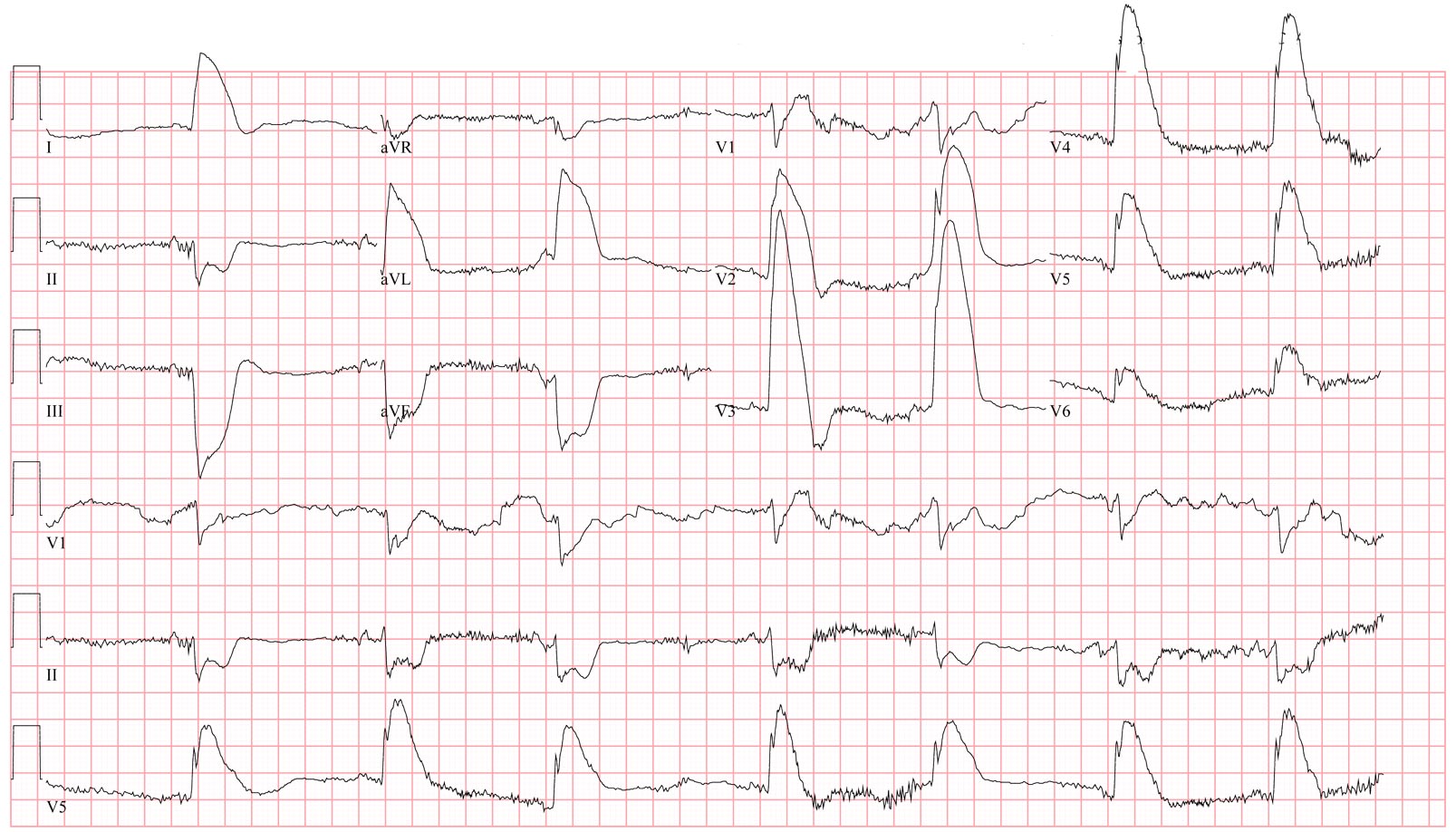 |
| (Click image to enlarge) |
Now before you leap to the answer at the link provided below, ask yourself:
(a) What is this?
(b) What could cause this?
(c) How would you manage it?
And when you've really thought about it, click here for the answer but be prepared to describe what you see and what you'd do next.
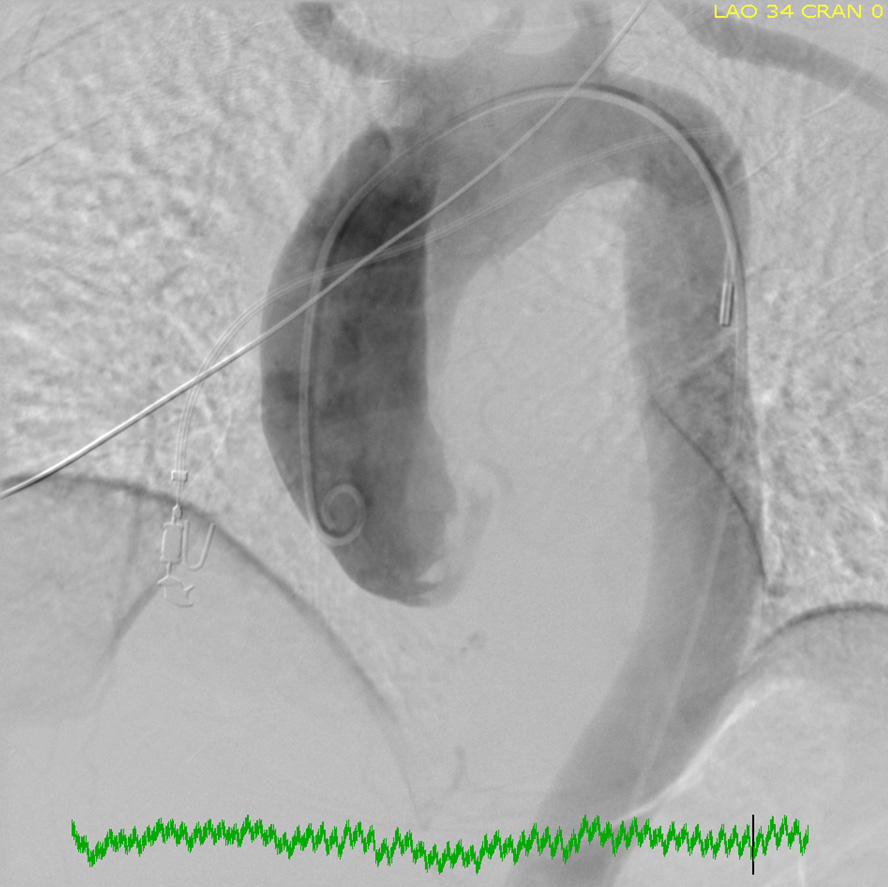
-Wes
P.S.: (Yeah, I'm giving the answer now because it's Friday)
Wednesday, May 01, 2013
Dr. John M: Autonomy vs beneficence? Shared decision-making in the patient considered for an ICD
Dr. Lin and Matlock were quoted in Dr. John Mandrola's post today:
-Wes
"Convincing physicians to engage in shared decision-making is a complex undertaking, as physicians may believe that they are following clinical practice guidelines in strongly recommending an ICD to eligible patients. Because quality-improvement efforts often focus on increasing physician adherence to guidelines and reward physicians for clinical processes or outcomes rather than high-quality decision-making, the message to physicians is that guideline adherence, rather than individualized care, is best."For implantable cardiac defibrillator (ICD) implanting physicians everywhere, if you read nothing else today, read this excellent post by Dr. John M.
-Wes
Subscribe to:
Posts (Atom)