In every medical journal, authors must disclose all conflict of interests that might exist to the editors of that journal as a condition of publication. However, as we are increasingly becoming aware, journal editors do not have to disclose payments they receive from outside sources (pharmaceutical industry, special interests, the government) to publish content in their own journal. I think they should.
Medical journals, especially those with large physician "reach," are being used less for scientific endeavors and more for political or marketing agendas. Of course, this is nothing new, in medicine, but it's high time medical journals understand that with the availability of information on the internet, that "special arrangements" with various entities might not remain so private any longer. As I noted in my earlier blog post regarding the simultaneous publication of a non-peer reviewed white paper in the Annals of Internal Medicine and The Lancet and this publication's association to recent revelations concerning the finances of the American Board of Internal Medicine and their Foundation, such a practice risks jeopardizing their scientific credibility, especially if those revelations are found to be credible. Legitimacy is an important asset to medical journals and medical journal editors should be aware that physicians who are increasingly being subject to political agendas are growing increasingly frustrated at this covert practice.
More recently, we've seen the editorial decision of another medical journal, the Journal of the American Medical Association (JAMA), decide to allow the conflict of interests of choosing Press Ganey Chief Medical Officer Thomas H Lee, MD as an editorial author for a discussion surrounding the American Board of Internal Medicine (ABIM) Maintenance of Certification (MOC) in their 10 Dec 2014 issue. Also, the fact that pointed questions to a webcast supporting the ABIM's MOC process had many questions cherry-picked by the moderators. I have no problem with a journal siding with one opinion or the other provided there is full disclosure about the financial relationships of the authors of the paper AND those of the journal itself. But any legitimate discussion requires the disclosure of real or potential conflicts of interests held by the journal to critically review the credibility of what is published. Any double-standard regarding the disclosure of conflicts of interest should not be tolerated by the medical community, especially by physicians who struggle to improve the care of our patients in our evolving health care system, especially when that health care system appears to be increasingly hostile toward physicians and their patients.
-Wes
Showing posts with label medical journals. Show all posts
Showing posts with label medical journals. Show all posts
Monday, December 22, 2014


Friday, June 21, 2013
Journals R.I.P.
I cleaned house today: a few years of my favorite print journals were stacked high, soon to enter the recycling bin:
It's funny. As a medical student, I cut out articles and carefully sorted them by topic in manila folders separated by organ systems in a large standup file cabinet for easy reference. I cherished that file system for it contained the latest and greatest articles on whatever topic I needed.
Next came the purview of the really cool docs: bound journals. Boy, did you look bad-ass having bound journals on your shelf (just like those in the library!). It only cost a minor fortune to send them to a binding company, wait several months and, presto, you were as cool as your professors and ALWAYS had the latest articles you needed close by.
But as fast as that moment arrived, it disappeared.
After all, the volume of journals you needed quickly quadrupled, quintupled, and expanded faster than vinegar to baking soda. Stacks and stacks of journals accumulated in my office so quickly that I found I never had time to read them all. So I triaged: New England Journal of Medicine? Nope. Annals of Internal Medicine? Nope. JACC? Sure. Heart Rhythm? Have to have that one. PACE? Not so much.
And on and on it went.
But now, thankfully, there's RSS feeds. And Google.
So goodbye my paper-backed friends, it's been wonderful. Thanks for all the memories and the security of knowing you were there.
May you now, officially, rest in peace.
Somewhere else.
-Wes
 |
| R.I.P., journal clutter. |
It's funny. As a medical student, I cut out articles and carefully sorted them by topic in manila folders separated by organ systems in a large standup file cabinet for easy reference. I cherished that file system for it contained the latest and greatest articles on whatever topic I needed.
Next came the purview of the really cool docs: bound journals. Boy, did you look bad-ass having bound journals on your shelf (just like those in the library!). It only cost a minor fortune to send them to a binding company, wait several months and, presto, you were as cool as your professors and ALWAYS had the latest articles you needed close by.
But as fast as that moment arrived, it disappeared.
After all, the volume of journals you needed quickly quadrupled, quintupled, and expanded faster than vinegar to baking soda. Stacks and stacks of journals accumulated in my office so quickly that I found I never had time to read them all. So I triaged: New England Journal of Medicine? Nope. Annals of Internal Medicine? Nope. JACC? Sure. Heart Rhythm? Have to have that one. PACE? Not so much.
And on and on it went.
But now, thankfully, there's RSS feeds. And Google.
So goodbye my paper-backed friends, it's been wonderful. Thanks for all the memories and the security of knowing you were there.
May you now, officially, rest in peace.
Somewhere else.
-Wes
Monday, August 01, 2011
Are Print Medical Journals Dead?
This morning in the Chicago Tribune's business section appeared an article entitled "Just What the Doctor Ordered" that included an interview with Dr. Howard Bauchner, the new editor for the Journal of the American Medical Association (JAMA). He plans to pursue a strategy of "intelligent innovation" for the journal:
Which leads to the inevitable end result: print medical journals are on life support. Like Borders Book Stores, print journals will no longer be archived in neat little rows in doctor's offices any longer - it simply is not how we get our information anymore. Dr. Bauchner, to his credit, acknowledges this.
But what he also fails to acknowledge is the business model that must keep pace with today's internet. Doctors have a myriad of choices as to where they can turn to get their information and unless the content itself is really compelling there will be too many other sources of feel-good information-crack out there that will catch doctors' eyes. Doctors will not pay for their content since there is no precedent to doing so, so the journal will have to rely on advertising revenue to fund their publications, much like the rest of the internet. Doctors and the public have already grown weary of the endless public relations "research" forwarded to our smartphones and the JAMA content will become just one more such source to cast a wary eye. How they manage to remove themselves from industry bias of "free content" provided to doctors will be JAMA's greatest hurdle.
But there's one other important challenge the journal will encounter in keeping their physician readers: their name. It will be next to impossible for the Journal to escape that fact that they are associated with the American Medical Association, since the odds of a rebranding of the name after 128 years is unlikely. Ultimately, how the next few years shape up for doctors might have more impact on the journal's physician readership than the content they deliver.
-Wes
...looking for ways to get information to doctors and consumers through several new platforms, such as social media, video and other forms. "If you look at TED or Big Think, they have been experimenting with video clips," Bauchner said. "I could imagine having some of our authors do video clips where they speak about the meaning of their research for eight or 10 minutes, and then that's easily linked to a smart phone."He also wants shorter on-line version of articles that condense the topic to 500 words from the typical 2,500- to 3,0000-word articles not too dissimilar, I suppose, to the abstract.
Which leads to the inevitable end result: print medical journals are on life support. Like Borders Book Stores, print journals will no longer be archived in neat little rows in doctor's offices any longer - it simply is not how we get our information anymore. Dr. Bauchner, to his credit, acknowledges this.
But what he also fails to acknowledge is the business model that must keep pace with today's internet. Doctors have a myriad of choices as to where they can turn to get their information and unless the content itself is really compelling there will be too many other sources of feel-good information-crack out there that will catch doctors' eyes. Doctors will not pay for their content since there is no precedent to doing so, so the journal will have to rely on advertising revenue to fund their publications, much like the rest of the internet. Doctors and the public have already grown weary of the endless public relations "research" forwarded to our smartphones and the JAMA content will become just one more such source to cast a wary eye. How they manage to remove themselves from industry bias of "free content" provided to doctors will be JAMA's greatest hurdle.
But there's one other important challenge the journal will encounter in keeping their physician readers: their name. It will be next to impossible for the Journal to escape that fact that they are associated with the American Medical Association, since the odds of a rebranding of the name after 128 years is unlikely. Ultimately, how the next few years shape up for doctors might have more impact on the journal's physician readership than the content they deliver.
-Wes
Wednesday, March 09, 2011
How Independent Are Our Peer-Reviewed Scientific Journals?
On September 27, 2010, the peer-reviewed scientific journal Europace published online-before-print a case report entitled "Spontaneous explosion of implantable cardioverter-defibrillator" by Martin Hudec and Gabriela Kaliska. In the pdf of that case report a figure containing a color photo of the affected patient's chest, chest xray, and two pictures of the extracted device (one seen here) were included.
The pictures and case presentation were dramatic. The case very rare. Both were perfect reasons to report such an important case to the medical literature.
And so these doctors sent the case to Europace on 29 June 2010 and the article was accepted after revision on 16 Aug 2010 with the article appearing online 27 September 2010.
The authors must have felt very proud to have an article published relatively quickly and the editors and reviewers of Europace must have thought the case was unique enough and important enough to have the article revised according to their specifications, then published online.
Until I reported the case on this blog 5 October 2010 and included images from a portion of the case report's figure.
Remarkably, later that same day, Europace removed the case report from its website without comment. The article simply vanished. I attempted to e-mail the editor of Europace to inquire about the reason for the retraction but received no reply, so I contacted the lead author, Martin Hudec, MD. He kindly responded to me and I included his email response in the comments to my post two days later. In his note he acknowledged "talking to engineers" about his paper:
So I did.
To be fair, Dr. Hudec has repeatedly stated that it was his decision alone to withdraw his case report and not Europace's editorial board. Eventually the dust settled, but many questions remained.
Until yesterday.
I learned that the revised case report was published online again on 17 February 2011 in Europace!
Somehow I had missed it.
Now we find the term "exploding" has been replaced with the term "heat dissipation" in the revised case report's title: "Case report of out-of-hospital heat dissipation of an implantable cardioverter-defibrillator."
But also gone is the figure containing the clinically relevant information regarding the patient: the patient's chest, the chest xray, the pictures of the explanted device. In its place: an sterile black-and-white AP and lateral xray of the device performed outside the body. The description of the injury now states:
Finally, in the section of the revised case report entitled "Overview of events with similar characteristics," the authors state that they identified "This and similar isolated cases (without an underlying cause) found in the MAUDE database for the years 2000-2010" and summarized them in a table. The table noted that three of the 10 cases had an "Audible noise ('pop') excluding notifier", three had "Damaged housing, battery, or subassembly", nine of 10 had "Burns or burning sensation" and two resulted in "Death/external rescue required." Not a single detail regarding the manufacturers, models, clinical circumstances of the ten previously-identified cases or specific FDA MAUDE report numbers were provided. Instead, a link to the FDA's MAUDE database search page was included in the references. You'll have to find the cases yourself, I guess.
Finally, in response to the dramatic findings of this case, the authors now conclude:
Or is the real story here that independent scientific peer-reviewed journals might not be so independent after all.
-Wes
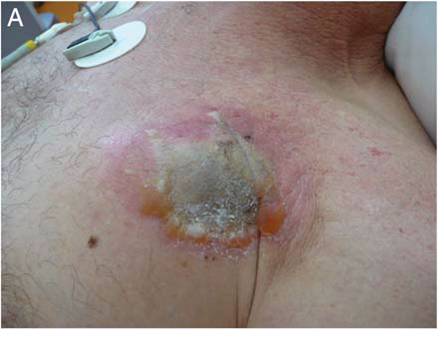
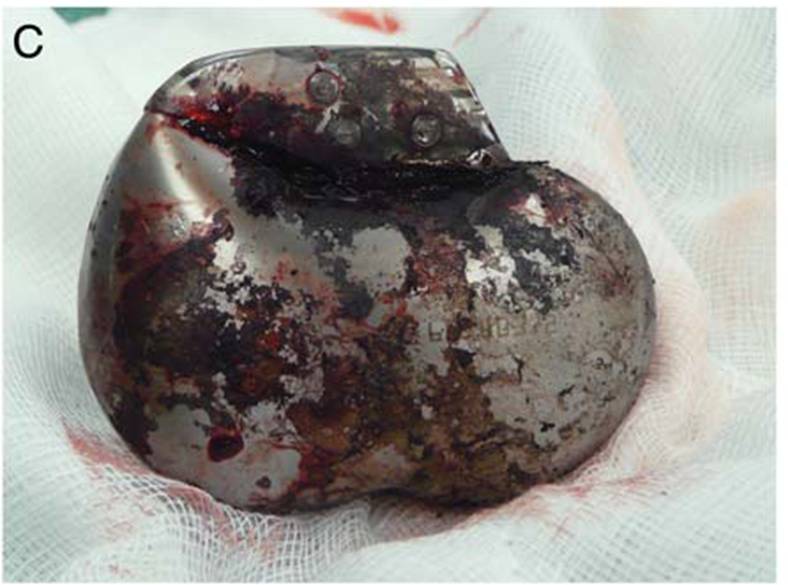
The pictures and case presentation were dramatic. The case very rare. Both were perfect reasons to report such an important case to the medical literature.
And so these doctors sent the case to Europace on 29 June 2010 and the article was accepted after revision on 16 Aug 2010 with the article appearing online 27 September 2010.
The authors must have felt very proud to have an article published relatively quickly and the editors and reviewers of Europace must have thought the case was unique enough and important enough to have the article revised according to their specifications, then published online.
Until I reported the case on this blog 5 October 2010 and included images from a portion of the case report's figure.
Remarkably, later that same day, Europace removed the case report from its website without comment. The article simply vanished. I attempted to e-mail the editor of Europace to inquire about the reason for the retraction but received no reply, so I contacted the lead author, Martin Hudec, MD. He kindly responded to me and I included his email response in the comments to my post two days later. In his note he acknowledged "talking to engineers" about his paper:
What I see happening is some kind of media sensation being created without the facts. (ed note: this blog, a media sensation?) This concerns me because my only intention was to share a rare experience that would hopefully help my colleagues to more fully understand the possible complications that can occur, even if rarely, with such complex technology.Astoundingly, on 8 October, just three days after my original post, I met with Biotronik representatives eager to make sure I had their "internal company memo" with the facts regarding this case that I could use with their permission on this blog.
So, please allow me to give you the information that you are missing.
The term "explosion" is not accurate. After talking to engineers the more appropriate word would be 'venting' of the battery. The shape of ICD was distorted, but not ruptured in any way.
Furthermore, I have described what I believed was the first such a complication published, there are more reports about battery overheating which I got to my hands but not published in medical journals. These malfunctions are extremely rare and very unfortunate, however any device from any manufacturer could and has had such complications.
This information is important to put the report into the appropriate context.
So I did.
To be fair, Dr. Hudec has repeatedly stated that it was his decision alone to withdraw his case report and not Europace's editorial board. Eventually the dust settled, but many questions remained.
Until yesterday.
I learned that the revised case report was published online again on 17 February 2011 in Europace!
Somehow I had missed it.
Now we find the term "exploding" has been replaced with the term "heat dissipation" in the revised case report's title: "Case report of out-of-hospital heat dissipation of an implantable cardioverter-defibrillator."
But also gone is the figure containing the clinically relevant information regarding the patient: the patient's chest, the chest xray, the pictures of the explanted device. In its place: an sterile black-and-white AP and lateral xray of the device performed outside the body. The description of the injury now states:
Chest radiography displayed signs of pneumomediastinum and deformity of the ICD housing. A subsequent ultrasound of the left thorax identified a small pneumothorax. Interrogation of the ICD was not possible and the device was explanted within 5 h of the event. Burned necrotic tissue was observed on the device surface and along the internal aspect of the pectoral pocket. The patient has recovered from the explant procedure without further event."No mention of the appearance of the skin over the device as seen in the earlier pictures is described. The case report also fail to explain the root cause of the problem, stating:
Extensive analysis of the device suggested that the battery had overheated, possibly due to the presence of a foreign particle causing a short circuit. The resulting pressure forced the battery to vent inside (ed: emphasis mine) the ICD housing.What? Inside the housing? Seems the housing of the device ruptured and gas escaped OUTSIDE the housing causing significant patient trauma: how else would this patient have gotten a pneumomediastinum and pneumothorax? And what happened to the possible hypothesis for failure of a so-called "lithium reaction" described in the earlier case report?
Finally, in the section of the revised case report entitled "Overview of events with similar characteristics," the authors state that they identified "This and similar isolated cases (without an underlying cause) found in the MAUDE database for the years 2000-2010" and summarized them in a table. The table noted that three of the 10 cases had an "Audible noise ('pop') excluding notifier", three had "Damaged housing, battery, or subassembly", nine of 10 had "Burns or burning sensation" and two resulted in "Death/external rescue required." Not a single detail regarding the manufacturers, models, clinical circumstances of the ten previously-identified cases or specific FDA MAUDE report numbers were provided. Instead, a link to the FDA's MAUDE database search page was included in the references. You'll have to find the cases yourself, I guess.
Finally, in response to the dramatic findings of this case, the authors now conclude:
Implantable cardioverter-defibrillators are produced under strict regulatory and manufacturer quality controls. There are over 250,000 ICDs implanted worldwide each year, documenting a high level of established reliability. Clinicians implanting ICDs should be aware of the possibility that a normal risk of malfunction exists, however is far outweighed by the advantages that are gained from this state of the art therapy.Ahem. Aren't case reports about a person and not a device? Are doctors unable to advocate for their patients for fear of upsetting the medical device industry? Is the conclusion really that "cardioverter-defibrillators are produced under strict regulatory and manufacturer quality controls?"
Or is the real story here that independent scientific peer-reviewed journals might not be so independent after all.
-Wes
Wednesday, December 16, 2009
Scientific Medical Journals and the Media
The article appeared yesterday in the Wall Street Journal: "Study Shows Older Patients Benefiting From Defibrillators."
One would think a doctor might like to read the article, especially one dealing with defibrillators.
So I checked late last night and wouldn't you know, no such article was on-line. Then I checked again early this morning. Still no reference on line. I checked Google. I checked Circulation: Heart Failure's website. I checked for the press release on the American Heart Association's press release web page.
No such article.
But Reuters had seen it (I think) (or at least they saw the American Heart Association's press release about the article, I really don't know).
And so I waited and waited, only to find that the article was finally posted on-line publically on the Circulation: Heart Failure's website at about 12-1PM CST, almost a full 18 hours later the manuscript was reported upon by the main stream media.
The article certainly has plenty to comment upon, but I will forgo that for the moment and instead focus on this disturbing trend of media releases pitched to journalists before the scientific community.
Given that this study was funded by GlaxoSmith Kline and the journal Circulation: Heart Failure is published by the American Heart Association who acknowledges multimillion dollar funding from the pharmaceutical and medical device companies we have to wonder: why are physicians being left out of the opportunity to critically review scientific publications before mainstream media broadcasts information to our patients and the public? Might it be that the sponsors of these trials might not like what certain doctors might say about the study? Or are such press releases being more like classic TV ads hoping to prod patient's to "Ask Your Doctor" about study's findings? What potential implications might these press releases have on public policy mandating doctors to "Get With the Guidelines" for the treatment of heart failure going forward?
I find the feeding of jounalists these manuscripts before the very scientists who subscribe to the these journals troubling at best and potentially subversive and manipulative at worst.
-Wes
One would think a doctor might like to read the article, especially one dealing with defibrillators.
So I checked late last night and wouldn't you know, no such article was on-line. Then I checked again early this morning. Still no reference on line. I checked Google. I checked Circulation: Heart Failure's website. I checked for the press release on the American Heart Association's press release web page.
No such article.
But Reuters had seen it (I think) (or at least they saw the American Heart Association's press release about the article, I really don't know).
And so I waited and waited, only to find that the article was finally posted on-line publically on the Circulation: Heart Failure's website at about 12-1PM CST, almost a full 18 hours later the manuscript was reported upon by the main stream media.
The article certainly has plenty to comment upon, but I will forgo that for the moment and instead focus on this disturbing trend of media releases pitched to journalists before the scientific community.
Given that this study was funded by GlaxoSmith Kline and the journal Circulation: Heart Failure is published by the American Heart Association who acknowledges multimillion dollar funding from the pharmaceutical and medical device companies we have to wonder: why are physicians being left out of the opportunity to critically review scientific publications before mainstream media broadcasts information to our patients and the public? Might it be that the sponsors of these trials might not like what certain doctors might say about the study? Or are such press releases being more like classic TV ads hoping to prod patient's to "Ask Your Doctor" about study's findings? What potential implications might these press releases have on public policy mandating doctors to "Get With the Guidelines" for the treatment of heart failure going forward?
I find the feeding of jounalists these manuscripts before the very scientists who subscribe to the these journals troubling at best and potentially subversive and manipulative at worst.
-Wes
Friday, April 25, 2008
Publish or Perish

I woke this morning and realized that I had missed the Big Point in my last post.
Last night, I was lamenting over the fact that another EP journal had been born – one of a series of six new journals of the “Circulation” line from the American Heart Association – one more to try to scour to keep current.
But this morning I found myself asking, “Why more journals?"
In the era of the Internet, print media throughout the world is struggling. Readership of newspapers and magazines has plummeted as people migrate to the Internet, where information can be organized quickly specific to the reader’s desires. Print media can’t do that. I suspect medical journals are trying to adapt to this “specialization” of topics in a way as the Internet, but older titles have found themselves, like newspapers, with falling readership and fewer advertisers to support the printed word. But as free online peer-reviewed publishing devoid of commercial interests and vetted by the online-community in real-time takes hold, the threat to printed journals grows.
Moreover, every week, my office is inundated with scores of “free” journals filled with white papers promoting the next great widget or medical technique. There are even journals that summarize each week’s journals. These throw-away journals have become more sophisticated, too, with glossy print and all, as advertisers seek new ways to reach their prey: me, the doctor.
So the print
Look at the titles of the new Circulation line of journals: Circulation: Arrhythmia and Electrophysiology, Circulation: Heart Failure, Circulation: Cardiovascular Genetics, Circulation: Cardiovascular Imaging, Circulation: Cardiovascular Quality and Outcomes, and Circulation: Cardiovascular Interventions. These titles no longer dwell on an the pathophysiology of an organ system in a patient any longer (remember "Heart?"). No, like the general internists who proceded the specialist with declining revenues, those broader journals had their day generating revenue and notariety. Now, the new titles reflect the era of specialization.
After all, that's where Medicare still pays and business opportunities lie...
...at least for now.
-Wes
Thursday, April 24, 2008
New EP Journal Premiers
Seems the "Journal Wars" are heating up between the Heart Rhythm Society (which publishes HeartRhythm) and the American Heart Association:
I look forward to seeing the new issue, but damn, it seems there's just too many journals to keep up with these days!
Can you say "information overload?"
-Wes
Circulation: Arrhythmia and Electrophysiology is the first of the new "Circulation portfolio" of journals, designed to meet the growing demand for tightly focused information in areas at the cutting edge of cardiology. Circulation: Heart Failure will be the second journal to premier in coming weeks. The remaining four titles - Circulation: Cardiovascular Genetics; Circulation: Cardiovascular Imaging; Circulation: Cardiovascular Quality and Outcomes (Eds note: Can you say CMS and JCAHO??); and Circulation: Cardiovascular Interventions - are scheduled for launch later in 2008.William Stevenson, MD, director of the clinical cardiac electrophysiology program at Brigham and Women's Hospital and professor of medicine at Harvard Medical School, will serve as editor of the AHA's new EP journal.
Each bimonthly issue of Circulation: Arrhythmia and Electrophysiology and the other new journals will be available in both print and online formats. The journal Web site, http://circep.ahajournals.org will also present "Publish Ahead of Print" articles and other online features.
I look forward to seeing the new issue, but damn, it seems there's just too many journals to keep up with these days!
Can you say "information overload?"
-Wes
Subscribe to:
Posts (Atom)