It goes without saying: if procedures have complications, be truthful with the public and with patients. Otherwise, some might publically question your outcomes. If that happens, noone is likely to benefit.
-Wes
Showing posts with label percutaneous aortic valve replacement. Show all posts
Showing posts with label percutaneous aortic valve replacement. Show all posts
Monday, January 23, 2012


Monday, February 21, 2011
Electrophysiologists' New Annuity: Percutaneous Aortic Valve Replacements
From Circulation:
From the discussion section of the paper came these recommendations regarding the monitoring requirements after transcatheter aortic valve implantation (TAVI):
Reference:
Khawaja MZ, Rajani R, Cook A, et al. "Permanent Pacemaker Insertion After CoreValve Transcatheter Aortic Valve Implantation: Incidence and Contributing Factors (the UK CoreValve Collaborative)" Circulation 2011 DOI: 10.1161/CIRCULATIONAHA.109.927152
One third of patients undergoing a CoreValve transcatheter aortic valve implantation procedure require a permanent pacemaker (PPM) within 30 days. Periprocedural atrioventricular block, balloon predilatation, use of the larger CoreValve prosthesis, increased interventricular septum diameter and prolonged QRS duration were associated with the need for PPM.With the compact AV node immediately adjacent to the non-coronary cusp of the aortic valve, it's remarkable AV block is not more frequent.
From the discussion section of the paper came these recommendations regarding the monitoring requirements after transcatheter aortic valve implantation (TAVI):
Recommendations based on our findings would suggest that patients who do not develop a broad QRS complex postprocedure can be safely discharged, from the electrophysiological viewpoint, without need for prolonged monitoring, especially if there has been no disturbance of conduction during implantation and the smaller 26-mm valve has been used. However, patients who develop bundle-branch block should probably be monitored for a minimum of 5 days (emphasis mine) for the development of higher-grade AV block.Interestingly, the conclusions of the same article recommend that 7 days of monitoring may be more appropriate:
The increased rates of PPM implantation in patients with postprocedural bundle-branch block and overall median time to implantation of 4 days (interquartile, range 2 to 7 days) in those who required pacing lead us to recommend that these patients be observed for higher-grade conduction disturbances for up to a week postprocedurally, with greatest care taken in those with periprocedural AV block, those receiving the larger 29-mm device, and patients with greater IVSd."Even with a week's monitoring, pacemakers were seen even later in a small group of patients (from the Results section of the paper):
Eighty-one of 243 patients (33.3%) underwent PPM implantation within 30 days. Nine patients received their implants on the same day as the index procedure. A further 7 patients (2.9%) underwent PPM implantation during longer-term follow-up at 31, 42, 42, 53, 132, 152, and 187 days.-Wes
Reference:
Khawaja MZ, Rajani R, Cook A, et al. "Permanent Pacemaker Insertion After CoreValve Transcatheter Aortic Valve Implantation: Incidence and Contributing Factors (the UK CoreValve Collaborative)" Circulation 2011 DOI: 10.1161/CIRCULATIONAHA.109.927152
Friday, August 27, 2010
Good Thing or Bad?
From an innovation standpoint, there's no question that this is a good thing.
But a percutaneous aortic valve at 101?
Guess it depends on how old you are when you look at this.
Given the cost of this procedure and the projections for when Medicare will go bust, young folks might have a legitimate concern that the funds for health care might not be available for such a procedure by the time they're eligible.
-Wes
But a percutaneous aortic valve at 101?
Guess it depends on how old you are when you look at this.
Given the cost of this procedure and the projections for when Medicare will go bust, young folks might have a legitimate concern that the funds for health care might not be available for such a procedure by the time they're eligible.
-Wes
Thursday, October 22, 2009
Prosthetic Aortic Valve? There's an App For That!
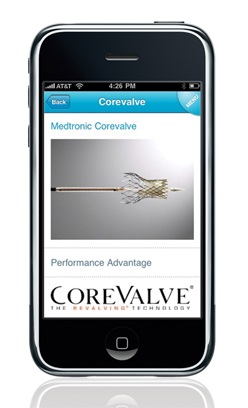 Meet iAorticValve produced by iMobileHealthCare, available now for upload to your iPhone.
In an era where the medical device industry is increasingly concerned about health care reform, innovation, and the implications for providing their products to patients, it's nice to know there are helpful companies sprouting up that can place company literature about mechanical, biologic, or percutaneous prosthetic aortic valves, both approved and experimental, on your iPhone free of charge. Further, if you want to go ahead and calculate your own STS (Society of Thoracic Surgery) Risk Calculator for placement of a heart valve, heck, you can do that also.
Do not, however, look for objective criticism of the various valve types since most device literature there fails to include warnings, containdications, or adverse events about the devices. Further, references were not hyperlinked, making the utility of the quickly reviewing the references challenging for the casual user. Maybe more information is provided if you're a patient that registers for the $39.99 (doctors pay $59.99) annual access fee to become part of the "network," but I regret that I failed to cough up the change when I realized I could just search Google instead on my iPhone for the same information.
However, I did register as a "patient" as a free trial to look around, and saw some nicely-produced industry videos from YouTube for my consumption, information on some nice doctors with an interest in experimental percutaneous valve placements and thoracic surgery along with information on which insurers those doctors accept.
But a word of caution is also in order. The images and content I found on the iPhone app appear to be those also displayed on the manufacturers' websites and from doctor's available online webpages. Whether or not these doctors are aware that this information exists there is uncertain. I did a little investigative reporting and discovered that at least one of the doctors on the company website did not personally register his information nor grant permission for its use there. In short, then, the iMobileHealthCare team appears to have aggregated information from various web sources with a heavy bias toward percutaneous aortic valve implantation. I could find no disclaimer to this effect on their site.
US FDA regulations that clearly state that marketing experimental devices before they are properly labeled is strictly prohibited. But does that marketing scheme pertain to other companies that don't make those devices? I don't know. It is interesting that this app promotes doctors who are investigating some of the percutenous aotic valve devices to patients eager to "learn more." I'll let you decide if that sounds like marketing.
But alas, it's a new iPhone frontier and the information contained on the device is out there in other locations on the web. Feel free upload the 5+ megabyte app on your iPhone for "free" and look around at the pretty pictures and see the link under "Resources" to PubMed's home page or the blog with a few entries. While there are a few bugs in the software, it's interesting to see where things are going in mobile health care information age for patients and doctors.
It's also interesting to see the challenges industry will have going forward trying to comply with FDA marketing regulations.
-Wes
iAorticValve press release.
FCC Disclosure: I have no financial interest in the iAorticValve app nor iMobileHealthCare.
Monday, March 02, 2009
How To Survive the Market Crash
After seeing the market plunge another 300 points today, perhaps it is time for an uplifting story.
It was a day that started out like many others: group meeting, hurry to the lab, meet my patient before their procedure, review the surgical plan with the staff, perform the surgery, orders, greet the family to discuss the case, electronic note, discharge summary, copies to the referring(s), see a consult, then head off to clinic.
Before leaving, I came down to the cath lab break room to a cacophony of folks milling about and eyeing two monstrous pizza's in the center of the table with a very elderly gentleman with a radiant smile who was surrounded by nurses and technicians and eagerly greeting those that entered. "Was it a drug rep," I thought. "No. Too old for that. And, oh my goodness, is that a plugged tracheostomy tube beneath his collar? What the...????"
And as I turned back toward the door, I saw the cake, beautifully decorated with an EKG and life-like edible heart that would be the envy of even the folks at Street Anatomy:

"Doctor Fisher, we'd like you to meet Mr. Jones (not his real name), he's one of our PARTNER patients whose celebrating his birthday with us today as a way of saying thanks." (For those unfamiliar, the PARTNER Trial is a study for Edwards Lifesciences testing percutaneous aortic valve replacement technology).
"Thank you," he said crushing my hand while standing on his own power, his voice hoarse from the trach. "I can't tell you how great I feel. I couldn't do anything before my procedure."
"But sir, I'm a heart electrician, not a plumber... and I was just passing through..."
"No matter! Glad you're here!" he exclaimed.
Imagine: birthday cake and pizza for our staff provided not by a drug rep or the hospital, but a grateful patient with a heart of gold that took a bit of his precious time to say thanks.
Tell me, does it get any better than that?
Thanks, "Mr. Jones" and may you have the happiest of birthdays!
-Wes
It was a day that started out like many others: group meeting, hurry to the lab, meet my patient before their procedure, review the surgical plan with the staff, perform the surgery, orders, greet the family to discuss the case, electronic note, discharge summary, copies to the referring(s), see a consult, then head off to clinic.
Before leaving, I came down to the cath lab break room to a cacophony of folks milling about and eyeing two monstrous pizza's in the center of the table with a very elderly gentleman with a radiant smile who was surrounded by nurses and technicians and eagerly greeting those that entered. "Was it a drug rep," I thought. "No. Too old for that. And, oh my goodness, is that a plugged tracheostomy tube beneath his collar? What the...????"
And as I turned back toward the door, I saw the cake, beautifully decorated with an EKG and life-like edible heart that would be the envy of even the folks at Street Anatomy:
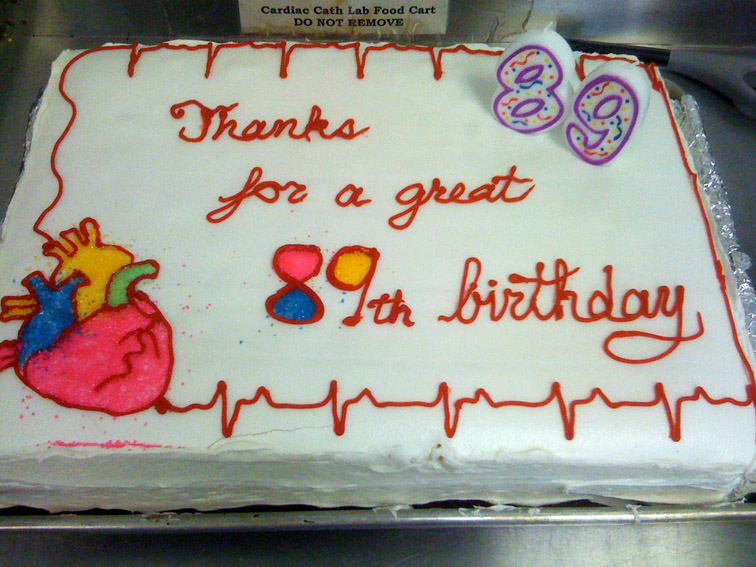
Click image to enlarge
"Doctor Fisher, we'd like you to meet Mr. Jones (not his real name), he's one of our PARTNER patients whose celebrating his birthday with us today as a way of saying thanks." (For those unfamiliar, the PARTNER Trial is a study for Edwards Lifesciences testing percutaneous aortic valve replacement technology).
"Thank you," he said crushing my hand while standing on his own power, his voice hoarse from the trach. "I can't tell you how great I feel. I couldn't do anything before my procedure."
"But sir, I'm a heart electrician, not a plumber... and I was just passing through..."
"No matter! Glad you're here!" he exclaimed.
Imagine: birthday cake and pizza for our staff provided not by a drug rep or the hospital, but a grateful patient with a heart of gold that took a bit of his precious time to say thanks.
Tell me, does it get any better than that?
Thanks, "Mr. Jones" and may you have the happiest of birthdays!
-Wes
Subscribe to:
Posts (Atom)